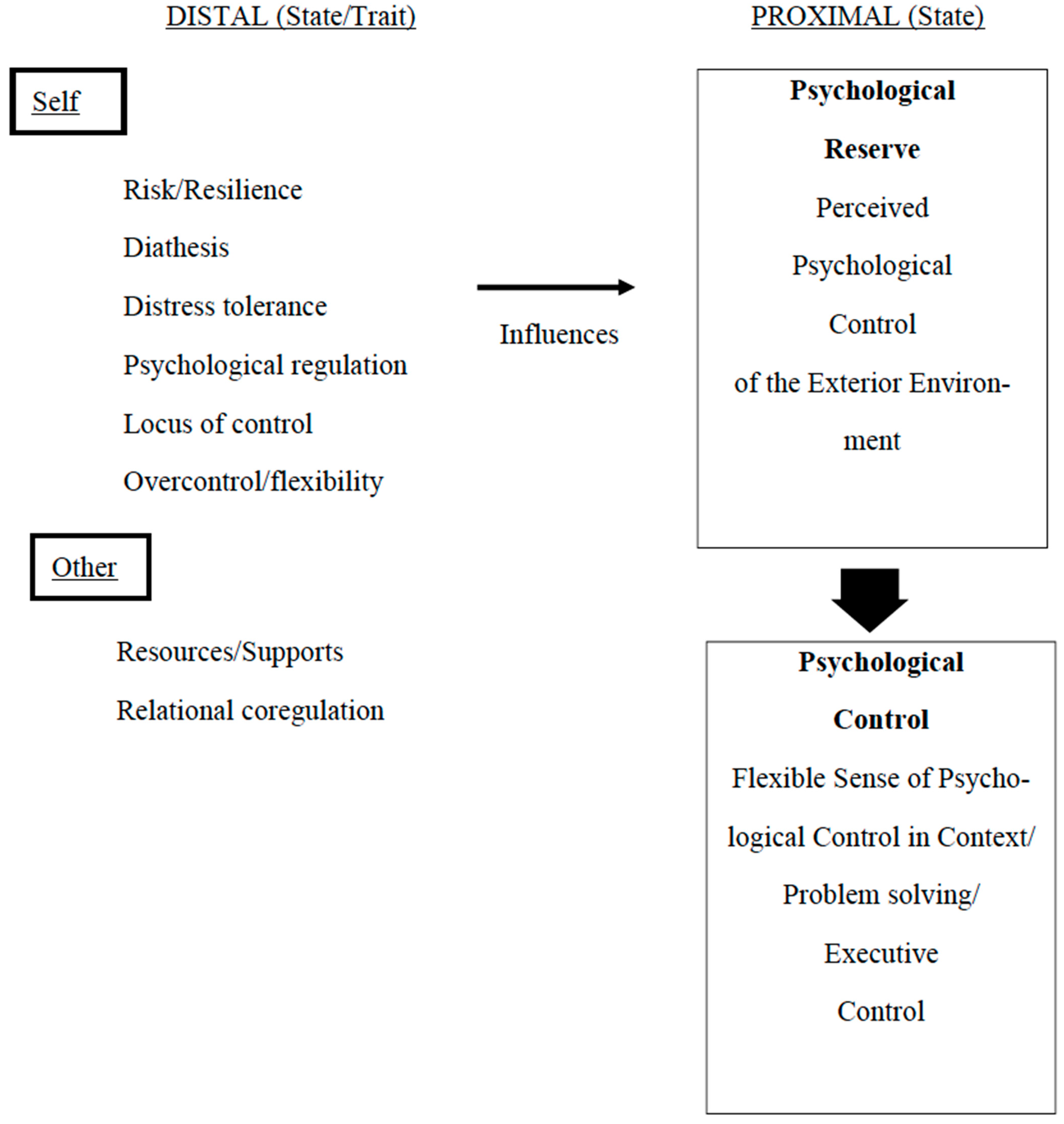
Psychological Reserve/External Psychological Control in Psychotherapy: Review and New Models

Abstract
1. Background
2. Key Concepts
2.1. Concepts
2.2. Psychological Reserve
2.3. Psychological Control
3. Terminology Related to Psychological Reserve and Psychological Control
3.1. Psychological Resource Model
3.2. Elaboration
3.3. Other Terms
3.3.1. Introduction
3.3.2. Methods
3.3.3. Psychological Control and Psychological Reserve: Definitions and Comparison
3.3.4. Comment
4. Future Research Directions
4.1. Questionnaire
4.2. Mathematical Representation
5. Final Remarks
5.1. Limitations
5.2. Directions for Future Research
5.3. Applications
5.4. The Validity of the Theorizing
Author Contributions
Funding
Institutional Review Board Statement
Informed Consent Statement
Data Availability Statement
Conflicts of Interest
Appendix A
Appendix A.1. External Psychological Control × Reserve Model
Appendix A.1.1. Introduction
Appendix A.1.2. Variables and Parameters (With Ranges and Interpretation)
Appendix A.1.3. State Variable
- Q(t)
- ○
- Role: State variable.
- ○
- Meaning: Effective external psychological control at time t, conceptualized as the product of control and reserve,
- ○
- Scale: 0–1 (proportion of “maximal” control × reserve). We think it is fair to assume that such a property has a maximum and minimum value. These might differ per person, but for simplicity, we can always transform these to 1 and 0, respectively. This applies to all 0–1 scales.
- ○
- Default initial value: 1 (starting at full control/reserve).
- ○
- Notes: When is small, either control or reserve, or both are low.
Appendix A.1.4. Conceptual Components
- C(t)
- ○
- Role: Conceptual component of Q.
- ○
- Meaning: Level of external psychological control at time t.
- ○
- Scale: 0–1, with as resting/maximal control.
- ○
- Note: In this implementation, C is not simulated separately; it is aggregated into Q.
- R(t)
- ○
- Role: Conceptual component of Q.
- ○
- Meaning: Psychological reserve (buffer, capacity) at time t.
- ○
- Scale: 0–1, with as resting/maximal reserve.
- ○
- Note: Also not simulated separately; R’s influence is “folded into” Q.
Appendix A.1.5. Parameters
- (Qr in code)
- ○
- Role: Parameter.
- ○
- Meaning: Resting/maximal level of effective control × reserve ().
- ○
- Typical range: Often fixed at 1 (but could be >0 if you want individual differences in maximum).
- ○
- Interpretation: Upper bound toward which Q recovers when depletion is absent.
- (rho)
- ○
- Role: Parameter, recovery rate.
- ○
- Meaning: Speed at which Q returns toward its resting level in absence of depletion.
- ○
- Units: 1/time unit.
- ○
- Typical range: 0.01–1.0.
- ▪
- Small (e.g., 0.01–0.05): very slow recovery.
- ▪
- Medium (0.1–0.3): moderate recovery.
- ▪
- Large (>0.5): rapid recovery.
- ○
- Interpretation: Higher → faster recovery from depletion.
- (time-varying depletion rate)
- ○
- Role: Time-varying parameter (function of t and “instances” i).
- ○
- Meaning: Net depletion rate at time t, reflecting demands, life events, therapy, etc.
- ○
- Units: 1/time unit.
- ○
- Typical range:
- ▪
- Baseline: 0–0.1 (mild day-to-day depletion).
- ▪
- Stressful events: 0.2–1.0 (strong depletion).
- ▪
- Optionally to represent strongly restorative conditions (net boosting), but in the basic “depletion” version .
- ○
- Interpretation: Higher → stronger current depletion of external psychological control.
- Event timing parameters (implementation details for )
- ○
- t_event_start, t_event_end: time window of a stressful period (e.g., major life stressor).
- ○
- t_therapy_start, t_therapy_end: time window where therapy reduces depletion.
- ○
- These are not “core” theory parameters, but implementation details specifying when changes.
Appendix A.1.6. Model Specification and R Implementation
Appendix A.1.7. ODE Model
| model_Q <- function(t, state, pars) { with(as.list(c(state, pars)), { # ----- Time-varying depletion rate delta_t ----- # Baseline depletion: delta_t <- delta_baseline # Stressful period with stronger depletion if (t >= t_event_start && t < t_event_end) { delta_t <- delta_event } # Therapy period with reduced depletion if (t >= t_therapy_start && t < t_therapy_end) { delta_t <- delta_therapy } # Differential equation: # dQ/dt = -delta_t * Q + rho * (Qr - Q) dQ <- - delta_t * Q + rho * (Qr - Q) # Return derivative and also delta_t as an output variable list(c(dQ), delta_t = delta_t) }) } |
Appendix A.1.8. Default Parameters and Single Simulation
| # Default parameters pars <- c( # Core theory parameters rho = 0.20, # recovery rate Qr = 1.00, # maximum/resting level # Depletion parameters delta_baseline = 0.05, # baseline depletion (day-to-day demands) delta_event = 0.50, # depletion during stressful period delta_therapy = 0.02, # reduced depletion during therapy # Event timing (in arbitrary time units) t_event_start = 10, t_event_end = 30, t_therapy_start = 30, t_therapy_end = 60 ) # Initial state and time grid state <- c(Q = 1.0) # start at full control × reserve times <- seq(0, 100, by = 0.1) # simulation horizon # Run model out <- ode(y = state, times = times, func = model_Q, parms = pars) out_df <- as.data.frame(out) head(out_df) ## time Q delta_t ## 1 0.0 1.0000000 0.05 ## 2 0.1 0.9950617 0.05 ## 3 0.2 0.9902454 0.05 ## 4 0.3 0.9855480 0.05 ## 5 0.4 0.9809669 0.05 ## 6 0.5 0.9764988 0.05 |
Appendix A.1.9. Plots for a Single Parameter Setting
| ggplot(out_df, aes(x = time, y = Q)) + geom_line(linewidth = 1) + labs( x = "Time", y = "Q(t) = C(t) × R(t)", title = "Dynamics of psychological control × reserve" ) + ylim(0, 1.05) + theme_minimal() |
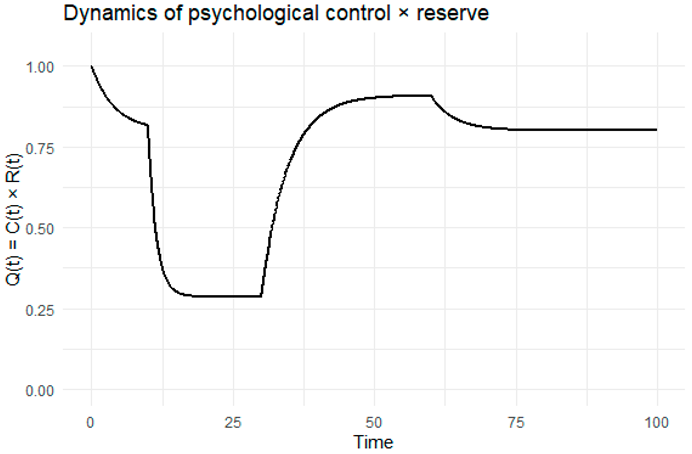
| ggplot(out_df, aes(x = time, y = delta_t)) + geom_step(linewidth = 1) + labs( x = "Time", y = expression(delta[t]), title = "Time-varying depletion rate" ) + theme_minimal() |
Appendix B
Appendix B.1. Creating and Testing Empirically Psychological Models: The Case for Psychological Control and Psychological Reserve
Appendix B.2. The Construct
Appendix B.3. The Term
Appendix B.4. Development
Theoretical Critique
- A.
- On Theory
- 1.
- Most theories are verbal, underspecified, and weakly predictive.
- 2.
- Research data seldom falsify or refine theory.
- 3.
- Constructs are poorly defined, and boundary conditions are not clear.
- 4.
- Constructs are ambiguous, as are auxiliaries, which undermine inference.
- 5.
- Theories are vague and can fit any data, including false positives.
- 6.
- It is difficult to derive hypotheses from theories that are not good.
- 7.
- Imprecise theories make it difficult to make predictions.
- B.
- On Synthesis
- 8.
- Theories have little comparison, revision, and updating.
- 9.
- Theories overlap.
- 10.
- Theories survive or “fade away” too slowly.
- 11.
- Incompatible constructs and terms do not foster integration.
- 12.
- Findings are disconnected and do not foster synthesis.
- 13.
- A lack of integration and explanatory connections inhibits unifying theories.
- 14.
- Methodological sophistication is preferred relative to conceptual integration.
- C.
- On Modeling
- 15.
- Formal modeling is underused; it is needed for explicating mechanisms.
- 16.
- Formal models are needed for deriving testable predictions.
- D.
- On Empirical Work
- 17.
- There is a lack of specification for theoretical work vs. empirical research.
- 18.
- Flexible analyses are rewarded.
- 19.
- Measurement and statistics (factor, network) are preferred compared to establishing mechanisms.
- 20.
- Journals and funders seek data-driven articles over theory development and conceptual integration.
References
- Akbari, M., Hosseini, Z. S., Seydavi, M., Zegel, M., Zvolensky, M. J., & Vujanovic, A. A. (2022). Distress tolerance and posttraumatic stress disorder: A systematic review and meta-analysis. Cognitive Behaviour Therapy, 51(1), 42–71. [Google Scholar] [CrossRef]
- American Psychological Association. (2015). APA dictionary of psychology. Available online: https://dictionary.apa.org/ (accessed on 15 January 2023).
- Bandura, A. (1977). Self-efficacy: Toward a unifying theory of behavioral change. Psychological Review, 84(2), 191–215. [Google Scholar] [CrossRef] [PubMed]
- Baumeister, R. F., André, N., Southwick, D. A., & Tice, D. M. (2024). Self-control and limited willpower: Current status of ego depletion theory and research. Current Opinion in Psychology, 60, 101882. [Google Scholar] [CrossRef] [PubMed]
- Benight, C. C., Harwell, A., & Shoji, K. (2018). Self-regulation shift theory: A dynamic personal agency approach to recovery capital and methodological suggestions. Frontiers in Psychology, 9, 1738. [Google Scholar] [CrossRef] [PubMed]
- Broerman, R. (2018). Diathesis-stress model. In Encyclopedia of personality and individual differences (pp. 1–3). Springer. [Google Scholar] [CrossRef]
- Brown, R. J., Burton, A. L., & Abbott, M. J. (2022). The relationship between distress tolerance and symptoms of depression: Validation of the Distress Tolerance Scale (DTS) and short-form (DTS-SF). Journal of Clinical Psychology, 78(12), 2609–2630. [Google Scholar] [CrossRef]
- Brown, T. A., White, K. S., Forsyth, J. P., & Barlow, D. H. (2004). The structure of perceived emotional control: Psychometric properties of a revised anxiety control questionnaire. Behavior Therapy, 35(1), 75–99. [Google Scholar] [CrossRef]
- Burton, S., Leonhardt, M., Sheedy, P., Cheng, W. S., & Murphy, S. A. (2025). Analyzing the phenomenology and association of anxiety on disaster impacts. Traumatology. [Google Scholar] [CrossRef]
- Carleton, R. N. (2016). Into the unknown: A review and synthesis of contemporary models involving uncertainty. Journal of Anxiety Disorders, 39, 30–43. [Google Scholar] [CrossRef]
- Clinchard, C., Casas, B., & Kim-Spoon, J. (2025). Childhood maltreatment impacts emotion regulation difficulties, but not strategy use, throughout adolescence and young adulthood. Emotion, 26, 141–152. [Google Scholar] [CrossRef]
- Debra, G., Michels, N., & Giletta, M. (2024). Cognitive control processes and emotion regulation in adolescence: Examining the impact of affective inhibition and heart-rate-variability on emotion regulation dynamics in daily life. Developmental Cognitive Neuroscience, 70, 101454. [Google Scholar] [CrossRef]
- de Ridder, D. T. D., Lensvelt-Mulders, G., Finkenauer, C., Stok, F. M., & Baumeister, R. F. (2012). Taking stock of self-control: A meta-analysis of how trait self-control relates to a wide range of behaviors. Personality and Social Psychology Review: An Official Journal of the Society for Personality and Social Psychology, Inc., 16(1), 76–99. [Google Scholar] [CrossRef]
- Duttweiler, P. C. (1984). The Internal Control Index: A newly developed measure of locus of control. Educational and Psychological Measurement, 44(2), 209–221. [Google Scholar] [CrossRef]
- Fares-Otero, N. E., Borràs, R., Solé, B., Torrent, C., Garriga, M., Serra-Navarro, M., Forte, M. F., Montejo, L., Salgado-Pineda, P., Montoro, I., Sánchez-Gistau, V., Pomarol-Clotet, E., Ramos-Quiroga, J. A., Tortorella, A., Menculini, G., Grande, I., Garcia-Rizo, C., Martinez-Aran, A., Bernardo, M., … Verdolini, N. (2024). Cognitive reserve moderates the relationship between childhood maltreatment, objective and subjective cognition, and psychosocial functioning in individuals with first-episode psychosis. Psychological Trauma, 17(3), 520–536. [Google Scholar] [CrossRef]
- Foster, J. C., Cohodes, E. M., Mandell, J. D., McCauley, S., Hodges, H. R., Pierre, J. C., Kribakaran, S., Haberman, J. T., Notti, M. E., Schroeder, M. M., Ababio, R., Beloborodova, A., & Gee, D. G. (2025). Psychological and environmental correlates of locus of control and posttraumatic stress symptoms: A latent profile analysis. Psychological Trauma: Theory, Research, Practice, and Policy. Advance online publication. [Google Scholar] [CrossRef]
- Fritsche, I., Lautenbacher, J., & Masson, T. (2025). Let’s take back control: Disentangling and integrating group-based and certainty-based social responses to threatened personal control. European Review of Social Psychology, 29, 1–49. [Google Scholar] [CrossRef]
- Gallo, L. C., & Matthews, K. A. (2003). Understanding the association between socioeconomic status and physical health: Do negative emotions play a role? Psychological Bulletin, 129(1), 10–51. [Google Scholar] [CrossRef]
- Garcia, O. G., Hamm, J. M., Weston, S. J., Pierce, M. J., Tan, J. X. Y., & Duggan, K. A. (2025). Discrimination, psychosocial resources, and sleep: A test of the reserve capacity model. Health Psychology, 44(11), 1049–1062. [Google Scholar] [CrossRef]
- Garner, J. B., Fang, X., & Self-Brown, S. (2025). Testing the indirect effects of sense of control & perceived stress in the relationship between child abuse history & intimate partner violence perpetration in adulthood. Journal of Family Violence. [Google Scholar] [CrossRef]
- Greenaway, K. H. (2023). Electing to take control: Political identification and personal control. Political Psychology, 44(5), 1031–1051. [Google Scholar] [CrossRef]
- Greenaway, K. H., Haslam, S. A., Cruwys, T., Branscombe, N. R., Ysseldyk, R., & Heldreth, C. (2015). From “we” to “me”: Group identification enhances perceived personal control with consequences for health and well-being. Journal of Personality and Social Psychology, 109(1), 53–74. [Google Scholar] [CrossRef] [PubMed]
- Gross, J. J., Richards, J. M., & John, O. P. (2006). Emotion regulation in everyday life. In D. K. Snyder, J. Simpson, & J. N. Hughes (Eds.), Emotion regulation in couples and families: Pathways to dysfunction and health. American Psychological Association. [Google Scholar] [CrossRef]
- Heise, M., Ruzek, J. I., Haug, N., & Cordova, M. J. (2025). Grit and chronic pain: Associations with distress, catastrophizing, interference, and control. Journal of Clinical Psychology in Medical Settings, 32, 487–497. [Google Scholar] [CrossRef] [PubMed]
- Hobfoll, S. E. (2011). Conservation of resources theory: Its implication for stress, health, and resilience. In The Oxford handbook of stress, health, and coping (pp. 127–147). Oxford University Press. [Google Scholar]
- Hobfoll, S. E., Halbesleben, J., Neveu, J.-P., & Westman, M. (2018). Conservation of resources in the organizational context: The reality of resources and their consequences. Annual Review of Organizational Psychology and Organizational Behavior, 5(1), 103–128. [Google Scholar] [CrossRef]
- Hu, Y., & Sompolinsky, H. (2022). The spectrum of covariance matrices of randomly connected recurrent neuronal networks with linear dynamics. PLoS Computational Biology, 18(7), e1010327. [Google Scholar] [CrossRef] [PubMed]
- Kay, A. C., Gaucher, D., Napier, J. L., Callan, M. J., & Laurin, K. (2008). God and the government: Testing a compensatory control mechanism for the support of external systems. Journal of Personality and Social Psychology, 95(1), 18–35. [Google Scholar] [CrossRef]
- Kay, A. C., Whitson, J. A., Gaucher, D., & Galinsky, A. D. (2009). Compensatory control: Achieving order through the mind, our institutions, and the heavens. Current Directions in Psychological Science, 18(5), 264–268. [Google Scholar] [CrossRef]
- Kennaway, R. (2020). When causation does not imply correlation. In The interdisciplinary handbook of perceptual control theory (pp. 49–72). Elsevier. [Google Scholar] [CrossRef]
- Kerns, R. D., Turk, D. C., & Rudy, T. E. (1985). The West Haven-Yale Multidimensional Pain Inventory (WHYMPI). Pain, 23(4), 345–356. [Google Scholar] [CrossRef]
- Khosravani, V., Samimi Ardestani, S. M., Moulding, R., Amirpour, S., Pazhoohesh, Z., Aghaeimazraji, M., & Mohammadpanah Ardakan, A. (2025). How is being uncertain linked to OCD symptoms? Do beliefs about losing control and transdiagnostic and disorder-specific coping responses matter? Cognitive Therapy and Research, 50, 70–81. [Google Scholar] [CrossRef]
- Kolb, B., & Gibb, R. (2011). Brain plasticity and behaviour in the developing brain. Journal of the Canadian Academy of Child and Adolescent Psychiatry = Journal de l’Academie Canadienne de Psychiatrie de L’enfant et de L’adolescent, 20(4), 265–276. [Google Scholar]
- Lachman, M. E., & Weaver, S. L. (1998a). Sociodemographic variations in the sense of control by domain: Findings from the MacArthur studies of midlife. Psychology and Aging, 13(4), 553–562. [Google Scholar] [CrossRef]
- Lachman, M. E., & Weaver, S. L. (1998b). The sense of control as a moderator of social class differences in health and well-being. Journal of Personality and Social Psychology, 74(3), 763–773. [Google Scholar] [CrossRef]
- Littleton, H., Ricca, B., Higgins, M., Zamundu, A., Dolezal, M., Allen, A. B., & Benight, C. C. (2025). Evaluating the dynamic interrelations among coping self-efficacy, coping behaviors, and PTSD symptoms: Analysis using mixed methods EMA data. Journal of Aggression, Maltreatment & Trauma, 34(7), 990–1010. [Google Scholar] [CrossRef]
- Long, L. J., Cardona, N. D., Hey, A., Moreno, J., Barlow, D. H., & Farchione, T. J. (2025). Hope predicts long-term well-being following cognitive behavioral therapy for anxiety and related disorders. Psychotherapy Research, 36, 760–773. [Google Scholar] [CrossRef]
- Lopez, M. M., Naragon-Gainey, K., & Conway, C. C. (2024). Defining distress tolerance in a structural model of Big Five personality domains. Journal of Personality, 93(3), 567–580. [Google Scholar] [CrossRef]
- Lynch, T. R. (2018). Radically open dialectical behavior therapy: Theory and practice for treating disorders of overcontrol. Context Press. [Google Scholar]
- Murphy, J. W., Shotwell-Tabke, C., Smith, D. L., Valdespino-Hayden, Z., Patton, E., Pridgen, S., & Held, P. (2025). Evaluating self-efficacy as a treatment mechanism during an intensive treatment program for posttraumatic stress disorder. Psychological Trauma Theory Research Practice and Policy, 17(6), 1192–1201. [Google Scholar] [CrossRef]
- Neufeld, R. W. J. (1999). Dynamic differentials of stress and coping. Psychological Review, 106(2), 385–397. [Google Scholar] [CrossRef]
- Nicol, A. A. M. (2007). Social dominance orientation, right-wing authoritarianism, and their relation with alienation and spheres of control. Personality and Individual Differences, 43(4), 891–899. [Google Scholar] [CrossRef]
- O’Driscoll, C., Epskamp, S., Fried, E. I., Saunders, R., Cardoso, A., Stott, J., Wheatley, J., Cirkovic, M., Naqvi, S. A., Buckman, J. E. J., & Pilling, S. (2022). Transdiagnostic symptom dynamics during psychotherapy. Scientific Reports, 12(1), 10881. [Google Scholar] [CrossRef] [PubMed]
- Paulhus, D. L., & Van Selst, M. (1990). The spheres of control scale: 10 yr of research. Personality and Individual Differences, 11(10), 1029–1036. [Google Scholar] [CrossRef]
- Pukstad, E., Halvorsen, J. Ø., Jensen, M. R., Solhaug, S., & Nordahl, H. (2025). Do metacognitive beliefs satisfy criteria as mechanisms of change in treatment? A systematic review and evidence synthesis. Clinical Psychology Review, 122, 102654. [Google Scholar] [CrossRef]
- Quagliato, L. A., Coelho, D. A., de Matos, U. M. A., & Nardi, A. E. (2021). Physical abuse during childhood predicts IL-2R levels in adult panic disorder patients. Journal of Affective Disorders, 295, 1440–1444. [Google Scholar] [CrossRef]
- Radomsky, A. S., & Gagné, J.-P. (2019). The development and validation of the Beliefs About Losing Control Inventory (BALCI). Cognitive Behaviour Therapy, 49(2), 97–112. [Google Scholar] [CrossRef]
- Sahib, A., Chen, J., Cárdenas, D., & Calear, A. L. (2023). Intolerance of uncertainty and emotion regulation: A meta-analytic and systematic review. Clinical Psychology Review, 101, 102270. [Google Scholar] [CrossRef]
- Sayar, S. E., & Çapik, C. (2025). The effect of health belief model-based creative drama education on health locus of control and smoking perception in adolescents: A randomized controlled trial. Public Health Nursing, 42(3), 1343–1353. [Google Scholar] [CrossRef]
- Senger, A. R., Jo, D., Zvolensky, M. J., & Gallagher, M. W. (2025). Perceived control, distress tolerance, and anxiety sensitivity: Evaluating longitudinal associations with posttraumatic stress during the COVID-19 pandemic. Cognitive Therapy and Research. [Google Scholar] [CrossRef]
- Sompolinsky, H. (2014). Computational neuroscience: Beyond the local circuit. Current Opinion in Neurobiology, 25, xiii–xviii. [Google Scholar] [CrossRef]
- Spooner, M., Elliott, T. R., Luo, W., Lee, K. M., & Williamson, M. L. C. (2025). Pre-disability resilience and well-being following the onset of functional impairments. British Journal of Health Psychology, 30(1), e12781. [Google Scholar] [CrossRef]
- Steinhoff, M. F., Sudit, E., Fox, N. A., Tillman, R., Herzberg, M. P., Barch, D. M., Luby, J. L., & Gilbert, K. (2025). Childhood behavioral inhibition and overcontrol: Risk for psychiatric and peer outcomes. Developmental Psychology. Advance online publication. [Google Scholar] [CrossRef] [PubMed]
- Şener, G., & Altan-Atalay, A. (2025). Tolerance of uncontrollability and psychopathology: The role of maladaptive emotion regulation. Cognitive Therapy and Research, 49, 239–248. [Google Scholar] [CrossRef]
- Tangney, J. P., Baumeister, R. F., & Boone, A. L. (2004). High self-control predicts good adjustment, less pathology, better grades, and interpersonal success. Journal of Personality, 72(2), 271–324. [Google Scholar] [CrossRef] [PubMed]
- van Dongen, N., Glöckner, A., Musfeld, P., Sarafoglou, A., Borsboom, D., Bringmann, L., Eronen, M., Evers, K. C., Frankenhuis, W., Fried, E., Haslbeck, J., Helmich, M. A., Laskar, P., van Lissa, C., McElreath, R., Nak, J., Maatman, F. J. W. O., Popov, V., Robinaugh, D., … Yuan, L. (2026, January). The state and status of theory in psychological science: The recent decades until now. Available online: https://www.researchgate.net/publication/400682749_The_state_and_status_of_theory_in_psychological_science (accessed on 17 March 2026).
- van Dongen, N., van Bork, R., Finnemann, A., Haslbeck, J. M. B., van der Maas, H. L. J., Robinaugh, D. J., de Ron, J., Sprenger, J., & Borsboom, D. (2025). Productive explanation: A framework for evaluating explanations in psychological science. Psychological Review, 132(2), 311–329. [Google Scholar] [CrossRef]
- Veilleux, J. C. (2022). A Theory of momentary distress tolerance: Toward understanding contextually situated choices to engage with or avoid distress. Clinical Psychological Science, 11(2), 357–380. [Google Scholar] [CrossRef]
- Wang, A., Quinn, B. P. A., Gofton, H., & Andrews, T. J. (2024). No evidence for an other-race effect in dominance and trustworthy judgements from faces. Perception, 53(9), 632–644. [Google Scholar] [CrossRef]
- Wells, A., & Matthews, G. (1994). Attention and emotion: A clinical perspective. Psychology Press; Taylor & Francis Group. [Google Scholar]
- Wells, A., & Matthews, G. (1996). Modelling cognition in emotional disorder: The S-REF model. Behaviour Research and Therapy, 34(11–12), 881–888. [Google Scholar] [CrossRef] [PubMed]
- Xu, R., Ding, Y., Guo, Y., & van Prooijen, J.-W. (2024). System-justifying beliefs buffer against psychological distress during the COVID-19 pandemic. British Journal of Social Psychology, 64(1), e12779. [Google Scholar] [CrossRef]
- Young, G. (2015). Causality in psychiatry: A hybrid symptom network construct model. Frontiers in Psychiatry, 6, 164. [Google Scholar] [CrossRef] [PubMed]
- Young, G. (2022a). Causality and neo-stages in development: Toward unifying psychology. Springer International Publishing. [Google Scholar]
- Young, G. (2022b). Psychotherapeutic change mechanisms and causal psychotherapy: Applications to child abuse and trauma. Journal of Child & Adolescent Trauma, 15, 911–923. [Google Scholar] [CrossRef]
- Young, G. (2023a). An integrated Neo-Piagetian/Neo-Eriksonian development model I: Stages, substages, and mechanisms of change. Current Psychology, 42, 32368–32385. [Google Scholar] [CrossRef]
- Young, G. (2023b). An integrated Neo-Piagetian/Neo-Eriksonian development model II: RAF, qubit, and supra-theory modeling. Current Psychology, 43, 449–464. [Google Scholar] [CrossRef]
- Young, G. (2026). Psychological change mechanisms in psychotherapy: Applications to traumatized youth and adults [submitted]. Behavioral Sciences. [Google Scholar]
- Zhang, S., Shi, R., Ma, G., Peng, J., & Wang, Z. (2023). The interaction between measurement and individual difference in ego depletion: Task type, trait self-control and action orientation. Psychological Reports, 128(5), 3796–3824. [Google Scholar] [CrossRef]

Disclaimer/Publisher’s Note: The statements, opinions and data contained in all publications are solely those of the individual author(s) and contributor(s) and not of MDPI and/or the editor(s). MDPI and/or the editor(s) disclaim responsibility for any injury to people or property resulting from any ideas, methods, instructions or products referred to in the content. |
© 2026 by the authors. Licensee MDPI, Basel, Switzerland. This article is an open access article distributed under the terms and conditions of the Creative Commons Attribution (CC BY) license.
Share and Cite
Young, G.; van Dongen, N. Psychological Reserve/External Psychological Control in Psychotherapy: Review and New Models. Behav. Sci. 2026, 16, 485. https://doi.org/10.3390/bs16040485
Young G, van Dongen N. Psychological Reserve/External Psychological Control in Psychotherapy: Review and New Models. Behavioral Sciences. 2026; 16(4):485. https://doi.org/10.3390/bs16040485
Chicago/Turabian StyleYoung, Gerald, and Noah van Dongen. 2026. "Psychological Reserve/External Psychological Control in Psychotherapy: Review and New Models" Behavioral Sciences 16, no. 4: 485. https://doi.org/10.3390/bs16040485
APA StyleYoung, G., & van Dongen, N. (2026). Psychological Reserve/External Psychological Control in Psychotherapy: Review and New Models. Behavioral Sciences, 16(4), 485. https://doi.org/10.3390/bs16040485