The Consumer’s Reservation Price as an Adaptive Aspiration Level


Abstract
1. Introduction
2. Literature Review and Research Gap
2.1. The Reservation Price in Neoclassical Search Theory
2.2. Unstable Preferences and the Reservation Price
2.3. Additional Perspectives on the Dynamics of the Reservation Price
2.3.1. Reference Prices
2.3.2. Non-Optimizing Search Behavior
3. The Consumer’s Reservation Price as an Adaptive Aspiration Level
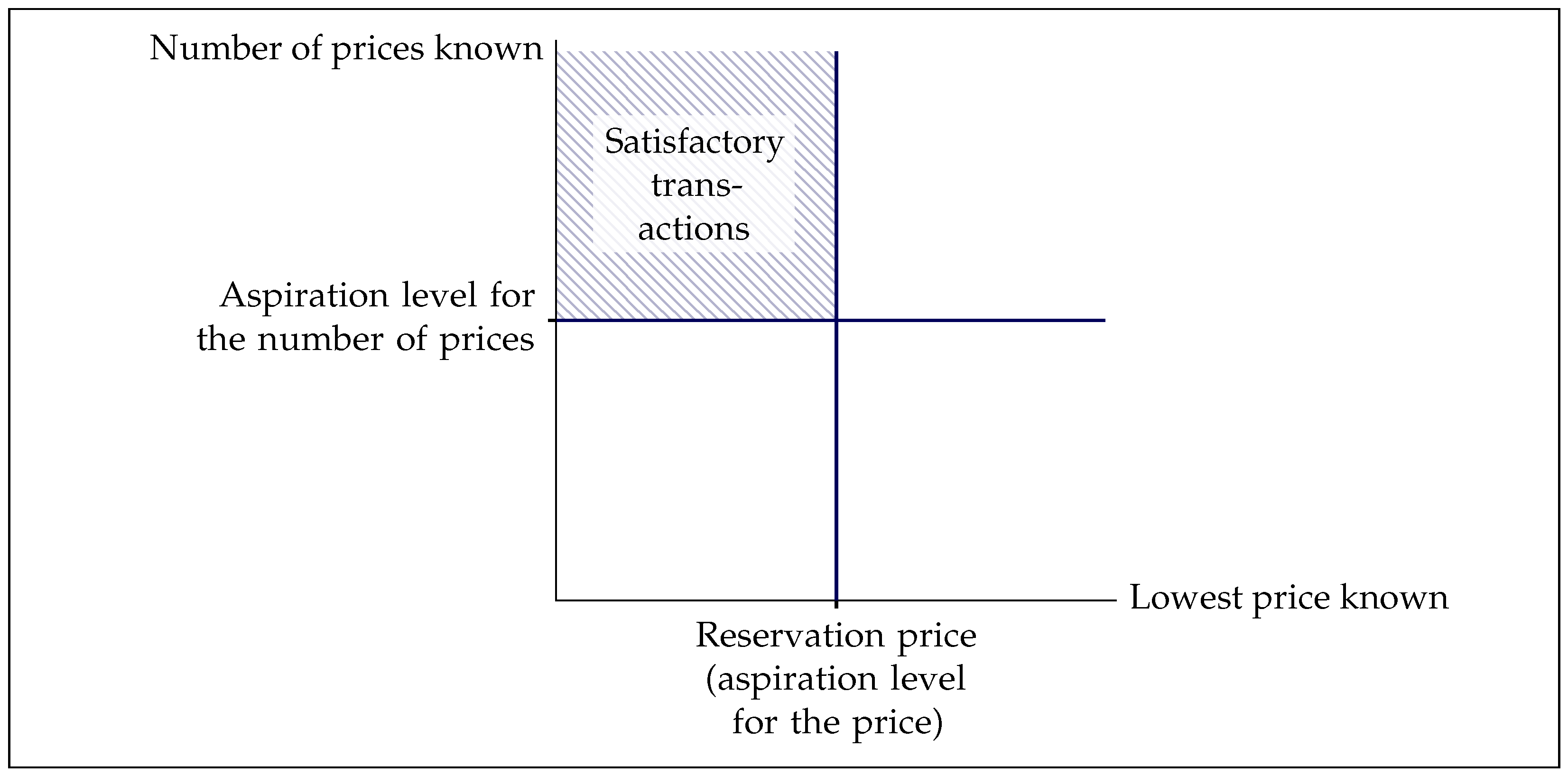
3.1. The Theory of Aspiration Levels and Its Application to the Reservation Price
3.1.1. The Aspiration Level as an Independent Variable
3.1.2. The Aspiration Level as a Dependent Variable
3.2. An Attainment Discrepancy Model of the Dynamics of the Consumer’s Reservation Price
- : Lewin et al. (1944) note that individuals tend to set a high aspiration level to keep it above actual performance, and to increase it during an action (see also Lant, 1992; Murphy et al., 2001). This observation translates to consumers having a tendency to reduce their reservation price during search, conditional on the prices observed.
- : This “inertia” term models the extent to which the previous reservation price anchors the current reservation price. If there is inertia, (Lant, 1992). A rigid interpretation of the ADM suggests the more specific hypothesis : if the attainment discrepancy—i.e., the difference between the lowest price known and the previous reservation price—explains changes in the reservation price, the latter should stay constant if the former is held constant. However, the tendency to reduce the reservation price may lead to . (While reflects an absolute reduction in the reservation price from one search step to the next, reflects a relative reduction.)
- and : The core hypothesis is that the reservation price adapts to the lowest price known, both upward and downward. Adjustments in either direction will never be perfect, which would imply a constant . Upward adjustments may typically be partial (), as consumers will not always raise their reservation price to the lowest price they know. Downward adjustments may also be partial () because even though consumers will likely purchase at (Section 3.3), their reservation price can remain above the lowest price they know due to psychological stickiness, a desire to achieve greater success or to avoid future failure by keeping a buffer, and a tolerance up to just noticeable differences (see Gilboa & Schmeidler, 2001). Generally, the theory of aspiration levels implies typically gradual, not instantaneous, complete adaptation (Lewin et al., 1944; Simon, 1955).
- : This relation operationalizes the hypothesis that downward adjustments of the reservation price are stronger than upward adjustments, reflecting the observation by Lewin et al. (1944, p. 373) that success “should make for a less tense emotional situation than failure” and that individuals have a tendency to avoid failure. This “failure aversion” is akin to loss aversion in prospect theory; see Section 6.2.2.
3.3. Necessary and Sufficient Conditions for Search to End with a Purchase
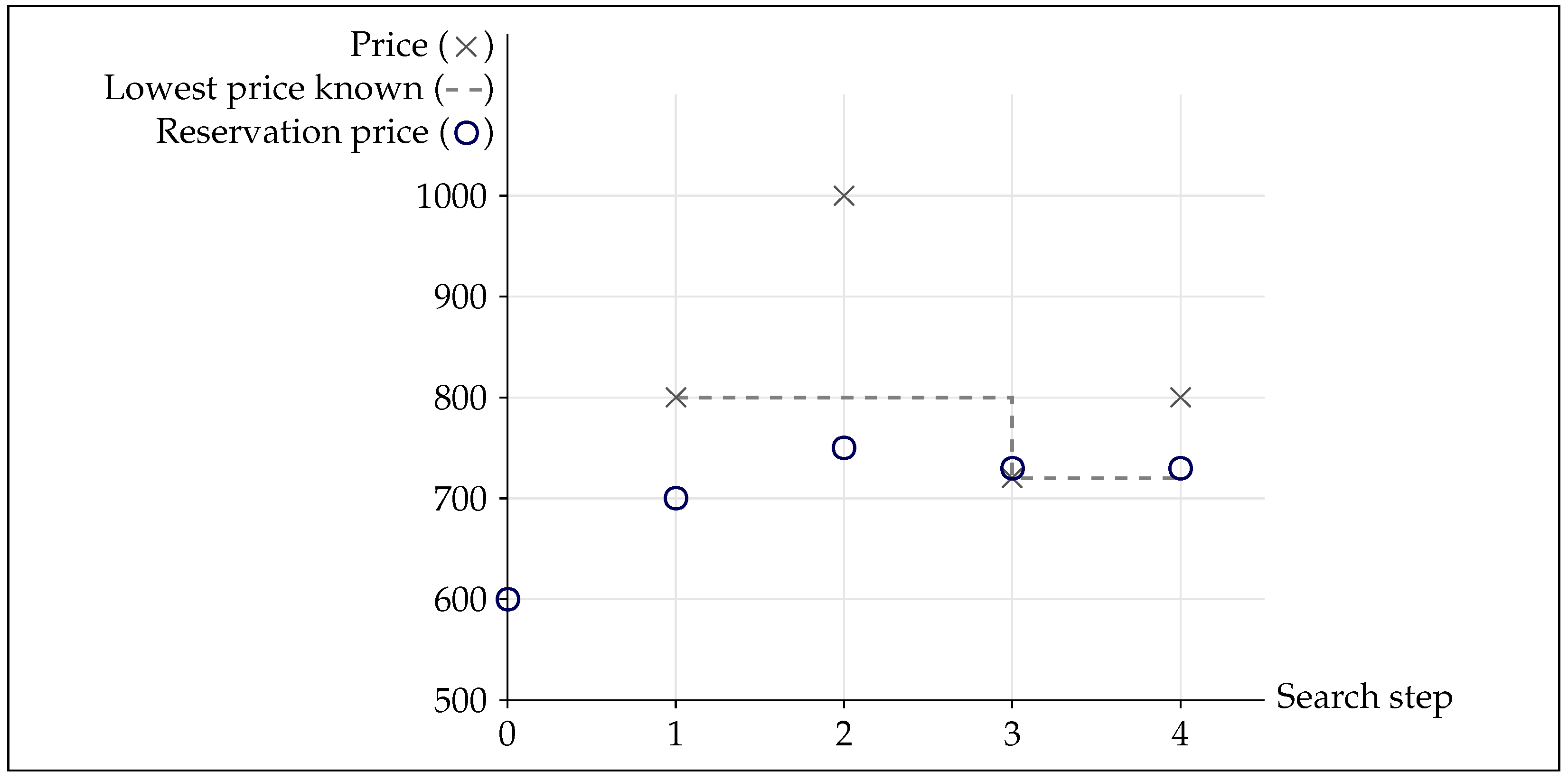
3.4. An Illustration of the Hypothesized Search Behavior
4. Method
4.1. Experimental Procedure
4.2. Incentive Structure
4.3. Operationalization and Measurement of the Reservation Price
4.4. Experimental Design and Experimental Rounds
4.5. Supplementary Rounds
4.6. Sample Characteristics
5. Results
5.1. Descriptive Statistics and Treatment of Outliers
5.2. Regression Models
5.2.1. Main Specification
5.2.2. Alternative Specifications
5.3. Estimation Results
- : The estimate is significantly smaller than zero (, ).
- : is significantly greater than zero (, ) and smaller than one (, ).
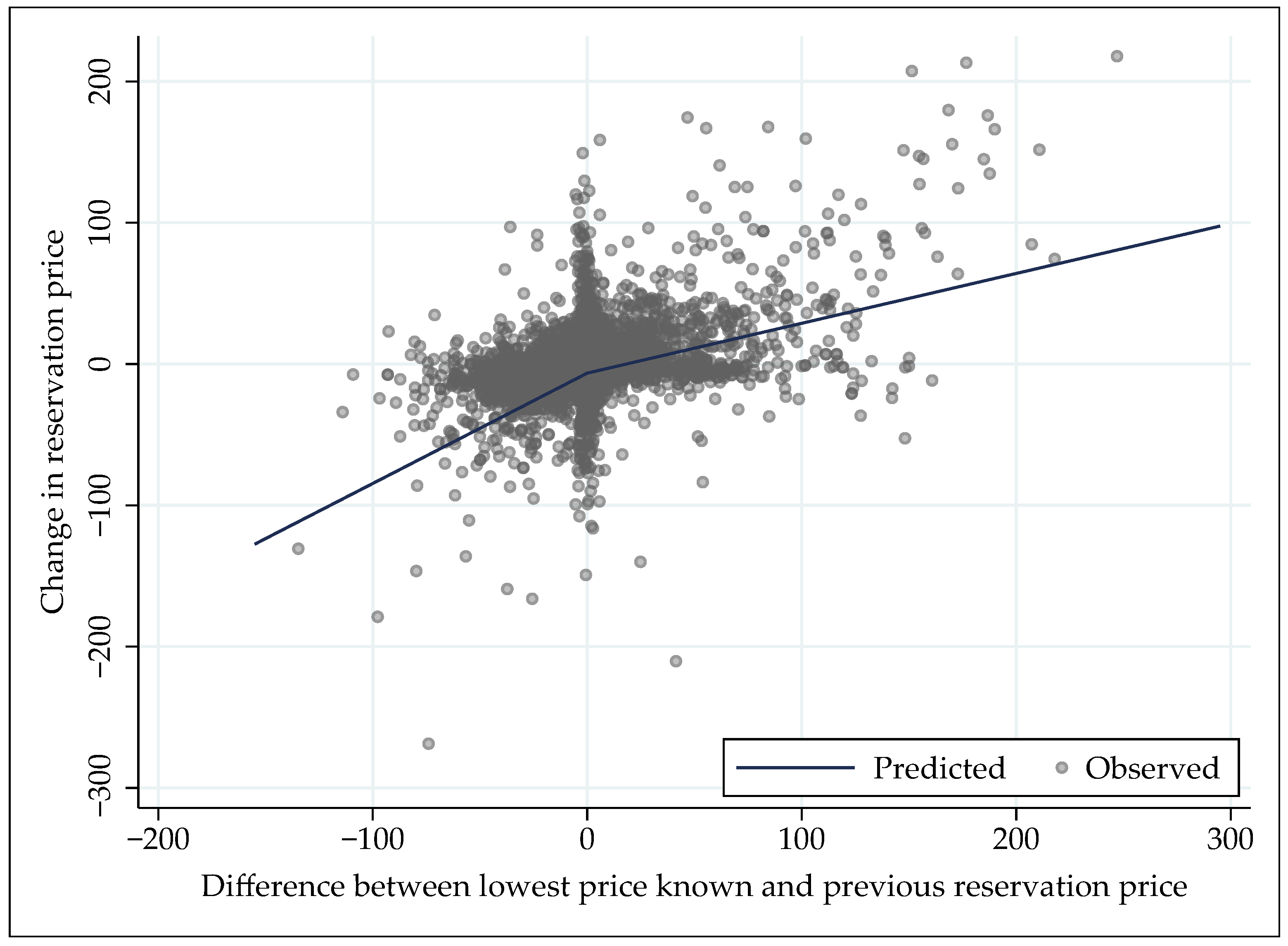
- and : is significantly greater than zero (, ) and smaller than one (, ). For , results are mixed: the estimate is significantly greater than zero (, ) but not smaller than one (, ). The latter result is driven by cluster-robust standard errors; with conventional standard errors, the estimate is significantly smaller than one (, ). Thus, the lower-bound part of the hypothesis is supported, while the upper-bound part is supported under the assumption of independent and identically distributed error terms. The lower-bound part is sufficient for downward adjustments of the reservation price.
- : A similar qualification applies for . With cluster-robust standard errors, the difference is weakly significant (, ), while it is significant with conventional standard errors (, ). The difference seems large enough to deem it practically important.
6. Discussion
6.1. Summary
6.2. Implications
6.2.1. Behavioral Challenges to Welfare Economics
6.2.2. Theoretical Foundations of Behavioral Economics
6.3. Limitations
7. Conclusions
Funding
Institutional Review Board Statement
Informed Consent Statement
Data Availability Statement
Conflicts of Interest
Appendix A. Experimental Instructions and Displays
- The following texts and illustrations are translated from German.
- Before registration: Thank you for your interest in our study on decision-making behavior. By taking part, you are making an important contribution to scientific research and at the same time you can win an online-shopping voucher for 20 euros! The study is very simple: Your task is to buy a specific product. To do this, you can visit a number of simulated sellers and then decide where to buy the product.
- You will not make actual buying commitments in this study. Nevertheless, it is important that you behave in the same way as you would if you were making a real purchase. The simulated sellers are based on sellers that also exist in reality: In the study, real-life conditions are replicated as closely as possible.
- To take part in the study, all you need to do is register. We need some personal data to make statistical statements. Your e-mail address will only be used to inform you if you have won a shopping voucher. On the next page, you will find an explanation of how the study works. Thank you in advance for your support!
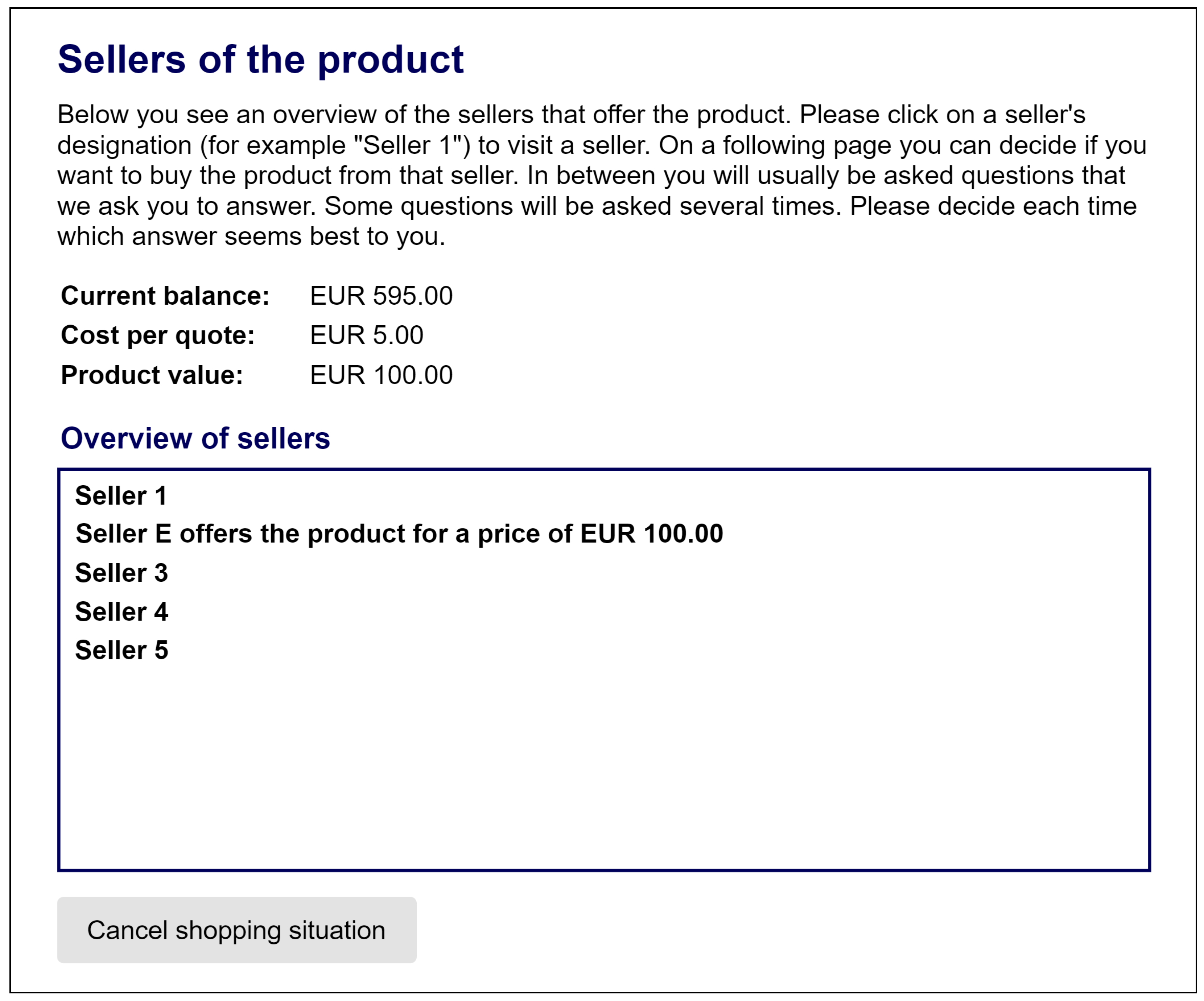
- After registration: In this study, you will encounter several simulated shopping situations. In each situation, your task is to buy a specific product. It is not important which product it is. The products are therefore referred to as “Product A” or “Product D,” for example. Just imagine that you have decided to buy a certain product that can be used over a longer period of time.
- The product is offered by several sellers in each shopping situation. You can visit these sellers and then decide where to buy the product. Just like the products, the sellers are not mentioned by name, but are referred to as “Seller A” or “Seller D,” for example. The sellers and the product do not differ within a shopping situation! All sellers therefore offer the same product. However, the sellers may charge different prices.
- Some information is important for you in every shopping situation:
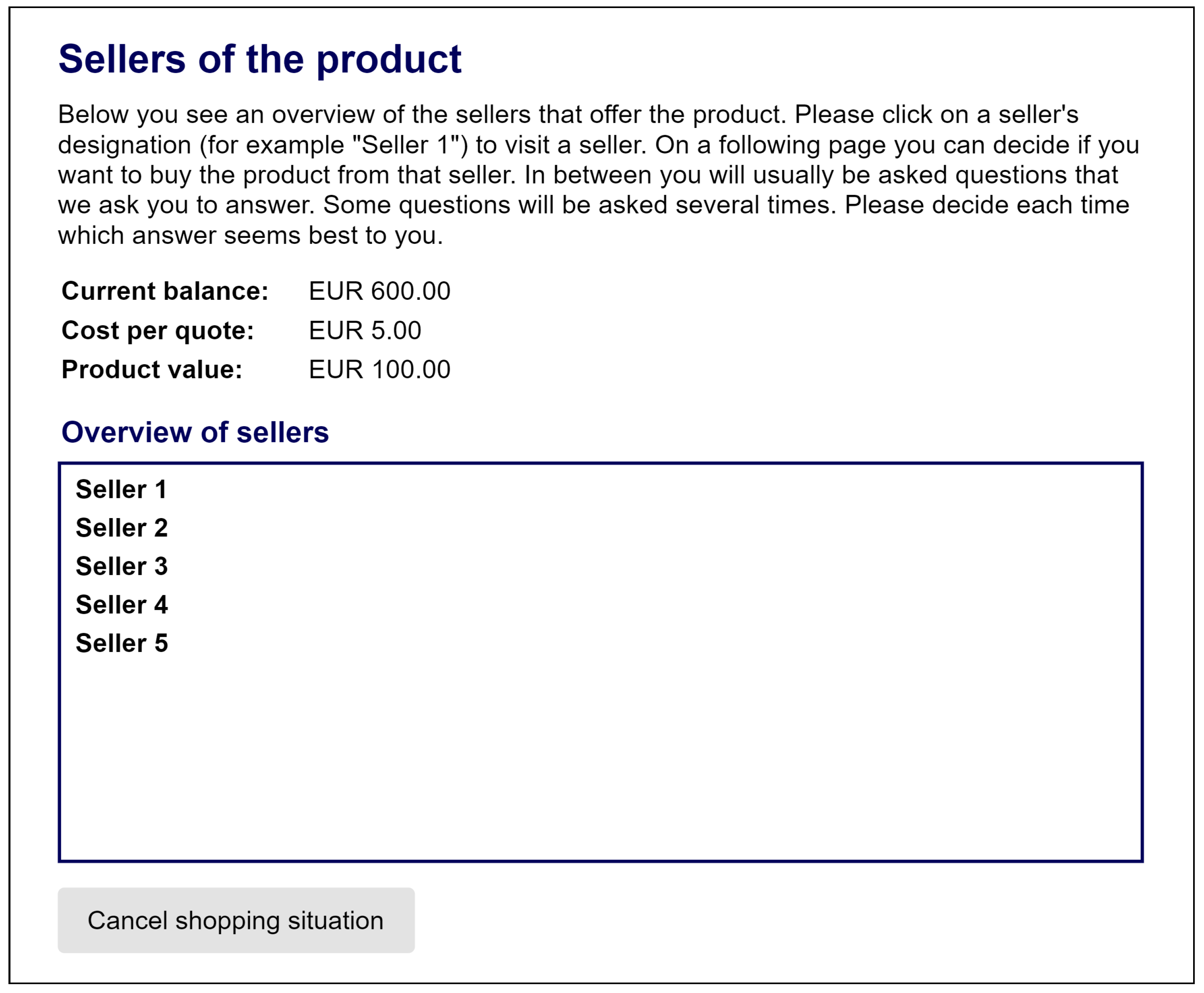
- The starting balance: This is the euro amount you have at the start of the situation.
- The cost per quote: For each seller you visit, this euro amount will be deducted from your balance. However, you can visit a seller repeatedly without being charged again.
- The price paid: When you buy the product, the price charged by the chosen seller will be deducted from your balance.
- The product value: This is the euro amount that will be added to your balance when you buy the product. Imagine that you resell the product at the product value immediately after you have bought it.
- The final balance: This is the euro amount you have left at the end of a situation.
- An example: You have a starting balance of 1000 euros in a shopping situation, the cost per quote is 10 euros, and the product value is 500 euros. You visit five sellers and buy the product from one of them for 400 euros. This leaves you with 1050 euros as your final balance, according to the following calculation:
1000 euros (starting balance) − 5 × 10 euros (number of sellers visited times cost per quote) − 400 euros (price paid) + 500 euros (product value) = 1050 euros (final balance) - All participants have a chance to win one of 15 online-shopping vouchers for 20 euros. You can influence your chance of winning by earning a high final balance in each shopping situation: After the study is concluded, we will randomly select one situation—and for every euro of your final balance in that situation, one ticket will enter the prize pot for you!
- Your task in every situation is to buy the product. However, you can also cancel a situation without buying the product. In this case, no price paid will be deducted from your balance, but the product value will not be credited to you either.
- You can take as much time as you need to complete the study, but you should not take a break of more than 10 min. The average completion time without a break is approximately 20 min. You will be informed when you have completed all the shopping situations.
- If you have any questions, please contact: researcher contact information.



Appendix B. Validity, Reliability, and Manipulation Checks
Appendix B.1. Measurement Validity
Appendix B.2. Measurement Reliability
Appendix B.3. Manipulation Check
Appendix C. Detection of Outliers
Appendix D. Additional Estimation Results

| Coefficient | Estimate Standard Error (p-Value) | ||||
|---|---|---|---|---|---|
| (RM1)’ | (RM2) | (RM3) | (RM4) | (RM5) | |
| β0 | −2.542 | −1.850 | −2.958 | 4.822 | −13.403 |
| 0.812 | 0.661 | 0.666 | 0.524 | 1.761 | |
| (0.0019) | (0.0054) | (0.0000) | (0.0000) | (0.0000) | |
| β1 | 0.989 | 0.981 | 0.973 | 1.009 | 0.913 |
| 0.004 | 0.005 | 0.003 | 0.002 | 0.010 | |
| (0.0000) | (0.0000) | (0.0000) | (0.0000) | (0.0000) | |
| β2 | 0.256 | 0.371 | −0.620 | ||
| 0.030 | 0.025 | 0.099 | |||
| (0.0000) | (0.0000) | (0.0000) | |||
| 0.296 | |||||
| 0.035 | |||||
| (0.0000) | |||||
| 0.802 | |||||
| 0.185 | |||||
| (0.0000) | |||||
| β3 | −0.050 | ||||
| 0.075 | |||||
| (0.5036) | |||||
| β4 | 1.553 | ||||
| 0.503 | |||||
| (0.0022) | |||||
| Observations | 2544 | 2544 | 4731 | 4731 | 2544 |
| Model p-value | 0.0000 | 0.0000 | 0.0000 | 0.0000 | 0.0000 |
| 1 | Generically, aspiration levels have an upward orientation: high values are preferred to low values. In the terminology by Lewin et al. (1944, p. 335), an individual’s “ideal goal” is the maximum that is possible. In consumer price search, the ideal goal is the minimum, and low values are preferred to high values. See also Selten (1998). |
| 2 | It would be more general to assume that the consumer, when deciding on a specific product, also incorporates information about prices. For the present research, I assume the simpler setting, i.e., analytically separate the decision on quality from the decision on price, and model only the latter. |
| 3 | Since existing software could not be used, especially because of the need to repeatedly measure the reservation price, the website was developed for this research and related projects. Prior results were published in, for example, van Baal (2011, 2015). A part of the present explanations is based on these works. |
| 4 | The descriptives align with previous findings. Similar proportions of subjects not making a purchase were reported by Hey (1982) and Kogut (1992). The number of sellers visited is consistent with the recurring observation that many consumers tend to search little (Casner, 2021; Johnson et al., 2004; Kogut, 1990; Marcu & Noussair, 2024; Schunk, 2009; Schunk & Winter, 2009; Sonnemans, 1998; Zwick et al., 2003) |
| 5 | In total, 7956 reservation prices for 428 subjects are available (Section 5.1). In (RM1), (RM3), as well as (RM4), the lagged reservation price reduces the estimation sample by 3077 initial values, and by another 148 because of a lagged outlier, resulting in 4731 observations for 412 subjects. For (RM1)’, (RM2), and (RM5), another 2187 first observations per search spell cannot enter the estimation, resulting in 2544 observations for 372 subjects. |
| 6 | A similar implication follows from neoclassical search models with an unknown price distribution (Section 2.1), as they allow for changes in beliefs about the distribution to affect reservation prices. |
| 7 | As a case in point, compare the diagram in Siegel (1957, p. 257) to the value function in Kahneman and Tversky (1979, p. 279). |
References
- Ahrens, S., Pirschel, I., & Snower, D. J. (2017). A theory of price adjustment under loss aversion. Journal of Economic Behavior and Organization, 134, 78–95. [Google Scholar] [CrossRef] [Scilit]
- Akaike, H. (1974). A new look at the statistical model identification. IEEE Transactions on Automatic Control, 19(6), 716–723. [Google Scholar] [CrossRef] [Scilit]
- Altman, M. (2023). Introduction to the handbook of research methods in behavioural economics. In M. Altman (Ed.), Handbook of research methods in behavioural economics (pp. 1–12). Edward Elgar Publishing. [Google Scholar] [CrossRef] [Scilit]
- Antonides, G. (1996). Psychology in economics and business: An introduction to economic psychology (2nd ed.). Kluwer. [Google Scholar]
- Ariely, D., Loewenstein, G., & Prelec, D. (2003). “Coherent arbitrariness”: Stable demand curves without stable preferences. Quarterly Journal of Economics, 118(1), 73–105. [Google Scholar] [CrossRef] [Scilit]
- Ariely, D., Loewenstein, G., & Prelec, D. (2006). Tom Sawyer and the construction of value. Journal of Economic Behavior and Organization, 60(1), 1–10. [Google Scholar] [CrossRef] [Scilit]
- Arrow, K. J., & Nerlove, M. (1958). A note on expectations and stability. Econometrica, 26(2), 297–305. [Google Scholar] [CrossRef] [Scilit]
- Artinger, F. M., Gigerenzer, G., & Jacobs, P. (2022). Satisficing: Integrating two traditions. Journal of Economic Literature, 60(2), 598–635. [Google Scholar] [CrossRef] [Scilit]
- Axell, B. (1974). Price dispersion and information—An adaptive sequential search model. Swedish Journal of Economics, 76(1), 77–98. [Google Scholar] [CrossRef] [Scilit]
- Becker, G. M., DeGroot, M. H., & Marschak, J. (1964). Measuring utility by a single-response sequential method. Behavioral Science, 9(3), 226–232. [Google Scholar] [CrossRef] [Scilit]
- Bettman, J. R., Luce, M. F., & Payne, J. W. (1998). Constructive consumer choice processes. Journal of Consumer Research, 25(3), 187–217. [Google Scholar] [CrossRef] [Scilit]
- Bikhchandani, S., & Sharma, S. (1996). Optimal search with learning. Journal of Economic Dynamics and Control, 20(1–3), 333–359. [Google Scholar] [CrossRef] [Scilit]
- Brown, M., Flinn, C. J., & Schotter, A. (2011). Real-time search in the laboratory and the market. American Economic Review, 101(2), 948–974. [Google Scholar] [CrossRef] [Scilit]
- Butler, D., & Loomes, G. (1997). Quasi-rational search under incomplete information: Some evidence from experiments. The Manchester School, 65(2), 127–144. [Google Scholar] [CrossRef] [Scilit]
- Camerer, C. F., & Hogarth, R. M. (1999). The effects of financial incentives in experiments: A review and capital-labor-production framework. Journal of Risk and Uncertainty, 19(1–3), 7–42. [Google Scholar] [CrossRef] [Scilit]
- Caplin, A., Dean, M., & Martin, D. (2011). Search and satisficing. American Economic Review, 101(7), 2899–2922. [Google Scholar] [CrossRef] [Scilit]
- Casner, B. (2021). Learning while shopping: An experimental investigation into the effect of learning on consumer search. Experimental Economics, 24(1), 238–273. [Google Scholar] [CrossRef] [Scilit]
- Chou, C.-F., & Talmain, G. (1993). Nonparametric search. Journal of Economic Dynamics and Control, 17(5–6), 771–784. [Google Scholar] [CrossRef] [Scilit]
- Cohen, J., Cohen, P., West, S. G., & Aiken, L. S. (2003). Applied multiple regression/correlation analysis for the behavioral sciences (3rd ed.). Lawrence Erlbaum Associates. [Google Scholar] [CrossRef] [Scilit]
- Conlisk, J. (1996). Why bounded rationality? Journal of Economic Literature, 34(2), 669–700. [Google Scholar]
- Conlisk, J. (2003). A note on convergence of adaptive satisficing to optimal stopping. Journal of Political Economy, 111(6), 1353–1360. [Google Scholar] [CrossRef] [Scilit]
- Cowen, N., & Dold, M. (2021). Introduction: Symposium on escaping paternalism: Rationality, behavioral economics and public policy by Mario J. Rizzo and Glen Whitman. Review of Behavioral Economics, 8(3–4), 213–220. [Google Scholar] [CrossRef] [Scilit]
- Cox, J. C., & Oaxaca, R. L. (1992). Direct tests of the reservation wage property. The Economic Journal, 102(415), 1423–1432. [Google Scholar] [CrossRef] [Scilit]
- Cyert, R. M., & March, J. G. (1992). A behavioral theory of the firm (2nd ed.). Blackwell. [Google Scholar]
- D’Agostino, R. B., Belanger, A., & D’Agostino, R. B., Jr. (1990). A suggestion for using powerful and informative tests of normality. The American Statistician, 44(4), 316–321. [Google Scholar] [CrossRef] [Scilit]
- Dembo, T. (1931). Der Ärger als dynamisches problem. Psychologische Forschung, 15(1–2), 1–144. [Google Scholar] [CrossRef] [Scilit]
- Dolansky, E., & Vandenbosch, M. (2013). Price sequences, perceived variability, and choice. Journal of Product and Brand Management, 22(4), 314–321. [Google Scholar] [CrossRef] [Scilit]
- Dubra, J. (2004). Optimism and overconfidence in search. Review of Economic Dynamics, 7(1), 198–218. [Google Scholar] [CrossRef] [Scilit]
- Epstein, R. A., & Rizzo, M. J. (2018). Introduction: Behavioral economics and new paternalism. Review of Behavioral Economics, 5(3–4), 197–200. [Google Scholar] [CrossRef] [Scilit]
- Gigerenzer, G. (2018). The bias bias in behavioral economics. Review of Behavioral Economics, 5(3–4), 303–336. [Google Scholar] [CrossRef] [Scilit]
- Gigerenzer, G., & Selten, R. (Eds.). (2001). Bounded rationality: The adaptive toolbox. MIT Press. [Google Scholar] [CrossRef] [Scilit]
- Gilboa, I., & Schmeidler, D. (2001). Reaction to price changes and aspiration level adjustments. Review of Economic Design, 6(2), 215–223. [Google Scholar] [CrossRef] [Scilit]
- Glynn, M. A., Lant, T. K., & Mezias, S. J. (1991). Incrementalism, learning, and ambiguity: An experimental study of aspiration level adaptation. Academy of Management Best Paper Proceedings, 1991, 384–388. [Google Scholar] [CrossRef] [Scilit]
- Grubbs, F. E. (1969). Procedures for detecting outlying observations in samples. Technometrics, 11(1), 1–21. [Google Scholar] [CrossRef]
- Hawkins, D. M. (1980). Identification of outliers. Chapman and Hall. [Google Scholar]
- Helson, H. (1964). Adaptation-level theory: An experimental and systematic approach to behavior. Harper and Row. [Google Scholar]
- Hey, J. D. (1981). Are optimal search rules reasonable? and vice versa? (and does it matter anyway?). Journal of Economic Behavior and Organization, 2(1), 47–70. [Google Scholar] [CrossRef] [Scilit]
- Hey, J. D. (1982). Search for rules for search. Journal of Economic Behavior and Organization, 3(1), 65–81. [Google Scholar] [CrossRef] [Scilit]
- Hey, J. D. (1987). Still searching. Journal of Economic Behavior and Organization, 8(1), 137–144. [Google Scholar] [CrossRef] [Scilit]
- Hey, J. D. (1991). Experiments in economics. Blackwell. [Google Scholar]
- Hey, J. D. (1993). Testing search theory. The Manchester School, 61(1), 82–94. [Google Scholar] [CrossRef] [Scilit]
- Hoeffler, S., & Ariely, D. (1999). Constructing stable preferences: A look into dimensions of experience and their impact on preference stability. Journal of Consumer Psychology, 8(2), 113–139. [Google Scholar] [CrossRef] [Scilit]
- Hoppe, F. (1930). Erfolg und misserfolg. Psychologische Forschung, 14(1–2), 1–62. [Google Scholar]
- Isoni, A., Brooks, P., Loomes, G., & Sugden, R. (2016). Do markets reveal preferences or shape them? Journal of Economic Behavior and Organization, 122, 1–16. [Google Scholar] [CrossRef] [Scilit]
- Jacobson, R., & Obermiller, C. (1989). The formation of reference price. Advances in Consumer Research, 16(1), 234–240. [Google Scholar]
- Johnson, E. J., Moe, W. W., Fader, P. S., Bellman, S., & Lohse, G. L. (2004). On the depth and dynamics of online search behavior. Management Science, 50(3), 299–308. [Google Scholar] [CrossRef] [Scilit]
- Kahneman, D., & Tversky, A. (1979). Prospect theory: An analysis of decision under risk. Econometrica, 47(2), 263–291. [Google Scholar] [CrossRef] [Scilit]
- Kahneman, D., & Tversky, A. (1984). Choices, values, and frames. American Psychologist, 39(4), 341–350. [Google Scholar] [CrossRef]
- Karni, E., & Schwartz, A. (1977). Search theory: The case of search with uncertain recall. Journal of Economic Theory, 16(1), 38–52. [Google Scholar] [CrossRef] [Scilit]
- Kogut, C. A. (1990). Consumer search behavior and sunk costs. Journal of Economic Behavior and Organization, 14(3), 381–392. [Google Scholar] [CrossRef] [Scilit]
- Kogut, C. A. (1992). Recall in consumer search. Journal of Economic Behavior and Organization, 17(1), 141–151. [Google Scholar] [CrossRef] [Scilit]
- Kohn, M. G., & Shavell, S. (1974). The theory of search. Journal of Economic Theory, 9(2), 93–123. [Google Scholar] [CrossRef] [Scilit]
- Koyck, L. M. (1954). Distributed lags and investment analysis. North-Holland. [Google Scholar]
- Lant, T. K. (1992). Aspiration level adaptation: An empirical exploration. Management Science, 38(5), 623–644. [Google Scholar] [CrossRef] [Scilit]
- Levinthal, D., & March, J. G. (1981). A model of adaptive organizational search. Journal of Economic Behavior and Organization, 2(4), 307–333. [Google Scholar] [CrossRef] [Scilit]
- Lewin, K., Dembo, T., Festinger, L., & Snedden Sears, P. (1944). Level of aspiration. In J. M. Hunt (Ed.), Personality and the behavior disorders (pp. 333–378). Ronald Press. [Google Scholar]
- Lichtenstein, D. R., Bloch, P. H., & Black, W. C. (1988). Correlates of price acceptability. Journal of Consumer Research, 15(2), 243–252. [Google Scholar] [CrossRef] [Scilit]
- Manning, R., & Morgan, P. B. (1982). Search and consumer theory. Review of Economic Studies, 49(156), 203–216. [Google Scholar] [CrossRef] [Scilit]
- March, J. G., & Simon, H. A. (1993). Organizations (2nd ed.). Blackwell. [Google Scholar]
- Marcu, E., & Noussair, C. N. (2024). Sequential search with a price freeze option: Theory and experimental evidence. Experimental Economics, 27(5), 1106–1139. [Google Scholar] [CrossRef] [Scilit]
- Mazar, N., Koszegi, B., & Ariely, D. (2014). True context-dependent preferences? The causes of market-dependent valuations. Journal of Behavioral Decision Making, 27(3), 200–208. [Google Scholar] [CrossRef] [Scilit]
- McCall, J. J. (1970). Economics of information and job search. Quarterly Journal of Economics, 84(1), 113–126. [Google Scholar] [CrossRef] [Scilit]
- Mezias, S. J. (1988). Aspiration level effects: An empirical investigation. Journal of Economic Behavior and Organization, 10(4), 389–400. [Google Scholar] [CrossRef] [Scilit]
- Mezias, S. J., Chen, Y.-R., & Murphy, P. R. (2002). Aspiration-level adaptation in an american financial services organization: A field study. Management Science, 48(10), 1285–1300. [Google Scholar] [CrossRef] [Scilit]
- Murphy, P. R., Mezias, S. J., & Chen, Y. R. (2001). Adapting aspirations to feedback: The role of success and failure. In T. K. Lant, & Z. Shapira (Eds.), Organizational cognition: Computation and interpretation (pp. 125–146). Lawrence Erlbaum Associates. [Google Scholar]
- Nunes, J. C., & Boatwright, P. (2004). Incidental prices and their effect on willingness to pay. Journal of Marketing Research, 41(4), 457–466. [Google Scholar] [CrossRef] [Scilit]
- Nunnally, J. C., & Bernstein, I. H. (1994). Psychometric theory (3rd ed.). McGraw-Hill. [Google Scholar]
- Payne, J. W., Bettman, J. R., & Johnson, E. J. (1992). Behavioral decision research: A constructive processing perspective. Annual Review of Psychology, 43(1), 87–131. [Google Scholar] [CrossRef]
- Puto, C. P. (1987). The framing of buying decisions. Journal of Consumer Research, 14(3), 301–315. [Google Scholar] [CrossRef] [Scilit]
- Rizzo, M. J., & Whitman, G. (2019). Escaping paternalism: Rationality, behavioral economics, and public policy. Cambridge University Press. [Google Scholar] [CrossRef] [Scilit]
- Rosenfield, D. B., & Shapiro, R. D. (1981). Optimal adaptive price search. Journal of Economic Theory, 25(1), 1–20. [Google Scholar] [CrossRef] [Scilit]
- Rothschild, M. (1974). Searching for the lowest price when the distribution of prices is unknown. Journal of Political Economy, 82(4), 689–711. [Google Scholar] [CrossRef] [Scilit]
- Schotter, A., & Braunstein, Y. M. (1981). Economic search: An experimental study. Economic Inquiry, 19(1), 1–25. [Google Scholar] [CrossRef] [Scilit]
- Schunk, D. (2009). Behavioral heterogeneity in dynamic search situations: Theory and experimental evidence. Journal of Economic Dynamics and Control, 33(9), 1719–1738. [Google Scholar] [CrossRef] [Scilit]
- Schunk, D., & Winter, J. (2009). The relationship between risk attitudes and heuristics in search tasks: A laboratory experiment. Journal of Economic Behavior and Organization, 71(2), 347–360. [Google Scholar] [CrossRef] [Scilit]
- Schwarz, G. (1978). Estimating the dimension of a model. Annals of Statistics, 6(2), 461–464. [Google Scholar] [CrossRef] [Scilit]
- Scitovszky, T. (1944). Some consequences of the habit of judging quality by price. The Review of Economic Studies, 12(2), 100–105. [Google Scholar] [CrossRef] [Scilit]
- Selten, R. (1998). Aspiration adaptation theory. Journal of Mathematical Psychology, 42(2–3), 191–214. [Google Scholar] [CrossRef] [Scilit] [PubMed]
- Siegel, S. (1957). Level of aspiration and decision making. Psychological Review, 64(4), 253–262. [Google Scholar] [CrossRef] [Scilit] [PubMed]
- Simon, H. A. (1955). A behavioral model of rational choice. Quarterly Journal of Economics, 69(1), 99–118. [Google Scholar] [CrossRef] [Scilit]
- Simon, H. A. (1956). Rational choice and the structure of the environment. Psychological Review, 63(2), 129–138. [Google Scholar] [CrossRef] [Scilit]
- Simon, H. A. (1979). Rational decision making in business organizations. American Economic Review, 69(4), 493–513. [Google Scholar]
- Simon, H. A. (1984). On the behavioral and rational foundations of economic dynamics. Journal of Economic Behavior and Organization, 5(1), 35–55. [Google Scholar] [CrossRef] [Scilit]
- Simon, H. A. (1997). Administrative behavior: A study of decision-making processes in administrative organizations (4th ed.). Free Press. [Google Scholar]
- Smith, V. L. (1976). Experimental economics: Induced value theory. American Economic Review, 66(2), 274–279. [Google Scholar]
- Sonnemans, J. (1998). Strategies of search. Journal of Economic Behavior and Organization, 35(3), 309–332. [Google Scholar] [CrossRef] [Scilit]
- Starbuck, W. H. (1963). Level of aspiration. Psychological Review, 70(1), 51–60. [Google Scholar] [CrossRef] [Scilit]
- Stigler, G. J. (1961). The economics of information. Journal of Political Economy, 69(3), 213–225. [Google Scholar] [CrossRef] [Scilit]
- Telser, L. G. (1973). Searching for the lowest price. American Economic Review, 63(2), 40–49. [Google Scholar]
- Thaler, R. H. (1985). Mental accounting and consumer choice. Marketing Science, 4(3), 199–214. [Google Scholar] [CrossRef] [Scilit]
- Thaler, R. H. (1999). Mental accounting matters. Journal of Behavioral Decision Making, 12(3), 183–206. [Google Scholar] [CrossRef] [Scilit]
- Thaler, R. H. (2015). Misbehaving: The making of behavioral economics. W. W. Norton. [Google Scholar]
- Tukey, J. W. (1977). Exploratory data analysis. Addison-Wesley. [Google Scholar]
- Tversky, A., & Kahneman, D. (1974). Judgment under uncertainty: Heuristics and biases. Science, 185(4157), 1124–1131. [Google Scholar] [CrossRef] [Scilit]
- Tversky, A., & Kahneman, D. (1991). Loss aversion in riskless choice: A reference-dependent model. The Quarterly Journal of Economics, 106(4), 1039–1061. [Google Scholar] [CrossRef] [Scilit]
- Tversky, A., & Kahneman, D. (1992). Advances in prospect theory: Cumulative representation of uncertainty. Journal of Risk and Uncertainty, 5(4), 297–323. [Google Scholar] [CrossRef] [Scilit]
- Tversky, A., & Simonson, I. (1993). Context-dependent preferences. Management Science, 39(10), 1179–1189. [Google Scholar] [CrossRef] [Scilit]
- van Baal, S. (2011). Das preissuchverhalten der konsumenten: Ein verhaltensökonomisches erklärungsmodell auf der basis der theorie des anspruchsniveaus. Gabler. [Google Scholar] [CrossRef] [Scilit]
- van Baal, S. (2015). Not all seals are equal: An experimental investigation of the effect of third-party seals on purchase probability in electronic commerce. Electronic Commerce Research, 15(2), 177–206. [Google Scholar] [CrossRef] [Scilit]
- Varian, H. R. (1992). Microeconomic analysis (3rd ed.). W. W. Norton. [Google Scholar]
- Walsh, J. E. (1959). Large sample nonparametric rejection of outlying observations. Annals of the Institute of Statistical Mathematics, 10(3), 223–232. [Google Scholar] [CrossRef] [Scilit]
- Weitzman, M. L. (1979). Optimal search for the best alternative. Econometrica, 47(3), 641–654. [Google Scholar] [CrossRef] [Scilit]
- Wertenbroch, K., & Skiera, B. (2002). Measuring consumers’ willingness to pay at the point of purchase. Journal of Marketing Research, 39(2), 228–241. [Google Scholar] [CrossRef] [Scilit]
- Winer, R. S. (1988). Behavioral perspective on pricing: Buyers’ subjective perceptions of price revisited. In T. M. Devinney (Ed.), Issues in pricing: Theory and research (pp. 35–57). Lexington Books. [Google Scholar]
- Wooldridge, J. M. (2010). Econometric analysis of cross section and panel data (2nd ed.). MIT Press. [Google Scholar]
- Zwick, R., Rapoport, A., Lo, A. K. C., & Muthukrishnan, A. V. (2003). Consumer sequential search: Not enough or too much? Marketing Science, 22(4), 503–519. [Google Scholar] [CrossRef] [Scilit]


| 100 | 400 | ||||
| 5 | 20 | 5 | 20 | ||
| 5 | S1 | S2 | S3 | S4 | |
| 10 | S5 | S6 | S7 | S8 | |
| 1 | 2 | 3 | 4 | 5 | 6 | 7 | 8 | 9 | 10 | |
|---|---|---|---|---|---|---|---|---|---|---|
| S1 | 100 | 90 | 75 | 110 | 75 | |||||
| S2 | 90 | 110 | 75 | 95 | 100 | |||||
| S3 | 380 | 420 | 325 | 355 | 315 | |||||
| S4 | 415 | 380 | 365 | 375 | 400 | |||||
| S5 | 90 | 90 | 105 | 75 | 95 | 70 | 75 | 90 | 85 | 95 |
| S6 | 100 | 110 | 90 | 85 | 85 | 115 | 80 | 95 | 90 | 90 |
| S7 | 370 | 430 | 365 | 405 | 345 | 385 | 370 | 400 | 405 | 340 |
| S8 | 415 | 370 | 385 | 355 | 400 | 335 | 320 | 330 | 365 | 405 |
| No. of Purchases | No. of Purchases at | No. of Purchases by Recall | Mean No. of Visited Sellers () | Mean Purchase Price () | Mean Final Balance () | |
|---|---|---|---|---|---|---|
| S1 | 421 | 419 | 11 | 2.29 | 85.69 | 602.61 |
| S2 | 420 | 411 | 45 | 1.78 | 85.25 | 578.91 |
| S3 | 425 | 419 | 48 | 2.35 | 347.28 | 640.60 |
| S4 | 415 | 411 | 48 | 2.42 | 377.61 | 573.29 |
| S5 | 417 | 413 | 42 | 2.39 | 84.41 | 603.24 |
| S6 | 409 | 403 | 47 | 2.40 | 93.64 | 557.99 |
| S7 | 421 | 408 | 49 | 2.64 | 364.76 | 621.44 |
| S8 | 416 | 408 | 35 | 2.47 | 371.17 | 578.59 |
| Total | 3344 | 3292 | 325 | 2.34 | 226.57 | 594.58 |
| No. of Observations | Mean | Median | Standard Deviation | Minimum | Maximum | |
|---|---|---|---|---|---|---|
| S1 | 996 | 85.18 | 78.50 | 60.25 | 2.00 | 1000.00 |
| S2 | 810 | 92.84 | 80.00 | 69.06 | 1.00 | 750.00 |
| S3 | 1054 | 320.21 | 345.00 | 76.98 | 1.00 | 1000.00 |
| S4 | 1094 | 329.06 | 350.00 | 74.60 | 0.00 | 800.00 |
| S5 | 1071 | 84.05 | 75.00 | 60.14 | 0.00 | 800.00 |
| S6 | 1086 | 92.06 | 80.00 | 63.24 | 1.00 | 600.00 |
| S7 | 1185 | 319.78 | 330.00 | 69.68 | 1.00 | 600.00 |
| S8 | 1100 | 330.88 | 350.00 | 69.91 | 1.00 | 600.00 |
| Total | 8396 | 213.25 | 250.00 | 136.51 | 0.00 | 1000.00 |
| Model | AIC | BIC | RMSE | ||
|---|---|---|---|---|---|
| (RM1) | 40,597.66 | 40,617.05 | 17.66 | 0.9800 | 0.9800 |
| (RM3) | 40,651.08 | 40,664.00 | 17.76 | 0.9797 | 0.9797 |
| (RM4) | 42,548.18 | 42,554.64 | 21.71 | 0.9697 | 0.9697 |
| (RM1)’ | 20,760.99 | 20,778.51 | 14.31 | 0.9852 | 0.9851 |
| (RM2) | 21,049.57 | 21,061.25 | 15.15 | 0.9834 | 0.9833 |
| (RM5) | 22,647.92 | 22,671.29 | 20.73 | 0.9689 | 0.9688 |
| Dependent Variable: | ||||
|---|---|---|---|---|
| Independent Variable | Coefficient | Estimate | Standard Error | p-Value |
| −2.584 | 0.728 | 0.0004 | ||
| 0.977 | 0.004 | 0.0000 | ||
| 0.353 | 0.027 | 0.0000 | ||
| 0.781 | 0.318 | 0.0145 | ||
| Observations (subjects) | 4731 (412) | |||
| F-statistic | 72,182.26 | |||
| Degrees of freedom | 3, 411 | |||
| Model p-value | 0.0000 | |||
Disclaimer/Publisher’s Note: The statements, opinions and data contained in all publications are solely those of the individual author(s) and contributor(s) and not of MDPI and/or the editor(s). MDPI and/or the editor(s) disclaim responsibility for any injury to people or property resulting from any ideas, methods, instructions or products referred to in the content. |
© 2026 by the author. Licensee MDPI, Basel, Switzerland. This article is an open access article distributed under the terms and conditions of the Creative Commons Attribution (CC BY) license.
Share and Cite
van Baal, S. The Consumer’s Reservation Price as an Adaptive Aspiration Level. Behav. Sci. 2026, 16, 421. https://doi.org/10.3390/bs16030421
van Baal S. The Consumer’s Reservation Price as an Adaptive Aspiration Level. Behavioral Sciences. 2026; 16(3):421. https://doi.org/10.3390/bs16030421
Chicago/Turabian Stylevan Baal, Sebastian. 2026. "The Consumer’s Reservation Price as an Adaptive Aspiration Level" Behavioral Sciences 16, no. 3: 421. https://doi.org/10.3390/bs16030421
APA Stylevan Baal, S. (2026). The Consumer’s Reservation Price as an Adaptive Aspiration Level. Behavioral Sciences, 16(3), 421. https://doi.org/10.3390/bs16030421