A Child-Centered Framework for Determining Mental Distress Severity and Liability: Evidence from Chinese Judicial Practice


Abstract
1. Introduction
2. Literature Review
2.1. The Best Interests of the Child and Child Participation
2.2. Compensation for Mental Distress and Severity
3. Methods
3.1. Research Design
3.2. Data Collection
3.3. Data Analysis
4. Results
4.1. Analysis of Representative Cases and Adjudicative Approaches
4.2. Structural Causes of Adjudicative Inconsistency
5. Discussion
5.1. Interpreting Adjudicative Inconsistency in Light of Existing Scholarship
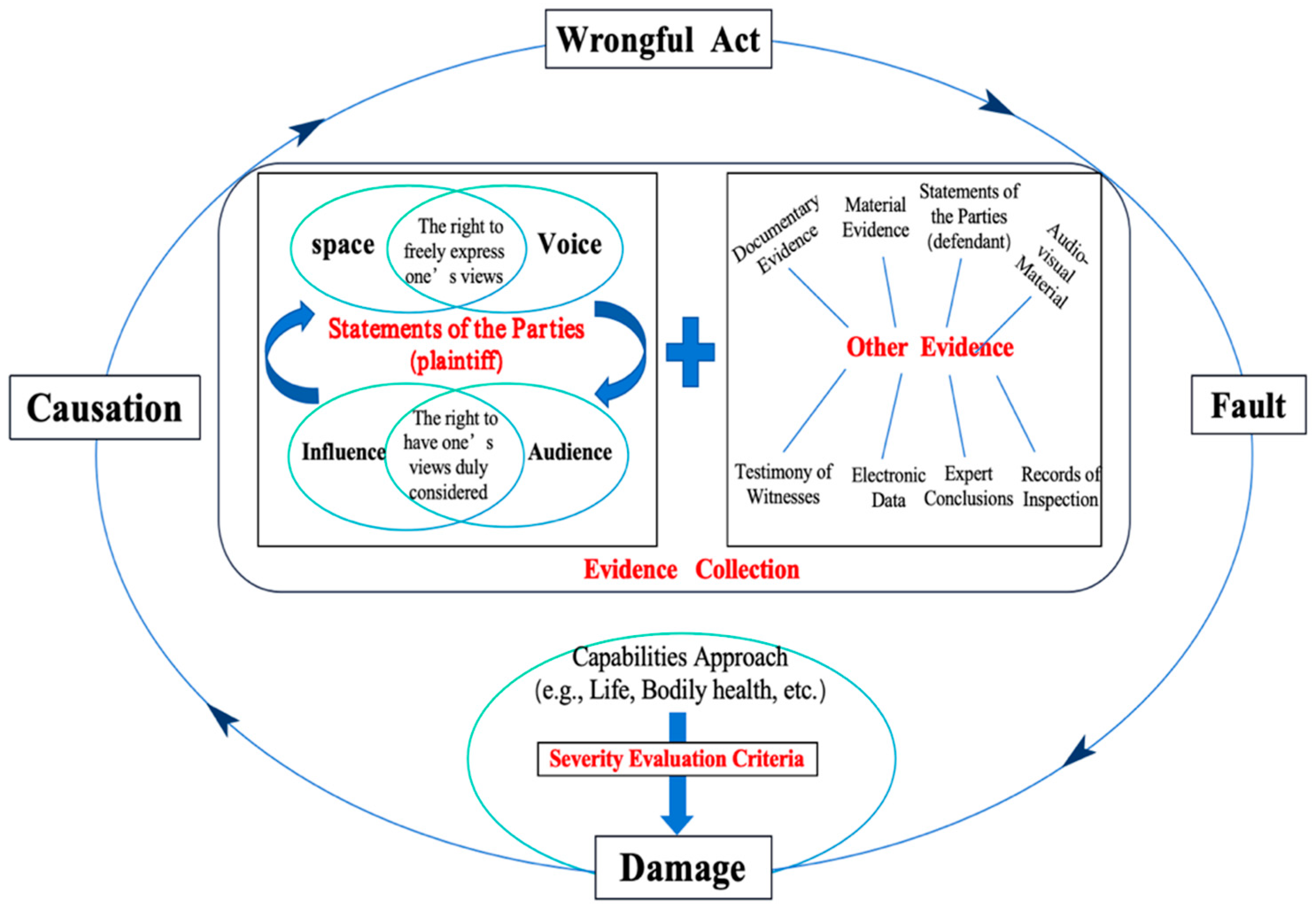
5.2. Operationalizing the Best Interests of the Child: The Dual-Model Framework
5.3. Judicial and Institutional Implications
6. Limitations and Future Research Directions
7. Conclusions
Author Contributions
Funding
Institutional Review Board Statement
Informed Consent Statement
Data Availability Statement
Acknowledgments
Conflicts of Interest
References
- Berrick, J. D., Skivenes, M., & Roscoe, J. N. (2022). Children’s rights and parents’ rights: Popular attitudes about when we privilege one over the other. International Journal of Social Welfare, 31(4), 449–462. [Google Scholar] [CrossRef]
- Biddulph, S., & Rosenzweig, J. (2019). Handbook on human rights in China. Edward Elgar Publishing. [Google Scholar]
- Byrne, B., & Lundy, L. (2019). Children’s rights-based childhood policy: A six-P framework. The International Journal of Human Rights, 23(3), 357–373. [Google Scholar] [CrossRef]
- Campbell, S., Greenwood, M., Prior, S., Shearer, T., Walkem, K., Young, S., Bywaters, D., & Walker, K. (2020). Purposive sampling: Complex or simple? Research case examples. Journal of Research in Nursing, 25(8), 652–661. [Google Scholar] [CrossRef]
- Correia, N., Aguiar, C., & Consortium, P. (2022). Children’s right to participate: The Lundy model applied to early childhood education and care. The International Journal of Children’s Rights, 30(2), 378–405. [Google Scholar] [CrossRef]
- Dixon, R., & Nussbaum, M. C. (2011). Children’s rights and a capabilities approach: The question of special priority. Cornell Law Review, 97, 549–593. [Google Scholar] [CrossRef][Green Version]
- Feng, K., & Ran, C. (2025). Restriction on the compensation for mental damage. Qilu Journal, (6), 73–86. [Google Scholar]
- Fuentes, A., & Vannelli, M. (2021). Expanding the protection of children’s rights towards a dignified life: The emerging jurisprudential developments in the americas. Laws, 10(4), 84. [Google Scholar] [CrossRef]
- Gresdahl, M., Fauske, H., & Storhaug, A. S. (2025). Balancing child participation and protection in emergency cases: Ensuring the child’s best interests. Children and Youth Services Review, 172, 108259. [Google Scholar] [CrossRef]
- Henderson-Dekort, E., van Bakel, H., Smits, V., & Van Regenmortel, T. (2023). “In accordance with age and maturity”: Children’s perspectives, conceptions and insights regarding their capacities and meaningful participation. Action Research, 21(1), 30–61. [Google Scholar] [CrossRef]
- Hong, G. (2024). The system of damages for non-pecuniary losses in the Chinese civil code. Chinese Journal of Law, 46(4), 94–112. [Google Scholar]
- Hu, J. (2020). Construction of participatory democratic life for children: Necessity and possibility. Journal of Anhui Normal University (Humanities & Social Sciences), 48(6), 120–127. [Google Scholar] [CrossRef]
- Kasperska, M. (2021). Personality rights—A universal tool for the recovery of non-pecuniary loss. Athens Journal of Law, 7(4), 575–586. [Google Scholar] [CrossRef]
- Keddell, E. (2023). Recognising the embedded child in child protection: Children’s participation, inequalities and cultural capital. Children and Youth Services Review, 147, 106815. [Google Scholar] [CrossRef]
- Kennan, D., Brady, B., & Forkan, C. (2018). Supporting children’s participation in decision making: A systematic literature review exploring the effectiveness of participatory processes. The British Journal of Social Work, 48(7), 1985–2002. [Google Scholar] [CrossRef]
- Kennan, D., Brady, B., Forkan, C., & Tierney, E. (2021). Developing, implementing and critiquing an evaluation framework to assess the extent to which a child’s right to be heard is embedded at an organisational level. Child Indicators Research, 14(5), 1931–1948. [Google Scholar] [CrossRef]
- Lewinsohn-Zamir, D. (2013). Can’t buy me love: Monetary versus in-kind remedies. University of Illinois Law Review, 2013(1), 151–194. [Google Scholar]
- Liu, Z. (2024). Limitation and diversion of inheritance of mental damage compensation. Contemporary Law Review, 38(5), 75–86. [Google Scholar]
- Long, K. A., & Grant, C. (2024). Child participation in South African primary schools: How useful is the Lundy model? South African Journal of Childhood Education, 14(1), 1354. [Google Scholar] [CrossRef]
- Løvlie, A. G. (2023). Evidence in Norwegian child protection interventions–Analysing cases of familial violence. Child & Family Social Work, 28(1), 236–247. [Google Scholar] [CrossRef]
- Lundy, L. (2007). ‘Voice’is not enough: Conceptualising Article 12 of the United Nations Convention on the Rights of the Child. British Educational Research Journal, 33(6), 927–942. [Google Scholar] [CrossRef]
- Lundy, L., McEvoy, L., & Byrne, B. (2011). Working with young children as co-researchers: An approach informed by the United Nations convention on the rights of the child. Early Education & Development, 22(5), 714–736. [Google Scholar] [CrossRef]
- Luo, X. (2024). Interpretive dimension of mental damages compensation for breach of contract. Journal of Nantong University (Social Sciences Edition), 40(1), 120–131. [Google Scholar]
- MacKenzie, A., Owaineh, M., Bower, C., & Özkaya, C. (2023). Barriers to inclusive education under occupation: An evaluative approach using Nussbaum’s capabilities approach. International Journal of Educational Research Open, 5, 100299. [Google Scholar] [CrossRef]
- Molloy, S. (2022). Contemplating the Lundy model as a framework for children’s participation in peace negotiations. The International Journal of Children’s Rights, 30(4), 957–989. [Google Scholar] [CrossRef]
- Molloy, S. (2024). The committee on the rights of the child and article 12: Applying the Lundy model to treaty body recommendations. Leiden Journal of International Law, 37(3), 669–693. [Google Scholar] [CrossRef]
- Mulvey, K. L., Gönültaş, S., & Richardson, C. B. (2020). Who is to blame? Children’s and adults’ moral judgments regarding victim and transgressor negligence. Cognitive Science, 44(4), e12833. [Google Scholar] [CrossRef] [PubMed]
- Murray, J., Swadener, B. B., & Smith, K. (2020). The Routledge international handbook of young children’s rights. Routledge. [Google Scholar]
- Nussbaum, M. C. (2006). Education and democratic citizenship: Capabilities and quality education. Journal of Human Development, 7(3), 385–395. [Google Scholar] [CrossRef]
- Nyimbili, F., & Nyimbili, L. (2024). Types of purposive sampling techniques with their examples and application in qualitative research studies. British Journal of Multidisciplinary and Advanced Studies, 5(1), 90–99. [Google Scholar] [CrossRef]
- Qu, M., & Wang, Z. (2020). On the punitive function of mental damage compensation—An empirical research based on the mental damage compensation of medical tort. Journal of Shandong University (Philosophy and Social Sciences), (5), 31–41. [Google Scholar] [CrossRef]
- Schweiger, G. (2025). The capability approach as a normative foundation for social work with socially disadvantaged children and youth. Social Sciences, 14(6), 326. [Google Scholar] [CrossRef]
- Shu, G., Li, X., & Lei, L. (2020). The frontier of methodology of law. China University of Political Science and Law Press. [Google Scholar]
- Stake, R. E. (2013). Multiple case study analysis. Guilford Press. [Google Scholar]
- Sutherland, E. E., & Macfarlane, L.-A. B. (2016). Implementing article 3 of the United Nations convention on the rights of the child: Best interests, welfare and well-being. Cambridge University Press. [Google Scholar]
- Tajik, O., Golzar, J., & Noor, S. (2025). Purposive sampling. International Journal of Education & Language Studies, 2(2), 1–9. [Google Scholar] [CrossRef]
- Thoma, M. V., Bernays, F., Eising, C. M., Maercker, A., & Rohner, S. L. (2021). Child maltreatment, lifetime trauma, and mental health in Swiss older survivors of enforced child welfare practices: Investigating the mediating role of self-esteem and self-compassion. Child Abuse & Neglect, 113, 104925. [Google Scholar] [CrossRef]
- Thomson, M. (2021). A capabilities approach to best interests assessments. Legal Studies, 41(2), 276–293. [Google Scholar] [CrossRef]
- Vecchio, G., & Martens, K. (2021). Accessibility and the capabilities approach: A review of the literature and proposal for conceptual advancements. Transport Reviews, 41(6), 833–854. [Google Scholar] [CrossRef]
- Vilgeus Loy, S., & Kneck, Å. (2025). Lundy’s model and beyond: Exploring a girl’s perspective on participation in voluntary sports organizations. Sport in Society, 29(3), 627–643. [Google Scholar] [CrossRef]
- Waldock, T. (2016). Theorising children’s rights and child welfare paradigms. The International Journal of Children’s Rights, 24(2), 304–329. [Google Scholar] [CrossRef]
- Wang, D., & Wang, B. (2021). A judicial empirical study on the principle of “the best interests of the child”—From the principles of national conventions to the building of adjudication norms. The Journal of Human Rights, 20(6), 1012–1033. [Google Scholar] [CrossRef]
- Wang, X., Tan, X., Qiu, Y., & Li, X. (2024). In the best interests of preschool children: Revisiting the preschool education law. Studies in Early Childhood Education(6), 14–24. [Google Scholar] [CrossRef]
- Xiao, J., & Li, H. (2024). A study on the principle of the best interests of the child in civil proceedings. Journal of Law Application, (1), 65–78. [Google Scholar]
- Xie, H. (2010). Three key words for mental distress. Studies in Law and Business, 27(6), 11–15. [Google Scholar] [CrossRef]
- Yang, L. (2013). Treatise on the law of torts (5th ed.). People’s Court Press. [Google Scholar]
- Yang, X. (2025). On compensation for mental distress in infringement of personality rights. Journal of Comparative Law, (4), 104–121. [Google Scholar]
- Yang, Z. (2022). Judicial argumentation on application of similar cases. Chinese Journal of Law, 44(5), 54–68. [Google Scholar]
- Yin, R. K. (2018). Case study research and applications: Design and methods (6th ed.). Sage Publication. [Google Scholar]
- Zhang, X. (2009). From the judicial interpretation to the draft of the Tort Liability Act: The establishment and improvement of the system of compensation for moral damage. Jinan Journal (Philosophy & Social Sciences), 31(2), 2–11,244. [Google Scholar]
- Zhong, X., & Tang, Y. (2022). Amount of moral distress for sexual abuse of a young girl by a minor. People’s Judicature (35), 45–49. [Google Scholar] [CrossRef]
- Zhu, Z. (2022). On the concept of severity in compensation for mental distress arising from infringement of personality rights. Law and Social Development, 28(2), 136–153. [Google Scholar]


| Case Number | Case Name | Brief Case Summary | Summary of the Reasoning of the Court | Whether the Case Supports Compensation for Mental Distress | Consideration of Preschoolers’ Particularities in Adjudication | |
|---|---|---|---|---|---|---|
| 1 | (2022) Guangdong 06 Civil Final No. 15098 | Ye vs. A Kindergarten Education Training Contract Dispute Case | The defendant kindergarten expelled the child following the plaintiff’s mother’s complaint about its alleged irregularities, thereby shifting the dispute between the parents and the kindergarten onto the child. | The kindergarten dismissed the child following conflicts with the parents, leading to physical and psychological harm. Considering the specific circumstances, the court awarded the child ¥10,000 in compensation, while rejecting the plaintiff’s claim for a higher amount. It should be noted that early education is irreversible. | √ | √ |
| 2 | (2024) Shanxi 01 Civil Final No. 19263 | Civil judgment of the second instance on the mental distress compensation dispute between Wang and kindergarten in Xi’an New City | After noticing scratches on her child Liu’s face and receiving no satisfactory response from the kindergarten, the mother reported the incident to the police. The kindergarten expelled the child and issued a refund. | Compensation for mental distress requires proof of severe psychological harm in accordance with legal standards. In this case, although the child experienced mental pressure after discontinuing attendance at the kindergarten, the evidence was insufficient to establish “severe mental distress” as defined by law. | ☓ | ☓ |
| 3 | (2024) Beijing 0105 Civil First No. 36804 | Civil judgement of the first instance of the dispute over the liability of an educational institution between Li and a Beijing company | During an activity at the defendant’s park, the plaintiff’s child climbed onto a platform adjacent to the ocean ball pool and fell, sustaining a fracture. | The plaintiff sought compensation for mental distress, claiming the accident severely affected him and his family, but submitted no supporting evidence. Based on the infringement, consequences, fault degree, and other relevant factors, the court awarded ¥5000 as compensation. As a children’s care institution, the defendant must fulfill its duty of care in accordance with the developmental needs of preschoolers and safeguard their physical and mental health as well as their legal rights. | √ | √ |
| 4 | (2024) Liaoning 07Civil Final No. 2682 | Second-instance judgement in the dispute between Miao and a kindergarten over the liability of an educational institution | The appellant sustained injuries during a physical education class at the appellee’s kindergarten due to inadequate safety measures and the appellant’s status as a minor lacking full capacity. | The court dismissed the appellant’s claim for mental distress due to the absence of a disability assessment and lack of substantiating evidence. | ☓ | ☓ |
| 5 | (2024) Guangdong 0705 Civil First No. 150 | Civil judgement of first instance in a dispute over the liability of B educational institution | A daycare provider was unable to demonstrate that a child’s injury either occurred prior to enrollment or was self-inflicted while under its supervision. | Children possess limited emotional regulation and heightened pain sensitivity, making crying a normal response to injury. The plaintiff failed to demonstrate that the incident resulted in sustained physiological or psychological abnormalities or permanent harm to the child, nor evidence of severe mental distress. | ☓ | √ |
| 6 | (2018) Heilongjiang 10 Civil Final No. 37 | Civil judgement in the dispute between a kindergarten and Song on the liability of an educational institution | The child sustained head and facial injuries while attending the defendant’s kindergarten. The defendant alleged the injury was accidental, whereas the plaintiff accused the teacher of physical abuse; however, neither party provided substantiating evidence regarding the cause. | Given the plaintiff’s young age and psychological vulnerability, the court recognized that damage occurring in an educational setting could cause lasting trauma and mental distress. Accordingly, the claim for mental distress was upheld. Considering the degree of fault, damage, and local living standards, the court awarded ¥4000 for compensation. | √ | √ |
| 7 | (2017) Shanxi 01 Civil Final No. 2081 | Civil judgment of the second instance on the tort liability dispute between Zhang and the kindergarten teacher | At the age of two and a half, the appellee was enrolled in daycare, where a teacher engaged in inappropriate restraint of young children through verbal abuse and physical acts such as pressing a shoe against the child’s forehead. This finding is substantiated by evidence including audiovisual recordings, statements from both parties, and the ruling of the Board of Education. | Although the child’s injuries lacked clear medical diagnosis, they constitute an objective fact. The teacher, who served as a primary attachment figure for the child, perpetrated verbal and physical abuse that exceeded the child’s capacity to endure. The severity of damage in this case can be reasonably inferred by a reasonable person without further evidence. The Court accordingly dismissed the appellant’s claim. | √ | √ |
Disclaimer/Publisher’s Note: The statements, opinions and data contained in all publications are solely those of the individual author(s) and contributor(s) and not of MDPI and/or the editor(s). MDPI and/or the editor(s) disclaim responsibility for any injury to people or property resulting from any ideas, methods, instructions or products referred to in the content. |
© 2026 by the authors. Licensee MDPI, Basel, Switzerland. This article is an open access article distributed under the terms and conditions of the Creative Commons Attribution (CC BY) license.
Share and Cite
Xue, Q.; Yu, D.; Zhang, Z. A Child-Centered Framework for Determining Mental Distress Severity and Liability: Evidence from Chinese Judicial Practice. Behav. Sci. 2026, 16, 388. https://doi.org/10.3390/bs16030388
Xue Q, Yu D, Zhang Z. A Child-Centered Framework for Determining Mental Distress Severity and Liability: Evidence from Chinese Judicial Practice. Behavioral Sciences. 2026; 16(3):388. https://doi.org/10.3390/bs16030388
Chicago/Turabian StyleXue, Qidi, Dongqing Yu, and Zexin Zhang. 2026. "A Child-Centered Framework for Determining Mental Distress Severity and Liability: Evidence from Chinese Judicial Practice" Behavioral Sciences 16, no. 3: 388. https://doi.org/10.3390/bs16030388
APA StyleXue, Q., Yu, D., & Zhang, Z. (2026). A Child-Centered Framework for Determining Mental Distress Severity and Liability: Evidence from Chinese Judicial Practice. Behavioral Sciences, 16(3), 388. https://doi.org/10.3390/bs16030388