Strength Amid Strain: Coping, Racism, and Racial Socialization Stress in Black Caregivers
 ,
,  ,
,
Abstract
1. Introduction
2. Black Americans’ Experiences with Racialized Challenges
3. Racial Socialization Stress Among Black Caregivers
4. Coping Self-Efficacy: Problem Solving, Emotions, and Social Support
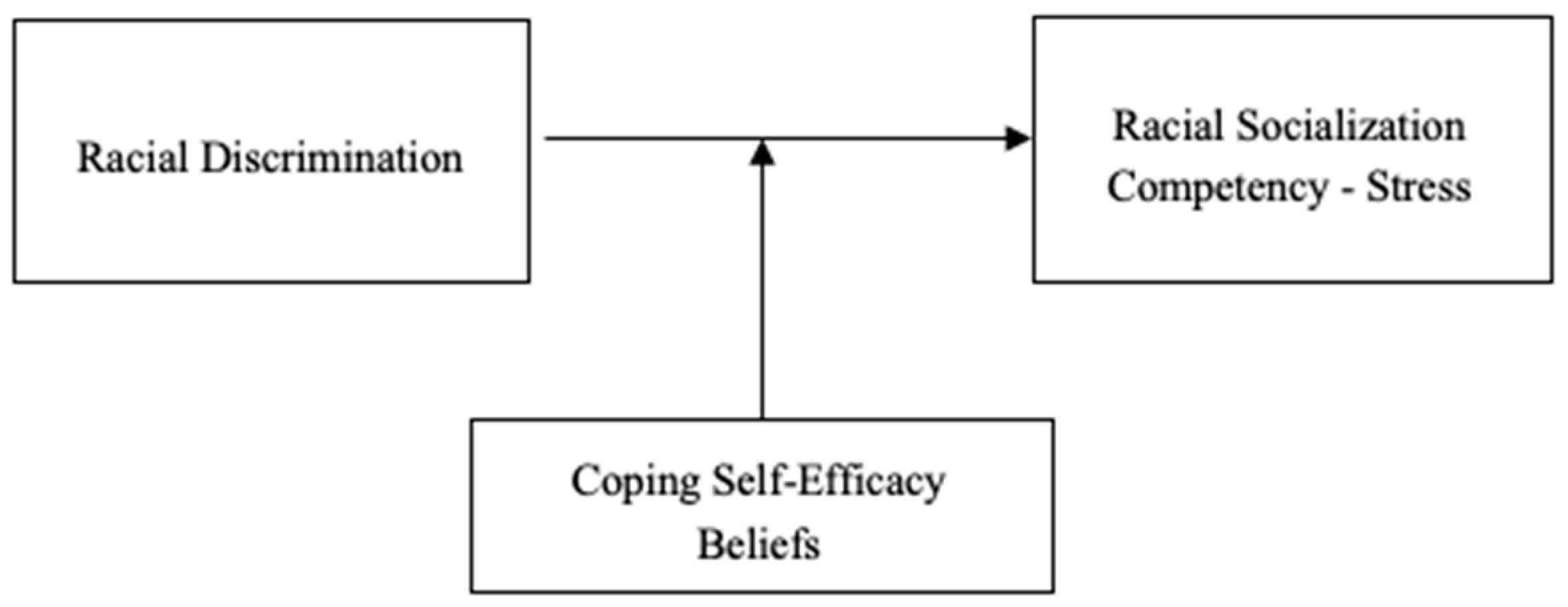
5. Guiding Framework
6. Current Study
Positionality Statement
7. Method
7.1. Participants
7.2. Procedure
7.3. Measures
Racial Discrimination
- Moderators
- Socialization Outcome
7.4. Data Analyses Plan
8. Results
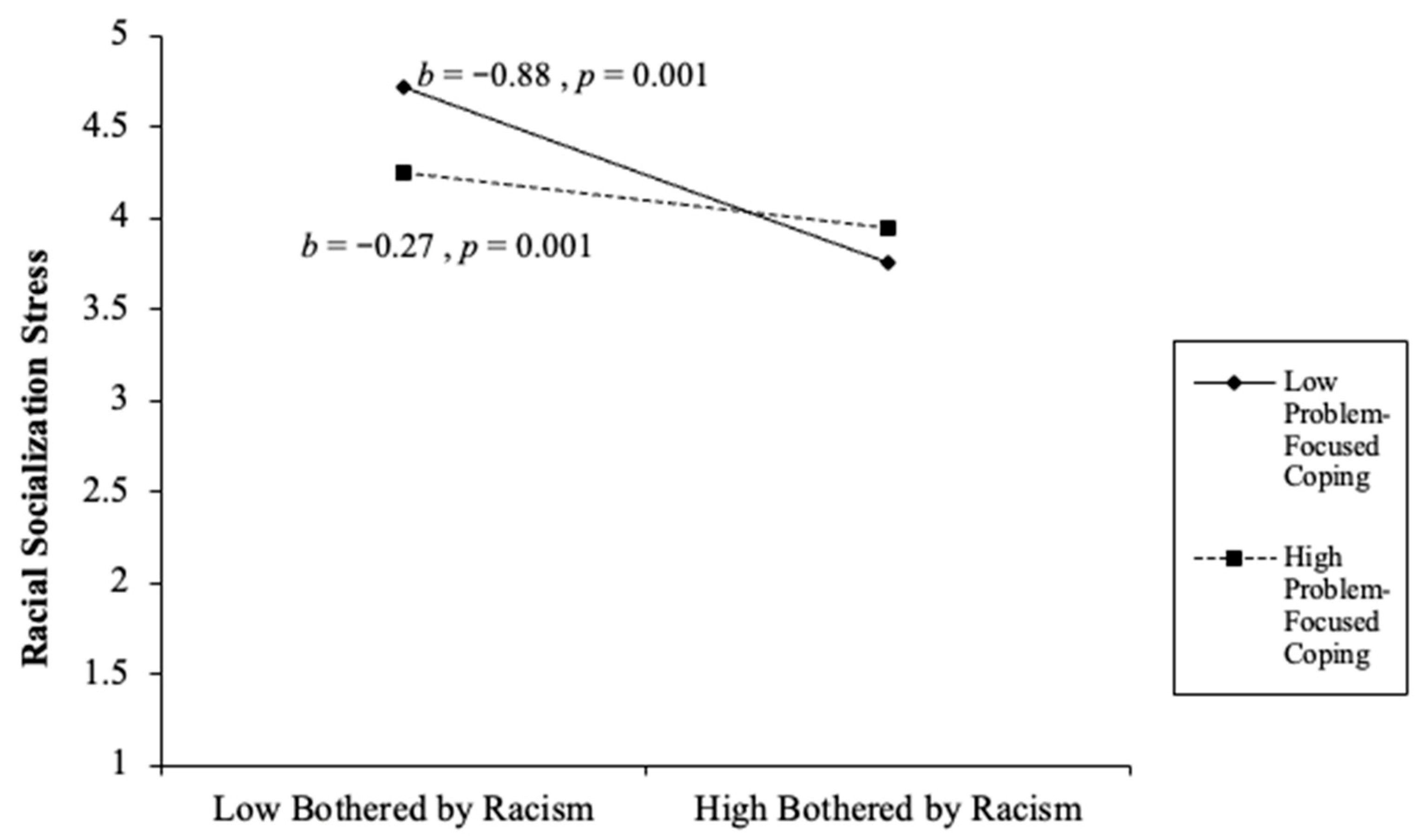
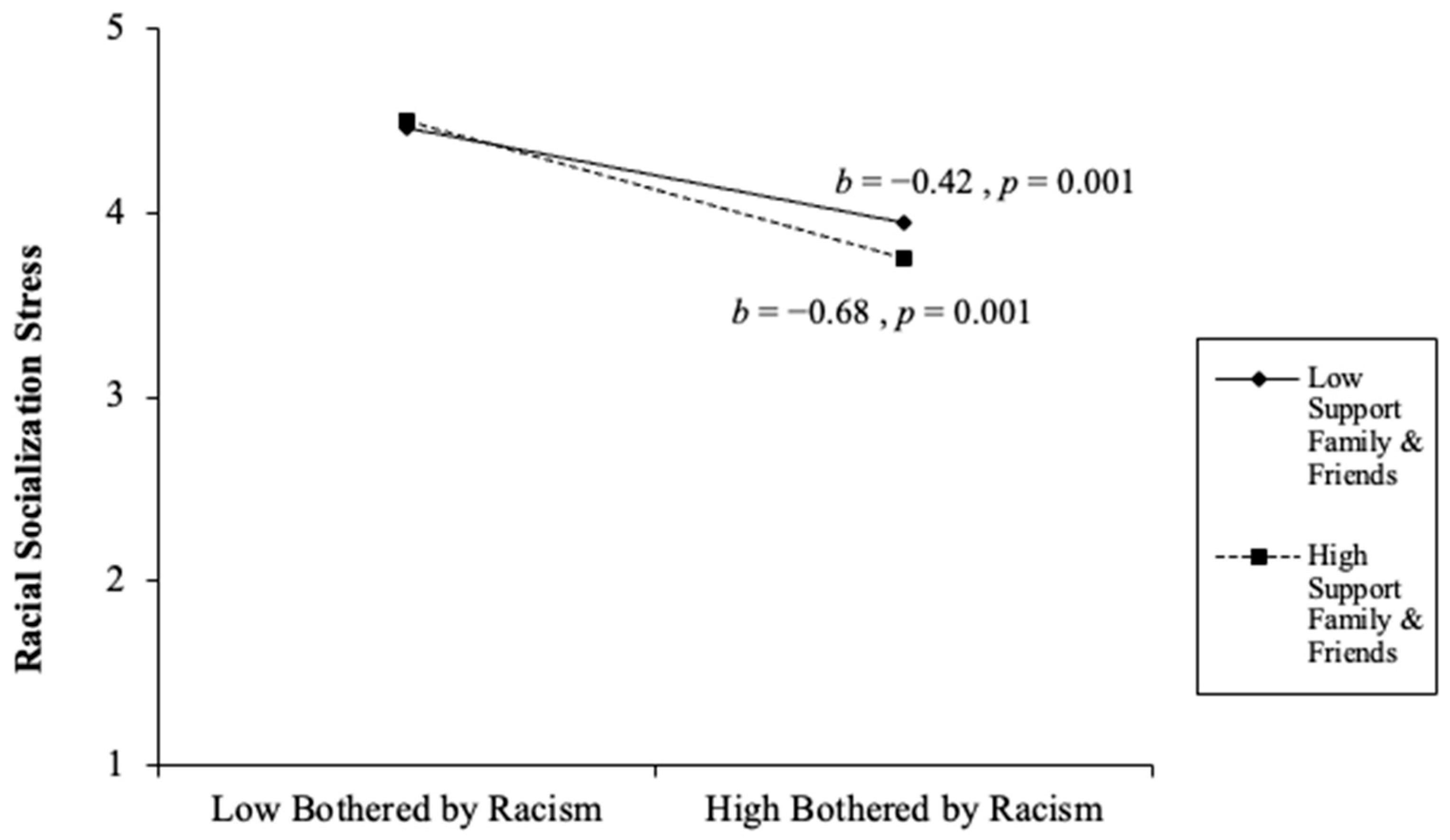
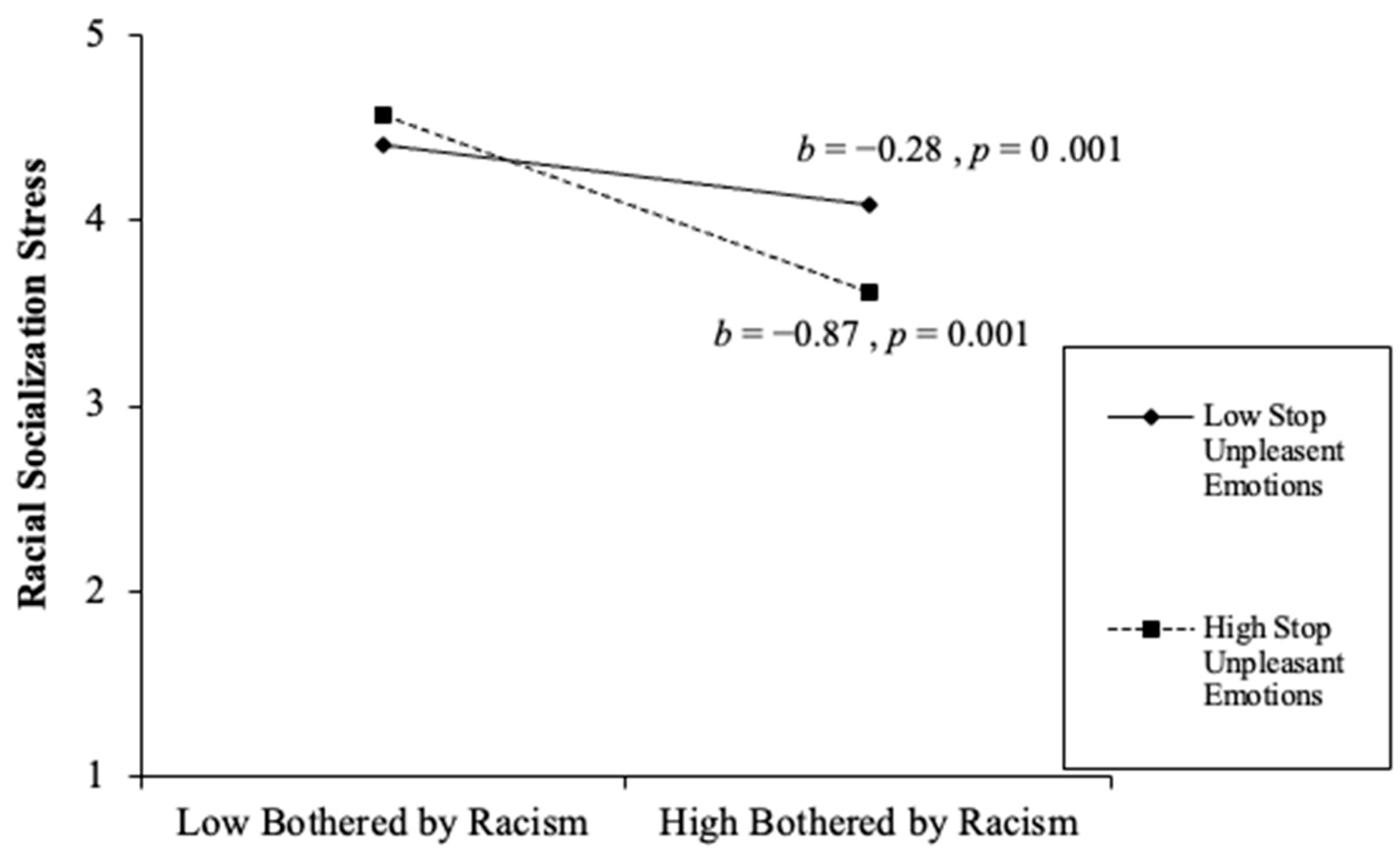
Racial Socialization Stress
9. Discussion
9.1. Problem-Focused Coping Self-Efficacy
9.2. Support Seeking Self Efficacy
9.3. Stopping Unpleasant Emotions Self-Efficacy
9.4. Implications
9.5. Strengths and Limitations
10. Conclusions
Author Contributions
Funding
Institutional Review Board Statement
Informed Consent Statement
Data Availability Statement
Conflicts of Interest
References
- Aiken, L. S., & West, S. G. (1991). Multiple regression: Testing and interpreting interactions. Sage Publications. [Google Scholar]
- Anderson, R. E., Johnson, N., Jones, S. C. T., Patterson, A., & Anyiwo, N. (2024). Racial socialization and black adolescent mental health and developmental outcomes: A critical review and future directions. Journal of Clinical Child & Adolescent Psychology, 53(5), 709–732. [Google Scholar] [CrossRef] [PubMed]
- Anderson, R. E., Jones, S. C. T., Navarro, C. C., McKenny, M. C., Mehta, T. J., & Stevenson, H. C. (2018a). Addressing the mental health needs of black American youth and families: A case study from the EMBRace intervention. International Journal of Environmental Research and Public Health, 15(5), 898. [Google Scholar] [CrossRef] [PubMed]
- Anderson, R. E., Jones, S. C. T., Saleem, F. T., Metzger, I., Anyiwo, N., Nisbeth, K. S., Bess, K. D., Resnicow, K., & Stevenson, H. C. (2021). Interrupting the pathway from discrimination to black adolescents’ psychosocial outcomes: The contribution of parental racial worries and racial socialization competency. Child Development, 92(6), 2375–2394. [Google Scholar] [CrossRef] [PubMed]
- Anderson, R. E., McKenny, M., & Stevenson, H. C. (2018b). EMBRace: Developing a racial socialization intervention to reduce racial stress and enhance racial coping among black parents and adolescents. Family Process, 58(1), 53–67. [Google Scholar] [CrossRef]
- Anderson, R. E., & Stevenson, H. C. (2019). RECASTing racial stress and trauma: Theorizing the healing potential of racial socialization in families. American Psychologist, 74(1), 63–75. [Google Scholar] [CrossRef]
- Banaji, M. R., Fiske, S. T., & Massey, D. S. (2021). Systemic racism: Individuals and interactions, institutions and society. Cognitive Research Principles and Implications, 6(1), 82. [Google Scholar] [CrossRef]
- Bandura, A. (1997). Self-efficacy: The exercise of control. W.H. Freeman. [Google Scholar]
- Brondolo, E., Brady Ver Halen, N., Pencille, M., Beatty, D., & Contrada, R. J. (2009). Coping with racism: A selective review of the literature and a theoretical and methodological critique. Journal of Behavioral Medicine, 32(1), 64–88. [Google Scholar] [CrossRef]
- Brooks Stephens, J. R., Jones, S. C., Madubata, I. J., Mitchell, S., Walker, R. L., & Anderson, R. E. (2023). It runs in the family: Parent racial worries and youth internalizing problems within Black families. Journal of Child and Family Studies, 32(10), 3106–3119. [Google Scholar] [CrossRef]
- Caldwell, C., Jr., Shears, J., Miller, D., & Jordan, T. (2026). Preparing and protecting: Black fathers’ racial socialization practices with their daughters. Families in Society: The Journal of Contemporary Social Services. [Google Scholar] [CrossRef]
- Carter, R. T. (2006). Race-based traumatic stress. Psychiatric Times, 23(14), 37. Available online: https://www.psychiatrictimes.com/view/race-based-traumatic-stress/ (accessed on 1 December 2025).
- Charity-Parker, B. M., & Adams-Bass, V. N. (2023). Exploring black youth’s belief in racial socialization across parental and non-parental agents. Journal of Child and Family Studies, 32(10), 3213–3230. [Google Scholar] [CrossRef]
- Chesney, M. A., Neilands, T. B., Chambers, D. B., Taylor, J. M., & Folkman, S. (2006). A validity and reliability study of the coping self-efficacy scale. British Journal of Health Psychology, 11(3), 421–437. [Google Scholar] [CrossRef] [PubMed]
- Christophe, N. K., Stein, G. L., Kiang, L., Johnson, N. C., Jones, S. C. T., Stevenson, H. C., Anyiwo, N., & Anderson, R. E. (2022). A 21st century take on racial-ethnic socialization: Patterns of competency and content among diverse parents of color. Social Sciences, 11(2), 88. [Google Scholar] [CrossRef]
- Cohen, J., & Cohen, P. (1983). Applied multiple regression/correlation analysis for the behavioral sciences (2nd ed.). Erlbaum. [Google Scholar]
- Cole, T. A., Dubuclet, C. M., Valentine, J., Meyer, E. A., & Orcutt, H. K. (2024). Assessing the mediating role of emotion regulation and experiential avoidance within a posttraumatic stress disorder and racial trauma framework. Psychological Trauma: Theory, Research, Practice, and Policy, 16(2), 254–261. [Google Scholar] [CrossRef] [PubMed]
- Comas-Díaz, L., Hall, G. N., & Neville, H. A. (2019). Racial trauma: Theory, research, and healing: Introduction to the special issue. American Psychologist, 74(1), 1–5. [Google Scholar] [CrossRef]
- Compas, B. E., Connor-Smith, J. K., Saltzman, H., Thomsen, A. H., & Wadsworth, M. E. (2001). Coping with stress during childhood and adolescence: Problems, progress, and potential in theory and research. Psychological Bulletin, 127(1), 87–127. [Google Scholar] [CrossRef]
- Cooper, S. M., Robbins, P. A., Burnett, M., Mcbride, M., Shaheed, J., & Smith, N. A. (2020). African American fathers’ coping patterns: Implications for father-son involvement and race-related discussions. Journal of Applied Developmental Psychology, 70, 101163. [Google Scholar] [CrossRef]
- Galán, C. A., Yu, A. C., O’Connor, J., Akinbola, D. T., & Anderson, R. E. (2021). Having the talk when our little ones just learned to walk: Racial socialization with young children in contemporary times. Infant and Child Development, 31(1), e2276. [Google Scholar] [CrossRef]
- Glanz, K., Rimer, B. K., & Viswanath, K. (Eds.). (2008). Health behavior and health education: Theory, research, and practice (4th ed.). Jossey-Bass. [Google Scholar]
- Graham, J. R., Calloway, A., & Roemer, L. (2015). The buffering effects of emotion regulation in the relationship between experiences of racism and anxiety in a Black American sample. Cognitive Therapy and Research, 39(5), 553–563. [Google Scholar] [CrossRef]
- Hankerson, S. H., Moise, N., Wilson, D., Waller, B. Y., Arnold, K. T., Duarte, C., Lugo-Candelas, C., Weissman, M. M., Wainberg, M., Yehuda, R., & Shim, R. (2022). The intergenerational impact of structural racism and cumulative trauma on depression. American Journal of Psychiatry, 179(6), 434–440. [Google Scholar] [CrossRef]
- Harrell, S. P. (1997). Racism and life experiences scales: Racial hassles (RaLES) [Database record]. APA PsycTests. [Google Scholar] [CrossRef]
- Hirschman, C., Alba, R., & Farley, R. (2000). The meaning and measurement of race in the US census: Glimpses into the future. Demography, 37(3), 381–393. [Google Scholar] [CrossRef]
- Hughes, D., Rodriguez, J., Smith, E. P., Johnson, D. J., Stevenson, H. C., & Spicer, P. (2006). Parents’ ethnic-racial socialization practices: A review of research and directions for future study. Developmental Psychology, 42(5), 747–770. [Google Scholar] [CrossRef]
- Jacob, G., Faber, S. C., Faber, N., Bartlett, A., Ouimet, A. J., & Williams, M. T. (2022). A systematic review of black people coping with racism: Approaches, analysis, and empowerment. Perspectives on Psychological Science, 18(2), 392–415. [Google Scholar] [CrossRef] [PubMed]
- Jones, J. M. (1997). Prejudice and racism (2nd ed.). McGraw-Hill. [Google Scholar]
- Jones, S. C. T., Anderson, R. E., & Stevenson, H. C. (2021a). Differentiating competency from content: Parental racial socialization profiles and their associated factors. Family Process, 61(2), 705–721. [Google Scholar] [CrossRef] [PubMed]
- Jones, S. C. T., Anderson, R. E., & Stevenson, H. C. (2021b). Not the same old song and dance: Viewing racial socialization through a family systems lens to resist racial trauma. Adversity and Resilience Science, 2(4), 225–233. [Google Scholar] [CrossRef]
- Jones, S. C. T., Simon, C., Yadeta, K., Patterson, A., & Anderson, R. E. (2023). When resilience is not enough: Imagining novel approaches to supporting Black youth navigating racism. Development and Psychopathology, 35(5), 2132–2140. [Google Scholar] [CrossRef]
- Kazmierski, K. F. M., Borelli, J. L., & Rao, U. (2023). Multidimensional discrimination distress, controlling parenting, and parent–adolescent attachment relationships: Racial/ethnic differences. Journal of Social Issues, 79(1), 334–359. [Google Scholar] [CrossRef]
- Lazarus, R. S., & Folkman, S. (1984). Stress, appraisal, and coping. Springer Publishing Company. [Google Scholar]
- Lesane-Brown, C. L. (2006). A review of race socialization within Black families. Developmental Review, 26(4), 400–426. [Google Scholar] [CrossRef]
- McNeil Smith, S. M. N., Reynolds, J. E., Fincham, F. D., & Beach, S. R. H. (2016). Parental experiences of racial discrimination and youth racial socialization in two-parent African American families. Cultural Diversity and Ethnic Minority Psychology, 22(2), 268–276. [Google Scholar] [CrossRef]
- Moody, M. D. (2022). Vicarious experiences of major discrimination and the life satisfaction of black and white adults from a community sample. Journal of Happiness Studies, 23, 2725–2743. [Google Scholar] [CrossRef]
- Murry, V. M., Butler-Barnes, S. T., Mayo-Gamble, T. L., & Inniss-Thompson, M. N. (2018). Excavating new constructs for family stress theories in the context of everyday life experiences of black American families. Journal of Family Theory & Review, 10(2), 384–405. [Google Scholar] [CrossRef]
- Osborne, K. R., Caughy, M. O., Oshri, A., Smith, E. P., & Owen, M. T. (2020). Racism and preparation for bias within African American families. Cultural Diversity & Ethnic Minority Psychology, 27(2), 269–279. [Google Scholar] [CrossRef]
- Paige, J. W. (2022). Examining the loss of wealth and downward mobility of African Americans: A review of challenges for the black middle class. RAND Corporation. [Google Scholar] [CrossRef]
- Park, C. L., Edmondson, D., & Lee, J. (2012). Development of self-regulation abilities as predictors of psychological adjustment across the first year of college. Journal of Adult Development, 19(1), 40–49. [Google Scholar] [CrossRef]
- Pascoe, E. A., & Smart Richman, L. (2009). Perceived discrimination and health: A meta-analytic review. Psychological Bulletin, 135(4), 531–554. [Google Scholar] [CrossRef] [PubMed]
- Patel, J., & Patel, P. (2019). Consequences of repression of emotion: Physical health, mental health and general well being. International Journal of Psychotherapy Practice and Research, 1(3), 16–21. [Google Scholar] [CrossRef]
- Peterson, G. W., Hennon, C. B., & Knox, T. (2010). Conceptualizing parental stress with family stress theory. In Families and change: Coping with stressful events and transitions (pp. 25–48). SAGE. [Google Scholar]
- Pew Research Center. (2024, June 15). Most black Americans believe U.S. institutions were designed to hold black people back. Pew Research Center. [Google Scholar]
- Richardson, B. L., Macon, T. A., Mustafaa, F. N., Bogan, E. D., Cole-Lewis, Y., & Chavous, T. M. (2015). Associations of racial discrimination and parental discrimination coping messages with African American adolescent racial identity. Journal of Youth and Adolescence, 44, 1301–1317. [Google Scholar] [CrossRef]
- Saleem, F. T., Anderson, R. E., & Williams, M. (2025). The talk and walk in black families: Exploring racial socialization stress and worry in the context of parents’ and adolescents’ discrimination experiences. Family Process, 64(1), 221–236. [Google Scholar] [CrossRef]
- Saleem, F. T., English, D., Busby, D. R., Lambert, S. F., Harrison, A., Stock, M. L., & Gibbons, F. X. (2016). The impact of African American parents’ racial discrimination experiences and perceived neighborhood cohesion on their racial socialization practices. Journal of Youth and Adolescence, 45(7), 1338–1349. [Google Scholar] [CrossRef]
- Saperstein, A., & Penner, A. M. (2012). Racial fluidity and inequality in the United States. American Journal of Sociology, 118(3), 676–727. [Google Scholar] [CrossRef]
- Smith, N. A., McDonald, A., Wei, W., Johnson, S. A., Adeji, D., & Witherspoon, D. P. (2022). Embracing race, resisting oppression: African American parents as experienced guides for navigating racial oppression: Dismantling systems of racism and oppression during adolescence. Journal of Research on Adolescence: The Official Journal of the Society for Research on Adolescence, 32(1), 115–133. [Google Scholar] [CrossRef]
- Smith-Bynum, M. A., Anderson, R. E., Davis, B. L., Franco, M. G., & English, D. (2016). Observed racial socialization and maternal positive emotions in African American mother–adolescent discussions about racial discrimination. Child Development, 87(6), 1926–1939. [Google Scholar] [CrossRef]
- Thoits, P. A. (2011). Mechanisms linking social ties and support to physical and mental health. Journal of Health and Social Behavior, 52(2), 145–161. [Google Scholar] [CrossRef]
- Thomas, A. J., & Blackmon, S. M. (2015). The influence of the Trayvon martin shooting on racial socialization practices of African American parents. Journal of Black Psychology, 41(1), 75–89. [Google Scholar] [CrossRef]
- Utsey, S. O., & Ponterotto, J. G. (1996). Development and validation of the Index of Race-Related Stress (IRRS). Journal of Counseling Psychology, 43(4), 490–501. [Google Scholar] [CrossRef]
- Ventura, I. M., & Flores, R. D. (2025). The “rise” of multiracials? Examining the growth in multiracial identification in the 2020 US census. RSF: The Russell Sage Foundation Journal of the Social Sciences, 11(1), 44–64. [Google Scholar] [CrossRef]
- Williams, D. R. (2018). Stress and the mental health of populations of color: Advancing our understanding of race-related stressors. Journal of Health and Social Behavior, 59(4), 466–485. [Google Scholar] [CrossRef]
- Willis, H. A., Polanco-Roman, L., Derella, O. J., & Zayde, A. (2024). Emotional impacts of racial discrimination on caregiver-child dyads: Can mentalizing-focused parenting groups buffer against racism-related stress? Development and Psychopathology, 37(2), 684–695. [Google Scholar] [CrossRef]
- Wills, T. A., & Shinar, O. (2000). Measuring perceived and received social support. In S. Cohen, L. G. Underwood, & B. H. Gottlieb (Eds.), Social support measurement and intervention: A guide for health and social scientists (pp. 86–135). Oxford University Press. [Google Scholar]
- Wilson, T., & Gentzler, A. L. (2021). Emotion regulation and coping with racial stressors among African Americans across the lifespan. Developmental Review, 61, 100967. [Google Scholar] [CrossRef]



| M | SD | |
|---|---|---|
| Age | 37.29 | 3.64 |
| Education | 4.29 | 0.699 |
| Income | 2.20 | 0.514 |
| Number of Children | 2.09 | 0.737 |
| Racial Socialization Stress | 3.45 | 0.735 |
| Racial Discrimination | 3.88 | 0.535 |
| Problem-Focused Coping | 6.87 | 0.747 |
| Stop Unpleasant Thoughts & Emotions | 6.88 | 0.794 |
| Support from Family & Friends | 6.88 | 0.875 |
| Variables | 1 | 2 | 3 | 4 | 5 | 6 | 7 | 8 |
|---|---|---|---|---|---|---|---|---|
| 1. Age | ||||||||
| 2. Education | −0.15 ** | |||||||
| 3. Income | −0.07 | 0.23 ** | ||||||
| 4. Number of Children | 0.31 ** | 0.28 ** | −0.23 ** | |||||
| 5. Racial Discrimination | −0.18 * | −0.17 ** | 0.38 ** | −0.49 ** | ||||
| 6. Unpleasant Thoughts | −0.14 ** | 0.16 ** | 0.28 ** | −0.13 ** | 0.29 ** | |||
| 7. Problem-Focused Coping | −0.05 | 0.28 ** | 0.24 ** | 0.02 | 0.11 ** | 0.78 ** | ||
| 8. Support from Family & Friends | −0.09 * | 0.17 * | 0.21 ** | −0.04 | 0.17 ** | 0.68 ** | 0.69 ** | |
| 9. Racial Socialization Stress | 0.16 ** | 0.15 ** | −0.45 ** | 0.42 ** | −0.65 ** | −0.40 ** | −0.27 ** | −0.30 ** |
| B (SE) | β | p | |
|---|---|---|---|
| Model 1 | |||
| Age | 0.01 (0.01) | 0.01 | 0.656 |
| Education | −0.44 (0.04) | −0.42 | 0.001 *** |
| Number of Children | 0.26 (0.04) | 0.26 | 0.001 *** |
| Income | 0.24 (0.05) | 0.16 | 0.001 *** |
| Gender (1 = Mothers, 0 = Fathers/Stepfathers) | −0.06 (0.05) | −0.04 | 0.201 |
| Model 2 | |||
| Age | 0.01 (0.01) | 0.01 | 0.843 |
| Education | −0.27 (0.03) | −0.26 | 0.001 *** |
| Number of Children | 0.08 (0.03) | 0.08 | 0.013 * |
| Income | 0.14 (0.04) | 0.09 | 0.001 *** |
| Gender (1 = Mothers, 0 = Fathers/Stepfathers) | −0.04 (0.04) | −0.02 | 0.319 |
| Racial Discrimination | −0.66 (0.04) | −0.49 | 0.001 *** |
| Model 3 | |||
| Age | −0.05 (0.01) | −0.02 | 0.386 |
| Education | −0.24 (0.03) | −0.22 | 0.001 *** |
| Number of Children | 0.09 (0.03) | 0.09 | 0.004 ** |
| Income | 0.22 (0.04) | 0.15 | 0.001 *** |
| Gender (1 = Mothers, 0 = Fathers/Stepfathers) | −0.09 (0.04) | −0.06 | 0.019 * |
| Racial Discrimination | −0.58 (0.04) | −0.43 | 0.001 *** |
| Problem-Focused Coping | −0.06 (0.04) | −0.06 | 0.130 |
| Stop Unpleasant Thoughts & Emotions | −0.11 (0.04) | −0.12 | 0.005 ** |
| Support from Family & Friends | −0.07 (0.03) | −0.08 | 0.029 * |
| Model 4 | |||
| Age | −0.08 (0.01) | −0.38 | 0.155 |
| Education | −0.22 (0.03) | −0.21 | 0.001 *** |
| Number of Children | 0.09 (0.03) | 0.09 | 0.002 ** |
| Income | 0.20 (0.04) | 0.14 | 0.001 *** |
| Gender (1 = Mothers, 0 = Fathers/Stepfathers) | −0.08 (0.04) | −0.05 | 0.029 * |
| Racial Discrimination | −0.57 (0.04) | −0.43 | 0.001 *** |
| Problem-Focused Coping | −0.09 (0.04) | −0.09 | 0.028 * |
| Stop Unpleasant Thoughts & Emotions | −0.10 (0.04) | −0.10 | 0.014 * |
| Support from Family & Friends | −0.04 (0.03) | −0.05 | 0.162 |
| Racism × Problem-Focused Coping | 0.40 (0.07) | 0.23 | 0.001 *** |
| Racism × Stop Unpleasant Thoughts & Emotion | −0.12 (0.05) | −0.07 | 0.026 * |
| Racism × Support from Family & Friends | −0.37 (0.06) | −0.20 | 0.001 *** |
Disclaimer/Publisher’s Note: The statements, opinions and data contained in all publications are solely those of the individual author(s) and contributor(s) and not of MDPI and/or the editor(s). MDPI and/or the editor(s) disclaim responsibility for any injury to people or property resulting from any ideas, methods, instructions or products referred to in the content. |
© 2026 by the authors. Licensee MDPI, Basel, Switzerland. This article is an open access article distributed under the terms and conditions of the Creative Commons Attribution (CC BY) license.
Share and Cite
Sargent, E.; Debreaux, M.; Butler-Barnes, S.T.; Smith, I.; Peoples, J. Strength Amid Strain: Coping, Racism, and Racial Socialization Stress in Black Caregivers. Behav. Sci. 2026, 16, 326. https://doi.org/10.3390/bs16030326
Sargent E, Debreaux M, Butler-Barnes ST, Smith I, Peoples J. Strength Amid Strain: Coping, Racism, and Racial Socialization Stress in Black Caregivers. Behavioral Sciences. 2026; 16(3):326. https://doi.org/10.3390/bs16030326
Chicago/Turabian StyleSargent, Emani, Marlena Debreaux, Sheretta T. Butler-Barnes, Ivy Smith, and JaNiene Peoples. 2026. "Strength Amid Strain: Coping, Racism, and Racial Socialization Stress in Black Caregivers" Behavioral Sciences 16, no. 3: 326. https://doi.org/10.3390/bs16030326
APA StyleSargent, E., Debreaux, M., Butler-Barnes, S. T., Smith, I., & Peoples, J. (2026). Strength Amid Strain: Coping, Racism, and Racial Socialization Stress in Black Caregivers. Behavioral Sciences, 16(3), 326. https://doi.org/10.3390/bs16030326