

Uncertainty as a Gateway to Beauty: The Impact of Uncertainty Reduction on Art Appreciation


Abstract
1. Introduction
2. Study 1
2.1. Method (Study 1)
2.1.1. Study 1 Participants
2.1.2. Materials (Study 1)
2.1.3. Study 1 Procedure
2.2. Data Analyses
2.3. Results for Study 1
2.3.1. Manipulation Check (Study 1)
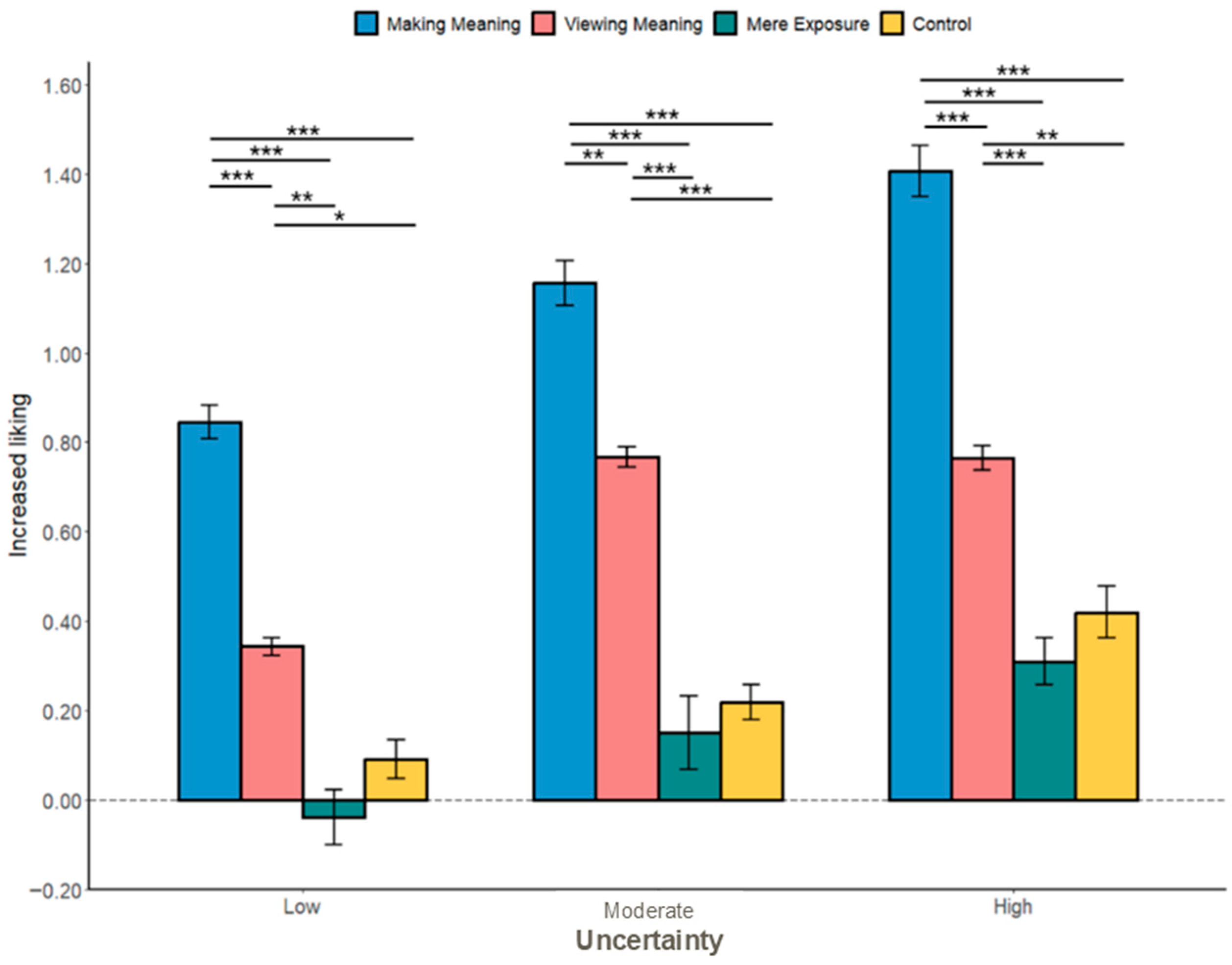
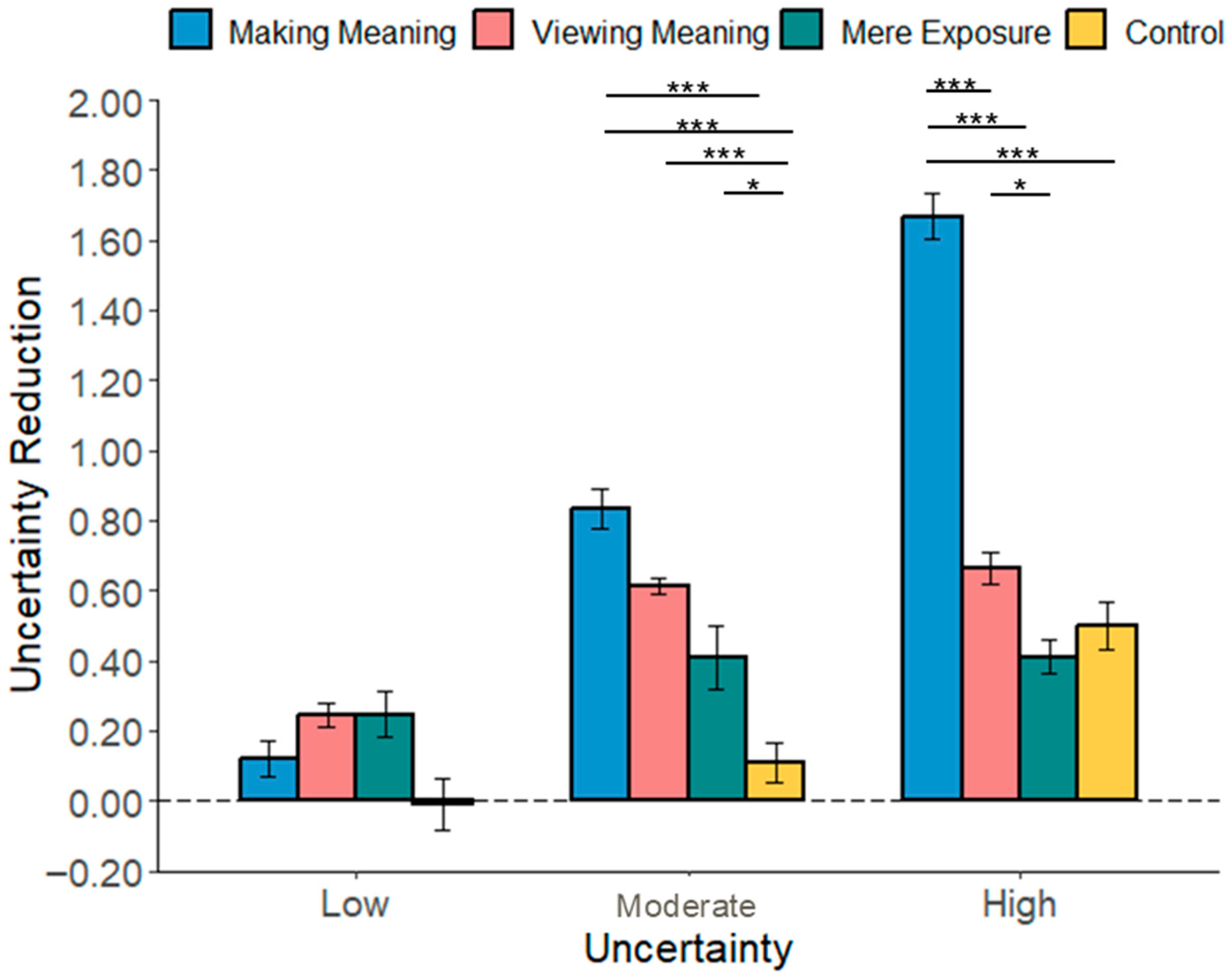
2.3.2. Effects of Uncertainty Reduction Modes on Uncertainty and Aesthetic Experience
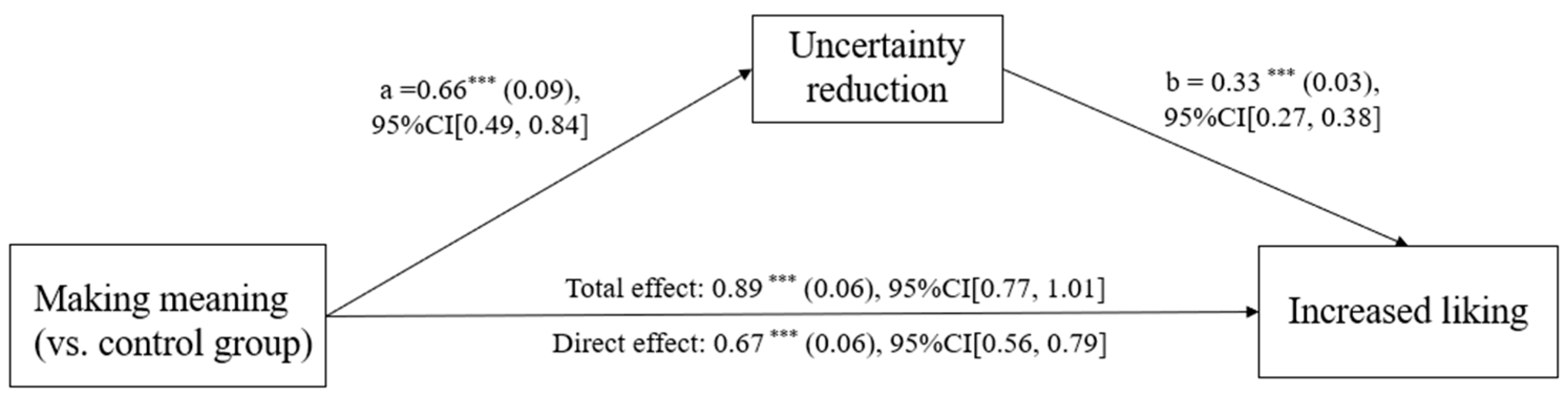
2.3.3. The Mediating Role of Perceived Uncertainty Reduction
2.4. Discussion (Study 1)
3. Study 2
3.1. Method (Study 2)
3.1.1. Participants (Study 2)
3.1.2. Study 2 Procedure
3.2. Results (Study 2)
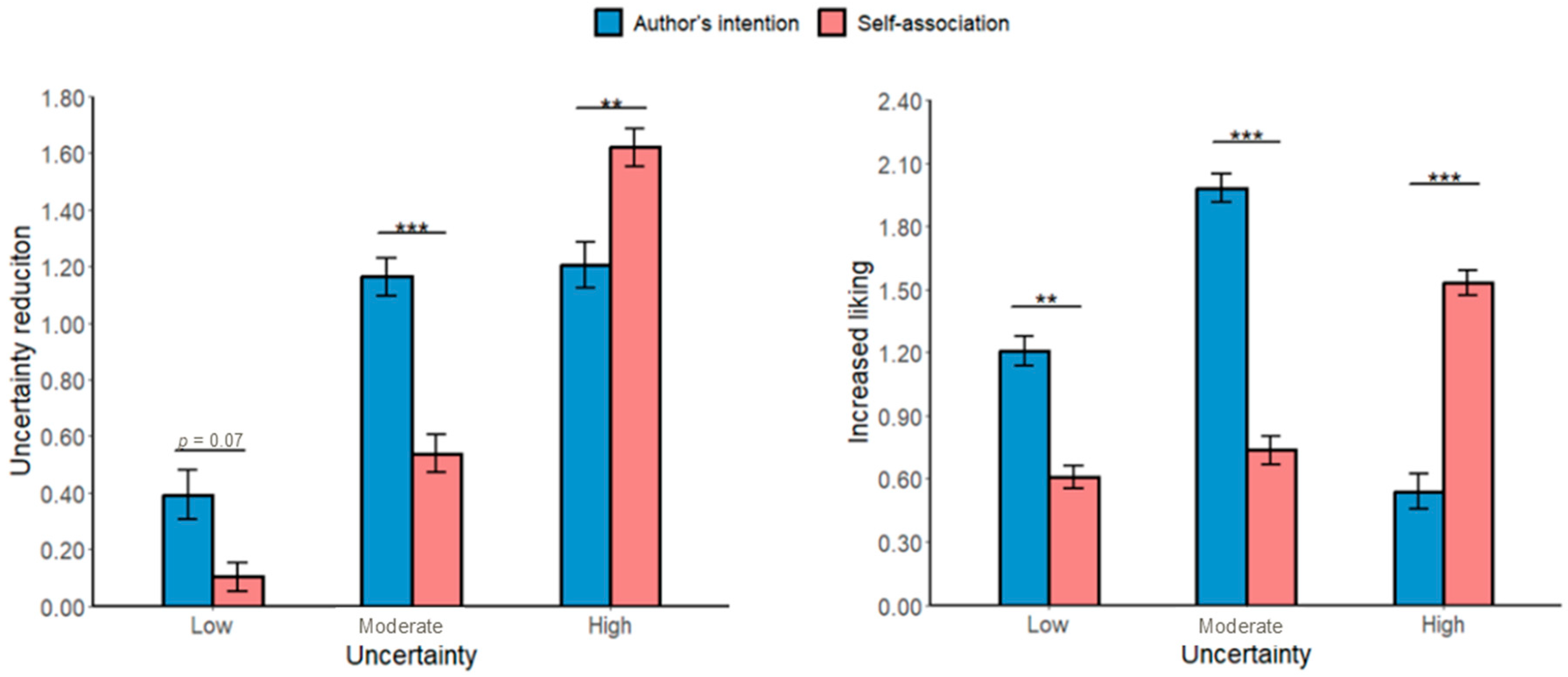
3.2.1. Type of Meaning-Making and Uncertainty Reduction
3.2.2. Increased Liking
3.2.3. Increased Beauty (Study 2)
3.2.4. Boredom Reduction (Study 2)
3.2.5. Increased Pleasure (Study 2)
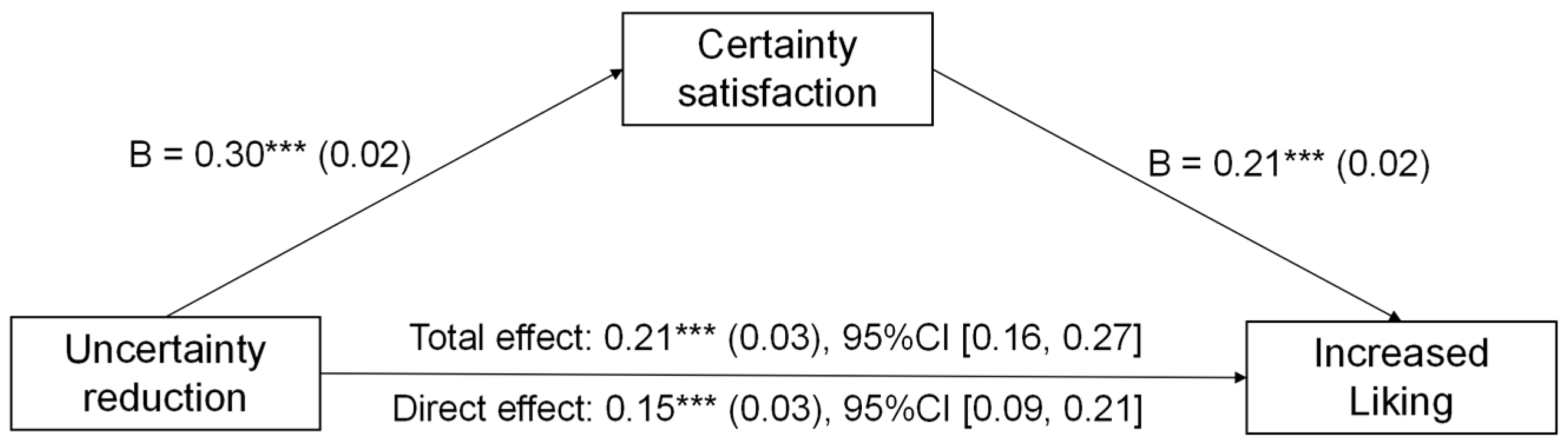
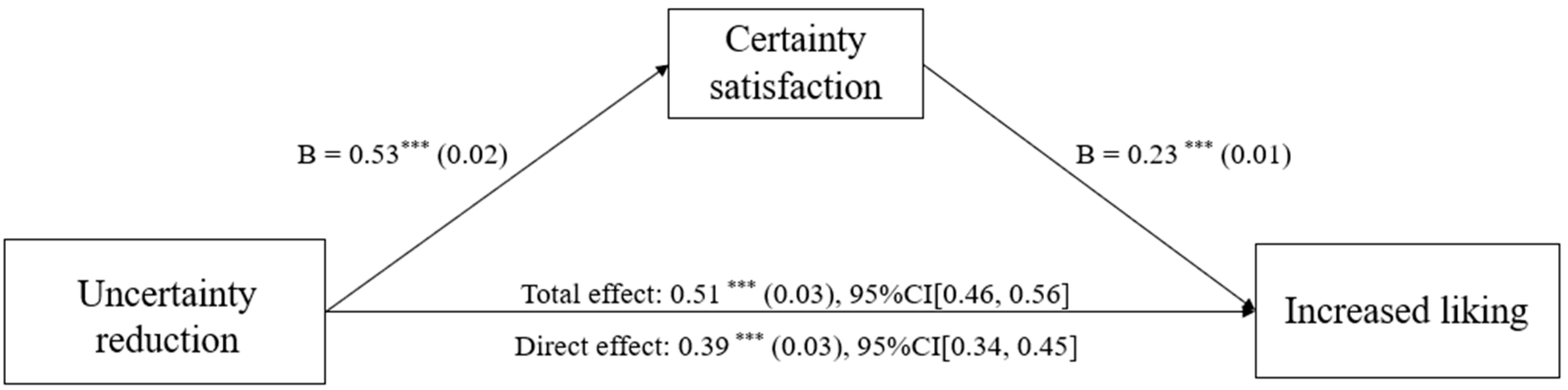
3.2.6. Mediation via the Satisfaction of Certainty Needs
3.3. Discussion (Study 2)
4. Study 3
4.1. Method for Study 3
4.1.1. Participants for Study 3
4.1.2. Materials for Study 3
4.1.3. Study 3 Procedure
4.2. Results (Study 3)
4.2.1. Manipulation Check for Study 3
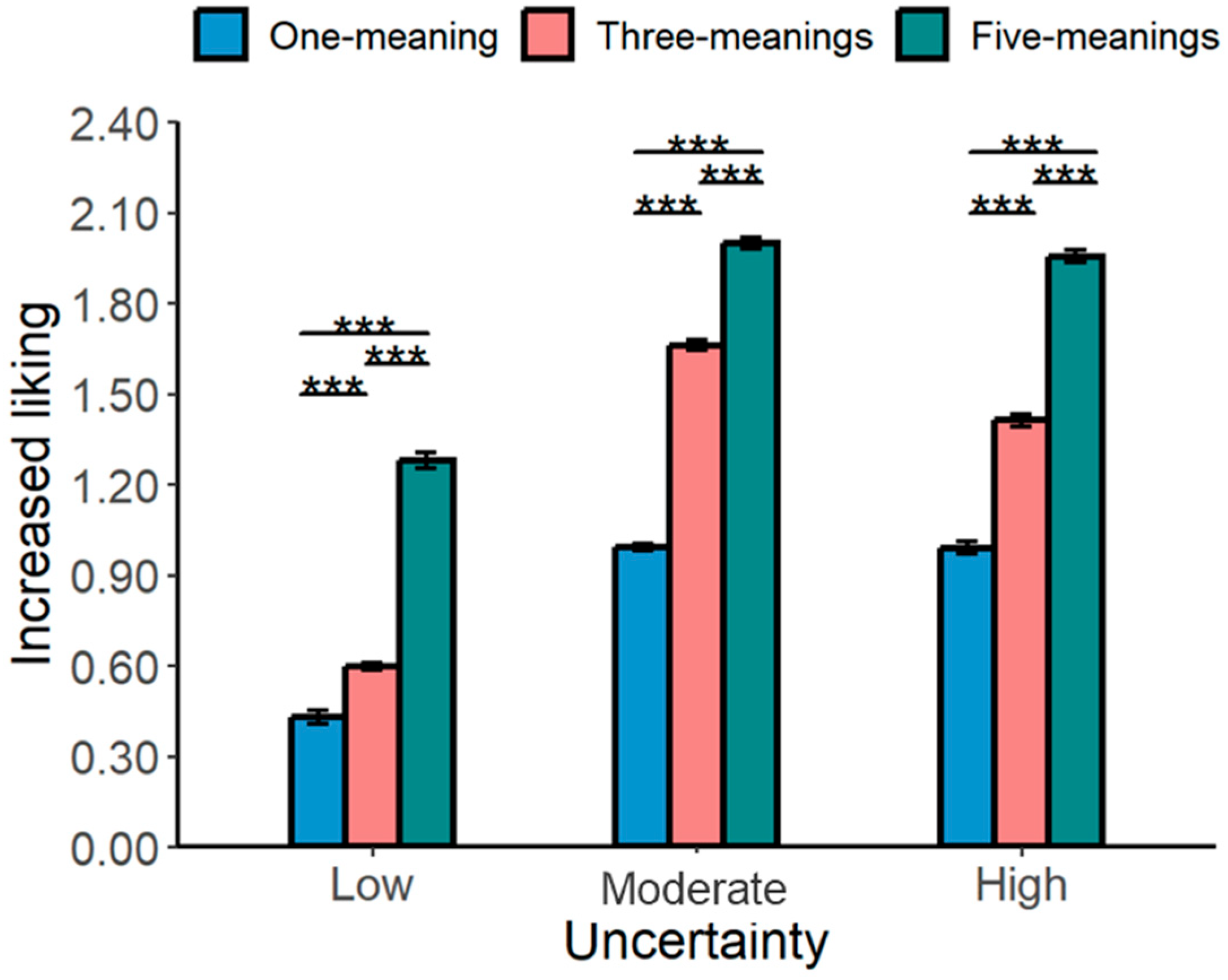
4.2.2. Number of Meanings and Increased Liking
4.2.3. Increased Beauty (Study 3)
4.2.4. Boredom Reduction (Study 3)
4.2.5. Increased Pleasure (Study 3)
4.2.6. Mediating Effects of Certainty Satisfaction
4.2.7. Moderated Mediation
4.3. Discussion (Study 3)
5. General Discussion
5.1. Theoretical Contributions
5.2. Practical Implications
5.3. Limitations and Future Directions
Supplementary Materials
Author Contributions
Funding
Institutional Review Board Statement
Informed Consent Statement
Data Availability Statement
Conflicts of Interest
References
- Bao, H. W. S. (2023). bruceR: Broadly Useful Convenient and Efficient R Functions. R package version 2.1.0. Available online: https://CRAN.R-project.org/package=bruceR (accessed on 13 February 2026).
- Bartlett, F. C. (1932). Remembering: A study in experimental and social psychology. Cambridge University Press. [Google Scholar]
- Bates, D., Mächler, M., Bolker, B., & Walker, S. (2015). Fitting linear mixed-effects models using lme4. arXiv, arXiv:1406.5823. [Google Scholar] [CrossRef]
- Belke, B., Leder, H., & Carbon, C. C. (2015). When challenging art gets liked: Evidences for a dual preference formation process for fluent and non-fluent portraits. PLoS ONE, 10(8), e0131796. [Google Scholar] [CrossRef]
- Belke, B., Leder, H., Strobach, T., & Carbon, C.-C. (2010). Cognitive fluency: High-level processing dynamics in art appreciation. Psychology of Aesthetics, Creativity, and the Arts, 4(4), 214–222. [Google Scholar] [CrossRef]
- Berlyne, D. E. (1970). Novelty, complexity, and hedonic value. Perception & Psychophysics, 8(5), 279–286. [Google Scholar] [CrossRef]
- Brielmann, A. A., & Dayan, P. (2022). A computational model of aesthetic value. Psychological Review, 129(6), 1319–1337. [Google Scholar] [CrossRef]
- Cheung, V. K. M., Harrison, P. M. C., Meyer, L., Pearce, M. T., Haynes, J.-D., & Koelsch, S. (2019). Uncertainty and surprise jointly predict musical pleasure and amygdala, hippocampus, and auditory cortex activity. Current Biology, 29(23), 4084–4092.e4. [Google Scholar] [CrossRef]
- Cohen, J. (1988). Statistical power analysis for the behavioral sciences (2nd ed.). Lawrence Erlbaum Associates. [Google Scholar]
- Crowley, D. J. (1958). Aesthetic judgment and cultural relativism. The Journal of Aesthetics and Art Criticism, 17(2), 187–193. [Google Scholar] [CrossRef]
- Csikszentmihalyi, M. (2000). Flow: The psychology of optimal experience. Harper Perennial Modern Classics. [Google Scholar]
- Danckert, J., & Elpidorou, A. (2023). In search of boredom: Beyond a functional account. Trends in Cognitive Sciences, 27(5), 494–507. [Google Scholar] [CrossRef]
- Dewey, J. (1929). The quest for certainty (p. 318). Minton, Balch. [Google Scholar]
- Drake, J. E., Papazian, K., & Grossman, E. (2024). Gravitating toward the arts during the COVID-19 pandemic. Psychology of Aesthetics, Creativity, and the Arts, 18(4), 654–665. [Google Scholar] [CrossRef]
- Faul, F., Erdfelder, E., Lang, A.-G., & Buchner, A. (2007). G*Power 3: A flexible statistical power analysis program for the social, behavioral, and biomedical sciences. Behavior Research Methods, 39(2), 175–191. [Google Scholar] [CrossRef] [PubMed]
- Fox, J., & Weisberg, S. (2018). An R companion to applied regression. SAGE Publications. [Google Scholar]
- Frascaroli, J., Leder, H., Brattico, E., & Van de Cruys, S. (2024). Aesthetics and predictive processing: Grounds and prospects of a fruitful encounter. Philosophical Transactions of the Royal Society B: Biological Sciences, 379(1895), 20220410. [Google Scholar] [CrossRef]
- Friston, K. (2010). The free-energy principle: A unified brain theory? Nature Reviews Neuroscience, 11(2), 127–138. [Google Scholar] [CrossRef]
- Gao, J. (2019). Aesthetics and art: Traditional and contemporary China in a comparative perspective. Springer. [Google Scholar]
- Hayes, A. F., & Preacher, K. J. (2014). Statistical mediation analysis with a multicategorical independent variable. The British Journal of Mathematical and Statistical Psychology, 67(3), 451–470. [Google Scholar] [CrossRef] [PubMed]
- Hayes, A. F., & Scharkow, M. (2013). The relative trustworthiness of inferential tests of the indirect effect in statistical mediation analysis: Does method really matter? Psychological Science, 24(10), 1918–1927. [Google Scholar] [CrossRef]
- Hirsch, E. D. (1960). Objective interpretation. Publications of the Modern Language Association of America, 75(4), 463–479. [Google Scholar] [CrossRef]
- Hirsh, J. B., Mar, R. A., & Peterson, J. B. (2012). Psychological entropy: A framework for understanding uncertainty-related anxiety. Psychological Review, 119(2), 304–320. [Google Scholar] [CrossRef] [PubMed]
- Ingarden, R. S. (1965). Information theory and thermodynamics of light part II. Principles of information thermodynamics. Fortschritte Der Physik, 13(12), 755–805. [Google Scholar] [CrossRef]
- Iser, W. (1978). The act of reading: A theory of aesthetic response. Johns Hopkins University Press. [Google Scholar]
- Jakesch, M., Goller, J., & Leder, H. (2017). Positive fEMG patterns with ambiguity in paintings. Frontiers in Psychology, 8, 785. [Google Scholar] [CrossRef]
- Jakesch, M., & Leder, H. (2009). Finding meaning in art: Preferred levels of ambiguity in art appreciation. Quarterly Journal of Experimental Psychology, 62(11), 2105–2112. [Google Scholar] [CrossRef]
- Jauss, H. R. (1982). Poiesis. Critical Inquiry, 8(3), 591–608. [Google Scholar] [CrossRef]
- Kemp, W., & Meyer, R. (1985). Death at work: A case study on constitutive blanks in nineteenth-century painting. Representations, 10, 102–123. [Google Scholar] [CrossRef] [PubMed][Green Version]
- Kjørup, S. (1971). Æstetiske problemer: En indføring i kunstens filosofi. Roskilde Universitets Forlag. [Google Scholar]
- Kruglanski, A. W., & Webster, D. M. (1996). Motivated closing of the mind: “Seizing” and “freezing”. Psychological Review, 103(2), 263–283. [Google Scholar] [CrossRef]
- Kuznetsova, A., Brockhoff, P. B., & Christensen, R. H. B. (2017). lmerTest package: Tests in linear mixed effects models. Journal of Statistical Software, 82, 1–26. [Google Scholar] [CrossRef]
- Leder, H., Belke, B., Oeberst, A., & Augustin, D. (2004). A model of aesthetic appreciation and aesthetic judgments. British Journal of Psychology, 95(4), 489–508. [Google Scholar] [CrossRef]
- Lenth, R. V. (2024). emmeans: Estimated Marginal Means, aka Least-Squares Means. R package version 1.10.1. Available online: https://CRAN.R-project.org/package=emmeans (accessed on 13 February 2026).
- Leventhal, A. M., Martin, R. L., Seals, R. W., Tapia, E., & Rehm, L. P. (2007). Investigating the dynamics of affect: Psychological mechanisms of affective habituation to pleasurable stimuli. Motivation and Emotion, 31(2), 145–157. [Google Scholar] [CrossRef]
- Mas-Herrero, E., Dagher, A., & Zatorre, R. J. (2018). Modulating musical reward sensitivity up and down with transcranial magnetic stimulation. Nature Human Behaviour, 2(1), 27–32. [Google Scholar] [CrossRef]
- Matuschek, H., Kliegl, R., Vasishth, S., Baayen, H., & Bates, D. (2017). Balancing Type I error and power in linear mixed models. Journal of Memory and Language, 94, 305–315. [Google Scholar] [CrossRef]
- Menninghaus, W., Wagner, V., Hanich, J., Wassiliwizky, E., Jacobsen, T., & Koelsch, S. (2017). The distancing-embracing model of the enjoyment of negative emotions in art reception. Behavioral and Brain Sciences, 40, e347. [Google Scholar] [CrossRef]
- Menninghaus, W., Wagner, V., Wassiliwizky, E., Schindler, I., Hanich, J., Jacobsen, T., & Koelsch, S. (2019). What are aesthetic emotions? Psychological Review, 126(2), 171–195. [Google Scholar] [CrossRef] [PubMed]
- Mikuni, J., Specker, E., Pelowski, M., Leder, H., & Kawabata, H. (2022). Is there a general “art fatigue” effect? A cross-paradigm, cross-cultural study of repeated art viewing in the laboratory. Psychology of Aesthetics, Creativity, and the Arts, 16(2), 343–360. [Google Scholar] [CrossRef]
- Millis, K. (2001). Making meaning brings pleasure: The influence of titles on aesthetic experiences. Emotion, 1(3), 320–329. [Google Scholar] [CrossRef]
- Mrkva, K., & Van Boven, L. (2020). Salience theory of mere exposure: Relative exposure increases liking, extremity, and emotional intensity. Journal of Personality and Social Psychology, 118(6), 1118–1145. [Google Scholar] [CrossRef]
- Muth, C., Hesslinger, V. M., & Carbon, C.-C. (2015). The appeal of challenge in the perception of art: How ambiguity, solvability of ambiguity, and the opportunity for insight affect appreciation. Psychology of Aesthetics, Creativity, and the Arts, 9(3), 206–216. [Google Scholar] [CrossRef]
- Muth, C., Pepperell, R., & Carbon, C.-C. (2013). Give me gestalt! Preference for cubist artworks revealing high detectability of objects. Leonardo, 46(5), 488–489. [Google Scholar] [CrossRef]
- Pelowski, M., Markey, P. S., Forster, M., Gerger, G., & Leder, H. (2017). Move me, astonish me delight my eyes and brain: The Vienna Integrated Model of top-down and bottom-up processes in Art Perception (VIMAP) and corresponding affective, evaluative, and neurophysiological correlates. Physics of Life Reviews, 21, 80–125. [Google Scholar] [CrossRef]
- Preacher, K. J., & Hayes, A. F. (2008). Asymptotic and resampling strategies for assessing and comparing indirect effects in multiple mediator models. Behavior Research Methods, 40(3), 879–891. [Google Scholar] [CrossRef]
- Proulx, T., Inzlicht, M., & Harmon-Jones, E. (2012). Understanding all inconsistency compensation as a palliative response to violated expectations. Trends in Cognitive Sciences, 16(5), 285–291. [Google Scholar] [CrossRef] [PubMed]
- Reber, R., Schwarz, N., & Winkielman, P. (2004). Processing fluency and aesthetic pleasure: Is beauty in the perceiver’s processing experience? Personality and Social Psychology Review, 8(4), 364–382. [Google Scholar] [CrossRef] [PubMed]
- Sarasso, P., Neppi-Modona, M., Sacco, K., & Ronga, I. (2020). “Stopping for knowledge”: The sense of beauty in the perception-action cycle. Neuroscience and Biobehavioral Reviews, 118, 723–738. [Google Scholar] [CrossRef]
- Schindler, S., Zell, E., Botsch, M., & Kissler, J. (2017). Differential effects of face-realism and emotion on event-related brain potentials and their implications for the uncanny valley theory. Scientific Reports, 7(1), 45003. [Google Scholar] [CrossRef]
- Silvia, P. J. (2008). Interest—The curious emotion. Current Directions in Psychological Science, 17(1), 57–60. [Google Scholar] [CrossRef]
- Slamecka, N. J., & Graf, P. (1978). The generation effect: Delineation of a phenomenon. Journal of Experimental Psychology: Human Learning and Memory, 4(6), 592–604. [Google Scholar] [CrossRef]
- Thompson, W. F., Bullot, N. J., & Margulis, E. H. (2023). The psychological basis of music appreciation: Structure, self, source. Psychological Review, 130(1), 260–284. [Google Scholar] [CrossRef]
- Van de Cruys, S., & Wagemans, J. (2011a). Gestalts as predictions—Some reflections and an application to art. Gestalt Theory, 33(3–4), 325–344. [Google Scholar]
- Van de Cruys, S., & Wagemans, J. (2011b). Putting reward in art: A tentative prediction error account of visual art. I-Perception, 2(9), 1035–1062. [Google Scholar] [CrossRef]
- Vessel, E. A., Pasqualette, L., Uran, C., Koldehoff, S., Bignardi, G., & Vinck, M. (2023). Self-relevance predicts the aesthetic appeal of real and synthetic artworks generated via neural style transfer. Psychological Science, 34(9), 1007–1023. [Google Scholar] [CrossRef]
- Vessel, E. A., Reymond, C., & Etcoff, N. (2021). Effect of formal training on consensus of visual aesthetic appreciation. International Association of Empirical Aesthetics. Available online: https://irf.fhnw.ch/entities/publication/2c87a115-63ec-4118-bf9d-469bba0de60e (accessed on 1 September 2021).
- Wimsatt, W. K., & Beardsley, M. C. (1946). The intentional fallacy. The Sewanee Review, 54(3), 468–488. [Google Scholar]
- Xu, W., & Zhao, J. (2023). Investigating visual aesthetic fatigue in urban green spaces. International Journal of Environmental Research, 17(2), 27. [Google Scholar] [CrossRef]
- Young, J. O. (1997). Relativism and the evaluation of art. Journal of Aesthetic Education, 31(1), 9. [Google Scholar] [CrossRef]
- Zajonc, R. B. (1968). Attitudinal effects of mere exposure. Journal of Personality and Social Psychology, 9(2), 1–27. [Google Scholar] [CrossRef]




| Fixed Effect | b | SE | t-Value | p-Value |
|---|---|---|---|---|
| Uncertainty Reduction | ||||
| Intercept | 0.12 | 0.09 | 1.28 | 0.201 |
| PT (moderate uncertainty) | 0.71 | 0.13 | 5.36 | <0.001 |
| PT (high uncertainty) | 1.55 | 0.13 | 11.89 | <0.001 |
| URM (viewing meaning) | 0.13 | 0.13 | 0.94 | 0.349 |
| URM (mere exposure) | 0.13 | 0.13 | 0.96 | 0.338 |
| URM (control) | −0.13 | 0.13 | −0.99 | 0.322 |
| PT (moderate uncertainty): URM (viewing meaning) | −0.34 | 0.19 | −1.83 | 0.068 |
| PT (high uncertainty): URM (viewing meaning) | −1.13 | 0.19 | −5.97 | <0.001 |
| PT (moderate uncertainty): URM (mere exposure) | −0.55 | 0.19 | −2.89 | 0.004 |
| PT (high uncertainty): URM (mere exposure) | −1.38 | 0.18 | −7.65 | <0.001 |
| PT (moderate uncertainty): URM (control) | −0.60 | 0.18 | −3.23 | 0.001 |
| PT (high uncertainty): URM (control) | −1.04 | 0.18 | −5.61 | <0.001 |
| Conditional R2 | 0.34 | |||
| Marginal R2 | 0.14 | |||
| Increased Liking | ||||
| Intercept | 0.85 | 0.07 | 12.09 | <0.001 |
| PT (moderate uncertainty) | 0.32 | 0.10 | 3.14 | 0.002 |
| PT (high uncertainty) | 0.56 | 0.10 | 5.62 | <0.001 |
| URM (viewing meaning) | −0.50 | 0.10 | −4.89 | <0.001 |
| URM (mere exposure) | −0.88 | 0.10 | −8.72 | <0.001 |
| URM (control) | −0.76 | 0.10 | −7.59 | <0.001 |
| PT (moderate uncertainty): URM (viewing meaning) | 0.11 | 0.14 | 0.78 | 0.435 |
| PT (high uncertainty): URM (viewing meaning) | −0.14 | 0.14 | −0.96 | 0.337 |
| PT (moderate uncertainty): URM (mere exposure) | −0.12 | 0.15 | −0.85 | 0.396 |
| PT (high uncertainty): URM (mere exposure) | −0.21 | 0.14 | −1.54 | 0.124 |
| PT (moderate uncertainty): URM (control) | −0.18 | 0.14 | −1.30 | 0.192 |
| PT (high uncertainty): URM (control) | −0.23 | 0.14 | −1.64 | 0.102 |
| Conditional R2 | 0.32 | |||
| Marginal R2 | 0.19 | |||
| Increased Beauty | ||||
| Intercept | 0.82 | 0.07 | 11.84 | <0.001 |
| PT (moderate uncertainty) | 0.27 | 0.10 | 2.73 | 0.007 |
| PT (high uncertainty) | 0.52 | 0.10 | 5.28 | <0.001 |
| URM (viewing meaning) | −0.50 | 0.10 | −5.17 | <0.001 |
| URM (mere exposure) | −0.74 | 0.10 | −7.78 | <0.001 |
| URM (control) | −0.69 | 0.09 | −7.42 | <0.001 |
| PT (moderate uncertainty): URM (viewing meaning) | 0.16 | 0.14 | 1.18 | 0.234 |
| PT (high uncertainty): URM (viewing meaning) | −0.07 | 0.14 | −0.53 | 0.599 |
| PT (moderate uncertainty): URM (mere exposure) | −0.25 | 0.14 | −1.82 | 0.069 |
| PT (high uncertainty): URM (mere exposure) | −0.24 | 0.13 | −1.84 | 0.066 |
| PT (moderate uncertainty): URM (control) | −0.15 | 0.13 | −1.14 | 0.256 |
| PT (high uncertainty): URM (control) | −0.33 | 0.13 | −2.51 | 0.013 |
| Conditional R2 | 0.34 | |||
| Marginal R2 | 0.19 | |||
| Boredom Reduction | ||||
| Intercept | 0.32 | 0.09 | 3.58 | <0.001 |
| PT (moderate uncertainty) | 0.21 | 0.13 | 1.62 | 0.106 |
| PT (high uncertainty) | 0.97 | 0.13 | 7.53 | <0.001 |
| URM (viewing meaning) | 0.01 | 0.13 | 0.07 | 0.943 |
| URM (mere exposure) | −0.23 | 0.13 | −1.80 | 0.071 |
| URM (control) | −0.28 | 0.13 | −2.20 | 0.028 |
| PT (moderate uncertainty): URM (viewing meaning) | 0.08 | 0.18 | 0.44 | 0.658 |
| PT (high uncertainty): URM (viewing meaning) | −0.59 | 0.19 | −3.16 | 0.001 |
| PT (moderate uncertainty): URM (mere exposure) | 0.14 | 0.19 | 0.76 | 0.445 |
| PT (high uncertainty): URM (mere exposure) | −0.66 | 0.18 | −3.72 | <0.001 |
| PT (moderate uncertainty): URM (control) | −0.30 | 0.18 | −1.65 | 0.099 |
| PT (high uncertainty): URM (control) | −0.64 | 0.18 | −3.54 | <0.001 |
| Conditional R2 | 0.26 | |||
| Marginal R2 | 0.08 | |||
| Increased Pleasure | ||||
| Intercept | 0.81 | 0.07 | 11.74 | <0.001 |
| PT (moderate uncertainty) | 0.39 | 0.10 | 4.02 | <0.001 |
| PT (high uncertainty) | 0.48 | 0.10 | 4.94 | <0.001 |
| URM (viewing meaning) | −0.48 | 0.10 | −4.72 | <0.001 |
| URM (mere exposure) | −0.76 | 0.10 | −7.62 | <0.001 |
| URM (control) | −0.75 | 0.10 | −7.75 | <0.001 |
| PT (moderate uncertainty): URM (viewing meaning) | 0.03 | 0.14 | 0.18 | 0.86 |
| PT (high uncertainty): URM (viewing meaning) | 0.02 | 0.14 | 0.13 | 0.90 |
| PT (moderate uncertainty): URM (mere exposure) | −0.13 | 0.14 | −0.91 | 0.37 |
| PT (high uncertainty): URM (mere exposure) | −0.18 | 0.14 | −1.34 | 0.18 |
| PT (moderate uncertainty): URM (control) | −0.23 | 0.14 | −1.70 | 0.09 |
| PT (high uncertainty): URM (control) | −0.14 | 0.14 | −1.03 | 0.30 |
| Conditional R2 | 0.26 | |||
| Marginal R2 | 0.15 | |||
| Fixed Effect | b | SE | t Value | p Value |
|---|---|---|---|---|
| Uncertainty Reduction | ||||
| Intercept | 0.39 | 0.12 | 3.16 | 0.002 |
| PT (moderate uncertainty) | 0.77 | 0.17 | 4.47 | <0.001 |
| PT (high uncertainty) | 0.81 | 0.17 | 4.46 | <0.001 |
| MMT (self-association) | −0.29 | 0.16 | −1.83 | 0.069 |
| PT (moderate uncertainty): MMT (self-association) | −0.33 | 0.22 | −1.52 | 0.129 |
| PT (high uncertainty): MMT (self-association) | 0.71 | 0.22 | 3.24 | 0.001 |
| Conditional R2 | 0.32 | |||
| Marginal R2 | 0.15 | |||
| Increased Liking | ||||
| Intercept | 1.21 | 0.12 | 9.80 | <0.001 |
| PT (moderate uncertainty) | 0.77 | 0.17 | 4.56 | <0.001 |
| PT (high uncertainty) | −0.67 | 0.17 | −3.98 | <0.001 |
| MMT (self-association) | −0.60 | 0.17 | −3.51 | <0.001 |
| PT (moderate uncertainty): MMT (self-association) | −0.65 | 0.23 | −2.76 | 0.006 |
| PT (high uncertainty): MMT (self-association) | 1.59 | 0.23 | 6.80 | <0.001 |
| Conditional R2 | 0.39 | |||
| Marginal R2 | 0.16 | |||
| Increased Beauty | ||||
| Intercept | 1.17 | 0.13 | 9.14 | <0.001 |
| PT (moderate uncertainty) | 0.71 | 0.18 | 4.01 | <0.001 |
| PT (high uncertainty) | −0.67 | 0.17 | −3.86 | <0.001 |
| MMT (self-association) | −0.59 | 0.18 | −3.30 | 0.001 |
| PT (moderate uncertainty): MMT (self-association) | −0.64 | 0.24 | −2.63 | 0.009 |
| PT (high uncertainty): MMT (self-association) | 1.58 | 0.24 | 6.50 | <0.001 |
| Conditional R2 | 0.52 | |||
| Marginal R2 | 0.18 | |||
| Boredom Reduction | ||||
| Intercept | −0.30 | 0.13 | −2.45 | 0.015 |
| PT (moderate uncertainty) | −0.60 | 0.17 | −3.57 | <0.001 |
| PT (high uncertainty) | −0.31 | 0.17 | −1.84 | 0.067 |
| MMT (self-association) | 0.35 | 0.17 | 2.15 | 0.033 |
| PT (moderate uncertainty): MMT (self-association) | 0.00 | 0.23 | 0.02 | 0.986 |
| PT (high uncertainty): MMT (self-association) | −1.09 | 0.23 | −4.82 | <0.001 |
| Conditional R2 | 0.28 | |||
| Marginal R2 | 0.10 | |||
| Increased Pleasure | ||||
| Intercept | −0.30 | 0.12 | −2.45 | 0.015 |
| PT (moderate uncertainty) | −0.60 | 0.17 | −3.57 | <0.001 |
| PT (high uncertainty) | −0.31 | 0.17 | −1.84 | 0.067 |
| MMT (self-association) | 0.35 | 0.16 | 2.15 | 0.033 |
| PT (moderate uncertainty): MMT (self-association) | 0.00 | 0.23 | 0.02 | 0.986 |
| PT (high uncertainty): MMT (self-association) | −1.09 | 0.23 | −4.82 | <0.001 |
| Conditional R2 | 0.45 | |||
| Marginal R2 | 0.14 |
| Fixed Effect | b | SE | t Value | p Value |
|---|---|---|---|---|
| Increased Liking | ||||
| Intercept | 0.43 | 0.03 | 16.37 | <0.001 |
| PT (moderate uncertainty) | 0.56 | 0.04 | 15.16 | <0.001 |
| PT (high uncertainty) | 0.56 | 0.04 | 15.09 | <0.001 |
| NM (three meanings) | 0.17 | 0.04 | 4.48 | <0.001 |
| NM (five meanings) | 0.85 | 0.04 | 22.75 | <0.001 |
| PT (moderate uncertainty): NM (three meanings) | 0.50 | 0.05 | 9.51 | <0.001 |
| PT (high uncertainty): NM (three meanings) | 0.25 | 0.05 | 4.84 | <0.001 |
| PT (moderate uncertainty): NM (five meanings) | 0.16 | 0.05 | 2.98 | 0.003 |
| PT (high uncertainty): NM (five meanings) | 0.11 | 0.05 | 2.17 | 0.031 |
| Conditional R2 | 0.74 | |||
| Marginal R2 | 0.70 | |||
| Increased Beauty | ||||
| Intercept | 0.36 | 0.04 | 9.67 | <0.001 |
| PT (moderate uncertainty) | 0.61 | 0.05 | 11.57 | <0.001 |
| PT (high uncertainty) | 0.70 | 0.05 | 13.28 | <0.001 |
| NM (three meanings) | 0.23 | 0.04 | 5.26 | <0.001 |
| NM (five meanings) | 0.97 | 0.04 | 22.29 | <0.001 |
| PT (moderate uncertainty): NM (three meanings) | 0.41 | 0.06 | 6.73 | <0.001 |
| PT (high uncertainty): NM (three meanings) | 0.13 | 0.06 | 2.05 | 0.041 |
| PT (moderate uncertainty): NM (five meanings) | 0.02 | 0.06 | 0.34 | 0.734 |
| PT (high uncertainty): NM (five meanings) | −0.12 | 0.06 | −1.95 | 0.052 |
| Conditional R2 | 0.70 | |||
| Marginal R2 | 0.64 | |||
| Boredom Reduction | ||||
| Intercept | 0.40 | 0.04 | 10.25 | <0.001 |
| PT (moderate uncertainty) | 0.40 | 0.06 | 7.20 | <0.001 |
| PT (high uncertainty) | 0.60 | 0.06 | 10.75 | <0.001 |
| NM (three meanings) | 0.29 | 0.05 | 5.41 | <0.001 |
| NM (five meanings) | 0.48 | 0.05 | 8.99 | <0.001 |
| PT (moderate uncertainty): NM (three meanings) | 0.27 | 0.08 | 3.66 | <0.001 |
| PT (high uncertainty): NM (three meanings) | 0.18 | 0.07 | 2.37 | 0.018 |
| PT (moderate uncertainty): NM (five meanings) | 0.46 | 0.08 | 6.11 | <0.001 |
| PT (high uncertainty): NM (five meanings) | 0.41 | 0.08 | 5.43 | <0.001 |
| Conditional R2 | 0.52 | |||
| Marginal R2 | 0.46 | |||
| Increased Pleasure | ||||
| Intercept | 0.36 | 0.03 | 12.41 | <0.001 |
| PT (moderate uncertainty) | 0.61 | 0.04 | 14.76 | <0.001 |
| PT (high uncertainty) | 0.69 | 0.04 | 16.55 | <0.001 |
| NM (three meanings) | 0.21 | 0.04 | 5.04 | <0.001 |
| NM (five meanings) | 0.82 | 0.04 | 19.66 | <0.001 |
| PT (moderate uncertainty): NM (three meanings) | 0.45 | 0.06 | 7.63 | <0.001 |
| PT (high uncertainty): NM (three meanings) | 0.10 | 0.06 | 1.73 | 0.084 |
| PT (moderate uncertainty): NM (five meanings) | 0.21 | 0.06 | 3.57 | <0.001 |
| PT (high uncertainty): NM (five meanings) | 0.10 | 0.06 | 1.73 | 0.084 |
| Conditional R2 | 0.69 | |||
| Marginal R2 | 0.65 |
| Theoretical Component/Prediction | Processing Fluency Theory | Predictive Processing | Berlyne’s Arousal Theory | Bartlett’s “Effort after Meaning” | Iser’s Aesthetic of Reception | MDURM (Current Model) |
|---|---|---|---|---|---|---|
| 1. Role of high uncertainty/ambiguity | − (aversive; implies low fluency) | + (prediction error as a signal to be resolved) | − (aversive; linked to over-arousal) | + (triggers cognitive effort) | + (indeterminacy as a structural feature) | + (a potential “gateway” under active engagement) |
| 2. Primary source of aesthetic pleasure | + (processing ease/fluency) | + (successful reduction of prediction error) | + (optimal arousal level) | + (effortful meaning construction) | + (“concretization” of meaning) | + (active uncertainty resolution and certainty-need satisfaction) |
| 3. Passive vs. active processing emphasis | ? (often implicit/automatic) | ? (can be automatic or active, depending on the context) | ? (mostly stimulus driven) | + (active effort is central) | + (viewer as co-creator) | + (active agency is central) |
| 4. Inverted-U relation between uncertainty and pleasure | ? (typically, a linear fluency–preference relation) | ? (focuses on dynamics of error reduction rather than fixed levels) | + (core theoretical assumption) | ? (process oriented not stimulus level) | ? (structure oriented) | ± (preference depends on strategy and engagement mode) |
| 5. Role of meaning-making strategies | ? (not a core construct) | + (model updating and sense-making) | ? (exploration without explicit semantics) | + (schema construction) | + (gap-filling) | + (strategy dependent: intent based vs. self-associative) |
| 6. Explicit motivational mechanism | ? (hedonic marking of fluency) | + (epistemic motivation/order) | + (arousal regulation) | + (drive to comprehend) | ? (implicit reader involvement) | + (the need for certainty as an explicit mediator) |
| 7. Role of boredom | ? (not a central construct) | + (perfect predictability implies low engagement) | + (low arousal linked to boredom) | ? (not explicitly addressed) | ? (not explicitly addressed) | + (meaning-making reduces boredom; H5) |
Disclaimer/Publisher’s Note: The statements, opinions and data contained in all publications are solely those of the individual author(s) and contributor(s) and not of MDPI and/or the editor(s). MDPI and/or the editor(s) disclaim responsibility for any injury to people or property resulting from any ideas, methods, instructions or products referred to in the content. |
© 2026 by the authors. Licensee MDPI, Basel, Switzerland. This article is an open access article distributed under the terms and conditions of the Creative Commons Attribution (CC BY) license.
Share and Cite
Duan, Y.; Hou, Y.; Ouyang, T.; Chen, W.; Wu, C.; Zhang, W.; He, X. Uncertainty as a Gateway to Beauty: The Impact of Uncertainty Reduction on Art Appreciation. Behav. Sci. 2026, 16, 286. https://doi.org/10.3390/bs16020286
Duan Y, Hou Y, Ouyang T, Chen W, Wu C, Zhang W, He X. Uncertainty as a Gateway to Beauty: The Impact of Uncertainty Reduction on Art Appreciation. Behavioral Sciences. 2026; 16(2):286. https://doi.org/10.3390/bs16020286
Chicago/Turabian StyleDuan, Yan, Yonghui Hou, Tingting Ouyang, Wanyi Chen, Chenjing Wu, Wei Zhang, and Xianyou He. 2026. "Uncertainty as a Gateway to Beauty: The Impact of Uncertainty Reduction on Art Appreciation" Behavioral Sciences 16, no. 2: 286. https://doi.org/10.3390/bs16020286
APA StyleDuan, Y., Hou, Y., Ouyang, T., Chen, W., Wu, C., Zhang, W., & He, X. (2026). Uncertainty as a Gateway to Beauty: The Impact of Uncertainty Reduction on Art Appreciation. Behavioral Sciences, 16(2), 286. https://doi.org/10.3390/bs16020286