Topic Modeling of Social Media Discourse of Autism Support Groups

Abstract
1. Introduction
2. Materials and Methods
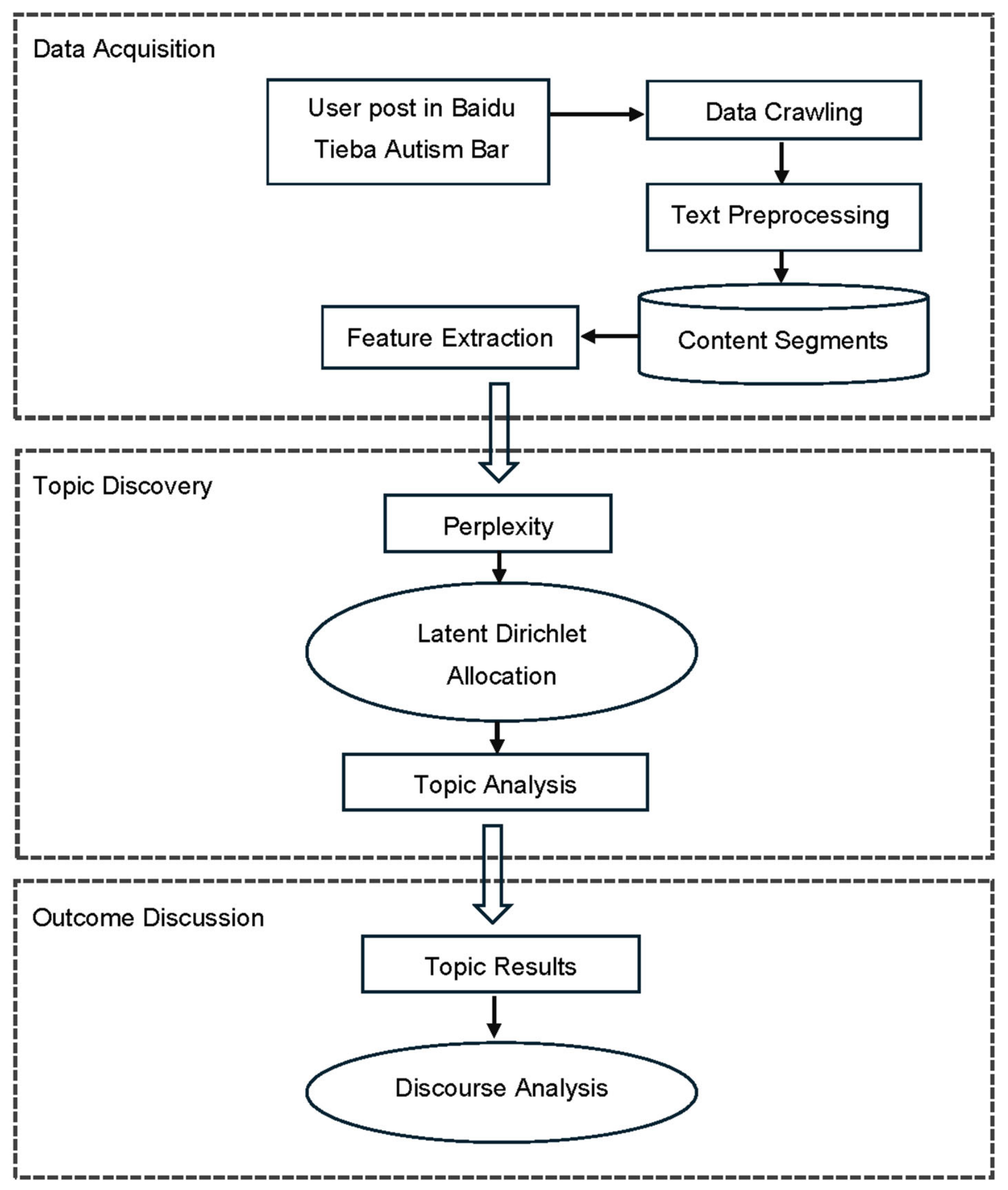
2.1. Study Design
2.2. Data Collection
2.2.1. Selection of Social Media Platform
2.2.2. Data Crawling
2.3. Data Preprocessing
2.3.1. Text Cleaning
2.3.2. Removal of Stopwords
2.3.3. Tokenization
2.4. LDA Topic Modeling
2.4.1. About LDA
2.4.2. Model Training
2.4.3. LDA Model Evaluation
2.4.4. Topic Labeling
3. Results
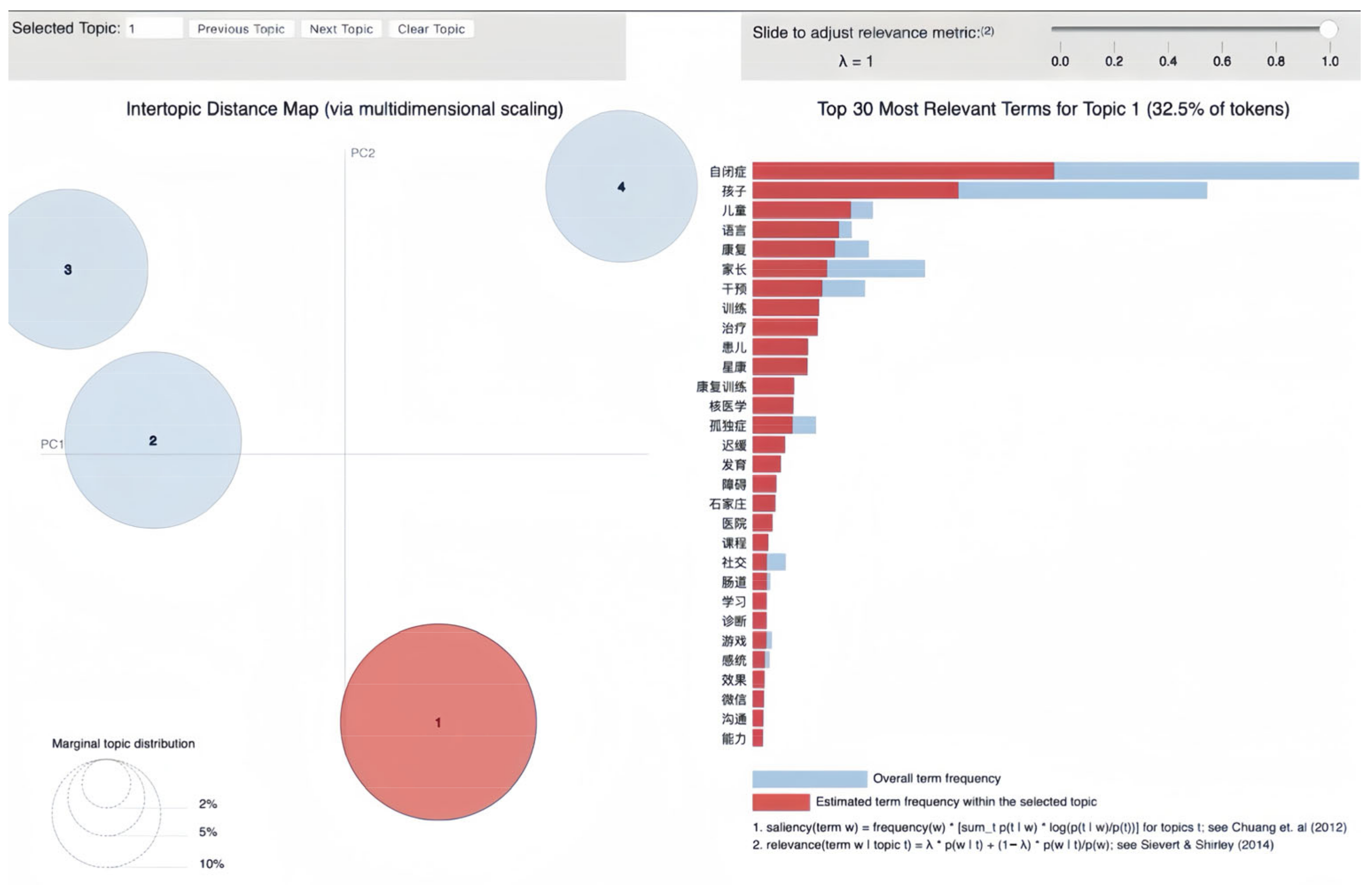
3.1. Autism Intervention and Therapy
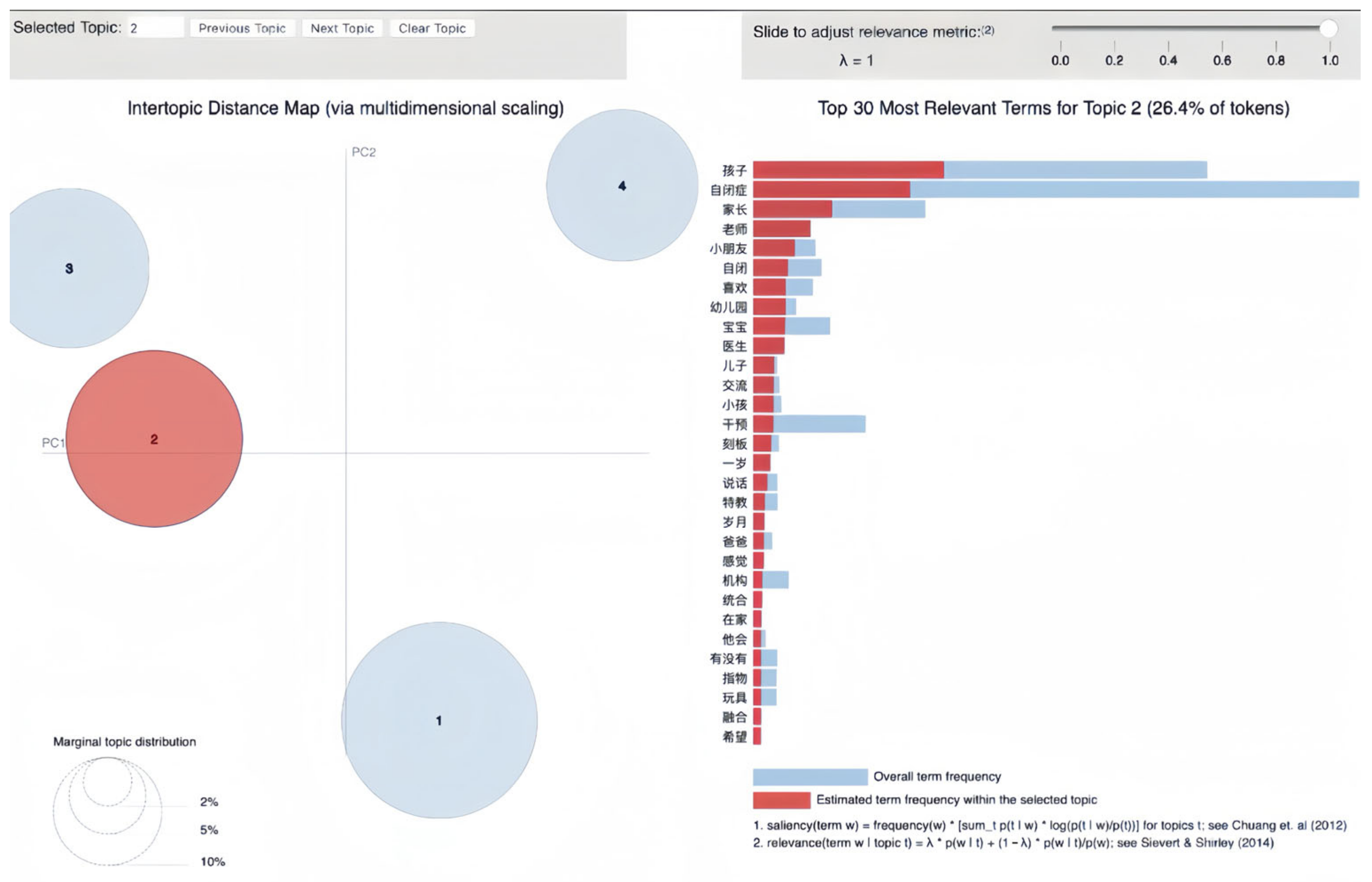
3.2. Early Childhood Autism and Education
3.3. Early Childhood Symptoms and Family Interaction
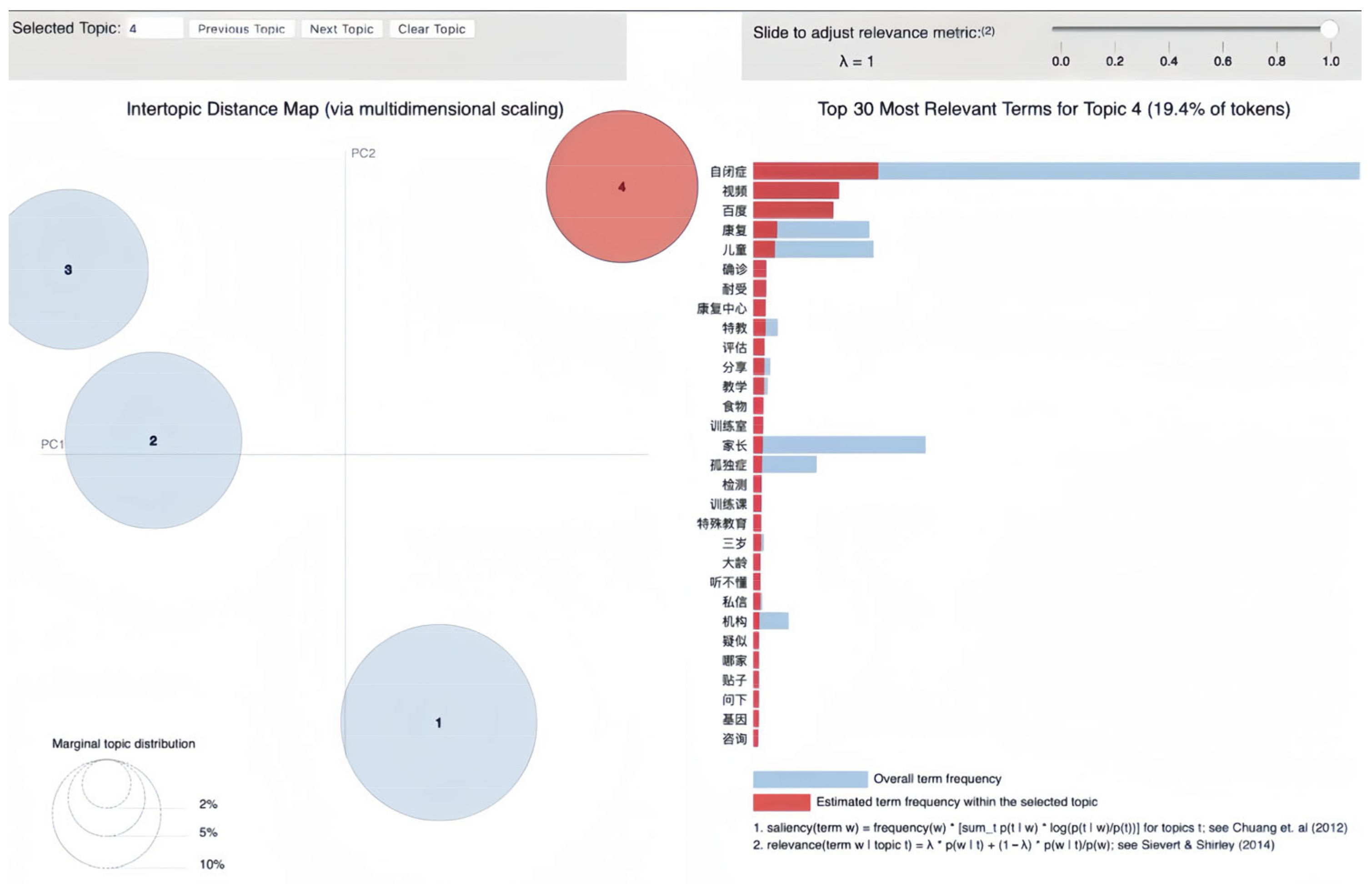
3.4. Educational Resources and Community Support
4. Discussion
4.1. Topics Among ASD Support Groups
4.2. Sociocultural Factors in Chinese Social Media and Implications
4.3. Limitations and Future Research
5. Conclusions
Author Contributions
Funding
Institutional Review Board Statement
Informed Consent Statement
Data Availability Statement
Acknowledgments
Conflicts of Interest
References
- American Psychiatric Association. (2013). Diagnostic and statistical manual of mental disorders (5th ed.). American Psychiatric Association. [Google Scholar]
- Bellon-Harn, M. L., Boyd, R. L., & Manchaiah, V. (2022). Applied behavior analysis as treatment for autism spectrum disorders: Topic modeling and linguistic analysis of Reddit posts. Frontiers in Rehabilitation Sciences, 2, 682533. [Google Scholar] [CrossRef]
- Bird, S., Klein, E., & Loper, E. (2009). Natural language processing with Python: Analyzing text with the natural language toolkit. O’Reilly Media, Inc. [Google Scholar]
- Blei, D. M., Ng, A. Y., & Jordan, M. I. (2003). Latent dirichlet allocation. Journal of Machine Learning Research, 3, 993–1022. [Google Scholar]
- Boyd, D. M., & Ellison, N. B. (2007). Social network sites: Definition, history, and scholarship. Journal of Computer-Mediated Communication, 13(1), 210–230. [Google Scholar] [CrossRef]
- Che, W., Feng, Y., Qin, L., & Liu, T. (2021). N-LTP: An open-source neural language technology platform for Chinese. In Proceedings of the 2021 conference on empirical methods in natural language processing: System demonstrations (pp. 42–49). Association for Computational Linguistics. [Google Scholar] [CrossRef]
- Chuang, J., Manning, C. D., & Heer, J. (2012). Termite: Visualization techniques for assessing textual topic models. In Proceedings of the international working conference on advanced visual interfaces (pp. 74–77). Association for Computing Machinery. [Google Scholar] [CrossRef]
- Corti, L., Zanetti, M., Tricella, G., & Bonati, M. (2022). Social media analysis of Twitter tweets related to ASD in 2019–2020, with particular attention to COVID-19: Topic modeling and sentiment analysis. Journal of Big Data, 9(1), 113. [Google Scholar] [CrossRef] [PubMed]
- Coulson, N. S. (2005). Receiving social support online: An analysis of a computer-mediated support group for individuals living with irritable bowel syndrome. Cyberpsychology & Behavior, 8(6), 580–584. [Google Scholar] [CrossRef]
- Davidson, J., & Orsini, M. (2013). Worlds of autism: Across the spectrum of neurological difference. University of Minnesota Press. [Google Scholar]
- Duffin, S. J., Bath, P. A., & Sbaffi, L. (2025). The role of online groups for autistic people in users’ autism information journeys. Journal of Documentation, 81(4), 1095–1124. [Google Scholar] [CrossRef]
- Dunn, M. E., Burbine, T., Bowers, C. A., & Tantleff-Dunn, S. (2001). Moderators of stress in parents of children with autism. Community Mental Health Journal, 42(1), 56–67. [Google Scholar] [CrossRef]
- Dunn, W. (2011). Best practice occupational therapy for children and families in community settings (2nd ed.). SLACK Inc. [Google Scholar]
- Dunn, W., Cox, J., Foster, L., Mische-Lawson, L., & Tanquary, J. (2012). Impact of a contextual intervention on child participation and parent competence among children with autism spectrum disorders: A pretest–posttest repeated-measures design. The American Journal of Occupational Therapy, 66(5), 520–528. [Google Scholar] [CrossRef]
- Fairclough, N. (1992). Discourse and text: Linguistic and intertextual analysis within discourse analysis. Discourse & Society, 3(2), 193–217. [Google Scholar] [CrossRef]
- Fairclough, N. (1995). Critical discourse analysis: The critical study of language. Longman. [Google Scholar]
- Fan, X., & Ko, K. S. (2025). Chinese caregivers’ experiences parenting children with autism spectrum disorder: A descriptive qualitative study. Frontiers in Psychiatry, 16, 1514948. [Google Scholar] [CrossRef]
- Gillespie-Lynch, K., Brooks, P. J., Someki, F., Obeid, R., Shane-Simpson, C., Kapp, S. K., Daou, N., & Smith, D. S. (2015). Changing college students’ conceptions of autism: An online training to increase knowledge and decrease stigma. Journal of Autism and Developmental Disorders, 45, 2553–2566. [Google Scholar] [CrossRef]
- Griffiths, T. L., & Steyvers, M. (2004). Finding scientific topics. Proceedings of the National Academy of Sciences of the United States of America, 101(Suppl. 1), 5228–5235. [Google Scholar] [CrossRef] [PubMed]
- Guldberg, K. (2010). Educating children on the autism spectrum: Preconditions for inclusion and notions of ‘best autism practice’in the early years. British Journal of Special Education, 37(4), 168–174. [Google Scholar] [CrossRef]
- Gupta, A., & Singhal, N. (2005). Psychosocial support for families of children with autism. Asia Pacific Disability Rehabilitation Journal, 16(2), 62–83. [Google Scholar]
- Haddi, E., Liu, X., & Shi, Y. (2013). The role of text pre-processing in sentiment analysis. Procedia Computer Science, 17, 26–32. [Google Scholar] [CrossRef]
- Hoffman, M., Bach, F. R., & Blei, D. M. (2010). Online learning for latent dirichlet allocation. Advances in Neural Information Processing Systems (NIPS), 23, 856–864. [Google Scholar]
- Hofstede, G. (2001). Culture’s consequences: Comparing values, behaviors, institutions, and organizations across nations (2nd ed.). Sage Publications. [Google Scholar]
- Huang, M., & Zhou, Z. (2016). Perceived self-efficacy, cultural values, and coping styles among Chinese families of children with autism. International Journal of School & Educational Psychology, 4(2), 61–70. [Google Scholar] [CrossRef]
- Hull, L., Petrides, K. V., Allison, C., Smith, P., Baron-Cohen, S., Lai, M. C., & Mandy, W. (2017). “Putting on my best normal”: Social camouflaging in adults with autism spectrum conditions. Journal of Autism and Developmental Disorders, 47(8), 2519–2534. [Google Scholar] [CrossRef]
- Jelodar, H., Wang, Y., Yuan, C., Feng, X., Jiang, X., Li, Y., & Zhao, L. (2019). Latent Dirichlet allocation (LDA) and topic modeling: Models, applications, a survey. Multimedia Tools and Applications, 78, 15169–15211. [Google Scholar] [CrossRef]
- Jing, H., & McKeown, K. (2000, April 29–May 4). Cut and paste based text summarization. 1st Meeting of the North American Chapter of the Association for Computational Linguistics, Seattle, WA, USA. [Google Scholar]
- Kasari, C., Gulsrud, A., Freeman, S., Paparella, T., & Hellemann, G. (2012). Longitudinal follow-up of children with autism receiving targeted interventions on joint attention and play. Journal of the American Academy of Child & Adolescent Psychiatry, 51(5), 487–495. [Google Scholar] [CrossRef]
- Kientz, M., & Dunn, W. (2012). Evaluating the effectiveness of contextual intervention for adolescents with autism spectrum disorders. Journal of Occupational Therapy, Schools, & Early Intervention, 5(3–4), 196–208. [Google Scholar] [CrossRef]
- Landa, R. (2007). Early communication development and intervention for children with autism. Mental Retardation and Developmental Disabilities Research Reviews, 13(1), 16–25. [Google Scholar] [CrossRef] [PubMed]
- Larnyo, E., Nutakor, J. A., Addai-Dansoh, S., & Nkrumah, E. N. K. (2024). Sentiment analysis of post-COVID-19 health information needs of autism spectrum disorder community: Insights from social media discussions. Frontiers in Psychiatry, 15, 1441349. [Google Scholar] [CrossRef] [PubMed]
- Lewis, L. F. (2023). Autism as a difference or a disorder? Exploring the views of individuals who use peer-led online support groups for autistic partners. Autism, 27(2), 321–330. [Google Scholar] [CrossRef]
- Li, H. (2019). Representations and public discourse of Chinese family cultures across media platforms. International Journal of Media & Cultural Politics, 15(2), 239–247. [Google Scholar] [CrossRef]
- Li, X., Xu, H., & Zhang, J. (2024). Attitudes of Chinese public towards the autism community: Evidence from a decade of Weibo data. Heliyon, 10(16), e35113. [Google Scholar] [CrossRef]
- Liu, J., Kong, J., & Zhang, X. (2020). Study on differences between patients with physiological and psychological diseases in online health communities: Topic analysis and sentiment analysis. International Journal of Environmental Research and Public Health, 17(5), 1508. [Google Scholar] [CrossRef]
- Liu, Y. (2014). Research on the social support network of families with children with autism [Unpublished Master’s Thesis]. Lanzhou University.
- Loper, E., & Bird, S. (2002). NLTK: The natural language toolkit. arXiv, arXiv:cs/0205028. [Google Scholar] [CrossRef]
- Lorence, D. (2007). Examining online chat within a domain of uncertainty: The case of Asperger’s syndrome. Health Information & Libraries Journal, 24(2), 128–136. [Google Scholar]
- Lyall, K., Croen, L., Daniels, J., Fallin, M. D., Ladd-Acosta, C., Lee, B. K., Park, B. Y., Snyder, N. W., Schendel, D., Volk, H., & Windham, G. C. (2017). The changing epidemiology of autism spectrum disorders. Annual Review of Public Health, 38, 81–102. [Google Scholar] [CrossRef]
- Marwick, A., & Lewis, R. (2017). Media manipulation and disinformation online (Vol. 359, pp. 1146–1151). Data & Society Research Institute. [Google Scholar]
- Napitupulu, L., & Kurniawan, Y. (2023). Online social support and psychological well-being of caregivers of children with autism spectrum disorder. European Journal of Educational Research, 12(2), 927–946. [Google Scholar] [CrossRef]
- Ng, C. S. M., Fang, Y., Wang, Z., & Zhang, M. (2021). Potential factors of parenting stress in Chinese parents of children with autism spectrum disorder: A systematic review. Focus on Autism and Other Developmental Disabilities, 36(4), 237–248. [Google Scholar] [CrossRef]
- Nguyen, T., Duong, T., Phung, D., & Venkatesh, S. (2014). Affective, linguistic and topic patterns in online autism communities. In International conference on web information systems engineering (pp. 474–488). Springer International Publishing. [Google Scholar] [CrossRef]
- Reichow, B., & Volkmar, F. R. (2010). Social skills interventions for individuals with autism: Evaluation for evidence-based practices within a best evidence synthesis framework. Journal of Autism and Developmental Disorders, 40(2), 149–166. [Google Scholar] [CrossRef] [PubMed]
- Shaw, K. A. (2025). Prevalence and early identification of autism spectrum disorder among children aged 4 and 8 years—Autism and developmental disabilities monitoring network, 16 sites, United States, 2022. MMWR Surveillance Summaries, 74(2), 1–22. [Google Scholar] [CrossRef]
- Sievert, C., & Shirley, K. (2014). LDAvis: A method for visualizing and interpreting topics. In Proceedings of the workshop on interactive language learning, visualization, and interfaces (pp. 63–70). Association for Computational Linguistics. [Google Scholar]
- Simpson, R. L. (2005). Evidence-based practices and students with autism spectrum disorders. Focus on Autism and Other Developmental Disabilities, 20(3), 140–149. [Google Scholar] [CrossRef]
- Skafle, I., Gabarron, E., & Nordahl-Hansen, A. (2024). Social media shape autism perception and identity. Autism, 28(10), 2489–2502. [Google Scholar] [CrossRef]
- Smith, T., & Iadarola, S. (2015). Evidence base update for autism spectrum disorder. Journal of Clinical Child & Adolescent Psychology, 44(6), 897–922. [Google Scholar] [CrossRef]
- Su, S., Paynter, J., & Gilmore, L. (2021). Chinese parents’ understanding of autism spectrum disorder. International Journal of Disability, Development and Education, 68(3), 414–426. [Google Scholar] [CrossRef]
- Sun, X., Allison, C., Matthews, F. E., Sharp, S. J., Auyeung, B., Baron-Cohen, S., & Brayne, C. (2013). Prevalence of autism in mainland China, Hong Kong and Taiwan: A systematic review and meta-analysis. Molecular Autism, 10(1), 7. [Google Scholar] [CrossRef]
- Tang, L., & Bie, B. (2016). The stigma of autism in china: An analysis of newspaper portrayals of autism between 2003 and 2012. Health Communication, 31(4), 445–452. [Google Scholar] [CrossRef]
- Walsh, C. E., Moody, E., Blakeley-Smith, A., Duncan, A., Hepburn, S., Keefer, A., Klinger, L., Meyer, A., O’Kelley, S., & Reaven, J. (2018). The relationship between treatment acceptability and youth outcome in group CBT for youth with ASD and anxiety. Journal of Contemporary Psychotherapy, 48(3), 123–132. [Google Scholar] [CrossRef]
- Wang, F., Lao, U. C., Xing, Y. P., Zhou, P., Deng, W. L., Wang, Y., Ji, Y., Chen, M. Y., Li, H., & Zou, X. B. (2022). Parents’ knowledge and attitude and behavior toward autism: A survey of Chinese families having children with autism spectrum disorder. Translational Pediatrics, 11(9), 1445. [Google Scholar] [CrossRef]
- Yuan, Q., Wei, X., Li, S., Gao, R., & Liang, T. (2024). Unveiling public attitudes and themes towards heart failure in China on Baidu Tieba: A data mining study. Research Square. [Google Scholar] [CrossRef]
- Zhang, J., Lin, X., Zhou, S., Ye, B., Zhang, Y., & Xiong, H. (2024). Social support and parenting self-efficacy in parents of children with ASD: The mediating role of post-traumatic growth and the moderating role of self-esteem. Current Psychology, 43(10), 9025–9040. [Google Scholar] [CrossRef]
- Zhao, Y., Zhang, J., & Wu, M. (2019). Finding users’ voice on social media: An investigation of online support groups for autism-affected users on Facebook. International Journal of Environmental Research and Public Health, 16(23), 4804. [Google Scholar] [CrossRef]
- Zhou, Q., Lei, Y., Du, H., & Tao, Y. (2023). Public concerns and attitudes towards autism on Chinese social media based on K-means algorithm. Scientific Reports, 13(1), 15173. [Google Scholar] [CrossRef]
- Zhou, W., & Guan, W. (2024). How is autism portrayed in news media? A corpus-based, mixed-methods analysis in China. Frontiers in Communication, 9, 1460556. [Google Scholar] [CrossRef]

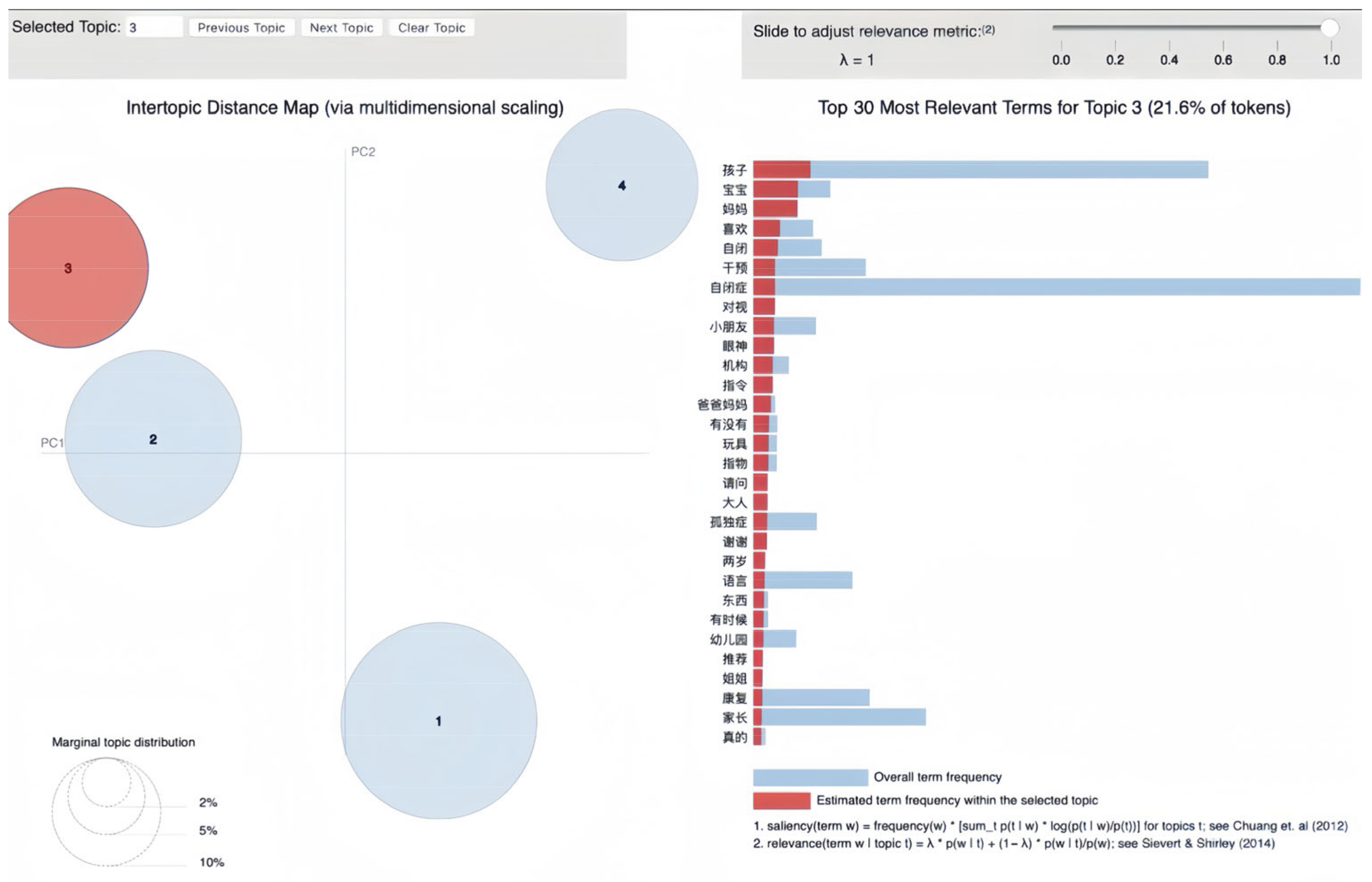


| Topic 1 | Topic 2 | Topic 3 | Topic 4 | |
|---|---|---|---|---|
| Themes | Autism Intervention and Therapy | Early Childhood Autism and Education | Early Childhood Symptoms and Family Interaction | Educational Resources and Community Support |
| Keywords | 儿童 (children), 语言 (language), 康复 (rehabilitation), 家长 (parents), 干预 (intervention), 训练 (training), 治疗 (treatment), 患儿 (pediatric patients), 星康 (Xingkang “Star Health”), 康复训练 (rehabilitation training), 核医学 (nuclear medicine), etc. | 老师 (teacher), 小朋友 (kids), 喜欢 (like), 幼儿园 (kindergarten), 宝宝 (baby), 医生 (doctor), 儿子 (son), 交流 (communicate), 干预 (intervention), 刻板 (stereotypical), 说话 (speak), 特教 (special education), 爸爸 (dad), 感觉 (sense), 机构 (institute), 统合 (integration) | 妈妈 (mother), 喜欢 (enjoy), 干预 (intervention), 对视 (eye contact), 小朋友 (kids), 眼神 (eye contact), 机构 (institution), 指令 (instruction), 爸爸妈妈 (parents), 玩具 (toy), 指物 (point at things), 大人 (adults) | 视频 (video), 百度 (Baidu), 康复 (rehabilitation), 确诊 (diagnosed), 耐受 (tolerate), 康复中心rehabilitation center), 特教 (special education), 评估 (evaluation), 分享 (share), 教学 (teaching), 食物 (food), 训练室 (training room), 私信 (private message), 机构 (institution), 基因 (gene), 咨询 (consult) |
Disclaimer/Publisher’s Note: The statements, opinions and data contained in all publications are solely those of the individual author(s) and contributor(s) and not of MDPI and/or the editor(s). MDPI and/or the editor(s) disclaim responsibility for any injury to people or property resulting from any ideas, methods, instructions or products referred to in the content. |
© 2026 by the authors. Licensee MDPI, Basel, Switzerland. This article is an open access article distributed under the terms and conditions of the Creative Commons Attribution (CC BY) license.
Share and Cite
Deng, Y.; Yang, L.; Chen, J. Topic Modeling of Social Media Discourse of Autism Support Groups. Behav. Sci. 2026, 16, 280. https://doi.org/10.3390/bs16020280
Deng Y, Yang L, Chen J. Topic Modeling of Social Media Discourse of Autism Support Groups. Behavioral Sciences. 2026; 16(2):280. https://doi.org/10.3390/bs16020280
Chicago/Turabian StyleDeng, Yu, Lei Yang, and Juanjuan Chen. 2026. "Topic Modeling of Social Media Discourse of Autism Support Groups" Behavioral Sciences 16, no. 2: 280. https://doi.org/10.3390/bs16020280
APA StyleDeng, Y., Yang, L., & Chen, J. (2026). Topic Modeling of Social Media Discourse of Autism Support Groups. Behavioral Sciences, 16(2), 280. https://doi.org/10.3390/bs16020280