
The Influence of Structured Nature Experiences on Youth Mental, Emotional, and Social Health Competencies in Summer Camps: A Systematic Review


Abstract
1. Introduction
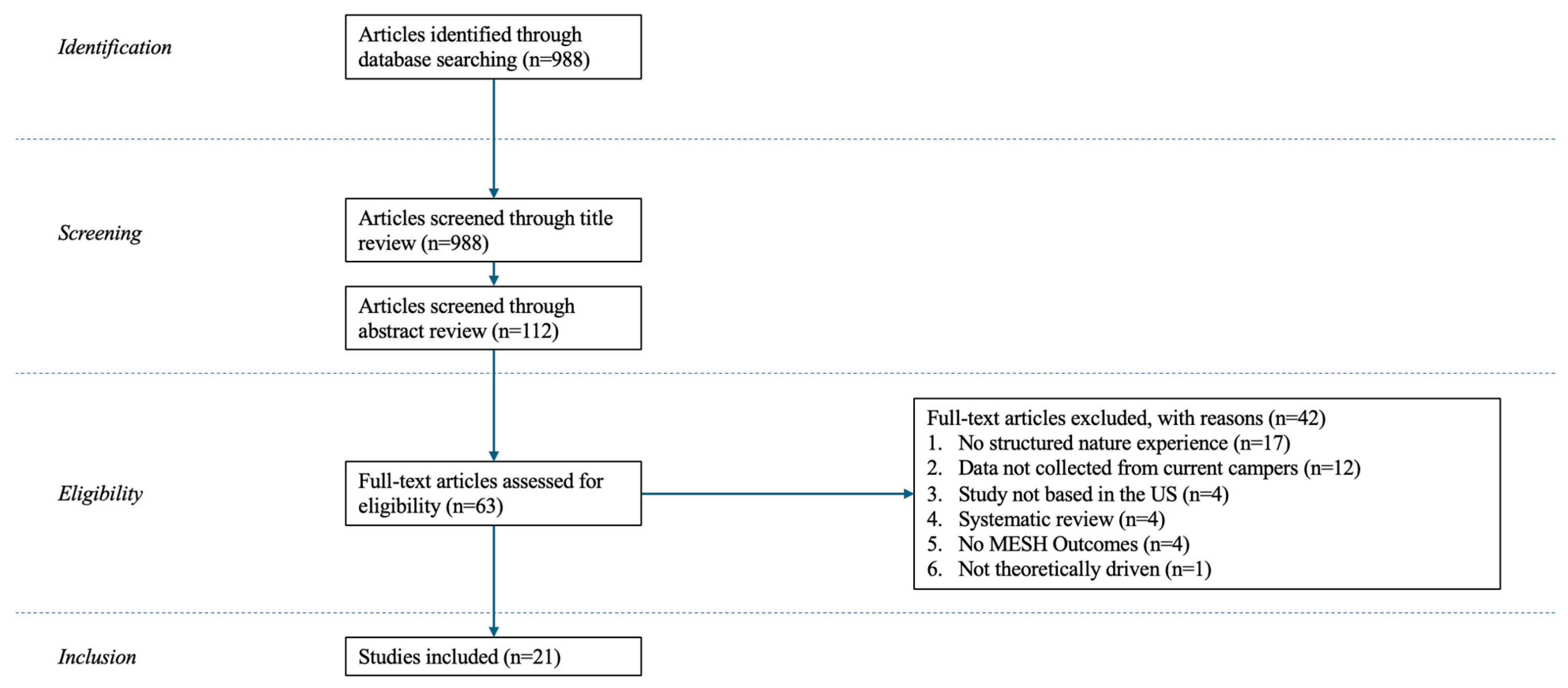
2. Methods
2.1. Positionality
2.2. Search Strategy
Youth|child|camper “summer camp”|“resident camp”|“day camp”|“overnight camp” nature|outdoor|“outdoor experience”|“experiential learning” “social competence”|“social intelligence”|“emotional intelligence”|“emotional competence”|“interpersonal skills”
2.3. Eligibility Criteria
- Study was conducted at camp,
- Study was conducted with campers about their self-reported experiences,
- The article named at least one SNE that occurred at camp (e.g., ropes course, kayaking, hiking, etc.),
- The study included at least one MESH outcome, and
- The article was broadly informed by theory.
- Full text not available in English,
- Study was conducted outside of the United States or Canada,
- Study did not take place in the outdoors,
- The only SNE mentioned was arts and crafts, organized sport, or physical activity,
- Data were collected from students within a school setting,
- Data were retrospective (i.e., more than 18 months removed from their camp experience), or
- Article was a systematic review of the literature.
2.4. Literature Selection and Extraction
2.5. Data Synthesis
3. Results
3.1. Synthesized Themes
3.2. Mental Health
3.2.1. Self-Esteem and Self-Perception
3.2.2. Sense of Purpose
3.2.3. Engagement
3.3. Emotional Health
3.3.1. Emotional Regulation
3.3.2. Resilience
3.4. Social Health
3.4.1. Social Belonging
3.4.2. Communication and Relationship Skills
3.4.3. Social Development
4. Discussion
4.1. Key Findings
4.2. Limitations
4.3. Future Directions
5. Conclusions
Author Contributions
Funding
Institutional Review Board Statement
Informed Consent Statement
Data Availability Statement
Conflicts of Interest
Appendix A

| Study | Study Design | Study Sample | Population Served | Geographic Location | Camp Characteristics | Structured Nature Experiences | MESH Domains and Measures ab | Major Findings |
|---|---|---|---|---|---|---|---|---|
| (Allen et al., 2011) | Quantitative Pre-/Post-test | 50 | Coed, At risk youth with behavioral and academic problems | Virginia, US | Day Camp 1 Site 2 Weeks | Adventure climbing challenge | M, E, S Character development (DeRoche, 2004) |
|
| (Arnoldo et al., 2006) | Quantitative Pre-/Post-test | 45 | Coed, Youth burn survivors | Texas, US | Overnight 1 Site 1 Week | Nature hikes, fishing, canoeing | M Rosenberg Self-Esteem Scale (1989) |
|
| (Browne et al., 2011) | Quantitative Quasi-experimental; Pre-/Post-test | 177 | Coed | US | Day and Overnight 13 Sites M = 23.8 days | Nature based problem solving, interactive nature experiences | M Leadership Skills—(ACA Youth Outcomes Battery, YOB; Sibthorp et al., 2010), Civic Engagement for Youth Scale (Flanagan et al., 2007) |
|
| (Burns et al., 2023) | Qualitative Semi-structured interviews | 15 | Coed | West Virginia, US | Overnight 1 Site 8 Days | Geology | M self-efficacy |
|
| (Campbell et al., 2022) | Mixed Methods Pre-/Post-test and follow-up | 3 | Coed, youth who have experienced childhood victimization | Not reported | Overnight 1 Site 1 Week | Campfire, field games | M, E, S Strengths and Difficulties Questionnaire (Goodman, 1997); Victimization (JVQR2-RIV; Hamby et al., 2011) |
|
| (Chawla & MacDermid Wadsworth, 2012) | Quantitative Pre-/Post-test | 44 | Coed, Military dependents | Indiana, US | Overnight 1 Site 1 Week | Outdoor activities and games that develop an understanding of the local fauna and wildlife | M, E, S Self Perception Profile for Children (SPPC; Harter, 1985); Self-Perception Profile for Adolescents (SPPA; Harter, 1988) |
|
| (Devine & Dawson, 2010) | Quantitative Longitudinal, 3 time points | 31 | Coed, Youth with craniofacial differences | Midwest, US | Overnight 1 Site 1 Week | Fishing, swimming, climbing, teambuilding, cabin campouts, recreational games, archery, arts, music, and nature activities | M, S Rosenberg Self-Esteem Scale (Rosenberg, 1965, 1988); Social Acceptance/Perception (source not listed) |
|
| (Devine et al., 2015) | Quantitative Longitudinal, 3 time points | 46 | Coed, Youth with cochlear implants or hearing aids | Midwest, US | Overnight 1 Site 1 Week | Hiking, swimming, horseback riding, sports, nature, climbing, canoeing, adventure therapy | S Social Acceptance Scale (SAS; Devine, 1997); Peds QL General Well-Being Scale (Hallstrand et al., 2003; Varni et al., 1999) |
|
| (Faith et al., 2019) | Quantitative Pre-/Post-test | 62 | Coed, Youth with cancer, sickle cell, renal disease, heart disease, other chronic conditions | Midwest, US | Overnight 1 Site 1 Week | Fishing trips; optional activities include swimming; high ropes courses | M, E Children’s Hope Scale (CHS; Snyder et al., 1997); Child Attitude Toward Illness Scale (CATIS; Austin & Huberty, 1993); Benefit and Burden Scale for Children (BBSC; Currier et al., 2009) |
|
| (Gillard & Allsop, 2016) | Qualitative Videoed interviews | 24 | Coed, Children with serious illnesses | Northeast, US | Overnight 1 Site 7 Days | Outdoor activities, fishing | M, E, S belonging, enjoyment, be myself, positive affect, growth |
|
| (Griswold et al., 2014) | Qualitative Focus groups and observations | 18 | Coed, Youth with Tourette’s | Midwest, US | Overnight 1 Site 1 Week | Swimming, boating, horseback riding, and a ropes course with a zip line | M, S relatedness, social development, programmatic outcomes |
|
| (Hellman & Gwinn, 2017) | Quantitative Pre-/Post-test | 229 | Coed, Children exposed to domestic violence | US | Overnight 9 Sites 6 Days | Rafting, tubing, high and low ropes challenge courses, horseback riding, kayaking and canoeing, recreational hiking and field games, nightly campfires | M, E, S Children’s Hope Scale (CHS; Snyder et al., 1997) |
|
| (Linver et al., 2023) | Mixed Methods Longitudinal surveys, 3 time points; 1 time interviews | 4121 (online survey), 106 (interviews) | Coed, Youth involved with Boy Scouts | New Mexico, Florida Keys, Minnesota/Canada boundary waters, West Virginia, US | Day and Overnight 4 Sites 6-10 Days | Backpacking and hiking expeditions, snorkeling, scuba diving, sailing, and fishing, conservation efforts and marine biology studies, canoeing and winter camping expeditions, ziplining, rock climbing, mountain biking, and white water rafting. | M, E, S communication, ethical decision making, connection to others, citizenship, purpose, leadership, joy/fun, perceived cultural humility |
|
| (Schmalz et al., 2011) | Qualitative Focus groups, one-on-one interviews | 26 | Girls | Vermont, US | Overnight 1 Site 4 or 8 Weeks | Can choose between 16 activity departments, at any time, for any duration. | M, S sense of self |
|
| (Son et al., 2017) | Qualitative Focus groups | 22 | Coed, Suburban youth | Pacific Northwest, US | Overnight 1 Site 5 Days | Outdoor adventure education, snow science course | M, S optimal engagement, self-determination, values |
|
| (Uhls et al., 2014) | Quantitative Pre-/Post-test | 51 (experimental), 54 (control) | Coed | California, US | Overnight | forest ecology, outdoor skills, animal survival, day hike, archery, orienteering | S The Child and Adolescent Social Perception Measure (CASP); Media use (Pea et al., 2012; Uhls, 2013) |
|
| (Whittington et al., 2016) | Quantitative Pre-/Post-test w/longitudinal subset | 26 (reported on the RSCA), 87 (participated in the program) | Girls, Youth who are socially and economically disadvantaged | Vermont, US | Day Camp More than 1 Site 5 Days | Mountain biking, daily trail rides, a two-part self-defense workshop | M, E, S Resiliency Scale for Children and Adolescents (RSCA®); (Prince-Embury, 2007) |
|
Appendix B. References for Measures in Table A1
- Austin, J. K., & Huberty, T. J. (1993). Development of the child attitude toward illness scale. Journal of Pediatric Psychology, 18(4), 467–480. https://doi.org/10.1093/jpepsy/18.4.467.
- Currier, J. M., Hermes, S., & Phipps, S. (2009). Children’s response to serious illness: Perceptions of benefit and burden in a pediatric cancer population. Journal of Pediatric Psychology, 34(10), 1129–1134. https://doi.org/10.1093/jpepsy/jsp021.
- DeRoche, E. (2004). Evaluating character development: 51 tools for measuring success. Character Development Group.
- Devine, M. A. (1997). The relationship between social acceptance and leisure participation for people with disabilities [Unpublished dissertation]. University of Georgia.
- Flanagan, C. A., Syvertsen, A. K., & Stout, M. D. (2007). Civic engagement models: Tapping adolescents’ civic engagement. CIRCLE Working Paper, 55. Available online: https://www.researchgate.net/publication/234700265_Civic_Measurement_Models_Tapping_Adolescents%27_Civic_Engagement_CIRCLE_Working_Paper_55 (accessed on 14 July 2025).
- Goodman, R. (1997). The strengths and difficulties questionnaire: A research note. Journal of Child Psychology and Psychiatry, 38(5), 581–586. https://doi.org/10.1111/j.1469-7610.1997.tb01545.x.
- Hallstrand, T. S., Curtis, J. R., Aitken, M. L., & Sullivan, S. D. (2003). Quality of life in adolescents with mild asthma. Pediatric Pulmonology, 36, 536–543. https://doi.org/10.1002/ppul.10395.
- Hamby, S., Finkelhor, D., Turner, H., & Kracke, K. (2011). The juvenile victimization questionnaire toolkit. University of New Hampshire. Available online: https://www.unh.edu/ccrc/juvenile-victimization-questionnaire (accessed on 14 July, 2025).
- Harter, S. (1985). The self-perception profile for children: Revision of the Perceived competence scale for children [Manual]. University of Denver.
- Devine, S. (1988). Manual for the self-perception profile for adolescents [Manual]. University of Denver.
- Napier, T. L., & Wright, C. J. (1974). An evaluation of forced relocation of population due to rural community development (Research Bulletin 1073). Ohio Agricultural Research and Development Center. Available online: https://core.ac.uk/download/pdf/159572899.pdf (accessed on 14 July 205).
- Pea, R., Nass, C., Meheula, L., Rance, M., Kumar, A., Bamford, H., Nass, M., Simha, A., Stillerman, B., Yang, S., & Zhou, M. (2012). Media use, face-to-face communication, media multitasking, and social well-being among 8–12 year old girls. Developmental Psychology, 48, 327–336. http://dx.doi.org/10.1037/a0027030.
- Prince-Embury, S. (2007). Resiliency scales for children and adolescents: Profiles of personal strengths manual. Harcourt Assessments.
- Rosenberg, M. (1965). The Rosenberg self-esteem scale. Princeton University Press. https://doi.org/10.1037/t01038-000.
- Rosenberg, M. (1988). Self-objectification: Relevance for the species and society. Sociological Forum, 3(4), 548–565. https://doi.org/10.1007/bf01115414.
- Rosenberg, M. (1989). Society and the adolescent self-image. Wesleyan University Press.
- Sibthorp, J., Browne, L. P., & Bialeschki, M. D. (2010). Problem-solving and camp connectedness: Two new measures for the ACA youth outcomes battery. Research on Education in the Outdoors, 10, 1–12. https://doi.org/10.1353/roe.2010.0002.
- Snyder, C. R., Hoza, B., Pelham, W. E., Rapoff, M., Ware, L., Danovsky, M., Highberger, H. R., & Stahl, K. J. (1997). The development and validation of the Children’s Hope scale. Journal of Pediatric Psychology, 22(3), 399–421. https://doi.org/10.1093/jpepsy/22.3.399.
- Uhls, Y. (2013, April 18–20). Values and new media: How social media relates to preteen values. The Society for Research on Child Development, Seattle, WA, USA.
- Varni, J. W., Seid, M., & Kurtin, P. S. (1999). Pediatric health-related quality of life measurement technology: A guide for health care decision makes. Journal of Clinical Outcomes Management, 6, 33–40.
References
- * Allen, K., Akinyanju, K., Milliken, T., Lorek, E., & Walker, T. T. (2011). Improving the pro-social skills of transitioning urban youth: A summer camp approach. Middle School Journal, 42(4), 14–22. [Google Scholar] [CrossRef]
- Arnold, M. E., & Silliman, B. (2017). From theory to practice: A critical review of positive youth development program frameworks. Journal of Youth Development, 12(2), 1–20. [Google Scholar] [CrossRef]
- * Arnoldo, B. D., Crump, D., Burris, A. M., Hunt, J. L., & Purdue, G. F. (2006). Self-esteem measurement before and after summer burn camp in pediatric burn patients. Journal of Burn Care & Research, 27(6), 786–789. [Google Scholar] [CrossRef]
- Baker, M., & Allison, T. (2024, December 12). Decoding research for camp pros everywhere (No. 2) [Audio podcast episode]. The Pudding. Go Camp Pro. Available online: https://gocamp.pro/the-pudding/decoding-research (accessed on 11 September 2025).
- Bandura, A. (1997). Self-efficacy: The exercise of control. Freeman. [Google Scholar]
- Bialeschki, M. D., Henderson, K. A., & James, P. A. (2007). Camp experiences and developmental outcomes for youth. Child and Adolescent Psychiatric Clinics of North America, 16(4), 769–788. [Google Scholar] [CrossRef] [PubMed]
- Bialeschki, M. D., Krehbiel, A., & Henderson, K. (2002). Outcomes of camping: Perceptions from camper focus groups. Coalition for Education in the Outdoors, 6, 147–156. [Google Scholar]
- Bratman, G. N., Daily, G. C., Levy, B. J., & Gross, J. J. (2015). The benefits of nature experience: Improved affect and cognition. Landscape and Urban Planning, 138, 41–50. [Google Scholar] [CrossRef]
- * Browne, L. P., Garst, B. A., & Bialeschki, M. D. (2011). Engaging youth in environmental sustainability: Impact of the Camp 2 grow program. Journal of Park and Recreation Administration, 29(3), 70–85. [Google Scholar]
- * Burns, R. C., Janowicz, L., Smaldone, D., Pierskalla, C., & Moreira, J. C. (2023). Impact of an adventure geology STEM camp on outdoor self-efficacy. Interdisciplinary Journal of Environmental and Science Education, 19(4), e2315. [Google Scholar] [CrossRef]
- * Campbell, K. D., Hasselle, A. J., & Howell, K. H. (2022). A familial case study exploring the effects of a strengths-based camp intervention on children’s self-perception. Clinical Case Studies, 21(6), 571–587. [Google Scholar] [CrossRef]
- Catalano, R. F., Berglund, M. L., Ryan, J. A., Lonczak, H. S., & Hawkins, J. D. (2004). Positive youth development in the United States: Research findings on evaluations of positive youth development programs. The Annals of the American Academy of Political and Social Science, 591(1), 98–124. [Google Scholar] [CrossRef]
- Chase, D. L. (2015). Does challenge by choice increase participation? Journal of Experiential Education, 38(2), 108–128, (Original work published 2014). [Google Scholar] [CrossRef]
- * Chawla, N., & MacDermid Wadsworth, S. M. (2012). The impact of an operation purple camp intervention on military children and adolescents’ self-perception of social acceptance, athletic competence, and global self-worth. The American Journal of Family Therapy, 40(3), 267–278. [Google Scholar] [CrossRef]
- Cotton Bronk, K., Hill, P. L., Lapsley, D. K., Talib, T. L., & Finch, H. (2009). Purpose, hope, and life satisfaction in three age groups. The Journal of Positive Psychology, 4(6), 500–510. [Google Scholar] [CrossRef]
- * Devine, M. A., & Dawson, S. (2010). The effect of a residential camp experience on self esteem and social acceptance of youth with craniofacial differences. Therapeutic Recreation Journal, 44(2), 105–120. [Google Scholar]
- * Devine, M. A., Piatt, J., & Dawson, S. L. (2015). The role of a disability-specific camp in promoting social acceptance and quality of life for youth with hearing impairments. Therapeutic Recreation Journal, 49(4), 293–309. Available online: https://www.proquest.com/scholarly-journals/role-disability-specific-camp-promoting-social/docview/1732132450/se-2 (accessed on 3 July 2024). [CrossRef]
- Dopko, R. L., Capaldi, C. A., & Zelenski, J. M. (2019). The psychological and social benefits of a nature experience for children: A preliminary investigation. Journal of Environmental Psychology, 63, 134–138. [Google Scholar] [CrossRef]
- Dresner, M., & Gill, M. (1994). Environmental education at summer nature camp. The Journal of Environmental Education, 25(3), 35–41. [Google Scholar] [CrossRef]
- Eccles, J. S., & Gootman, J. A. (2002). Community programs to promote youth development: Committee on community-level programs for youth. National Academy Press. [Google Scholar]
- * Faith, M. A., Mayes, S., Pratt, C. D., & Carter, C. (2019). Improvements in hope and beliefs about illness following a summer camp for youth with chronic illnesses. Journal of Pediatric Nursing, 44, 56–62. [Google Scholar] [CrossRef] [PubMed]
- Garner, M. A., Taft, E. D., & Stevens, C. L. (2015). Do children increase their environmental consciousness during summer camp? A comparison of two programs. Journal of Outdoor Recreation, Education, and Leadership, 7(1), 20–34. [Google Scholar] [CrossRef]
- Garst, B. A., Skrocki, A., Gaslin, T., Schultz, B., Hashikawa, A., Bunke, C., Gaberson, K., & DeHudy, A. (2024a). Assessing camp provider needs related to the mental, emotional, and social health needs of youth and staff: Implications for parent communication, human resources, and transition of care. Journal of Park and Recreation Administration, 42(2), 1–18. [Google Scholar] [CrossRef]
- Garst, B. A., Skrocki, A., Owens, M. H., Gaslin, T., Schultz, B. E., Hashikawa, A. N., Gaberson, K. B., Ambrose, M., & DeHudy, A. A. (2024b). Evaluating the mental, emotional, and social health status of youth and staff in a national summer camp cohort. Children’s Health Care, 1–21. [Google Scholar] [CrossRef]
- Gay, M. (2022, May 28). Summer camp for all. The New York Times. Available online: https://www.nytimes.com/2022/05/28/opinion/summer-camp-for-all.html (accessed on 18 September 2025).
- Gehanno, J. F., Rollin, L., & Darmoni, S. (2013). Is the coverage of Google Scholar enough to be used alone for systematic reviews. BMC Medical Informatics and Decision Making, 13(1), 7. [Google Scholar] [CrossRef]
- Gill, T. (2014). The benefits of children’s engagement with nature: A systematic literature review. Children, Youth and Environments, 24(2), 10–34. [Google Scholar] [CrossRef]
- * Gillard, A., & Allsop, J. (2016). Camp experiences in the lives of adolescents with serious illnesses. Children and Youth Services Review, 65, 112–119. [Google Scholar] [CrossRef]
- * Griswold, M., Hegarty, C. B., Harrist, C., Trauntvein, N., & Griswold, D. (2014). Exploring the social impacts of a summer camp for youth with Tourette syndrome. Research in Outdoor Education, 12(1), 15–35. [Google Scholar] [CrossRef]
- Hamilton, S. F. (1999). A three-part definition of youth development [Unpublished manuscript]. Cornell University College of Human Ecology.
- Harzing, A. W. (2007). Publish or perish. Available online: https://harzing.com/resources/publish-or-perish (accessed on 6 June 2024).
- * Hellman, C. M., & Gwinn, C. (2017). Camp HOPE as an intervention for children exposed to domestic violence: A program evaluation of hope, and strength of character. Child and Adolescent Social Work Journal, 34, 269–276. [Google Scholar] [CrossRef]
- Henderson, K. A., Bialeschki, M. D., & James, P. A. (2007). Overview of camp research. Child and Adolescent Psychiatric Clinics of North America, 16(4), 755–767. [Google Scholar] [CrossRef] [PubMed]
- Lerner, R. M. (2002). Concepts and theories of human development. Lawrence Erlbaum. [Google Scholar]
- Lerner, R. M., & Castellino, D. R. (2002). Contemporary developmental theory and adolescence: Developmental systems and applied developmental science. Journal of Adolescent Health, 31, 122–135. [Google Scholar] [CrossRef]
- * Linver, M. R., Urban, J. B., Les, E., Xue, X., & Nager, A. (2023). “The greatest experience ever”: Benefits of participation in high-adventure activities for youth. Youth, 3(4), 1284–1300. [Google Scholar] [CrossRef]
- Lubeznik-Warner, R., Garst, B. A., Hamilton, J., Skrocki, A., Wycoff, T., Gaslin, T., & Pearson, L. (2025). Catalyzing care: Implementation and evaluation of the Campwell wellbeing program [White paper]. Alliance for Camp Health. Available online: https://allianceforcamphealth.org/wp-content/uploads/2025/10/Catalyzing-Care-Implementation-and-Evaluation-of-the-CampWell-Well-Being-Program.pdf (accessed on 17 November 2025).
- Lubeznik-Warner, R. P., & Rosen, N. (2023). Supporting staff supports youth well-being at summer camp. Journal of Youth Development, 18(3), 3. [Google Scholar] [CrossRef]
- * Martin, K. (2018). Summer camp youth leadership development: An investigation of adolescents’ perceptions of best practices. Journal of Youth Development, 13(1), 161–182. [Google Scholar] [CrossRef]
- McHugh, M. L. (2012). Interrater reliability: The kappa statistic. Biochemia Medica, 22(3), 276–282. [Google Scholar] [CrossRef]
- * Mishna, F. (2005). The application of self psychology to therapeutic camps. Psychoanalytic Social Work, 12(1), 51–71. [Google Scholar] [CrossRef]
- National Academies of Sciences, Engineering, and Medicine (NASEM). (2019). Shaping summertime experiences: Opportunities to promote healthy development and well-being for children and youth. The National Academies Press. [Google Scholar] [CrossRef]
- Orth, Z., Moosajee, F., & Van Wyk, B. (2022). Measuring mental wellness of adolescents: A systematic review of instruments. Frontiers in Psychology, 13, 835601. [Google Scholar] [CrossRef] [PubMed]
- Owens, M. H., Erceg, L. E., & Faricy, A. (2021). Recognizing MESH as a component of a camp’s health profile. Journal of Outdoor Recreation, Education, and Leadership, 13(2), 61–66. [Google Scholar]
- Pollock, D., Peters, M. D. J., Khalil, H., McInerney, P., Alexander, L., Tricco, A. C., Evans, C., de Moraes, É. B., Godfrey, C. M., Pieper, D., Saran, A., Stern, C., & Munn, Z. (2023). Recommendations for the extraction, analysis, and presentation of results in scoping reviews. JBI Evidence Synthesis, 21(3), 520–532. [Google Scholar] [CrossRef] [PubMed]
- Popay, J., Roberts, H., Sowden, A., Petticrew, M., Arai, L., Rodgers, M., Britten, N., Roen, K., & Duffy, S. (2006). Guidance on the conduct of narrative synthesis in systematic reviews. A product from the ESRC methods programme (Version 1). Lancaster University. [Google Scholar] [CrossRef]
- * Rimmer, R. B., Fornaciari, G. M., Foster, K. N., Bay, C. R., Wadsworth, M. M., Wood, M., & Caruso, D. M. (2007). Impact of a pediatric residential burn camp experience on burn survivors’ perceptions of self and attitudes regarding the camp community. Journal of Burn Care & Research, 28(2), 334–341. [Google Scholar] [CrossRef]
- * Roberts, N. S., & Suren, A. T. (2010). Through the eyes of youth: A qualitative evaluation of outdoor leadership programs. Journal of Park and Recreation Administration, 28(4), 59–80. [Google Scholar]
- Rossman, J. R., & Schlatter, B. E. (2015). Recreation programming: Designing leisure experiences (7th ed.). Sagamore. [Google Scholar]
- Ryan, R., & Deci, E. (2000). Self-determination theory and the facilitation of intrinsic motivation, social development, and well-being. American Psychologist, 55(1), 68–78. [Google Scholar] [CrossRef]
- * Schmalz, D. L., Kerstetter, D. L., & Kleiber, D. A. (2011). An evaluation of developmental outcomes at a free-choice oriented girls summer camp. Journal of Outdoor Recreation, Education, and Leadership, 3(1). [Google Scholar] [CrossRef]
- Sibthorp, J., Wilson, C., Povilaitis, V., & Browne, L. (2020). Active ingredients of learning at summer camp. Journal of Outdoor and Environmental Education, 23(1), 21–37. [Google Scholar] [CrossRef]
- Snyder, C. R. (1995). Conceptualizing, measuring, and nurturing hope. Journal of Counseling & Development, 73(3), 355–360. [Google Scholar] [CrossRef]
- * Son, J. S., Mackenzie, S. H., Eitel, K., & Luvaas, E. (2017). Engaging youth in physical activity and STEM subjects through outdoor adventure education. Journal of Outdoor and Environmental Education, 20, 32–44. [Google Scholar] [CrossRef]
- Spielvogel, B., Lubeznik-Warner, R. P., Sibthorp, J., & Browne, L. P. (2024). A national longitudinal study examining social-emotional benefits of summer camp for early adolescents: Effects of attendance, dosage, and experience quality. Journal of Leisure Research, 57, 1–21. [Google Scholar] [CrossRef]
- Tan, Q., Nie, Y., Son, P., Underwood, R. A., Murray, P., Hebert, C., McKey, K. L., Hendrick, C., Staiano, A. E., & Chen, S. (2024). Preliminary effectiveness of a one-week summer day camp for improving children’s health behaviors and psychosocial well-being outcomes. Children, 11(9), 1097. [Google Scholar] [CrossRef]
- Thomas, J., & Harden, A. (2008). Methods for the thematic synthesis of qualitative research in systematic reviews. BMC Medical Research Methodology, 8(1), 45. [Google Scholar] [CrossRef]
- Thurber, C. A., Scanlin, M. M., Scheuler, L., & Henderson, K. A. (2007). Youth development outcomes of the camp experience: Evidence for multidimensional growth. Journal of Youth and Adolescence, 36(3), 241–254. [Google Scholar] [CrossRef] [PubMed]
- * Uhls, Y. T., Michikyan, M., Morris, J., Garcia, D., Small, G. W., Zgourou, E., & Greenfield, P. M. (2014). Five days at outdoor education camp without screens improves preteen skills with nonverbal emotion cues. Computers in Human Behavior, 39, 387–392. [Google Scholar] [CrossRef]
- Vasilaki, M. M., Zafeiroudi, A., Tsartsapakis, I., Grivas, G. V., Chatzipanteli, A., Aphamis, G., Giannaki, C., & Kouthouris, C. (2025). Learning in nature: A systematic review and meta-analysis of outdoor recreation’s role in youth development. Education Sciences, 15(3), 332. [Google Scholar] [CrossRef]
- * Whittington, A., Aspelmeier, J. E., & Budbill, N. W. (2016). Promoting resiliency in adolescent girls through adventure programming. Journal of Adventure Education and Outdoor Learning, 16(1), 2–15. [Google Scholar] [CrossRef]
- Wilson, C., Akiva, T., Sibthorp, J., & Browne, L. P. (2019). Fostering distinct and transferable learning via summer camp. Children and Youth Services Review, 98, 269–277. [Google Scholar] [CrossRef]
- Xiao, Y., & Watson, M. (2019). Guidance on conducting a systematic literature review. Journal of Planning Education and Research, 39(1), 93–112. [Google Scholar] [CrossRef]

Disclaimer/Publisher’s Note: The statements, opinions and data contained in all publications are solely those of the individual author(s) and contributor(s) and not of MDPI and/or the editor(s). MDPI and/or the editor(s) disclaim responsibility for any injury to people or property resulting from any ideas, methods, instructions or products referred to in the content. |
© 2026 by the authors. Licensee MDPI, Basel, Switzerland. This article is an open access article distributed under the terms and conditions of the Creative Commons Attribution (CC BY) license.
Share and Cite
Berry, D.; Skrocki, A.; Howell, E.; Pilgreen, D. The Influence of Structured Nature Experiences on Youth Mental, Emotional, and Social Health Competencies in Summer Camps: A Systematic Review. Behav. Sci. 2026, 16, 246. https://doi.org/10.3390/bs16020246
Berry D, Skrocki A, Howell E, Pilgreen D. The Influence of Structured Nature Experiences on Youth Mental, Emotional, and Social Health Competencies in Summer Camps: A Systematic Review. Behavioral Sciences. 2026; 16(2):246. https://doi.org/10.3390/bs16020246
Chicago/Turabian StyleBerry, Daniela, Alexandra Skrocki, Emily Howell, and Daniel Pilgreen. 2026. "The Influence of Structured Nature Experiences on Youth Mental, Emotional, and Social Health Competencies in Summer Camps: A Systematic Review" Behavioral Sciences 16, no. 2: 246. https://doi.org/10.3390/bs16020246
APA StyleBerry, D., Skrocki, A., Howell, E., & Pilgreen, D. (2026). The Influence of Structured Nature Experiences on Youth Mental, Emotional, and Social Health Competencies in Summer Camps: A Systematic Review. Behavioral Sciences, 16(2), 246. https://doi.org/10.3390/bs16020246