How Stress Mindset Mitigates Burnout: The Role of Hope in Work–Family Conflict Among Chinese Teachers


Abstract
1. Introduction
1.1. Work–Family Conflict (WFC) and Burnout
1.2. The Mediating Role of Hope
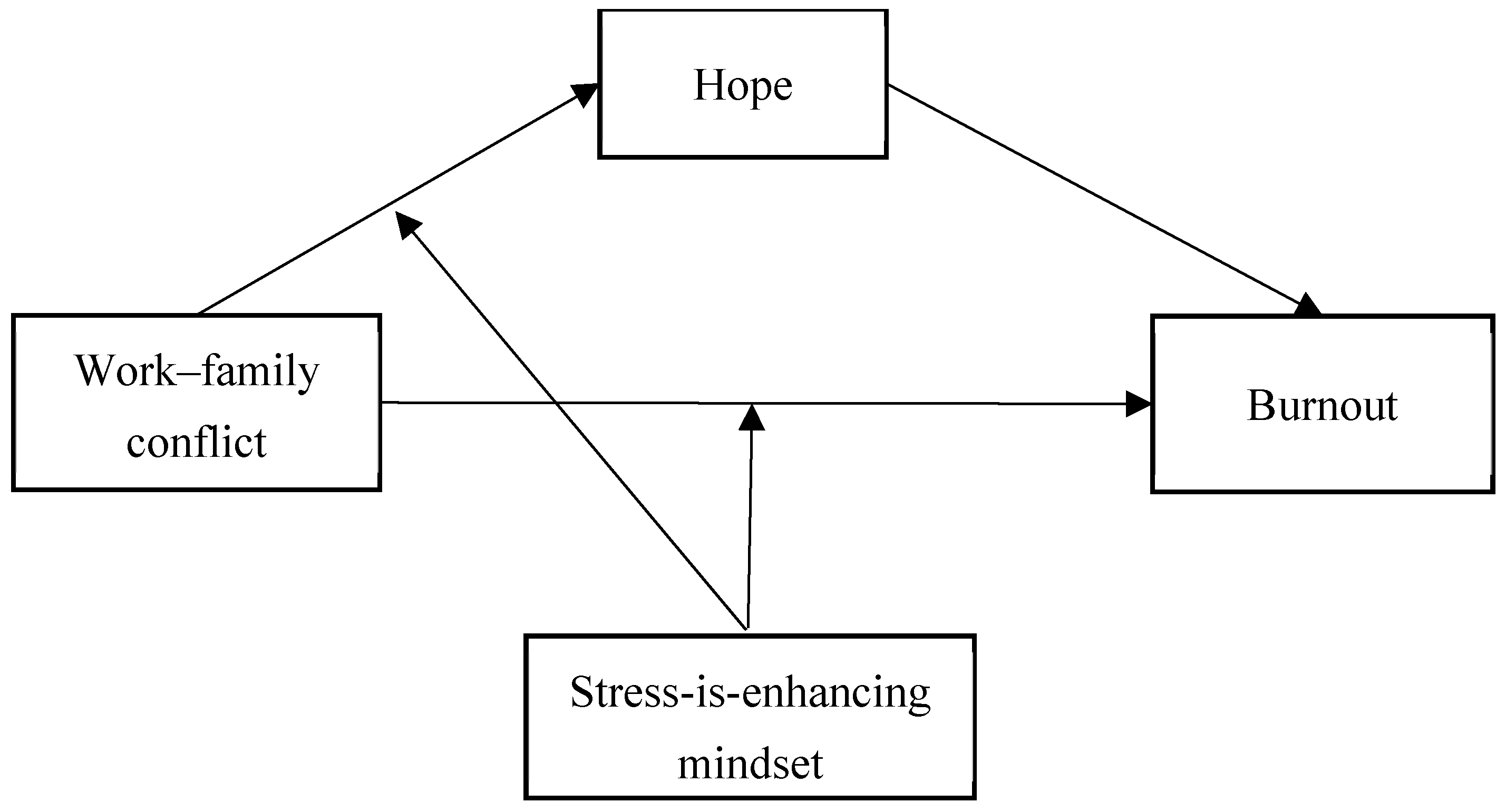
1.3. The Moderating Role of Stress-Is-Enhancing Mindset
2. Materials and Methods
2.1. Participants
2.2. Procedure
2.3. Measures
2.3.1. Demographic Characteristics
2.3.2. Work–Family Conflict
2.3.3. Hope
2.3.4. Stress-Is-Enhancing Mindset
2.3.5. Burnout
2.4. Data Analysis
3. Results
3.1. Descriptive Statistics
3.2. Correlations
3.3. Mediation Analysis of Hope
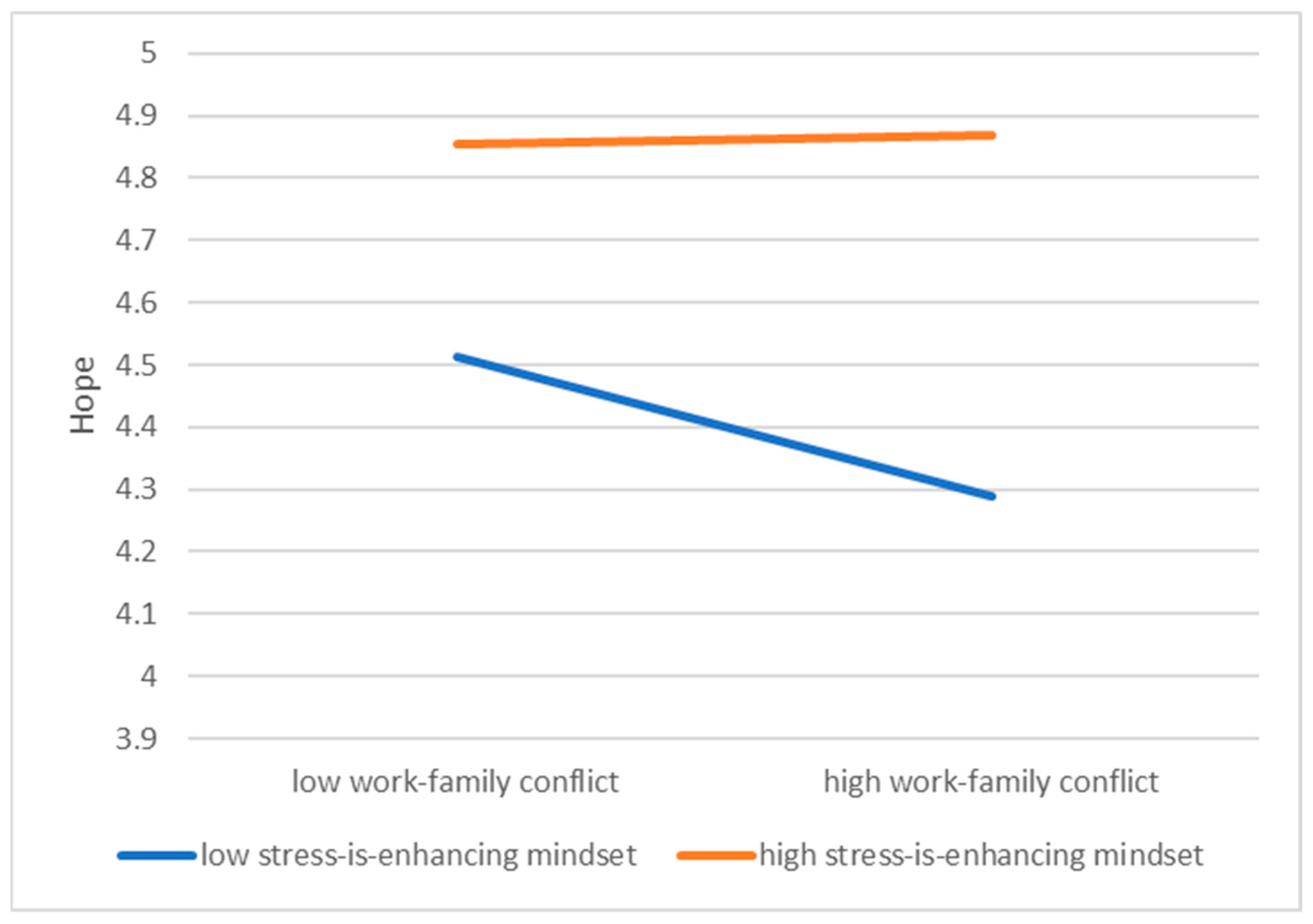
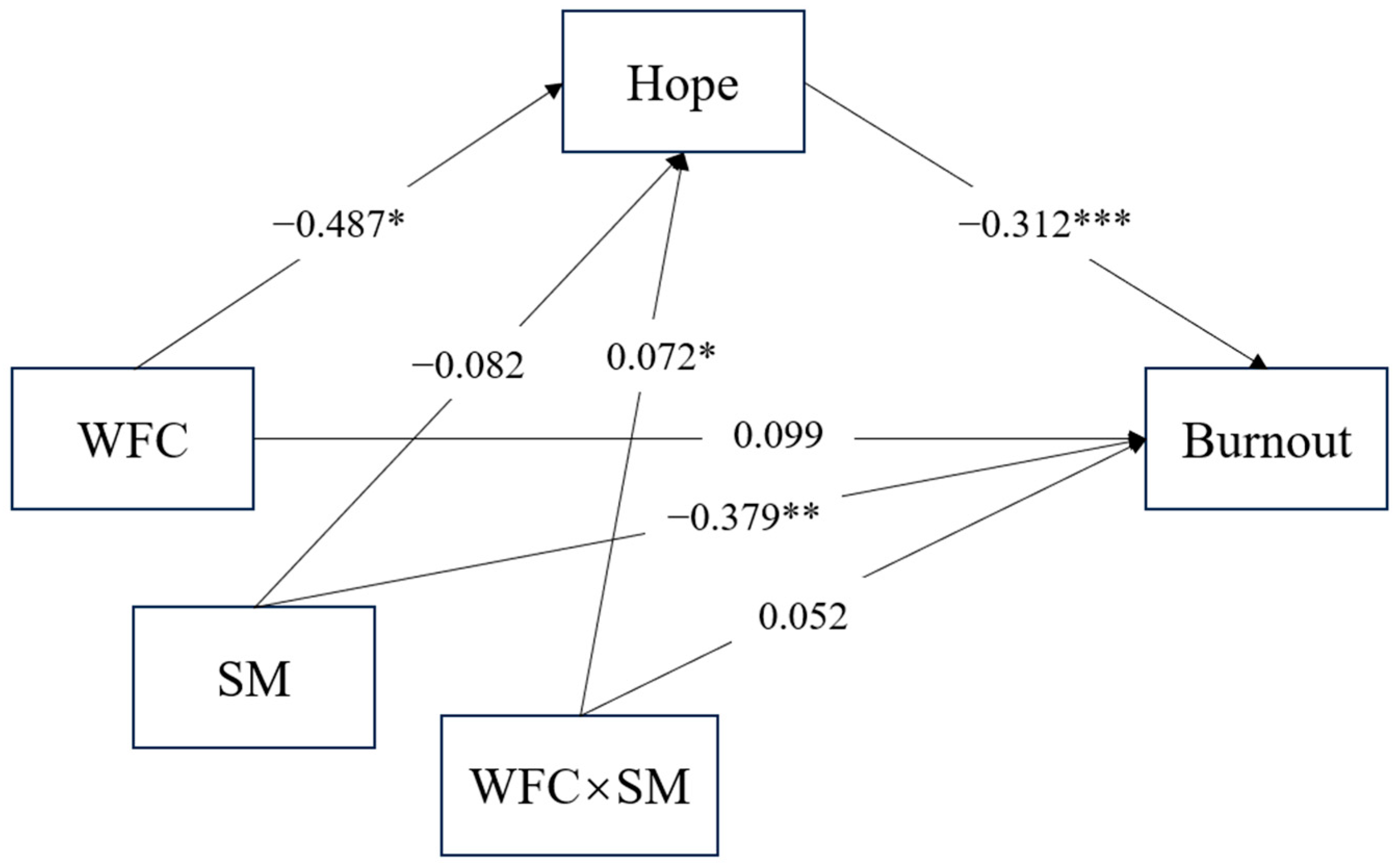
3.4. Moderation Analysis of Stress-Is-Enhancing Mindset
4. Discussion
5. Conclusions
Author Contributions
Funding
Institutional Review Board Statement
Informed Consent Statement
Data Availability Statement
Acknowledgments
Conflicts of Interest
Abbreviations
| WFC | Work–family conflict |
| COR | Conservation of Resources |
| FIW | Family interference with work |
References
- Boles, J. S., Johnston, M. W., & Hair, J. F., Jr. (1997). Role stress, work–family conflict and emotional exhaustion: Inter-relationships and effects on some work-related consequences. Journal of Personal Selling & Sales Management, 17(1), 17–28. [Google Scholar]
- Brotheridge, C. M., & Lee, R. T. (2002). Testing a conservation of resources model of the dynamics of emotional labor. Journal of Occupational Health Psychology, 7(1), 57. [Google Scholar] [CrossRef]
- Byron, K. (2005). A meta-analytic review of work–family conflict and its antecedents. Journal of Vocational Behaviour, 67(2), 169–198. [Google Scholar] [CrossRef] [Scilit]
- Casper, A., Sonnentag, S., & Tremmel, S. (2017). Mindset matters: The role of employees’ stress mindset for day-specific reactions to workload anticipation. European Journal of Work and Organizational Psychology, 26(6), 798–810. [Google Scholar] [CrossRef] [Scilit]
- Chang, M. L. (2009). An appraisal perspective of teacher burnout: Examining the emotional work of teachers. Educational Psychology Review, 21, 193–218. [Google Scholar] [CrossRef] [Scilit]
- Chen, Z., & Hou, L. (2021). An actor-partner interdependence model of work challenge stressors and work–family outcomes: The moderating roles of dual-career couples’ stress mindsets. Journal of Business and Psychology, 36, 1109–1123. [Google Scholar] [CrossRef] [Scilit]
- Crum, A. J., Akinola, M., Martin, A., & Fath, S. (2017). The role of stress mindset in shaping cognitive, emotional, and physiological responses to challenging and threatening stress. Anxiety, Stress, & Coping, 30(4), 379–395. [Google Scholar] [CrossRef] [Scilit] [PubMed]
- Crum, A. J., Salovey, P., & Achor, S. (2013). Rethinking stress: The role of mindsets in determining the stress response. Journal of Personality and Social Psychology, 104(4), 716. [Google Scholar] [CrossRef] [Scilit] [PubMed]
- Djudiyah, D., Alif, M., & Firdiyanti, R. (2023). The effects of hope and self-efficacy on employee burnout. Journal of Educational, Health, Community Psychology, 12(1), 52–77. [Google Scholar]
- Frone, M. R., Russell, M., & Cooper, M. L. (1992). Antecedents and outcomes of work–family conflict: Testing a model of the work–family interface. Journal of Applied Psychology, 77(1), 65. [Google Scholar] [CrossRef]
- Gao, Z., & Zhao, C. (2014). Why is it difficult to balance work and family? An analysis based on work–family boundary theory. Acta Psychologica Sinica, 46(4), 552–568. [Google Scholar] [CrossRef] [Scilit]
- García-Arroyo, J. A., Osca Segovia, A., & Peiró, J. M. (2019). Meta-analytical review of teacher burnout across 36 societies: The role of national learning assessments and gender egalitarianism. Psychology & Health, 34(6), 733–753. [Google Scholar] [CrossRef] [Scilit]
- Grandey, A. A., & Cropanzano, R. (1999). The conservation of resources model applied to work–family conflict and strain. Journal of Vocational Behaviour, 54(2), 350–370. [Google Scholar] [CrossRef] [Scilit]
- Greenhaus, J. H., & Beutell, N. J. (1985). Sources of conflict between work and family roles. Academy of Management Review, 10(1), 76–88. [Google Scholar] [CrossRef] [Scilit]
- Gustafsson, H., Hassmén, P., & Podlog, L. (2010). Exploring the relationship between hope and burnout in competitive sport. Journal of Sports Sciences, 28(14), 1495–1504. [Google Scholar] [CrossRef] [Scilit]
- Gustafsson, H., Skoog, T., Podlog, L., Lundqvist, C., & Wagnsson, S. (2013). Hope and athlete burnout: Stress and affect as mediators. Psychology of Sport and Exercise, 14(5), 640–649. [Google Scholar] [CrossRef] [Scilit]
- Gutek, B. A., Searle, S., & Klepa, L. (1991). Rational versus gender role explanations for work–family conflict. Journal of Applied Psychology, 76(4), 560. [Google Scholar] [CrossRef]
- Hahm, S. W. (2016). Effect of general/job stress mindset to decrease the influence of job stress to burnout. Information, 19(11B), 5365–5372. [Google Scholar]
- Halbesleben, J. R., Neveu, J. P., Paustian-Underdahl, S. C., & Westman, M. (2014). Getting to the “COR” understanding the role of resources in conservation of resources theory. Journal of Management, 40(5), 1334–1364. [Google Scholar] [CrossRef] [Scilit]
- Hammond, M. M., Murphy, C., & Demsky, C. A. (2021). Stress mindset and the work–family interface. International Journal of Manpower, 42(1), 150–166. [Google Scholar] [CrossRef] [Scilit]
- Herbert, M. (2011). An exploration of the relationships between psychological capital (hope, optimism, self-efficacy, resilience), occupational stress, burnout and employee engagement [Doctoral dissertation, Stellenbosch University]. [Google Scholar]
- Herman, K. C., Hickmon-Rosa, J. E., & Reinke, W. M. (2018). Empirically derived profiles of teacher stress, burnout, self-efficacy, and coping and associated student outcomes. Journal of Positive Behaviour Interventions, 20(2), 90–100. [Google Scholar] [CrossRef] [Scilit]
- Hobfoll, S. E. (1989). Conservation of resources: A new attempt at conceptualising stress. American Psychologist, 44(3), 513. [Google Scholar] [CrossRef]
- Hobfoll, S. E., Halbesleben, J., Neveu, J. P., & Westman, M. (2018). Conservation of resources in the organizational context: The reality of resources and their consequences. Annual Review of Organizational Psychology and Organizational Behavior, 5(1), 103–128. [Google Scholar] [CrossRef] [Scilit]
- Li, X., Lin, X., Zhang, F., & Tian, Y. (2021). Playing roles in work and family: Effects of work/family conflicts on job and life satisfaction among junior high school teachers. Frontiers in Psychology, 12, 772025. [Google Scholar] [CrossRef] [Scilit]
- Li, Y., Ni, X., Zhang, W., Wang, J., Yu, C., & Zou, H. (2024). The relationship between work–family conflict and job burnout among primary and secondary school teachers: The role of depression and cognitive reappraisal. Frontiers in Psychology, 15, 1438933. [Google Scholar] [CrossRef] [Scilit] [PubMed]
- Liu, H., & Cheung, F. M. (2015). The role of work–family role integration in a job demands–resources model among Chinese secondary school teachers. Asian Journal of Social Psychology, 18(4), 288–298. [Google Scholar] [CrossRef] [Scilit]
- Luthans, F., Avolio, B. J., Walumbwa, F. O., & Li, W. (2005). The psychological capital of Chinese workers: Exploring the relationship with performance. Management and Organization Review, 1(2), 249–271. [Google Scholar] [CrossRef] [Scilit]
- Mansell, P. C., & Turner, M. J. (2023). The mediating role of proactive coping in the relationships between stress mindset, challenge appraisal tendencies, and psychological wellbeing. Frontiers in Psychology, 14, 1140790. [Google Scholar] [CrossRef] [Scilit] [PubMed]
- Maslach, C., & Leiter, M. P. (2016). Understanding the burnout experience: Recent research and its implications for psychiatry. World Psychiatry, 15(2), 103–111. [Google Scholar] [CrossRef] [Scilit] [PubMed]
- Matore, E. M., & Khairani, A. Z. (2020). The pattern of skewness and kurtosis using mean score and logit in measuring adversity quotient (AQ) for normality testing. International Journal of Future Generation Communication and Networking, 13(1), 688–702. [Google Scholar]
- Nart, S., & Batur, O. (2014). The relation between work–family conflict, job stress, organizational commitment and job performance: A study on Turkish primary teachers. European Journal of Research on Education, 2(2), 72–81. [Google Scholar] [CrossRef] [Scilit]
- Olivier, M. A. J., & Venter, D. J. L. (2003). The extent and causes of stress in teachers in the George region. South African Journal of Education, 23(3), 186–192. [Google Scholar]
- Oren, L., & Levin, L. (2017). Work–family conflict/enrichment: The role of personal resources. International Journal of Manpower, 38(8), 1102–1113. [Google Scholar] [CrossRef] [Scilit]
- Park, D., Yu, A., Metz, S. E., Tsukayama, E., Crum, A. J., & Duckworth, A. L. (2018). Beliefs about stress attenuate the relation among adverse life events, perceived distress, and self-control. Child Development, 89(6), 2059–2069. [Google Scholar] [CrossRef] [Scilit]
- Pharris, A. B., Munoz, R. T., & Hellman, C. M. (2022). Hope and resilience as protective factors linked to lower burnout among child welfare workers. Children and Youth Services Review, 136, 106424. [Google Scholar] [CrossRef] [Scilit]
- Pu, J., Hou, H., Ma, R., & Sang, J. (2017). The effect of psychological capital between work–family conflict and job burnout in Chinese university teachers: Testing for mediation and moderation. Journal of Health Psychology, 22(14), 1799–1807. [Google Scholar] [CrossRef] [Scilit] [PubMed]
- Rajendran, N., Watt, H. M., & Richardson, P. W. (2020). Teacher burnout and turnover intent. The Australian Educational Researcher, 47(3), 477–500. [Google Scholar] [CrossRef] [Scilit]
- Skaalvik, E. M., & Skaalvik, S. (2020). Teacher burnout: Relations between dimensions of burnout, perceived school context, job satisfaction and motivation for teaching. A longitudinal study. Teachers and Teaching, 26(7–8), 602–616. [Google Scholar] [CrossRef] [Scilit]
- Snyder, C. R. (2002). Hope theory: Rainbows in the mind. Psychological Inquiry, 13(4), 249–275. [Google Scholar] [CrossRef] [Scilit]
- Szcześniak, M., Falewicz, A., Wnuk, M., Bielecka, G., & Madej, D. (2024). The mediating effect of hope agency on perceived stress and professional burnout among Polish corporate employees. Scientific Reports, 14(1), 1859. [Google Scholar] [CrossRef] [Scilit]
- Wang, G., Liu, C., & Wu, X. (2003). Development of educator burnout inventory. Psychological Development and Education, 19(3), 82–86. [Google Scholar]
- Wang, Y., Liu, L., Wang, J., & Wang, L. (2012). Work-family conflict and burnout among Chinese doctors: The mediating role of psychological capital. Journal of Occupational Health, 54(3), 232–240. [Google Scholar] [CrossRef] [Scilit]
- Wei, S., Sun, H., Ding, H., & Song, S. (2024). The relationship between primary and secondary school teachers’ work–family conflict and thriving at work: An exploration based on polynomial regression and response surface analysis. Studies of Psychology and Behavior, 22(2), 266–273. [Google Scholar]
- Wu, J., Li, Q., Wu, Q., & Li, Q. (2022). Social class-based discrimination and psychological symptoms among socioeconomically disadvantaged college students: The moderated mediation role of stress mindset and rumination. Frontiers in Psychiatry, 13, 858951. [Google Scholar] [CrossRef] [Scilit] [PubMed]
- Yavas, U., Babakus, E., & Karatepe, O. M. (2013). Does hope moderate the impact of job burnout on frontline bank employees’ in-role and extra-role performances? International Journal of Bank Marketing, 31(1), 56–70. [Google Scholar] [CrossRef] [Scilit]
- Zábrodská, K., Mudrák, J., Šolcová, I., Květon, P., Blatný, M., & Machovcová, K. (2018). Burnout among university faculty: The central role of work–family conflict. Educational Psychology, 38(6), 800–819. [Google Scholar] [CrossRef] [Scilit]
- Zhong, Y., Lai, S., Li, Y., Yang, K., Tang, H., & Zhang, X. Y. (2025). Burnout and its relationship with depressive symptoms in primary school teachers under the “Double Reduction” policy in China. Frontiers in Public Health, 12, 1420452. [Google Scholar] [CrossRef] [Scilit] [PubMed]
- Zhou, Y., Jin, T., & Zhang, L. (2024). Can the stress be managed? Stress mindset as a mitigating factor in the influence of job demands on burnout. Nursing Open, 11(9), e70028. [Google Scholar] [CrossRef] [Scilit]
- Zhu, X., Tian, G., Yin, H., & He, W. (2021). Is familism a motivator or stressor? Relationships between Confucian familism, emotional labor, work–family conflict, and emotional exhaustion among Chinese teachers. Frontiers in Psychology, 12, 766047. [Google Scholar] [CrossRef] [Scilit]



| Variables | Minimum | Maximum | Mean | SD | Number (%) |
|---|---|---|---|---|---|
| N | 452 (100%) | ||||
| Age | 22 | 58 | 39.4 | 8.62 | |
| Years of teaching | 0 | 47 | 17.11 | 10.06 | |
| Gender | |||||
| Female | 355 (78.5%) | ||||
| Male | 97 (21.5%) | ||||
| Educational level | |||||
| Senior high school | 4 (0.9%) | ||||
| Junior college | 16 (3.5%) | ||||
| Undergraduate | 354 (78.3%) | ||||
| Postgraduate | 78 (17.3%) | ||||
| Marital status | |||||
| Married | 359 (79.4%) | ||||
| Single | 93 (20.6%) | ||||
| Monthly income | 9234.85 | 1807.16 | |||
| Health status | 1 | 5 | 3.08 | 0.98 | |
| Work–family conflict | 1 | 5 | 3.31 | 0.66 | |
| Hope | 1 | 6 | 4.61 | 0.81 | |
| Stress-is-enhancing mindset | 1 | 5 | 3.04 | 0.52 | |
| Burnout | 1 | 7 | 3.14 | 1.01 |
| (1) | (2) | (3) | (4) | (5) | (6) | (7) | (8) | (9) | |
|---|---|---|---|---|---|---|---|---|---|
| (1) Gender | - | ||||||||
| (2) Teaching years | −0.13 *** | - | |||||||
| (3) Marital status | 0.03 | 0.39 *** | - | ||||||
| (4) Monthly income | −0.01 * | 0.24 *** | 0.11 * | - | |||||
| (5) Educational level | 0.18 *** | −0.47 *** | −0.26 *** | −0.05 | - | ||||
| (6) Health status | −0.06 | −0.19 *** | −0.17 *** | −0.05 | 0.14 ** | - | |||
| (7) Work–family conflict | 0.00 | 0.00 | 0.07 | 0.02 | 0.04 | −0.32 *** | - | ||
| (8) Stress-is-enhancing mindset | −0.04 | 0.02 | 0.06 | 0.05 | 0.00 | 0.21 *** | −0.24 *** | - | |
| (9) Hope | −0.04 | 0.12 * | 0.10 * | 0.16 ** | −0.03 | 0.14 ** | −0.15 ** | 0.31 *** | - |
| (10) Burnout | 0.00 | −0.09 * | −0.13 ** | −0.11 * | 0.07 | −0.22 *** | 0.49 *** | −0.36 *** | −0.44 *** |
| Variables | Model 1 | Model 2 | ||||
|---|---|---|---|---|---|---|
| Outcome: Hope | Outcome: Burnout | |||||
| B | Boot SE | Boot 95% CI | B | Boot SE | Boot 95% CI | |
| Years of teaching | 0.006 | 0.004 | [−0.003, 0.014] | 0.000 | 0.004 | [−0.008, 0.009] |
| Married status | 0.200 * | 0.098 | [0.004, 0.388] | −0.297 ** | 0.103 | [−0.499, −0.093] |
| Monthly income | 1.301 | 0.677 | [−0.074, 2.518] | −0.563 | 0.424 | [−1.396, 0.271] |
| Health status | 0.125 ** | 0.049 | [0.023, 0.215] | −0.067 | 0.043 | [−0.152, 0.015] |
| Work–family Conflict | −0.142 * | 0.076 | [−0.297, −0.001] | 0.657 *** | 0.062 | [0.530, 0.773] |
| Hope | −0.425 *** | 0.052 | [−0.533, −0.329] | |||
| Variables | Model 1 | Model 2 | ||||
|---|---|---|---|---|---|---|
| Outcome: Hope | Outcome: Burnout | |||||
| B | SE | 95% CI | B | SE | 95% CI | |
| Years of teaching | 0.005 | 0.004 | [−0.003, 0.013] | −0.001 | 0.004 | [−0.009, 0.008] |
| Married status | 0.143 | 0.098 | [−0.049, 0.335] | −0.271 ** | 0.100 | [−0.467, −0.075] |
| Monthly income | 1.210 ** | 0.406 | [0.412, 2.008] | −0.496 | 0.418 | [−1.317, 0.324] |
| Health status | 0.078 | 0.041 | [−0.002, 0.159] | 0.056 | 0.042 | [−0.138, 0.026] |
| Work–family conflict (WFC) | −0.598 * | 0.255 | [−1.100, −0.096] | 0.152 | 0.262 | [−0.363, 0.666] |
| Stress-is-enhancing mindset (SM) | −0.127 | 0.259 | [−0.635, 0.381] | −0.736 ** | 0.263 | [−1.254, −0.219] |
| Hope | −0.389 *** | 0.049 | [−0.486, −0.292] | |||
| WFC×SM | 0.171 * | 0.081 | [0.011, 0.330] | 0.152 | 0.083 | [−0.012, 0.315] |
| Model summary | ||||||
| F | 10.752 *** | 38.740 *** | ||||
| R2 | 0.150 | 0.421 | ||||
Disclaimer/Publisher’s Note: The statements, opinions and data contained in all publications are solely those of the individual author(s) and contributor(s) and not of MDPI and/or the editor(s). MDPI and/or the editor(s) disclaim responsibility for any injury to people or property resulting from any ideas, methods, instructions or products referred to in the content. |
© 2026 by the authors. Licensee MDPI, Basel, Switzerland. This article is an open access article distributed under the terms and conditions of the Creative Commons Attribution (CC BY) license.
Share and Cite
Li, Q.; Li, B.; Zhao, C.; Xiao, S. How Stress Mindset Mitigates Burnout: The Role of Hope in Work–Family Conflict Among Chinese Teachers. Behav. Sci. 2026, 16, 186. https://doi.org/10.3390/bs16020186
Li Q, Li B, Zhao C, Xiao S. How Stress Mindset Mitigates Burnout: The Role of Hope in Work–Family Conflict Among Chinese Teachers. Behavioral Sciences. 2026; 16(2):186. https://doi.org/10.3390/bs16020186
Chicago/Turabian StyleLi, Qianfeng, Bohan Li, Caner Zhao, and Shaobei Xiao. 2026. "How Stress Mindset Mitigates Burnout: The Role of Hope in Work–Family Conflict Among Chinese Teachers" Behavioral Sciences 16, no. 2: 186. https://doi.org/10.3390/bs16020186
APA StyleLi, Q., Li, B., Zhao, C., & Xiao, S. (2026). How Stress Mindset Mitigates Burnout: The Role of Hope in Work–Family Conflict Among Chinese Teachers. Behavioral Sciences, 16(2), 186. https://doi.org/10.3390/bs16020186