From Synergy to Strain: Exploring the Psychological Mechanisms Linking Employee–AI Collaboration and Knowledge Hiding


Abstract
1. Introduction
2. Theory and Hypotheses
2.1. Theoretical Background
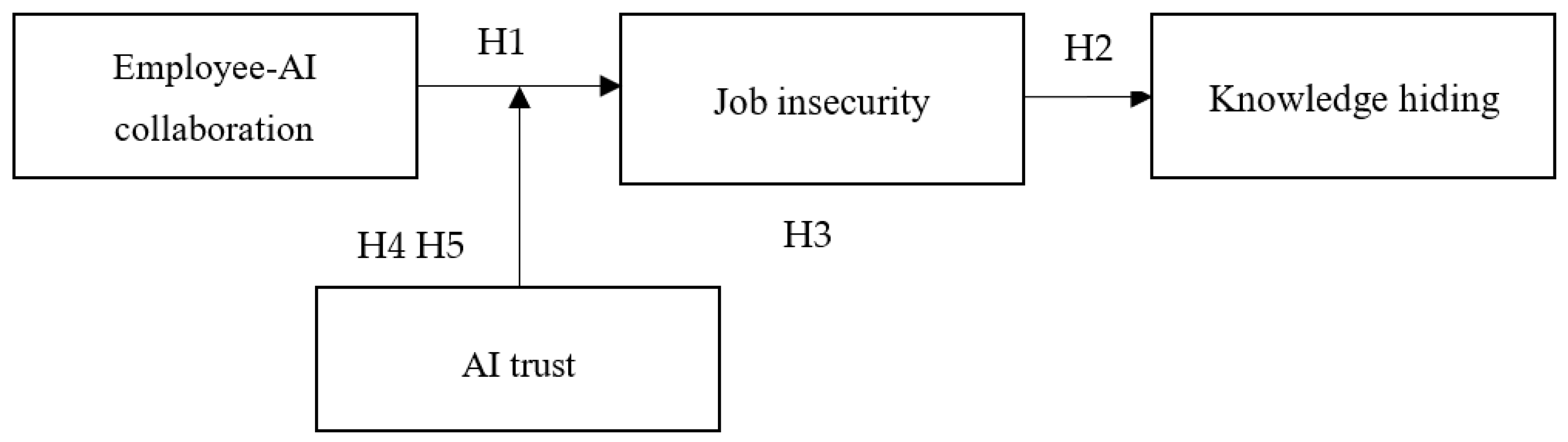
2.2. Employee–AI Collaboration and Job Insecurity
2.3. Job Insecurity and Knowledge Hiding
2.4. The Mediating Role of Job Insecurity
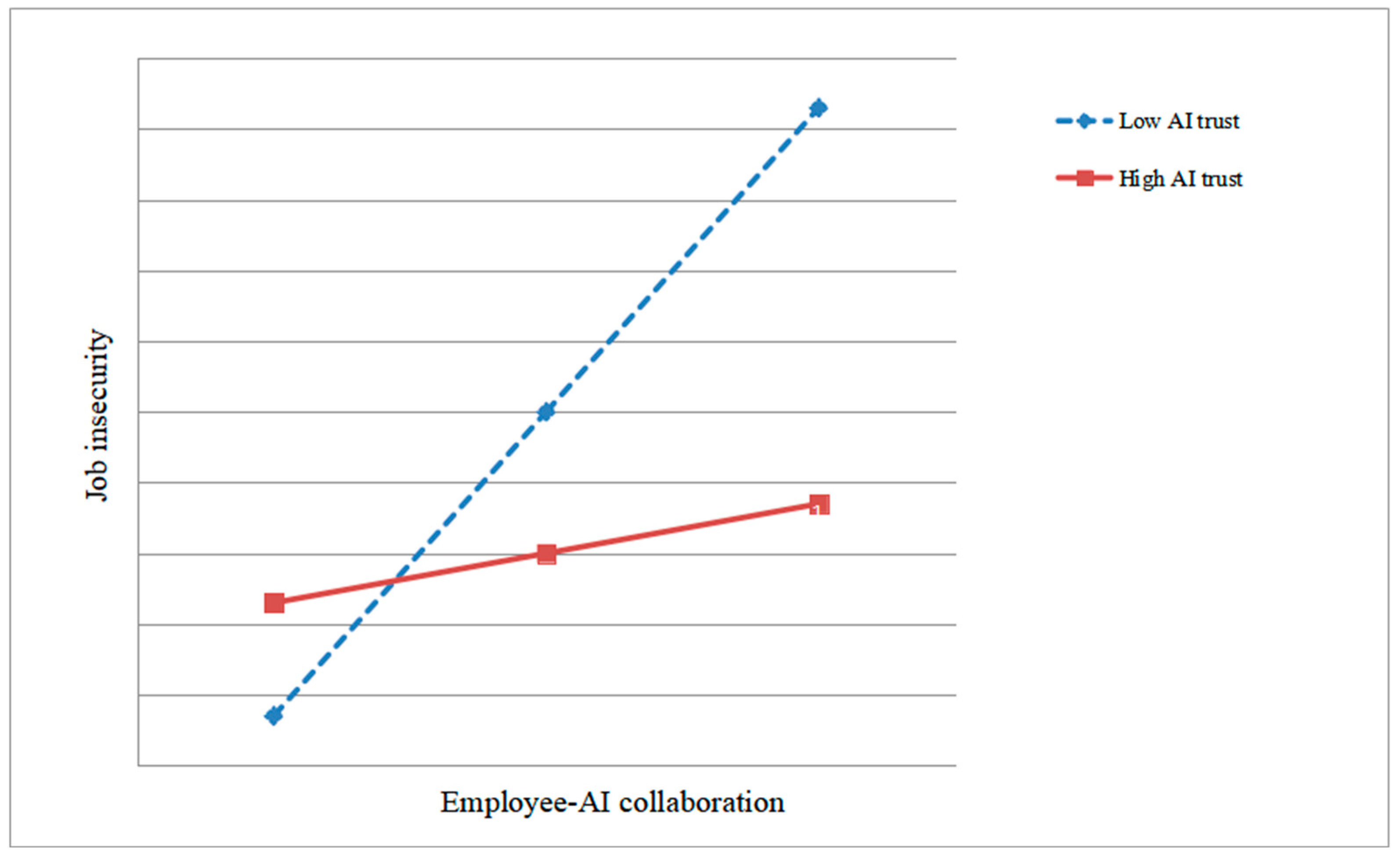
2.5. The Moderating Role of AI Trust
3. Method
3.1. Procedure and Sample
3.2. Measures
4. Results
4.1. Test for Common Method Bias
4.2. Descriptive Statistics
4.3. Confirmatory Factor Analysis
4.4. The Results on Reliability and Validity
4.5. Hypothesis Testing
5. Discussion
5.1. Theoretical Contributions
5.2. Practical Implications
5.3. Limitations and Future Research Directions
6. Conclusions
Author Contributions
Funding
Institutional Review Board Statement
Informed Consent Statement
Data Availability Statement
Conflicts of Interest
References
- Anand, A., Offergelt, F., & Anand, P. (2022). Knowledge hiding—A systematic review and research agenda. Journal of Knowledge Management, 26(6), 1438–1457. [Google Scholar]
- Arain, G. A., Bhatti, Z. A., Ashraf, N., & Fang, Y.-H. (2020). Top-down knowledge hiding in organizations: An empirical study of the consequences of supervisor knowledge hiding among local and foreign workers in the Middle East. Journal of Business Ethics, 164(3), 611–625. [Google Scholar] [CrossRef]
- Arias-Pérez, J., & Vélez-Jaramillo, J. (2022). Understanding knowledge hiding under technological turbulence caused by artificial intelligence and robotics. Journal of Knowledge Management, 26(6), 1476–1491. [Google Scholar] [CrossRef]
- Asan, O., Bayrak, A. E., & Choudhury, A. (2020). Artificial intelligence and human trust in healthcare: Focus on clinicians. Journal of Medical Internet Research, 22(6), e15154. [Google Scholar] [CrossRef]
- Bedué, P., & Fritzsche, A. (2022). Can we trust AI? An empirical investigation of trust requirements and guide to successful AI adoption. Journal of Enterprise Information Management, 35(2), 530–549. [Google Scholar] [CrossRef]
- Budhwar, P., Chowdhury, S., Wood, G., Aguinis, H., Bamber, G. J., Beltran, J. R., Boselie, P., Lee Cooke, F., Decker, S., & DeNisi, A. (2023). Human resource management in the age of generative artificial intelligence: Perspectives and research directions on ChatGPT. Human Resource Management Journal, 33(3), 606–659. [Google Scholar] [CrossRef]
- Cao, J., & Song, Z. (2025). An incoming threat: The influence of automation potential on job insecurity. Asia-Pacific Journal of Business Administration, 17(1), 116–135. [Google Scholar] [CrossRef]
- Chen, J., Xue, J., Li, Y., & Luo, W. (2025). Impact of different employee—AI interaction: Instrumental vs. emotional support and gender differences. International Journal of Human–Computer Interaction, 41(21), 13394–13407. [Google Scholar] [CrossRef]
- Cheng, G. H. L., & Chan, D. K. S. (2008). Who suffers more from job insecurity? A meta-analytic review. Applied Psychology, 57(2), 272–303. [Google Scholar] [CrossRef]
- Choung, H., David, P., & Ross, A. (2023). Trust in AI and its role in the acceptance of AI technologies. International Journal of Human–Computer Interaction, 39(9), 1727–1739. [Google Scholar] [CrossRef]
- Connelly, C. E., Černe, M., Dysvik, A., & Škerlavaj, M. (2019). Understanding knowledge hiding in organizations. Journal of Organizational Behavior, 40(7), 779–782. [Google Scholar] [CrossRef]
- Connelly, C. E., Zweig, D., Webster, J., & Trougakos, J. P. (2012). Knowledge hiding in organizations. Journal of organizational behavior, 33(1), 64–88. [Google Scholar] [CrossRef]
- Černe, M., Nerstad, C. G., Dysvik, A., & Škerlavaj, M. (2014). What goes around comes around: Knowledge hiding, perceived motivational climate, and creativity. Academy of Management Journal, 57(1), 172–192. [Google Scholar] [CrossRef]
- de Brito Duarte, R., Correia, F., Arriaga, P., & Paiva, A. (2023). AI trust: Can explainable AI enhance warranted trust? Human Behavior and Emerging Technologies, 2023(1), 4637678. [Google Scholar] [CrossRef]
- De Witte, H., Pienaar, J., & De Cuyper, N. (2016). Review of 30 years of longitudinal studies on the association between job insecurity and health and well-being: Is there causal evidence? Australian Psychologist, 51(1), 18–31. [Google Scholar] [CrossRef]
- Fauzi, M. A. (2023). Knowledge hiding behavior in higher education institutions: A scientometric analysis and systematic literature review approach. Journal of Knowledge Management, 27(2), 302–327. [Google Scholar] [CrossRef]
- Ferrario, A., & Loi, M. (2022, June 21–24). How explainability contributes to trust in AI. 2022 ACM Conference on Fairness, Accountability, and Transparency (pp. 1457–1466), Seoul, Republic of Korea. [Google Scholar]
- Gerlich, M. (2024). Exploring motivators for trust in the dichotomy of human—AI trust dynamics. Social Sciences, 13(5), 251. [Google Scholar] [CrossRef]
- Gibbard, K., Gill, H., Powell, D., & Hausdorf, P. A. (2025). Explain it to me like I’m five: Harnessing the power of explanations to increase trust in workplace generative AI. Behaviour & Information Technology, 1–19. [Google Scholar] [CrossRef]
- Gillath, O., Ai, T., Branicky, M. S., Keshmiri, S., Davison, R. B., & Spaulding, R. (2021). Attachment and trust in artificial intelligence. Computers in Human Behavior, 115, 106607. [Google Scholar] [CrossRef]
- Glikson, E., & Woolley, A. W. (2020). Human trust in artificial intelligence: Review of empirical research. Academy of Management Annals, 14(2), 627–660. [Google Scholar] [CrossRef]
- Habbal, A., Ali, M. K., & Abuzaraida, M. A. (2024). Artificial Intelligence Trust, risk and security management (AI trism): Frameworks, applications, challenges and future research directions. Expert Systems with Applications, 240, 122442. [Google Scholar] [CrossRef]
- Hellgren, J., Sverke, M., & Isaksson, K. (1999). A two-dimensional approach to job insecurity: Consequences for employee attitudes and well-being. European Journal of Work and Organizational Psychology, 8(2), 179–195. [Google Scholar] [CrossRef]
- Ibrahim Hassan, A. H., Baquero, A., Salama, W. M., & Ahmed Khairy, H. (2024). Engaging hotel employees in the era of artificial intelligence: The interplay of artificial intelligence awareness, job insecurity, and technical self-efficacy. Journal of Logistics, Informatics and Service Science, 11(5), 522–539. [Google Scholar]
- Jiang, L., & Lavaysse, L. M. (2018). Cognitive and affective job insecurity: A meta-analysis and a primary study. Journal of Management, 44(6), 2307–2342. [Google Scholar] [CrossRef]
- Kaplan, A. D., Kessler, T. T., Brill, J. C., & Hancock, P. A. (2023). Trust in artificial intelligence: Meta-analytic findings. Human Factors, 65(2), 337–359. [Google Scholar] [CrossRef]
- Khoreva, V., & Wechtler, H. (2020). Exploring the consequences of knowledge hiding: An agency theory perspective. Journal of Managerial Psychology, 35(2), 71–84. [Google Scholar] [CrossRef]
- Kim, B. J., & Kim, M. J. (2024). How artificial intelligence-induced job insecurity shapes knowledge dynamics: The mitigating role of artificial intelligence self-efficacy. Journal of Innovation & Knowledge, 9(4), 100590. [Google Scholar] [CrossRef]
- Kim, B. J., & Lee, J. (2025). The dark sides of artificial intelligence implementation: Examining how corporate social responsibility buffers the impact of artificial intelligence-induced job insecurity on pro-environmental behavior through meaningfulness of work. Sustainable Development, 33(3), 4732–4756. [Google Scholar] [CrossRef]
- Kim, J., Giroux, M., & Lee, J. C. (2021). When do you trust AI? The effect of number presentation detail on consumer trust and acceptance of AI recommendations. Psychology & Marketing, 38(7), 1140–1155. [Google Scholar] [CrossRef]
- Kong, H., Yin, Z., Baruch, Y., & Yuan, Y. (2023). The impact of trust in AI on career sustainability: The role of employee–AI collaboration and protean career orientation. Journal of Vocational Behavior, 146, 103928. [Google Scholar] [CrossRef]
- Koo, B., Curtis, C., & Ryan, B. (2021). Examining the impact of artificial intelligence on hotel employees through job insecurity perspectives. International Journal of Hospitality Management, 95, 102763. [Google Scholar] [CrossRef]
- Lazarus, R. F. S., & Folkman, S. (2006). Stress, appraisal and coping. Springer Publishing. [Google Scholar]
- László, K. D., Pikhart, H., Kopp, M. S., Bobak, M., Pajak, A., Malyutina, S., Salavecz, G., & Marmot, M. (2010). Job insecurity and health: A study of 16 European countries. Social Science & Medicine, 70(6), 867–874. [Google Scholar] [CrossRef]
- Lee, C., Huang, G.-H., & Ashford, S. J. (2018). Job insecurity and the changing workplace: Recent developments and the future trends in job insecurity research. Annual Review of Organizational Psychology and Organizational Behavior, 5, 335–359. [Google Scholar] [CrossRef]
- Li, J.-M., Hao-Yu, W., Ruo-Xi, Z., & Wu, T.-J. (2025a). How employee-generative AI collaboration affects employees work and family outcomes? The relationship instrumentality perspective. The International Journal of Human Resource Management, 36(8), 1431–1457. [Google Scholar] [CrossRef]
- Li, J.-M., Wu, T.-J., Wu, Y. J., & Goh, M. (2023). Systematic literature review of human–machine collaboration in organizations using bibliometric analysis. Management Decision, 61(10), 2920–2944. [Google Scholar] [CrossRef]
- Li, J.-M., Zhang, L.-X., & Mao, M.-Y. (2025b). How does human-AI interaction affect employees’ workplace procrastination? Technological Forecasting and Social Change, 212, 123951. [Google Scholar] [CrossRef]
- Li, J.-M., Zhang, R.-X., Wu, T.-J., & Mao, M. (2024). How does work autonomy in human-robot collaboration affect hotel employees’ work and health outcomes? Role of job insecurity and person-job fit. International Journal of Hospitality Management, 117, 103654. [Google Scholar] [CrossRef]
- Lu, C. C. A., Yeh, C. C. R., & Lai, C. C. S. (2025). The role of intelligence, trust and interpersonal job characteristics in employees’ AI usage acceptance. International Journal of Hospitality Management, 126, 104032. [Google Scholar] [CrossRef]
- McGrath, M. J., Lack, O., Tisch, J., & Duenser, A. (2025). Measuring trust in artificial intelligence: Validation of an established scale and its short form. Frontiers in Artificial Intelligence, 8, 1582880. [Google Scholar] [CrossRef] [PubMed]
- Mylrea, M., & Robinson, N. (2023). AI trust framework and maturity model: Improving security, ethics and trust in AI. Cybersecurity and Innovative Technology Journal, 1(1), 1–15. [Google Scholar] [CrossRef]
- Nguyen, T.-M., Malik, A., & Budhwar, P. (2022). Knowledge hiding in organizational crisis: The moderating role of leadership. Journal of Business Research, 139, 161–172. [Google Scholar] [CrossRef] [PubMed]
- Oliveira, M., Curado, C., & de Garcia, P. S. (2021). Knowledge hiding and knowledge hoarding: A systematic literature review. Knowledge and Process Management, 28(3), 277–294. [Google Scholar] [CrossRef]
- Omrani, N., Rivieccio, G., Fiore, U., Schiavone, F., & Agreda, S. G. (2022). To trust or not to trust? An assessment of trust in AI-based systems: Concerns, ethics and contexts. Technological Forecasting and Social Change, 181, 121763. [Google Scholar] [CrossRef]
- Pan, W., Zhang, Q., Teo, T. S., & Lim, V. K. (2018). The dark triad and knowledge hiding. International Journal of Information Management, 42, 36–48. [Google Scholar] [CrossRef]
- Perez, F., Conway, N., Peterson, J., & Roques, O. (2024). Me, my work and AI: How radiologists craft their work and identity. Journal of Vocational Behavior, 155, 104042. [Google Scholar] [CrossRef]
- Preacher, K. J., & Hayes, A. F. (2008). Asymptotic and resampling strategies for assessing and comparing indirect effects in multiple mediator models. Behavior Research Methods, 40(3), 879–891. [Google Scholar] [CrossRef]
- Reinhardt, K. (2023). Trust and trustworthiness in AI ethics. AI and Ethics, 3(3), 735–744. [Google Scholar] [CrossRef]
- Rezwan, R. B., & Takahashi, Y. (2021). The psychology behind knowledge hiding in an organization. Administrative Sciences, 11(2), 57. [Google Scholar] [CrossRef]
- Serenko, A., & Bontis, N. (2016). Understanding counterproductive knowledge behavior: Antecedents and consequences of intra-organizational knowledge hiding. Journal of Knowledge Management, 20(6), 1199–1224. [Google Scholar] [CrossRef]
- Sharif, M. N., Zhang, L., Asif, M., Alshdaifat, S. M., & Hanaysha, J. R. (2025). Artificial intelligence and employee outcomes: Investigating the role of job insecurity and technostress in the hospitality industry. Acta Psychologica, 253, 104733. [Google Scholar] [CrossRef] [PubMed]
- Sverke, M., Hellgren, J., & Näswall, K. (2006). Job insecurity: A literature review (Vol. 1, pp. 1–30). Arbetslivsinstitutet. [Google Scholar]
- Tu, Y., Hao, P., & Long, L. (2023). Job replacement or job transformation? Definition, consequences, and sources of technology-driven job insecurity. Advances in Psychological Science, 31(8), 1359. [Google Scholar] [CrossRef]
- Ueno, T., Sawa, Y., Kim, Y., Urakami, J., Oura, H., & Seaborn, K. (2022, April 29–May 5). Trust in human-AI interaction: Scoping out models, measures, and methods. CHI Conference on Human Factors in Computing Systems Extended Abstracts (pp. 1–7), New Orleans, LA, USA. [Google Scholar]
- Wu, T.-J., Liang, Y., & Wang, Y. (2024). The buffering role of workplace mindfulness: How job insecurity of human-artificial intelligence collaboration impacts employees’ work–life-related outcomes. Journal of Business and Psychology, 39(6), 1395–1411. [Google Scholar] [CrossRef]
- Wu, T.-J., Zhang, R. X., & Li, J. M. (2025a). When employees meet digital-intelligence transformation: Unveiling the role of employee intentions. International Journal of Information Management, 84, 102912. [Google Scholar] [CrossRef]
- Wu, T.-J., Zhang, R. X., & Zhang, Z. (2025b). Navigating the human-artificial intelligence collaboration landscape: Impact on quality of work life and work engagement. Journal of Hospitality and Tourism Management, 62, 276–283. [Google Scholar] [CrossRef]
- Xu, C., Yao, Z., & Huo, W. (2024). Every coin has two sides: The application of artificial intelligence on employees’ unethical behaviours. Knowledge Management Research & Practice, 23(6), 597–610. [Google Scholar] [CrossRef]
- Xu, G., & Xue, M. (2023). Unemployment risk perception and knowledge hiding under the disruption of artificial intelligence transformation. Social Behavior and Personality, 51(2), e12106. [Google Scholar] [CrossRef]
- Zhang, L.-X., Li, J.-M., Wang, L.-L., Mao, M.-Y., & Zhang, R.-X. (2023). How does the usage of robots in hotels affect employees’ turnover intention? A double-edged sword study. Journal of Hospitality and Tourism Management, 57, 74–83. [Google Scholar] [CrossRef]
- Zhang, Y., Rong, S., Dunlop, E., Jiang, R., Zhang, Z., & Tang, J. Q. (2023). Modeling the influence of individual differences on knowledge hiding. Journal of Knowledge Management, 27(6), 1637–1659. [Google Scholar] [CrossRef]
- Zhao, H., Xia, Q., He, P., Sheard, G., & Wan, P. (2016). Workplace ostracism and knowledge hiding in service organizations. International Journal of Hospitality Management, 59, 84–94. [Google Scholar] [CrossRef]



| Variable | Mean | SD | 1 | 2 | 3 | 4 | 5 | 6 | 7 |
|---|---|---|---|---|---|---|---|---|---|
| 1. Gender | - | - | 1 | ||||||
| 2. Age | 32.40 | 6.80 | 0.02 | 1 | |||||
| 3. Employee-AI collaboration | 4.21 | 1.22 | 0.23 | 0.11 | 1 | ||||
| 4. Job insecurity | 3.89 | 1.04 | 0.32 | 0.22 | 0.33 ** | 1 | |||
| 5. Knowledge hiding | 4.01 | 0.89 | −0.33 | 0.32 | 0.27 ** | 0.30 *** | 1 | ||
| 6. AI trust | 2.85 | 1.23 | 0.22 | 0.10 | 0.24 ** | −0.22 ** | −0.31 ** | 1 |
| Model | χ2/df | CFI | TLI | RMSEA |
|---|---|---|---|---|
| Four-factor model | 1.22 | 0.94 | 0.95 | 0.06 |
| Three-factor model | 6.34 | 0.74 | 0.70 | 0.15 |
| Two-factor model | 8.55 | 0.48 | 0.44 | 0.21 |
| One-factor model | 10.64 | 0.42 | 0.39 | 0.34 |
| Variables | Items | Mean | SD | Factor Loading | AVE | CR |
|---|---|---|---|---|---|---|
| Employee-AI collaboration | A1 | 4.25 | 1.21 | 0.83 | 0.73 | 0.93 |
| A2 | 4.18 | 1.20 | 0.86 | |||
| A3 | 4.30 | 1.23 | 0.88 | |||
| A4 | 4.15 | 1.19 | 0.84 | |||
| A5 | 4.17 | 1.24 | 0.87 | |||
| AI trust | B1 | 2.90 | 1.25 | 0.78 | 0.65 | 0.91 |
| B2 | 2.83 | 1.22 | 0.80 | |||
| B3 | 2.88 | 1.2 | 0.82 | |||
| B4 | 2.79 | 1.26 | 0.84 | |||
| B5 | 2.91 | 1.23 | 0.79 | |||
| B6 | 2.87 | 1.21 | 0.83 | |||
| Job insecurity | C1 | 3.92 | 1.03 | 0.79 | 0.62 | 0.90 |
| C2 | 3.88 | 1.04 | 0.81 | |||
| C3 | 3.91 | 1.02 | 0.78 | |||
| C4 | 3.86 | 1.05 | 0.77 | |||
| C5 | 3.85 | 1.04 | 0.80 | |||
| C6 | 3.90 | 1.06 | 0.82 | |||
| C7 | 3.93 | 1.03 | 0.84 | |||
| Knowledge hiding | D1 | 4.02 | 0.92 | 0.74 | 0.61 | 0.94 |
| D2 | 4.01 | 0.91 | 0.77 | |||
| D3 | 3.98 | 0.9 | 0.79 | |||
| D4 | 4.05 | 0.88 | 0.81 | |||
| D5 | 4.03 | 0.87 | 0.76 | |||
| D6 | 4.00 | 0.89 | 0.78 | |||
| D7 | 4.07 | 0.90 | 0.82 | |||
| D8 | 4.09 | 0.91 | 0.80 | |||
| D9 | 3.96 | 0.92 | 0.75 | |||
| D10 | 4.10 | 0.88 | 0.83 | |||
| D11 | 3.97 | 0.93 | 0.81 | |||
| D12 | 4.00 | 0.89 | 0.79 |
| Model | Job Insecurity | Knowledge Hiding | ||||||
|---|---|---|---|---|---|---|---|---|
| M1 | M2 | M3 | M4 | |||||
| B | SE | B | SE | B | SE | B | SE | |
| Gender | 0.08 | 0.06 | 0.07 | 0.06 | 0.05 | 0.04 | 0.09 | 0.05 |
| Age | −0.03 | 0.04 | −0.02 | 0.04 | 0.08 | 0.05 | 0.08 | 0.04 |
| Employee-AI collaboration | 0.28 *** | 0.07 | 0.25 | 0.05 | 0.27 *** | 0.06 | 0.21 *** | 0.05 |
| Job insecurity | 0.03 | 0.23 *** | 0.04 | |||||
| AI trust | −0.10 | 0.05 | ||||||
| Int | −0.18 ** | 0.05 | ||||||
| R2 | 0.06 | 0.18 | 0.23 | 0.34 | ||||
| F Value | 2.1 | 6.75 | 7.89 | 9.34 | ||||
| Moderator | Effect | Standard Error | Lower Limit of 95% Confidence Interval | Higher Limit of 95% Confidence Interval |
|---|---|---|---|---|
| Mean − 1 SD | 0.28 | 0.03 | 0.12 | 0.33 |
| Mean + 1 SD | 0.13 | 0.27 | –0.06 | 0.29 |
Disclaimer/Publisher’s Note: The statements, opinions and data contained in all publications are solely those of the individual author(s) and contributor(s) and not of MDPI and/or the editor(s). MDPI and/or the editor(s) disclaim responsibility for any injury to people or property resulting from any ideas, methods, instructions or products referred to in the content. |
© 2025 by the authors. Licensee MDPI, Basel, Switzerland. This article is an open access article distributed under the terms and conditions of the Creative Commons Attribution (CC BY) license.
Share and Cite
Li, Y.-B.; Liao, T.-H.; Tsai, C.-H.; Wu, T.-J. From Synergy to Strain: Exploring the Psychological Mechanisms Linking Employee–AI Collaboration and Knowledge Hiding. Behav. Sci. 2026, 16, 13. https://doi.org/10.3390/bs16010013
Li Y-B, Liao T-H, Tsai C-H, Wu T-J. From Synergy to Strain: Exploring the Psychological Mechanisms Linking Employee–AI Collaboration and Knowledge Hiding. Behavioral Sciences. 2026; 16(1):13. https://doi.org/10.3390/bs16010013
Chicago/Turabian StyleLi, Yi-Bin, Ting-Hsiu Liao, Chih-Hao Tsai, and Tung-Ju Wu. 2026. "From Synergy to Strain: Exploring the Psychological Mechanisms Linking Employee–AI Collaboration and Knowledge Hiding" Behavioral Sciences 16, no. 1: 13. https://doi.org/10.3390/bs16010013
APA StyleLi, Y.-B., Liao, T.-H., Tsai, C.-H., & Wu, T.-J. (2026). From Synergy to Strain: Exploring the Psychological Mechanisms Linking Employee–AI Collaboration and Knowledge Hiding. Behavioral Sciences, 16(1), 13. https://doi.org/10.3390/bs16010013