Early Life Adversity and Disordered Eating: Cognitive and Neural Mechanisms
Abstract
1. Introduction
Neural Development Patterns of ELA
2. Method
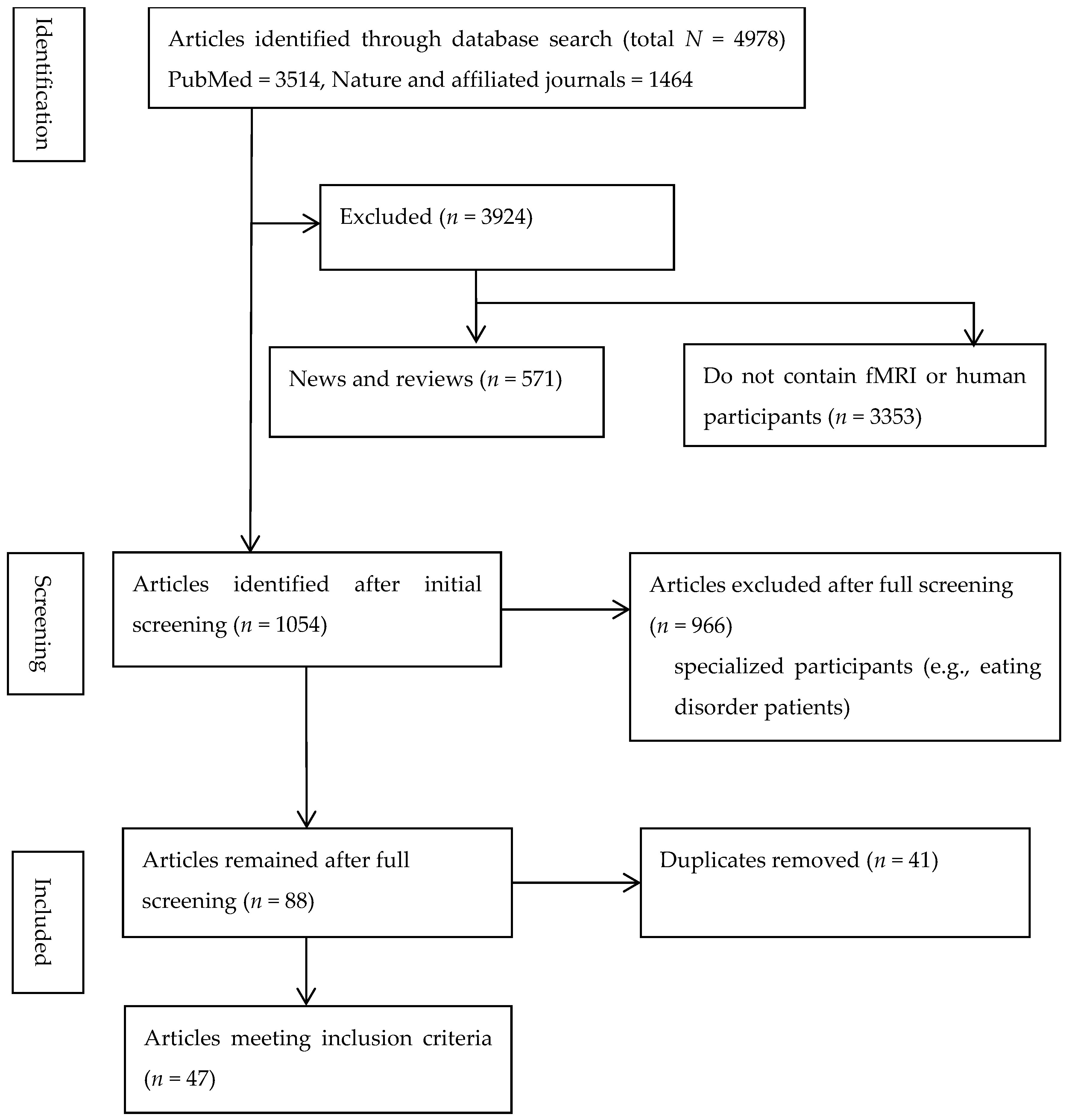
Paper Identification and Review
3. Results
3.1. Structural Changes, Functional Changes, and Cognitive Processing Patterns Related to ELA
3.2. Association Between ELA and Disordered Eating
3.2.1. Structural MRI Evidence
3.2.2. Resting States and Task-Based fMRI Evidence
3.2.3. Cognitive Processing Patterns
4. Discussion
5. Limitations
6. Conclusions
Author Contributions
Funding
Institutional Review Board Statement
Informed Consent Statement
Data Availability Statement
Conflicts of Interest
Abbreviations
| ELA | early life adversity |
| OFC | orbitofrontal cortex |
| vmPFC | ventromedial prefrontal cortex |
| ACC | anterior cingulate cortex |
| DMN | default mode network |
| IFG | inferior frontal gyrus |
References
- Avery, J., Carrington, M., Ingeholm, J., Darcey, V., Simmons, W., Hall, K., & Martin, A. (2025). Automatic engagement of limbic and prefrontal networks in response to food images reflects distinct information about food hedonics and inhibitory control. Communications Biology, 8(1), 270. [Google Scholar] [CrossRef]
- Baum, G. L., Cui, Z., Roalf, D. R., Ciric, R., Betzel, R. F., Larsen, B., Cieslak, M., Cook, P. A., Xia, C. H., Moore, T. M., Ruparel, K., Oathes, D. J., Alexander-Bloch, A. F., Shinohara, R. T., Raznahan, A., Gur, R. E., Gur, R. C., Bassett, D. S., & Satterthwaite, T. D. (2020). Development of structure–function coupling in human brain networks during youth. Proceedings of the National Academy of Sciences of the United States of America, 117(1), 771–778. [Google Scholar] [CrossRef]
- Birn, R., Roeber, B., & Pollak, S. (2017). Early childhood stress exposure, reward pathways, and adult decision making. Proceedings of the National Academy of Sciences of the United States of America, 114(51), 13549–13554. [Google Scholar] [CrossRef]
- Brennan, A., Marstaller, L., Burianová, H., Benton, D., Hanley, C., Newstead, S., & Young, H. (2022). Weaker connectivity in resting state networks is associated with disinhibited eating in older adults. International Journal of Obesity, 46(4), 859–865. [Google Scholar] [CrossRef] [PubMed]
- Brumback, T., Worley, M., Nguyen-Louie, T., Squeglia, L., Jacobus, J., & Tapert, S. (2016). Neural predictors of alcohol use and psychopathology symptoms in adolescents. Development and Psychopathology, 28(4), 1209–1216. [Google Scholar] [CrossRef] [PubMed]
- Buimer, E., Brouwer, R., Mandl, R., Pas, P., Schnack, H., & Pol, H. (2022). Adverse childhood experiences and fronto-subcortical structures in the developing brain. Frontiers in Psychiatry, 13, 955871. [Google Scholar] [CrossRef] [PubMed]
- Buthmann, J., Miller, J., Uy, J., Coury, S., Jo, B., & Gotlib, I. (2024). Early life stress predicts trajectories of emotional problems and hippocampal volume in adolescence. European Child and Adolescent Psychiatry, 33(7), 2331–2342. [Google Scholar] [CrossRef]
- Chan, S., Ngoh, Z., Ong, Z., Teh, A., Kee, M., Zhou, J., Fortier, M., Yap, F., Macisaac, J., Kobor, M., Silveira, P., Meaney, M., & Tan, A. (2024). The influence of early-life adversity on the coupling of structural and functional brain connectivity across childhood. Nature Mental Health, 2(1), 52–62. [Google Scholar] [CrossRef]
- Chen, H., & Jackson, T. (2008). Prevalence and sociodemographic correlates of eating disorder endorsements among adolescents and young adults from China. European Eating Disorders Review, 16(5), 375–385. [Google Scholar] [CrossRef]
- Chen, X., Dong, D., Zhou, F., Gao, X., Liu, Y., Wang, J., Qin, J., Tian, Y., Xiao, M., Xu, X., Li, W., Qiu, J., Feng, T., He, Q., Lei, X., & Chen, H. (2023). Connectome-based prediction of eating disorder-associated symptomatology. Psychological Medicine, 53(12), 5786–5799. [Google Scholar] [CrossRef]
- Chen, X., Gao, X., Qin, J., Wang, C., Xiao, M., Tian, Y., Luo, Y., Qiu, J., Feng, T., He, Q., Lei, X., & Chen, H. (2021). Resting-state functional network connectivity underlying eating disorder symptoms in healthy young adults. Neuroimage-Clinical, 30, 102671. [Google Scholar] [CrossRef]
- Chen, X., Li, W., Luo, Y., Liu, Y., Xu, X., Gao, X., & Chen, H. (2025). Functional and effective connectivity between reward and inhibitory control networks underlying subclinical binge eating. British Journal of Psychiatry, 227(1), 442–455. [Google Scholar] [CrossRef]
- Chen, X., Li, W., Qin, J., Gao, X., Liu, Y., Song, S., Huang, Y., & Chen, H. (2022). Gray matter volume and functional connectivity underlying binge eating in healthy children. Eating and Weight Disorders-Studies on Anorexia Bulimia and Obesity, 27(8), 3469–3478. [Google Scholar] [CrossRef]
- Cheng, T., Mills, K., Dominguez, O., Zeithamova, D., Perrone, A., Sturgeon, D., Ewing, S., Fisher, P., Pfeifer, J., Fair, D., & Seghete, K. (2021). Characterizing the impact of adversity, abuse, and neglect on adolescent amygdala resting-state functional connectivity. Developmental Cognitive Neuroscience, 47, 100894. [Google Scholar] [CrossRef]
- DeCasien, A., & Higham, J. (2019). Primate mosaic brain evolution reflects selection on sensory and cognitive specialization. Nature Ecology & Evolution, 3(10), 1483–1493. [Google Scholar] [CrossRef] [PubMed]
- Demers, C., Hankin, B., Hennessey, E., Haase, M., Bagonis, M., Kim, S., Gilmore, J., Hoffman, M., Styner, M., & Davis, E. (2022). Maternal adverse childhood experiences and infant subcortical brain volume. Neurobiology of Stress, 21, 100487. [Google Scholar] [CrossRef] [PubMed]
- Díaz-Arteche, C., Simmons, J., Ganella, D., Schwartz, O., Kim, J., Farrow, P., & Whittle, S. (2021). Associations between early life stress and anterior pituitary gland volume development—A novel index of long-term hypothalamic-pituitary-adrenal axis functioning. Developmental Psychobiology, 63(4), 808–816. [Google Scholar] [CrossRef] [PubMed]
- Ellis, B., & Del Giudice, M. (2019). Developmental adaptation to stress: An evolutionary perspective. Annual Review of Psychology, 70, 111–139. [Google Scholar] [CrossRef]
- Elton, A., Lewis, B., & Nixon, S. (2025). The effects of adverse life events on brain development in the ABCD study®: A propensity-weighted analysis. Molecular Psychiatry, 30(6), 2463–2474. [Google Scholar] [CrossRef]
- Fujisawa, T., Yatsuga, C., Mabe, H., Yamada, E., Masuda, M., & Tomoda, A. (2015). Anorexia nervosa during adolescence is associated with decreased gray matter volume in the inferior frontal gyrus. PLoS ONE, 10(6), e0128548. [Google Scholar] [CrossRef]
- Furtado, E., Camacho, M., Chin, J., & Barch, D. (2024). Complex emotion processing and early life adversity in the healthy brain network sample. Developmental Cognitive Neuroscience, 70, 101469. [Google Scholar] [CrossRef] [PubMed]
- Gold, A., Sheridan, M., Peverill, M., Busso, D., Lambert, H., Alves, S., Pine, D., & McLaughlin, K. (2016). Childhood abuse and reduced cortical thickness in brain regions involved in emotional processing. Journal of Child Psychology and Psychiatry, 57(10), 1154–1164. [Google Scholar] [CrossRef]
- Hagan, K., Datta, N., Stern, M., & Bohon, C. (2023). Aberrant reward-related neural activation: Dimensional correlate of binge-eating severity or categorical marker of binge eating? Journal of Psychiatric Research, 161, 54–61. [Google Scholar] [CrossRef]
- Hendrix, C., Dilks, D., McKenna, B., Dunlop, A., Corwin, E., & Brennan, P. (2021). Maternal childhood adversity associates with frontoamygdala connectivity in neonates. Biological Psychiatry: Cognitive Neuroscience and Neuroimaging, 6(4), 470–478. [Google Scholar] [CrossRef]
- Herzberg, M., & Gunnar, M. (2020). Early life stress and brain function: Activity and connectivity associated with processing emotion and reward. Neuroimage, 209, 116493. [Google Scholar] [CrossRef]
- Hilbert, A., Kurz, S., Dremmel, D., Blüher, S., Munsch, S., & Schmidt, R. (2018). Cue reactivity, habituation, and eating in the absence of hunger in children with loss of control eating and attention-deficit/hyperactivity disorder. International Journal of Eating Disorders, 51(3), 223–232. [Google Scholar] [CrossRef]
- Holz, N., Zabihi, M., Kia, S., Monninger, M., Aggensteiner, P., Siehl, S., Floris, D., Bokde, A., Desrivières, S., Flor, H., Grigis, A., Garavan, H., Gowland, P., Heinz, A., Brühl, R., Martinot, J., Martinot, M., Orfanos, D., Paus, T., … Marquand, A. (2023). A stable and replicable neural signature of lifespan adversity in the adult brain. Nature Neuroscience, 26(9), 1603–1612. [Google Scholar] [CrossRef] [PubMed]
- Jackson, T., & Chen, H. (2014). Risk factors for disordered eating during early and middle adolescence: A two year longitudinal study of mainland Chinese boys and girls. Journal of Abnormal Child Psychology, 42(5), 791–802. [Google Scholar] [CrossRef] [PubMed]
- Jeong, H., Durham, E., Moore, T., Dupont, R., McDowell, M., Cardenas-Iniguez, C., Micciche, E., Berman, M., Lahey, B., & Kaczkurkin, A. (2021). The association between latent trauma and brain structure in children. Translational Psychiatry, 11(1), 240. [Google Scholar] [CrossRef]
- Kawamoto, M., Takagishi, H., Ishihara, T., Takagi, S., Kanai, R., Sugihara, G., Takahashi, H., & Matsuda, T. (2023). Hippocampal volume mediates the relationship of parental rejection in childhood with social cognition in healthy adults. Scientific Reports, 13(1), 19167. [Google Scholar] [CrossRef]
- Kennedy, B., Hanson, J., Buser, N., van den Bos, W., Rudolph, K., Davidson, R., & Pollak, S. (2021). Accumbofrontal tract integrity is related to early life adversity and feedback learning. Neuropsychopharmacology, 46(13), 2288–2294. [Google Scholar] [CrossRef] [PubMed]
- Lavillegrand, J., Al-Rifai, R., Thietart, S., Guyon, T., Vandestienne, M., Cohen, R., Duval, V., Zhong, X., Yen, D., Ozturk, M., Negishi, Y., Konkel, J., Pinteaux, E., Lenoir, O., Vilar, J., Laurans, L., Esposito, B., Bredon, M., Sokol, H., … Ait-Oufella, H. (2024). Alternating high-fat diet enhances atherosclerosis by neutrophil reprogramming. Nature, 634(8033), 447–456. [Google Scholar] [CrossRef] [PubMed]
- Levis, S., Birnie, M., Bolton, J., Perrone, C., Montesinos, J., Baram, T., & Mahler, S. (2022). Enduring disruption of reward and stress circuit activities by early-life adversity in Male rats. Translational Psychiatry, 12(1), 251. [Google Scholar] [CrossRef] [PubMed]
- Liu, W., Zhang, W., Zheng, Z., Zou, J., Liu, X., Huang, S., You, W., He, Y., Zhang, J., Wang, X., & Pan, B. (2020). Identification of a prefrontal cortex-to-amygdala pathway for chronic stress-induced anxiety. Nature Communications, 11(1), 2221. [Google Scholar] [CrossRef]
- Liu, Y., Quan, H., Song, S., Zhang, X., Yang, C., & Chen, H. (2019). Decreased conflict control in overweight chinese females: Behavioral and event-related potentials evidence. Nutrients, 11(7), 1450. [Google Scholar] [CrossRef]
- Luo, L., Luo, Y., Chen, X., Xiao, M., Bian, Z., Leng, X., Li, W., Wang, J., Yang, Y., Liu, Y., & Chen, H. (2024). Structural and functional neural patterns among sub-threshold bulimia nervosa: Abnormalities in dorsolateral prefrontal cortex and orbitofrontal cortex. Psychiatry Research-Neuroimaging, 342, 111825. [Google Scholar] [CrossRef]
- Luo, Y., Chen, X., Zeng, W., Xiao, M., Liu, Y., Gao, X., & Chen, H. (2023a). Associations of harsh, unpredictable environment, amygdala connectivity and overeating for children. Progress in Neuro-Psychopharmacology & Biological Psychiatry, 120, 110644. [Google Scholar] [CrossRef]
- Luo, Y., Jackson, T., Chang, L., & Chen, H. (2023b). Testing links between unfavorable living conditions, fast life-history strategy adoption, and overeating: A four-wave longitudinal study. European Child and Adolescent Psychiatry, 32(7), 1219–1228. [Google Scholar] [CrossRef]
- Luo, Y., Jackson, T., Niu, G., & Chen, H. (2020a). Effects of gender and appearance comparisons on associations between media-based appearance pressure and disordered eating: Testing a moderated mediation model. Sex Roles, 82(5–6), 293–305. [Google Scholar] [CrossRef]
- Luo, Y., Niu, G., & Chen, H. (2020b). Early life environmental unpredictability and overeating: Based on life history theory. Acta Psychologica Sinica, 52(10), 1224–1236. [Google Scholar] [CrossRef]
- Luo, Y., Niu, G., Kong, F., & Chen, H. (2019). Online interpersonal sexual objectification experiences and Chinese adolescent girls’ intuitive eating: The role of broad conceptualization of beauty and body appreciation. Eating Behaviors, 33, 55–60. [Google Scholar] [CrossRef] [PubMed]
- Luo, Y., Xiao, M., Chen, X., Zeng, W., & Chen, H. (2024). Harsh, unpredictable childhood environments are associated with inferior frontal gyrus connectivity and binge eating tendencies in late adolescents. Appetite, 195, 107210. [Google Scholar] [CrossRef] [PubMed]
- Maier, S., Makwana, A., & Hare, T. (2015). Acute stress impairs self-control in goal-directed choice by altering multiple functional connections within the brain’s decision circuits. Neuron, 87(3), 621–631. [Google Scholar] [CrossRef]
- Malave, L., van Dijk, M., & Anacker, C. (2022). Early life adversity shapes neural circuit function during sensitive postnatal developmental periods. Translational Psychiatry, 12(1), 306. [Google Scholar] [CrossRef]
- Martin, E., Cao, M., Schulz, K., Hildebrandt, T., Sysko, R., Berner, L., & Li, X. (2024). Distinct topological properties of the reward anticipation network in preadolescent children with binge eating disorder symptoms. Journal of the American Academy of Child and Adolescent Psychiatry, 63(11), 1158–1168. [Google Scholar] [CrossRef]
- Martin, E., Schulz, K. P., Hildebrandt, T., Sysko, R., Berner, L. A., & Li, X. (2025). Distinct attention network topology and dynamics and their relations with pubertal hormones in preadolescent boys and girls with binge eating. Translational Psychiatry. in press. [Google Scholar] [CrossRef]
- Merritt, K., Laguna, P., Sethi, A., Drakesmith, M., Ashley, S., Bloomfield, M., Fonville, L., Perry, G., Lancaster, T., Dimitriadis, S., Zammit, S., Evans, C., Lewis, G., Kempton, M., Linden, D., Reichenberg, A., Jones, D., & David, A. (2023). The impact of cumulative obstetric complications and childhood trauma on brain volume in young people with psychotic experiences. Molecular Psychiatry, 28(9), 3688–3697. [Google Scholar] [CrossRef]
- Miller, J., Dennis, E., Heft-Neal, S., Jo, B., & Gotlib, I. (2022). Fine particulate air pollution, early life stress, and their interactive effects on adolescent structural brain development: A longitudinal tensor-based morphometry study. Cerebral Cortex, 32(10), 2156–2169. [Google Scholar] [CrossRef] [PubMed]
- Miller, J., Gluckman, P., Fortier, M., Chong, Y., Meaney, M., Tan, A., & Gotlib, I. (2024). Faster pace of hippocampal growth mediates the association between perinatal adversity and childhood depression. Developmental Cognitive Neuroscience, 67, 101392. [Google Scholar] [CrossRef]
- Morelli, N. M., Liuzzi, M. T., Duong, J. B., Kryza-Lacombe, M., Chad-Friedman, E., Villodas, M. T., Dougherty, L. R., & Wiggins, J. L. (2021). Reward-related neural correlates of early life stress in school-aged children. Developmental Cognitive Neuroscience, 49, 100963. [Google Scholar] [CrossRef]
- Petrican, R., Chopra, S., Segal, A., Fallon, N., & Fornito, A. (2025). Functional brain network dynamics mediate the relationship between female reproductive aging and interpersonal adversity. Nature Mental Health, 3(1), 104–123. [Google Scholar] [CrossRef]
- Peverill, M., Rosen, M., Lurie, L., Sambrook, K., Sheridan, M., & McLaughlin, K. (2023). Childhood trauma and brain structure in children and adolescents. Developmental Cognitive Neuroscience, 59, 101180. [Google Scholar] [CrossRef] [PubMed]
- Price, M., Albaugh, M., Hahn, S., Juliano, A., Fani, N., Brier, Z., Legrand, A., Van Stolk-Cooke, K., Chaarani, B., Potter, A., Peck, K., Allgaier, N., Banaschewski, T., Bokde, A., Quinlan, E., Desrivières, S., Flor, H., Grigis, A., Gowland, P., … Garavan, H. (2021). Examination of the association between exposure to childhood maltreatment and brain structure in young adults: A machine learning analysis. Neuropsychopharmacology, 46(11), 1888–1894. [Google Scholar] [CrossRef] [PubMed]
- Qiu, A., Shen, C., López-Vicente, M., Szekely, E., Chong, Y., White, T., & Wazana, A. (2024). Maternal positive mental health during pregnancy impacts the hippocampus and functional brain networks in children. Nature Mental Health, 2(3), 320–327. [Google Scholar] [CrossRef]
- Quidé, Y., Tonini, E., Watkeys, O., Carr, V., & Green, M. (2021). Schizotypy, childhood trauma and brain morphometry. Schizophrenia Research, 238, 73–81. [Google Scholar] [CrossRef]
- Ravichandran, S., Sood, R., Das, I., Dong, T., Figueroa, J., Yang, J., Finger, N., Vaughan, A., Vora, P., Selvaraj, K., Labus, J., & Gupta, A. (2024). Early life adversity impacts alterations in brain structure and food addiction in individuals with high BMI. Scientific Reports, 14(1), 13141. [Google Scholar] [CrossRef]
- Sacu, S., Hermann, A., Banaschewski, T., Gerchen, M., & Holz, N. (2025). The long-term correlates of developmental stress on whole-brain functional connectivity during emotion regulation. Translational Psychiatry, 15(1), 152. [Google Scholar] [CrossRef]
- Stice, E., & Burger, K. (2019). Neural vulnerability factors for obesity. Clinical Psychology Review, 68, 38–53. [Google Scholar] [CrossRef]
- Stice, E., Yokum, S., Gau, J., & Shaw, H. (2025). Neural risk factors that predict the future onset of binge eating or compensatory weight control behaviors: A prospective 4-year fMRI study. Psychological Medicine, 55, e48. [Google Scholar] [CrossRef] [PubMed]
- Tie, B., Yao, S., Gao, Y., Xu, Y., Briley, D., Wang, Y., He, J., & Qiu, J. (2025). Connectome-based predictive modeling of longitudinal development of muscularity-oriented disordered eating and links with childhood maltreatment. Body Image, 55, 101984. [Google Scholar] [CrossRef]
- Tooley, U. A., Latham, A., Kenley, J. K., Alexopoulos, D., Smyser, T. A., Nielsen, A. N., Gorham, L., Warner, B. B., Shimony, J. S., Neil, J. J., Luby, J. L., Barch, D. M., Rogers, C. E., & Smyser, C. D. (2024). Prenatal environment is associated with the pace of cortical network development over the first three years of life. Nature Communication, 15(1), 7932. [Google Scholar] [CrossRef] [PubMed] [PubMed Central]
- Tryon, M., Carter, C., DeCant, R., & Laugero, K. (2013). Chronic stress exposure may affect the brain’s response to high calorie food cues and predispose to obesogenic eating habits. Physiology & Behavior, 120, 233–242. [Google Scholar] [CrossRef]
- Twist, O. (2024). Risks and resilience—Rewriting childhood adversity. Nature Mental Health, 2(12), 1429–1430. [Google Scholar] [CrossRef]
- Wade, M., Fox, N., Zeanah, C., & Nelson, C. (2019). Long-term effects of institutional rearing, foster care, and brain activity on memory and executive functioning. Proceedings of the National Academy of Sciences of the United States of America, 116(5), 1808–1813. [Google Scholar] [CrossRef]
- Wang, Z., Cao, X., Zheng, X., Chen, Y., & Zhu, J. (2024). Abnormalities in brain structure following childhood unpredictability: A mechanism underlying depressive and anxiety symptoms. Psychological Medicine, 54(2), 299–307. [Google Scholar] [CrossRef] [PubMed]
- Wong, T., Moore, T., Seidlitz, J., Yuen, K., Ruparel, K., Barzilay, R., Calkins, M., Alexander-Bloch, A., Satterthwaite, T., Gur, R., & Gur, R. (2023). Traumatic stress load and stressor reactivity score associated with accelerated gray matter maturation in youths indexed by normative models. Molecular Psychiatry, 28(3), 1137–1145. [Google Scholar] [CrossRef]
- Yang, R., Yu, Q., Owen, C., Aspe, G., & Wiggins, J. (2021). Contributions of childhood abuse and neglect to reward neural substrates in adolescence. Neuroimage-Clinical, 32, 102832. [Google Scholar] [CrossRef]
- Yang, Y., Kong, T., Ji, F., Liu, R., & Luo, L. (2024). Associations among environmental unpredictability, changes in resting-state functional connectivity, and adolescent psychopathology in the ABCD study. Psychological Medicine, 54(15), 4119–4128. [Google Scholar] [CrossRef]
- Yang, Y., Kong, T., Liu, R., & Luo, L. (2025). Associations of interpersonal and socioeconomic early life adversity dimensions with adolescents’ corticolimbic circuits, cognition, and mental health. Translational Psychiatry, 15(1), 168. [Google Scholar] [CrossRef]
- Yu, X., Robinson, L., Bobou, M., Zhang, Z., Banaschewski, T., Barker, G., Bokde, A., Flor, H., Grigis, A., Garavan, H., Gowland, P., Heinz, A., Bruehl, R., Martinot, J., Martinot, M., Artiges, E., Nees, F., Orfanos, D., Lemaitre, H., … ESTRA Consortia. (2025a). Multimodal investigations of structural and functional brain alterations in anorexia and bulimia nervosa and their relationships to psychopathology. Biological Psychiatry, 98(3), 237–248. [Google Scholar] [CrossRef]
- Yu, X., Zhang, Z., Herle, M., Banaschewski, T., Barker, G. J., Bokde, A. L. W., Flor, H., Grigis, A., Garavan, H., Gowland, P., Heinz, A., Brühl, R., Martinot, J.-L., Martinot, M.-L. P., Artiges, E., Nees, F., Orfanos, D. P., Lemaître, H., Paus, T., … Fröhner, J. H. (2025b). Relationships of eating behaviors with psychopathology, brain maturation and genetic risk for obesity in an adolescent cohort study. Nature Mental Health, 3(1), 58–70. [Google Scholar] [CrossRef] [PubMed]
- Zhang, J., Zhao, T., Zhang, J., Zhang, Z., Li, H., Cheng, B., Pang, Y., Wu, H., & Wang, J. (2022). Prediction of childhood maltreatment and subtypes with personalized functional connectome of large-scale brain networks. Human Brain Mapping, 43(15), 4710–4721. [Google Scholar] [CrossRef] [PubMed]
- Zhu, J., Anderson, C., Ohashi, K., Khan, A., & Teicher, M. (2023). Potential sensitive period effects of maltreatment on amygdala, hippocampal and cortical response to threat. Molecular Psychiatry, 28(12), 5128–5139. [Google Scholar] [CrossRef] [PubMed]


| Study | Sample Size | Age 1 (M ± SD) | Measures of Adversity | Neuroimaging | Task | Main Findings |
|---|---|---|---|---|---|---|
| Summary for Neuroimaging Studies on Early Life/Childhood Experiences | ||||||
| (Buimer et al., 2022) | 1184 | 9.54 ± 0.86 | Adverse childhood experiences | MRI | Substance abuse in the household was associated with larger cortical surface area in the left superior frontal gyrus, right superior frontal gyrus, left pars triangularis, left rostral middle frontal gyrus, and right caudal anterior cingulate gyrus. Household exposure to violence was associated with lower fractional anisotropy in the left and right cingulum bundle hippocampus region. | |
| (Buthmann et al., 2024) | 155 | 11.33 ± 1.05 | The Traumatic Events Screening Inventory for Children; modified version of the UCLA Life Stress Interview | MRI | Severity of ELA was associated with greater likelihood of belonging to the low HCV/high symptom | |
| (Chan et al., 2024) | 549 | 31.1 ± 5.2 | Adversity measured by seven components focused on prenatal exposures | MRI, RSFC | A linear decrease in SC–FC was observed from age 4.5 to 7.5 years. When stratified by ELA, only the high-adversity group showed a curvilinear trajectory, with a steep decrease between age 4.5 and 6 years, suggestive of accelerated neurodevelopment. | |
| (Cheng et al., 2021) | Adversity, n = 127; None, n = 96; Abuse only, n = 33; Neglect only, n = 28; Both, n = 45; Neither, n = 96 | 16.1 ± 2.3; 16.4 ± 2.5; 16.7 ± 2.5; 15.5 ± 2.3; 16.4 ± 2.3; 16.4 ± 2.5 | Adverse Childhood Experiences (ACE) questionnaire; Childhood Trauma Questionnaire | RSFC | In a general model, adversity was associated with altered amygdala RSFC with clusters within the left anterior lateral prefrontal cortex. In a dimensional model, abuse was associated with altered amygdala rs-fc within the orbitofrontal cortex, dorsal praecuneus, posterior cingulate cortex, and dorsal anterior cingulate cortex/anterior mid-cingulate cortex, as well as within the dorsal attention, visual, and somatomotor networks. Neglect was associated with altered amygdala RSFC with the hippocampus, supplementary motor cortex, temporoparietal junction, and regions within the dorsal attention network | |
| (Demers et al., 2022) | 85 | Maternal age at delivery 31.37 ± 5.17 | Adverse Childhood Experiences Questionnaire | MRI | Higher maternal ACEs were associated with smaller left, and right amygdala volume of infants. | |
| (Díaz-Arteche et al., 2021) | 91 | 16.46 ± 0.52 | Event planning and problem-solving interactions measuring mother-adolescent dyads; stressful life events questionnaire and the Child Trauma Questionnaire | MRI | In females, childhood maltreatment predicted larger anterior pituitary gland volume at T4. | |
| RSFC | ELA were associated with decreased anterior hippocampal-cortical functional connectivity. | |||||
| (Elton et al., 2025) | 338 | 9.9 ± 0.1 | Adverse Life Events Scale | RSFC | Adverse life events were related to greater decreases in network-to-subcortical functional connectivity across most networks, but particularly for the cingulo-opercular network and sensorimotor network; adverse life events were also associated with increasing connectivity within and between motor and sensory networks. | |
| (Hendrix et al., 2021) | 48 | 26.4 ± 2.7 (weeks) | Childhood Trauma Questionnaire–Short Form; Perceived Stress Scale; Spielberger State-Trait Anxiety Inventory; Edinburgh Depression Scale | RSFC | Emotional neglect from the mother’s childhood positively correlated with left and right amygdala–the dorsal anterior cingulate cortex functional connectivity in neonates | |
| (Holz et al., 2023) | 169 | 29.60 ± 5.92 | Childhood Trauma Questionnaire | MRI | Structural alterations were associated with ELA, including increased volume of the amygdala, hippocampus, and orbitofrontal cortex (OFC), as well as reduced volume of the ventromedial prefrontal cortex (vmPFC) and anterior cingulate cortex (ACC) | |
| (Jeong et al., 2021) | 9270 | 119.17 ± 7.47 (months) | Kiddie Schedule for Affective Disorders and Schizophrenia (K-SADS) administered to a parent or guardian | MRI | Trauma exposure was associated with thinner cortices in the bilateral superior frontal gyri and right caudal middle frontal gyrus as well as thicker cortices in the left isthmus cingulate and posterior cingulate; trauma exposure was associated with smaller GMV in the right amygdala and right putamen. | |
| (Kawamoto et al., 2023) | 400 | 40.6 ± 10.4 | short form of Egna Minnen Beträffande Uppfostran; Childhood Trauma Questionnaire | MRI | Greater parental rejection resulted in smaller hippocampal and amygdala volumes; | |
| (Kennedy et al., 2021) | 77 | 181 ± 15 (months) | Youth Life Stress Interview | MRI | Greater adversity was associated with lower accumbofrontal tract integrity in both the left and right hemispheres | |
| (Y. Luo et al., 2023a) | 85 | 10.20 ± 0.99 | Family Unpredictability Scale; subjective SES; Children’s Eating Behaviour Questionnaire; Food portion choice in the absence of hunger | RSFC | Environmental harshness and unpredictability were negatively associated with bilateral BLA-left inferior frontal gyrus (IFG) connectivity, while dynamic RSFC analyses found that environmental harshness and unpredictability was negatively associated with right CMA, left inferior parietal lobule, and right CMA-right precuneus connectivity | |
| (Y. Luo et al., 2024) | 501 | 19.22 ± 0.83 | Environmental Harshness and Unpredictability Scale; uncontrolled eating subscale of eating behaviours | RSFC | Harsh, unpredictable childhood environments are associated with significant but modest decreases in connectivity of right inferior frontal gyrus (IFG)-bilateral medial frontal gyrus, right IFG-bilateral inferior parietal lobule (IPL), and right IFG-left superior frontal gyrus connectivity, as well as attentional engagement to high-calorie food and binge eating tendencies. | |
| (Merritt et al., 2023) | 275 | 21.53 ± 1.46 | cumulative psychological trauma; cumulative pre and perinatal risk | MRI | Cumulative pre/perinatal risk was associated with smaller left subgenual cingulate volume; Cumulative childhood trauma was associated with larger left dorsal striatum, right prefrontal cortex and smaller left insula volume | |
| (Miller et al., 2022) | 115 | 11.51 ± 1.08 | modified version of the Traumatic Events Screening Inventory for Children; modified version of the UCLA Life Stress Interview coding system | MRI | ELA was positively associated with change in brain volume (expansion) in 13 of these clusters, which included white matter in the left cerebellum and bilateral superior frontal gyrus, and grey matter in the left caudate, right cuneus, right lateral and inferior occipital gyrus, and various frontal cortical regions (e.g., bilateral superior and inferior frontal gyrus, bilateral medial orbitofrontal cortex). ELA was negatively associated with volumetric change (contraction) in 9 clusters that included gray matter in the right globus pallidus, right entorhinal cortex and fusiform gyrus, left posterior cingulate gyrus, and various frontal, temporal, and parietal cortical regions (e.g., right superior frontal gyrus, left supramarginal gyrus) | |
| (Miller et al., 2024) | 784 | At age 4.5, 6, 7.5 | Perinatal adversity | MRI | Greater adversity was associated with reduced bilateral hippocampal body volume in early childhood, but also to faster growth in the right hippocampal body across childhood. | |
| (Morelli et al., 2021) | 46 | 4.8 ± 0.8 | Early life stress, Exposure to parental depression, Exposure to parental hostility | MRI & fMRI & RSFC | Reward Processing Task | In the reward condition, higher levels of early life stress, were related to decreased right amygdala connectivity with frontal regions during hit trials but increased connectivity during miss trials. Higher levels of early life stress were associated with greater differences in left amygdala connectivity with left dorsal frontal cortex |
| (Peverill et al., 2023) | 161 | 12.64 ± 2.67 | Childhood Experiences of Care and Abuse Interview; Childhood Trauma Questionnaire; Violence Exposure Scale for Children Revised; short form of the Home Observation for Measurement of the Environment | MRI | Greater threat was associated with thinner cortex in a network including areas involved in salience processing (anterior insula, vmPFC), and smaller amygdala volume (particularly in younger participants), after controlling for deprivation. Threat was also associated with thinning in the frontoparietal control network. | |
| (Price et al., 2021) | Maltreatment, n = 96; Comparison, n = 288 | 19.20 ± 0.79; 19.04 ± 0.71 | Childhood Trauma Questionnaire | MRI | Individuals with a maltreatment history had reduced surface areas and cortical thicknesses primarily in frontal-temporal regions; and they also had larger cortical thicknesses in occipital regions and surface areas in frontal regions. | |
| (Qiu et al., 2024) | 381 | 7.5 cohort study | State–Trait Anxiety Inventory; Beck Depression Inventory—II, the Edinburgh Postnatal Depression Scale; questions on pregnancy-related feelings administered at 26–28 weeks of Maternal pregnancy | RSFC, MRI | Girls born to mothers who reported greater positive mental health during pregnancy showed larger bilateral hippocampi.; Children of mothers with greater positive mental health exhibited altered functional connectivity of several networks, including default mode, salience, executive control, amygdala and thalamo-hippocampal networks | |
| (Quidé et al., 2021) | 160 | 40.08 ± 13.64 | Childhood Adversity Questionnaire | MRI | Trauma exposure was negatively associated with GMC of the middle frontal gyrus and parietal lobule, while negatively associated with grey matter volume covariation in the cerebellum. | |
| (Sacu et al., 2025) | 161 | 32.21 ± 0.29 | modified version of Munich Event List; block-designed emotion regulation task | RSFC | While prenatal and childhood stress were associated with lower connectivity between subcortex and cognitive networks, stress exposure unique to adolescence was related to higher connectivity from the salience network to the cognitive networks during emotion regulation. | |
| (Tooley et al., 2024) | 261 | 41.3 ± 8.1 (months) | Area Deprivation Index percentiles; Healthy Eating Index; Prenatal disadvantage | RSFC | The magnitude of associations between prenatal disadvantage and developmental increases in local segregation differed across functional systems, with the strongest associations found in somatomotor-hand, somatomotor-mouth, dorsal attention, visual, and frontoparietal systems | |
| (Wang et al., 2024) | 158 | 22.07 ± 2.08 | Childhood unpredictability | MRI | After controlling for the effect of childhood trauma, childhood unpredictability was correlated with greater GMV in bilateral frontal pole, bilateral precuneus, bilateral postcentral gyrus, right hemisphere of fusiform, and lingual gyrus, and left hemisphere of ventrolateral prefrontal cortex as well as occipital gyrus | |
| (Wong et al., 2023) | Normative, n = 245; Low, n = 377; Moderate, n = 376; High, n = 376 | 14.3 ± 4.2; 13.8 ± 3.3; 14.9 ± 3.4; 16.8 ± 3.1 | Traumatic Stressful Load; Stressor Reactivity Score | MRI | The high SRS group revealed a pattern of accelerated grey matter maturation; Positive correlations between averaged quantile regression index and Stressor reactivity score were found in bilateral thalamus proper and putamen, right caudate and amygdala | |
| (Y. Yang et al., 2024) | 5885 | 119.13 ± 7.51 (months) | Life Events Scale | RSFC | Unpredictability was associated with a smaller increase in RSFC within default mode network (DMN) and a smaller decrease in RSFC between cingulo-opercular network (CON) and DMN. | |
| (Y. Yang et al., 2025) | 5885 | 119.13 ± 7.51 (months) | Interpersonal and socioeconomic threat; Interpersonal and socioeconomic unpredictability; Interpersonal and socioeconomic deprivation | RSFC | Interpersonal unpredictability was associated with a greater decrease in RSFC of cingulo-opercular network(CON)-left amygdala, CON-right amygdala, CON-right hippocampus, and retrosplenial temporal network(RTN)-left hippocampus, as well as a greater increase in RSFC of RTN-right hippocampus; socioeconomic deprivation was associated with a greater decrease in RSFC of CON-left amygdala, CON-right amygdala, CON-right hippocampus, and RTN-left hippocampus, as well as a greater increase in RSFC of RTN-left amygdala and RTN-right hippocampus. | |
| (Zhang et al., 2022) | 215 | 25.5 ± 6.3 | Self-reported retrospective childhood trauma questionnaire | RSFC | FPN and DN networks made large contribution to predicting emotional abuse and physical neglect, FPN, DN, and VIS networks made large contribution to predicting emotional neglect, FPN, DAT, and VAT networks made large contribution to predicting sexual abuse, and VIS, DN, FPN, and VAT showed large contribution to predictingphysical abuse. | |
| (Zhu et al., 2023) | 202 | 23.2 ± 1.7 | Maltreatment and Abuse Chronology of Exposure scale | fMRI | Food Pictures Task | BOLD activation fMRI response to threatening versus neutral facial images was assessed in key components of the threat detection system (i.e., amygdala, hippocampus, anterior cingulate, inferior frontal gyrus and ventromedial and dorsomedial prefrontal cortices); |
| (Furtado et al., 2024) | 521 | 10.47 ± 2.79 | Alabama Parenting Questionnaire (APQ), Barratt Simplified Measure of Social Status (Barratt), Family History—Research Diagnostic Criteria (PreInt_RDC), Financial Security Questionnaire (FSQ), Negative Life Events Scale (NLES) and PhenX neighbourhood Safety (PhenX) | Task-based fMRI | Viewing Emotion-specific and Emotion Non-specific Content | DMN, VAN, CON and amygdala activation during sad/emotional, bonding, action, conflict, sad, or fearful scenes; Greater inconsistent discipline was associated with greater VAN activation during sad or emotional scenes. |
| (R. Yang et al., 2021) | 45 | 14.9 ± 1.9 | Childhood Trauma Questionnaire | Task-based fMRI | Monetary Incentive Delay Task | Adolescents who experienced higher levels of abuse show greater activation in right dorsal prefrontal cortex, right inferior frontal gyrus, and right ventrolateral prefrontal cortex in the non-reward compared to reward condition during reward anticipation; individuals with higher abuse show much more exaggerated differences among conditions, especially during misses: greater activation when missing a potential reward vs. missing when there was no potential reward in multiple temporoparietal (left temporoparietal junction, right middle/superior temporal gyrus, right precuneus, right temporal pole, right Para hippocampal gyrus, left middle/inferior temporal and fusiform gyri, right angular/inferior parietal lobule, left precuneus/angular gyrus), posterior (left precuneus/posterior cingulate gyrus), and prefrontal (left dorsolateral) cortical regions during performance. |
| Summary for Neuroimaging Studies on disordered eating | ||||||
| (Brennan et al., 2022) | Young, n = 21; Old, n = 20 | 23.59 ± 4.22; 67.01 ± 3.68 | Three Factor Eating Questionnaire | RSFC | Older, compared to younger, individuals reported lower levels of disinhibited eating, consumed a healthier diet, and had weaker connectivity in the frontoparietal (FPN) and default mode (DMN) networks. | |
| (X. Chen et al., 2021) | 693 | 18.37 ± 0.87 | Eating disorder diagnosis scale | RSFC | Bulimia-type eating was associated with weaker intra-network and inter-network functional synchrony; | |
| (X. Chen et al., 2022) | 76 | 9.86 ± 0.83 | The eating disorder inventory-child-bulimia subscale | RSFC, MRI | Higher levels of BE were correlated with greater grey matter volumes (GMV) in the left fusiform and right insula and weaker RSFC between the right insula and following three regions: right orbital frontal cortex, left cingulate gyrus, and left superior frontal gyrus | |
| (X. Chen et al., 2023) | 660 | 18.51 ± 1.04 | Eating disorder diagnosis scale | RSFC | The connectivity predictive of body image concerns was identified within and between networks implicated in cognitive control (frontoparietal and medial frontal), reward sensitivity (subcortical), and visual perception (visual). | |
| (L. Luo et al., 2024) | sub-BN Group, n = 145; Control Group, n = 140 | 18.99 ± 0.76; 18.89 ± 0.91 | Eating disorder diagnosis scale | MRI; RSFC | The sub-BN group exhibited abnormalities of the right dorsolateral prefrontal cortex and right orbitofrontal cortex in both GMV and DC, and displayed decreased FC between these regions and the precuneus. We also observed that sub-BN presented with reduced FC between the calcarine and superior temporal gyrus, middle temporal gyrus and inferior parietal gyrus. | |
| (Martin et al., 2024) | BED symptoms, n = 83; Control Group, n = 123 | 9.9 ± 0.60; 10.0 ± 0.60 | Kiddie Schedule for Affective Disorders and Schizophrenia | RSFC | The BED-S group showed alterations in topological properties associated with the frontostriatal subnetwork, such as reduced nodal efficiency in the superior frontal gyrus, nucleus accumbens, putamen. | |
| (Martin et al., 2025) | BE symptoms, n = 77; Control Group, n = 104 | 9.95 ± 0.62; 9.97 ± 0.60 | Parent/guardian responses to the Kiddie Schedule for Affective Disorders and Schizophrenia (K-SADS) based on DSM-5 criteria; parent reports of binge eating (ABCD K-SADS item: Symptom—Binge Eating Present) | RSFC | The nodal topological properties, i.e., nodal efficiency, betweenness-centrality and degree, of the caudate nucleus, hippocampus and inferior parietal gyrus (IPG) significantly differentiated children with and without BE symptoms; | |
| (Ravichandran et al., 2024) | No food addiction, n = 72; Food Addiction, n = 42 | 33.24 ± 10.92 30.33 ± 9.35 | Early Traumatic Inventory-Self Report; Yale Food Addiction Scale | MRI | Individuals with high FA had greater cortical thickness of the ACC, and greater surface area and volume of the orbital gyrus, while individuals with low FA had greater surface area and volume of the posterior central sulcus; participants with FA had greater volume of the caudate nucleus, greater cortical thickness of the short insular gyrus, and greater volume of the laterodorsal tegmentum nucleus; participants with the highest levels of ELA showed the strongest negative association between the Reward Control brain signature and FA scores. | |
| (Tie et al., 2025) | 212 | 18.87 ± 0.97 | Muscularity-Oriented Eating Test; Childhood Trauma Questionnaire | RSFC | CPM identified the most significant predictive connections in the dorsolateral prefrontal cortex, inferior frontal gyrus, and cerebellum, with positive muscularity-oriented disordered eating networks primarily linking the salience/limbic network to the cerebellum and the fronto-parietal network to the default mode network. | |
| (Yu et al., 2025b) | REs, N = 324; E/UEs, N = 249; HEs, N = 423 | 14.56 ± 0.43; 14.49 ± 0.41; 14.49 ± 0.42 | ED section (section P) of the Development and Well-being Assessment; short version of the TFEQ | MRI | Compared with HEs, REs showed smaller grey matter volume (GMV) reductions in the left cerebellum. E/UEs had smaller GMV reductions in two subclusters in the left cerebellum and five subclusters in the right hemisphere, including the middle frontal gyrus (MFG), putamen, medial superior frontal gyrus and postcentral gyrus. A lower GMV increase in the right parahippocampal gyrus was also observed; for cortical thickness (CT), with REs experiencing more pro nounced CT reduction. In contrast, comparing E/UEs with HEs showed significant interactions across nine brain regions. These included the left lingual gyrus, bilateral frontal pole, bilateral rostral MFG, left pericalcarine, left cuneus, right caudal MFG and right caudal anterior cingulate gyrus, with E/UEs showing less CT reduction than HEs; for sulcal depth (SD), REs had a less pronounced reduction in the left frontal pole compared with E/UEs. Moreover, E/UEs showed larger SD reductions across nine regions compared with HEs, including the bilateral rostral MFG, left frontal pole, bilateral superior frontal gyrus, right caudal MFG, right pars orbitalis, right pars opercularis and right pars triangularis gyrus | |
| (Avery et al., 2025) | 43 | 31 ± 7.8 | — | Task-based fMRI | Food Pictures fMRI task | Regions positively associated with both Pleasantness and Self-Control included reward-associated regions such as the bilateral orbitofrontal cortex and ventral striatum, along with other regions such as the ventromedial prefrontal cortex. |
| (X. Chen et al., 2025) | Binge Eating subgroup, n = 30; Control Group, n = 29 | 20.37 ± 1.45; 19.41 ± 1.35 | Eating disorder diagnosis scale | Task-based fMRI | Go/no go Task | The binge eating subclinical group relative to controls displayed fewer reward-inhibition undirectional and directional synchronisations (i.e., medial orbitofrontal cortex [mOFC]-superior parietal gyrus [SPG] connectivity, mOFC → SPG excitatory connectivity) during food reward_nogo condition. |
| (Hagan et al., 2023) | 59 | 25.67 ± 5.11 | Eating Disorders Examination (EDE) version 16 | Task-based fMRI | Monetary Incentive Delay Task | Mean percent signal change in the right nucleus accumbens was significantly lower in women with BE versus women without BE. |
| (Stice et al., 2025) | 88 | 14.5 ± 0.9 | Eating Disorder Diagnostic Interview | Task-based fMRI | Food Go/no-go paradigm; Food Receipt Paradigm; Negative Mood Induction Paradigm; | Elevated responsivity of regions implicated in attention and valuation (dorsal anterior cingulate cortex; ventromedial prefrontal cortex) to thin models and lower responsivity of a reward valuation region (caudate) to anticipated milkshake tastes (which correlated with feeling fat) predicted the future onset of binge eating or compensatory behaviours |
| (Yu et al., 2025a) | Healthy control, n = 57; Bulimia nervosa subtypes, n = 65; Anorexia nervosa subtypes, n = 65 | 22.63 ± 0.62; 21.70 ± 2.08; 22.21 ± 2.01 | Three-Factor Eating Questionnaire | MRI, Task-based fMRI | MID Task; Emotional Face Task; Stop Signal Task | Compared with healthy control participants, eating disorder subgroups showed reduced GMV in the left lateral orbitofrontal cortex and lower cortical thickness in the left rostral middle frontal gyrus and precuneus; eating disorder subgroups exhibited smaller thickness in several left-lateralized regions than HCs, including the left rostral MFG, paracentral lobule, lingual gyrus/precuneus, and left middle temporal gyrus; eating disorder subgroups showed deactivations in the bilateral cerebellum (crus II) and right SFG compared with HCs and lower activations in the visual cortex (left lingual gyrus/right calcarine fissure) during reward anticipation; deactivations in the right middle temporal gyrus and the triangular part of the left IFG were also observed in the BN and AN subgroups, with lower activations or deactivation in other visual areas (right fusiform gyrus and left middle occipital gyrus [MOG]). |
Disclaimer/Publisher’s Note: The statements, opinions and data contained in all publications are solely those of the individual author(s) and contributor(s) and not of MDPI and/or the editor(s). MDPI and/or the editor(s) disclaim responsibility for any injury to people or property resulting from any ideas, methods, instructions or products referred to in the content. |
© 2025 by the authors. Licensee MDPI, Basel, Switzerland. This article is an open access article distributed under the terms and conditions of the Creative Commons Attribution (CC BY) license (https://creativecommons.org/licenses/by/4.0/).
Share and Cite
Luo, Y.; Zhang, J.; Chen, H. Early Life Adversity and Disordered Eating: Cognitive and Neural Mechanisms. Behav. Sci. 2025, 15, 1739. https://doi.org/10.3390/bs15121739
Luo Y, Zhang J, Chen H. Early Life Adversity and Disordered Eating: Cognitive and Neural Mechanisms. Behavioral Sciences. 2025; 15(12):1739. https://doi.org/10.3390/bs15121739
Chicago/Turabian StyleLuo, Yijun, Jingqiu Zhang, and Hong Chen. 2025. "Early Life Adversity and Disordered Eating: Cognitive and Neural Mechanisms" Behavioral Sciences 15, no. 12: 1739. https://doi.org/10.3390/bs15121739
APA StyleLuo, Y., Zhang, J., & Chen, H. (2025). Early Life Adversity and Disordered Eating: Cognitive and Neural Mechanisms. Behavioral Sciences, 15(12), 1739. https://doi.org/10.3390/bs15121739