The Association Between Serious Leisure and University Students’ Life Satisfaction: Focusing on the Broaden-and-Build Theory of Positive Emotions

Abstract
1. Introduction
2. Materials and Methods
2.1. Participants
2.2. Procedures
2.3. Measures
2.4. Statistical Analysis
3. Results
3.1. Descriptive Statistics for the Study Variables
3.2. CFA for Measurement Model
3.3. Hypothesized Model
4. Discussion
5. Limitations and Future Directions
6. Conclusions
6.1. Theoretical Contributions and Implications
6.2. Implications for Practitioners
Author Contributions
Funding
Institutional Review Board Statement
Informed Consent Statement
Data Availability Statement
Conflicts of Interest
References
- Avey, J. B., Luthans, F., Smith, R. M., & Palmer, N. F. (2010). Impact of positive psychological capital on employee well-being over time. Journal of Occupational Health Psychology, 15(1), 17–28. [Google Scholar] [CrossRef]
- Avey, J. B., Reichard, R. J., Luthans, F., & Mhatre, K. H. (2011). Meta-analysis of the impact of positive psychological capital on employee attitudes, behaviors, and performance. Human Resource Development Quarterly, 22(2), 127–152. [Google Scholar] [CrossRef]
- Bourdieu, P. (1977). Outline of a theory of practice (R. Nice, Trans.). Cambridge University Press. [Google Scholar]
- Brown, C. A., McGuire, F. A., & Voelkl, J. (2008). The link between successful aging and serious leisure. International Journal of Aging and Human Development, 66(1), 73–95. [Google Scholar] [CrossRef] [PubMed]
- Cai, Y., Ma, J., & Lee, Y.-S. (2020). How do Chinese travelers experience the Arctic? Insights from a hedonic and eudaimonic perspective. Scandinavian Journal of Hospitality and Tourism, 20(5), 444–466. [Google Scholar] [CrossRef]
- Chen, C., Li, M., & Huang, J. (2020). Serious leisure and psychological well-being: Mediating effects of positive cognition and affect. Leisure Sciences, 42(3–4), 297–315. [Google Scholar]
- Choi, H., & Yang, S. (2018). Mediating effects of grit and positive psychological capital on the relationship between leisure activities and life satisfaction in high school students. The Korean Journal of Developmental Psychology, 31(2), 105–123. [Google Scholar] [CrossRef]
- Cohn, M. A., & Fredrickson, B. L. (2009). Positive emotions. In C. R. Snyder, & S. J. Lopez (Eds.), Handbook of positive psychology (2nd ed., pp. 13–24). Oxford University Press. [Google Scholar]
- Diener, E. D., Emmons, R. A., Larsen, R. J., & Griffin, S. (1985). The satisfaction with life scale. Journal of Personality Assessment, 49(1), 71–75. [Google Scholar] [CrossRef] [PubMed]
- Dirzyte, A., Patapas, A., & Perminas, A. (2022). Associations between leisure preferences, mindfulness, psychological capital, and life satisfaction. International Journal of Environmental Research and Public Health, 19(7), 4121. [Google Scholar] [CrossRef] [PubMed]
- Elkington, S., & Stebbins, R. A. (2014). The serious leisure perspective: An introduction. Routledge; Taylor & Francis Group. [Google Scholar]
- Fornell, C., & Larcker, D. F. (1981). Evaluating structural equation models with unobservable variables and measurement error. Journal of Marketing Research, 18(1), 39–50. [Google Scholar] [CrossRef]
- Fredrickson, B. L. (1998). What good are positive emotions? Review of General Psychology, 2, 300–319. [Google Scholar] [CrossRef]
- Fredrickson, B. L. (2001). The role of positive emotions in positive psychology: Broaden-and-build theory of positive emotions. American Psychologist, 56(3), 218–226. [Google Scholar] [CrossRef] [PubMed]
- Fredrickson, B. L. (2004). The broaden-and-build theory of positive emotions. Philosophical Transactions of the Royal Society B: Biological Sciences, 359(1449), 1367–1378. [Google Scholar] [CrossRef] [PubMed]
- Fredrickson, B. L. (2013). Positive emotions broaden and build. In P. Devine, & A. Plant (Eds.), Advances in experimental social psychology (Vol. 47, pp. 1–53). Academic Press. [Google Scholar]
- Fredrickson, B. L., & Levenson, R. W. (1998). Positive emotions speed recovery from the cardiovascular sequelae of negative emotions. Cognition & Emotion, 12(2), 191–220. [Google Scholar]
- Gould, J., Moore, D., McGuire, F., & Stebbins, R. A. (2008). Development of the serious leisure inventory and measure. Journal of Leisure Research, 40(1), 47–68. [Google Scholar] [CrossRef]
- Hair, J. F., Black, W. C., Babin, B. J., & Anderson, R. E. (2019). Multivariate data analysis (8th ed.). Cengage Learning. [Google Scholar]
- Havitz, M. E., Kaczynski, A. T., & Mannell, R. C. (2013). Exploring relationships between physical activity, leisure involvement, self-Efficacy, and motivation via participant segmentation. Leisure Sciences, 35(1), 45–62. [Google Scholar] [CrossRef]
- Heidari, K., & Gravelle, F. (2025). Does intensity of nature-based recreation drive environmental stewardship? Journal of Outdoor Recreation and Tourism, 51, 100925. [Google Scholar] [CrossRef]
- Heintzman, P., & Mannell, R. C. (2003). Spiritual functions of leisure and well-being: A study of active older adults. Leisure Sciences, 25(2–3), 253–274. [Google Scholar]
- Henseler, J., Ringle, C. M., & Sarstedt, M. (2015). A new criterion for assessing discriminant validity in variance-based structural equation modeling. Journal of the Academy of Marketing Science, 43(1), 115–135. [Google Scholar] [CrossRef]
- Heo, J., Lee, Y., Kim, B., & Chun, S. (2013a). Contribution of serious leisure to successful aging: The case of older Korean golfers. Leisure Studies, 32(4), 407–422. [Google Scholar]
- Heo, J., Stebbins, R. A., Kim, J., & Lee, I. (2013b). Serious leisure, life satisfaction, and health of older adults. Leisure Sciences, 35(1), 16–32. [Google Scholar] [CrossRef]
- Hofstede, G. (2011). Dimensionalizing cultures: The Hofstede model in context. Online Readings in Psychology and Culture, 2(1), 3–26. [Google Scholar] [CrossRef]
- Hu, L. T., & Bentler, P. M. (1999). Cutoff criteria for fit indexes in covariance structure analysis: Conventional criteria versus new alternatives. Structural Equation Modeling: A Multidisciplinary Journal, 6(1), 1–55. [Google Scholar] [CrossRef]
- Hubbard, J., & Mannell, R. C. (2001). Testing competing models of the leisure constraint negotiation process in a corporate employee recreation setting. Leisure Sciences, 23(3), 145–163. [Google Scholar] [CrossRef]
- Ingram, R. E., & Wisnicki, K. S. (1988). Assessment of positive automatic cognition. Journal of Consulting and Clinical Psychology, 56(6), 898–902. [Google Scholar] [CrossRef] [PubMed]
- Isen, A. M. (2008). Some ways in which positive affect influences decision making and problem solving. In M. Lewis, J. M. Haviland-Jones, & L. F. Barrett (Eds.), Handbook of emotions (3rd ed., pp. 548–573). Guilford Press. [Google Scholar]
- Jung, J., & Oh, K. (2018). How positive psychological capital of participants, in swimming, affects psychological wellbeing and participation satisfaction. The Korea Journal of Sports Science, 27(3), 335–344. [Google Scholar] [CrossRef]
- Kelly, J. R., Chun, H. E., & Stebbins, R. A. (2019). Serious leisure and positive emotions: The role of engagement in fostering well-being. Journal of Positive Psychology, 14(5), 623–634. [Google Scholar]
- Kercher, K. (1992). Assessing subjective well-being in the old-old: The PANAS as a measure of orthogonal dimensions of positive and negative affect. Research on Aging, 14(2), 131–168. [Google Scholar] [CrossRef]
- Kim, B. (2015). The effect of university student’s parent attachment and separation-individuation on university student’s automatic thought [Master’s thesis, Kyungpook National University]. [Google Scholar]
- Kim, K., & Lee, H. (2019). The effects of positive affect and response styles to positive affect on well-being. Korean Journal of School Psychology, 16(3), 339–359. [Google Scholar]
- Kim, M. (2009). Development for serious leisure sclae (SLS). The Korean Journal of Physical Education, 48(4), 397–408. [Google Scholar]
- Kim, M., Hwang, D., & Shin, K. (2022). Parenting stress and subjective satisfaction: The Moderating effect of serious leisure in mothers of elementary-school-aged children. Korean Journal of Leisure, Recreation & Park, 46(4), 101–111. [Google Scholar]
- Kim, N., & Lim, Y. (2012). The verification of intervening effect of youth activity on the relationship between stress and life satisfaction of adolescents. Korean Journal of Youth Studies, 19(8), 219–240. [Google Scholar]
- Kim, S. (2016). The relationship between self-complexity and school adjustment among high school students: The Mediating effects of positive automatic thought and positive psychological capital [Master’s thesis, Sangji University]. [Google Scholar]
- Kitayama, S., Mesquita, B., & Karasawa, M. (2006). Cultural affordances and emotional experience: Socially engaging and disengaging emotions in Japan and the United States. Journal of Personality and Social Psychology, 91(5), 890–903. [Google Scholar] [CrossRef]
- Ko, D. (2017). Structural influences of seriousness in travel on positive psychological capital for travel and life satisfaction. Journal of Tourism Sciences, 41(1), 159–181. [Google Scholar]
- Ko, D., & Kim, B. (2016). The structural relationships among seriousness in leisure experience, positive psychological capital for leisureand life satisfaction. Korean Journal of Consumenr and Advertising Psychology, 17(1), 179–198. [Google Scholar]
- Lamont, M., Kennelly, M., & Moyle, B. (2014). Costs and perseverance in serious leisure careers. Leisure Sciences, 36(2), 144–160. [Google Scholar] [CrossRef]
- Lee, J., & Kim, J. (2002). Assessment of positive cognition: A standardization study of Korean automatic thought questionnaire-positive: ATQ-P. Korean Journal of Clinical Psychology, 21(3), 647–664. [Google Scholar]
- Lee, K. J., Cho, S., & Kim, Y. (2018). Serious leisure qualities and subjective well-being: The mediating role of social support. Leisure Sciences, 40(6), 549–566. [Google Scholar]
- Lee, S., & Park, J. (2021). Impact of serious leisure on college students’ mental health and academic performance. Journal of Leisure Research, 53(4), 500–516. [Google Scholar]
- Leversen, I., Danilsen, A. G., Birkeland, M. S., & Samdal, O. (2012). Basic psychological need satisfaction in leisure activities and adolescents’ life satisfaction. Journal of Youth and Adolescence, 41(12), 1588–1599. [Google Scholar] [CrossRef]
- Liechty, T., Ganoe, M. R., & Marston, H. R. (2017). Physically active leisure and the transition to retirement: The value of context. Annals of Leisure Research, 20(1), 23–38. [Google Scholar] [CrossRef]
- Lower-Hoppe, L. M., Aicher, T. J., & Baker, B. J. (2023). Intention–behaviour relationship within community running clubs. World Leisure Journal, 65(1), 3–27. [Google Scholar] [CrossRef]
- Luthans, F. (2002). Positive organizational behavior: Developing and managing psychological strengths. Academy of Management Perspectives, 16(1), 57–72. [Google Scholar] [CrossRef]
- Luthans, F., Avey, J. B., Avolio, B. J., & Peterson, S. J. (2010). The development and resulting performance impact of positive psychological capital. Human Resource Development Quarterly, 21(1), 41–67. [Google Scholar] [CrossRef]
- Luthans, F., Avolio, B. J., Avey, J. B., & Norman, S. M. (2007). Positive psychological capital: Measurement and relationship with performance and satisfaction. Personnel Psychology, 60(3), 541–572. [Google Scholar] [CrossRef]
- Luthans, F., Youssef, C. M., & Avolio, B. J. (2006). Psychological capital: Developing the human competitive edge. Oxford University Press. [Google Scholar]
- Luthans, F., & Youssef-Morgan, C. M. (2017). Psychological capital: An evidence-based positive approach. Annual Review of Organizational Psychology and Organizational Behavior, 4, 339–366. [Google Scholar] [CrossRef]
- Markus, H. R., & Kitayama, S. (1991). Culture and the self: Implications for cognition, emotion, and motivation. Psychological Review, 98(2), 224–253. [Google Scholar] [CrossRef]
- Mouratidou, M., Donald, W. E., Mohandas, N. P., & Ma, Y. (2024). Exploring the relationship between self-perceived academic performance and entrepreneurial intention. Higher Education Skills and Work-Based Learning, 14(4), 767–781. [Google Scholar] [CrossRef]
- Newman, D. B., Tay, L., & Diener, E. (2014). Leisure and subjective well-being: A model of psychological mechanisms as mediating factors. Journal of Happiness Studies, 15(3), 555–578. [Google Scholar] [CrossRef]
- Özdemir, A. S., Ayyıldız Durhan, T., & Akgül, B. M. (2020). Serious leisure inventory and measurement (short form): Validity and reliability analysis. Asian Journal of Education and Training, 6(2), 286–293. [Google Scholar] [CrossRef]
- Podsakoff, P. M., MacKenzie, S. B., Lee, J.-Y., & Podsakoff, N. P. (2003). Common method biases in behavioral research: A critical review of the literature and recommended remedies. Journal of Applied Psychology, 88(5), 879–903. [Google Scholar] [CrossRef]
- Rojek, C. (2010). Leisure and emotional intelligence. World Leisure Journal, 52(4), 263–275. [Google Scholar] [CrossRef]
- Seligman, M. E. P. (1998). Building human strength: Psychology’s forgotten mission. APA Monitor, 29, 2. [Google Scholar]
- Seligman, M. E. P. (2020). The second wave of positive psychology: Exploring the positive-negative dichotomy. Journal of Positive Psychology, 15(1), 1–4. [Google Scholar]
- Sharma, A., Hewege, C., & Perera, C. (2025). Exploring the relationships between behavioural biases and the rational behaviour of Australian female consumers. Behavioral Sciences, 15(1), 58. [Google Scholar] [CrossRef] [PubMed]
- Stalp, M. C., Leap, B., & Kelly, K. (2023). ‘This was like some Little House on the Prairie shit’: The intensive care (work) of making PPE during COVID-19. Journal of Leisure Research, 54(2), 250–268. [Google Scholar] [CrossRef]
- Stebbins, R. A. (1982). Serious leisure: A conceptual statement. Pacific Sociological Review, 25(2), 251–272. [Google Scholar] [CrossRef]
- Stebbins, R. A. (2001). The costs and benefits of hedonism: Some consequences of taking casual leisure seriously. Leisure Studies, 20(4), 305–309. [Google Scholar] [CrossRef]
- Stebbins, R. A. (2005). Project-based leisure: Theoretical neglect of a common use of free time. Leisure Studies, 24(1), 1–11. [Google Scholar] [CrossRef]
- Stebbins, R. A. (2007). Serious leisure: A perspective for our time. Transaction Publishers. [Google Scholar]
- Stebbins, R. A. (2020). The serious leisure perspective: An introduction. Routledge. [Google Scholar]
- Tugade, M. M., & Fredrickson, B. L. (2004). Resilient individuals use positive emotions to bounce back from negative emotional experiences. Journal of Personality and Social Psychology, 86(2), 320–333. [Google Scholar] [CrossRef] [PubMed]
- Turner, V. (1969). The ritual process: Structure and anti-structure. Aldine. [Google Scholar]
- Veal, A. J. (2017). The serious leisure perspective and the nature of leisure. World Leisure Journal, 59(2), 93–99. [Google Scholar]
- Wang, L. (2021). Informal volunteering. In Routledge handbook of volunteering in events, sport and tourism (pp. 473–483). Routledge. [Google Scholar]
- Watson, D., Clark, L. A., & Tellegen, A. (1988). Development and validation of brief measures of positive and negative affect: The PANAS scales. Journal of Personality and Social Psychology, 54(6), 1063–1070. [Google Scholar] [CrossRef] [PubMed]



| Variables | 1 | 2 | 3 | 4 | 5 |
|---|---|---|---|---|---|
| 1. serious leisure | - | 0.28 | 0.35 | 0.44 | 0.36 |
| 2. positive emotion | 0.28 | - | 0.50 | 0.47 | 0.51 |
| 3. positive thought | 0.35 | 0.50 | - | 0.76 | 0.68 |
| 4. PsyCap | 0.44 | 0.47 | 0.76 | - | −0.69 |
| 5. life satisfaction | 0.36 | 0.51 | 0.68 | 0.69 |
| Variables | 1 | 2 | 3 | 4 | 5 |
|---|---|---|---|---|---|
| 1. serious leisure (M = 3.226, SD = 0.786) | 1 | ||||
| 2. positive emotion (M = 2.423, SD = 0.769) | 0.235 * | 1 | |||
| 3. positive thought (M = 2.926, SD = 0.763) | 0.323 * | 0.420 * | 1 | ||
| 4. PsyCap (M = 3.247, SD = 0.661) | 0.393 * | 0.430 * | 0.730 * | 1 | |
| 5. life satisfaction (M = 3.699, SD = 1.128) | 0.308 * | 0.461 * | 0.555 * | 0.602 * | 1 |
| Skewness | −0.303 | 0.081 | −0.185 | −0.342 | −0.091 |
| Kurtosis | 0.233 | −0.514 | −0.480 | 0.594 | −0.203 |
| 2nd Order Factor | 1st Order Factor | Item | λ | AVE | CR |
|---|---|---|---|---|---|
| Serious Leisure | sl1 | 0.595 | 0.540 | 0.874 | |
| sl2 | 0.619 | ||||
| sl3 | 0.774 | ||||
| sl4 | 0.806 | ||||
| sl5 | 0.795 | ||||
| sl6 | 0.789 | ||||
| Positive Emotion | pe1 | 0.817 | 0.502 | 0.832 | |
| pe2 | 0.530 | ||||
| pe3 | 0.661 | ||||
| pe4 | 0.629 | ||||
| pe5 | 0.771 | ||||
| positive thought | Positive self-evaluation | sel1 | 0.838 | 0.750 | 0.900 |
| sel2 | 0.866 | ||||
| se3 | 0.893 | ||||
| others evaluations of self | oe1 | 0.849 | 0.808 | 0.894 | |
| oe2 | 0.940 | ||||
| PsyCap | Efficacy | e1 | 0.825 | 0.681 | 0.914 |
| e2 | 0.882 | ||||
| e3 | 0.853 | ||||
| e4 | 0.807 | ||||
| e5 | 0.754 | ||||
| Optimism | o1 | 0.826 | 0.536 | 0.849 | |
| o2 | 0.696 | ||||
| o3 | 0.815 | ||||
| o4 | 0.663 | ||||
| o5 | 0.594 | ||||
| Hope | h1 | 0.775 | 0.588 | 0.877 | |
| h2 | 0.842 | ||||
| h3 | 0.733 | ||||
| h4 | 0.748 | ||||
| h5 | 0.730 | ||||
| Resilience | r1 | 0.823 | 0.707 | 0.878 | |
| r2 | 0.831 | ||||
| r3 | 0.868 | ||||
| life satisfaction | ls1 | 0.701 | 0.562 | 0.865 | |
| ls2 | 0.765 | ||||
| ls3 | 0.822 | ||||
| ls4 | 0.710 | ||||
| ls5 | 0.746 |
| Path | B | S.E. | t Value |
|---|---|---|---|
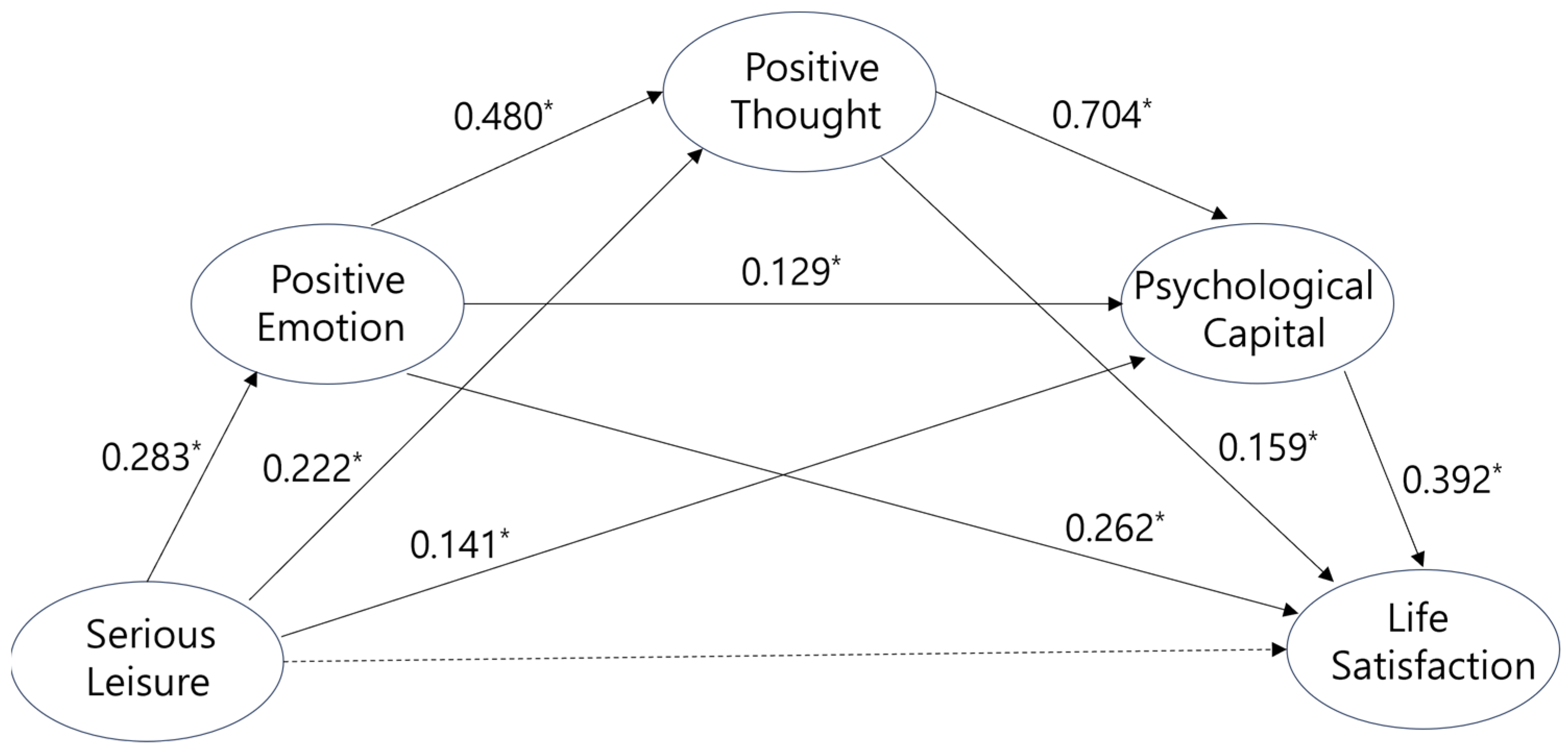
| serious leisure → positive emotion | 0.283 * | 0.051 | 5.304 |
| serious leisure → positive thought | 0.222 * | 0.037 | 8.553 |
| serious leisure → PsyCap | 0.141 * | 0.028 | 3.724 |
| serious leisure → life satisfaction | 0.043 | 0.054 | 0.963 |
| positive emotion → positive thought | 0.480 * | 0.045 | 8.553 |
| positive emotion → PsyCap | 0.129 * | 0.036 | 2.823 |
| positive emotion → life satisfaction | 0.262 * | 0.069 | 4.889 |
| positive thought → PsyCap | 0.704 * | 0.062 | 10.892 |
| positive thought → life satisfaction | 0.159 * | 0.133 | 1.888 |
| PsyCap → life satisfaction | 0.392 * | 0.151 | 4.286 |
| Path | 95% C.I. | |||
|---|---|---|---|---|
| B | S.E. | LLCI | ULCI | |
| (1) serious leisure → positive emotion → life satisfaction | 0.074 | 0.024 | 0.028 | 0.121 |
| (2) serious leisure → positive thought → life satisfaction | 0.156 | 0.029 | 0.099 | 0.214 |
| (3) serious leisure → PsyCap → life satisfaction | 0.055 | 0.024 | 0.008 | 0.102 |
| (4) serious leisure → positive emotion → positive thought → life satisfaction | 0.096 | 0.021 | 0.054 | 0.137 |
| (5) serious leisure → positive emotion → PsyCap → life satisfaction | 0.014 | 0.007 | 0.003 | 0.029 |
| (6) serious leisure → positive thought → PsyCap → life satisfaction | 0.014 | 0.013 | 0.012 | 0.039 |
| (7) serious leisure → positive emotion → positive thought → PsyCap → life satisfaction | 0.008 | 0.008 | 0.007 | 0.024 |
Disclaimer/Publisher’s Note: The statements, opinions and data contained in all publications are solely those of the individual author(s) and contributor(s) and not of MDPI and/or the editor(s). MDPI and/or the editor(s) disclaim responsibility for any injury to people or property resulting from any ideas, methods, instructions or products referred to in the content. |
© 2025 by the authors. Licensee MDPI, Basel, Switzerland. This article is an open access article distributed under the terms and conditions of the Creative Commons Attribution (CC BY) license (https://creativecommons.org/licenses/by/4.0/).
Share and Cite
Shin, K.; You, S.; Sohn, Y. The Association Between Serious Leisure and University Students’ Life Satisfaction: Focusing on the Broaden-and-Build Theory of Positive Emotions. Behav. Sci. 2025, 15, 1677. https://doi.org/10.3390/bs15121677
Shin K, You S, Sohn Y. The Association Between Serious Leisure and University Students’ Life Satisfaction: Focusing on the Broaden-and-Build Theory of Positive Emotions. Behavioral Sciences. 2025; 15(12):1677. https://doi.org/10.3390/bs15121677
Chicago/Turabian StyleShin, Kyulee, Sukkyung You, and Youngmi Sohn. 2025. "The Association Between Serious Leisure and University Students’ Life Satisfaction: Focusing on the Broaden-and-Build Theory of Positive Emotions" Behavioral Sciences 15, no. 12: 1677. https://doi.org/10.3390/bs15121677
APA StyleShin, K., You, S., & Sohn, Y. (2025). The Association Between Serious Leisure and University Students’ Life Satisfaction: Focusing on the Broaden-and-Build Theory of Positive Emotions. Behavioral Sciences, 15(12), 1677. https://doi.org/10.3390/bs15121677