

Hearing Tones, Missing Boundaries: Cross-Level Selective Transfer of Prosodic Boundaries Among Chinese–English Learners

Abstract
1. Introduction
1.1. Challenges of Prosodic Boundaries in L2s
1.2. The Cue-Weighting Transfer Hypothesis
1.3. Criticisms of the Cue-Weighting Transfer Hypothesis
2. Present Study1
2.1. Data Analyses
2.2. Experiment 1
2.2.1. Participants
2.2.2. Materials2
- I bought jelly#beans and cookies as presents for him. (lexical constituent boundary)
- I bought jelly#, beans, and cookies as presents for him. (intonational phrase boundary)
- I bought jelly#. Beans and cookies were presents for him. (sentence boundary)
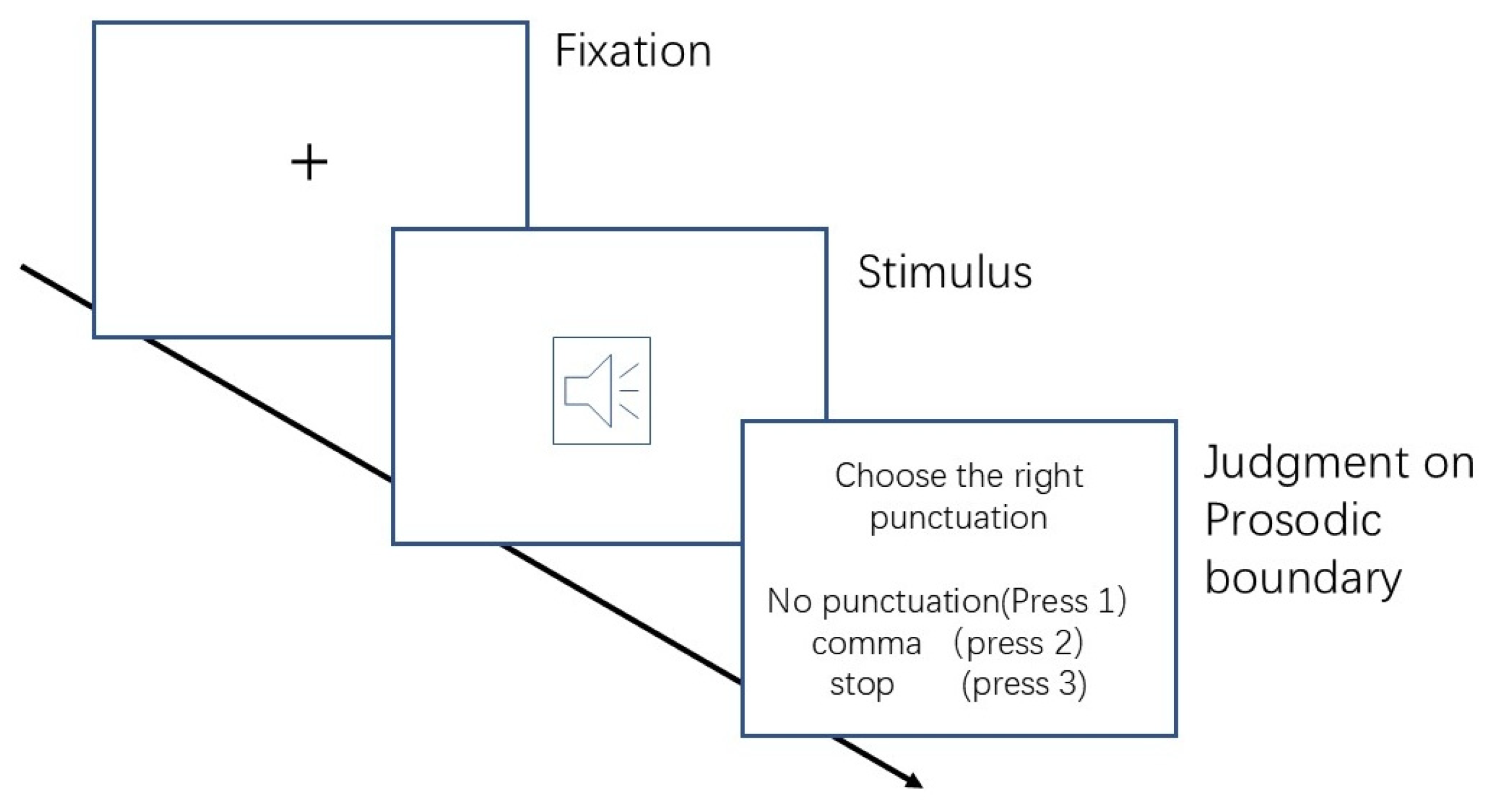
2.2.3. Procedure
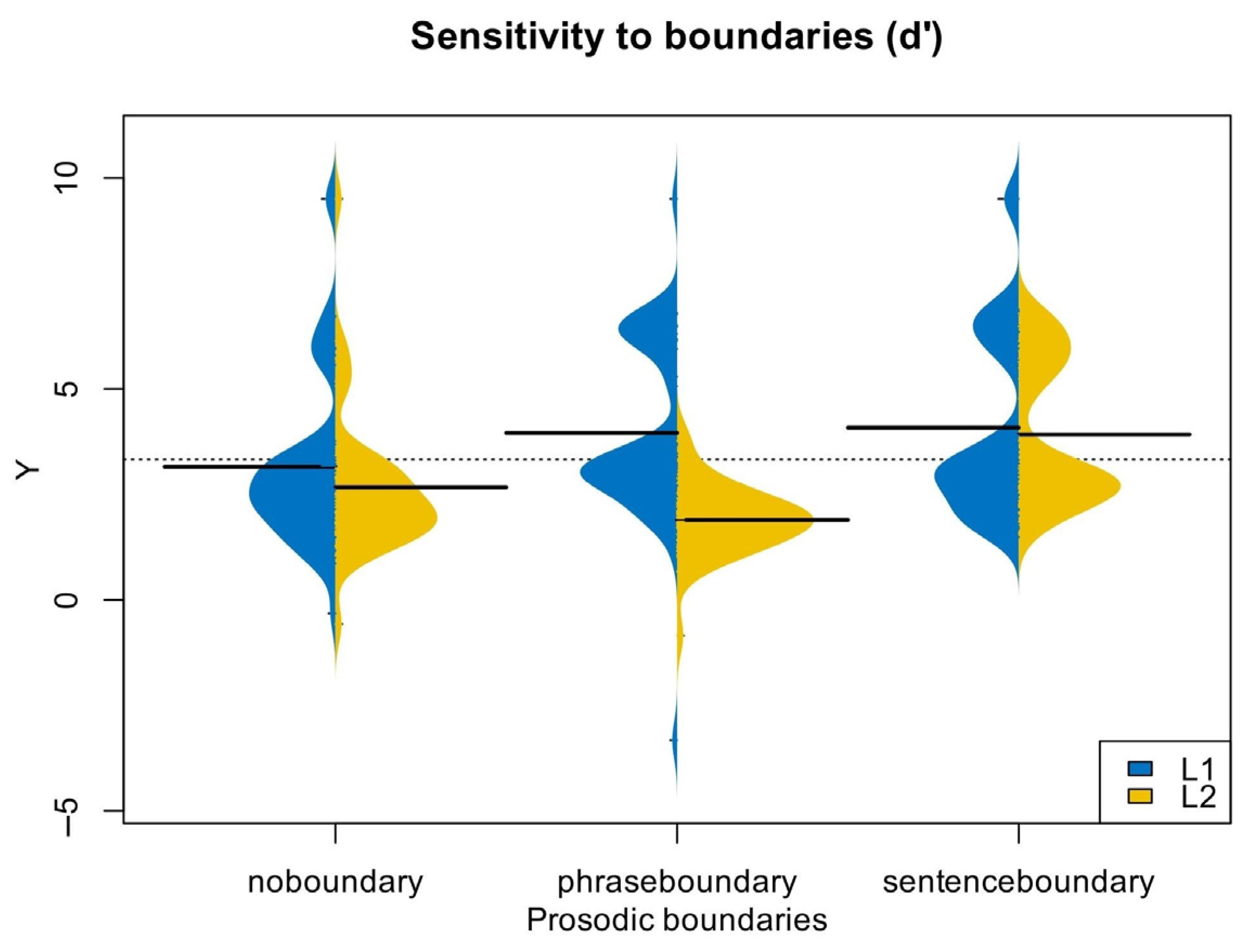
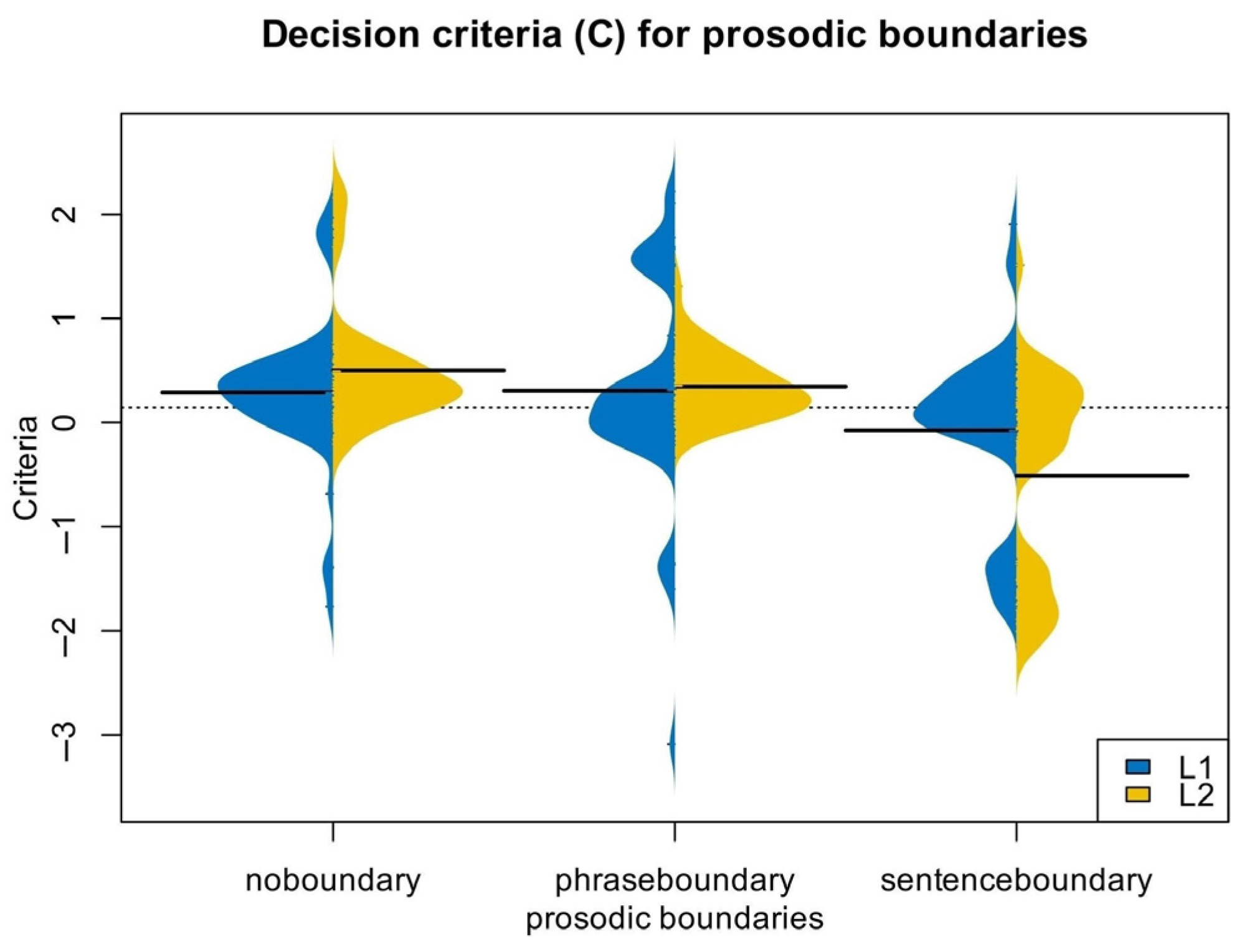
2.2.4. Results
2.3. Experiment 2
2.3.1. Participants
2.3.2. Materials
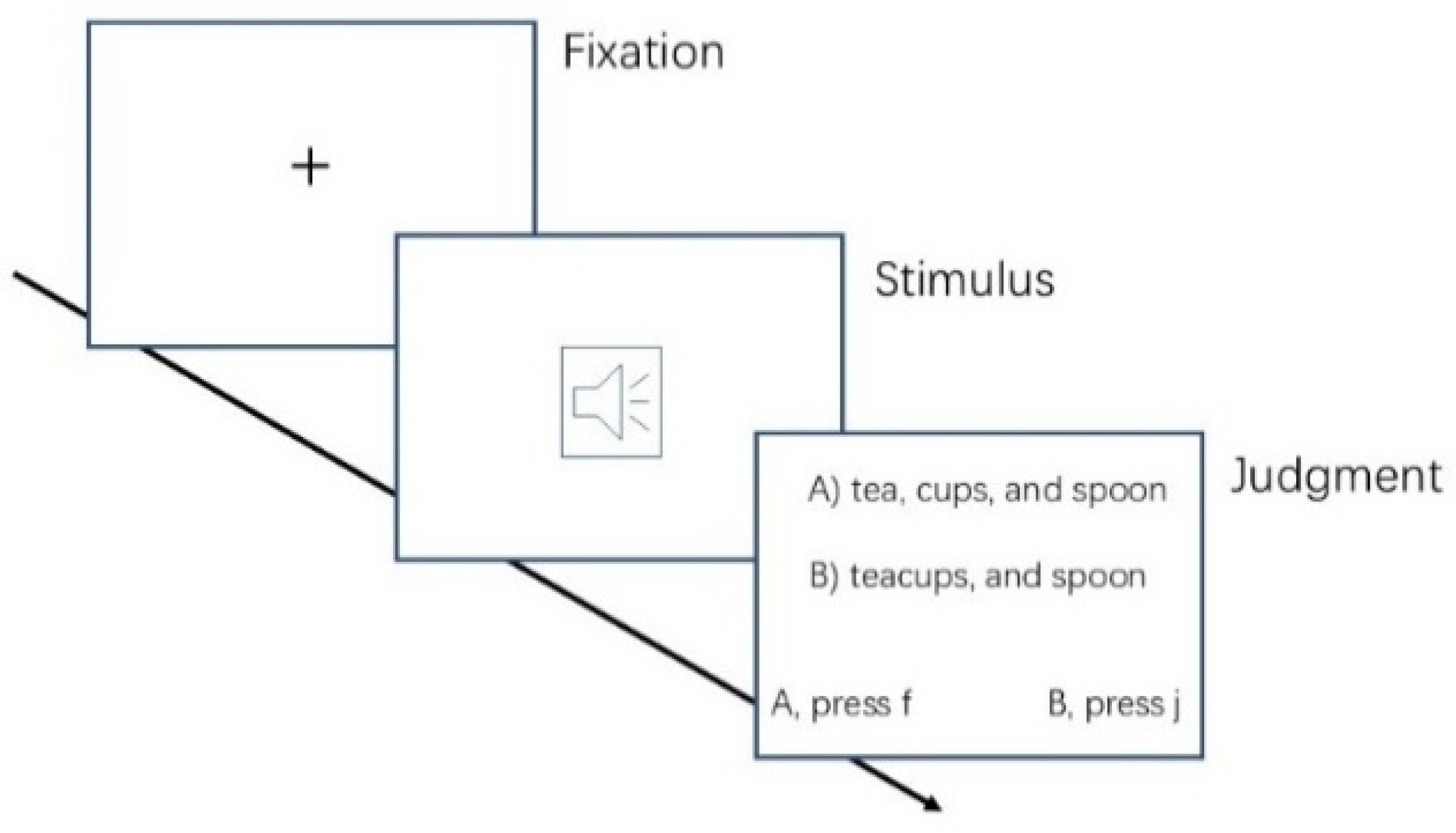
2.3.3. Procedure
2.3.4. Results
3. Discussion
3.1. The Selective Difficulty of Perceiving Prosodic Boundaries
3.2. The Transfer of Cue-Weighting Strategies from L1 to L2
4. Conclusions
Author Contributions
Funding
Institutional Review Board Statement
Informed Consent Statement
Data Availability Statement
Conflicts of Interest
| 1 | We would like to thank Bei Wang for her valuable advice on the experimental design. |
| 2 | We thank an anonymous reviewer for bringing to our attention a limitation in our experimental design. While the stimulus set primarily consisted of compound words (e.g., jellybean, accounting for 70% of the materials), it also included some noun phrases (e.g., chocolate yogurt). According to the prosodic hierarchy, these two structures belong to different levels. A compound like jellybean typically forms a single prosodic word, whereas a noun phrase like chocolate yogurt constitutes a higher-level phonological phrase (i.e., intermediate phrase, see Selkirk, 2005). This structural distinction is accompanied by a significant difference in their canonical stress patterns. The compounds in our study typically had initial stress (e.g., JELLYbean), while the noun phrases had final stress (e.g., chocolate YOgurt). To ensure that these phonetic differences did not lead to different intonational contours, we conducted a post-hoc analysis. The findings revealed that this variability in stimulus type did not have a significant effect on our key results (specifically, at the ‘no-boundary’ and ‘phrase-boundary’ levels): Paired-samples t-tests comparing the two stimulus types at these levels showed no significant differences (all ps > 0.05) among both groups of participants. |
References
- Aasland, W. A., & Baum, S. R. (2003). Temporal parameters as cues to phrasal boundaries: A comparison of processing by left-hemisphere-damaged and right-hemisphere-damaged individuals. Brain and Language, 87(3), 385–399. [Google Scholar] [CrossRef]
- Baek, H. (2022). Prosodic cue weighting in the processing of ambiguous sentences by native English listeners and Korean listeners of English. The Journal of the Acoustical Society of America, 151, 158–167. [Google Scholar] [CrossRef]
- Chang, C. B. (2018). Perceptual attention as the locus of transfer to nonnative speech perception. Journal of Phonetics, 68, 85–102. [Google Scholar] [CrossRef]
- Chao, Y. R. (1968). Language and symbolic systems. Foundations of Language, 7(3), 439–440. [Google Scholar]
- Chinese Ministry of Education. (2018). New curriculum standard (English). People’s Education Press. [Google Scholar]
- Chrabaszcz, A., Winn, M., Lin, C. Y., & Idsardi, W. J. (2014). Acoustic cues to perception of word stress by English, Mandarin, and Russian speakers. Journal of Speech, Language, and Hearing Research, 57(4), 1468–1479. [Google Scholar] [CrossRef] [PubMed]
- Duanmu, S. (2007). The phonology of standard Chinese. Oxford University Press. [Google Scholar]
- Dupoux, E., Sebastián-Gallés, N., Navarrete, E., & Peperkamp, S. (2008). Persistent stress ‘deafness’: The case of French learners of Spanish. Cognition, 106(2), 682–706. [Google Scholar] [CrossRef]
- Escudero, P., Benders, T., & Lipski, S. (2009). Native, non-native and L2 perceptual cue weighting for Dutch vowels: The case of Dutch, German, and Spanish listeners. Journal of Phonetics, 37(4), 452–465. [Google Scholar] [CrossRef]
- Francis, A. L., & Nusbaum, H. C. (2002). Selective attention and the acquisition of new phonetic categories. Journal of Experimental Psychology: Human Perception and Performance, 28(2), 349–366. [Google Scholar] [CrossRef]
- Frazier, L., Carlson, K., & Clifton, C., Jr. (2006). Prosodic phrasing is central to language comprehension. Trends in Cognitive Sciences, 10(6), 244–249. [Google Scholar] [CrossRef] [PubMed]
- Gawronski, B., Ng, N. L., & Luke, D. M. (2023). Truth sensitivity and partisan bias in responses to misinformation. Journal of Experimental Psychology: General, 152(8), 2205–2236. [Google Scholar] [CrossRef] [PubMed]
- Green, D. M., & Swets, J. A. (Eds.). (1966). Signal detection theory and psychophysics. Wiley. [Google Scholar]
- Holliman, A., Gutiérrez Palma, N., Critten, S., Wood, C., Cunnane, H., & Pillinger, C. (2017). Examining the independent contribution of prosodic sensitivity to word reading and spelling in early readers. Reading and Writing: An Interdisciplinary Journal, 30(3), 509–521. [Google Scholar] [CrossRef]
- Holt, L. L., & Lotto, A. J. (2006). Cue weighting in auditory categorization: Implications for first and second language acquisition. Journal of the Acoustical Society of America, 119(5), 3059–3071. [Google Scholar] [CrossRef]
- Holzgrefe-Lang, J., Wellmann, C., Petrone, C., & Räling, R. (2016). How pitch change and final lengthening cue boundary perception in German: Converging evidence from ERPs and prosodic judgments. Language, Cognition, and Neuroscience, 31(7), 1–17. [Google Scholar] [CrossRef]
- Iverson, P., Kuhl, P., Akahane-Yamada, R., Diesch, E., Tohkura, Y., Kettermann, A., & Siebert, C. (2003). A perceptual interference account of acquisition difficulties for non-native phonemes. Cognition, 87(1), B47–B57. [Google Scholar] [CrossRef]
- Kim, H. (2020). Testing the cue-weighting transfer hypothesis with Korean listeners’ perception of English lexical stress. The Journal of the Acoustical Society of America, 148, 2812. [Google Scholar] [CrossRef]
- Kluender, K. R., Lotto, A. J., Holt, L. L., & Bloedel, S. L. (1998). Role of experience for language-specific functional mappings of vowel sounds. Journal of the Acoustical Society of America, 104(6), 3568–3582. [Google Scholar] [CrossRef]
- Lin, C., Wang, M., Idsardi, W. J., & Xu, Y. (2014). Stress processing in mandarin-English and Korean-English bilinguals. Bilingualism: Language and Cognition, 17, 316–346. [Google Scholar] [CrossRef]
- Lynn, S. K., & Barrett, L. F. (2014). “Utilizing” signal detection theory. Psychological Science, 25(9), 1663–1673. [Google Scholar] [CrossRef] [PubMed]
- McAllister, R., Flege, J. E., & Piske, T. (2002). The influence of L1 on the acquisition of Swedish quantity by native speakers of Spanish, English and Estonian. Journal of Phonetics, 30, 229–258. [Google Scholar] [CrossRef]
- Nenonen, S., Shestakova, A., Huotilainen, M., & Näätänen, R. (2003). Linguistic relevance of duration within the native language determines the accuracy of speech-sound duration processing. Cognitive Brain Research, 16, 492–495. [Google Scholar] [CrossRef]
- Nickels, S., Opitz, B., & Steinhauer, K. (2013). ERPs show that classroom-instructed late second language learners rely on the same prosodic cues in syntactic parsing as native speakers. Neuroscience Letters, 557, 107–111. [Google Scholar] [CrossRef]
- Nickels, S., & Steinhauer, K. (2016). Prosody-syntax integration in a second language: Contrasting event-related potentials from German and Chinese learners of English using linear mixed effect models. Second Language Research, 34(1), 9–37. [Google Scholar] [CrossRef]
- Pennington, M., & Ellis, N. C. (2000). Cantonese speakers’ memory for English sentences with prosodic cues. Modern Language Journal, 64(3), 372–389. [Google Scholar] [CrossRef]
- Petrone, C., Truckenbrodt, H., Wellmann, C., Holzgrefe-Lang, J., Wartenbruger, I., & Hohle, B. (2017). Prosodic boundary cues in German: Evidence from the production and perception of bracketed lists. Journal of Phonetics, 61, 71–92. [Google Scholar] [CrossRef]
- Price, P., Ostendorf, M., Shattuck-Hufnagel, S., & Fong, C. (1991). The use of prosody in syntactic disambiguation. Journal of the Acoustical Society of America, 90, 2956–2970. [Google Scholar] [CrossRef] [PubMed]
- Pu, Y. H. (2003). English intonation: Its form, function and application. Foreign Language Teaching and Research Press. [Google Scholar]
- Qin, Z., Chien, Y.-F., & Tremblay, A. (2017). Processing of word-level stress by Mandarin-speaking second language learners of English. Applied Psycholinguistics, 38(3), 541–570. [Google Scholar] [CrossRef]
- Schertz, J., Cho, T., Lotto, A., & Warner, N. (2015). Individual differences in phonetic cue use in production and perception of a non-native sound contrast. Journal of Phonetics, 52, 183–204. [Google Scholar] [CrossRef] [PubMed]
- Schmidt, E., Pérez, A., Cilibrasi, L., & Tsimpli, I. (2020). Prosody facilitates memory recall in L1 but not L2. Studies in Second Language Acquisition, 42(1), 223–238. [Google Scholar] [CrossRef]
- Seidl, A., & Cristià, A. (2008). Developmental changes in the weighting of prosodic cues. Developmental Science, 11(4), 596–606. [Google Scholar] [CrossRef]
- Selkirk, E. (2005). Comments on intonational phrasing. In S. Frota, M. Vigario, & M. J. Freitas (Eds.), Prosodies (pp. 11–58). de Gruyter. [Google Scholar]
- Tremblay, A., Broersma, M., & Coughlin, C. E. (2018). The functional weight of a prosodic cue in the native language predicts the learning of speech segmentation in a second language. Bilingualism: Language and Cognition, 21(3), 640–652. [Google Scholar] [CrossRef]
- Wightman, C. W., Shattuck-Hufnagel, S., Ostendorf, M., & Price, P. J. (1992). Segmental durations in the vicinity of prosodic phrase boundaries. Journal of the Acoustic Society of America, 91, 1707–1717. [Google Scholar] [CrossRef] [PubMed]
- Yang, X., Shen, X., Li, W., & Yang, Y. (2014). How listeners weight acoustic cues to intonational phrase boundaries. PLoS ONE, 9(7), e102166. [Google Scholar] [CrossRef] [PubMed]
- Yang, Y. F. (杨玉芳). (1997). Prosodic cues to syntactic boundaries (句法边界的韵律学表现). Acta Acoustica (声学学报), 20(5), 414–421. [Google Scholar]
- Zhang, X. T. (2012). A comparison of cue-weighting in the perception of prosodic phrase boundaries in English and Chinese [Unpublished doctoral dissertation, University of Michigan]. [Google Scholar]
- Zhang, Y., & Ding, H. (2020). The effect of ambiguity awareness on second language learners’ prosodic disambiguation. Frontiers in Psychology, 11, 573520. [Google Scholar] [CrossRef] [PubMed]
- Zhang, Y., & Francis, A. L. (2010). The weighting of vowel quality in native and non-native listeners’ perception of English lexical stress. Journal of Phonetics, 38(2), 260–271. [Google Scholar] [CrossRef]



| English Monolinguals | Chinese–English Learners | |
|---|---|---|
| d’ no boundary | 3.16 ± 2.05 | 2.67 ± 1.73 |
| d’phrase boundary | 3.96 ± 2.16 | 1.90 ± 0.81 |
| d’sentence boundary | 4.09 ± 2.24 | 3.92 ± 1.70 |
| English Monolinguals | Chinese–English Learners | |
|---|---|---|
| C no boundary | 0.29 ± 0.68 | 0.50 ± 0.56 |
| C phrase boundary | 0.31 ± 1.02 | 0.35 ± 0.29 |
| C sentence boundary | −0.07 ± 0.84 | −0.51 ± 0.99 |
| English Monolinguals | Chinese–English Learners | |
|---|---|---|
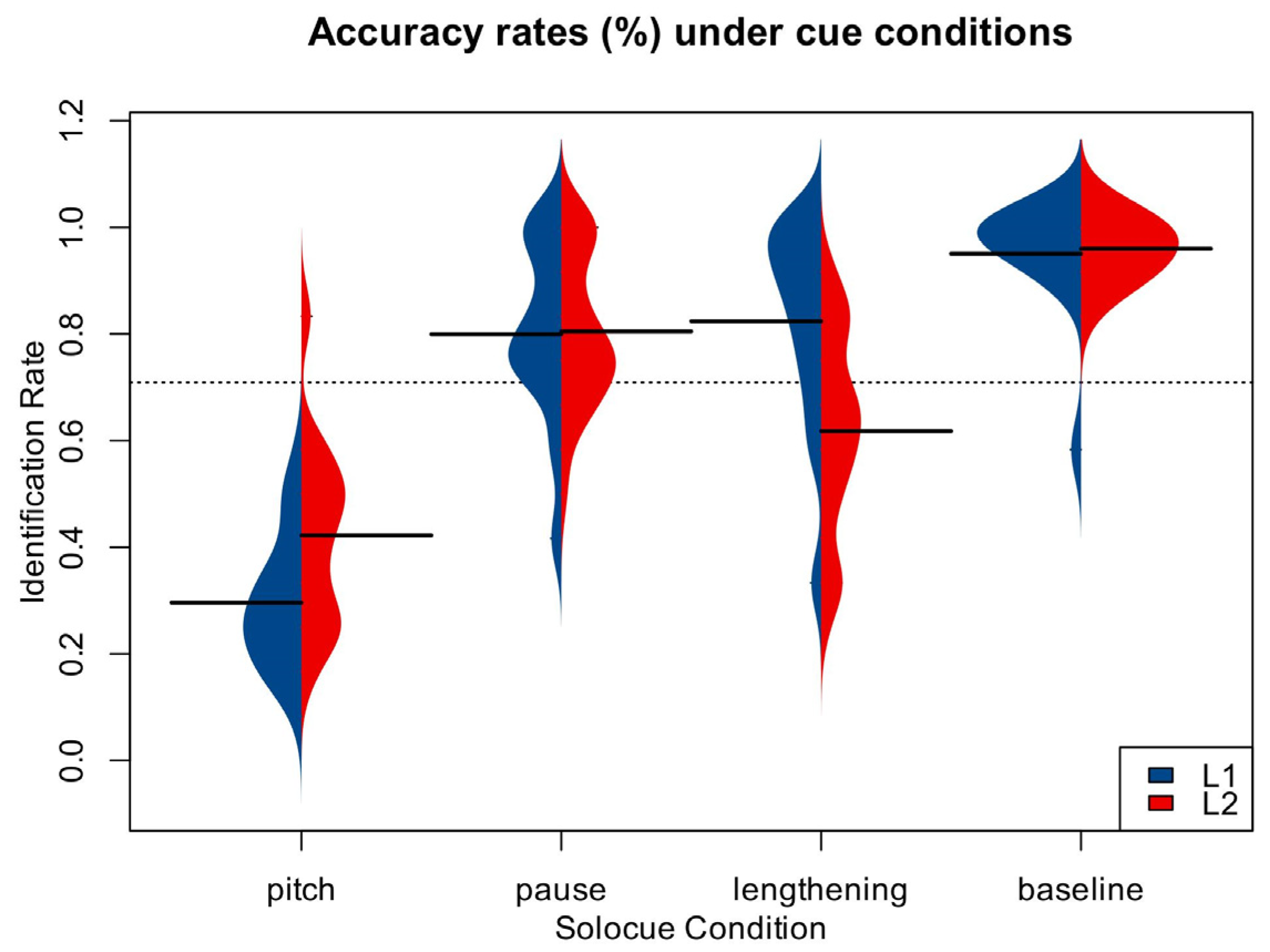
| Baseline | 95.06 ± 11.15 | 95.98 ± 4.79 |
| Pause | 79.94 ± 16.87 | 80.46 ± 14.13 |
| Lengthening | 82.41 ± 19.25 | 61.78 ± 18.97 |
| Pitch | 29.63 ± 12.52 | 42.24 ± 17.39 |
Disclaimer/Publisher’s Note: The statements, opinions and data contained in all publications are solely those of the individual author(s) and contributor(s) and not of MDPI and/or the editor(s). MDPI and/or the editor(s) disclaim responsibility for any injury to people or property resulting from any ideas, methods, instructions or products referred to in the content. |
© 2025 by the authors. Licensee MDPI, Basel, Switzerland. This article is an open access article distributed under the terms and conditions of the Creative Commons Attribution (CC BY) license (https://creativecommons.org/licenses/by/4.0/).
Share and Cite
Fang, L.; Li, Z.; Yu, K.; Schwieter, J.W.; Wang, R. Hearing Tones, Missing Boundaries: Cross-Level Selective Transfer of Prosodic Boundaries Among Chinese–English Learners. Behav. Sci. 2025, 15, 1605. https://doi.org/10.3390/bs15121605
Fang L, Li Z, Yu K, Schwieter JW, Wang R. Hearing Tones, Missing Boundaries: Cross-Level Selective Transfer of Prosodic Boundaries Among Chinese–English Learners. Behavioral Sciences. 2025; 15(12):1605. https://doi.org/10.3390/bs15121605
Chicago/Turabian StyleFang, Lan, Zilong Li, Keke Yu, John W. Schwieter, and Ruiming Wang. 2025. "Hearing Tones, Missing Boundaries: Cross-Level Selective Transfer of Prosodic Boundaries Among Chinese–English Learners" Behavioral Sciences 15, no. 12: 1605. https://doi.org/10.3390/bs15121605
APA StyleFang, L., Li, Z., Yu, K., Schwieter, J. W., & Wang, R. (2025). Hearing Tones, Missing Boundaries: Cross-Level Selective Transfer of Prosodic Boundaries Among Chinese–English Learners. Behavioral Sciences, 15(12), 1605. https://doi.org/10.3390/bs15121605