
Faecal Calprotectin: A Non-Invasive Marker for Diagnosing and Monitoring Acute Diverticulitis


Abstract
1. Introduction
2. Materials and Methods
2.1. Search Strategy and Study Selection
2.2. Inclusion and Exclusion Criteria
2.3. Data Extraction
3. Results
3.1. Diagnostic Utility: Differentiating Organic from Functional Disease
3.2. Correlation with Endoscopic Disease Severity
3.3. Predicting Recurrence and Risk Stratification
3.4. Monitoring Therapeutic Response
3.5. Microbiota Correlations
3.6. Important Confounders and Limitations in the Literature

4. Discussion
4.1. Diagnostic Utility and Proposed Thresholds
4.2. Correlation with Disease Severity
4.3. Predicting Recurrence: Promise and Limitations
4.4. Therapeutic Monitoring
4.5. Comparison with Competing Biomarkers
4.6. Clinical Implementation: A Cautious Approach
4.7. Future Directions
5. Conclusions
Author Contributions
Funding
Institutional Review Board Statement
Informed Consent Statement
Data Availability Statement
Conflicts of Interest
Abbreviations
| AD | acute diverticulitis |
| ACD | acute complicated diverticulitis |
| AUD | acute uncomplicated diverticulitis |
| AUC | area under the curve |
| CI | confidence interval |
| CODA | a validated prognostic score for diverticular disease |
| CRP | C-reactive protein |
| CT | computed tomography |
| DAMP | damage-associated molecular pattern |
| DD | diverticular disease |
| DICA | Diverticular Inflammation and Complication Assessment |
| ELISA | enzyme-linked immunosorbent assay |
| FC | faecal calprotectin |
| FIT | faecal immunochemical testing |
| GIQLI | Gastrointestinal Quality of Life Index |
| IBD | inflammatory bowel disease |
| IBS | irritable bowel syndrome |
| IL-6 | interleukin-6 |
| IQR | interquartile range |
| kDa | kilodalton |
| NPV | negative predictive value |
| NSAID | non-steroidal anti-inflammatory drug |
| POC | point-of-care |
| PPV | positive predictive value |
| PRISMA | Preferred Reporting Items for Systematic Reviews and Meta-Analyses |
| RCT | randomised controlled trial |
| SCAD | segmental colitis associated with diverticula |
| SF-12 | Short Form 12 Health Survey |
| SUDD | symptomatic uncomplicated diverticular disease |
| TNFα | tumour necrosis factor alpha |
| VAS | visual analogue scale |
| μg/g | micrograms per gram |
References
- Piscopo, N.; Ellul, P. Diverticular Disease: A Review on Pathophysiology and Recent Evidence. Ulst. Med. J. 2020, 89, 83–88. [Google Scholar]
- Strate, L.L.; Morris, A.M. Epidemiology, Pathophysiology, and Treatment of Diverticulitis. Gastroenterology 2019, 156, 1282–1298.e1. [Google Scholar] [CrossRef] [PubMed]
- Tănase, I.; Păun, S.; Stoica, B.; Negoi, I.; Gaspar, B.; Beuran, M. Epidemiology of diverticular disease—Systematic review of the literature. Chirurgia 2015, 110, 9–14. [Google Scholar] [PubMed]
- Moore, B.W. A soluble protein characteristic of the nervous system. Biochem. Biophys. Res. Commun. 1965, 19, 739–744. [Google Scholar] [CrossRef] [PubMed]
- Vogl, T.; Tenbrock, K.; Ludwig, S.; Leukert, N.; Ehrhardt, C.; van Zoelen, M.A.; Nacken, W.; Foell, D.; van der Poll, T.; Sorg, C.; et al. Mrp8 and Mrp14 are endogenous activators of Toll-like receptor 4, promoting lethal, endotoxin-induced shock. Nat. Med. 2007, 13, 1042–1049. [Google Scholar] [CrossRef] [PubMed]
- Jukic, A.; Bakiri, L.; Wagner, E.F.; Tilg, H.; Adolph, T.E. Calprotectin: From biomarker to biological function. Gut 2021, 70, 1978–1988. [Google Scholar] [CrossRef] [PubMed]
- Tursi, A.; Brandimarte, G.; Elisei, W.; Giorgetti, G.M.; Inchingolo, C.D.; Aiello, F. Faecal calprotectin in colonic diverticular disease: A case-control study. Int. J. Colorectal Dis. 2009, 24, 49–55. [Google Scholar] [PubMed]
- Saviano, A.; Petruzziello, C.; Zanza, C.; Candelli, M.; Gabrielli, M.; Migneco, A.; Franceschi, F.; Ojetti, V. Role of Fecal Calprotectin in Patients Presenting to the Emergency Department with Abdominal Pain with or without Diarrhea or Rectal Bleeding. Rev. Recent Clin. Trials 2024, 19, 70–75. [Google Scholar] [CrossRef] [PubMed]
- Kok, L.; Elias, S.G.; Witteman, B.J.; Goedhard, J.G.; Muris, J.W.; Moons, K.G.; de Wit, N.J. Diagnostic accuracy of point-of-care fecal calprotectin and immunochemical occult blood tests for diagnosis of organic bowel disease in primary care: The Cost-Effectiveness of a Decision Rule for Abdominal Complaints in Primary Care (CEDAR) study. Clin. Chem. 2012, 58, 989–998. [Google Scholar] [CrossRef] [PubMed]
- Elias, S.G.; Kok, L.; de Wit, N.J.; Witteman, B.J.; Goedhard, J.G.; Romberg-Camps, M.J.; Muris, J.W.M.; Moons, K.G.M. Is there an added value of faecal calprotectin and haemoglobin in the diagnostic work-up for primary care patients suspected of significant colorectal disease? A cross-sectional diagnostic study. BMC Med. 2016, 14, 141. [Google Scholar] [CrossRef] [PubMed]
- Tursi, A.; Brandimarte, G.; Di Mario, F.; Annunziata, M.L.; Bafutto, M.; Bianco, M.A.; Colucci, R.; Conigliaro, R.; Danese, S.; De Bastiani, R.; et al. Predictive value of the Diverticular Inflammation and Complication Assessment (DICA) endoscopic classification on the outcome of diverticular disease of the colon: An international study. United Eur. Gastroenterol. J. 2016, 4, 604–613. [Google Scholar] [CrossRef]
- Tursi, A.; Piovani, D.; Brandimarte, G.; Di Mario, F.; Elisei, W.; Picchio, M.; Figlioli, G.; Bassotti, G.; Allegretta, L.; Annunziata, M.L.; et al. Bowel movement alterations predict the severity of diverticular disease and the risk of acute diverticulitis: A prospective, international study. Intest. Res. 2025, 23, 96–106. [Google Scholar] [CrossRef] [PubMed]
- Tursi, A.; Cassieri, C.; Colucci, R.; Elisei, W.; Picchio, M.; Brandimarte, G. Budesonide MMX™ is effective in patients having persistent symptoms and raised fecal calprotectin following treatments for diverticular disease. J. Gastrointest. Liver Dis. 2019, 28, 45–47. [Google Scholar] [CrossRef]
- Tursi, A.; Elisei, W.; Picchio, M.; Brandimarte, G. Increased faecal calprotectin predicts recurrence of colonic diverticulitis. Int. J. Colorectal Dis. 2014, 29, 931–935. [Google Scholar] [CrossRef] [PubMed]
- Tursi, A.; Piovani, D.; Brandimarte, G.; Di Mario, F.; Elisei, W.; Picchio, M.; Allegretta, L.; Annunziata, M.L.; Bafutto, M.; Bassotti, G.; et al. Diverticular Inflammation and Complication Assessment classification, CODA score and fecal calprotectin in clinical assessment of patients with diverticular disease: A decision curve analysis. United Eur. Gastroenterol. J. 2023, 11, 642–653. [Google Scholar] [CrossRef]
- Lahat, A.; Necula, D.; Yavzori, M.; Picard, O.; Halperin, S.; Eliakim, R.; Ben-Horin, S. Prolonged Recurrent Abdominal Pain is Associated with Ongoing Underlying Mucosal Inflammation in Patients who had an Episode of Acute Complicated Diverticulitis. J. Clin. Gastroenterol. 2019, 53, e178–e185. [Google Scholar] [CrossRef] [PubMed]
- Ojetti, V.; Saviano, A.; Brigida, M.; Petruzziello, C.; Caronna, M.; Gayani, G.; Franceschi, F. Randomized control trial on the efficacy of Limosilactobacillus reuteri ATCC PTA 4659 in reducing inflammatory markers in acute uncomplicated diverticulitis. Eur. J. Gastroenterol. Hepatol. 2022, 34, 496–502. [Google Scholar] [CrossRef] [PubMed]
- Brandimarte, G.; Frajese, G.V.; Bargiggia, S.; Castellani, D.; Cocco, A.; Colucci, R.; Evangelista, E.; Gravina, A.G.; Napoletano, D.; Nardi, E.; et al. Performance of a multicompounds nutraceutical formulation in patients with symptomatic uncomplicated diverticular disease. Minerva Gastroenterol. 2022, 68, 216–222. [Google Scholar] [CrossRef]
- Tursi, A.; Mocci, G.; Usai-Satta, P.; Elisei, W. Impact of a Symbiotic Mixture on Moderate-to-severe Diverticular Disease of the Colon. Rev. Recent Clin. Trials 2025, 20, 27–35. [Google Scholar] [CrossRef] [PubMed]
- Kvasnovsky, C.L.; Leong, L.E.X.; Choo, J.M.; Abell, G.C.J.; Papagrigoriadis, S.; Bruce, K.D.; Rogers, G.B. Clinical and symptom scores are significantly correlated with fecal microbiota features in patients with symptomatic uncomplicated diverticular disease: A pilot study. Eur. J. Gastroenterol. Hepatol. 2018, 30, 107–112. [Google Scholar] [CrossRef] [PubMed]
- Hovstadius, H.; Lundgren, D.; Karling, P. Elevated Faecal Calprotectin in Patients with a Normal Colonoscopy: Does It Matter in Clinical Practice? A Retrospective Observational Study. Inflamm. Intest. Dis. 2021, 6, 101–108. [Google Scholar] [CrossRef] [PubMed]
- Ogundipe, O.A.; Campbell, A. Microscopic colitis impacts quality of life in older people. BMJ Case Rep. 2019, 12, e228092. [Google Scholar] [CrossRef] [PubMed]

| Reference | Study Design | Sample Size | Population | Key FC Findings | Clinical Application |
|---|---|---|---|---|---|
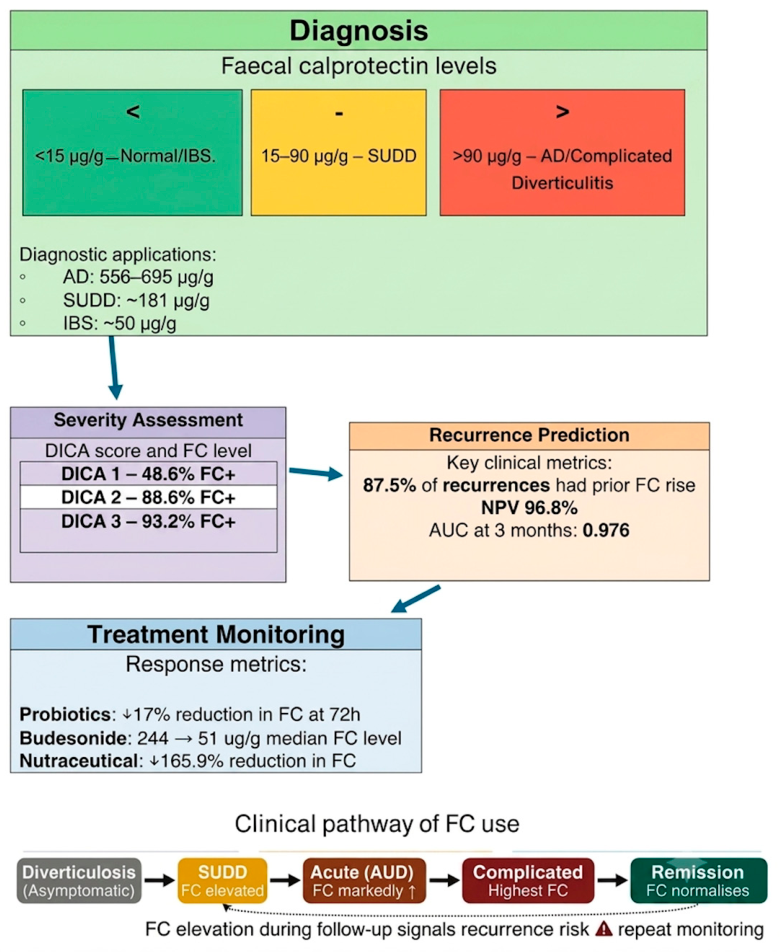
| Saviano, Petruzziello [8] | Retrospective observational | 146 patients | ED patients with abdominal pain | ACD: 694.74 ± 315.88 μg/g; AUD: 556.33 ± 330.87 μg/g; IBS: 50 ± 47.2 μg/g; PPV 40%, NPV 84% for AUD vs. ACD | Diagnosis in emergency setting |
| Kok, Elias [9] | Prospective diagnostic (CEDAR) | 386 patients | Primary care with lower abdominal complaints | Diverticulitis patients: median POC FC 220 μg/g, ELISA 477 μg/g | Diagnosis in primary care |
| Elias, Kok [10] | Prospective cross-sectional diagnostic study | 810 primary care patients | Patients suspected of significant colorectal disease (including 18 with diverticulitis) | Adding quantitative POC calprotectin to clinical data increased AUC from 0.741 to 0.763 (p = 0.078)—not statistically significant | Diagnosis in primary care; limited utility as standalone test; better performance when combined with FIT |
| Tursi, Brandimarte [11] | Retrospective cohort | 1651 patients | DD patients with DICA classification | FC positivity: DICA 1: 48.6%, DICA 2: 88.6%, DICA 3: 93.2% (p < 0.0001) | Correlating with endoscopic severity |
| Tursi, Piovani [12] | Multicenter prospective cohort | 871 patients | Newly diagnosed DD | FC range 8–1800 μg/g, median 25 μg/g; higher FC with constipation/diarrhoea (p < 0.01); FC > 90 μg/g: 18.9% AD incidence | Risk stratification, correlation with symptoms |
| Tursi, Cassieri [13] | Post-hoc analysis | 24 patients | DICA 2/3 patients, treatment-resistant | Baseline FC 244.5 µg/g → 51.0 µg/g at 6 months (p < 0.001) post-budesonide; normalised with clinical remission | Monitoring therapeutic response |
| Tursi, Elisei [14] | Prospective cohort | 54 patients (48 analysed) | AUD patients after remission | Increased FC detected in 35.4% during follow-up; 87.5% of recurrence cases had elevated FC; NPV 96.8% for recurrence | Predicting recurrence |
| Tursi, Piovani [15] | International prospective cohort | 871 patients | Newly diagnosed DD, 3-year follow-up | HR 3.29 per log increase; FC ≥ 90 μg/g: 18.9% AD incidence vs. 5.2% with lower FC; 3-month AUC 0.976 | Predicting AD, short-term risk stratification |
| Lahat, Necula [16] | Prospective observational | 16 patients | Post-AD (8 severe, 8 nonsevere) | Severe AD: 115.75 ± 85.9 μg/g; nonsevere: 35 ± 8.74 μg/g (p = 0.08); correlated with cytokine expression | Persistent inflammation after severe AD |
| Ojetti, Saviano [17] | RCT | 119 patients | AUD patients | Baseline FC: 640.01 ± 150.20 mg/L (probiotic), 568.20 ± 130.65 mg/L (placebo); 72 h reduction: 17% vs. 10.6% (p < 0.05) | Monitoring therapeutic response |
| Brandimarte, Frajese [18] | Retrospective observational | 350 patients | SUDD on nutraceutical treatment | Baseline FC 181.3 μg/g → 100.2 μg/g at 3 months (44.8% reduction, p < 0.001) → 67.9 μg/g at 6 months (65.9% reduction, p < 0.001) | Monitoring therapeutic response |
| Tursi, Mocci [19] | Retrospective | 24 patients | DICA 2/3 on symbiotic treatment | Baseline FC: DICA 2: 112 ± 30 μg/g, DICA 3: 126 ± 22 μg/g (p = 0.05). DICA 2 FC decreased significantly (p < 0.02); DICA 3 FC unchanged (p = 0.132). Two DICA 3 patients with rising FC (194 ± 15 μg/g) developed AUD. | Monitoring treatment response by severity |
| Kvasnovsky, Leong [20] | Pilot study | 28 patients | SUDD patients | FC correlated with alpha diversity (p = 0.005) and Lactobacillus abundance (p = 0.004); previous AD: 104.1 ± 139.2 μg/g vs. no AD: 48.5 ± 52.0 μg/g | Microbiota correlations |
| Hovstadius, Lundgren [21] | Retrospective observational | 585 patients | Normal colonoscopy, FC tested | FC > 50 μg/g: 34% of cohort; diverticulosis prevalence 41% vs. 35% (p = 0.015); 13 AD cases, only 31% had elevated FC at baseline | Association with diverticulosis, confounders |
| Proposed Threshold | Clinical Interpretation | Supporting Evidence | Key Limitations |
|---|---|---|---|
| ≤15 μg/g | Normal/healthy controls; typical of IBS | Tursi [7]; Saviano et al. [8] (IBS mean 50 ± 47.2 μg/g, but IBS subgroup may be lower) | Overlap with quiescent DD; some healthy individuals have FC up to 50 μg/g |
| ~15–60 μg/g | SUDD; subclinical inflammation | Tursi [7]; Brandimarte et al. [18] (median 181.3 μg/g at baseline, decreasing to 67.9 μg/g); Kok et al. [9] (diverticulosis without active inflammation: median 52 μg/g) | Wide range; significant overlap with IBS and healthy controls; no validated cut-off |
| ≥60 μg/g | AUD; active diverticular inflammation | Tursi [7]; Saviano et al. [8] (AUD mean 556.33 ± 330.87 μg/g); Ojetti et al. [17] (baseline ~640 mg/L ≈ ~640 μg/g) | Considerable inter-individual variability; non-specific (also elevated in IBD, infectious colitis, microscopic colitis) |
| ≥90 μg/g | High risk for AD recurrence | Tursi et al. [15] (18.9% vs. 5.2% 3-year AD incidence) | Derived from single prospective cohort; requires external validation |
| >50 μg/g | Associated with diverticulosis; pharmacological confounders common | Hovstadius et al. [21] | High rates of PPI, aspirin, and NSAID use in this group limit specificity |
| Marker/Modality | Diagnosis | Severity Assessment | Recurrence Prediction | Treatment Monitoring | Key Advantages | Key Limitations |
|---|---|---|---|---|---|---|
| FC | Good | Good | Good (short-term) | Good | Non-invasive; stool-based; correlates with mucosal inflammation; repeatable | Non-specific; affected by medications (PPIs, NSAIDs, aspirin); no standardised thresholds |
| CRP | Good | Moderate | Poor | Moderate | Widely available; rapid turnaround; well-validated for acute inflammation | Lacks intestinal specificity; normalises quickly; poor correlation with endoscopic severity |
| WCC | Moderate | Poor | Poor | Poor | Routine test; inexpensive | Very non-specific; poor prognostic value |
| FIT | Limited | None | None | None | Highly sensitive for colorectal neoplasia; inexpensive | No role in diverticulitis; false positives with inflammation |
| CT imaging | Excellent (complicated) | Excellent | N/A | N/A | Gold standard for complicated disease; anatomical detail | Radiation exposure; expensive; not repeatable for monitoring |
| Ultrasound | Moderate | Moderate | N/A | N/A | No radiation; inexpensive; bedside availability | Operator-dependent; limited in obese patients; poor for deep structures |
Disclaimer/Publisher’s Note: The statements, opinions and data contained in all publications are solely those of the individual author(s) and contributor(s) and not of MDPI and/or the editor(s). MDPI and/or the editor(s) disclaim responsibility for any injury to people or property resulting from any ideas, methods, instructions or products referred to in the content. |
© 2026 by the authors. Licensee MDPI, Basel, Switzerland. This article is an open access article distributed under the terms and conditions of the Creative Commons Attribution (CC BY) license.
Share and Cite
Mohammed, A.; Baig, Y.; Butler, A.E. Faecal Calprotectin: A Non-Invasive Marker for Diagnosing and Monitoring Acute Diverticulitis. Med. Sci. 2026, 14, 406. https://doi.org/10.3390/medsci14030406
Mohammed A, Baig Y, Butler AE. Faecal Calprotectin: A Non-Invasive Marker for Diagnosing and Monitoring Acute Diverticulitis. Medical Sciences. 2026; 14(3):406. https://doi.org/10.3390/medsci14030406
Chicago/Turabian StyleMohammed, Aamer, Yahiya Baig, and Alexandra E. Butler. 2026. "Faecal Calprotectin: A Non-Invasive Marker for Diagnosing and Monitoring Acute Diverticulitis" Medical Sciences 14, no. 3: 406. https://doi.org/10.3390/medsci14030406
APA StyleMohammed, A., Baig, Y., & Butler, A. E. (2026). Faecal Calprotectin: A Non-Invasive Marker for Diagnosing and Monitoring Acute Diverticulitis. Medical Sciences, 14(3), 406. https://doi.org/10.3390/medsci14030406