
Nicotine Withdrawal Syndrome in Intensive Care Patients—Preventive and Therapeutic Implications

 ,
,  ,
,  and
and
Abstract
1. Introduction
1.1. Background
1.2. Aim
2. Methods
2.1. Study Design
2.2. Review Questions
- What are the possible complications in smokers hospitalised in the ICU (with nicotine dependence as a risk factor)?
- What is known about the frequency and clinical presentation of nicotine withdrawal syndrome or withdrawal-related symptoms in adult ICU patients?
- What interventions are used to prevent nicotine withdrawal symptoms in intensive care patients?
2.3. Identifying Relevant Studies
2.3.1. Population
2.3.2. Concept
2.3.3. Context
2.4. Study Selection
2.5. Charting the Data
2.6. Collating, Summarising, and Reporting the Results
3. Results
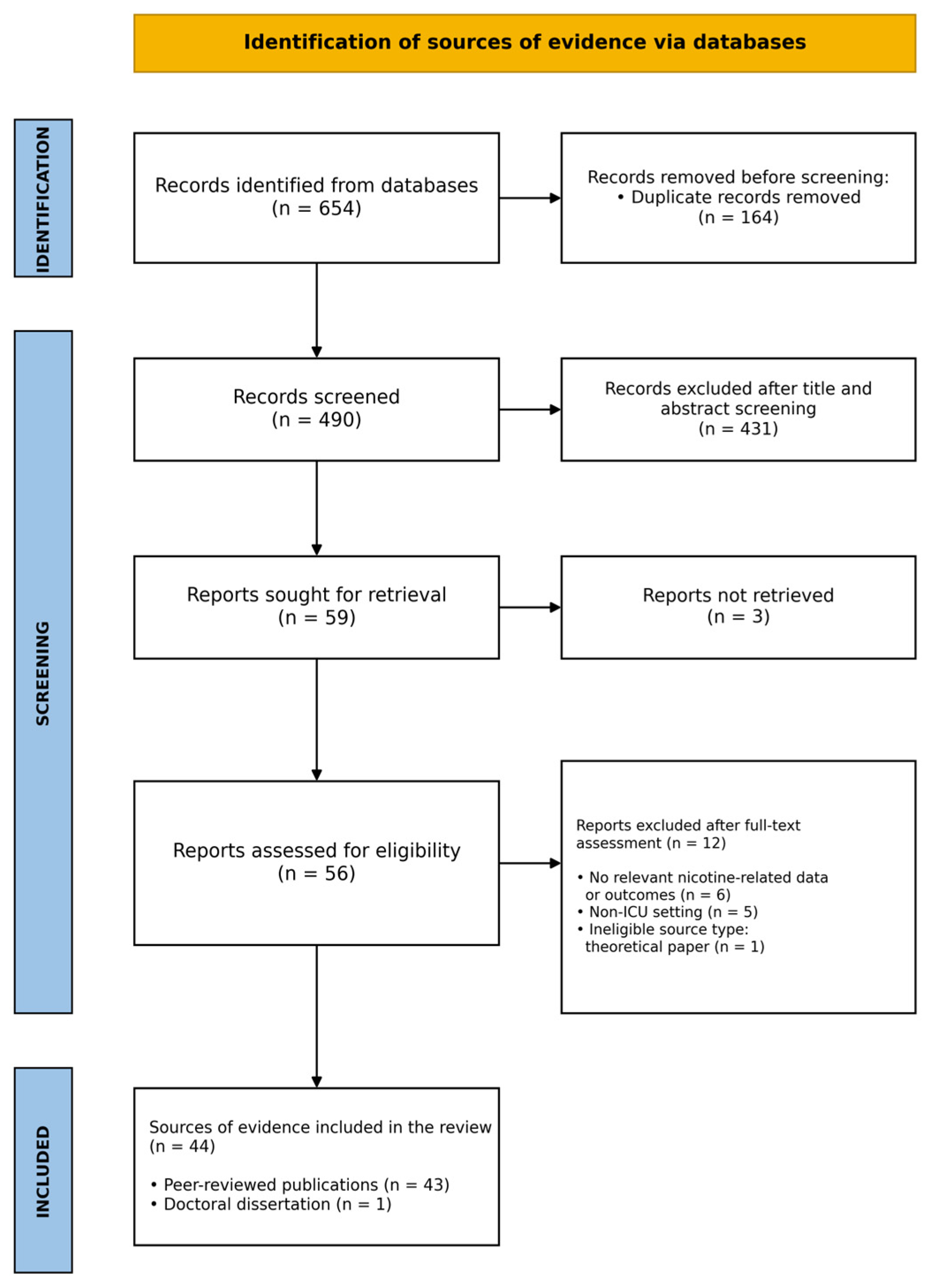
3.1. Search Outcomes
3.2. Characteristics of the Included Studies
3.3. Study Design
3.4. ICU Setting (General vs. Cardiac vs. Neuro)
3.5. Evidence-Focus Classification and Mapping to the Review Questions (PCC-Aligned)
3.6. Results by Review Question
4. Discussion
4.1. Smoking-Related Exposure and ICU Outcomes
4.2. Nicotine Withdrawal Syndrome in the ICU: Frequency and Clinical Presentation
4.3. Interventions Used to Prevent or Mitigate Nicotine Withdrawal in the ICU
5. Strengths and Limitations
6. Implications for Clinical Practice
6.1. Routine Identification of Nicotine Dependence at ICU Admission
6.2. Early Monitoring of Withdrawal Symptoms
6.3. Integration of Nicotine Dependence into Delirium Prevention Protocols
6.4. Individualisation of Sedation Management
6.5. Careful and Selective Consideration of Nicotine Replacement Therapy (NRT)
6.6. Education of the Therapeutic Team
6.7. Planning of Further Care and Smoking Cessation Interventions
6.8. Proposed ICU Admission Protocol for Nicotine-Dependent Patients
7. Conclusions
Supplementary Materials
Author Contributions
Funding
Institutional Review Board Statement
Informed Consent Statement
Data Availability Statement
Conflicts of Interest
References
- European Network for Smoking and Tobacco Prevention (ENSP). Guidelines for Treating Tobacco Dependence. English Edition; European Network for Smoking and Tobacco Prevention (ENSP): Brussels, Belgium, 2020; Available online: https://ensp.network/wp-content/uploads/2020/10/guidelines_2020_english_forprint.pdf (accessed on 25 January 2026).
- World Health Organization. International Statistical Classification of Diseases and Related Health Problems (11th Revision): ICD-11 for Mortality and Morbidity Statistics. Available online: https://icd.who.int/browse11/l-m/en#/http://id.who.int/icd/entity/1699574100/mms/unspecified (accessed on 25 January 2026).
- Kowalski, M.; Udy, A.A.; McRobbie, H.J.; Dooley, M.J. Nicotine replacement therapy for agitation and delirium management in the intensive care unit: A systematic review of the literature. J. Intensive Care 2016, 4, 69. [Google Scholar] [CrossRef] [PubMed]
- Ho, K.M.; Hart, G.; Austin, D.; Hunter, M.; Botha, J.; Chavan, S. Dose-related effect of smoking on mortality in critically ill patients: A multicentre cohort study. Intensive Care Med. 2011, 37, 981–989. [Google Scholar] [CrossRef] [PubMed]
- Lucidarme, O.; Seguin, A.; Daubin, C.; Ramakers, M.; Terzi, N.; Beck, P.; Charbonneau, P.; du Cheyron, D. Nicotine withdrawal and agitation in ventilated critically ill patients. Crit. Care 2010, 14, R58. [Google Scholar] [CrossRef] [PubMed]
- Kerr, A.; McVey, J.T.; Wood, A.M.; Van Haren, F.M.P. Safety of nicotine replacement therapy in critically ill smokers: A retrospective cohort study. Anaesth. Intensive Care 2016, 44, 758–761. [Google Scholar] [CrossRef] [PubMed]
- Lee, A.H.; Afessa, B. The association of nicotine replacement therapy with mortality in a medical intensive care unit. Crit. Care Med. 2007, 35, 1517–1521. [Google Scholar] [CrossRef] [PubMed]
- de Jong, B.; Schuppers, A.S.; Kruisdijk-Gerritsen, A.; Arbouw, M.E.L.; van den Oever, H.L.A.; van Zanten, A.R.H. The safety and efficacy of nicotine replacement therapy in the intensive care unit: A randomised controlled pilot study. Ann. Intensive Care 2018, 8, 70. [Google Scholar] [CrossRef] [PubMed]
- Pathak, V.; Rendon, I.S.H.; Lupu, R.; Tactuk, N.; Olutade, T.; Durham, C.; Stumacher, R. Outcome of nicotine replacement therapy in patients admitted to ICU: A randomized controlled double-blind prospective pilot study. Respir. Care 2013, 58, 1625–1629. [Google Scholar] [CrossRef] [PubMed]
- Kanova, M.; Tejkalova, K.; Neiser, J.; Kula, R. Nicotine replacement therapy in surgical patients. Neuro Endocrinol. Lett. 2021, 42, 305–311. [Google Scholar] [PubMed]
- Mehta, S.; Cook, D.; Devlin, J.W.; Skrobik, Y.; Meade, M.; Fergusson, D.; Herridge, M.; Steinberg, M.; Granton, J.; Ferguson, N.; et al. Prevalence, risk factors, and outcomes of delirium in mechanically ventilated adults. Crit. Care Med. 2015, 43, 557–566. [Google Scholar] [CrossRef] [PubMed]
- Mardani, D.; Bigdelian, H. Predictors and clinical outcomes of postoperative delirium after administration of dexamethasone in patients undergoing coronary artery bypass surgery. Int. J. Prev. Med. 2012, 3, 420–427. [Google Scholar] [PubMed]
- Seder, D.B.; Schmidt, J.M.; Badjatia, N.; Fernandez, L.; Rincon, F.; Claassen, J.; Gordon, E.; Carrera, E.; Kurtz, P.; Lee, K.; et al. Transdermal nicotine replacement therapy in cigarette smokers with acute subarachnoid hemorrhage. Neurocritical Care 2011, 14, 77–83. [Google Scholar] [PubMed]
- Gallagher, R.; Williscroft, D. Nicotine withdrawal as an unusual cause of terminal delirium. Can. Fam. Physician 2022, 68, 591–593. [Google Scholar] [CrossRef] [PubMed]
- Peters, M.; Godfrey, C.; McInerney, P.; Baldini Soares, C.; Khalil, H.; Parker, D. The Joanna Briggs Institute Reviewers’ Manual 2015: Methodology for JBI Scoping Reviews; The Joanna Briggs Institute: Adelaide, Australia, 2015; pp. 1–24. [Google Scholar]
- Tricco, A.C.; Lillie, E.; Zarin, W.; O’Brien, K.K.; Colquhoun, H.; Levac, D.; Moher, D.; Peters, M.D.J.; Horsley, T.; Weeks, L.; et al. PRISMA extension for scoping reviews (PRISMA-ScR): Checklist and explanation. Ann. Intern. Med. 2018, 169, 467–473. [Google Scholar] [CrossRef] [PubMed]
- Peters, M.D.J.; Marnie, C.; Tricco, A.C.; Pollock, D.; Munn, Z.; Alexander, L.; McInerney, P.; Godfrey, C.M.; Khalil, H. Updated methodological guidance for the conduct of scoping reviews. JBI Evid. Synth. 2020, 18, 2119–2126. [Google Scholar] [CrossRef] [PubMed]
- Braun, V.; Clarke, V. Using thematic analysis in psychology. Qual. Res. Psychol. 2006, 3, 77–101. [Google Scholar] [CrossRef]
- de Almeida, T.M.L.; de Azevedo, L.C.P.; Nosé, P.M.G.; de Freitas, F.G.R.; Machado, F.R. Risk factors for agitation in critically ill patients. Rev. Bras. Ter. Intensiv. 2016, 28, 413–419. [Google Scholar] [CrossRef]
- Van Rompaey, B.; Elseviers, M.M.; Schuurmans, M.J.; Shortridge-Baggett, L.M.; Truijen, S.; Bossaert, L. Risk factors for delirium in intensive care patients: A prospective cohort study. Crit. Care 2009, 13, R77. [Google Scholar] [CrossRef] [PubMed]
- Cartin-Ceba, R.; Warner, D.O.; Hays, J.T.; Afessa, B. Nicotine replacement therapy in critically ill patients: A prospective observational cohort study. Crit. Care Med. 2011, 39, 1635–1640. [Google Scholar] [CrossRef] [PubMed]
- Avrami, S.; Argyriou, G.; Kadda, O.; Bakalis, E.; Vasilopoulos, G.; Marvaki, C. Delirium in intensive care unit: Factors that affect the appearance of delirium and its importance to the patients’ final outcome. Rostrum Asclepius 2012, 11, 549–562. Available online: www.vima-asklipiou.gr (accessed on 11 May 2026).
- Jayaswal, A.K.; Sampath, H.; Soohinda, G.; Dutta, S. Delirium in medical intensive care units: Incidence, subtypes, risk factors, and outcome. Indian J. Psychiatry 2019, 61, 352–358. [Google Scholar] [CrossRef] [PubMed]
- Yang, J.; Zhou, Y.; Kang, Y.; Xu, B.; Wang, P.; Lv, Y.; Wang, Z. Risk factors of delirium in sequential sedation patients in intensive care units. BioMed Res. Int. 2017, 2017, 3539872. [Google Scholar] [CrossRef] [PubMed]
- Huang, H.W.; Zhang, G.B.; Li, H.Y.; Wang, C.M.; Wang, Y.M.; Sun, X.M.; Chen, J.-R.; Chen, G.-Q.; Xu, M.; Zhou, J.-X. Development of an early prediction model for postoperative delirium in neurosurgical patients admitted to the ICU after elective craniotomy (E-PREPOD-NS): A secondary analysis of a prospective cohort study. J. Clin. Neurosci. 2021, 90, 217–224. [Google Scholar] [PubMed]
- Dubois, M.J.; Bergeron, N.; Dumont, M.; Dial, S.; Skrobik, Y. Delirium in an intensive care unit: A study of risk factors. Intensive Care Med. 2001, 27, 1297–1304. [Google Scholar] [CrossRef] [PubMed]
- Kerber, K.; Zangmeister, J.; McNett, M. Relationship between delirium and ventilatory outcomes in the medical intensive care unit. Crit. Care Nurse 2020, 40, 24–32. [Google Scholar] [CrossRef] [PubMed]
- Yang, M.; Hu, Z.; Huang, Y.; Zhang, G.; Kang, F.; Chen, D. Association between nicotine-dependent patients and delirium in intensive care units: A retrospective cohort study using a large clinical database. BMC Psychiatry 2025, 25, 1068. [Google Scholar] [CrossRef] [PubMed]
- Tian, H.; Chen, M.; Yu, W.; Ma, Q.; Lu, P.; Zhang, J.; Jin, Y.; Wang, M. Risk factors associated with postoperative intensive care unit delirium in patients undergoing invasive mechanical ventilation following acute exacerbation of chronic obstructive pulmonary disease. J. Int. Med. Res. 2020, 48, 0300060520946516. [Google Scholar] [CrossRef] [PubMed]
- Wang, R.; Liu, R.; Xu, Z.; Wang, H. Correlation between smoking and delirium in patients with sepsis: A retrospective analysis utilizing the MIMIC database. Tob. Induc. Dis. 2025, 23, 10-18332. [Google Scholar] [CrossRef]
- Zhao, Y.; Guo, S.; Wang, Z.; Dong, Y.; Wei, W.; Su, Z. Clinical investigation into risk factors for delirium post-cardiac surgery and its implications for nursing intervention guided by behavior change theory. J. Cardiothorac. Surg. 2024, 19, 608. [Google Scholar] [CrossRef] [PubMed]
- Kotfis, K.; Szylińska, A.; Listewnik, M.; Lechowicz, K.; Kosiorowska, M.; Drożdżal, S.; Brykczyński, M.; Rotter, I.; Żukowski, M. Balancing intubation time with postoperative risk in cardiac surgery patients: A retrospective cohort analysis. Ther. Clin. Risk Manag. 2018, 14, 2203–2212. [Google Scholar] [CrossRef] [PubMed]
- Wu, N.N.; Zhang, Y.B.; Wang, S.Y.; Zhao, Y.H.; Zhong, X.M. Incidence, prevalence and risk factors of delirium in ICU patients: A systematic review and meta-analysis. Nurs. Crit. Care 2023, 28, 653–669. [Google Scholar]
- Ng, K.T.; Gillies, M.; Griffith, D.M. Effect of nicotine replacement therapy on mortality, delirium, and duration of therapy in critically ill smokers: A systematic review and meta-analysis. Anaesth. Intensive Care 2017, 45, 556–561. [Google Scholar] [CrossRef] [PubMed]
- Hsieh, S.J.; Shum, M.; Lee, A.N.; Hasselmark, F.; Gong, M.N. Cigarette smoking as a risk factor for delirium in hospitalized and intensive care unit patients. Ann. Am. Thorac. Soc. 2013, 10, 496–503. [Google Scholar] [CrossRef] [PubMed]
- Aljuhani, O.; Al Sulaiman, K.; Alkofide, H.; AlFaifi, M.; Alshehri, A.A.; Aljohani, S.; Algethamy, H. Evaluating the effectiveness of nicotine replacement therapy in critically ill smokers: A meta-analysis of randomized controlled trials. Tob. Induc. Dis. 2024, 22, 10-18332. [Google Scholar] [CrossRef]
- Huai, J.; Ye, X. A meta-analysis of critically ill patients reveals several potential risk factors for delirium. Gen. Hosp. Psychiatry 2014, 36, 488–496. [Google Scholar] [CrossRef] [PubMed]
- Kebapçi, A.; Genç, Z. The effect of prone position on the development of ventilator-associated pneumonia in COVID-19 patients in intensive care unit: A cross-sectional and case-control study. Turk. Klin. J. Med. Sci. 2025, 45, 92–100. [Google Scholar]
- Komninou, M.A.; Egli, S.; Rossi, A.; Ernst, J.; Krauthammer, M.; Schuepbach, R.A.; Delgado, M.; Bartussek, J. Former smoking, but not active smoking, is associated with delirium in postoperative ICU patients: A matched case-control study. Front. Psychiatry 2024, 15, 1347071. [Google Scholar] [CrossRef] [PubMed]
- Locihova, H.; Axmann, K. Comparing the CAM-ICU and ICDSC for assessing delirium in non-intubated intensive care patients. Cent. Eur. J. Nurs. Midwifery 2022, 13, 587–594. [Google Scholar]
- Tiwari, A.M.; Zirpe, K.G.; Khan, A.Z.; Gurav, S.K.; Deshmukh, A.M.; Suryawanshi, P.B.; Kapse, U.S.; Wankhede, P.P.; Bamne, S.N.; Bhoyar, A.P.; et al. Incidence, subtypes, risk factors, and outcome of delirium: A prospective observational study from Indian intensive care unit. Indian. J. Crit. Care Med. 2023, 27, 111–118. [Google Scholar] [CrossRef] [PubMed]
- Vyveganathan, L.; Izaham, A.; Wan Mat, W.R.; Tang, S.P.; Abdul Rahman, R.; Abdul Manap, N. Delirium in critically ill patients: Incidence, risk factors and outcomes. Crit. Care Shock. 2019, 22, 25–40. [Google Scholar]
- Spiropoulou, E.; Samanidis, G.; Kanakis, M.; Nenekidis, I. Risk factors for acute postoperative delirium in cardiac surgery patients >65 years old. J. Pers. Med. 2022, 12, 1529. [Google Scholar] [CrossRef] [PubMed]
- Dehghani-Ghorbi, M.; Sadeghi, S.; Kharazmi, A.B.; Delkash, P.; Sheikholeslami, S.A. Clinical characteristics and outcomes of cancer patients intensive care unit admission. Arch. Anesthesiol. Crit. Care 2025, 11, 336–341. [Google Scholar]
- Li, H.R.; Guo, Y. High-risk factors for delirium in severely ill patients and the application of emotional nursing combined with pain nursing. World J. Psychiatry 2024, 14, 1027–1033. [Google Scholar] [CrossRef] [PubMed]
- Hughes, J.R. Effects of abstinence from tobacco: Valid symptoms and time course. Nicotine Tob. Res. 2007, 9, 315–327. [Google Scholar] [CrossRef] [PubMed]
- Cai, M.; Jiang, F.; Lin, L.; Peng, Y.; Li, S.; Chen, L.; Lin, Y. Poor sleep quality is a risk factor for adverse clinical outcomes in patients with acute aortic dissection: A prospective cohort study. J. Sleep Res. 2025, 34, e14411. [Google Scholar] [PubMed]
- Carle, C.M. Nicotine Withdrawal Symptoms and Utilization of Nicotine Replacement Therapy in Critically Ill Smokers. Ph.D. Thesis, The Ohio State University, Columbus, OH, USA, 2012. [Google Scholar]
- Atkins, P.M.; Mion, L.C.; Mendelson, W.; Palmer, R.M.; Slomka, J.; Franko, T. Characteristics and outcomes of patients who self-extubate from ventilatory support: A case-control study. Chest 1997, 112, 1317–1340. [Google Scholar] [CrossRef] [PubMed]
- Awissi, D.K.; Lebrun, G.; Fagnan, M.; Skrobik, Y. Alcohol, nicotine, and iatrogenic withdrawals in the ICU. Crit. Care Med. 2013, 41, S57–S68. [Google Scholar] [CrossRef] [PubMed]
- Honisett, T.D. Nicotine replacement therapy for smokers admitted to intensive care. Intensive Crit. Care Nurs. 2001, 17, 318–321. [Google Scholar] [CrossRef] [PubMed]
- Mayer, S.A.; Chong, J.Y.; Ridgway, E.; Min, K.C.; Commichau, C.; Bernardini, G.L. Delirium from nicotine withdrawal in neuro-ICU patients. Neurology 2001, 57, 551–553. [Google Scholar] [CrossRef] [PubMed]
- Panos, N.G.; Tesoro, E.P.; Kim, K.S.; Mucksavage, J.J. Outcomes associated with transdermal nicotine replacement therapy in a neurosurgery intensive care unit. Am. J. Health Syst. Pharm. 2010, 67, 1357–1361. [Google Scholar] [CrossRef] [PubMed]
- Lindson, N.; Thompson, T.P.; Ferrey, A.; Lambert, J.D.; Aveyard, P. Motivational interviewing for smoking cessation. Cochrane Database Syst. Rev. 2019, 7, CD006936. [Google Scholar] [CrossRef] [PubMed]
- Siu, A.L.; US Preventive Services Task Force. Behavioral and pharmacotherapy interventions for tobacco smoking cessation in adults, including pregnant women: U.S. Preventive Services Task Force recommendation statement. Ann. Intern. Med. 2015, 163, 622–634. [Google Scholar] [CrossRef] [PubMed]


| Inclusion Criteria | Exclusion Criteria | |
|---|---|---|
| Population (P) | • Adult patients (≥18 years) • Hospitalised in the ICU • Patients with current or past nicotine dependence (active smokers, nicotine-dependent individuals, individuals with a history of tobacco smoking) | • Paediatric patients (<18 years) • Patients without data on smoking/nicotine status • Patients hospitalised in settings other than the ICU (e.g., medical, surgical, or postoperative wards) |
| Concept (C) | • Studies addressing one or more of the following issues: risk factors for complications in patients with nicotine dependence in the ICU; occurrence, symptoms, and consequences of nicotine withdrawal syndrome; pharmacological and non-pharmacological interventions to prevent/alleviate withdrawal syndrome | • Studies not related to nicotine dependence or nicotine withdrawal syndrome • Addictions other than nicotine dependence (e.g., alcohol, opioids, benzodiazepines) |
| Context (C) | • ICUs of various types | • Studies concerning other clinical contexts (e.g., long-term care, palliative care) |
| Study type (S) | • Reviews (various types) • Meta-analyses • Quantitative studies • Qualitative studies • Intervention studies (RCTs, non-RCTs) • Observational studies (prospective, retrospective) • Case reports • Doctoral dissertations reporting original empirical data, available in full text | • Letters to the editor • Editorials • Commentaries • Conference abstracts • Non-full-text sources • Master’s theses and other academic works not reporting original empirical ICU data |
| Years considered/time period | Without time limit | N/A |
| Language | English | Other languages |
| First Author | Country | Study Design | Setting | Number of Participants | Main Findings | Evidence Focus (Review Question) | Intervention Code | Intervention Category |
|---|---|---|---|---|---|---|---|---|
| Kowalski M. et al., 2016 [3] | Australia | Systematic review | Adult current smokers admitted to ICU; NRT used to manage nicotine withdrawal; delirium/agitation assessed variably across studies | 6 studies included (1033 patients) | This systematic review evaluated whether NRT reduced agitation or delirium in critically ill smokers. Findings were inconclusive: three included studies reported an association between NRT and increased agitation or delirium, one found neither benefit nor harm, and two reported improvement in symptoms attributed by the original authors to nicotine withdrawal. Outcome definitions and assessment methods were inconsistent, and the review did not directly estimate the occurrence or clinical phenotype of NWS. | IFE (RQ3) | NRT—transdermal nicotine patch | Pharmacological |
| Lucidarme O. et al., 2010 [5] | France | Prospective observational cohort study | Two adult ICUs; included patients requiring respiratory support and mechanical ventilation > 48 h; NRT was prohibited during the study | 144 total; 44 smokers, 100 non-smokers | Agitation occurred more frequently in smokers than in non-smokers (64% vs. 32%; p = 0.0005), whereas delirium incidence did not differ significantly. Smokers had more self-removal of tubes/catheters and required more supplemental sedatives/analgesics, neuroleptics, and physical restraints. Active smoking was independently associated with agitation (OR 3.13; 95% CI 1.45–6.74). The study explicitly examined sudden nicotine abstinence; however, NWS was not diagnosed using a withdrawal-specific ICU instrument. | SRE (RQ1); WFE (RQ2) | ||
| Kerr A. et al., 2016 [6] | Australia | Retrospective case–control study | 31-bed mixed medical-surgical ICU; active smokers receiving transdermal NRT matched to active smokers without NRT (age/sex/APACHE II) | 252 (126 NRT, 126 control) | The NRT group had higher antipsychotic use (34.1% vs. 11.1%), more frequent use of physical restraints (29.4% vs. 9.5%), and longer intubation duration; 30-day mortality did not differ significantly. | IFE (RQ3) | NRT—transdermal nicotine patch | Pharmacological |
| Lee AH. et al., 2007 [7] | USA | Retrospective case–control study | Medical ICU, tertiary academic hospital | 180 (90 NRT + 90 controls) | Among active smokers admitted to the ICU, exposure to NRT was associated with higher hospital mortality (20% vs. 7%). After adjustment for illness severity (APACHE III-predicted mortality) and invasive mechanical ventilation, NRT remained independently associated with increased mortality (OR 24.6; 95% CI 3.6–167.6). Twenty-eight-day ICU-free days were fewer in the NRT group. | IFE (RQ3) | NRT—formulation not specified | Pharmacological |
| de Jong B. et al., 2018 [8] | The Netherlands | Randomised controlled trial | Two medical-surgical ICUs in two university-affiliated teaching hospitals; mechanically ventilated adult active smokers (>10 cigarettes/day) | 47 | NRT vs. placebo: no difference in 30- or 90-day mortality; serious adverse events were comparable. There was more time alive without delirium, sedation, or coma by day 20, and more patients were discharged from the ICU/hospital by day 30. | IFE (RQ3) | NRT—transdermal nicotine patch | Pharmacological |
| Pathak V. et al., 2013 [9] | USA | Randomised controlled trial | 20-bed mixed medical-surgical ICU, St Barnabas Hospital, Bronx, New York; adult smokers ≥1 pack/day, with or without mechanical ventilation | 40 | NRT (21 mg patch) vs. placebo: numerically shorter ICU stay (4.5 vs. 7.0 days), fewer ventilator days (1.9 vs. 3.5), and fewer days receiving sedation/analgesia in the NRT group; differences were not statistically significant in this pilot study. No deaths occurred during ICU follow-up. | IFE (RQ3) | NRT—transdermal nicotine patch | Pharmacological |
| Kanova M. et al., 2021 [10] | Czech Republic | Randomised controlled trial | 21-bed ICU; elective major surgery patients with nicotine dependence (≥10 cigarettes/day; ≤30 days since cessation), expected ICU stay >24 h; CAM-ICU assessed daily; 21 mg patch for up to 7 days or until ICU discharge | 52 (26 NRT, 26 placebo) | NRT did not reduce delirium incidence and did not significantly affect length of hospitalisation, sedation, analgesia, vasopressor use, duration of APV, or ICU stay in this cohort. | IFE (RQ3) | NRT—transdermal nicotine patch | Pharmacological |
| Mehta S. et al., 2015 [11] | Canada/USA | Randomised controlled trial | 16 North American medical and surgical ICUs; critically ill mechanically ventilated adults; delirium screened daily using ICDSC (positive ≥4) | 430 total; 420 assessed for delirium | Delirium occurred in 53.8% (226/420). A history of tobacco use was more frequent among patients with delirium than among those without delirium (31.5% vs. 16.2%). The adverse clinical course reported in the study was associated with delirium; it was not directly attributed to tobacco use history. NWS was not assessed. | SRE (RQ1) | ||
| Mardani D. et al., 2012 [12] | Iran | Randomised controlled trial | Cardiac surgery ICU (CSICU), Chamran Heart Center Hospital, Isfahan | 196 | The incidence of POD was 17.34%; smoking history was associated with higher odds of POD (OR 8.358; 95% CI 1.855–37.870). Longer time to extubation and longer ICU stay were associated with POD, not directly with smoking history. Dexamethasone was associated with a lower risk of POD. NWS was not assessed. | SRE (RQ1) | ||
| Seder DB. et al., 2011 [13] | USA | Retrospective observational cohort study | 18-bed neuro-ICU; admissions for subarachnoid haemorrhage | Active smokers with SAH: NRT n = 128 vs. no NRT n = 106 (total smokers included in analysis n = 234) | NRT was associated with lower 3-month mortality (multivariable OR 0.12; 95% CI 0.04–0.37); no differences were observed in delayed cerebral ischaemia or vasospasm. Delirium and seizures were more common in the NRT group (delirium 19% vs. 9%; seizures 9% vs. 2%). The study evaluated NRT-associated outcomes among active smokers with SAH and did not assess the occurrence or clinical phenotype of NWS. | IFE (RQ3) | NRT—transdermal nicotine patch | Pharmacological |
| de Almeida TML et al., 2016 [19] | Brazil | Prospective observational cohort study | 17-bed general ICU, university hospital | 113 | Agitation within the first 7 ICU days occurred in 31.8% of patients. In multivariable analysis, smoking was an independent risk factor for agitation (OR 4.49; 95% CI 1.33–15.17), alongside delirium, moderate/severe pain, and mechanical ventilation. Agitation was associated with fewer mechanical ventilation-free days at day 7. | SRE (RQ1) | ||
| Van Rompaey B., et al., 2009 [20] | Belgium | Prospective observational cohort study | ICU; delirium assessed using the NEECHAM Confusion Scale | 523 patients | Heavy smoking (≥10 cigarettes/day) was associated with an increased risk of delirium (reported OR ≈ 2.04). | SRE (RQ1) | ||
| Cartin-Ceba R et al., 2011 [21] | USA | Prospective observational cohort study | 24-bed medical ICU | 330 total; NRT group n = 174 vs. no-NRT group n = 156 | Hospital mortality did not differ significantly between groups. After adjustment for illness severity and the propensity to receive NRT, NRT was not associated with increased hospital mortality (OR 1.4; 95% CI 0.5–3.9). Secondary outcomes included delirium-related measures and restraint use. The study evaluated NRT-associated outcomes and did not assess the occurrence or clinical phenotype of NWS. | IFE (RQ3) | NRT—transdermal nicotine patch | Pharmacological |
| Avrami S et al., 2012 [22] | Greece | Prospective observational cohort study | ICU; delirium assessed with CAM-ICU; sedation assessed with RASS | 122 ICU patients (stay > 48 h) | Delirium frequency was 43%; a history of smoking was associated with delirium (p = 0.023). Delirium was associated with increased mortality (p = 0.001). | SRE (RQ1) | ||
| Jayaswal AK. et al., 2019 [23] | India | Prospective observational cohort study | ICU (tertiary care teaching hospital); delirium assessed with CAM-ICU, motor subtype with RASS | 280 patients; delirium in 88 (31.4%) | Tobacco use was a significant predisposing factor for ICU delirium (p = 0.016). Delirium was associated with longer ICU stay and higher 1-month post-discharge mortality. | SRE (RQ1) | ||
| Yang L. et al., 2017 [24] | China | Prospective observational cohort study | Medical and surgical ICU; mechanically ventilated patients receiving sequential sedation; delirium assessed every 4 h with CAM-ICU | 141 patients | Regular smoking independently increased the risk of delirium (RR 2.366; 95% CI 1.277–4.382; p = 0.006). Sequential sedation with dexmedetomidine was associated with a lower risk of delirium (RR 0.448; p = 0.040). | SRE (RQ1) | ||
| Huang HW et al., 2021 [25] | China | Prospective observational cohort study | Neurosurgical ICU after elective craniotomy; adults ≥ 18 years; POD assessed with CAM-ICU twice daily on postoperative days 1–3 | 800 | Smoking history was independently associated with POD (aOR 2.582; 95% CI 1.611–4.140) within a multivariable prediction model. | SRE (RQ1) | ||
| Dubois MJ et al., 2001 [26] | Canada | Prospective observational cohort study | 16-bed medical-surgical ICU | 198 with complete comparative data (38 delirium; 160 no delirium); total cohort also reported as 216 in outcome analyses | In multivariable analysis, smoking was associated with an increased risk of delirium (OR 2.2; 95% CI 0.94–4.90; borderline significance). The delirium group had higher rates of device/catheter removal (~20%) and self-extubation (~10%), with a trend towards longer ICU stay. | SRE (RQ1) | ||
| Kerber K. et al., 2020 [27] | USA | Retrospective cohort study | Medical ICU (MICU); adult patients ≥ 18 years requiring endotracheal intubation and mechanical ventilation > 24 h | 171 | Hypoactive delirium was common (up to 44% within the first 7 days). Delirium was not a predictor of unplanned extubation; however, smoking history predicted unplanned extubation (OR ≈ 3.2), together with COPD (OR ≈ 5.2) and failed spontaneous breathing trials (OR ≈ 12.6). | SRE (RQ1) | ||
| Yang M. et al., 2025 [28] | USA | Retrospective cohort study | Adult ICU stays ≥24 h with delirium assessments (CAM-ICU); nicotine dependence defined using ICD-9/ICD-10 codes; MIMIC-IV v3.1 | 24,043 (ND = 2662; after PSM: 2653 per group) | Nicotine dependence was associated with a higher incidence of ICU delirium (after PSM: 30.8% vs. 27.2%, p = 0.004) and with a higher delirium risk in multivariable models; no significant differences in mortality or length of stay were observed after matching. | SRE (RQ1) | ||
| Tian H. et al., 2020 [29] | China | Retrospective cohort study | Tertiary hospital ICU; patients with AECOPD requiring invasive mechanical ventilation; delirium monitored with CAM-ICU | 620 | ICU delirium occurred in 15.0% (93/620). In multivariable analysis, current smoking was identified as a significant risk factor for ICU delirium, together with age, male sex, alcoholism with active abstinence, stage 3 AKI, and ASA III. | SRE (RQ1) | ||
| Wang R. et al., 2025 [30] | USA | Retrospective observational cohort study | Adult ICU patients with sepsis (MIMIC-IV, 2008–2022) | 10,855 | Smoking was associated with a higher incidence of delirium (34.8% vs. 25.7%) and remained independently associated after adjustment (OR ~1.44; 95% CI 1.28–1.61); the association was confirmed using PSM and IPTW. PaCO2 partially mediated the effect (~7.9%). | SRE (RQ1) | ||
| Zhao Y. et al., 2024 [31] | China | Retrospective observational cohort study | Post-cardiac surgery ICU (CABG patients; ≥24 h observation) | 320 | The incidence of POD was 29.06%. Univariate differences included smoking; multivariable risk factors were longer surgery duration, longer ICU stay, longer duration of mechanical ventilation, and higher pain scores (VAS). | SRE (RQ1) | ||
| Kotfis K. et al., 2018 [32] | Poland | Retrospective observational cohort study | Tertiary hospital cardiac ICU after isolated CABG (postoperative intubated/mechanically ventilated patients) | 1904 | Intubation time >12 h increased the risk of postoperative delirium (OR 1.548) and haemofiltration; smokers were more common among those extubated earlier, with smoking measured as a baseline factor. | SRE (RQ1) | ||
| Wu NN et al., 2023 [33] | China | Systematic review/meta-analysis | Intensive care unit settings (different countries and ICU types in the primary studies) | 51 studies, 39,076 patients | Smoking was significantly associated with delirium: OR 1.55 (95% CI 1.11–2.00), 4 studies; I2 = 74.1%; p < 0.001. | SRE (RQ1) | ||
| Ng K. T. et al., 2017 [34] | UK/Malaysia | Systematic review/meta-analysis | ICU settings (mixed medical/surgical ICU, medical ICU, neurosurgical ICU, postoperative CABG across included studies) | 8 studies; total n = 2636 | Meta-analysis of observational studies showed that NRT was associated with increased delirium (3 studies; n = 908; OR 4.03, 95% CI 2.64–6.15; I2 = 0%). No statistically significant difference in ICU mortality was found in the pooled analysis (reported OR 0.58; 95% CI 0.31–1.10). The authors concluded that routine NRT cannot currently be recommended to prevent delirium or reduce mortality because of the lack of high-quality data. | IFE (RQ3) | NRT—transdermal nicotine patch | Pharmacological |
| S. Jean Hsieh sj. et al., 2013 [35] | USA | Systematic review/meta-analysis | Adult ICU and surgical hospital populations (included cohort studies) | 14 cohort studies (total 4382 patients) | Evidence was inconclusive and insufficient to determine whether active smoking is a risk factor for delirium; major limitations included heterogeneity and poor/variable assessment of smoking exposure, without biomarker validation. | SRE (RQ1) | ||
| Aljuhani O. et al., 2024 [36] | Saudi Arabia | Systematic review/meta-analysis | ICU smokers randomised to receive NRT vs. no NRT/placebo during ICU stay; MEDLINE/Embase searched through 13 February 2023 | 3 RCTs; 139 total (67 NRT, 72 control) | Pooled results showed that NRT was associated with a shorter ICU length of stay (MD ≈ −3.06 days); no significant pooled differences were found for duration of mechanical ventilation, duration of delirium, or vasopressor duration. | IFE (RQ3) | NRT—formulation not specified | Pharmacological |
| Huai J. et al., 2014 [37] | China | Systematic review/meta-analysis | Critical care/ICU settings; MEDLINE and Embase search through January 2014; included studies used validated delirium tools (e.g., CAM-ICU/ICDSC/NEECHAM/Nu-DESC) | 25 studies; total N = 8553 | Pooled estimates indicated that smoking was not significantly associated with delirium overall (univariate OR ≈ 1.01 [0.81–1.25]; multivariate OR ≈ 1.61 [0.83–3.10]); delirium risk was associated with age, hypertension, mechanical ventilation, and higher APACHE II scores. | SRE (RQ1) | ||
| Kebapçı A. et al., 2025 [38] | Türkiye | Retrospective case–control study | Medical-surgical ICU; intubated patients with COVID-19 (mechanical ventilation ≥48 h) | 138 (prone n = 59; supine n = 79) | In the prone-positioned subgroup, smoking increased the risk of VAP (OR 8.146; 95% CI 1.297–51.161; p = 0.025). | SRE (RQ1) | ||
| Komninou MA et al., 2024 [39] | Switzerland | Retrospective case–control study | Postoperative ICU patients; smoking status categorised as non-smoker/active smoker/former smoker; delirium compared across groups with matched analysis | 495 total; matched analysis reported in pairs | Former smoking was associated with higher odds of delirium (unmatched OR 1.82; matched OR 3.0); active smoking did not differ significantly from non-smokers. Regression analysis confirmed former smoking as an independent factor (OR ~2.87). | SRE (RQ1) | ||
| Locihová H. et al., 2022 [40] | Czech Republic | Prospective observational study | ICU, non-intubated patients, stay > 24 h | 126 consecutive patients | Smoking was significantly associated with delirium in Kendall’s tau analyses: CAM-ICU tau = 0.191 (p < 0.001); ICDSC tau = 0.224 (p < 0.001). | SRE (RQ1) | ||
| Tiwari AM et al., 2023 [41] | India | Prospective observational study | Adult ICU (48-bed level 3 semi-closed ICU); delirium assessed with CAM-ICU + RASS; confirmation by psychiatrist/neurophysician | 936 patients included; delirium confirmed in 207 (22.11%) | Smoking history was significantly associated with delirium (Table 2; p < 0.05). Delirium was associated with complications such as catheter/tube removal, aspiration, reintubation, and pressure ulcers, as well as with higher mortality (21.3% vs. 5%). | SRE (RQ1) | ||
| Vyveganathan L. et al., 2019 [42] | Malaysia | Prospective cross-sectional observational study | General ICU, teaching hospital in Kuala Lumpur; adults ≥ 18 years; ICU stay > 24 h | 139 | Delirium incidence was 42% (hypoactive 68%); smoking was among the significant predisposing risk factors. Delirium was associated with longer duration of mechanical ventilation and longer ICU stay. | SRE (RQ1) | ||
| Spiropoulou E. et al., 2022 [43] | Greece | Prospective observational study | Cardiac surgery ICU, Onassis Cardiac Surgery Center | 86 | The incidence of POD assessed with CAM-ICU was 25.6%; smoking history was associated with POD in univariable analysis (OR 3.8; 95% CI 1.15–12.5). Other associated factors included alcohol use, COPD, ICU arrhythmia, and post-extubation hypoxaemia; multivariable predictors included post-extubation hypoxaemia, heart rate after extubation, and alcohol use. | SRE (RQ1) | ||
| Dehghani-Ghorbi M. et al., 2025 [44] | Iran | Retrospective observational study | ICU admissions of patients with underlying cancer | 90 | Delirium was more frequent in patients with a smoking history (Table 2: smoking history yes, 66.7% with delirium vs. 40.5% without; p = 0.01). Pressure ulcers were also more frequent in patients with a smoking history (lee: smoking history yes, 81% with pressure ulcers vs. 46.4% without; p = 0.005). | SRE (RQ1) | ||
| Li HR et al., 2024 [45] | China | Retrospective observational study | Emergency ICU | 301 | Independent risk factors for delirium included smoking history (OR 2.787). Combined emotional and pain nursing was associated with a lower risk of delirium (OR 0.351). | SRE (RQ1) | ||
| Cai M. et al., 2025 [47] | China | Prospective observational cohort study | Single tertiary hospital (Fujian Medical University Union Hospital); postoperative cardiac surgery ICU with mechanical ventilation | 216 (final analysed sample) | Smoking history was independently associated with prolonged mechanical ventilation (OR 7.417; 95% CI 2.425–22.684). Poor sleep quality (OR 11.59; 95% CI 3.844–34.942) and postoperative delirium (OR 5.10; 95% CI 1.793–14.504) were also independently associated with prolonged mechanical ventilation. NWS was not assessed. | SRE (RQ1) | ||
| Carle CM. et al., 2012 [48] | USA | Prospective observational study; Doctoral dissertation | ICU (19-bed unit); measures collected within 24 h of admission and repeatedly during ICU stay; delirium measured with CAM-ICU, agitation with RASS, anxiety with the Faces Anxiety Scale, craving with a VAS; cotinine/cortisol also included | 8 enrolled (from 105 screened; recruitment details reported) | This doctoral dissertation reported a small prospective observational pilot study describing the trajectory of nicotine withdrawal-related symptoms in critically ill smokers, including anxiety, agitation, craving, and delirium-related measures; NRT exposure was rare and at physician discretion, reflecting feasibility limitations. | WFE (RQ2); IFE (RQ3) | NRT—formulation not specified | Pharmacological |
| Atkins PM, et al., 1997 [49] | USA | Retrospective case–control study | Adult ICUs, tertiary referral centre | 150 (50 self-extubation; 100 controls) | Cases of self-extubation were more likely to have a current smoking history (p < 0.05). Independent factors for self-extubation were restlessness/agitation and hospital-acquired adverse events. Self-extubation was associated with longer ICU/hospital stays and higher rates of reintubation and complications. | SRE (RQ1) | ||
| Awissi DK et al., 2013 [50] | Canada | Narrative review | ICU | Not applicable (review) | This narrative review addressed the clinical recognition and management of alcohol, nicotine, and iatrogenic withdrawal in the ICU. For nicotine withdrawal, it discussed possible manifestations and NRT while emphasising the limited ICU-specific evidence. It did not provide primary prevalence data or a validated ICU-specific diagnostic approach for NWS. | WFE (RQ2); IFE (RQ3) | NRT—transdermal nicotine patch | Pharmacological |
| Honisett TD., 2001 [51] | UK | Narrative review | ICU context (review) | Not applicable | This review discussed nicotine withdrawal in smokers hospitalised in the ICU, including symptom profile and clinical recognition, and outlined nicotine replacement options, focusing on patches, as a supportive strategy to reduce withdrawal-related agitation/restlessness and potentially improve ICU tolerance. Evidence gaps and research questions were highlighted. | WFE (RQ2); IFE (RQ3) | NRT—transdermal nicotine patch | Pharmacological |
| Mayer SA et al., 2001 [52] | USA | Case report | Neurological ICU (neuro-ICU) | 5 | Five heavy smokers with brain injury developed agitated delirium 2–10 days after smoking cessation; each showed rapid clinical improvement within hours of receiving a 21 mg transdermal nicotine patch. The authors explicitly noted that causality was not proven and that the findings might reflect coincidence or underlying neurological disease, warranting confirmation in randomised trials. | WFE (RQ2); IFE (RQ3) | NRT—transdermal nicotine patch | Pharmacological |
| Panos NG. et al., 2010 [53] | USA | Retrospective cohort study | Neurosurgery ICU, University of Illinois Medical Center at Chicago; adults > 18 years admitted with neurological insults; groups: smokers + NRT, smokers without NRT, non-smokers | 340 | No difference in unfavourable discharge disposition was found between groups (p = 0.17). The NRT group had longer ICU and hospital length of stay; other secondary outcomes (mortality, rebleeding, ischaemic stroke) did not differ. | IFE (RQ3) | NRT—transdermal nicotine patch | Pharmacological |
Disclaimer/Publisher’s Note: The statements, opinions and data contained in all publications are solely those of the individual author(s) and contributor(s) and not of MDPI and/or the editor(s). MDPI and/or the editor(s) disclaim responsibility for any injury to people or property resulting from any ideas, methods, instructions or products referred to in the content. |
© 2026 by the authors. Licensee MDPI, Basel, Switzerland. This article is an open access article distributed under the terms and conditions of the Creative Commons Attribution (CC BY) license.
Share and Cite
Piotrkowska, R.; Miszewska, A.; Lange, S.; Mędrzycka-Dąbrowska, W.; Krupa-Nurcek, S. Nicotine Withdrawal Syndrome in Intensive Care Patients—Preventive and Therapeutic Implications. Med. Sci. 2026, 14, 374. https://doi.org/10.3390/medsci14030374
Piotrkowska R, Miszewska A, Lange S, Mędrzycka-Dąbrowska W, Krupa-Nurcek S. Nicotine Withdrawal Syndrome in Intensive Care Patients—Preventive and Therapeutic Implications. Medical Sciences. 2026; 14(3):374. https://doi.org/10.3390/medsci14030374
Chicago/Turabian StylePiotrkowska, Renata, Aneta Miszewska, Sandra Lange, Wioletta Mędrzycka-Dąbrowska, and Sabina Krupa-Nurcek. 2026. "Nicotine Withdrawal Syndrome in Intensive Care Patients—Preventive and Therapeutic Implications" Medical Sciences 14, no. 3: 374. https://doi.org/10.3390/medsci14030374
APA StylePiotrkowska, R., Miszewska, A., Lange, S., Mędrzycka-Dąbrowska, W., & Krupa-Nurcek, S. (2026). Nicotine Withdrawal Syndrome in Intensive Care Patients—Preventive and Therapeutic Implications. Medical Sciences, 14(3), 374. https://doi.org/10.3390/medsci14030374