
Spatial Immunology in Translation: Linking Immune Organisation to Therapeutic Outcome

Abstract
1. Spatial Context as an Underweighted Dimension in Immune Therapies
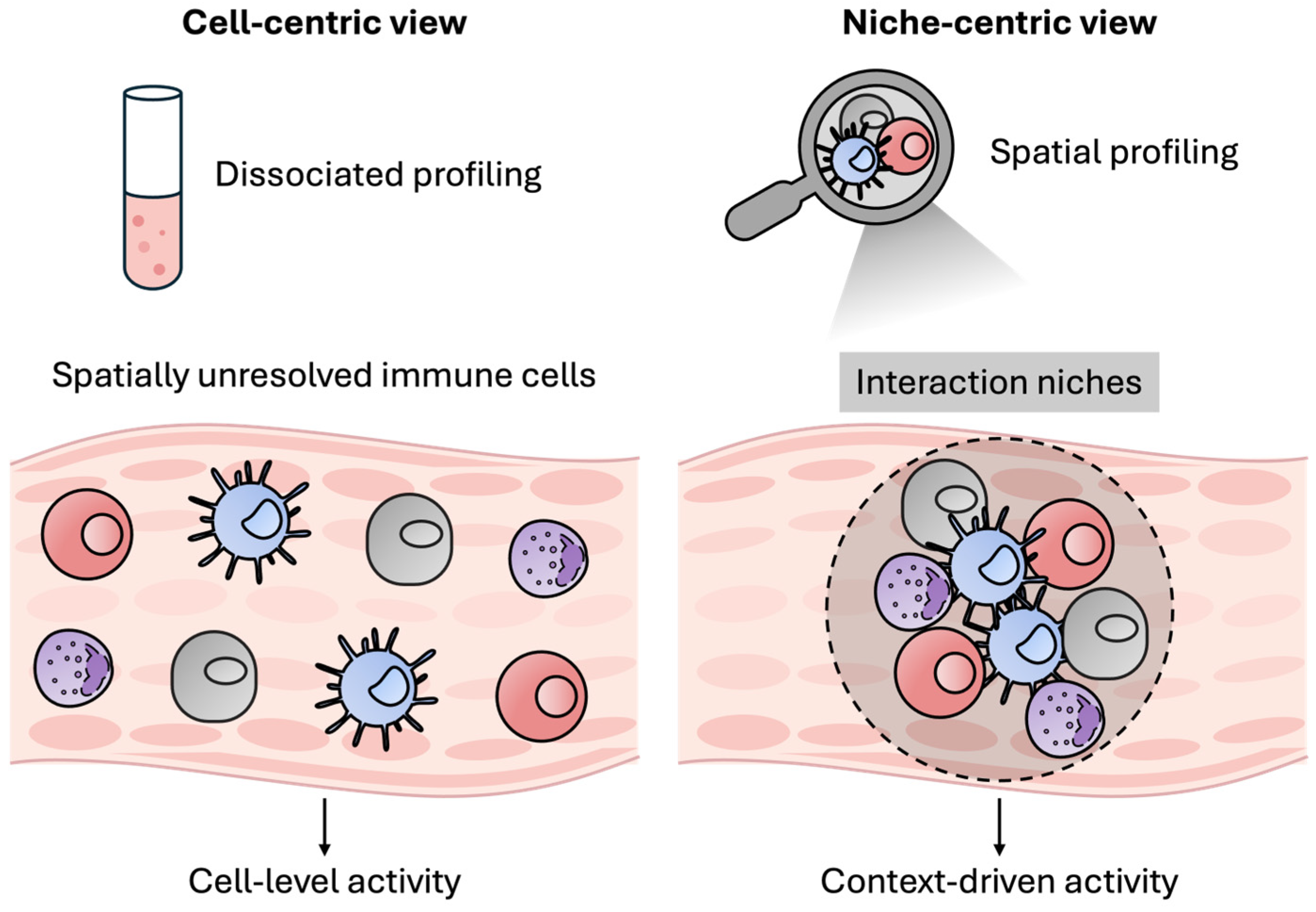
2. Immune Interaction Niches as Functional Units of Inflammation
2.1. From Cell Types to Interaction-Defined Niches
2.2. Determinants of Niche Functionality
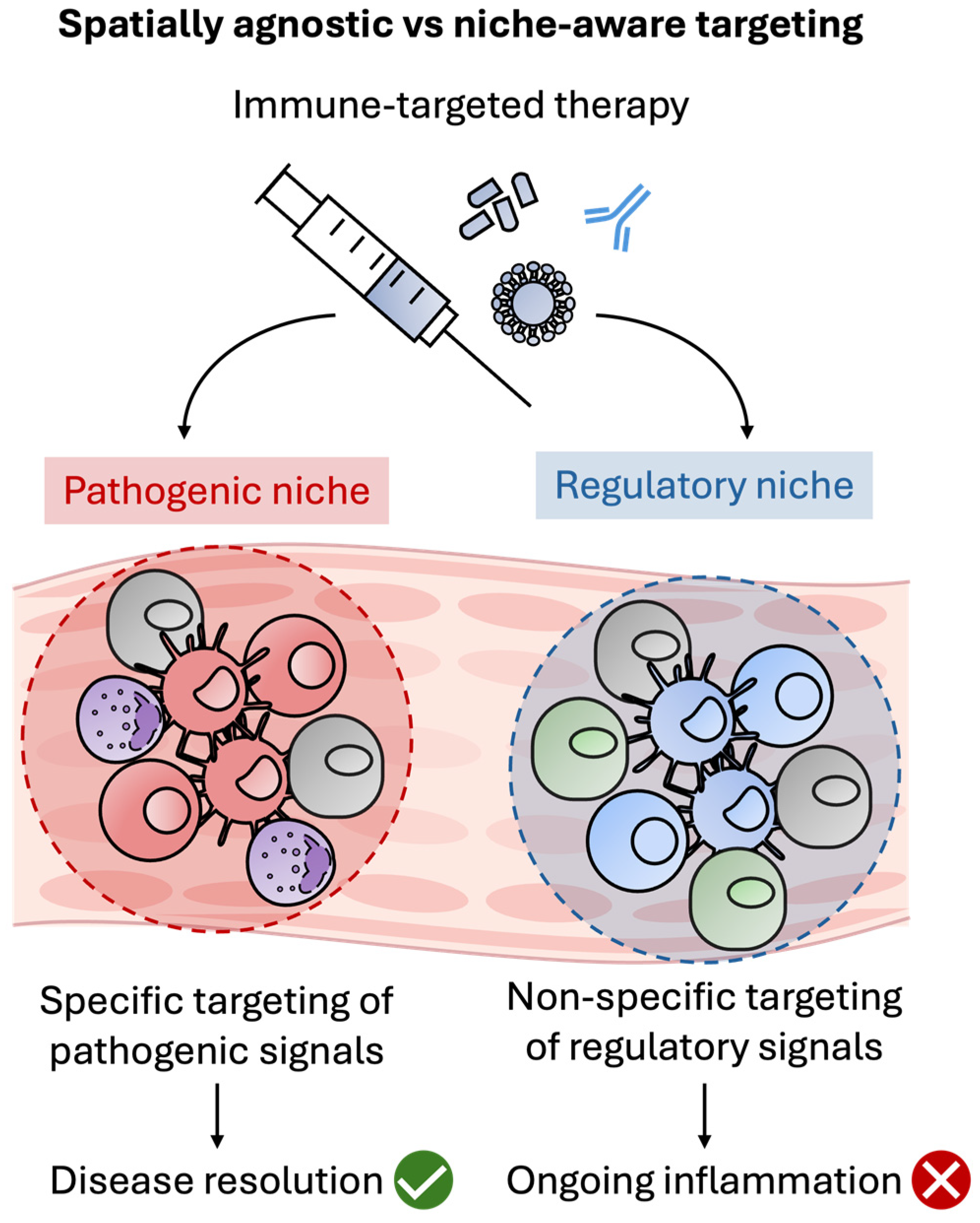
3. Why Molecular Targeting Alone Might Not Predict Therapeutic Outcome
3.1. Spatial Context and Variability in Immune Signalling Outcomes
3.2. Off-Target Effects Arising from Spatially Unresolved Intervention
3.3. Spatial and Temporal Alignment of Immune Modulation
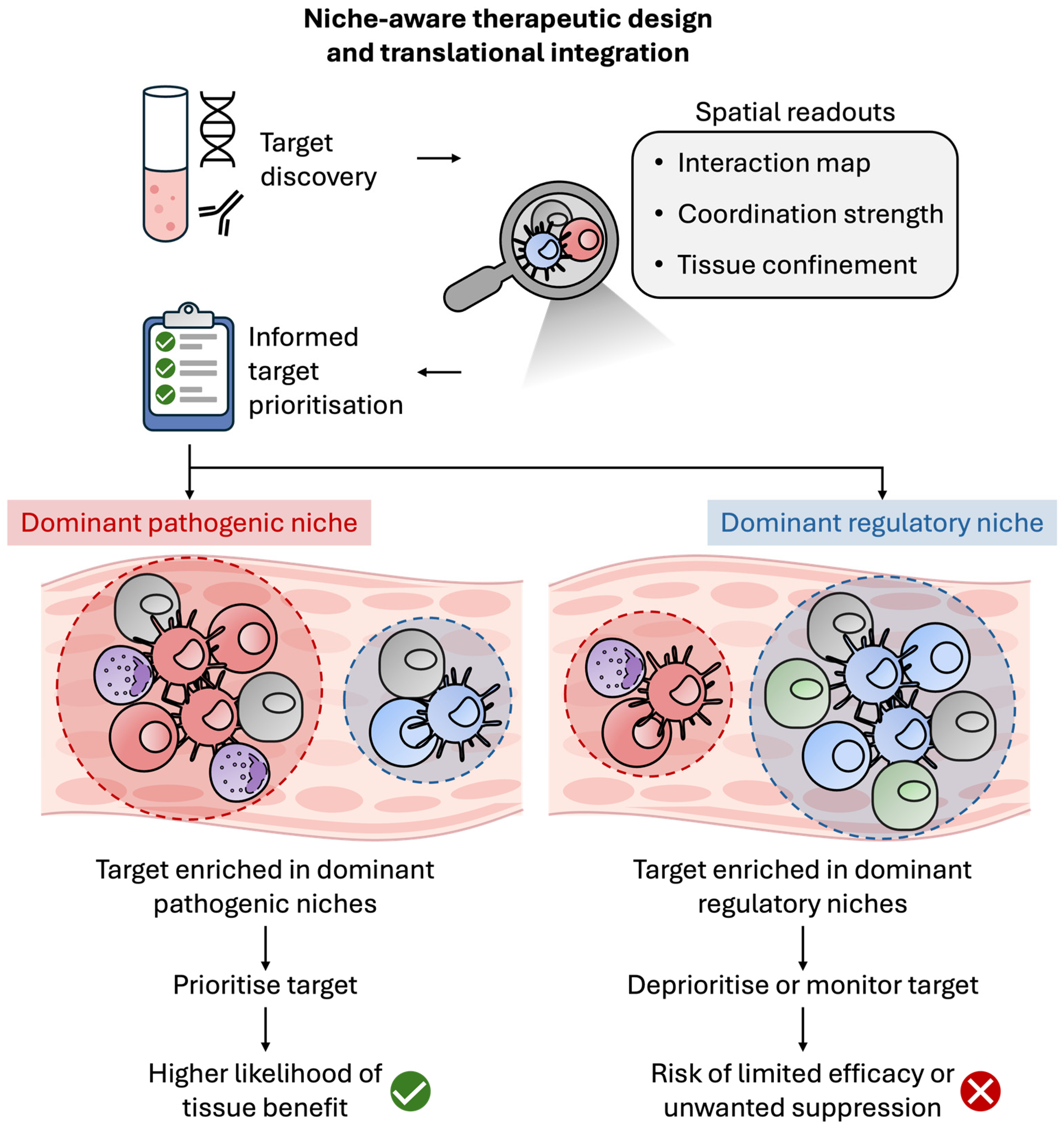
4. Toward Niche-Aware Therapeutic Design
4.1. Spatial Features That Define Actionable Targets
4.2. Integrating Spatial Readouts into Translational Pipelines
4.3. Practical Limitations and Strategies for Selective Implementation
5. Concluding Remarks and Future Directions
Funding
Institutional Review Board Statement
Informed Consent Statement
Data Availability Statement
Conflicts of Interest
Abbreviation
| Ref | References |
References
- Piao, W.; Lee, Z.L.; Zapas, G.; Wu, L.; Jewell, C.M.; Abdi, R.; Bromberg, J.S. Regulatory T Cell and Endothelial Cell Crosstalk. Nat. Rev. Immunol. 2025, 25, 588–607. [Google Scholar] [CrossRef]
- Mirchandani, A.S.; Sanchez-Garcia, M.A.; Walmsley, S.R. How Oxygenation Shapes Immune Responses: Emerging Roles for Physioxia and Pathological Hypoxia. Nat. Rev. Immunol. 2025, 25, 161–177. [Google Scholar] [CrossRef] [PubMed]
- José, C.; Almeida, R.; Veras, F.P.; Paiva, I.M.; Schneider, A.H.; Silva, C.; Gomes, G.F.; Costa, V.F.; Manuella, B.; Silva, S.; et al. Neutrophil Virucidal Activity Against SARS-CoV-2 Is Mediated by Neutrophil Extracellular Traps. J. Infect. Dis. 2024, 229, 1352–1365. [Google Scholar] [CrossRef]
- Bonilha, C.S.; Veras, F.P.; de Queiroz Cunha, F. NET-Targeted Therapy: Effects, Limitations, and Potential Strategies to Enhance Treatment Efficacy. Trends Pharmacol. Sci. 2023, 44, 622–634. [Google Scholar] [CrossRef] [PubMed]
- Bedaj, M.; Bonilha, C.S.; Mcinnes, I.B.; Garside, P.; Benson, R.A.; Benson, R.A. Tofacitinib Inhibits CD4 T Cell Polarisation to Th1 during Priming Thereby Leading to Clinical Impact in a Model of Experimental Arthritis. Clin. Exp. Rheumatol. 2022, 40, 1313–1323. [Google Scholar] [CrossRef]
- Prendergast, C.T.; Benson, R.A.; Scales, H.E.; Bonilha, C.S.; Cole, J.J.; McInnes, I.; Brewer, J.M.; Garside, P. Dissecting the Molecular Control of Immune Cell Accumulation in the Inflamed Joint. JCI Insight 2022, 7, e151281. [Google Scholar] [CrossRef] [PubMed]
- Bonilha, C.S.; Veras, F.P.; dos Santos Ramos, A.; Gomes, G.F.; Rodrigues Lemes, R.M.; Arruda, E.; Alves-Filho, J.C.; Cunha, T.M.; Cunha, F.Q. PAD4 Inhibition Impacts Immune Responses in SARS-CoV-2 Infection. Mucosal Immunol. 2025, 18, 861–873. [Google Scholar] [CrossRef]
- van de Wall, S.; Anthony, S.M.; Hancox, L.S.; Pewe, L.L.; Langlois, R.A.; Zehn, D.; Badovinac, V.P.; Harty, J.T. Dynamic Landscapes and Protective Immunity Coordinated by Influenza-Specific Lung-Resident Memory CD8+ T Cells Revealed by Intravital Imaging. Immunity 2024, 57, 1878–1892.e5. [Google Scholar] [CrossRef]
- Reina-Campos, M.; Monell, A.; Ferry, A.; Luna, V.; Cheung, K.P.; Galletti, G.; Scharping, N.E.; Takehara, K.K.; Quon, S.; Challita, P.P.; et al. Tissue-Resident Memory CD8 T Cell Diversity Is Spatiotemporally Imprinted. Nature 2025, 639, 483–492. [Google Scholar] [CrossRef]
- Gong, D.; Arbesfeld-Qiu, J.M.; Perrault, E.; Bae, J.W.; Hwang, W.L. Spatial Oncology: Translating Contextual Biology to the Clinic. Cancer Cell 2024, 42, 1653–1675. [Google Scholar] [CrossRef]
- Kumaran, G.; Carroll, L.; Muirhead, N.; Bottomley, M.J. How Can Spatial Transcriptomic Profiling Advance Our Understanding of Skin Diseases? J. Investig. Dermatol. 2025, 145, 522–535. [Google Scholar] [CrossRef]
- Zhang, H.; Patrick, M.T.; Zhao, J.; Zhai, X.; Liu, J.; Li, Z.; Gu, Y.; Welch, J.; Zhou, X.; Modlin, R.L.; et al. Techniques and Analytic Workflow for Spatial Transcriptomics and Its Application to Allergy and Inflammation. J. Allergy Clin. Immunol. 2025, 155, 678–687. [Google Scholar] [CrossRef]
- Castillo, R.L.; Sidhu, I.; Dolgalev, I.; Chu, T.; Prystupa, A.; Subudhi, I.; Yan, D.; Konieczny, P.; Hsieh, B.; Haberman, R.H.; et al. Spatial Transcriptomics Stratifies Psoriatic Disease Severity by Emergent Cellular Ecosystems. Sci. Immunol. 2023, 8, eabq7991. [Google Scholar] [CrossRef]
- Subudhi, I.; Konieczny, P.; Prystupa, A.; Castillo, R.L.; Sze-Tu, E.; Xing, Y.; Rosenblum, D.; Reznikov, I.; Sidhu, I.; Loomis, C.; et al. Metabolic Coordination between Skin Epithelium and Type 17 Immunity Sustains Chronic Skin Inflammation. Immunity 2024, 57, 1665–1680.e7. [Google Scholar] [CrossRef]
- Schäbitz, A.; Hillig, C.; Mubarak, M.; Jargosch, M.; Farnoud, A.; Scala, E.; Kurzen, N.; Pilz, A.C.; Bhalla, N.; Thomas, J.; et al. Spatial Transcriptomics Landscape of Lesions from Non-Communicable Inflammatory Skin Diseases. Nat. Commun. 2022, 13, 7729. [Google Scholar] [CrossRef] [PubMed]
- De Lima, J.; Boutet, M.A.; Bortolotti, O.; Chépeaux, L.A.; Glasson, Y.; Dumé, A.S.; Lau, R.; Humbert, P.; Allain, S.; Le Pluart, A.; et al. Spatial Mapping of Rheumatoid Arthritis Synovial Niches Reveals a LYVE1+ Macrophage Network Associated with Response to Therapy. Ann. Rheum. Dis. 2025, 84, 1955–1967. [Google Scholar] [CrossRef] [PubMed]
- Carlberg, K.; Korotkova, M.; Larsson, L.; Catrina, A.I.; Ståhl, P.L.; Malmström, V. Exploring Inflammatory Signatures in Arthritic Joint Biopsies with Spatial Transcriptomics. Sci. Rep. 2019, 9, 18975. [Google Scholar] [CrossRef]
- Caetano, A.J.; Redhead, Y.; Karim, F.; Dhami, P.; Kannambath, S.; Nuamah, R.; Volponi, A.A.; Nibali, L.; Booth, V.; D’Agostino, E.M.; et al. Spatially Resolved Transcriptomics Reveals Pro-Inflammatory Fibroblast Involved in Lymphocyte Recruitment through CXCL8 and CXCL10. eLife 2023, 12, e81525. [Google Scholar] [CrossRef]
- Massimino, L.; Parigi, T.L.; Riva, M.; Nicolò, S.; Errico, C.; Spanò, S.; Mino, S.; Bugatti, M.; Frontali, A.; Scarfò, F.; et al. Spatiotemporal Analysis of Crohn’s Disease Reveals PECAM2 Signaling at the Basis of the Inflammation-to-Fibrosis Transition. J. Crohns Colitis 2025, 19, jjaf130. [Google Scholar] [CrossRef]
- Kolachala, V.L.; Maddipatla, S.C.; Murthy, S.; Hwang, Y.; Dodd, A.F.; Sharma, G.; Munasinghe, S.; Pelia, R.S.; Venkateswaran, S.; Anbazhagan, M.; et al. Altered Inflammatory Mucosal Signatures within Their Spatial and Cellular Context during Active Ileal Crohn’s Disease. JCI Insight 2025, 10, e171783. [Google Scholar] [CrossRef] [PubMed]
- Yalom, L.K.; Herrnreiter, C.J.; Bui, T.M.; Lockhart, J.; Piccolo, E.B.; Ren, X.; Wei, C.; Serdiukova, A.; Thorp, E.B.; Dulai, P.S.; et al. Spatially Separated Epithelium-Associated and Lamina Propria Neutrophils Present Distinct Functional Identities in the Inflamed Colon Mucosa. Mucosal Immunol. 2025, 18, 685–699. [Google Scholar] [CrossRef]
- Karimi, E.; Yu, M.W.; Maritan, S.M.; Perus, L.J.M.; Rezanejad, M.; Sorin, M.; Dankner, M.; Fallah, P.; Doré, S.; Zuo, D.; et al. Single-Cell Spatial Immune Landscapes of Primary and Metastatic Brain Tumours. Nature 2023, 614, 555–563. [Google Scholar] [CrossRef] [PubMed]
- Liu, Y.; Ye, S.Y.; He, S.; Chi, D.M.; Wang, X.Z.; Wen, Y.F.; Ma, D.; Nie, R.C.; Xiang, P.; Zhou, Y.; et al. Single-Cell and Spatial Transcriptome Analyses Reveal Tertiary Lymphoid Structures Linked to Tumour Progression and Immunotherapy Response in Nasopharyngeal Carcinoma. Nat. Commun. 2024, 15, 7713. [Google Scholar] [CrossRef] [PubMed]
- Arora, R.; Cao, C.; Kumar, M.; Sinha, S.; Chanda, A.; McNeil, R.; Samuel, D.; Arora, R.K.; Matthews, T.W.; Chandarana, S.; et al. Spatial Transcriptomics Reveals Distinct and Conserved Tumor Core and Edge Architectures That Predict Survival and Targeted Therapy Response. Nat. Commun. 2023, 14, 5029. [Google Scholar] [CrossRef]
- Firsova, A.B.; Marco Salas, S.; Kuemmerle, L.B.; Abalo, X.M.; Sountoulidis, A.; Larsson, L.; Mahbubani, K.T.; Theelke, J.; Andrusivova, Z.; Alonso Galicia, L.; et al. Spatial Single-Cell Atlas Reveals Regional Variations in Healthy and Diseased Human Lung. Nat. Commun. 2025, 16, 9745. [Google Scholar] [CrossRef] [PubMed]
- Polonsky, M.; Gerhardt, L.M.S.; Yun, J.; Koppitch, K.; Colón, K.L.; Amrhein, H.; Wold, B.; Zheng, S.; Yuan, G.C.; Thomson, M.; et al. Spatial Transcriptomics Defines Injury Specific Microenvironments and Cellular Interactions in Kidney Regeneration and Disease. Nat. Commun. 2024, 15, 7010. [Google Scholar] [CrossRef]
- Smith, D.; Eichinger, A.; Fennell, É.; Xu-Monette, Z.Y.; Rech, A.; Wang, J.; Esteva, E.; Seyedian, A.; Yang, X.; Zhang, M.; et al. Spatial and Single Cell Mapping of Castleman Disease Reveals Key Stromal Cell Types and Cytokine Pathways. Nat. Commun. 2025, 16, 6009. [Google Scholar] [CrossRef]
- Lütge, M.; Kurz, L.; Stanossek, Y.; Meili, S.; Cheng, H.-W.; De Martin, A.; Brandstadter, J.; Maillard, I.; Robinson, M.D.; Stoeckli, S.J.; et al. Fibroblastic Reticular Cells Form Reactive Myeloid Cell Niches in Human Lymph Nodes. Sci. Immunol. 2025, 10, eads6820. [Google Scholar] [CrossRef]
- Launonen, I.M.; Niemiec, I.; Hincapié-Otero, M.; Erkan, E.P.; Junquera, A.; Afenteva, D.; Falco, M.M.; Liang, Z.; Salko, M.; Chamchougia, F.; et al. Chemotherapy Induces Myeloid-Driven Spatially Confined T Cell Exhaustion in Ovarian Cancer. Cancer Cell 2024, 42, 2045–2063.e10. [Google Scholar] [CrossRef]
- Vannan, A.; Lyu, R.; Williams, A.L.; Negretti, N.M.; Mee, E.D.; Hirsh, J.; Hirsh, S.; Hadad, N.; Nichols, D.S.; Calvi, C.L.; et al. Spatial Transcriptomics Identifies Molecular Niche Dysregulation Associated with Distal Lung Remodeling in Pulmonary Fibrosis. Nat. Genet. 2025, 57, 647–658. [Google Scholar] [CrossRef]
- Amisaki, M.; Zebboudj, A.; Yano, H.; Zhang, S.L.; Payne, G.; Chandra, A.K.; Yu, R.; Guasp, P.; Sethna, Z.M.; Ohmoto, A.; et al. IL-33-Activated ILC2s Induce Tertiary Lymphoid Structures in Pancreatic Cancer. Nature 2025, 638, 1076–1084. [Google Scholar] [CrossRef] [PubMed]
- Wagner, M.; Ealey, K.N.; Tetsu, H.; Kiniwa, T.; Motomura, Y.; Moro, K.; Koyasu, S. Tumor-Derived Lactic Acid Contributes to the Paucity of Intratumoral ILC2s. Cell Rep. 2020, 30, 2743–2757.e5. [Google Scholar] [CrossRef] [PubMed]
- Jacquelot, N.; Seillet, C.; Wang, M.; Pizzolla, A.; Liao, Y.; Hediyeh-zadeh, S.; Grisaru-Tal, S.; Louis, C.; Huang, Q.; Schreuder, J.; et al. Blockade of the Co-Inhibitory Molecule PD-1 Unleashes ILC2-Dependent Antitumor Immunity in Melanoma. Nat. Immunol. 2021, 22, 851–864. [Google Scholar] [CrossRef]
- Alexandre, Y.O.; Potemkin, N.; Schienstock, D.; Duchamp, B.; Poch, A.; Christo, S.N.; Li, S.; Qin, L.; Beattie, L.; Utzschneider, D.T.; et al. Splenic Fibroblastic Reticular Cells Orchestrate Dendritic Cell Maturation and Facilitate CD8+ T Cell Priming and Protective Memory. Sci. Adv. 2025, 11, eadt5939. [Google Scholar] [CrossRef]
- FitzPatrick, M.E.B.; Antanaviciute, A.; Dunstan, M.; Künnapuu, K.; Trzupek, D.; Provine, N.M.; Dooley, K.; Zhang, J.Y.; Irwin, S.L.; Garner, L.C.; et al. Immune–Epithelial–Stromal Networks Define the Cellular Ecosystem of the Small Intestine in Celiac Disease. Nat. Immunol. 2025, 26, 947–962. [Google Scholar] [CrossRef]
- Bonilha, C.S. The Synapse Revisited: Molecular Networks of CD4 T Cell–DC Interactions. Int. Immunopharmacol. 2025, 167, 115715. [Google Scholar] [CrossRef]
- Bonilha, C.S.; Benson, R.A.; Scales, H.E.; Brewer, J.M.; Garside, P. Junctional Adhesion Molecule-A on Dendritic Cells Regulates Th1 Differentiation. Immunol. Lett. 2021, 235, 32–40. [Google Scholar] [CrossRef]
- O’Neill, A.; Zakaria, N.; Bull, C.; Egan, H.; Corry, S.M.; Leonard, N.A.; O’Meara, C.; Howard, L.; Walsh, A.; Reidy, E.; et al. Stromal Cells Modulate Innate Immune Cell Phenotype and Function in Colorectal Cancer via the Sialic Acid/Siglec Axis. J. Immunother. Cancer 2025, 13, e012491. [Google Scholar] [CrossRef] [PubMed]
- Niec, R.E.; Rudensky, A.Y.; Fuchs, E. Inflammatory Adaptation in Barrier Tissues. Cell 2021, 184, 3361–3375. [Google Scholar] [CrossRef]
- Lund, A.W.; Wagner, M.; Fankhauser, M.; Steinskog, E.S.; Broggi, M.A.; Spranger, S.; Gajewski, T.F.; Alitalo, K.; Eikesdal, H.P.; Wiig, H.; et al. Lymphatic Vessels Regulate Immune Microenvironments in Human and Murine Melanoma. J. Clin. Investig. 2016, 126, 3389–3402. [Google Scholar] [CrossRef]
- Wagner, M.; Steinskog, E.S.; Wiig, H. Blockade of Lymphangiogenesis Shapes Tumor-Promoting Adipose Tissue Inflammation. Am. J. Pathol. 2019, 189, 2102–2114. [Google Scholar] [CrossRef]
- Fankhauser, M.; Broggi, M.A.S.; Potin, L.; Bordry, N.; Jeanbart, L.; Lund, A.W.; Da Costa, E.; Hauert, S.; Rincon-Restrepo, M.; Tremblay, C.; et al. Tumor Lymphangiogenesis Promotes T Cell Infiltration and Potentiates Immunotherapy in Melanoma. Sci. Transl. Med. 2017, 9, eaal4712. [Google Scholar] [CrossRef]
- Scholaert, M.; Houmadi, R.; Martin, J.; Serhan, N.; Tauber, M.; Braun, E.; Basso, L.; Merle, E.; Descargues, P.; Viguier, M.; et al. 3D Deconvolution of Human Skin Immune Architecture with Multiplex Annotated Tissue Imaging System. Sci. Adv. 2023, 9, eadf9491. [Google Scholar] [CrossRef]
- Smithmyer, M.E.; Hu, A.; Dufort, M.J.; Hocking, A.M.; Wiedeman, A.E.; Fasano, K.J.; Torgerson, T.R.; Skene, P.J.; Reading, J.; Li, X.; et al. Longitudinally Stable T Cell Function and Innate Immune Activation Distinguish Healthy Adult Immunotypes. Sci. Transl. Med. 2025, 17, eadt4605. [Google Scholar] [CrossRef] [PubMed]
- Zotova, N.; Zhuravleva, Y.; Chereshnev, V.; Gusev, E. Acute and Chronic Systemic Inflammation: Features and Differences in the Pathogenesis, and Integral Criteria for Verification and Differentiation. Int. J. Mol. Sci. 2023, 24, 1144. [Google Scholar] [CrossRef]
- Holst-Hansen, T.; Nielsen, P.Y.; Jensen, M.H.; Mandrup-Poulsen, T.; Trusina, A. Tipping-Point Transition from Transient to Persistent Inflammation in Pancreatic Islets. npj Syst. Biol. Appl. 2024, 10, 102. [Google Scholar] [CrossRef]
- Mennillo, E.; Kim, Y.J.; Lee, G.; Rusu, I.; Patel, R.K.; Dorman, L.C.; Flynn, E.; Li, S.; Bain, J.L.; Andersen, C.; et al. Single-Cell and Spatial Multi-Omics Highlight Effects of Anti-Integrin Therapy across Cellular Compartments in Ulcerative Colitis. Nat. Commun. 2024, 15, 1493. [Google Scholar] [CrossRef] [PubMed]
- Thomas, T.; Friedrich, M.; Rich-Griffin, C.; Pohin, M.; Agarwal, D.; Pakpoor, J.; Lee, C.; Tandon, R.; Rendek, A.; Aschenbrenner, D.; et al. A Longitudinal Single-Cell Atlas of Anti-Tumour Necrosis Factor Treatment in Inflammatory Bowel Disease. Nat. Immunol. 2024, 25, 2152–2165. [Google Scholar] [CrossRef] [PubMed]
- Guo, A.; Ross, C.; Chande, N.; Gregor, J.; Ponich, T.; Khanna, R.; Sey, M.; Beaton, M.; Yan, B.; Kim, R.B.; et al. High Oncostatin M Predicts Lack of Clinical Remission for Patients with Inflammatory Bowel Disease on Tumor Necrosis Factor α Antagonists. Sci. Rep. 2022, 12, 1185. [Google Scholar] [CrossRef]
- Rivellese, F.; Nerviani, A.; Giorli, G.; Warren, L.; Jaworska, E.; Bombardieri, M.; Lewis, M.J.; Humby, F.; Pratt, A.G.; Filer, A.; et al. Stratification of Biological Therapies by Pathobiology in Biologic-Naive Patients with Rheumatoid Arthritis (STRAP and STRAP-EU): Two Parallel, Open-Label, Biopsy-Driven, Randomised Trials. Lancet Rheumatol. 2023, 5, e648–e659. [Google Scholar] [CrossRef]
- Battat, R.; Sangiorgi, B.; Linggi, B.; Gui, X.; Smith, M.I.; Mehandru, S.; Longman, R.; Lukin, D.J.; Scherl, E.J.; Qin, L.; et al. Spatial Transcriptomics Reveals Unique Inflammatory Signatures across All Anatomic Locations in Postoperative Crohn’s Disease. J. Crohns Colitis 2025, 19, jjaf180. [Google Scholar] [CrossRef]
- Wang, X.Q.; Danenberg, E.; Huang, C.S.; Egle, D.; Callari, M.; Bermejo, B.; Dugo, M.; Zamagni, C.; Thill, M.; Anton, A.; et al. Spatial Predictors of Immunotherapy Response in Triple-Negative Breast Cancer. Nature 2023, 621, 868–876. [Google Scholar] [CrossRef]
- Yoshimoto, M.; Sugihara, K.; Tokumura, K.; Tsuji, S.; Hinoi, E. Integrated Spatial and Single-Cell Transcriptomics Reveals Poor Prognostic Ligand–Receptor Pairs in Glioblastoma. Cells 2025, 14, 1540. [Google Scholar] [CrossRef]
- Li, S.; Wang, R.; Liu, S.; Li, S.C. Finding Spatially Variable Ligand-Receptor Interactions with Functional Support from Downstream Genes. Nat. Commun. 2025, 16, 7784. [Google Scholar] [CrossRef]
- Bonilha, C.S. Platelet–Neutrophil Niches Associate with Epidermal Immune Activation and Systemic Inflammation in Psoriatic Disease. J. Mol. Med. 2026, 104, 74. [Google Scholar] [CrossRef] [PubMed]
- Magalhaes, G.S.; Gregorio, J.F.; Beltrami, V.A.; Felix, F.B.; Oliveira-Campos, L.; Bonilha, C.S.; Righetti, R.F.; Tibério, I.d.F.L.C.; De Sousa, F.B.; Rezende, B.M.; et al. A Single Dose of Angiotensin-(1–7) Resolves Eosinophilic Inflammation and Protects the Lungs from a Secondary Inflammatory Challenge. Inflamm. Res. 2024, 73, 1019–1031. [Google Scholar] [CrossRef] [PubMed]
- De Araujo, S.; Costa, V.V.R.D.M.; Santos, F.M.; De Sousa, C.D.F.; Moreira, T.P.; Gonçalves, M.R.; Franciel, B.F.; Queiroz-Junior, C.M.; Perretti, M.; Souza, D.G.; et al. Annexin A1-FPR2/ALX Signaling Axis Regulates Acute Inflammation during Chikungunya Virus Infection. Cells 2022, 11, 2717. [Google Scholar] [CrossRef] [PubMed]
- Salié, H.; Wischer, L.; D’Alessio, A.; Godbole, I.; Suo, Y.; Otto-Mora, P.; Beck, J.; Neumann, O.; Stenzinger, A.; Schirmacher, P.; et al. Spatial Single-Cell Profiling and Neighbourhood Analysis Reveal the Determinants of Immune Architecture Connected to Checkpoint Inhibitor Therapy Outcome in Hepatocellular Carcinoma. Gut 2025, 74, 451–466. [Google Scholar] [CrossRef]
- Oh, J.; Hoelzl, J.; Carlson, J.C.T.; Bill, R.; Peterson, H.M.; Faquin, W.C.; Pittet, M.J.; Pai, S.I.; Weissleder, R. Spatial Analysis Identifies DC Niches as Predictors of Pembrolizumab Therapy in Head and Neck Squamous Cell Cancer. Cell Rep. Med. 2025, 6, 102100. [Google Scholar] [CrossRef]
- Quek, C.; Pratapa, A.; Bai, X.; Al-Eryani, G.; Pires da Silva, I.; Mayer, A.; Bartonicek, N.; Harvey, K.; Maher, N.G.; Conway, J.W.; et al. Single-Cell Spatial Multiomics Reveals Tumor Microenvironment Vulnerabilities in Cancer Resistance to Immunotherapy. Cell Rep. 2024, 43, 114392. [Google Scholar] [CrossRef]
- Thomas, M.F.; Slowikowski, K.; Manakongtreecheep, K.; Sen, P.; Samanta, N.; Tantivit, J.; Nasrallah, M.; Zubiri, L.; Smith, N.P.; Tirard, A.; et al. Single-Cell Transcriptomic Analyses Reveal Distinct Immune Cell Contributions to Epithelial Barrier Dysfunction in Checkpoint Inhibitor Colitis. Nat. Med. 2024, 30, 1349–1362. [Google Scholar] [CrossRef]
- Gupta, T.; Antanaviciute, A.; Hyun-Jung Lee, C.; Ottakandathil Babu, R.; Aulicino, A.; Christoforidou, Z.; Siejka-Zielinska, P.; O’Brien-Ball, C.; Chen, H.; Fawkner-Corbett, D.; et al. Tracking in Situ Checkpoint Inhibitor-Bound Target T Cells in Patients with Checkpoint-Induced Colitis. Cancer Cell 2024, 42, 797–814.e15. [Google Scholar] [CrossRef]
- Cui, X.; Liu, S.; Song, H.; Xu, J.; Sun, Y. Single-Cell and Spatial Transcriptomic Analyses Revealing Tumor Microenvironment Remodeling after Neoadjuvant Chemoimmunotherapy in Non-Small Cell Lung Cancer. Mol. Cancer 2025, 24, 111. [Google Scholar] [CrossRef] [PubMed]
- Chi, H.; Pepper, M.; Thomas, P.G. Principles and Therapeutic Applications of Adaptive Immunity. Cell 2024, 187, 2052–2078. [Google Scholar] [CrossRef]
- Giamarellos-Bourboulis, E.J.; Kotsaki, A.; Kotsamidi, I.; Efthymiou, A.; Koutsoukou, V.; Ehler, J.; Paridou, A.; Frantzeskaki, F.; Müller, M.C.A.; Pickkers, P.; et al. Precision Immunotherapy to Improve Sepsis Outcomes: The ImmunoSep Randomized Clinical Trial. JAMA 2025, 335, 775–786. [Google Scholar] [CrossRef]
- Davar, D.; Morrison, R.M.; Dzutsev, A.K.; Karunamurthy, A.; Chauvin, J.M.; Amatore, F.; Deutsch, J.S.; Das Neves, R.X.; Rodrigues, R.R.; McCulloch, J.A.; et al. Neoadjuvant Vidutolimod and Nivolumab in High-Risk Resectable Melanoma: A Prospective Phase II Trial. Cancer Cell 2024, 42, 1898–1918.e12. [Google Scholar] [CrossRef] [PubMed]
- Feng, R.; Spieth, L.; Liu, L.; Berghoff, S.; Franz, J.; Liu, Q.; Wang, Z.; Tiwari, V.; Vitale, S.; Frerich, S.; et al. Single-Cell Spatial Transcriptomic Profiling Defines a Pathogenic Inflammatory Niche in Chronic Active Multiple Sclerosis Lesions. Immunity 2025, 58, 2989–3005.e10. [Google Scholar] [CrossRef]
- Patel, B.K.; Raabe, M.J.; Lang, E.R.; Song, Y.; Lu, C.; Deshpande, V.; Nieman, L.T.; Aryee, M.J.; Chen, Y.-B.; Ting, D.T.; et al. Spatial Transcriptomics Reveals Distinct Tissue Niches Linked with Steroid Responsiveness in Acute Gastrointestinal GVHD. Blood 2023, 142, 1831–1844. [Google Scholar] [CrossRef]
- Peyraud, F.; Guégan, J.P.; Rey, C.; Lara, O.; Odin, O.; Del Castillo, M.; Vanhersecke, L.; Coindre, J.M.; Clot, E.; Brunet, M.; et al. Spatially Resolved Transcriptomics Reveal the Determinants of Primary Resistance to Immunotherapy in NSCLC with Mature Tertiary Lymphoid Structures. Cell Rep. Med. 2025, 6, 101934. [Google Scholar] [CrossRef] [PubMed]
- Soupir, A.C.; Hayes, M.T.; Peak, T.C.; Ospina, O.; Chakiryan, N.H.; Berglund, A.E.; Stewart, P.A.; Nguyen, J.; Segura, C.M.; Francis, N.L.; et al. Increased Spatial Coupling of Integrin and Collagen IV in the Immunoresistant Clear-Cell Renal-Cell Carcinoma Tumor Microenvironment. Genome Biol. 2024, 25, 308. [Google Scholar] [CrossRef]
- Chan, A.S.F.; Greiner, J.; Marschhäuser, L.; Brennan, T.A.; Perez-Feliz, S.; Agrawal, A.; Hemmer, H.; Sinning, K.; Cheung, J.W.L.; Iqbal, Z.; et al. Spatiotemporal Dynamics of the Cardioimmune Niche during Lesion Repair. Nat. Cardiovasc. Res. 2025, 4, 1550–1572. [Google Scholar] [CrossRef]
- Weeratunga, P.; Hunter, B.; Sergeant, M.; Bull, J.; Clelland, C.; Denney, L.; Vuppusetty, C.; Burgoyne, R.; Woo, J.; Hu, T.; et al. Temporo-Spatial Cellular Atlas of the Regenerating Alveolar Niche in Idiopathic Pulmonary Fibrosis. Nat. Commun. 2025, 16, 7150. [Google Scholar] [CrossRef]
- Lerma-Martin, C.; Badia-i-Mompel, P.; Ramirez Flores, R.O.; Sekol, P.; Schäfer, P.S.L.; Riedl, C.J.; Hofmann, A.; Thäwel, T.; Wünnemann, F.; Ibarra-Arellano, M.A.; et al. Cell Type Mapping Reveals Tissue Niches and Interactions in Subcortical Multiple Sclerosis Lesions. Nat. Neurosci. 2024, 27, 2354–2365. [Google Scholar] [CrossRef]
- Benjamin, K.; Bhandari, A.; Kepple, J.D.; Qi, R.; Shang, Z.; Xing, Y.; An, Y.; Zhang, N.; Hou, Y.; Crockford, T.L.; et al. Multiscale Topology Classifies Cells in Subcellular Spatial Transcriptomics. Nature 2024, 630, 943–949. [Google Scholar] [CrossRef]
- Chen, J.H.; Nieman, L.T.; Spurrell, M.; Jorgji, V.; Elmelech, L.; Richieri, P.; Xu, K.H.; Madhu, R.; Parikh, M.; Zamora, I.; et al. Human Lung Cancer Harbors Spatially Organized Stem-Immunity Hubs Associated with Response to Immunotherapy. Nat. Immunol. 2024, 25, 644–658. [Google Scholar] [CrossRef] [PubMed]
- Patkar, S.; Chen, A.; Basnet, A.; Bixby, A.; Rajendran, R.; Chernet, R.; Faso, S.; Kumar, P.A.; Desai, D.; El-Zammar, O.; et al. Predicting the Tumor Microenvironment Composition and Immunotherapy Response in Non-Small Cell Lung Cancer from Digital Histopathology Images. npj Precis. Oncol. 2024, 8, 280. [Google Scholar] [CrossRef]
- Abdulrahman, Z.; Slieker, R.C.; McGuire, D.; Welters, M.J.P.; Van Poelgeest, M.I.E.; Van Der Burg, S.H. Single-Cell Spatial Transcriptomics Unravels Cell States and Ecosystems Associated with Clinical Response to Immunotherapy. J. Immunother. Cancer 2025, 13, e011308. [Google Scholar] [CrossRef] [PubMed]
- Li, Y.; Luo, Y. STdGCN: Spatial Transcriptomic Cell-Type Deconvolution Using Graph Convolutional Networks. Genome Biol. 2024, 25, 206. [Google Scholar] [CrossRef]
- Bonilha, C.S. Ligand–Receptor Hotspots in Dendritic–T Cell Niches Expose Targets in Autoimmunity. Transl. Res. 2026, 288, 21–32. [Google Scholar] [CrossRef] [PubMed]
- Lim, H.J.; Wang, Y.; Buzdin, A.; Li, X. A Practical Guide for Choosing an Optimal Spatial Transcriptomics Technology from Seven Major Commercially Available Options. BMC Genom. 2025, 26, 47. [Google Scholar] [CrossRef]
- Khan, M.; Arslanturk, S.; Draghici, S. A Comprehensive Review of Spatial Transcriptomics Data Alignment and Integration. Nucleic Acids Res. 2025, 53, gkaf536. [Google Scholar] [CrossRef]
- Si, Y.; Lee, J.S.; Jun, G.; Kang, H.M.; Lee, J.H. Spatial Omics Enters the Microscopic Realm: Opportunities and Challenges. Trends Genet. 2025, 41, 774–787. [Google Scholar] [CrossRef]
- Heitz, M.; Ma, Y.; Kubal, S.; Schiebinger, G. Spatial Transcriptomics Brings New Challenges and Opportunities for Trajectory Inference. Annu. Rev. Biomed. Data Sci. 2025, 8, 1–19. [Google Scholar] [CrossRef]
- Bonilha, C.S. Spatial Imbalance of Innate-like T-Cell Niches Underlies Clinical Trajectories in Psoriasis. Int. J. Mol. Sci. 2026, 27, 715. [Google Scholar] [CrossRef]
- Bonilha, C.S. Immune Triad Microenvironments Define Coordinated Activation Architecture in Psoriatic Disease. Int. Immunopharmacol. 2026, 173, 116337. [Google Scholar] [CrossRef]
- Jiménez-Santos, M.J.; García-Martín, S.; Rubio-Fernández, M.; Gómez-López, G.; Al-Shahrour, F. Spatial Transcriptomics in Breast Cancer Reveals Tumour Microenvironment-Driven Drug Responses and Clonal Therapeutic Heterogeneity. NAR Cancer 2024, 6, zcae046. [Google Scholar] [CrossRef]
- Wang, X.; Venet, D.; Lifrange, F.; Larsimont, D.; Rediti, M.; Stenbeck, L.; Dupont, F.; Rouas, G.; Garcia, A.J.; Craciun, L.; et al. Spatial Transcriptomics Reveals Substantial Heterogeneity in Triple-Negative Breast Cancer with Potential Clinical Implications. Nat. Commun. 2024, 15, 10232. [Google Scholar] [CrossRef]
- Song, X.; Xiong, A.; Wu, F.; Li, X.; Wang, J.; Jiang, T.; Chen, P.; Zhang, X.; Zhao, Z.; Liu, H.; et al. Spatial Multi-Omics Revealed the Impact of Tumor Ecosystem Heterogeneity on Immunotherapy Efficacy in Patients with Advanced Non-Small Cell Lung Cancer Treated with Bispecific Antibody. J. Immunother. Cancer 2023, 11, e006234. [Google Scholar] [CrossRef]
- Bonilha, C.S. A Spatial Transit–Retention Axis Reveals Adaptive Immune Organisation in Psoriatic Disease. Mol. Cell. Biochem. 2026. [Google Scholar] [CrossRef]
- Zhou, L.F.; Liao, H.Y.; Han, Y.; Zhao, Y. The Use of Organoids in Creating Immune Microenvironments and Treating Gynecological Tumors. J. Transl. Med. 2024, 22, 856. [Google Scholar] [CrossRef]



| Niche Type | Dominant Cell Interactions | Tissue Context | Functional Outcome | Ref. |
|---|---|---|---|---|
| Dynamic interaction niches | ||||
| Metabolically coordinated immune niche | Immune cells engaging in inflammation-driven metabolic coordination within locally confined immune environments | Actively inflamed tissue regions | Sustained local amplification of type 17 immune programmes through dynamically regulated metabolic interactions | [14] |
| Neutrophil-centred antimicrobial niche | Spatially segregated neutrophil populations exhibiting distinct functional programmes within inflamed tissue | Inflamed mucosal tissue | Localised neutrophil effector activity with compartment-specific inflammatory and antimicrobial functions | [21] |
| Transient effector T cell interaction niche | Effector T cells engaging antigen-presenting cells within locally organised stromal interaction zones | Sites of acute immune activation | Coordinated signal exchange supporting T cell priming and early effector differentiation | [34] |
| Spatially anchored niches | ||||
| Fibroblast-organised immune niche | Activated fibroblasts coordinating immune cell positioning and signalling | Stromal tissue frameworks | Spatial confinement and reinforcement of inflammatory programmes | [18] |
| Vascular-associated immune niche | Perivascular macrophages organised around endothelial structures and interacting with infiltrating immune cells | Perivascular regions | Regulation of immune entry, positioning, and retention | [16] |
| Epithelial–immune interface niche | Epithelial cells engaging immune cells through contact and local mediators | Barrier tissues | Coupling of immune activation with tissue state | [35] |
| Resident memory immune niche | Tissue-resident memory T cells exhibiting region-specific differentiation and functional imprinting | Non-lymphoid tissues | Spatially imprinted immune surveillance with locally specialised functional programmes | [9] |
| Spatial Feature | Description in Tissue Context | Translational Relevance for Target Selection |
|---|---|---|
| Niche restriction | Preferential localisation of target activity within discrete immune interaction environments | Prioritises targets engaged within spatially confined pathological settings |
| Cell–cell coupling strength | Dependence of signalling on sustained proximity or contact between specific cell populations | Identifies targets whose impact arises from coordinated interaction dynamics |
| Tissue compartment specificity | Enrichment of target activity within defined anatomical compartments | Distinguishes targets linked to disease-associated tissue regions |
| Spatial concordance with pathology | Alignment of target activity with regions of tissue damage or inflammatory remodelling | Supports prioritisation of targets relevant to active disease sites |
| Persistence across disease stages | Stability of target engagement within interaction environments over time | Differentiates targets linked to sustained pathology from transient responses |
| Spatial separation from regulatory niches | Exclusion of target activity from interaction environments associated with immune regulation | Reduces risk of disrupting protective or homeostatic interactions |
| Technology Class | Main Strengths | Main Limitations | Translational Applications |
|---|---|---|---|
| Spatial transcriptomics | Broad molecular profiling with preservation of tissue location | Resolution varies across platforms, low-abundance signals may be missed, and tissue coverage can limit throughput | Mapping pathway activity to tissue regions, identifying disease-associated niches, and supporting target prioritisation |
| Single-cell spatial transcriptomics | High-resolution linkage between cellular state and tissue organisation | Greater technical complexity, higher cost, and limited scalability across large cohorts | Defining cellular ecosystems, resolving local immune programmes, and linking spatial organisation to therapeutic response |
| Multiplex imaging | Protein-level localisation with high spatial resolution and direct visualisation of cellular neighbourhoods | Limited marker number, antibody dependence, segmentation uncertainty, and image-analysis complexity | Quantifying immune localisation, cell–cell proximity, tissue compartmentalisation, and pathology-compatible biomarkers |
| Digital pathology and AI-assisted histology | Scalable use of routine tissue images and compatibility with clinical workflows | Requires robust training datasets, external validation, and careful biological interpretation | Inferring tissue microenvironment features, supporting patient stratification, and developing clinically deployable spatial biomarkers |
| Integrated spatial computational analysis | Combines spatial, single-cell, histological, and clinical data into interpretable tissue-level features | Dependent on reference quality, model assumptions, and harmonisation across platforms | Reconstructing interaction niches, prioritising candidate pathways, and interpreting response variability across patient groups |
Disclaimer/Publisher’s Note: The statements, opinions and data contained in all publications are solely those of the individual author(s) and contributor(s) and not of MDPI and/or the editor(s). MDPI and/or the editor(s) disclaim responsibility for any injury to people or property resulting from any ideas, methods, instructions or products referred to in the content. |
© 2026 by the author. Licensee MDPI, Basel, Switzerland. This article is an open access article distributed under the terms and conditions of the Creative Commons Attribution (CC BY) license.
Share and Cite
Bonilha, C.S. Spatial Immunology in Translation: Linking Immune Organisation to Therapeutic Outcome. Med. Sci. 2026, 14, 308. https://doi.org/10.3390/medsci14020308
Bonilha CS. Spatial Immunology in Translation: Linking Immune Organisation to Therapeutic Outcome. Medical Sciences. 2026; 14(2):308. https://doi.org/10.3390/medsci14020308
Chicago/Turabian StyleBonilha, Caio Santos. 2026. "Spatial Immunology in Translation: Linking Immune Organisation to Therapeutic Outcome" Medical Sciences 14, no. 2: 308. https://doi.org/10.3390/medsci14020308
APA StyleBonilha, C. S. (2026). Spatial Immunology in Translation: Linking Immune Organisation to Therapeutic Outcome. Medical Sciences, 14(2), 308. https://doi.org/10.3390/medsci14020308