
Article

Risk of Long-Term Clozapine Medication over Decades for Cardiac Adverse Events Including Heart Failure and Its Pathophysiology: A Japan and China Retrospective Cohort Analysis

1
Department of Neuropsychiatry, Division of Neuroscience, Graduate School of Medicine, Mie University, Tsu 514-8507, Japan
2
Department of Psychiatry, National Hospital Organization Sakakibara Hospital, 777 Sakakibara, Tsu 514-1292, Japan
3
Department of Psychiatry, The First Affiliated Hospital of China Medical University, Shenyang 110001, China
4
Department of Cardiology and Nephrology, Graduate School of Medicine, Mie University, Tsu 514-8507, Japan
5
Jinzhou Kangning Hospital, Jinzhou 121019, China
6
Shenyang Jing’an Mental Health Hospital, Shenyang 110163, China
*
Author to whom correspondence should be addressed.
Med. Sci. 2026, 14(2), 306; https://doi.org/10.3390/medsci14020306
Submission received: 26 April 2026 / Revised: 3 June 2026 / Accepted: 9 June 2026 / Published: 11 June 2026

Abstract

Background/Objectives: Clozapine is the sole antipsychotic approved for treatment-resistant schizophrenia, but it is a double-edged therapeutic option due to various lethal adverse reactions. This study aimed to assess the risk of long-term clozapine medication-induced cardiotoxicity, which has not yet been fully elucidated. Methods: This study is a multicenter retrospective cohort study of patients with schizophrenia in Japan and China who received clozapine monotherapy. Cases for which serum NT-proBNP concentration and LVEF derived from echocardiography were available in 2025 were included. In addition, blood examinations, including those administered by the Japanese Clozaril Patient Monitoring Service, were statistically analyzed as independent variables. Results: Among a total of 315 cases, including 99 Japanese (clozapine exposure duration: 57.5 ± 4.0 months) and 216 Chinese (208.1 ± 11.0 months) cases, were enrolled. In both Japan and China, age-standardized prevalence of heart failure among patients with prescribed clozapine were higher compared to general population, with odds ratios of 3.2 (95%CI: 1.4–6.4) and 6.9 (95%CI: 3.6–12.0), respectively. The risk factors for stage-B heart failure associated with clozapine were prolonged exposure duration, higher plasma levels of clozapine, and increasing monocytes. Unexpectedly, over 70% of cases with stage-B heart failure associated with clozapine identified in this study did not have metabolic complications. Other than those with cardiomyopathy, myocardial infarction, ileus, or chronic renal failure, no cases with ejection fraction < 50% were observed, suggesting that stage-B heart failure associated with clozapine is speculated to be likely suggestive of HFpEF. Conclusions: Traditionally, psychiatry has focused on myocarditis and cardiomyopathy developing several weeks and months after initiation of clozapine medication; however, this study revealed asymptomatic heart failure as a third cardiac adverse reaction of clozapine that develops years later. Therefore, regular monitoring of NT-proBNP contributes to improving long-term prognosis of treatment-resistant schizophrenia with prescribed clozapine.

1. Introduction

Clozapine is one of the most efficacious antipsychotics and the sole antipsychotic approved for treatment-resistant schizophrenia; however, its tolerability profile is complicated by a lowest incidence of extrapyramidal side effects and a high frequency of weight gain and metabolic complications, along with other difficult-to-manage adverse effects, such as liver damage, thermoregulatory disturbances, and hypersalivation [1,2,3,4]. Notably, among adverse reactions of clozapine, agranulocytosis is the most well-recognized life-threatening complication [1,5,6,7], whereas cardiotoxicity, such as myocarditis, cardiomyopathy, and myocardial infarction, as well as non-infectious pneumonia, pulmonary embolism, deep vein thrombosis, and convulsion, have been evaluated to carry a higher relative mortality compared to agranulocytosis [1,7,8,9,10]. Therefore, clozapine remains a double-edged therapeutic option due to these adverse reactions [1,2,3].
Notably, in East Asia, the proportion of individuals with low clozapine clearance (probably due to low CYP1A2 activity) is higher than Caucasians, raising concerns of clozapine-induced cardiotoxicity [11,12,13,14,15,16,17]. Most cases of clozapine-induced myocarditis develop within several weeks after clozapine initiation, whereas clozapine-induced cardiomyopathy typically manifests after several months of clozapine exposure [18,19,20]. Among clozapine-induced cardiotoxicities, the prevalence of clozapine-induced cardiomyopathy is approximately half that of clozapine-induced myocarditis, but case-fatality rates are comparable [1,18]. Therefore, the concern is that prevalence of clozapine-induced cardiomyopathy has been underestimated, since the development of clozapine-induced cardiomyopathy requires long-term clozapine exposure [1,2,21,22]. Indeed, reported prevalence of clozapine-induced cardiomyopathy was 1.4% in Oceania, where cardiac function monitoring is conducted intensively, versus 0.2% in other regions [18]. In other words, these regional differences in the prevalence of clozapine-induced cardiotoxicity should be viewed with concern for underestimation, especially in situations where intensive/continuous cardiac function monitoring is not being implemented. Despite concerns about the high risk of cardiotoxicity with clozapine in East Asia [11,17], the actual prevalence associated with clozapine-induced cardiotoxicity in East Asia, including Japan and China, is lacking, especially when only two Japanese case reports regarding clozapine-induced cardiomyopathy have been published to date [16,21]. So far, clozapine-induced cardiotoxicities have been considered to be type B adverse reactions of clozapine as rare, unpredictable, and not dose-dependent events [1,19,23,24,25]. However, the dose-dependent and time-dependent features suggest that the pathophysiology of clozapine-induced cardiotoxicities possibly do not necessarily comprise type B adverse reactions. Indeed, our recent preclinical studies demonstrated that clozapine inhibited protein phosphatase 2A (PP2A) activity together with enhancement of Src activity, possibly contributing to mechanisms of clinical efficacies and adverse reactions of clozapine [26,27]. Given the evidence that aberrant Src activation and reduced PP2A activity contribute to the exacerbation of pathophysiology in cardiomyopathy, myocardial infarction, and arrhythmogenesis [28,29,30,31,32,33,34], it cannot be excluded that clozapine has modest but clinically relevant pharmacodynamic cardiotoxic risks. In other words, clozapine-induced cardiotoxicity may not be attributable solely to a type B adverse reaction related to individual vulnerability, as it may also involve type A mechanisms associated with dose dependence, time dependence, and/or cumulative exposure, as well as potential interactions among these mechanisms [21,22,26,27,35]. Based on the fact that the majority of patients with treatment-resistant schizophrenia require decades of clozapine therapy [2,36,37], investigating not just clozapine-induced myocarditis/cardiomyopathy but also the broader impact of long-term clozapine exposure on cardiac function can provide critically important clinical information for improving long-term prognosis in this population.
Currently, heart failure (HF) has been defined as a global pandemic, with 64.3 million people estimated to suffer from heart failure worldwide in 2017 [38]. Although the prevalence of HFrEF (heart failure with reduced ejection fraction: EF < 40%) has been stable or even decreasing, the prevalence of HFpEF (heart failure with preserved ejection fraction: EF > 50%) has conversely been observed to be increasing, resulting in the increasing total prevalence of HF [38,39]. Notably, as opposed to HFrEF for which prognosis and survival have improved due to successful evidence-based therapies for HF, survival rates for HFpEF have yet to improve [38,39]. Prevalence of crude heart failure in China and Japan were reported to be lower than other regions, with 1.1% in China and 1.5% in Japan [38,40,41]; however, HFpEF accounts for 69% of patients with stage-C heart failure, defined as those currently experiencing symptomatic heart failure, and 51% of patients with stage-D heart failure, defined as those with persistent severe symptoms that markedly limit daily activities despite optimal medical and non-pharmacological therapies, suggesting that HFpEF has become the predominant heart failure phenotype and that its burden continues to increase in Japan [42]. As the burden of heart failure continues to grow, early initiation of guideline-directed medical therapy at stage-B heart failure, defined as structural or functional cardiac abnormalities in the absence of current symptoms, is increasingly recognized as contributing to the prevention of progression to stage-C heart failure and the reduction in long-term cardiovascular risk [39]. It is well-known that metabolic complication is a risk factor for HFpEF [43,44,45,46]. Considering the evidence that clozapine is a high-risk antipsychotic for metabolic complications [1,47,48,49,50], the hypothesis that long-term clozapine exposure contributes to the development of HF via metabolic complications is plausible. Based on these backgrounds, this study determined the prevalence of cardiac dysfunction among patients with long-term clozapine prescriptions, and explored the pathophysiology of cardiac dysfunction in patients prescribed clozapine.

2. Materials and Methods

This study was approved by the Clinical Research Ethics Review Committee of Mie University Hospital (approval no. H2022-200, 27 October 2022) and the Ethics Committee of the First Affiliated Hospital of China Medical University (approval no. 2024-1040, 20 November 2022). The requirement for obtaining individual informed consent was waived because the study used existing clinical data and posed minimal risk to the participants. The study information was publicly disclosed in accordance with the national guidelines of Japan and China, and patients were given the opportunity to opt out.

2.1. Cases

This study retrospectively reviewed the medical records of patients attending and admitted to two affiliated facilities of Mie University (Tsu, Japan) and three psychiatric-specialized institutions of the medical alliance in the Department of Psychiatry, the First Affiliated Hospital of China Medical University (Shenyang, Liaoning Province, China).
In Japan, clozapine was approved as the monotherapy for treatment-resistant schizophrenia in 2009 (clozapine is not approved for administration in combination with other antipsychotic medication). Information on concomitant non-antipsychotic medications in the Japanese cohort is summarized in Supplementary Table S1. In China, clozapine was approved for the treatment of schizophrenia in 1976 (gradually put into widespread clinical use starting in 1980). In China, the concomitant medication of clozapine with other antipsychotics has not been prohibited; however, in this study, only cases receiving clozapine monotherapy were included to match Japanese conditions [1,51]. In China, according to medical insurance regulations, non-psychiatric drugs are not allowed to be combined for hospitalized patients with schizophrenia who have no confirmed physical illnesses. Only two patients in the Chinese cohort were administered propranolol concomitantly (Supplementary Table S1). These medication characteristics reflect the differences in psychiatric medical practices between China and Japan.
In Japan and China, the study included cases for which clinical records were available at the initiation period of clozapine prescription, as well as laboratory examination data in 2025 (from 1 January 2025 to 31 December 2025) required by the Japanese Clozaril Patient Monitoring Service, including serum/plasma levels of creatinine (Cre), estimated glomerular filtration rate (eGFR), creatine kinase (CPK), glycosylated hemoglobin A1c (HbA1c), triglycerides (TG), HDL cholesterol (HDL), LDL cholesterol (LDL), neutrophil (Neut), lymphocyte (Lyph), monocyte (Mono), eosinophil (Eo), basophil (Baso), platelet (PLT), and cardiac function, such as brain natriuretic peptide (BNP), NT-proBNP, or left ventricular ejection fraction (LVEF). In the Japanese cohort, NT-proBNP and LVEF are regularly determined to detect cardiomyopathy and myocarditis at an early stage (asymptomatic stage). In the Chinese cohort, LVEF, BNP, or NT-proBNP monitoring is performed on asymptomatic patients only with their informed consent (for detection of cardiac dysfunction at an early stage or asymptomatic stage). In this study, LVEDV (left ventricular end-diastolic volume), LVESV (left ventricular end-systolic volume), IVST (interventricular septal thickness), PWT (posterior wall thickness), and LVEF (left ventricular ejection fraction) were monitored using echocardiography. All echocardiographic data were reviewed and verified by cardiologists during the LVEF calculation process, and diagnoses were made accordingly. In this study, LVEF was used as a representative value for assessing cardiac function using echocardiographic monitoring. Cases in which the duration of clozapine administration could not be defined were excluded. Particularly, some cases where clozapine administration was initiated at another facility and transferred to the participating research facility were excluded, due to the fact that the observation period was over 16 years in Japan and over 45 years in China, which is longer than the mandatory record-keeping period for general medical facilities. Especially in Japan, cases were included for which plasma levels of clozapine (CLZL), desmethyl-clozapine (DMCL), and clozapine-N-oxide (CNOL), as well as the aforementioned laboratory examination data, could be collected at multiple time points; therefore, these cases were adopted for fixed-effects analysis.

2.2. Statistical Analyses

As defined in the 2025 Guidelines for the Diagnosis and Treatment of Heart Failure (JCS/JHFS), patients with BNP > 35 pg/mL, NT-proBNP > 125 pg/mL, or LVEF < 50% were evaluated as having HF more severe than stage-B [39]. Prevalence of HF in Japan and China were calculated using real-world databases, the Japan Medical Data Center and the national urban employee basic medical insurance, respectively (crude HF prevalence) [40,41]. Age-standardized HF prevalence in Japan and China was derived from the crude HF prevalence using WHO’s World Standard Population model [52].
Random effects of daily dose and exposure duration of clozapine, Cre, eGFR, CPK, HbA1c, TG, HDL, LDL, neutrophils, lymphocytes, monocytes, eosinophils, basophils, and platelets on NT-proBNP and LVEF were analyzed by multiple regression analysis (MRA) using Gretl for Windows (v2025c), and analysis of covariance (ANCOVA) by SPSS for Windows (ver30.0, IBM, Armonk, NY, USA) was conducted.
For cases who underwent multiple NT-proBNP or LVEF measurements (in Japanese cases), fixed effects analyses were conducted using a linear mixed model for repeated measures, in which clozapine exposure duration was a linear covariate (LMM: lme4 ver2.0-1 in R) as temporal-dependent fixed effect. Additionally, fixed effects of daily dose and exposure duration of clozapine, as well as laboratory data (eGFR, CPK, HbA1c, tg, HDL, LDL), blood cell counts (neutrophils, lymphocytes, monocytes, eosinophils, basophils, and platelets), and plasma levels of clozapine and its metabolites (CLZ, DMC, CNO) on NT-proBNP and LVEF were determined using a hierarchical linear regression model with robust standard error (HLM: Gretl for windows, v2025c) [53,54,55].

3. Results

3.1. Prevalence of HF Associated with Clozapine

The total number of cases of clozapine prescribed alone without other concomitant antipsychotics, and for whom medical records were available in Japan (2009–2025) and China (1980–2025), were 99 (64 males and 35 females) and 216 (120 males and 96 females), respectively. In Japanese cases, NT-proBNP was measured in all 99 cases and LVEF was measured in 55 cases (39 males and 16 females). In Chinese cases, LVEF, NT-proBNP, and BNP were measured in 174 cases (97 males and 77 females), 82 cases (45 males and 37 females), and nine cases (3 males and 6 females), respectively (Table 1 and Table 2 and Supplementary Figure S1).
The number of patients with stage-B HF, defined by “JCS/JHFS 2025 Guideline on Diagnosis and Treatment of Heart Failure” (asymptomatic with NT-proBNP > 125 pg/mL, BNP > 35 pg/mL or LVEF < 50%), or more severe [39] equaled nine cases in Japan (crude prevalence = 9.1%, 95%CI: 4.2–16.6%) and 13 cases in China (crude prevalence = 6.0%, 95%CI: 3.2–10.1%) (Supplementary Table S2).
Age-standardized HF prevalence in general population of Japan and China were 1.9% and 0.53%, respectively. Age-standardized HF prevalence in patients with clozapine prescriptions in Japan and China were 7.2% and 2.9%, respectively. Therefore, the odds ratio for age-standardized HF prevalence among patients with prescribed clozapine in Japan and China were 3.2 (95%CI: 1.4–6.4) and 6.9 (95%CI: 3.6–12.0), respectively, compared to general population [40,41]. Neither regional nor sexual differences in the prevalence of HF associated with clozapine were detected in clozapine-prescribed patients. Therefore, the risk of stage-B HF associated with clozapine between Japan and China was almost equal.
Among nine Japanese cases, one case was diagnosed with cardiomyopathy/HFrEF associated with clozapine exposure (incidence = 1.0%, 95%CI: 0–5.5%) who had discontinued the clozapine prescription [21]. One case had renal dysfunction (incidence = 1.0%, 95%CI: 0–5.5%). Two cases had cardiomyopathy and myocardial infarction (incidence = 2.0%, 95%CI: 0.2–7.1%). Among 13 cases in China, there were no obvious cases with cardiomyopathy/HFrEF associated with clozapine exposure in China. Four cases had poorly controlled diabetes (incidence = 1.9%, 95%CI: 0.5–4.7%), but the other nine cases could not identify severe complications (incidence = 4.2%, 95%CI: 1.9–7.8%).
Concomitant non-antipsychotic medications in the cohorts of this study are summarized in Supplementary Table S1. In the Chinese cohort, two patients receiving propranolol in combination were included. Propranolol is metabolized by CYP1A2/2C19/2D6, but the cardiac function of patients receiving propranolol remained normal [56]. In the Japanese cohort, various concomitant non-antipsychotic medications were administered in clozapine-prescribed patients; however, there were no concomitant non-antipsychotic medications metabolized by CYP1A2, which is major metabolic enzyme for clozapine (Supplementary Tables S1 and S2).

3.2. Fixed-Effects Analyses in the Japanese Cohort

3.2.1. Impacts of Clozapine Exposure Periods on NT-proBNP and LVEF in Japan Using LMM

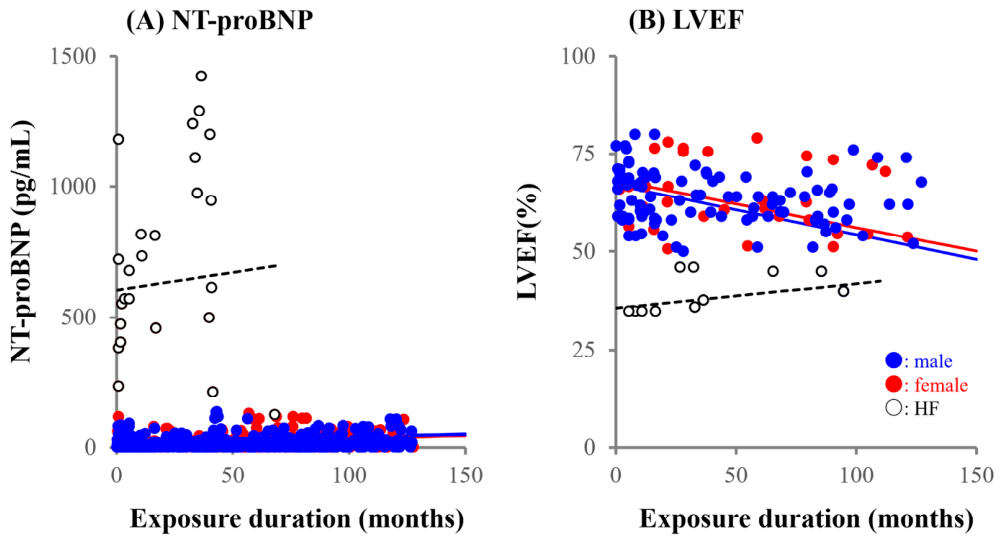
The database in Japan contained multiple time points of NT-proBNP, LVEF, and other laboratory data, allowing for fixed-effect analysis. Temporal impacts of clozapine exposure duration on NT-proBNP and LVEF were determined using LMM. Among all cases with and without cardiac functional abnormalities, significant relations between NT-proBNP/LVEF and clozapine exposure duration could not be detected (Figure 1). Among cases with HF (NT-proBNP > 125 pg/mL or LVEF < 50%) alone, relations between NT-proBNP/LVEF and clozapine exposure duration could also not be detected (Figure 1). However, among cases without HF (excluding cases with NT-proBNP > 125 or LVEF < 50), prolonged clozapine exposure duration related to increasing NT-proBNP levels and decreased LVEF (Figure 1). No sex-dependent differences were detected in the relations between clozapine exposure duration and NT-proBNP/LVEF. These results suggest the possibility that HF associated with clozapine has type B adverse reactions, but clozapine possibly has time-dependent cardiotoxicity, such as type A adverse reactions.

3.2.2. Impacts of Exposure Periods and Daily Dose of Clozapine on NT-proBNP and LVEF in Japan Using HLM

The relations between daily dose and exposure duration of clozapine and NT-proBNP and LVEF in cases of prescribed clozapine without HF (excluding cases with NT-proBNP > 125 and LVEF < 50) were analyzed using fixed effects of HLM with robust standard error. Among males + females, males, and females, both exposure duration and daily dose of clozapine alone positively related to NT-proBNP and negatively to LVEF (Table 3). These results were identical to the results using LMM. When these independent variables were combined, among males + females, males, and females, clozapine exposure duration was positively related to NT-proBNP and negatively related to LVEF, but significant relations between daily clozapine dose and NT-proBNP/LVEF could not be detected (Table 3). Therefore, these results suggest that exposure duration of clozapine is probably predominant factor for cardiac function compared to clozapine daily dose.

3.2.3. Impacts of Laboratory Data and Blood Cell Counts on NT-proBNP and LVEF in Japan Using HLM

The relations between laboratory examination data (eGFR, CPK, HbA1c, TG, HDL, and LDL) and blood cell counts (neutrophils, lymphocytes, monocytes, eosinophils, basophils, and platelets) and NT-proBNP and LVEF in cases of prescribed clozapine without HF (excluding cases with NT-proBNP > 125 and LVEF < 50) were also analyzed using fixed effects of HLM with robust standard error. From laboratory examination data required by the Clozaril Patient Monitoring Service, CPK, eGFR, and monocytes related to cardiac dysfunction (NT-proBNP and LVEF), whereas any other laboratory examination values did not significantly relate with NT-proBNP or LVEF (Table 4).

3.2.4. Impacts of Plasma Clozapine Levels on NT-proBNP and LVEF in Japan Using HLM with Robust Standard Error

The relations between plasma levels of clozapine and its metabolites and NT-proBNP and LVEF in cases of prescribed clozapine without HF (excluding cases with NT-proBNP > 125 and LVEF < 50) were also analyzed using fixed effects of HLM with robust standard error. Plasma clozapine levels alone positively related to NT-proBNP but not to LVEF in males + females, males, and females (Table 5). Considering the pronounced interindividual variability in clozapine clearance within the Japanese population [11], these discrepancies suggest that such pharmacokinetic heterogeneity in Japan possibly plays a major role in individual vulnerability to increasing NT-proBNP or cardiac dysfunction associated with long-term clozapine medication.

3.3. Random-Effects Analyses in Both Japanese and Chinese Cohorts

3.3.1. Impacts of Daily Dose and Exposure Duration of Clozapine, Monocytes, eGFR, and CPK on NT-proBNP and LVEF Using MRA

The data from China contained single points of NT-proBNP, LVEF, and other laboratory data in 2025 alone. Therefore, random-effect analyses were conducted using pooled data in both China and Japan in 2025. The effects of clozapine exposure duration, CPK, eGFR and monocytes, which were detected to have significant impacts on NT-proBNP and LVEF in Japanese cases by fixed-effects analyses, as well as clozapine daily dose, were determined using MRA. Among all the cases with and without abnormalities of NT-proBNP and LVEF, significant relations between any independent variables (clozapine exposure duration, clozapine daily dose, eGFR, CPK, and monocytes) to NT-proBNP could not be detected. In contrast, among groups without abnormalities (excluding cases with NT-proBNP > 125, BNP > 35, and LVEF < 50), NT-proBNP levels were positively related to clozapine exposure duration and monocytes in Japanese cases (males + females). In Chinese cases (males + females), NT-proBNP levels were positively related to clozapine exposure duration alone. Among all males (Japanese + Chinese) and females (Japanese + Chinese), NT-proBNP did not relate to any independent variables (Table 6). Significant relations between LVEF and five independent variables could not be detected (Table 6).

3.3.2. Impacts of Exposure Duration of Clozapine and Monocytes on NT-proBNP Using ANCOVA

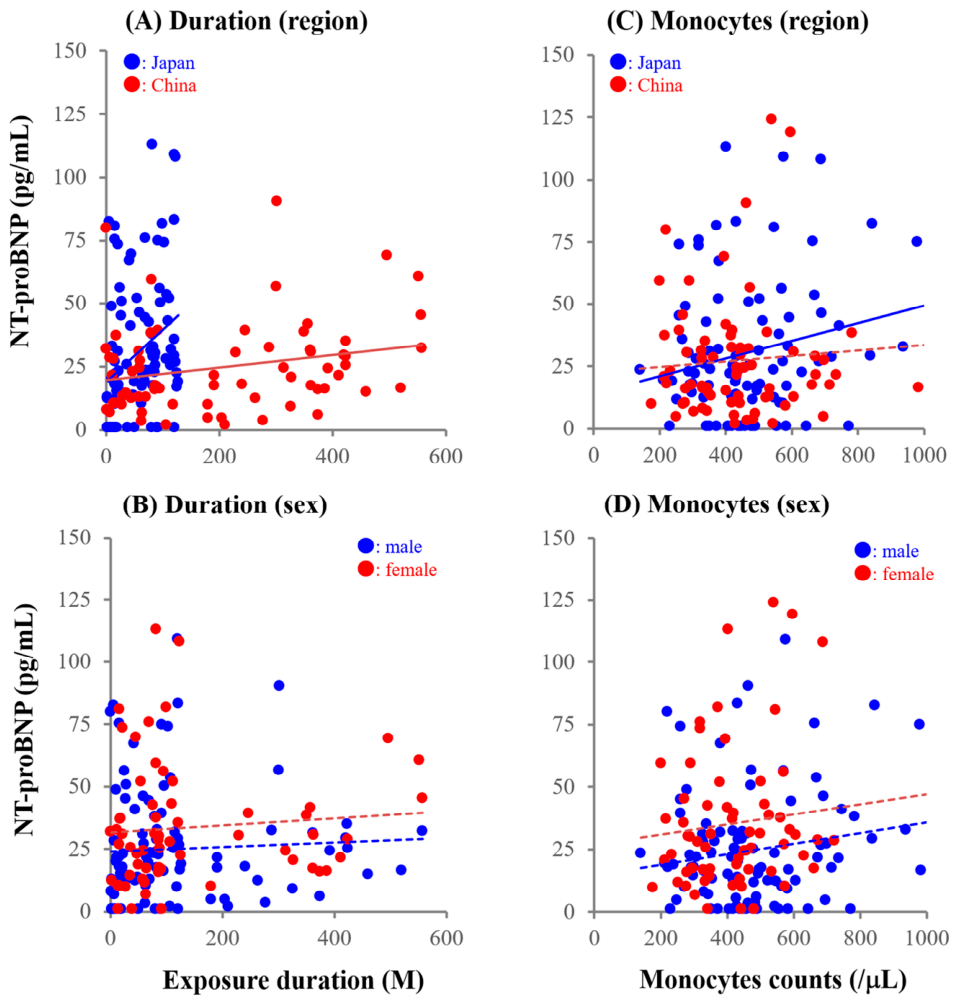
Interestingly, in above section, the significant relations between NT-proBNP and clozapine exposure duration could not be detected when China and Japan were pooled. These discrepancies may be due to confounding factors related to clinical different conditions between Japan and China, such as clozapine exposure duration (Table 1 and Table 2). Therefore, impacts of clozapine exposure duration and monocytes on NT-proBNP were determined using ANCOVA. Positive impacts of clozapine exposure duration on NT-proBNP in Japan (males + females) were greater than in China (males + females) (Figure 2). In an analysis including only cases with exposure duration less than 100 months, the difference between Japan and China in the positive trends of clozapine exposure duration on NT-proBNP could not be detected (Supplementary Figure S2). Significant impacts of exposure duration on NT-proBNP in males (Japanese + Chinese) and females (Japanese + Chinese) were not detected (Figure 2). In contrast, positive impacts of monocytes on NT-proBNP in Japan were detected, but these could not be detected in China (Figure 2). Both monocytes of males and females (Japanese + Chinese) were not related to NT-proBNP (Figure 2).

3.4. Impacts of Daily Dose and Exposure Duration of Clozapine on Monocytes

3.4.1. Fixed Effects of Exposure Duration and Daily Dose of Clozapine on Monocytes

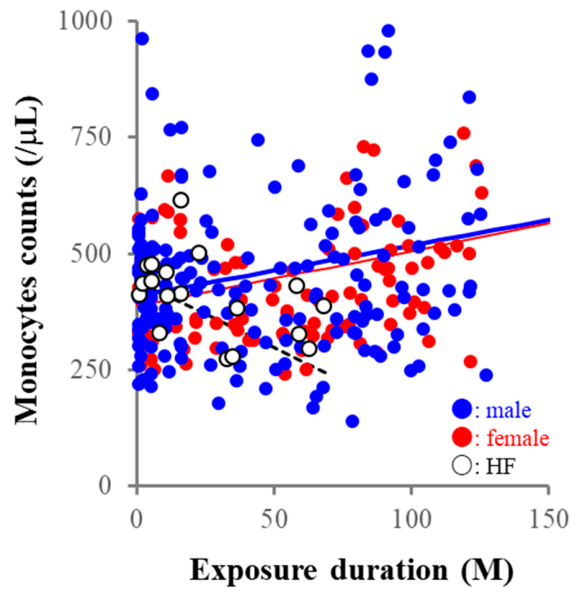
The results in the above sections suggest that clozapine exposure duration may increase NT-proBNP levels in cases of prescribed clozapine by increasing monocytes. Within the Japanese cohort without HF (males + females, males and females), LMM detected the positive fixed effects of exposure duration of clozapine on monocytes counts (Figure 3).
Furthermore, HLM with robust standard error also detected the positive fixed effects of plasma levels and exposure duration of clozapine on monocytes counts, but daily dose of clozapine did not relate to monocytes (Table 7).

3.4.2. Random Effects of Exposure Duration and Daily Dose of Clozapine on Monocytes

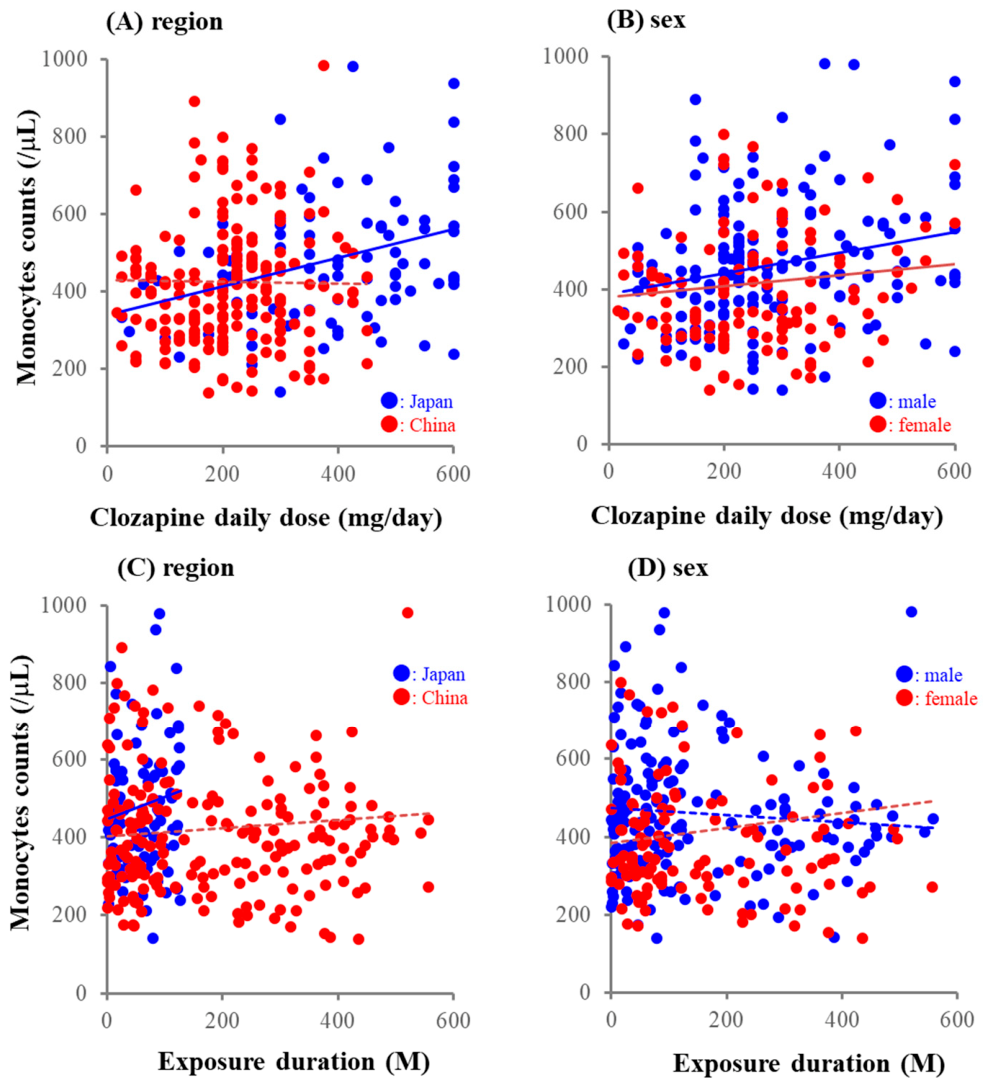
In contrast to fixed effects in Japanese cases, among cases combined Japanese and Chinese cohorts without HF, positive random effects of clozapine daily dose on monocytes were detected in Japan (males + females), males (Japanese + Chinese) and females (Japanese + Chinese), but not in China (males + females) by ANCOVA (Figure 4).
Positive random effect of clozapine exposure duration on monocytes were detected in Japan (males + females), but not in males (Japanese + Chinese), China (males + females), males (Japanese + Chinese) or females (Japanese + Chinese) by ANCOVA (Figure 4).
Similar to the results from ANCOVA, positive random effects of clozapine daily dose on monocytes were detected in all Japanese (males + females), as well as males (Japanese + Chinese) and females (Japanese + Chinese), but not for clozapine exposure duration by MRA (Table 8).

4. Discussion

This study revealed several important findings regarding the impacts of long-term clozapine administration on cardiac function in East Asian populations (including Japan and China). This study suggests the possibility that cardiotoxicities associated with clozapine exposure may not only comprise well-known acute myocarditis, occurring within weeks, and subacute cardiomyopathy, developing over several months, but also a third toxicity, in which cardiac dysfunction gradually progresses over several years (probably within one hundred months), ultimately manifesting to suggest HFpEF. Fixed- and random-effects analyses detected several risk factors for heart failure associated with clozapine, including prolonged exposure duration, higher plasma level of clozapine, and increasing monocytes. Importantly, over 70% of cases with heart failure associated with clozapine identified in this study did not have metabolic complications. Considering the facts that clozapine remains the sole effective antipsychotic for patients with treatment-resistant schizophrenia, patients with treatment-resistant schizophrenia must require long-term clozapine medication as their sole therapeutic option [1,2]. Therefore, our findings underscore the clinical importance for psychiatrists to maintain ongoing surveillance of cardiac function in patients who have already been receiving clozapine for extended periods to improve long-term prognosis of treatment-resistant schizophrenia with prescribed clozapine.

4.1. Clozapine and Cardiac Function

Clozapine-induced cardiotoxicity has a time-dependent characteristic, as the risk of clozapine-induced myocarditis is high for several months, with a subsequently increasing risk for clozapine-induced cardiomyopathy after initiation of clozapine intake [18,23,57,58]. Based on these clinical findings, LVEF monitoring using echocardiography has been considered important and useful diagnostic marker for cardiac dysfunction in cases of long-term clozapine exposure [18,59]. Indeed, although globally unified consensus regarding the diagnostic criteria for clozapine-induced cardiomyopathy has yet to be established, LVEF < 50% and decreasing LVEF of over 10% from baseline have nevertheless been adopted as diagnostic thresholds in various clinical studies [18,59]. However, this study elucidated that in cases with long-term clozapine medication, the majority of HF are suggestive of HFpEF, which is insensitive to detection with LVEF monitoring or asymptomatic HF. Therefore, compared to LVEF monitoring using echocardiography, NT-proBNP is considered a more sensitive and clinically useful biomarker for stage-B HF associated with clozapine.
Monitoring LVEF using echocardiography requires costly equipment and skilled sonographers and cardiologists to obtain reliable LVEF measurements. The technical and financial burden to monitoring LVEF can be substantial, since prescriptions of clozapine are typically only permitted for psychiatrists who are board-certified psychiatrists registered with the Clozaril Patient Monitoring Service in specialized psychiatric hospitals. In contrast, NT-proBNP is a simple blood test that avoids the various logistical burdens associated with echocardiography, making it a more feasible clinical tool for routine HF monitoring in psychiatric settings. Moreover, cases with asymptomatic HF or are suggestive of HFpEF identified in this study were partially complicated with poorly controlled diabetes, asymptomatic old myocardial infarction, and chronic renal dysfunction, which are well-known complications for clozapine medication. These facts further support the notion that NT-proBNP may serve as a valuable biomarker for comprehensive screening of cardiac dysfunction associated with long-term clozapine therapy. Therefore, the present findings emphasized the potential utility of NT-proBNP as a practical and sensitive indicator for detecting early cardiac impairment in patients receiving prolonged clozapine treatment.
The distinct pathophysiological bases between HFrEF and HFpEF are involved in their divergent preceding complications/comorbidities and subsequent inflammatory pathways [60,61,62,63]. HFrEF is typically preceded by the acute/chronic loss of cardiomyocytes induced typically by ischemia, genetic mutations, or myocarditis, whereas HFpEF is characteristically preceded by clusters of non-cardiac metabolic comorbidities, such as obesity, type 2 diabetes, and renal dysfunction [60,61,62,63]. These different triggers dictate the nature of the inflammatory response; in HFrEF, systemic and cardiac inflammation occur as a secondary reaction to cardiomyocyte damage and necrosis. In contrast, HFpEF posits that metabolic risk factors drive chronic, low-grade systemic inflammation, which acts as a primary mediator of early microvascular endothelial dysfunction and subsequent myocardial stiffening [60,61,62,63,64]. Considering the evidence that clozapine is a high-risk antipsychotic for metabolic complications [1,47,48,49,50], the hypothesis that long-term clozapine exposure contributes to the development of HFpEF via metabolic complications is easily plausible. However, it should be considered that causes of stage-B HF associated with clozapine possibly comprise not just clozapine-induced metabolic complications but also other pathophysiology, as clozapine itself possesses pharmacological targets that may directly or indirectly affect the pathophysiology of HFpEF since over 70% of the cases with asymptomatic HF identified in this study did not have metabolic complications.
In this study, positive relations in patients with long-term clozapine medication were observed among clozapine (exposure duration, plasma levels, and daily dose), NT-proBNP, and monocytes. Early inflammatory reactions following clozapine initiation frequently involve eosinophilic responses [65]. A recent multicenter cohort study demonstrated that eosinophilia occurred in approximately half of the patients who developed inflammatory adverse events during the titration phase, typically appearing shortly after the onset of fever or C-reactive protein elevation [65]. Hyperactivation of eosinophilic responses is also considered to play an important role in the pathophysiology of clozapine-induced myocarditis [57,66]. This temporal pattern suggests that eosinophilia may represent a component of the broader inflammatory cascade triggered by clozapine rather than an isolated hematologic abnormality [57,66]. Growing evidence suggests that clozapine-induced inflammatory reactions also involve coordinated activation of monocytic responses [67,68]. However, to our knowledge, both monocyte and eosinophil responses have been limited to observations within the first few weeks of clozapine administration, but there are no reports targeting the slow monocyte response observed several years or more after clozapine exposure, as identified in this study. Both clinical and preclinical studies reported that increasing counts and responses of monocytes are potentially involved in decreasing cardiac function in patients and animal models of HFpEF, suggesting that by maintaining and promoting chronic inflammation associated with monocytes, they play an important role in the pathomechanism of HFpEF as a driver of diastolic dysfunction [69,70,71]. A pharmacodynamic preclinical study reported that clozapine activated Src and decreased PP2A activities [26,27]. Activation of Src activity alone can force cells to differentiate into the monocytic lineage and attenuate pathway to neutrophils [72,73,74,75]. Additionally, decreased PP2A activity in monocytes plays important roles in foam cell formation and initiation of atherosclerosis via the p38/CD36 signaling complex [76]. Considering these preclinical and clinical findings, the results in this study demonstrate that the positive relations between monocytes and NT-proBNP could be, at least partially, involved in the pathophysiology of stage-B HF associated with clozapine as a potentially novel pathophysiology.
CYP enzyme activity plays a critical role in determining clozapine-induced cardiotoxicity risk. CYP1A2, the primary enzyme responsible for clozapine clearance via N-demethylation, reduces cardiotoxicity risk when active; reduced CYP1A2 activity—due to smoking cessation, CYP1A2-inhibiting comedications, or Asian ancestry—elevates plasma clozapine concentrations and increases myocarditis risk [77,78]. Conversely, CYP3A4 predominantly catalyzes clozapine N-oxidation, generating reactive oxygen species and nitrenium intermediates implicated in direct cardiotoxic bioactivation, particularly within cardiac mitochondria [79,80]. CYP2D6 contributes modestly to clozapine clearance; poor metabolizers may experience elevated plasma levels, yet CYP2D6 also catalyzes nitrenium formation, making its net cardiotoxic contribution bidirectional [79,81]. Therapeutic drug monitoring guided by individual CYP phenotype therefore represents a rational strategy for minimizing clozapine cardiotoxicity [78]. In this study, only two patients in the Chinese cohort were prescribed propranolol, which is metabolized by CYP1A2, CYP2C19, and CYP2D6 [77,78], as concomitant medications, but their cardiac function remained within normal limits. In contrast, in the Japanese cohort, a number of concomitant medications, the majority of which are metabolized by CYP3A4 but not by CYP1A2, possibly contributed in suppressing rather than increasing cardiotoxicity [79,80].
Based on these pharmacokinetic findings, application of internationally clozapine titration protocol to Japanese population has recently been concerned and considered to be risk for myocarditis associated with clozapine exposure, since clozapine clearance in East Asians is lower than other regions [11,17,82]. Indeed, in Japan, the initial titration protocol is strictly regulated by the Pharmaceuticals and Medical Devices Agency (PMDA). According to the official prescribing information, clozapine is initiated at 12.5 mg on day 1, followed by 25 mg once daily on day 2. From day 3 onward, the dose may be increased by 25 mg per day, depending on clinical response, with the general recommendation to titrate up to 200 mg/day over approximately three weeks. When the daily dose exceeds 50 mg, it should be administered in two or three divided doses. The recommended maintenance dose ranges from 200 to 400 mg/day, given in two or three divided doses, with adjustments made according to symptom severity and tolerability. Importantly, each dose increase must be separated by at least four days, and the increment should not exceed 100 mg/day. The maximum permitted daily dose under Japanese regulations is 600 mg/day. In contrast, although clozapine prescriptions in China allow greater clinical discretion for the treating psychiatrist, the titration schedule itself is generally faster than that mandated in Japan. Indeed, the standard initial titration protocol in China is that clozapine is initiated at 12.5–25 mg daily, with gradual escalation to 100–300 mg daily within 1–2 weeks, up to a maximum of 600 mg daily. This indicates that Chinese patients typically reach 100–300 mg/day within the first 1–2 weeks, which represents a more rapid escalation compared with the strictly regulated Japanese PMDA protocol, which recommends titration to 200 mg/day over approximately three weeks. Therefore, titration method in the initial stages of clozapine administration may not be involved in the pathomechanisms of stage-B HF associated with clozapine. Instead, impacts of plasma levels and exposure duration of clozapine plays important roles in the pathomechanisms of stage-B HF associated with clozapine. In spite of shorter exposure duration in Japan than in China, there was no difference in the prevalence of HF between the two countries. This is probably explainable by the higher clozapine daily dose in Japan compared to China, and the results that the impacts of exposure duration on HF may be more pronounced in exposure periods within 100 months, as suggested by the results of this study. Furthermore, inter-individual variability in CYP1A2 and CYP2D6 activity, partly determined by genetic polymorphisms, may modulate cardiotoxicity severity by altering plasma clozapine levels. Although direct evidence linking these polymorphisms to cardiac outcomes remains limited, reduced CYP1A2 activity variants (*1C/*1D) have been associated with elevated clozapine concentrations and metabolic complications, suggesting that pharmacogenetic profiling may help identify patients at higher risk of clozapine associated cardiac dysfunction [79,81,83,84].
This study succeeded in demonstrating the high risk of asymptomatic HF, including HF suggestive of HFpEF, as a novel potential concern in long-term clozapine administration. However, there are several limitations in this study that warrant mentioning. This study was observational in a small cohort and it cannot be ignored as that it may be probably subject to ecological fallacy. The prevalence of cardiomyopathy and HF associated with clozapine are subject to confounding, as information on potential confounder(s) may not be available and associations at the population level do not necessarily represent associations at the individual level (ecological fallacy). Indeed, the potential pathophysiology of stage-B HF associated with clozapine had a greater impact by fixed-effects analyses compared to random-effects analyses. Data from Chinese cases was limited to one single period in 2025. Further data collection over multiple periods in Chinese cases, considering the impacts of various confounding factors between Japan and China, could lead to a more detailed and accurate understanding regarding HF associated with long-term clozapine medication. Among asymptomatic HF cases, few cases (less than 50%) measured both NT-proBNP and LVEF. Clarifying whether HF associated with clozapine manifests predominantly as suggestive of HFpEF or HFrEF could possibly contribute to the development of a more rigorous and clinically meaningful pathophysiological framework. This study successfully revealed the possibility that long-term clozapine monotherapy is a potential risk factor for heart failure. However, identifying the relationship between clozapine’s clinical efficacy and its risk of cardiotoxicity is both clinically and pathophysiologically important; therefore, further studies are needed.

4.2. Limitations

This study successfully identified stage-B or more severe heart failure risk and its associated biomarkers in patients prescribed clozapine monotherapy in Japan (15 years) and China (45 years). The comparison between Japanese and Chinese cohorts itself contributed to clinically valuable findings in psychiatric medicine; however, this study has several limitations. While this study attempted to compare heart failure risk between the general population and patients with long-term clozapine medication, the influence of confounding factors could not be fully excluded. Patients with treatment-resistant schizophrenia may differ substantially from the general population in numerous respects, including smoking habits, obesity, hypertension, physical activity levels, and access to medical care. Further studies comparing clozapine-treated patients with clozapine-naive schizophrenic patients can improve the precision of heart failure risk estimates attributable to clozapine itself. Furthermore, a comparison of clozapine discontinuation rates and their underlying causes between the Japanese (15 year) and Chinese (45 year) cohorts may provide additional clinically important insights in psychiatric medicine.

5. Conclusions

This study revealed that the risk of asymptomatic HF in cases of long-term prescribed clozapine (57.5 ± 4.0 months in Japan and 208.1 ± 11.0 months in China) had approximately 3- and 6-folds higher odds in both Japan and China, respectively. Asymptomatic HF due to long-term clozapine exposure was both time dependent and concentration dependent, and the fixed effect of clozapine was more sensitive than the random effect. Therefore, it is highly likely that asymptomatic HF can be adequately predicted in routine clinical practice through regular NT-proBNP monitoring. Given that patients on long-term prescribed clozapine are resistant to other conventional antipsychotics and have few alternative treatment options, psychiatrists can contribute to improving the long-term prognosis of patients with treatment-resistant schizophrenia by adding regular NT-proBNP monitoring to conventional psychiatric symptom assessment.

Supplementary Materials

The following supporting information can be downloaded at: https://www.mdpi.com/article/10.3390/medsci14020306/s1. Supplementary Table S1: List of concomitant non-antipsychotic medications. Supplementary Figure S1: Flow diagram of study cohort. Supplementary Table S2: Cases indicating abnormalities of NT-proBNP, BNP or LVEF. Supplementary Figure S2: Impacts of clozapine exposure duration within 100 months on NT-proBNP in Japan and China.

Author Contributions

M.O., E.M. and M.M. conceptualized the study. M.O. took principal responsibility for the study, including project management, manuscript submission, and revision. N.Y., K.D. and G.Z. supervised. M.O., X.S., T.O. (Toshiaki Onitsuka), J.X., C.L., R.K., T.K. and T.O. (Taku Omori) advised on ICD-10 codes used to identify schizophrenia, cardiomyopathy, and heart failure. R.O., E.M. and M.O. advised on epidemiological and statistical analysis. M.O. and R.O. retrieved, verified, and curated study data. T.O. (Tomoka Oka), Y.I., N.Y. and M.O. conducted epidemiological and statistical analyses. R.O., R.K. and M.O. visualized findings and wrote the original manuscript and Supplementary Materials. All authors contributed to the review and editing of the final manuscript. R.O., N.Y., X.S., T.O. (Tomoka Oka), J.X., C.L., R.K., M.M., E.M., T.K., G.Z. and M.O. contributed to data collection. M.O. drafted the report with all authors critically reviewing the paper. All authors reviewed and approved the final report. Each author contributed important intellectual content during drafting or revision of the manuscript and accepts accountability for the overall work, ensuring that questions pertaining to the accuracy or integrity of any portion of the work are appropriately investigated and resolved. The corresponding authors have attested that all the listed authors meet the authorship criteria and that no others meeting the criteria have been omitted. M.O., G.Z., R.O. and N.Y. have verified the data and have access to the raw data. M.O. had final responsibility for the decision to submit for publication, and all authors were deeply involved in the manuscript drafting and revision process, including substantive discussion, critical feedback, and repeated rounds of text editing. All authors have read and agreed to the published version of the manuscript.

Funding

This study was supported by the Japan Society for the Promotion of Science (19K08073) and the Major Project of the Department of Science and Technology of Liaoning Province (2024JH2/102600305).

Institutional Review Board Statement

The requirement for obtaining individual informed consent was waived by the Clinical Research Ethics Review Committee of Mie University Hospital (approval no. H2022-200, 27 October 2022) and the Ethics Committee of the First Affiliated Hospital of China Medical University (approval no. 2024-1040, 20 November 2024), as the study used existing clinical data and posed minimal risk to the participants. The study information was publicly disclosed in accordance with the national guidelines of Japan and China, and patients were given the opportunity to opt out.

Informed Consent Statement

The requirement for obtaining individual informed consent was waived because the study used existing clinical data and posed minimal risk to the participants. The study information was publicly disclosed in accordance with the national guidelines of Japan and China, and patients were given the opportunity to opt out.

Data Availability Statement

The original contributions presented in this study are included in the article/Supplementary Materials. Further inquiries can be directed to Prof Motohiro Okada.

Conflicts of Interest

The authors declare no conflicts of interest.

Abbreviations

The following abbreviations are used in this manuscript:
BNPBrain natriuretic peptide
CNOClozapine-N-oxide
DMCDesmethyl-clozapine
EFEjection fraction
eGFREstimated glomerular filtration rate
HFHeart failure
HFpEFHeart failure with preserved ejection fraction
HFrEFHeart failure with reduced ejection fraction
HLMHierarchical linear regression model with robust standard error
LMMLinear mixed model for repeated measures
LVEFLeft ventricular ejection fraction
MRAMultiple regression analysis
PP2AProtein phosphatase 2A

References

  1. Okada, M.; Fukuyama, K.; Shiroyama, T.; Murata, M. A Working Hypothesis Regarding Identical Pathomechanisms between Clinical Efficacy and Adverse Reaction of Clozapine via the Activation of Connexin43. Int. J. Mol. Sci. 2020, 21, 7019. [Google Scholar] [CrossRef]
  2. Luykx, J.J.; Gonzalez-Diaz, J.M.; Guu, T.W.; van der Horst, M.Z.; van Dellen, E.; Boks, M.P.; Guloksuz, S.; DeLisi, L.E.; Sommer, I.E.; Cummins, R.; et al. An International Research Agenda for Clozapine-Resistant Schizophrenia. Lancet Psychiatry 2023, 10, 644–652. [Google Scholar] [CrossRef]
  3. Howes, O.D.; McCutcheon, R.; Agid, O.; de Bartolomeis, A.; van Beveren, N.J.; Birnbaum, M.L.; Bloomfield, M.A.; Bressan, R.A.; Buchanan, R.W.; Carpenter, W.T.; et al. Treatment-Resistant Schizophrenia: Treatment Response and Resistance in Psychosis (TRRIP) Working Group Consensus Guidelines on Diagnosis and Terminology. Am. J. Psychiatry 2017, 174, 216–229. [Google Scholar] [CrossRef]
  4. Dong, S.; Schneider-Thoma, J.; Bighelli, I.; Siafis, S.; Wang, D.; Burschinski, A.; Schestag, K.; Samara, M.; Leucht, S. A network meta-analysis of efficacy, acceptability, and tolerability of antipsychotics in treatment-resistant schizophrenia. Eur. Arch. Psychiatry Clin. Neurosci. 2024, 274, 917–928. [Google Scholar] [CrossRef] [PubMed]
  5. Li, X.H.; Zhong, X.M.; Lu, L.; Zheng, W.; Wang, S.B.; Rao, W.W.; Wang, S.; Ng, C.H.; Ungvari, G.S.; Wang, G.; et al. The prevalence of agranulocytosis and related death in clozapine-treated patients: A comprehensive meta-analysis of observational studies. Psychol. Med. 2020, 50, 583–594. [Google Scholar] [CrossRef]
  6. Myles, N.; Myles, H.; Xia, S.; Large, M.; Kisely, S.; Galletly, C.; Bird, R.; Siskind, D. Meta-analysis examining the epidemiology of clozapine-associated neutropenia. Acta Psychiatr. Scand. 2018, 138, 101–109. [Google Scholar] [CrossRef]
  7. De Leon, J.; Sanz, E.J.; De Las Cuevas, C. Data from the World Health Organization’s Pharmacovigilance Database Supports the Prominent Role of Pneumonia in Mortality Associated with Clozapine Adverse Drug Reactions. Schizophr. Bull. 2020, 46, 1–3. [Google Scholar] [CrossRef]
  8. De Las Cuevas, C.; Sanz, E.J.; de Leon, J. Fatal Outcomes in Use of Clozapine: A VigiBase Study of 6402 Women and 11,222 Men. J. Clin. Psychopharmacol. 2025, 45, 547–553. [Google Scholar] [CrossRef]
  9. De Las Cuevas, C.; Sanz, E.J.; de Leon, J. Pharmacovigilance in Action: Utilizing VigiBase Data to Improve Clozapine Safety. Patient Prefer. Adherence 2024, 18, 2261–2280. [Google Scholar] [CrossRef] [PubMed]
  10. De Las Cuevas, C.; Sanz, E.J.; de Leon, J. Clozapine-treated patients and myocardial infarction in adults: A pharmacovigilance study in VigiBase interpreted in the context of the literature. Expert Opin. Drug Saf. 2026; in press. [CrossRef]
  11. de Leon, J.; Tandon, R. The clozapine package inserts need to reflect lower doses for Asians. Asian J. Psychiatr. 2025, 110, 104622. [Google Scholar] [CrossRef]
  12. Molden, E. Personalized dosing of clozapine stratified by patients’ ancestry—International consensus guidelines. Nord. J. Psychiatry 2023, 77, 1–2. [Google Scholar] [CrossRef]
  13. Ding, J.; Liu, J.; Zhang, Y.; Xing, H.; Zhang, Y.; Li, L.; Zhang, S.; Wang, H.; Yang, L.; Cui, X. A retrospective study of clozapine and norclozapine concentration in patients with schizophrenia: Data from the Therapeutic Drug Monitoring Service, 2019–2022. Asian J. Psychiatry 2024, 91, 103865. [Google Scholar] [CrossRef]
  14. Grover, S.; Kathiravan, S.; Dua, D. Delirium Research in India: A Systematic Review. J. Neurosci. Rural Pract. 2021, 12, 236–266. [Google Scholar] [CrossRef] [PubMed]
  15. Kitagawa, K.; Uekusa, S.; Hanai, Y.; Kimura, I.; Tsukahara, M.; Kagawa, A.; Sasaoka, K.; Sakishiro, Y.; Miyake, A.; Watanabe, Y.; et al. Changes in psychopharmacotherapy for patients with schizophrenia in a psychiatric institution in Japan: A 12-year prescription survey pre- and post-introduction of clozapine. Asian J. Psychiatry 2024, 96, 104047. [Google Scholar] [CrossRef]
  16. Kikuchi, Y.; Ataka, K.; Yagisawa, K.; Omori, Y.; Shimizu, K.; Kanbayashi, T.; Shimizu, T. Clozapine-induced cardiomyopathy: A first case in Japan. Schizophr. Res. 2013, 150, 586–587. [Google Scholar] [CrossRef]
  17. Kikuchi, Y.; Onodera, B.; Komatsu, H.; Tomita, H. Ethnicity-Based Personalized Clozapine Titration Strategies for Prevention of Clozapine-Induced Inflammation: Recommendations Based on Evidence from the Japanese Population. CNS Drugs 2026, 40, 181–197. [Google Scholar] [CrossRef]
  18. Siskind, D.; Sidhu, A.; Cross, J.; Chua, Y.T.; Myles, N.; Cohen, D.; Kisely, S. Systematic review and meta-analysis of rates of clozapine-associated myocarditis and cardiomyopathy. Aust. N. Z. J. Psychiatry 2020, 54, 467–481. [Google Scholar] [CrossRef]
  19. Patel, R.K.; Moore, A.M.; Piper, S.; Sweeney, M.; Whiskey, E.; Cole, G.; Shergill, S.S.; Plymen, C.M. Clozapine and cardiotoxicity—A guide for psychiatrists written by cardiologists. Psychiatry Res. 2019, 282, 112491. [Google Scholar] [CrossRef] [PubMed]
  20. Imazu, S.; Hata, T.; Toyoda, K.; Kubo, Y.; Yamauchi, S.; Kinoshita, S.; Nishihara, M.; Inada, K.; Kanazawa, T. Safety profile of clozapine: Analysis using national registry data in Japan. J. Psychiatr. Res. 2021, 141, 116–123. [Google Scholar] [CrossRef] [PubMed]
  21. Ito, Y.; Murata, M.; Taku, O.; Fukuyama, K.; Motomura, E.; Dohi, K.; Okada, M. Developed catatonia with rhabdomyolysis and exacerbated cardiac failure upon switching from clozapine to olanzapine owing to cardiomyopathy during clozapine medication—A case report. Asian J. Psychiatry 2023, 80, 103376. [Google Scholar] [CrossRef]
  22. Ito, Y.; Yamamoto, N.; Nakagawa, T.; Kato, R.; Murata, M.; Onitsuka, T.; Omori, T.; Kitano, T.; Motomura, E.; Dohi, K.; et al. Case Report: Successful rechallenge with clozapine after clozapine-induced cardiomyopathy in a patient with treatment-resistant schizophrenia. Asian J. Psychiatry 2026, 119, 104948. [Google Scholar] [CrossRef]
  23. Wagner, E.; Korman, N.; Solmi, M.; Mortazavi, M.; Aminifarsani, Z.; Dubrovin Leao, D.; Burrage, M.K.; Siskind, D.; McMahon, L.; Howes, O.D.; et al. Multidisciplinary consensus on prevention, screening and monitoring of clozapine-associated myocarditis and clozapine rechallenge after myocarditis. Br. J. Psychiatry 2025, 228, 348–356. [Google Scholar] [CrossRef] [PubMed]
  24. Bellissima, B.L.; Vara, A.; Helsby, N.; Garavan, F.; Tingle, M.D. Incidence and investigation of potential risk-factors for clozapine-associated myocarditis and cardiomyopathy in a New Zealand cohort. Psychiatry Res. 2021, 299, 113873. [Google Scholar] [CrossRef]
  25. Toyoda, K.; Hata, T.; Yamauchi, S.; Kinoshita, S.; Nishihara, M.; Uchiyama, K.; Inada, K.; Kanazawa, T. A descriptive study of 10-year clozapine use from the nationwide database in Japan. Psychiatry Res. 2021, 297, 113764. [Google Scholar] [CrossRef] [PubMed]
  26. Okada, M.; Fukuyama, K.; Motomura, E. Impacts of exposure to and subsequent discontinuation of clozapine on tripartite synaptic transmission. Br. J. Pharmacol. 2024, 181, 4571–4592. [Google Scholar] [CrossRef] [PubMed]
  27. Okada, M.; Okubo, R.; Motomura, E. Exploring the pathophysiology underlying clozapine-induced enhancement of glutamatergic transmission through L-glutamate and D-serine release associated with pannexin1 hemichannels. Br. J. Pharmacol. 2025, 182, 4710–4728. [Google Scholar] [CrossRef]
  28. Lin, F.; Liang, X.; Meng, Y.; Zhu, Y.; Li, C.; Zhou, X.; Hu, S.; Yi, N.; Lin, Q.; He, S.; et al. Unmasking Protein Phosphatase 2A Regulatory Subunit B as a Crucial Factor in the Progression of Dilated Cardiomyopathy. Biomedicines 2024, 12, 1887. [Google Scholar] [CrossRef]
  29. Gigli, M.; Stolfo, D.; Merlo, M.; Sinagra, G.; Taylor, M.R.G.; Mestroni, L. Pathophysiology of dilated cardiomyopathy: From mechanisms to precision medicine. Nat. Rev. Cardiol. 2025, 22, 183–198. [Google Scholar] [CrossRef]
  30. Li, W.; Zhu, Y.; Wang, W.; He, D.; Feng, L.; Li, Z. Src tyrosine kinase promotes cardiac remodeling induced by chronic sympathetic activation. Biosci. Rep. 2023, 43, BSR20231097. [Google Scholar] [CrossRef]
  31. Hussain, M.; Ikram, W.; Ikram, U. Role of c-Src and reactive oxygen species in cardiovascular diseases. Mol. Genet. Genom. 2023, 298, 315–328. [Google Scholar] [CrossRef]
  32. Zhai, Y.; Yang, J.; Zhang, J.; Yang, J.; Li, Q.; Zheng, T. Src-family Protein Tyrosine Kinases: A promising target for treating Cardiovascular Diseases. Int. J. Med. Sci. 2021, 18, 1216–1224. [Google Scholar] [CrossRef]
  33. Elmadani, M.; Raatikainen, S.; Mattila, O.; Alakoski, T.; Piuhola, J.; Astrom, P.; Tenhunen, O.; Magga, J.; Kerkela, R. Dasatinib targets c-Src kinase in cardiotoxicity. Toxicol. Rep. 2023, 10, 521–528. [Google Scholar] [CrossRef]
  34. Chu, T.F.; Rupnick, M.A.; Kerkela, R.; Dallabrida, S.M.; Zurakowski, D.; Nguyen, L.; Woulfe, K.; Pravda, E.; Cassiola, F.; Desai, J.; et al. Cardiotoxicity associated with tyrosine kinase inhibitor sunitinib. Lancet 2007, 370, 2011–2019. [Google Scholar] [CrossRef]
  35. Vickers, M.; Ramineni, V.; Malacova, E.; Eriksson, L.; McMahon, K.; Moudgil, V.; Scott, J.; Siskind, D. Risk factors for clozapine-induced myocarditis and cardiomyopathy: A systematic review and meta-analysis. Acta Psychiatr. Scand. 2022, 145, 442–455. [Google Scholar] [CrossRef]
  36. McCutcheon, R.A.; Pillinger, T.; Varvari, I.; Halstead, S.; Ayinde, O.O.; Crossley, N.A.; Correll, C.U.; Hahn, M.; Howes, O.D.; Kane, J.M.; et al. INTEGRATE: International guidelines for the algorithmic treatment of schizophrenia. Lancet Psychiatry 2025, 12, 384–394. [Google Scholar] [CrossRef]
  37. Goff, D.C. The Pharmacologic Treatment of Schizophrenia-2021. JAMA 2021, 325, 175–176. [Google Scholar] [CrossRef] [PubMed]
  38. Savarese, G.; Becher, P.M.; Lund, L.H.; Seferovic, P.; Rosano, G.M.C.; Coats, A.J.S. Global burden of heart failure: A comprehensive and updated review of epidemiology. Cardiovasc. Res. 2023, 118, 3272–3287. [Google Scholar] [CrossRef] [PubMed]
  39. Kitai, T.; Kohsaka, S.; Kato, T.; Kato, E.; Sato, K.; Teramoto, K.; Yaku, H.; Akiyama, E.; Ando, M.; Izumi, C.; et al. JCS/JHFS 2025 Guideline on Diagnosis and Treatment of Heart Failure. J. Card. Fail. 2025, 31, 1164–1322. [Google Scholar] [CrossRef]
  40. Zhang, L.; Ono, Y.; Qiao, Q.; Nagai, T. Trends in heart failure prevalence in Japan 2014-2019: A report from healthcare administration databases. ESC Heart Fail. 2023, 10, 1996–2009. [Google Scholar] [CrossRef] [PubMed]
  41. Wang, H.; Chai, K.; Du, M.; Wang, S.; Cai, J.P.; Li, Y.; Zeng, P.; Zhu, W.; Zhan, S.; Yang, J. Prevalence and Incidence of Heart Failure Among Urban Patients in China: A National Population-Based Analysis. Circ. Heart Fail. 2021, 14, e008406. [Google Scholar] [CrossRef] [PubMed]
  42. Shiba, N.; Nochioka, K.; Miura, M.; Kohno, H.; Shimokawa, H. CHART-2 Investigators Trend of westernization of etiology and clinical characteristics of heart failure patients in Japan—First report from the CHART-2 study. Circ. J. 2011, 75, 823–833. [Google Scholar] [CrossRef]
  43. Capone, F.; Haseli, S.P.; Liu, L.; Strocchi, S.; Langenberg, C.; Lusis, A.J.; Pietzner, M.; Muoio, D.M.; Rider, O.J.; Raman, B.; et al. HFpEF and MASLD: Converging mechanisms and clinical implications. Nat. Rev. Cardiol. 2026, in press. [Google Scholar] [CrossRef]
  44. Brar, A.S.; Khanna, T.; Sohal, A.; Hatwal, J.; Sharma, V.; Singh, C.; Batta, A.; Chandra, P.; Mohan, B. Metabolic dysfunction-associated steatotic liver disease and heart failure with preserved ejection fraction: A state-of-the-art review. World J. Cardiol. 2026, 18, 111954. [Google Scholar] [CrossRef]
  45. Leite, A.R.; Dias, J.; Godinho, T.; Correia-Chaves, J.; Borges-Canha, M.; Lourenço, I.M.; Leite-Moreira, A.; Neves, J.S. Metabolic Dysfunction-Associated Steatotic Liver Disease and Heart Failure with Preserved Ejection Fraction: A Bidirectional Relationship with Clinical and Therapeutic Implications. Endocrinol. Insights 2024, 20, 12–28. [Google Scholar] [CrossRef]
  46. Gatto, C.; Rusciano, M.R.; Visco, V.; Vecchione, C.; Ciccarelli, M. Pathophysiology of HFpEF: Insights from a Metabolic-Mitochondrial Perspective. Int. J. Mol. Sci. 2025, 27, 284. [Google Scholar] [CrossRef]
  47. Bernardo, M.; Rico-Villademoros, F.; Garcia-Rizo, C.; Rojo, R.; Gomez-Huelgas, R. Real-World Data on the Adverse Metabolic Effects of Second-Generation Antipsychotics and Their Potential Determinants in Adult Patients: A Systematic Review of Population-Based Studies. Adv. Ther. 2021, 38, 2491–2512. [Google Scholar] [CrossRef] [PubMed]
  48. Piras, M.; Chahma, J.; Ranjbar, S.; Laaboub, N.; Grosu, C.; Plessen, K.J.; von Gunten, A.; Conus, P.; Eap, C.B. Is Clozapine-induced Weight Gain Dose-dependent? Results From a Prospective Cohort Study. Schizophr. Bull. 2023, 49, 944–952. [Google Scholar] [CrossRef]
  49. Fehsel, K. Metabolic Side Effects from Antipsychotic Treatment with Clozapine Linked to Aryl Hydrocarbon Receptor (AhR) Activation. Biomedicines 2024, 12, 2294. [Google Scholar] [CrossRef] [PubMed]
  50. Yuen, J.W.Y.; Kim, D.D.; Procyshyn, R.M.; Panenka, W.J.; Honer, W.G.; Barr, A.M. A Focused Review of the Metabolic Side-Effects of Clozapine. Front. Endocrinol. 2021, 12, 609240. [Google Scholar] [CrossRef]
  51. Tang, Y.L.; Mao, P.X.; Jiang, F.; Chen, Q.; Wang, C.Y.; Cai, Z.J.; Mitchell, P.B. Clozapine in China. Pharmacopsychiatry 2008, 41, 1–9. [Google Scholar] [CrossRef]
  52. Ahmad, O.B.; Boschi-Pinto, C.; Lopez, A.D.; Murray, C.J.; Lozano, R.; Inoue, M. Age standardization of rates: A new WHO standard. In GPE Discussion Paper Series: No.31; World Health Organization: Geneva, Switzerland, 2001; Volume 9. [Google Scholar]
  53. Okada, M.; Matsumoto, R.; Motomura, E.; Shiroyama, T.; Murata, M. Exploring characteristics of increased suicide during the COVID-19 pandemic in Japan using provisional governmental data. Lancet Reg. Health West. Pac. 2022, 24, 100481. [Google Scholar] [CrossRef]
  54. Okada, M.; Matsumoto, R.; Shiroyama, T.; Motomura, E. Suicidal Mortality and Motives Among Middle-School, High-School, and University Students. JAMA Netw. Open 2023, 6, e2328144. [Google Scholar] [CrossRef]
  55. McDade, E.; Cummings, J.L.; Dhadda, S.; Swanson, C.J.; Reyderman, L.; Kanekiyo, M.; Koyama, A.; Irizarry, M.; Kramer, L.D.; Bateman, R.J. Lecanemab in patients with early Alzheimer’s disease: Detailed results on biomarker, cognitive, and clinical effects from the randomized and open-label extension of the phase 2 proof-of-concept study. Alzheimer’s Res. Ther. 2022, 14, 191. [Google Scholar] [CrossRef] [PubMed]
  56. Yoshimoto, K.; Echizen, H.; Chiba, K.; Tani, M.; Ishizaki, T. Identification of human CYP isoforms involved in the metabolism of propranolol enantiomers--N-desisopropylation is mediated mainly by CYP1A2. Br. J. Clin. Pharmacol. 1995, 39, 421–431. [Google Scholar] [CrossRef] [PubMed]
  57. Bellissima, B.L.; Tingle, M.D.; Cicovic, A.; Alawami, M.; Kenedi, C. A systematic review of clozapine-induced myocarditis. Int. J. Cardiol. 2018, 259, 122–129. [Google Scholar] [CrossRef]
  58. Paffoni, P.; Maffè, S.; Bergamasco, L.; Facchini, E.; Ticozzi, S.; Prenna, E.; Anchisi, C.; Paino, A.; Ariotti, S.; Dellavesa, P. Clozapine Induced Cardiomyopathy. Eur. Heart J. Suppl. 2025, 27, suaf076.225. [Google Scholar] [CrossRef]
  59. Youssef, D.L.; Narayanan, P.; Gill, N. Incidence and risk factors for clozapine-induced myocarditis and cardiomyopathy at a regional mental health service in Australia. Australas. Psychiatry 2016, 24, 176–180. [Google Scholar] [CrossRef] [PubMed]
  60. Mishra, S.; Kass, D.A. Cellular and molecular pathobiology of heart failure with preserved ejection fraction. Nat. Rev. Cardiol. 2021, 18, 400–423. [Google Scholar] [CrossRef]
  61. Pozzi, A.; Spoladore, R.; Iorio, A.; Corrado, G.; D’Amario, D. Heart failure with preserved ejection fraction, from pathophysiology to technology tools aim improve patients’ management. Heart Fail. Rev. 2025, 31, 3. [Google Scholar] [CrossRef]
  62. Fayyaz, A.U.; Eltony, M.; Prokop, L.J.; Koepp, K.E.; Borlaug, B.A.; Dasari, S.; Bois, M.C.; Margulies, K.B.; Maleszewski, J.J.; Wang, Y.; et al. Pathophysiological insights into HFpEF from studies of human cardiac tissue. Nat. Rev. Cardiol. 2025, 22, 90–104. [Google Scholar] [CrossRef]
  63. Youn, J.C.; Ahn, Y.; Jung, H.O. Pathophysiology of Heart Failure with Preserved Ejection Fraction. Heart Fail. Clin. 2021, 17, 327–335. [Google Scholar] [CrossRef]
  64. Simmonds, S.J.; Cuijpers, I.; Heymans, S.; Jones, E.A.V. Cellular and Molecular Differences between HFpEF and HFrEF: A Step Ahead in an Improved Pathological Understanding. Cells 2020, 9, 242. [Google Scholar] [CrossRef]
  65. Kikuchi, Y.; Otsuka, Y.; Ito, F.; Yada, Y.; Tanifuji, H.; Komatsu, H.; Tomita, H. Relationship Between Clozapine-Induced Inflammation and Eosinophilia: A Retrospective Cohort Study. Schizophr. Bull. 2026, 52, sbae213. [Google Scholar] [CrossRef]
  66. Halawa, N.; Armstrong, M.; Fancy, S.; Abidi, S. Clozapine-induced myocarditis and subsequent rechallenge: A narrative literature review and case report. J. Can. Acad. Child. Adolesc. Psychiatry 2023, 32, e252–e263. [Google Scholar]
  67. Sernoskie, S.C.; Lobach, A.R.; Kato, R.; Jee, A.; Weston, J.K.; Uetrecht, J. Clozapine Induces an Acute Proinflammatory Response That Is Attenuated by Inhibition of Inflammasome Signaling: Implications for Idiosyncratic Drug-Induced Agranulocytosis. Toxicol. Sci. 2022, 186, 70–82. [Google Scholar] [CrossRef]
  68. Leung, J.G.; Zhang, L.; Markota, M.; Ellingrod, V.L.; Gerberi, D.J.; Bishop, J.R. A systematic review of clozapine-associated inflammation and related monitoring. Pharmacotherapy 2023, 43, 1364–1396. [Google Scholar] [CrossRef]
  69. Kessler, E.L.; Dal Canto, E.; Diez-Benavente, E.; van Ommen, A.M.; Kapteijn, D.; Glade, M.C.; Bekkering, S.; Haitjema, S.; Valstar, G.; Cramer, M.J.; et al. Non-classical monocytes are associated with functional markers of left ventricular diastolic dysfunction and heart failure with preserved ejection fraction. Int. J. Cardiol. 2025, 429, 133161. [Google Scholar] [CrossRef]
  70. Smart, C.D.; Madhur, M.S. The immunology of heart failure with preserved ejection fraction. Clin. Sci. 2023, 137, 1225–1247. [Google Scholar] [CrossRef]
  71. Wang, X.; Song, M.; Ma, L.; Yang, Y. Association between a specific monocyte subset and heart failure with preserved ejection fraction in patients with uremia. Explor. Cardiol. 2025, 3, 101247. [Google Scholar] [CrossRef]
  72. Bourgin-Hierle, C.; Gobert-Gosse, S.; Therier, J.; Grasset, M.F.; Mouchiroud, G. Src-family kinases play an essential role in differentiation signaling downstream of macrophage colony-stimulating factor receptors mediating persistent phosphorylation of phospholipase C-gamma2 and MAP kinases ERK1 and ERK2. Leukemia 2008, 22, 161–169. [Google Scholar] [CrossRef]
  73. Zhu, G.; Xie, Y.; Li, L.; Li, R.; Sun, Y.; Zhou, T.; Cun, Y. Single-cell RNA sequencing reveals important role of monocytes and macrophages during mucopolysaccharidosis treatment. Sci. Rep. 2025, 15, 12364. [Google Scholar] [CrossRef]
  74. Wu, Y.; Geng, S.; Atkinson, G.; Caldwell, B.; Wang, J.; Li, L. Sustained monocyte activation by persistent challenges with either oxLDL or free cholesterol and underlying mechanisms. Immunohorizons 2026, 10, vlag005. [Google Scholar] [CrossRef]
  75. Huber, R.; Pietsch, D.; Gunther, J.; Welz, B.; Vogt, N.; Brand, K. Regulation of monocyte differentiation by specific signaling modules and associated transcription factor networks. Cell. Mol. Life Sci. 2014, 71, 63–92. [Google Scholar] [CrossRef]
  76. Li, R.; Zhang, C.; Xie, F.; Zhou, X.; Hu, X.; Shi, J.; Du, X.; Lin, Z.; Dong, N. Protein Phosphatase 2A Deficiency in Macrophages Increases Foam Cell Formation and Accelerates Atherosclerotic Lesion Development. Front. Cardiovasc. Med. 2021, 8, 745009. [Google Scholar] [CrossRef] [PubMed]
  77. Curto, M.; Girardi, N.; Lionetto, L.; Ciavarella, G.M.; Ferracuti, S.; Baldessarini, R.J. Systematic Review of Clozapine Cardiotoxicity. Curr. Psychiatry Rep. 2016, 18, 68. [Google Scholar] [CrossRef] [PubMed]
  78. Dean, L.; Kane, M. Clozapine Therapy and CYP Genotype. In Medical Genetics Summaries; Pratt, V.M., Scott, S.A., Pirmohamed, M., Esquivel, B., Kattman, B.L., Malheiro, A.J., Eds.; National Center of Biotechnology Information: Bethesda, MD, USA, 2012. [Google Scholar]
  79. Arzuk, E.; Karakus, F.; Orhan, H. Bioactivation of clozapine by mitochondria of the murine heart: Possible cause of cardiotoxicity. Toxicology 2021, 447, 152628. [Google Scholar] [CrossRef] [PubMed]
  80. Kingston, E.; Tingle, M.; Bellissima, B.L.; Helsby, N.; Burns, K. CYP-catalysed cycling of clozapine and clozapine-N-oxide promotes the generation of reactive oxygen species in vitro. Xenobiotica 2024, 54, 26–37. [Google Scholar] [CrossRef]
  81. Bellissima, B.L.; Burns, K.E.; Helsby, N.A.; Kingston, E.L.; Garavan, F.; Tingle, M.D. Clozapine metabolism and cardiotoxicity: A prospective longitudinal study. Int. J. Cardiol. 2024, 403, 131788. [Google Scholar] [CrossRef]
  82. Kikuchi, Y.; Yada, Y.; Otsuka, Y.; Ito, F.; Tanifuji, H.; Komatsu, H.; Tomita, H. Slower clozapine titration is associated with delayed onset of clozapine-induced fever among Japanese patients with schizophrenia. Schizophrenia 2023, 9, 82. [Google Scholar] [CrossRef]
  83. Melkersson, K.I.; Scordo, M.G.; Gunes, A.; Dahl, M.-L. Impact of CYP1A2 and CYP2D6 Polymorphisms on Drug Metabolism and on Insulin and Lipid Elevations and Insulin Resistance in Clozapine-Treated Patients. J. Clin. Psychiatry 2007, 68, 697–704. [Google Scholar] [CrossRef] [PubMed]
  84. Viikki, M.; Kampman, O.; Seppälä, N.; Mononen, N.; Lehtimäki, T.; Leinonen, E. CYP1A2 polymorphism -1545C > T (rs2470890) is associated with increased side effects to clozapine. BMC Psychiatry 2014, 14, 50. [Google Scholar] [CrossRef]
Figure 1. Impacts of clozapine exposure duration on NT-proBNP (A) and LVEF (B) detected by LMM in Japan. Ordinates indicate NT-proBNP level (pg/mL) and LVEF (%), and abscissas indicate duration of clozapine exposure (months). Open circles represent cases indicating abnormalities in NT-proBNP (>125 pg/mL) or LVEF (<50%). Blue and red circles represent males and females within reference ranges of NT-proBNP and LVEF. Solid and dotted lines indicate significant and non-significant trends, respectively, as detected by linear mixed model for repeated measures (LMM). Fixed effects of NT-proBNP in males and females by LMM were 0.17 ± 0.06 (β ± SE), t(463.8) = 2.96 (p < 0.01) and 0.16 ± 0.06, t(170.5) = 2.5 (p < 0.05), respectively. Fixed-effects LVEF of males and females by LMM were −0.11 ± 0.02, t(45.3) = −4.2 (p < 0.01) and −0.10 ± 0.04, t(32.4) = −2.3 (p < 0.05), respectively.
Medsci 14 00306 g001
Figure 2. Impacts of clozapine exposure duration and monocytes on NT-proBNP. Panels (A,B) indicate relations between clozapine exposure duration (months) and NT-proBNP levels (pg/mL), disaggregated by region (Japan vs. China) and sex (males vs. females). Panels (C,D) indicate relations between monocytes counts (/μL) and NT-proBNP levels (pg/mL), disaggregated by region (Japan vs. China) and sex (males vs. females). Blue and red circles in panels (A,C) indicate Japanese and Chinese cases, respectively. Blue and red circles in panels (B,D) indicate males and females, respectively. Solid and dotted lines indicate significant and non-significant trends detected by ANCOVA. In panel (A): Fregion(1,160) = 0.1 (p > 0.1), Fduration(1,160) = 13.6 (p < 0.05), and Fregion*duration(1,160) = 9.3 (p < 0.05). In panel (B): Fsex(1,160) = 1.9 (p > 0.1), Fduration(1,160) = 0.3 (p > 0.1), and Fsex*duration(1,160) = 0.1 (p > 0.1). In panel (C): Fregion(1,166) = 0.8 (p > 0.1), Fmonocyte(1,166) = 6.9 (p < 0.01), and Fregion*monocyte(1,166) = 1.9 (p > 0.1). In panel (D): Fsex(1,295) = 0.1 (p > 0.1), Fmonocyte(1,295) = 5.5 (p < 0.05), and Fsex*duration(1,295) = 0.5 (p > 0.1).
Medsci 14 00306 g002
Figure 3. Impacts of exposure duration on monocytes using LMM. Panel indicates fixed effects of clozapine exposure duration (months) on monocytes counts (/μL) in Japanese cases by LMM. Blue and red circles indicate males and females, respectively. Open circles represent cases with abnormalities in NT-proBNP (>125 pg/mL) or LVEF (<50%). Solid and dotted lines indicate significant and non-significant in LMM. Fixed effects of exposure duration on monocytes in males and females by LMM were 0.91 ± 0.41 (β ± SE), t(102.1) = 2.22 (p < 0.05) and 1.01 ± 0.50, t(47.3) = 2.0 (p < 0.05), respectively.
Medsci 14 00306 g003
Figure 4. Impacts of daily dose and exposure duration of clozapine on monocytes using ANCOVA. Panels (A,B) indicate impacts of clozapine daily dose (mg/day) on monocytes counts (/μL), disaggregated by region (Japanese vs. Chinese cases) and sex (males vs. females). Blue and red circles indicate Japanese and Chinese cases in panel (A) and males and females in panel (C). In panel (A): Fregion(1,295) = 1.9 (p > 0.1), Fdose(1,295) = 2.7 (p > 0.05), and Fregion*dose(1,296) = 4.0 (p < 0.05). In panel (B): Fsex(1,295) = 0.1 (p > 0.1), Fdose(1,295) = 5.5 (p < 0.05), and Fsex*dose(1,295) = 0.5 (p > 0.1). In panel (C): Fregion(1,287) = 0.6 (p > 0.1), Fduration(1,287) = 1.4 (p > 0.1), and Fregion*duration (1,287) = 2.0 (p > 0.1). In panel (D): Fsex(1,287) = 3.2 (p > 0.05), Fduration(1,287) = 3.1 (p > 0.05), and Fsex*duration(1,287) = 0.3 (p > 0.1).
Medsci 14 00306 g004
Table 1. Discriminative statistics in cases of prescribed clozapine in Japan.
Japan
Male + Female Male Female
Reference RangeMeanSENMeanSENMeanSEN
Age (Y) 45.31.19943.81.46448.21.735
Dose (mg/day)379.515.299381.119.564376.824.635
Administration duration (M)57.54.09953.05.26465.76.235
NT-proBNP<125 pg/mL60.717.79971.327.26441.35.435
BNP<35 pg/mL---------
LVEF<55%59.21.15558.41.33961.12.116
eGFR>90 mL/min/1.73 m281.51.89983.62.26477.73.035
CPK20–200 U/L88.58.49997.710.76471.813.235
HbA1c<6.5%5.40.0955.40.0615.40.134
TG<150 mg/dL145.19.499158.312.164120.914.235
HDL>40 mg/dL55.21.69550.41.76364.52.932
LDL<130 mg/dL92.62.99993.63.66490.75.135
Neut2500–8000/μL4658.2178.8994560.4220.7644837.0306.935
Lyph1000–4000/μL1711.867.4991714.986.1641706.1109.135
Mono100–700/μL477.518.199485.623.464462.628.635
Eo50–500/μL213.928.999240.240.964165.731.735
Baso25–100/μL36.62.69939.53.66431.43.135
PLT15–45 × 104/µL24.30.79923.60.76425.51.335
CLZL350–600 ng/mL607.737.098573.745.863668.862.435
DMCL100–300 ng/mL631.044.498581.153.863720.976.635
CNOL(ng/mL)160.012.798147.811.663182.028.835
Brain natriuretic peptide (BNP), left ventricular ejection fraction (LVEF), creatinine (Cre), estimated glomerular filtration rate (eGFR), creatine kinase (CPK), glycosylated hemoglobin A1c (HbA1c), triglycerides (TG), HDL cholesterol (HDL), LDL cholesterol (LDL), neutrophil (Neut), lymphocyte (Lyph), monocyte (Mono), eosinophil (Eo), basophil (Baso), platelet (PLT), plasma levels of clozapine (CLZL), desmethyl-clozapine (DMCL), clozapine-N-oxide (CNOL), standard error (SE).
Table 2. Discriminative statistics in cases prescribed clozapine in China.
China
Male + Female Male Female
Reference RangeMeanSENMeanSENMeanSEN
Age (Y) 52.10.821650.81.112053.61.196
Dose (mg/day)192.210.9207193.814.9116190.115.991
Administration duration (M)209.76.7215218.38.9120198.910.295
NT-proBNP<125 pg/mL64.922.88283.941.24541.76.337
BNP<35 pg/mL84.936.1929.91.43112.451.76
LVEF<55%64.30.317463.80.49764.80.577
eGFR>90 mL/min/1.73 m282.51.221686.11.712077.91.596
CPK20–200 U/L69.13.320682.15.411054.13.096
HbA1c<6.5%6.10.12066.20.11196.10.187
TG<150 mg/dL154.45.6216156.88.2120151.37.496
HDL>40 mg/dL43.40.921641.31.212046.11.296
LDL<130 mg/dL89.51.721686.32.312093.52.696
Neut2500–8000/μL3977.7102.02163934.0120.31204032.4173.896
Lyph1000–4000/μL1991.443.02162125.258.61201824.259.196
Mono100–700/μL418.814.4216440.413.7120391.727.496
Eo50–500/μL158.79.9216186.714.8120123.611.696
Baso25–100/μL24.61.121625.71.712023.21.596
PLT15–45 × 104/µL21.80.521620.30.812023.80.696
Table 3. Fixed effects of exposure duration and daily dose of clozapine on NT-proBNP and LVEF by HLM with robust standard error.
NT-proBNP
SexFpFactorβSETp
Male + female77.0260.000Duration0.7240.0828.780.000**
Male38.4610.000Duration0.5980.0966.20.000**
Female43.1220.000Duration0.930.1426.570.000**
Male + female9.5170.003Dose0.0450.0153.090.000**
Male3.9660.058Dose0.0240.0121.980.000**
Female6.7570.014Dose0.1220.0472.60.000**
Male + female40.890.000Duration0.690.0828.430.000**
Dose0.020.0131.550.124
Male20.2250.000Duration0.590.1035.730.000**
Dose0.0040.0130.340.735
Female27.8160.035Duration0.8280.1336.240.025*
Dose0.0830.0292.890.102
LVEF
SexFpFactorβSETp
Male + female33.2160.000Duration−0.2850.049−5.760.000**
Male32.4260.000Duration−0.3230.057−5.690.000**
Female84.3230.000Duration−0.1610.018−9.180.000**
Male + female11.6370.001Dose−0.0210.006−3.410.000**
male10.7580.002Dose−0.0210.006−3.280.000**
Female12.6610.003Dose−0.0240.007−3.560.000**
Male + female18.7920.000Duration−0.2550.052−4.880.000**
Dose−0.0110.007−1.570.122
Male16.9940.000Duration−0.2950.066−4.490.000**
Dose−0.0080.009−0.950.350
Female3.5950.028Duration−0.1670.025−6.690.022*
Dose−0.0250.021−1.170.274
** p < 0.01, * p < 0.05.
Table 4. Fixed effects of laboratory data and blood cell counts on NT-proBNP and LVEF by HLM with robust standard error.
NT-proBNP LVEF
SexFpFactorβSETp SexFpFactorβSETp
Male + female3.4950.004eGFR−0.1860.12−1.550.261 Male + female4.4730.001eGFR0.280.0853.290.002**
CPK0.0820.018.40.014* CPK0.0240.0221.130.265
HbA1c−21.338.695−2.450.134 HbA1c5.4513.9931.370.178
TG−0.010.012−0.770.521 tg−0.0080.008−0.980.332
HDL0.2830.1322.150.165 HDL−0.0500.078−0.650.521
LDL−0.2760.096−2.890.102 LDL0.0270.0690.390.7
Male1.4760.201eGFR−0.1210.148−0.820.416 Male5.3850.001eGFR0.2550.0992.570.015*
CPK0.0130.0340.390.698 CPK0.0380.0231.660.107
HbA1c−19.27710.218−1.890.064 HbA1c8.0534.6061.750.089
tg0.0140.0330.430.668 tg−0.0010.009−1.120.269
HDL0.2130.1831.170.248 HDL−0.1250.1−1.260.217
LDL−0.0420.065−0.650.517 LDL−0.0760.073−1.040.307
Female7.230.001eGFR−0.2780.373−0.750.461 Female20.330.001eGFR0.2080.0543.830.019*
CPK0.180.0692.590.014* CPK−0.3520.056−6.250.003**
HbA1c−19.73223.488−0.840.407 HbA1c6.4743.9271.650.175
tg0.0870.040−2.160.039* tg−0.0360.027−1.30.264
HDL0.6970.4771.460.154 HDL0.0030.0460.050.96
LDL−0.6890.445−1.550.132 LDL0.2510.0298.60.001
Male + female2.6960.018Neut−0.0020.001−1.630.106 Male + female2.4850.034Neut0.0010.0011.050.3
Lyph−0.0030.005−0.570.568 Lyph0.0030.0021.770.083
Mono0.0480.0172.820.006** Mono−0.0220.009−2.530.014*
Eo−0.0110.016−0.690.491 Eo−0.0030.011−0.320.750
Baso0.1420.0881.620.108 Baso−0.0010.045−0.030.976
PLT−0.3010.386−0.780.437 PLT−0.0410.174−0.240.815
Male4.5450.001Neut−0.0020.001−1.790.074 Male5.0000.001Neut0.00101.060.399
Lyph−0.0020.003−0.750.455 Lyph0.0020.0011.50.273
Mono0.0490.0182.720.007 Mono−0.0170.003−5.720.029*
Eo−0.0160.009−1.840.066 Eo0.0050.0070.680.566
Baso0.0510.0780.660.511 Baso0.0510.0530.960.437
PLT0.4380.2851.540.124 PLT0.0110.1420.080.946
Female4.6840.018Neut0.0010.0010.920.455 Female3.0210.036Neut0.0040.0022.160.084
Lyph−0.0040.004−0.990.428 Lyph0.0090.0061.630.164
Mono0.040.0123.190.001** Mono−0.0650.023−2.80.038*
Eo0.0140.0091.510.270 Eo−0.0320.023−1.40.219
Baso0.4240.1852.290.150 Baso0.1210.1280.950.386
PLT−1.6270.66−2.460.133 PLT−0.3710.403−0.920.399
** p < 0.01, * p < 0.05.
Table 5. Impacts of plasma clozapine levels on NT-proBNP and LVEF in Japan using HLM.
NT-proBNP
SexFpFactorβSETp
Male + female9.3140.000CLZ0.02210.00952.330.022*
DMC0.00770.00970.80.428
CNO0.02080.02290.910.366
Male10.1190.000CLZ0.01990.00972.050.045*
DMC−0.00960.0092−1.040.304
CNO0.05540.02861.940.057
Female3.7270.014CLZ0.1370.05412.530.013*
DMC0.09540.08811.080.282
CNO0.08640.10850.80.428
LVEF
Male + female7.1520.000CLZ−0.0070.004−1.80.077
DMC−0.0070.006−1.250.218
CNO−0.0040.006−0.620.538
Male10.7930.000CLZ−0.0040.007−0.640.590
DMC−0.0060.007−0.860.481
CNO−0.030.009−3.320.080
Female2.6440.083CLZ−0.0110.022−0.510.621
DMC−0.0040.015−0.260.800
CNO0.0030.010.250.809
* p < 0.05, β: randomly varying coefficients.
Table 6. Impacts of daily dose and exposure duration of clozapine, CPK, eGFR, and monocytes on NT-proBNP and LVEF using MRA.
NT-proBNPAdjusted R2FpFactorbSETp
ALL0.0272.0640.073DU0.01840.01221.510.133
Dose0.02440.01311.860.065
Mono0.01120.01190.940.348
eGFR−0.05720.0957−0.600.551
CPK0.01650.02400.690.493
JPN0.0863.0940.013DU0.19020.07372.580.012*
Dose0.00140.01550.090.927
Mono0.03000.01492.010.048*
eGFR0.01830.13810.130.895
CPK0.00230.02750.080.933
CHN0.0282.400.047DU0.02440.01102.220.030*
Dose−0.02660.0215−1.240.219
Mono−0.01650.0119−1.390.170
eGFR−0.10340.1046−0.990.327
CPK0.04720.04930.960.342
Male−0.0071.2840.278DU0.01230.01670.740.462
Dose0.00800.01610.500.622
Mono0.01690.01471.150.253
eGFR−0.05240.1182−0.440.659
CPK0.02960.02731.080.281
Female0.0711.7850.131DU0.02160.02091.030.305
Dose0.05280.03221.640.107
Mono0.01590.02240.710.480
eGFR0.11640.18880.620.540
CPK−0.00030.11150.000.998
LVEFAdjusted R2FpfactorbSETp
ALL0.0452.1870.057DU0.00160.00230.690.489
Dose−0.00890.0048−1.860.066
Mono0.00040.00210.210.831
eGFR−0.02590.0207−1.250.213
CPK−0.00830.0054−1.540.126
JPN−0.0900.3360.888DU−0.00620.0276−0.220.824
Dose−0.00560.0068−0.820.415
Mono0.00140.00380.370.716
eGFR−0.00590.0513−0.110.910
CPK−0.00530.0089−0.590.556
CHN−0.0051.0830.372DU−0.00050.0022−0.210.836
Dose−0.00230.0039−0.590.555
Mono0.00150.00230.670.503
eGFR−0.02940.0218−1.350.181
CPK−0.01070.0061−1.740.083
Male0.0462.1130.069DU0.00710.00371.900.062
Dose−0.00580.0036−1.620.108
Mono0.00210.00290.740.462
eGFR−0.00530.0264−0.200.842
CPK−0.00760.0078−0.960.337
Female0.0671.5330.189DU−0.00760.0047−1.610.111
Dose−0.01450.0080−1.820.078
Mono−0.00310.0039−0.790.430
eGFR−0.06900.0471−1.470.147
CPK0.00780.01870.420.679
* p < 0.05.
Table 7. Fixed effects of plasma levels, daily dose, and exposure duration of clozapine on monocyte counts (Japanese cases analyzed by fixed effects of hierarchical linear regression analysis with robust standard error).
SexFpFactorβSETp
Male + female5.6880.000Duration1.0290.1079.630.011*
Dose0.0070.0080.890.470
CLZL0.1040.0244.310.049*
Male6.0150.000Duration1.4820.1519.800.010*
Dose−0.0090.017−0.530.647
CLZL0.0760.0174.440.047*
Female4.7790.007Duration1.5900.11513.790.005**
Dose0.1080.2840.380.707
CLZL0.1790.0702.550.013*
** p < 0.01, * p < 0.05.
Table 8. Random effects of daily dose and exposure duration of clozapine on monocytes counts using MRA.
MonocytesAdjusted R2FpFactorβSETp
ALL0.0578.8220.000Duration−0.0620.068−0.910.363
Dose0.2750.0753.650.000**
JPN0.0734.9670.009Duration−0.1440.589−0.240.808
Dose0.3900.1542.530.013*
CHN−0.0060.5930.554Duration−0.0470.076−0.620.536
Dose0.0750.1100.680.496
Male0.0425.2180.006Duration−0.0270.086−0.320.751
Dose0.2610.0922.830.005*
Female0.0504.0410.020Duration−0.1000.097−1.030.307
Dose0.2580.1291.990.049*
** p < 0.01, * p < 0.05.
Disclaimer/Publisher’s Note: The statements, opinions and data contained in all publications are solely those of the individual author(s) and contributor(s) and not of MDPI and/or the editor(s). MDPI and/or the editor(s) disclaim responsibility for any injury to people or property resulting from any ideas, methods, instructions or products referred to in the content.