
Antimicrobial Efficacy of Endogenous Blue Light Photoinactivation (400–470 nm) Against Escherichia coli: A Systematic Review of In Vitro Evidence and Clinical Implications
 , ,
, ,  , , and add
Show full author list
, , and add
Show full author list
Abstract
1. Introduction
2. Materials and Methods
2.1. Study Design and Protocol Registration
2.2. Search Strategy and Information Sources
2.3. Eligibility Criteria (PICO)
2.4. Study Selection and Data Extraction
2.5. Quality and Risk of Bias Assessment
2.6. Data Synthesis
3. Results
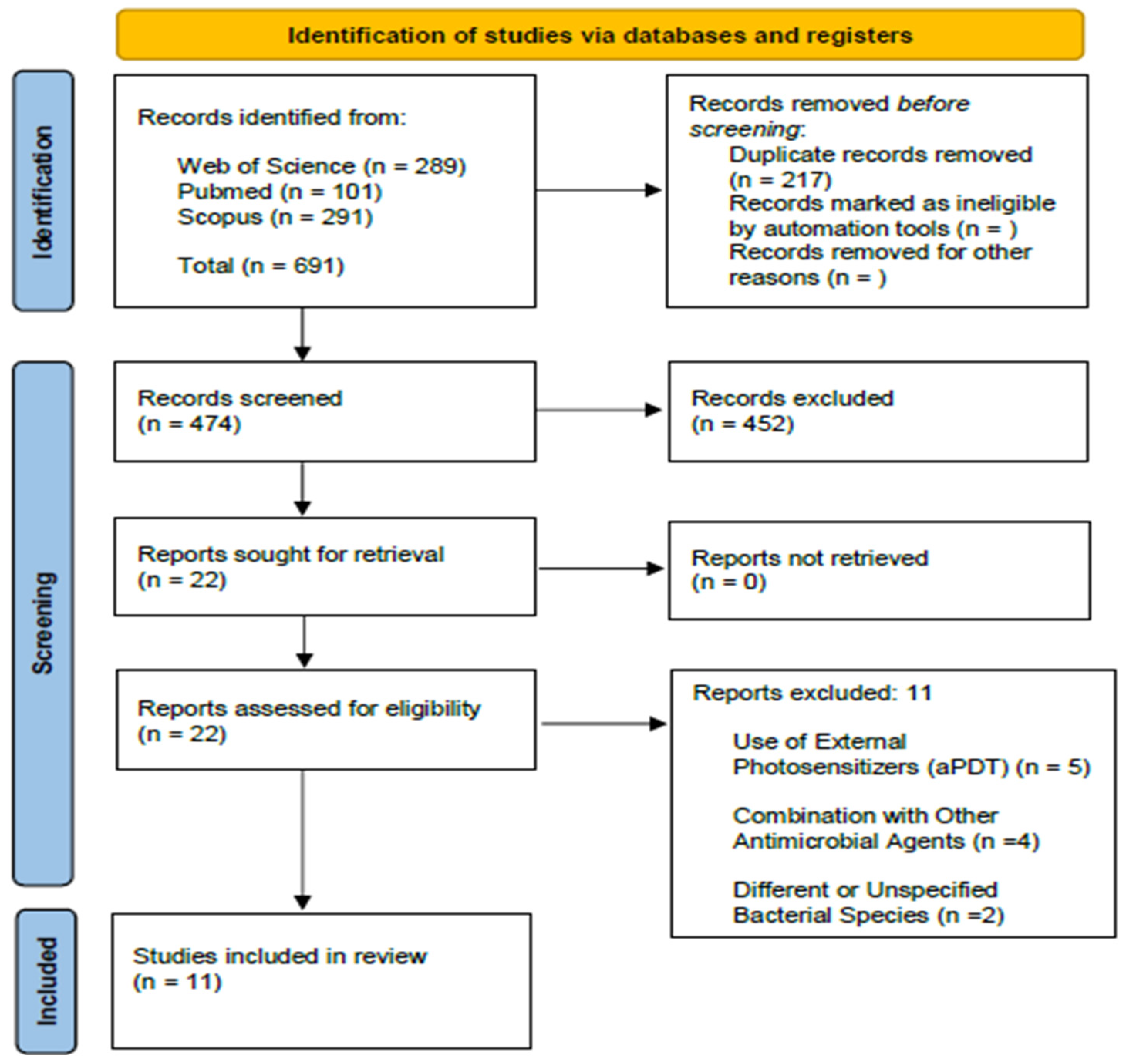
3.1. Study Selection Flow
3.2. Characteristics of the Included Studies
3.3. Analysis of the Risk of Bias
3.4. Analysis of Irradiation Parameters
3.5. Susceptibility in Different Bacterial States
3.6. Impact of Matrices and Stress Factors
3.7. Resistance and Security
4. Discussion
4.1. Biophysics of Photoinactivation and the Soret Band
4.2. Effectiveness Against High-Risk Clones and Bacterial Resistance
4.3. Influence of Metabolic and Organizational State
4.4. Impact of Biological Matrices and the Attenuation Phenomenon
4.5. Clinical Perspectives and Cellular Safety
4.6. Potential of aBL Against Other Pathogenic Bacteria and Future Perspectives
5. Conclusions
Author Contributions
Funding
Institutional Review Board Statement
Informed Consent Statement
Data Availability Statement
Acknowledgments
Conflicts of Interest
Abbreviations
| aBL | Antimicrobial Blue Light |
| ROS | Reactive Oxygen Species |
| CFU | Colony Forming Unit |
| MDR | Multidrug-Resistant |
| CPE | Carbapenemase-Producing Enterobacteriaceae |
| LED | Light-Emitting Diode |
| OHAT | Office of Health Assessment and Translation |
| PRISMA | Preferred Reporting Items for Systematic Reviews and Meta-Analyses |
| J/cm2 | Joules per square centimeter (Fluence/Energy Dose) |
| mW/cm2 | Milliwatts per square centimeter (Irradiance/Power Density) |
References
- Murray, C.J.; Ikuta, K.S.; Sharara, F.; Swetschinski, L.; Robles Aguilar, G.; Gray, A.; Han, C.; Bisignano, C.; Rao, P.; Wool, E.; et al. Global burden of bacterial antimicrobial resistance in 2019: A systematic analysis. Lancet 2022, 399, 629–655. [Google Scholar] [CrossRef]
- Drake, A.; Sassoon, I.; Armitage, J.; Abbas, S.; Maudling, R.; Gupta-Wright, A.; Serrano, A.; Shafa, A.; Shorten, T. Country governance of antimicrobial resistance (AMR) surveillance: Observations on global progress and aid programme effectiveness using data from the Tracking AMR Country Self-Assessment Survey (TrACSS). Global Health 2026, 22, 8. [Google Scholar] [CrossRef]
- Huemer, M.; Mairpady Shambat, S.; Brugger, S.D.; Zinkernagel, A.S. Antibiotic resistance and persistence—Implications for human health and treatment perspectives. EMBO Rep. 2020, 21, e51034. [Google Scholar] [CrossRef]
- Abbas, A.; Barkhouse, A.; Hackenberger, D.; Wright, G.D. Antibiotic resistance: A key microbial survival mechanism that threatens public health. Cell Host Microbe 2024, 32, 837–851. [Google Scholar] [CrossRef] [PubMed]
- Sati, H.; Carrara, E.; Savoldi, A.; Hansen, P.; Garlasco, J.; Campagnaro, E.; Boccia, S.; Castillo-Polo, J.A.; Magrini, E.; Garcia-Vello, P.; et al. The WHO Bacterial Priority Pathogens List 2024: A prioritisation study to guide research, development, and public health strategies against antimicrobial resistance. Lancet Infect. Dis. 2025, 25, 1033–1043. [Google Scholar] [CrossRef] [PubMed]
- Mudau, K.L.; Ntobeng, L.R.; Kalu, C.M.; Tekere, M. Pathogenicity and virulence factors of Escherichia coli discovered using next generation sequencing technologies and proteomics. Front. Bacteriol. 2025, 4, 1677775. [Google Scholar] [CrossRef]
- Klein, R.D.; Hultgren, S.J. Urinary tract infections: Microbial pathogenesis, host-pathogen interactions and new treatment strategies. Nat. Rev. Microbiol. 2020, 18, 211–226. [Google Scholar] [CrossRef]
- Zhou, Y.; Zhou, Z.; Zheng, L.; Gong, Z.; Li, Y.; Jin, Y.; Huang, Y.; Chi, M. Urinary tract infections caused by uropathogenic Escherichia coli: Mechanisms of infection and treatment options. Int. J. Mol. Sci. 2023, 24, 10537. [Google Scholar] [CrossRef]
- Li, Y.; Sun, X.; Dong, N.; Wang, Z.; Li, R. Global distribution and genomic characteristics of carbapenemase-producing Escherichia coli among humans, 2005–2023. Drug Resist. Updates 2024, 72, 101031. [Google Scholar] [CrossRef] [PubMed]
- Doerr, N.; Dietze, N.; Lippmann, N.; Rodloff, A.C. Extended-spectrum beta-lactamases found in Escherichia coli isolates obtained from blood cultures and corresponding stool specimen. Sci. Rep. 2023, 13, 8940. [Google Scholar] [CrossRef]
- Moura, R.S.; Afonso, J.P.R.; Mello, D.A.C.P.G.; Palma, R.K.; Oliveira-Silva, I.; Oliveira, R.F.; Oliveira, D.A.A.P.; Santos, D.B.; Silva, C.H.M.; Guedes, O.A. Hydrogels associated with photodynamic therapy have antimicrobial effect against Staphylococcus aureus: A systematic review. Gels 2024, 10, 635. [Google Scholar] [CrossRef]
- Ramírez Castillo, F.Y.; Guerrero Barrera, A.L.; Harel, J.; Avelar González, F.J.; Vogeleer, P.; Arreola Guerra, J.M.; González Gámez, M. Biofilm formation by Escherichia coli isolated from urinary tract infections from Aguascalientes, Mexico. Microorganisms 2023, 11, 2858. [Google Scholar] [CrossRef]
- Davidova-Gerzova, L.; Lausova, J.; Sukkar, I.; Nesporova, K.; Nechutna, L.; Vlkova, K.; Chudejova, K.; Krutova, M.; Palkovicova, J.; Kaspar, J. Hospital and community wastewater as a source of multidrug-resistant ESBL-producing Escherichia coli. Front. Cell. Infect. Microbiol. 2023, 13, 1184081. [Google Scholar] [CrossRef]
- Sharan, M.; Vijay, D.; Dhaka, P.; Bedi, J.S.; Gill, J.P.S. Biofilms as a microbial hazard in the food industry: A scoping review. J. Appl. Microbiol. 2022, 133, 2210–2234. [Google Scholar] [CrossRef]
- Enwemeka, C.S. Antimicrobial blue light: An emerging alternative to antibiotics. Photomed. Laser Surg. 2013, 31, 509–511. [Google Scholar] [CrossRef]
- Negri, L.B.; Korupolu, S.; Farinelli, W.; Jolly, A.K.; Redmond, R.W.; Aggarwal, S.; Rahme, L.G.; Gilchrist, K.H.; Anderson, R.R.; Gelfand, J.A. Antimicrobial blue light reduces human-wound pathogens’ resistance to tetracycline-class antibiotics in biofilms. Cells 2025, 14, 219. [Google Scholar] [CrossRef]
- Huang, S.; Lin, S.; Qin, H.; Jiang, H.; Liu, M. The parameters affecting antimicrobial efficiency of antimicrobial blue light therapy: A review and prospect. Biomedicines 2023, 11, 1197. [Google Scholar] [CrossRef]
- Oliveira, L.V.F.; Apostólico, N.; Uriarte, J.J.; da Palma, R.K.; Prates, R.A.; Deana, A.M.; Ferreira, L.R.; Afonso, J.P.R.; de Paula Vieira, R.; de Oliveira Júnior, M.C. Photodynamic therapy in the extracellular matrix of mouse lungs: Preliminary results of an alternative tissue sterilization process. Int. J. Photoenergy 2021, 2021, 5578387. [Google Scholar] [CrossRef]
- Dai, T. The antimicrobial effect of blue light: What are behind? Virulence 2017, 8, 649–652. [Google Scholar] [CrossRef]
- Leanse, L.G.; Dos Anjos, C.; Mushtaq, S.; Dai, T. Antimicrobial blue light: A ‘magic bullet’ for the 21st century and beyond? Adv. Drug Deliv. Rev. 2022, 180, 114057. [Google Scholar] [CrossRef]
- Lena, A.; Comuzzi, C.; Manzano, M.; Maifreni, M. Effect of blue light at different wavelengths on the inactivation of foodborne bacteria: Evaluation of microbial susceptibility. Food Microbiol. 2026, 137, 105052. [Google Scholar] [CrossRef]
- Huang, S.T.; Wu, C.Y.; Lee, N.; Cheng, C.W.; Yang, M.J.; Hung, Y.A.; Wong, T.W.; Liang, J.Y. Effects of 462 nm light-emitting diode on the inactivation of Escherichia coli and a multidrug-resistant by tetracycline photoreaction. J. Clin. Med. 2018, 7, 278. [Google Scholar] [CrossRef]
- Imtiaz, S.; Bilal, M.; Saleem, M. Antimicrobial photodynamic therapy against Escherichia coli by exploiting endogenously produced protoporphyrin IX- in vitro study. Lasers Med. Sci. 2024, 39, 204. [Google Scholar] [CrossRef]
- Halstead, F.D.; Ahmed, Z.; Apperly, P.; Anderson, R.; Fraise, A.P.; Guilding, C.L.; Webber, M.A. Antibacterial activity of blue light against nosocomial wound pathogens growing planktonically and as mature biofilms. Appl. Environ. Microbiol. 2016, 82, 4006–4016. [Google Scholar] [CrossRef]
- Page, M.J.; McKenzie, J.E.; Bossuyt, P.M.; Boutron, I.; Hoffmann, T.C.; Mulrow, C.D.; Shamseer, L.; Tetzlaff, J.M.; Akl, E.A.; Brennan, S.E.; et al. The PRISMA 2020 statement: An updated guideline for reporting systematic reviews. BMJ 2021, 372, n71. [Google Scholar] [CrossRef]
- National Toxicology Program. OHAT Risk of Bias Rating Tool for Human and Animal Studies; US Department of Health and Human Services: Washington, DC, USA, 2015.
- Dos Anjos, C.; Sellera, F.P.; Leanse, L.G.; Dai, T.; Pogliani, F.C. Antimicrobial blue light inactivation of international clones of multidrug-resistant Escherichia coli ST10, ST131 and ST648. Photodiagn. Photodyn. Ther. 2019, 27, 51–53. [Google Scholar] [CrossRef]
- Luo, S.; Fang, T.; Ge, C.; Wang, J. Blue light for inactivation of meatborne pathogens and maintaining the freshness of beef. J. Food Prot. 2022, 85, 553–562. [Google Scholar] [CrossRef]
- Abana, C.M.; Brannon, J.R.; Ebbott, R.A.; Dunigan, T.L.; Guckes, K.R.; Fuseini, H.; Marshall, A.F.; Iovine, N.M.; Hadjifrangiskou, M. Characterization of blue light irradiation effects on pathogenic and nonpathogenic Escherichia coli. Microbiol. Open 2017, 6, e466. [Google Scholar] [CrossRef]
- Shehatou, C.; Maclean, M.; Wilson, M.P.; MacGregor, S.J.; Anderson, J.G. Characterizing the antimicrobial properties of 405 nm light and the Corning® light-diffusing fiber delivery system. Lasers Surg. Med. 2019, 51, 887–896. [Google Scholar] [CrossRef]
- McKenzie, K.; Maclean, M.; Timoshkin, I.V.; Endarko, E.; MacGregor, S.J.; Anderson, J.G. Enhanced inactivation of Escherichia coli and Listeria monocytogenes by exposure to 405 nm light under sub-lethal temperature, salt and acid stress conditions. Int. J. Food Microbiol. 2014, 170, 91–98. [Google Scholar] [CrossRef]
- Leanse, L.G.; Harrington, Z.M.; Fang, Y.; Ahmed, I.; Dai, T. Evaluating the potential for resistance development to antimicrobial blue light (at 405 nm) in gram-negative bacteria: In vitro and in vivo studies. Front. Microbiol. 2018, 9, 2403. [Google Scholar] [CrossRef]
- Kim, S.; Kim, J.; Lim, W.; Jeon, S.; Kim, O.; Koh, J.T.; Choi, H.; Chung, J. In vitro bactericidal effects of 625, 525, and 425 nm wavelength (red, green, and blue) light-emitting diode irradiation. Photomed. Laser Surg. 2013, 31, 554–562. [Google Scholar] [CrossRef]
- Dos Anjos, C.; Sellera, F.P.; Rodrigues, A.S.; Dai, T.; Pogliani, F.C. Inactivation of milk-borne pathogens by blue light exposure. J. Dairy Sci. 2020, 103, 1261–1268. [Google Scholar] [CrossRef]
- Ngowwatana, P.; Thongratsakul, S.; Sariya, L.; Sukkanon, C.; Tankaew, P.; Ruenphet, S. Selective bactericidal efficacy of 465-nm blue light phototherapy against standard and canine wound pathogens: An in vitro evaluation. Vet. World 2025, 18, 2064–2071. [Google Scholar] [CrossRef]
- Halstead, F.D.; Thwaite, J.E.; Burt, R.; Laws, T.R.; Winslow, R.; Ahmed, Z.; Anderson, R.; Webber, M.A. The potential of visible blue light (405 nm) as a novel decontamination strategy for carbapenemase-producing Enterobacteriaceae (CPE). Antimicrob. Resist. Infect. Control 2019, 8, 14. [Google Scholar]
- Yang, J.; Yun, S.; Park, W. Blue light sensing BlsA-mediated modulation of meropenem resistance and biofilm formation in Acinetobacter baumannii. mSystems 2023, 8, e0089722. [Google Scholar]
- Qin, H.; Niu, H.; Guo, Y.; Wang, X.; Liu, T.; Zhao, C. Blue light-activated 5,10,15,20-tetrakis(4-bromophenyl)porphyrin for photodynamic eradication of drug-resistant Staphylococcus aureus. RSC Adv. 2024, 14, 39779–39786. [Google Scholar] [CrossRef]
- Hoenes, K.; Bauer, R.; Meurle, T.; Spellerberg, B.; Hessling, M. Inactivation effect of violet and blue light on ESKAPE pathogens and closely related non-pathogenic bacterial species—A promising tool against antibiotic-sensitive and antibiotic-resistant microorganisms. Front. Microbiol. 2021, 11, 612367. [Google Scholar] [CrossRef]
- Kosarieh, E.; Sattari Khavas, S.; Chiniforush, N.; Afrasiabi, S. Comparison of the effects of continuous and pulsed blue light for reduction of Enterococcus faecalis biofilms. Lasers Med. Sci. 2025, 40, 396. [Google Scholar]
- Ong, J.; Godfrey, R.; Nazarian, A.; Tam, J.; Isaacson, B.M.; Pasquina, P.F.; Williams, D.L. Comparison of Staphylococcus aureus tolerance between antimicrobial blue light, levofloxacin, and rifampin. Front. Microbiol. 2023, 14, 1158558. [Google Scholar] [CrossRef]
- Hadi, J.; Wu, S.; Brightwell, G. Antimicrobial blue light versus pathogenic bacteria: Mechanism, application in the food industry, hurdle technologies and potential resistance. Foods 2020, 9, 1895. [Google Scholar] [CrossRef] [PubMed]
- Lee, J.I.; Kim, S.S.; Kang, D.H. The combined effect of folic acid and 365-405 nm light emitting diode for inactivation of foodborne pathogens and its bactericidal mechanisms. Int. J. Food Microbiol. 2022, 373, 109704. [Google Scholar] [CrossRef] [PubMed]
- Mechmechani, S.; Khelissa, S.; Gharsallaoui, A.; Omari, K.E.; Hamze, M.; Chihib, N.E. Hurdle technology using encapsulated enzymes and essential oils to fight bacterial biofilms. Appl. Microbiol. Biotechnol. 2022, 106, 2311–2335. [Google Scholar] [CrossRef] [PubMed]


| Author | Strain/Lineage | Wavelength | Technical Parameters | Bacterial Status | Main Result (Effectiveness) |
|---|---|---|---|---|---|
| [27] | EPEC CFT 073 and EAEC_042 | 400 nm | 60 mW/cm2; 54–108 J/cm2 | Planktonics/Biofilm | Reduction < 5-log; >90% reduction in biofilm seeding. |
| [28] | MDR Clones (ST10, ST131, ST648) | 405 nm | 155 mW/cm2; 139.5 J/cm2 | Planktonicks | Reduction of 1.4 to 5.3 log10 (effective against multidrug-resistant bacteria). |
| [29] | E. coli ATCC 25922 | 460 nm | 40 mW/cm2; 144 J/cm2 | Planktonic/Meat | Reduction of 5.0 log (liquid) and 1.45 log (meat). |
| [30] | UPEC UTI89 and MG1655 | 405 nm | 2.1–2.8 mW/cm2; 500 J/cm2 | Planktonics/Biofilm | Reduction > 5-log in the log phase; resistance in the stationary phase. |
| [31] | E. coli (Clinical Strain) | 405 nm | 10.6–64.2 mW/cm2 | Surface/Blood | Inactivation of approximately 7-log in agar; reduced efficacy in blood. |
| [32] | E. coli NCTC 9001 | 405 nm | 10 to 90 mW/cm2 | Planktonicks (Stress) | Synergy: accelerated inactivation under heat, salt, or acid. |
| [33] | E. coli ATCC 25922 | 405 nm | 50 mW/cm2; 108 J/cm2 | In vitro and In vivo | No resistance after 15 cycles; effective on wounds. |
| [34] | E. coli DH5α | 425 nm | 2.3 to 20.2 J/cm2 | Planktonicks | Only 425 nm was effective; reduction with time/dose. |
| [35] | E. coli ATCC 25922 | 405 nm | 120 mW/cm2; 540 J/cm2 | Cow’s Milk | 3-log reduction in skim milk; less in whole milk. |
| [36] | E. coli ATCC 25922 and Canine Isolates | 465 nm | 127 mW/cm2; 15–60 J/cm2 | Planktonicks | Significant reduction (>3-log) from 45 J/cm2. |
| [37] | CPE E. coli (Superbugs: NDM, OXA-48) | 405 nm | 60 mW/cm2; 18–108 J/cm2 | Biofilm (72 h) | Significant reduction in biofilm viability and seeding. |
| Study | Design | Total Score | Quality (%) | OHAT Tier | Main Strength/Focus |
|---|---|---|---|---|---|
| [27] | In vitro | 21/30 | 70.0% | Tier 2 | Mature biofilms and clinical isolate diversity. +3 |
| [28] | In vitro | 22/30 | 73.3% | Tier 2 | International MDR clones (KPC and MCR-1). |
| [29] | In vitro/Matrix | 22/30 | 73.3% | Tier 2 | Meat matrix and freshness (thermal control). +1 |
| [30] | In vitro | 22/30 | 73.3% | Tier 2 | Synergistic effect of cold temperatures. |
| [31] | In vitro | 22/30 | 73.3% | Tier 2 | Light-diffusing fiber delivery system. +3 |
| [32] | In vitro | 22/30 | 73.3% | Tier 2 | Synergy with acid and salt stress conditions. |
| [33] | In vitro/In vivo | 23/30 | 76.6% | Tier 1/2 | Explicit report of randomization in animal model. +2 |
| [34] | In vitro | 22/30 | 73.3% | Tier 2 | Multi-spectral comparison (Red, Green, Blue). +3 |
| [35] | In vitro/Matrix | 22/30 | 73.3% | Tier 2 | Complex matrix (milk) and fat content control. |
| [36] | In vitro | 22/30 | 73.3% | Tier 2 | Canine wound pathogens and active cooling system. +1 |
| [37] | In vitro | 22/30 | 73.3% | Tier 2 | Carbapenemase-producing Enterobacteriaceae. |
| Biological Target/Application Scenario | Optimal Wavelength | Suggested Fluence (Dose) | Recommended Irradiance | Expected Outcome |
|---|---|---|---|---|
| [27] Planktonic (Log Phase) | 405 nm | 15–60 J/cm2 | 50–100 mW/cm2 | >3-log reduction |
| [27] Mature Biofilms (72 h) | 405 nm | 100–200 J/cm2 | >100 mW/cm2 | Seeding inhibition (>90%) |
| [32] In Vivo (Wounds) | 405–465 nm | 45–100 J/cm2 | Moderate (with active cooling) | Disinfection without cytotoxicity |
| [31] Complex Matrices (Meat/Milk) | 405 nm | >150 J/cm2 (or Fractionated) | High (>120 mW/cm2) | Compensate for optical attenuation |
| E. coli Pathotype/Lineage | Associated Clinical Conditions | Potential aBL Application Scenario |
|---|---|---|
| [27] Uropathogenic (UPEC) | Urinary Tract Infections (UTIs), Cystitis | Intracavitary devices or catheter decontamination |
| [37] Enteroaggregative (EAEC) | Persistent Diarrhea, Gastroenteritis | Food surface decontamination/Water treatment |
| [33] MDR Clones (ST131, ST648) | Sepsis, Surgical Site Infections | Wound bed therapy/Pre-surgical skin antisepsis |
| [37] Commesal Laboratory Strains | Opportunistic Infections | Environmental surface disinfection |
Disclaimer/Publisher’s Note: The statements, opinions and data contained in all publications are solely those of the individual author(s) and contributor(s) and not of MDPI and/or the editor(s). MDPI and/or the editor(s) disclaim responsibility for any injury to people or property resulting from any ideas, methods, instructions or products referred to in the content. |
© 2026 by the authors. Licensee MDPI, Basel, Switzerland. This article is an open access article distributed under the terms and conditions of the Creative Commons Attribution (CC BY) license.
Share and Cite
Mello, D.A.C.P.G.; Afonso, J.P.R.; Carvalho, E.E.; Appelt Filho, H.A.; Ribeiro Júnior, J.B.S.; Alves, L.R.; Sousa, M.B.G.; Oliveira, S.A.; Silva, G.Q.; Bueno, R.S.; et al. Antimicrobial Efficacy of Endogenous Blue Light Photoinactivation (400–470 nm) Against Escherichia coli: A Systematic Review of In Vitro Evidence and Clinical Implications. Med. Sci. 2026, 14, 261. https://doi.org/10.3390/medsci14020261
Mello DACPG, Afonso JPR, Carvalho EE, Appelt Filho HA, Ribeiro Júnior JBS, Alves LR, Sousa MBG, Oliveira SA, Silva GQ, Bueno RS, et al. Antimicrobial Efficacy of Endogenous Blue Light Photoinactivation (400–470 nm) Against Escherichia coli: A Systematic Review of In Vitro Evidence and Clinical Implications. Medical Sciences. 2026; 14(2):261. https://doi.org/10.3390/medsci14020261
Chicago/Turabian StyleMello, Diego Antônio C. P. Gomes, João Pedro R. Afonso, Everton Edgar Carvalho, Hustênio Abílio Appelt Filho, Jairo Belém Soares Ribeiro Júnior, Larissa Rodrigues Alves, Mickael Breno Godoi Sousa, Salomão Antonio Oliveira, Guilherme Quireza Silva, Rafael Souza Bueno, and et al. 2026. "Antimicrobial Efficacy of Endogenous Blue Light Photoinactivation (400–470 nm) Against Escherichia coli: A Systematic Review of In Vitro Evidence and Clinical Implications" Medical Sciences 14, no. 2: 261. https://doi.org/10.3390/medsci14020261
APA StyleMello, D. A. C. P. G., Afonso, J. P. R., Carvalho, E. E., Appelt Filho, H. A., Ribeiro Júnior, J. B. S., Alves, L. R., Sousa, M. B. G., Oliveira, S. A., Silva, G. Q., Bueno, R. S., Fernandes, T. V., Marconi, D. G., Andraus, R. A. C., Silva, C. H. M., Oliveira, D. A. A. P., Oliveira-Silva, I., Oliveira, R. F., Guedes, O. A., Freitas Júnior, W. R., ... Toledo, L. G. M. (2026). Antimicrobial Efficacy of Endogenous Blue Light Photoinactivation (400–470 nm) Against Escherichia coli: A Systematic Review of In Vitro Evidence and Clinical Implications. Medical Sciences, 14(2), 261. https://doi.org/10.3390/medsci14020261