
Loss of PTEN as an Independent Poor Prognosis Indicator in Lung Adenocarcinoma, but Not in Squamous Cell Carcinoma, Is Associated with an Immunosuppressive Tumor Microenvironment and Distinct Co-Mutational Profiles
 , ,
, ,  , and
, and
Abstract
1. Introduction
2. Materials and Methods
2.1. Cohorts of Patients
2.2. Immunohistochemistry
2.3. Bioinformatic and Statistical Analyses
2.3.1. Data Sources and Cohort Selection
2.3.2. Quality Data Processing
2.3.3. MAF File Generation
2.3.4. Mutation Analysis
2.3.5. Visualization
2.3.6. Statistical Analyses
3. Results
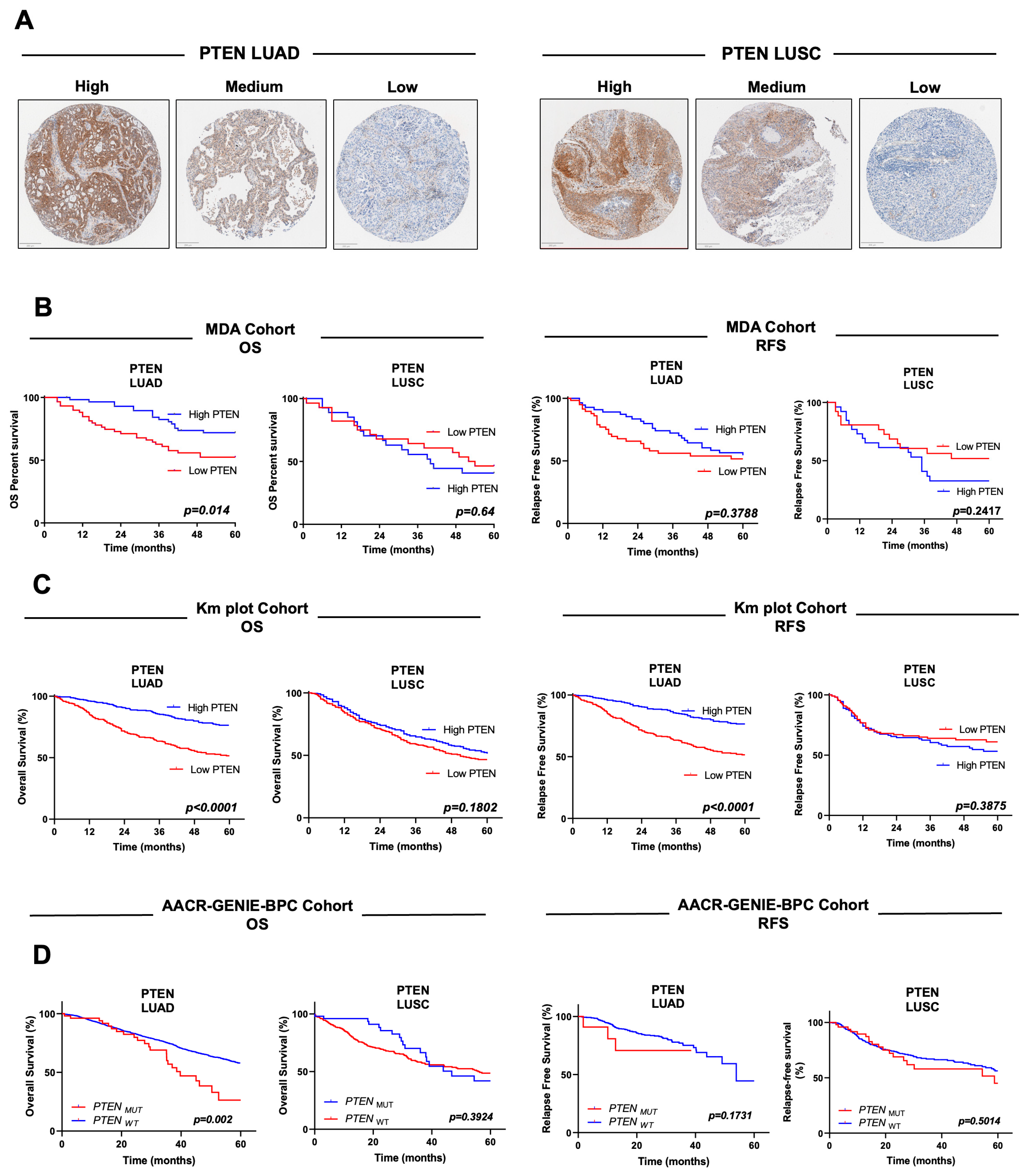
3.1. Low Levels of PTEN Are Associated with Poor Prognosis in Lung Adenocarcinomas, but Not in Lung Squamous Cell Carcinomas
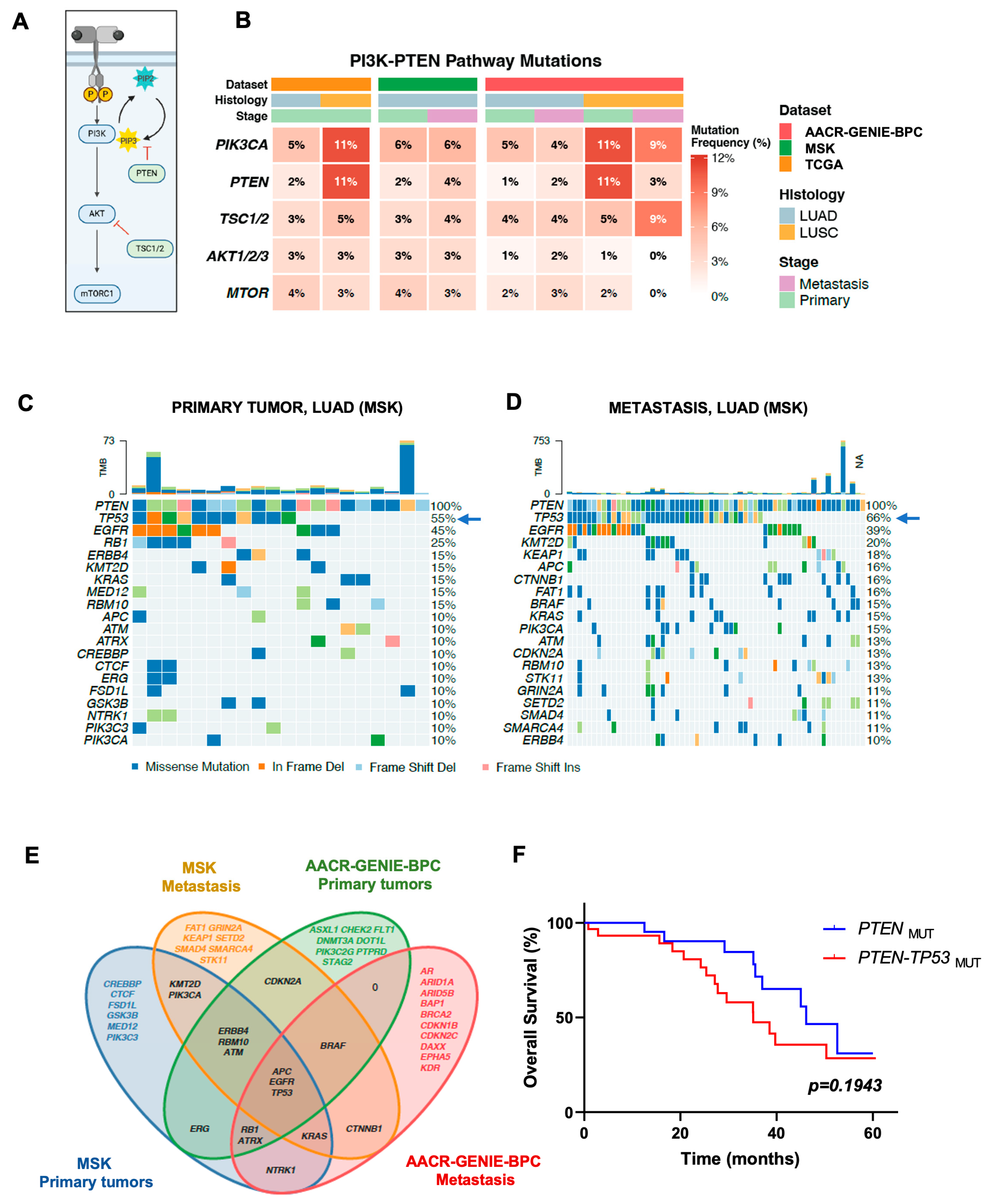
3.2. Co-Mutation Patterns Associated with PTEN Loss in Lung Adenocarcinomas and Lung Squamous Carcinomas
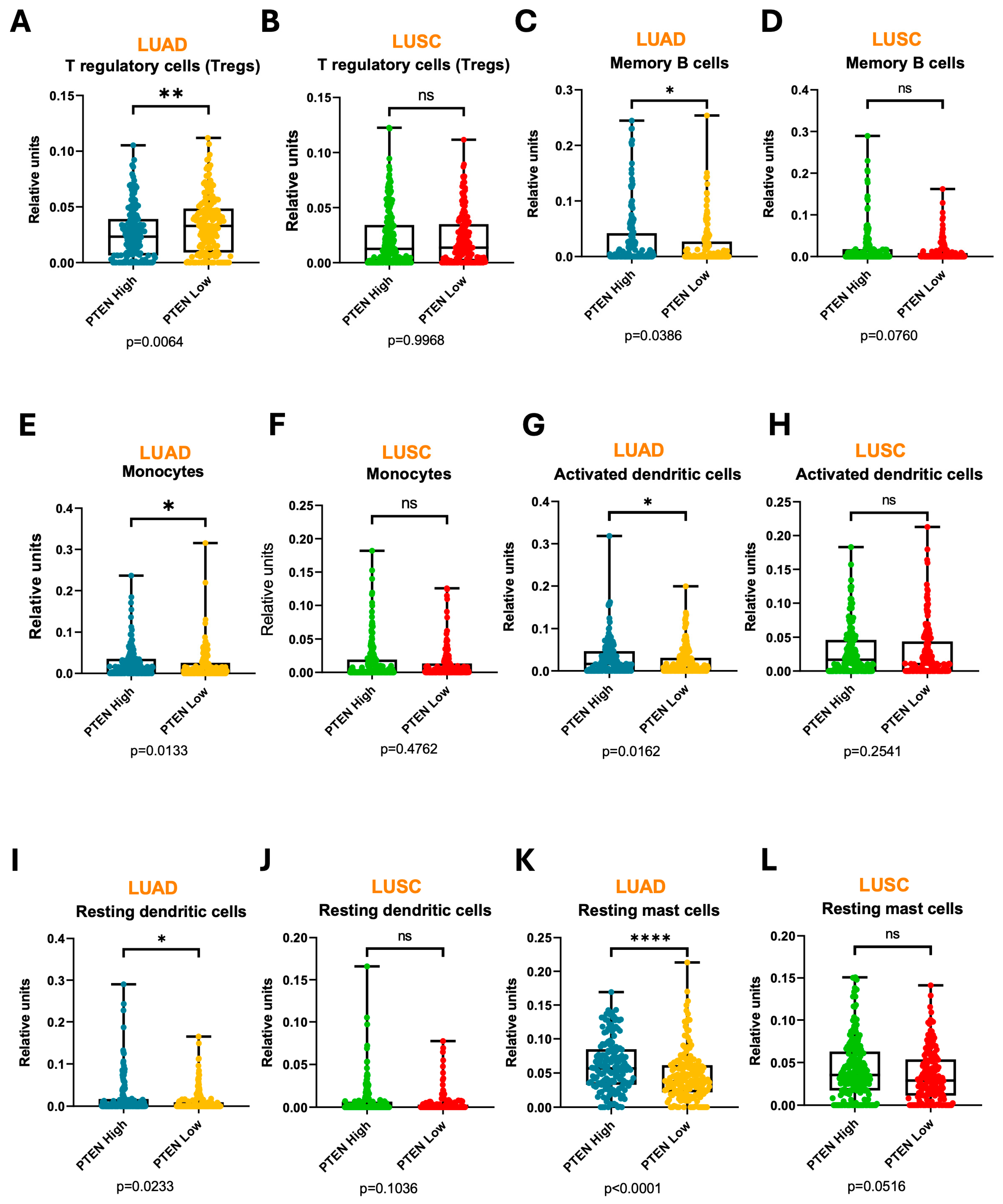
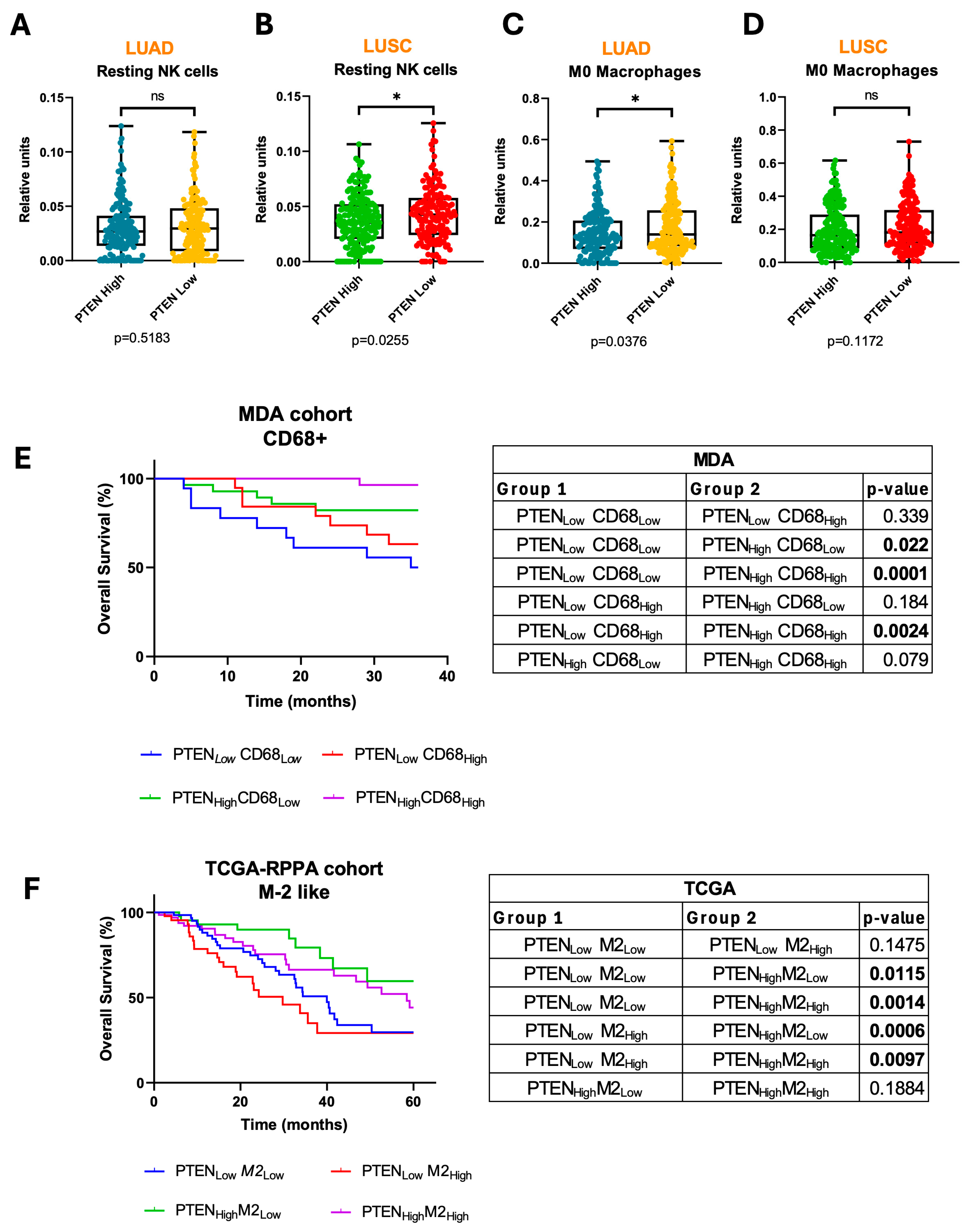
3.3. PTEN-Low Lung Adenocarcinomas Are Enriched in Immunosuppressive Populations
4. Discussion
Supplementary Materials
Author Contributions
Funding
Institutional Review Board Statement
Informed Consent Statement
Data Availability Statement
Conflicts of Interest
References
- Collisson, E.A.; Campbell, J.D.; Brooks, A.N. Comprehensive molecular profiling of lung adenocarcinoma. Nature 2014, 511, 543–550. [Google Scholar] [CrossRef] [PubMed]
- Hammerman, P.S.; Wistuba, I.I.; Wilkerson, M.D. Comprehensive genomic characterization of squamous cell lung cancers. Nature 2012, 489, 519–525. [Google Scholar] [CrossRef]
- Hendriks, L.E.L.; Kerr, K.M.; Menis, J.; Mok, T.S.K.; Peters, S.; Planchard, D.; Smit, E.F.; Solomon, B.J.; Wu, Y.-L. Non-small-cell lung cancer. Nat. Rev. Dis. Primers 2024, 10, 71. [Google Scholar] [CrossRef]
- Sirhan, Z.; Alojair, R.; Thyagarajan, A.; Sahu, R.P. Therapeutic Implications of PTEN in Non-Small Cell Lung Cancer. Pharmaceutics 2023, 15, 2090. [Google Scholar] [CrossRef]
- Exposito, F.; Zhang, Y.; Li, J.; Wang, X.; Chen, L.; Gupta, S.; Liu, Z.; Kim, J.; Patel, A. PTEN Loss Confers Resistance to Anti-PD-1 Therapy in Non-Small Cell Lung Cancer by Increasing Tumor Infiltration of Regulatory T Cells. Cancer Res. 2023, 83, 2513–2526. [Google Scholar] [CrossRef]
- Gkountakos, A.; Agarwal, P.; Saeed, U.; Meszaros, J.; Burkhalter, M.; Burkhalter, M. PTEN in Lung Cancer: Dealing with the Problem, Building on New Knowledge and Turning the Game Around. Cancers 2019, 1, 1141. [Google Scholar] [CrossRef]
- Perumal, E.; Dang, U.T.; Kannan, R.; Ramraj, S.K.; Ghosh, D.; Rangarajan, A. PTEN inactivation induces epithelial-mesenchymal transition and metastasis by intranuclear translocation of β-catenin and snail/slug in non-small cell lung carcinoma cells. Lung Cancer 2019, 130, 25–34. [Google Scholar] [CrossRef] [PubMed]
- Zhao, Y.; Zheng, R.; Li, J.; Lin, F.; Liu, L. Loss of phosphatase and tensin homolog expression correlates with clinicopathological features of non-small cell lung cancer patients and its impact on survival: A systematic review and meta-analysis. Thorac. Cancer 2017, 8, 203–213. [Google Scholar] [CrossRef]
- Paredes, R.; Borea, R.; Drago, F.; Russo, A.; Nigita, G.; Rolfo, C. Genetic drivers of tumor microenvironment and immunotherapy resistance in non-small cell lung cancer: The role of KEAP1, SMARCA4, and PTEN mutations. J. Immunother. Cancer 2025, 13, e012288. [Google Scholar] [CrossRef]
- Xiao, J.; Lin, H.; Chen, Y.; Lin, Y.; Zhang, H. PTEN expression is a prognostic marker for patients with non-small cell lung cancer: A systematic review and meta-analysis of the literature. Oncotarget 2016, 7, 57832–57840. [Google Scholar] [CrossRef] [PubMed]
- Li, X.; Wang, J.; Zhang, H.; Liu, Z.; Chen, Y.; Sun, Y. High levels of Phosphatase and Tensin Homolog Expression Predict Favorable Prognosis in Patients with Non-small Cell Lung Cancer. Cell Biochem. Biophys. 2015, 73, 631–637. [Google Scholar] [CrossRef]
- Yanagawa, N.; Shiono, S.; Abiko, M.; Ogata, S.; Katoh, H.; Kitamura, H. Loss of phosphatase and tensin homolog protein expression is an independent poor prognostic marker in lung adenocarcinoma. J. Thorac. Oncol. 2012, 7, 1513–1521. [Google Scholar] [CrossRef]
- Hayes, D.F.; Sauerbrei, W.; McShane, L.M.; Altman, D.G.; Simon, R. REMARK guidelines for tumour biomarker study reporting: A remarkable history. Br. J. Cancer 2023, 128, 443–445. [Google Scholar] [CrossRef] [PubMed]
- Cumberbatch, M.G.K.; Vanarsdall, A.L.; Robinson, D.R. Identification of a subset of human non-small cell lung cancer patients with high PI3Kβ and low PTEN expression, more prevalent in squamous cell carcinoma. Clin. Cancer Res. 2014, 20, 595–603. [Google Scholar] [CrossRef]
- Rocha, P.; Zhang, J.; Laza-Briviesca, R.; Cruz-Bermúdez, A.; Bota-Rabassedas, N.; Sanchez-Espiridon, B.; Yoshimura, K.; Behrens, C.; Lu, W.; Tang, X.; et al. Distinct Immune Gene Programs Associated with Host Tumor Immunity, Neoadjuvant Chemotherapy, and Chemoimmunotherapy in Resectable NSCLC. Clin. Cancer Res. 2022, 28, 2461–2473. [Google Scholar] [CrossRef]
- Federico, L.; McGrail, D.J.; Bentebibel, S.E.; Haymaker, C.; Ravelli, A.; Forget, M.A.; Karpinets, T.; Jiang, P.; Reuben, A.; Negrao, M.V.; et al. Distinct tumor-infiltrating lymphocyte landscapes are associated with clinical outcomes in localized non-small-cell lung cancer. Ann. Oncol. 2022, 33, 42–56. [Google Scholar] [CrossRef] [PubMed]
- Parra, E.R.; Behrens, C.; Rodriguez-Canales, J.; Tang, X.; Wistuba, I.I.; McMahan, L.; Truini, A.; Chen, G.; Tetzlaff, M.T.; Altan, M.; et al. Immuno-profiling and cellular spatial analysis using five immune oncology multiplex immunofluorescence panels for paraffin tumor tissue. Sci. Rep. 2021, 11, 88156. [Google Scholar] [CrossRef]
- Ellrott, K.; Bailey, M.H.; Saksena, G.; Covington, K.R.; Kandoth, C.; Stewart, C.; Hess, J.; Ma, S.; Chiotti, K.E.; McLellan, M.D.; et al. Scalable Open Science Approach for Mutation Calling of Tumor Exomes Using Multiple Genomic Pipelines. Cell Syst. 2018, 6, 271–281.e7. [Google Scholar] [CrossRef]
- Shyr, C.; Tarailo-Graovac, M.; Gottlieb, M.; Lee, J.J.Y.; Van Karnebeek, C.; Wasserman, W.W. FLAGS, frequently mutated genes in public exomes. BMC Med. Genom. 2014, 7, 64. [Google Scholar] [CrossRef] [PubMed]
- Xu, J.Y.; Zhang, C.; Wang, X.; Zhai, L.; Ma, Y.; Dong, M.; Ji, Q.; Li, Y.; Liu, Z.; Li, Y.; et al. Integrative Proteomic Characterization of Human Lung Adenocarcinoma. Cell 2020, 182, 245–261.e17. [Google Scholar] [CrossRef]
- Lengel, H.B.; Li, H.; Zhang, J.; Wang, L.; Chen, X.; Liu, Y.; Gao, J.; Patel, S.; Kim, J.; Tran, T.; et al. Genomic mapping of metastatic organotropism in lung adenocarcinoma. Cancer Cell 2023, 41, 970–985.e3. [Google Scholar] [CrossRef]
- Choudhury, N.J.; Raghav, K.; Bose, R.; Lee, J.J.; Lin, D.I.; Stewart, M.; Sun, J.; Wu, Y.; Zhao, Y. The GENIE BPC NSCLC Cohort: A Real-World Repository Integrating Standardized Clinical and Genomic Data for 1,846 Patients with Non-Small Cell Lung Cancer. Clin. Cancer Res. 2023, 29, 3418–3428. [Google Scholar] [CrossRef]
- Shi, S.; Ye, L.; Yu, X.; Jin, K.; Wu, W. Focus on mast cells in the tumor microenvironment: Current knowledge and future directions. Biochim. Biophys. Acta Rev. Cancer 2023, 1878, 188845. [Google Scholar] [CrossRef]
- Hurwitz, A.A.; Watkins, S.K. Watkins Immune suppression in the tumor microenvironment: A role for dendritic cell-mediated tolerization of T cells. Cancer Immunol. Immunother. 2012, 61, 289–293. [Google Scholar] [CrossRef] [PubMed]
- Zhang, L.; Chen, J.; Cheng, T.; Yang, H.; Li, H.; Pan, C. Identification of the key genes and characterizations of Tumor Immune Microenvironment in Lung Adenocarcinoma (LUAD) and Lung Squamous Cell Carcinoma (LUSC). J. Cancer 2020, 11, 4965–4979. [Google Scholar] [CrossRef]
- Liu, X.; Wu, S.; Yang, Y.; Zhao, M.; Zhu, G.; Hou, Z. The prognostic landscape of tumor-infiltrating immune cell and immunomodulators in lung cancer. Biomed. Pharmacother. 2017, 95, 55–61. [Google Scholar] [CrossRef] [PubMed]
- Farha, M.; Jairath, N.K.; Lawrence, T.S.; El Naqa, I. Characterization of the Tumor Immune Microenvironment Identifies M0 Macrophage-Enriched Cluster as a Poor Prognostic Factor in Hepatocellular Carcinoma. JCO Clin. Cancer Inform. 2020, 4, 1002–1013. [Google Scholar] [CrossRef]
- Hou, W.; Jiang, J.; Zhu, L.; Xu, H.; Zhu, L. Single-cell RNA sequencing reveals a B cell-related immunosuppressive landscape and a potential suppressor in hepatocellular carcinoma. J. Transl. Med. 2025, 23, 6869. [Google Scholar] [CrossRef] [PubMed]
- Schaafsma, E.; Jiang, C.; Cheng, C. B cell infiltration is highly associated with prognosis and an immune-infiltrated tumor microenvironment in neuroblastoma. J. Cancer Metastasis Treat. 2021, 7, 72. [Google Scholar] [CrossRef]
- Jacquelot, N.; Tellier, J.; Nutt, S.L.; Betz, G.T. Tertiary lymphoid structures and B lymphocytes in cancer prognosis and response to immunotherapies. Oncoimmunology 2021, 10, 1900508. [Google Scholar] [CrossRef]
- Song, M.S.; Salmena, L.; Pandolfi, P.P. The functions and regulation of the PTEN tumour suppressor. Nat. Rev. Mol. Cell Biol. 2012, 13, 283–296. [Google Scholar] [CrossRef]
- Fusco, N.; Sajjadi, E.; Venetis, K.; Gaudioso, G.; Lopez, G.; Corti, C. PTEN Alterations and Their Role in Cancer Management: Are We Making Headway on Precision Medicine? Genes 2020, 11, 719. [Google Scholar] [CrossRef]
- Jin, G.; Kim, M.J.; Jeon, H.S.; Kim, D.S.; Kang, H.G.; Lee, S.Y. PTEN mutations and relationship to EGFR, ERBB2, KRAS, and TP53 mutations in non-small cell lung cancers. Lung Cancer 2010, 69, 279–283. [Google Scholar] [CrossRef] [PubMed]
- Li, X.; Yang, P.; Hou, X.; Ji, S. Post-Translational Modification of PTEN Protein: Quantity and Activity. Oncol. Rev. 2024, 18, 1430237. [Google Scholar] [CrossRef]
- Marsit, C.J.; Zheng, S.; Aldape, K. PTEN expression in non-small-cell lung cancer: Evaluating its relation to tumor characteristics, allelic loss, and epigenetic alteration. Hum. Pathol. 2005, 36, 768–776. [Google Scholar] [CrossRef] [PubMed]
- Tang, J.M.; He, Q.Y.; Guo, R.X.; Chang, X.J. Phosphorylated Akt overexpression and loss of PTEN expression in non-small cell lung cancer confers poor prognosis. Lung Cancer 2006, 51, 181–191. [Google Scholar] [CrossRef]
- Kwon, C.H.; Zhao, J.; Chen, J. Pten haploinsufficiency accelerates formation of high-grade astrocytomas. Cancer Res. 2008, 68, 3286–3294. [Google Scholar] [CrossRef]
- Kwabi-Addo, B.; Giri, D.; Schaid, D.J.; Ittmann, M. Haploinsufficiency of the Pten tumor suppressor gene promotes prostate cancer progression. Proc. Natl. Acad. Sci. USA 2001, 98, 11563–11568. [Google Scholar] [CrossRef] [PubMed]
- Sos, M.L.; Rode, H.B.; Heynck, S.; Peifer, M.; Fischer, F.; Klughammer, B. PTEN loss contributes to erlotinib resistance in EGFR-mutant lung cancer by activation of Akt and EGFR. Cancer Res. 2009, 69, 3256–3261. [Google Scholar] [CrossRef]
- Campbell, J.D.; Alexandrov, A.; Kim, J.; Wala, J.A.; Berger, A.H.; Pedamallu, C.S.; Shukla, S.A.; Guo, G.; Brooks, A.N.; Murray, B.A.; et al. Distinct patterns of somatic genome alterations in lung adenocarcinomas and squamous cell carcinomas. Nat. Genet. 2016, 48, 607–616. [Google Scholar] [CrossRef]
- Chen, Z.; Trotman, L.C.; Shaffer, D.; Lin, H.K.; Dotan, Z.A.; Niki, M.; Koutcher, J.A.; Scher, H.I.; Ludwig, T.; Gerald, W.; et al. Crucial role of p53-dependent cellular senescence in suppression of Pten-deficient tumorigenesis. Nature 2005, 436, 725–730. [Google Scholar] [CrossRef]
- Hou, S.Q.; Ouyang, M.; Brandmaier, A.; Hao, H.; Shen, W.H. PTEN in the maintenance of genome integrity: From DNA replication to chromosome segregation. Bioessays 2017, 39, 1700082. [Google Scholar] [CrossRef] [PubMed]



| LUAD (n = 118) | |||||||
|---|---|---|---|---|---|---|---|
| RFS | OS | ||||||
| HR | %95 CI | p | HR | %95 CI | p | ||
| Gender | Male | 1 | |||||
| Female | 1.52 | (0.75–3.10) | 0.247 | ||||
| Stage | I | 1 | 1 | ||||
| II | 0.83 | (0.35–1.95) | 0.668 | 1.92 | (0.75–4.94) | 0.174 | |
| III | 2.32 | (1.05–5.09) | 0.036 | 4.70 | (1.95–11.36) | 0.001 | |
| IV | 6.87 | (1.16–40.70) | 0.034 | 3.28 | (0.34–31.40) | 0.303 | |
| Neoadjuvant therapy | No | 1 | 1 | ||||
| Yes | 1.24 | (0.46–3.35) | 0.668 | 1.20 | (0.47–3.07) | 0.703 | |
| PTEN protein | Q3–Q4 | 1 | |||||
| Q1 | 2.09 | (1.02–4.30) | 0.045 | ||||
| LUAD (n = 118) | ||||||
|---|---|---|---|---|---|---|
| RFS | OS | |||||
| HR | %95 CI | p | HR | %95 CI | p | |
| CD4+ cells | 0.76 | (0.273–2.129) | 0.60 | |||
| CD8+ cells | 0.37 | (0.102–1.369) | 0.14 | 0.88 | (0.390–1.965) | 0.75 |
| CD3 + cells | 2.27 | (0.527–9.737) | 0.27 | |||
| CD68+ cells | 0.44 | (0.201–0.961) | 0.04 | 0.67 | (0.300–1.486) | 0.32 |
| Foxp3+ cells | 2.15 | (0.583–7.899) | 0.25 | |||
| Granzyme-b+ cells | 0.65 | (0.284–1.478) | 0.30 | |||
Disclaimer/Publisher’s Note: The statements, opinions and data contained in all publications are solely those of the individual author(s) and contributor(s) and not of MDPI and/or the editor(s). MDPI and/or the editor(s) disclaim responsibility for any injury to people or property resulting from any ideas, methods, instructions or products referred to in the content. |
© 2026 by the authors. Licensee MDPI, Basel, Switzerland. This article is an open access article distributed under the terms and conditions of the Creative Commons Attribution (CC BY) license.
Share and Cite
Houry, M.; Silva, S.J.; Artola, M.; Behrens, C.; Politi, K.; Wistuba, I.; Montuenga, L.; Exposito, F.; Calvo, A. Loss of PTEN as an Independent Poor Prognosis Indicator in Lung Adenocarcinoma, but Not in Squamous Cell Carcinoma, Is Associated with an Immunosuppressive Tumor Microenvironment and Distinct Co-Mutational Profiles. Med. Sci. 2026, 14, 254. https://doi.org/10.3390/medsci14020254
Houry M, Silva SJ, Artola M, Behrens C, Politi K, Wistuba I, Montuenga L, Exposito F, Calvo A. Loss of PTEN as an Independent Poor Prognosis Indicator in Lung Adenocarcinoma, but Not in Squamous Cell Carcinoma, Is Associated with an Immunosuppressive Tumor Microenvironment and Distinct Co-Mutational Profiles. Medical Sciences. 2026; 14(2):254. https://doi.org/10.3390/medsci14020254
Chicago/Turabian StyleHoury, Maeva, Shannon J. Silva, Maider Artola, Carmen Behrens, Katerina Politi, Ignacio Wistuba, Luis Montuenga, Francisco Exposito, and Alfonso Calvo. 2026. "Loss of PTEN as an Independent Poor Prognosis Indicator in Lung Adenocarcinoma, but Not in Squamous Cell Carcinoma, Is Associated with an Immunosuppressive Tumor Microenvironment and Distinct Co-Mutational Profiles" Medical Sciences 14, no. 2: 254. https://doi.org/10.3390/medsci14020254
APA StyleHoury, M., Silva, S. J., Artola, M., Behrens, C., Politi, K., Wistuba, I., Montuenga, L., Exposito, F., & Calvo, A. (2026). Loss of PTEN as an Independent Poor Prognosis Indicator in Lung Adenocarcinoma, but Not in Squamous Cell Carcinoma, Is Associated with an Immunosuppressive Tumor Microenvironment and Distinct Co-Mutational Profiles. Medical Sciences, 14(2), 254. https://doi.org/10.3390/medsci14020254