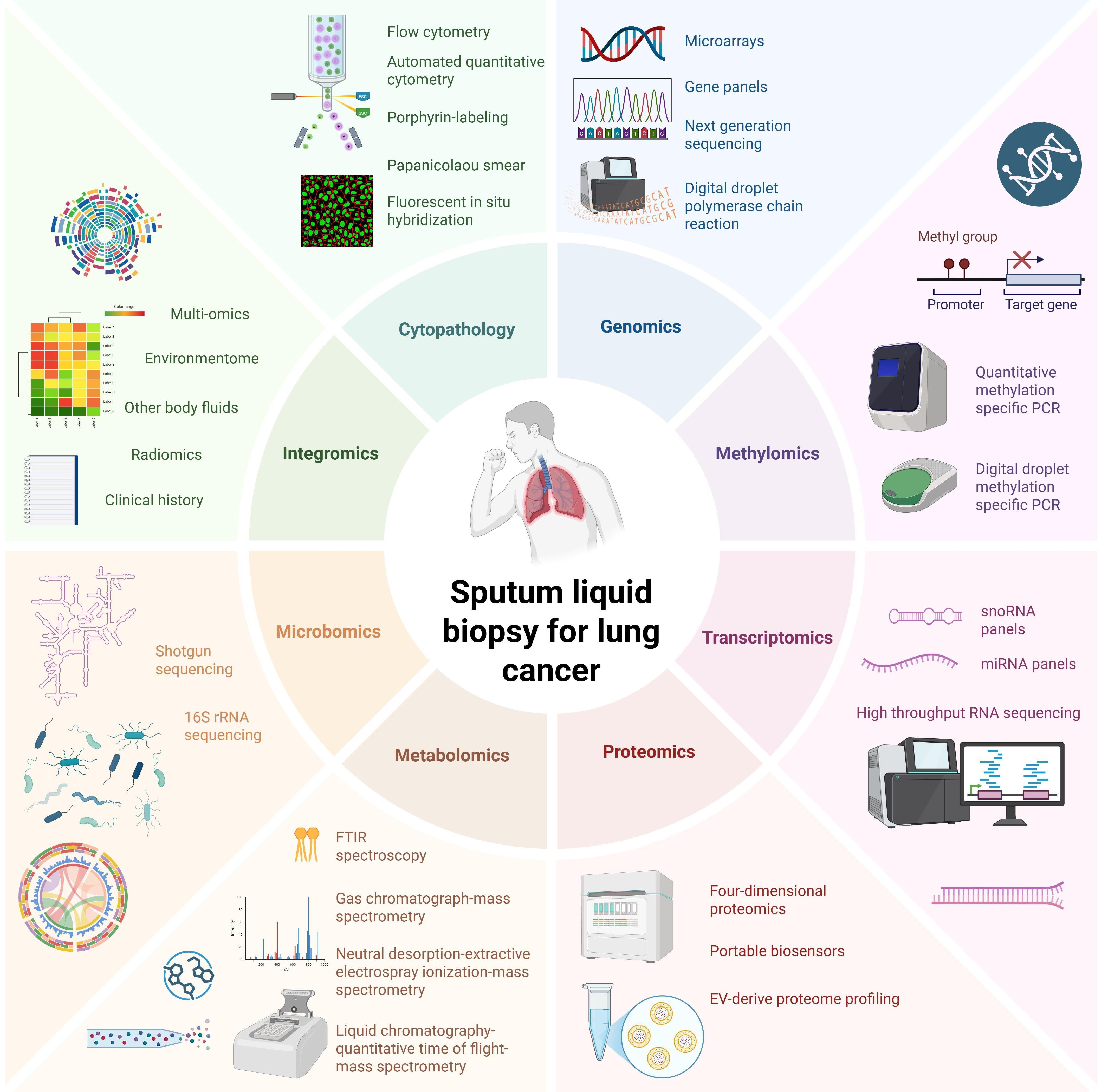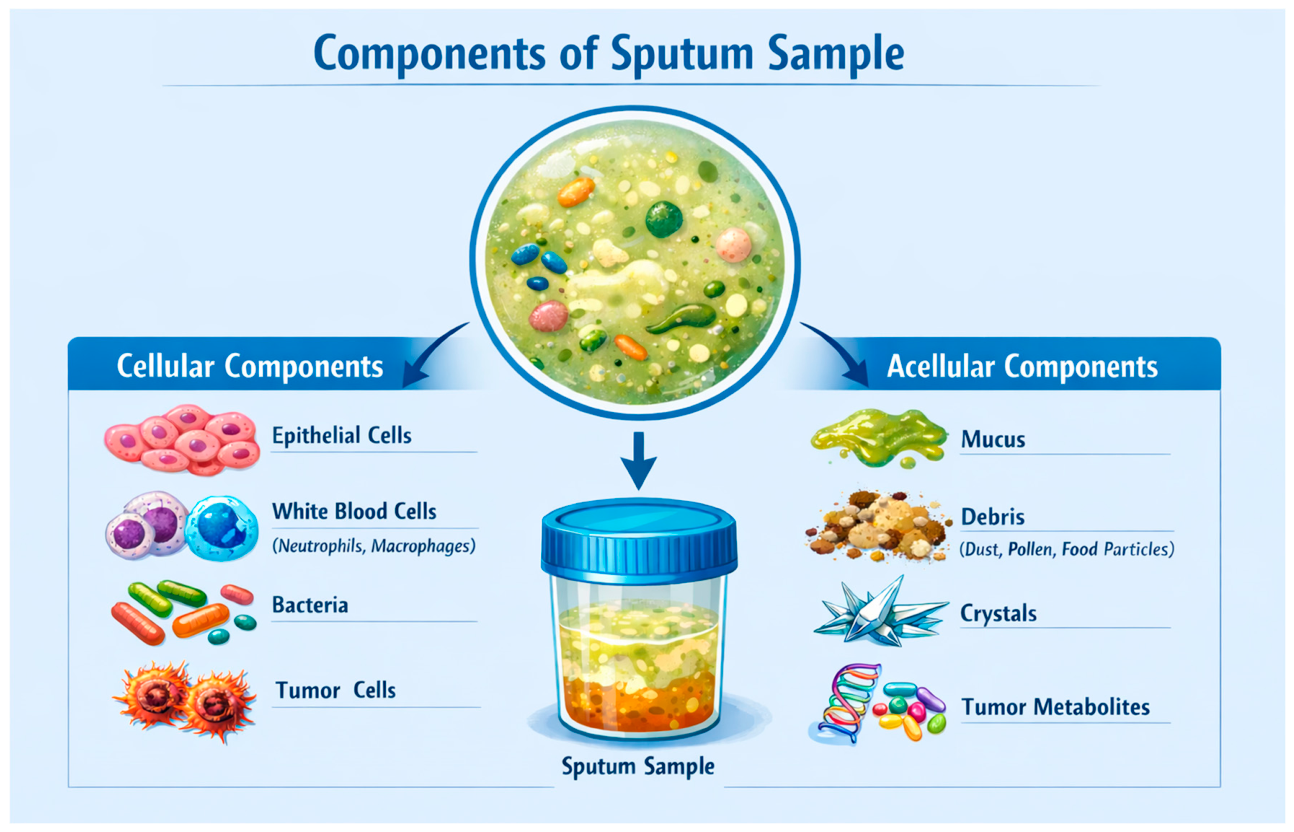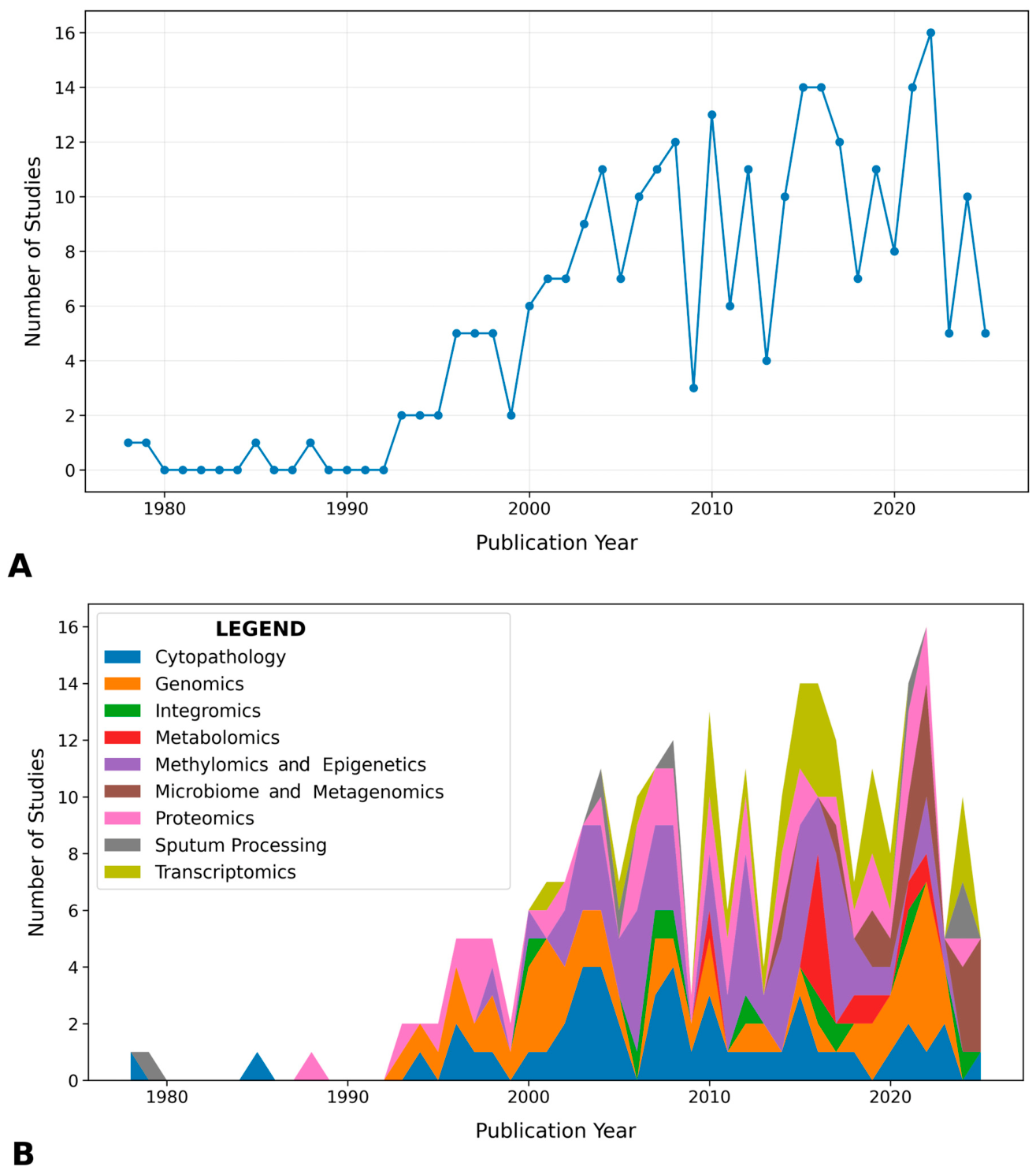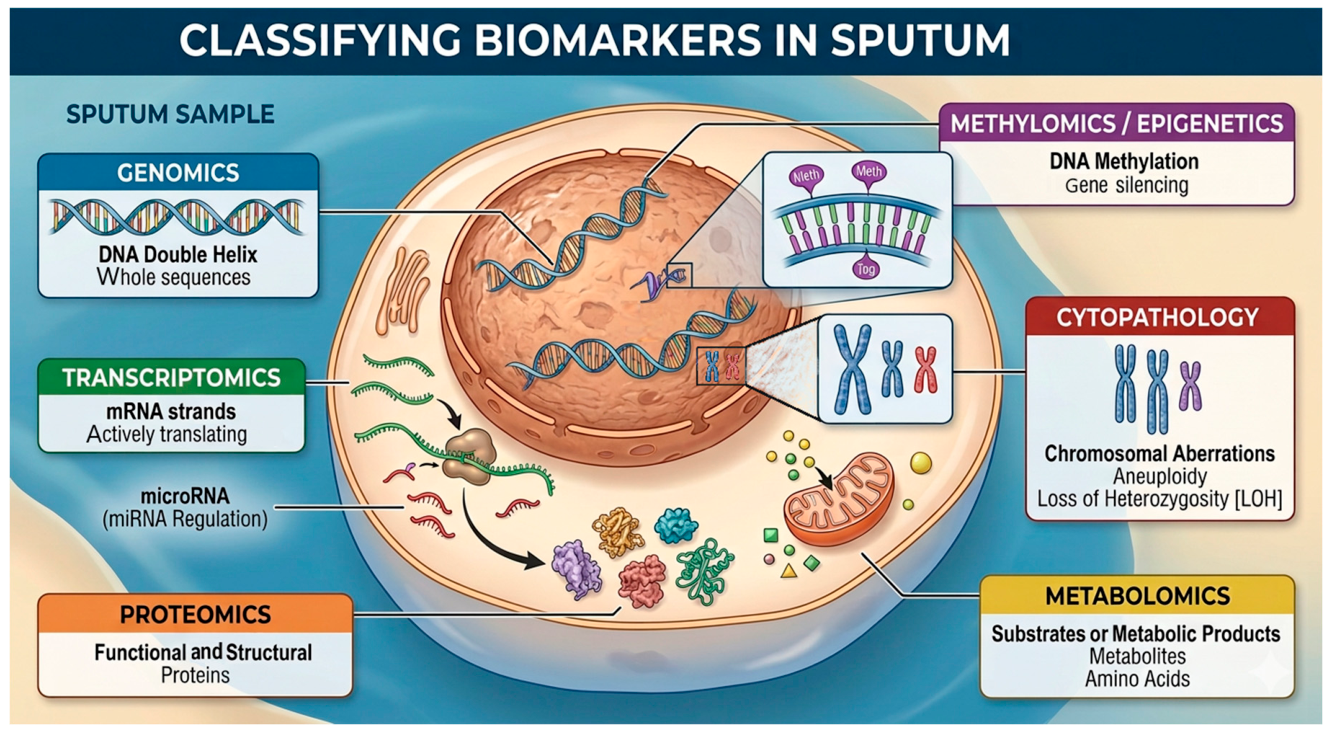

Sputum Liquid Biopsy for Lung Cancer Screening, Diagnosis, Subtyping, Surveillance, Response Prediction, and Prognostication: A Scoping Review

 ,
,  ,
,  ,
, 
Abstract
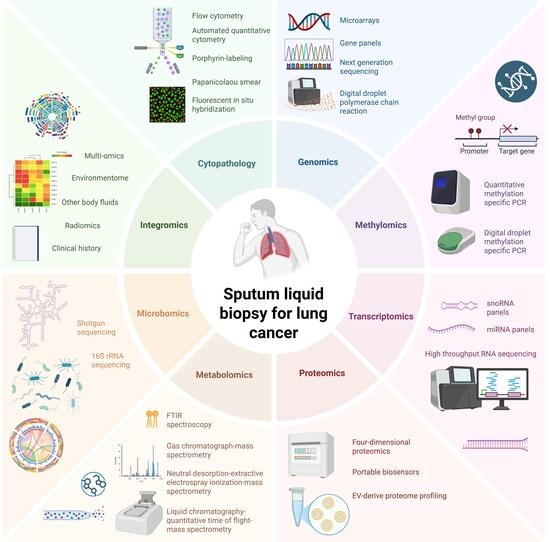
1. Introduction
2. Materials and Methods
2.1. Scoping Review Methodology and Reporting Framework
2.2. Eligibility Criteria
2.3. Information Sources and Search Strategy
2.4. Study Selection and Data Charting
2.5. Risk of Bias Assessment and Critical Appraisal
2.6. Data Synthesis
3. Results
3.1. Study Selection and Inclusion
3.2. Characteristics of Sources
3.3. Reporting Quality and Risk of Bias
3.4. Evidence Mapping and Synthesis by Biomarker Domain
3.4.1. Cytopathology

| Cytopathology Approach | Representative Techniques | Representative Studies | Main Findings | Typical Setting | Key Limitations |
|---|---|---|---|---|---|
| Conventional sputum cytology | Papanicolaou smear; morphologic assessment of exfoliated cells | Historical cytology literature, including Payne et al. (1997) [35] | Established sputum as a clinically relevant respiratory specimen; historical foundation for LC detection, but diagnostic yield variable | Historical screening and diagnostic studies | Variable sensitivity; dependence on specimen adequacy; operator- and interpreter-related variability |
| Automated DNA cytometry/flow cytometry | Quantitative microscopy; automated DNA cytometry; flow cytometry; porphyrin-labeling of sputum; AI-assisted classification | Patriquin et al. (2015) [36] Rebel et al. (2021) [37] Bederka et al. (2022) [38] Bauta et al. (2023) [39] | Promising discrimination between malignant and non-malignant sputum samples; supported contemporary assay development, including CyPath® Lung (bioAffinity Technologies, Inc.; San Antonio, TX, USA) | Case–control and cohort studies, with evolving interest in screening applications | Heterogeneous designs and platforms; limited prospective screening validation; incomplete standardization across studies |
| Cell enrichment for cytologic diagnosis | Magnetic-activated cell sorting (MACS) | Qiu et al. (2008) [41] | Magnetic enrichment of bronchial epithelial cells appeared to improve recovery of diagnostically relevant cells from sputum | Diagnostic enrichment setting | Limited external validation and sparse follow-up literature |
| FISH/chromosomal aberration assays | FISH for chromosomal aberrations; aneusomy panels; chromosomal copy number abnormalities | Jia et al. (2000) [44] Baron et al. (2017) [47] Shlomi et al. (2018) [46] | FISH-based chromosomal aberration assays generally demonstrated higher sensitivity than conventional sputum cytology in head-to-head comparisons; appeared especially promising in high-risk populations | High-risk or diagnostically enriched cohorts | Performance varied by assay platform, clinical setting, and study design; small or selected samples; moderate to high risk of bias |
| Microsatellite alteration assays | Loss of heterozygosity (LOH); microsatellite instability (MSI); fractional allele loss panels | Mao et al. (1994) [42] Miozzo et al. (1996) [43] Castagnaro et al. (2007) [45] Arvanitis et al. (2003) [48] | Microsatellite-based analyses were technically feasible and biologically informative; abnormal signals detected in some patients with LC and occasionally in heavy smokers, with fractional allele loss markedly higher in cases than controls | Mostly proof-of-concept and small case–control studies | Small sample sizes; proof-of-concept designs; non-standardized marker panels; limited reproducibility data; generally moderate-high or high risk of bias |
| Telomerase-based assays | Telomerase repeat amplification protocol (TRAP) assay | Sen et al. (2001 and 2002) [49,50] Pasrija et al. (2007) [51] | Prospective diagnostic studies reported generally favorable but inconsistent performance for telomerase activity in sputum | Clinically suspected, predominantly advanced-stage, populations | Sensitivity inconsistent across studies; false-positive results in some non-malignant inflammatory conditions |
3.4.2. Genomics
| Domain | Representative Techniques | Representative Studies | Main Findings | Typical Setting | Key Limitations |
|---|---|---|---|---|---|
| TP53 and K-RAS mutations | PCR-based mutation detection of K-RAS codon 12 and TP53 alterations | Takeda et al. [52] Zhang et al. [54] Nakajima et al. [55] Chen et al. [56] Guo et al. [58] Anderson et al. [59] | Compared with cytology, molecular detection often improved sensitivity, but specificity was imperfect High-risk controls were mutation-positive (field cancerization) | Mainly high-risk smokers and patients with suspected or established LC; mostly feasibility, diagnostic, or case–control designs | Small sample sizes; older low-sensitivity platforms; heterogeneous pre-analytic methods; occasional tumor-sputum discordance; concern for field cancerization; overall risk of bias generally moderate to high |
| EGFR mutation | ARMS-PCR, ddPCR, sequencing-based techniques; sputum cell sediment or supernatant cfDNA | Su et al. [60] Wang et al. [73] Isaka et al. [62] | Sputum-based EGFR genotyping is feasible, especially in advanced NSCLC and in cytology-positive or tumor-enriched sputum Specificity was consistently high, whereas sensitivity varied markedly | Paired tumor-sputum samples from suspected or known NSCLC; often, advanced stage; cytology-positive sputum in some studies | Sensitivity inconsistent in unselected sputum; selected populations or exclusion of inadequate specimens; limited external clinical validation |
| BRAF mutation EML4-ALK fusion | BRAF V600E detection in virtual sputum; multiplex RT-PCR and LCCP for EML4-ALK fusion detection | Emaus et al. [64] Soda et al. [65] Wang et al. [66] Morikawa et al. [68] | Preclinical evidence of BRAF V600E mutation in artificial sputum Proof-of-concept clinical studies supported EML4-ALK fusion detection, but tiny sample size | Established NSCLC undergoing molecular profiling; mostly cytology-positive sputum | Extremely limited evidence base; findings mainly support feasibility |
| Multi-gene panels | Mini-chip and multiplex assays targeting combinations of genes or alterations | Jiang et al. [69] Jiang et al. [70] Carozzi et al. [71] | Panels consistently outperformed single-gene assays; favorable sensitivity and specificity in early-stage NSCLC, when combined with CT | Case–control and screening-enriched cohorts; several studies emphasized central tumors or CT-screening cohorts | Panel marker composition and thresholds varied considerably across studies; limiting comparability; selection bias; limited external validation |
| Broad NGS profiling of sputum cfDNA | Large targeted sequencing panels (e.g., 10-gene, 168-gene, or 520-gene panels) | Qin et al. [24] Xie et al. [25] Wang et al. [72] | Sputum cfDNA NGS demonstrated moderate to high concordance with paired tumor tissue Better performance in sputum supernatant than cell sediment Higher sensitivity in advanced disease | Advanced NSCLC; paired tissue comparator studies evaluating molecular profiling | Selected, advanced-disease cohorts; applicability to clinical settings uncertain; heterogeneity due to differences in panel size, specimen processing techniques, and adequacy criteria |
3.4.3. Methylomics and Epigenetics
| Domain | Representative Techniques | Representative Studies | Main Findings | Typical Setting | Key Limitations |
|---|---|---|---|---|---|
| Proof-of-concept | Conventional MSP | Belinsky et al. [74] | Biologic plausibility of sputum methylation as an early event in lung carcinogenesis | Early biologic discovery and translational studies in smokers and LC patients | Primarily mechanistic and observational; limited immediate clinical validation for stand-alone diagnosis |
| Field cancerization in smokers | Nested MSP, MSRE-PCR | Belinsky et al. [75] Rosell et al. [83] | Methylation abnormalities are frequent, even in cancer-free smokers, and may persist after smoking cessation | High-risk smoking populations without known LC | Background prevalence reduces cancer specificity and complicates interpretation of isolated methylated loci |
| Multi-gene methylation panels | Multiplex MSP, MSRE-PCR | Belinsky et al. [76] Mohammed et al. [84] | Panel-based assays generally outperformed single-gene testing; increasing numbers of methylated genes correlated with higher lung cancer risk | High-risk smokers and known LC patients; case–control or cohort designs | Moderate sensitivity and specificity; predictive performance varied by time to diagnosis and cohort characteristics |
| Methylation markers linked to post-resection recurrence | Multiplex MSP, MSRE-PCR, CoBRA-MSP | Belinsky et al. [79] Tessema et al. [85] | Gene methylation in sputum post-resection was associated with odds of recurrence | High-risk screening or surveillance cohorts undergoing longitudinal follow-up | Few methylation markers were specific for recurrence |
| DNA methylation topology | 3D quantitative DNA methylation imaging | Tajbakhsh et al. [80] Soukiasian et al. [81] | Sputum-based methylation topology can detect hypomethylated cancerous cells, potentially detecting early LC | High-risk smokers, LC patients, and COPD patients | Small sample size; limited prospective clinical validation; moderate to high-risk of bias |
| Systematic review of sputum cfDNA methylomics | QMSP and ddMSP | Wen et al. [27] | Sensitivity and specificity of sputum methylated tumor DNA for LC detection varied considerably; divergence relates to tumor site, sample acquisition, extraction methods, and methylation measurement techniques | Meta-analysis of 15 studies with substantial, but unquantified, heterogeneity | Substantial heterogeneity in study designs, sputum acquisition protocols, and methylation measurement techniques; however, no objective measure of heterogeneity reported |
3.4.4. Proteomics
3.4.5. Transcriptomics
| Transcriptomic Approach | Representative Biomarkers | Representative Studies | Main Findings | Key Limitations |
|---|---|---|---|---|
| Single-target mRNA assays | Survivin mRNA RT-PCR; hTERT mRNA template-ready PCR; preproGRP RT-PCR | Chen et al. [92] Chen et al. [94] Dong et al. [93] Lacroix et al. [97] | Single-gene mRNA assays improved diagnostic yield over sputum cytology; hTERT mRNA showed strong specificity compared with benign pulmonary controls; preproGRP showed limited sensitivity for SCLC | Sample size; heterogeneous studies; RNA integrity, sputum handling, and cellular composition likely influenced performance |
| Single ncRNA markers | miR-223; circ_0006949 | Bagheri et al. [95] Bai et al. [96] | Promising discriminatory ability; miR-223 and circ_0006949 showed specificity for NSCLC | Small and exploratory studies; limited external validation; risk of overfitting |
| Histology-oriented miRNA panels | Four-miRNA adenocarcinoma panel (miR-486, miR-21, miR-200b, miR-375); three-miRNA squamous cell carcinoma panel (miR-205, miR-210, miR-708) | Yu et al. [98] Xing et al. [99] | Panels outperformed single target assays; consistent across training and validation cohorts; potential for sputum-based histologic subtyping | Hospital-based case–control cohorts with diagnostically enriched populations; broad applicability uncertain |
| General diagnostic miRNA panels | Five-miRNA, three-miRNA, and two-miRNA digital PCR panels | Roa et al. [100] Razzak et al. [101] Li et al. [102] | miRNA panels had high sensitivity and specificity for NSCLC; digital PCR more precise and feasible for sputum-based quantification | Performance varied across platforms, panel composition, and disease stage; small sample size; internal validation only |
| Integrated RNA plus imaging approaches | miR-31/miR-210 panel with CT; three-miRNA panel for indeterminate SPN | Shen et al. [103] Xing et al. [104] | Sputum RNA biomarkers combined with CT improved sensitivity and specificity for SPN triage and diagnosis | Independent, external validation awaited; impact on clinical outcomes remains to be demonstrated |
| snoRNA and broader ncRNA panels | snoRD66/snoRD78; five-ncRNA panel; miR-145/miR-126/miR-7 panel | Su et al. [106] | snoRNA and mixed ncRNA panels had moderate to strong diagnostic performance; improved specificity when combined with CT | Small sample size; limited external validation; risk of overfitting |
3.4.6. Metabolomics
3.4.7. Metagenomics and Microbiomics
| Metagenomic Approaches | Representative Biomarkers | Representative Studies | Main Findings | Key Limitations |
|---|---|---|---|---|
| Exploratory diagnostic microbiome profiling | 16S rRNA shotgun sequencing; microbial community composition and β-diversity analyses | Baranova et al. [127] Cameron et al. [118] Druzhinin et al. [119] | Sputum microbial composition differed between LC and non-cancer controls; airway dysbiosis accompanies LC | Small, single-center, and exploratory studies; global diversity findings were inconsistent; performance metrics missing in many studies |
| Histology-specific microbiome stratification | Subtype-focused sputum bacterial profiling in squamous cell carcinoma versus adenocarcinoma | Druzhinin et al. [121] Baranova et al. [117] | Microbiome alterations more pronounced in squamous cell carcinoma than in adenocarcinoma | Hypothesis-generating evidence based on cross-sectional study; external, independent validation needed |
| Stage, metastasis, and molecular phenotype associations | Association analyses linking sputum microbiota to early versus advanced stage, metastatic pattern, and EGFR mutation status | Huang et al. [122] Lu et al. [123] | Within NSCLC, sputum microbial patterns were associated with stage, metastasis, and molecular alterations | Biological feasibility studies; confounding bias possible; needs larger scale validation |
| Machine-learning diagnostic models | Random-forest models based on sputum microbial signatures | Lu et al. [123] | Machine-learning models afforded fair discriminatory performance (AUROC 0.75) for NSCLC | Limited external validation; uncertain reproducibility across populations and sequencing pipelines |
| Integrated multi-analyte biomarker panels | Sputum bacterial DNA markers combined with circulating plasma miRNAs | Dhilipkannah et al. [124] | Combined sputum DNA and plasma miRNA panel had 87% sensitivity and 89% specificity | Impact on patient outcomes uncertain; independent validation needed |
| Immunotherapy response prediction | Baseline sputum microbiota as predictors of anti-PD-1 ICI response | Zhang et al. [128] Zapata-Garcia et al. [126] | Higher airway α-diversity and enrichment of certain taxa associated with response to anti-PD-1 ICI therapy | Early-phase, retrospective, exploratory evidence; confounding bias possible; clinical utility remains to be demonstrated |
3.4.8. Integromics/Multi-Omics Approaches
| Integromics Approach | Representative Biomarkers | Representative Studies | Main Findings | Key Limitations |
|---|---|---|---|---|
| Multimodality sputum assessment | Combined sputum cytopathology (DNA cytometry; FISH for LOH and MSI), genomics (K-RAS and TP53 mutations), methylomics (p16INK4a and RASSF1A promoter hypermethylation), proteomics (MAGE A1-A6) and transcriptomics (miR-31, miR-210) | Kersting et al. (2000) [134] Baryshnikova et al. (2008) [130] Shin et al. (2012) [135] Su et al. (2016) [131] | Combining multiple sputum-based biomarkers improves upon the performance of conventional cytology; performance metrics suggest strong sensitivity, specificity, and overall accuracy in nested case–control studies | Although stronger than conventional approaches, assays relied on targeted biomarkers/candidates selected from earlier work; nested case–control designs with unclear applicability to real-world cohorts |
| Sputum LB combined with blood-based LB | Microplate ddPCR quantification of multiple sputum miRNAs, sputum DNA methylation, and plasma miRNAs | Li et al. (2021) [82] | A 96-well ddPCR workflow simultaneously quantified many candidate targets and identified an integrated biomarker panel spanning sputum and plasma that outperformed single biomarker classes for early LC diagnosis, with reproducible validation in an independent cohort | Retrospective case–control design; applicability to real-world screening cohorts remains unclear |
| Sputum LB in conjunction with imaging | ITALUNG biomarker panel (IBP) combined with sputum cytopathology and LDCT results | Carozzi et al. (2017) [133] | The IBP showed very high positivity among baseline screen-detected LC; when combined with LDCT, IBP improved specificity and positive predictive value relative to single-test screening | IBP alone had lower specificity when used alone; simulation-based extrapolation used for multimodal performance metrics; further validation needed in real-world screening cohorts |
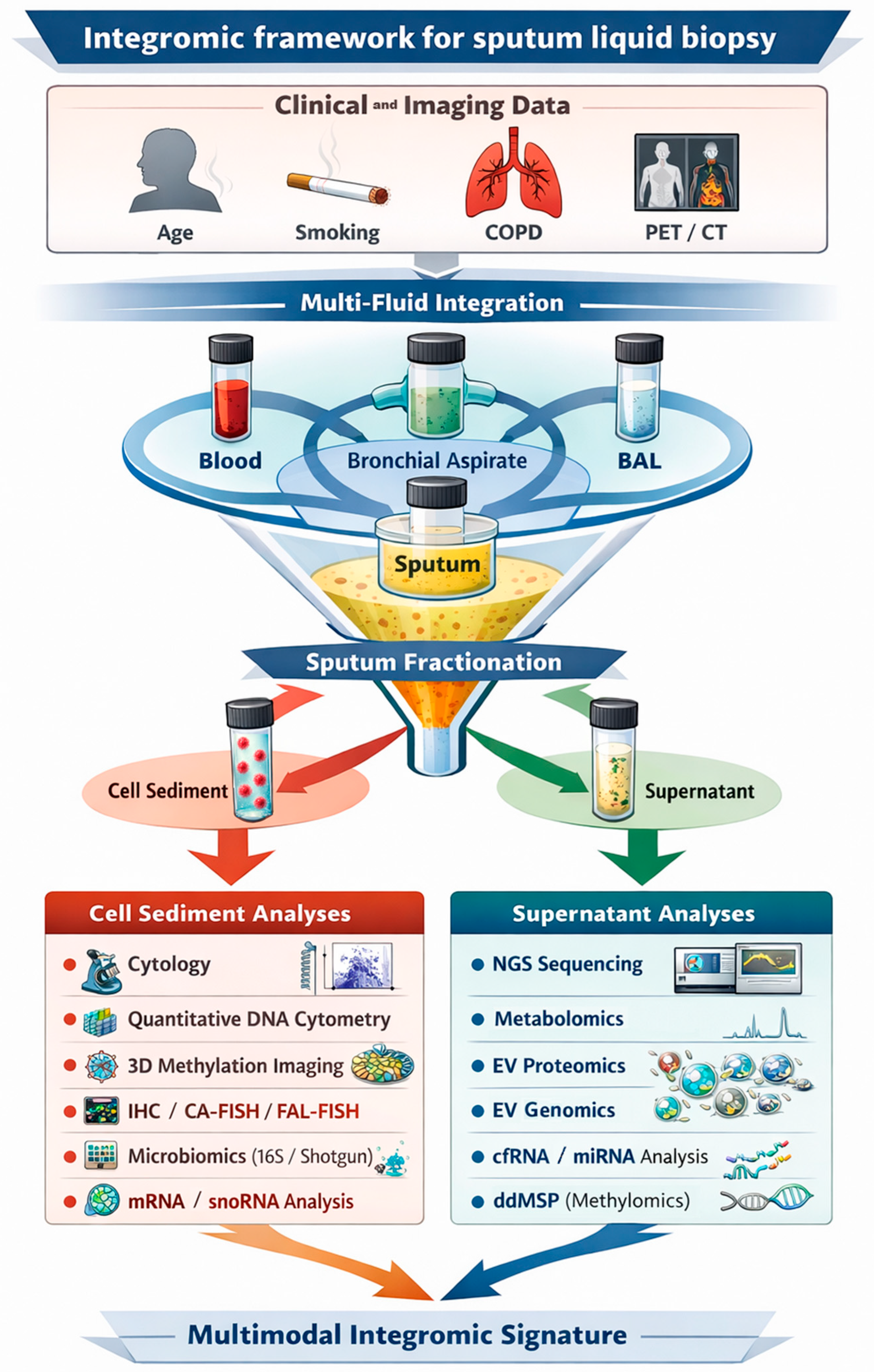
| True multi-omics (clinical, imaging, blood, and sputum) approach | Clinical variables (e.g., smoking), imaging (e.g., SPN), sputum LB (e.g., microbial signals, methylomics) and plasma LB (e.g., ncRNA profile) | Liao et al. (2024) [132] | This mature “integromic” framework (molecular signals from plasma and sputum combined with radiologic and clinical predictors) could distinguish malignant from benign LDCT-detected nodules with sufficient specificity, outperforming other approaches | Low sensitivity for stage I disease; impact on patient outcomes needs to be validated in real-world screening cohorts |
3.4.9. Other: Laboratory Techniques and Sputum Processing
4. Discussion
4.1. Key Findings
4.2. Research Gaps and Barriers to Translation
4.3. Implications of Available Evidence
4.4. Priorities for Future Research
5. Conclusions
Supplementary Materials
Author Contributions
Funding
Institutional Review Board Statement
Informed Consent Statement
Data Availability Statement
Acknowledgments
Conflicts of Interest
Abbreviations
| AGA | Actionable genomic alteration |
| AI | Artificial intelligence |
| ALK | Anaplastic lymphoma kinase |
| AMP | Adenosine monophosphate |
| ANN | Artificial neural network |
| APC | Adenomatous polyposis coli |
| ARMS | Amplification-refractory mutation system |
| AUC | Area under the curve |
| AUROC | Area under the receiver operating characteristic curve |
| BIOCROSS | Biomarker-based cross-sectional study |
| BRAF | v-raf murine sarcoma viral oncogene, homolog B |
| CA125 | Cancer antigen 125 |
| CA-FISH | Chromosomal aneusomy–fluorescence in situ hybridization |
| CAP | Community-acquired pneumonia |
| CD | Cluster of differentiation |
| CEA | Carcinoembryonic antigen |
| cfDNA | Cell-free deoxyribonucleic acid |
| cfRNA | Cell-free ribonucleic acid |
| CID | Collision-induced dissociation |
| circRNA | Circular ribonucleic acid |
| CoBRA | Combined bisulfite modification and restriction analysis |
| COPD | Chronic obstructive pulmonary disease |
| CRP | C-reactive protein |
| CT | Computed tomography |
| CTCs | Circulating tumor cells |
| ctDNA | Circulating tumor deoxyribonucleic acid |
| CYFRA21-1 | Cytokeratin fragment 19 |
| CYGB | Cytoglobin |
| ddMSP | Droplet digital methylation-specific polymerase chain reaction |
| ddPCR | Droplet digital polymerase chain reaction |
| DELUGE | Detecting Early Lung Cancer in the Mississippi Delta Cohort |
| diaPASEF | Data-independent acquisition, parallel accumulation, serial fragmentation (proteomics) |
| DNA | Deoxyribonucleic acid |
| DPAK | Death-associated protein kinase |
| DPPC | Dipalmitoyl phosphatidylcholine |
| EBC | Exhaled breath condensate |
| EDRN | Early Detection Research Network |
| EGFR | Epidermal growth factor receptor |
| ELISA | Enzyme-linked immunosorbent assay |
| EML4 | Echinoderm microtubule-associated protein-like 4 |
| ENO1 | Enolase 1 |
| EV | Extracellular vesicle |
| FAL-FISH | Fractional allele loss–fluorescence in situ hybridization |
| FDA | Food and Drug Administration |
| FHIT | Fragile histidine triad |
| FIE-MS | Flow infusion electrospray ion mass spectrometry |
| FISH | Fluorescence in situ hybridization |
| FTIR | Fourier transform infrared (spectroscopy) |
| GC-MS | Gas chromatography–mass spectrometry |
| GRP | Gastrin-releasing peptide |
| GLOBOCAN | Global Cancer Observatory |
| HER2 | Human epidermal growth factor receptor 2 |
| HSROC | Hierarchical summary receiver operating characteristic |
| hTERT | Human telomerase reverse transcriptase |
| HYAL2 | Hyaluronidase 2 |
| IBP | ITALUNG biomarker panel |
| ICAM-1 | Intercellular adhesion molecule 1 |
| ICI | Immune checkpoint inhibitor |
| JBI | Joanna Briggs Institute |
| K-RAS | Kirsten rat sarcoma viral oncogene homolog |
| LB | Liquid biopsy |
| LC | Lung cancer |
| LCCP | Lung Cancer Compact Panel® |
| LC-QTOF-MS | Liquid chromatography quadrupole time-of-flight mass spectrometry |
| LDCT | Low-dose computed tomography |
| LOH | Loss of heterozygosity |
| MACS | Magnetic-activated cell sorting |
| MAGE-A | Melanoma-associated antigen A family |
| MALDI-TOF | Matrix-assisted laser desorption/ionization time-of-flight |
| MAP4 | Microtubule-associated protein 4 |
| MCM | Minichromosome maintenance |
| MGMT | O6-methylguanine DNA methyltransferase |
| miRNA | Micro-ribonucleic acid |
| mRNA | Messenger ribonucleic acid |
| MRS | Magnetic resonance spectroscopy |
| MS | Mass spectrometry |
| MSI | Microsatellite instability |
| MSP | Methylation-specific polymerase chain reaction |
| MSRE | Methylation-specific restriction enzyme |
| NCCN | National Comprehensive Cancer Network |
| NCI | National Cancer Institute |
| ncRNA | Non-coding ribonucleic acid |
| ND-EESI-MS | Neutral desorption extractive electrospray ionization mass spectrometry |
| NGS | Next-generation sequencing |
| NLST | National Lung Screening Trial |
| NMR | Nuclear magnetic resonance |
| NRG | Neuregulin |
| NSCLC | Non–small cell lung cancer |
| NSE | Neuron-specific enolase |
| NTRK | Neurotrophic tyrosine receptor kinase |
| OPLS-DA | Orthogonal partial least squares discriminant analysis |
| p16INK4a | Inhibitor of cyclin-dependent kinase–4 family, 16 kDa protein |
| p53 | Tumor protein 53 |
| PAX5 | Paired box 5 |
| PCA | Principal component analysis |
| PCR | Polymerase chain reaction |
| PD1 | Programmed cell death protein 1 |
| PG | Phosphatidylglycerol |
| PGP | Phosphatidylglycerol phosphate |
| PLS-DA | Partial least squares discriminant analysis |
| PRISMA-ScR | Preferred Reporting Items for Systematic Reviews and Meta-Analyses—extension for Scoping Reviews |
| PWS | Pulsed wave spectrometry |
| QMSP | Quantitative methylation-specific polymerase chain reaction |
| QUADAS-2 | Quality Assessment of Diagnostic Accuracy Studies |
| QUIPS | Quality in Prognostic Studies |
| RAR | Retinoic acid receptor |
| RASSF1A | Ras association domain family 1 isoform A |
| RET | Rearranged during transfection proto-oncogene |
| RNA | Ribonucleic acid |
| ROC | Receiver operating characteristic |
| RT-PCR | Reverse transcription polymerase chain reaction |
| SCFA | Short-chain fatty acids |
| SCLC | Small cell lung cancer |
| SELDI-TOF | Surface-enhanced laser desorption/ionization time-of-flight |
| SERPINA1 | Serpin family A member 1 |
| SKP2 | S-phase kinase-associated protein 2 |
| snoRNA | Small nucleolar ribonucleic acid |
| SOX | SRY-box transcription factor |
| sPLS-DA | Sparse partial least squares discriminant analysis |
| SPN | Solitary pulmonary nodule |
| TAC1 | Tachykinin precursor 1 |
| TNF | Tumor necrosis factor |
| TRAP | Telomerase repeat amplification protocol |
| UGGT1 | UDP-glucose:glycoprotein glucosyltransferase 1 |
| VEGF | Vascular endothelial growth factor |
Appendix A
Appendix A.1. Cytopathology
- bioAffinity Technologies Inc. Detection of early-stage lung cancer in sputum using flow cytometry and an automated analysis pipeline. Available online: https://clinicaltrials.gov/study/NCT07168993 (accessed on 20 March 2026)
- Adonis, M.I.; Diaz, J.; Miranda, V.R.; Chahuan, M.; Zambrano, A.; Benitez, H.C.; Campos, M.; Avaria, P.; Urzua, U.; Marin, P.; et al. Biomarkers for screening of lung cancer and pre-neoplastic lesions in a high risk Chilean population. Biol Res 2014, 47, 62, doi:10.1186/0717-6287-47-62.
- Arvanitis, D.A.; Papadakis, E.; Zafiropoulos, A.; Spandidos, D.A. Fractional allele loss is a valuable marker for human lung cancer detection in sputum. Lung Cancer 2003, 40, 55–66, doi:10.1016/s0169-5002(02)00531-7.
- Auffermann, W.; Bocking, A. Early detection of precancerous lesions in dysplasias of the lung by rapid DNA image cytometry. Anal Quant Cytol Histol 1985, 7, 218–226.
- Baron, A.E.; Kako, S.; Feser, W.J.; Malinowski, H.; Merrick, D.; Garg, K.; Malkoski, S.; Pretzel, S.; Siegfried, J.M.; Franklin, W.A.; et al. Clinical Utility of Chromosomal Aneusomy in Individuals at High Risk of Lung Cancer. J Thorac Oncol 2017, 12, 1512–1523, doi:10.1016/j.jtho.2017.06.008.
- Bauta, W.; Grayson, M.; Titone, R.; Rebeles, J.; Rebel, V.I. Porphyrin-modified beads for use as compensation controls in flow cytometry. J Vis Exp 2023, doi:10.3791/65294.
- Bederka, L.H.; Sanchez, J.R.; Rebeles, J.; Araujo, P.R.; Grayson, M.H.; Lai, S.C.; DePalo, L.R.; Habib, S.A.; Hill, D.G.; Lopez, K.; et al. Sputum analysis by flow cytometry; an effective platform to analyze the lung environment. PLoS One 2022, 17, e0272069, doi:10.1371/journal.pone.0272069.
- Cao, L.; Zhai, Z.; Li, J.; Xu, M.; Xia, H.; Xu, X.; Ma, D.; Mei, X.; Cui, W. [The diagnostic value of flow cytometric DNA analysis of sputum in lung cancer]. Zhongguo Fei Ai Za Zhi 2004, 7, 202–205, doi:10.3779/j.issn.1009-3419.2004.03.05.
- Castagnaro, A.; Marangio, E.; Verduri, A.; Chetta, A.; D’Ippolito, R.; Del Donno, M.; Olivieri, D.; Di Cola, G. Microsatellite analysis of induced sputum DNA in patients with lung cancer in heavy smokers and in healthy subjects. Exp Lung Res 2007, 33, 289–301, doi:10.1080/01902140701539687.
- Cui, J.; Wang, X.; Rao, Y.; Ji, T.; Li, L. A new method for the sputum cytology test without direct contact to specimens during COVID-19 pandemic. Front Med (Lausanne) 2021, 8, 746731, doi:10.3389/fmed.2021.746731.
- Eerola, A.K.; Soini, Y.; Lehto, V.P.; Paakko, P. Increased numbers of alveolar macrophages with apoptotic bodies predict lung carcinoma. Apoptosis 1998, 3, 261–266, doi:10.1023/a:1009661209006.
- Fafin-Lefevre, M.; Morlais, F.; Guittet, L.; Clin, B.; Launoy, G.; Galateau-Salle, F.; Plancoulaine, B.; Herlin, P.; Letourneux, M. Nuclear morphology for the detection of alterations in bronchial cells from lung cancer: an attempt to improve sensitivity and specificity. Anal Quant Cytol Histol 2011, 33, 183–195.
- Fan, Y.G.; Hu, P.; Jiang, Y.; Chang, R.S.; Yao, S.X.; Wang, W.; He, J.; Prorok, P.; Qiao, Y.L. Association between sputum atypia and lung cancer risk in an occupational cohort in Yunnan, China. Chest 2009, 135, 778–785, doi:10.1378/chest.08-1469.
- Grainger, J.M.; Husain, O.A. Use of a mucolytic agent (Cytoclair) in the preparation of cell material for the detection of malignant cells in sputum. J Clin Pathol 1978, 31, 585–590, doi:10.1136/jcp.31.6.585.
- Guber, A.; Greif, J.; Rona, R.; Fireman, E.; Madi, L.; Kaplan, T.; Yemini, Z.; Gottfried, M.; Katz, R.L.; Daniely, M. Computerized analysis of cytology and fluorescence in situ hybridization (FISH) in induced sputum for lung cancer detection. Cancer Cytopathol 2010, 118, 269–277, doi:10.1002/cncy.20094.
- Jia, D.; Zhang, Z.; Liu, S. [Application of fluorescence in situ hybridization (FISH) in sputum cytologic diagnosis of lung cancer]. Zhonghua Zhong Liu Za Zhi 2000, 22, 477–479.
- Kang, J.U.; Koo, S.H.; Kwon, K.C.; Park, J.W.; Jung, S.S. Gain of the EGFR gene located on 7p12 is a frequent and early event in squamous cell carcinoma of the lung. Cancer Genet Cytogenet 2008, 184, 31–37, doi:10.1016/j.cancergencyto.2008.03.002.
- Katz, R.L.; Zaidi, T.M.; Fernandez, R.L.; Zhang, J.; He, W.; Acosta, C.; Daniely, M.; Madi, L.; Vargas, M.A.; Dong, Q.; et al. Automated detection of genetic abnormalities combined with cytology in sputum is a sensitive predictor of lung cancer. Mod Pathol 2008, 21, 950–960, doi:10.1038/modpathol.2008.71.
- Kemp, R.A.; Reinders, D.M.; Turic, B. Detection of lung cancer by automated sputum cytometry. J Thorac Oncol 2007, 2, 993–1000, doi:10.1097/JTO.0b013e318158d488.
- Kennedy, T.C.; Franklin, W.A.; Prindiville, S.A.; Cook, R.; Dempsey, E.C.; Keith, R.L.; Hirsch, F.R.; Merrick, T.A.; Shroyer, K.R.; Petty, T.L.; et al. High prevalence of occult endobronchial malignancy in high risk patients with moderate sputum atypia. Lung Cancer 2005, 49, 187–191, doi:10.1016/j.lungcan.2005.02.009.
- Kennedy, T.C.; Proudfoot, S.P.; Franklin, W.A.; Merrick, T.A.; Saccomanno, G.; Corkill, M.E.; Mumma, D.L.; Sirgi, K.E.; Miller, Y.E.; Archer, P.G.; et al. Cytopathological analysis of sputum in patients with airflow obstruction and significant smoking histories. Cancer Res 1996, 56, 4673–4678.
- Krivokuca, Z.; Tatomirovic, Z.; Cvetkovic, G.; Dzambas, J.; Skuletic, V.; Ristic, S. Validity of cytology in the diagnosis of small cell lung carcinoma. Vojnosanitetski pregled 2020, 77, 954–961, doi:10.2298/vsp180813172k.
- Li, G.; Guillaud, M.; LeRiche, J.; McWilliams, A.; Gazdar, A.; Lam, S.; MacAulay, C. Automated sputum cytometry for detection of intraepithelial neoplasias in the lung. Anal Cell Pathol (Amst) 2012, 35, 187–201, doi:10.3233/ACP-2012-0053.
- Lin, P.; Chen, Y.; Xu, J.; Huang, X.; Wen, W.; Zhang, L.; Kong, W.; Zhao, Z.; Ye, Y.; Bao, Z.; et al. A multicenter-retrospective cohort study of chromosome instability in lung cancer: clinical characteristics and prognosis of patients harboring chromosomal instability detected by metagenomic next-generation sequencing. J Thorac Dis 2023, 15, 112–122, doi:10.21037/jtd-22-1732.
- Mao, L.; Lee, D.J.; Tockman, M.S.; Erozan, Y.S.; Askin, F.; Sidransky, D. Microsatellite alterations as clonal markers for the detection of human cancer. Proc Natl Acad Sci U S A 1994, 91, 9871–9875, doi:10.1073/pnas.91.21.9871.
- McWilliams, A.; Mayo, J.; MacDonald, S.; leRiche, J.C.; Palcic, B.; Szabo, E.; Lam, S. Lung cancer screening. American Journal of Respiratory and Critical Care Medicine 2003, 168, 1167–1173, doi:10.1164/rccm.200301-144OC.
- Miozzo, M.; Sozzi, G.; Musso, K.; Pilotti, S.; Incarbone, M.; Pastorino, U.; Pierotti, M.A. Microsatellite alterations in bronchial and sputum specimens of lung cancer patients. Cancer Res 1996, 56, 2285–2288.
- Mondal, N.K.; Roychoudhury, S.; Ray, M.R. Higher AgNOR expression in metaplastic and dysplastic airway epithelial cells predicts the risk of developing lung cancer in women chronically exposed to biomass smoke. J Environ Pathol Toxicol Oncol 2015, 34, 35–51, doi:10.1615/jenvironpatholtoxicoloncol.2015010708.
- Palcic, B.; Garner, D.M.; Beveridge, J.; Sun, X.R.; Doudkine, A.; MacAulay, C.; Lam, S.; Payne, P.W. Increase of sensitivity of sputum cytology using high-resolution image cytometry: field study results. Cytometry 2002, 50, 168–176, doi:10.1002/cyto.10065.
- Pasrija, T.; Srinivasan, R.; Behera, D.; Majumdar, S. Telomerase activity in sputum and telomerase and its components in biopsies of advanced lung cancer. Eur J Cancer 2007, 43, 1476–1482, doi:10.1016/j.ejca.2007.04.003.
- Patriquin, L.; Merrick, D.T.; Hill, D.; Holcomb, R.G.; Lemieux, M.E.; Bennett, G.; Karia, B.; Rebel, V.I.; Bauer, T., 2nd. Early detection of lung cancer with meso tetra (4-carboxyphenyl) porphyrin-labeled sputum. J Thorac Oncol 2015, 10, 1311–1318, doi:10.1097/JTO.0000000000000627.
- Payne, P.W.; Sebo, T.J.; Doudkine, A.; Garner, D.; MacAulay, C.; Lam, S.; LeRichie, J.C.; Palcic, B. Sputum screening by quantitative microscopy: a reexamination of a portion of the National Cancer Institute Cooperative Early Lung Cancer Study. Mayo Clin Proc 1997, 72, 697–704, doi:10.4065/72.8.697.
- Prindiville, S.A.; Byers, T.; Hirsch, F.R.; Franklin, W.A.; Miller, Y.E.; Vu, K.O.; Wolf, H.J.; Baron, A.E.; Shroyer, K.R.; Zeng, C.; et al. Sputum cytological atypia as a predictor of incident lung cancer in a cohort of heavy smokers with airflow obstruction. Cancer Epidemiol Biomarkers Prev 2003, 12, 987–993.
- Qiu, Q.; Todd, N.W.; Li, R.; Peng, H.; Liu, Z.; Yfantis, H.G.; Katz, R.L.; Stass, S.A.; Jiang, F. Magnetic enrichment of bronchial epithelial cells from sputum for lung cancer diagnosis. Cancer 2008, 114, 275–283, doi:10.1002/cncr.23596.
- Rebel, V.; Bederka, L.; Araujo, P.; Sanchez, J.; Grayson, M.; Lemieux, M.; Rebeles, J.; Lai, S.; Reveles, X. Automated flow cytometry test distinguishes cancer from non-cancer in sputum with high sensitivity and specificity. In: Proceedings of the Journal of Thoracic Oncology, 2021; pp. S279-S280.
- Romeo, M.S.; Sokolova, I.A.; Morrison, L.E.; Zeng, C.; Baron, A.E.; Hirsch, F.R.; Miller, Y.E.; Franklin, W.A.; Varella-Garcia, M. Chromosomal abnormalities in non-small cell lung carcinomas and in bronchial epithelia of high-risk smokers detected by multi-target interphase fluorescence in situ hybridization. J Mol Diagn 2003, 5, 103–112, doi:10.1016/s1525-1578(10)60459-x.
- Saraswathy Veena, V.; Sara George, P.; Jayasree, K.; Sujathan, K. Comparative analysis of cell morphology in sputum samples homogenized with dithiothreitol, N-acetyl-L cysteine, Cytorich((R)) red preservative and in cellblock preparations to enhance the sensitivity of sputum cytology for the diagnosis of lung cancer. Diagn Cytopathol 2015, 43, 551–558, doi:10.1002/dc.23266.
- Sen, S.; Reddy, V.G.; Guleria, R.; Jain, S.K.; Kapila, K.; Singh, N. Telomerase--a potential molecular marker of lung and cervical cancer. Clin Chem Lab Med 2002, 40, 994–1001, doi:10.1515/CCLM.2002.173.
- Sen, S.; Reddy, V.G.; Khanna, N.; Guleria, R.; Kapila, K.; Singh, N. A comparative study of telomerase activity in sputum, bronchial washing and biopsy specimens of lung cancer. Lung Cancer 2001, 33, 41–49, doi:10.1016/s0169-5002(01)00193-3.
- Shlomi, D.; Peled, N.; Schwarz, Y.A.; Soo Hoo, G.W.; Batra, R.K.; Fink, G.; Kaplan, T.; Cohen, L.; Mollan, S.; Burfeind, W.R., Jr. Non-invasive early detection of malignant pulmonary nodules by FISH-based sputum test. Cancer Genet 2018, 226–227, 1–10, doi:10.1016/j.cancergen.2018.04.118.
- Tao, W.; Li, J.; Cheng, L.L. [Application of DNA-image cytometry in the diagnosis of lung cancer]. Zhonghua Zhong Liu Za Zhi 2016, 38, 113–117, doi:10.3760/cma.j.issn.0253-3766.2016.02.007.
- Tercelj, M.; Ales, A.; Rott, T.; Sever, N.; Prodnik, L.; Erzen, J.; Primic-Zakelj, M.; Rylander, R. DNA-based sputum cell image analysis for lung cancer in a clinical setting. Acta Cytol 2008, 52, 584–590, doi:10.1159/000325602.
- Varella-Garcia, M.; Kittelson, J.; Schulte, A.P.; Vu, K.O.; Wolf, H.J.; Zeng, C.; Hirsch, F.R.; Byers, T.; Kennedy, T.; Miller, Y.E.; et al. Multi-target interphase fluorescence in situ hybridization assay increases sensitivity of sputum cytology as a predictor of lung cancer. Cancer Detect Prev 2004, 28, 244–251, doi:10.1016/j.cdp.2004.04.007.
- Varella-Garcia, M.; Schulte, A.P.; Wolf, H.J.; Feser, W.J.; Zeng, C.; Braudrick, S.; Yin, X.; Hirsch, F.R.; Kennedy, T.C.; Keith, R.L.; et al. The detection of chromosomal aneusomy by fluorescence in situ hybridization in sputum predicts lung cancer incidence. Cancer Prev Res (Phila) 2010, 3, 447–453, doi:10.1158/1940-6207.CAPR-09-0165.
- Wang, F.; Zhang, Y.; Feng, Y.C.; Huang, Y.C. Comparison between FISH and cytology of sputum samples in detection of lung cancer. Journal of Practical Oncology 2013, 28, 197–199.
- Wang, X.; Cao, A.; Peng, M.; Hu, C.; Liu, D.; Gu, T.; Liu, H. The value of chest CT scan and tumor markers detection in sputum for early diagnosis of peripheral lung cancer. Zhongguo Fei Ai Za Zhi 2004, 7, 58–63, doi:10.3779/j.issn.1009-3419.2004.01.15.
- Xing, S.; Khanavkar, B.; Nakhosteen, J.A.; Atay, Z.; Jockel, K.H.; Marek, W.; Group, R.L.S. Predictive value of image cytometry for diagnosis of lung cancer in heavy smokers. Eur Respir J 2005, 25, 956–963, doi:10.1183/09031936.05.00118903.
- Yang, J.; Zhou, Y. Detection of DNA aneuploidy in exfoliated airway epithelia cells of sputum specimens by the automated image cytometry and its clinical value in the identification of lung cancer. J Huazhong Univ Sci Technolog Med Sci 2004, 24, 407–410, doi:10.1007/BF02861880.
- Zlobec, I.; Raineri, I.; Schneider, S.; Schoenegg, R.; Grilli, B.; Herzog, M.; Savic, S.; Bubendorf, L. Assessment of mean EGFR gene copy number is a highly reproducible method for evaluating FISH in histological and cytological cancer specimens. Lung Cancer 2010, 68, 192–197, doi:10.1016/j.lungcan.2009.06.019.
Appendix A.2. Genomics
- Anderson, M.; Sladon, S.; Michels, R.; Davidson, L.; Conwell, K., 2nd; Lechner, J.; Franklin, W.; Saccomanno, G.; Wiest, J. Examination of p53 alterations and cytokeratin expression in sputa collected from patients prior to histological diagnosis of squamous cell carcinoma. J Cell Biochem Suppl 1996, 25, 185–190.
- Besaratinia, A.; Maas, L.M.; Van Breda, S.G.; Curfs, D.M.; Kleinjans, J.C.; Wouters, E.F.; Van Schooten, F.J. Applicability of induced sputum for molecular dosimetry of exposure to inhalatory carcinogens: 32P-postlabeling of lipophilic DNA adducts in smokers and nonsmokers. Cancer Epidemiol Biomarkers Prev 2000, 9, 367–372.
- Carozzi, F.M.; Bisanzi, S.; Falini, P.; Sani, C.; Venturini, G.; Lopes Pegna, A.; Bianchi, R.; Ronchi, C.; Picozzi, G.; Mascalchi, M.; et al. Molecular profile in body fluids in subjects enrolled in a randomised trial for lung cancer screening: Perspectives of integrated strategies for early diagnosis. Lung Cancer 2010, 68, 216–221, doi:10.1016/j.lungcan.2009.06.015.
- Chen, J.T.; Chen, Y.C.; Wang, Y.C.; Tseng, R.C.; Chen, C.Y.; Wang, Y.C. Alterations of the p16(ink4a) gene in resected nonsmall cell lung tumors and exfoliated cells within sputum. Int J Cancer 2002, 98, 724–731, doi:10.1002/ijc.10262.
- Chen, J.T.; Ho, W.L.; Cheng, Y.W.; Lee, H. Detection of p53 mutations in sputum smears precedes diagnosis of non-small cell lung carcinoma. Anticancer Res 2000, 20, 2687–2690.
- Destro, A.; Bianchi, P.; Alloisio, M.; Laghi, L.; Di Gioia, S.; Malesci, A.; Cariboni, U.; Gribaudi, G.; Bulfamante, G.; Marchetti, A.; et al. K-ras and p16(INK4A)alterations in sputum of NSCLC patients and in heavy asymptomatic chronic smokers. Lung Cancer 2004, 44, 23–32, doi:10.1016/j.lungcan.2003.10.002.
- Emaus, M.N.; Anderson, J.L. Selective extraction of low-abundance BRAF V600E mutation from plasma, urine, and sputum using ion-tagged oligonucleotides and magnetic ionic liquids. Anal Bioanal Chem 2022, 414, 277–286, doi:10.1007/s00216-021-03216-8.
- Feng, Z.; Tian, D.; Lan, Q.; Mumford, J.L. A sensitive immunofluorescence assay for detection of p53 protein accumulation in sputum. Anticancer Res 1999, 19, 3847–3852.
- Guo, X.-j.; Ni, P.-h.; Li, L.; Deng, W.-w.; Wan, H.-y.; Shi, G.-c. Detection of p53 gene mutation of bronchoscopic samples in the patients suspected to lung cancer. Chinese Journal of Cancer Research 2000, 12, 282–285, doi:10.1007/bf02983507.
- Hackner, K.; Buder, A.; Hochmair, M.J.; Strieder, M.; Grech, C.; Fabikan, H.; Burghuber, O.C.; Errhalt, P.; Filipits, M. Detection of EGFR activating and resistance mutations by droplet digital PCR in sputum of EGFR-mutated NSCLC patients. Clin Med Insights Oncol 2021, 15, 1179554921993072, doi:10.1177/1179554921993072.
- Han, B.; Liao, M.; Bao, G.; Feng, J.; Dong, Q. [The relationship between smoking and p53 and Ki-ras gene mutations in sputum cells of patients with lung cancer]. Zhongguo Fei Ai Za Zhi 2001, 4, 41–43, doi:10.3779/j.issn.1009-3419.2001.01.11.
- He, C.; Wei, C.; Wen, J.; Chen, S.; Chen, L.; Wu, Y.; Shen, Y.; Bai, H.; Zhang, Y.; Chen, X.; et al. Comprehensive analysis of NGS and ARMS-PCR for detecting EGFR mutations based on 4467 cases of NSCLC patients. J Cancer Res Clin Oncol 2022, 148, 321–330, doi:10.1007/s00432-021-03818-w.
- Hubers, A.J.; Heideman, D.A.; Yatabe, Y.; Wood, M.D.; Tull, J.; Taron, M.; Molina, M.A.; Mayo, C.; Bertran-Alamillo, J.; Herder, G.J.; et al. EGFR mutation analysis in sputum of lung cancer patients: a multitechnique study. Lung Cancer 2013, 82, 38–43, doi:10.1016/j.lungcan.2013.07.011.
- Isaka, T.; Yokose, T.; Ito, H.; Nakayama, H.; Miyagi, Y.; Saito, H.; Masuda, M. Detection of EGFR mutation of pulmonary adenocarcinoma in sputum using droplet digital PCR. BMC Pulm Med 2021, 21, 100, doi:10.1186/s12890-021-01468-9.
- Jakupciak, J.P.; Maragh, S.; Markowitz, M.E.; Greenberg, A.K.; Hoque, M.O.; Maitra, A.; Barker, P.E.; Wagner, P.D.; Rom, W.N.; Srivastava, S.; et al. Performance of mitochondrial DNA mutations detecting early stage cancer. BMC Cancer 2008, 8, 285, doi:10.1186/1471-2407-8-285.
- Jiang, F.; Todd, N.W.; Li, R.; Zhang, H.; Fang, H.; Stass, S.A. A panel of sputum-based genomic marker for early detection of lung cancer. Cancer Prev Res (Phila) 2010, 3, 1571–1578, doi:10.1158/1940-6207.CAPR-10-0128.
- Jiang, F.; Todd, N.W.; Qiu, Q.; Liu, Z.; Katz, R.L.; Stass, S.A. Combined genetic analysis of sputum and computed tomography for noninvasive diagnosis of non-small-cell lung cancer. Lung Cancer 2009, 66, 58–63, doi:10.1016/j.lungcan.2009.01.004.
- Keohavong, P.; Gao, W.M.; Zheng, K.C.; Mady, H.; Lan, Q.; Melhem, M.; Mumford, J. Detection of K-ras and p53 mutations in sputum samples of lung cancer patients using laser capture microdissection microscope and mutation analysis. Anal Biochem 2004, 324, 92–99, doi:10.1016/j.ab.2003.09.030.
- Keohavong, P.; Lan, Q.; Gao, W.M.; DeMarini, D.M.; Mass, M.J.; Li, X.M.; Roop, B.C.; Weissfeld, J.; Tian, D.; Mumford, J.L. K-ras mutations in lung carcinomas from nonsmoking women exposed to unvented coal smoke in China. Lung Cancer 2003, 41, 21–27, doi:10.1016/s0169-5002(03)00125-9.
- Keohavong, P.; Lan, Q.; Gao, W.M.; Zheng, K.C.; Mady, H.H.; Melhem, M.F.; Mumford, J.L. Detection of p53 and K-ras mutations in sputum of individuals exposed to smoky coal emissions in Xuan Wei County, China. Carcinogenesis 2005, 26, 303–308, doi:10.1093/carcin/bgh328.
- Kim, I.A.; Hur, J.Y.; Kim, H.J.; Kim, W.S.; Lee, K.Y. Extracellular vesicle-based bronchoalveolar lavage fluid liquid biopsy for EGFR mutation testing in advanced non-squamous NSCLC. Cancers (Basel) 2022, 14, doi:10.3390/cancers14112744.
- Lan, Q.; Feng, Z.; Tian, D.; He, X.; Rothman, N.; Tian, L.; Lu, X.; Terry, M.B.; Mumford, J.L. p53 gene expression in relation to indoor exposure to unvented coal smoke in Xuan Wei, China. J Occup Environ Med 2001, 43, 226–230, doi:10.1097/00043764-200103000-00010.
- Li, R.; Todd, N.W.; Qiu, Q.; Fan, T.; Zhao, R.Y.; Rodgers, W.H.; Fang, H.B.; Katz, R.L.; Stass, S.A.; Jiang, F. Genetic deletions in sputum as diagnostic markers for early detection of stage I non-small cell lung cancer. Clin Cancer Res 2007, 13, 482–487, doi:10.1158/1078-0432.CCR-06-1593.
- Mao, L.; Hruban, R.H.; Boyle, J.O.; Tockman, M.; Sidransky, D. Detection of oncogene mutations in sputum precedes diagnosis of lung cancer. Cancer Res 1994, 54, 1634–1637.
- Marchetti, A.; Buttitta, F.; Carnicelli, V.; Pellegrini, S.; Bertacca, G.; Merlo, G.; Bevilacqua, G. Enriched SSCP: a highly sensitive method for the detection of unknown mutations. Application to the molecular diagnosis of lung cancer in sputum samples. Diagn Mol Pathol 1997, 6, 185–191, doi:10.1097/00019606-199708000-00002.
- Morikawa, K.; Kinoshita, K.; Kida, H.; Inoue, T.; Mineshita, M. Preliminary results of NGS gene panel test using NSCLC sputum cytology and therapeutic effect using corresponding molecular-targeted drugs. Genes (Basel) 2022, 13, doi:10.3390/genes13050812.
- Morikawa, K.; Kinoshita, K.; Matsuzawa, S.; Kida, H.; Handa, H.; Inoue, T.; Nakamura, S.; Sato, Y.; Mineshita, M. EML4-ALK gene mutation detected with new NGS lung cancer panel CDx using sputum cytology in a case of advanced NSCLC. Diagnostics (Basel) 2023, 13, 2327, doi:10.3390/diagnostics13142327.
- Nakajima, E.; Hirano, T.; Konaka, C.; Ikeda, N.; Kawate, N.; Ebihara, Y.; Kato, H. K-ras mutation in sputum of primary lung cancer patients does not always reflect that of cancerous cells. Int J Oncol 2001, doi:10.3892/ijo.18.1.105.
- Nishikawa, T.; Fujii, T.; Tatsumi, S.; Sugimoto, A.; Sekita-Hatakeyama, Y.; Shimada, K.; Yamazaki, M.; Hatakeyama, K.; Ohbayashi, C. Molecular analysis of liquid-based cytological specimen using virtually positive sputum with adenocarcinoma cells. Diagnostics (Basel) 2020, 10, doi:10.3390/diagnostics10020084.
- Oh, S.Y.; Lee, H.T. Efficiency of EGFR mutation analysis for small microdissected cytological specimens using multitech DNA extraction solution. Cancer Cytopathol 2015, 123, 401–412, doi:10.1002/cncy.21550.
- Papadakis, E.D.; Soulitzis, N.; Spandidos, D.A. Association of p53 codon 72 polymorphism with advanced lung cancer: the Arg allele is preferentially retained in tumours arising in Arg/Pro germline heterozygotes. Br J Cancer 2002, 87, 1013–1018, doi:10.1038/sj.bjc.6600595.
- Qin, L.; Guo, T.; Yang, H.; Deng, P.; Gu, Q.; Liu, C.; Wu, M.; Lizaso, A.; Li, B.; Zhang, S.; et al. The utility of sputum supernatant as an alternative liquid biopsy specimen for next-generation sequencing-based somatic variation profiling. Ann Transl Med 2022, 10, 462, doi:10.21037/atm-22-1297.
- Ronai, Z.; Yabubovskaya, M.S.; Zhang, E.; Belitsky, G.A. K-ras mutation in sputum of patients with or without lung cancer. J Cell Biochem Suppl 1996, 25, 172–176.
- Soda, M.; Isobe, K.; Inoue, A.; Maemondo, M.; Oizumi, S.; Fujita, Y.; Gemma, A.; Yamashita, Y.; Ueno, T.; Takeuchi, K.; et al. A prospective PCR-based screening for the EML4-ALK oncogene in non-small cell lung cancer. Clin Cancer Res 2012, 18, 5682–5689, doi:10.1158/1078-0432.CCR-11-2947.
- Somers, V.A.; Pietersen, A.M.; Theunissen, P.H.; Thunnissen, F.B. Detection of K-ras point mutations in sputum from patients with adenocarcinoma of the lung by point-EXACCT. J Clin Oncol 1998, 16, 3061–3068, doi:10.1200/JCO.1998.16.9.3061.
- Su, F.; Fu, Y.; Wu, Q.; Zheng, K.; Tang, Y.; Su, X.; Wang, Y.; Jiang, L. High concordance of EGFR mutation status between sputum and corresponding tissue specimens of late-stage lung cancers using amplification refractory mutation system-PCR. Int J Clin Exp Pathol 2018, 11, 2683–2690.
- Takeda, S.; Ichii, S.; Nakamura, Y. Detection of K-ras mutation in sputum by mutant-allele-specific amplification (MASA). Hum Mutat 1993, 2, 112–117, doi:10.1002/humu.1380020209.
- Tanaka, T.; Nagai, Y.; Miyazawa, H.; Koyama, N.; Matsuoka, S.; Sutani, A.; Huqun; Udagawa, K.; Murayama, Y.; Nagata, M.; et al. Reliability of the peptide nucleic acid-locked nucleic acid polymerase chain reaction clamp-based test for epidermal growth factor receptor mutations integrated into the clinical practice for non-small cell lung cancers. Cancer Sci 2007, 98, 246–252, doi:10.1111/j.1349-7006.2006.00377.x.
- Wang, B.; Li, L.; Yao, L.; Liu, L.; Zhu, Y. [Detection of p53 gene alteration in sputum sample and its implications in early diagnosis of lung cancer]. Zhonghua Nei Ke Za Zhi 2001, 40, 101–104.
- Wang, L.; Wang, G.; Xia, X. [Detection of oncogenic mutations in sputum and its diagnostic value of lung cancer]. Zhonghua Jie He He Hu Xi Za Zhi 1998, 21, 236–239.
- Wang, Y.; Liu, Y.; Zhao, C.; Li, X.; Wu, C.; Hou, L.; Zhang, S.; Jiang, T.; Chen, X.; Su, C.; et al. Feasibility of cytological specimens for ALK fusion detection in patients with advanced NSCLC using the method of RT-PCR. Lung Cancer 2016, 94, 28–34, doi:10.1016/j.lungcan.2016.01.014.
- Wang, Z.; Li, L.; Wang, Y.; Li, X.; Xu, Y.; Wang, M.; Liang, L.; Wu, X.; Tang, M.; Li, Y.; et al. Sputum cell-free DNA for detection of alterations of multiple driver genes in lung adenocarcinoma. Cancer Cytopathol 2023, 131, 110–116, doi:10.1002/cncy.22644.
- Wang, Z.; Li, X.; Zhang, L.; Xu, Y.; Wang, M.; Liang, L.; Jiao, P.; Li, Y.; He, S.; Du, J.; et al. Sputum cell-free DNA: Valued surrogate sample for the detection of EGFR exon 20 p.T790M mutation in patients with advanced lung adenocarcinoma and acquired resistance to EGFR-TKIs. Cancer Med 2021, 10, 3323–3331, doi:10.1002/cam4.3817.
- Wang, Z.; Zhang, L.; Li, L.; Li, X.; Xu, Y.; Wang, M.; Liang, L.; Jiao, P.; Li, Y.; He, S.; et al. Sputum cell-free DNA: Valued surrogate sample for detection of EGFR mutation in patients with advanced lung adenocarcinoma. J Mol Diagn 2020, 22, 934–942, doi:10.1016/j.jmoldx.2020.04.208.
- Wu, Z.; Yang, Z.; Li, C.S.; Zhao, W.; Liang, Z.X.; Dai, Y.; Zhu, Q.; Miao, K.L.; Cui, D.H.; Chen, L.A. Differences in the genomic profiles of cell-free DNA between plasma, sputum, urine, and tumor tissue in advanced NSCLC. Cancer Med 2019, 8, 910–919, doi:10.1002/cam4.1935.
- Wu, Z.; Yang, Z.; Li, C.S.; Zhao, W.; Liang, Z.X.; Dai, Y.; Zeng, J.; Zhu, Q.; Miao, K.L.; Cui, D.H.; et al. Non-invasive detection of EGFR and TP53 mutations through the combination of plasma, urine and sputum in advanced non-small cell lung cancer. Oncol Lett 2019, 18, 3581–3590, doi:10.3892/ol.2019.10726.
- Xie, X.; Wu, J.; Guo, B.; Wang, L.; Deng, H.; Lin, X.; Liu, M.; Qin, Y.; Luo, W.; Yang, Y.; et al. Comprehensive characterization reveals sputum supernatant as a valuable alternative liquid biopsy for genome profiling in advanced non-small cell lung cancer. Respir Res 2022, 23, 175, doi:10.1186/s12931-022-02097-4.
- Yakubovskaya, M.S.; Spiegelman, V.; Luo, F.C.; Malaev, S.; Salnev, A.; Zborovskaya, I.; Gasparyan, A.; Polotsky, B.; Machaladze, Z.; Trachtenberg, A.C.; et al. High frequency of K-ras mutations in normal appearing lung tissues and sputum of patients with lung cancer. Int J Cancer 1995, 63, 810–814, doi:10.1002/ijc.2910630611.
- Zhang, L.F.; Gao, W.M.; Gealy, R.; Weissfeld, J.; Elder, E.; Whiteside, T.L.; Keohavong, P. Comparison of K-ras gene mutations in tumour and sputum DNA of patients with lung cancer. Biomarkers 2003, 8, 156–161, doi:10.1080/1354750021000046589.
Appendix A.3. Epigenetics
- Belinsky, S.A.; Grimes, M.J.; Casas, E.; Stidley, C.A.; Franklin, W.A.; Bocklage, T.J.; Johnson, D.H.; Schiller, J.H. Predicting gene promoter methylation in non-small-cell lung cancer by evaluating sputum and serum. Br J Cancer 2007, 96, 1278–1283, doi:10.1038/sj.bjc.6603721.
- Belinsky, S.A.; Klinge, D.M.; Dekker, J.D.; Smith, M.W.; Bocklage, T.J.; Gilliland, F.D.; Crowell, R.E.; Karp, D.D.; Stidley, C.A.; Picchi, M.A. Gene promoter methylation in plasma and sputum increases with lung cancer risk. Clin Cancer Res 2005, 11, 6505–6511, doi:10.1158/1078-0432.CCR-05-0625.
- Belinsky, S.A.; Leng, S.; Wu, G.; Thomas, C.L.; Picchi, M.A.; Lee, S.J.; Aisner, S.; Ramalingam, S.; Khuri, F.R.; Karp, D.D. Gene methylation biomarkers in sputum and plasma as predictors for lung cancer recurrence. Cancer Prev Res (Phila) 2017, 10, 635–640, doi:10.1158/1940-6207.CAPR-17-0177.
- Belinsky, S.A.; Liechty, K.C.; Gentry, F.D.; Wolf, H.J.; Rogers, J.; Vu, K.; Haney, J.; Kennedy, T.C.; Hirsch, F.R.; Miller, Y.; et al. Promoter hypermethylation of multiple genes in sputum precedes lung cancer incidence in a high-risk cohort. Cancer Res 2006, 66, 3338–3344, doi:10.1158/0008-5472.CAN-05-3408.
- Belinsky, S.A.; Nikula, K.J.; Palmisano, W.A.; Michels, R.; Saccomanno, G.; Gabrielson, E.; Baylin, S.B.; Herman, J.G. Aberrant methylation of p16(INK4a) is an early event in lung cancer and a potential biomarker for early diagnosis. Proc Natl Acad Sci U S A 1998, 95, 11891–11896, doi:10.1073/pnas.95.20.11891.
- Belinsky, S.A.; Palmisano, W.A.; Gilliland, F.D.; Crooks, L.A.; Divine, K.K.; Winters, S.A.; Grimes, M.J.; Harms, H.J.; Tellez, C.S.; Smith, T.M.; et al. Aberrant promoter methylation in bronchial epithelium and sputum from current and former smokers. Cancer Res 2002, 62, 2370–2377.
- Bruse, S.; Petersen, H.; Weissfeld, J.; Picchi, M.; Willink, R.; Do, K.; Siegfried, J.; Belinsky, S.A.; Tesfaigzi, Y. Increased methylation of lung cancer-associated genes in sputum DNA of former smokers with chronic mucous hypersecretion. Respir Res 2014, 15, 2, doi:10.1186/1465-9921-15-2.
- Cirincione, R.; Lintas, C.; Conte, D.; Mariani, L.; Roz, L.; Vignola, A.M.; Pastorino, U.; Sozzi, G. Methylation profile in tumor and sputum samples of lung cancer patients detected by spiral computed tomography: a nested case-control study. Int J Cancer 2006, 118, 1248–1253, doi:10.1002/ijc.21473.
- Diaz-Lagares, A.; Mendez-Gonzalez, J.; Hervas, D.; Saigi, M.; Pajares, M.J.; Garcia, D.; Crujerias, A.B.; Pio, R.; Montuenga, L.M.; Zulueta, J.; et al. A novel epigenetic signature for early diagnosis in lung cancer. Clin Cancer Res 2016, 22, 3361–3371, doi:10.1158/1078-0432.CCR-15-2346.
- Flores, K.G.; Stidley, C.A.; Mackey, A.J.; Picchi, M.A.; Stabler, S.P.; Siegfried, J.M.; Byers, T.; Berwick, M.; Belinsky, S.A.; Leng, S. Sex-specific association of sequence variants in CBS and MTRR with risk for promoter hypermethylation in the lung epithelium of smokers. Carcinogenesis 2012, 33, 1542–1547, doi:10.1093/carcin/bgs194.
- Fumagalli, C.; Bianchi, F.; Raviele, P.R.; Vacirca, D.; Bertalot, G.; Rampinelli, C.; Lazzeroni, M.; Bonanni, B.; Veronesi, G.; Fusco, N.; et al. Circulating and tissue biomarkers in early-stage non-small cell lung cancer. Ecancermedicalscience 2017, 11, 717, doi:10.3332/ecancer.2017.717.
- Gaballah, I.F.; Helal, S.F.; Mourad, B.H. Early detection of lung cancer potential among Egyptian wood workers. Int J Occup Environ Health 2017, 23, 120–127, doi:10.1080/10773525.2018.1428265.
- Georgiou, E.; Valeri, R.; Tzimagiorgis, G.; Anzel, J.; Krikelis, D.; Tsilikas, C.; Sarikos, G.; Destouni, C.; Dimitriadou, A.; Kouidou, S. Aberrant p16 promoter methylation among Greek lung cancer patients and smokers: correlation with smoking. Eur J Cancer Prev 2007, 16, 396–402, doi:10.1097/01.cej.0000236260.26265.d6.
- Gilliland, F.D.; Harms, H.J.; Crowell, R.E.; Li, Y.F.; Willink, R.; Belinsky, S.A. Glutathione S-transferase P1 and NADPH quinone oxidoreductase polymorphisms are associated with aberrant promoter methylation of P16(INK4a) and O(6)-methylguanine-DNA methyltransferase in sputum. Cancer Res 2002, 62, 2248–2252.
- Guzman, L.; Depix, M.S.; Salinas, A.M.; Roldan, R.; Aguayo, F.; Silva, A.; Vinet, R. Analysis of aberrant methylation on promoter sequences of tumor suppressor genes and total DNA in sputum samples: a promising tool for early detection of COPD and lung cancer in smokers. Diagn Pathol 2012, 7, 87, doi:10.1186/1746-1596-7-87.
- Hubers, A.J.; Brinkman, P.; Boksem, R.J.; Rhodius, R.J.; Witte, B.I.; Zwinderman, A.H.; Heideman, D.A.; Duin, S.; Koning, R.; Steenbergen, R.D.; et al. Combined sputum hypermethylation and eNose analysis for lung cancer diagnosis. J Clin Pathol 2014, 67, 707–711, doi:10.1136/jclinpath-2014-202414.
- Hubers, A.J.; Heideman, D.A.; Burgers, S.A.; Herder, G.J.; Sterk, P.J.; Rhodius, R.J.; Smit, H.J.; Krouwels, F.; Welling, A.; Witte, B.I.; et al. DNA hypermethylation analysis in sputum for the diagnosis of lung cancer: training validation set approach. Br J Cancer 2015, 112, 1105–1113, doi:10.1038/bjc.2014.636.
- Hubers, A.J.; Heideman, D.A.; Duin, S.; Witte, B.I.; de Koning, H.J.; Groen, H.J.; Prinsen, C.F.; Bolijn, A.S.; Wouters, M.; van der Meer, S.E.; et al. DNA hypermethylation analysis in sputum of asymptomatic subjects at risk for lung cancer participating in the NELSON trial: argument for maximum screening interval of 2 years. J Clin Pathol 2017, 70, 250–254, doi:10.1136/jclinpath-2016-203734.
- Hubers, A.J.; Heideman, D.A.; Herder, G.J.; Burgers, S.A.; Sterk, P.J.; Kunst, P.W.; Smit, H.J.; Postmus, P.E.; Witte, B.I.; Duin, S.; et al. Prolonged sampling of spontaneous sputum improves sensitivity of hypermethylation analysis for lung cancer. J Clin Pathol 2012, 65, 541–545, doi:10.1136/jclinpath-2012-200712.
- Hubers, A.J.; van der Drift, M.A.; Prinsen, C.F.; Witte, B.I.; Wang, Y.; Shivapurkar, N.; Stastny, V.; Bolijn, A.S.; Hol, B.E.; Feng, Z.; et al. Methylation analysis in spontaneous sputum for lung cancer diagnosis. Lung Cancer 2014, 84, 127–133, doi:10.1016/j.lungcan.2014.01.019.
- Hulbert, A.; Jusue-Torres, I.; Stark, A.; Chen, C.; Rodgers, K.; Lee, B.; Griffin, C.; Yang, A.; Huang, P.; Wrangle, J.; et al. Early detection of lung cancer using DNA promoter hypermethylation in plasma and sputum. Clin Cancer Res 2017, 23, 1998–2005, doi:10.1158/1078-0432.CCR-16-1371.
- Hwang, S.H.; Kim, K.U.; Kim, J.E.; Kim, H.H.; Lee, M.K.; Lee, C.H.; Lee, S.Y.; Oh, T.; An, S. Detection of HOXA9 gene methylation in tumor tissues and induced sputum samples from primary lung cancer patients. Clin Chem Lab Med 2011, 49, 699–704, doi:10.1515/CCLM.2011.108.
- Kim, J.P.; Kim, K.M.; Kwon, S.S.; Kim, Y.K.; Kim, K.H.; Moon, H.S.; Song, J.S.; Park, S.H.; Ahn, J.H. p16INK4a Promoter hypermethylation in sputum, blood, and tissue from non-small cell lung cancer and pulmonary inflammation. Tuberc Respir Dis (Seoul) 2006, 60, 160–171, doi:10.4046/trd.2006.60.02.160.
- Konno, S.; Morishita, Y.; Fukasawa, M.; Shu, Y.; Wang, D.; Tanaka, R.; Minami, Y.; Iijima, T.; Noguchi, M. Anthracotic index and DNA methylation status of sputum contents can be used for identifying the population at risk of lung carcinoma. Cancer 2004, 102, 348–354, doi:10.1002/cncr.20643.
- Leng, S.; Bernauer, A.M.; Hong, C.; Do, K.C.; Yingling, C.M.; Flores, K.G.; Tessema, M.; Tellez, C.S.; Willink, R.P.; Burki, E.A.; et al. The A/G allele of rs16906252 predicts for MGMT methylation and is selectively silenced in premalignant lesions from smokers and in lung adenocarcinomas. Clin Cancer Res 2011, 17, 2014–2023, doi:10.1158/1078-0432.CCR-10-3026.
- Leng, S.; Do, K.; Yingling, C.M.; Picchi, M.A.; Wolf, H.J.; Kennedy, T.C.; Feser, W.J.; Baron, A.E.; Franklin, W.A.; Brock, M.V.; et al. Defining a gene promoter methylation signature in sputum for lung cancer risk assessment. Clin Cancer Res 2012, 18, 3387–3395, doi:10.1158/1078-0432.CCR-11-3049.
- Leng, S.; Liu, Y.; Thomas, C.L.; Gauderman, W.J.; Picchi, M.A.; Bruse, S.E.; Zhang, X.; Flores, K.G.; Van Den Berg, D.; Stidley, C.A.; et al. Native American ancestry affects the risk for gene methylation in the lungs of Hispanic smokers from New Mexico. Am J Respir Crit Care Med 2013, 188, 1110–1116, doi:10.1164/rccm.201305-0925OC.
- Leng, S.; Liu, Y.; Weissfeld, J.L.; Thomas, C.L.; Han, Y.; Picchi, M.A.; Edlund, C.K.; Willink, R.P.; Gaither Davis, A.L.; Do, K.C.; et al. 15q12 variants, sputum gene promoter hypermethylation, and lung cancer risk: a GWAS in smokers. J Natl Cancer Inst 2015, 107, doi:10.1093/jnci/djv035.
- Leng, S.; Picchi, M.A.; Kang, H.; Wu, G.; Filipczak, P.T.; Juri, D.E.; Zhang, X.; Gauderman, W.J.; Gilliland, F.D.; Belinsky, S.A. Dietary nutrient intake, ethnicity, and epigenetic silencing of lung cancer genes detected in sputum in New Mexican smokers. Cancer Prev Res (Phila) 2018, 11, 93–102, doi:10.1158/1940-6207.CAPR-17-0196.
- Leng, S.; Stidley, C.A.; Liu, Y.; Edlund, C.K.; Willink, R.P.; Han, Y.; Landi, M.T.; Thun, M.; Picchi, M.A.; Bruse, S.E.; et al. Genetic determinants for promoter hypermethylation in the lungs of smokers: a candidate gene-based study. Cancer Res 2012, 72, 707–715, doi:10.1158/0008-5472.CAN-11-3194.
- Leng, S.; Stidley, C.A.; Willink, R.; Bernauer, A.; Do, K.; Picchi, M.A.; Sheng, X.; Frasco, M.A.; Van Den Berg, D.; Gilliland, F.D.; et al. Double-strand break damage and associated DNA repair genes predispose smokers to gene methylation. Cancer Res 2008, 68, 3049–3056, doi:10.1158/0008-5472.CAN-07-6344.
- Leng, S.; Wu, G.; Collins, L.B.; Thomas, C.L.; Tellez, C.S.; Jauregui, A.R.; Picchi, M.A.; Zhang, X.; Juri, D.E.; Desai, D.; et al. Implication of a chromosome 15q15.2 locus in regulating UBR1 and predisposing smokers to MGMT methylation in lung. Cancer Res 2015, 75, 3108–3117, doi:10.1158/0008-5472.CAN-15-0243.
- Leng, S.; Wu, G.; Klinge, D.M.; Thomas, C.L.; Casas, E.; Picchi, M.A.; Stidley, C.A.; Lee, S.J.; Aisner, S.; Siegfried, J.M.; et al. Gene methylation biomarkers in sputum as a classifier for lung cancer risk. Oncotarget 2017, 8, 63978–63985, doi:10.18632/oncotarget.19255.
- Liu, J.Y.; An, Q.; Xu, G.D.; Lei, W.D.; Li, L.; Pan, Q.J.; Han, N.J.; Cheng, S.J.; Gao, Y.N. [Hypermethylation of p16 gene in clinical specimens of patients with lung cancer]. Zhonghua Zhong Liu Za Zhi 2004, 26, 75–77.
- Liu, W.B.; Han, F.; Huang, Y.S.; Chen, H.Q.; Chen, J.P.; Wang, D.D.; Jiang, X.; Yin, L.; Cao, J.; Liu, J.Y. TMEM196 hypermethylation as a novel diagnostic and prognostic biomarker for lung cancer. Mol Carcinog 2019, 58, 474–487, doi:10.1002/mc.22942.
- Liu, W.B.; Han, F.; Jiang, X.; Yin, L.; Chen, H.Q.; Li, Y.H.; Liu, Y.; Cao, J.; Liu, J.Y. Epigenetic regulation of ANKRD18B in lung cancer. Mol Carcinog 2015, 54, 312–321, doi:10.1002/mc.22101.
- Liu, Y.; An, Q.; Li, L.; Zhang, D.; Huang, J.; Feng, X.; Cheng, S.; Gao, Y. Hypermethylation of p16INK4a in Chinese lung cancer patients: biological and clinical implications. Carcinogenesis 2003, 24, 1897–1901, doi:10.1093/carcin/bgg169.
- Liu, Y.; Lan, Q.; Shen, M.; Jin, J.; Mumford, J.; Ren, D.; Keohavong, P. Aberrant gene promoter methylation in sputum from individuals exposed to smoky coal emissions. Anticancer Res 2008, 28, 2061–2066.
- Machida, E.O.; Brock, M.V.; Hooker, C.M.; Nakayama, J.; Ishida, A.; Amano, J.; Picchi, M.A.; Belinsky, S.A.; Herman, J.G.; Taniguchi, S.; et al. Hypermethylation of ASC/TMS1 is a sputum marker for late-stage lung cancer. Cancer Res 2006, 66, 6210–6218, doi:10.1158/0008-5472.CAN-05-4447.
- Millares, L.; Rosell, A.; Seto, L.; Sanz, J.; Andreo, F.; Monso, E. Variability in the measurement of the methylation status of lung cancer-related genes in bronchial secretions. Oncol Rep 2014, 32, 1435–1440, doi:10.3892/or.2014.3364.
- Mohammed, F.; Baydaa Abed Hussein, A.; Ahmed, T. Evaluation of methylation panel in the promoter region of p16(INK4a), RASSF1A, and MGMT as a biomarker in sputum for lung cancer. Arch Razi Inst 2022, 77, 1075–1081, doi:10.22092/ARI.2022.357985.2131.
- Olaussen, K.A.; Soria, J.C.; Park, Y.W.; Kim, H.J.; Kim, S.H.; Ro, J.Y.; Andre, F.; Jang, S.J. Assessing abnormal gene promoter methylation in paraffin-embedded sputum from patients with NSCLC. Eur J Cancer 2005, 41, 2112–2119, doi:10.1016/j.ejca.2005.06.013.
- Palmisano, W.A.; Divine, K.K.; Saccomanno, G.; Gilliland, F.D.; Baylin, S.B.; Herman, J.G.; Belinsky, S.A. Predicting lung cancer by detecting aberrant promoter methylation in sputum. Cancer Res 2000, 60, 5954–5958.
- Peng, Z.; Shan, C.; Wang, H. [Value of promoter methylation of RASSF1A, p16, and DAPK genes in induced sputum in diagnosing lung cancers]. Zhong Nan Da Xue Xue Bao Yi Xue Ban 2010, 35, 247–253, doi:10.3969/j.issn.1672-7347.2010.03.010.
- Rosell, A.; Rodriguez, N.; Monso, E.; Taron, M.; Millares, L.; Ramirez, J.L.; Lopez-Lisbona, R.; Cubero, N.; Andreo, F.; Sanz, J.; et al. Aberrant gene methylation and bronchial dysplasia in high risk lung cancer patients. Lung Cancer 2016, 94, 102–107, doi:10.1016/j.lungcan.2016.02.003.
- Shivapurkar, N.; Stastny, V.; Suzuki, M.; Wistuba, II; Li, L.; Zheng, Y.; Feng, Z.; Hol, B.; Prinsen, C.; Thunnissen, F.B.; et al. Application of a methylation gene panel by quantitative PCR for lung cancers. Cancer Lett 2007, 247, 56–71, doi:10.1016/j.canlet.2006.03.020.
- Shivapurkar, N.; Stastny, V.; Xie, Y.; Prinsen, C.; Frenkel, E.; Czerniak, B.; Thunnissen, F.B.; Minna, J.D.; Gazdar, A.F. Differential methylation of a short CpG-rich sequence within exon 1 of TCF21 gene: a promising cancer biomarker assay. Cancer Epidemiol Biomarkers Prev 2008, 17, 995–1000, doi:10.1158/1055-9965.EPI-07-2808.
- Soukiasian, H.J.; Leung, A.; Imai, T.; Bose, S.; Kim, S.; Mosenifar, Z.; Gupta, N.K.; Tajbakhsh, J. Highly sensitive noninvasive early lung cancer detection using DNA methylation topology in sputum-derived epithelial cells. JTCVS Open 2023, 13, 389–410, doi:10.1016/j.xjon.2022.11.018.
- Su, S.B.; Yang, L.J.; Zhang, W.; Jin, Y.L.; Nie, J.H.; Tong, J. [p16 and MGMT gene methylation in sputum cells of uranium workers]. Zhonghua Lao Dong Wei Sheng Zhi Ye Bing Za Zhi 2006, 24, 92–95.
- Su, Y.; Fang, H.B.; Jiang, F. An epigenetic classifier for early stage lung cancer. Clin Epigenetics 2018, 10, 68, doi:10.1186/s13148-018-0502-3.
- Tajbakhsh, J.; Mortazavi, F.; Gupta, N.K. DNA methylation topology differentiates between normal and malignant in cell models, resected human tissues, and exfoliated sputum cells of lung epithelium. Front Oncol 2022, 12, 991120, doi:10.3389/fonc.2022.991120.
- Tessema, M.; Klinge, D.M.; Yingling, C.M.; Do, K.; Van Neste, L.; Belinsky, S.A. Re-expression of CXCL14, a common target for epigenetic silencing in lung cancer, induces tumor necrosis. Oncogene 2010, 29, 5159–5170, doi:10.1038/onc.2010.255.
- Tessema, M.; Tassew, D.D.; Yingling, C.M.; Do, K.; Picchi, M.A.; Wu, G.; Petersen, H.; Randell, S.; Lin, Y.; Belinsky, S.A.; et al. Identification of novel epigenetic abnormalities as sputum biomarkers for lung cancer risk among smokers and COPD patients. Lung Cancer 2020, 146, 189–196, doi:10.1016/j.lungcan.2020.05.017.
- Tessema, M.; Yingling, C.M.; Picchi, M.A.; Wu, G.; Liu, Y.; Weissfeld, J.L.; Siegfried, J.M.; Tesfaigzi, Y.; Belinsky, S.A. Epigenetic repression of CCDC37 and MAP1B links chronic obstructive pulmonary disease to lung cancer. J Thorac Oncol 2015, 10, 1181–1188, doi:10.1097/JTO.0000000000000592.
- Wang, Y.C.; Lu, Y.P.; Tseng, R.C.; Lin, R.K.; Chang, J.W.; Chen, J.T.; Shih, C.M.; Chen, C.Y. Inactivation of hMLH1 and hMSH2 by promoter methylation in primary non-small cell lung tumors and matched sputum samples. J Clin Invest 2003, 111, 887–895, doi:10.1172/JCI15475.
- Zhang, W.; Sun, Y.; Lu, G. [The diagnostic value of determination of p16 methylation of sputum exfoliated cells for peripheral lung cancer]. Zhongguo Fei Ai Za Zhi 2004, 7, 46–49, doi:10.3779/j.issn.1009-3419.2004.01.12.
- Zochbauer-Muller, S.; Lam, S.; Toyooka, S.; Virmani, A.K.; Toyooka, K.O.; Seidl, S.; Minna, J.D.; Gazdar, A.F. Aberrant methylation of multiple genes in the upper aerodigestive tract epithelium of heavy smokers. Int J Cancer 2003, 107, 612–616, doi:10.1002/ijc.11458.
Appendix A.4. Transcriptomics
- Bagheri, A.; Khorram Khorshid, H.R.; Mowla, S.J.; Mohebbi, H.A.; Mohammadian, A.; Yaseri, M.; Solaymani-Dodaran, M.; Sherafatian, M.; Tavallaie, M. Altered miR-223 expression in sputum for diagnosis of non-small cell lung cancer. Avicenna J Med Biotechnol 2017, 9, 189–195.
- Bagheri, A.; Khorshid, H.R.K.; Tavallaie, M.; Mowla, S.J.; Sherafatian, M.; Rashidi, M.; Zargari, M.; Boroujeni, M.E.; Hosseini, S.M. A panel of noncoding RNAs in non-small-cell lung cancer. J Cell Biochem 2019, 120, 8280–8290, doi:10.1002/jcb.28111.
- Bai, C.; Wang, C.; Hua, J.; Zhao, N.; Li, T.; Li, W.; Niu, W.; Zhong, B.; Yang, S.; Chen, C.; et al. Circ_0006949 as a potential non-invasive diagnosis biomarker promotes the proliferation of NSCLC cells via miR-4673/GLUL axis. Biochim Biophys Acta Mol Basis Dis 2024, 1870, doi:10.1016/j.bbadis.2024.167234.
- Chen, E.; Bao, Z.; Zhen, H.; Chen, Y.; Wu, C.; Zhang, J.; Xu, H.; Ding, Y.; Wang, Y.; Yu, F.; et al. Template-ready PCR method for detection of human telomerase reverse transcriptase mRNA in sputum. Anal Biochem 2019, 577, 34–41, doi:10.1016/j.ab.2019.04.008.
- Chen, Y.-q.; Li, D.-m.; Cai, Y.-y.; Liu, C.; Xia, X.-m.; Hu, J.-f. [The expression of survivin messenger RNA in sputum and cancerous tissue in human lung cancer]. Zhonghua Jie He He Hu Xi Za Zhi 2005, 28, 225–229.
- Dong, D.-q.; Yang, Y.-h.; Xue, D.-y.; Feng, X.-j. [Expression of survivin mRNA of sputum and pleural effusions in human lung cancer]. Zhong Nan Da Xue Xue Bao Yi Xue Ban 2006, 31, 848–852.
- Gupta, C.; Su, J.; Zhan, M.; Stass, S.A.; Jiang, F. Sputum long non-coding RNA biomarkers for diagnosis of lung cancer. Cancer Biomark 2019, 26, 219–227, doi:10.3233/cbm-190161.
- Kim, J.O.; Gazala, S.; Razzak, R.; Guo, L.; Ghosh, S.; Roa, W.H.; Bedard, E.L. Non-small cell lung cancer detection using microRNA expression profiling of bronchoalveolar lavage fluid and sputum. Anticancer Res 2015, 35, 1873–1880.
- Lacroix, J.; Becker, H.D.; Woerner, S.M.; Rittgen, W.; Drings, P.; von Knebel Doeberitz, M. Sensitive detection of rare cancer cells in sputum and peripheral blood samples of patients with lung cancer by preproGRP-specific RT-PCR. Int J Cancer 2001, 92, 1–8, doi:10.1002/1097-0215(200102)9999:9999<::Aid-ijc1159>3.0.Co;2-5.
- Lee, H.Y.; Kim, J.I.; Cho, S.H.; Ko, T.Y.; Kim, H.S.; Park, S.D.; Cho, S.R.; Chang, H.K.; Hwang, G.J.; Jung, S.B. Expression of the Brother of the Regulator of Imprinted Sites gene in the sputum of patients with lung cancer. Korean J Thorac Cardiovasc Surg 2014, 47, 378–383, doi:10.5090/kjtcs.2014.47.4.378.
- Li, N.; Ma, J.; Guarnera, M.A.; Fang, H.; Cai, L.; Jiang, F. Digital PCR quantification of miRNAs in sputum for diagnosis of lung cancer. J Cancer Res Clin Oncol 2013, 140, 145–150, doi:10.1007/s00432-013-1555-5.
- Liao, J.; Shen, J.; Leng, Q.; Qin, M.; Zhan, M.; Jiang, F. MicroRNA-based biomarkers for diagnosis of non-small cell lung cancer (NSCLC). Thorac Cancer 2020, 11, 762–768, doi:10.1111/1759-7714.13337.
- Lin, Y.; Holden, V.; Dhilipkannah, P.; Deepak, J.; Todd, N.W.; Jiang, F. A non-coding RNA landscape of bronchial epitheliums of lung cancer patients. Biomedicines 2020, 8, doi:10.3390/biomedicines8040088.
- Pottelberge, G.R.V.; Mestdagh, P.; Bracke, K.R.; Thas, O.; Durme, Y.M.T.A.v.; Joos, G.F.; Vandesompele, J.; Brusselle, G.G. MicroRNA expression in induced sputum of smokers and patients with chronic obstructive pulmonary disease. Am J Respir Crit Care Med 2011, 183, 898–906, doi:10.1164/rccm.201002-0304OC.
- Quin, C.; McClelland, A.; Zeng, T.H. Nano detection of miR-155 for early lung cancer diagnosis via surface-enhanced Raman spectroscopy. In: Proceedings of the 2024 IEEE 24th International Conference on Nanotechnology (NANO), 2024; pp. 311–316.
- Razzak, R.; Bédard, E.L.R.; Kim, J.O.; Gazala, S.; Guo, L.; Ghosh, S.; Joy, A.; Nijjar, T.; Wong, E.; Roa, W.H. MicroRNA expression profiling of sputum for the detection of early and locally advanced non-small-cell lung cancer: a prospective case–control study. Curr Oncol 2016, 23, 86–94, doi:10.3747/co.23.2830.
- Roa, W.H.; Kim, J.O.; Razzak, R.; Du, H.; Guo, L.; Singh, R.; Gazala, S.; Ghosh, S.; Wong, E.; Joy, A.A.; et al. Sputum microRNA profiling: A novel approach for the early detection of non-small cell lung cancer. Clin Invest Med 2012, 35, E271-E281, doi:10.25011/cim.v35i5.18700.
- Sheervalilou, R.; Khamaneh, A.M.; Sharifi, A.; Nazemiyeh, M.; Taghizadieh, A.; Ansarin, K.; Zarghami, N. Using miR-10b, miR-1 and miR-30a expression profiles of bronchoalveolar lavage and sputum for early detection of non-small cell lung cancer. Biomed Pharmacother 2017, 88, 1173–1182, doi:10.1016/j.biopha.2017.02.002.
- Shen, J.; Liao, J.; Guarnera, M.A.; Fang, H.; Cai, L.; Stass, S.A.; Jiang, F. Analysis of MicroRNAs in sputum to improve computed tomography for lung cancer diagnosis. J Thorac Oncol 2014, 9, 33–40, doi:10.1097/JTO.0000000000000025.
- Su, J.; Anjuman, N.; Guarnera, M.A.; Zhang, H.; Stass, S.A.; Jiang, F. Analysis of lung flute-collected sputum for lung cancer diagnosis. Biomark Insights 2015, 10, doi:10.4137/bmi.S26883.
- Su, J.; Leng, Q.; Lin, Y.; Ma, J.; Jiang, F.; Lee, C.-J.; Fang, H.; Jiang, F. Integrating circulating immunological and sputum biomarkers for the early detection of lung cancer. Biomark Cancer 2018, 10, doi:10.1177/1179299x18759297.
- Su, J.; Liao, J.; Gao, L.; Shen, J.; Guarnera, M.A.; Zhan, M.; Fang, H.; Stass, S.A.; Jiang, F. Analysis of small nucleolar RNAs in sputum for lung cancer diagnosis. Oncotarget 2016, 7, 5131–5142, doi:10.18632/oncotarget.4219.
- Su, Y.; Guarnera, M.A.; Fang, H.; Jiang, F. Small non-coding RNA biomarkers in sputum for lung cancer diagnosis. Mol Cancer 2016, 15, doi:10.1186/s12943-016-0520-8.
- Tellez, C.S.; Juri, D.E.; Do, K.; Picchi, M.A.; Wang, T.; Liu, G.; Spira, A.; Belinsky, S.A. miR-196b is epigenetically silenced during the premalignant stage of lung carcinogenesis. Cancer Res 2016, 76, 4741–4751, doi:10.1158/0008-5472.Can-15-3367.
- Xie, Y.; Todd, N.W.; Liu, Z.; Zhan, M.; Fang, H.; Peng, H.; Alattar, M.; Deepak, J.; Stass, S.A.; Jiang, F. Altered miRNA expression in sputum for diagnosis of non-small cell lung cancer. Lung Cancer 2010, 67, 170–176, doi:10.1016/j.lungcan.2009.04.004.
- Xing, L.; Su, J.; Guarnera, M.A.; Zhang, H.; Cai, L.; Zhou, R.; Stass, S.A.; Jiang, F. Sputum microRNA biomarkers for identifying lung cancer in indeterminate solitary pulmonary nodules. Clin Cancer Res 2015, 21, 484–489, doi:10.1158/1078-0432.Ccr-14-1873.
- Xing, L.; Todd, N.W.; Yu, L.; Fang, H.; Jiang, F. Early detection of squamous cell lung cancer in sputum by a panel of microRNA markers. Mod Pathol 2010, 23, 1157–1164, doi:10.1038/modpathol.2010.111.
- Yazdanpour, M.; Rahmani, S.; Bayat, H.; Mirtavoos-Mahyari, H.; Khosravi, A.; Mowla, S.J. Non-invasive discrimination of adenocarcinoma and squamous cell carcinoma based on differential expression of miR-944 and miR-326 in sputum samples of lung cancer patients. Hum Gene (Amst) 2024, 40, doi:10.1016/j.humgen.2024.201273.
- Yu, L.; Todd, N.W.; Xing, L.; Xie, Y.; Zhang, H.; Liu, Z.; Fang, H.; Zhang, J.; Katz, R.L.; Jiang, F. Early detection of lung adenocarcinoma in sputum by a panel of microRNA markers. Int J Cancer 2010, 127, 2870–2878, doi:10.1002/ijc.25289.
Appendix A.5. Proteomics
- Ajona, D.; Razquin, C.; Pastor, M.D.; Pajares, M.J.; Garcia, J.; Cardenal, F.; Fleischhacker, M.; Lozano, M.D.; Zulueta, J.J.; Schmidt, B.; et al. Elevated levels of the complement activation product C4d in bronchial fluids for the diagnosis of lung cancer. PLoS One 2015, 10, e0119878, doi:10.1371/journal.pone.0119878.
- Ali-Labib, R.; Louka, M.L.; Galal, I.H.; Tarek, M. Evaluation of matrix metalloproteinase-2 in lung cancer. Proteomics Clin Appl 2014, 8, 251–257, doi:10.1002/prca.201300086.
- Arenas-De Larriva, M.D.S.; Fernandez-Vega, A.; Jurado-Gamez, B.; Ortea, I. diaPASEF proteomics and feature selection for the description of sputum proteome profiles in a cohort of different subtypes of lung cancer patients and controls. Int J Mol Sci 2022, 23, doi:10.3390/ijms23158737.
- Bar-Shai, A.; Shenhar-Tsarfaty, S.; Ahimor, A.; Ophir, N.; Rotem, M.; Alcalay, Y.; Fireman, E. A novel combined score of biomarkers in sputum may be an indicator for lung cancer: A pilot study. Clin Chim Acta 2018, 487, 139–144, doi:10.1016/j.cca.2018.09.027.
- Bottger, F.; Schaaij-Visser, T.B.; de Reus, I.; Piersma, S.R.; Pham, T.V.; Nagel, R.; Brakenhoff, R.H.; Thunnissen, E.; Smit, E.F.; Jimenez, C.R. Proteome analysis of non-small cell lung cancer cell line secretomes and patient sputum reveals biofluid biomarker candidates for cisplatin response prediction. J Proteomics 2019, 196, 106–119, doi:10.1016/j.jprot.2019.01.018.
- Carpagnano, G.E.; Palladino, G.P.; Lacedonia, D.; Koutelou, A.; Orlando, S.; Foschino-Barbaro, M.P. Neutrophilic airways inflammation in lung cancer: the role of exhaled LTB-4 and IL-8. BMC Cancer 2011, 11, 226, doi:10.1186/1471-2407-11-226.
- Carpagnano, G.E.; Spanevello, A.; Curci, C.; Salerno, F.; Palladino, G.P.; Resta, O.; Di Gioia, G.; Carpagnano, F.; Foschino Barbaro, M.P. IL-2, TNF-alpha, and leptin: local versus systemic concentrations in NSCLC patients. Oncol Res 2007, 16, 375–381, doi:10.3727/000000006783980900.
- Du, Y.J.; Cao, Y.X.; Duan, X.H. [Study on the correlation between the inflammatory factors in the serum and the induced sputum and the hypothalamic-pituitary-adrenal axis function in advanced lung adenocarcinoma of different syndromes]. Zhongguo Zhong Xi Yi Jie He Za Zhi 2012, 32, 896–901.
- Ganjali, M.; Kheirkhah, B.; Amini, K. Expression of miRNA-601 and PD-L1 among Iranian patients with lung cancer and their relationship with smoking and Mycoplasma infection. Cell J 2021, 23, 723–729, doi:10.22074/cellj.2021.7704.
- Hillas, G.; Moschos, C.; Dimakou, K.; Vlastos, F.; Avgeropoulou, S.; Christakopoulou, I.; Rasidakis, A.; Bakakos, P. Carcinoembryonic antigen, neuron-specific enolase and cytokeratin fragment 19 (CYFRA 21-1) levels in induced sputum of lung cancer patients. Scand J Clin Lab Invest 2008, 68, 542–547, doi:10.1080/00365510701883172.
- Jheon, S.; Hyun, D.S.; Lee, S.C.; Yoon, G.S.; Jeon, C.H.; Park, J.W.; Park, C.K.; Jung, M.H.; Lee, K.D.; Chang, H.K. Lung cancer detection by a RT-nested PCR using MAGE A1--6 common primers. Lung Cancer 2004, 43, 29–37, doi:10.1016/j.lungcan.2003.08.014.
- Josyula, A.B.; Poplin, G.S.; Kurzius-Spencer, M.; McClellen, H.E.; Kopplin, M.J.; Sturup, S.; Clark Lantz, R.; Burgess, J.L. Environmental arsenic exposure and sputum metalloproteinase concentrations. Environ Res 2006, 102, 283–290, doi:10.1016/j.envres.2006.01.003.
- Li, N.; Holden, V.K.; Deepak, J.; Todd, N.W.; Jiang, F. Autoantibodies against tumor-associated antigens in sputum as biomarkers for lung cancer. Transl Oncol 2021, 14, 100991, doi:10.1016/j.tranon.2020.100991.
- Masilamani, V.; Trinka, V.; Al Salhi, M.; Elangovan, M.; Raghavan, V.; Al Diab, A.R.; Hajjar, W.; Ainia, M.; Al-Mustafa, A.; Al-Nachawati, H. A new lung cancer biomarker--a preliminary report. Photomed Laser Surg 2011, 29, 161–170, doi:10.1089/pho.2009.2615.
- Mumford, J.L.; Tian, D.; Younes, M.; Hu, F.; Lan, Q.; Ostrowski, M.L.; He, X.; Feng, Z. Detection of p53 protein accumulation in sputum and lung adenocarcinoma associated with indoor exposure to unvented coal smoke in China. Anticancer Res 1999, 19, 951–958.
- Niklinski, J.; Chyczewski, L.; Chyczewska, E.; Laudanski, J.; Furman, M. A correlative study of bronchial cytology, bronchoalveolar lavage (BAL) and serum tumor markers in the diagnosis of lung carcinoma. Folia Histochem Cytobiol 1993, 31, 211–213.
- Panakkal, N.; Lekshmi, A.; Krishna, K.M.J.; Saraswathy, V.V.; Sujathan, K. Expression of minichromosome maintenance proteins in the exfoliated cells supplement sputum cytology in the diagnosis of lung cancer. Cytojournal 2024, 21, 81, doi:10.25259/Cytojournal_115_2024.
- Pio, R.; Garcia, J.; Corrales, L.; Ajona, D.; Fleischhacker, M.; Pajares, M.J.; Cardenal, F.; Seijo, L.; Zulueta, J.J.; Nadal, E.; et al. Complement factor H is elevated in bronchoalveolar lavage fluid and sputum from patients with lung cancer. Cancer Epidemiol Biomarkers Prev 2010, 19, 2665–2672, doi:10.1158/1055-9965.EPI-10-0467.
- Qiao, Y.L.; Tockman, M.S.; Li, L.; Erozan, Y.S.; Yao, S.X.; Barrett, M.J.; Zhou, W.H.; Giffen, C.A.; Luo, X.C.; Taylor, P.R. A case-cohort study of an early biomarker of lung cancer in a screening cohort of Yunnan tin miners in China. Cancer Epidemiol Biomarkers Prev 1997, 6, 893–900.
- Rangel, M.P.; de Sa, V.K.; Martins, V.; Martins, J.R.; Parra, E.R.; Mendes, A.; Andrade, P.C.; Reis, R.M.; Longatto-Filho, A.; Oliveira, C.Z.; et al. Tissue hyaluronan expression, as reflected in the sputum of lung cancer patients, is an indicator of malignancy. Braz J Med Biol Res 2015, 48, 557–567, doi:10.1590/1414-431X20144300.
- Rostila, A.M.; Anttila, S.L.; Lalowski, M.M.; Vuopala, K.S.; Toljamo, T.I.; Lindstrom, I.; Baumann, M.H.; Puustinen, A.M. Reactive oxygen species-regulating proteins peroxiredoxin 2 and thioredoxin, and glyceraldehyde-3-phosphate dehydrogenase are differentially abundant in induced sputum from smokers with lung cancer or asbestos exposure. Eur J Cancer Prev 2020, 29, 238–247, doi:10.1097/CEJ.0000000000000537.
- Roychoudhury, S.; Mondal, N.K.; Mukherjee, S.; Dutta, A.; Siddique, S.; Ray, M.R. Activation of protein kinase B (PKB/Akt) and risk of lung cancer among rural women in India who cook with biomass fuel. Toxicol Appl Pharmacol 2012, 259, 45–53, doi:10.1016/j.taap.2011.12.002.
- Setoguchi, Y.; Kato, M.; Shoji, M.; Honjoh, T.; Kamei, M.; Sugitani, M.; Sato, S.; Hashizume, S.; Hanagiri, T.; Yoshimatsu, T.; et al. Immunocytochemical detection of lung cancer cells with monoclonal antibodies to 14-3-3 proteins. Hum Antibodies Hybridomas 1995, 6, 137–144.
- Shaham, J.; Fireman, E.; Korenstein-Ilan, A.; Lerman, Y. Detection of p53 protein in induced sputum after occupational exposure to crystalline silica. J Occup Environ Med 2007, 49, 730–735, doi:10.1097/JOM.0b013e31805d0be4.
- Shivapurkar, N.; Stastny, V.; Okumura, N.; Girard, L.; Xie, Y.; Prinsen, C.; Thunnissen, F.B.; Wistuba, I.I.; Czerniak, B.; Frenkel, E.; Roth, J.A. Cytoglobin, the newest member of the globin family, functions as a tumor suppressor gene. Cancer Res 2008, 68, 7448–7456, doi:10.1158/0008-5472.CAN-08-0565.
- Shoji, M.; Kawamoto, S.; Seki, K.; Teruya, K.; Setoguchi, Y.; Mochizuki, K.; Kato, M.; Hashizume, S.; Hanagiri, T.; Yoshimatsu, T.; et al. Lung cancer-reacting human recombinant antibody AE6F4: potential usefulness in the sputum cytodiagnosis. Hum Antibodies Hybridomas 1996, 7, 27–36.
- Sueoka, E.; Sueoka, N.; Goto, Y.; Matsuyama, S.; Nishimura, H.; Sato, M.; Fujimura, S.; Chiba, H.; Fujiki, H. Heterogeneous nuclear ribonucleoprotein B1 as early cancer biomarker for occult cancer of human lungs and bronchial dysplasia. Cancer Res 2001, 61, 1896–1902.
- Sun, B.; Wang, H.; Wang, X.; Huang, H.; Ding, W.; Jing, R.; Shi, G.; Zhu, L. A proliferation-inducing ligand: a new biomarker for non-small cell lung cancer. Exp Lung Res 2009, 35, 486–500, doi:10.1080/01902140902759274.
- Tierney, L.A.; Neft, R.E.; Belinsky, S.A.; Lauer, F.T.; Gilliland, F.D.; Crowell, R.E.; Lechner, J.F. Double-label suspension immunohistochemistry for the detection of gene dysfunction in sputum. J Histotechnol 2013, 20, 13–17, doi:10.1179/his.1997.20.1.13.
- Tockman, M.S.; Gupta, P.K.; Myers, J.D.; Frost, J.K.; Baylin, S.B.; Gold, E.B.; Chase, A.M.; Wilkinson, P.H.; Mulshine, J.L. Sensitive and specific monoclonal antibody recognition of human lung cancer antigen on preserved sputum cells: a new approach to early lung cancer detection. J Clin Oncol 1988, 6, 1685–1693, doi:10.1200/JCO.1988.6.11.1685.
- Tockman, M.S.; Mulshine, J.L.; Piantadosi, S.; Erozan, Y.S.; Gupta, P.K.; Ruckdeschel, J.C.; Taylor, P.R.; Zhukov, T.; Zhou, W.H.; Qiao, Y.L.; et al. Prospective detection of preclinical lung cancer: results from two studies of heterogeneous nuclear ribonucleoprotein A2/B1 overexpression. Clin Cancer Res 1997, 3, 2237–2246.
- Trubnikov, G.A.; Sukharev, A.E.; Uklistaia, T.A.; Orlova, E.A. [Clinico-diagnostic role of ferritin and lactoferrin assays in benign and malignant affections of lungs and pleura]. Klin Med (Mosk) 1998, 76, 21–26.
- Veena, V.S.; Rajan, K.; Saritha, V.N.; George, P.S.; Chandramohan, K.; Jayasree, K.; Thara, S.; Sujathan, K. DNA replication licensing proteins for early detection of lung cancer. Asian Pac J Cancer Prev 2017, 18, 3041–3047, doi:10.22034/APJCP.2017.18.11.3041.
- Veena, V.S.; George, P.S.; Rajan, K.; Chandramohan, K.; Jayasree, K.; Sujathan, K. Immunocytochemistry on sputum samples predicts prognosis of lung cancer. J Cytol 2019, 36, 38–43, doi:10.4103/JOC.JOC_103_17.
- Veena, V.S.; Saritha, V.N.; George, P.S.; Rajan, K.; Jayasree, K.; Sujathan, K. Immunoexpression of TTF1 and p63 differentiates lung adenocarcinomas in sputum samples. J Cytol 2021, 38, 151–157, doi:10.4103/JOC.JOC_252_16.
- Wang, J.; Qiao, X.Y.; Lu, F.H.; Zhou, Z.G.; Song, Y.Z.; Huo, J.J.; Liu, X. TGF-beta1 in serum and induced sputum for predicting radiation pneumonitis in patients with non-small cell lung cancer after radiotherapy. Chin J Cancer 2010, 29, 325–329, doi:10.5732/cjc.009.10454.
- Wu, C.; Li, W.; Xu, D.; Chen, W.; Wei, D.; Zhou, Q. [Expression and value of hnRNP B1 in sputum of patients with lung cancer by immunohistochemistry method]. Zhongguo Fei Ai Za Zhi 2006, 9, 428–430, doi:10.3779/j.issn.1009-3419.2006.05.07.
- Yang, S.W.; Choi, P.R.; You, H.J.; Kim, J.G.; Oak, C.H.; Jang, T.W.; Jung, M.H. Relation between ERCC1 expression in sputum and survival after cisplatin-based chemotherapy in patients with non-small cell lung cancer. Tuberc Respir Dis (Seoul) 2006, 60, 151–159, doi:10.4046/trd.2006.60.2.151.
- Yook, D.S.; Shin, H.-S.; Choi, P.; Kim, J.-H.; Shin, S.-H.; Ok, C.-H.; Cho, H.-M.; Jang, T.-W.; Jung, M.-H.; Park, J.-W.; et al. Expression of MAGE in the induced sputum of lung cancer patients. Tuberc Respir Dis (Seoul) 2002, 53, 265–274, doi:10.4046/trd.2002.53.3.265.
- Yu, L.; Shen, J.; Mannoor, K.; Guarnera, M.; Jiang, F. Identification of ENO1 as a potential sputum biomarker for early-stage lung cancer by shotgun proteomics. Clin Lung Cancer 2014, 15, 372–378 e371, doi:10.1016/j.cllc.2014.05.003.
- Zhang, R.; Zhang, J.; Tan, F.; Yang, D.; Wang, B.; Dai, J.; Qi, Y.; Ran, L.; He, W.; Lv, Y.; et al. Multi-channel AgNWs-doped interdigitated organic electrochemical transistors enable sputum-based device towards noninvasive and portable diagnosis of lung cancer. Mater Today Bio 2022, 16, 100385, doi:10.1016/j.mtbio.2022.100385.
Appendix A.6. Metabolomics
- Ahmed, N.; Bezabeh, T.; Ijare, O.B.; Myers, R.; Alomran, R.; Aliani, M.; Nugent, Z.; Banerji, S.; Kim, J.; Qing, G.; et al. Metabolic signatures of lung cancer in sputum and exhaled breath condensate detected by (1)H magnetic resonance spectroscopy: a feasibility study. Magn Reson Insights 2016, 9, 29–35, doi:10.4137/MRI.S40864.
- Ahmed, N.; Kidane, B.; Wang, L.; Nugent, Z.; Moldovan, N.; McElrea, A.; Shariati-Ievari, S.; Qing, G.; Tan, L.; Buduhan, G.; et al. Metabolic alterations in sputum and exhaled breath condensate of early stage non-small cell lung cancer patients after surgical resection: a pilot study. Front Oncol 2022, 12, 874964, doi:10.3389/fonc.2022.874964.
- Ahmed, N.; Kidane, B.; Wang, L.; Qing, G.; Tan, L.; Buduhan, G.; Srinathan, S.; Aliani, M. Non-invasive exploration of metabolic profile of lung cancer with magnetic resonance spectroscopy and mass spectrometry. Contemp Clin Trials Commun 2019, 16, 100445, doi:10.1016/j.conctc.2019.100445.
- Ardatskaya, M.D.; Ponomareva, E.V.; Shevtsov, V.V.; Evdokimova, S.A.; Odintsov, S.V. Diagnostic and tactical importance of studying short chain fatty acids in different biological substrates took place in patients with chronic obstructive pulmonary disease, lung cancer and community-acquired pneumonia developed after anticancer therapy. Eksp Klin Gastroenterol 2016, 17–25.
- Cameron, S.J.; Lewis, K.E.; Beckmann, M.; Allison, G.G.; Ghosal, R.; Lewis, P.D.; Mur, L.A. The metabolomic detection of lung cancer biomarkers in sputum. Lung Cancer 2016, 94, 88–95, doi:10.1016/j.lungcan.2016.02.006.
- Gao, X.F.; Xiao, Y.; Dai, Y. Direct analysis of human sputum for differentiating non-small cell lung cancer by neutral desorption extractive electrospray ionization mass spectrometry. Anal Sci 2018, 34, 1067–1071, doi:10.2116/analsci.18P008.
- Lewis, P.D.; Lewis, K.E.; Ghosal, R.; Bayliss, S.; Lloyd, A.J.; Wills, J.; Godfrey, R.; Kloer, P.; Mur, L.A. Evaluation of FTIR spectroscopy as a diagnostic tool for lung cancer using sputum. BMC Cancer 2010, 10, 640, doi:10.1186/1471-2407-10-640.
- O’Shea, K.; Cameron, S.J.; Lewis, K.E.; Lu, C.; Mur, L.A. Metabolomic-based biomarker discovery for non-invasive lung cancer screening: A case study. Biochim Biophys Acta 2016, 1860, 2682–2687, doi:10.1016/j.bbagen.2016.07.007.
- Zhang, J.; Xu, J.; Lu, H.; Ding, J.; Yu, D.; Li, P.; Xiong, J.; Liu, X.; Chen, H.; Wei, Y. Altered phosphatidylcholines expression in sputum for diagnosis of non-small cell lung cancer. Oncotarget 2016, 7, 63158–63165, doi:10.18632/oncotarget.11283.
- Zheng, Q.; Zhang, J.; Wang, X.; Zhang, W.; Xiao, Y.; Hu, S.; Xu, J. Neutral desorption extractive electrospray ionization mass spectrometry analysis sputum for non-invasive lung adenocarcinoma detection. Onco Targets Ther 2021, 14, 469–479, doi:10.2147/OTT.S269300.
Appendix A.7. Integromics (Integrative Multi-Omics)
- Baryshnikova, E.; Destro, A.; Infante, M.V.; Cavuto, S.; Cariboni, U.; Alloisio, M.; Ceresoli, G.L.; Lutman, R.; Brambilla, G.; Chiesa, G.; et al. Molecular alterations in spontaneous sputum of cancer-free heavy smokers: results from a large screening program. Clin Cancer Res 2008, 14, 1913–1919, doi:10.1158/1078-0432.CCR-07-1741.
- Carozzi, F.M.; Bisanzi, S.; Carrozzi, L.; Falaschi, F.; Lopes Pegna, A.; Mascalchi, M.; Picozzi, G.; Peluso, M.; Sani, C.; Greco, L.; et al. Multimodal lung cancer screening using the ITALUNG biomarker panel and low dose computed tomography. Results of the ITALUNG biomarker study. Int J Cancer 2017, 141, 94–101, doi:10.1002/ijc.30727.
- Hsu, H.S.; Chen, T.P.; Wen, C.K.; Hung, C.H.; Chen, C.Y.; Chen, J.T.; Wang, Y.C. Multiple genetic and epigenetic biomarkers for lung cancer detection in cytologically negative sputum and a nested case-control study for risk assessment. J Pathol 2007, 213, 412–419, doi:10.1002/path.2246.
- Kersting, M.; Friedl, C.; Kraus, A.; Behn, M.; Pankow, W.; Schuermann, M. Differential frequencies of p16(INK4a) promoter hypermethylation, p53 mutation, and K-ras mutation in exfoliative material mark the development of lung cancer in symptomatic chronic smokers. J Clin Oncol 2000, 18, 3221–3229, doi:10.1200/JCO.2000.18.18.3221.
- Li, N.; Dhilipkannah, P.; Jiang, F. High-throughput detection of multiple miRNAs and methylated DNA by droplet digital PCR. J Pers Med 2021, 11, doi:10.3390/jpm11050359.
- Liao, J.; Dhilipkannah, P.; Jiang, F. Improving CT scan for lung cancer diagnosis with an integromic signature. J Biol Methods 2024, 11, e99010023, doi:10.14440/jbm.2024.0028.
- Shin, K.C.; Lee, K.H.; Lee, C.H.; Shin, I.H.; Suh, H.S.; Jeon, C.H. MAGE A1-A6 RT-PCR and MAGE A3 and p16 methylation analysis in induced sputum from patients with lung cancer and non-malignant lung diseases. Oncol Rep 2012, 27, 911–916, doi:10.3892/or.2011.1566.
- Su, Y.; Fang, H.; Jiang, F. Integrating DNA methylation and microRNA biomarkers in sputum for lung cancer detection. Clin Epigenetics 2016, 8, 109, doi:10.1186/s13148-016-0275-5.
- Wang, Y.C.; Hsu, H.S.; Chen, T.P.; Chen, J.T. Molecular diagnostic markers for lung cancer in sputum and plasma. Ann N Y Acad Sci 2006, 1075, 179–184, doi:10.1196/annals.1368.024.
Appendix A.8. Metagenomics and Microbiome
- Baranova, E.; Druzhinin, V.; Matskova, L.; Demenkov, P.; Volobaev, V.; Larionov, A. Comparison of sputum and oropharyngeal microbiome compositions in patients with non-small cell lung cancer. OBM Genetics 2022, 06, 1–23, doi:10.21926/obm.genet.2204169.
- Baranova, E.; Druzhinin, V.; Matskova, L.; Demenkov, P.; Volobaev, V.; Minina, V.; Larionov, A.; Titov, V. Sputum microbiome composition in patients with squamous cell lung carcinoma. Life (Basel) 2022, 12, doi:10.3390/life12091365.
- Cameron, S.J.S.; Lewis, K.E.; Huws, S.A.; Hegarty, M.J.; Lewis, P.D.; Pachebat, J.A.; Mur, L.A.J. A pilot study using metagenomic sequencing of the sputum microbiome suggests potential bacterial biomarkers for lung cancer. PLoS One 2017, 12, e0177062, doi:10.1371/journal.pone.0177062.
- Dhilipkannah, P.; Sachdeva, A.; Holden, V.K.; Jiang, F. Integrative biomarker panel for improved lung cancer diagnosis using plasma microRNAs and sputum bacterial DNA. Curr Oncol 2024, 31, 5949–5959, doi:10.3390/curroncol31100444.
- Druzhinin, V.G.; Baranova, E.D.; Demenkov, P.S.; Matskova, L.V.; Larionov, A.V. Composition of the sputum bacterial microbiome of patients with different pathomorphological forms of non-small-cell lung cancer. Vavilovskii Zhurnal Genet Selektsii 2024, 28, 204–214, doi:10.18699/vjgb-24-25.
- Druzhinin, V.G.; Matskova, L.V.; Demenkov, P.S.; Baranova, E.D.; Volobaev, V.P.; Minina, V.I.; Apalko, S.V.; Churina, M.A.; Romanyuk, S.A.; Shcherbak, S.G.; et al. Taxonomic diversity of sputum microbiome in lung cancer patients and its relationship with chromosomal aberrations in blood lymphocytes. Sci Rep 2020, 10, 9681, doi:10.1038/s41598-020-66654-x.
- Druzhinin, V.G.; Matskova, L.V.; Demenkov, P.S.; Baranova, E.D.; Volobaev, V.P.; Minina, V.I.; Larionov, A.V.; Titov, V.A.; Fucic, A. Genetic damage in lymphocytes of lung cancer patients is correlated to the composition of the respiratory tract microbiome. Mutagenesis 2021, 36, 143–153, doi:10.1093/mutage/geab004.
- Druzhinin, V.G.; Baranova, E.D.; Demenkov, P.S.; Matskova, L.V.; Larionov, A.V.; Yuzhalin, A.E. Lower respiratory tract microbiome signatures of health and lung cancer across different smoking statuses. Cancers (Basel) 2025, 17, 2643, doi:10.3390/cancers17162643.
- He, J.Q.; Chen, Q.; Wu, S.J.; Wang, D.Q.; Zhang, S.Y.; Zhang, S.Z.; Chen, R.L.; Wang, J.F.; Wang, Z.; Yu, C.H. Potential implications of the lung microbiota in patients with chronic obstruction pulmonary disease and non-small cell lung cancer. Front Cell Infect Microbiol 2022, 12, 937864, doi:10.3389/fcimb.2022.937864.
- Hosgood, H.D., 3rd; Mongodin, E.F.; Wan, Y.; Hua, X.; Rothman, N.; Hu, W.; Vermeulen, R.; Seow, W.J.; Rohan, T.; Xu, J.; et al. The respiratory tract microbiome and its relationship to lung cancer and environmental exposures found in rural China. Environ Mol Mutagen 2019, 60, 617–623, doi:10.1002/em.22291.
- Hosgood, H.D., 3rd; Sapkota, A.R.; Rothman, N.; Rohan, T.; Hu, W.; Xu, J.; Vermeulen, R.; He, X.; White, J.R.; Wu, G.; et al. The potential role of lung microbiota in lung cancer attributed to household coal burning exposures. Environ Mol Mutagen 2014, 55, 643–651, doi:10.1002/em.21878.
- Huang, D.; Ren, Q.; Xie, L.; Chen, Y.; Li, C.; Su, X.; Lin, L.; Liu, L.; Zhao, H.; Luo, T.; et al. Association between airway microbiota and systemic inflammation markers in non-small cell lung cancer patients. Sci Rep 2025, 15, 3539, doi:10.1038/s41598-025-86231-4.
- Huang, D.; Su, X.; Yuan, M.; Zhang, S.; He, J.; Deng, Q.; Qiu, W.; Dong, H.; Cai, S. The characterization of lung microbiome in lung cancer patients with different clinicopathology. Am J Cancer Res 2019, 9, 2047–2063.
- Huang, D.H.; He, J.; Su, X.F.; Wen, Y.N.; Zhang, S.J.; Liu, L.Y.; Zhao, H.; Ye, C.P.; Wu, J.H.; Cai, S.; et al. The airway microbiota of non-small cell lung cancer patients and its relationship to tumor stage and EGFR gene mutation. Thorac Cancer 2022, 13, 858–869, doi:10.1111/1759-7714.14340.
- Li, S.; Zhan, Y.; Wang, Y.; Li, W.; Wang, X.; Wang, H.; Sun, W.; Cao, X.; Li, Z.; Ye, F. One-step diagnosis of infection and lung cancer using metagenomic sequencing. Respir Res 2025, 26, 48, doi:10.1186/s12931-025-03127-7.
- Lu, H.; Gao, N.L.; Tong, F.; Wang, J.; Li, H.; Zhang, R.; Ma, H.; Yang, N.; Zhang, Y.; Wang, Y.; et al. Alterations of the human lung and gut microbiomes in non-small cell lung carcinomas and distant metastasis. Microbiol Spectr 2021, 9, e0080221, doi:10.1128/Spectrum.00802-21.
- Zapata-García, M.; Moratiel-Pellitero, A.; Isla, D.; Gálvez, E.; Gascón-Ruiz, M.; Sesma, A.; Barbero, R.; Galeano, J.; Del Campo, R.; Ocáriz, M.; Quílez, E. Impact of antibiotics, corticosteroids, and microbiota on immunotherapy efficacy in patients with non-small cell lung cancer. Heliyon 2024, 10, e33684, doi:10.1016/j.heliyon.2024.e33684.
- Zhang, C.; Wang, J.; Sun, Z.; Cao, Y.; Mu, Z.; Ji, X. Commensal microbiota contributes to predicting the response to immune checkpoint inhibitors in non-small-cell lung cancer patients. Cancer Sci 2021, 112, 3005–3017, doi:10.1111/cas.14979.
- Zhang, L., Li, M.J., Li, X.P., Yang, B., Xiao, T., Wang, P., Zhang, W.D. Respiratory microbiota diversity as a predictive biomarker for the efficacy of PD-1 blockades in patients with advanced non-small cell lung cancer: A retrospective exploratory study. Oncol Lett 2025, 29, 251, doi:10.3892/ol.2025.14997.
Appendix A.9. Sputum Collection, Storage, and Processing
- Bano, A.; Yadav, P.; Sharma, M.; Verma, D.; Vats, R.; Chaudhry, D.; Kumar, P.; Bhardwaj, R. Extraction and characterization of exosomes from the exhaled breath condensate and sputum of lung cancer patients and vulnerable tobacco consumers-potential noninvasive diagnostic biomarker source. J Breath Res 2024, 18, doi:10.1088/1752-7163/ad5eae.
- Frost, J.K.; Tyrer, H.W.; Pressman, N.J.; Albright, C.D.; Vansickel, M.H.; Gill, G.W. Automatic cell identification and enrichment in lung cancer. I. Light scatter and fluorescence parameters. J Histochem Cytochem 1979, 27, 545–551, doi:10.1177/27.1.86575.
- Gottschall, E.B.; McGinley, J.N.; Spoelstra, N.; Knott, K.; Wolfe, P.; Rose, C.; Singh, M.; Thompson, H.J. Effect of cytological fixative and environmental conditions on nuclear morphometric characteristics of squamous epithelial cells in sputum. Cytometry B Clin Cytom 2005, 67, 19–26, doi:10.1002/cyto.b.20060.
- Grayson, M.; Lai, S.C.; Bederka, L.H.; Araujo, P.; Sanchez, J.; Reveles, X.T.; Rebel, V.I.; Rebeles, J. Quality-controlled sputum analysis by flow cytometry. J Vis Exp 2021, 9, e62785, doi:10.3791/62785.
- Kraemer, P.S.; Sanchez, C.A.; Goodman, G.E.; Jett, J.; Rabinovitch, P.S.; Reid, B.J. Flow cytometric enrichment for respiratory epithelial cells in sputum. Cytometry A 2004, 60, 1–7, doi:10.1002/cyto.a.20041.
- Ma, Y.; Wang, Y.; He, L.; Du, J.; Li, L.; Bie, Z.; Li, Y.; Xu, X.; Zhou, W.; Wu, X.; et al. Preservation of cfRNA in cytological supernatants for cfDNA & cfRNA double detection in non-small cell lung cancer patients. Cancer Med 2024, 13, e70197, doi:10.1002/cam4.70197.
- van der Drift, M.A.; Prinsen, C.F.; Hol, B.E.; Bolijn, A.S.; Jeunink, M.A.; Dekhuijzen, P.N.; Thunnissen, F.B. Can free DNA be detected in sputum of lung cancer patients? Lung Cancer 2008, 61, 385–390, doi:10.1016/j.lungcan.2008.01.007.
References
- Ji, Y.; Zhang, Y.; Liu, S.; Li, J.; Jin, Q.; Wu, J.; Duan, H.; Liu, X.; Yang, L.; Huang, Y. The epidemiological landscape of lung cancer: Current status, temporal trend and future projections based on the latest estimates from GLOBOCAN 2022. J. Natl. Cancer Cent. 2025, 5, 278–286. [Google Scholar] [CrossRef] [PubMed]
- Siegel, R.L.; Kratzer, T.B.; Wagle, N.S.; Sung, H.; Jemal, A. Cancer statistics, 2026. CA Cancer J. Clin. 2026, 76, e70043. [Google Scholar] [CrossRef] [PubMed]
- Santucci, C.; Mignozzi, S.; Levi, F.; Malvezzi, M.; Boffetta, P.; Negri, E.; La Vecchia, C. European cancer mortality predictions for the year 2026: The levelling of female lung cancer mortality. Ann. Oncol. 2026, 37, 555–564. [Google Scholar] [CrossRef]
- Hu, C.; Nong, S.; Meng, Y.; Deng, R.; Cheng, Y.; Wang, J.; Luo, B. Burden of tracheal, bronchus, and lung cancer based on GBD 2021. Discov. Oncol. 2026, 17, 409. [Google Scholar] [CrossRef]
- Ansari, M.M.; Kumar, S.; Belal Bin Heyat, M.; Umair, T.; Akhtar, F.; Parveen, S.; Saeed, S.H.; Li, J.P. Lung cancer in the new era: Trends, innovations, and future recommendations. WIREs Data Min. Knowl. Discov. 2026, 16, e70061. [Google Scholar] [CrossRef]
- National Lung Screening Trial Research Team; Aberle, D.R.; Adams, A.M.; Berg, C.D.; Black, W.C.; Clapp, J.D.; Fagerstrom, R.M.; Gareen, I.F.; Gatsonis, C.; Marcus, P.M.; et al. Reduced lung-cancer mortality with low-dose computed tomographic screening. N. Engl. J. Med. 2011, 365, 395–409. [Google Scholar] [CrossRef]
- de Koning, H.J.; van der Aalst, C.M.; de Jong, P.A.; Scholten, E.T.; Nackaerts, K.; Heuvelmans, M.A.; Lammers, J.J.; Weenink, C.; Yousaf-Khan, U.; Horeweg, N.; et al. Reduced lung-cancer mortality with volume CT screening in a randomized trial. N. Engl. J. Med. 2020, 382, 503–513. [Google Scholar] [CrossRef]
- Paci, E.; Puliti, D.; Lopes Pegna, A.; Carrozzi, L.; Picozzi, G.; Falaschi, F.; Pistelli, F.; Aquilini, F.; Ocello, C.; Zappa, M.; et al. Mortality, survival and incidence rates in the ITALUNG randomised lung cancer screening trial. Thorax 2017, 72, 825–831. [Google Scholar] [CrossRef]
- Henderson, L.M.; Kim, R.Y.; Tanner, N.T.; Tsai, E.B.; Begnaud, A.; Dako, F.; Gieske, M.; Kallianos, K.; Richman, I.; Sakoda, L.C.; et al. Lung cancer screening and incidental findings: A research agenda: An official American Thoracic Society research statement. Am. J. Respir. Crit. Care Med. 2025, 211, 436–451. [Google Scholar] [CrossRef]
- Snoeckx, A.; Silva, M.; Prosch, H.; Biederer, J.; Frauenfelder, T.; Gleeson, F.; Jacobs, C.; Kauczor, H.U.; Parkar, A.P.; Schaefer-Prokop, C.; et al. Lung cancer screening with low-dose CT: Definition of positive, indeterminate, and negative screen results. A nodule management recommendation from the European Society of Thoracic Imaging. Eur. Radiol. 2026, 36, 135–147. [Google Scholar] [CrossRef]
- Osarogiagbon, R.U.; Liao, W.; Faris, N.R.; Meadows-Taylor, M.; Fehnel, C.; Lane, J.; Williams, S.C.; Patel, A.A.; Akinbobola, O.A.; Pacheco, A.; et al. Lung cancer diagnosed through screening, lung nodule, and neither program: A prospective observational study of the detecting early lung cancer (DELUGE) in the Mississippi Delta cohort. J. Clin. Oncol. 2022, 40, 2094–2105. [Google Scholar] [CrossRef]
- Zhang, J.; Park, M.D.; Pandya, T.; Shum, E.; Wu, J.; Heeke, S.; Salehi-Rad, R.; Marron, T.U.; Wei, Z.; Li, H.; et al. Innovative approaches for lung cancer screening and interception. Nat. Rev. Clin. Oncol. 2026, 23, 374–389. [Google Scholar] [CrossRef]
- Awais, M.; Rehman, A.; Bukhari, S.S. Advances in liquid biopsy and virtual biopsy for care of patients with glioma: A narrative review. Expert. Rev. Anticancer. Ther. 2025, 25, 529–550. [Google Scholar] [CrossRef] [PubMed]
- Foundation Medicine Inc. FoundationOne Liquid CDx is the First FDA-Approved Companion Diagnostic to Identify Patients Who May Be Eligible for TEPMETKO. Available online: https://www.foundationmedicine.com/press-release/fda-approval-foundationone-liquid-cdx-tepmetko (accessed on 1 March 2026).
- Association for Diagnostics & Laboratory Medicine. Foundation Medicine Lung Cancer Test Gets Two FDA Approvals. Available online: https://myadlm.org/cln/articles/2023/april/foundation-medicine-lung-cancer-test-gets-two-fda-approvals (accessed on 1 March 2026).
- Philippidis, A. FDA approves Guardant test as first pan-cancer liquid biopsy, CDx for AstraZeneca’s Tagrisso. GEN Edge 2020, 2, 224–227. [Google Scholar] [CrossRef]
- Guardant Health Inc. Guardant Health’s Shield™ Blood Test Approved by FDA as a Primary Screening Option, Clearing Path for Medicare Reimbursement and a New Era of Colorectal Cancer Screening. Available online: https://investors.guardanthealth.com/press-releases/press-releases/2024/Guardant-Healths-Shield-Blood-Test-Approved-by-FDA-as-a-Primary-Screening-Option-Clearing-Path-for-Medicare-Reimbursement-and-a-New-Era-of-Colorectal-Cancer-Screening/default.aspx (accessed on 1 March 2026).
- Mayerhoefer, M.E.; Kienzle, A.; Woo, S.; Vargas, H.A. Update on liquid biopsy. Radiology 2025, 315, e241030. [Google Scholar] [CrossRef]
- Cohen, D. Galleri cancer tests: Controversial NHS trial fails to meet key goal. BMJ 2026, 392, s364. [Google Scholar] [CrossRef]
- GRAIL Inc. Landmark NHS-Galleri Trial Demonstrates a Substantial Reduction in Stage IV Cancer Diagnoses, Increased Stage I and II Detection of Deadly Cancers, and Four-Fold Higher Cancer Detection Rate. Available online: https://grail.com/press-releases/landmark-nhs-galleri-trial-demonstrates-a-substantial-reduction-in-stage-iv-cancer-diagnoses-increased-stage-i-and-ii-detection-of-deadly-cancers-and-four-fold-higher-cancer-detection-rate/ (accessed on 1 March 2026).
- Silvestri, G.A.; Tanner, N.T.; Kearney, P.; Vachani, A.; Massion, P.P.; Porter, A.; Springmeyer, S.C.; Fang, K.C.; Midthun, D.; Mazzone, P.J.; et al. Assessment of plasma proteomics biomarker’s ability to distinguish benign From malignant lung nodules: Results of the PANOPTIC (Pulmonary Nodule Plasma Proteomic Classifier) trial. Chest 2018, 154, 491–500. [Google Scholar] [CrossRef] [PubMed]
- Pitcher, T.J.; Long, K.J.; Kammer, M.N.; Schuldheisz, S.; Bajantri, B.; Gleeson, T.; Zanchi, D.; Bansal, S.; Yuhico, L.; Peek, L.J.; et al. Validation of a blood-based autoantibody test to assess lung cancer risk in 4-30 mm pulmonary nodules: A retrospective pooled analysis of four cohort studies. Future Oncol. 2026, 22, 831–842. [Google Scholar] [CrossRef]
- Jahani, M.M.; Mashayekhi, P.; Omrani, M.D.; Meibody, A.A. Efficacy of liquid biopsy for genetic mutations determination in non-small cell lung cancer: A systematic review on literatures. BMC Cancer 2025, 25, 433. [Google Scholar] [CrossRef]
- Qin, L.; Guo, T.; Yang, H.; Deng, P.; Gu, Q.; Liu, C.; Wu, M.; Lizaso, A.; Li, B.; Zhang, S.; et al. The utility of sputum supernatant as an alternative liquid biopsy specimen for next-generation sequencing-based somatic variation profiling. Ann. Transl. Med. 2022, 10, 462. [Google Scholar] [CrossRef]
- Xie, X.; Wu, J.; Guo, B.; Wang, L.; Deng, H.; Lin, X.; Liu, M.; Qin, Y.; Luo, W.; Yang, Y.; et al. Comprehensive characterization reveals sputum supernatant as a valuable alternative liquid biopsy for genome profiling in advanced non-small cell lung cancer. Respir. Res. 2022, 23, 175. [Google Scholar] [CrossRef]
- Khan, A.; Raza, F.; He, N. Nanoscale extracellular vesicle-enabled liquid biopsy: Advances and challenges for lung cancer detection. Micromachines 2024, 15, 1181. [Google Scholar] [CrossRef]
- Wen, S.W.C.; Borg, M.; Timm, S.; Hansen, T.F.; Hilberg, O.; Andersen, R.F. Methylated cell-free tumor DNA in sputum as a tool for diagnosing lung cancer-A systematic review and meta-analysis. Cancers 2024, 16, 506. [Google Scholar] [CrossRef] [PubMed]
- Wang, F.; Zhang, Y.; Feng, Y.C.; Huang, Y.C. Comparison between FISH and cytology of sputum samples in detection of lung cancer. J. Pract. Oncol. 2013, 28, 197–199. [Google Scholar]
- Kato, T.; Vykoukal, J.V.; Fahrmann, J.F.; Hanash, S. Extracellular vesicles in lung cancer: Prospects for diagnostic and therapeutic applications. Cancers 2021, 13, 4604. [Google Scholar] [CrossRef]
- Peters, M.D.; Godfrey, C.M.; Khalil, H.; McInerney, P.; Parker, D.; Soares, C.B. Guidance for conducting systematic scoping reviews. Int. J. Evid. Based Healthc. 2015, 13, 141–146. [Google Scholar] [CrossRef]
- Tricco, A.C.; Lillie, E.; Zarin, W.; O’Brien, K.K.; Colquhoun, H.; Levac, D.; Moher, D.; Peters, M.D.J.; Horsley, T.; Weeks, L.; et al. PRISMA Extension for Scoping Reviews (PRISMA-ScR): Checklist and Explanation. Ann. Intern. Med. 2018, 169, 467–473. [Google Scholar] [CrossRef]
- Rehman, A. Sputum Liquid Biopsy for Screening, Diagnosis, Subtyping, Surveillance, Response Prediction and Prognostication of Lung Cancer. Available online: https://osf.io/pt7bg (accessed on 1 March 2026).
- Whiting, P.F.; Rutjes, A.W.S.; Westwood, M.E.; Mallett, S.; Deeks, J.J.; Reitsma, J.B.; Leeflang, M.M.G.; Sterne, J.A.C.; Bossuyt, P.M.M.; the QUADAS-2 Group. QUADAS-2: A revised tool for the quality assessment of diagnostic accuracy studies. Ann. Intern. Med. 2011, 155, 529–536. [Google Scholar] [CrossRef]
- Wirsching, J.; Grassmann, S.; Eichelmann, F.; Harms, L.M.; Schenk, M.; Barth, E.; Berndzen, A.; Olalekan, M.; Sarmini, L.; Zuberer, H.; et al. Development and reliability assessment of a new quality appraisal tool for cross-sectional studies using biomarker data (BIOCROSS). BMC Med. Res. Methodol. 2018, 18, 122. [Google Scholar] [CrossRef]
- Payne, P.W.; Sebo, T.J.; Doudkine, A.; Garner, D.; MacAulay, C.; Lam, S.; LeRichie, J.C.; Palcic, B. Sputum screening by quantitative microscopy: A reexamination of a portion of the National Cancer Institute Cooperative Early Lung Cancer Study. Mayo Clin. Proc. 1997, 72, 697–704. [Google Scholar] [CrossRef] [PubMed]
- Patriquin, L.; Merrick, D.T.; Hill, D.; Holcomb, R.G.; Lemieux, M.E.; Bennett, G.; Karia, B.; Rebel, V.I.; Bauer, T., 2nd. Early detection of lung cancer with meso tetra (4-Carboxyphenyl) porphyrin-labeled sputum. J. Thorac. Oncol. 2015, 10, 1311–1318. [Google Scholar] [CrossRef]
- Rebel, V.; Bederka, L.; Araujo, P.; Sanchez, J.; Grayson, M.; Lemieux, M.; Rebeles, J.; Lai, S.; Reveles, X. Automated flow cytometry test distinguishes cancer from non-cancer in sputum with high sensitivity and specificity. J. Thorac. Oncol. 2021, 16, S279–S280. [Google Scholar] [CrossRef]
- Bederka, L.H.; Sanchez, J.R.; Rebeles, J.; Araujo, P.R.; Grayson, M.H.; Lai, S.C.; DePalo, L.R.; Habib, S.A.; Hill, D.G.; Lopez, K.; et al. Sputum analysis by flow cytometry; an effective platform to analyze the lung environment. PLoS ONE 2022, 17, e0272069. [Google Scholar] [CrossRef]
- Bauta, W.; Grayson, M.; Titone, R.; Rebeles, J.; Rebel, V.I. Porphyrin-modified beads for use as compensation controls in flow cytometry. J. Vis. Exp. 2023, 193, e65294. [Google Scholar] [CrossRef]
- bioAffinity Technologies Inc. Detection of Early-Stage Lung Cancer in Sputum Using Flow Cytometry and an Automated Analysis Pipeline. Available online: https://clinicaltrials.gov/study/NCT07168993 (accessed on 20 March 2026).
- Qiu, Q.; Todd, N.W.; Li, R.; Peng, H.; Liu, Z.; Yfantis, H.G.; Katz, R.L.; Stass, S.A.; Jiang, F. Magnetic enrichment of bronchial epithelial cells from sputum for lung cancer diagnosis. Cancer 2008, 114, 275–283. [Google Scholar] [CrossRef] [PubMed]
- Mao, L.; Lee, D.J.; Tockman, M.S.; Erozan, Y.S.; Askin, F.; Sidransky, D. Microsatellite alterations as clonal markers for the detection of human cancer. Proc. Natl. Acad. Sci. USA 1994, 91, 9871–9875. [Google Scholar] [CrossRef]
- Miozzo, M.; Sozzi, G.; Musso, K.; Pilotti, S.; Incarbone, M.; Pastorino, U.; Pierotti, M.A. Microsatellite alterations in bronchial and sputum specimens of lung cancer patients. Cancer Res. 1996, 56, 2285–2288. [Google Scholar] [PubMed]
- Jia, D.; Zhang, Z.; Liu, S. Application of fluorescence in situ hybridization (FISH) in sputum cytologic diagnosis of lung cancer. Zhonghua Zhong Liu Za Zhi 2000, 22, 477–479. [Google Scholar] [PubMed]
- Castagnaro, A.; Marangio, E.; Verduri, A.; Chetta, A.; D’Ippolito, R.; Del Donno, M.; Olivieri, D.; Di Cola, G. Microsatellite analysis of induced sputum DNA in patients with lung cancer in heavy smokers and in healthy subjects. Exp. Lung Res. 2007, 33, 289–301. [Google Scholar] [CrossRef]
- Shlomi, D.; Peled, N.; Schwarz, Y.A.; Soo Hoo, G.W.; Batra, R.K.; Fink, G.; Kaplan, T.; Cohen, L.; Mollan, S.; Burfeind, W.R., Jr. Non-invasive early detection of malignant pulmonary nodules by FISH-based sputum test. Cancer Genet. 2018, 226–227, 1–10. [Google Scholar] [CrossRef]
- Baron, A.E.; Kako, S.; Feser, W.J.; Malinowski, H.; Merrick, D.; Garg, K.; Malkoski, S.; Pretzel, S.; Siegfried, J.M.; Franklin, W.A.; et al. Clinical utility of chromosomal aneusomy in individuals at high risk of lung cancer. J. Thorac. Oncol. 2017, 12, 1512–1523. [Google Scholar] [CrossRef] [PubMed][Green Version]
- Arvanitis, D.A.; Papadakis, E.; Zafiropoulos, A.; Spandidos, D.A. Fractional allele loss is a valuable marker for human lung cancer detection in sputum. Lung Cancer 2003, 40, 55–66. [Google Scholar] [CrossRef]
- Sen, S.; Reddy, V.G.; Khanna, N.; Guleria, R.; Kapila, K.; Singh, N. A comparative study of telomerase activity in sputum, bronchial washing and biopsy specimens of lung cancer. Lung Cancer 2001, 33, 41–49. [Google Scholar] [CrossRef]
- Sen, S.; Reddy, V.G.; Guleria, R.; Jain, S.K.; Kapila, K.; Singh, N. Telomerase—A potential molecular marker of lung and cervical cancer. Clin. Chem. Lab. Med. 2002, 40, 994–1001. [Google Scholar] [CrossRef]
- Pasrija, T.; Srinivasan, R.; Behera, D.; Majumdar, S. Telomerase activity in sputum and telomerase and its components in biopsies of advanced lung cancer. Eur. J. Cancer 2007, 43, 1476–1482. [Google Scholar] [CrossRef]
- Takeda, S.; Ichii, S.; Nakamura, Y. Detection of K-ras mutation in sputum by mutant-allele-specific amplification (MASA). Hum. Mutat. 1993, 2, 112–117. [Google Scholar] [CrossRef]
- Ronai, Z.; Yabubovskaya, M.S.; Zhang, E.; Belitsky, G.A. K-ras mutation in sputum of patients with or without lung cancer. J. Cell. Biochem. 1996, 25, 172–176. [Google Scholar]
- Zhang, L.F.; Gao, W.M.; Gealy, R.; Weissfeld, J.; Elder, E.; Whiteside, T.L.; Keohavong, P. Comparison of K-ras gene mutations in tumour and sputum DNA of patients with lung cancer. Biomarkers 2003, 8, 156–161. [Google Scholar] [CrossRef] [PubMed]
- Nakajima, E.; Hirano, T.; Konaka, C.; Ikeda, N.; Kawate, N.; Ebihara, Y.; Kato, H. K-ras mutation in sputum of primary lung cancer patients does not always reflect that of cancerous cells. Int. J. Oncol. 2001, 18, 105–115. [Google Scholar] [CrossRef] [PubMed]
- Chen, J.T.; Ho, W.L.; Cheng, Y.W.; Lee, H. Detection of p53 mutations in sputum smears precedes diagnosis of non-small cell lung carcinoma. Anticancer Res. 2000, 20, 2687–2690. [Google Scholar] [PubMed]
- Wang, B.; Li, L.; Yao, L.; Liu, L.; Zhu, Y. Detection of p53 gene alteration in sputum sample and its implications in early diagnosis of lung cancer. Zhonghua Nei Ke Za Zhi 2001, 40, 101–104. [Google Scholar] [PubMed]
- Guo, X.-J.; Ni, P.-H.; Li, L.; Deng, W.-W.; Wan, H.-Y.; Shi, G.-C. Detection of p53 gene mutation of bronchoscopic samples in the patients suspected to lung cancer. Chin. J. Cancer Res. 2000, 12, 282–285. [Google Scholar] [CrossRef]
- Anderson, M.; Sladon, S.; Michels, R.; Davidson, L.; Conwell, K., 2nd; Lechner, J.; Franklin, W.; Saccomanno, G.; Wiest, J. Examination of p53 alterations and cytokeratin expression in sputa collected from patients prior to histological diagnosis of squamous cell carcinoma. J. Cell. Biochem. 1996, 25, 185–190. [Google Scholar] [CrossRef]
- Su, F.; Fu, Y.; Wu, Q.; Zheng, K.; Tang, Y.; Su, X.; Wang, Y.; Jiang, L. High concordance of EGFR mutation status between sputum and corresponding tissue specimens of late-stage lung cancers using amplification refractory mutation system-PCR. Int. J. Clin. Exp. Pathol. 2018, 11, 2683–2690. [Google Scholar]
- Wang, Z.; Zhang, L.; Li, L.; Li, X.; Xu, Y.; Wang, M.; Liang, L.; Jiao, P.; Li, Y.; He, S.; et al. Sputum cell-free DNA: Valued surrogate sample for detection of EGFR mutation in patients with advanced lung adenocarcinoma. J. Mol. Diagn. 2020, 22, 934–942. [Google Scholar] [CrossRef]
- Isaka, T.; Yokose, T.; Ito, H.; Nakayama, H.; Miyagi, Y.; Saito, H.; Masuda, M. Detection of EGFR mutation of pulmonary adenocarcinoma in sputum using droplet digital PCR. BMC Pulm. Med. 2021, 21, 100. [Google Scholar] [CrossRef]
- Wu, Z.; Yang, Z.; Li, C.S.; Zhao, W.; Liang, Z.X.; Dai, Y.; Zhu, Q.; Miao, K.L.; Cui, D.H.; Chen, L.A. Differences in the genomic profiles of cell-free DNA between plasma, sputum, urine, and tumor tissue in advanced NSCLC. Cancer Med. 2019, 8, 910–919. [Google Scholar] [CrossRef]
- Emaus, M.N.; Anderson, J.L. Selective extraction of low-abundance BRAF V600E mutation from plasma, urine, and sputum using ion-tagged oligonucleotides and magnetic ionic liquids. Anal. Bioanal. Chem. 2022, 414, 277–286. [Google Scholar] [CrossRef] [PubMed]
- Soda, M.; Isobe, K.; Inoue, A.; Maemondo, M.; Oizumi, S.; Fujita, Y.; Gemma, A.; Yamashita, Y.; Ueno, T.; Takeuchi, K.; et al. A prospective PCR-based screening for the EML4-ALK oncogene in non-small cell lung cancer. Clin. Cancer Res. 2012, 18, 5682–5689. [Google Scholar] [CrossRef]
- Wang, Y.; Liu, Y.; Zhao, C.; Li, X.; Wu, C.; Hou, L.; Zhang, S.; Jiang, T.; Chen, X.; Su, C.; et al. Feasibility of cytological specimens for ALK fusion detection in patients with advanced NSCLC using the method of RT-PCR. Lung Cancer 2016, 94, 28–34. [Google Scholar] [CrossRef] [PubMed]
- Morikawa, K.; Kinoshita, K.; Kida, H.; Inoue, T.; Mineshita, M. Preliminary results of NGS gene panel test using NSCLC sputum cytology and therapeutic effect using corresponding molecular-targeted drugs. Genes 2022, 13, 812. [Google Scholar] [CrossRef]
- Morikawa, K.; Kinoshita, K.; Matsuzawa, S.; Kida, H.; Handa, H.; Inoue, T.; Nakamura, S.; Sato, Y.; Mineshita, M. EML4-ALK gene mutation detected with New NGS lung cancer panel CDx using sputum cytology in a case of advanced NSCLC. Diagnostics 2023, 13, 2327. [Google Scholar] [CrossRef]
- Jiang, F.; Todd, N.W.; Qiu, Q.; Liu, Z.; Katz, R.L.; Stass, S.A. Combined genetic analysis of sputum and computed tomography for noninvasive diagnosis of non-small-cell lung cancer. Lung Cancer 2009, 66, 58–63. [Google Scholar] [CrossRef]
- Jiang, F.; Todd, N.W.; Li, R.; Zhang, H.; Fang, H.; Stass, S.A. A panel of sputum-based genomic marker for early detection of lung cancer. Cancer Prev. Res. 2010, 3, 1571–1578. [Google Scholar] [CrossRef]
- Carozzi, F.M.; Bisanzi, S.; Falini, P.; Sani, C.; Venturini, G.; Lopes Pegna, A.; Bianchi, R.; Ronchi, C.; Picozzi, G.; Mascalchi, M.; et al. Molecular profile in body fluids in subjects enrolled in a randomised trial for lung cancer screening: Perspectives of integrated strategies for early diagnosis. Lung Cancer 2010, 68, 216–221. [Google Scholar] [CrossRef] [PubMed]
- Wang, Z.; Li, L.; Wang, Y.; Li, X.; Xu, Y.; Wang, M.; Liang, L.; Wu, X.; Tang, M.; Li, Y.; et al. Sputum cell-free DNA for detection of alterations of multiple driver genes in lung adenocarcinoma. Cancer Cytopathol. 2023, 131, 110–116. [Google Scholar] [CrossRef] [PubMed]
- Wang, Z.; Li, X.; Zhang, L.; Xu, Y.; Wang, M.; Liang, L.; Jiao, P.; Li, Y.; He, S.; Du, J.; et al. Sputum cell-free DNA: Valued surrogate sample for the detection of EGFR exon 20 p.T790M mutation in patients with advanced lung adenocarcinoma and acquired resistance to EGFR-TKIs. Cancer Med. 2021, 10, 3323–3331. [Google Scholar] [CrossRef] [PubMed]
- Belinsky, S.A.; Nikula, K.J.; Palmisano, W.A.; Michels, R.; Saccomanno, G.; Gabrielson, E.; Baylin, S.B.; Herman, J.G. Aberrant methylation of p16(INK4a) is an early event in lung cancer and a potential biomarker for early diagnosis. Proc. Natl. Acad. Sci. USA 1998, 95, 11891–11896. [Google Scholar] [CrossRef]
- Belinsky, S.A.; Palmisano, W.A.; Gilliland, F.D.; Crooks, L.A.; Divine, K.K.; Winters, S.A.; Grimes, M.J.; Harms, H.J.; Tellez, C.S.; Smith, T.M.; et al. Aberrant promoter methylation in bronchial epithelium and sputum from current and former smokers. Cancer Res. 2002, 62, 2370–2377. [Google Scholar]
- Belinsky, S.A.; Liechty, K.C.; Gentry, F.D.; Wolf, H.J.; Rogers, J.; Vu, K.; Haney, J.; Kennedy, T.C.; Hirsch, F.R.; Miller, Y.; et al. Promoter hypermethylation of multiple genes in sputum precedes lung cancer incidence in a high-risk cohort. Cancer Res. 2006, 66, 3338–3344. [Google Scholar] [CrossRef]
- Belinsky, S.A.; Grimes, M.J.; Casas, E.; Stidley, C.A.; Franklin, W.A.; Bocklage, T.J.; Johnson, D.H.; Schiller, J.H. Predicting gene promoter methylation in non-small-cell lung cancer by evaluating sputum and serum. Br. J. Cancer 2007, 96, 1278–1283. [Google Scholar] [CrossRef]
- Bruse, S.; Petersen, H.; Weissfeld, J.; Picchi, M.; Willink, R.; Do, K.; Siegfried, J.; Belinsky, S.A.; Tesfaigzi, Y. Increased methylation of lung cancer-associated genes in sputum DNA of former smokers with chronic mucous hypersecretion. Respir. Res. 2014, 15, 2. [Google Scholar] [CrossRef]
- Belinsky, S.A.; Leng, S.; Wu, G.; Thomas, C.L.; Picchi, M.A.; Lee, S.J.; Aisner, S.; Ramalingam, S.; Khuri, F.R.; Karp, D.D. Gene methylation biomarkers in sputum and plasma as predictors for lung cancer recurrence. Cancer Prev. Res. 2017, 10, 635–640. [Google Scholar] [CrossRef]
- Tajbakhsh, J.; Mortazavi, F.; Gupta, N.K. DNA methylation topology differentiates between normal and malignant in cell models, resected human tissues, and exfoliated sputum cells of lung epithelium. Front. Oncol. 2022, 12, 991120. [Google Scholar] [CrossRef] [PubMed]
- Soukiasian, H.J.; Leung, A.; Imai, T.; Bose, S.; Kim, S.; Mosenifar, Z.; Gupta, N.K.; Tajbakhsh, J. Highly sensitive noninvasive early lung cancer detection using DNA methylation topology in sputum-derived epithelial cells. JTCVS Open 2023, 13, 389–410. [Google Scholar] [CrossRef]
- Li, N.; Dhilipkannah, P.; Jiang, F. High-throughput detection of multiple miRNAs and methylated DNA by droplet digital PCR. J. Pers. Med. 2021, 11, 359. [Google Scholar] [CrossRef]
- Rosell, A.; Rodriguez, N.; Monso, E.; Taron, M.; Millares, L.; Ramirez, J.L.; Lopez-Lisbona, R.; Cubero, N.; Andreo, F.; Sanz, J.; et al. Aberrant gene methylation and bronchial dysplasia in high risk lung cancer patients. Lung Cancer 2016, 94, 102–107. [Google Scholar] [CrossRef] [PubMed]
- Mohammed, F.; Baydaa Abed Hussein, A.; Ahmed, T. Evaluation of methylation panel in the promoter region of p16(INK4a), RASSF1A, and MGMT as a biomarker in sputum for lung cancer. Arch. Razi Inst. 2022, 77, 1075–1081. [Google Scholar] [CrossRef]
- Tessema, M.; Tassew, D.D.; Yingling, C.M.; Do, K.; Picchi, M.A.; Wu, G.; Petersen, H.; Randell, S.; Lin, Y.; Belinsky, S.A.; et al. Identification of novel epigenetic abnormalities as sputum biomarkers for lung cancer risk among smokers and COPD patients. Lung Cancer 2020, 146, 189–196. [Google Scholar] [CrossRef]
- Hillas, G.; Moschos, C.; Dimakou, K.; Vlastos, F.; Avgeropoulou, S.; Christakopoulou, I.; Rasidakis, A.; Bakakos, P. Carcinoembryonic antigen, neuron-specific enolase and cytokeratin fragment 19 (CYFRA 21-1) levels in induced sputum of lung cancer patients. Scand. J. Clin. Lab. Investig. 2008, 68, 542–547. [Google Scholar] [CrossRef] [PubMed]
- Bar-Shai, A.; Shenhar-Tsarfaty, S.; Ahimor, A.; Ophir, N.; Rotem, M.; Alcalay, Y.; Fireman, E. A novel combined score of biomarkers in sputum may be an indicator for lung cancer: A pilot study. Clin. Chim. Acta 2018, 487, 139–144. [Google Scholar] [CrossRef]
- Panakkal, N.; Lekshmi, A.; Krishna, K.M.J.; Saraswathy, V.V.; Sujathan, K. Expression of minichromosome maintenance proteins in the exfoliated cells supplement sputum cytology in the diagnosis of lung cancer. CytoJournal 2024, 21, 81. [Google Scholar] [CrossRef] [PubMed]
- Arenas-De Larriva, M.D.S.; Fernandez-Vega, A.; Jurado-Gamez, B.; Ortea, I. diaPASEF proteomics and feature selection for the description of sputum proteome profiles in a cohort of different subtypes of lung cancer patients and controls. Int. J. Mol. Sci. 2022, 23, 8737. [Google Scholar] [CrossRef]
- Bottger, F.; Schaaij-Visser, T.B.; de Reus, I.; Piersma, S.R.; Pham, T.V.; Nagel, R.; Brakenhoff, R.H.; Thunnissen, E.; Smit, E.F.; Jimenez, C.R. Proteome analysis of non-small cell lung cancer cell line secretomes and patient sputum reveals biofluid biomarker candidates for cisplatin response prediction. J. Proteom. 2019, 196, 106–119. [Google Scholar] [CrossRef]
- Zhang, R.; Zhang, J.; Tan, F.; Yang, D.; Wang, B.; Dai, J.; Qi, Y.; Ran, L.; He, W.; Lv, Y.; et al. Multi-channel AgNWs-doped interdigitated organic electrochemical transistors enable sputum-based device towards noninvasive and portable diagnosis of lung cancer. Mater. Today Bio 2022, 16, 100385. [Google Scholar] [CrossRef] [PubMed]
- Chen, Y.-Q.; Li, D.-M.; Cai, Y.-Y.; Liu, C.; Xia, X.-M.; Hu, J.-F. The expression of survivin messenger RNA in sputum and cancerous tissue in human lung cancer. Zhonghua Jie He He Hu Xi Za Zhi 2005, 28, 225–229. [Google Scholar]
- Dong, D.-Q.; Yang, Y.-H.; Xue, D.-Y.; Feng, X.-J. Expression of survivin mRNA of sputum and pleural effusions in human lung cancer. Zhong Nan Da Xue Xue Bao Yi Xue Ban 2006, 31, 848–852. [Google Scholar]
- Chen, E.; Bao, Z.; Zhen, H.; Chen, Y.; Wu, C.; Zhang, J.; Xu, H.; Ding, Y.; Wang, Y.; Yu, F.; et al. Template-ready PCR method for detection of human telomerase reverse transcriptase mRNA in sputum. Anal. Biochem. 2019, 577, 34–41. [Google Scholar] [CrossRef]
- Bagheri, A.; Khorram Khorshid, H.R.; Mowla, S.J.; Mohebbi, H.A.; Mohammadian, A.; Yaseri, M.; Solaymani-Dodaran, M.; Sherafatian, M.; Tavallaie, M. Altered miR-223 expression in sputum for diagnosis of non-small cell lung cancer. Avicenna J. Med. Biotechnol. 2017, 9, 189–195. [Google Scholar] [PubMed]
- Bai, C.; Wang, C.; Hua, J.; Zhao, N.; Li, T.; Li, W.; Niu, W.; Zhong, B.; Yang, S.; Chen, C.; et al. Circ_0006949 as a potential non-invasive diagnosis biomarker promotes the proliferation of NSCLC cells via miR-4673/GLUL axis. Biochim. Biophys. Acta Mol. Basis Dis. 2024, 1870, 167234. [Google Scholar] [CrossRef]
- Lacroix, J.; Becker, H.D.; Woerner, S.M.; Rittgen, W.; Drings, P.; von Knebel Doeberitz, M. Sensitive detection of rare cancer cells in sputum and peripheral blood samples of patients with lung cancer by preproGRP-specific RT-PCR. Int. J. Cancer 2001, 92, 1–8. [Google Scholar] [CrossRef]
- Yu, L.; Todd, N.W.; Xing, L.; Xie, Y.; Zhang, H.; Liu, Z.; Fang, H.; Zhang, J.; Katz, R.L.; Jiang, F. Early detection of lung adenocarcinoma in sputum by a panel of microRNA markers. Int. J. Cancer 2010, 127, 2870–2878. [Google Scholar] [CrossRef]
- Xing, L.; Todd, N.W.; Yu, L.; Fang, H.; Jiang, F. Early detection of squamous cell lung cancer in sputum by a panel of microRNA markers. Mod. Pathol. 2010, 23, 1157–1164. [Google Scholar] [CrossRef] [PubMed]
- Roa, W.H.; Kim, J.O.; Razzak, R.; Du, H.; Guo, L.; Singh, R.; Gazala, S.; Ghosh, S.; Wong, E.; Joy, A.A.; et al. Sputum microRNA profiling: A novel approach for the early detection of non-small cell lung cancer. Clin. Investig. Med. 2012, 35, E271–E281. [Google Scholar] [CrossRef]
- Razzak, R.; Bédard, E.L.R.; Kim, J.O.; Gazala, S.; Guo, L.; Ghosh, S.; Joy, A.; Nijjar, T.; Wong, E.; Roa, W.H. MicroRNA expression profiling of sputum for the detection of early and locally advanced non-small-cell lung cancer: A prospective case–control study. Curr. Oncol. 2016, 23, 86–94. [Google Scholar] [CrossRef]
- Li, N.; Ma, J.; Guarnera, M.A.; Fang, H.; Cai, L.; Jiang, F. Digital PCR quantification of miRNAs in sputum for diagnosis of lung cancer. J. Cancer Res. Clin. Oncol. 2013, 140, 145–150. [Google Scholar] [CrossRef]
- Shen, J.; Liao, J.; Guarnera, M.A.; Fang, H.; Cai, L.; Stass, S.A.; Jiang, F. Analysis of microRNAs in sputum to improve computed tomography for lung cancer diagnosis. J. Thorac. Oncol. 2014, 9, 33–40. [Google Scholar] [CrossRef]
- Xing, L.; Su, J.; Guarnera, M.A.; Zhang, H.; Cai, L.; Zhou, R.; Stass, S.A.; Jiang, F. Sputum microRNA biomarkers for identifying lung cancer in indeterminate solitary pulmonary nodules. Clin. Cancer Res. 2015, 21, 484–489. [Google Scholar] [CrossRef]
- Su, J.; Anjuman, N.; Guarnera, M.A.; Zhang, H.; Stass, S.A.; Jiang, F. Analysis of lung flute-collected sputum for lung cancer diagnosis. Biomark. Insights 2015, 10, BMI.S26883. [Google Scholar] [CrossRef] [PubMed]
- Su, J.; Liao, J.; Gao, L.; Shen, J.; Guarnera, M.A.; Zhan, M.; Fang, H.; Stass, S.A.; Jiang, F. Analysis of small nucleolar RNAs in sputum for lung cancer diagnosis. Oncotarget 2016, 7, 5131–5142. [Google Scholar] [CrossRef] [PubMed]
- Bagheri, A.; Khorshid, H.R.K.; Tavallaie, M.; Mowla, S.J.; Sherafatian, M.; Rashidi, M.; Zargari, M.; Boroujeni, M.E.; Hosseini, S.M. A panel of noncoding RNAs in non-small-cell lung cancer. J. Cell. Biochem. 2019, 120, 8280–8290. [Google Scholar] [CrossRef] [PubMed]
- Ahmed, N.; Bezabeh, T.; Ijare, O.B.; Myers, R.; Alomran, R.; Aliani, M.; Nugent, Z.; Banerji, S.; Kim, J.; Qing, G.; et al. Metabolic signatures of lung cancer in sputum and exhaled breath condensate detected by 1H magnetic resonance spectroscopy: A feasibility study. Magn. Reson. Insights 2016, 9, 29–35. [Google Scholar] [CrossRef]
- Ahmed, N.; Kidane, B.; Wang, L.; Qing, G.; Tan, L.; Buduhan, G.; Srinathan, S.; Aliani, M. Non-invasive exploration of metabolic profile of lung cancer with magnetic resonance spectroscopy and mass spectrometry. Contemp. Clin. Trials Commun. 2019, 16, 100445. [Google Scholar] [CrossRef]
- Ahmed, N.; Kidane, B.; Wang, L.; Nugent, Z.; Moldovan, N.; McElrea, A.; Shariati-Ievari, S.; Qing, G.; Tan, L.; Buduhan, G.; et al. Metabolic alterations in sputum and exhaled breath condensate of early stage non-small cell lung cancer patients after surgical resection: A pilot study. Front. Oncol. 2022, 12, 874964. [Google Scholar] [CrossRef]
- Cameron, S.J.; Lewis, K.E.; Beckmann, M.; Allison, G.G.; Ghosal, R.; Lewis, P.D.; Mur, L.A. The metabolomic detection of lung cancer biomarkers in sputum. Lung Cancer 2016, 94, 88–95. [Google Scholar] [CrossRef] [PubMed]
- Zhang, J.; Xu, J.; Lu, H.; Ding, J.; Yu, D.; Li, P.; Xiong, J.; Liu, X.; Chen, H.; Wei, Y. Altered phosphatidylcholines expression in sputum for diagnosis of non-small cell lung cancer. Oncotarget 2016, 7, 63158–63165. [Google Scholar] [CrossRef]
- Gao, X.F.; Xiao, Y.; Dai, Y. Direct analysis of human sputum for differentiating non-small cell lung cancer by neutral desorption extractive electrospray ionization mass spectrometry. Anal. Sci. 2018, 34, 1067–1071. [Google Scholar] [CrossRef]
- Zheng, Q.; Zhang, J.; Wang, X.; Zhang, W.; Xiao, Y.; Hu, S.; Xu, J. Neutral desorption extractive electrospray ionization mass spectrometry analysis sputum for non-invasive lung adenocarcinoma detection. Onco Targets Ther. 2021, 14, 469–479. [Google Scholar] [CrossRef]
- Lewis, P.D.; Lewis, K.E.; Ghosal, R.; Bayliss, S.; Lloyd, A.J.; Wills, J.; Godfrey, R.; Kloer, P.; Mur, L.A. Evaluation of FTIR spectroscopy as a diagnostic tool for lung cancer using sputum. BMC Cancer 2010, 10, 640. [Google Scholar] [CrossRef] [PubMed]
- Ardatskaya, M.D.; Ponomareva, E.V.; Shevtsov, V.V.; Evdokimova, S.A.; Odintsov, S.V. Diagnostic and tactical importance of studying short chain fatty acids in different biological substrates took place in patients with chronic obstructive pulmonary disease, lung cancer and community-acquired pneumonia developed after anticancer therapy. Eksp. Klin. Gastroenterol. 2016, 11, 17–25. [Google Scholar]
- Baranova, E.; Druzhinin, V.; Matskova, L.; Demenkov, P.; Volobaev, V.; Minina, V.; Larionov, A.; Titov, V. Sputum microbiome composition in patients with squamous cell lung carcinoma. Life 2022, 12, 1365. [Google Scholar] [CrossRef]
- Cameron, S.J.S.; Lewis, K.E.; Huws, S.A.; Hegarty, M.J.; Lewis, P.D.; Pachebat, J.A.; Mur, L.A.J. A pilot study using metagenomic sequencing of the sputum microbiome suggests potential bacterial biomarkers for lung cancer. PLoS ONE 2017, 12, e0177062. [Google Scholar] [CrossRef]
- Druzhinin, V.G.; Matskova, L.V.; Demenkov, P.S.; Baranova, E.D.; Volobaev, V.P.; Minina, V.I.; Apalko, S.V.; Churina, M.A.; Romanyuk, S.A.; Shcherbak, S.G.; et al. Taxonomic diversity of sputum microbiome in lung cancer patients and its relationship with chromosomal aberrations in blood lymphocytes. Sci. Rep. 2020, 10, 9681. [Google Scholar] [CrossRef]
- Druzhinin, V.G.; Matskova, L.V.; Demenkov, P.S.; Baranova, E.D.; Volobaev, V.P.; Minina, V.I.; Larionov, A.V.; Titov, V.A.; Fucic, A. Genetic damage in lymphocytes of lung cancer patients is correlated to the composition of the respiratory tract microbiome. Mutagenesis 2021, 36, 143–153. [Google Scholar] [CrossRef]
- Druzhinin, V.G.; Baranova, E.D.; Demenkov, P.S.; Matskova, L.V.; Larionov, A.V. Composition of the sputum bacterial microbiome of patients with different pathomorphological forms of non-small-cell lung cancer. Vavilovskii Zhurnal Genet. Sel. 2024, 28, 204–214. [Google Scholar] [CrossRef]
- Huang, D.H.; He, J.; Su, X.F.; Wen, Y.N.; Zhang, S.J.; Liu, L.Y.; Zhao, H.; Ye, C.P.; Wu, J.H.; Cai, S.; et al. The airway microbiota of non-small cell lung cancer patients and its relationship to tumor stage and EGFR gene mutation. Thorac. Cancer 2022, 13, 858–869. [Google Scholar] [CrossRef]
- Lu, H.; Gao, N.L.; Tong, F.; Wang, J.; Li, H.; Zhang, R.; Ma, H.; Yang, N.; Zhang, Y.; Wang, Y.; et al. Alterations of the human lung and gut microbiomes in non-small cell lung carcinomas and distant metastasis. Microbiol. Spectr. 2021, 9, e0080221. [Google Scholar] [CrossRef]
- Dhilipkannah, P.; Sachdeva, A.; Holden, V.K.; Jiang, F. Integrative biomarker panel for improved lung cancer diagnosis using plasma microRNAs and sputum bacterial DNA. Curr. Oncol. 2024, 31, 5949–5959. [Google Scholar] [CrossRef] [PubMed]
- Zhang, L.; Li, M.J.; Li, X.P.; Yang, B.; Xiao, T.; Wang, P.; Zhang, W.D. Respiratory microbiota diversity as a predictive biomarker for the efficacy of PD-1 blockades in patients with advanced non-small cell lung cancer: A retrospective exploratory study. Oncol. Lett. 2025, 29, 251. [Google Scholar] [CrossRef] [PubMed]
- Zapata-Garcia, M.; Moratiel-Pellitero, A.; Isla, D.; Galvez, E.; Gascon-Ruiz, M.; Sesma, A.; Barbero, R.; Galeano, J.; Del Campo, R.; Ocariz, M.; et al. Impact of antibiotics, corticosteroids, and microbiota on immunotherapy efficacy in patients with non-small cell lung cancer. Heliyon 2024, 10, e33684. [Google Scholar] [CrossRef] [PubMed]
- Baranova, E.; Druzhinin, V.; Matskova, L.; Demenkov, P.; Volobaev, V.; Larionov, A. Comparison of sputum and oropharyngeal microbiome compositions in patients with non-small cell lung cancer. OBM Genet. 2022, 6, 1–23. [Google Scholar] [CrossRef]
- Zhang, C.; Wang, J.; Sun, Z.; Cao, Y.; Mu, Z.; Ji, X. Commensal microbiota contributes to predicting the response to immune checkpoint inhibitors in non-small-cell lung cancer patients. Cancer Sci. 2021, 112, 3005–3017. [Google Scholar] [CrossRef]
- Hsu, H.S.; Chen, T.P.; Wen, C.K.; Hung, C.H.; Chen, C.Y.; Chen, J.T.; Wang, Y.C. Multiple genetic and epigenetic biomarkers for lung cancer detection in cytologically negative sputum and a nested case-control study for risk assessment. J. Pathol. 2007, 213, 412–419. [Google Scholar] [CrossRef]
- Baryshnikova, E.; Destro, A.; Infante, M.V.; Cavuto, S.; Cariboni, U.; Alloisio, M.; Ceresoli, G.L.; Lutman, R.; Brambilla, G.; Chiesa, G.; et al. Molecular alterations in spontaneous sputum of cancer-free heavy smokers: Results from a large screening program. Clin. Cancer Res. 2008, 14, 1913–1919. [Google Scholar] [CrossRef] [PubMed]
- Su, Y.; Fang, H.; Jiang, F. Integrating DNA methylation and microRNA biomarkers in sputum for lung cancer detection. Clin. Epigenetics 2016, 8, 109. [Google Scholar] [CrossRef]
- Liao, J.; Dhilipkannah, P.; Jiang, F. Improving CT scan for lung cancer diagnosis with an integromic signature. J. Biol. Methods 2024, 11, e99010023. [Google Scholar] [CrossRef] [PubMed]
- Carozzi, F.M.; Bisanzi, S.; Carrozzi, L.; Falaschi, F.; Lopes Pegna, A.; Mascalchi, M.; Picozzi, G.; Peluso, M.; Sani, C.; Greco, L.; et al. Multimodal lung cancer screening using the ITALUNG biomarker panel and low dose computed tomography. Results of the ITALUNG biomarker study. Int. J. Cancer 2017, 141, 94–101. [Google Scholar] [CrossRef] [PubMed]
- Kersting, M.; Friedl, C.; Kraus, A.; Behn, M.; Pankow, W.; Schuermann, M. Differential frequencies of p16(INK4a) promoter hypermethylation, p53 mutation, and K-ras mutation in exfoliative material mark the development of lung cancer in symptomatic chronic smokers. J. Clin. Oncol. 2000, 18, 3221–3229. [Google Scholar] [CrossRef]
- Shin, K.C.; Lee, K.H.; Lee, C.H.; Shin, I.H.; Suh, H.S.; Jeon, C.H. MAGE A1-A6 RT-PCR and MAGE A3 and p16 methylation analysis in induced sputum from patients with lung cancer and non-malignant lung diseases. Oncol. Rep. 2012, 27, 911–916. [Google Scholar] [CrossRef]
- Frost, J.K.; Tyrer, H.W.; Pressman, N.J.; Albright, C.D.; Vansickel, M.H.; Gill, G.W. Automatic cell identification and enrichment in lung cancer. I. Light scatter and fluorescence parameters. J. Histochem. Cytochem. 1979, 27, 545–551. [Google Scholar] [CrossRef]
- Kraemer, P.S.; Sanchez, C.A.; Goodman, G.E.; Jett, J.; Rabinovitch, P.S.; Reid, B.J. Flow cytometric enrichment for respiratory epithelial cells in sputum. Cytom. A 2004, 60, 1–7. [Google Scholar] [CrossRef]
- Gottschall, E.B.; McGinley, J.N.; Spoelstra, N.; Knott, K.; Wolfe, P.; Rose, C.; Singh, M.; Thompson, H.J. Effect of cytological fixative and environmental conditions on nuclear morphometric characteristics of squamous epithelial cells in sputum. Cytom. B Clin. Cytom. 2005, 67, 19–26. [Google Scholar] [CrossRef]
- van der Drift, M.A.; Prinsen, C.F.; Hol, B.E.; Bolijn, A.S.; Jeunink, M.A.; Dekhuijzen, P.N.; Thunnissen, F.B. Can free DNA be detected in sputum of lung cancer patients? Lung Cancer 2008, 61, 385–390. [Google Scholar] [CrossRef]
- Bano, A.; Yadav, P.; Sharma, M.; Verma, D.; Vats, R.; Chaudhry, D.; Kumar, P.; Bhardwaj, R. Extraction and characterization of exosomes from the exhaled breath condensate and sputum of lung cancer patients and vulnerable tobacco consumers-potential noninvasive diagnostic biomarker source. J. Breath. Res. 2024, 18, 046003. [Google Scholar] [CrossRef]
- Ma, Y.; Wang, Y.; He, L.; Du, J.; Li, L.; Bie, Z.; Li, Y.; Xu, X.; Zhou, W.; Wu, X.; et al. Preservation of cfRNA in cytological supernatants for cfDNA & cfRNA double detection in non-small cell lung cancer patients. Cancer Med. 2024, 13, e70197. [Google Scholar] [CrossRef]
- National Comprehensive Care Network. National Comprehensive Care Network Guidelines: Non-Small Cell Lung Cancer, Version 5. 2026. Available online: https://guidelines.nccn.org/guidelines/NSCLC5_2026 (accessed on 25 March 2026).
- Wu, S.; Jiang, R.; Fedorowicz, G.; Wong, M.; Chamberlin, J.S.; Lofaro, L.; Walsh, P.S.; Kennedy, G.C.; Hao, Y.; Huang, J.; et al. Analytical validation of the Percepta nasal swab classifier; an RNA next-generation sequencing assay for the assessment of lung cancer risk in pulmonary nodules. BMC Cancer 2025, 25, 577. [Google Scholar] [CrossRef]
- Veracyte Inc. Clinical Utility of Management of Patients with CT and LDCT Identified Pulmonary Nodules Using the Percepta Nasal Swab Classifier. Available online: https://clinicaltrials.gov/study/NCT06426628 (accessed on 1 March 2026).
- Cao, B. Association Between Microbiome and the Efficacy and Safety of PD-1/PD-L1 Blockade in Resectable NSCLC. Available online: https://clinicaltrials.gov/study/NCT06613308 (accessed on 15 March 2026).
- Royal Marsden NHS Foundation Trust. Nodule Immunophenotyping Biomarker for Lung Cancer Early Diagnosis Study. Available online: https://clinicaltrials.gov/study/NCT05432739 (accessed on 15 March 2026).
- Maniscalco, M.; Candia, C.; Fuschillo, S.; Ambrosino, P.; Paris, D.; Motta, A. Exhaled breath condensate (EBC) in respiratory diseases: Recent advances and future perspectives in the age of omic sciences. J. Breath. Res. 2024, 18, 045001. [Google Scholar] [CrossRef]
- Pos, O.; Styk, J.; Kubanova, M.; Bokorova, S.; Buglyo, G.; Soltesz, B.; Lukasz, P.; Benes, V.; Repiska, V.; Nagy, B.; et al. Breath biopsy biomarkers: Cell-free nucleic acids in exhaled breath condensate. Front. Med. 2025, 12, 1693114. [Google Scholar] [CrossRef]
- Perez-Sanchez, C.; Barbarroja, N.; Pantaleao, L.C.; Lopez-Sanchez, L.M.; Ozanne, S.E.; Jurado-Gamez, B.; Aranda, E.; Lopez-Pedrera, C.; Rodriguez-Ariza, A. Clinical Utility of microRNAs in Exhaled Breath Condensate as Biomarkers for Lung Cancer. J. Pers. Med. 2021, 11, 111. [Google Scholar] [CrossRef]
- Cherchi, R.; Cusano, R.; Orru, S.; Ferrari, P.A.; Massidda, M.; Fotia, G.; De Matteis, S.; Cocco, P. Next Generation Sequencing for miRNA Detection on the Exhaled Breath Condensate: A Pilot Study. Epigenet. Insights 2023, 16, 25168657231160985. [Google Scholar] [CrossRef]
- Ferrari, P.A.; Salis, C.B.; Maccio, A. Current Evidence Supporting the Role of miRNA as a Biomarker for Lung Cancer Diagnosis Through Exhaled Breath Condensate Collection: A Narrative Review. Life 2025, 15, 683. [Google Scholar] [CrossRef]

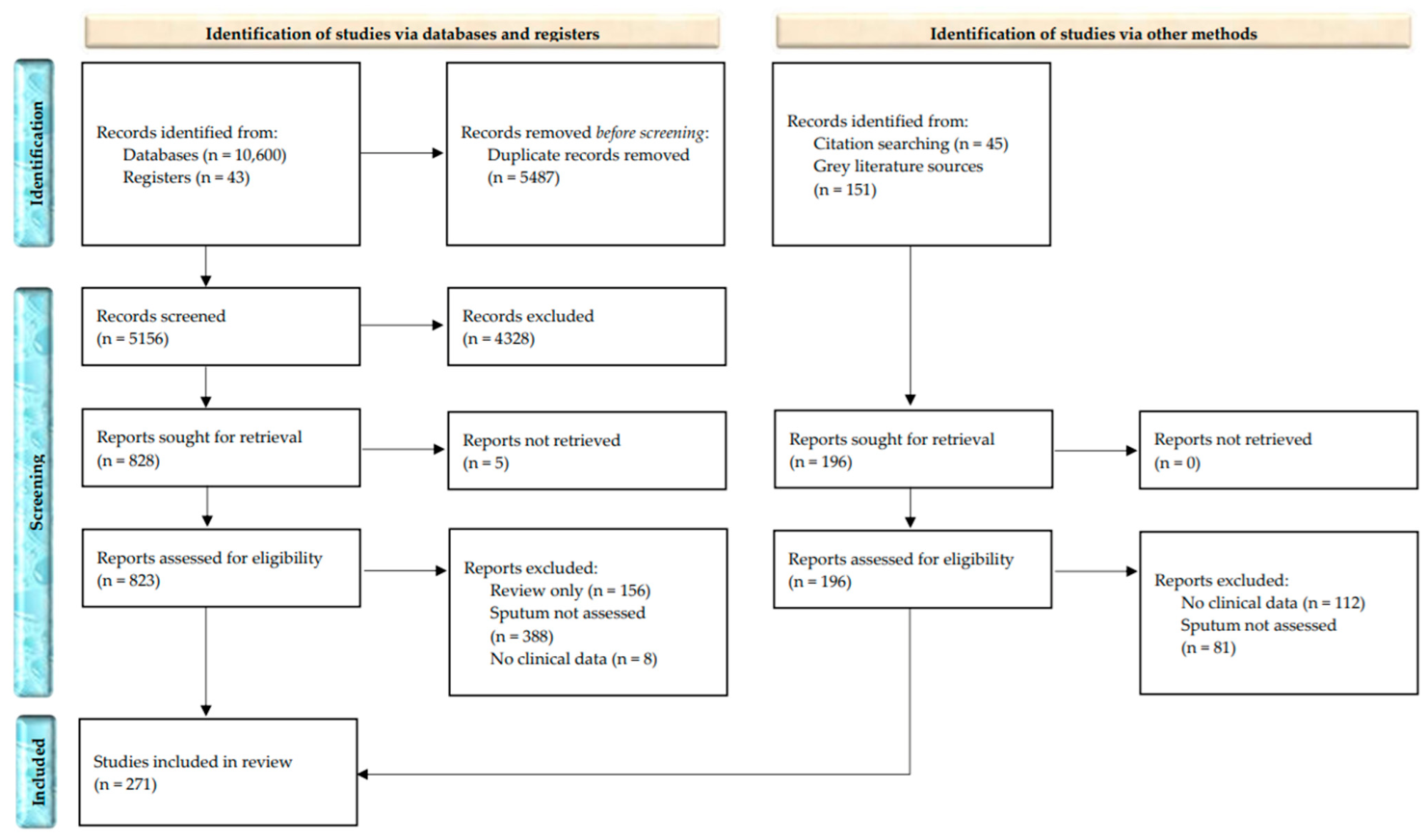


| Domain | Representative Techniques | Representative Studies | Main Findings | Typical Setting | Key Limitations |
|---|---|---|---|---|---|
| Single-marker tumor protein assays | Induced sputum ELISA for CYFRA21-1, CEA, NSE, etc. | Hillas et al. [86] | CYFRA21-1 was ~7× higher in LC than COPD (86% sensitivity, 75% specificity) | Diagnostic discrimination in symptomatic or clinically suspected LC | Older, single-analyte assays; modest sample size; limited external validation |
| Exploratory combined protein panels | ELISA for multiple proteins e.g., VEGF, ICAM-1, TNFα, etc. | Bar-Shai et al. [87] | Inflammatory and tumor-related proteins differed significantly among LC, COPD, and healthy controls; combined biomarker score improved case discrimination | Pilot, diagnostic enrichment, case–control studies | Combined biomarker score remains exploratory (calibration missing; external validation uncertain); risk of overfitting |
| Protein expression markers in exfoliated sputum cells | Cell-block IHC for MCM2, MCM7, etc. | Pankkal et al. [88] | MCM2 (80.3% sensitivity and 100% specificity) and MCM7 (92.1% sensitivity and 100% specificity) augmented conventional cytology | Cytology-linked diagnostic workup using exfoliated sputum cells in suspected LC | Single-study evidence (limited sample size); specialized cytologic processing required |
| High-dimensional discovery proteomics | diaPASEF (MS) profiling across 527 sputum proteins | Arenas-De Larriva et al. [89] | An internally cross-validated sPLS-DA model discriminated LC from controls, with an AUROC of 0.97 | Established or suspected LC compared with controls (case–control designs) | Small sample size; case–control designs; limited external validation |
| Secretome (EV)-linked predictive proteomics | Proteome analysis of NSCLC cell-line secretomes integrated with patient sputum | Böttger et al. [90] | Feasibility of response prediction (34 sputum-detectable proteins associated with response to cisplatin) | Prospective cohort with established NSCLC undergoing chemotherapy | Early phase evidence; clinical utility uncertain |
| Multiplex biosensor devices | Portable sputum biosensor based on multichannel organic electrochemical transistor technology | Zhang et al. [91] | Excellent performance (AUROC 0.931) in case–control cohort; potential for longitudinal monitoring | Case–control designs (LC cases and heavy smokers at risk) | Case–control, diagnostically enriched populations; real-world effectiveness yet to be established |
| Study | Sample Size | Techniques | Main Findings | Key Limitations |
|---|---|---|---|---|
| Lewis et al. (2010) | 50 sputum samples (25 LC and 25 controls) | FTIR spectroscopy of sputum cell pellets; fingerprint-region spectral features linked to glycogen, proteins, and nucleic-acid-associated bands | FTIR-based sputum profiling separated LC from control using a small set of discriminatory wavenumbers (metabolic fingerprinting feasibility) | Case–control design with non-representative healthy controls; data-driven feature selection; absence of external validation |
| Ahmed et al. (2016) | 20 sputum specimens (10 NSCLC and 10 benign lung conditions) | 1H-MRS/NMR of sputum and EBC to assess low–molecular weight metabolites such as glucose, methanol, acetate, propionate, lysine, and formate | Relative absence of glucose in sputum and lower methanol in EBC noted in patients with NSCLC (biological feasibility) | Tiny sample size; predominantly advanced-stage NSCLC; hypothesis-generating findings |
| Ardatskaya et al. (2016) | 147 patients (60 LC, 21 LC + CAP, and 38 COPD) and 30 healthy controls | Gas-liquid chromatographic analysis of sputum SCFA: acetate, propionate, and butyrate fractions plus anaerobic index | SCFA profiling showed systematic differences across healthy controls, COPD, LC, and LC complicated by CAP | Mixed disease cohorts; diagnostic metrics not reported; lack of external validation; reproducibility unclear |
| Cameron et al. (2016) | Sputum from 34 suspected LC cases (16 confirmed) and 33 healthy controls | FIE-MS and GC-MS of gangliosides, polyamines, and lipid metabolites | Untargeted MS profiling identified sputum metabolites that distinguished LC from both healthy controls and symptomatic non-cancer patients | Case–control design; non-representative controls; possible confounding bias |
| O’Shea et al. (2016) | Sputum from 23 LC cases, 11 symptomatic patients, and 33 healthy volunteers | FIE-MS features integrated with ANN classifiers | Secondary modeling of sputum metabolomic data discriminated LC from control with excellent internally cross-validated diagnostic performance | Tiny sample size; case–control design; lack of external validation; potential overfitting |
| Zhang et al. (2016) | 307 sputum samples (167 NSCLC and 140 controls) | ND-EESI-MS lipid fingerprinting of DPPC, PG, PGP, and related phospholipid species | NSCLC sputum showed lower relative abundance of DPPC and higher PG and PGP compared with controls | No diagnostic metrics reported; lack of external validation; reproducibility unclear; potential overfitting |
| Gao et al. (2018) | 100 sputum samples (50 NSCLC and 50 controls) | ND-EESI-MS analysis of spontaneous sputum without extensive pretreatment | ND-EESI-MS identified sputum fingerprints that could differentiate NSCLC patients from healthy controls by PCA | Case–control design with diagnostically enriched population; possible confounding bias |
| Zheng et al. (2021) | 143 spontaneous sputum samples (76 adenocarcinoma and 67 controls) | ND-EESI-MS with PLS-DA or OPLS-DA to assess hydroxyphenyllactic acid, phytosphingosine, N-nonanoylglycine, sphinganine, and S-carboxymethyl-L-cysteine | A five-metabolite sputum panel discriminated lung adenocarcinoma from controls with high accuracy; pathway analysis implicated sphingolipid metabolism, fatty-acid metabolism, carnitine synthesis, and the Warburg effect | Case–control design with diagnostically enriched population; lack of external validation; potential overfitting |
| Ahmed et al. (2022) | 15 sputum specimens (2 squamous cell carcinoma; 13 adenocarcinoma) | Pre- versus post-surgical resection NMR and LC-QTOF-MS of sputum and EBC: lipids, purines, carnitines, glucose, acetate, propionate, AMP, and diacetylspermine | Numerous sputum and EBC metabolites changed after resection; potential utility for treatment-response assessment and recurrence surveillance; sputum changes included glucose, adenosine monophosphate, and N1,N12-diacetylspermine | Tiny sample size; confounding bias from surgery-related physiologic stress; hypothesis-generating findings |
| Biomarker Category | Potential Clinical Use Cases | Candidate Biomarkers and/or Techniques | Translational Maturity * | Next Steps |
|---|---|---|---|---|
| Cytopathology | Diagnosis Screening Histologic subtyping Actionable alterations Prognostication | Flow cytometry | Phase 4 (prospective validation phase) | Evaluation in large, multicenter, prospective cohorts |
| MACS | Phase 2 (assay standardization phase) | Assay standardization and further validation | ||
| Papanicolaou smear | Phase 5 (ready for clinical use) | Combine with other approaches for clinical use | ||
| Quantitative microscopy (LungSign®; Perceptronix Medical Inc.; Vancouver, BC, Canada), automated DNA cytometry, 3D morphologic cytometry (LuCED®; Vision Gate Inc.; Pheonix, AZ, USA), PWS microscopy | Phase 3 (retrospective validation phase) | Clinical validation and use in prospective screening cohorts | ||
| Porphyrin labeling (CyPath®; bioAffinity Technologies, Inc.; San Antonio, TX, USA) | Phase 4–5 (prospective validation and early clinical use phase) | Follow results of NCT07168993 | ||
| FISH for MSI | Phase 3 (retrospective validation phase) | Assess performance in prospective cohorts | ||
| CA-FISH panel | Phase 3 (retrospective validation phase) | |||
| EGFR copy number assessment | Phase 4 (prospective validation phase) | |||
| FAL-FISH panel | Phase 2–3 (assay development and retrospective validation phase) | Assay development and clinical validation | ||
| TRAP | Phase 2 (assay development phase) | Assay development and clinical validation | ||
| Genomics | Diagnosis Screening Actionable alterations Monitoring response Prognostication | EGFR mutations | Phase 2–4 (assay development and clinical validation phase) | Assay standardization and clinical validation |
| BRAF mutation | Phase 2 (assay development phase) | Assay development, standardization, and development | ||
| K-RAS mutation | Phase 2–4 (assay development and clinical validation phase) | Assay standardization and clinical validation | ||
| TP53 mutation | Phase 2–4 (assay development and clinical validation phase) | Assay standardization and clinical validation | ||
| EML4-ALK fusion | Phase 2–3 (assay development and clinical validation phase) | Assay development, standardization, and validation | ||
| PD-L1 status | Phase 2 (assay development phase) | Assay development and standardization; clinical validation | ||
| HER2, ROS1, RET, MET, NTRK, and NRG gene alterations | No sputum-based data | Discovery of sputum-based methods of detection | ||
| Multiplex ddPCR panels | Phase 2 (assay development phase) | Assay development and standardization; clinical validation | ||
| NGS profiling | ||||
| Methylomics | Diagnosis Screening Prognostication | ddMSP panels (p16INK4a, RASSF1A, SOX17, TAC1, etc.) | Phase 3–4 (clinical validation phase) | Clinical validation, evaluation in prospective cohorts, and impact on patient outcomes |
| 3D quantitative DNA topology imaging | Phase 2 (assay development phase) | Assay development, standardization, and calibration; clinical validation | ||
| Transcriptomics | Diagnosis Screening Subtyping Monitoring response Prognostication | Survivin mRNA hTERT mRNA | Phase 2 (assay development phase) | Assay development, standardization, and calibration |
| Adenocarcinoma four-miRNA panel Squamous cell carcinoma three-miRNA panel | Phase 3 (clinical validation phase) | Clinical validation and evaluation in prospective cohorts | ||
| snoRNA panel | Phase 2 (assay development phase) | Assay development, standardization, and calibration | ||
| Proteomics | Diagnosis Screening Histologic subtyping Actionable alterations Monitoring response Surveillance Prognostication | Cell block IHC for tumor markers | Phase 2–3 (assay development and clinical validation phase) | Clinical validation and evaluation in prospective cohorts |
| Single and multiple protein panels (SELDI-TOF/MALDI-TOF and ELISA) | Phase 2–3 (assay development and clinical validation phase) | Assay development and standardization; clinical validation | ||
| diaPASEF (MS) profiling | Phase 2 (assay development phase) | Assay development, standardization, and calibration | ||
| EV-derived proteome profiling, similar to ExoDx™ Lung(ALK) [Exosome Diagnostics Inc.; Waltham, MA, USA] | ||||
| Portable biosensors (multichannel electrochemical transistor technology) | Phase 3–4 (assay development and clinical validation phase) | Evaluation in prospective cohorts and assessment of impact on patient outcomes | ||
| Metabolomics | Diagnosis Screening Monitoring response Surveillance | FTIR spectroscopy, Raman spectroscopy, GC-MS, FIE-MS, and ND-EESI-MS for lipid fingerprinting, and glucose and glycolytic metabolites | Phase 2 (assay development phase) | Assay development, standardization, and calibration followed by clinical validation |
| Microbiomics | Diagnosis Histologic subtyping Response prediction Monitoring response Prognostication | 16S rRNA sequencing for specific taxa (Gemella, Firmicutes, Bacillus, Granulicatella, etc.) | Phase 2 (assay development phase) | Assay development and calibration, clinical validation, and assessment in prospective cohorts |
Disclaimer/Publisher’s Note: The statements, opinions and data contained in all publications are solely those of the individual author(s) and contributor(s) and not of MDPI and/or the editor(s). MDPI and/or the editor(s) disclaim responsibility for any injury to people or property resulting from any ideas, methods, instructions or products referred to in the content. |
© 2026 by the authors. Licensee MDPI, Basel, Switzerland. This article is an open access article distributed under the terms and conditions of the Creative Commons Attribution (CC BY) license.
Share and Cite
Rehman, A.; Awais, M.; Baloch, H.N.U.A.; Leghari, M.O.; Ahmad, A.; Javed, H. Sputum Liquid Biopsy for Lung Cancer Screening, Diagnosis, Subtyping, Surveillance, Response Prediction, and Prognostication: A Scoping Review. Med. Sci. 2026, 14, 231. https://doi.org/10.3390/medsci14020231
Rehman A, Awais M, Baloch HNUA, Leghari MO, Ahmad A, Javed H. Sputum Liquid Biopsy for Lung Cancer Screening, Diagnosis, Subtyping, Surveillance, Response Prediction, and Prognostication: A Scoping Review. Medical Sciences. 2026; 14(2):231. https://doi.org/10.3390/medsci14020231
Chicago/Turabian StyleRehman, Abdul, Muhammad Awais, Hafiza Noor Ul Ain Baloch, Muhammad Omer Leghari, Arfa Ahmad, and Hafiz Javed. 2026. "Sputum Liquid Biopsy for Lung Cancer Screening, Diagnosis, Subtyping, Surveillance, Response Prediction, and Prognostication: A Scoping Review" Medical Sciences 14, no. 2: 231. https://doi.org/10.3390/medsci14020231
APA StyleRehman, A., Awais, M., Baloch, H. N. U. A., Leghari, M. O., Ahmad, A., & Javed, H. (2026). Sputum Liquid Biopsy for Lung Cancer Screening, Diagnosis, Subtyping, Surveillance, Response Prediction, and Prognostication: A Scoping Review. Medical Sciences, 14(2), 231. https://doi.org/10.3390/medsci14020231