
The Diagnostic Potential of Eye Tracking to Detect Autism Spectrum Disorder in Children: A Systematic Review

 , , ,
, , ,  ,
,
Abstract
1. Introduction
2. Materials and Methods
2.1. Information Sources and Search Strategy
2.2. PIRD (Population, Index Test, Reference Test, Diagnosis/Outcome)
- Population: ASD Individuals;
- Index test: Eye tracking parameters;
- Diagnostic outcome: Accuracy metrics, including sensitivity, specificity, the Area Under the Curve (AUC), and predictive values.
2.3. Selection Criteria
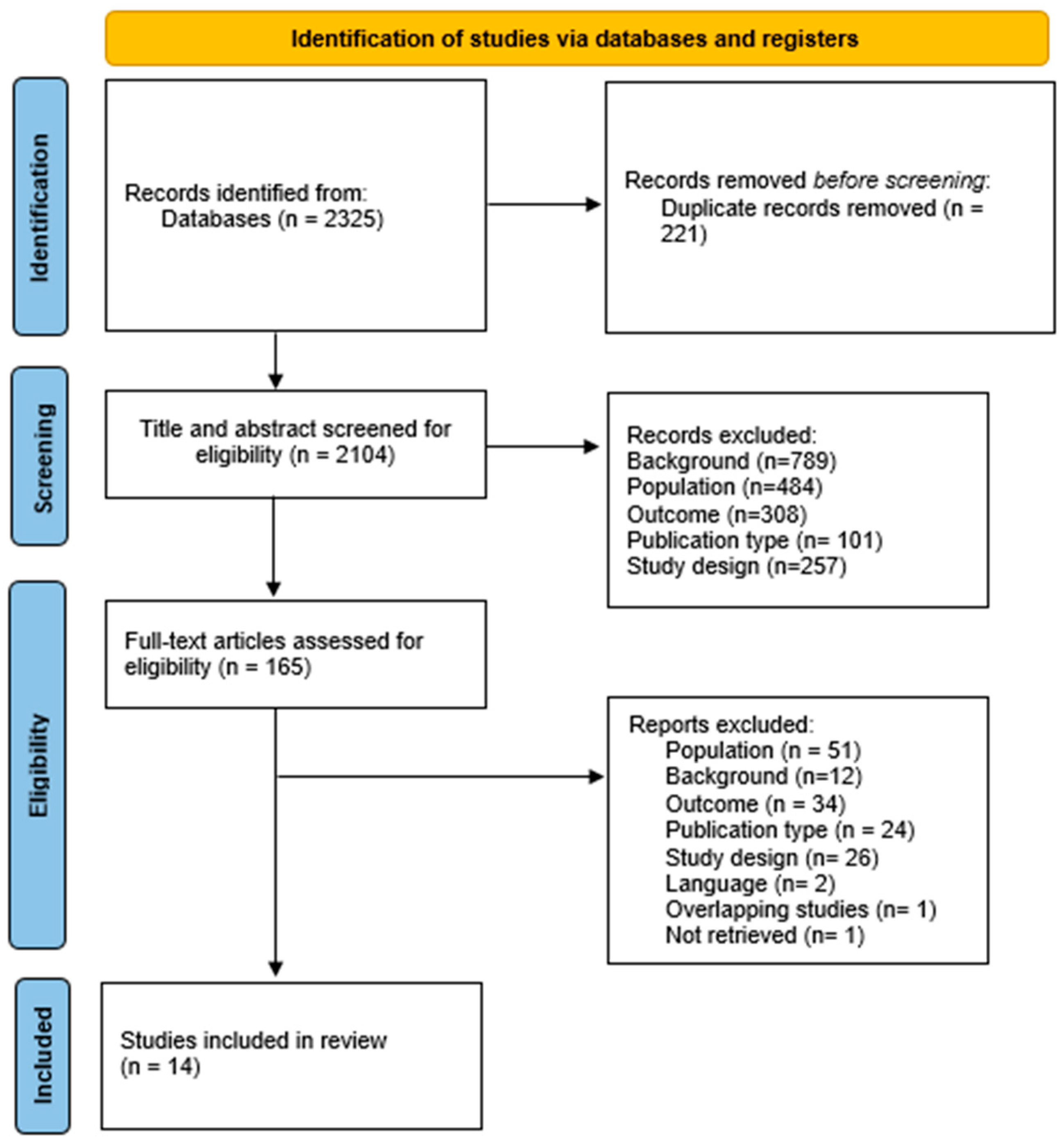
2.4. Selection Procedures
2.5. Data Extraction
2.6. Quality Assessment
3. Results
3.1. Sample Characteristic and Diagnostic Assessment
3.2. Eye-Tracking Device

| Author | Year | Title | Journal | Location |
|---|---|---|---|---|
| Anderson, C.J. et al. [79] | 2006 | Visual scanning and pupillary responses in young children with autism spectrum disorder | Journal of Clinical and Experimental Neuropsychology | North America—USA |
| Chevallier, C. et al. [67] | 2015 | Measuring social attention and motivation in Autism Spectrum Disorder using eye-tracking: Stimulus type matters | Autism Research | North America—Pennsylvania |
| Falck Ytter, T. [68] | 2008 | Face inversion effects in autism: a combined looking time and pupillometric study | Autism Research | Europe—Sweden |
| Falck Ytter, T. et al. [69] | 2013 | Visualization and Analysis of Eye Movement Data from Children with Typical and Atypical Development | Journal of Autism and Developmental Disorders | Europe—Sweden |
| Frazier, T.W. et al. [76] | 2018 | Development and Validation of Objective and Quantitative Eye Tracking–Based Measures of Autism Risk and Symptom Levels | Journal of the American Academy of Child & Adolescent Psychiatry | North America |
| Jones, W. et al. [80] | 2008 | Absence of Preferential Looking to the Eyes of Approaching Adults Predicts Level of Social Disability in 2-Year-Old Toddlers With Autism Spectrum Disorder | Archives of General Psychiatry | North America—Connecticut |
| Kou, J. et al. [70] | 2019 | Comparison of three different eye-tracking tasks for distinguishing autistic from typically developing children and autistic symptom severity | Autism Research | ASIA—Cina |
| Muratori, F. et al. [77] | 2019 | How Attention to Faces and Objects Changes Over Time in Toddlers with Autism Spectrum Disorders: Preliminary Evidence from An Eye Tracking Study | Brain Sciences | Europe—Italy |
| Pierce, K. et al. [71] | 2011 | Preference for Geometric Patterns Early in Life as a Risk Factor for Autism | Archives of gGeneral Ppsychiatry | North America—California |
| Polzer, L. et al. [72] | 2022 | Pupillometric measures of altered stimulus-evoked locus coeruleusnorepinephrine activity explain attenuated social attention in preschoolers with autism spectrum disorder | Autism Research | Europe—Germany |
| Putra, P et al. [73] | 2021 | Identifying autism spectrum disorder symptoms using response and gaze behavior during theGo/NoGo game CatChicken | Scientific Reports | Asia—Japan |
| Shic, F. et al. [75] | 2022 | The autism biomarkers consortium for clinical trials: evaluation of a battery of candidate eye-tracking biomarkers for use in autism clinical trials | Molecular Autism | North America—Connecticut—USA—North Carolina—Massachusetts—Washington—California |
| Wang, Q. et al. [78] | 2018 | Operationalizing atypical gaze in toddlers with autism spectrum disorders: a cohesion-based approach | Molecular Autism | North America—Connecticut |
| Wen, T. H et al. [74] | 2022 | Large scale validation of an early-age eye tracking biomarker of an autism spectrum disorder subtype | Scientific Reports | North America—California |
| Author | Sample | M:F | Years Mean (SD); [Range] | Psychodiagnostic Assessment |
|---|---|---|---|---|
| Anderson, C.J. et al. [79] | 9 ASD 1 | 8:1 | 49.6 months (n.r); [12–72] | ADOS-G; MSEL |
| 6 DD | 6:0 | 43.6 months (n.r); [12–72] | ||
| 9 TD | 8:1 | 49.8 months (n.r); [12–72] | ||
| Chevallier, C. et al. [67] | 59 ASD | 13:1 | 12.2 years (3.3); [6–17] | DSM-IV; ADOS; ADI-R |
| 22 TD | 22:0 | 14.9 years (1.7); [6–17] | ||
| Falk Ytter, T. [68] | 15 ASD | 4:1 | 5.2 years (11 months); [n.r] | DSM-IV; ADOS; ADI-R |
| 15 TD | 2.75:1 | 4.11 years (38 day); [n.r] | ||
| Falk Ytter, T. et al. [69] | 39 ASD | 7:1 | 6.1 years (0.8); [4.0–7.3] | DSM-IV; DISCO interview; ABC; WPPSI-III; VABS |
| 28 TD | 1:1 | 6.1 years (0.6); [4.3–7.3] | ||
| Frazier, T.W. et al. [76] | 91 ASD | 4.6:1 | 5.7 years (3.6); [1.6–15.8] | DSM-5; ADOS-2; MSEL |
| 110 TD | 3.5:1 | 6.8 years (3.3); [1.8–17.6] | ||
| Jones, W. et al. [80] | 15 ASD | 3:1 | 2.28 years (0.58); [n.r] | ADOS-2; ADI-R; MSEL;VABS |
| 15 DD | 3:1 | 2.06 years (0.66); [n.r] | ||
| 36 TD | 2:1 | 2.03 years (0.68); [n.r] | ||
| Kou, J. et al. [70] | 32 ASD | 4:1 | 3.72 years (1.25); [n.r] | DSM-IV; ICD-10; ADOS-2 |
| 34 TD | 3:1 | 4.10 years (0.47); [n.r] | ||
| Muratori, F. et al. [77] | 12 ASD | 5:1 | T1: 25.1 months (4.6); [19–33] T2: 31.7 months (4.7); [25–39] | DSM-5; ADOS-2; VABS |
| 15 TD | 6:1 | T1: 26.5 months (4.1); [18–30] | ||
| Pierce, K. et al. [71] | 37 ASD | 4:1 | 26.7 months (7.7); [14–42] | ADOS-T; ADI-R; MSEL; VABS |
| 22 DD | 3:1 | 22.7 months (8.5); [12–41] | ||
| 51 TD | 2:1 | 24.6 months (8.2); [12–43] | ||
| Polzer, L. et al. [72] | 57 ASD | 1.6:1 | 47.95 months (10.21); [18–65] | DSM-5; ADOS2; ADI-R |
| 39 TD | 1:1 | 33.28 months (10.31); [18–65] | ||
| Putra, P. et al. [73] | 21 ASD (10 with ADHD) | 2:1 | 4.6 years (0.4); [n.r.] | diagnosed by clinicians |
| 31 TD | 3:1 | 5 years (0.6); [n.r.] | ||
| Shic, F. et al. [75] | 280 ASD | 3:1 | T1: 8.55 years (1.64); [6–11.6] T2: + 6 week | DSM-5; ADOS-2; ADI-R; VABS |
| 119 TD | 2:1 | T1: 8.51 years (1.61); [6–11.6] T2: + 6 week | ||
| Wang, Q. et al. [78] | 112 ASD | 6:1 | 22.39 months (3.02); [n.r] | ADOS-G; ADI-R; MSEL; VABS |
| 36 DD | 8:1 | 21.71 months (3.38); [n.r] | ||
| 163 TD | 1:1 | 21.89 months (3.39); [n.r] | ||
| Wen, T.H. et al. [74] | 725 ASD | 3:1 | 26.40 months (8.25); [12–49] | ADOS-2; MSEL; VABS |
| 103 ASD-Feat | 5:1 | 23.84 months (9.17); [11–44] | ||
| 128 GDD | 3:1 | 26.38 months (9.81); [12–46] | ||
| 198 LD | 3:1 | 20.78 months (7.44); [10–48] | ||
| 162 Other | 2:1 | 23.15 months (9.31); [11–48] | ||
| 487 TD | 2:1 | 23.32 months (9.17); [11–48] | ||
| 60 TypSIB ASD | 1:1 | 21.86 months (8.79); [12–44] |
| Author | Eye Tracker Device | Sampling Rate (Hz) | Screen Distance (cm) | Resolution Pixel | Monitor’s Inches |
|---|---|---|---|---|---|
| Anderson, C.J. et al. [79] | ASL Model 504 (Applied Science Laboratories)+ Flock of Birds magnetic head tracker | 60 Hz | n.r | n.r | 16″ |
| Chevallier, C. et al. [67] | Tobii X120 | 60 Hz | 60 | n.r | 30″ |
| Falck Ytter, T. [68] | Tobii 1750 remote infrared eye tracker | 50 Hz | 60 | n.r | 17″ |
| Falck Ytter, T. et al. [69] | Tobii T120 | 60 Hz | n.r | n.r | n.r |
| Frazier, T.W. et al. [76] | SMI RED 250 | 60 Hz | 75 | 1280 × 1024 | 19″ |
| Jones, W. et al. [80] | ISCAN Inc | 60 Hz | 50.8 | 640 × 480 | 20″ |
| Kou, J. et al. [70] | Tobii TX300 Binocular | 60 Hz | n.r | 1920 × 1080 | 23″ |
| Muratori, F. et al. [77] | SMI RED 500 | 120 Hz | 50 | n.r | n.r |
| Pierce, K. et al. [71] | Tobii T120 | 120 Hz | 60 | n.r | 17″ |
| Polzer, L. et al. [72] | Tobii TX300 | 300 Hz | 50–80 | 1920 × 1080 | n.r |
| Putra, P et al. [73] | Tobii 4C | 90 Hz | 50–90 | n.r | n.r |
| Shic, F. et al. [75] | Eyelink 1000 Plus binocular remote | 500 Hz | 65 | 1920 × 1200 | 24″ |
| Wang, Q. et al. [78] | SMI iView X RED | 60 Hz | 75 | n.r | 24″ |
| Wen, T. H et al. [74] | Tobii T120 | 60 Hz | n.r | n.r | n.r |
3.3. Psychophysics and Neuropsychological Constructs
3.4. Type of Stimuli
3.5. Outcome Parameters and Metrics of the Eye Tracker
3.5.1. Fixation Based Measures
Temporal Fixation Metrics
Proportion-Based Fixation
Fixation and Transition Count Measures
Spatial Gaze Parameters
Derived or Composite Fixation Indices
3.5.2. Saccade Latency
3.6. Accuracy, Sensitivity, and Specificity Task
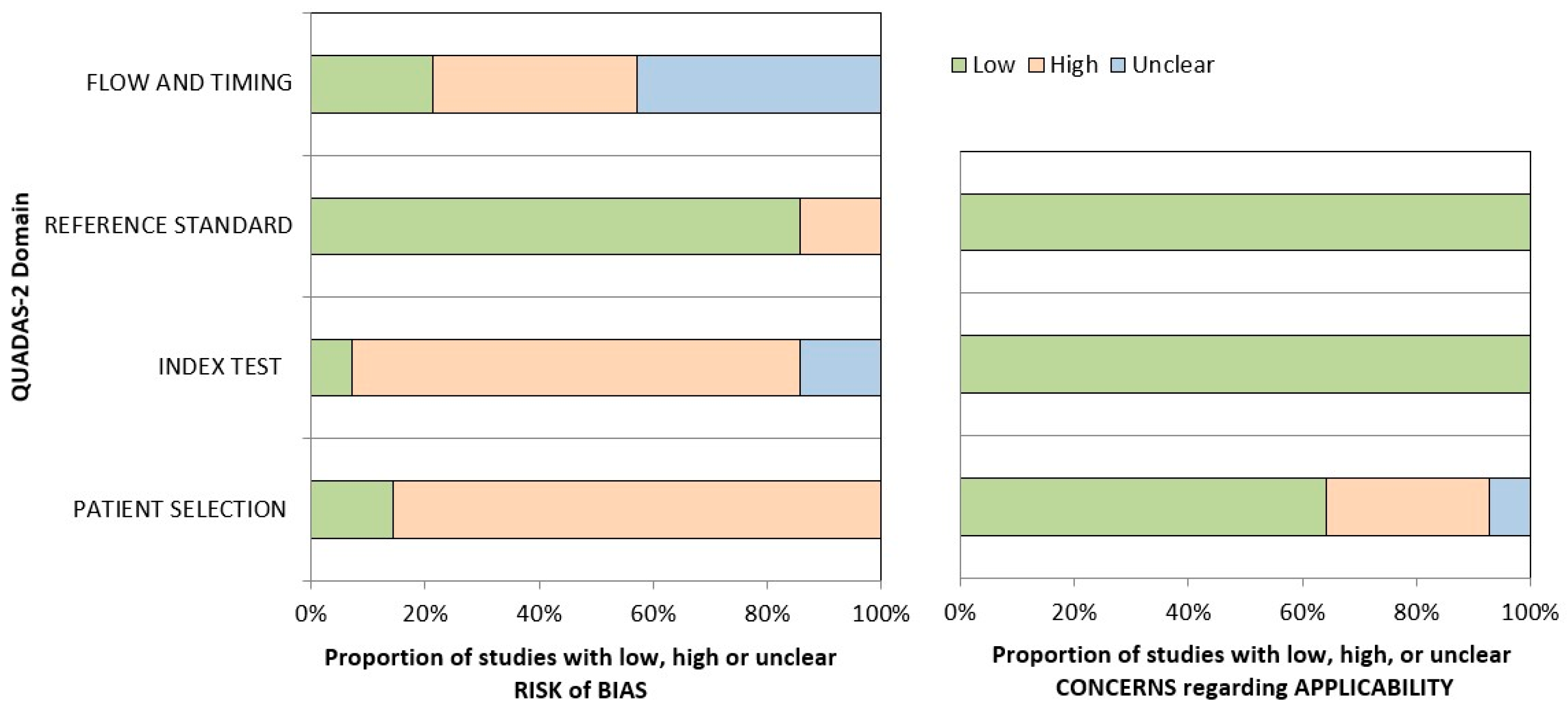
3.7. Quality of the Studies
4. Discussion
4.1. Neuropsychological Construct and Type of Stimuli
4.2. Outcome Parameters and Gaze Metrics
4.3. Diagnostic Accuracy, Sensitivity, and Specificity of Eye-Tracking Metrics
5. Conclusions
6. Limitation
- -
- Sample size: many studies have small sample sizes, which can affect the generalizability of the results. Furthermore, several studies have predominantly involved male autistic participants (M:F ≥ 5:1), which reduces the applicability of the results to women, who remain underrepresented in eye tracking research.
- -
- Task design: different eye-tracking tasks have been used to study autism, and the task design can impact the results obtained. Task design should be carefully selected to ensure that it is relevant and appropriate for the specific population being studied.
- -
- Eye tracking technology: eye tracking technology can also affect the results, as different technologies have different levels of accuracy and reliability.
- -
- Interaction between gaze and other factors: gaze patterns can be influenced by many other factors, such as attention, motivation, and task demand. Importantly, the very wide age range represented in the included studies (from infancy to late adolescence) implies that the neuropsychological construct underlying visual attention to complex social scenes likely differs across developmental stages. This limits the direct comparability of results across studies, as attentional mechanisms observed at 12 months of age cannot be assumed to reflect the same cognitive processes seen in older children or adolescents.
- -
- The high rate of high-risk trials in patient selection was probably due to the lack of a consecutive or random sample of enrolled patients. Only 2 studies ensured consecutive enrolment of patients.
- -
- Due to the intrinsic nature of the test and the lack of a threshold, the overall risk of bias in the index test area was very high.
- -
- Test–retest reliability to measure the consistency of results on the same sample at a different point in time. Few studies show these results and in most studies; moreover, the lack of standardized follow-up time and the inappropriate interval between the index test and the reference standard meant that only three studies achieved a low risk of bias. Only one study [75] reported test–retest reliability, and even in that case reliability was limited to specific measures. The absence of systematic reproducibility analyses across studies severely restricts the interpretability of gaze-based measures as stable traits, and highlights a major gap for any biomarker intended for clinical use.
Future Research
Supplementary Materials
Author Contributions
Funding
Institutional Review Board Statement
Informed Consent Statement
Data Availability Statement
Conflicts of Interest
Abbreviations
| ASD | Autism Spectrum Disorder |
| TD | Typically developing |
| AoI | Ares of Interest |
| ICD-10 | International Classification of Diseases |
| ADOS | Autism Diagnostic Observation Schedule |
| ADI-R | Autism Diagnostic Interview-Revised |
| MSEL | Mullen Scales of Early Learning |
| VABS | Vineland Adaptive Behavior Scales |
| DISCO | Diagnostic Interview for Social and Communication Disorders |
| M-CHAT | Modified Checklist for Autism in Toddlers |
| ABC | Aberrant Behavior Checklist |
| RoI | Region of Interest |
| DGI | Dynamic Geometric Images |
| SOC-M | Social Motion |
| GEO-M | Geometric Motion |
| OMI | Oculomotor Index of Gaze to Human Faces |
| D2R | Distance-to-Reference |
| AUC | Area Under the Curve |
| ROC | Receiver Operating Characteristic |
| QUADAS | Quality Assessment of Diagnostic Accuracy Studies |
| PRISMA | Preferred Reporting Items for Systematic Reviews and Meta-Analyses |
| DTA | Diagnostic Test Accuracy |
References
- Lobar, S.L. DSM-V Changes for Autism Spectrum Disorder (ASD): Implications for Diagnosis, Management, and Care Coordination for Children with ASDs. J. Pediatr. Health Care 2016, 30, 359–365. [Google Scholar] [CrossRef]
- Lord, C.; Elsabbagh, M.; Baird, G.; Veenstra-Vanderweele, J. Autism spectrum disorder. Lancet 2018, 392, 508–520. [Google Scholar] [CrossRef]
- American Psychiatric Association. Diagnostic and Statistical Manual of Mental Disorders: DSM-5™, 5th ed.; American Psychiatric Publishing: Washington, DC, USA, 2013. [Google Scholar]
- Waizbard-Bartov, E.; Miller, M. Does the severity of autism symptoms change over time? A review of the evidence, impacts, and gaps in current knowledge. Clin. Psychol. Rev. 2023, 99, 102230. [Google Scholar] [CrossRef] [PubMed]
- Vacas, J.; Antolí, A.; Sánchez-Raya, A.; Pérez-Dueñas, C.; Cuadrado, F. Social attention and autism in early childhood: Evidence on individuals with ASD and multiple complex developmental disorder. Early Hum. Dev. 2022, 171, 105622. [Google Scholar]
- Ivanović, I. Psychiatric Comorbidities in Children with ASD: Autism Centre Experience. Front. Psychiatry 2021, 12, 673169. [Google Scholar] [CrossRef]
- Bauman, M.L. Medical comorbidities in autism: Challenges to diagnosis and treatment. Neurotherapeutics 2010, 7, 320–327. [Google Scholar] [CrossRef] [PubMed]
- Ming, X.; Brimacombe, M.; Chaaban, J.; Zimmerman-Bier, B.; Wagner, G.C. Autism spectrum disorders: Concurrent clinical disorders. J. Child Neurol. 2008, 23, 6–13. [Google Scholar] [CrossRef]
- Rossignol, D.A.; Frye, R.E. Mitochondrial dysfunction in autism spectrum disorders: A systematic review and meta-analysis. Mol. Psychiatry 2012, 17, 290–314. [Google Scholar] [CrossRef]
- Young, S.; Hollingdale, J.; Absoud, M.; Bolton, P.; Branney, P.; Colley, W.; Craze, E.; Dave, M.; Deeley, Q.; Farrag, E.; et al. Guidance for identification and treatment of individuals with attention deficit/hyperactivity disorder and autism spectrum disorder based upon expert consensus. BMC Med. 2020, 18, 146. [Google Scholar] [CrossRef]
- Alaghband-Rad, J.; Hajikarim-Hamedani, A.; Motamed, M. Camouflage and masking behavior in adult autism. Front. Psychiatry 2023, 14, 1108110. [Google Scholar] [CrossRef] [PubMed]
- Falkmer, T.; Anderson, K.; Falkmer, M.; Horlin, C. Diagnostic procedures in autism spectrum disorders: A systematic literature review. Eur. Child Adolesc. Psychiatry 2013, 22, 329–340. [Google Scholar] [CrossRef] [PubMed]
- Randall, M.; Albein-Urios, N.; Brignell, A.; Gulenc, A.; Hennel, S.; Coates, C.; Symeonides, C.; Hiscock, H.; Marraffa, C.; Silove, N.; et al. Diagnosing autism: Australian paediatric research network surveys. J. Paediatr. Child Health 2016, 52, 11–17. [Google Scholar] [CrossRef] [PubMed]
- Stewart, J.; Vigil, D.; Ryst, E.; Yang, W. Refining best practices for the diagnosis of autism. Nev. J. Public Health 2014, 11, 1–12. [Google Scholar]
- Rødgaard, E.-M.; Rodríguez-Herreros, B.; Zeribi, A.; Jensen, K.; Courchesne, V.; Douard, E.; Gagnon, D.; Huguet, G.; Jacquemont, S.; Mottron, L. Clinical correlates of diagnostic certainty in children and youths with Autistic Disorder. Mol. Autism 2024, 15, 592. [Google Scholar] [CrossRef] [PubMed]
- Ahlers, K.; Gabrielsen, T.P.; Ellzey, A.; Brady, A.; Litchford, A.; Fox, J.; Nguyen, Q.-T.; Carbone, P.S. A pilot project using pediatricians as initial diagnosticians in multidisciplinary autism evaluations for young children. J. Dev. Behav. Pediatr. 2019, 40, 1–11. [Google Scholar] [CrossRef]
- Penner, M.; Senman, L.; Andoni, L.; Dupuis, A.; Anagnostou, E.; Kao, S.; Solish, A.; Shouldice, M.; Ferguson, G.; Brian, J. Concordance of diagnosis of autism spectrum disorder made by pediatricians vs a multidisciplinary specialist team. JAMA Netw. Open 2023, 6, e2252879. [Google Scholar] [CrossRef]
- Alfuraydan, M.; Croxall, J.; Hurt, L.; Kerr, M.; Brophy, S. Use of telehealth for facilitating the diagnostic assessment of autism spectrum disorder (ASD): A scoping review. PLoS ONE 2020, 15, e0236415. [Google Scholar] [CrossRef]
- Ellison, K.S.; Guidry, J.; Picou, P.; Adenuga, P.; Davis, T.E., III. Telehealth and autism prior to and in the age of COVID-19: A systematic and critical review of the last decade. Clin. Child Fam. Psychol. Rev. 2021, 24, 599–630. [Google Scholar] [CrossRef]
- McNally Keehn, R.; Swigonski, N.; Enneking, B.; Ryan, T.; Monahan, P.; Martin, A.M.; Hamrick, L.; Kadlaskar, G.; Paxton, A.; Ciccarelli, M.; et al. Diagnostic accuracy of primary care clinicians across a statewide system of autism evaluation. Pediatrics 2023, 152, e2023061188. [Google Scholar] [CrossRef]
- Stavropoulos, K.K.M.; Bolourian, Y.; Blacher, J. A scoping review of telehealth diagnosis of autism spectrum disorder. PLoS ONE 2022, 17, e0263062. [Google Scholar] [CrossRef]
- Valentine, A.Z.; Hall, S.S.; Young, E.; Brown, B.J.; Groom, M.J.; Hollis, C.; Hall, C.L. Implementation of telehealth services to assess, monitor, and treat neurodevelopmental disorders: A systematic review. J. Med. Internet Res. 2021, 23, e22619. [Google Scholar] [CrossRef] [PubMed]
- Weitlauf, A.S.; McPheeters, M.L.; Peters, B.; Sathe, N.; Travis, R.; Aiello, R.; Williamson, E.; Veenstra-VanderWeele, J.; Krishnaswami, S.; Jerome, R.; et al. Therapies for Children with Autism Spectrum Disorder: Behavioral Interventions Update; Agency for Healthcare Research and Quality (US): Rockville, MD, USA, 2014; AHRQ Comparative Effectiveness Reviews. [Google Scholar]
- Franz, L.; Goodwin, C.D.; Rieder, A.; Matheis, M.; Damiano, D.L. Early intervention for very young children with or at high likelihood for autism spectrum disorder: An overview of reviews. Dev. Med. Child Neurol. 2022, 64, 1063–1076. [Google Scholar] [CrossRef]
- Miller, L.E.; Dai, Y.G.; Fein, D.A.; Robins, D.L. Characteristics of toddlers with early versus later diagnosis of autism spectrum disorder. Autism 2021, 25, 416–428. [Google Scholar] [CrossRef]
- Congiu, S.; Doneddu, G.; Fadda, R. Attention toward social and non-social stimuli in preschool children with autism spectrum disorder: An eye-tracking study. Int. J. Environ. Res. Public Health 2024, 21, 421. [Google Scholar] [CrossRef]
- Loth, E.; Spooren, W.; Ham, L.M.; Isaac, M.B.; Auriche-Benichou, C.; Banaschewski, T.; Baron-Cohen, S.; Broich, K.; Bölte, S.; Bourgeron, T.; et al. Identification and validation of biomarkers for autism spectrum disorders. Nat. Rev. Drug Discov. 2016, 15, 70–73. [Google Scholar] [CrossRef]
- Fletcher-Watson, S.; Hampton, S. The potential of eye-tracking as a sensitive measure of behavioural change in response to intervention. Sci. Rep. 2018, 8, 14715. [Google Scholar] [CrossRef]
- Frazier, T.W.; Strauss, M.; Klingemier, E.W.; Zetzer, E.E.; Hardan, A.Y.; Eng, C.; Youngstrom, E.A. A Meta-Analysis of Gaze Differences to Social and Nonsocial Information Between Individuals With and Without Autism. J. Am. Acad. Child Adolesc. Psychiatry 2017, 56, 546–555. [Google Scholar] [CrossRef] [PubMed]
- Dalton, K.M.; Nacewicz, B.M.; Johnstone, T.; Schaefer, H.S.; Gernsbacher, M.A.; Goldsmith, H.H.; Alexander, A.L.; Davidson, R.J. Gaze fixation and the neural circuitry of face processing in autism. Nat. Neurosci. 2005, 8, 519–526. [Google Scholar] [CrossRef] [PubMed]
- Riddiford, J.A.; Enticott, P.G.; Lavale, A.; Gurvich, C. Gaze and social functioning associations in autism spectrum disorder: A systematic review and meta-analysis. Autism Res. 2022, 15, 1380–1446. [Google Scholar] [CrossRef] [PubMed]
- Klin, A.; Jones, W.; Schultz, R.; Volkmar, F.; Cohen, D. Visual fixation patterns during viewing of naturalistic social situations as predictors of social competence in individuals with autism. Arch. Gen. Psychiatry 2002, 59, 809–816. [Google Scholar] [CrossRef]
- Falck-Ytter, T.; Bölte, S.; Gredebäck, G. Eye tracking in early autism research. J. Neurodev. Disord. 2013, 5, 28. [Google Scholar] [CrossRef]
- Guillon, Q.; Hadjikhani, N.; Baduel, S.; Rogé, B. Visual social attention in autism spectrum disorder: Insights from eye tracking studies. Neurosci. Biobehav. Rev. 2014, 42, 279–297. [Google Scholar] [CrossRef]
- Chita-Tegmark, M. Social attention in ASD: A review and meta-analysis of eye-tracking studies. Res. Dev. Disabil. 2016, 48, 79–93. [Google Scholar] [CrossRef]
- Papagiannopoulou, E.A.; Chitty, K.M.; Hermens, D.F.; Hickie, I.B.; Lagopoulos, J. A systematic review and meta-analysis of eye-tracking studies in children with autism spectrum disorders. Soc. Neurosci. 2014, 9, 610–632. [Google Scholar] [CrossRef] [PubMed]
- Hamner, T.; Vivanti, G. Eye-tracking research in autism spectrum disorder: What are we measuring and for what purposes? Curr. Dev. Disord. Rep. 2019, 6, 37–44. [Google Scholar] [CrossRef]
- Mastergeorge, A.M.; Kahathuduwa, C.; Blume, J. Eye-tracking in infants and young children at risk for autism spectrum disorder: A systematic review of visual stimuli in experimental paradigms. J. Autism Dev. Disord. 2021, 51, 2578–2599. [Google Scholar] [CrossRef] [PubMed]
- Hou, W.; Jiang, Y.; Yang, Y.; Zhu, L.; Li, J. Evaluating the validity of eye-tracking tasks and stimuli in detecting high-risk infants later diagnosed with autism: A meta-analysis. Clin. Psychol. Rev. 2024, 112, 102466. [Google Scholar]
- Setien-Ramos, I.; Lugo-Marin, J.; Gisbert-Gustemps, L.; Diez-Villoria, E.; Magan-Maganto, M.; Canal-Bedia, R.; Ramos-Quiroga, J.A. Eye-tracking studies in adults with autism spectrum disorder: A systematic review and meta-analysis. J. Autism Dev. Disord. 2023, 53, 2430–2443. [Google Scholar] [CrossRef] [PubMed]
- Wei, Q.; Cao, H.; Shi, Y.; Xu, X.; Li, T. Machine learning based on eye-tracking data to identify Autism Spectrum Disorder: A systematic review and meta-analysis. J. Biomed. Inform. 2023, 137, 104254. [Google Scholar] [CrossRef]
- Tecar, C.; Chiperi, L.E.; Iftimie, B.E.; Livint-Popa, L.; Stefanescu, E.; Lucia, S.M.; Muresanu, D.F. Eye-Tracking as a Screening Tool in the Early Diagnosis of Autism Spectrum Disorder: A Systematic Review and Meta-Analysis. J. Clin. Med. 2025, 14, 8801. [Google Scholar] [CrossRef]
- Murias, M.; Major, S.; Davlantis, K.; Franz, L.; Harris, A.; Rardin, B.; Sabatos-DeVito, M.; Dawson, G. Validation of eye-tracking measures of social attention as a potential biomarker for autism clinical trials. Autism Res. 2018, 11, 166–174. [Google Scholar] [CrossRef]
- Wang, R.K.; Kwong, K.; Liu, K.; Kong, X.J. New eye tracking metrics system: The value in early identification of children with autism spectrum disorder. Front. Psychiatry 2024, 15, 1518180. [Google Scholar] [CrossRef]
- Mori, T.; Tsuchiya, K.J.; Harada, T.; Nakayasu, C.; Okumura, A.; Nishimura, T.; Katayama, T.; Endo, M. Autism symptoms, functional impairments, and gaze fixation measured using an eye-tracker in 6-year-old children. Front. Psychiatry 2023, 14, 1250763. [Google Scholar] [CrossRef]
- Vivanti, G.; Dissanayake, C. Propensity to imitate in autism is not modulated by the model’s gaze direction: An eye-tracking study. Autism Res. 2014, 7, 392–399. [Google Scholar] [CrossRef]
- Vivanti, G.; Hocking, D.R.; Fanning, P.; Dissanayake, C. Social affiliation motives modulate spontaneous learning in Williams syndrome but not in autism. Mol. Autism 2016, 7, 40. [Google Scholar] [CrossRef] [PubMed]
- Hessels, R.S.; Benjamins, J.S.; Cornelissen, T.H.W.; Hooge, I.T.C. A Validation of Automatically-Generated Areas-of-Interest in Videos of a Face for Eye-Tracking Research. Front. Psychol. 2018, 9, 1367. [Google Scholar] [CrossRef] [PubMed]
- Vehlen, A.; Spenthof, I.; Tönsing, D.; Heinrichs, M.; Domes, G. Evaluation of an eye tracking setup for studying visual attention in face-to-face conversations. Sci. Rep. 2021, 11, 2661. [Google Scholar] [CrossRef]
- Keehn, B.; Monahan, P.; Enneking, B.; Ryan, T.; Swigonski, N.; McNally Keehn, R. Eye-Tracking Biomarkers and Autism Diagnosis in Primary Care. JAMA Netw. Open 2024, 7, e2411190. [Google Scholar] [CrossRef] [PubMed]
- Hudry, K.; Chetcuti, L.; Tan, D.W.; Clark, A.; Aulich, A.; Bent, C.A.; Green, C.C.; Smith, J.; Fordyce, K.; Ninomiya, M.; et al. Accuracy of a 2-minute eye-tracking assessment to support autism identification/diagnosis. Mol. Autism 2025, 16, 36. [Google Scholar] [CrossRef]
- Moher, D.; Liberati, A.; Tetzlaff, J.; Altman, D.G. Preferred reporting items for systematic reviews and meta-analyses: The PRISMA statement. PLoS Med. 2009, 6, e1000097. [Google Scholar] [CrossRef]
- Page, M.J.; McKenzie, J.E.; Bossuyt, P.M.; Boutron, I.; Hoffmann, T.C.; Mulrow, C.D.; Shamseer, L.; Tetzlaff, J.M.; Akl, E.A.; Brennan, S.E.; et al. The PRISMA 2020 statement: An updated guideline for reporting systematic reviews. BMJ 2021, 372, n71. [Google Scholar] [CrossRef]
- McInnes, M.D.F.; Moher, D.; Thombs, B.D.; McGrath, T.A.; Bossuyt, P.M.; The PRISMA-DTA Group; Clifford, T.; Cohen, J.F.; Deeks, J.J.; Gatsonis, C.; et al. Preferred reporting items for a systematic review and meta-analysis of diagnostic test accuracy studies: The PRISMA-DTA statement. JAMA 2018, 319, 388–396. [Google Scholar]
- Campbell, J.M.; Klugar, M.; Ding, S.; Carmody, D.P.; Hakonsen, S.J.; Jadotte, Y.T.; White, S.; Munn, Z. Diagnostic test accuracy: Methods for systematic review and meta-analysis. Int. J. Evid.-Based Healthc. 2015, 13, 154–162. [Google Scholar] [CrossRef] [PubMed]
- American Psychiatric Association. Diagnostic and Statistical Manual of Mental Disorders: DSM-IV; American Psychiatric Association: Washington, DC, USA, 1994. [Google Scholar]
- de Vries, L.; Fouquaet, I.; Boets, B.; Naulaers, G.; Steyaert, J. Autism spectrum disorder and pupillometry: A systematic review and meta-analysis. Neurosci. Biobehav. Rev. 2021, 120, 479–508. [Google Scholar] [CrossRef]
- Whiting, P.F.; Rutjes, A.W.S.; Westwood, M.E.; Mallett, S.; Deeks, J.J.; Reitsma, J.B.; Leeflang, M.M.G.; Sterne, J.A.C.; Bossuyt, P.M.M.; QUADAS-2 Group. QUADAS-2: A revised tool for the quality assessment of diagnostic accuracy studies. Ann. Intern. Med. 2011, 155, 529–536. [Google Scholar] [CrossRef] [PubMed]
- World Health Organization. International Statistical Classification of Diseases and Related Health Problems, 10th ed.; World Health Organization: Geneva, Switzerland, 2016. [Google Scholar]
- Gotham, K.; Pickles, A.; Lord, C. Standardizing ADOS scores for a measure of severity in autism spectrum disorders. J. Autism Dev. Disord. 2009, 39, 693–705. [Google Scholar] [CrossRef]
- Lord, C.; Rutter, M.; Le Couteur, A. Autism Diagnostic Interview–Revised: A revised version of a diagnostic interview for caregivers of individuals with possible pervasive developmental disorders. J. Autism Dev. Disord. 1994, 24, 659–685. [Google Scholar] [CrossRef]
- Mullen, E.M. Mullen Scales of Early Learning; American Guidance Service: Circle Pines, MN, USA, 1995; pp. 58–64. [Google Scholar]
- Sparrow, S.S.; Cicchetti, D.V.; Saulnier, C.A. Vineland Adaptive Behavior Scales, 3rd ed.; Pearson: San Antonio, TX, USA, 2016. [Google Scholar]
- Wing, L.; Leekam, S.R.; Libby, S.J.; Gould, J.; Larcombe, M. The Diagnostic Interview for Social and Communication Disorders: Background, inter-rater reliability and clinical use. J. Child Psychol. Psychiatry 2002, 43, 307–325. [Google Scholar]
- Wechsler, D. WPPSI-III. Wechsler Preschool and Primary Scale of Intelligence—Terza Edizione; Fancello, G.S., Cianchetti, C., Eds.; Giunti Editore: Florence, Italy, 2008. [Google Scholar]
- Aman, M.G.; Singh, N.N.; Stewart, A.W.; Field, C.J. The aberrant behavior checklist: A behavior rating scale for the assessment of treatment effects. Am. J. Ment. Defic. 1985, 89, 485–491. [Google Scholar] [PubMed]
- Chevallier, C.; Parish-Morris, J.; McVey, A.; Rump, K.M.; Sasson, N.J.; Herrington, J.D.; Schultz, R.T. Measuring social attention and motivation in autism spectrum disorder using eye-tracking: Stimulus type matters. Autism Res. 2015, 8, 620–628. [Google Scholar] [CrossRef] [PubMed]
- Falck-Ytter, T. Face inversion effects in autism: A combined looking time and pupillometric study. Autism Res. 2008, 1, 297–306. [Google Scholar] [CrossRef]
- Falck-Ytter, T.; von Hofsten, C.; Gillberg, C.; Fernell, E. Visualization and analysis of eye movement data from children with typical and atypical development. J. Autism Dev. Disord. 2013, 43, 2249–2258. [Google Scholar] [CrossRef]
- Kou, J.; Le, J.; Fu, M.; Lan, C.; Chen, Z.; Li, Q.; Zhao, W.; Xu, L.; Becker, B.; Kendrick, K.M. Comparison of three different eye-tracking tasks for distinguishing autistic from typically developing children and autistic symptom severity. Autism Res. 2019, 12, 1529–1540. [Google Scholar] [CrossRef]
- Pierce, K.; Conant, D.; Hazin, R.; Stoner, R.; Desmond, J. Preference for geometric patterns early in life as a risk factor for autism. Arch. Gen. Psychiatry 2011, 68, 101–109. [Google Scholar] [CrossRef] [PubMed]
- Polzer, L.; Freitag, C.M.; Bast, N. Pupillometric measures of altered stimulus-evoked locus coeruleus–norepinephrine activity explain attenuated social attention in preschoolers with autism spectrum disorder. Autism Res. 2022, 15, 2167–2180. [Google Scholar] [CrossRef]
- Putra, P.U.; Shima, K.; Alvarez, S.A.; Shimatani, K. Publisher Correction: Identifying autism spectrum disorder symptoms using response and gaze behavior during the Go/NoGo game CatChicken. Sci. Rep. 2021, 11, 22012, Erratum in Sci. Rep. 2021, 11, 23937. [Google Scholar]
- Wen, T.H.; Cheng, A.; Andreason, C.; Zahiri, J.; Xiao, Y.; Xu, R.; Bao, B.; Courchesne, E.; Barnes, C.C.; Arias, S.J.; et al. Large-scale validation of an early-age eye-tracking biomarker of an autism spectrum disorder subtype. Sci. Rep. 2022, 12, 4253. [Google Scholar] [CrossRef]
- Shic, F.; Naples, A.J.; Barney, E.C.; Chang, S.A.; Li, B.; McAllister, T.; Kim, M.; Dommer, K.J.; Hasselmo, S.; Atyabi, A.; et al. The autism biomarkers consortium for clinical trials: Evaluation of a battery of candidate eye-tracking biomarkers for use in autism clinical trials. Mol. Autism 2022, 13, 15. [Google Scholar] [CrossRef]
- Frazier, T.W.; Klingemier, E.W.; Beukemann, M.; Speer, L.; Markowitz, L.; Parikh, S.; Wexberg, S.; Giuliano, K.; Schulte, E.; Delahunty, C.; et al. Development of an objective autism risk index using remote eye tracking. J. Am. Acad. Child Adolesc. Psychiatry 2016, 55, 301–309. [Google Scholar] [CrossRef]
- Muratori, F.; Billeci, L.; Calderoni, S.; Boncoddo, M.; Lattarulo, C.; Costanzo, V.; Turi, M.; Colombi, C.; Narzisi, A. How attention to faces and objects changes over time in toddlers with autism spectrum disorders: Preliminary evidence from an eye-tracking study. Brain Sci. 2019, 9, 344. [Google Scholar] [CrossRef] [PubMed]
- Wang, Q.; Campbell, D.J.; Macari, S.L.; Chawarska, K.; Shic, F. Operationalizing atypical gaze in toddlers with autism spectrum disorders: A cohesion-based approach. Mol. Autism 2018, 9, 25. [Google Scholar] [CrossRef]
- Anderson, C.J.; Colombo, J.; Shaddy, J.D. Visual scanning and pupillary responses in young children with autism spectrum disorder. J. Clin. Exp. Neuropsychol. 2006, 28, 1238–1256. [Google Scholar] [CrossRef] [PubMed]
- Jones, W.; Carr, K.; Klin, A. Absence of preferential looking to the eyes of approaching adults predicts level of social disability in 2-year-old toddlers with autism spectrum disorder. Arch. Gen. Psychiatry 2008, 65, 946–954. [Google Scholar] [CrossRef]
- Pauszek, J.R. An introduction to eye tracking in human factors healthcare research and medical device testing. Hum. Factors Healthc. 2023, 3, 100031. [Google Scholar] [CrossRef]
- Boraston, Z.; Blakemore, S.-J. The application of eye-tracking technology in the study of autism. J. Physiol. 2007, 581, 893–898. [Google Scholar] [CrossRef] [PubMed]
- Abualait, T.; Alabbad, M.; Kaleem, I.; Imran, H.; Khan, H.; Kiyani, M.M.; Bashir, S. Autism Spectrum Disorder in Children: Early Signs and Therapeutic Interventions. Children 2024, 11, 1311. [Google Scholar] [CrossRef] [PubMed]
- Calderoni, S.; Billeci, L.; Narzisi, A.; Brambilla, P.; Retico, A.; Muratori, F. Rehabilitative interventions and brain plasticity in autism spectrum disorders: Focus on MRI-based studies. Front. Neurosci. 2016, 10, 139. [Google Scholar] [CrossRef]
- Keles, U.; Kliemann, D.; Byrge, L.; Saarimäki, H.; Paul, L.K.; Kennedy, D.P.; Adolphs, R. Atypical gaze patterns in autistic adults are heterogeneous across but reliable within individuals. Mol. Autism 2022, 13, 39. [Google Scholar] [CrossRef]
- Billeci, L.; Narzisi, A.; Campatelli, G.; Crifaci, G.; Calderoni, S.; Gagliano, A.; Calzone, C.; Colombi, C.; Pioggia, G.; Muratori, F.; et al. Disentangling the initiation from the response in joint attention: An eye-tracking study in toddlers with autism spectrum disorders. Transl. Psychiatry 2016, 6, e808. [Google Scholar] [CrossRef]
- Hirstein, W.; Iversen, P.; Ramachandran, V.S. Autonomic responses of autistic children to people and objects. Proc. Biol. Sci. 2001, 268, 1883–1888. [Google Scholar] [CrossRef]
- Chetcuti, L.; Varcin, K.J.; Boutrus, M.; Smith, J.; Bent, C.A.; Whitehouse, A.J.O.; Hudry, K. Feasibility of a 2-minute eye-tracking protocol to support the early identification of autism. Sci. Rep. 2024, 14, 5117. [Google Scholar] [CrossRef]
- Stone, A.; Bosworth, R.G. Exploring Infant Sensitivity to Visual Language using Eye Tracking and the Preferential Looking Paradigm. J. Vis. Exp. 2019, 15, 147. [Google Scholar] [CrossRef]
- Vernetti, A.; Butler, M.; Banarjee, C.; Boxberger, A.; All, K.; Macari, S.; Chawarska, K. Face-to-face live eye-tracking in toddlers with autism: Feasibility and impact of familiarity and face covering. Autism Res. 2024, 17, 1381–1390. [Google Scholar] [CrossRef] [PubMed]
- Jones, W.; Klaiman, C.; Richardson, S.; Aoki, C.; Smith, C.; Minjarez, M.; Bernier, R.; Pedapati, E.; Bishop, S.; Ence, W.; et al. Eye-Tracking-Based Measurement of Social Visual Engagement Compared with Expert Clinical Diagnosis of Autism. JAMA 2023, 330, 854–865. [Google Scholar] [CrossRef] [PubMed]
- Wall, N.G.; Smith, O.; Campbell, L.; Loughland, C.; Schall, U. Using EEG and Eye Tracking to Evaluate an Emotion Recognition iPad App for Autistic Children. Clin. EEG Neurosci. 2025. [Google Scholar] [CrossRef]
- Eckstein, M.K.; Guerra-Carrillo, B.; Miller Singley, A.T.; Bunge, S.A. Beyond eye gaze: What else can eye-tracking reveal about cognition and cognitive development? Dev. Cogn. Neurosci. 2017, 25, 69–91. [Google Scholar] [CrossRef]
- Thorup, E.; Nyström, P.; Gredebäck, G.; Bölte, S.; Falck-Ytter, T.; EASE Team. Reduced Alternating Gaze During Social Interaction in Infancy is Associated with Elevated Symptoms of Autism in Toddlerhood. J. Abnorm. Child Psychol. 2018, 46, 1547–1561. [Google Scholar] [CrossRef]
- Gernsbacher, M.A.; Stevenson, J.L.; Khandakar, S.; Goldsmith, H.H. Why Does Joint Attention Look Atypical in Autism? Child Dev. Perspect. 2008, 2, 38–45. [Google Scholar]
- Billeci, L.; Narzisi, A.; Tonacci, A.; Sbriscia-Fioretti, B.; Serasini, L.; Fulceri, F.; Apicella, F.; Sicca, F.; Calderoni, S.; Muratori, F. An integrated EEG and eye-tracking approach for the study of responding and initiating joint attention in Autism Spectrum Disorders. Sci. Rep. 2017, 7, 13560. [Google Scholar] [CrossRef]
- Zhang, B.H.; Jiang, Q.R.; Yan, C.S.; Tao, R. Interpersonal synchronization and eye-tracking in children with autism spectrum disorder: A systematic review. Displays 2025, 87, 102950. [Google Scholar] [CrossRef]
- Tomalski, P.; López Pérez, D.; Radkowska, A.; Malinowska-Korczak, A. Selective changes in complexity of visual scanning for social stimuli in infancy. Front. Psychol. 2021, 12, 705600. [Google Scholar] [CrossRef] [PubMed]
- Wass, S.V.; Forssman, L.; Leppänen, J. Robustness and precision: How data quality may influence key dependent variables in infant eye-tracker analyses. Infancy 2014, 19, 427–460. [Google Scholar] [CrossRef]
- Siqueiros-Sanchez, M.; Bussu, G.; Portugal, A.M.; Ronald, A.; Falck-Ytter, T. Genetic and environmental contributions to individual differences in visual attention and oculomotor control in early infancy. Child Dev. 2025, 96, 619–634. [Google Scholar] [CrossRef]
- Kong, X.J.; Wei, Z.; Sun, B.; Tu, Y.; Huang, Y.; Cheng, M.; Yu, S.; Wilson, G.; Park, J.; Feng, Z.; et al. Different Eye Tracking Patterns in Autism Spectrum Disorder in Toddler and Preschool Children. Front. Psychiatry 2022, 13, 899521. [Google Scholar] [CrossRef]
- Peter, C.; Antoniou, M.P.; Antonietti, E.; Almeida Osório, J.; Rosselet Amoussou, J.; Chabane, N.; Rodríguez-Herreros, B. The use of eye-tracking to find objective outcome measures of early intervention strategies for children with autism: A systematic review. Neurosci. Biobehav. Rev. 2025, 179, 106391. [Google Scholar] [CrossRef]
- Major, S.; Isaev, D.; Grapel, J.; Calnan, T.; Tenenbaum, E.; Carpenter, K.; Franz, L.; Howard, J.; Vermeer, S.; Sapiro, G.; et al. Shorter average look durations to dynamic social stimuli are associated with higher levels of autism symptoms in young autistic children. Autism: Int. J. Res. Pract. 2022, 26, 1451–1459. [Google Scholar] [CrossRef] [PubMed]
- Del Bianco, T.; Mason, L.; Charman, T.; Tillman, J.; Loth, E.; Hayward, H.; Shic, F.; Buitelaar, J.; Johnson, M.H.; Jones, E.J.; et al. Temporal Profiles of Social Attention Are Different Across Development in Autistic and Neurotypical People. Biol. Psychiatry Cogn. Neurosci. Neuroimaging 2021, 6, 813–824. [Google Scholar] [CrossRef]
- Crawford, H.; Moss, J.; Oliver, C.; Elliott, N.; Anderson, G.M.; McCleery, J.P. Visual preference for social stimuli in individuals with autism or neurodevelopmental disorders: An eye-tracking study. Mol. Autism 2016, 7, 24. [Google Scholar] [CrossRef] [PubMed]
- Vacas, J.; Antolí, A.; Sánchez-Raya, A.; Pérez-Dueñas, C.; Cuadrado, F. Visual preference for social vs. non-social images in young children with autism spectrum disorders. An eye tracking study. PLoS ONE 2021, 16, e0252795. [Google Scholar] [CrossRef] [PubMed]
- Mason, L.; Shic, F.; Falck-Ytter, T.; Chakrabarti, B.; Charman, T.; Loth, E.; Tillmann, J.; Banaschewski, T.; Baron-Cohen, S.; Bölte, S.; et al. Preference for biological motion is reduced in ASD: Implications for clinical trials and the search for biomarkers. Mol. Autism 2021, 12, 74. [Google Scholar] [CrossRef]
- Masedu, F.; Vagnetti, R.; Pino, M.C.; Valenti, M.; Mazza, M. Comparison of Visual Fixation Trajectories in Toddlers with Autism Spectrum Disorder and Typical Development: A Markov Chain Model. Brain Sci. 2021, 12, 10. [Google Scholar] [CrossRef]
- Sadria, M.; Karimi, S.; Layton, A.T. Network centrality analysis of eye-gaze data in autism spectrum disorder. Comput. Biol. Med. 2019, 111, 103332. [Google Scholar] [CrossRef] [PubMed]
- Wang, S.; Jiang, M.; Duchesne, X.M.; Laugeson, E.A.; Kennedy, D.P.; Adolphs, R.; Zhao, Q. Atypical Visual Saliency in Autism Spectrum Disorder Quantified through Model-Based Eye Tracking. Neuron 2015, 88, 604–616. [Google Scholar] [CrossRef]
- Schmitt, L.M.; Cook, E.H.; Sweeney, J.A.; Mosconi, M.W. Saccadic eye movement abnormalities in autism spectrum disorder indicate dysfunctions in cerebellum and brainstem. Mol. Autism 2014, 5, 47. [Google Scholar] [CrossRef] [PubMed]
- Tenenbaum, E.J.; Major, S.; Carpenter, K.L.H.; Howard, J.; Murias, M.; Dawson, G. Distance from Typical Scan Path When Viewing Complex Stimuli in Children with Autism Spectrum Disorder and its Association with Behavior. J. Autism Dev. Disord. 2021, 51, 3492–3505. [Google Scholar] [CrossRef]
- Noris, B.; Nadel, J.; Barker, M.; Hadjikhani, N.; Billard, A. Investigating gaze of children with ASD in naturalistic settings. PLoS ONE 2012, 7, e44144. [Google Scholar]
- Kojovic, N.; Cekic, S.; Castañón, S.H.; Franchini, M.; Sperdin, H.F.; Sandini, C.; Jan, R.K.; Zöller, D.; Ben Hadid, L.; Bavelier, D.; et al. Unraveling the developmental dynamic of visual exploration of social interactions in autism. eLife 2024, 13, e85623. [Google Scholar] [CrossRef]
- Skaramagkas, V.; Giannakakis, G.; Ktistakis, E.; Manousos, D.; Karatzanis, I.; Tachos, N.; Tripoliti, E.E.; Marias, K.; Fotiadis, D.I.; Tsiknakis, M. Review of eye tracking metrics involved in emotional and cognitive processes. IEEE Rev. Biomed. Eng. 2023, 16, 260–277. [Google Scholar] [CrossRef]
- Armstrong, T.; Olatunji, B.O. Eye tracking of attention in the affective disorders: A meta-analytic review and synthesis. Clin. Psychol. Rev. 2012, 32, 704–723. [Google Scholar] [CrossRef]
- Salvucci, D.; Goldberg, J. Identifying fixations and saccades in eye-tracking protocols. In Proceedings of the Eye Tracking Research & Application Symposium, ETRA 2000, Palm Beach Gardens, FL, USA, 6–8 November 2000. [Google Scholar]


| Author | Neuropsychological Construct | Category | Parameters | Tipe of Stimuly | Task Type | Result | Diagnostic Accuracy |
|---|---|---|---|---|---|---|---|
| Anderson, C.J. et al. [79] | Preferential looking | Temporal Metrics | Total fixation time; fixation duration; mean fixation duration | Static Social & Not-social Passive | Children passively looked at still images for 15 s each while seated; no explicit behavioral response required. | Children with ASD showed reduced fixation time and shorter fixation durations on landscapes compared to TD. These visual scanning measures correlated negatively with the ADOS-G Behavior subscale (r ≈ −0.76, p < 0.05), indicating less exploration was linked to greater behavioral impairment. No significant group differences for fixation on faces or internal facial regions | Visual scanning measures alone (time tracked, fixation duration on landscapes) significantly differentiated ASD from both control groups. In discriminant analysis, these scanning variables contributed strongly to correct group classification (part of 78% overall accuracy) |
| Chevallier, C. et al. [67] | preferential looking paradigm; activity monitoring paradigm | Temporal Metrics; Proportion Metrics; Derived Metrics; | Total fixation time; fixation proportion; fixation difference | Dynamic & Static Social & Not-social Passive—Active | (I) “Static Visual Exploration” task displayed static images of objects and people. (II) In the “Dynamic Visual Exploration” task simultaneously played four dynamic video clips of individual faces and objects. (III) An “Interactive Visual Exploration” task presented highly ecological video clips of children playing together. | The Interactive task was the only one that differentiated between the ASD and the TD group. The ASD group spent less time looking at social stimuli, and marginally more time looking at object stimuli. | AUC = 0.721 (p = 0.002) for the Interactive task; no significant AUC for Static or Dynamic tasks. |
| Falck Ytter, T. [68] | preferential looking paradigm | Temporal Metrics; Proportion Metrics; Derived Metrics | Total fixation time; fixation proportion; fixation correlation | Dynamic Social Passive | The children watched short videos on a screen consisting of 24 clips, with a model showing 6 expressions × in an upright/upside-down position. | Both groups looked less at faces during inverted presentations (p = 0.005). ASD children showed less change in fixation pattern (upright vs. inverted). Positive correlations between eye/mouth fixations across conditions only in ASD (r = 0.62–0.71, p < 0.05). | No AUC or cut-off reported. However, fixation metrics significantly differentiated ASD from TD (t(28) = −2.19, p = 0.037). |
| Falck Ytter, T. et al. [69] | social information processing | Temporal Metrics; proportion Metrics; count metrics; Spatial metrics; Derived metrics | Total fixation time; fixation proportion; number of fixation; fixation rate; fixation distance (D2R); | Dynamic Social & Non-Social Passive | The stimuli were six short 20 s videos of semi-naturalistic social interactions between two young children (one slightly older than the other), shown in different orders to each participant. The reference point (r) was the nose of one actors. | In all tasks, a significantly different fixation duration was identified between the groups in the first 4–6 s. During this period, children with TD tended to focus on the actor’s face, whereas this tendency was weaker and delayed in children with ASD. In all tasks, a significant difference in D2R values was observed between the groups in the first 4–6 s. In addition, other time intervals were identified in which there were group differences in D2R, but during these periods the groups did not differ significantly in fixation duration. | AUC = 0.916 (AOI), AUC = 0.855 (corrected AOI), AUC = 0.815 (D2R) |
| Frazier, T.W. et al. [76] | Social information processing paradigm | Temporal metrics; Proportion metrics; count metrics; | Number of fixation; fixation proportion; fixation duration, total fixation time; mean fixation duration | Dynamic & Static Social & Not-social Passive | Passive viewing of 44 stimuli including faces, joint attention, social bids, abstract shapes, and naturalistic interactions | The Autism Risk Index (ARI) showed excellent discriminative validity for ASD diagnosis. Fixation metrics derived from temporal ROIs significantly contributed to this index. Although no direct correlation with ADOS-2 severity scores was observed. | AUC: 0.92 (train), 0.86 (test); AUC < 4y = 0.925, ≥4y = 0.931; ΔR2 = 0.22 vs. ADOS-2; ASI–ADOS-2 correlation: r = 0.58–0.67 |
| Jones, W. et al. [80] | preferential looking paradigm | Temporal metrics; Proportion metrics; Saccade metrics | fixation proportion; total fixation time, Saccade velocity | Dynamic Social & Non-Social Active | All videos showed actresses playing the role of a caregiver, looking directly into the camera, and entreating the viewing child by engaging in childhood games (with both video and audio). | Autistic subjects stared significantly less on the eye region and more on the mouth region than the TD and DD. | Fixation to eyes was the strongest predictor of group membership (Cohen’s d = 1.56 vs. TD; d = 1.40 vs. DD). Eye fixation was significantly correlated with social disability (r = −0.669, p < 0.01) |
| Kou, J. et al. [70] | preferential looking paradigm | Temporal Metrics; Proportion metrics; Derived Metrics | Total fixation time; fixation duration; fixation proportion; fixation difference | Dynamic & Static Social & Non-Social Passive | (1) The first task displays dynamic dancing Chinese humans versus dynamic geometry patterns. (2) The second task displays point-light animate (walking human or cat) and inanimate (randomly moving point-light) videos. (3) The last task compared attention to static pictures showing a toy alone or with a child playing with it. | The ASD group spent significantly more total time and more fixation counts on geometric images than TD. %Total fixation duration and count are significantly sensitive in task (1) and task (3), or combining them. | ROC AUC for Task 1 (DSI): 0.801 (fixation duration), 0.815 (fixation count); Task 2 (cat animation): 0.742; Task 3 (toy with child): 0.714. Best association with symptom severity: Task 1, ADOS-2 SA (r = −0.45 to −0.52). |
| Muratori, F. et al. [77] | joint attention paradigm | Temporal metrics; Proportion metrics; Derived metrics; Count metrics | Number of transitions; fixation difference (normalized transition score); fixation duration; fixation proportion; | Dynamic Social & Non-Social Passive | IJA-1 with a predictable event: an actress was positioned between two little cars placed on the table in front of her and one of the two cars (‘target object’) moved, while the actor maintained a direct gaze to the child with a neutral expression; IJA-2 with an unpredictable event: the same actress was initially alone in the scene, and then a toy truck (“target object”) appeared unexpectedly and crossed the screen while the actress maintained a direct gaze with a neutral expression. | In IJA-1, ASD had significantly higher transitions from target object to face, and significantly higher normalized transition scores compared to TD. In the IJA-2 task, ASD had significantly higher transitions from target object to face and from face to target object than TD. Moreover, ASD had a significantly higher fixation duration to face. Six months later in the IJA2 task, ASD differences in transitions from face to target object were still higher. | Eye-tracking metrics predicted longitudinal clinical changes. Specifically, ADOS items at baseline (e.g., pointing, gesturing, showing) significantly predicted visual attention changes at follow-up. Regression models showed moderate predictive power (e.g., ADOS_A7 → transitions from face to non-target object: β = −0.63, adj-R2 = 0.34, p = 0.027). |
| Pierce, K. et al. [71] | preferential looking paradigm | Temporal metrics; Proportion metrics; Derived metrics; saccades metrics | total fixation time; fixation proportion; fixation difference; saccade count | Dynamic Social & Non-Social Passive | A video simultaneously reproduced geometric (DGI) and social images (DSI). The DGI consisted of animated screen saver programs. The DSI consisted of a series of short sequences of children doing yoga. The final movie contained a total of 28 scenes with single-scene duration varying from 2 to 4 s for a total presentation time of 60 s at 24 frames per second. | Toddlers with ASD spent significantly more time fixating DGI compared to TD toddlers and toddlers with DD. ASD who preferred geometric images showed significantly fewer saccades per second while viewing those and higher saccade rates while viewing non-preferred social images. | ROC curve analysis: AUC = 0.686 (p < 0.001). Using a cutoff of 68.6% fixation time on geometric patterns yielded a Positive Predictive Value (PPV) of 100% for ASD diagnosis. |
| Polzer, L. et al. [72] | preferential looking paradigm; changing light condition paradigm | Temporal metrics; Proportional metrics; derived metrics | Fixation proportion; fixation duration; fixation difference | Dynamic & Static Social & Not-Social Passive | (a) simultaneous presentation of one geometric motion video and social motion video, for 10 different trials, each slide lasting 6 s; (b) Black and white slides were presented alternately on the screen for a total of 12 trials, each slide lasted 5 s. | The attenuated preference for social movement in the ASD group compared with the TD group statistically predicted the diagnosis. ASDs showed attenuated SEPR in response to social stimuli and attenuated LAPR to dark light conditions. Only SEPR was associated with social motion preference. | Predictive model using SOC-M preference (pseudo R2 = 0.486) |
| Putra, P et al. [73] | Inhibiting action and spatial and gaze-adjustment | Temporal metrics; spatial metrics; derived metrics | Total Fixation time; fixation distance; gaze velocity; gaze acceleration; gaze entropy; gaze adjustment coefficient | Static Not-Social Active | The game represented the Go and NoGo stimuli as “Chicken” and “Cat” characters, respectively. A stimulus appeared randomly in one of nine locations for a fixed duration of time. The children should respond to the chicken character (Go stimulus) by pressing a space bar but they must inhibit their action towards the cat character (NoGo stimulus). The system categorized a subject’s response as one of four types: Go-positive if the subject responded to the Go character; Go-negative if they missed it; NoGo-positive if they inhibited their action in response to the NoGo character; NoGo-negative if they reacted to it. | A statistically significant difference in spatial and auto-regressive temporal gaze-related features. | AUC > 0.85 Accuracy = 88.6% MCC supports good specificity, though no numeric value reported. |
| Shic, F. et al. [75] | (I, II, III) Activity Monitoring, (IV) preferential looking paradigm | Proportion metrics; Derived metrics | fixation proportion; fixation composite index; fixation difference | Dynamic & Static Social & Not- Social Passive | Four of these tasks focused on social-attentional constructs and included: (I) Activity Monitoring depicting videos of two adults playing with toys; (II) the Social Interactive task, videos of two children engaged in parallel and joint play; (III) Static Social Scenes (StaticScenes), images depicting varied naturalistic scenes involving people; and (IV) Biological Motion Preference, point-light display videos of biological motion versus non-biological control stimuli shown side-by-side. During static image trials, a wordless soundtrack was played. During video trials, the actresses spoke in child-friendly language and directed their eyes to each other (mutual gaze) or the joint activity (activity gaze). | ASD had lower OMI scores, and looked less at faces in ActivityMonitoring, SocialInteractive, and StaticScenes tasks, confirmed also on test–retest reliability. The ASD group had later Pupillary light reflex latencies but did not persist on short-term stability. | Group discrimination supported (OMI: Cohen’s d = 0.788; η2 = 0.117); not diagnostic but useful for subgroup stratification |
| Wang, Q. et al. [78] | Activity Monitoring; joint attention paradigm | Derived metrics; spatial metrics | fixation index; fixation typically index; cohesion value; proportion of high cohesion frame; | Dynamic Social & Non-Social Passive | The stimuli were shown a 3 min video with four conditions in which an actress looks directly at the camera to elicit eye contact or to elicit joint attention turning by looking at a toy with different modalities (Dyadic Bid, Sandwich, Joint Attention, and Animated Toys). | The ASD group had significantly lower typicality scores compared to the other group in Sandwich and Dyadic Bid. | Significant group differences in gaze typicality scores across conditions; lower scores in ASD associated with greater symptom severity (ADOS-SA). Pseudo-R2 = 0.486. |
| Wen, T. H et al. [73] | preferential looking paradigm | Proportion metrics; derived metrics; saccade metrics | fixation proportion; fixation difference; saccade count and frequency | Dynamic Social & Non-Social Passive | GeoPref eye-tracking test, composed of a series of short sequences of 2 rectangular areas of interest containing dynamic social (DSI) and geometric (DGI) images. | Children with ASD showed the highest percentage of fixation duration at DGI compared to other sample groups: the percentage of DGI fixation was significantly correlated with all clinical measures and all associated subscales. ASD who preferred geometric images showed significantly fewer saccades per second while viewing those and higher saccade rates while viewing non-preferred social images; ASD who preferred social images had nearly typical saccadic patterns. Combining these two parameters, the GeoPref Test had 98% specificity, 33% sensitivity, 81% PPV, and 65% NPV. | GeoPref Test (fixation ≥ 69%): Spec 98%, Sens 17%, PPV 81%, NPV 65%; GeoPref + saccades/s (fix ≥ 61.3%, saccades/s ≥ 2.29): Spec 95.2%, Sens 33.3%, Acc 71%, PPV 81.4%, NPV 71.2% |
Disclaimer/Publisher’s Note: The statements, opinions and data contained in all publications are solely those of the individual author(s) and contributor(s) and not of MDPI and/or the editor(s). MDPI and/or the editor(s) disclaim responsibility for any injury to people or property resulting from any ideas, methods, instructions or products referred to in the content. |
© 2026 by the authors. Licensee MDPI, Basel, Switzerland. This article is an open access article distributed under the terms and conditions of the Creative Commons Attribution (CC BY) license.
Share and Cite
Di Cara, M.; De Domenico, C.; Piccolo, A.; Alito, A.; Costa, L.; Quartarone, A.; Cucinotta, F. The Diagnostic Potential of Eye Tracking to Detect Autism Spectrum Disorder in Children: A Systematic Review. Med. Sci. 2026, 14, 28. https://doi.org/10.3390/medsci14010028
Di Cara M, De Domenico C, Piccolo A, Alito A, Costa L, Quartarone A, Cucinotta F. The Diagnostic Potential of Eye Tracking to Detect Autism Spectrum Disorder in Children: A Systematic Review. Medical Sciences. 2026; 14(1):28. https://doi.org/10.3390/medsci14010028
Chicago/Turabian StyleDi Cara, Marcella, Carmela De Domenico, Adriana Piccolo, Angelo Alito, Lara Costa, Angelo Quartarone, and Francesca Cucinotta. 2026. "The Diagnostic Potential of Eye Tracking to Detect Autism Spectrum Disorder in Children: A Systematic Review" Medical Sciences 14, no. 1: 28. https://doi.org/10.3390/medsci14010028
APA StyleDi Cara, M., De Domenico, C., Piccolo, A., Alito, A., Costa, L., Quartarone, A., & Cucinotta, F. (2026). The Diagnostic Potential of Eye Tracking to Detect Autism Spectrum Disorder in Children: A Systematic Review. Medical Sciences, 14(1), 28. https://doi.org/10.3390/medsci14010028