


Abstract
Background/Objectives: Diagnostic evaluation and management of nontraumatic osteonecrosis of the femoral head (ONFH) vary substantially. This systematic review was conducted to inform development of the Association Research Circulation Osseous (ARCO) clinical practice guideline for diagnosis and treatment of ARCO stages I to III ONFH. Methods: We searched MEDLINE, EMBASE, Web of Science, SCOPUS, Global Index Medicus, and the Cochrane Library for studies evaluating imaging modalities and treatments for adult ONFH. We assessed risk of bias using the QUADAS-2, the ROB-2, and the ROBINS-I tools; conducted meta-analyses using random-effects regression; and evaluated certainty of evidence using GRADE methodology. Results: Among 36 included studies, 18 addressed diagnostic test accuracy and 18 addressed comparative effectiveness of treatments. Magnetic resonance imaging (MRI) demonstrated the highest pooled sensitivity (0.91; 95% confidence interval (CI), 0.87 to 0.94) and specificity (0.96; 95% CI, 0.87 to 0.99) for ONFH diagnosis. Bone marrow edema and grade 2+ joint effusion on MRI differentiated symptomatic versus asymptomatic disease. Computed tomography and MRI better detected subchondral fractures than plain radiography. Very low-grade evidence suggested lower rates of femoral head collapse with core decompression plus bone marrow concentrate compared with core decompression alone (pooled relative risk [RR], 0.55; 95% CI, 0.36 to 0.83), and with vascularized versus non-vascularized bone grafting (RR, 0.35; 95% CI, 0.14 to 0.84) over a ≤5-year follow-up. Based on three non-comparative case series, osteotomies might have a lower risk of collapse over a 10- to 20-year follow-up, but this needs to be evaluated in future comparative research. Inconsistent outcome reporting hindered treatment outcome pooling. There were no comparative studies that evaluated observation only versus intervention in asymptomatic disease or strategies for monitoring treatment response. Conclusions: Evidence supporting optimal imaging modalities and early joint-preserving interventions remains limited and predominantly observational, underscoring the need for high-quality comparative studies with consistently defined core outcomes to guide clinical decision-making.
1. Introduction
Nontraumatic osteonecrosis of the femoral head (ONFH) is a progressive, debilitating disorder characterized by compromised blood supply to the femoral head, leading to osteocyte death, structural bone failure, and eventual articular collapse. If left untreated, ONFH frequently progresses to secondary hip osteoarthritis, often necessitating total hip arthroplasty (THA) at a relatively young age [1,2,3]. Approximately 10 to 20 thousand patients are diagnosed with osteonecrosis of the femoral head (ONFH) each year in the United States, with even higher prevalence reported in some Asian countries, and roughly 10% of all total hip arthroplasty patients have this diagnosis [1,2,3,4].
The pathophysiology of ONFH is multifactorial and incompletely understood [5,6]. Proposed mechanisms include intravascular thrombosis, extravascular compression, endothelial dysfunction, and impaired bone repair, all of which converge on reduced femoral head perfusion [1,2,3,4,5,6]. Common nontraumatic etiologies include systemic corticosteroid exposure, excessive alcohol consumption, hemoglobinopathies, autoimmune disease, solid organ transplantation, and idiopathic disease. Importantly, disease progression is strongly influenced by lesion size, location within the femoral head, and mechanical loading patterns, factors that complicate both prognostication and treatment selection [1,2,3,4,5,6].
Early-stage ONFH is often asymptomatic or minimally symptomatic, yet structural compromise may already be present [1,2,3,6]. Once subchondral fracture occurs, the likelihood of femoral head collapse rises sharply, and joint-preserving options become limited [1,2,3,6]. Consequently, accurate early diagnosis and precise staging are central to clinical decision-making. Several staging systems have been proposed, including the Ficat–Arlet, Steinberg, and Association Research Circulation Osseous (ARCO) classifications, with the ARCO system increasingly favored due to its incorporation of modern imaging findings and explicit distinction between precollapse and postcollapse disease [1,6].
Imaging plays a pivotal role across the disease spectrum [1,3,5,6]. Plain radiography remains widely used but lacks sensitivity for early disease [5,6]. Magnetic resonance imaging (MRI) is considered the reference standard for early detection and for delineating lesion extent, while computed tomography (CT) may better characterize subchondral fracture and early collapse [1,3,5,6]. However, uncertainty persists regarding the optimal imaging modality for specific clinical purposes, including differentiation of symptomatic versus asymptomatic disease and monitoring response to treatment. Moreover, advances in MRI and CT technology over the past decade have outpaced the evidence base guiding their clinical use in ONFH [1,3,6].
Management of ONFH varies widely across and within countries due to limited high-quality evidence, inconsistent disease-staging systems, and differences in cultural expectations, surgeon preferences, and resource availability [6]. In precollapse disease (ARCO stages I–II), joint-preserving interventions such as core decompression, biologic augmentation, bone grafting, and proximal femoral osteotomy aim to delay or prevent femoral head collapse [1,3,5,6]. In postcollapse disease (ARCO stage III and beyond), arthroplasty remains the preferred definitive treatment for most patients [1,3,5,6]. Despite decades of investigation, no single intervention has demonstrated clear superiority across patient subgroups or disease stages. Because no single treatment has been clearly shown to be superior at any given disease stage, surgeons often individualize care based on patient factors and extent of femoral head involvement [6]. These challenges highlight the need for evidence-based clinical practice guidelines to bring greater consistency and improve patient outcomes. To meet this need, the Association Research Circulation Osseous (ARCO), an international society devoted to the study of bone circulation, convened a workgroup of international experts in the management of ONFH to develop an evidence-based clinical practice guideline [7]. We conducted this systematic review on the diagnosis and treatment of nontraumatic ONFH to help the ARCO clinical practice guideline (CPG) workgroup develop recommendations for the evidence-based CPG on this topic. This systematic review is intended to serve as a resource for the ARCO CPG workgroup voting and does not contain methodology and results of the ARCO CPG workgroup voting or the final consensus-based guideline statements. The Key Questions (KQs) for this systematic review are as follows:
KQ #1: In patients undergoing diagnostic evaluation for ONFH, what imaging studies are most sensitive and specific for (a) diagnosis? (b) detecting subchondral fracture? (c) monitoring the effect of any intervention? (d) correlating symptomatic versus asymptomatic disease?
KQ #2: In patients who have ARCO stages I to II ONFH (without femoral head subchondral fracture or collapse): (a) What treatment is best at preventing femoral head subchondral fracture? (b) For asymptomatic patients, does treatment versus serial observation reduce the risk of femoral head subchondral fracture? (c) For symptomatic patients, should total hip arthroplasty (THA) be performed to reduce pain?
KQ #3: In patients who have ARCO stage 3 ONFH (with a femoral head fracture, with or without collapse), what surgical treatment (e.g., rotational osteotomy, hemiarthroplasty, surface replacement arthroplasty, or total hip arthroplasty) yields the best functional outcome for patients who have (a) an estimated lifespan less than 25 years? (older patients); (b) an estimated lifespan greater than 25 years? (younger patients).
2. Methods
This systematic review was conducted based on guidance in the U.S. Agency for Healthcare Research and Quality Methods Guide and the GRADE framework and reported using the Preferred Reporting Items for Systematic Reviews and Meta-Analyses (PRISMA), including the extension for Diagnostic Test Accuracy [8,9,10,11]. The protocol was prospectively registered in PROSPERO (CRD42024200381).
2.1. Study Selection Criteria
For this systematic review, we applied key question-specific inclusion and exclusion criteria (Table S1) to ensure relevance and methodological rigor [7]. For KQ1, we included human studies of adults (greater than 16 years) focused on diagnostic imaging test accuracy-related outcomes rather than treatment outcomes and excluded non-English full texts, case reports, interventions evaluated in only one small single-center study (less than 100 patients), and non-original data. For KQ2, we included studies of non-traumatic ONFH in ARCO Stages I to II that were human, prospective or retrospective, and enrolled greater than 15 patients, who had advanced imaging (CT or MRI) and ≥ two years of follow-up assessing radiographic progression and evaluating interventions that were tested in at least two independent eligible studies; standard exclusions applied. For KQ3, we included human studies of ARCO Stage III ONFH meeting similar methodological criteria (evidence levels 1 to 4, greater than 15 patients, uniform treatment, staging, and outcome data, ≥2-year follow-up) and applied the same exclusions.
2.2. Search Strategy and Screening
We conducted comprehensive searches in Medline (Ovid and PubMed), EMBASE, Web of Science Core Collection, SCOPUS, Global Index Medicus, and the Cochrane Library. A qualified medical librarian developed three unique search strategies, one for each KQ, following principles in the Peer Review of Electronic Search Strategies (PRESS) 2015 guideline [12]. The search strategies were reviewed and refined by the study team (Supplementary S1). The review team conducted dual independent reviews of titles/abstracts and full texts of potentially eligible studies on the cloud-based screening portal Rayyan. Additionally, we hand-searched reference lists of included studies and relevant systematic reviews. A final survey of all ARCO guideline workgroup members confirmed consensus on the completeness and adequacy of the literature search.
2.3. Data Extraction
Study-level data were extracted into Microsoft Excel sheets using templates based on the Template for Intervention Description and Replication (TIDieR) checklist, including first author, year of publication, digital identifier, descriptive data for study population, interventions, comparators, outcomes, and results [13].
2.4. Risk of Bias Assessment
The risk of bias (ROB) in included studies was assessed using the QUADAS-2 tool for studies of diagnostic test accuracy, the Cochrane ROB2 tool for randomized controlled trials (RCTs), and the ROBINS-I tool for non-randomized studies of interventions [14,15,16].
2.5. Data Analyses
We pooled data for a given intervention–comparator–outcome set of diagnostic imaging modalities when they were evaluated in two or more studies. For diagnostic test accuracy, we conducted meta-analyses using the bivariate, random effects model and the hierarchical summary receiver operating characteristics (sROC) model to jointly synthesize sensitivity and specificity across studies, accounting for within-study and between-study variability [17]. Summary estimates were presented with 95% confidence intervals, and heterogeneity was assessed by visual inspection of coupled forest plots and examination of model-derived variance components. For comparative effectiveness outcomes, we pooled risk ratios using a random-effects model with the Hartung–Knapp–Sidik–Jonkman (HKSJ) estimator to provide more robust inference in the presence of heterogeneity and small study effects [18]. We conducted analyses using R version 4.4.0 (R Core Team, 2024) or Stata 15 software (College Station, TX, USA; StataCorp LLC).
2.6. Strength of Evidence Assessment
The strength of evidence was assessed for each key outcome–intervention–comparator set using the GRADE framework [10]. Certainty of evidence was rated as high, moderate, low, or very low, with possible downgrades for risk of bias, consistency, directness, precision, and publication bias; and possible upgrades for large effect sizes, evidence of a dose–response relationship, and situations in which all plausible confounding would reduce a demonstrated effect. This approach ensured a systematic, transparent, and reproducible assessment of the certainty of evidence across all KQs. Certainty of evidence assessment was conducted only for outcomes drawn from direct comparisons with relevant intervention–comparator pairs relevant to KQs. We did not conduct certainty of evidence assessments for data from non-comparative (single-arm) studies.
3. Results
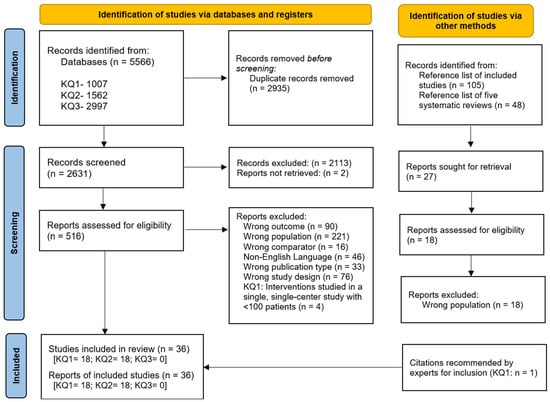
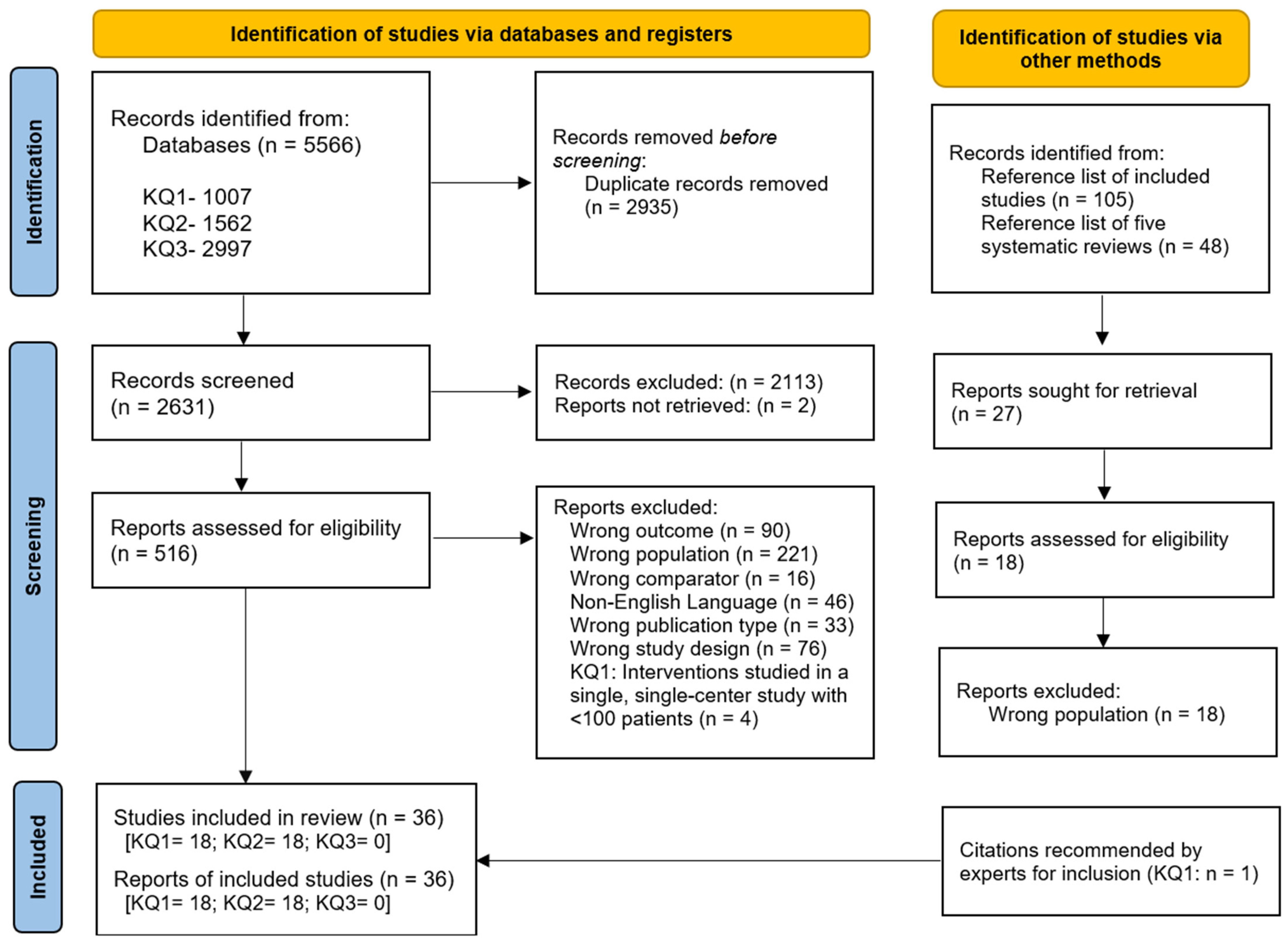
From 5566 citations, we included 36 studies (Figure 1 and Figure S1), with 18 studies under KQ1 and 18 studies under KQ2 [19,20,21,22,23,24,25,26,27,28,29,30,31,32,33,34,35,36,37,38,39,40,41,42,43,44,45,46,47,48,49,50,51,52,53,54]. We found no eligible studies under KQ3. Study-level metadata and study characteristics are presented in Tables S2 and S3, and ROB assessments are in Figures S2–S4.
Figure 1.
PRISMA Flow Diagram for Study Selection for Systematic Review: Diagnosis and Treatment of Osteonecrosis of Femoral Head. KQ: Key Question; Source: Page et al. [10]. This work is licensed under CC BY 4.0. To view a copy of this license, visit https://creativecommons.org/licenses/by/4.0/ (accessed on 17 February 2026).
3.1. KQ1a: Modality for Diagnosis
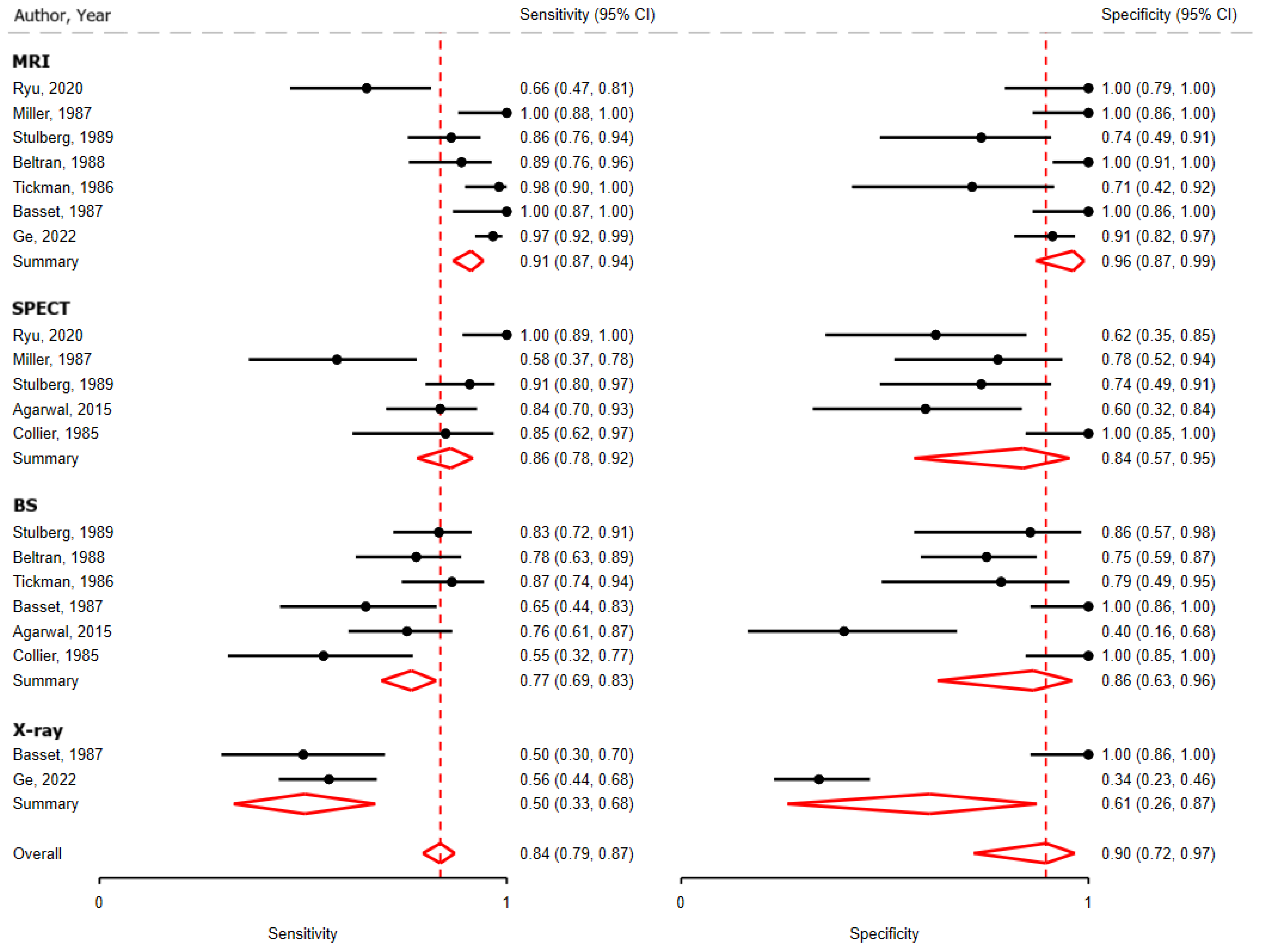
For KQ1a, we included nine comparative studies from the United States, Korea, China, and India (sample sizes [n] = 20 to 440 hips), primarily used histology as the reference standard, and compared MRI, SPECT, bone scintigraphy (BS), and radiography [19,20,21,22,23,24,25,26,27]. Nearly all comparative imaging studies showed high ROB in patient selection owing to retrospective designs and case-enriched samples and mixed judgment in reference standard blinding, with several studies assessed as high or unclear ROB (Figure S2).
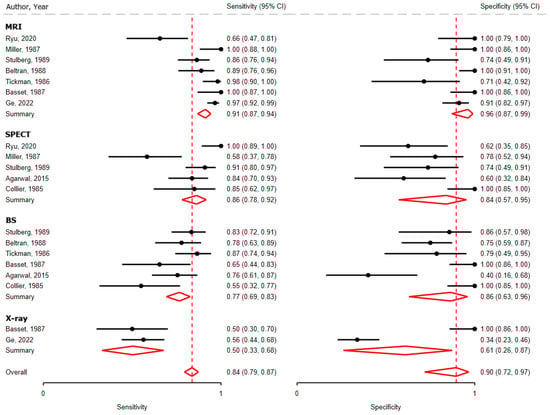
Magnetic resonance imaging demonstrated the highest overall diagnostic performance (Figure 2 and Table 1; very low-grade evidence). Among all modalities evaluated, MRI had the greatest pooled sensitivity (0.91; 95% confidence interval (CI), 0.87 to 0.94) and pooled specificity (0.96; 95% CI, 0.87 to 0.99). Standard radiography showed the poorest pooled sensitivity (0.50; 95% CI, 0.33 to 0.68) and specificity (0.61; 95% CI, 0.26 to 0.87). The sROC plot indicated imprecision in estimates (Figure S5).
Figure 2.
Forest Plots and Meta-Analysis for Key Question 1: Diagnosis and Evaluation of Osteonecrosis of the Femoral Head. BS—bone scintigraphy; MRI—magnetic resonance imaging; SPECT—single-photon emission computed tomography.
Table 1.
Strength of Evidence Assessments for Key Question 1 by GRADE Criteria for Systematic Review: Diagnosis and Treatment of Nontraumatic Osteonecrosis of Femoral Head.
3.2. KQ1b: Detection of Subchondral Fracture
For KQ1b (detection of subchondral fracture), we included four retrospective comparative studies (n = 45 to 1001 hips), one from China, one from Korea, and two from the USA, comparing frog-leg lateral and AP radiographs, digital radiography, MRI, and computed tomography (CT), with outcomes focused on sensitivity, specificity, predictive values, and accuracy [28,29,30,54]. All studies were assessed as high ROB in patient selection and flow/timing, reflecting heterogeneous imaging intervals and inconsistent application of reference standards (Figure S2).
A study reported that for detecting subchondral fractures, CT had the highest diagnostic yield, followed by MRI and X-ray (Table 1; very low-grade evidence) [29]. Another study concluded that 3-T MRI was not inferior to CT in detecting cases of ARCO stage III ONFH [54]. There were two retrospective studies that reported conflicting findings for the benefit of adding a frog-leg image in detecting subchondral fracture compared with a standard image alone, with one study favoring incremental diagnostic yield and another study reporting no difference in diagnostic yield (Table 1; very low-grade evidence) [28,30].
3.3. KQ1c: Monitoring Treatment Response
For KQ1c (monitoring treatment response), we identified three studies (n = 13 to 90 hips), one each from Austria, Greece, and the USA, evaluating MRI versus bone scintigraphy for serial assessment of necrosis volume after intervention, all relying on histology or MRI-based volumetry [27,31,32]. All three studies were assessed as low ROB in the index test, but high ROB in patient selection and flow/timing, consistent with retrospective cohorts and lack of standardized follow-up imaging, while applicability concerns remained minimal.
There was one comparative study that reported that MRI has better diagnostic performance than BS to monitor the effect of treatment in terms of detecting the extent of necrotic tissue (Table 1; very low-grade evidence) [27]. There were two single-arm studies that also demonstrated the utility of MRI in postoperative surveillance after core decompression, vascularized bone graft, and total arthroplasty [31,32].
3.4. KQ1d: Distinguishing Symptomatic from Asymptomatic ONFH
For KQ1d, we included three observational MRI-based studies (n = 37 to 123 hips), one each from Japan, China, and Korea, that examined correlations between bone marrow edema, joint effusion, and the presence of hip pain [33,34,35]. All three studies were assessed as unclear or high ROB in patient selection and in reference standard, as symptom assessment lacked blinding and relied on clinical self-report.
To differentiate symptomatic from asymptomatic hips, both bone marrow edema (BME) had higher pooled specificity for pain (0.98, 95% CI, 0.79 to 1.00) and grade 2+ effusion (0.80, 95% CI, 0.64 to 0.90) also had good specificity for pain (but lower than BME; Figure S6). The BME also had a greater positive likelihood ratio and diagnostic odds ratio compared with grade 2+ effusion (Table 1 and Table S4, Figure S7), suggesting greater accuracy of BME for differentiating symptomatic from asymptomatic nontraumatic ONFH (Table 1; moderate-grade evidence). Additionally, one study reported a greater probability of BME with increasing severity of pain and that in a logistic regression model adjusting for both indicators, only BME remained a significant predictor of pain [35].
3.5. KQ2a: Optimal Management of ARCO Stages I to II ONFH
We included 14 studies under KQ2a evaluating head-preserving interventions for early-stage ONFH with radiographic progression to collapse as the outcome of interest [36,37,38,39,40,41,42,43,44,45,46,47,48,49]. There were three studies that compared core decompression (CD) with and without bone marrow concentrate (BMC): two randomized controlled trials from Belgium and Germany (n = 24 hips and n = 25 hips; follow-up 24 to 60 months) and one U.S. retrospective comparative cohort assessing CD plus BMC versus CD alone [36,37,38]. There were three studies that compared vascularized fibular grafting (VBG) versus non-vascularized bone grafting (non-VBG): one randomized controlled trial from China (n = 46 versus n = 45 hips, respectively) and two retrospective matched cohort studies from Korea and the United States (n = 10 versus 10 hips respectively; n = 35 versus 35 hips, respectively), all reporting collapse outcomes at 50 to 60 months of follow-up [39,40,41]. Additional single-arm series (k = 4 studies) described outcomes of VBG without comparator groups, with sample sizes ranging from 17 to 39 hips and follow-up extending to 91 months [42,43,44,45]. There were two single-arm studies that evaluated osteotomy techniques, including transtrochanteric rotational osteotomy (n = 36 hips) and intertrochanteric curved varus osteotomy (n = 30 hips), with follow-up of 75 to 84 months [46,47]. A comparative cohort from Germany evaluated intertrochanteric osteotomy versus CD [48]. An Indian cohort compared CD plus non-VBG versus CD alone [49].
Across the three RCTs, ROB-2 assessments (Figure S3) showed high ROB, primarily due to issues in the randomization process and missing outcome data, with additional concerns in deviations from intended interventions [36,37,39]. The observational, comparative, and single-arm studies demonstrated serious or critical ROB in ROBINS-I, driven mainly by confounding and participant selection, though most studies had low risk in outcome measurement and reporting domains.
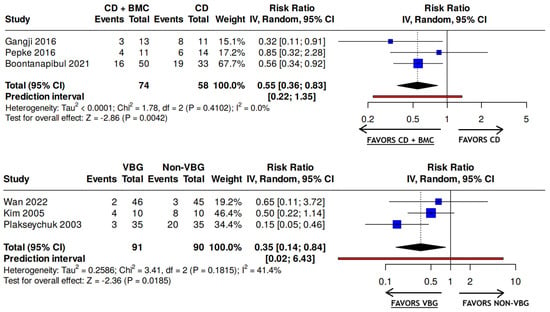
Across three studies (n = 132 hips; two RCTs and one retrospective study; Figure 3) evaluating CD with versus without BMC, the pooled risk of femoral head collapse was lower in the CD plus BMC group (31.1%) compared with CD alone (56.9%); the overall certainty of evidence was very low (Table 2) [36,37,38]. Meta-analysis demonstrated a pooled risk ratio of 0.55 (95% CI, 0.36 to 0.83), indicating a relative reduction in collapse risk (Figure 3). Similarly, pooling data from three studies (n = 181 hips; one RCT and two retrospective studies; Figure 3) comparing VBG with non-VBG showed a markedly lower collapse rate with VBG (9.9%) versus non-VBG (34.4%), yielding a pooled risk ratio of 0.35 (95% CI, 0.14 to 0.84), with very low certainty of evidence (Table 2) [39,40,41].
Figure 3.
Forest Plots and Meta-Analysis for Rate of Collapse After Surgical Treatment of ARCO Stages I–II Osteonecrosis of the Femoral Head. BMC—bone marrow concentrate; CD—core decompression; VBG—vascular bone graft.
Table 2.
Strength of Evidence Assessments for Key Question 2 by GRADE Criteria for Systematic Review: Diagnosis and Treatment of Nontraumatic Osteonecrosis of the Femoral Head.
Osteotomies were evaluated in three eligible single-arm studies with no comparator group [46,47,48]. The incidence of collapse was 11% (95% CI, 0 to 35%) over a follow-up period of greater than 10 to 20 years postoperatively. Due to the lack of a comparator group, the strength of evidence was not rated. Of note, all three studies used different techniques for osteotomy chosen based on clinical context. There was one study that compared CD plus non-VBG versus CD alone and reported no significant difference in rate of collapse [49].
3.6. KQ2b: Observation Versus Treatment for ARCO Stages I to II ONFH
For KQ2b, we found no studies directly comparing observation versus treatment, and we included four cohort studies (n = 68 to 121 hips; follow-up six to 168 months) that described the natural history of untreated asymptomatic ONFH, reporting progression to symptoms for observation alone [50,51,52,53]. All four studies were assessed at critical ROB owing to the single-arm design and no comparator (i.e., treated) group. Kang et al. (n = 68) reported 56% becoming symptomatic at a mean of 2.3 years; larger and laterally located lesions were significant predictors [51]. Nam et al. (n = 105) found 59% became symptomatic at approximately 25 months; extent and size strongly predicted progression [53]. In systemic lupus patients (n = 121), Hernigou et al. reported 95% of stage I and 100% of stage II hips developed pain within two to three years [50]. Min et al. (n = 81) found 32% collapsed at a mean of four years; large, laterally located (C2) lesions carried the highest risk [52].
We found no studies that met our eligibility criteria to answer KQ2c and KQ3. Therefore, the only means to address these questions for a guideline would default to consensus opinion by subject matter experts.
4. Discussion
This systematic review offers an integrated assessment of diagnostic and therapeutic evidence for nontraumatic ONFH, with the explicit goal of informing development of an evidence-based ARCO CPG. Several key findings emerge that have important implications for clinical practice across varied settings, research prioritization, and guideline formulation.
4.1. Diagnostic Imaging: Clinical Interpretation and Implications
Across comparative diagnostic accuracy studies, MRI demonstrated the highest sensitivity and specificity for early detection of ONFH. This finding is consistent with the biological basis of ONFH, in which early marrow and trabecular changes precede radiographic abnormalities. Notably, several studies included in our meta-analyses are old and may underestimate the performance of MRI in current times, given the advancement in MRI technology and diagnostic criteria over the years [55]. More recent, well-designed comparative studies may help improve certainty of evidence ratings to rise above very low grade. Beyond diagnosis, MRI findings—most notably bone marrow edema—showed strong associations with symptomatic disease in precollapse ONFH. These observations reinforce the clinical utility of MRI not only as a diagnostic tool, but also as a means of phenotyping disease activity and identifying patients at higher risk for pain and progression [54,55].
The CT and MRI both outperformed plain radiography in detecting subchondral fractures, although the certainty of evidence was very low. From a clinical perspective, this highlights an important diagnostic inflection point: once subchondral fracture occurs, the probability of femoral head collapse increases substantially, often altering management from joint-preserving strategies to arthroplasty [55]. The lack of high-quality comparative data limits firm recommendations regarding optimal modality selection, suggesting that imaging choice should be individualized based on availability, expertise, radiation exposure considerations, and clinical suspicion [54,55,56].
Our findings are highly applicable in modern orthopedic practice, where MRI is widely used and increasingly accessible [55]. However, applicability varies across health systems, as differences in MRI protocols, radiologic expertise, and imaging availability may influence diagnostic yield. Similarly, both CT and MRI may be used to detect subchondral fracture, though selection of modality may depend on local considerations regarding availability of technology and expertise, radiation exposure, and cost [54,56].
Evidence regarding imaging for monitoring treatment response was notably sparse. While MRI appears capable of quantifying necrotic volume and postoperative changes, thresholds for clinically meaningful change remain undefined. This gap limits the ability to use imaging as a surrogate endpoint in both clinical practice and research, underscoring the need for standardized imaging-based outcome measures.
4.2. Treatment of Precollapse ONFH: Interpreting Comparative Evidence
The therapeutic findings also align with and expand upon earlier systematic reviews. For early-stage ONFH (ARCO stages I–II), core decompression (CD) remains the most frequently studied intervention. Prior reviews emphasized the promise of CD in ONFH yet noted variability in outcomes, pooled data across disparate interventions, and did not report findings exclusively for precollapse ONFH (i.e., ARCO stages I or II) [57,58,59]. Our meta-analyses, incorporating more recent comparative studies, support those observations and provide evidence specifically for precollapse ONFH, suggesting improved radiographic outcomes when CD is combined with BMC. This is consistent with emerging biologic literature, which proposes enhanced reparative potential when CD is augmented with autologous cell-based therapies [60]. However, the certainty of evidence remains very low due to small sample sizes, risk of bias, and heterogeneity in patient selection and procedural technique.
Similarly, earlier reviews of vascularized fibular grafting and osteotomy have highlighted their potential role in experienced centers [61,62,63]. Our meta-analysis provides evidence specifically for precollapse ONFH, which should be contextualized with procedural complexity, surgeon expertise, and perioperative resources that might influence the feasibility and success of these interventions across practice environments. Notably, evidence for osteotomies comes from very few, non-comparative case series; however, the rate of postoperative collapse for osteotomies in these studies appears to be lower than that for other procedures. This finding suggests the need for large, well-designed, comparative effectiveness studies to evaluate whether osteotomies may be superior to other procedural options for treating precollapse ONFH [46,47,48].
Importantly, inconsistent outcome definitions across studies, particularly regarding collapse, progression, and functional recovery, and highly variable length of follow-up across studies substantially hindered pooling and interpretation. This limitation reflects a broader challenge in ONFH research and directly constrains the strength of guideline recommendations. There is a dire need to develop a standardized core outcomes set and a rigorous reporting framework for future RCTs and clinical research on ONFH to aid future pooling/synthesis of high-certainty evidence.
4.3. Natural History and the Challenge of Asymptomatic Disease
The natural history of asymptomatic ONFH remains poorly defined. Observational cohorts suggest that a substantial proportion of asymptomatic hips progress to pain or collapse, particularly in the presence of large or laterally located lesions. However, the absence of comparative studies evaluating observation versus early intervention prevents definitive conclusions regarding the benefit of prophylactic treatment. This uncertainty poses a common clinical dilemma and highlights an area where expert consensus, rather than evidence, may guide practice.
The natural history data for asymptomatic ONFH further underscores the importance of contextual factors. Progression to symptomatic disease or collapse varied widely across studies, reflecting differences in lesion size, location, comorbidities, and patient populations. These contextual variables are essential when interpreting progression risk, particularly in settings with differing prevalence of corticosteroid use, alcohol exposure, or systemic inflammatory conditions [1,2,3,4,5]. In advanced-stage ONFH, findings from this review reaffirm the variability in reported outcomes across joint-preserving procedures. Applicability of these interventions is closely tied to local expertise, patient selection practices, and operative resources, all of which shape real-world outcomes and should be considered when interpreting the comparative data.
4.4. Methodological Limitations of the Evidence Base
The existing evidence base for the diagnosis and treatment of ONFH has several important potential limitations that constrain the certainty of evidence. Many studies are small, single-center case series with heterogeneous populations, inconsistent staging criteria, and variable use of advanced imaging, making comparisons across studies difficult. Few investigations include long-term follow-up, and outcomes are often inconsistently defined, particularly with respect to radiographic progression and functional recovery. Treatment cohorts frequently lack uniformity in intervention protocols, and many studies do not adequately control potential confounding due to key prognostic factors such as lesion size, location, or etiology. Furthermore, studies often focused on clinically heterogeneous, mixed populations (e.g., mixing ARCO stages I to III disease), limiting evidence synthesis and generalizability of findings. This was one of the reasons why we did not find any eligible studies for supporting KQ 2c and KQ 3. Additionally, the predominance of observational designs, coupled with inadequate control for confounding and incomplete outcome reporting, limits the strength of causal inferences. These methodological weaknesses directly influenced GRADE certainty ratings, which were low or very low for most outcomes. As a result, even when pooled estimates suggest benefit, confidence in the magnitude and durability of effect remains limited.
4.5. Strengths and Limitations of the Review Process
This review’s strengths include the use of comprehensive, librarian-assisted search strategies; systematic evaluation of certainty of evidence using the GRADE framework; the rigor assured by leadership from highly experienced systematic review methodologists; and the consensus building using input from a large group of international physicians (eight countries) with subject expertise. Our use of hierarchical models for diagnostic accuracy and random-effects HKSJ methods for comparative outcomes further enhances analytical robustness. However, limitations include variability in study designs and reporting, heterogeneity in imaging and outcome measures, and the predominance of observational evidence for several key questions. These factors may reduce precision and limit the generalizability of some findings.
4.6. Implications for Guidelines and Future Research
Future research priorities should include well-designed, multicenter comparative studies with standardized staging, imaging protocols, and clearly defined outcomes. Development of a standardized core outcome set including radiographic, clinical, and patient-reported outcomes with long-term follow-up would substantially enhance comparability across trials and improve the evidentiary foundation for future guidelines.
From a guideline-development perspective, these findings highlight both areas of relative consensus and substantial evidence gaps. MRI can be recommended as the preferred modality for early diagnosis and assessment of symptomatic disease, while recommendations regarding specific joint-preserving treatments should be conditional and context-dependent.
5. Conclusions
This systematic review synthesizes the available evidence on diagnostic imaging and treatment outcomes for nontraumatic ONFH to inform the development of an ARCO clinical practice guideline. Among different modalities, MRI demonstrated the most consistent diagnostic accuracy, reliably detecting early ONFH and identifying bone marrow edema and joint effusion associated with symptomatic disease. Limited comparative data suggested CT more frequently identified subchondral fractures than radiography or MRI. Evidence on imaging for monitoring treatment response was sparse, with MRI being the only modality repeatedly shown to quantify lesion extent, though thresholds for meaningful change remain undefined. For early-stage ONFH (ARCO stages I and II), CD was the most studied intervention; small comparative studies suggested lower collapse rates when combined with BMC. Similarly, very low-grade evidence suggests lower rates of collapse with VBG compared with non-VBG. Other joint-preserving procedures were supported only by heterogeneous, single-center observational studies, limiting inference. There was no comparative study that evaluated observation only versus intervention in asymptomatic disease or strategies for monitoring treatment response. Overall, substantial methodological heterogeneity and predominant reliance on observational designs highlight the need for high-quality research with standardized reporting measures to enable comparative analysis for research in ONFH.
Supplementary Materials
The following supporting information can be downloaded at: https://www.mdpi.com/article/10.3390/medsci14010107/s1, Supplementary S1: Search Strategy and Screening: Supplemental Table S1. Study Selection Criteria for Systematic Review: Diagnosis and Treatment of Osteonecrosis of Femoral Head, Supplemental Figure S1 PRISMA Flow Diagram for Study Selection in Primary Searches; Supplementary S2. Description of Population, Intervention, Comparator, and Outcomes in Included Studies: Supplemental Table S2 Characteristic features of studies that were used in PICO1 recommendations, Supplemental Table S3 Characteristic features of studies that were used in PICO2 recommendations; Supplementary S3. Risk of Bias Assessments: Supplemental Figure S2 Risk of bias assessment using QUADAS-2 tool for studies under Key Question 1, Supplemental Figure S3 Risk of bias assessment using the Cochrane RoB2.0 tool for RCT studies under Key Question 2, Supplemental Figure S4 Risk of bias assessment using the ROBINS-I tool for non-RCT studies under Key Question 2; Supplementary S4. Meta-analyses: Supplemental Figure S5 Summary Receiver Operating Characteristics Plot for Diagnostic Test Accuracy Meta-Analysis for Different Modalities to Diagnose Osteonecrosis of Femoral Head, Supplemental Figure S6 Pooled Specificity and Sensitivity Estimates for KQ1d: Differentiating Asymptomatic versus Symptomatic Nontraumatic ONFH, Supplemental Figure S7 Positive Likelihood Ratios for MRI Signs to Differentiate Symptomatic versus Asymptomatic Nontraumatic ONFH, Supplemental Table S4. Diagnostic Odds Ratios for MRI signs to Differentiate Between Symptomatic Versus Asymptomatic Nontraumatic ONFH.
Author Contributions
Conceptualization, S.F.G.P., D.J.R., S.B.G., E.Y.C., Q.C., M.A.M. and L.C.J.; methodology, R.R.P., M.E.B. and R.K.; formal analysis, R.R.P., M.A.M. and E.Y.C.; investigation, R.R.P., A.M., S.F.G.P., D.J.R., R.K., G.S. and S.B.; data curation, S.F.G.P., D.J.R., Q.C., R.K. and G.S.; writing—original draft preparation, R.R.P.; writing—review and editing, all authors; visualization, R.R.P.; supervision, R.R.P., M.E.B., Q.C. and E.Y.C.; project administration, S.B. All authors have read and agreed to the published version of the manuscript.
Funding
This research received no external funding. R.R.P., M.E.B., and S.B. were supported by courtesy of the Evidence Synthesis Unit, Center for Learning Health Systems Science, University of Minnesota, MN, USA.
Institutional Review Board Statement
Not applicable.
Informed Consent Statement
Not applicable.
Data Availability Statement
The original contributions presented in this study are included in the article/Supplementary Material. Further inquiries can be directed to the corresponding author.
Acknowledgments
We would like to thank the ARCO Clinical Practice Guideline Development workgroup for their contributions to the review interpretations. We would like to particularly thank Caitlin Bakker and Nicole-Theis Mahon for helping develop and execute the search algorithms and screening process.
Conflicts of Interest
The authors declare no conflicts of interest.
References
- Moya-Angeler, J.; Gianakos, A.L.; Villa, J.C.; Ni, A.; Lane, J.M. Current concepts on osteonecrosis of the femoral head. World J. Orthop. 2015, 6, 590–601. [Google Scholar] [CrossRef] [Scilit]
- Ikeuchi, K.; Hasegawa, Y.; Seki, T.; Takegami, Y.; Amano, T.; Ishiguro, N. Epidemiology of nontraumatic osteonecrosis of the femoral head in Japan. Mod. Rheumatol. 2015, 25, 278–281. [Google Scholar] [CrossRef] [Scilit]
- Mont, M.A.; Zywiel, M.G.; Marker, D.R.; McGrath, M.S.; Delanois, R.E. The natural history of untreated asymptomatic osteonecrosis of the femoral head: A systematic literature review. J. Bone Jt. Surg. Am. 2010, 92, 2165–2170. [Google Scholar] [CrossRef] [Scilit] [PubMed]
- Zhao, D.-W.; Yu, M.; Hu, K.; Wang, W.; Yang, L.; Wang, B.-J.; Gao, X.-H.; Guo, Y.-M.; Xu, Y.-Q.; Wei, Y.-S.; et al. Prevalence of nontraumatic osteonecrosis of the femoral head and its associated risk factors in the Chinese population: Results from a nationally representative survey. Chin. Med. J. (Engl.) 2015, 128, 2843–2850. [Google Scholar] [CrossRef] [Scilit] [PubMed]
- Mankin, H.J. Nontraumatic necrosis of bone (osteonecrosis). N. Engl. J. Med. 1992, 326, 1473–1479. [Google Scholar]
- Mont, M.A.; Salem, H.S.; Piuzzi, N.S.; Goodman, S.B.; Jones, L.C. Nontraumatic osteonecrosis of the femoral head: Where do we stand today? A 5-year update. J. Bone Jt. Surg. Am. 2020, 97, 1604–1627. [Google Scholar] [CrossRef] [Scilit]
- Cheng, E.; Mont, M.A.; Goodman, S.B.; Sierra, R.J.; Cui, Q.; Salem, H.S. Diagnosis and Treatment of Femoral Head Osteonecrosis: A Protocol for Development of Evidence-Based Clinical Practice Guidelines. Surg. Technol. Int. 2021, 38, 371–378. [Google Scholar] [CrossRef] [PubMed]
- Methods Guide for Effectiveness and Comparative Effectiveness Reviews; Agency for Healthcare Research and Quality: Rockville, MD, USA, 2008. Available online: https://www.ncbi.nlm.nih.gov/books/NBK47095/ (accessed on 1 May 2025).
- Guyatt, G.H.; Oxman, A.D.; Vist, G.E.; Kunz, R.; Falck-Ytter, Y.; Alonso-Coello, P.; Schünemann, H.J. GRADE: An emerging consensus on rating quality of evidence and strength of recommendations. BMJ 2008, 336, 924–926. [Google Scholar] [CrossRef] [Scilit] [PubMed] [PubMed Central]
- Page, M.J.; McKenzie, J.E.; Bossuyt, P.M.; Boutron, I.; Hoffmann, T.C.; Mulrow, C.D.; Shamseer, L.; Tetzlaff, J.M.; Akl, E.A.; Brennan, S.E.; et al. The PRISMA 2020 statement: An updated guideline for reporting systematic reviews. BMJ 2021, 372, n71. [Google Scholar] [CrossRef] [Scilit] [PubMed] [PubMed Central]
- McInnes, M.D.F.; Moher, D.; Thombs, B.D.; McGrath, T.A.; Bossuyt, P.M.; Clifford, T.; Cohen, J.F.; Deeks, J.J.; Gatsonis, C.; Hooft, L.; et al. Preferred Reporting Items for a Systematic Review and Meta-analysis of Diagnostic Test Accuracy Studies: The PRISMA-DTA Statement. JAMA 2018, 319, 388–396, Erratum in: JAMA 2019, 322, 2026. https://doi.org/10.1001/jama.2019.18307. PMID: 29362800. [Google Scholar] [CrossRef] [Scilit]
- McGowan, J.; Sampson, M.; Salzwedel, D.M.; Cogo, E.; Foerster, V.; Lefebvre, C. PRESS Peer Review of Electronic Search Strategies: 2015 Guideline Statement. J. Clin. Epidemiol. 2016, 75, 40–46. [Google Scholar] [CrossRef] [Scilit] [PubMed]
- Hoffmann, T.C.; Glasziou, P.P.; Boutron, I.; Milne, R.; Perera, R.; Moher, D.; Altman, D.G.; Barbour, V.; Macdonald, H.; Johnston, M.; et al. Better reporting of interventions: Template for intervention description and replication (TIDieR) checklist and guide. BMJ 2014, 348, g1687. [Google Scholar] [CrossRef] [Scilit] [PubMed]
- Whiting, P.F.; Rutjes, A.W.S.; Westwood, M.E.; Mallett, S.; Deeks, J.J.; Reitsma, J.B.; Leeflang, M.M.G.; Sterne, J.A.C.; Bossuyt, P.M.M. QUADAS-2: A revised tool for the quality assessment of diagnostic accuracy studies. Ann. Intern. Med. 2011, 155, 529–536. [Google Scholar] [CrossRef] [Scilit] [PubMed]
- Sterne, J.A.C.; Savović, J.; Page, M.J.; Elbers, R.G.; Blencowe, N.S.; Boutron, I.; Cates, C.J.; Cheng, H.Y.; Corbett, M.S.; Eldridge, S.M.; et al. RoB 2: A revised tool for assessing risk of bias in randomised trials. BMJ 2019, 366, l4898. [Google Scholar] [CrossRef] [Scilit] [PubMed]
- Sterne, J.A.C.; Hernán, M.A.; Reeves, B.C.; Savović, J.; Berkman, N.D.; Viswanathan, M.; Henry, D.; Altman, D.G.; Ansari, M.T.; Boutron, I.; et al. ROBINS-I: A tool for assessing risk of bias in non-randomised studies of interventions. BMJ 2016, 355, i4919. [Google Scholar] [CrossRef] [Scilit] [PubMed] [PubMed Central]
- Lee, J.; Kim, K.W.; Choi, S.H.; Huh, J.; Park, S.H. Systematic Review and Meta-Analysis of Studies Evaluating Diagnostic Test Accuracy: A Practical Review for Clinical Researchers-Part II. Statistical Methods of Meta-Analysis. Korean J. Radiol. 2015, 16, 1188–1196. [Google Scholar] [CrossRef] [Scilit] [PubMed] [PubMed Central]
- Röver, C.; Knapp, G.; Friede, T. Hartung-Knapp-Sidik-Jonkman approach and its modification for random-effects meta-analysis with few studies. BMC Med. Res. Methodol. 2015, 15, 99. [Google Scholar] [CrossRef] [Scilit] [PubMed] [PubMed Central]
- Agarwal, K.K.; Mukherjee, A.; Sharma, P.; Bal, C.; Kumar, R. Incremental value of 99mTc-MDP hybrid SPECT/CT over planar scintigraphy and SPECT in avascular necrosis of the femoral head. Nucl. Med. Commun. 2015, 36, 1055–1062. [Google Scholar] [CrossRef] [Scilit]
- Bassett, L.W.; Gold, R.H.; Reicher, M.; Bennett, L.R.; Tooke, S.M. Magnetic resonance imaging in the early diagnosis of ischemic necrosis of the femoral head. Preliminary results. Clin. Orthop. Relat. Res. 1987, 214, 237–248. [Google Scholar] [CrossRef] [Scilit]
- Beltran, J.; Herman, L.J.; Burk, J.M.; A Zuelzer, W.; Clark, R.N.; Lucas, J.G.; Weiss, L.D.; Yang, A. Femoral head avascular necrosis: MR imaging with clinical-pathologic and radionuclide correlation. Radiology 1988, 166, 215–220. [Google Scholar] [CrossRef] [Scilit]
- Collier, B.; Carrera, G.; Johnson, R.; Isitman, A.; Hellman, R.; Knobel, J.; Finger, W.; Gonyo, J.; Malloy, P. Detection of femoral head avascular necrosis in adults by SPECT. J. Nucl. Med. 1985, 26, 979–987. [Google Scholar]
- Ge, H.; Wang, Z.; Zhang, J. X-ray, digital tomographic fusion, CT, and MRI in early ischemic necrosis of the femoral head. Medicine 2024, 103, e36281. [Google Scholar] [CrossRef] [Scilit]
- Miller, I.L.; Savory, C.G.; Polly, D.W., Jr.; Graham, G.D.; McCabe, J.M.; Callaghan, J.J. Femoral head osteonecrosis. Detection by magnetic resonance imaging versus single-photon emission computed tomography. Clin. Orthop. Relat. Res. 1989, 247, 152–162. [Google Scholar] [CrossRef] [Scilit]
- Ryu, J.-S.; Kim, J.S.; Moon, D.H.; Kim, S.M.; Shin, M.J.; Chang, J.S.; Kil Park, S.; Han, D.J.; Lee, H.K. Bone SPECT is more sensitive than MRI in the detection of early osteonecrosis of the femoral head after renal transplantation. J. Nucl. Med. 2002, 43, 1006–1011. [Google Scholar]
- Stulberg, B.N.; Levine, M.; Bauer, T.W.; Belhobek, G.H.; Pflanze, W.; Feiglin, D.H.I.; Roth, A.I. Multimodality approach to osteonecrosis of the femoral head. Clin. Orthop. Relat. Res. 1989, 240, 181–193. [Google Scholar] [CrossRef] [Scilit]
- Thickman, D.; Axel, L.; Kressel, H.Y.; Steinberg, M.; Chen, H.; Velchick, M.; Fallon, M.; Dalinka, M. Magnetic resonance imaging of avascular necrosis of the femoral head. Skelet. Radiol. 1986, 15, 133–140. [Google Scholar] [CrossRef] [Scilit] [PubMed]
- Chee, C.G.; Cho, J.; Kang, Y.; Kim, Y.; Lee, E.; Lee, J.W.; Ahn, J.M.; Kang, H.S. Diagnostic accuracy of digital radiography for the diagnosis of osteonecrosis of the femoral head, revisited. Acta Radiol. 2019, 60, 969–976. [Google Scholar] [CrossRef] [Scilit]
- Stevens, K.; Tao, C.; Lee, S.-U.; Salem, N.; Vandevenne, J.; Cheng, C.; Neumann, G.; Valentin-Opran, A.; Lang, P. Subchondral fractures in osteonecrosis of the femoral head: Comparison of radiography, CT, and MR imaging. AJR Am. J. Roentgenol. 2003, 180, 363–368. [Google Scholar] [CrossRef] [Scilit] [PubMed]
- Yang, F.; Deng, X.; Xin, P.; Hong, Z.; Pang, F.; He, W.; Wei, Q.; Li, Z. The Value of the Frog Lateral View Radiograph for Detecting Collapse of Femur Head Necrosis: A Retrospective Study of 1001 Cases. Front. Med. 2022, 9, 811644. [Google Scholar] [CrossRef] [Scilit]
- Plenk, H., Jr.; Gstettner, M.; Grossschmidt, K.; Breitenseher, M.; Urban, M.; Hofmann, S. Magnetic resonance imaging and histology of repair in femoral head osteonecrosis. Clin. Orthop. Relat. Res. 2001, 386, 42–53. [Google Scholar] [CrossRef] [Scilit]
- Bassounas, A.E.; Karantanas, A.H.; Fotiadis, D.I.; Malizos, K.N. Femoral head osteonecrosis: Volumetric MRI assessment and outcome. Eur. J. Radiol. 2007, 63, 10–15. [Google Scholar] [CrossRef] [Scilit] [PubMed]
- Hatanaka, H.; Motomura, G.; Ikemura, S.; Kubo, Y.; Utsunomiya, T.; Baba, S.; Kawano, K.; Nakashima, Y. Differences in magnetic resonance findings between symptomatic and asymptomatic pre-collapse osteonecrosis of the femoral head. Eur. J. Radiol. 2019, 112, 1–6. [Google Scholar] [CrossRef] [Scilit]
- Huang, G.S.; Chan, W.P.; Chang, Y.C.; Chang, C.Y.; Chen, C.Y.; Yu, J.S. MR imaging of bone marrow edema and joint effusion in patients with osteonecrosis of the femoral head: Relationship to pain. AJR Am. J. Roentgenol. 2003, 181, 545–549. [Google Scholar] [CrossRef] [Scilit] [PubMed]
- Koo, K.-H.; Ahn, I.-O.; Kim, R.; Song, H.-R.; Jeong, S.-T.; Na, J.-B.; Kim, Y.-S.; Cho, S.-H. Bone marrow edema and associated pain in early stage osteonecrosis of the femoral head: Prospective study with serial MR images. Radiology 1999, 213, 715–722. [Google Scholar] [CrossRef] [Scilit] [PubMed]
- Gangji, V.; Toungouz, M.; Lechanteur, C.; Beguin, Y.; Baudoux, E.; De Maertelaer, V.; Pather, S.; Katz, R.; Ino, J.; Egrise, D.; et al. THU0540 Autologous Osteoblastic Cells versus Concentrated Bone Marrow Implantation in Osteonecrosis of The Femoral Head: A Randomized Controlled Single Blind Study. Ann. Rheum. Dis. 2016, 75, 387. [Google Scholar] [CrossRef] [Scilit]
- Pepke, W.; Kasten, P.; Beckmann, N.A.; Janicki, P.; Egermann, M. Core Decompression and Autologous Bone Marrow Concentrate for Treatment of Femoral Head Osteonecrosis: A Randomized Prospective Study. Orthop. Rev. 2016, 8, 6162. [Google Scholar] [CrossRef] [Scilit]
- Boontanapibul, K.; Huddleston, J.I., 3rd; Amanatullah, D.F.; Maloney, W.J.; Goodman, S.B. Modified Kerboul Angle Predicts Outcome of Core Decompression with or Without Additional Cell Therapy. J. Arthroplast. 2021, 36, 1879–1886. [Google Scholar] [CrossRef] [Scilit]
- Wan, J.; Hu, Y.; Li, J.; Zeng, Y.; Ren, H. Comparison of the outcome of different bone grafts combined with modified core decompression for the treatment of ARCO II stage femoral head necrosis. Int. Orthop. 2022, 46, 1955–1962. [Google Scholar] [CrossRef] [Scilit]
- Kim, S.Y.; Kim, Y.G.; Kim, P.T.; Ihn, J.C.; Cho, B.C.; Koo, K.H. Vascularized compared with nonvascularized fibular grafts for large osteonecrotic lesions of the femoral head. J. Bone Jt. Surg. Am. 2005, 87, 2012–2018. [Google Scholar] [CrossRef] [Scilit]
- Plakseychuk, A.Y.; Kim, S.Y.; Park, B.C.; Varitimidis, S.E.; Rubash, H.E.; Sotereanos, D.G. Vascularized compared with nonvascularized fibular grafting for the treatment of osteonecrosis of the femoral head. J. Bone Jt. Surg. Am. 2003, 85, 589–596. [Google Scholar] [CrossRef] [Scilit]
- Kawate, K.; Ohmura, T.; Hiyoshi, N.; Teranishi, T.; Kataoka, H.; Tamai, K.; Ueha, T.; Takakura, Y. Limitations of Joint-Preserving Treatment for Osteonecrosis of the Femoral Head: Limitation of Free Vascularized Fibular Grafting. In Treatment of Osteoarthritic Change in the Hip: Joint Preservation or Joint Replacement? Springer: Berlin/Heidelberg, Germany, 2007; pp. 97–104. [Google Scholar]
- Öztürk, K.; Baydar, M.; Alpay, Y.; Şencan, A.; Orman, O.; Aykut, S. Clinical results of free vascularized fibula graft in the management of precollapse osteonecrosis of the femoral head: A retrospective clinical study. Acta Orthop. Traumatol. Turc. 2022, 56, 105–110. [Google Scholar] [CrossRef] [Scilit]
- Soucacos, P.N.; Beris, A.E.; Malizos, K.; Koropilias, A.; Zalavras, H.; Dailiana, Z. Treatment of avascular necrosis of the femoral head with vascularized fibular transplant. Clin. Orthop. Relat. Res. 2001, 386, 120–130. [Google Scholar] [CrossRef] [Scilit]
- Ünal, M.B.; Cansu, E.; Parmaksızoğlu, F.; Cift, H.; Gürcan, S. Treatment of osteonecrosis of the femoral head with free vascularized fibular grafting: Results of 7.6-year follow-up. Acta Orthop. Traumatol. Turc. 2016, 50, 501–506. [Google Scholar] [CrossRef] [Scilit]
- Biswal, S.; Hazra, S.; Yun, H.H.; Hur, C.Y.; Shon, W.Y. Transtrochanteric rotational osteotomy for nontraumatic osteonecrosis of the femoral head in young adults. Clin. Orthop. Relat. Res. 2009, 467, 1529–1537. [Google Scholar] [CrossRef] [Scilit]
- Hamanishi, M.; Yasunaga, Y.; Yamasaki, T.; Mori, R.; Shoji, T.; Ochi, M. The clinical and radiographic results of intertrochanteric curved varus osteotomy for idiopathic osteonecrosis of the femoral head. Arch. Orthop. Trauma. Surg. 2014, 134, 305–310. [Google Scholar] [CrossRef] [Scilit]
- Simank, H.G.; Brocai, D.R.; Brill, C.; Lukoschek, M. Comparison of results of core decompression and intertrochanteric osteotomy for nontraumatic osteonecrosis of the femoral head using Cox regression and survivorship analysis. J. Arthroplast. 2001, 16, 790–794. [Google Scholar] [CrossRef] [Scilit]
- Mohanty, S.P.; Singh, K.A.; Kundangar, R.; Shankar, V. Management of non-traumatic avascular necrosis of the femoral head-a comparative analysis of the outcome of multiple small diameter drilling and core decompression with fibular grafting. Musculoskelet. Surg. 2017, 101, 59–66. [Google Scholar] [CrossRef] [Scilit]
- Hernigou, P.; Habibi, A.; Bachir, D.; Galacteros, F. The natural history of asymptomatic osteonecrosis of the femoral head in adults with sickle cell disease. J. Bone Jt. Surg. Am. 2006, 88, 2565–2572. [Google Scholar] [CrossRef] [Scilit] [PubMed]
- Kang, J.S.; Moon, K.H.; Kwon, D.G.; Shin, B.K.; Woo, M.S. The natural history of asymptomatic osteonecrosis of the femoral head. Int. Orthop. 2013, 37, 379–384. [Google Scholar] [CrossRef] [Scilit] [PubMed] [PubMed Central]
- Min, B.W.; Song, K.S.; Cho, C.H.; Lee, S.M.; Lee, K.J. Untreated asymptomatic hips in patients with osteonecrosis of the femoral head. Clin. Orthop. Relat. Res. 2008, 466, 1087–1092. [Google Scholar] [CrossRef] [Scilit] [PubMed] [PubMed Central]
- Nam, K.W.; Kim, Y.L.; Yoo, J.J.; Koo, K.H.; Yoon, K.S.; Kim, H.J. Fate of untreated asymptomatic osteonecrosis of the femoral head. J. Bone Jt. Surg. Am. 2008, 90, 477–484. [Google Scholar] [CrossRef] [Scilit] [PubMed]
- Jordan, E.; Varady, N.H.; Hosseinzadeh, S.; Smith, S.; Chen, A.F.; Mont, M.; Iorio, R. Femoral Head Osteonecrosis: Computed Tomography Not Needed to Identify Collapse When Using the Association Research Circulation Osseous Staging System. Arthroplast. Today 2023, 24, 101244. [Google Scholar] [CrossRef] [Scilit] [PubMed]
- Sneag, D.B.; Abel, F.; Potter, H.G.; Fritz, J.; Koff, M.F.; Chung, C.B.; Pedoia, V.; Tan, E.T. MRI Advancements in Musculoskeletal Clinical and Research Practice. Radiology 2023, 308, e230531. [Google Scholar] [CrossRef] [Scilit] [PubMed] [PubMed Central]
- Demehri, S.; Baffour, F.I.; Klein, J.G.; Ghotbi, E.; Ibad, H.A.; Moradi, K.; Taguchi, K.; Fritz, J.; Carrino, J.A.; Guermazi, A.; et al. Musculoskeletal CT Imaging: State-of-the-Art Advancements and Future Directions. Radiology 2023, 308, e230344. [Google Scholar] [CrossRef] [Scilit] [PubMed] [PubMed Central]
- Hua, K.C.; Yang, X.G.; Feng, J.T.; Wang, F.; Yang, L.; Zhang, H.; Hu, Y.C. The efficacy and safety of core decompression for the treatment of femoral head necrosis: A systematic review and meta-analysis. J. Orthop. Surg. Res. 2019, 14, 306. [Google Scholar] [CrossRef] [Scilit] [PubMed] [PubMed Central]
- Konarski, W. Effectiveness of Different Types of Core Decompression in Early-Stage Osteonecrosis of the Femoral Head: A Systematic Review and Meta-Analysis. Med. Sci. 2025, 13, 258. [Google Scholar] [CrossRef] [Scilit] [PubMed] [PubMed Central]
- Tang, H.; Ling, T.; Zhao, E.; You, M.; Chen, X.; Chen, G.; Zhou, K.; Zhou, Z. The efficacy of core decompression combined with regenerative therapy in early femoral head necrosis: A systematic review and meta-analysis involving 954 subjects. Front. Pharmacol. 2025, 15, 1501590. [Google Scholar] [CrossRef] [Scilit] [PubMed] [PubMed Central]
- Chow, S.K.; Rainey, J.P.; Mont, M.A.; Jones, L.P.; Goodman, S.B. The Role of Cell Therapies for the Treatment of Osteonecrosis of the Femoral Head. J. Arthroplast. 2025, 40, S46–S50. [Google Scholar] [CrossRef] [Scilit] [PubMed]
- Millikan, P.D.; Karas, V.; Wellman, S.S. Treatment of osteonecrosis of the femoral head with vascularized bone grafting. Curr. Rev. Musculoskelet. Med. 2015, 8, 252–259. [Google Scholar] [CrossRef] [Scilit] [PubMed] [PubMed Central]
- Hu, L.; Deng, X.; Wei, B.; Wang, J.; Hou, D. Comparative analysis of surgical interventions for osteonecrosis of the femoral head: A network meta-analysis of randomized controlled trials. J. Orthop. Surg. Res. 2023, 18, 965. [Google Scholar] [CrossRef] [Scilit] [PubMed] [PubMed Central]
- Rodham, P.L.; Jido, J.T.; Bethell, H.; Giannoudis, V.P.; Panteli, M.; Kanakaris, N.K.; Giannoudis, P.V. The Role of Proximal Femoral Osteotomy for the Treatment of Avascular Necrosis: A Systematic Review of Clinical and Patient-Reported Outcomes. J. Clin. Med. 2025, 14, 5592. [Google Scholar] [CrossRef] [Scilit] [PubMed] [PubMed Central]

Disclaimer/Publisher’s Note: The statements, opinions and data contained in all publications are solely those of the individual author(s) and contributor(s) and not of MDPI and/or the editor(s). MDPI and/or the editor(s) disclaim responsibility for any injury to people or property resulting from any ideas, methods, instructions or products referred to in the content. |
© 2026 by the authors. Licensee MDPI, Basel, Switzerland. This article is an open access article distributed under the terms and conditions of the Creative Commons Attribution (CC BY) license.