


Abstract
The present work reveals plant and animal associates of 16 families and subfamilies of fossil beetles that have been preserved in amber from Mexico, the Dominican Republic, and Myanmar. The associates include mites, pseudoscorpions, spiders, insect parasites and predators, fungi, angiosperm parts, vertebrates, and nematodes. The presence of these fossil associates can be attributed to the rapid preservation of organisms in resin, thus maintaining natural associations almost “in situ”. Examples of present-day associations similar to those of the fossils show that specific behavioral patterns are often far more ancient than the specific lineages involved.
1. Introduction
Beetles, being the most successful animals on Earth and displaying a range of colors, shapes and sizes, form many associations with other organisms [1]. While a multitude of fossil beetles have been described, very few of them have left any physical or biological evidence of organisms that shared their environment.
The present work shows a range of plants, fungi and animals that were found associated with various fossil beetles. Such examples are rare, and the majority of cases occur in amber [2,3]. Preservation in this media is not only due to the rapid entombment of the organisms, thus maintaining any natural associations “in situ”, but also to the preservative properties of amber [4].
2. Materials and Methods
Examples of beetles associated with animals and plants were obtained from inclusions in Dominican, Mexican, and Burmese amber. Some cases were taken from the literature while others were selected from the Poinar amber collection at Oregon State University. Many of these associations are new and have not been examined by experts so taxonomic details are limited or unavailable. In some cases, the associated organisms are described but not the beetles and vice versa. Attempts were made to include all previous published cases of fossil beetles with associates. Ages of the amber sites containing specimens used in this work are 15–45 Mya for Dominican [5,6], 22.5–26 Mya for Mexican [7] and 97–110 Mya for Burmese [8,9].
3. Results
The associations between fossil beetles and other organisms are arranged under the associated organisms. Table 1 summarizes the fossil beetle groups with their various associates while Table 2 indicates the present location and accession numbers of the various specimens.
Table 1.
Beetle groups with associated organisms included in the present work.
Table 2.
Location of specimens figured in the present review. PAC = Poinar amber collection, maintained at Oregon State University, Corvallis, Oregon, USA.
3.1. Associations with Mites (Arachnida: Acari)
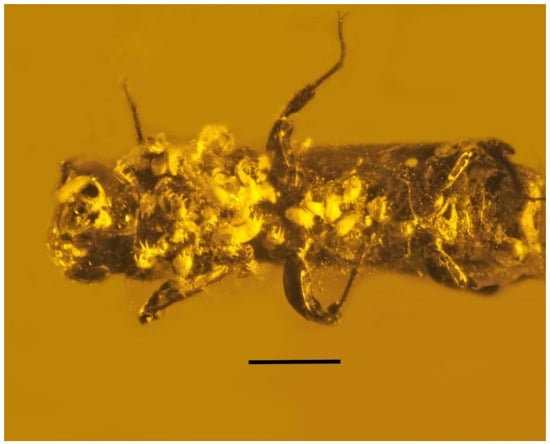
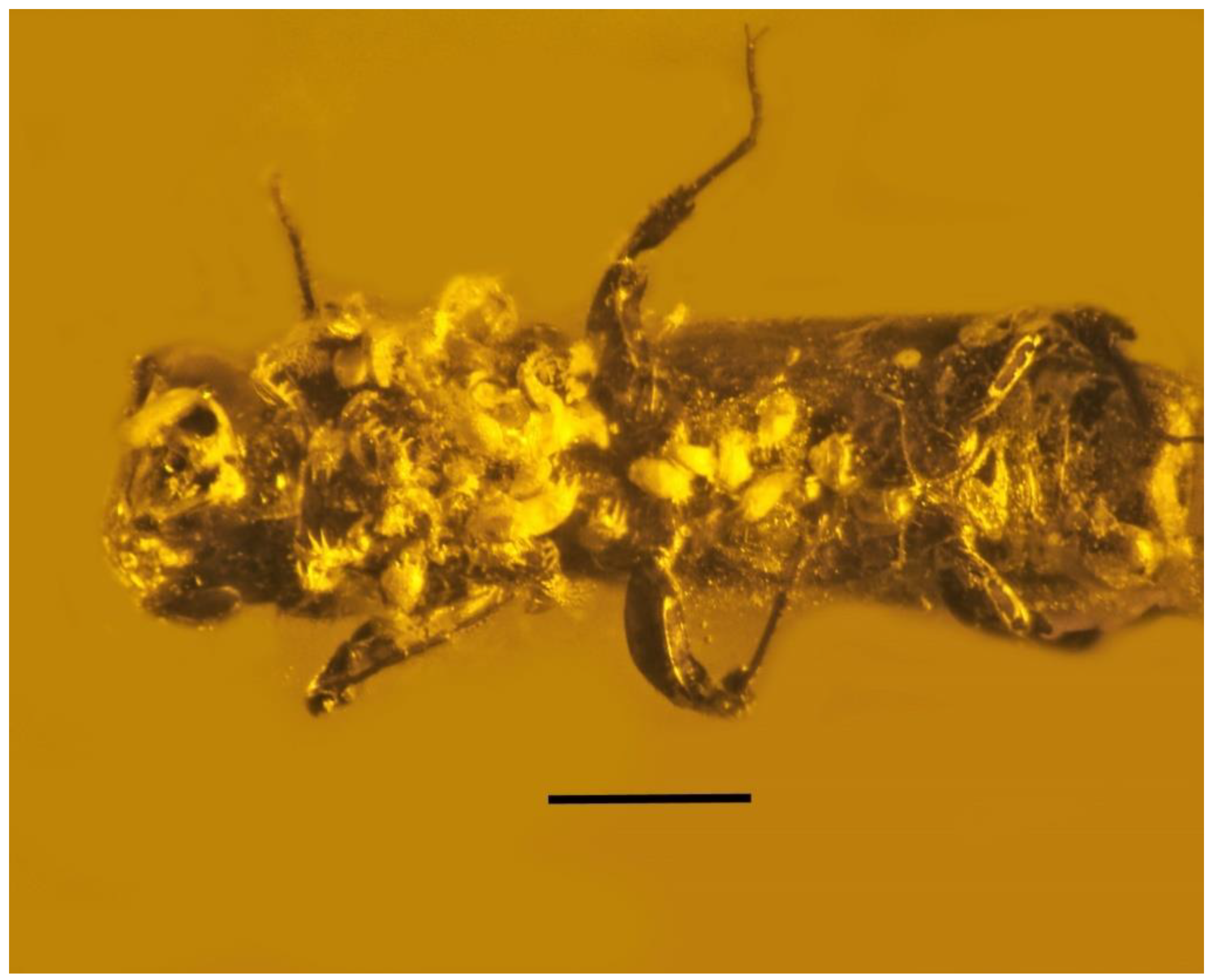
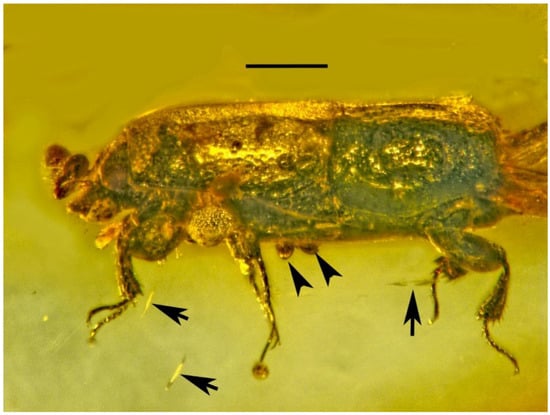
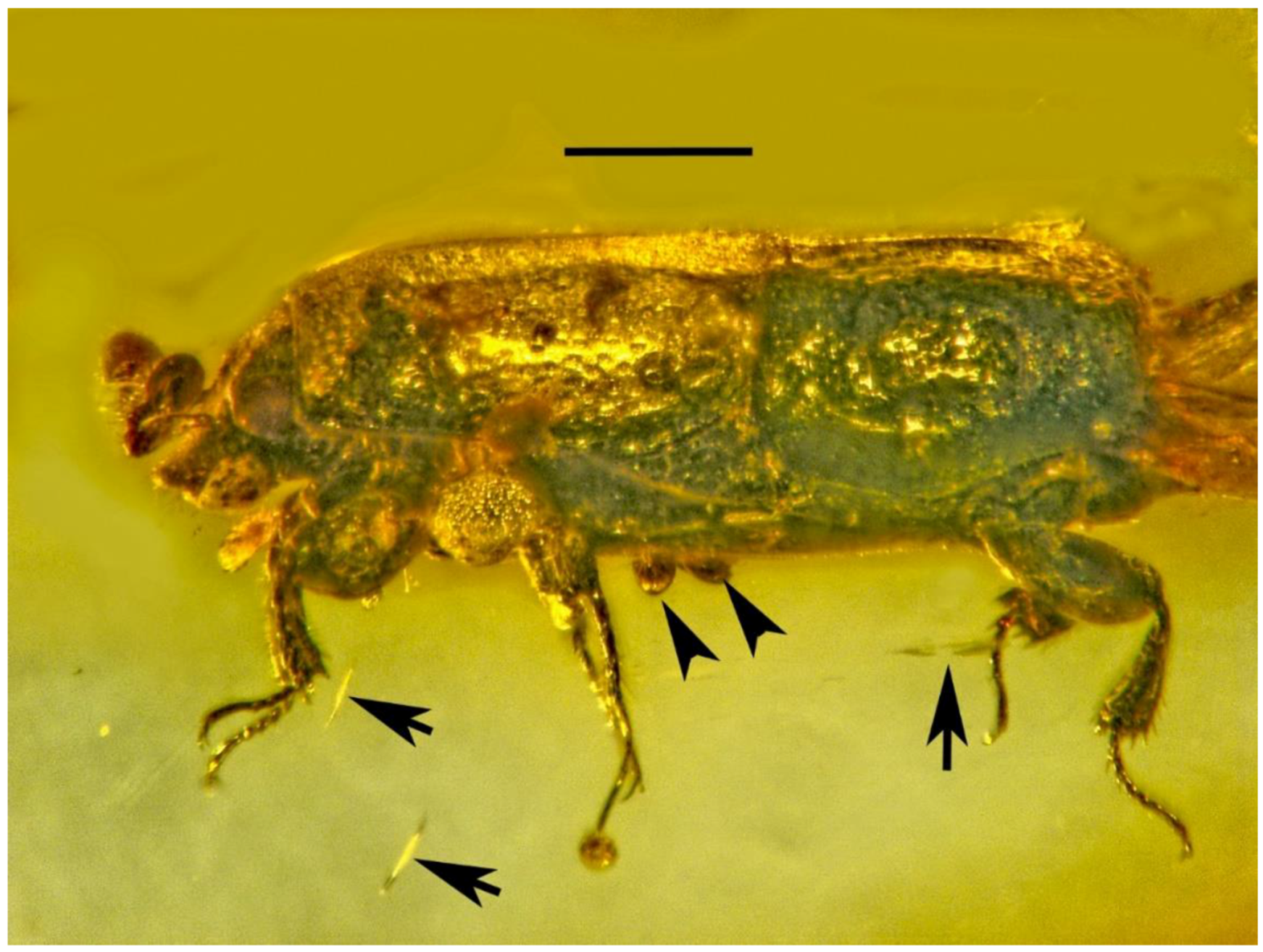
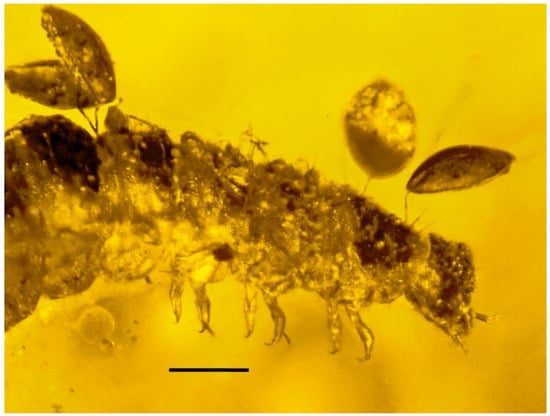
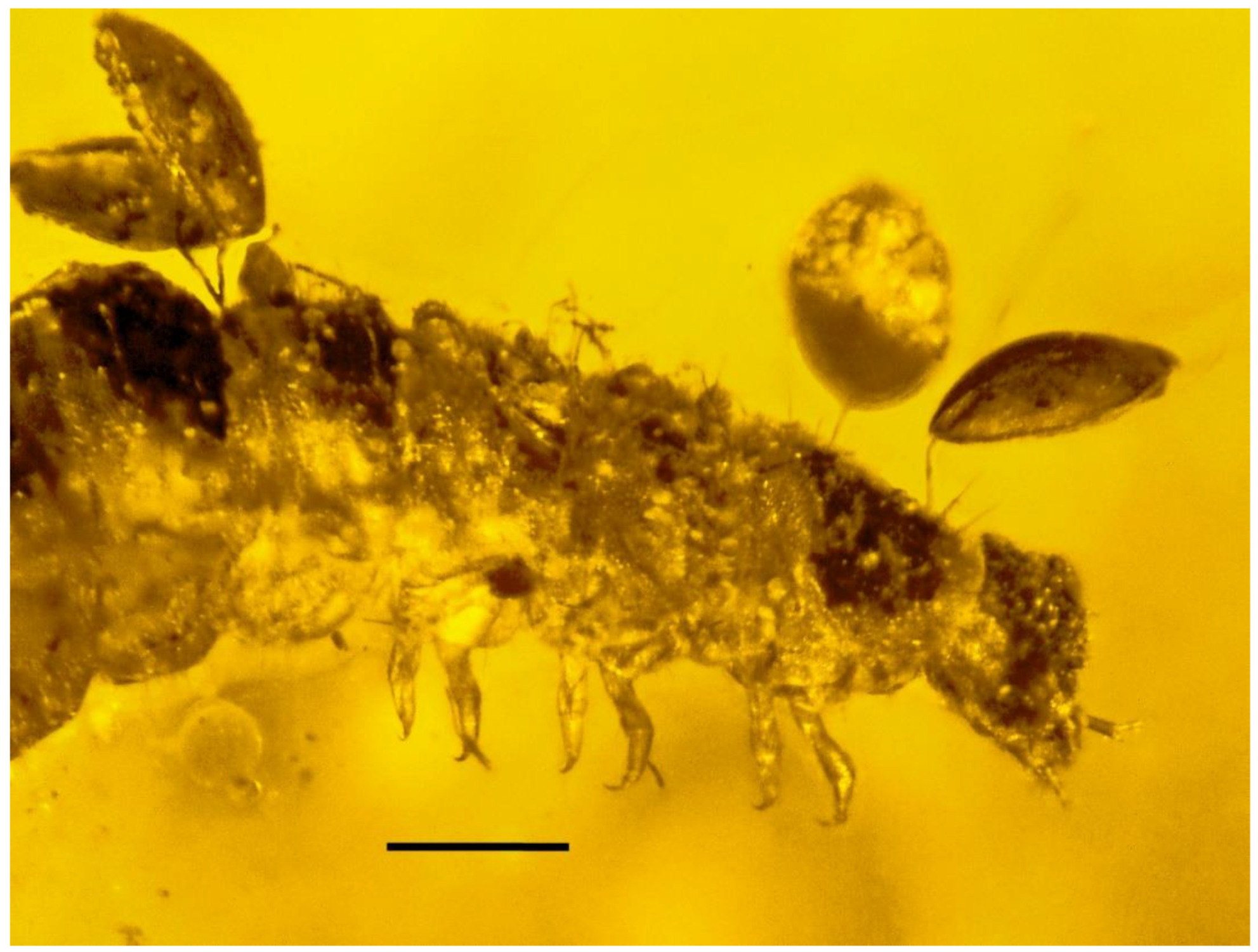
Mites are ubiquitous and it is likely that during their lifetime all extant beetle species encounter these small arachnids. In fossil beetles, it is usually the phoretic stages of mites that are associates. This is especially evident in wood inhabiting beetles that often share their habitats with mites. When the adult beetles are ready to fly to another location, the mites attach themselves to the beetles [10]. Phoretic mites in Dominican amber display different methods of attachment. Some mites simply hold on to the carrier’s body (Figure 1 and Figure 2), sometimes detaching when entering the resin (Figure 3). Others secure themselves to the cuticle of the beetle by their mouthparts (Figure 4). A more specialized method of attachment occurs when the mite forms a thin strand of hardened “glue” that is fastened to the beetle’s cuticle (Figure 5, Figure 6 and Figure 7) [11].
Figure 1.
Mites (Arachnida: Acari) clinging to the underparts of a platypodine beetle (Coleoptera: Curculionidae: Platypodinae) in Dominican amber. Scale bar = 30 µm.
Figure 2.
Two mites (Arachnida: Acari) (arrowheads) attached to the underparts of a histerid (Coleoptera: Histeridae) beetle in Dominican amber. Note also associated nematodes (arrows). Scale bar = 580 µm.
Figure 3.
Large mites (Arachnida: Acari) that detached from a platypodine beetle (Coleoptera: Curculionidae: Platypodinae) in Dominican amber. Scale bar = 780 µm.
Figure 4.
Mite (arrow) (Arachnida: Acari) holding a leg of a staphylinid beetle (Coleoptera: Staphylinidae) by its mouthparts in Dominican amber. Scale bar = 435 µm.
Figure 5.
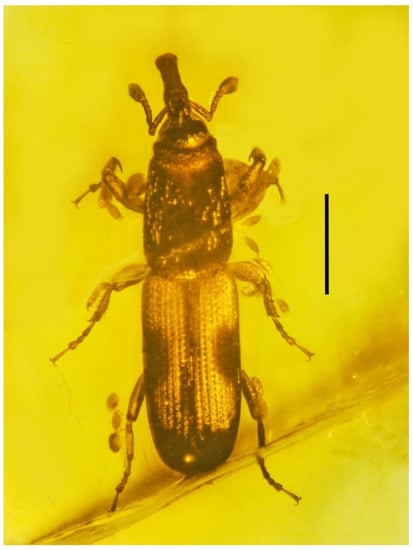
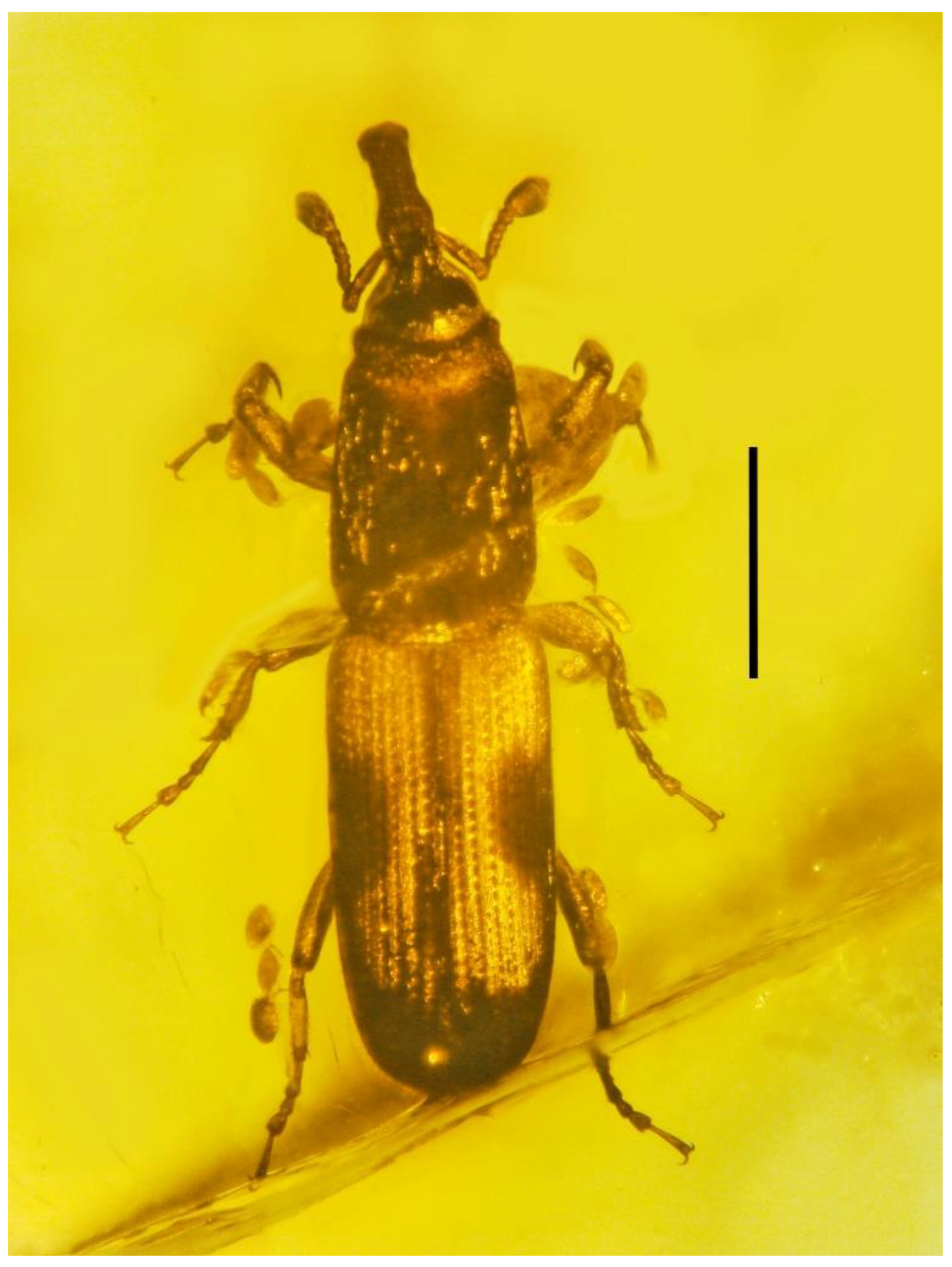
Mites (Arachnida: Acari) attached to a dryophthorid weevil, Bicalcasura maculata, (Coleoptera: Dryophthoridae) by hardened glue sticks in Dominican amber. Scale bar = 770 µm.
Figure 6.
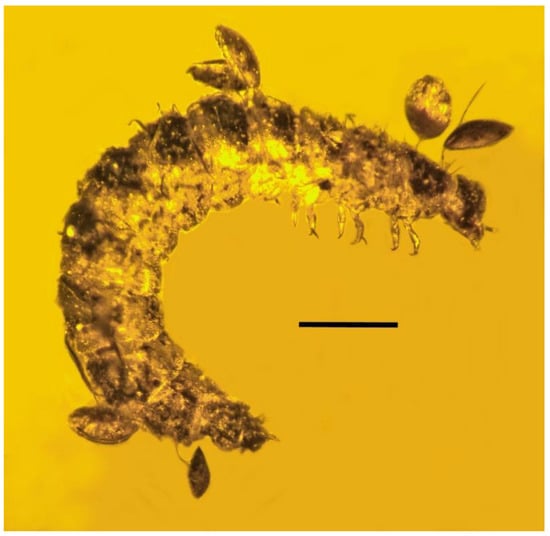
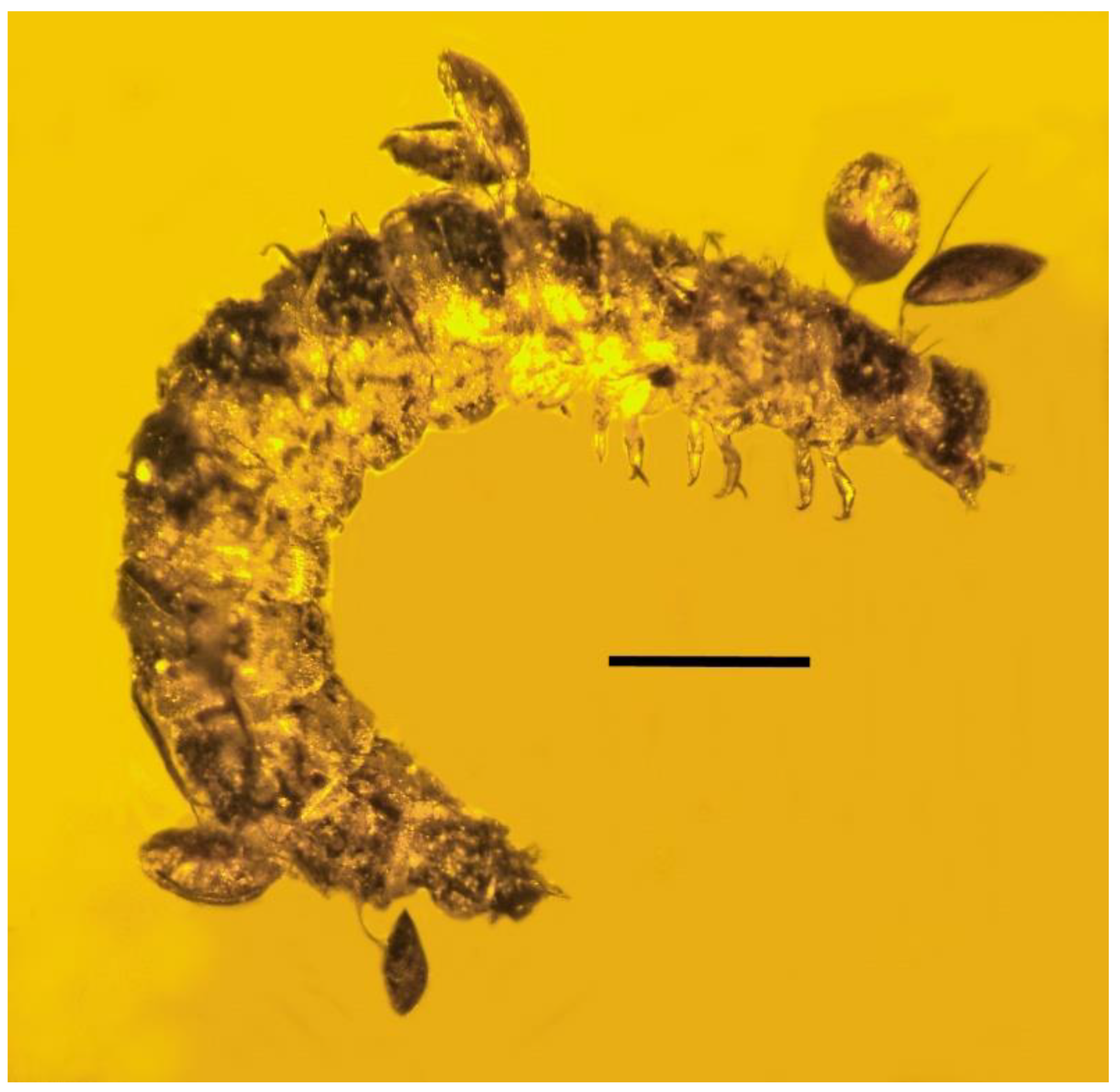
Deuteronymph uropodid mites (Arachnida: Acari) attached to a beetle larva by hardened glue sticks in Dominican amber. Scale bar = 450 µm.
Figure 7.
Detail of hardened glue sticks attaching phoretic mites (Arachnida: Acari) to the beetle larva in Figure 6. Scale bar = 75 µm.
3.2. Associations with Pseudoscorpions (Arachnida: Pseudoscorpiones)
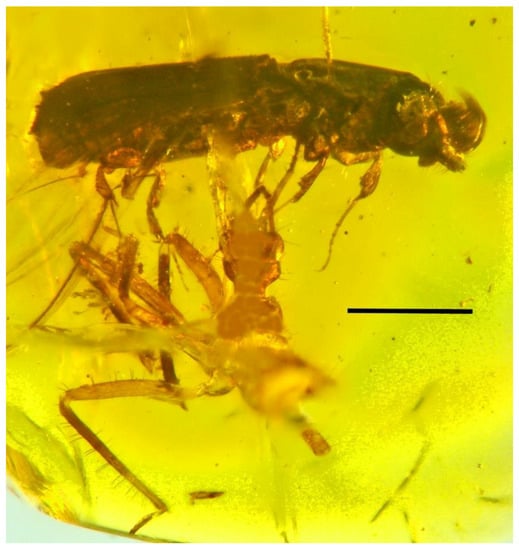
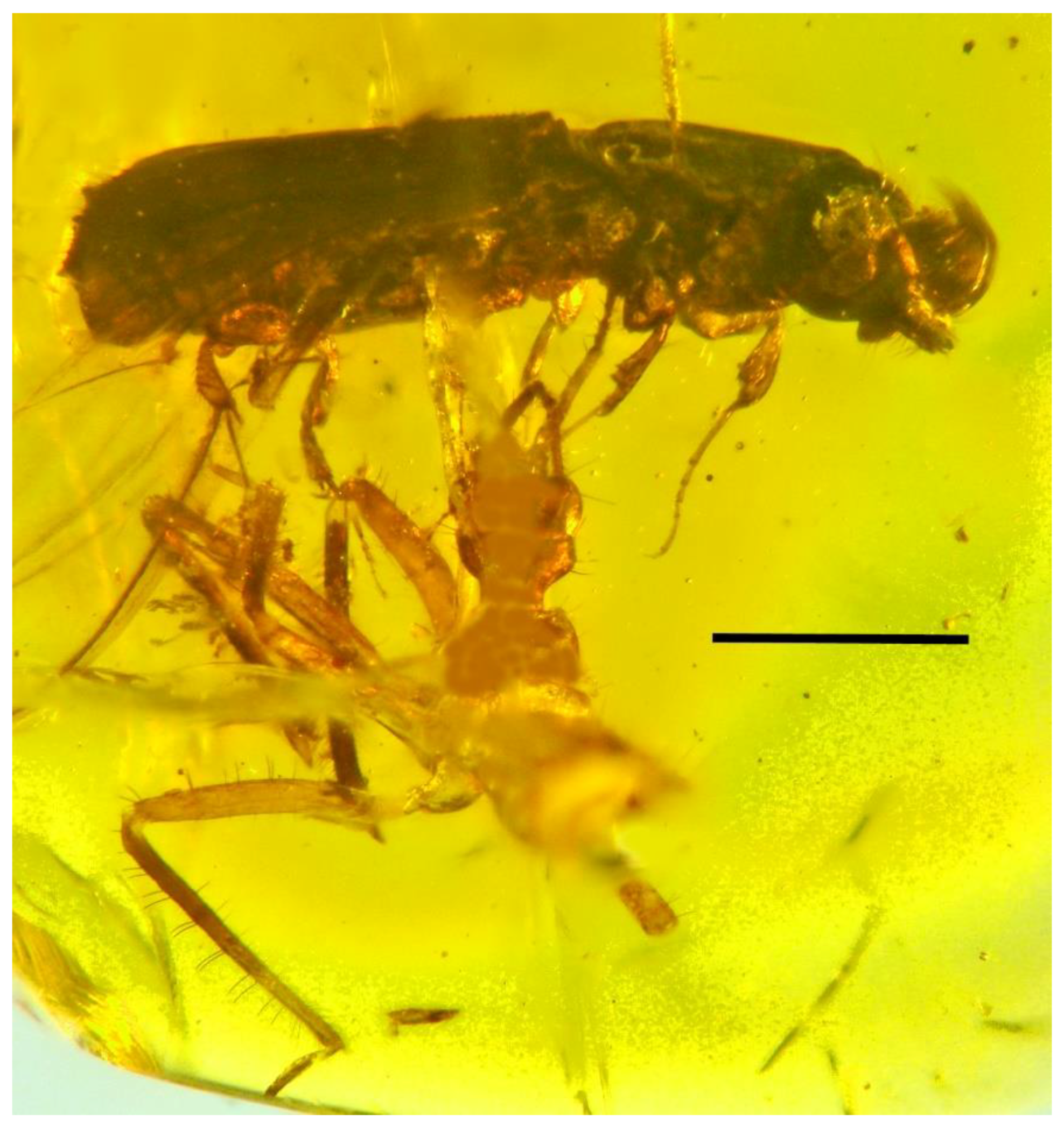
Pseudoscorpions in Dominican amber also use beetles for transport [12]. These arachnids normally grasp the posterior portion of the beetle’s abdomen, usually with one chela (Figure 8) but sometimes with two (Figure 9). Silken threads are apparently secreted from glands in their claws that attach their chela to the beetle [1].
Figure 8.
Adult pseudoscorpion (Parawithius sp.: Pseudoscorpiones: Withiidae) clasping a platypodine beetle (Cenocephalus rhinoceroides: Coleoptera: Curculionidae: Platypodinae) with one chela in Dominican amber. Arrows show phoretic nematodes that became detached from the beetle. Scale bar = 990 µm.
Figure 9.
Adult pseudoscorpion (Arachnida: Pseudoscorpiones) clasping a platypodine beetle (Coleoptera: Curculionidae: Platypodinae) with both chelae in Dominican amber. Scale bar = 950 µm.
3.3. Associations with Spiders (Arachnida: Araneae)
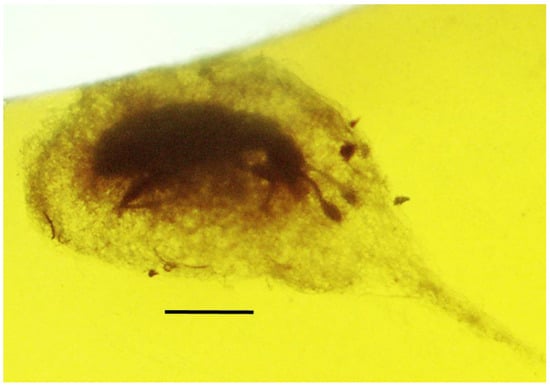
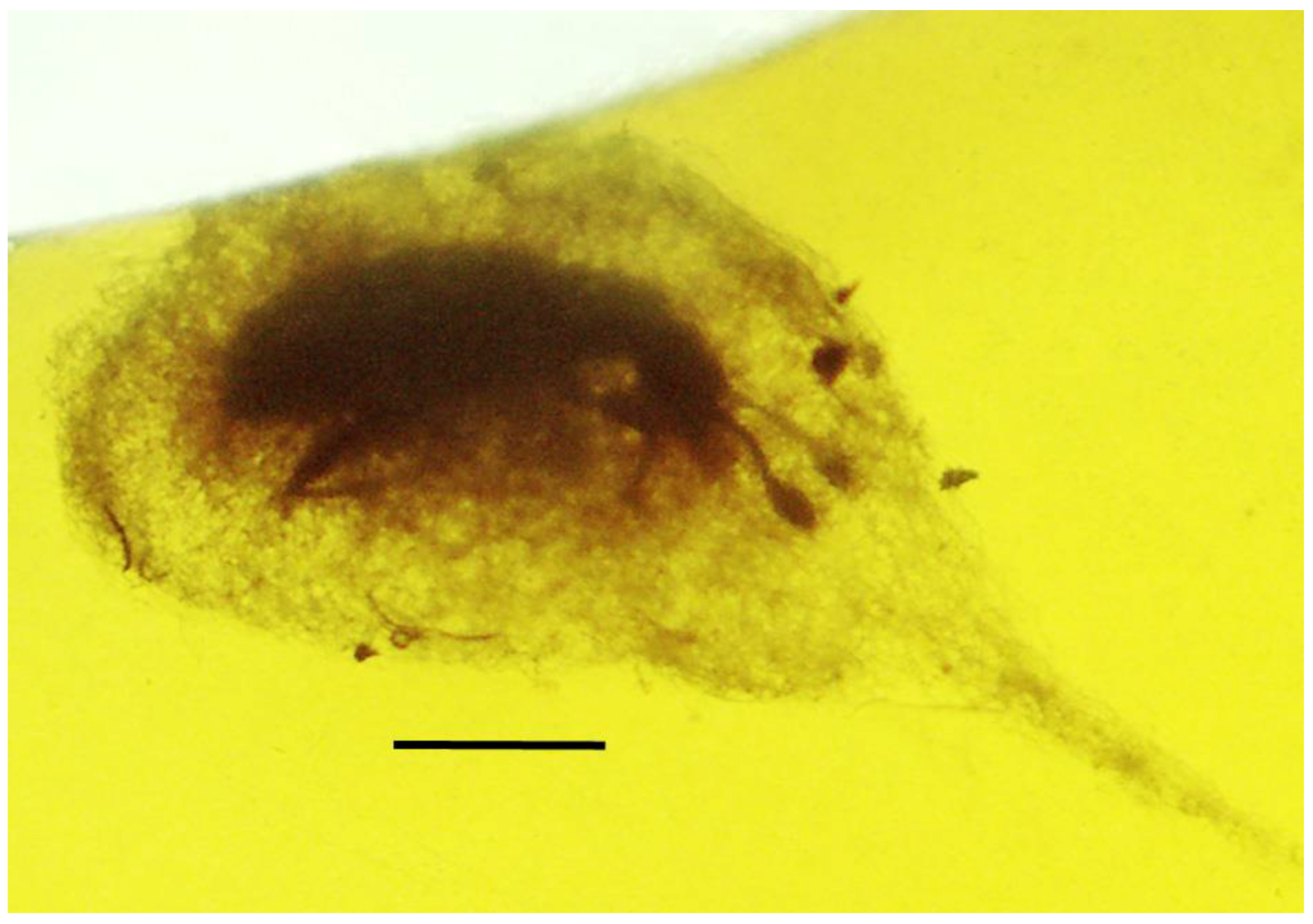
Spiders are an arachnid group that determine the fate of many beetles. Their webs in amber often capture various insects, including beetles. One spider cocoon was wrapped around an ant-like stone beetle (Staphylinidae: Scydmaeninae) in Dominican amber (Figure 10). Further evidence of spider webs capturing beetles in Dominican amber are an enmeshed platypodine beetle (Figure 11) and a colydiine beetle (Figure 12).
Figure 10.
Ant-like stone beetle (Coleoptera: Staphylinidae: Scydmaeninae) wrapped in a spider web “cocoon” in Dominican amber. Scale bar = 1.2 mm.
Figure 11.
Platypodine beetle (Coleoptera: Curculionidae: Platypodinae) in spider web in Dominican amber. Scale bar = 950 µm.
Figure 12.
Colydiine beetle (Coleoptera: Zopheridae) in spider web in Dominican amber. Scale bar = 1.0 mm.
3.4. Associations with Termites (Blattodea: Rhinotermitidae)
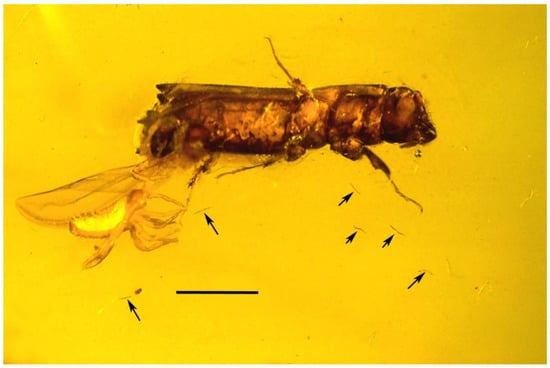
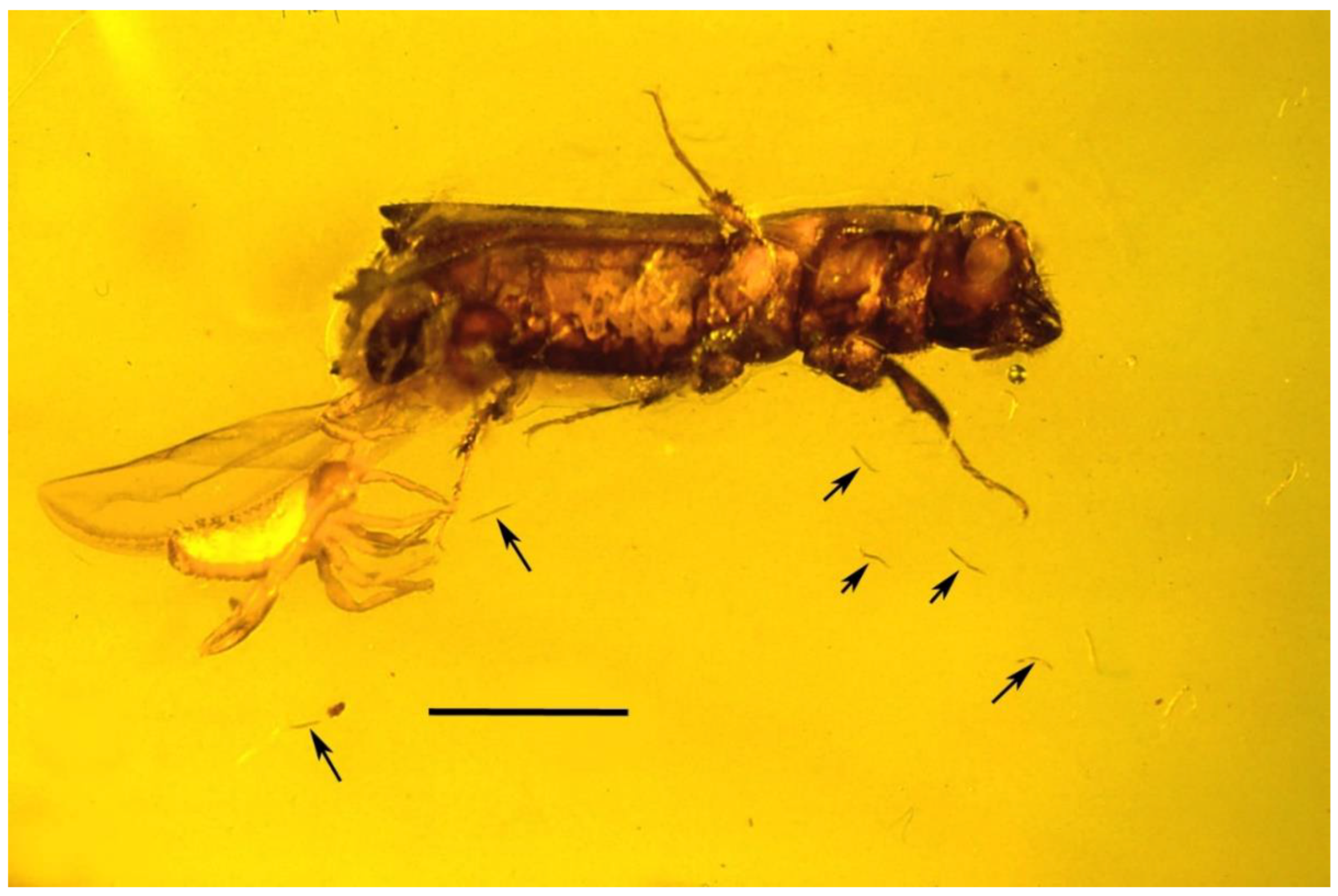
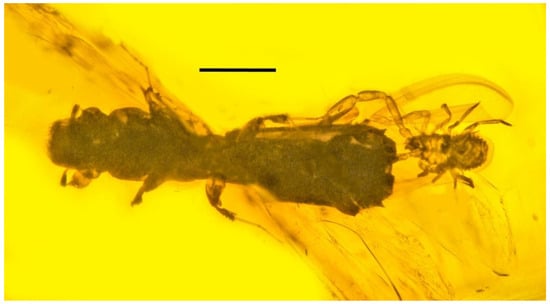
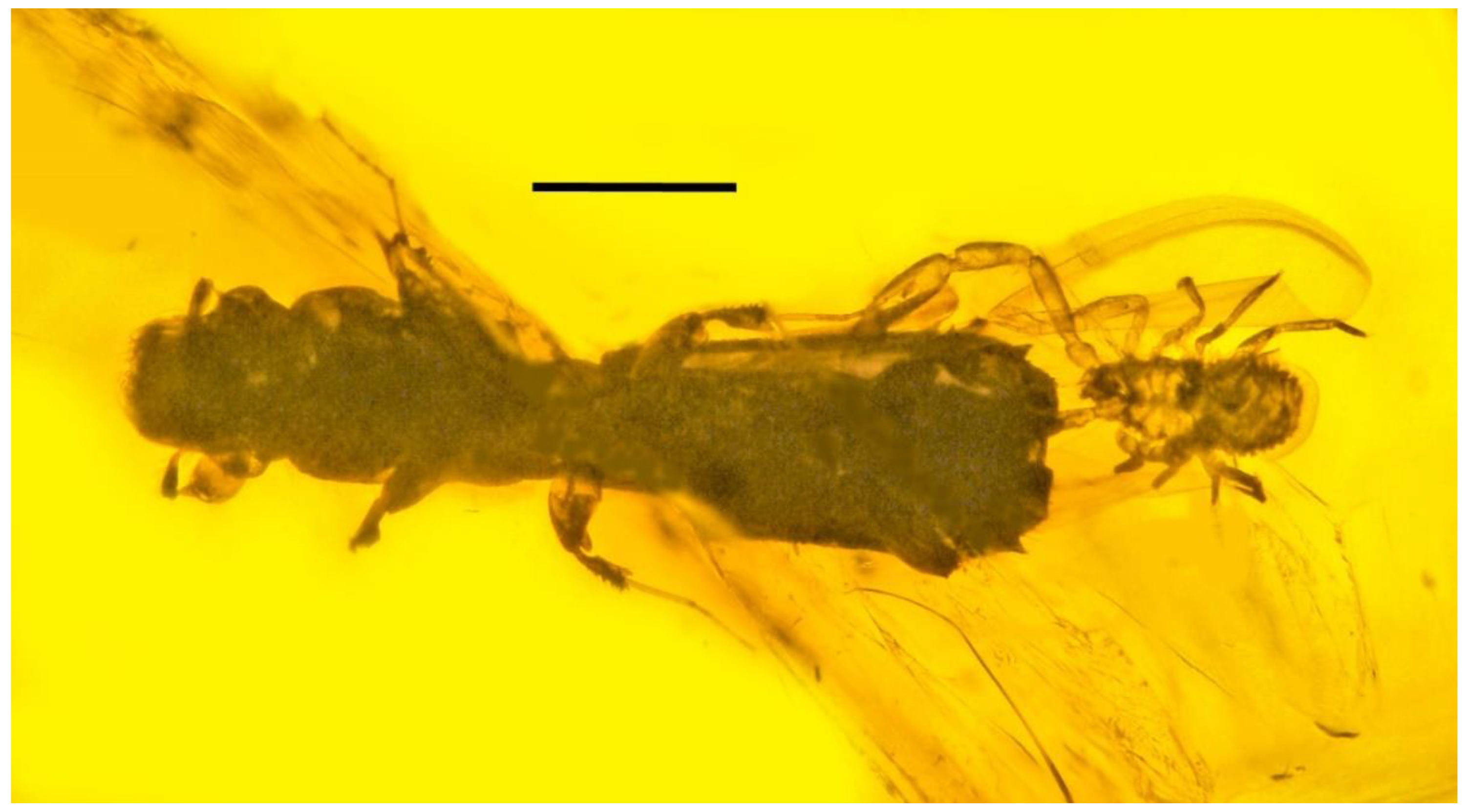
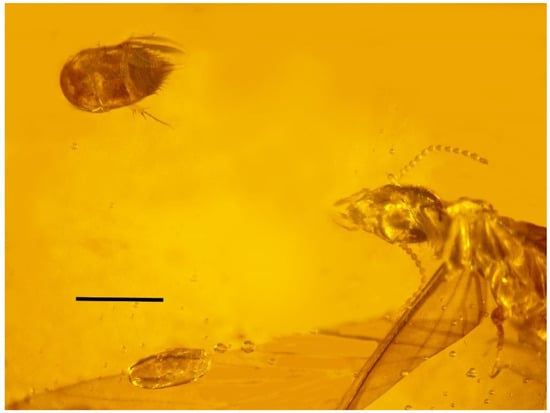
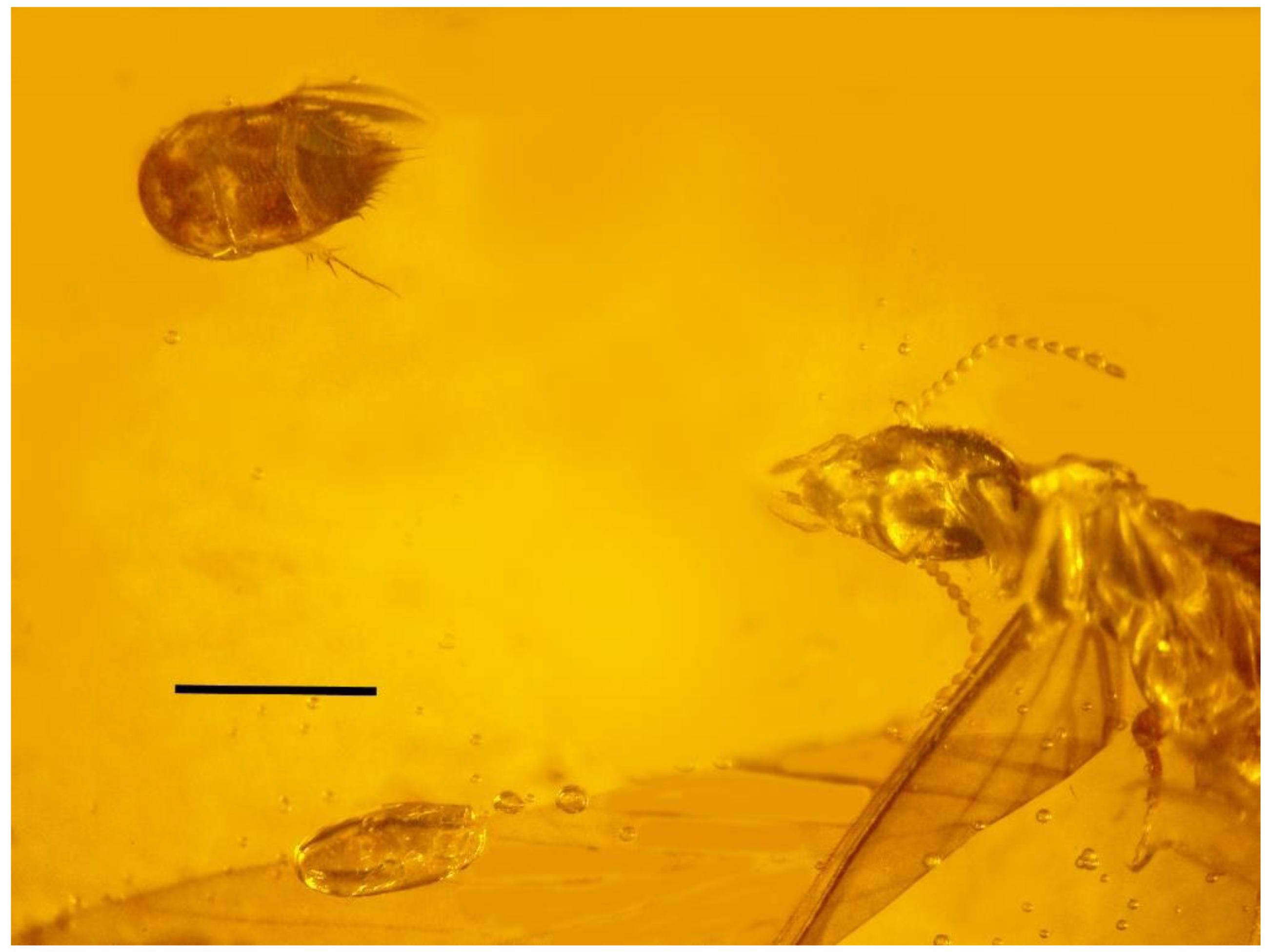
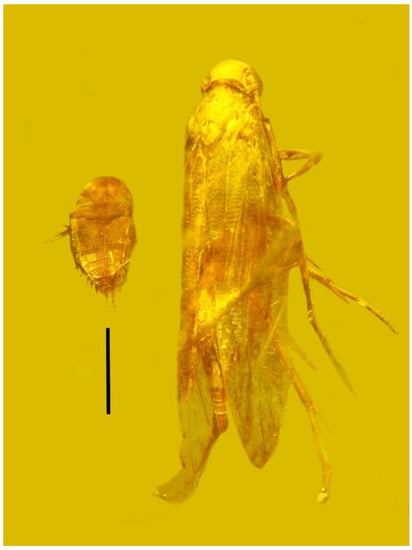
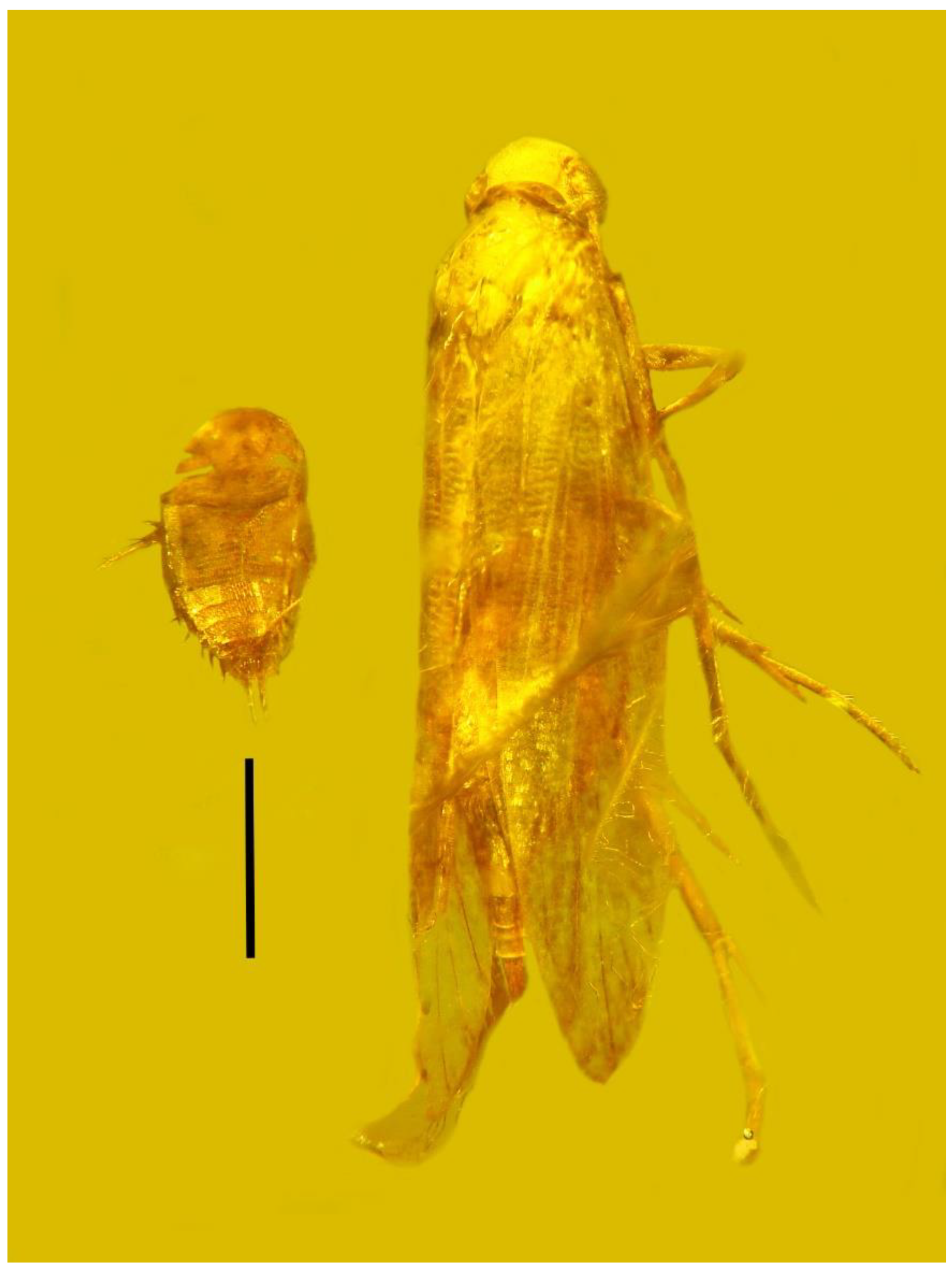
Staphylinids (Coleoptera: Staphylinidae) show a great morphological diversity related to their life habits. One subfamily, the Trichopseniinae, are shaped like horseshoe crabs, and being flightless, require assistance in reaching new habitats. Dominican amber specimens show that when these beetles are ready to leave their termite colonies, they crawl on winged termites (Figure 13) or on tineid (Lepidoptera: Tineidae) moths that also inhabit the termitaria (Figure 14). In both cases, the beetles do not appear to be attached to the carrier by any special device since they were free in the resin. These trichopseniine rove beetles date back to the mid-Cretaceous [13].
Figure 13.
Prorhinopsenius alzadae (Coleoptera: Staphylinidae) adjacent to a termite (Blattodea: Rhinotermitidae) in Dominican amber. Scale bar = 750 µm.
Figure 14.
A member of the Trichopseniinae (Coleoptera: Staphylinidae) adjacent to a tineid moth (Lepidoptera: Tineidae) in Dominican amber. Scale bar = 750 µm.
3.5. Associations with Insect Parasites and Predators
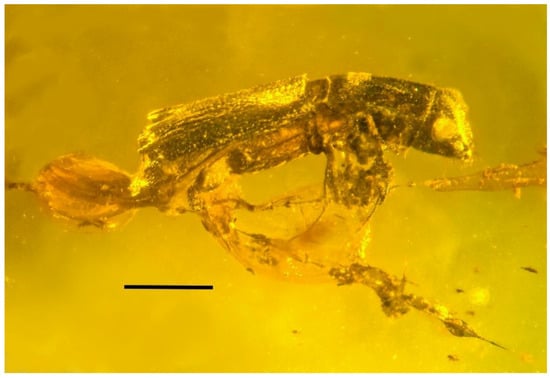
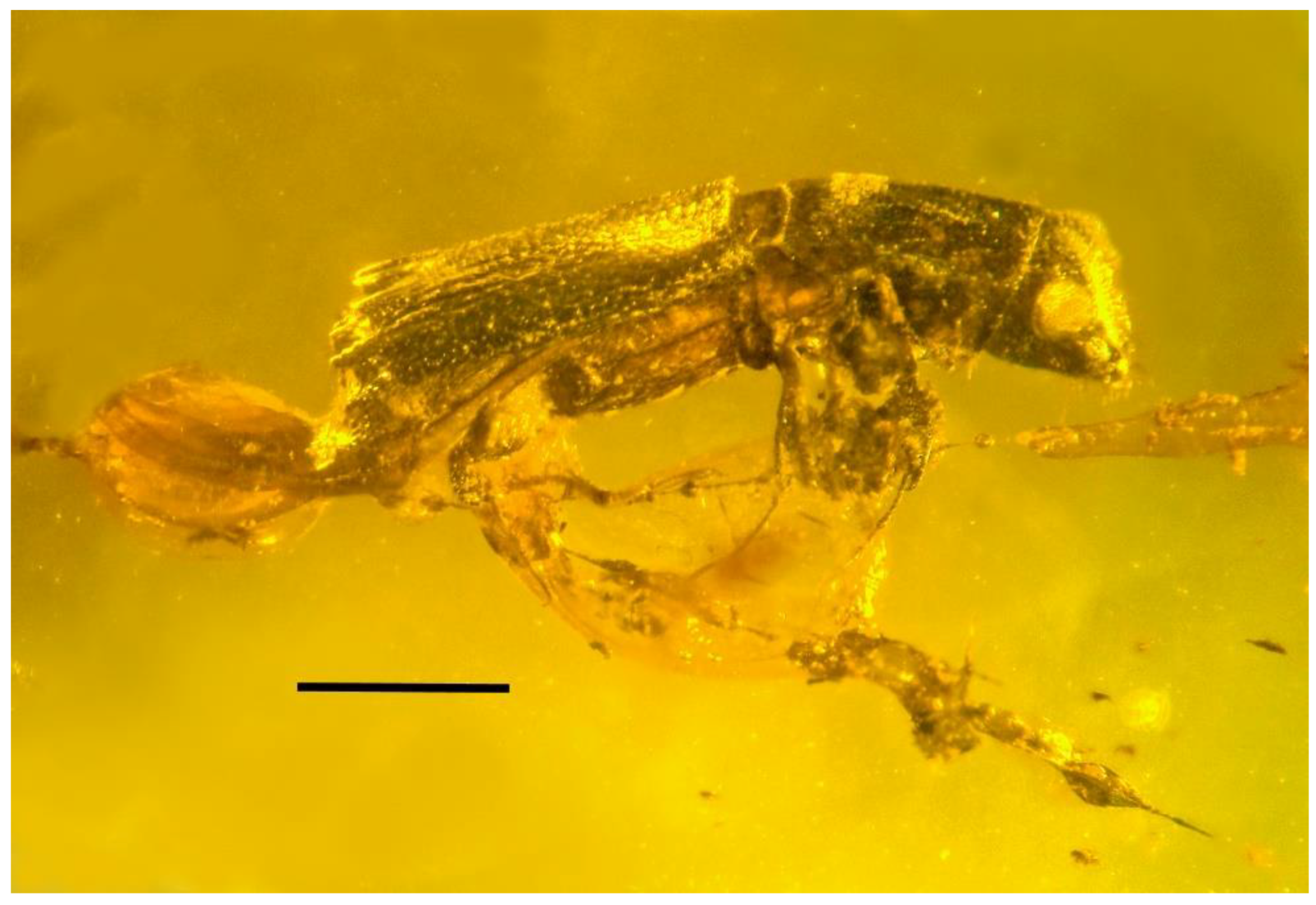
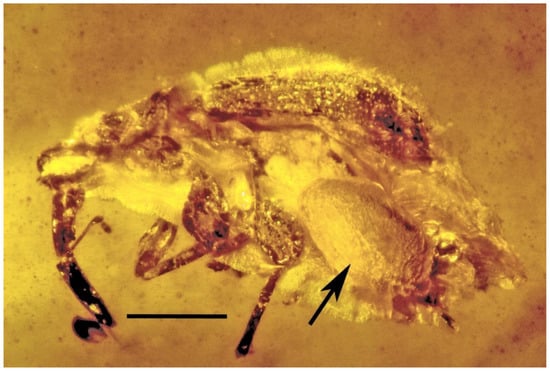
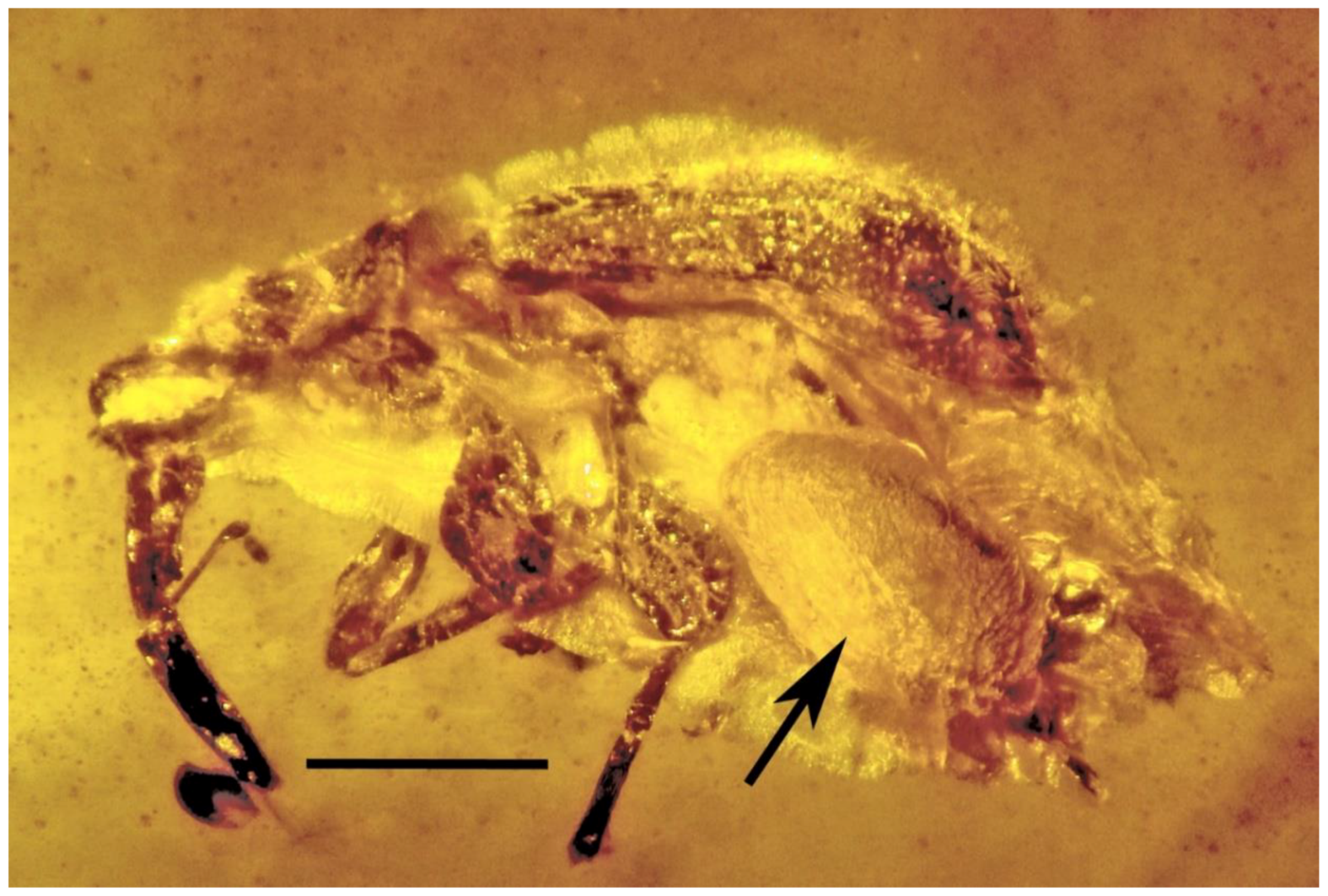
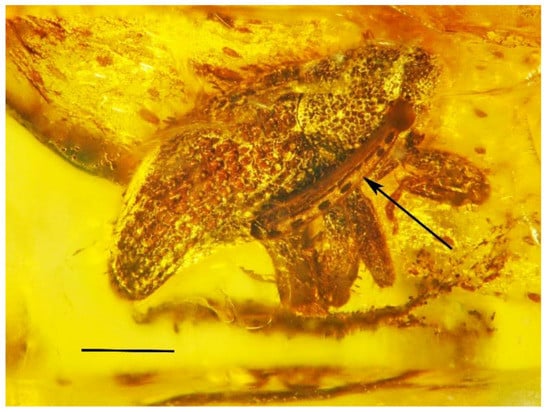
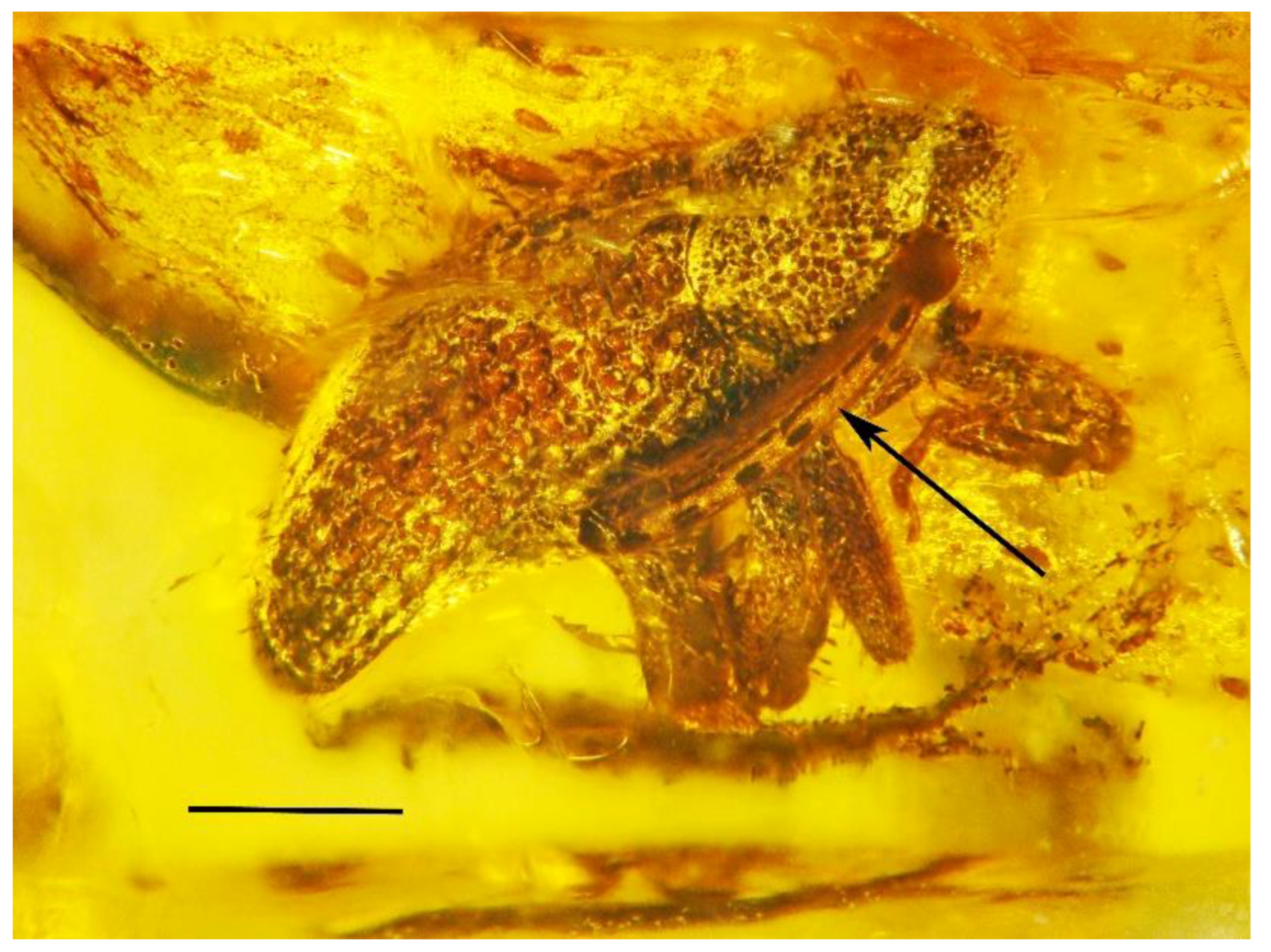
Euphorinae wasps (Hymenoptera: Braconidae) are well known for attacking various stages of beetles. In amber there is evidence of a euphorine wasp attacking the adult weevil, Habropezus plaisiommus (Coleoptera: Ithyceridae: Carinae) in Burmese amber (Figure 15) [14]. Cocoons and a mature pupa or newly hatched adult of another probable euphorine were attached to the body of an adult click beetle (Coleoptera: Elateridae) in Dominican amber (Figure 16 and Figure 17).
Figure 15.
A parasitized weevil, Habropezus plaisiommus (Coleoptera: Ithyceridae: Carinae), with a euphorine braconid cocoon (arrow) (Hymenoptera: Braconidae) in Burmese amber. Scale bar = 800 µm.
Figure 16.
A click beetle (Coleoptera: Elateridae) with attached probable euphorine cocoons (Hymenoptera: Braconidae) (arrow) in Dominican amber. Scale bar = 1.3 mm.
Figure 17.
Detail of cocoons shown in Figure 16. Arrow shows mature wasp pupa or newly emerged adult. Scale bar = 280 µm.
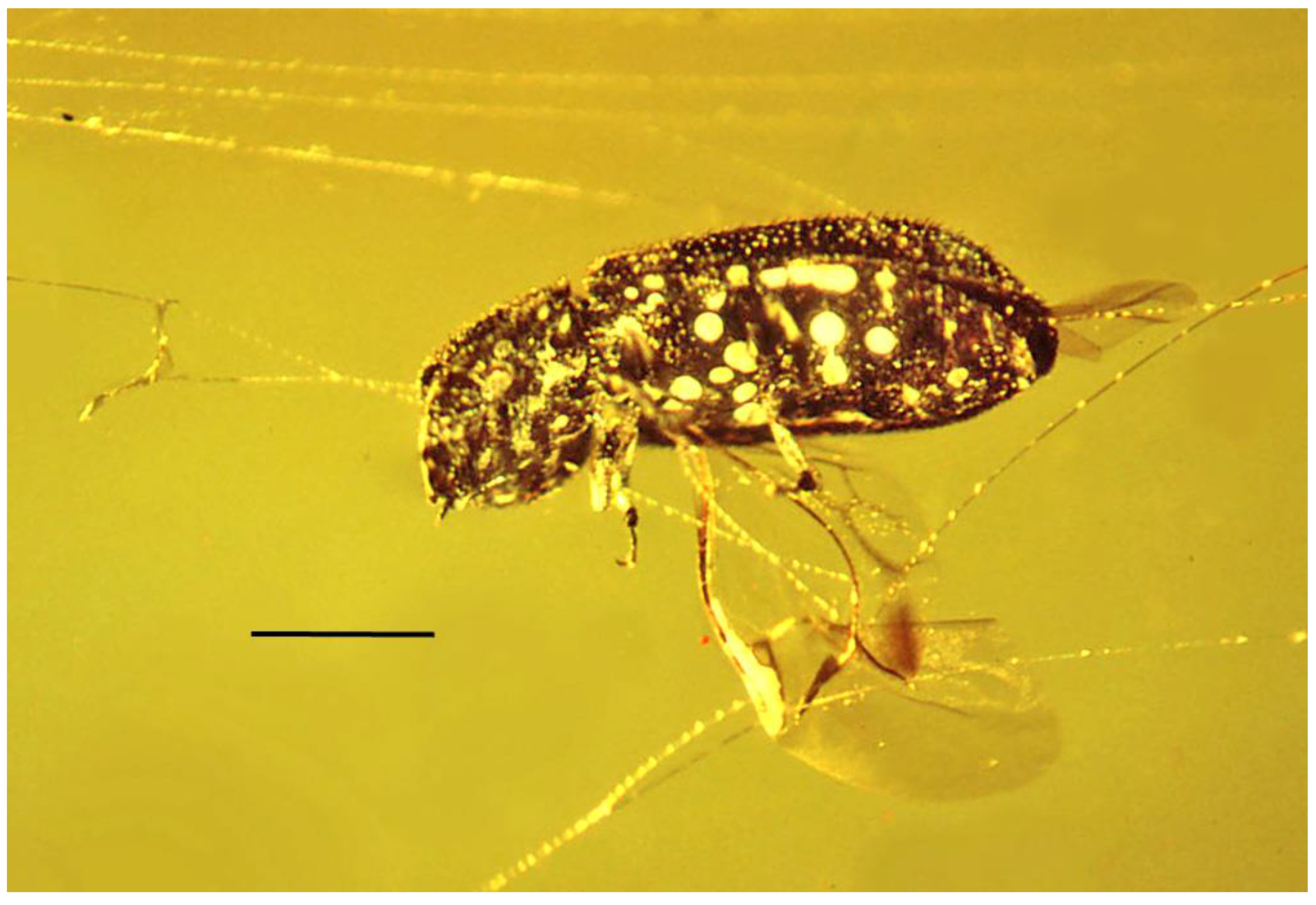
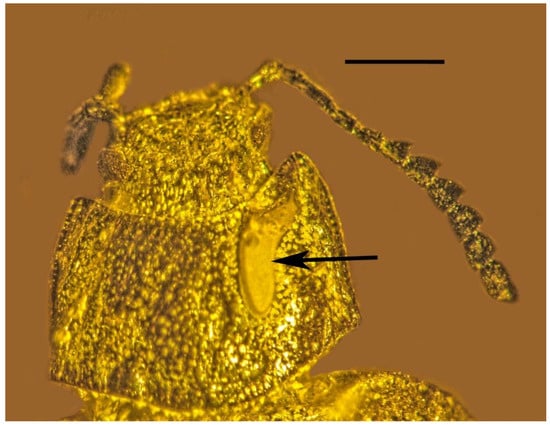
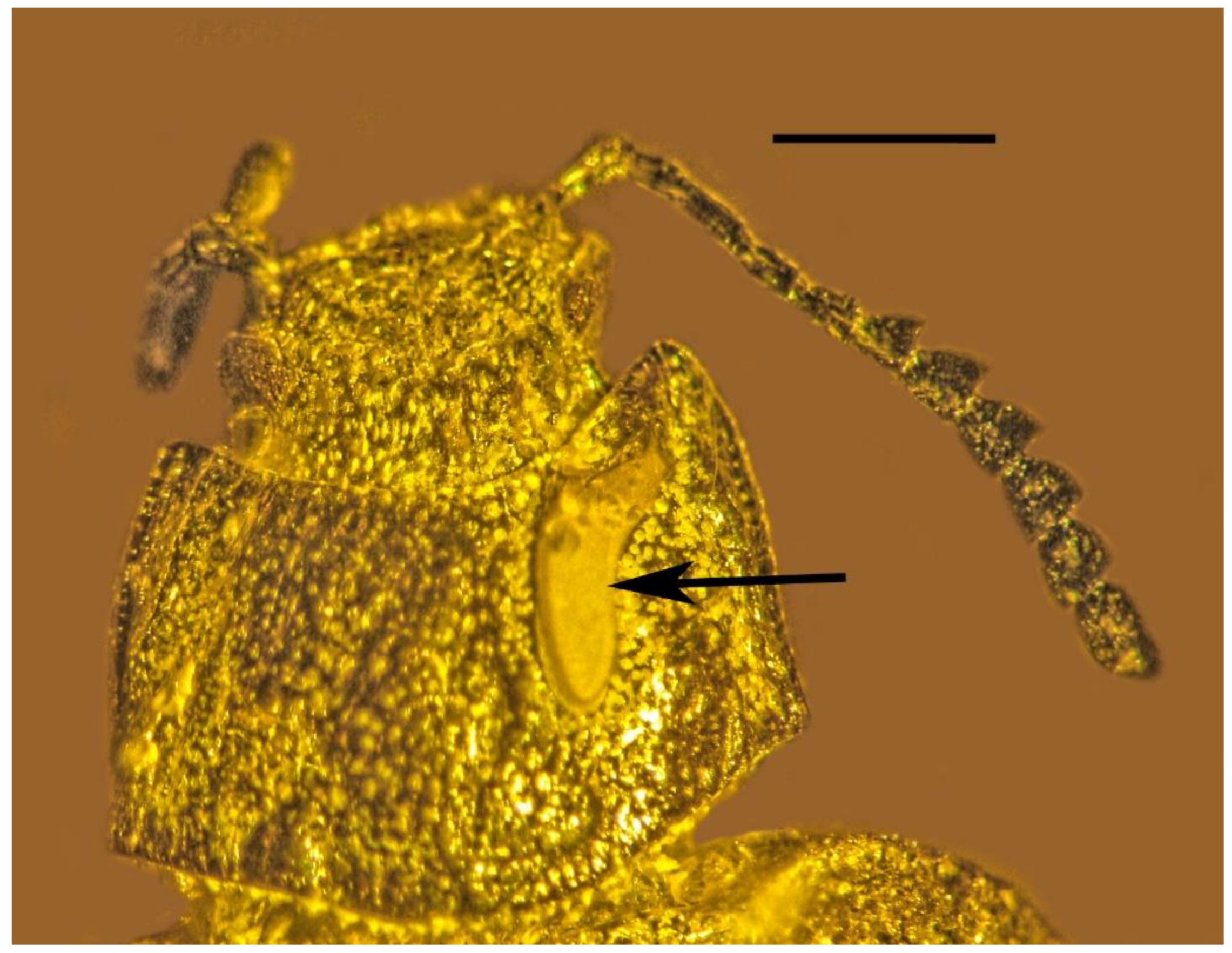
Tachinid flies (Diptera: Tachinidae) also attack beetles and the presence of a hatched tachinid egg on the pronotum of the leaf beetle, Stenaspidiotus microptilus (Coleoptera: Chrysomelidae) in Dominican amber, is fossil evidence of parasitism by this group [15] (Figure 18).
Figure 18.
Tachinid egg (Diptera: Tachinidae) (arrow) attached to the pronotum of the leaf beetle Stenaspidiotus microptilus (Coleoptera: Chrysomelidae) in Dominican amber. Scale bar = 750 µm.
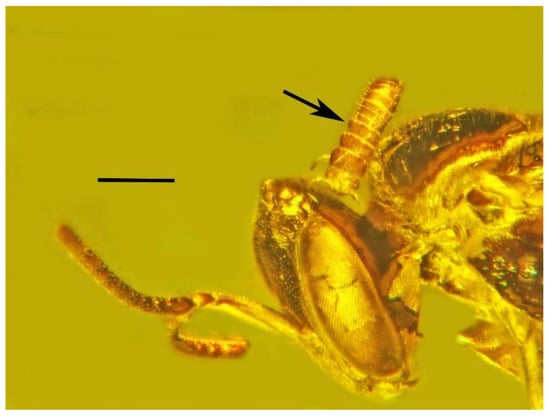
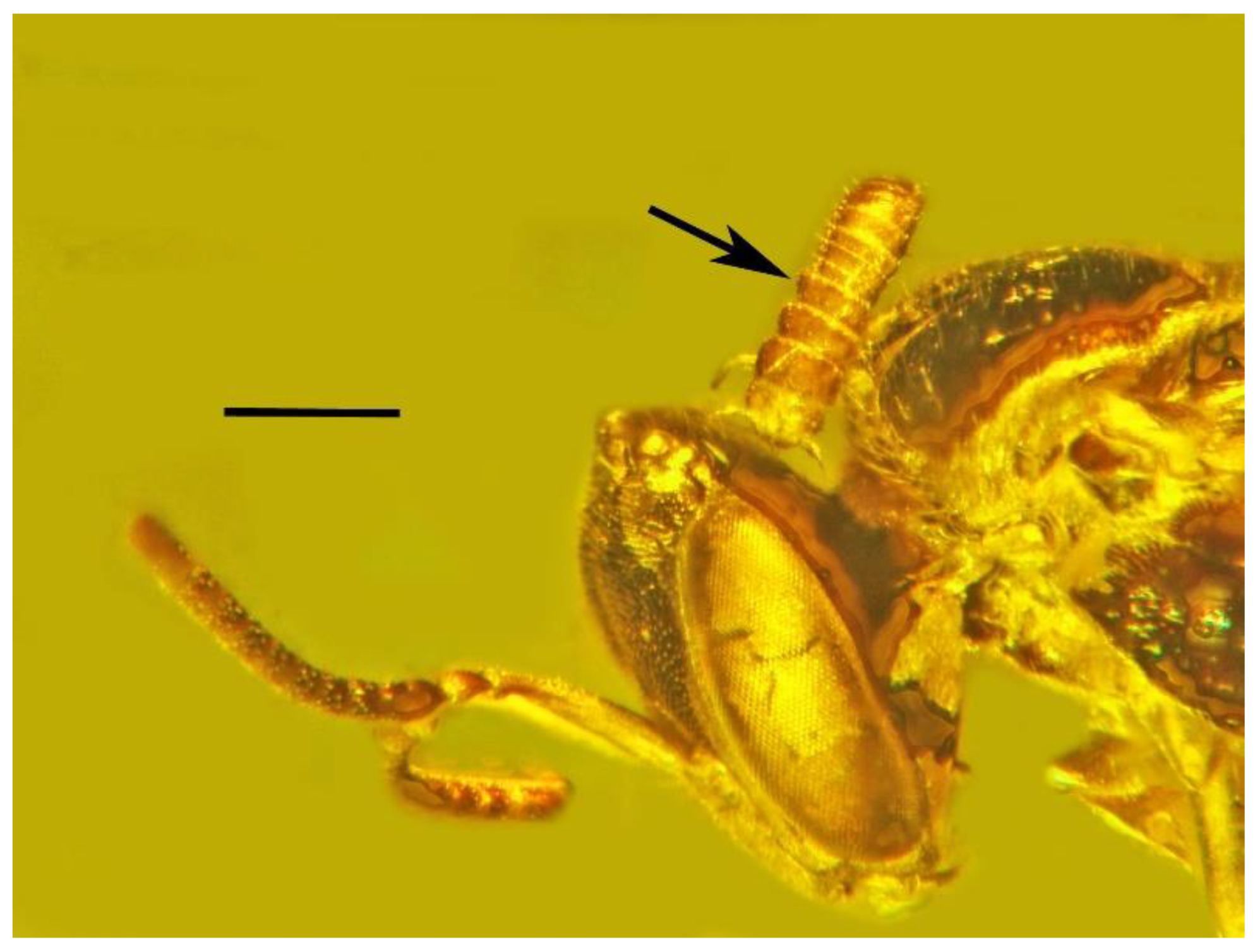
Fossil evidence of beetle predation is quite rare, so it was a surprise to find a platypodine under attack by a reduviid bug (Hemiptera: Reduviidae) in Dominican amber (Figure 19). Another case of predation involved the beetle as the predator. This was a meloid (Coleoptera: Meloidae) triungulin just above the “neck” of a stingless bee (Hymenoptera: Apidae) in Dominican amber (Figure 20). When carried back to the hive, the triungulin will devour the developing bee stages [16].
Figure 19.
Reduviid (Hemiptera: Reduviidae) attacking a platypodine (Coleoptera: Curculionidae: Platypodinae) in Dominican amber. Scale bar = 1.0 mm.
Figure 20.
Meloid triungulin (Coleoptera: Meloidae) (arrow) on a stingless bee (Hymenoptera: Apidae) in Dominican amber. Scale bar = 400 µm.
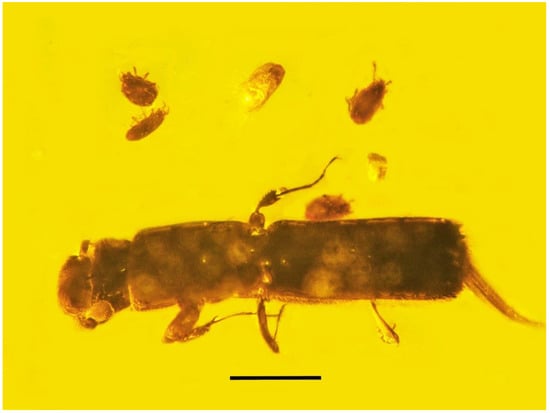
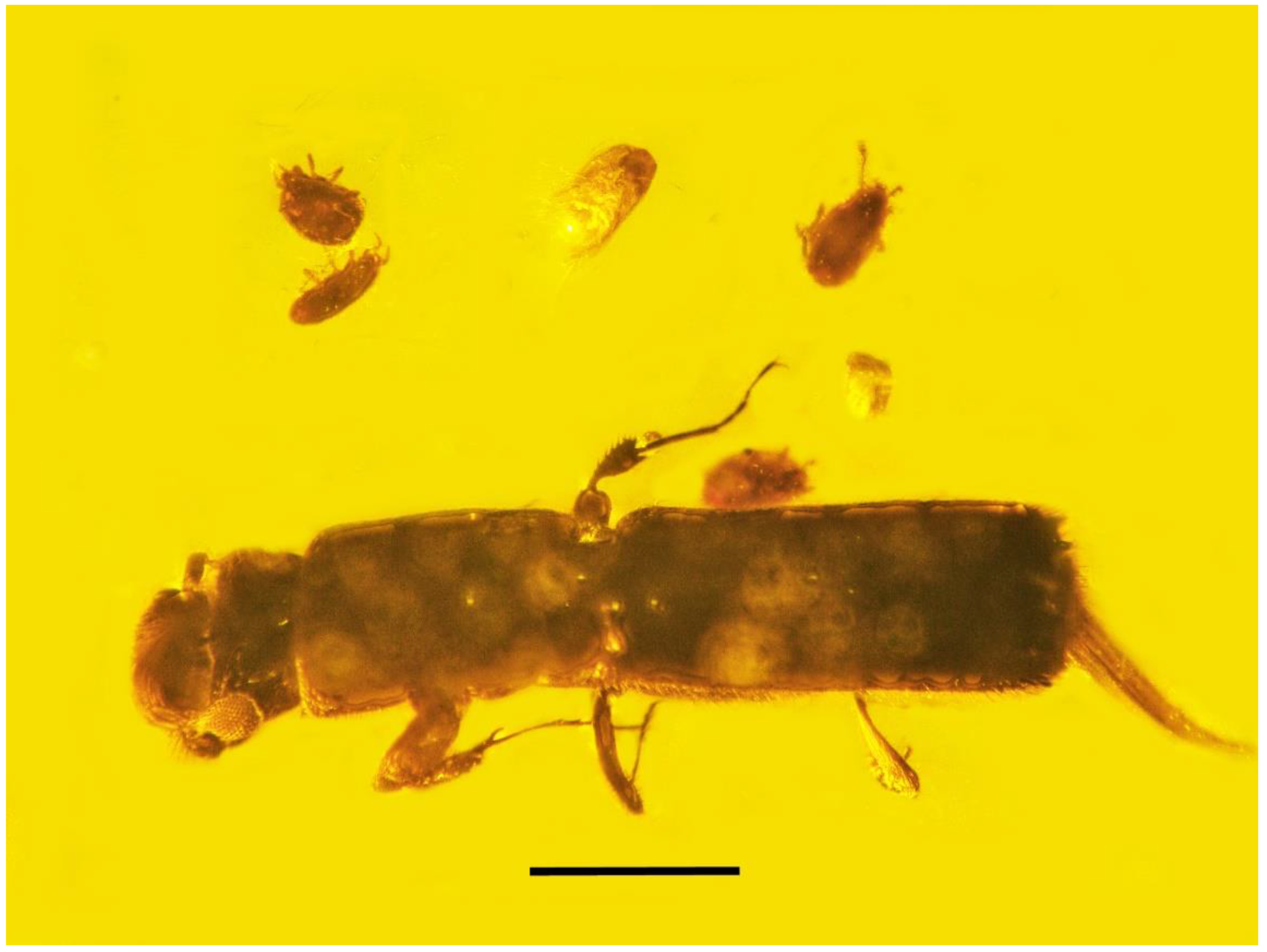
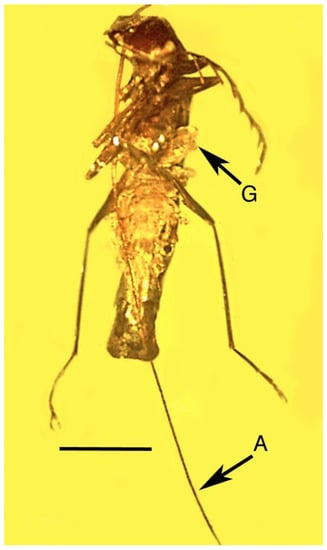
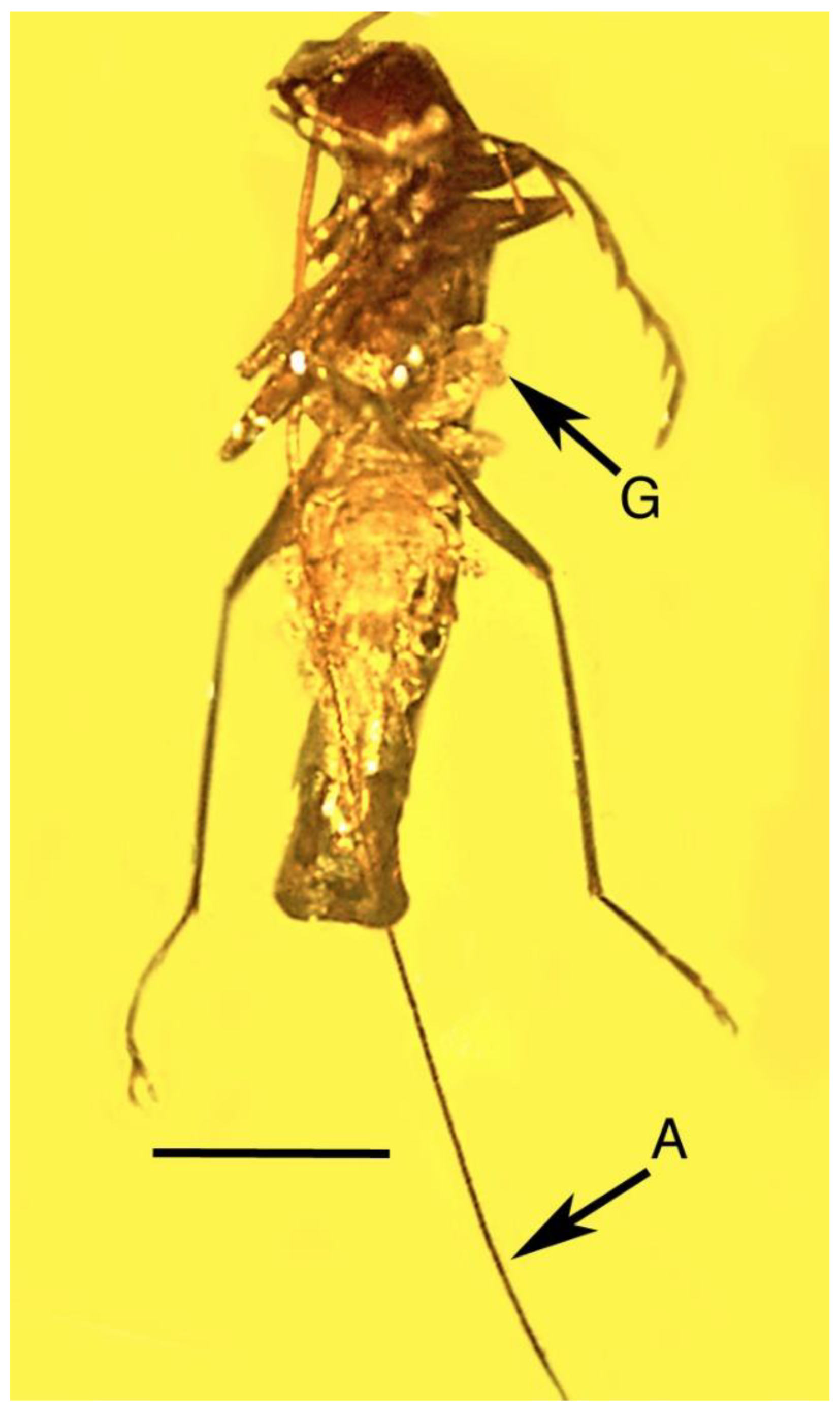
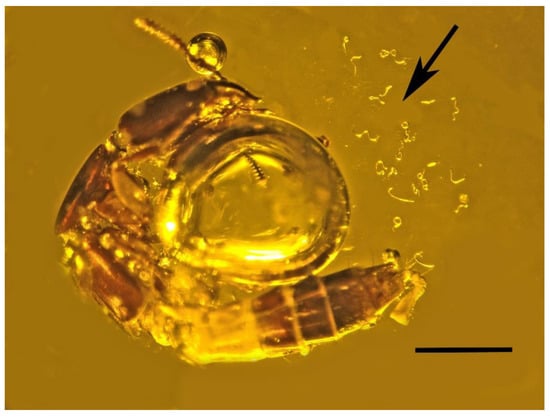
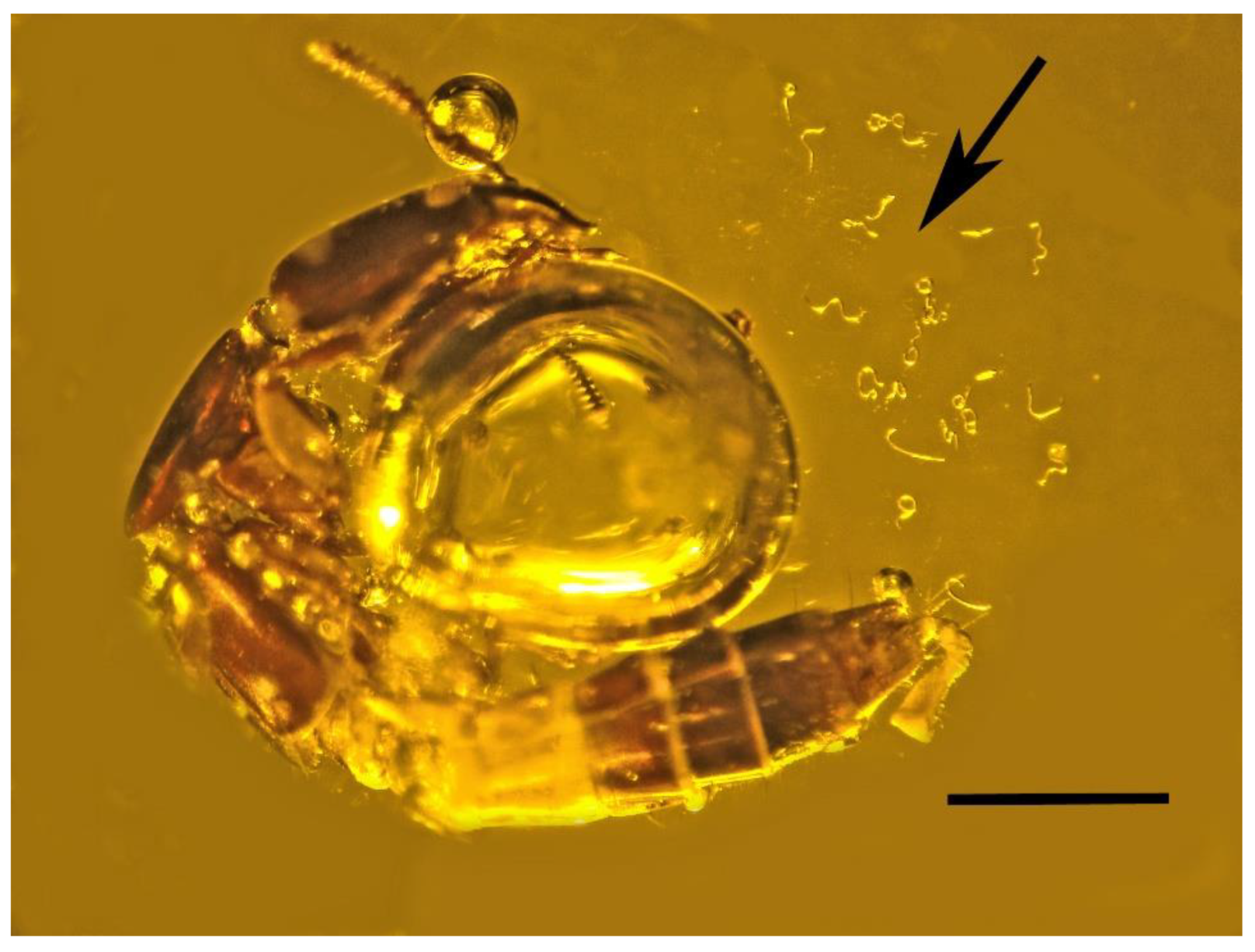
An unusual example of defensive behavior in response to a potential predator was found in a cantharid beetle (Coleoptera: Cantharidae) in Burmese amber. Based on the tactile stimulus of the antennae of a potential blattid predator, the beetle extruded chemical vesicles from its abdomen, one of which released a secretion that covered a portion of the potential predator’s antenna [17] (Figure 21).
Figure 21.
Soldier beetle (Coleoptera: Cantharidae) displaying chemical defense behavior in Burmese amber. G = extruded glandular vesicle. A = antenna of predatory blattid (Blattodea: Blattidae) in contact with the beetle. Scale bar = 1.2 mm.
3.6. Associations with Fungi
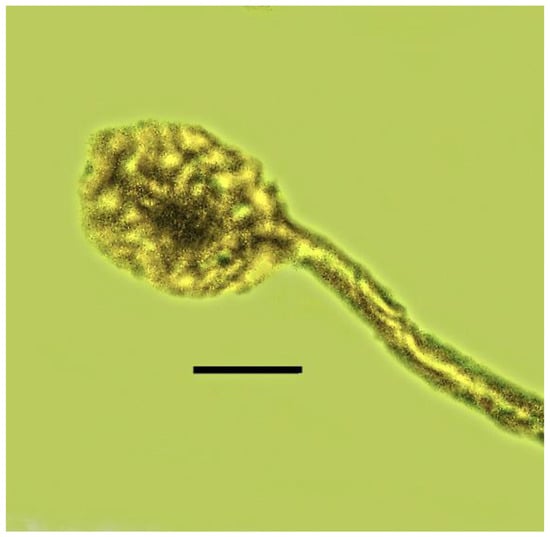
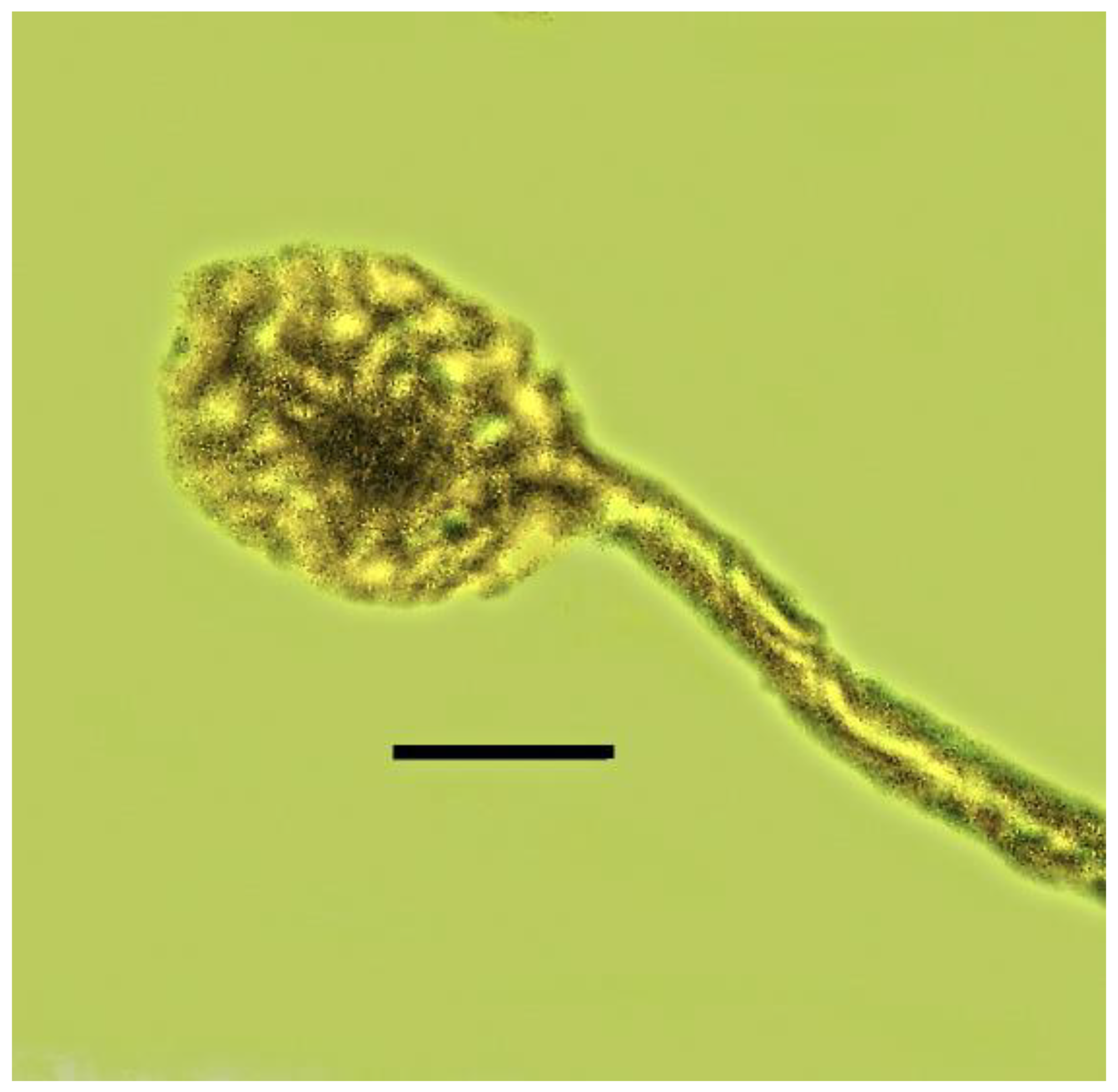
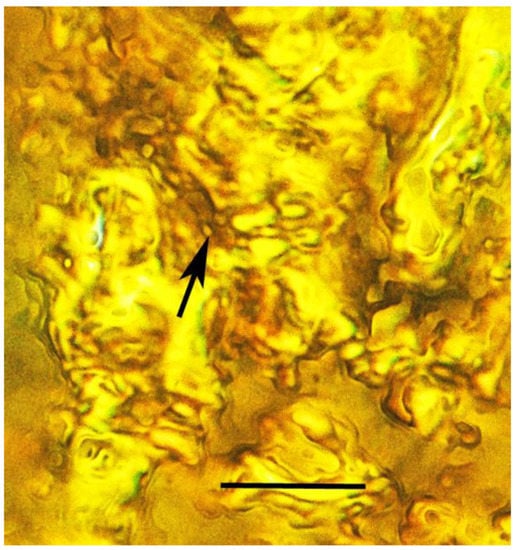
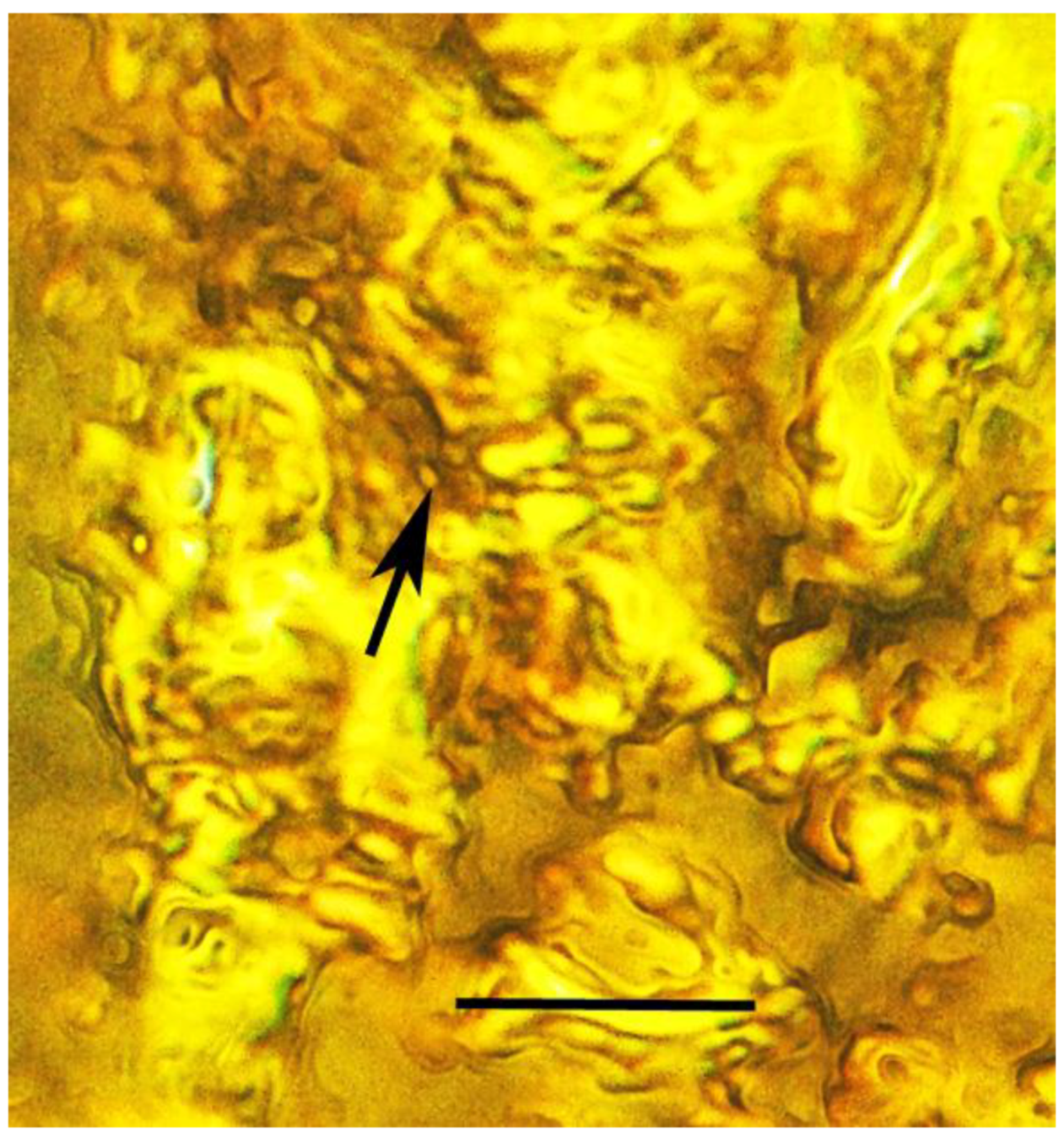
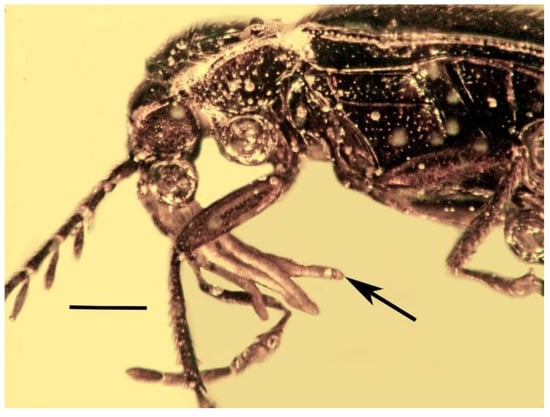
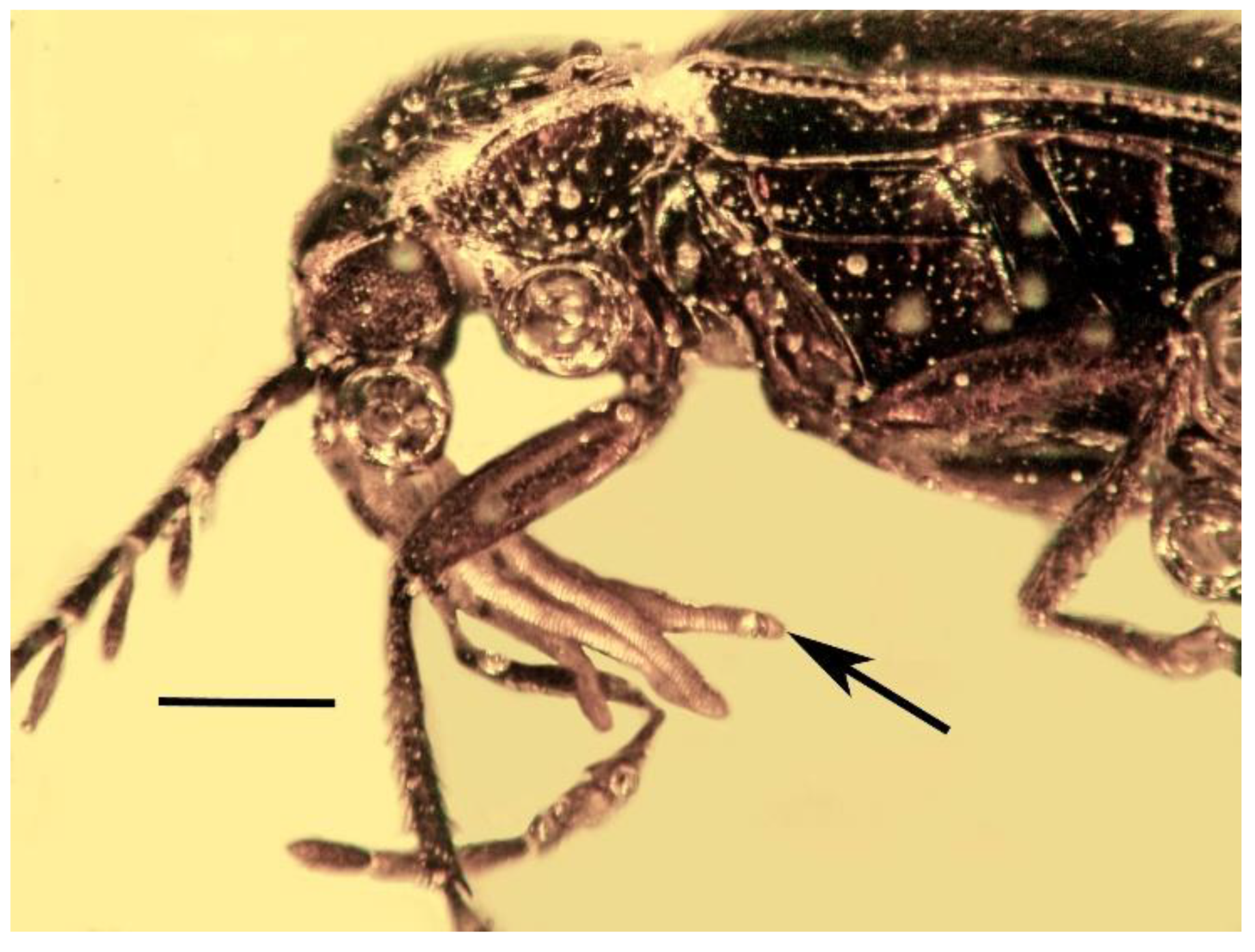
Fungi represent another ubiquitous group and the many diverse roles they have with insects are only now beginning to be understood. When considering fungal-beetle associations, the first image that comes to mind are the beetles that feed on various fungi [18]. One such fungal group that furnished nutrition for the developing stages of wood-boring beetles are ambrosia fungi that occur in the tunnels of bark beetles and are carried by the beetles in mycetangia from one site to another [19]. Evidence in Burmese amber of an ambrosia fungus associated with a platypodine beetle shows that this is an ancient association (Figure 22 and Figure 23) [20]. Hyphal fragments and yeast-like propagules within mycetangia on the femora of the beetle show that a close association with these fungi had already been established in platypodines (Coleoptera: Curculionidae: Platypodinae) by the mid-Cretaceous (Figure 24) [21].
Figure 22.
The platypodine, Palaeotylus femoralis (Coleoptera: Curculionidae: Platypodinae) covered with mycelium, conidiophores and conidia of the ambrosia fungus, Paleoambrosia entomophila (Ophiostomatales: Ophiostomataceae) in Burmese amber. Scale bar = 430 µm.
Figure 23.
Conidiophore of the ambrosia fungus, Paleoambrosia entomophila (Ophiostomatales: Ophiostomataceae) on Palaeotylus femoralis (Coleoptera: Curculionidae: Platypodinae) in Burmese amber. Scale bar = 6 µm.
Figure 24.
Portion of the femoral mycetangium of Palaeotylus femoralis (Coleoptera: Curculionidae: Platypodinae) showing hyphal fragments and yeast-like propagules (arrow) of the ambrosia fungus, Paleoambrosia entomophila (Ophiostomatales: Ophiostomataceae) in Burmese amber. Scale bar = 14 µm.
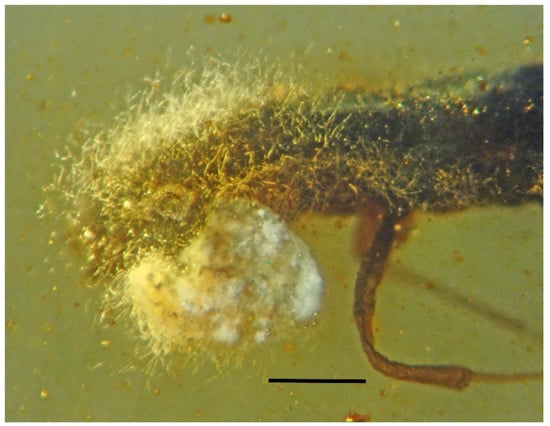
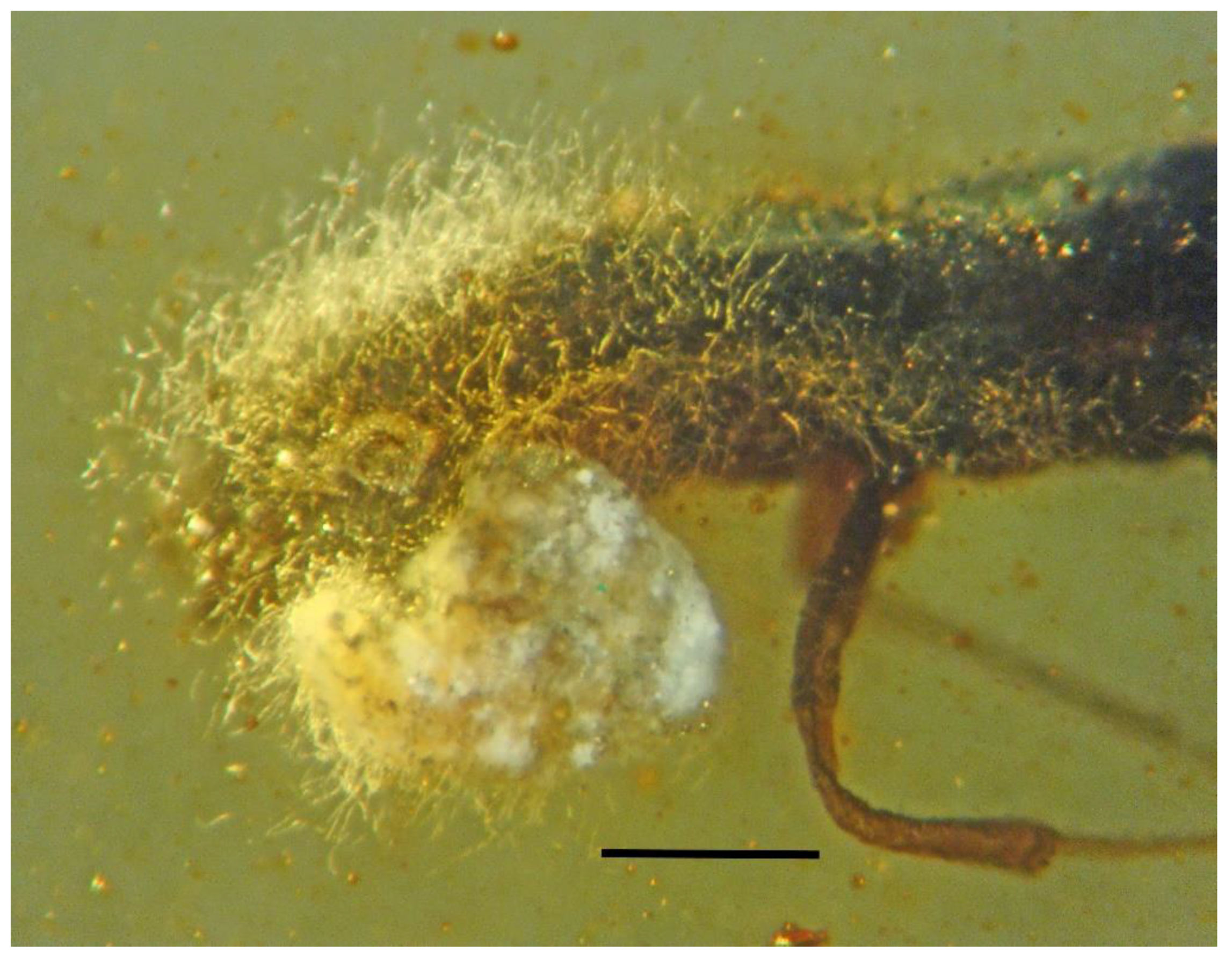
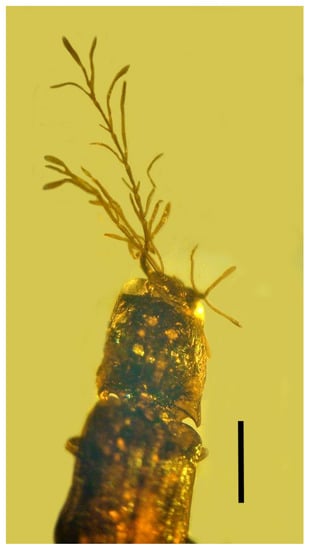
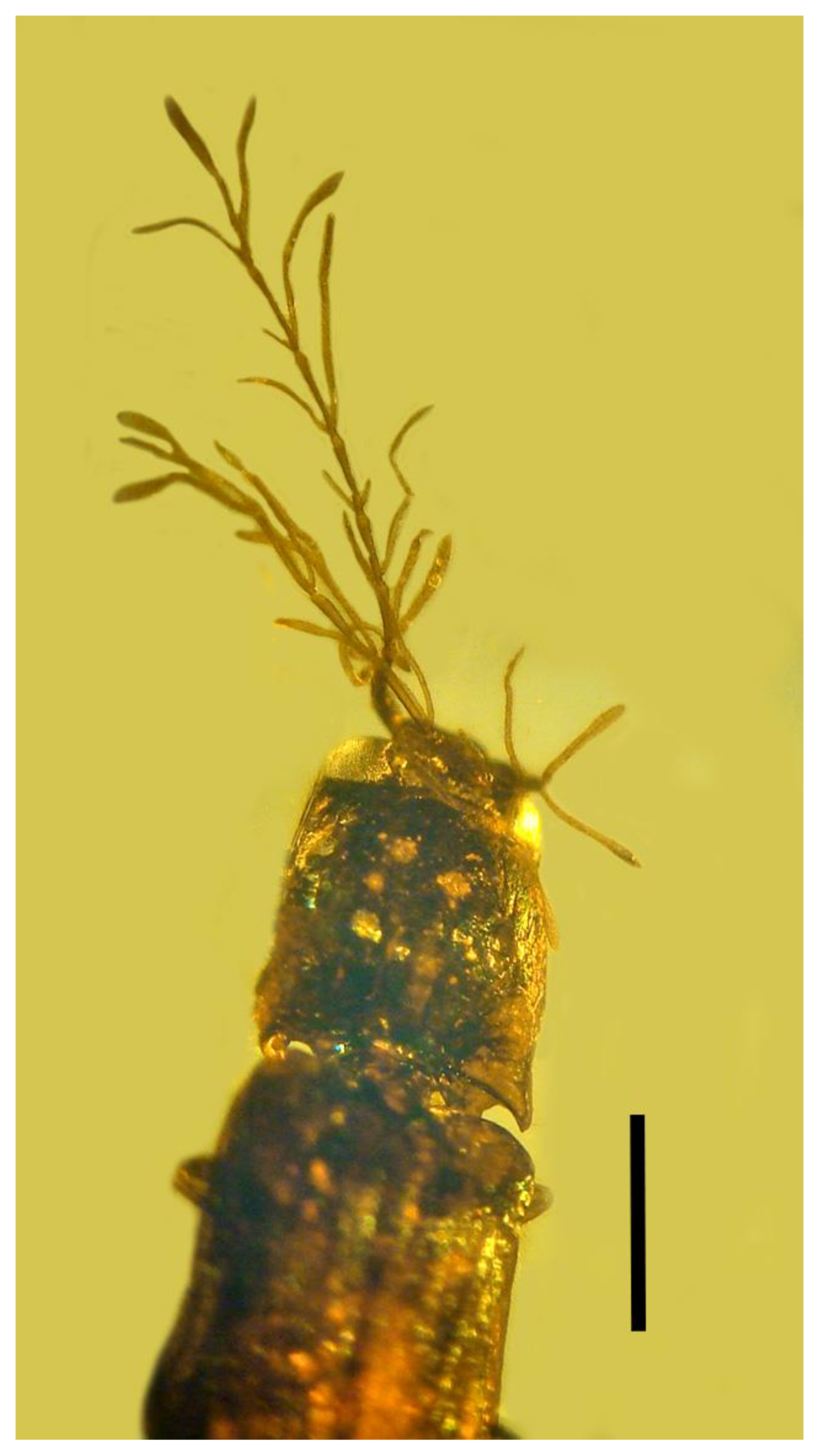
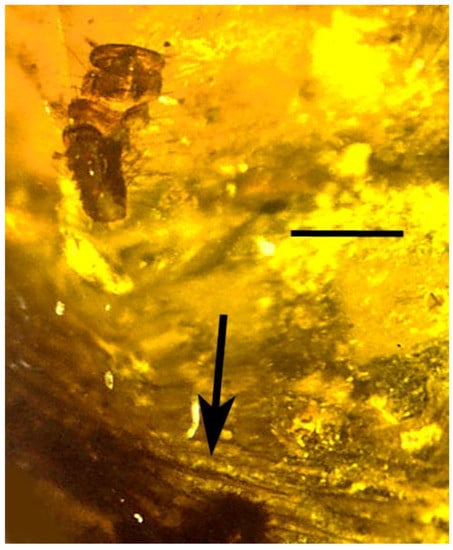
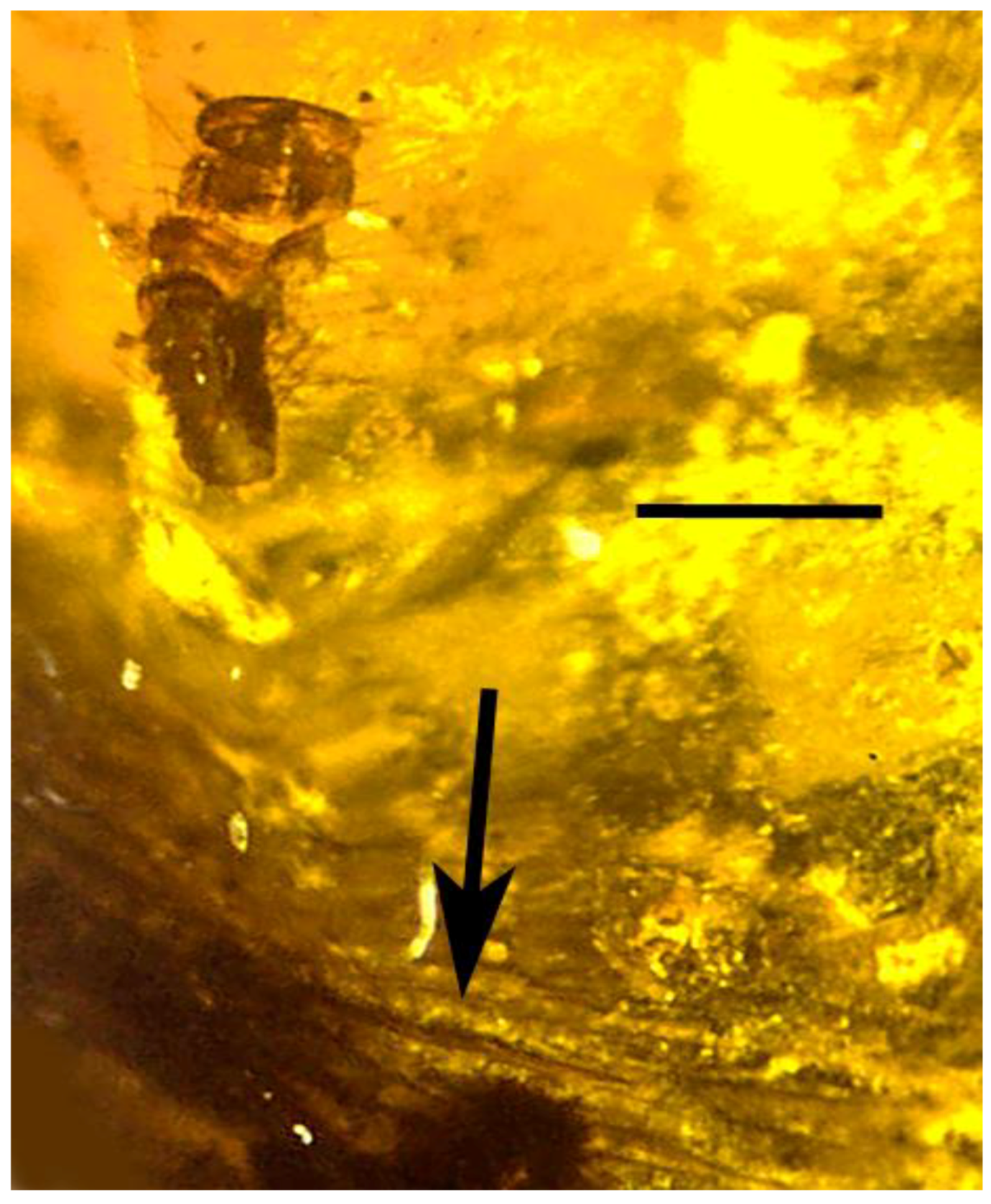
Other associations involve fungi that utilize beetles for nutrition. Members of the Trichomycetes are associated with the digestive tract of arthropods, including beetles [22]. These fungi obtain nourishment from digested food in the alimentary tract of the host and normally cause little or no physical damage. A rare example of a trichomycete growing out of the oral cavity of a click beetle (Coleoptera: Elateridae) was found in Burmese amber. It is typical for trichomycetes to establish themselves in the hindgut of the host, however Priscadvena corymbosa (Priscadvenales: Priscadvenaceae) could have established itself in the foregut since it is attached to the oral cavity of the beetle [23] (Figure 25).
Figure 25.
A trichomycete, Priscadvena corymbosa (Priscadvenales: Priscadvenaceae) emerging from the oral cavity of an elaterid beetle (Coleoptera: Elateridae) in Burmese amber. Scale bar = 1.0 mm.
3.7. Associations with Flowering Plants
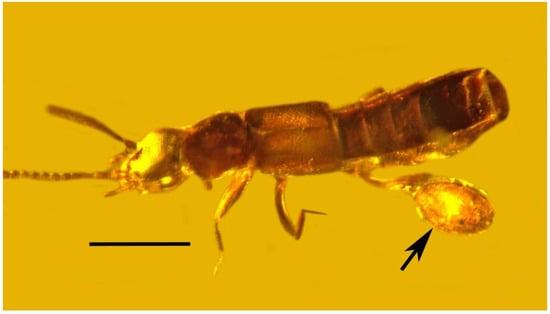
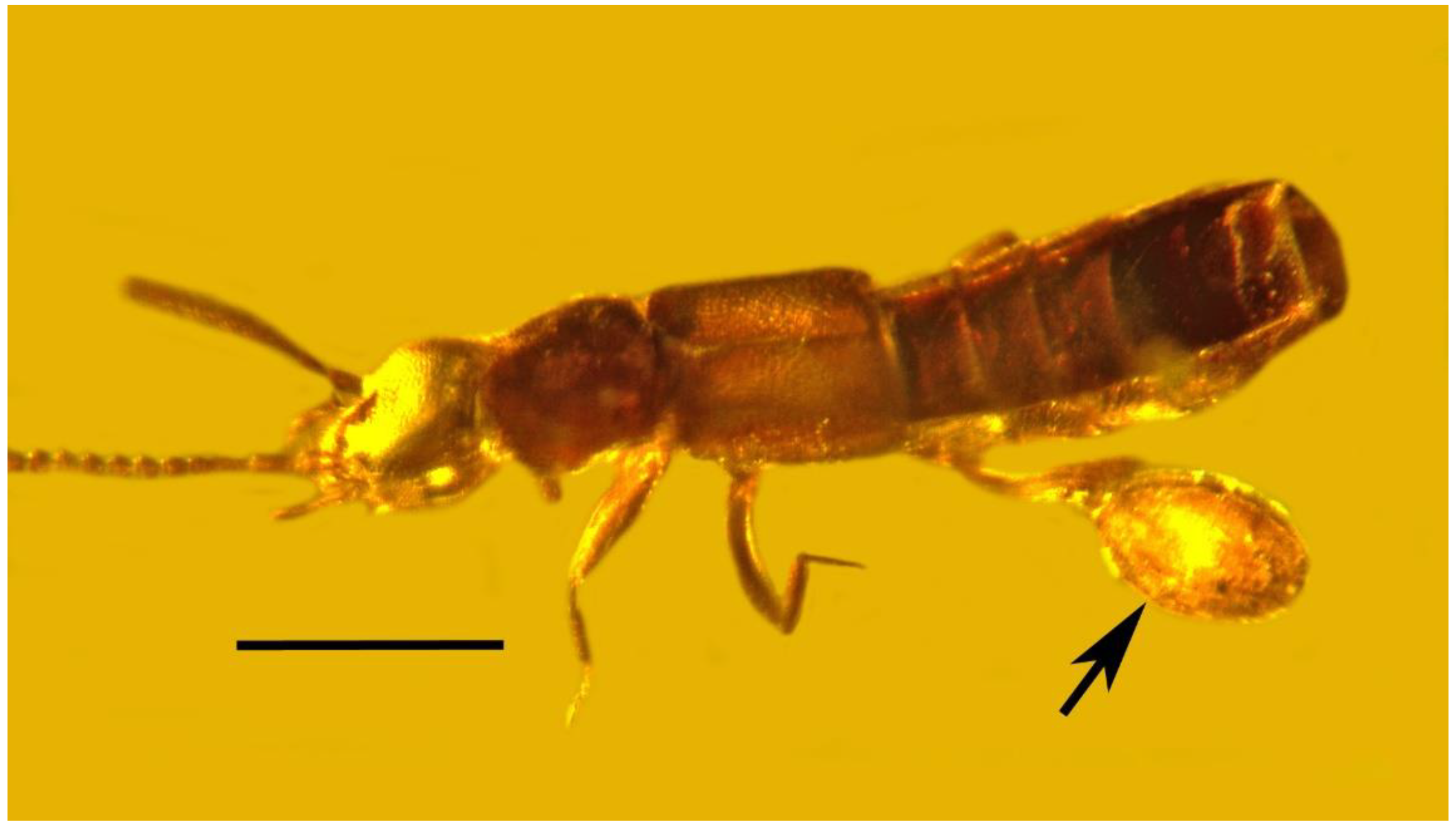
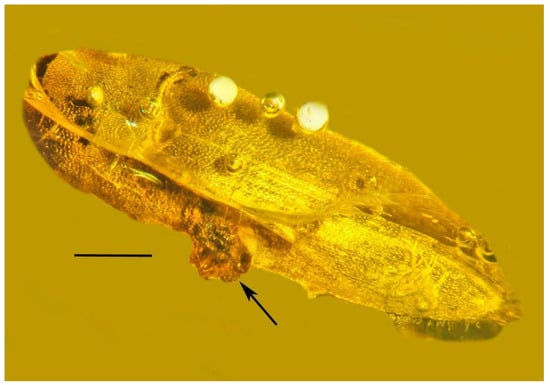
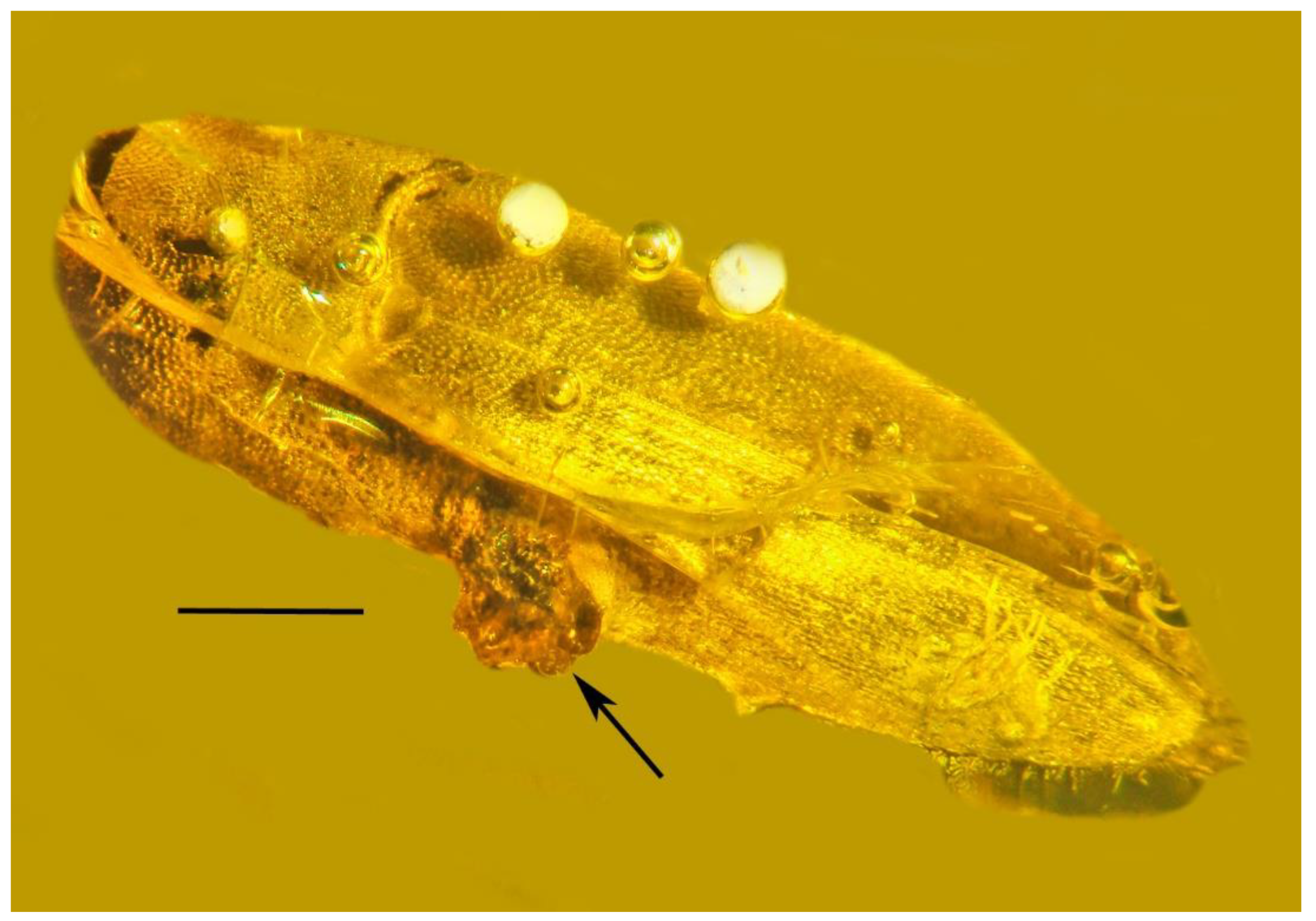
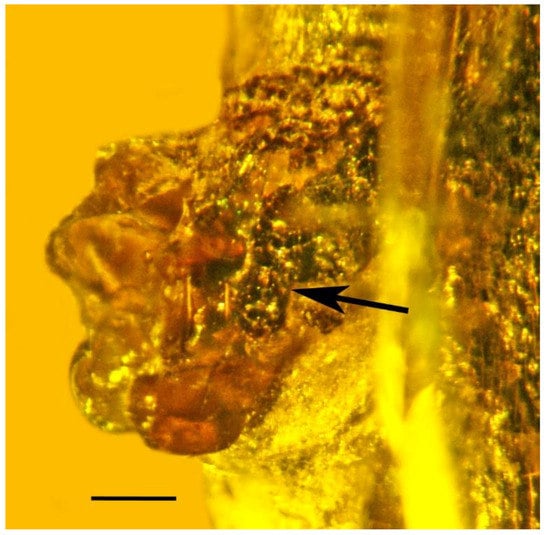
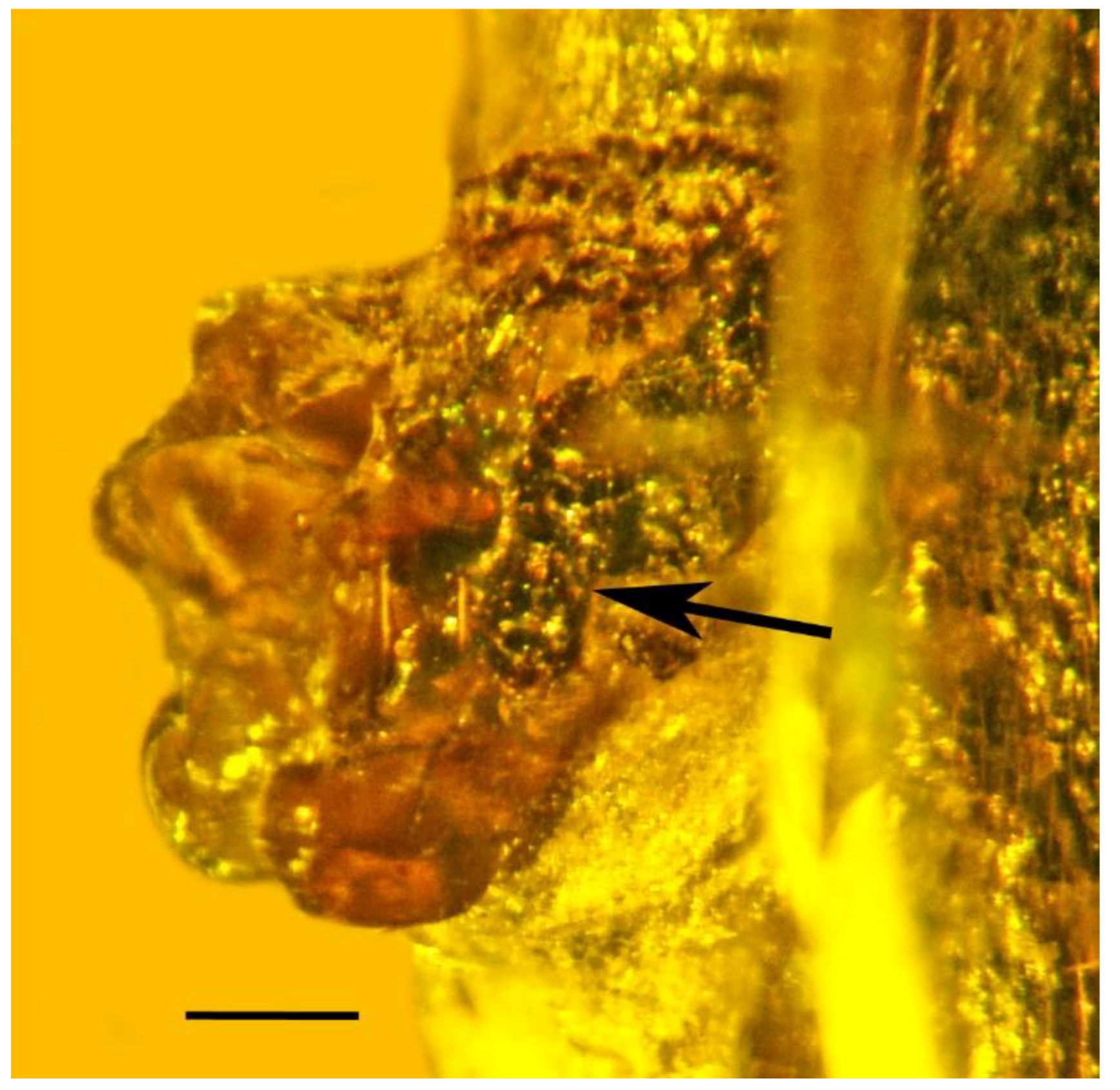
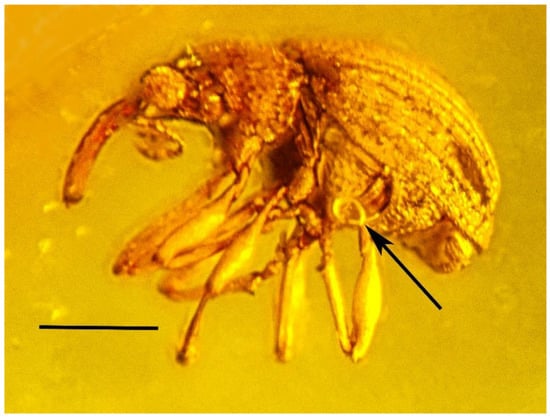
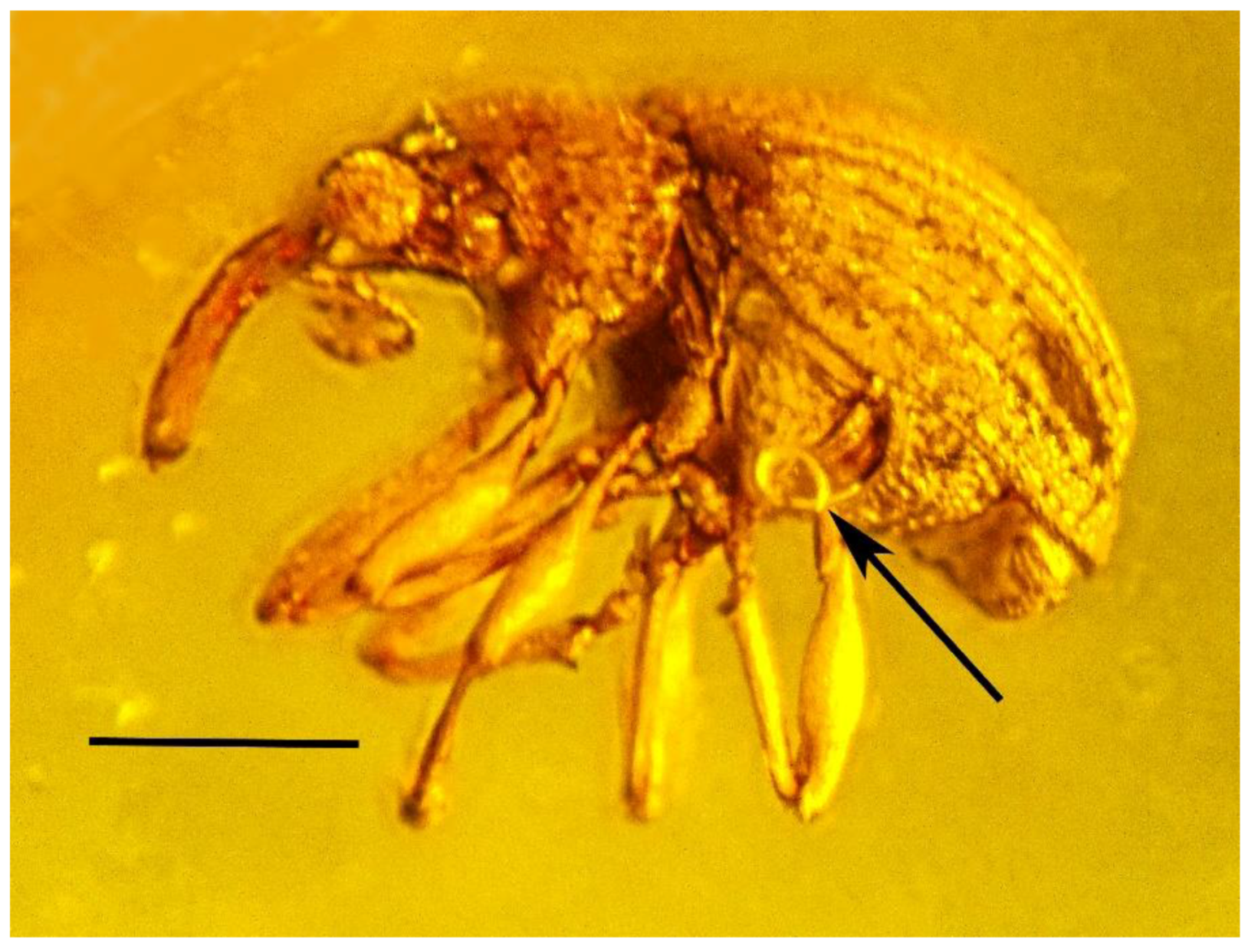
Orchids have a unique method of pollination that involves dispersing their pollen in little sacs called pollinia. Pollinia are usually attached to pollinators by adhesive pads (viscidia) with the entire pollination unit called a pollinarium. Beetles have various associations with orchids. They visit the flowers for pollen and nectar and consequently serve as pollinators and also use floral flowers and vegetative parts for rearing their young. A cryptorhynchid weevil (Coleoptera: Curculionidae) in Dominican amber had the pollinarium of Cyclindrocites browni (Angiospermae: Orchidaceae) attached to its pronotum (Figure 26). In Mexican amber, a ptilodactylid (Coleoptera: Ptilodactylidae) beetle had the pollinarium of Annulites mexicana (Angiospermae: Orchidaceae) attached to its mouthparts (Figure 27) [24].
Figure 26.
Cryptorhynchid weevil (Coleoptera: Curculionidae) with attached orchid pollinarium (arrow) of Cyclindrocites browni (Angiospermae: Orchidaceae) in Dominican amber. Scale bar = 1.0 mm.
Figure 27.
Ptilodactylid (Coleoptera: Ptilodactylidae) beetle with attached pollinarium (arrow) of Annulites mexicana (Angiospermae: Orchidaceae) in Mexican amber. Scale bar = 250 µm.
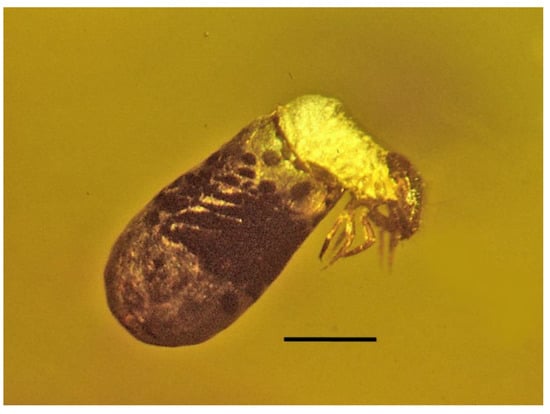
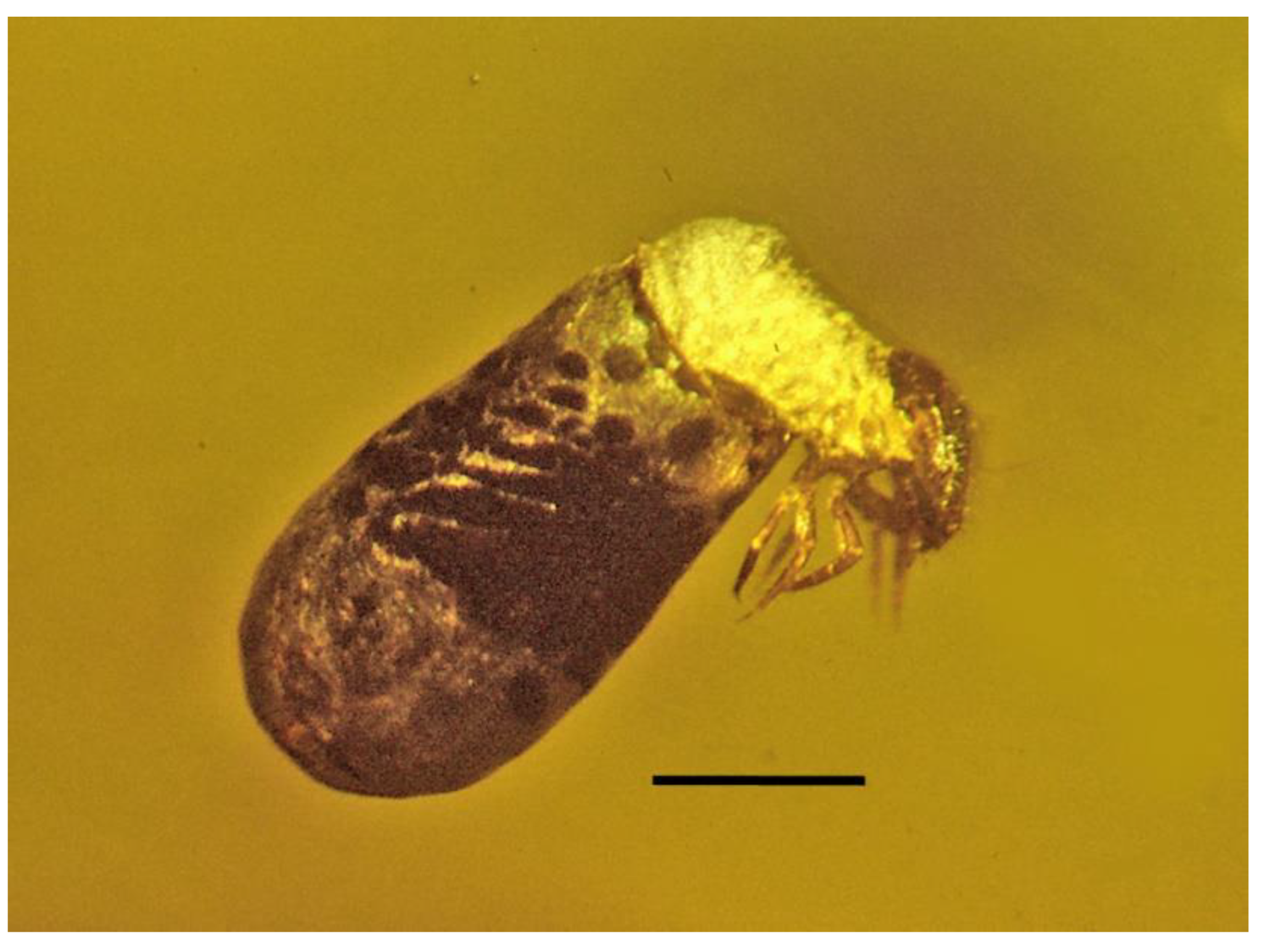
Case-bearing chrysomelid larvae (Coleoptera: Chrysomelidae) in Dominican amber are included here since the cases are often constructed with digested angiosperm remains (Figure 28). The ability to construct these cases and continually enlarge them to fit their growing bodies is an amazing example of insect behavior [25].
Figure 28.
Case-bearing chrysomelid beetle larva (Coleoptera: Chrysomelidae) in Dominican amber. Scale bar = 1.0 mm.
3.8. Associations with Vertebrates
An association of a fossil dermestid beetle (Coleoptera: Dermestidae) with a vertebrate is represented by a larva that was scavenging bird remains in Burmese amber (Figure 29). Dermestids are well known for feeding on vertebrate remains and experimenters remove tissue from skulls by placing them in an enclosed container with these beetles.
Figure 29.
Larva of dermestid beetle (Coleoptera: Dermestidae) adjacent to bird remains (arrow) in Burmese amber. Scale bar = 1.5 mm.
3.9. Associations with Nematodes (Nematoda)
Nematodes are another ubiquitous group that have formed diverse associations with plants and animals. Nematodes use beetles for development of their young as well as for phoresis [26] (Figure 2 and Figure 8). A case of the latter in Dominican amber is shown with the mycetophilous nematode, Cryptaphelencus dominicus (Nematoda: Aphelenchoidea), whose dauer (resistant stage juveniles) were released from the body of their platypodine carrier (Coleoptera: Curculionidae: Platypodinae) (Figure 30). Under normal conditions, when the platypodine arrived at its new habitat, these nematodes would leave the beetle and develop on fungi within the beetle’s tunnels. Bacteria- feeding nematodes, such as the diplogastrid, Scolytonema dominicana (Nematoda: Diplogastroidea), in Dominican amber, also used platypodines for transport (Figure 31).
Figure 30.
Dauer stages of the fungivorous aphelenchoidid nematode, Cryptaphelencus dominicus (Nematoda: Aphelenchoidea) that were phoretic on a platypodine (Coleoptera: Curculionidae) beetle in Dominican amber. Scale bar = 460 µm.
Figure 31.
Two diplogastrid nematodes (Scolytonema dominicana (Nematoda: Diplogastroidea) adjacent to a platypodine beetle (Coleoptera: Curculionidae: Platypodinae) in Dominican amber. Scale bar = 140 µm.
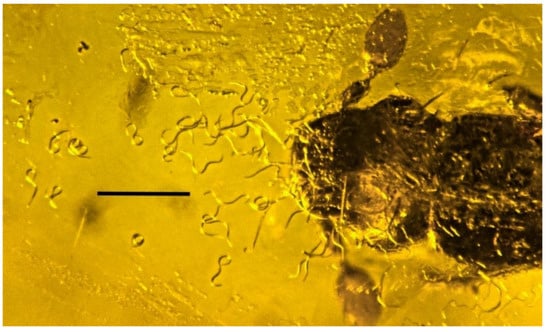
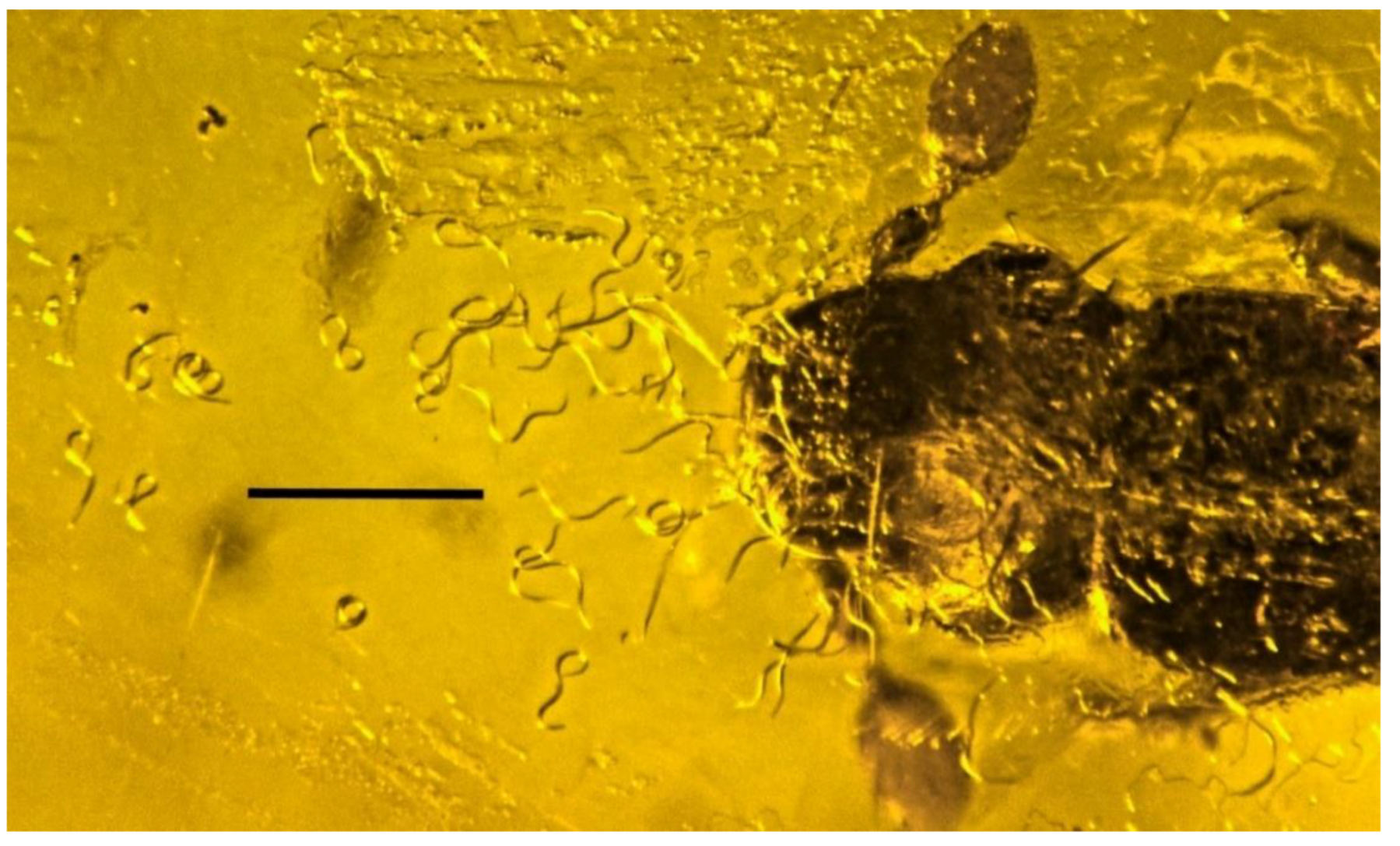
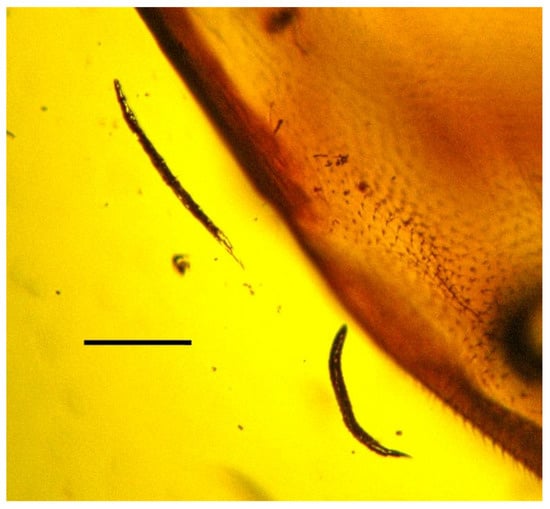
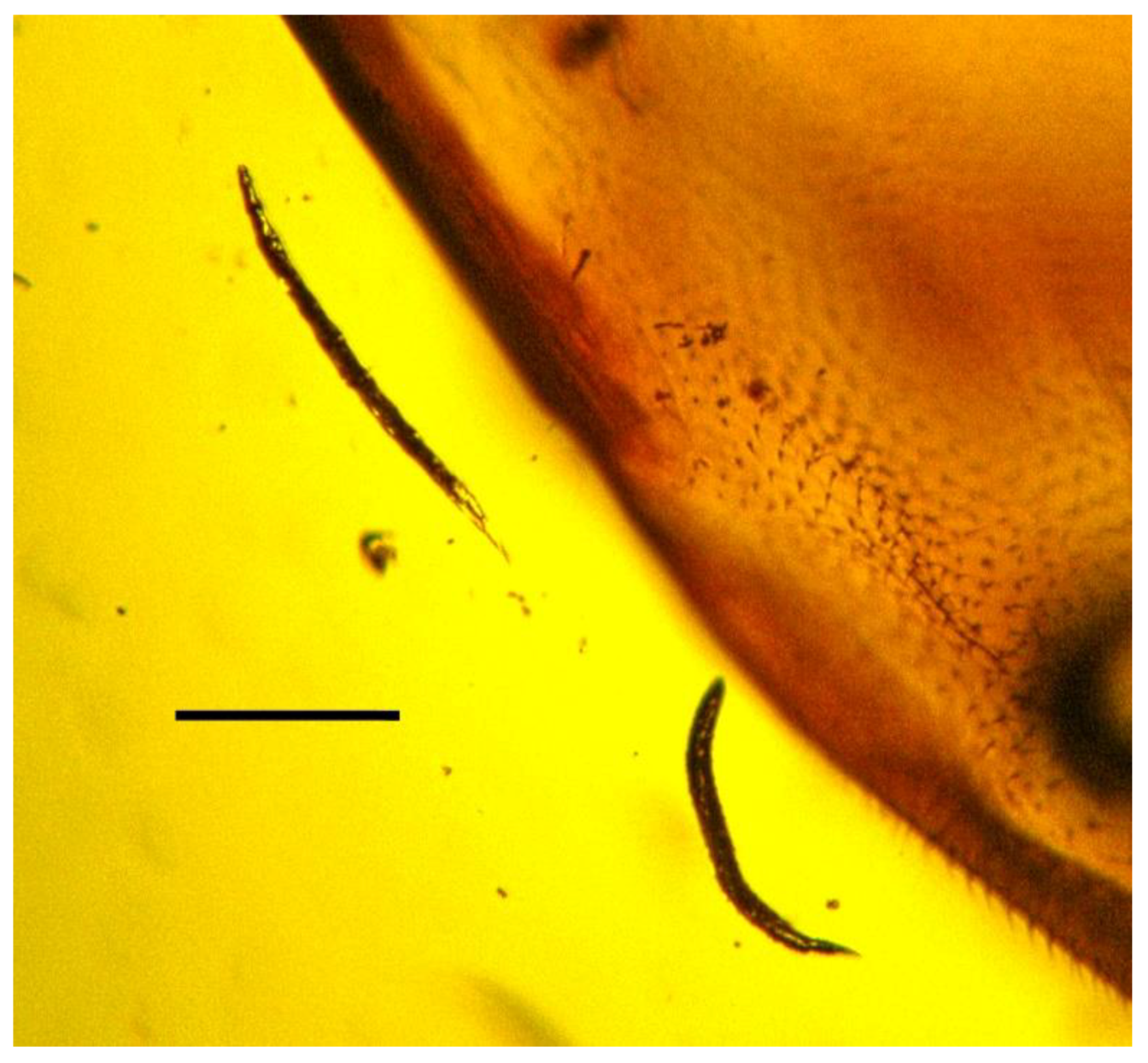
Beetles are also parasitized by nematodes that develop in their body cavity and sometimes juvenile stages of these parasites emerge when the host enters the resin. One such parasitic nematode is the allantonematid, Palaeoallantonema apionae (Nematoda: Allantonematidae), that emerged from its apionine (Coleoptera: Brentidae) weevil host in Dominican amber (Figure 32). Juveniles of another parasitic allantonematid, Palaeoallantonema dominicana (Nematoda: Allantonematidae) emerged from their rove beetle host (Coleoptera: Staphylinidae) in Dominican amber (Figure 33) [26,27].
Figure 32.
Parasitic nematode, Palaeoallantonema apionae (Nematoda: Allantonematidae) (arrow) that emerged from its apionid weevil host (Coleoptera: Brentidae) in Dominican amber. Scale bar = 420 µm.
Figure 33.
Parasitic juveniles (arrow) of the nematode, Palaeoallantonema dominicana (Nematoda: Allantonematidae) that emerged from their rove beetle (Coleoptera: Staphylinidae) host in Dominican amber. Scale bar = 900 µm.
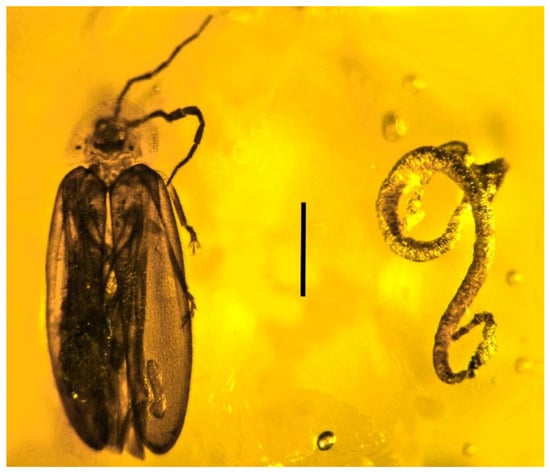
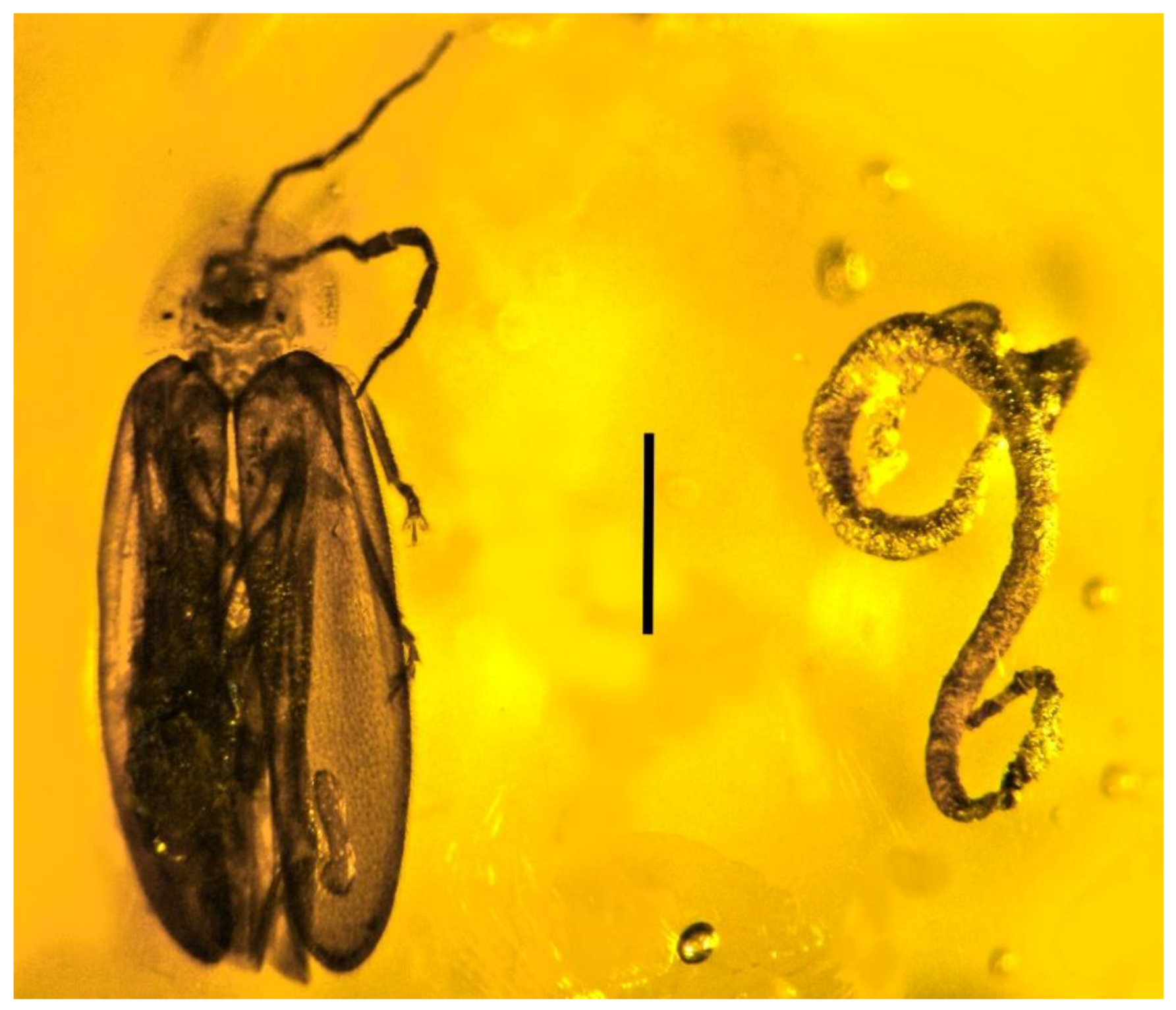
Mermithid nematodes parasitize terrestrial and freshwater insects as well as other invertebrates. After developing in the hemocoel of terrestrial hosts, the post-parasitic juveniles emerge and enter the soil where they mature to the adult stage. One rare fossil shows the mermithid, Heydenius lamprophilus (Nematoda: Mermithidae) that emerged from a lampyrid (Coleoptera: Lampyridae) beetle in Dominican amber [26] (Figure 34).
Figure 34.
A mermithid nematode, Heydenius lamprophilus (Nematoda: Mermithidae) that emerged from its lampyrid (Coleoptera: Lampyridae) beetle host in Dominican amber. Scale bar = 1.9 mm.
4. Discussion
The great majority of the fossil associations depicted here have continued to the present. Mites phoretic on weevils [10] and bark beetles [28] are widespread today. Pseudoscorpions have phoretic associations with extant beetles and other insect groups [12].
The interesting modification of the body of extant Trichopseniinae (Staphylinidae) living in termite colonies is well known today and specimens from Dominican amber have been compared to extant forms in Australia [29].
What is also interesting is that one of the Dominican specimens was found adjacent to an adult tineid moth. Tineid moths are known associates of termite colonies in Africa and it is likely that similar associations occur in the Neotropics [30].
Extant female euphorine braconids that attack adult beetles insert their ovipositor either through the intersegmental membrane in the abdominal region (as with Perilitus spp.), at the base of the elytra (as in Syrrhizus spp.) or in thoracic sutures (as with Cosmophorus spp.) [31]. When development is finished the mature larvae form a cocoon in the surroundings or attached to the host as the case illustrated here with the host beetle, Habropezus plaisiommus. Euphorines do not always kill their hosts upon emergence and there are records of some large hosts recovering, which may have been the case with the parasitized elaterid in Dominican amber [31].
The tachinid egg on the thorax of the leaf beetle Stenaspidiotus microptilus in Dominican amber resembles the eggs of extant members of the Neotropical genus Strongygaster that deposits eggs on adult leaf beetles [15].
Meloe triungulins are well known to have phoretic associations with extant bees and the biology of some species has been elucidated. When the triungulins are carried into bee nests, they devour bee eggs and larvae as well as any provisions, such as pollen and honey [31].
The cantharid beetle that was displaying a chemical defense response to a potential predator in Burmese amber is the earliest fossil record of a chemical defense response and shows that such responses, which occur today in these and other beetles, were present some 100 Mya [17].
Fungi can be a nutritional source for beetles. There are many studies on ambrosia fungi and their symbiosis with bark beetles [19]. There are also fungi that use beetles as hosts, including the trichomycete, Priscadvena corymbosa, that was emerging from the mouth of an elaterid beetle [23].
Records of nematodes associated with fossil beetles also have associations with contemporary family members. For instance, there are many cases of extant aphelenchoidid and diplogastrid nematodes associated with members of the Platypodinae [32]. There are also records of allantonematids parasitizing apionine weevils and rove beetles [32]. However, there does not appear to be any extant record of mermithid parasites of Lampyridae [32].
At this point, with 21 records from Dominican amber, four from Burmese amber and a single one from Mexican amber, it would appear that the number of beetles with associates from the three amber deposits are correlated with the availability of fossils from those three sites. Dominican amber specimens have been the easiest to obtain over the past 30 years. There must be examples of beetles with associates in Baltic amber, however that material has been difficult for collectors to acquire.
5. Conclusions
The many fossil associations depicted here that have continued to the present support the principle of behavior fixity or constancy [2,3]. In brief, this principle states that once successful associations between two or more separate lineages are established, they will continue as long as environmental conditions are favorable. Even if the partners of such associations become extinct at the specific or generic level, they are replaced by new lineages that continue the established alliances with little modification. Thus, specific behavioral patterns are often much more ancient than the specific lineages involved.
Funding
This research received no external funding. All photographs were taken by the author.
Conflicts of Interest
The author declares no conflict of interest.
References
- Evans, A.V.; Bellamy, C.L. An Inordinate Fondness for Beetles; Henry Holt and Company: New York, NY, USA, 1996; pp. 1–208. [Google Scholar]
- Boucot, A.J. Evolutionary Paleobiology of Behavior and Co-Evolution; Elsevier: Amsterdam, The Netherlands, 1990; pp. 1–725. [Google Scholar]
- Boucot, A.J.; Poinar, G.O., Jr. Fossil Behavior Compendium; CRC Press: Boca Raton, FL, USA, 2010; pp. 1–424. [Google Scholar]
- Poinar, G.O., Jr.; Hess, R. Preservative qualities of recent and fossil resins: Electron micrograph studies on tissue preserved in Baltic amber. J. Baltic Studies 1985, 16, 222–230. [Google Scholar] [CrossRef] [Scilit]
- Iturralde-Vinent, M.S.; MacPhee, R.D.E. Age and paleographic origin of Dominican amber. Science 1996, 273, 1850–1852. [Google Scholar] [CrossRef] [Scilit]
- Schlee, D. Das Bernstein-Kabinett. Stuttgart Beitrage Natur (C) 1990, 28, 1–100. [Google Scholar]
- Berggren, W.A.; Van Couvering, J.A.H. The late Neogene. Palaeogeo. Palaeoclimat. Palaeoecol. 1974, 16, 1–216. [Google Scholar]
- Cruickshank, R.D.; Ko, K. Geology of an amber locality in the Hukawng Valley, northern Myanmar. J. Asian Earth Sci. 2003, 21, 441–455. [Google Scholar] [CrossRef] [Scilit]
- Shi, G.; Grimaldi, D.A.; Harlow, G.E.; Wang, J.; Wang, J.; Yang, M.; Lei, W.; Li, Q.; Li, X. Age constraint on Burmese amber based on U–Pb dating of zircons. Cretac. Res. 2012, 37, 155–163. [Google Scholar] [CrossRef] [Scilit]
- Krantz, G.W.; Poinar, G.O., Jr. Mites, nematodes and the multimillion dollar weevil. J. Natural History 2004, 38, 135–141. [Google Scholar] [CrossRef] [Scilit]
- Poinar, G., Jr.; Legalov, A.A. Bicalcasura maculata n. gen., n. sp. (Curculionoidea: Dryophthoridae) with a list of weevils described from Dominican amber. Hist. Biol. 2013, 26, 449–453. [Google Scholar] [CrossRef] [Scilit]
- Poinar, G.O., Jr.; Curcic, B.P.M.; Cokendolpher, J.C. Arthropod phoresy involving pseudoscorpions in the past and present. Acta Arachnol. 1998, 47, 79–96. [Google Scholar] [CrossRef] [Scilit]
- Yamamoto, S.; Maruyama, M.; Parker, J. Evidence for social parasites of early insect societies by Cretaceous rove beetles. Nat. Commun. 2016, 7, 13658. [Google Scholar] [CrossRef] [Scilit]
- Poinar, G., Jr.; Shaw, S.R. Endoparasitism of a Cretaceous adult weevil by a euphorine wasp (Hymenoptera: Braconidae). N. Jb. Geol. Pal. A. 2016, 282, 109–113. [Google Scholar] [CrossRef] [Scilit]
- Poinar, G.O., Jr. Stenaspidiotus microptilus n. gen., n. sp. (Coleoptera: Chrysomelidae: Chrysomelinae) in Dominican amber, with evidence of tachinid (Diptera: Tachinidae) oviposition. Hist. Biol. 2012, 25, 101–105. [Google Scholar] [CrossRef] [Scilit]
- Poinar, G.O., Jr. Meloe dominicanus n. sp. (Coleoptera: Meloidae) phoretic on the bee Proplebia dominicana (Hymenoptera: Apidae) in Dominican amber. Proc. Entomol. Soc. Washington 2009, 111, 145–150. [Google Scholar] [CrossRef] [Scilit]
- Poinar, G.O., Jr.; Marshall, C.; Buckley, R. One hundred million years of chemical warfare by insects. J. Chem. Ecol. 2007, 33, 1663–1669. [Google Scholar] [CrossRef] [Scilit] [PubMed]
- Franc, V. Mycetophilous beetles (Coleoptera: Mycetophila)-indicators of well preserved ecosystems. Biologia 1997, 52, 181–186. [Google Scholar]
- Harrington, T.C. Ecology and evolution of mycophagous bark beetles and their fungal partners. In Insect-fungal Associations: Ecology and Evolution; Vega, F.E., Blackwell, M., Eds.; Oxford University Press: Oxford, England, 2005; pp. 257–291. [Google Scholar]
- Poinar, G.O., Jr.; Vega, F.E. A mid-Cretaceous ambrosia fungus, Paleoambrosia entomophila gen. nov. et sp. nov. (Ascomycota: Ophiostomatales) in Burmese (Myanmar) amber, and evidence for a femoral mycangium. Fungal. Biol. 2018, 122, 1159–1162. [Google Scholar] [CrossRef] [Scilit]
- Poinar, G.O., Jr.; Vega, F.E.; Legalov, A.A. New subfamily of ambrosia beetles (Coleoptera: Platypodidae) from mid-Cretaceous Burmese amber. Hist. Biol. 2018, 1–6. [Google Scholar] [CrossRef] [Scilit]
- Lichtwardt, R.W. The Trichomycetes: Fungal Associates of Arthropods; Springer Verlag: New York, NY, USA, 1986; pp. 1–343. [Google Scholar]
- Poinar, G.; Vega, F.E. A mid-Cretaceous trichomycete, Priscadvena corymbosa gen. et sp. nov., in Burmese amber. Fungal. Biol. 2019. [Google Scholar] [CrossRef] [Scilit]
- Poinar, G., Jr. Beetles with orchid pollinaria in Dominican and Mexican amber. Am. Èntomol. 2016, 62, 180–185. [Google Scholar] [CrossRef] [Scilit]
- Chaboo, C.S.; Brown, C.G.; Funk, D.J. Faecal case architecture in the gibbosus species group of Neochlamisus Karren, 1972 (Coleoptera: Chrysomelidae: Cryptocephalinae: Chlamisini). Zoöl. J. Linn. Soc. 2008, 152, 315–351. [Google Scholar] [CrossRef] [Scilit]
- Poinar, G.O., Jr. The Evolutionary History of Nematodes; Brill: Leiden, The Netherlands, 2011; pp. 1–429. [Google Scholar]
- Poinar, G.O., Jr.; Brodzinsky, J. Fossil evidence of a nematode (Tylenchida) parasitic in Staphylinidae (Coleoptera). Nematologica 1986, 31, 353–355. [Google Scholar]
- Wirth, S.F.; Weis, O.; Pernek, M. Comparison of phoretic mites associated with bark beetles Ips typographys and Ips cembrae from Central Croatia. Sumarski List 2016, 11–12, 549–560. [Google Scholar]
- Kistner, D.H. New species of termitophilous Trichopseniinae (Coleoptera: Staphylinidae) found with Mastotermes darwiniensis in Australia and in Dominican amber. Sociobiology 1998, 31, 51–64. [Google Scholar]
- Harris, W.V. African termites of the genus Schedorhinotermes (Isoptera: Rhinotermitidae) and associated termitophiles (Lepidoptera: Tineidae). System. Entomol. 1968, 37, 103–113. [Google Scholar] [CrossRef] [Scilit]
- Clausen, C.P. Entomophagous Insects; Hafner Publishing Company: New York, NY, USA, 1962; pp. 1–688. [Google Scholar]
- Poinar, G.O., Jr. Entomogenous Nematodes; E. J. Brill: Leiden, The Netherlands, 1975; pp. 1–317. [Google Scholar]

© 2019 by the author. Licensee MDPI, Basel, Switzerland. This article is an open access article distributed under the terms and conditions of the Creative Commons Attribution (CC BY) license (http://creativecommons.org/licenses/by/4.0/).