Article

Late Cretaceous Intraplate Mafic Dyke Swarms in the East Kunlun Orogen, Northern Tibetan Plateau: Implications for Lithospheric Reactivation and Early Surface Uplift

by
Denghui Chen
1,2,
Hao Wu
1,3,
Wei Wang
3,
Yujie Zhao
3,
Huajun Wen
3,
Dongming Jiang
3,
Xiaotong Sun
3 and
Fuhao Xiong
3,4,*
1
MLR Key Laboratory for the Study of Focused Magmatism and Giant Ore Deposits, Xi’an Center of China Geological Survey, Xi’an 710054, China
2
Research Centre for Orogenic Geology, China Geological Survey, Xi’an 710054, China
3
College of Earth and Planetary Sciences, Chengdu University of Technology, Chengdu 610059, China
4
State Key Laboratory of Oil and Gas Reservoir Geology and Exploitation, Chengdu University of Technology, Chengdu 610059, China
*
Author to whom correspondence should be addressed.
Geosciences 2026, 16(5), 201; https://doi.org/10.3390/geosciences16050201
Submission received: 24 March 2026 / Revised: 9 May 2026 / Accepted: 13 May 2026 / Published: 19 May 2026

Abstract

The Cretaceous represents a key period in the geodynamic evolution of the Tibetan Plateau and the initial development of its paleotopography. While widespread orogenesis and magmatism associated with the Lhasa–Qiangtang collision are well documented in southern Tibet, coeval magmatic records in northern Tibet are extremely limited, hindering constraints on the deep processes responsible for surface uplift. Zircon U–Pb ages, whole-rock geochemistry, and Sr–Nd–Hf isotopes are presented for two mafic dyke swarms from the East Kunlun Orogen, northern Tibet. The two dyke swarms were emplaced at 91.8 ± 2.0 Ma and 84.8 ± 0.6 Ma, indicating a previously underrecognized episode of Late Cretaceous mafic magmatism in northern Tibet. They are subalkaline tholeiites enriched in LILEs and LREEs, depleted in HFSEs, and characterized by negative Nb–Ta anomalies. Their decoupled Nd-Hf isotopes (εNd(t) = −4.96 to +0.94; εHf(t) = +3.75 to +5.76) indicate derivation from an enriched lithospheric mantle metasomatized by slab-related fluids during Permian-Triassic Paleo-Tethyan subduction. Partial melting modeling indicates that the magmas were generated by low-degree (1–5%) decompression melting of lherzolite within the spinel–garnet transition zone. We propose that these mafic dyke swarms formed in an intraplate extensional setting triggered by far-field stresses associated with the Lhasa–Qiangtang collision, which reactivated lithosphere-scale faults and induced localized mantle melting. These results provide new petrological constraints on Late Cretaceous intracontinental extension in northern Tibet and highlight mafic dyke swarms as key probes for linking lithospheric reactivation to early surface uplift of the Tibetan Plateau.

1. Introduction

The Cretaceous marks a critical stage in the geodynamic evolution of the Tibetan Plateau, during which the paleoenvironment, paleogeographic framework and lithospheric architecture of the region were fundamentally reorganized [1,2,3,4]. Following the closure of the Bangong–Nujiang Ocean, collision between the Lhasa and Qiangtang terranes (ca. 125–87 Ma) led to widespread crustal shortening, thickening, and magmatism in central and southern Tibet, contributing to the development of a proto-plateau [3,5,6,7]. These processes exerted a first-order control on the thermal structure and mechanical behavior of the lithosphere.
Northern Tibet, including the East Kunlun Orogenic Belt (EKOB), has long been regarded as magmatically quiescent during the Cretaceous due to the scarcity of coeval magmatic records [8,9,10,11]. However, increasing thermochronological and sedimentological evidence indicates that the EKOB and adjacent regions, such as the Altyn Tagh and West Qinling, experienced significant surface uplift and rapid exhumation during the Cretaceous (ca. 120–80 Ma) [12,13,14,15,16]. This apparent decoupling between strong surface uplift and weak magmatic expression suggests that the deep geodynamic processes governing northern Tibet during the Cretaceous remain poorly constrained.
Recent studies have identified sparse Cretaceous magmatic rocks in the EKOB, including granitoids and diabases, which provide important evidence for intracontinental tectono-magmatic activity [17,18]. These rocks also place key constraints on the deep geodynamic processes responsible for Cretaceous surface uplift in the East Kunlun Orogen. Nevertheless, the temporal evolution, source characteristics, and associated deep geodynamic processes remain poorly constrained. Mafic dyke swarms are widely regarded as key indicators of lithospheric extension and mantle upwelling, and their geochemical and isotopic compositions can effectively record mantle source characteristics, metasomatic processes, and melting conditions, making them ideal probes for investigating intracontinental tectonics and deep lithospheric dynamics [19,20,21]. Mafic dyke swarms can directly link lithospheric extension to mantle melting processes [22,23], providing crucial constraints on the mechanisms driving surface uplift.
We report two newly identified Late Cretaceous mafic dyke swarms from the East Kunlun Orogen. Through integrated field observations, zircon U–Pb geochronology, whole-rock geochemistry, and Sr–Nd–Hf isotopic analyses, we aim to constrain the petrogenesis of these mafic dykes and the nature of their mantle source, and then elucidate the geodynamic processes responsible for Late Cretaceous intracontinental extension and surface uplift in northern Tibet. This study provides new constraints on Cretaceous lithospheric reactivation in the northern Tibetan Plateau and highlights mafic dyke swarms as effective probes for deciphering deep geodynamic processes in intracontinental orogenic systems.

2. Geological Background

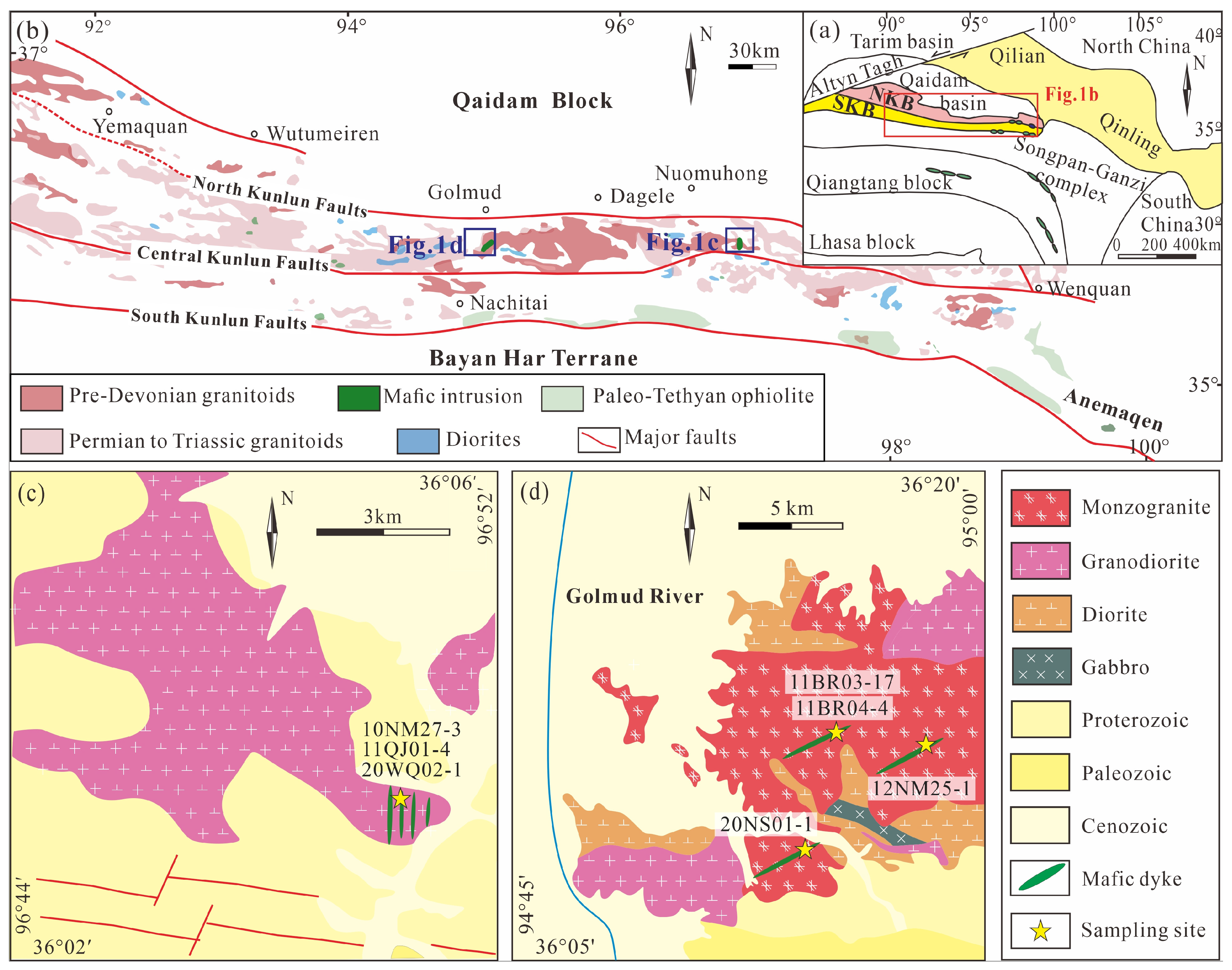
The East Kunlun Orogenic Belt (EKOB), located along the northern margin of the Tibetan Plateau, represents an important tectonic component of the plateau (Figure 1a) [24]. It records the assembly history between Gondwana and Laurasia and preserves abundant geological records of the Proto-Tethyan and Paleo-Tethyan orogenic cycles [10,24]. The differentiation in tectonic evolution between Gondwana and Laurasia became increasingly pronounced during the Late Precambrian. At the same time, the earliest oceanic domains, including the Proto-Tethys, began to open and were accompanied by the fragmentation of older continental configurations, and this process broadly corresponded to the Pan-African orogeny and coeval orogenic events related to the final amalgamation of Gondwana [25]. As the eastern margin of Gondwana evolved into a long-lived active continental margin system, some Gondwana-related continental fragments or microcontinents remained tectonically linked prior to their later dispersal. Among them, northern Zealandia was once connected to continental Australia before its separation in the Late Mesozoic, indicating that the eastern Gondwanan realm underwent protracted and persistent tectonic reorganization [26]. Such long-lived convergent cycles commonly involve subduction-related high-pressure–low-temperature metamorphism, nappe stacking, tectonic burial, and the subsequent exhumation of deeply subducted units [27]. In the East Kunlun Orogenic Belt (EKOB), these prolonged tectonic processes are manifested by the development of ophiolitic mélanges, arc-related magmatism, and the formation of high-pressure to ultrahigh-pressure metamorphic belts. Collectively, these features indicate that the belt records a composite evolutionary history jointly shaped by terrane detachment, oceanic consumption, and multi-stage accretion.
The EKOB trends approximately east–west and extends for about 1500 km. It is bounded by the Altyn Tagh Fault in the west, the West Qinling Orogenic Belt in the east, the Qaidam Basin to the north, and the Bayan Har–Songpan–Ganzi terrane to the south [9]. The Central Kunlun and South Kunlun faults divide the belt into the North Kunlun Block (NKB) and South Kunlun Block (SKB) (Figure 1a,b) [21]. The North Kunlun Block exposes a Precambrian metamorphic basement, mainly comprising the Paleoproterozoic to Mesoproterozoic Baishahe and Xiaomiao formations. The overlying strata are dominated by the Devonian Maoniushan Formation, which consists primarily of strongly deformed continental fluvial conglomerates with well-developed cleavage and molasse deposits [31]. Large volumes of Late Paleozoic to Early–Middle Mesozoic intrusive rocks related to arc magmatism are widely distributed in the NKB. Numerous Caledonian and Indosinian granitoid plutons collectively define an approximately east–west-trending magmatic belt [9,10,21]. The basement of the South Kunlun Block is mainly composed of the Kuhai Complex, which records a wide range of geological ages and has undergone intense migmatization, metamorphism, and deformation. It is characterized by gneiss, granulite, and migmatite, with lenses of metamorphic rocks locally preserved [24,31]. The overlying strata consist of Late Paleozoic shallow-marine successions, including clastic rocks, fossil-bearing carbonate units, and minor volcanic rocks [24,31]. Only limited Triassic intrusive rocks are sporadically exposed within the SKB [11]. The two Cretaceous mafic dyke swarms are distributed in the Nanshankou and Qiujidonggou areas adjacent to the Central Kunlun Fault zone in the North Kunlun Block. These dykes occur as swarms and intrude Triassic and Devonian granitic plutons, respectively (Figure 1c,d).

3. Sampling and Petrography

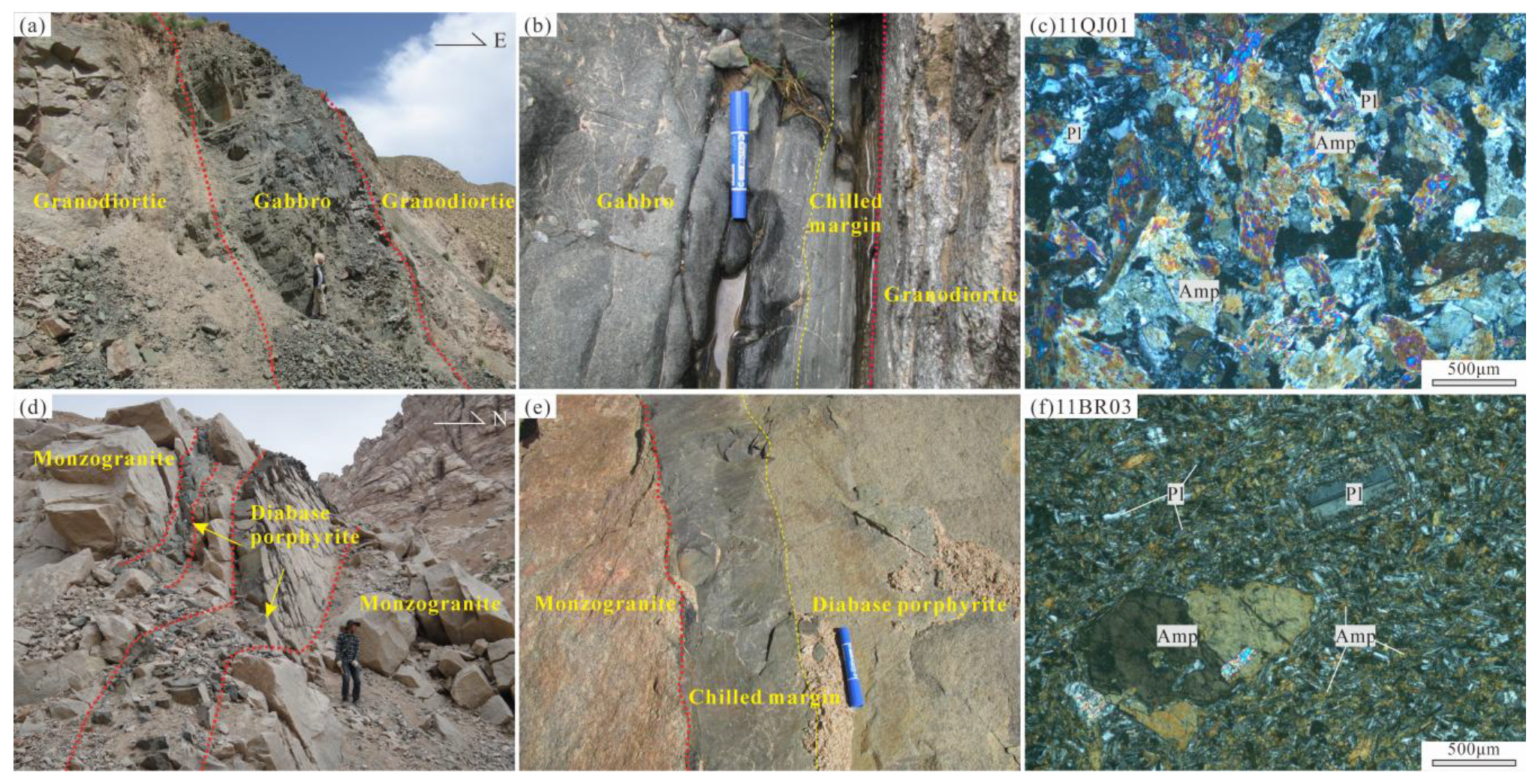
The Qiujidonggou mafic dykes are subvertical, strike nearly N–S, and intrude Devonian granodiorite. Individual dykes are several meters wide and display sharp intrusive contacts with the host rocks (Figure 2a). Well-developed chilled margins, approximately 15–20 cm wide, are present along the dyke boundaries (Figure 2b). The dykes are composed mainly of gabbro, which is grayish green to dark gray in hand specimen and exhibits a fine-grained, massive texture. Petrographically, the Qiujidonggou gabbro shows a typical gabbroic texture and consists predominantly of clinopyroxene and plagioclase (Figure 2c), but its pyroxene (~20 vol%) is variably altered to amphibole, actinolite, and epidote.
The Nanshankou mafic dykes are subvertical, strike nearly E–W, and intrude Triassic monzogranite (Figure 2d). They exhibit sharp contacts with the wall rocks and well-developed chilled margins approximately 20–30 cm wide (Figure 2e). The dykes are composed mainly of diabase porphyrite, which is grayish green to dark gray and displays a porphyritic texture with a massive structure. Petrographic observations indicate that the phenocrysts are mainly amphibole and plagioclase (Figure 2f). The groundmass displays a typical fine-grained igneous texture and is composed mainly of plagioclase and amphibole.

4. Analytical Methods

4.1. Zircon U–Pb Dating

Zircon U–Pb dating and trace-element determination were carried out in the same LA–ICP–MS analytical sessions at Wuhan SampleSolution Analytical Technology Co., Ltd., Wuhan, China. The analytical system consisted of a GeolasPro 193 nm ArF excimer laser-ablation unit (Coherent Corp., Saxonburg, PA, USA), fitted with a COMPexPro 102 laser source and MicroLas optics, connected to an Agilent 7900 ICP–MS (Agilent Technologies, Santa Clara, CA, USA). During ablation, helium was introduced into the sample cell as the transport gas and subsequently combined with Ar before the aerosol entered the plasma. A signal-smoothing apparatus was used to reduce short-term fluctuations in the ablation signal [32]. Analyses were performed with a laser beam diameter of 32 μm and a repetition rate of 5 Hz. Zircon 91,500 was adopted as the primary reference material for U–Pb isotopic calibration, whereas NIST SRM 610 glass was used for trace-element quantification. For each spot analysis, the gas background was monitored for 20–30 s before approximately 50 s of laser ablation. Raw time-resolved signals were reduced offline with ICPMSDataCal, including background subtraction, selection of stable signal intervals, correction for instrumental drift, and concentration calibration [33,34]. Concordia plots and weighted mean ages were generated using Isoplot [35].

4.2. Whole-Rock Major and Trace Element Geochemistry

Whole-rock major and trace elements were analyzed at Wuhan Shangpu Analytical Technology Co., Ltd. Only samples showing minimal alteration in petrographic examination were chosen for geochemical analysis. These samples were ground to <200 mesh in an agate mill to minimize contamination during preparation. Major-element compositions were obtained by wavelength-dispersive X-ray fluorescence spectrometry using a Rigaku ZSX Primus II instrument (Tokyo, Japan). Fused glass beads were prepared by mixing sample powder with Li2B4O7 flux at a mass ratio of 1:5. The XRF measurements were performed with a Rh-target X-ray tube operated at 50 kV and 60 mA, and the major oxides were quantified from Kα emission lines. Instrument calibration was based on Chinese national reference materials, and GBW07101-14 was analyzed together with the unknowns to monitor analytical accuracy. Matrix effects were corrected using the theoretical alpha-coefficient procedure. The analytical uncertainty for major oxides was generally <2% RSD, and total Fe is expressed as TFe2O3.
Trace-element concentrations were determined by ICP-MS using an Agilent 7700e instrument. Approximately 50 mg of each rock powder was decomposed in Teflon vessels using 1 mL HNO3 and 1 mL high-purity HF. The mixtures were evaporated twice at 190 °C and subsequently taken up again in 1 mL HNO3. Indium was introduced as an internal standard, whereas GSR-1, GSR-2, and GSR-3 were used as reference materials for external quality control. The solutions were finally transferred into polyethylene bottles and diluted to 100 g with 2% HNO3 before analysis. The reproducibility of trace-element measurements was better than 10% RSD. The detailed protocols for major- and trace-element analysis followed those described in [33,36].

4.3. Whole-Rock Sr-Nd and Zircon Hf Isotopes

Whole-rock Sr–Nd isotopic compositions were measured at WSSAT using a Thermo Fisher Scientific Neptune Plus MC–ICP–MS (Waltham, MA, USA). The mass spectrometer was configured with nine Faraday collectors and seven fixed ion counters. During data reduction, measured 87Sr/86Sr and 143Nd/144Nd ratios were corrected for instrumental mass fractionation by normalization to 86Sr/88Sr = 0.1194 and 146Nd/144Nd = 0.7219, respectively. The NIST SRM 987 Sr standard and the JNdi–1 Nd standard were analyzed during the same analytical sequence to monitor instrumental stability and data quality. Analytical accuracy and precision for Sr–Nd isotope measurements followed the procedures reported by [37].
In situ zircon Lu–Hf isotope analyses were carried out at WSSAT using a Neptune Plus MC–ICP–MS coupled to a Geolas HD 193 nm ArF excimer laser-ablation system (Coherent Corp.). Helium was introduced into the ablation cell as the carrier gas and mixed with Ar downstream before the aerosol entered the plasma. A small flow of N2 was added to the Ar gas stream to improve Hf ion-beam sensitivity. Zircon grains were analyzed in single-spot mode with a beam diameter of 44 μm and a laser energy density of approximately 10 J cm−2. Each analysis consisted of 20 s of gas-background measurement followed by 50 s of laser-ablation signal collection. Instrumental configurations used to enhance signal stability and sensitivity, including gas mixing, an X skimmer cone, and a Jet sample cone, followed the methods of [32,38].
Zircon reference materials were analyzed together with unknowns throughout the analytical session to evaluate data reliability. Plešovice was used as the primary reference zircon for calibration, whereas 91,500 and GJ–1 were treated as secondary standards for monitoring the correction procedure [39]. The external reproducibility of the reference materials was better than 0.000020 for 176Hf/177Hf ratios at the 2SD level, and the measured values agreed with published reference values within analytical uncertainty. The Jilin zircon standard was additionally analyzed to assess the reliability of Hf isotope data for zircons with elevated Yb/Hf ratios [40].

5. Results

5.1. Zircon U–Pb Ages

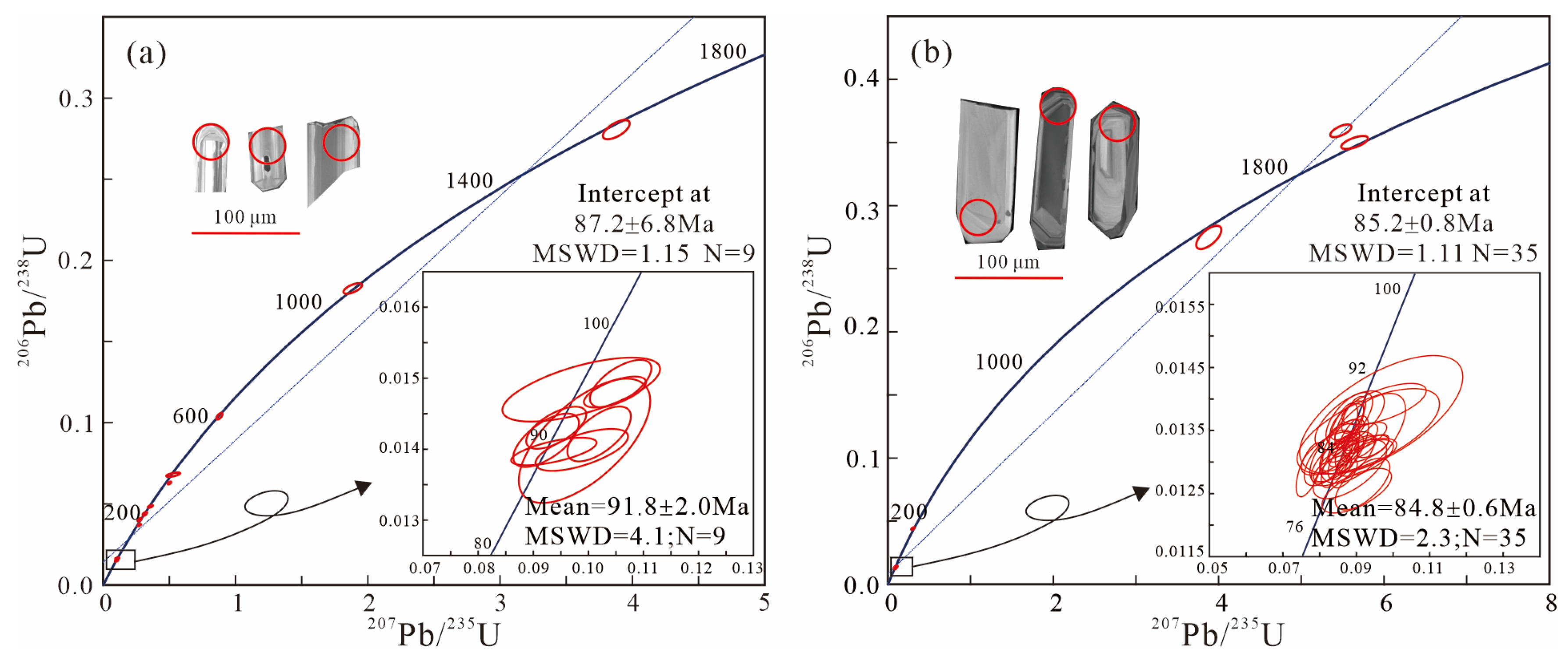
To constrain the emplacement and crystallization ages of the Nanshankou and Qiujidonggou mafic dyke swarms, LA-ICP-MS zircon U-Pb dating was carried out on Nanshankou sample 20NS01-1 and Qiujidonggou sample 20WQ02-1. The analytical results are presented in Figure 3 and the Supplementary Table S1. Zircon grains from both samples are generally colorless, transparent to pale yellow, and mostly subhedral to euhedral prismatic crystals with well-defined crystal faces. They are approximately 50–160 μm in size and commonly show length-to-width ratios of 1:1 to 3:1. Cathodoluminescence (CL) images reveal that most zircon grains display well-developed oscillatory zoning, indicating a typical magmatic origin [41]. Although such zoning records zircon growth under fluctuating magmatic conditions, it does not necessarily compromise U-Pb age determinations provided that analyses are restricted to single growth domains. Some grains also preserve inherited zircon cores or truncated internal domains, recognized by their distinct CL textures and ages significantly older than those of the main magmatic zircon population.
Analyses of 19 zircon grains from diabase porphyrite sample 20NS01-1 yield Th contents of 238–2785 ppm, U contents of 243–3471 ppm, and Th/U ratios of 0.30–1.33. Nine analyses define a weighted mean 206Pb/238U age of 91.8 ± 2.0 Ma (MSWD = 4.1, N = 9; Figure 3a). The lower intercept age of 87.2 ± 6.8 Ma (MSWD = 1.15) is consistent with the weighted mean age within analytical uncertainty. The remaining analyses yielded older inherited zircon ages. Therefore, the weighted mean 206Pb/238U age of 91.8 ± 2.0 Ma is interpreted as the crystallization age of the Nanshankou mafic dykes, indicating Late Cretaceous emplacement.
Analyses of 39 zircon grains from gabbro sample 20WQ02-1 yield Th contents of 133–4191 ppm, U contents of 253–5749 ppm, and Th/U ratios of 0.22–2.00. Excluding four inherited zircon analyses, the remaining 35 analyses define a weighted mean 206Pb/238U age of 84.8 ± 0.6 Ma (MSWD = 2.3, N = 35; Figure 3b). The lower intercept age of 85.2 ± 0.8 Ma (MSWD = 1.11, N = 35) is consistent with the weighted mean age within analytical uncertainty; therefore, the weighted mean 206Pb/238U age is interpreted as the crystallization age of the Qiujidonggou mafic dykes.

5.2. Whole-Rock Major and Trace Elements

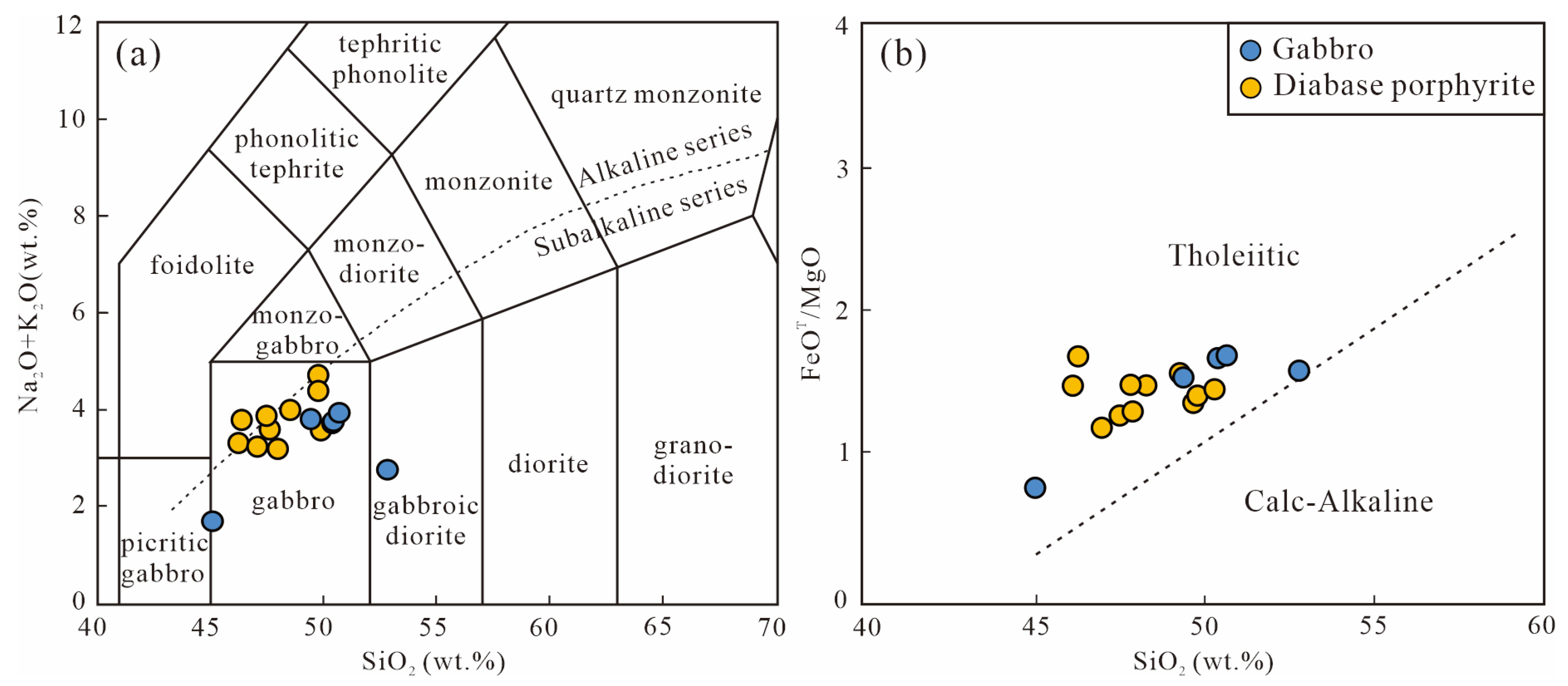
Whole-rock geochemical analyses were performed on 16 mafic dyke samples from the EKOB (Supplementary Table S2). The gabbro samples have SiO2 contents of 45.08–52.81 wt.% (avg. 49.69 wt.%), whereas the diabase porphyrites range from 46.22 to 50.35 wt.% (avg. 48.26 wt.%). Total alkali contents (Na2O + K2O) vary from 1.69 to 3.93 wt.% (avg. 3.19 wt.%) for the gabbros and from 3.21 to 4.73 wt.% (avg. 3.78 wt.%) for the diabase porphyrites. All samples plot within the subalkaline field on the TAS diagram (Figure 4a) and fall in the tholeiitic domain on the SiO2–FeOT/MgO diagram (Figure 4b), indicating affinity with the subalkaline tholeiitic series. The gabbros contain Al2O3 = 13.27–18.02 wt.% (avg. 16.96 wt.%) and TiO2 = 0.72–1.14 wt.% (avg. 0.98 wt.%), whereas the diabase porphyrites show slightly higher Al2O3 (16.53–19.27 wt.%, avg. 18.03 wt.%) and TiO2 (1.02–1.36 wt.%, avg. 1.13 wt.%). P2O5 contents are low in both rock types (0.06–0.18 wt.% in gabbros; 0.16–0.25 wt.% in diabase porphyrites). MgO contents vary widely in the gabbros (5.32–13.51 wt.%) but are more restricted in the diabase porphyrites (5.15–6.67 wt.%). Correspondingly, Mg# values range from 51.10 to 69.28 for the gabbros and from 51.26 to 59.65 for the diabase porphyrites.
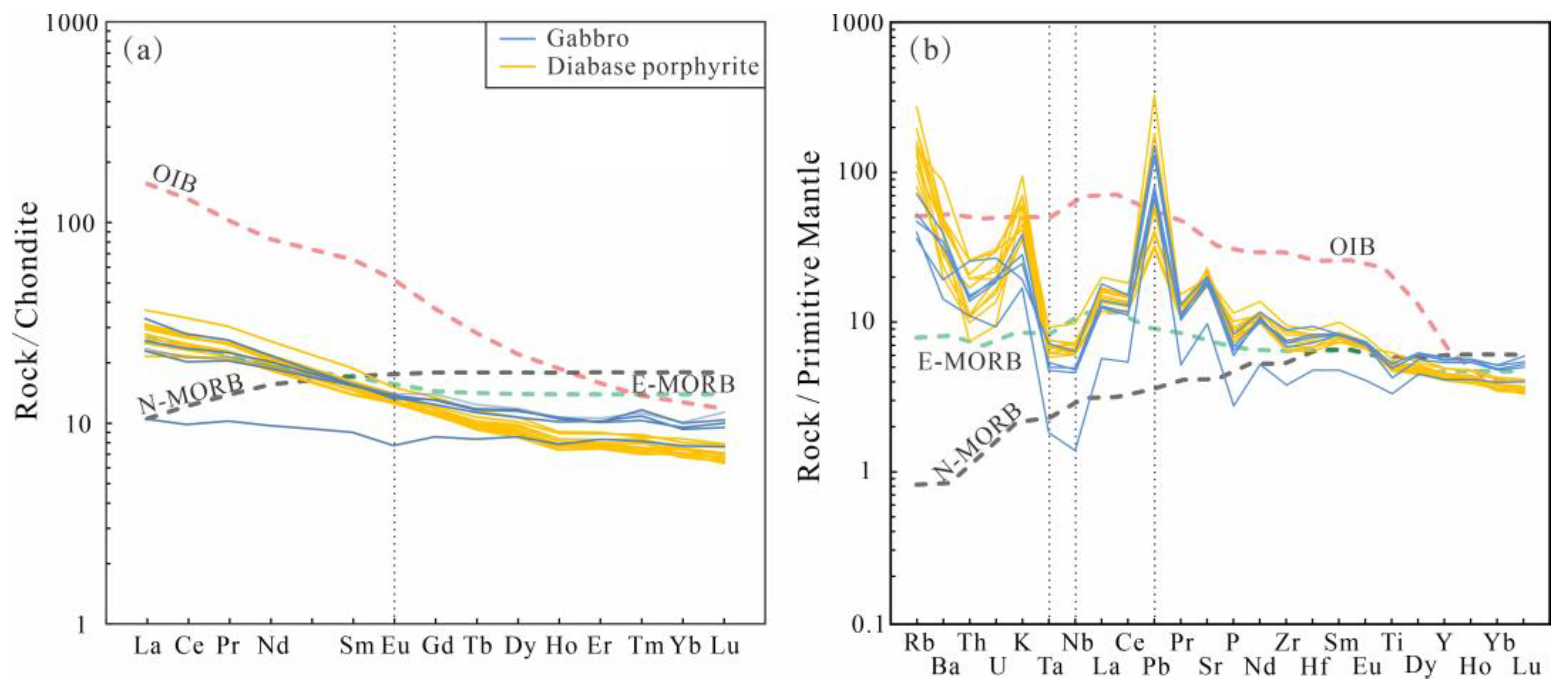
Chondrite-normalized REE patterns (Figure 5a) show moderate enrichment in LREEs and relative depletion in HREEs. Total REE contents range from 55.40 to 103.34 ppm in the gabbros and from 83.66 to 112.00 ppm in the diabase porphyrites. The gabbros exhibit ΣLREE/ΣHREE ratios of 2.10–4.17 and (La/Yb)N values of 1.45–3.77, whereas the diabase porphyrites show higher ratios (3.61–5.04 and 2.86–4.65, respectively), indicating moderate LREE–HREE fractionation. In contrast, (Gd/Yb)N ratios remain relatively constant (1.11–1.38 for gabbros; 1.45–1.63 for diabase porphyrites), suggesting limited fractionation among HREEs and relatively flat HREE patterns. With the exception of one gabbro sample showing a negative Eu anomaly, all other samples exhibit no significant Eu anomaly (δEu = 0.88–0.97 for gabbros; 0.90–1.02 for diabase porphyrites). Primitive mantle-normalized incompatible trace-element patterns (Figure 5b) show enrichment in LILEs (e.g., Rb and Pb) and negative Nb-Ta anomalies. The broadly similar REE and trace-element patterns of both lithologies indicate comparable source characteristics and evolutionary histories, consistent with a subalkaline tholeiitic affinity.

5.3. Whole-Rock Sr–Nd Isotopic and Zircon Lu–Hf Isotopic Compositions

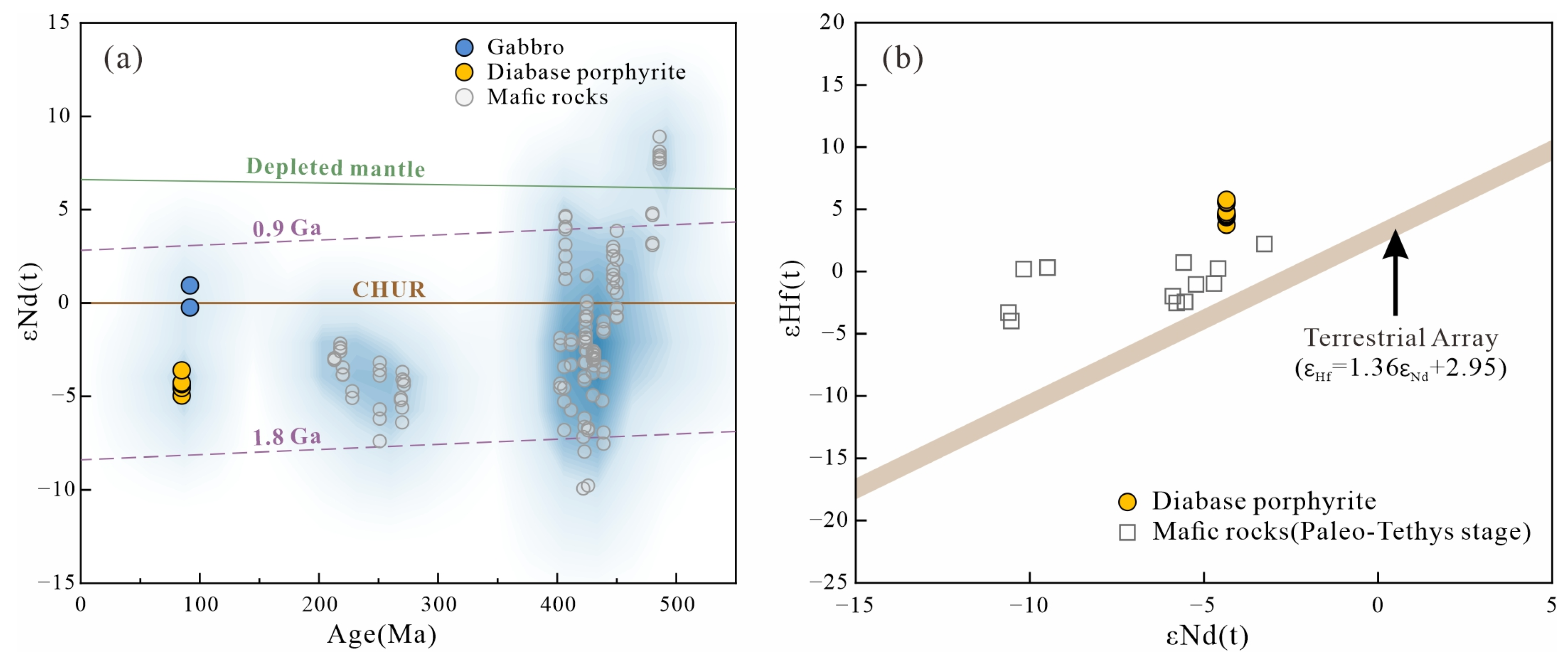
Whole-rock Sr–Nd isotopic data are provided in Supplementary Table S3 and plotted in Figure 6a. Initial isotopic ratios and εNd(t) values were calculated using the crystallization ages discussed in Section 5.1. The diabase porphyrites exhibit relatively high initial 87Sr/86Sr ratios (0.710910–0.712610) and low 143Nd/144Nd ratios (0.512356–0.512424), corresponding to εNd(t) values of −3.61 to −4.96 and TDM2 = 1187–1297 Ma. The gabbros show lower initial 87Sr/86Sr ratios (0.706727–0.707581) and higher 143Nd/144Nd ratios (0.512598–0.512677), with εNd(t) values ranging from −0.24 to +0.94, and TDM2 = 842–926 Ma.
Zircon Lu–Hf isotope results for the diabase porphyrites are listed in Supplementary Table S4 and shown in Figure 6b. Magmatic zircons from the diabase porphyrites yield 176Hf/177Hf ratios of 0.282612–0.282881 and positive εHf(t) values of 3.75–5.76, with corresponding two-stage model ages (TDM2) of 789–1392 Ma.

6. Discussion

6.1. Magmatic Processes

6.1.1. Crustal Contamination

Mafic magmas commonly undergo variable degrees of crustal contamination during ascent and emplacement, which can significantly modify their primary geochemical signatures. Such contamination typically leads to increased SiO2 and decreased MgO contents, accompanied by enrichment in large-ion lithophile elements (LILEs) and light rare earth elements (LREEs), and depletion in high field strength elements (HFSEs; e.g., Nb, Ta, and Ti) [45]. However, the studied Cretaceous mafic dykes do not exhibit these characteristics. The gabbros (SiO2 = 45.08–52.81 wt.%, MgO = 5.32–13.51 wt.%) and diabase porphyrites (SiO2 = 46.22–50.35 wt.%, MgO = 5.15–6.67 wt.%) display relatively low to moderate SiO2 and moderate to high MgO contents, suggesting an affinity with mantle-derived mafic magmas. This interpretation is further supported by their εNd(t) values of −3.61 to −4.96 and εHf(t) values of +3.75 to +5.76, which are broadly comparable to those of Triassic mantle-derived mafic rocks in the East Kunlun Orogen (Figure 6). These features suggest that the primary compositions of the magmas were largely preserved and that crustal contamination was limited.
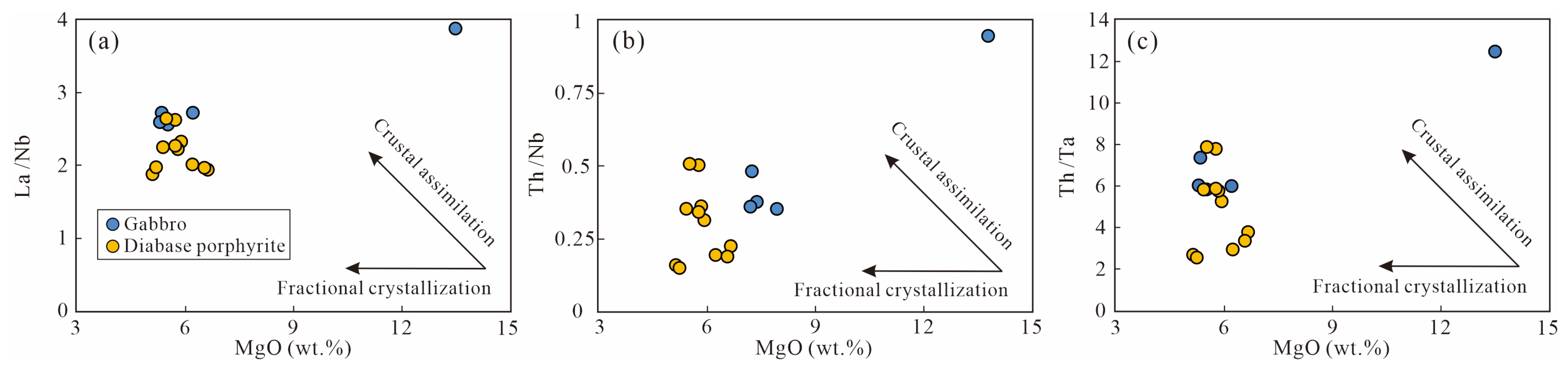
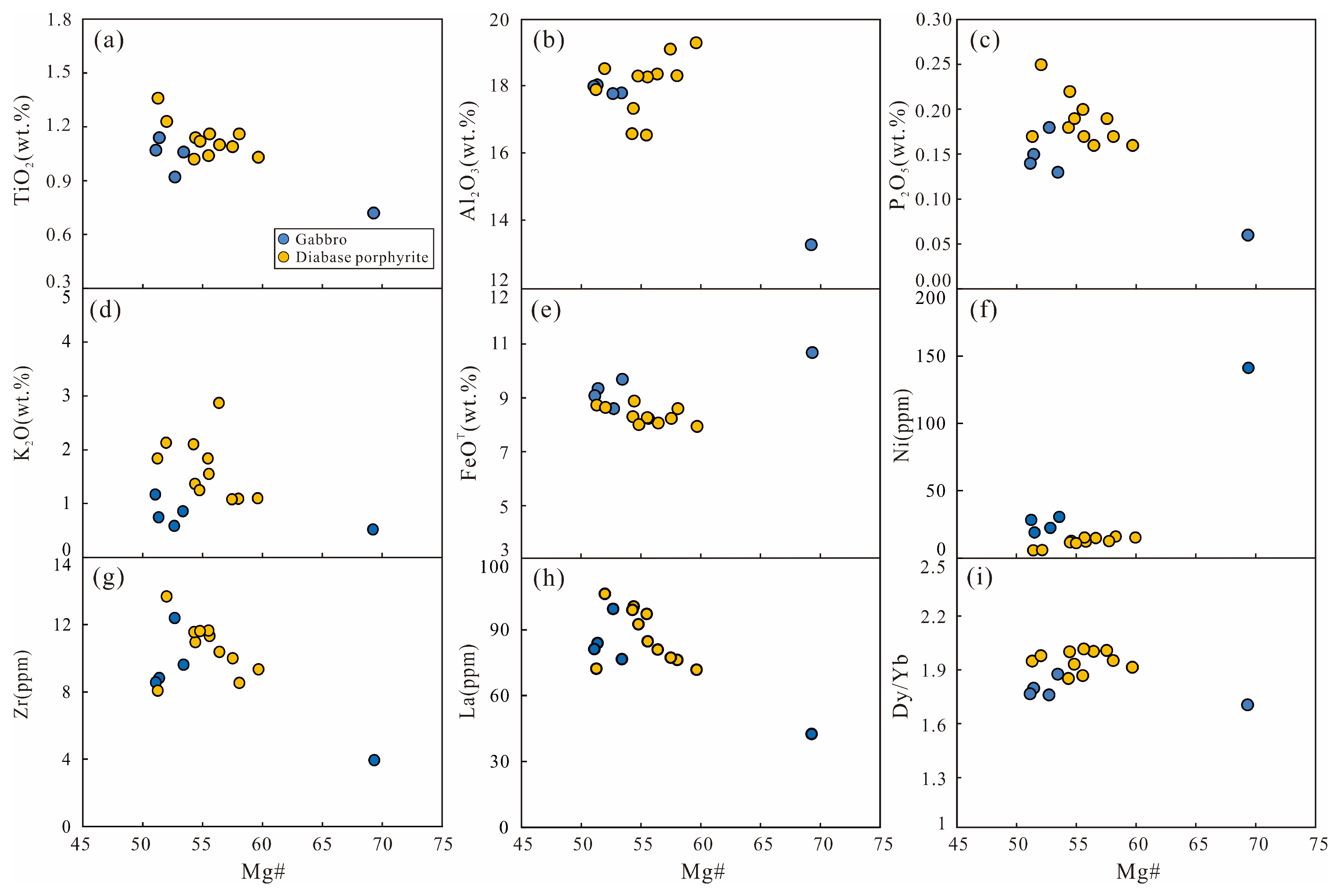
Incompatible element ratios provide further constraints. Ratios such as La/Nb, Th/Nb, and Th/Ta typically increase with decreasing MgO during crustal contamination. In contrast, the studied samples show only limited variation in these ratios, with no systematic increase as MgO decreases (Figure 7a–c). In some cases, slight decreases are observed, which are more consistent with fractional crystallization rather than crustal assimilation. In addition, the covariation of major and trace elements with Mg# generally indicates an evolutionary trend dominated by fractional crystallization, with no anomalous enrichment of crust-sensitive elements as Mg# varies (Figure 8), suggesting that no significant crustal contamination occurred.
High-field-strength element ratios further support a mantle-dominated origin. The samples display Nb/Ta (13.21–18.75) and Zr/Hf (28.80–40.06) ratios comparable to those of MORB (Nb/Ta ≈ 17.7; Zr/Hf ≈ 36.1) and distinct from average continental crust values (Nb/Ta ≈ 11; Zr/Hf ≈ 33) [42,43]. These lines of evidence indicate that crustal contamination played a negligible role in the evolution of the studied mafic magmas.

6.1.2. Fractional Crystallization

With significant crustal contamination ruled out, variations in major and trace elements of the mafic dykes can be used to evaluate their magmatic evolution. Primitive mantle-derived magmas are typically characterized by high Mg#, Cr, and Ni contents, which decrease during differentiation due to fractional crystallization of mafic minerals. The studied samples display relatively low Mg# values (51–69 for gabbros; 51–60 for diabase porphyrites), along with low Cr (4.5–702 ppm) and Ni (5.9–141 ppm) contents, significantly below those of primary mantle-derived magmas (Mg# > 65, Cr > 1000 ppm, Ni ≥ 250 ppm) [46,47]. These features indicate that the magmas are evolved rather than primary and have undergone substantial fractional crystallization, likely involving olivine and clinopyroxene.
Elemental correlations further constrain the crystallization sequence. Ni shows a broad positive correlation with Mg#, indicating progressive depletion of this compatible element during the crystallization of mafic minerals (Figure 8f). In contrast, La and Zr display overall negative correlations with Mg#, suggesting progressive enrichment of incompatible elements in the residual melt during magmatic evolution (Figure 8g,h). Together, these features are consistent with fractional crystallization dominated by mafic phases. By contrast, the lack of correlation between Mg# and Al2O3 (Figure 8b), together with weak negative Eu anomalies, suggests that plagioclase was not a major fractionating phase during the early stages. Similarly, the absence of a clear relationship between Mg# and Dy/Yb (Figure 8i) indicates that amphibole and garnet were not significant contributors to magma differentiation. In contrast, Mg# shows negative correlations with P2O5, TiO2, and FeOT (Figure 8a,c,e), indicating progressive enrichment of these components in the melt followed by late-stage crystallization of apatite and Fe–Ti oxides. Overall, the magmatic evolution of the Cretaceous mafic dykes in the EKOB was dominated by early fractional crystallization of olivine and clinopyroxene, followed by late-stage crystallization of apatite and Fe–Ti oxides, whereas plagioclase, amphibole, and garnet played only minor roles.

6.2. Nature of the Mantle Source and Metasomatic Processes

6.2.1. Nature of Mantle Source

The studied gabbro and diabase porphyrite samples exhibit enriched Sr–Nd isotopic compositions (Figure 6a), indicating that their parental magmas were not derived from a depleted asthenospheric mantle but instead originated from an enriched lithospheric mantle source. This interpretation is further supported by their high La/Nb (1.87–3.97) and La/Ta (31.77–52.41) ratios, which are significantly higher than those of typical depleted mantle-derived melts and consistent with lithospheric mantle-derived magmas (La/Nb > 1.5; La/Ta > 22) [43].
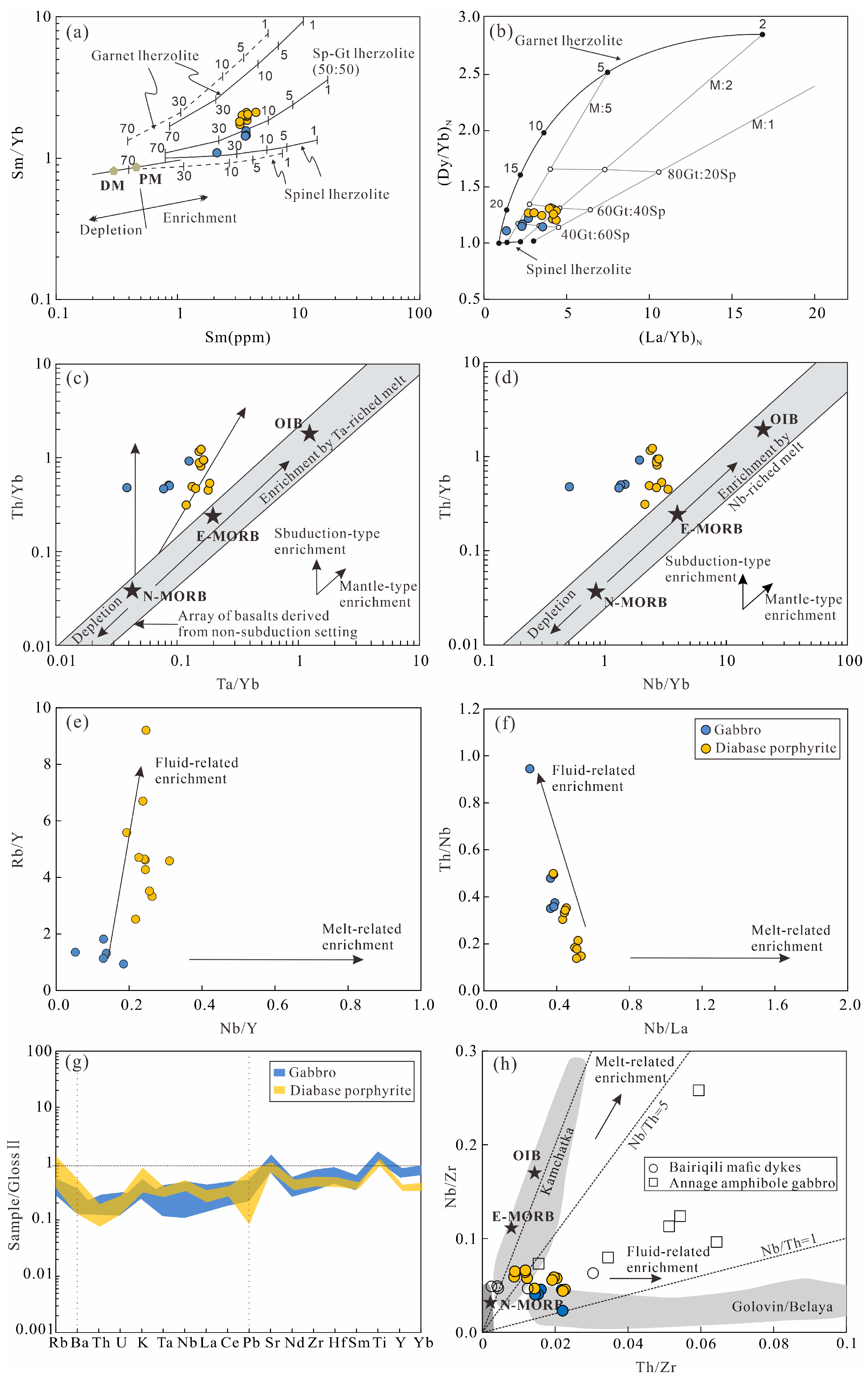
REE ratios are less affected by low-pressure fractional crystallization and can therefore provide useful first-order constraints on mantle source characteristics and partial melting conditions [48]. The low to moderate Ce/Y ratios (0.51–1.46), relative to melts generated from a strongly garnet-bearing deep mantle source, suggest that the studied rocks were unlikely to have been derived from a deeply seated garnet-dominated mantle source [49]. This is corroborated by non-modal batch melting models, in which the samples plot along melting trends of spinel–garnet lherzolite on Sm–Yb and (La/Yb)N–(Dy/Yb)N diagrams (Figure 9a,b). These results indicate that the magmas were generated by low-degree (ca. 1–5%) partial melting of lherzolite at depths corresponding to the spinel–garnet transition zone (~60–80 km). Combined geochemical and modeling constraints indicate that the parental magmas were derived from an enriched lithospheric mantle source and generated by low-degree decompression melting in the shallow upper mantle.

6.2.2. Metasomatic Enrichment of Mantle Source

Primitive mantle-normalized trace-element patterns show consistent enrichment in LILEs (e.g., Rb, K, Sr) and depletion in HFSEs (e.g., Nb and Ta), with pronounced negative Nb–Ta anomalies (Figure 5b). Positive Rb and K anomalies commonly imply the presence of K-rich hydrous phases, such as phlogopite or amphibole [50], in the mantle source. Moreover, the coexistence of negative Nb–Ta anomalies and elevated Th/Yb ratios is geochemically similar to that of arc basalts [51]. Nevertheless, previous studies suggest that the East Kunlun Orogen mainly underwent Proto-Tethyan and Paleo-Tethyan tectonic evolution, and no analogous subduction-related tectonic activity has been recognized in the Cretaceous [52,53]. In addition, elevated Th/Yb ratios and significant deviations from the MORB–E-MORB mantle array on Ta/Yb–Th/Yb and Nb/Yb–Th/Yb diagrams (Figure 9c,d) indicate that the mantle source was modified by subduction-related components rather than representing a simple depleted or enriched mantle endmember [54]. The nature of the metasomatic agent can be further constrained using element ratios sensitive to fluid versus melt contributions. The studied samples display relatively large variations in Rb/Y and Th/Nb, but limited variation in Nb/La and Nb/Y, and plot predominantly within the fluid-related metasomatism field on Rb/Y–Nb/Y and Th/Nb–Nb/La diagrams (Figure 9e,f). This suggests that source enrichment was dominated by slab-derived fluids rather than slab melts.
Figure 9. Source and metasomatism discrimination diagrams for the East Kunlun mafic dykes. (a) Sm/Yb versus Sm and (b) (Dy/Yb)N versus (La/Yb)N; N denotes chondrite-normalized values. Mantle reference arrays are defined by depleted MORB mantle (DM; [49]) and primitive mantle (PM; [43]). Non-modal melting curves for spinel lherzolite (Ol0.53 + Opx0.27 + Cpx0.17 + Sp0.03) and garnet lherzolite (Ol0.60 + Opx0.20 + Cpx0.10 + Gt0.10) use parameters from [48]. Ol = olivine; Opx = orthopyroxene; Cpx = clinopyroxene; Sp = spinel; Gt = garnet. Dashed and solid curves represent melting of DM and PM sources, respectively, and numbers along the curves indicate melt fraction. M:1, M:2, and M:5 denote mixing between 1%, 2%, and 5% melts of garnet and spinel peridotite. (c) Th/Yb versus Ta/Yb and (d) Th/Yb versus Nb/Yb; N-MORB, E-MORB, and OIB values are from [43], and melt- or fluid-enrichment vectors are from [50]. (e) Rb/Y versus Nb/Y and (f) Th/Nb versus Nb/La diagrams. (g) GLOSS-II-normalized incompatible-element patterns for the Qiujidonggou gabbro and Nanshankou diabase porphyrites [55]. (h) Th/Zr versus Nb/Zr diagram, modified after [56], and the mafic rock data are from [57,58].
Geosciences 16 00201 g009
Th/Nd and Sr/Th ratios provide additional constraints. The samples are characterized by low Th/Nd (0.05–0.15) and high Sr/Th (171–583), which contrast with the high Th/Nd and low Sr/Th signatures of GLOSS-II sediments but resemble fluids released from dehydrated altered oceanic crust (AOC) [45,59]. The two sample groups also display broadly similar GLOSS II-normalized trace-element patterns, with most elements plotting below GLOSS II and no systematic enrichment in sediment-related components such as Th and U (Figure 9g), arguing against a dominant contribution from sediment-derived melts. In terms of fluid-related trace-element systematics, their compositional trends are broadly comparable to those of the Golovin and Belaya magmatic rocks from the Kamchatka arc (Figure 9h), as well as to Early–Middle Triassic mafic rocks in East Kunlun that were interpreted to have been derived from a mantle source metasomatized by subduction-related fluids [57,58]. Together, these features suggest that mantle enrichment in the study area was dominated by fluid metasomatism, whereas melt metasomatism was limited.
Magmatic zircons from the Nanshankou diabase porphyrite yield εHf(t) values of +3.75 to +5.76, indicating an isotopically depleted source, which is decoupled from their enriched Sr-Nd isotopes (Figure 6b). This Nd–Hf decoupling is commonly attributed to the differential mobility of Nd and Hf during fluid-mediated metasomatism, as Nd is more readily mobilized in aqueous fluids, whereas Hf is largely retained in accessory phases such as zircon [60,61]. Similar enriched Nd isotopic signatures and Nd–Hf decoupling are widely observed in Paleo-Tethyan mafic rocks of the East Kunlun region (Figure 6b), suggesting that this isotopic decoupling was inherited from a lithospheric mantle source modified by Permian-Triassic Paleo-Tethyan subduction processes, rather than generated during Late Cretaceous magmatism. The studied Cretaceous mafic dykes in the EKOB were derived from an enriched lithospheric mantle source that had been metasomatized predominantly by fluids released from dehydrated altered oceanic crust during Paleo-Tethyan subduction, with negligible contribution from sediment-derived melts.

6.3. Magmatic-Tectonic Setting and Geological Implications

6.3.1. Tectonic Setting of Cretaceous Magmatism in the East Kunlun

Cretaceous magmatic records in the EKOB are volumetrically limited and discontinuously exposed, including the studied Late Cretaceous (91.8–84.8 Ma) mafic dyke swarms, as well as coeval intermediate–felsic intrusions and minor diabases reported previously (ca. 102–80 Ma) [17,18]. Collectively, these records demonstrate that the EKOB was not magmatically quiescent during the Cretaceous, but instead experienced episodic intraplate magmatism.
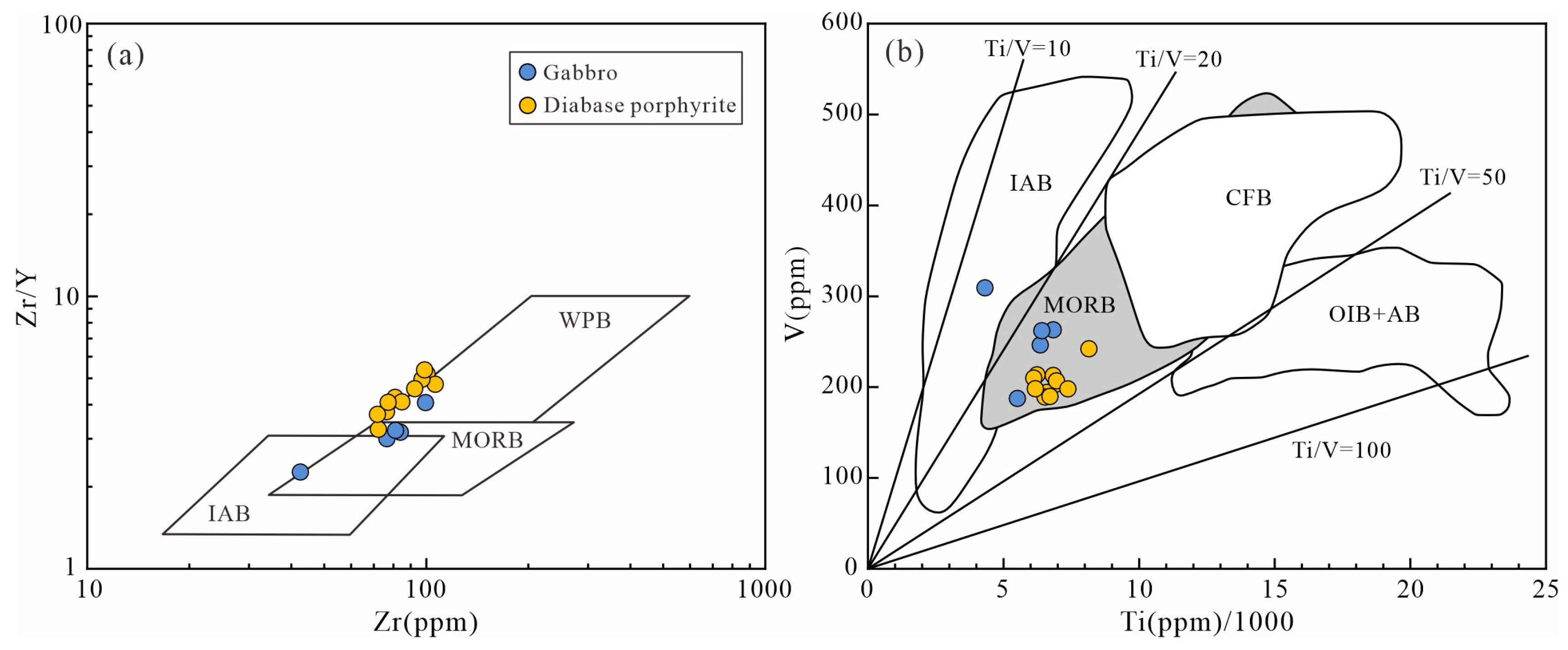
Geochemically, the studied mafic dykes plot within the transitional field between MORB and within-plate basalts and are clearly distinct from arc-related magmas (Figure 10a,b). Their E-MORB-like REE patterns, relatively high Nb contents (12.4–18.3 ppm), and elevated Nb/U ratios (31–39) indicate an intraplate extensional setting. Meanwhile, the presence of negative Nb–Ta anomalies suggests that their mantle source retained a subduction-related signature, rather than representing a newly formed depleted asthenospheric mantle. This geochemical inheritance is consistent with the tectonic evolution of the EKOB. Following the closure of the Paleo-Tethys Ocean in the Late Triassic, the EKOB entered a post-collisional intracontinental stage [9,10], during which subduction-modified lithospheric mantle was preserved. Comparable Early Cretaceous mafic dykes (ca. 120–102 Ma) in the Qimantage area of the northern EKOB also display intraplate geochemical affinities, suggesting that extension-related magmatism was regionally developed along the northern Tibetan Plateau during the Cretaceous.

6.3.2. Geodynamic Mechanism: Lithospheric Reactivation

The Cretaceous tectonic framework of the Tibetan Plateau was dominated by closure of the Bangong–Nujiang Ocean and subsequent collision between the Lhasa and Qiangtang terranes, which resulted in crustal thickening and uplift in central–southern Tibet [3,5]. The associated far-field compressional stresses were transmitted northward into the EKOB and adjacent regions, triggering widespread lithospheric reactivation. Multiple lines of evidence support this interpretation, including Cretaceous fault reactivation along the South Kunlun and Altyn Tagh fault systems, 40Ar/39Ar ages of 106–110 Ma from cataclasites, and regional thermochronological data indicating rapid exhumation during 120–80 Ma [13,62,63]. These structures likely served as lithosphere-scale conduits for magma ascent.
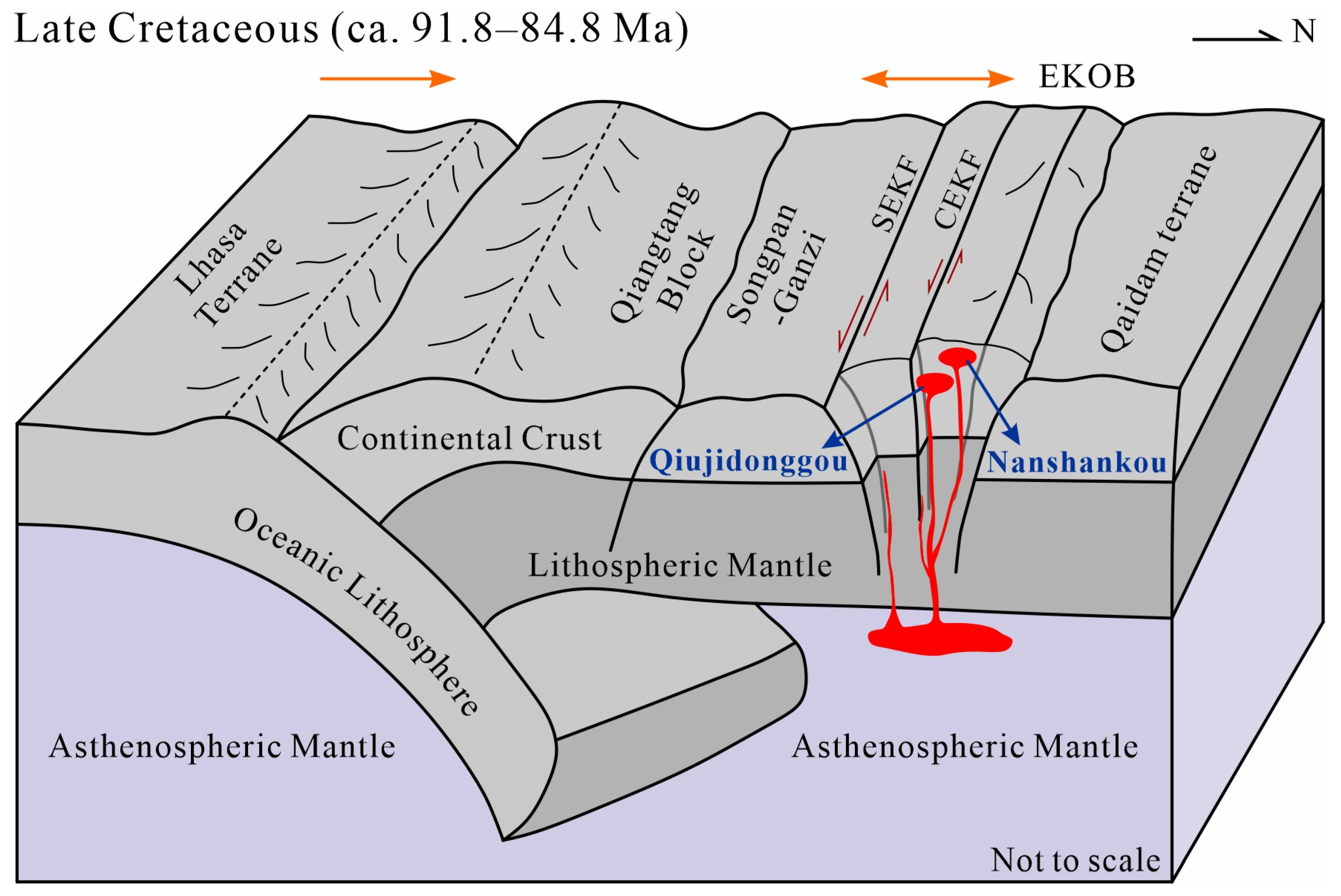
Geochemical and isotopic data further constrain the magma generation process. The studied dykes exhibit enriched Sr–Nd isotopic compositions and high La/Nb and La/Ta ratios, indicating derivation from a heterogeneous, subduction-modified lithospheric mantle. Partial melting models suggest generation at depths of ~60–80 km within the spinel–garnet transition zone through low-degree (1–5%) decompression melting. These features argue against large-scale asthenospheric upwelling and instead support localized melting of enriched lithospheric mantle triggered by tectono-thermal perturbations. The EKOB is bounded to the north by the thick and rigid lithosphere of the Qaidam block, whereas the orogenic lithosphere beneath the EKOB is relatively thinner and tectonically weaker [64,65]. Under far-field compression related to the Lhasa–Qiangtang collision, stress was transmitted northward into the EKOB and focused along inherited lithospheric-scale discontinuities, especially the South Kunlun–A’nyemaqen fault system [66]. At this lithospheric step, the rigid Qaidam lithospheric keel would have acted as a barrier to mantle flow and favored small-scale convective disturbance and localized thermal perturbation beneath the southern EKOB, analogous to edge-driven convection models proposed for lithospheric-thickness contrasts elsewhere on the northern Tibetan Plateau. Because the lithospheric mantle beneath the EKOB had already been metasomatized by Paleo-Tethyan slab-derived fluids or melts, it was likely fertile and susceptible to low-degree partial melting once subjected to such localized thermal perturbation. We propose that far-field compression associated with the Lhasa–Qiangtang collision induced reactivation of pre-existing deep lithospheric faults in the EKOB. This reactivation generated localized extension and thermal perturbation, leading to decompression melting of a metasomatized lithospheric mantle source and emplacement of mafic dyke swarms along fault-controlled pathways (Figure 11).

6.3.3. Implications for Cretaceous Uplift of Northern Tibet

The Late Cretaceous mafic magmatism in the EKOB provides important constraints on the deep geodynamic processes responsible for intracontinental deformation and early surface uplift in northern Tibet. The occurrence of intraplate mafic dyke swarms indicates that lithospheric extension and mantle melting were active during the Cretaceous, contradicting the traditional view of tectonic quiescence in northern Tibet during this period. The close association among fault reactivation, mantle melting, and magma ascent suggests that lithospheric-scale structures played a key role in coupling deep mantle processes with crustal deformation.
Thermal perturbation associated with mantle melting and magma ascent may have contributed to lithospheric thinning, density reduction, and isostatic uplift. Such processes are consistent with regional low-temperature thermochronological evidence for rapid exhumation during the Cretaceous [12,14,15,63], which likely represents the shallow expression of deeper lithospheric reactivation. The Late Cretaceous mafic dyke swarms in the EKOB not only record localized intraplate magmatism but also provide key evidence linking lithospheric reactivation, mantle melting, and early topographic growth along the northern margin of the Tibetan Plateau.

7. Conclusions

This study integrates field geological observations, petrographic characterization, zircon U–Pb geochronology, whole-rock major- and trace-element geochemistry, and whole-rock Sr–Nd and zircon Lu–Hf isotopic analyses to constrain the emplacement ages, petrogenesis, mantle source characteristics, and geodynamic significance of the Late Cretaceous mafic dyke swarms in the East Kunlun Orogen. By combining petrological and geochemical evidence with the regional tectonic framework, this work provides new insights into Late Cretaceous lithospheric reactivation, localized mantle melting, and the early surface uplift of northern Tibet.
  • Geochronology demonstrates that the Nanshankou and Qiujidonggou mafic dyke swarms were emplaced at ca. 91.8–84.8 Ma, providing clear evidence for a previously underrecognized episode of Late Cretaceous mafic magmatism in the East Kunlun Orogen, northern Tibet.
  • The mafic dykes belong to the subalkaline tholeiitic series and display systematic enrichment in LILEs and LREEs, depletion in HFSEs, and decoupled Nd–Hf isotopic compositions, indicating derivation from a subduction-modified lithospheric mantle rather than a depleted asthenospheric source.
  • The parental magmas were generated by low-degree (1–5%) partial melting of spinel–garnet transition zone lherzolite (~60–80 km). Their geochemical and isotopic signatures indicate a mantle source metasomatized predominantly by fluids derived from dehydrated altered oceanic crust during Paleo-Tethyan subduction.
  • The Late Cretaceous magmatism formed in an intraplate extensional setting driven by far-field stresses from the Lhasa–Qiangtang collision, which reactivated lithospheric faults and triggered localized mantle melting. This establishes a direct link between lithospheric reactivation, mantle melting, and early uplift in northern Tibet.

Supplementary Materials

The following supporting information can be downloaded at: https://www.mdpi.com/article/10.3390/geosciences16050201/s1, Table S1: LA–ICP–MS zircon U–Pb isotope and trace-element data; Table S2: whole-rock major- and trace-element compositions; Table S3: whole-rock Sr–Nd isotope data; Table S4: zircon Lu–Hf isotope data; and Table S5: comparative whole-rock Sr–Nd isotope compositions for the multi-stage evolution of the EKOB, northern Tibetan Plateau. References [67,68,69] are cited in Table S4, References [70,71,72,73,74,75,76,77,78,79,80,81,82,83,84,85,86,87,88,89] are cited in Table S5.

Author Contributions

Conceptualization, D.C. and F.X.; methodology, F.X.; software, H.W. (Huajun Wen); validation, W.W. and Y.Z.; formal analysis, D.C. and H.W. (Huajun Wen); investigation, D.C., H.W. (Hao Wu) and F.X.; resources, F.X.; data curation, H.W. (Hao Wu); writing—original draft preparation, D.C., W.W., D.J. and H.W. (Hao Wu); writing—review and editing, H.W. (Hao Wu), W.W. and F.X.; visualization, D.J., X.S. and Y.Z.; supervision, F.X.; project administration, F.X.; funding acquisition, F.X. All authors have read and agreed to the published version of the manuscript.

Funding

This research is jointly supported by grants from the Deep Earth Probe and Mineral Resources Exploration—National Science and Technology Major Project (No. 2024ZD1001802-4), the National Natural Science Foundation of China (No. 42572066), the Natural Science Foundation of Sichuan Province (No. 2024NSFSC1991), and the Science Popularization Works Creation Project of the Science and Technology Department of Sichuan Province (No. 2026JDKP0084).

Data Availability Statement

Data will be available upon request.

Acknowledgments

The authors used AI to improve the clarity, grammar, and readability of the manuscript during the revision process. The AI tool was used solely for language polishing and editorial refinement. All scientific interpretations, data analyses, and conclusions were developed, verified, and approved by the authors, who take full responsibility for the content of the manuscript.

Conflicts of Interest

The authors declare no conflicts of interest.

References

  1. Zhang, K.J. Cretaceous palaeogeography of Tibet and adjacent areas (China): Tectonic implications. Cretac. Res. 2000, 21, 23–33. [Google Scholar] [CrossRef] [Scilit]
  2. Wang, C.S.; Zhao, X.X.; Liu, Z.F.; Lippert, P.C.; Graham, S.A.; Coe, R.S.; Yi, H.Y.; Zhu, L.D.; Liu, S.; Li, Y.L. Constraints on the early uplift history of the Tibetan Plateau. Proc. Natl. Acad. Sci. USA 2008, 105, 4987–4992. [Google Scholar] [CrossRef] [Scilit] [PubMed]
  3. Ding, L.; Kapp, P.; Cai, F.L.; Garzione, C.N.; Xiong, Z.Y.; Wang, H.Q.; Wang, C.S. Timing and mechanisms of Tibetan Plateau uplift. Nat. Rev. Earth Environ. 2022, 3, 652–667. [Google Scholar] [CrossRef] [Scilit]
  4. Han, M.; Li, G.; Heimhofer, U.; Mutterlose, J. Late Albian–early Turonian calcareous nannofossils from southern Tibet—Implications for preservation, biostratigraphy and palaeoecology. Cretac. Res. 2025, 171, 106101. [Google Scholar] [CrossRef] [Scilit]
  5. Kapp, P.; DeCelles, P.G.; Gehrels, G.E.; Heizler, M.; Ding, L. Geological records of the Lhasa-Qiangtang and Indo-Asian collisions in the Nima area of central Tibet. Geol. Soc. Am. Bull. 2007, 119, 917–932. [Google Scholar] [CrossRef] [Scilit]
  6. Lai, W.; Hu, X.; Garzanti, E.; Xu, Y.; Ma, A.; Li, W. Early Cretaceous sedimentary evolution of the northern Lhasa terrane and the timing of initial Lhasa-Qiangtang collision. Gondwana Res. 2019, 73, 136–152. [Google Scholar] [CrossRef] [Scilit]
  7. Liu, X.H.; Liu, Y.S.; Rao, Y.; Guo, Y.; Guo, X.; Huang, X.; Li, H.L.; Ding, L.; Gao, R. Cretaceous–Cenozoic tectonic evolution of the central Qiangtang terrane and implications for the initial growth of the Tibetan Plateau. Tectonophysics 2026, 918, 230986. [Google Scholar] [CrossRef] [Scilit]
  8. Wu, L.; Xiao, A.C.; Wang, L.; Shen, Z.J.; Zhou, S.; Chen, Y.L.; Wang, L.H.; Liu, D.G.; Guan, J.P. Late Jurassic–Early Cretaceous Northern Qaidam Basin, NW China: Implications for the earliest Cretaceous intracontinental tectonism. Cretac. Res. 2011, 32, 552–564. [Google Scholar] [CrossRef] [Scilit]
  9. Mo, X.X.; Luo, Z.H.; Deng, J.F.; Yu, X.H.; Liu, C.D.; Chen, H.W.; Yuan, W.M.; Liu, Y.H. Granitoids and crustal growth in the East-Kunlun orogenic belt. Geol. J. China Univ. 2007, 13, 403–414. (In Chinese) [Google Scholar] [CrossRef]
  10. Xiong, F.H.; Ma, C.Q.; Zhang, J.Y.; Liu, B. Reworking of old continental lithosphere: An important crustal evolution mechanism in orogenic belts, as evidenced by Triassic I-type granitoids in the East Kunlun orogen, northern Tibetan Plateau. J. Geol. Soc. 2014, 171, 847–863. [Google Scholar] [CrossRef] [Scilit]
  11. Xiong, F.H.; Yan, D.D.; Ma, C.Q.; Hou, M.C.; Wang, M.; Huang, H.; Wang, W. Geochemical and petrological diversity of a transcrustal magmatic system driven by mushy magma mixing: Insights from the Triassic dike swarms in East Kunlun orogen, northern Tibetan Plateau. Geol. Soc. Am. Bull. 2024, 136, 5058–5074. [Google Scholar] [CrossRef] [Scilit]
  12. Mock, C.; Arnaud, N.O.; Cantagrel, J.M. An early unroofing in northeastern Tibet? Constraints from 40Ar/39Ar thermochronology on granitoids from the eastern Kunlun range (Qinghai, NW China). Earth Planet. Sci. Lett. 1999, 171, 107–122. [Google Scholar] [CrossRef] [Scilit]
  13. Arnaud, N.; Tapponnier, P.; Roger, F.; Brunel, M.; Schärer, U.; Wen, C.; Xu, Z.Q. Evidence for Mesozoic shear along the western Kunlun and Altyn-Tagh fault, northern Tibet (China). J. Geophys. Res. Solid Earth 2003, 108, 2053. [Google Scholar] [CrossRef] [Scilit]
  14. Yuan, W.M.; Zhang, A.P.; Tian, C.C.; Feng, X.; Hao, N.; Feng, Y.; Chen, X. The tectonic events in Halongxiuma district, East Kunlun Mountains, Qinghai-Tibet Plateau: Evidence from fission track thermochronology. Radiat. Meas. 2019, 123, 63–68. [Google Scholar] [CrossRef] [Scilit]
  15. Staisch, L.M.; Niemi, N.A.; Clark, M.K.; Chang, H. The Cenozoic evolution of crustal shortening and left-lateral shear in the central East Kunlun Shan: Implications for the uplift history of the Tibetan Plateau. Tectonics 2020, 39, e2020TC006065. [Google Scholar] [CrossRef] [Scilit]
  16. Li, L.; Chang, H.; Ding, R.; Qiang, X.K.; Sorrel, P. Cretaceous-Cenozoic cooling history of central-northern Tibet: Insights from the fission track thermochronology of detrital apatite from sediments of the Tuotuohe Basin. J. Asian Earth Sci. 2024, 272, 106256. [Google Scholar] [CrossRef] [Scilit]
  17. Zhao, H.J.; Bai, Y.S.; Liu, C.E.; Jia, X.L.; Zhang, H.L.; Chen, J. Discovery of Cretaceous basic dykes in Qimantag region of East Kunlun and its geological significance. Northwest. Geol. 2018, 51, 1–8. (In Chinese) [Google Scholar]
  18. Chu, Z.Q.; Zhou, H.; Wang, M.; Zhou, J.; Xiong, F.H. Petrogenesis and geodynamic implications of Cretaceous Nb-enriched mafic dykes in the East Kunlun Orogen, northern Tibet Plateau: Constraints from geochronology, geochemistry and Sr-Nd isotopes. Minerals 2024, 14, 89. [Google Scholar] [CrossRef] [Scilit]
  19. Tarney, J.; Jones, C.E. Trace element geochemistry of orogenic igneous rocks and crustal growth models. J. Geol. Soc. 1994, 151, 855–868. [Google Scholar] [CrossRef] [Scilit]
  20. Martinez-Poza, A.I.; Druguet, E. Structure and tectonic setting of the SE Sardinia mafic dyke swarm. Insights for the stress state during magma emplacement in the upper crust. J. Geodyn. 2016, 101, 170–185. [Google Scholar] [CrossRef] [Scilit]
  21. Xiong, F.H.; Ma, C.Q.; Chen, B.; Ducea, M.N.; Hou, M.C.; Ni, S.J. Intermediate-mafic dikes in the East Kunlun Orogen, northern Tibetan Plateau: A window into paleo-arc magma feeding system. Lithos 2019, 340–341, 152–165. [Google Scholar] [CrossRef] [Scilit]
  22. Hoek, J.D.; Seitz, H.M. Continental mafic dyke swarms as tectonic indicators: An example from the Vestfold Hills, East Antarctica. Precambrian Res. 1995, 75, 121–139. [Google Scholar] [CrossRef]
  23. Wang, Q.; Wyman, D.A.; Li, Z.X.; Sun, W.D.; Chung, S.L.; Vasconcelos, P.M.; Zhang, Q.; Dong, H.; Yu, Y.; Pearson, N. Eocene north-south trending dikes in central Tibet: New constraints on the timing of east-west extension with implications for early plateau uplift? Earth Planet. Sci. Lett. 2010, 298, 205–216. [Google Scholar] [CrossRef] [Scilit]
  24. Song, P.P.; Ding, L.; Zhang, L.Y.; Wu, C.; Duan, X.X.; Yue, Y.H.; Xie, J. Defining the main Paleo-Tethys suture in Tibet: First Permian paleomagnetic insights from the Eastern Kunlun Range. Earth Planet. Sci. Lett. 2026, 681, 119925. [Google Scholar] [CrossRef] [Scilit]
  25. Bozhko, N.A. The evolution of the mobile zones of Gondwana and Laurasia in the Late Precambrian. Tectonophysics 1986, 126, 125–135. [Google Scholar] [CrossRef] [Scilit]
  26. Henderson, R.A.; Foley, E.K.; Roberts, E.M. Jurassic tectonics of northeastern Gondwana: Evidence from the detrital zircon record of the Nambour Basin. J. Geol. Soc. 2022, 179, jgs2021-169. [Google Scholar] [CrossRef] [Scilit]
  27. Vrontzos, I.; Katrivanos, E.; Lazos, I.; Papadopoulou, L.; Kilias, A. Strain analysis and kinematics of deformation of the tectonic nappe pile in Olympos-Ossa mountainous area: Implications for the exhumation history of the HP/LT Ampelakia Unit and the Olympos-Ossa tectonic window (eastern Thessaly, central Greece). Geosciences 2024, 14, 179. [Google Scholar] [CrossRef] [Scilit]
  28. Yan, D.D.; Zhou, H.; Li, C.X.; Zhang, X.M.; Ma, C.Q.; Hou, M.C.; Huang, H.; Wang, W.; Xiong, F.H. Petrogenesis of Late Triassic adakitic plutons in the East Kunlun Orogen, northern Tibet: Geodynamic implications for the Paleo-Tethyan orogeny and crustal evolution. J. Asian Earth Sci. 2024, 268, 106165. [Google Scholar] [CrossRef] [Scilit]
  29. Xin, W.; Sun, F.Y.; Li, L.; Yan, J.M.; Zhang, Y.T.; Wang, Y.C.; Shen, T.S.; Yang, Y.J. The Wulonggou metaluminous A2-type granites in the Eastern Kunlun Orogenic Belt, NW China: Rejuvenation of subduction-related felsic crust and implications for post-collision extension. Lithos 2018, 312–313, 108–127. [Google Scholar] [CrossRef] [Scilit]
  30. Hao, M.N.; Xiong, F.H.; Zhao, H.; Gong, T.T. Petrogenesis of Devonian granites in the Qiujidonggou area, East Kunlun and its implications for the Proto-Tethys orogeny. J. Mineral. Petrol. 2021, 41, 59–70. (In Chinese) [Google Scholar] [CrossRef]
  31. Yan, D.D.; Xiong, F.H.; Brenna, M.; Ma, C.Q.; Hou, M.C.; Zou, H.; Huang, H.; Wang, W. Secrets of crust-mantle interaction in continental arc: Accessory minerals tell the tale in East Kunlun orogen, northern Tibet Plateau. Lithos 2026, 524–525, 108410. [Google Scholar] [CrossRef] [Scilit]
  32. Hu, Z.C.; Zhang, W.; Liu, Y.S.; Gao, S.; Li, M.; Zong, K.Q.; Chen, H.H.; Hu, S.H. “Wave” signal-smoothing and mercury-removing device for laser ablation quadrupole and multiple collector ICPMS analysis: Application to lead isotope analysis. Anal. Chem. 2015, 87, 1152–1157. [Google Scholar] [CrossRef] [Scilit]
  33. Liu, Y.S.; Hu, Z.C.; Gao, S.; Günther, D.; Xu, J.; Gao, C.G.; Chen, H.H. In situ analysis of major and trace elements of anhydrous minerals by LA-ICP-MS without applying an internal standard. Chem. Geol. 2008, 257, 34–43. [Google Scholar] [CrossRef] [Scilit]
  34. Liu, Y.S.; Gao, S.; Hu, Z.C.; Gao, C.G.; Zong, K.Q.; Wang, D.B. Continental and oceanic crust recycling-induced melt-peridotite interactions in the Trans-North China Orogen: U-Pb dating, Hf isotopes and trace elements in zircons of mantle xenoliths. J. Petrol. 2010, 51, 537–571. [Google Scholar] [CrossRef] [Scilit]
  35. Ludwig, K.R. ISOPLOT 3.00: A Geochronological Toolkit for Microsoft Excel; Berkeley Geochronology Center Special Publication No. 4; Berkeley Geochronology Center: Berkeley, CA, USA, 2003; 39p.
  36. Ma, Q.; Zheng, J.P.; Griffin, W.L.; Zhang, M.; Tang, H.Y.; Su, Y.P.; Ping, X.Q. Triassic “adakitic” rocks in an extensional setting (North China): Melts from the cratonic lower crust. Lithos 2012, 149, 159–173. [Google Scholar] [CrossRef] [Scilit]
  37. Lin, J.; Liu, Y.S.; Yang, Y.H.; Hu, Z.C. Calibration and correction of LA–ICP–MS and LA–MC–ICP–MS analyses for element contents and isotopic ratios. Solid Earth Sci. 2016, 1, 5–27. [Google Scholar] [CrossRef] [Scilit]
  38. Hu, Z.; Liu, Y.; Gao, S.; Xiao, S.; Zhao, L.; Günther, D.; Li, M.; Zhang, W.; Zong, K. A “wire” signal smoothing device for laser ablation inductively coupled plasma mass spectrometry analysis. Spectrochim. Acta Part B 2012, 78, 51–57. [Google Scholar] [CrossRef] [Scilit]
  39. Zhang, W.; Hu, Z.; Liu, Y. Iso-Compass: New freeware software for isotopic data reduction of LA-MC-ICP-MS. J. Anal. At. Spectrom. 2020, 35, 1087–1096. [Google Scholar] [CrossRef] [Scilit]
  40. Luo, T.; Li, Q.; Ling, X.; Li, Y.; Yang, C.; Wang, H.; Xia, X.; Zhang, S.; Xu, L.; Liu, X.; et al. Jilin zircon—A new natural reference material for microbeam U–Pb geochronology and Hf–O isotopic analysis. J. Anal. At. Spectrom. 2021, 36, 2216–2226. [Google Scholar] [CrossRef] [Scilit]
  41. Wu, Y.B.; Zheng, Y.F. Genesis of zircon and its constraints on interpretation of U-Pb age. Chin. Sci. Bull. 2004, 49, 1589–1604. (In Chinese) [Google Scholar] [CrossRef] [Scilit]
  42. Taylor, S.R.; McLennan, S.M. The Continental Crust: Its Composition and Evolution; Blackwell Scientific Publications: Oxford, UK, 1985; 312p. [Google Scholar]
  43. Sun, S.S.; McDonough, W.F. Chemical and isotopic systematics of oceanic basalts: Implications for mantle composition and processes. Geol. Soc. Lond. Spec. Publ. 1989, 42, 313–345. [Google Scholar] [CrossRef] [Scilit]
  44. Vervoort, J.D.; Patchett, P.J.; Blichert-Toft, J.; Albarède, F. Relationships between Lu–Hf and Sm–Nd isotopic systems in the global sedimentary system. Earth Planet. Sci. Lett. 1999, 168, 79–99. [Google Scholar] [CrossRef] [Scilit]
  45. Rudnick, R.L.; Gao, S. Composition of the continental crust. In Treatise on Geochemistry; Rudnick, R.L., Ed.; Elsevier: Amsterdam, The Netherlands, 2003; Volume 3, pp. 1–64. [Google Scholar] [CrossRef] [Scilit]
  46. Wilson, M. Igneous Petrogenesis: A Global Tectonic Approach; Springer: Dordrecht, The Netherlands, 1989; 466p. [Google Scholar]
  47. Gill, R. Igneous Rocks and Processes: A Practical Guide; Wiley-Blackwell: Hoboken, NJ, USA, 2010; 428p. [Google Scholar]
  48. Aldanmaz, E.; Pearce, J.A.; Thirlwall, M.F.; Mitchell, J.G. Petrogenetic evolution of late Cenozoic, post-collision volcanism in western Anatolia, Turkey. J. Volcanol. Geotherm. Res. 2000, 102, 67–95. [Google Scholar] [CrossRef] [Scilit]
  49. McKenzie, D.; O’Nions, R.K. Partial melt distributions from inversion of rare earth element concentrations. J. Petrol. 1991, 32, 1021–1091. [Google Scholar] [CrossRef] [Scilit]
  50. Foley, S.F. Petrological characterization of the source components of potassic magmas: Geochemical and experimental constraints. Lithos 1992, 28, 187–204. [Google Scholar] [CrossRef] [Scilit]
  51. Plank, T. The chemical composition of subducting sediments. In Treatise on Geochemistry, 2nd ed.; Holland, H.D., Turekian, K.K., Eds.; Elsevier: Oxford, UK, 2014; Volume 4, pp. 607–629. [Google Scholar] [CrossRef] [Scilit]
  52. Kepezhinskas, P.; McDermott, F.; Defant, M.J.; Hochstaedter, A.; Drummond, M.S.; Hawkesworth, C.J.; Koloskov, A.; Maury, R.C.; Bellon, H. Trace element and Sr-Nd-Pb isotopic constraints on a three-component model of Kamchatka arc petrogenesis. Geochim. Cosmochim. Acta 1997, 61, 577–600. [Google Scholar] [CrossRef] [Scilit]
  53. Xiong, F.H.; Ma, C.Q.; Zhang, J.Y.; Liu, B. LA-ICP-MS zircon U-Pb dating, elements and Sr-Nd-Hf isotope geochemistry of the Early Mesozoic mafic dyke swarms in East Kunlun orogenic belt. Acta Petrol. Sin. 2011, 27, 3350–3364. (In Chinese) [Google Scholar]
  54. Zhao, X.; Fu, L.B.; Wei, J.H.; Zhao, Y.J.; Tang, Y.; Yang, B.R.; Guan, B.; Wang, X.Y. Geochemical characteristics of An’nage hornblende gabbro from East Kunlun Orogenic Belt and its constraints on evolution of Paleo-Tethys Ocean. Earth Sci. 2018, 43, 354–370. (In Chinese) [Google Scholar] [CrossRef] [Scilit]
  55. Pearce, J.A.; Peate, D.W. Tectonic implications of the composition of volcanic arc magmas. Annu. Rev. Earth Planet. Sci. 1995, 23, 251–285. [Google Scholar] [CrossRef]
  56. Dong, Y.P.; He, D.F.; Sun, S.S.; Liu, X.M.; Zhou, X.H.; Zhang, F.F.; Yang, Z.; Cheng, B.; Zhao, G.C.; Li, J.H. Subduction and accretionary tectonics of the East Kunlun orogen, western segment of the Central China Orogenic System. Earth-Sci. Rev. 2018, 186, 231–261. [Google Scholar] [CrossRef] [Scilit]
  57. Feng, C.Y.; Wang, H.; Qu, H.Y.; Li, R.X.; Wang, K.Y. Paleo-Tethyan evolution and characteristics of large-scale metallogeny in the East Kunlun orogenic belt. Miner. Depos. 2024, 43, 1316–1335. (In Chinese) [Google Scholar]
  58. Pearce, J.A. Geochemical fingerprinting of oceanic basalts with applications to ophiolite classification and the search for Archean oceanic crust. Lithos 2008, 100, 14–48. [Google Scholar] [CrossRef] [Scilit]
  59. Gale, A.; Dalton, C.A.; Langmuir, C.H.; Su, Y.; Schilling, J.G. The mean composition of ocean ridge basalts. Geochem. Geophys. Geosyst. 2013, 14, 489–518. [Google Scholar] [CrossRef] [Scilit]
  60. Pearce, J.A.; Kempton, P.D.; Nowell, G.M.; Noble, S.R. Hf-Nd element and isotope perspective on the nature and provenance of mantle and subduction components in western Pacific arc-basin systems. J. Petrol. 1999, 40, 1579–1611. [Google Scholar] [CrossRef]
  61. Gudelius, D.; Aulbach, S.; Seitz, H.M.; Braga, R. Crustal fluids cause strong Lu-Hf fractionation and Hf-Nd-Li isotopic provinciality in the mantle of continental subduction zones. Geology 2022, 50, 163–168. [Google Scholar] [CrossRef] [Scilit]
  62. Craddock, W.H.; Kirby, E.; Zheng, D.W.; Liu, J.H. Tectonic setting of Cretaceous basins on the NE Tibetan Plateau: Insights from the Jungong basin. Basin Res. 2012, 24, 51–69. [Google Scholar] [CrossRef] [Scilit]
  63. Wu, C.; Zuza, A.V.; Zhou, Z.H.; Yin, A.; McRivette, M.W.; Chen, X.H.; Ding, L.; Geng, J.Z. Mesozoic-Cenozoic evolution of the Eastern Kunlun Range, central Tibet, and implications for basin evolution during the Indo-Asian collision. Lithosphere 2019, 11, 524–550. [Google Scholar] [CrossRef] [Scilit]
  64. Braitenberg, C.; Wang, Y.; Fang, J.; Hsu, H.T. Spatial variations of flexure parameters over the Tibet–Quinghai Plateau. Earth Planet. Sci. Lett. 2003, 205, 211–224. [Google Scholar] [CrossRef] [Scilit]
  65. Karplus, M.S.; Klemperer, S.L.; Zhao, W.; Kind, R.; Wu, Z.; Mechie, J.; Shi, D.; Brown, L.D.; Chen, C.; Su, H.; et al. Receiver-function imaging of the lithosphere at the Kunlun-Qaidam boundary, Northeast Tibet. Tectonophysics 2019, 759, 30–43. [Google Scholar] [CrossRef] [Scilit]
  66. Wei, H.H.; Wu, G.L.; Ding, L.; Fan, L.G.; Li, L.; Meng, Q.R. Revisiting the mechanisms of mid-Tertiary uplift of the NE Tibetan Plateau. Natl. Sci. Rev. 2023, 10, nwad008. [Google Scholar] [CrossRef] [Scilit]
  67. Blichert-Toft, J.; Albarède, F. The Lu-Hf isotope geochemistry of chondrites and the evolution of the mantle-crust system. Earth Planet. Sci. Lett. 1997, 148, 243–258. [Google Scholar] [CrossRef] [Scilit]
  68. Griffin, W.L.; Pearson, N.J.; Belousova, E.A.; Jackson, S.E.; van Achterbergh, E.; O’Reilly, S.Y.; Shee, S.R. The Hf isotope composition of cratonic mantle: LAM-MC-ICPMS analysis of zircon megacrysts in kimberlites. Geochim. Cosmochim. Acta 2000, 64, 133–147. [Google Scholar] [CrossRef] [Scilit]
  69. Söderlund, U.; Patchett, P.J.; Vervoort, J.D.; Isachsen, C.E. The 176Lu decay constant determined by Lu-Hf and U-Pb isotope systematics of Precambrian mafic intrusions. Earth Planet. Sci. Lett. 2004, 219, 311–324. [Google Scholar] [CrossRef] [Scilit]
  70. Fu, L.B.; Bagas, L.; Wei, J.H.; Chen, Y.; Chen, J.J.; Zhao, X.; Zhao, Z.X.; Li, A.B.; Zhang, W.K. Growth of early Paleozoic continental crust linked to the Proto-Tethys subduction and continental collision in the East Kunlun Orogen, northern Tibetan Plateau. Geol. Soc. Am. Bull. 2023, 135, 1709–1733. [Google Scholar] [CrossRef] [Scilit]
  71. Wang, B.Z.; Zhang, J.M.; Li, W.F.; Wang, T.S.; Jin, T.T.; Fu, C.L. Discovery of two stages of the Early Paleozoic adakitic intrusive rocks in the Kunlun River area, East Kunlun: Implications for collisional orogenic processes. Acta Petrol. Sin. 2023, 39, 763–784. (In Chinese) [Google Scholar] [CrossRef] [Scilit]
  72. Qin, L.; Sun, G.C.; Gao, P.; Zhao, Z.F.; Dai, L.Q.; Wen, G.; Xia, Y.S.; Zhou, Y. Sodic adakitic granites in the East Kunlun Orogen, China: Partial melting of ultrahigh-pressure metamorphic terranes during continental collision. Chem. Geol. 2024, 663, 122267. [Google Scholar] [CrossRef] [Scilit]
  73. Chen, J.J.; Fu, L.B.; Wei, J.H.; Tian, N.; Xiong, L.; Zhao, Y.J.; Zhang, Y.J.; Qi, Y.Q. Geochemical characteristics of Late Ordovician granodiorite in Gouli area, Eastern Kunlun Orogenic Belt, Qinghai Province: Implications on the evolution of Proto-Tethys Ocean. Earth Sci. 2016, 41, 1863–1882. (In Chinese) [Google Scholar] [CrossRef] [Scilit]
  74. Dong, G.C.; Luo, M.F.; Mo, X.X.; Zhao, Z.D.; Dong, L.Q.; Yu, X.H.; Wang, X.; Li, X.W.; Huang, X.F.; Liu, Y.B. Petrogenesis and tectonic implications of early Paleozoic granitoids in East Kunlun belt: Evidences from geochronology, geochemistry and isotopes. Geosci. Front. 2018, 9, 1383–1397. [Google Scholar] [CrossRef] [Scilit]
  75. Zhang, J.Y.; Ma, C.Q.; Xiong, F.H.; Liu, B.; Li, J.W.; Pan, Y.M. Early Paleozoic high-Mg diorite-granodiorite in the eastern Kunlun Orogen, western China: Response to continental collision and slab break-off. Lithos 2014, 210–211, 129–146. [Google Scholar] [CrossRef] [Scilit]
  76. Zhang, Z.W.; Wang, C.Y.; Qian, B.; Li, W.Y. The geochemistry characteristics of Silurian gabbro in East Kunlun Orogenic Belt and its mineralization relationship with magmatic Ni-Cu sulfide deposit. Acta Petrol. Sin. 2018, 34, 2262–2274. (In Chinese) [Google Scholar]
  77. Meng, F.C.; Cui, M.H.; Wu, X.K.; Ren, Y.F. Heishan mafic-ultramafic rocks in the Qimantag area of Eastern Kunlun, NW China: Remnants of an early Paleozoic incipient island arc. Gondwana Res. 2015, 27, 745–759. [Google Scholar] [CrossRef] [Scilit]
  78. Cui, M.H.; Meng, F.C.; Wu, X.K. Early Ordovician island arc of Qimantag Mountain, Eastern Kunlun: Evidences from geochemistry, Sm-Nd isotope and geochronology of intermediate-basic igneous rocks. Acta Petrol. Sin. 2011, 27, 3365–3379. (In Chinese) [Google Scholar]
  79. Dong, J.; Song, S.G.; Su, L.; Allen, M.B.; Li, Y.G.; Wang, C. Early Devonian mafic igneous rocks in the East Kunlun Orogen, NW China: Implications for the transition from the Proto- to Paleo-Tethys oceans. Lithos 2020, 376–377, 105771. [Google Scholar] [CrossRef] [Scilit]
  80. Xiong, F.H.; Ma, C.Q.; Wu, L.; Jiang, H.A.; Liu, B. Geochemistry, zircon U-Pb ages and Sr-Nd-Hf isotopes of an Ordovician appinitic pluton in the East Kunlun orogen: New evidence for Proto-Tethyan subduction. J. Asian Earth Sci. 2015, 111, 681–697. [Google Scholar] [CrossRef] [Scilit]
  81. Zhao, X.; Fu, L.B.; Santosh, M.; Wei, J.H.; Chen, J.J. The growth and evolution of continental crust contributed by multiple sources in the East Kunlun Orogen during Early Paleozoic. Earth-Sci. Rev. 2022, 233, 104190. [Google Scholar] [CrossRef] [Scilit]
  82. Jiang, C.Y.; Ling, J.L.; Zhou, W.; Du, W.; Wang, Z.X.; Fan, Y.Z.; Song, Y.F.; Song, Z.B. Petrogenesis of the Xiarihamu Ni-bearing layered mafic-ultramafic intrusion, East Kunlun: Implications for its extensional island arc environment. Acta Petrol. Sin. 2015, 31, 1117–1136. (In Chinese) [Google Scholar]
  83. Li, L.; Sun, F.Y.; Li, B.L.; Li, S.J.; Chen, G.J.; Wang, W.; Yan, J.M.; Zhao, T.F.; Dong, J.; Zhang, D.X. Geochronology, geochemistry and Sr-Nd-Pb-Hf isotopes of No. I Complex from the Shitoukengde Ni-Cu sulfide deposit in the Eastern Kunlun Orogen, western China: Implications for the magmatic source, geodynamic setting and genesis. Acta Geol. Sin. Engl. Ed. 2018, 92, 106–126. [Google Scholar] [CrossRef] [Scilit]
  84. Peng, B.; Sun, F.Y.; Li, B.L.; Wang, G.; Li, S.J.; Zhao, T.F.; Li, L.; Zhi, Y.B. The geochemistry and geochronology of the Xiarihamu II mafic-ultramafic complex, Eastern Kunlun, Qinghai Province, China: Implications for the genesis of magmatic Ni-Cu sulfide deposits. Ore Geol. Rev. 2016, 73, 13–28. [Google Scholar] [CrossRef] [Scilit]
  85. Yan, J.M.; Sun, F.Y.; Li, B.L.; Li, L.; Zhang, W.H.; Yan, Z.P.; Zhang, Y.S. Geochronological, geochemical, and mineralogical characteristics of the Akechukesai-I mafic-ultramafic complex in the Eastern Kunlun area of the northern Tibet Plateau, West China: Insights into ore potential. Ore Geol. Rev. 2020, 121, 103468. [Google Scholar] [CrossRef] [Scilit]
  86. Zhang, Z.W.; Wang, Y.L.; Qian, B.; Liu, Y.G.; Zhang, D.Y.; Lü, P.R.; Dong, J. Metallogeny and tectonomagmatic setting of Ni-Cu magmatic sulfide mineralization, Number I Shitoukengde mafic-ultramafic complex, East Kunlun Orogenic Belt, NW China. Ore Geol. Rev. 2018, 96, 236–246. [Google Scholar] [CrossRef] [Scilit]
  87. Zhang, Z.W.; Tang, Q.Y.; Li, C.S.; Wang, Y.L.; Ripley, E.M. Sr-Nd-Os-S isotope and PGE geochemistry of the Xiarihamu magmatic sulfide deposit in the Qinghai-Tibet Plateau, China. Miner. Depos. 2017, 52, 51–68. [Google Scholar] [CrossRef] [Scilit]
  88. Hu, Y.; Niu, Y.L.; Li, J.Y.; Ye, L.; Kong, J.J.; Chen, S.; Zhang, Y.; Zhang, G.R. Petrogenesis and tectonic significance of the Late Triassic mafic dikes and felsic volcanic rocks in the East Kunlun Orogenic Belt, Northern Tibet Plateau. Lithos 2016, 245, 205–222. [Google Scholar] [CrossRef] [Scilit]
  89. Zeng, L.; Zhang, K.J.; Tang, X.C.; Zhang, Y.X.; Li, Z.W. Mid-Permian rifting in Central China: Record of geochronology, geochemistry and Sr-Nd-Hf isotopes of bimodal magmatism on NE Qinghai-Tibetan Plateau. Gondwana Res. 2018, 57, 77–89. [Google Scholar] [CrossRef] [Scilit]
Figure 1. Regional geology of the East Kunlun Orogen. (a) Tectonic framework of the East Kunlun Orogen (modified after [28]); (b) Simplified geological map of the East Kunlun Orogen (modified after [29]); (c) Geological map of the Qiujidonggou intrusion (modified after [30]); (d) Geological map of the Nanshankou intrusion (modified after [31]).
Geosciences 16 00201 g001
Figure 2. Petrographic and lithological characteristics. (ac) Field and microscopic features of the Qiujidonggou mafic dykes; (df) field and microscopic features of the Nanshankou mafic dykes. Abbreviation: Amp = amphibole, Pl = Plagioclase.
Geosciences 16 00201 g002
Figure 3. Zircon U–Pb concordia diagrams and representative cathodoluminescence (CL) images of zircon grains from the Eastern Kunlun mafic dykes. (a) Sample 20NS01-1, Nanshankou diabase porphyrite; (b) Sample 20WQ02-1, Qiujidonggou gabbro.
Geosciences 16 00201 g003
Figure 4. (a) SiO2 vs. (Na2O + K2O) rock classification diagram; and (b) SiO2 vs. FeOT/MgO magma series discrimination diagram.
Geosciences 16 00201 g004
Figure 5. (a) Chondrite-normalized REE patterns and (b) primitive-mantle-normalized incompatible trace-element patterns for the Cretaceous mafic rocks from the East Kunlun Orogen. Chondrite REE normalization values are from [42]. Reference values for OIB, E-MORB, N-MORB, and primitive mantle are from [43].
Geosciences 16 00201 g005
Figure 6. (a) Whole-rock εNd(t) values plotted against zircon U–Pb ages. (b) Zircon εHf(t) values compared with whole-rock εNd(t). The terrestrial array is from [44]. Comparative East Kunlun data are listed in Supplementary Table S5.
Geosciences 16 00201 g006
Figure 7. Plots of (a) MgO vs. La/Nb, (b) MgO vs. Th/Nb and (c) MgO vs. Th/Ta for the Qiujidonggou gabbro and Nanshankou diabase porphyrite from the East Kunlun Orogen.
Geosciences 16 00201 g007
Figure 8. Variations in Mg# values with selected major and trace elements for samples from the East Kunlun mafic dykes. (a) TiO2 versus Mg#; (b) Al2O3 versus Mg#; (c) P2O5 versus Mg#; (d) K2O versus Mg#; (e) FeOT versus Mg#; (f) Ni versus Mg#; (g) Zr versus Mg#; (h) La versus Mg#; (i) Dy/Yb versus Mg#.
Geosciences 16 00201 g008
Figure 10. (a) Zr–Zr/Y tectonic discrimination diagram; and (b) Ti–V tectonic discrimination diagram.
Geosciences 16 00201 g010
Figure 11. Schematic tectonic evolution model of the East Kunlun Orogen during the Late Cretaceous in the northern Tibetan Plateau. Single-headed arrows denote the direction of collisional compression associated with the Lhasa terrane, and double-headed arrows denote the direction of localized extension. SEKF = South East Kunlun Fault; CEKF = Central East Kunlun Fault.
Geosciences 16 00201 g011
Disclaimer/Publisher’s Note: The statements, opinions and data contained in all publications are solely those of the individual author(s) and contributor(s) and not of MDPI and/or the editor(s). MDPI and/or the editor(s) disclaim responsibility for any injury to people or property resulting from any ideas, methods, instructions or products referred to in the content.