


Abstract
A wave-resource characterization along the coast of Vietnam was performed based on the 12-year period from 2007 to 2018, using the structured-grid Simulating WAves Nearshore (SWAN) model with a ~2.3 km spatial resolution. Extensive model validations were performed using an observed nearshore dataset and ERA5 offshore datasets. The wave parameters, significant wave height, wave period, total wave energy and omnidirectional wave power varied both spatially and temporally, with a strong seasonal pattern influenced by the northeast and southwest monsoons, with the impact of the northeast monsoon being stronger. Wave energy resources were highest in winter and lowest in summer, making the southcentral coast of Vietnam a prime location for wave energy harvesting. However, further feasibility and design studies are needed before wave farms can be established. The Gulf of Tonkin and the Gulf of Thailand had lower wave energy due to wind distribution, shadowing effects and changes in water depth. This study also noted the impact of ENSO phases on wave conditions. Year-round, El Niño generally weakened winds, leading to smaller waves and reduced wave energy, while La Niña had the opposite effect. Additionally, tropical cyclones can further amplify significant wave height, especially during both ENSO phases in July, thereby increasing wave energy.
1. Introduction
Rapid economic development, a global population boom and environmental pressures in recent decades have caused increased interest in harvesting renewable energy, especially from the ocean, which covers approximately 70% of the Earth’s surface. With the purpose of diversifying energy resources, increasing energy supplies and reducing carbon emissions, numerous studies have been and are being conducted to characterize and assess marine renewable energy resources. Meanwhile, an assortment of technologies to convert marine energy to electricity has been developed.
Unlike other forms of marine renewable energy, such as from currents, tides and differences in water temperature, wave energy is abundant, continuous, widely available and predictable. There are a variety of ways to harness it, onshore, nearshore and offshore. Global wave energy is estimated to be 29,500 TWh/year [1], while the total global electricity demand was 13,393 TWh/year in 2022 [2]. Therefore, wave energy represents a promising resource to help meet the electricity demand regionally and globally.
Wave energy is produced when the wind blowing over the ocean surface generates waves; it is transformed into electricity by a wave energy converter (WEC). Globally, although the technology is still developing and very expensive compared to other renewable energy sources such as solar, wind and hydroelectricity, there have been significant recent advances in research and in exploring wave energy capacity.
Wave-resource characterization and assessment are important first steps in laying the groundwork for effective strategies in wave energy conversion before setting up wave power plants, including the planning, design and development of wave-powered energy generation. By conducting thorough regional assessment studies, characterizing wave power at specific test sites and focusing on WEC design, researchers and developers can gain valuable insights into the wave resources available. This knowledge is indispensable for informed decision-making and the successful implementation of wave energy-generation projects. As demonstrated by numerous studies globally, building a successful strategy to exploit wave energy needs research into wave-resource characterization at global, national and regional scales [3,4,5,6,7,8,9,10,11,12,13].
Global wave resource assessments have been undertaken using hindcast datasets; however, most remain at a reconnaissance scale and do not provide the spatial resolution necessary to reliably characterize nearshore conditions, where initial wave energy converter (WECs) deployments are likely to occur. Significant research has been conducted to evaluate wave energy resources at regional and national scales worldwide using wave hindcast datasets, including studies in the United States [3,4,5,6,7], Australia [8,9,10], China [11,12], Scotland [13], the UK [14] and others.
For example, in 2011, the Electric Power Research Institute (EPRI) [15] was the first to carry out a nationwide mapping and evaluation of marine wave energy resources across the United States at a resolution of 4 arc-minutes (~5–7 km) using the Wave Watch III model (WW3) and National Oceanic and Atmospheric Administration (NOAA) hindcast data. However, due to the relatively coarse resolution of the WW3 model, it was unable to provide sufficiently detailed wave power characteristics in nearshore areas. Allahdadi et al. [4], Wu et al. [5] and Garci’a-Medina et al. [6] used the Simulating WAves Nearshore (SWAN) model to assess wave resources on the US east coast, west coast and Alaska coast, respectively. Their research followed the standards in the International Electrotechnical Commission (IEC) Technical Specification [16].
Australia’s national assessment of wave energy resources was conducted using a 35-year hindcast and a nested-grid modeling approach, with nearshore resolution reaching 4 arc-minutes and additional refinement achieved through multi-level nesting. Hemer et al. [9], using the archives of the NOAA Wave Watch III (NWW3) operational wave model, applied the SWAN wave model over the entire southern coastal margin of Australia, giving wave energy resource details for the southern coastal regions. In 2018, CSIRO initiated the Australian Wave Energy (AWavEA) project to build the Australian Wave Energy Atlas. Numerical model simulations were conducted to evaluate and verify the SNL-SWAN wave model [17].
Nearshore regions are considered the most promising for WEC deployment, largely because of the reduced complexity of electricity transmission and maintenance requirements [18]. Wave transformation in the nearshore is governed by bathymetric effects, particularly through refraction and depth-induced breaking. Owing to the limited long-term and spatially comprehensive wave observations in the coastal waters of Vietnam, a numerical investigation of the wave resource is imperative. This paper presents a detailed high-resolution (~2.3 km) modeling study of wave resource characteristics on Vietnam’s coastal zones to address the knowledge gaps at a national scale.
The South China Sea (SCS), located in the western Pacific Ocean, has moderate potential for wave energy, but there is a limited number of studies, with three notable publications: Lin et al. [19], Jiang et al. [20] and Yang et al. [21]. Their results showed that the wave energy in the northern part of the SCS was better than elsewhere; the next best area was in the central SCS. Moreover, the southcentral region of the Vietnam coast had higher wave power density than other areas. However, although one of the main aims of these studies was to indicate where to site wave energy farms, they did not present details of suitable nearshore areas due to the limitations of the WAM and WW3 models.
Vietnam, in the west of the SCS, has around 3260 km of coastline and more than 3000 islands. Most of the population lives on river deltas and in coastal cities; the population has increased rapidly during the last two decades, from around 79.9 million in 2000 to just over 97.3 million people in 2020 [22]. There is pressure on both the electricity supply and the environment because of the sharp growth in the energy required for households, the economy and security. Although the Vietnamese government has made efforts to reduce the use of fossil fuels and replace them with renewable energy, the overall proportion of renewable energy is still low. Hydropower potential is limited, and wind turbines and solar farms on the mainland have visual impacts. Marine energy, including wave energy, is therefore regarded as a prospective component of Vietnam’s long-term renewable energy strategy within the national energy transition framework as Resolution No. 55-NQ/TW (2020) [23] on renewable energy development; National Power Development Plan VIII (Decision No. 500/QĐ-TTg, 2023) [24]; Resolution No. 70-NQ/TW (2025) [25]; and the marine economic development policy (Resolution No. 36-NQ/TW, 2018) [26]. However, there are many technical and non-technical barriers to be overcome.
There have been two main projects in Vietnam’s coastal waters, led by Do Ngoc Quynh [27] and Nguyen Manh Hung [27,28]. The former determined the wave energy at 83 points along the coast of Vietnam, while the latter used the SWAN model forced by the wind field from JMA satellite data to calculate wave energy over the whole of the SCS. Although the wave energy potential in Do Ngoc Quynh et al. [27] was partitioned into six regions, they did not identify the specific locations that had the highest energy potential. The model spatial resolution in Nguyen Manh Hung et al. [27,28] was 0.25° × 0.25°, too coarse to resolve coastal regions, i.e., to include refraction and diffraction effects from the coastline.
Despite extensive testing of wave energy converters (WECs) worldwide, such technologies have not yet been deployed in Vietnam. A major limiting factor is the insufficient availability of high-resolution wave data to support developers and stakeholders. Furthermore, Vietnam has not yet had any pilot wave power plants. Vietnam did have one in the West Lake and Sam Son beach area (Thanh Hoa province) constructed by Dang The Ba [29], but it was small, with basic demonstration devices, and operated only for a short time. A study of locations with high wave energy potential will help guide marine energy development in Vietnam and provide information for potential investors.
In this study, the model is implemented in accordance with IEC TS 62600-101 [16] for marine energy, corresponding to Class 1 wave resource characterization. Simulations were performed for the three IEC-defined wave resource parameters, as well as additional bulk wave parameters, and the results were validated against observed data from a wave station operated by the Institute of Oceanography (IO), Vietnam Electricity (EVN) and Power Engineering Consulting JSC 2 (PECC2) as part of the Environmental Impact Assessment for the Ninh Thuan-1 nuclear power plant in 2013. Furthermore, the ERA5 wave dataset for 2013, including significant wave height, wave period, and wave direction, was collected to validate the wave data from SWAN.
Based on the model results, the national-scale wave energy resource was assessed following the IEC TS 62600-101 Class 1 standard guidelines for reporting and analysis. Furthermore, variability indices at monthly, seasonal, and annual timescales were computed to evaluate the wave resources and wave characteristics during ENSO events.
The structure of this paper is as follows. Section 2 presents the methods, model description, and validation, including error characterization. Section 3 presents the national wave resource assessment following the IEC TS 62600-101 Class 1 standard and examines the influence of ENSO. Section 4 concludes the study.
2. Data and Methods
2.1. Study Area
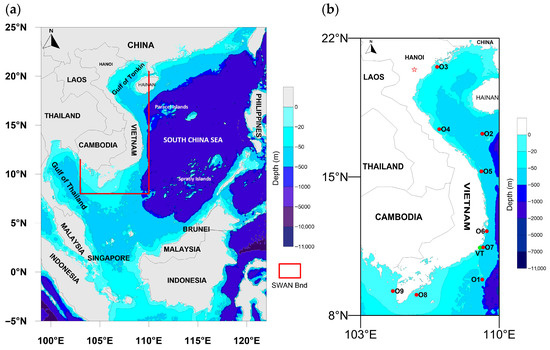
The South China Sea (SCS, Figure 1), located in the western part of the Pacific Ocean, is to a great extent enclosed by islands and the mainland but is connected to neighboring seas and oceans through several straits. The SCS is connected to the East China Sea by the Taiwan Strait in the northern part. The Philippine Sea (western Pacific) connects to the eastern part of the SCS by the large Luzon Strait and several other deep-water straits in the Philippines. The southern part of the SCS is connected to the Java Sea (Indonesia) through two Sunda gates between Jakarta and Lombok (near Bali) and to the Indian Ocean by the Karimata Strait, as well as through the Strait of Malacca between peninsula Malaysia and the island of Sumatra (Indonesia) in the southwestern part. The SCS covers an area of 3,447,000 km2 and includes the Gulf of Tonkin, the Gulf of Thailand, and the Spratly and Paracel Islands. It has an average depth of 1140 m, a maximum depth of 5567 m, a length of 3500 km and a volume of about 3,928,000 km3 [30].
Figure 1.
Bathymetry map (a) and SWAN model domain (b) for the Vietnam coast. SWAN Bnb (red solid lines): open boundary of the model; (b) also shows the locations of the nearshore observation station VT and the nine offshore stations O1–O9 (Table 1). Data from GEBCO_2023.
The SCS is surrounded by nine countries: China; the Philippines; Brunei; Indonesia; Singapore; Malaysia; Thailand; Cambodia; and Vietnam. Vietnam, in the west of the SCS, has around 3260 km of coastline and more than 3000 islands, with a part of the Gulf of Tonkin and the Gulf of Thailand [30] (Figure 1a). The SWAN model domain covers Vietnam’s coastal waters: 8–22° N and 103–110° E (Figure 1b).
2.2. Modeling Approach
There are spatial and temporal limitations in the observed wave data for the SCS, making it difficult to investigate long-term wave characteristics and assess energy potential. To address this limitation, numerical wave models, such as WAM, WW3, and SWAN, are widely used to simulate wave conditions under various sea states. WAM and WW3 are well suited for global and regional-scale applications, whereas SWAN is designed for small-scale simulations.
The SWAN v41.45 (Simulating WAves Nearshore) model is a third-generation spectral wave model for shallow-water applications, capable of producing reliable estimates of wave parameters in coastal regions, lakes, and estuaries based on specified wind forcing, bathymetry, and currents [5,6,7,31,32]. Developed by Delft University of Technology in the Netherlands, the model is freely available for download. The spectral wave action balance equation is solved, including the dominant processes of wave generation and dissipation:
where t represents time; N (t, x, y, , ) = E (, )/ denotes the wave action; E [J/m2] corresponds to the directional wave energy density spectrum; x and y define Cartesian coordinates; Cx and Cy indicate the group velocities in the two spatial dimensions; and describe the propagation velocities in spectral space; specifies the wave direction; and [s−1] is the wave frequency.
On the left-hand side of Equation (1), the temporal variation of wave action is described by the first term, while spatial propagation in geographical coordinates (x, y) is represented by the second and third terms. Refraction and changes in relative frequency induced by depth and currents are accounted for by the fourth and fifth terms, respectively.
The right-hand side consists of four source terms. The first term represents wind-induced wave growth (Sin), which is formulated using a linear growth function. The remaining terms account for energy dissipation processes, including whitecapping (Swc), nonlinear quadruplet wave interaction (Snl), bottom friction (Sbot) and depth-induced wave breaking (Sbrk).
Wave–current interactions have been shown to play a critical role in shaping wave energy characteristics. Wang et al. [33] demonstrated that these interactions can lead to increased significant wave heights in shallow coastal regions during cyclone-induced storm surges. Likewise, Shi et al. [34] found that wave–current interactions alter the distribution of wave energy, potentially affecting the compatibility between wave energy conditions and the optimal operating range of WECs. Furthermore, according to IEC-TS 62600-101, the effects of wave–current interactions on wave energy assessment should be taken into account when current velocities exceed 1.5 m/s. However, according to Nguyen et al. [28], the maximum current velocity in Vietnamese waters is less than 1 m/s. Wave–current interactions and water-level variations are not included in the SWAN model setup in this study, as the focus is solely on wave action.
The structured-grid version of SWAN is employed in this study to simulate wave conditions, using an hourly temporal resolution and a spatial resolution of approximately 0.02° (~2.3 km) within the focus area and a spatial resolution of approximately 0.02° (~2.3 km) in the study area.
2.3. Surface and Open-Boundary Forcing
The open-boundary conditions and wind-forcing data used in SWAN for the period 2007–2018 were: (i) hindcast wave data from Wave WatchIII [35,36], a third-generation offshore wave model configured on a global grid with a 0.5° spatial resolution; (ii) hindcast wind data from ERA5 (ECMWF Reanalysis v5), the fifth-generation European Centre for Medium-Range Weather Forecasts (ECMWF) reanalysis for the global climate and weather, with hourly temporal and 0.25° spatial resolution [37]; (iii) bathymetry data, used to build the area’s topography and assign interpolated water depth values to the mesh grids of the model; a high-resolution database from GEBCO_2023 (the General Bathymetric Chart of the Ocean) with a 15 arc-sec spatial resolution (~450 m) was used for the coastal and inner-shelf areas.
The northeast monsoon season starts in November and lasts until March. During this season, the Asian high-pressure system, commonly known as the Siberian high-pressure system, develops strongly, covering the entire SCS up to latitude 10°N. Northerly winds at the beginning of the season, northeasterly in the middle, prevail throughout the SCS region, stabilizing for a period of about 5–7 days and creating very large waves in the offshore area. The northeast monsoon can be divided into two periods. In the early period, the weather is dry, and the prevailing winds are northerly or northeasterly and strong and stable. The second period, in February and March, is the recession season, with a sub-high-pressure system in the East China Sea region, creating humid, drizzly weather. The prevailing winds during this period are northeasterly or north–northeasterly and are less stable, with weaker wind speeds than in the first period. In terms of impact time, the northeast monsoon belongs to the natural synoptic weather pattern with a duration of 5–7 days, but very often, there are additional monsoons [28].
The southwest monsoon season, also known as the summer monsoon, starts in May and ends in September. This monsoon is most active in the southern region of the SCS, with the prevailing wind southwesterly. In the middle and north of the SCS, the prevailing wind gradually shifts to the south–southwest and south. In the north of the Gulf of Tonkin, the wave field has a prevailing southerly direction. A southeasterly wind from the mouth of the Gulf of Tonkin has a very strong impact on activities offshore and on coastal wave regimes in coastal areas of the Red River Delta. The southwest monsoon season in the northern Gulf of Tonkin coincides with the storm season [28].
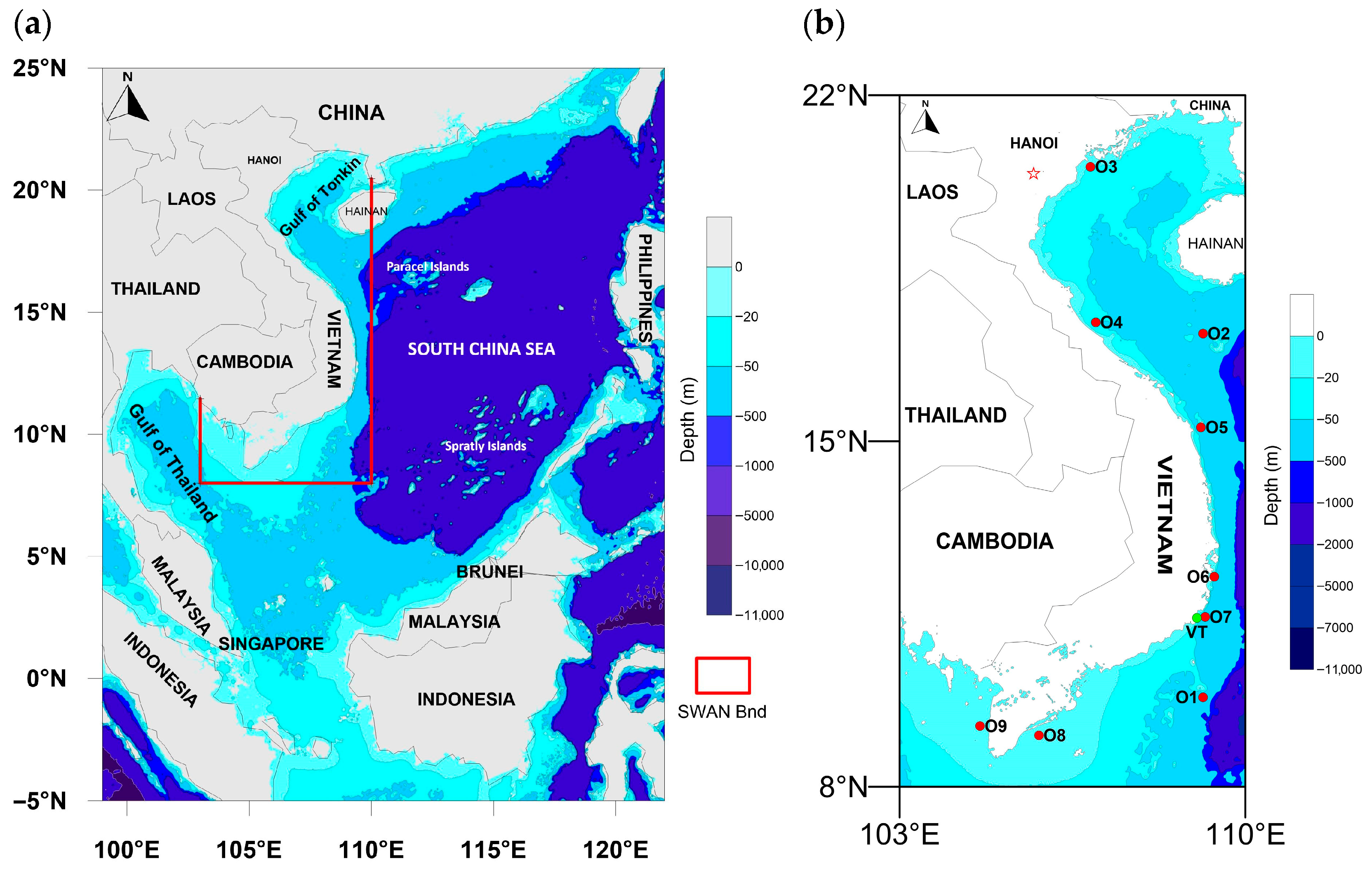
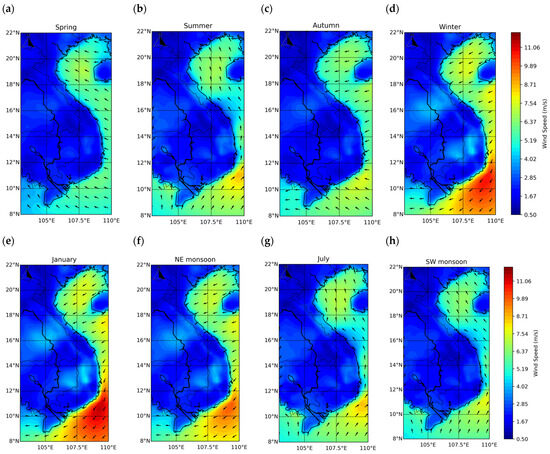
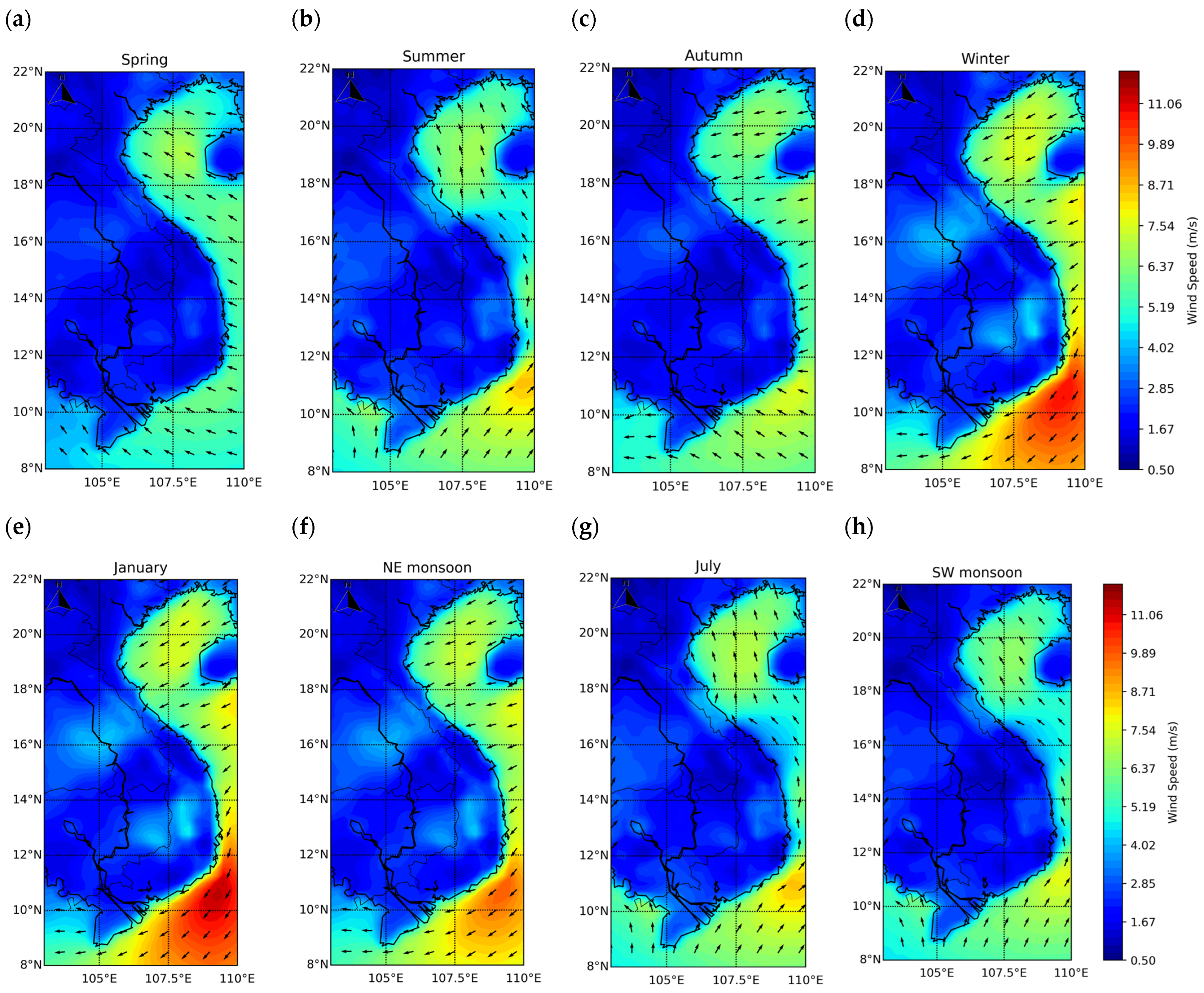
The seasonally and monsoonally averaged wind magnitude and direction from the ERA5 dataset over the seven-year period are shown in Figure 2. The seasonal definitions follow the Northern Hemisphere with spring (March–May); summer (June–August); autumn (September–November); winter (December–February). Wind speed over the study area varies seasonally and monsoonally, with strong winds in the northeast monsoon and in winter, weaker winds in the southwest monsoon and in summer. Wind direction exhibited significant spatial variability across the domain. In winter, the wind was a northeasterly over the whole study area because of the impact of the northeast monsoon. However, in summer, while the wind was a southwesterly in the southern SCS, in the middle of the SCS and in the Gulf of Tonkin, it was a southerly because of local geography. These wind patterns had an effect on wave characteristics.
Figure 2.
Seasonal wind speed and direction 10 m above the surface of the SCS from 2007 to2018: (a) spring; (b) summer; (c) autumn; (d) winter; (e) January; (f) NE monsoon season; (g) July; and (h) SW monsoon season. Wind data from the ERA5 dataset.
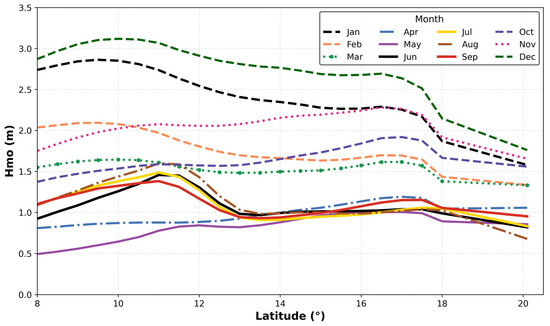
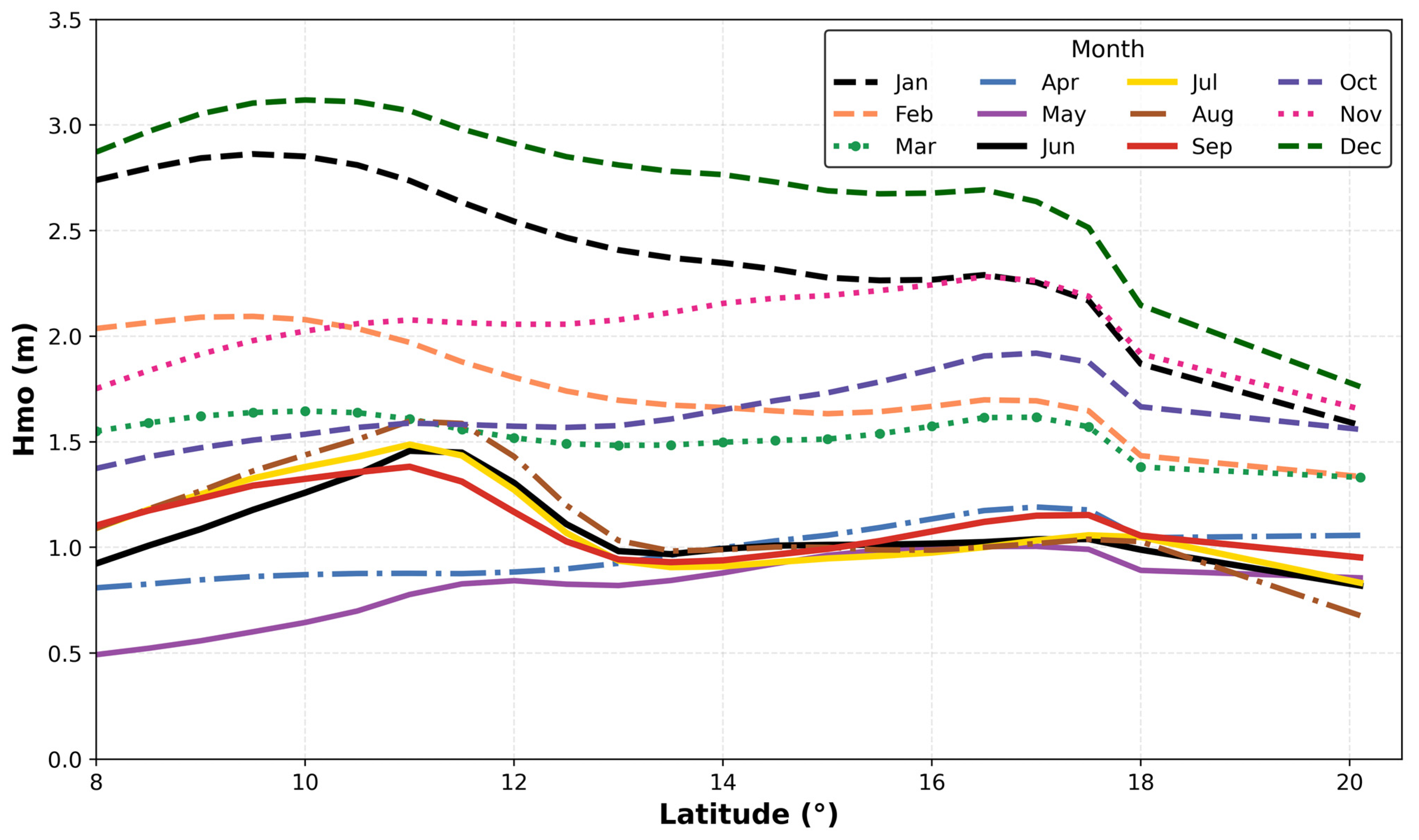
The monthly averaged significant wave heights for the SWAN model’s eastern boundary are presented in Figure 3 (SWAN Bnd in Figure 1). The significant wave heights during the autumn, winter and spring were two or three times higher than in the summer. The significant wave heights at low latitudes were larger than at high latitudes over the whole year, reaching a peak at 10° N in the winter and spring, at just over 3 m, and at 11.5° N in the summer, at around 1.5 m.
Figure 3.
Monthly averaged significant wave heights at the eastern boundary of SWAN from the WW3 model for the seven-year period2007–2018.
2.4. Wave Energy Resource Representation
According to the IEC TS 62600-101 Class 1 guidelines and the approach proposed by Yang et al. [21], four key wave parameters are considered, representing energy transport, energy content, wave period, and directional characteristics [6,7,21], with total wave energy as a supplement parameter.
The significant wave height, Hm0 (m):
where denotes the zeroth-frequency spectral moment.
The spectral moments are given by
where Sij denotes the variance spectrum resolved in both frequency and direction, f represents the discrete frequency, and denotes the discrete wave direction.
The energy period, Te (s):
The total wave energy, (J/m2):
where ρ denotes the water density; g represents the acceleration due to gravity.
The omnidirectional wave power, (W/m)
where is the group velocity defined based on linear wave theory.
2.5. Model Validation
2.5.1. Statistical Methods
The following statistical methods were used in the model validation and assessment of performance [5,6,7,21].
The root-mean-square-error:
where N represents the number of observations, Pi denotes the predicted results, and Mi is the observed data.
The mean percentage error (PE) is given by
which indicates the average normalized bias, expressed in percentage form.
The scatter index (SI) is given by
and the RMSE is normalized with respect to the mean of the observed data.
Model bias is defined as
The linear correlation coefficient, R, is given by
2.5.2. Wave Data for Model Validation
Wave data were collected at a water depth of approximately 20 m using an AWAC (Acoustic Waves and Currents sensor) wave recorder at the Vinh Truong station during 2013 (Table 1). The field investigation of wave characteristics was undertaken by the Institute of Oceanography (IO), Vietnam Electricity (EVN), and Power Engineering Consulting JSC 2 (PECC2) as part of the Environmental Impact Assessment for the Ninh Thuan-1 nuclear power plant.
Table 1.
Locations of the observation station VT and the nine offshore stations O1–O9, with their distances from the coast.
Additionally, to support model validation and ensure accuracy, wave data from the ERA5 reanalysis dataset developed by ECMWF, which was generated using the ECWAM (ECMWF WAve Model) model [32]. The ECWAM is a third-generation wave model with 0.25° spatial resolution and hourly temporal resolution that accounts for the physics of wave generation, propagation and dissipation. The global wave power estimates from the ERA5 reanalysis (1940–2022) were validated by Liu et al. [38] against multi-platform satellite altimeter data (1985–2022), showing good agreement over the analyzed period. Three parameters from each of nine offshore stations (Table 1) were used here to validate the SWAN model in 2013: significant height of combined wind waves and swell; mean wave period; and mean wave direction.
2.5.3. Model-Data Comparison
Model validation is a critical process to ensure the robustness and reliability of simulation results. In this study, a thorough validation was performed by comparing model outputs of significant wave height (Hm0), wave period (Te) and wave direction (Dir) with the buoy data from the Vinh Truong station. Additionally, owing to the limited availability of reliable offshore observations and the low quality of visual wave measurements along the coast of Vietnam, the ERA5 dataset was also used to compare with SWAN results for significant wave height at two offshore stations (O1 and O2), and seven nearshore stations (O3–O9).
A series of model performance metrics (Section 2.5.1) was calculated to evaluate the model quantitatively. The error statistics for significant wave height at three stations, and for wave period and wave direction at the Vinh Truong (VT) station are provided in Table 2.
Table 2.
Error statistics for the significant wave height, Hm0; the wave period, Te; and wave direction, Dir, at VT and O1–O9 stations.
The SWAN model showed good performance in reproducing the three parameters observed at VT, with R = 0.91, 0.73, 0.87 for Hm0, Te and Dir, respectively. The RMSE values are good for Hm0, acceptable for Te, but relatively large for Dir. This may be due to local geometric effects or coastal shadowing. In terms of bias, it can be seen that SWAN is very accurate for wave height, captures the trend but not perfectly for Te, and for direction, it is noisy but generally well captured.
SWAN clearly outperforms ERA5 in comparison with the observed data for significant wave height: SWAN has lower RMSE (0.29 < 0.46), nearly zero SWAN Bias, and better SI and R (SI, R of SWAN = 0.27, 0.91 and SI, R of ERA5 = 0.54, 0.88). For wave period, SWAN also represents better variability than ERA5, with lower RMSE, less negative bias (indicating that it is closer to observations), and higher correlation with lower SI and higher R. Moreover, SWAN significantly improves wave direction representation compared to ERA5, with lower RMSE, smaller bias, and much higher correlation (SI, R of SWAN = 0.38, 0.871 and SI, R of ERA5 = 0.42, 0.77). The RMSE of ERA5 is relatively large at 44° due to its coarse spatial resolution. Overall, the performance of SWAN was better than that of ERA5 at VT in comparison with the observed data. This is expected because ECWAM is a global model with a spatial resolution of 0.25°, whereas SWAN is a nearshore model with a spatial resolution of ~0.02° (~2.3 km).
Across all stations, when comparing SWAN with ERA5, SWAN shows strong agreement with ERA5 for Hm0, with R around 0.94–0.97 and a low RMSE. Wave period (Te) shows moderate to good agreement, with R ranging from 0.48 to 0.91, while wave direction (Dir) exhibits the weakest agreement, with correlation decreasing to 0.42 at O9.
The model performance varies depending on station location and wave parameters. At the best-performing stations (O1, O6, and VT), Hm0 shows high correlation (R ≈ 0.92–0.97) with low RMSE (≈0.25–0.40 m) and a small SI (≈0.15–0.38), indicating very good accuracy; wave period (Te) is also well reproduced at these stations, with R ≈ 0.86–0.91 and RMSE ≈ 0.76–1.16 s, while wave direction (Dir) shows acceptable performance with R ≈ 0.87–0.91 but RMSE around 28–39°.
The medium-performing stations (O2, O4, O5, O7, and O8) still perform well for Hm0, with high correlation (R ≈ 0.94–0.95) and relatively low RMSE (≈0.14–0.37 m). However, performance decreases slightly for Te and Dir, where RMSE increases (Te ≈ 1.02–1.13 s; Dir ≈ 27–41°) and correlation becomes more variable (R of Te ≈ 0.82–0.88; Dir R of Dir ≈ 0.63–0.92).
At the worst-performing stations, O3 and O9, specific deficiencies are observed. At O3, the SWAN wave period shows poor agreement with ERA5 (R = 0.48, RMSE = 0.80 s), although Hm0 remains accurate (R = 0.95, RMSE = 0.18 m). At O9, wave direction is significantly underestimated in performance, with a low correlation (R = 0.42) and high RMSE (~37°), indicating strong directional mismatch. These errors suggest that the limitations in performance are primarily related to the coarse spatial resolution of ERA5 as a global reanalysis product, which is not able to fully resolve nearshore wave processes. In contrast, O3 and O9 are located in geographically complex coastal regions—the Gulf of Tonkin and the Gulf of Thailand, respectively—where wave conditions are strongly influenced by shallow water effects, complex bathymetry, and coastal geometry.
Overall, the SWAN model showed good performance in reproducing the three observed parameters. ERA5 (based on ECWAM) is a global model with a spatial resolution of 0.25°, whereas SWAN is a nearshore model with a spatial resolution of ~0.02° (~2.3 km), so SWAN demonstrates better agreement with observations than ERA5 for all wave parameters. The two datasets show good consistency in open-water conditions; however, discrepancies increase in semi-enclosed seas and gulf regions, where local bathymetry and coastal shadowing significantly influence wave transformation and are not fully resolved by the coarser-resolution global model.
3. Results
3.1. Bivariate Histograms
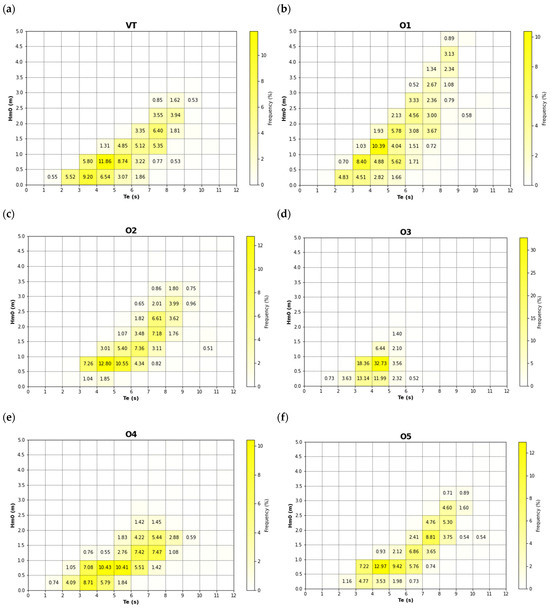
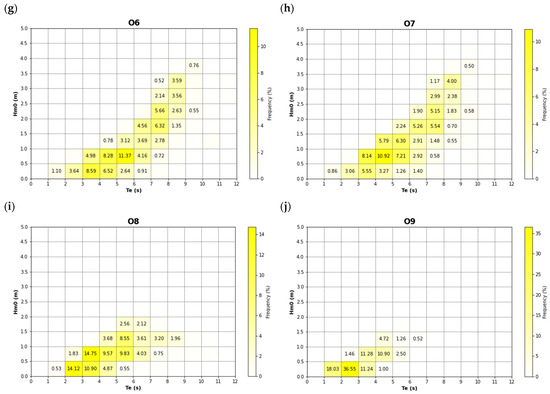
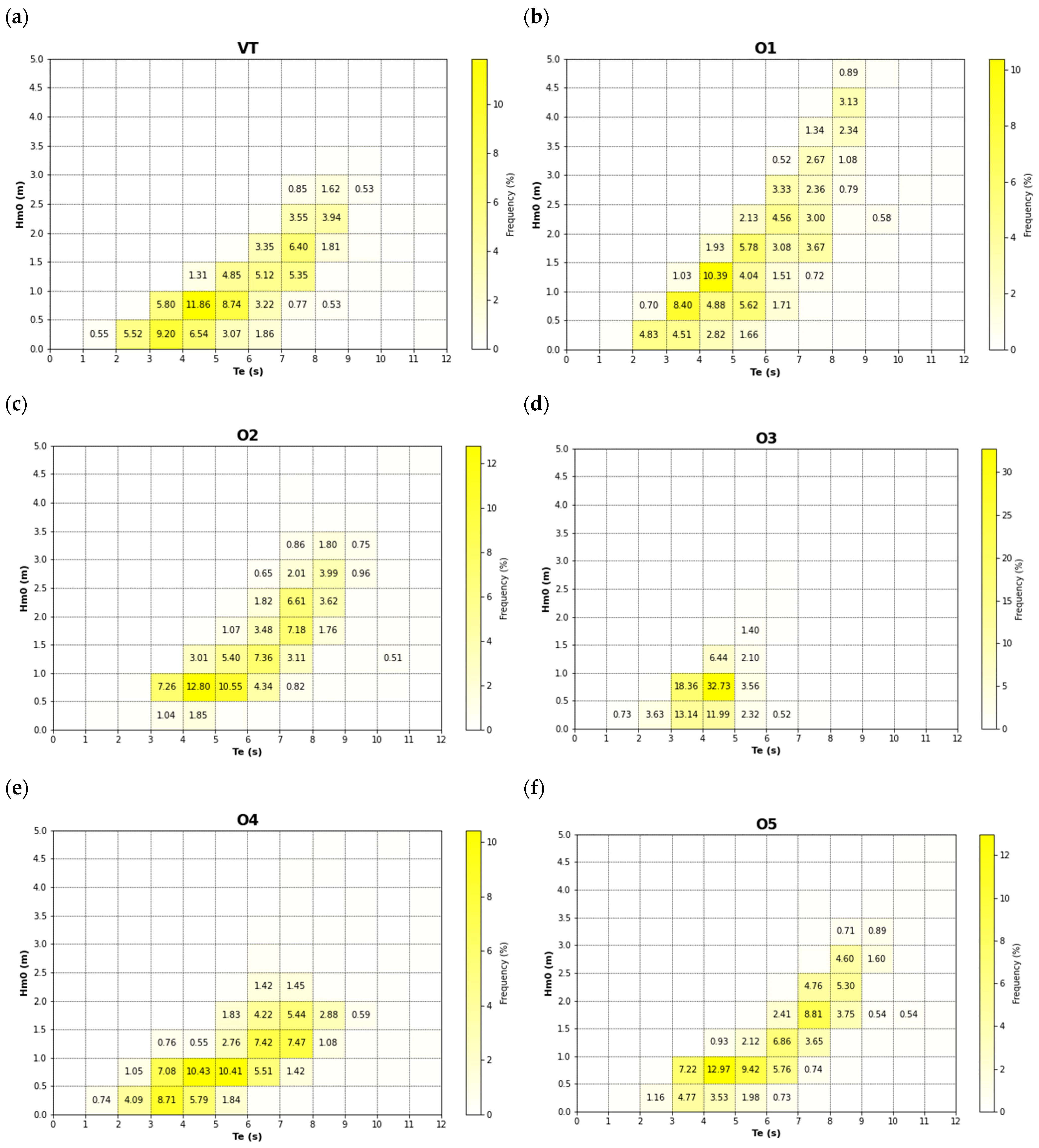
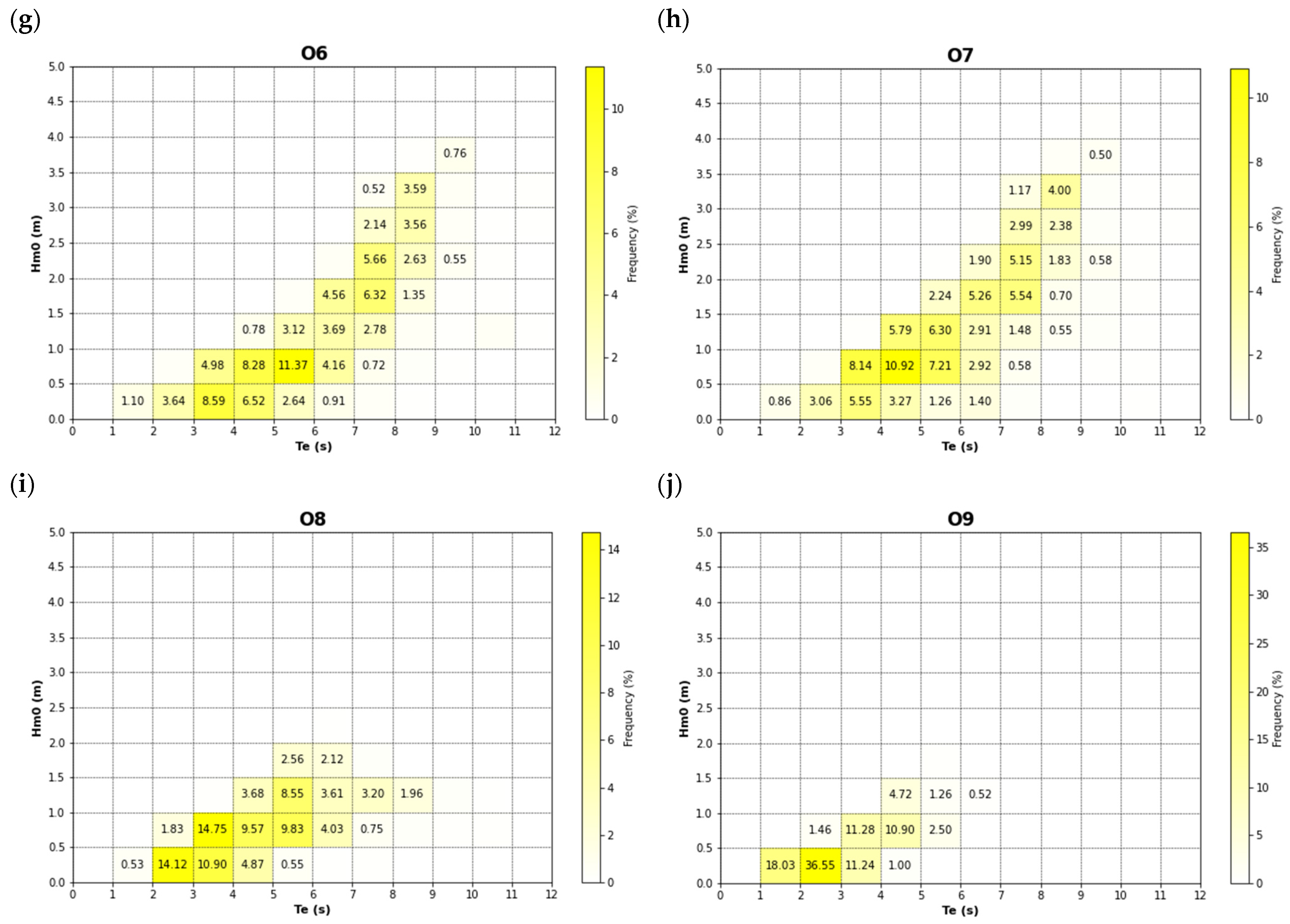
Sea-state variability is often described using bivariate probability distributions of significant wave height and energy period based on long-term datasets. Figure 4 shows the modeled percentage occurrence of these parameters at a nearshore station (VT) and the nine offshore stations (O1–O9). Seven of the offshore stations are 20 km from the coast (Table 1); wave energy extraction beyond 20 km offshore has been shown to incur prohibitively high transmission costs, rendering it economically impractical, as reported by Kilcher and Thresher [18]. Furthermore, along the southcentral coast of Vietnam, the narrow continental shelf results in a rapid increase in water depth beyond approximately 50 km offshore.
Figure 4.
Bivariate distributions of significant wave height Hm0 and wave energy period Te at each station; values in each sub-box are the percentage of occurrences of these values plotted as higher than 0.5%. Stations: (a) VT; (b) O1; (c) O2; (d) O3; (e) O4; (f) O5; (g) O6; (h) O7; (i) O8; (j) O9.
Following IEC TS recommendations, significant wave height was categorized into 0.5 m intervals ranging from 0 to 5 m, while the wave energy period was grouped into 1 s bins between 1 and 12 s. The percentage of occurrence of the box values is also indicated in Figure 4 by the color contours.
The maximum frequency of occurrence at VT was 11.8% in the box: Hm0 = 0.5–1 m and Te = 4–5 s; 10.39% at O1 (150 km offshore) in the box: Hm0 = 1–1.5 m and Te = 4–5 s; 12.8% at O2 (150 km offshore) in the box: Hm0 = 0.5–1 m and Te = 4–5 s. Wave conditions in the southern offshore region of the study area were generally higher than those in the northern region.
At the other seven stations (20 km offshore), the most apparent trend was the maximum frequency occurring at Hm0 = 0.5–1.0 m, except at O9. However, for Te, the most popular range was 4–5 s, except at O6 (5–6 s), O8 (3–4 s) and O9 (1–2 s). In general, waves at O6 and O7 were both longer and higher than elsewhere but shorter and lower at O9. The major reason for this could be the effect of shadowing caused by the land and changes in water depth.
3.2. National-Wide Resource Characterization
3.2.1. Monthly Variability in January and July
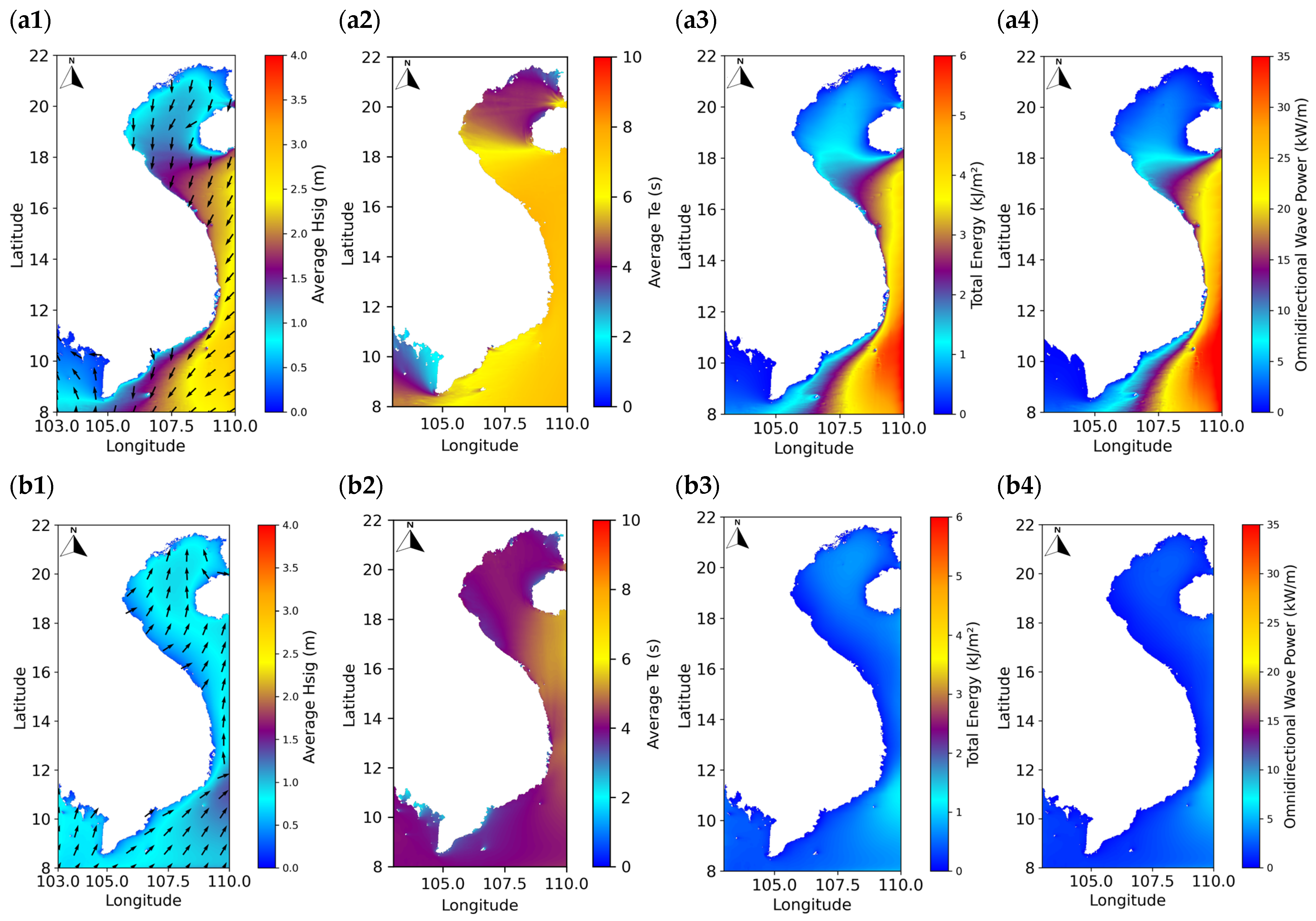
The distributions of monthly averaged significant wave height, wave period, total energy and omnidirectional wave power in January and July, averaged over seven years, are presented in Figure 5. The significant wave height in both months was in a range of 0.1–4.0 m, higher in January than in July, with the largest values, 1.5–3.0 m, in central Vietnamese waters at 8–18° N and 105.5–110° E. The waves propagated in a northeasterly direction due to the prevailing northeasterly winds during the northeast monsoon, with strong winds in January (Figure 2). The minimum wave heights, less than 0.5 m, were in the Gulf of Tonkin and the Gulf of Thailand, probably due to the combined effects of water depth and the weakened northeasterly wind in these areas; in both gulfs, the average water depth is approximately 50 m (Figure 1). The southern Chinese mainland and mainland Vietnam also reduced the wind speed in the gulfs (Figure 2). The main wave direction in the Gulf of Tonkin was northerly nearshore and northeasterly offshore. In the Gulf of Thailand, the main wave direction was southeasterly because of the local geography.
Figure 5.
Monthly averaged significant wave height (m) (1), with wave direction shown as arrows, wave period (s) (2), total wave energy (kJ/m2) (3), and omnidirectional wave power (kW/m) (4) in (a) January and (b) July over seven years: 2007–2018.
The significant wave height was lower in July, in a range of 0.5–1.5 m, due to the weaker southwest monsoon over the study area. The highest significant wave heights were observed offshore from the southcentral coast of Vietnam at 9–12° N and 108–110° E, 1–1.5 m, with the second-highest in the Gulf of Tonkin at around 1 m. In the other areas, the average significant wave height varied between 0.6 m and 1.0 m. The main wave direction was southwesterly due to the impact of the southwest monsoon (Figure 2).
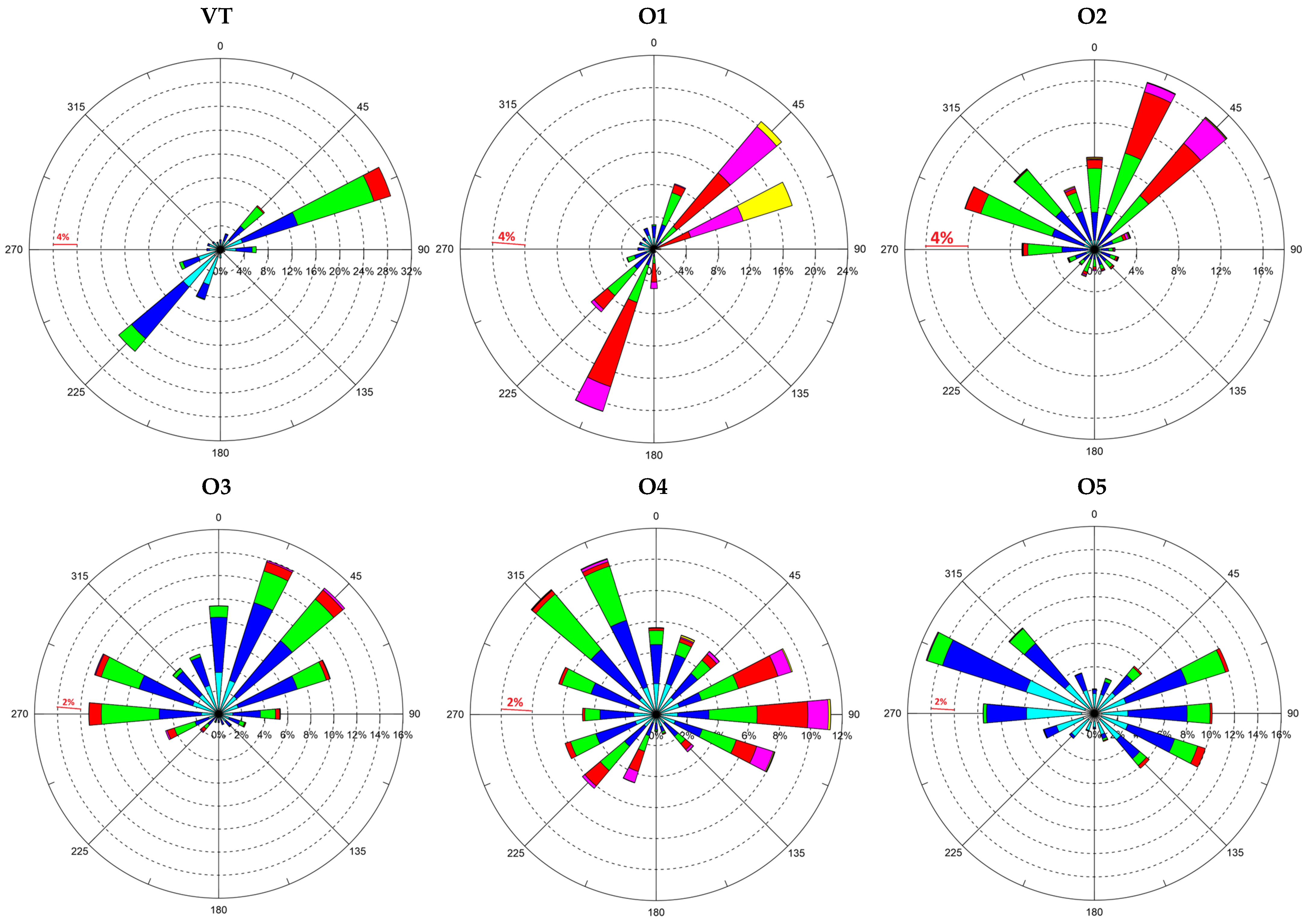
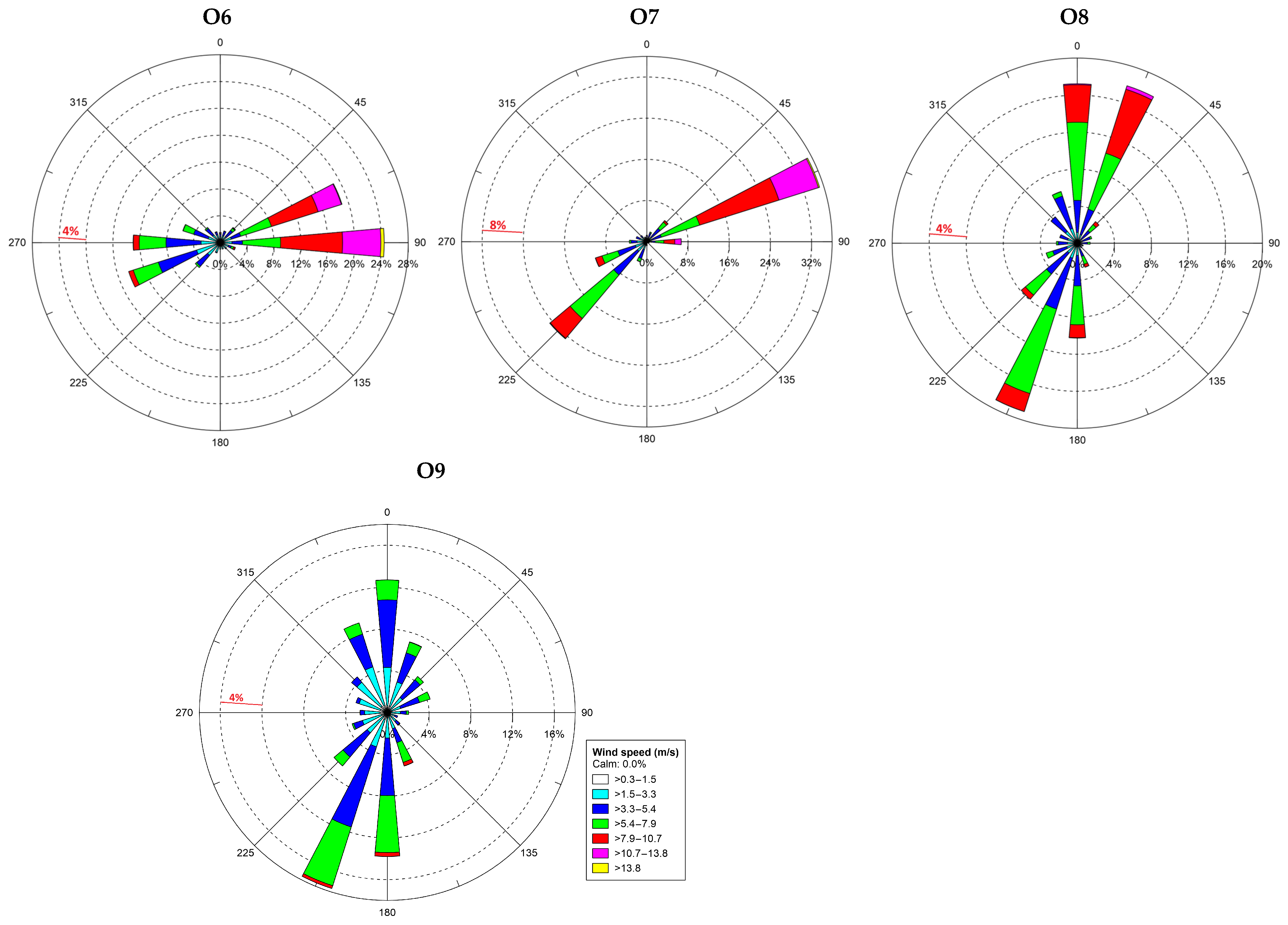
Figure A1 and Figure A2 (Appendix A) show the wave rose and wind rose for VT and O1–O9 stations. The wave rose analysis at all stations indicates that the dominant wave directions are northeast (NE), east (E), southwest (SW), and west (W), which is consistent with the monsoon regime of Biển Đông under the influence of the northeast and southwest monsoons. Among these, the northeast monsoon exerts a stronger influence than the southwest monsoon. At stations located in open sea conditions (O1, O2, O6, O7, O8, and VT), waves tend to be more stable, with high frequency concentrated in several dominant directions. In contrast, stations situated in sheltered areas (O3, O4, O5, and O9) exhibit greater directional dispersion due to the effects of topography and friction caused by islands, mountains, and the mainland. Notably, at stations VT, O1, O7, and O8, the wind and wave directions are nearly aligned. At station O2, wind–wave alignment is evident during the northeast monsoon; however, during the southwest monsoon, the wave direction is altered due to geographical influences, similar to stations O3, O4, and O5. Station O9 is strongly governed by the southwest monsoon, and due to its southwest-facing exposure, wave directions are predominantly from the southwest. Significant wave heights greater than 1.5 m mainly occur in the northeast direction, particularly at offshore and deep-water stations. A similar pattern can be observed for strong winds exceeding 10 m/s.
Figure 5(a2,b2) show the distributions of Te, the monthly averaged mean wave period. Te was larger in January than in July, between 6 s and 10 s, except in the Gulf of Tonkin (4–6 s) and the Gulf of Thailand (<3 s). Te was between 3 s and 6 s in most areas in July.
Figure 5 also shows the distributions of the monthly averaged total energy and omnidirectional wave power. In January, the largest values, 3–6 kJ/m2 and 20–35 kW/m, respectively, were found mainly in the center of the study area: at 8–18° N and 107.5–110° E. The same trend occurred in July, but over a smaller area: 1–2 kJ/m2 and 6–10 kW/m at 9–12° N and 108–110° E, respectively. In the Gulf of Thailand and Gulf of Tonkin, where the effects of shadowing and changes in water depth were most significant, the total wave energy in January was in a range of 1–2.5 kJ/m2, and the omnidirectional wave power was 1–5 kW/m; in July, the values were less than 1 kJ/m2 for total wave energy and 1–5 kW/m for omnidirectional wave power.
3.2.2. Seasonal Variability
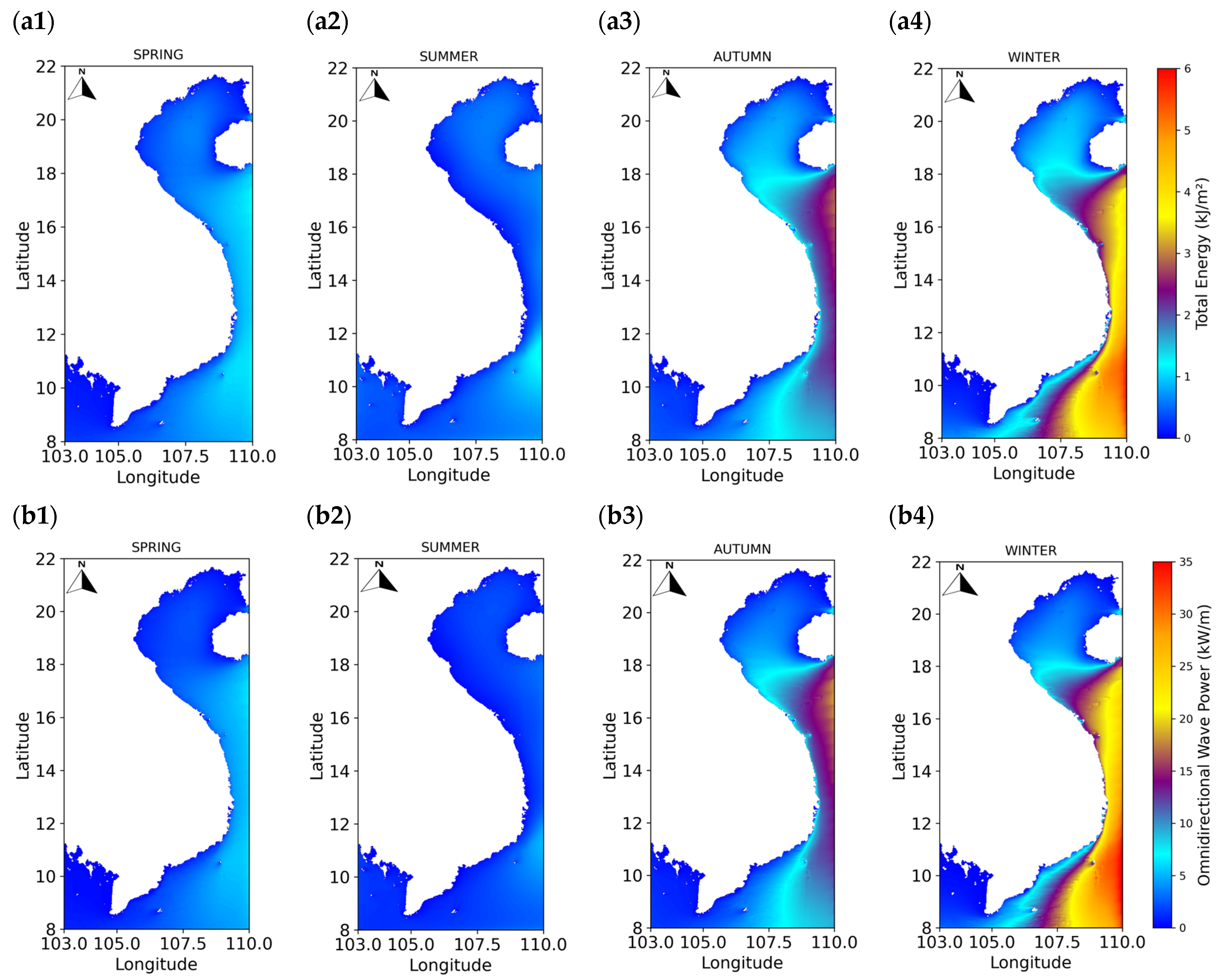
The seasonal distributions in total wave energy and omnidirectional wave power across the study area are illustrated in Figure 6, reflecting the significant influence of monsoon cycles. The study area is impacted by both the northeast and southwest monsoons, but the northeast monsoon has stronger winds and lasts longer. Therefore, winter provides the most significant contribution to the seasonally averaged wave power, with autumn and spring contributing the next largest shares; summer makes the smallest contribution. The spatial distributions of total wave energy and omnidirectional wave power are reasonably consistent with those of significant wave height: highest in the central areas and lowest in the Gulf of Tonkin and the Gulf of Thailand.
Figure 6.
Seasonal distributions from 2007 to 2018 of (a) total wave energy (kJ/m2) and (b) omnidirectional wave power (kW/m) in (1) spring; (2) summer; (3) autumn; and (4) winter.
In the central area in winter, the total wave energy ranged from 3 kJ/m2 to 6 kJ/m2, with omnidirectional wave power from 20 kW/m to 35 kW/m. The regions with the largest values were mostly offshore from the southcentral coast of Vietnam. In autumn, the total wave energy ranged from 1.5 kJ/m2 to 3 kJ/m2, with omnidirectional wave power from 8 kW/m to 20 kW/m, slightly smaller than in winter. The regions with the largest values were mostly offshore from southern Hainan Island. In spring, the total wave energy in most areas was around 1.3 kJ/m2, whereas the omnidirectional wave power ranged from 7 kW/m to 10 kW/m. The smallest total wave energy and omnidirectional wave power were in summer, at around 1 kJ/m2 and 5 kW/m, respectively.
The Gulf of Tonkin and the Gulf of Thailand had the lowest total wave energy and omnidirectional wave power, less than 1 kJ/m2 and 8 kW/m in winter, and 0.8 kJ/m2 and 2 kW/m in summer, respectively.
Overall, the southcentral coast of Vietnam (from Da Nang to Lam Dong) seems to be the best location to harvest wave energy, especially all islands in those areas, like Phu Quy Island. However, more studies on feasibility (Class 2) and design (Class 3), based on IEC-TS standards, will be needed before setting up wave farms.
3.3. Wave Characteristics During ENSO Events
The El Niño–Southern Oscillation (ENSO) affects global mean wave direction and wave power [39]. In the South China Sea, wave characteristics are influenced not only by strong seasonal variability but also by ENSO-related variability [40,41]. Accordingly, this study investigates ENSO-driven fluctuations in wave power, focusing on its two principal phases, El Niño and La Niña, and each phase has different impacts on oceanic wave conditions.
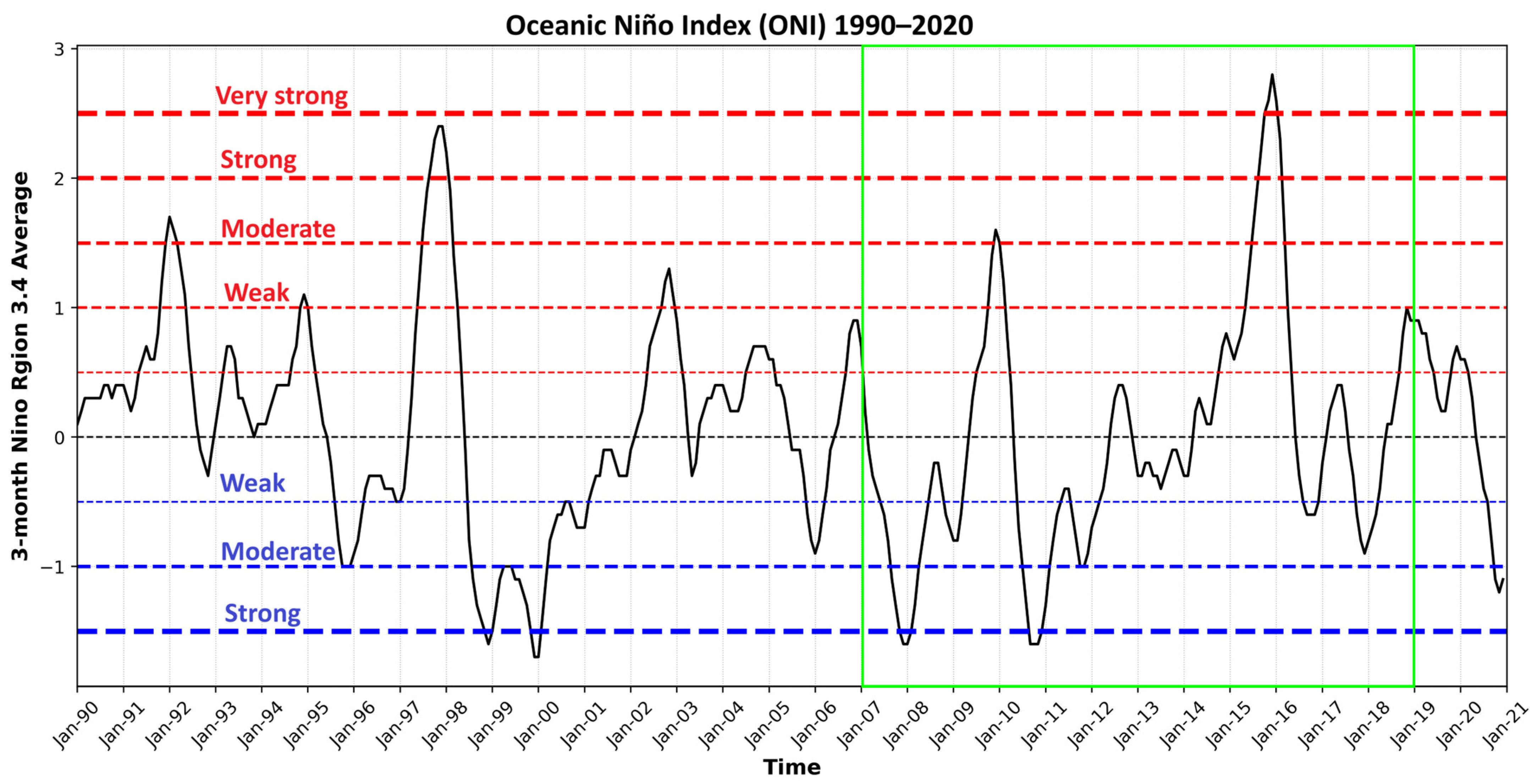
Figure 7 shows the Ocean Niño Index (ONI) from January 1990 to January 2021. This method is widely recognized as the primary standard used by NOAA for the classification of El Niño (warm phase) and La Niña (cool phase) events within the eastern tropical Pacific. The research period here was from 2007 to 2018, with 2010–2011 being strong La Niña years and 2015–2016 being very strong El Niño years.
Figure 7.
Ocean Niño Index (ONI) from Jan-1990 to Jan-2021. Red horizontal lines: El Niño phases with 4 levels (weak, moderate, strong and very strong). Blue horizontal lines: La Niña phases with 3 levels (weak, moderate and strong). Green box covers 2007–2018 [42].
3.3.1. Annual Significant Wave Height
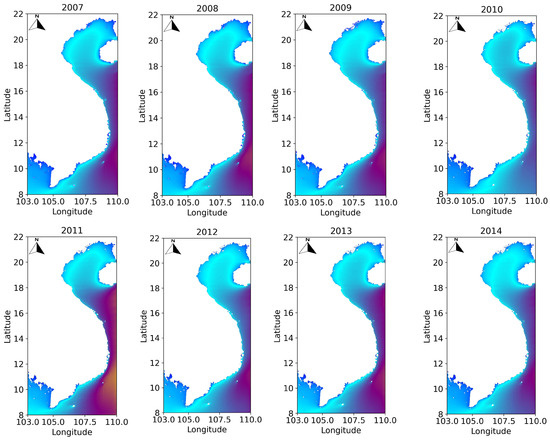
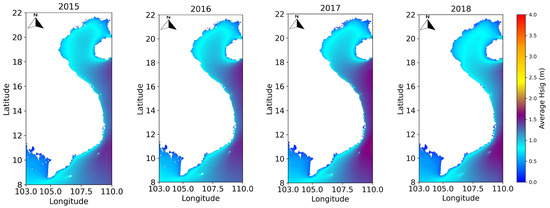
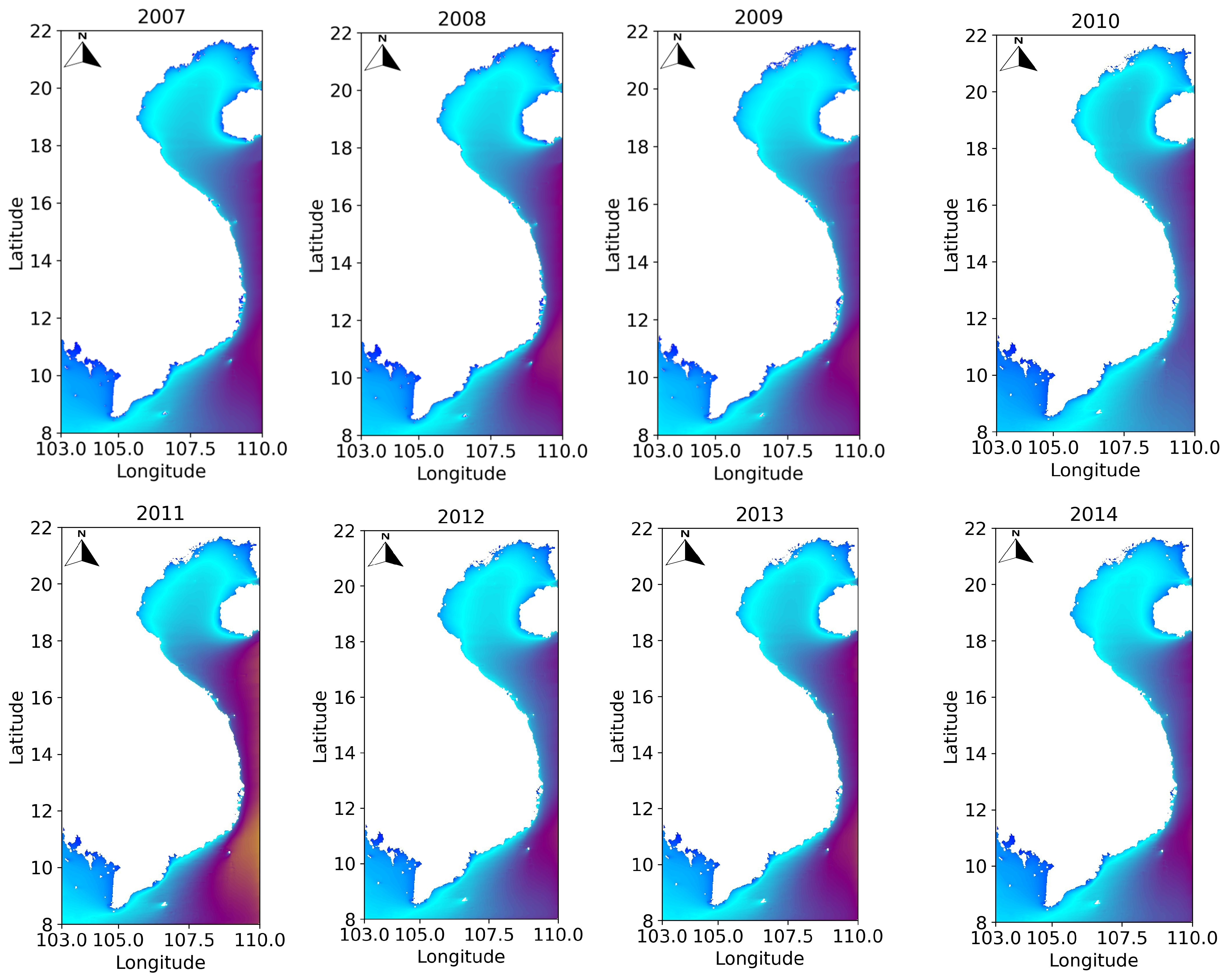
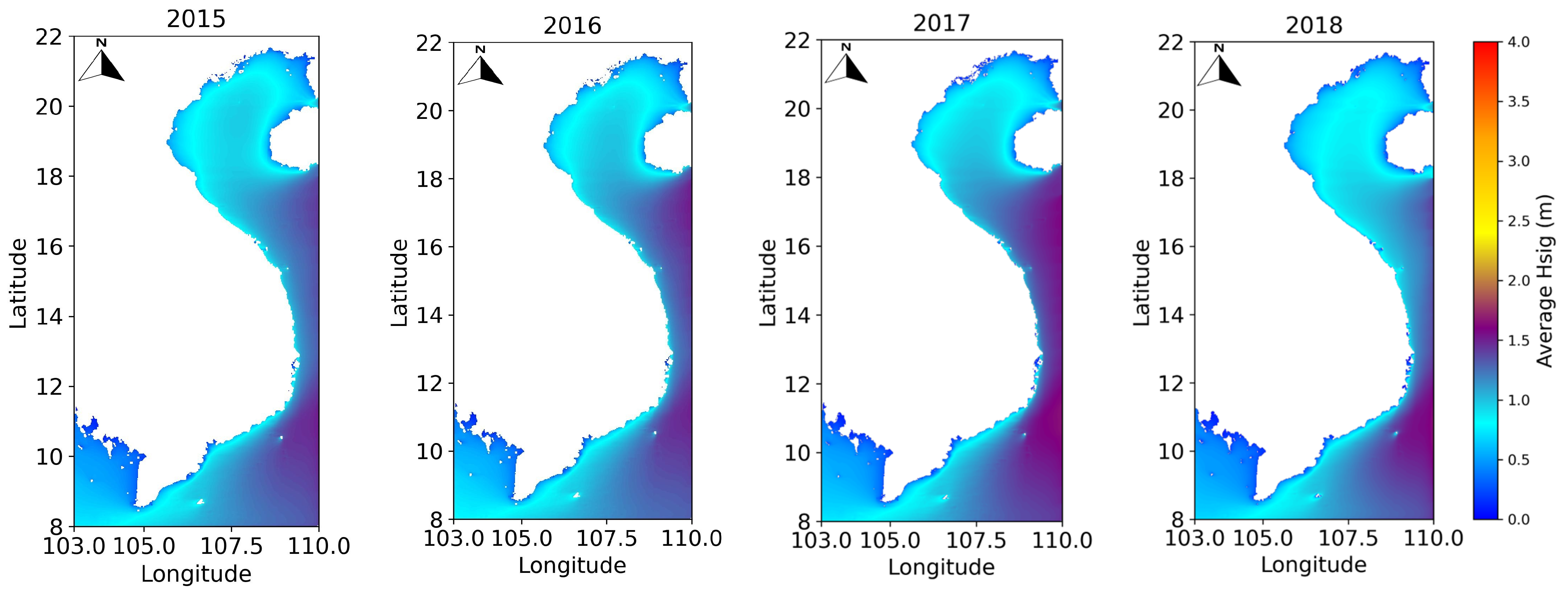
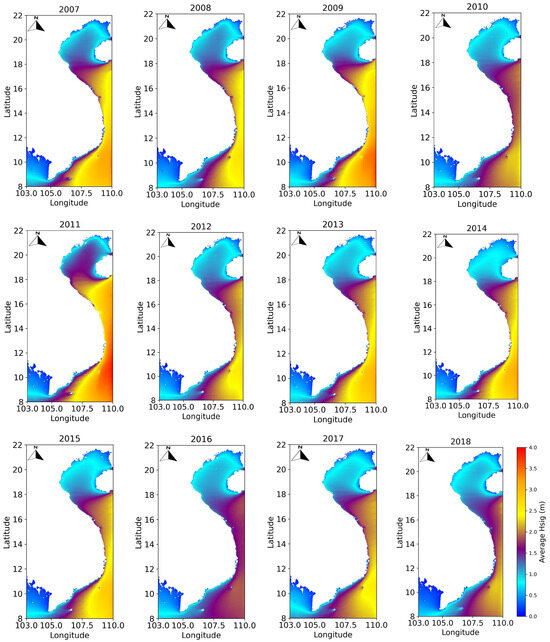
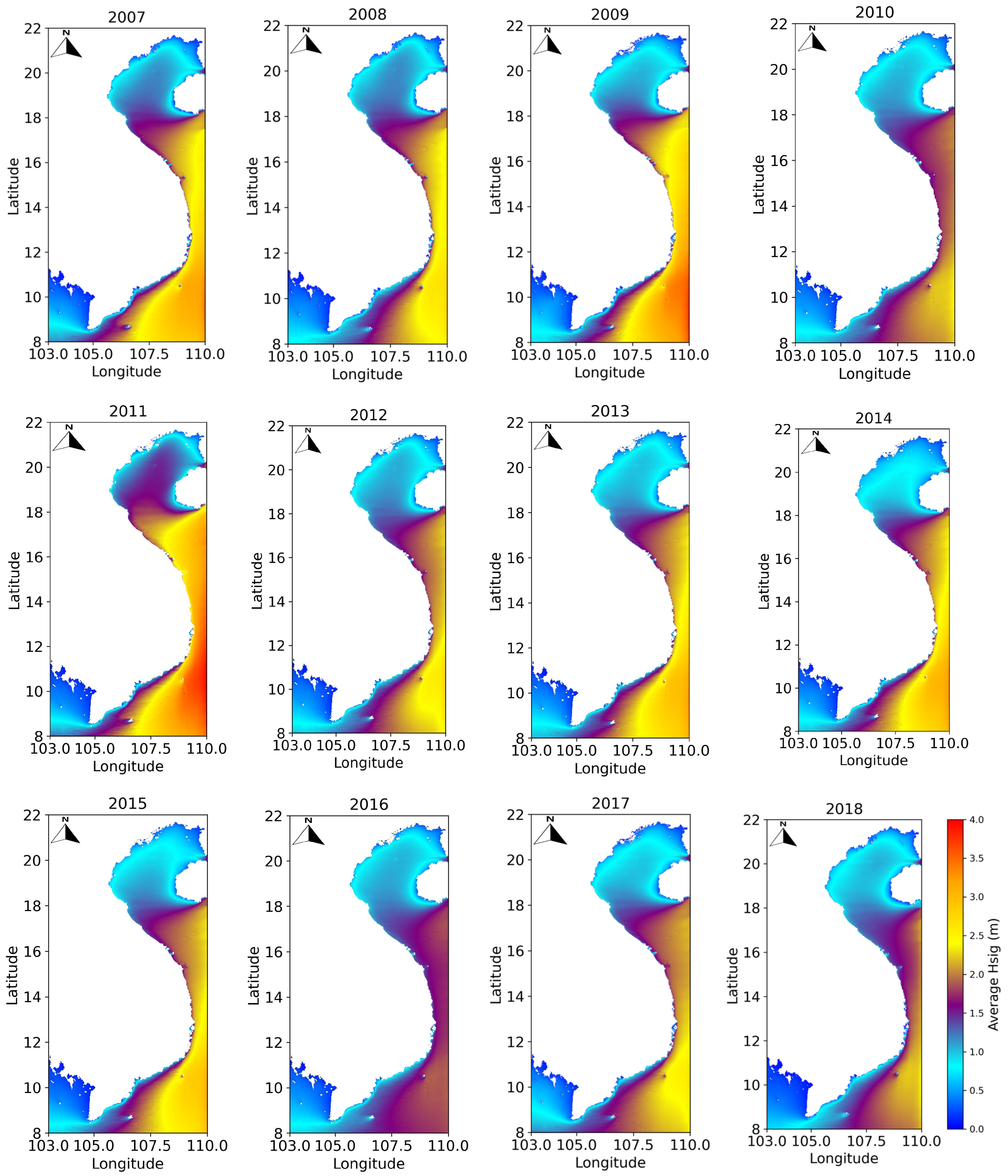
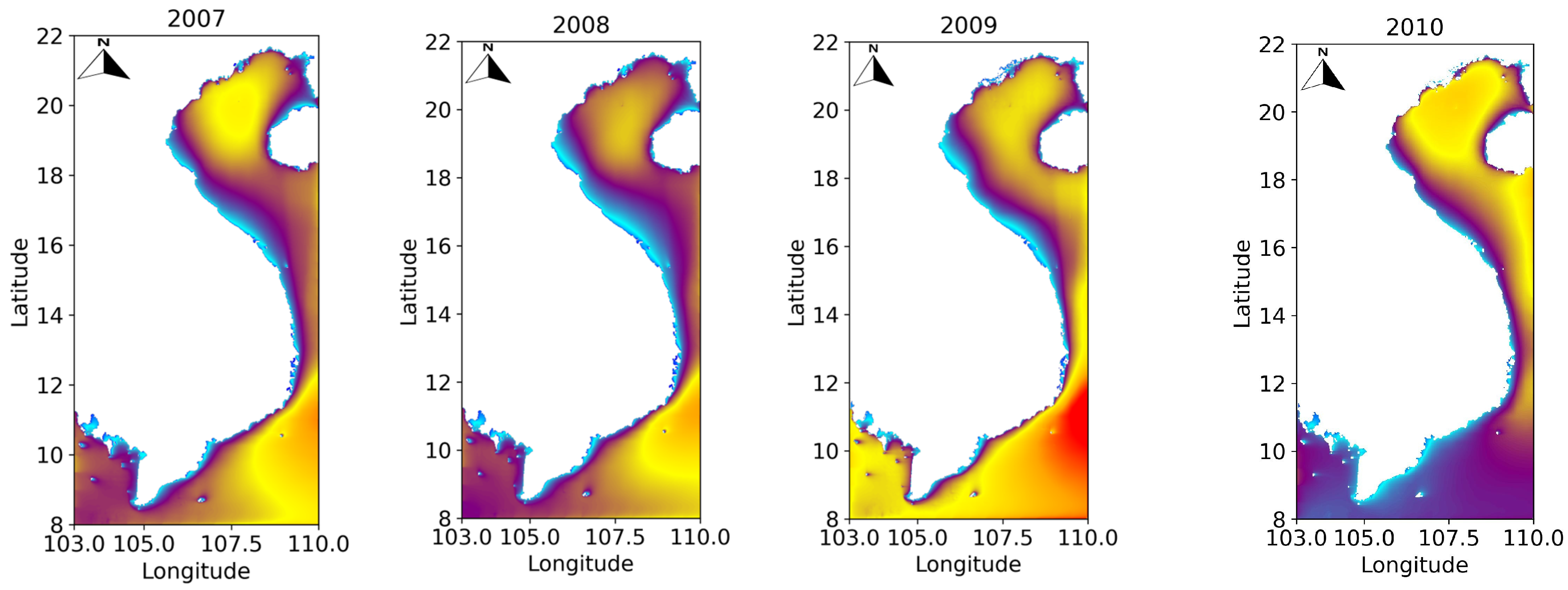
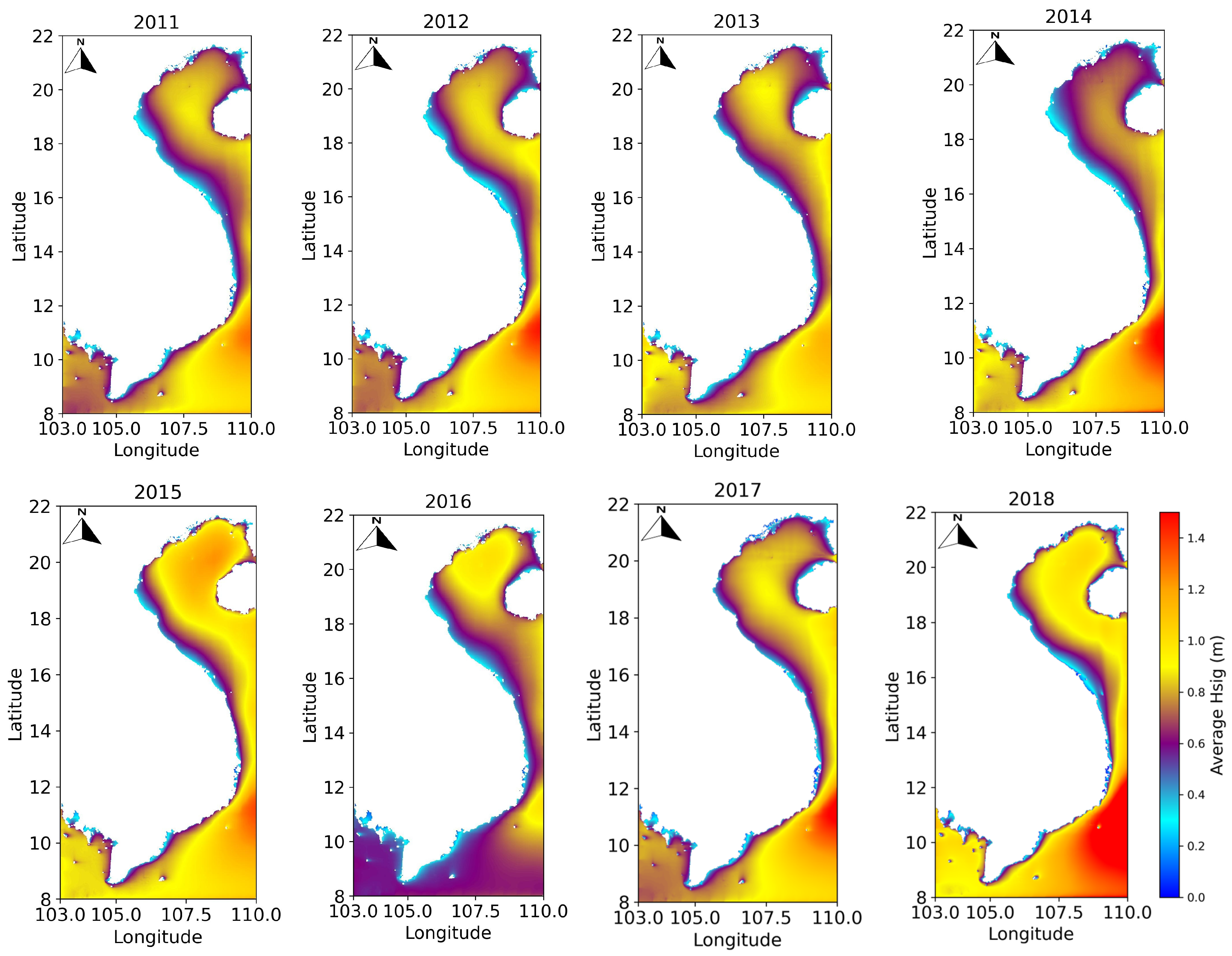
Annually averaged significant wave heights are shown in Figure 8. During El Niño years, the western Pacific generally experiences weaker-than-normal trade winds [43]. Therefore, in the El Niño years 2015 and 2016, weaker winds could have led to reduced significant wave heights. In the study area, this often translated to lower significant wave heights compared to La Niña years 2011, with an annual average maximum value just around 1.2–1.7 m. In contrast, the La Niña years (2010 and 2011) were characterized by stronger-than-normal trade winds in the western Pacific. This could have resulted in increased significant wave height because stronger winds typically generate higher waves. The study area experienced the highest significant wave heights in 2011, with an average maximum value of approximately 2–2.3 m. However, because the first half of 2010 was in an El Niño phase, the annually averaged significant wave heights were lower than in 2011. Overall, El Niño can lead to reduced wave power and La Niña to increased wave power in the study area.
Figure 8.
Annually averaged significant wave heights from 2007 to2018: 2007–2008: Strong La Nina; 2009–2010: Moderate El Nino; 2010–2011: Strong La Nina, 2011–2012: Moderate La Nina; 2014–2015: Weak El Nino; 2015–2016: Very strong El Nino, 2016–2017: Weak La Nina, 2018–2019: Weak El Nino.
3.3.2. Monthly Significant Wave Height in January and July
Significant wave heights in January (winter) and July (summer) were investigated to determine the impact of ENSO.
The monthly averaged maximum wind speeds in January of the La Niña years 2011, 2012, 2013 and 2014 were higher than those in the other years. The value in 2011 (strong La Niña) was 14.13 m/s, whereas the values in 2010 and 2016 (strong El Niño) were 11.65 m/s and 11.17 m/s, respectively (Table 3).
However, in July, tropical cyclones can amplify winds during both strong El Niño and La Niña phases. Approximately half of tropical cyclones have been shown to be linked to strong westerly burst-like anomalies in the western and central equatorial Pacific Ocean, as reported by Lian et al. [44]. These tropical cyclones tend to occur more frequently and move further equatorward and eastward during El Niño years compared to La Niña years (more discussion below). The average maximum wind speeds in July 2014 and 2015 were 11.22 m/s and 12.17 m/s, respectively (Table 3).
Table 3.
Monthly averaged maximum wind speeds (m/s) in January and July, from ERA5 wind data over the research area [37], and the number of tropical cyclones (TCs) in July in the West North Pacific (WNP) and the SCS, from the Hong Kong Observatory [45,46,47,48,49,50,51,52,53,54,55,56], between 2007 and 2018.
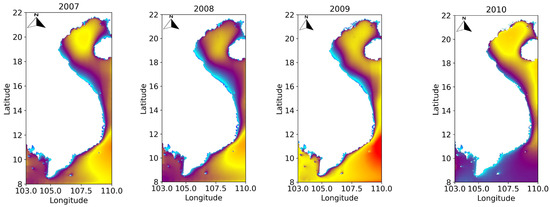
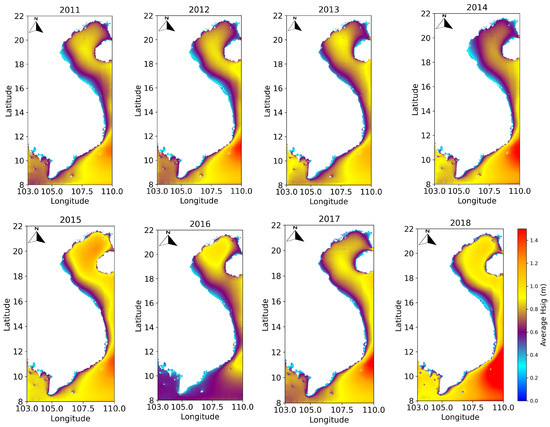
January’s monthly averaged significant wave heights are presented in Figure 9 with a scale of 0–4.0 m, and those in July in Figure 10 are presented with a scale of 0–1.5 m during the same period.
Figure 9.
Monthly averaged significant wave heights (m) in January from 2007 to2018.
Figure 10.
Monthly averaged significant wave heights (m) in July from 2007 to2018.
January 2011 experienced a strong La Niña, while 2010 and 2016 were strong El Niño years. January of 2012, 2013, and 2014 experienced a moderate and weak La Niña, whereas 2015 was a weak El Niño year. Consequently, as shown in Figure 9, the significant wave heights in January during La Niña years 2011, 2012, 2013, and 2014 reached approximately 4 m, 2.5 m, 3 m, and 3.5 m, respectively. In contrast, during El Niño, the maximum significant wave heights in 2010, 2015, and 2016 were 2.2 m, 3 m, and 2 m, respectively. Generally, the significant wave heights in January of La Niña years increased, while there was an opposite trend in El Niño years.
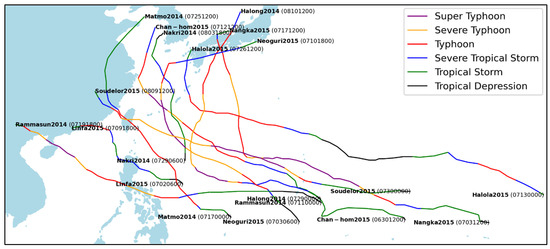
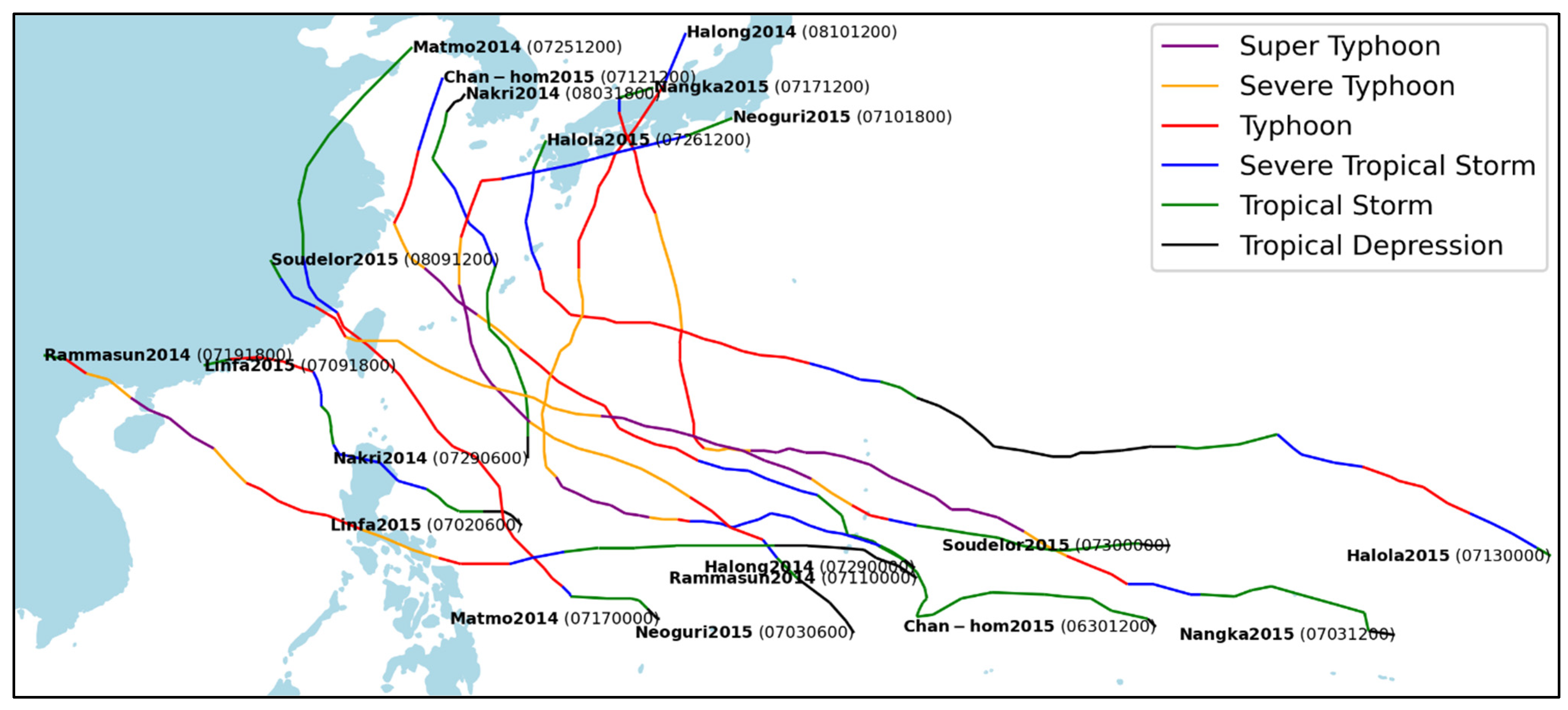
July 2015 experienced a strong El Niño, and 2014 experienced a weak El Niño, while 2011 and 2013 experienced weak La Niñas; 2010 and 2012 were in the transitional period between the two phases. As shown in Figure 10, the significant wave heights in 2011 and 2013 increased slightly; the maximum values were 1.5 m and 1.2 m, respectively. Similarly, there was a significant increase in wave height in 2014 and 2015, even though these were in the El Niño phase, with maximum values of approximately 1.6 m. This anomaly could be due to the impact of tropical cyclones in the study area. There were five tropical cyclones in both 2014 and 2015, three of which were super cyclones because of the impact of El Niño (Table 3). According to Ford [57], during El Niño phases, the formation region of tropical cyclones shifts south and east, with more cyclones forming closer to the equator and the dateline. In contrast, during La Niña events, the formation region moves north and west, with more cyclones forming in the subtropics southeast of Japan. El Niño phases tend to produce a greater number of strong tropical cyclones, while La Niña phases result in a greater number of weaker cyclones. Additionally, the report of tropical cyclones in 2015 by the Hong Kong Observatory [54] illustrates that the high number of super typhoons is partly due to the El Niño event, which caused above-normal sea surface temperatures in the central and eastern equatorial Pacific. This led to abnormal atmospheric circulation, displacing the breeding grounds of tropical cyclones further east. As a result, most tropical cyclones in 2015, including all 13 super typhoons, formed east of 140° E. These cyclones, moving west to northwest after formation, stayed over the ocean longer, increasing their chances of developing into super typhoons due to favorable conditions. All tropical cyclones formed as a tropical depression over the western North Pacific and moved north–northeastwards. They can affect the wind field in the SCS even though they may not move across the SCS. Most tropical cyclones moving across the SCS make landfall in northern Vietnam or southern China, so the study area was left in the tracks of tropical cyclones (Figure 11). Therefore, tropical cyclones caused strong winds in a southwesterly direction (Table 3) and then resulted in an increased significant wave height. Overall, tropical cyclones significantly enhanced wave height and energy potential during ENSO phases.
Figure 11.
Tropical cyclone tracks in 2014 and 2015 in the western North Pacific, with the names of tropical cyclones in the format Name Year (month–day–time), based on data from the Hong Kong Observatory [53,54].
4. Discussion
Vietnam’s national energy and marine development policies consistently emphasize a strong transition toward renewable energy as a key pillar of sustainable development, energy security, and green growth. This strategic direction is clearly articulated in several major policy documents, including Resolution No. 55-NQ/TW (2020) [23], Resolution No. 70-NQ/TW (2025) [25], Resolution No. 36-NQ/TW (2018) [26], and National Power Development Plan VIII (Decision No. 500/QĐ-TTg, 2023) [24].
Across these frameworks, a consistent long-term pathway for renewable energy development is established. Resolution No. 55-NQ/TW (2020) [23] sets the target that renewable energy will account for approximately 15–20% of total primary energy supply by 2030 and 25–30% by 2045. More recent policy updates, particularly Resolution No. 70-NQ/TW (2025) [25], further reinforce this ambition, targeting a renewable share of 25–30% by 2030. In the power sector, the National Power Development Plan VIII [24] projects a higher penetration level, with renewables expected to reach approximately 30.9–39.2% by 2030, and potentially up to 47% under scenarios supported by international cooperation mechanisms such as the Just Energy Transition Partnership (JETP). In the long term, renewables are projected to dominate the electricity mix, reaching approximately 67.5–71.5% by 2050.
In terms of policy orientation, Resolution No. 55-NQ/TW [23] and Resolution No. 70-NQ/TW [25] consistently prioritize renewable energy development as a substitute for fossil fuels. These resolutions not only prioritize the use of wind and solar energy and encourage development in regions and localities with comparative advantages, but also emphasize the need to conduct comprehensive research and assessment of potential, as well as to develop strategic orientations for geothermal, wave, tidal, and ocean current energy.
Resolution No. 36-NQ/TW (2018) [26] integrates renewable energy into Vietnam’s marine economic development strategy; emphasizes the prioritization of investment in basic research, scientific and technological research, and the training of marine human resources; and emphasizes offshore energy development, strengthening domestic technological capacity and developing energy infrastructure in island areas to support both economic growth and national security. It also highlights the importance of marine science, technology, and baseline surveys to support evidence-based planning and resource assessment. Decision No. 500/QĐ-TTg (2023) [24] builds on Resolution No. 36-NQ/TW (2018) [26], stating that electricity development must closely follow global trends in science and technology, particularly in renewable and new energy sources. It also highlights the need to align energy development with the country’s strategic shift toward a green, circular, and low-carbon economy.
Despite the global deployment and testing of various wave energy converters (WECs), Vietnam has not yet developed any pilot wave power plants or commercial wave farm projects. In addition to the high investment cost, one of the fundamental obstacles to this is the limited availability of detailed and reliable wave data for developers and stakeholders.
This study provides a national-scale overview of wave energy potential in Vietnam and identifies areas with high resource availability to support the strategic development of marine energy and to inform potential investors. Conducted at the national scale (Class 1), it serves as a foundational assessment for subsequent regional, provincial, and local studies (Class 2 and Class 3). In future work, the results can be downscaled through nesting within higher-resolution models to enable more detailed evaluation of wave energy potential at regional and local scales.
However, this study does not assess or select suitable wave energy converter (WEC) technologies based on the specific natural and economic conditions of each region, province, and coastal area in Vietnam. Currently, the authors are conducting a case study in Khanh Hoa Province to assess wave energy potential and propose appropriate WEC technologies that match local natural and economic conditions. The case study uses a finer-resolution SWAN model grid, nested within a 2.3 km parent grid. This aims to support strategies for the exploitation and sustainable development of marine renewable energy at the local level. Khanh Hoa Province was selected due to its long coastline, its location in the Southcentral Coast Region with significant wave energy potential, and its important role in regional economic development and security. In future work, this approach can be applied to other coastal areas, as well as extended to analyze the coastal protection potential of wave farms under extreme events or climate change impacts, as case studies in specific areas.
In terms of wave characteristics during ENSO events, the study period was twelve years (2007–2018), which is long enough for analyzing wave energy potential but still too short to assess the long-term impacts of climate variability. The two phases of ENSO, El Niño and La Niña, had different impacts on wave characteristics in specific events and trends, including monthly and annual significant wave height. However, to fully capture the effects of ENSO on wave characteristics, future work should extend the study period to cover multiple ENSO cycles in order to better observe variability and long-term patterns, including seasonal and interannual variations in wave behaviour.
5. Conclusions
This study presents wave-resource characterization in Vietnamese coastal waters using the high-resolution SWAN model based on hindcast datasets. A structured-grid SWAN model was used and validated against observed buoy data and ERA5 datasets from the ECWAM global model. The model used the WW3 wave parameters for the boundary conditions and forcing by ERA5 wind during the 12 year period 2007 to 2018.
Model validation results demonstrated good agreement between the high-resolution SWAN model and observations obtained from wave buoy data at a nearshore station and global wave model data at offshore and nearshore stations.
The wave parameters modeled, significant wave height, wave period, total wave energy and omnidirectional wave power, were found to vary both spatially and temporally.
This study is the first to assess wave energy potential along the entire Vietnamese coastline following the IEC-TS Class 1 standard at the national scale. The wave characteristics in the study area were strongly seasonal, with greater wave heights during the northeast monsoon. The values of wave energy resources in January are higher than in July. Similarly, those values are the highest in winter, followed in descending order by autumn, spring and summer. The southcentral coast of Vietnam seems to be the best location to harvest wave energy because it has the highest wave power resources overall during the year. However, further feasibility and design studies (Class 2 and Class 3) are needed before establishing wave farms. The Gulf of Tonkin and the Gulf of Thailand generally have a lower wave energy potential due to the wind distribution, shadowing effects and changes in water depth.
The results of this study serve as a foundational assessment for subsequent regional, provincial, and local studies (Class 2 and Class 3). In future work, the results can be downscaled through nesting within higher-resolution models to enable more detailed evaluation of wave energy potential at regional and local scales. Such studies should consider the full set of six IEC wave resource parameters: significant wave height, energy period, omnidirectional wave power, direction of maximum directionally resolved wave power, spectral width, and directionality coefficient, which are essential not only for comprehensive resource characterization but also for the design of wave energy converter (WEC) technologies. Additionally, future research should include the selection of suitable wave energy converter technologies and an evaluation of the coastal protection benefits provided by wave farms.
As well as strong seasonality, ENSO, with two main phases, El Niño and La Niña, had different impacts on the wave conditions. During an El Niño phase, the normal trade winds and the northeast and southwest monsoon winds become weaker, resulting in decreased significant wave height; generally, weaker winds produce smaller waves. In contrast, La Niña phases are characterized by stronger-than-normal trade winds and northeast and southwest monsoon winds in the western Pacific Ocean, resulting in increased significant wave height. Overall, ENSO phases impact wave conditions differently, with El Niño reducing and La Niña increasing wave power potential. Furthermore, tropical cyclones in July also significantly enhanced wave height and wave energy potential in both phases by producing strong winds.
Although this study assessed wave characteristics during ENSO phases, several limitations remain: (i) the analysis is limited to monthly and annual scales and does not fully capture seasonal and interannual variability; therefore, a longer study period is required in future work; (ii) a detailed quantitative assessment of wave energy during ENSO phases was not conducted for the study area; (iii) the study does not consider the influence of other climate modes, such as the Indian Ocean Dipole (IOD) and the Pacific Decadal Oscillation (PDO), nor their combined interactions with ENSO; (iv) future climate change scenarios were not included in the analysis; (v) the spatial scope is mainly restricted to the coastal waters of Vietnam, lacking a broader perspective over the entire South China Sea and finer-scale regional analyses (e.g., Southcentral or Southern Vietnam); and (vi) the selection and evaluation of wave energy converter (WEC) technologies have not been carried out in detail for specific local conditions.
Future work should address these limitations by extending the temporal coverage, incorporating multiple climate variability modes and climate change scenarios, expanding the spatial domain, and conducting detailed site-specific assessments and optimization of WEC technologies for practical applications.
Author Contributions
Conceptualization, T.T.D.N. and X.H.W.; methodology, T.T.D.N.; validation, T.T.D.N.; formal analysis, T.T.D.N.; data curation, T.T.D.N.; writing—original draft preparation, T.T.D.N.; writing—review and editing, T.T.D.N. and X.H.W.; visualization, T.T.D.N.; supervision, X.H.W. All authors have read and agreed to the published version of the manuscript.
Funding
This research received no external funding.
Data Availability Statement
Field measurements at the Vinh Truong station were collected under Contract No. 142/hd-tv2-p02 (dated 7 June 2012). This agreement between PECC2 and the IO covered the Subconsultant’s Services for Surveys and Investigation for the development of the Site Approval Dossier and the environmental impact assessment (EIA) of the Ninh Thuan 1 Nuclear Power Plant Project. Due to contractual confidentiality agreements, the underlying data cannot be made publicly accessible. Wave Watch III (WW3) datasets were sourced from the National Centers for Environmental Prediction (NCEP), developed by the Environmental Modeling Center (EMC), and are publicly available at https://polar.ncep.noaa.gov/waves/download2.shtml?, accessed on 24 April 2026. This study utilized ERA5 reanalysis datasets (ECMWF/C3S) and GEBCO_2023 bathymetric data. Both datasets are publicly accessible through the Copernicus Climate Data Store (https://cds.climate.copernicus.eu, accessed on 24 April 2026) and the GEBCO website (https://www.gebco.net, accessed on 24 April 2026), respectively.
Acknowledgments
This work is recorded as publication number 106 of the Sino-Australian Research Consortium for Coastal Management (previously the Sino-Australian Research Centre for Coastal Management). We gratefully acknowledge the support of the Australian Government through the Australia Awards Scholarship, which was instrumental in enabling this research. We also sincerely thank Le Dinh Mau and colleagues at the Institute of Oceanography (IO) for granting access to the Vinh Truong station observations. We acknowledge the data providers: NOAA/NCEP for the Wave Watch III (WW3) datasets, the ECMWF Copernicus Climate Change Service (C3S) for ERA5 reanalysis, and the General Bathymetric Chart of the Oceans (GEBCO) for the GEBCO_2023 bathymetric grid. We acknowledge the use of part of the study by Project IDs NVKN12.04/26-27 and VAST06.01/26-27, VAST. We would also like to express our sincere gratitude to Peter McIntyre for his valuable assistance with English language editing and proofreading and Nguyen Van Tuan (IO) for providing technical oversight for a part of the SWAN model input. The views and opinions expressed in this publication are solely those of the authors and do not necessarily represent the views of the Australian Government.
Conflicts of Interest
The authors declare no conflicts of interest.
Abbreviations
The following abbreviations are used in this manuscript:
| AWavEA | Australian Wave Energy |
| C3S | Copernicus Climate Change Service |
| ECMWF | European Centre for Medium-Range Weather Forecasts |
| ECWAM | ECMWF WAve Model |
| EIA | Environmental Impact Assessment |
| ENSO | El Niño–Southern Oscillation |
| EPRI | Electric Power Research Institute |
| ERA5 | ECMWF Reanalysis v5 |
| EVN | Vietnam Electricity |
| GEBCO | General Bathymetric Chart of the Ocean |
| HKO | Hong Kong Observatory |
| IEC-TS | International Electrotechnical Commission Technical Specification |
| IO | Institute of Oceanography |
| IOD | Indian Ocean Dipole |
| JMA | Japan Meteorological Agency |
| NCEP | National Centers for Environmental Prediction |
| NOAA | National Oceanic and Atmospheric Administration |
| NWW3 | NOAA Wave Watch III |
| ONI | Ocean Niño Index |
| PDO | Pacific Decadal Oscillation |
| PECC2 | Power Engineering Consulting JSC 2 |
| SCS | South China Sea |
| SWAN | Simulating WAves Nearshore Model |
| WAM | WAve Model |
| WEC | Wave Energy Converter |
| WW3 | Wave Watch III Model |
Appendix A. Wave Rose and Wind Rose for VT and O1–O9 Stations
Figure A1.
Wave rose for VT and O1–O9 stations.
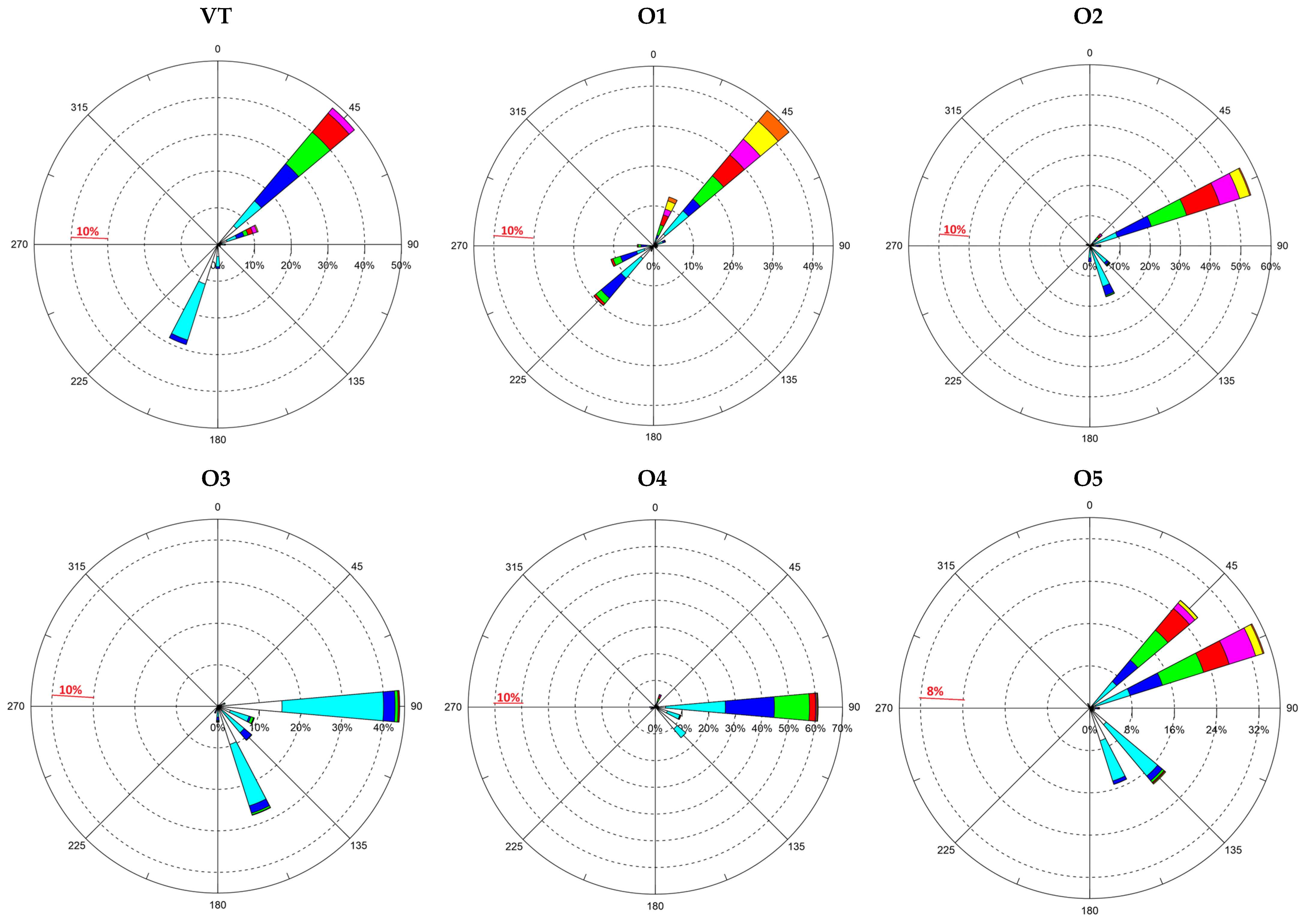
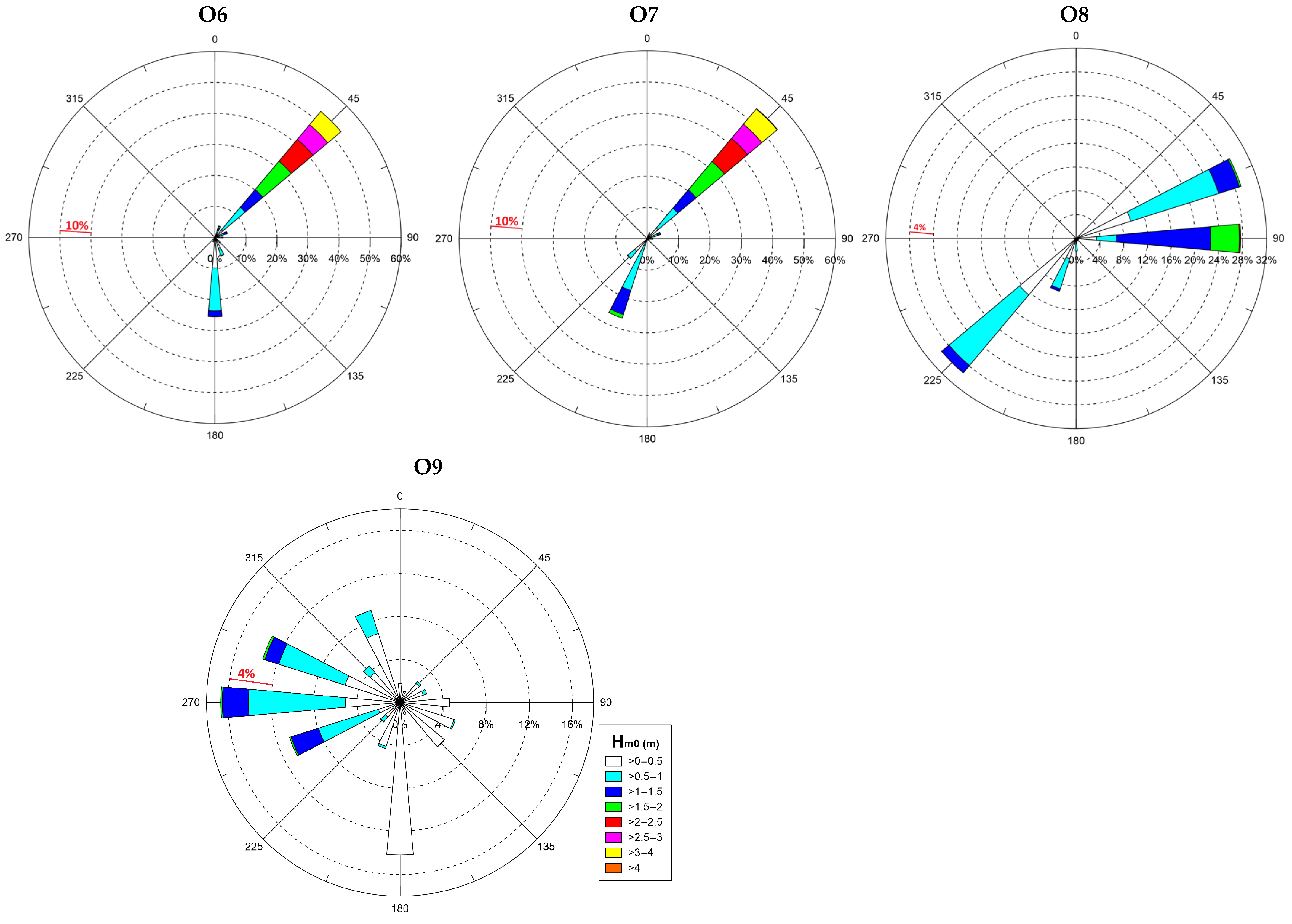
Figure A2.
Wind rose for VT and O1–O9 stations.
References
- Mo̸rk, G.; Barstow, S.; Kabuth, A.; Pontes, M.T. Assessing the global wave energy potential. In Proceedings of the ASME 29th International Conference on Ocean, Offshore and Arctic Engineering, Shanghai, China, 6–11 June 2010; Volume 3, pp. 447–454. [Google Scholar] [CrossRef] [Scilit]
- Wiatros-Motyka, M.; Jones, D.; Broadbent, H.; Fulghum, N.; Dizon, R.; Macdonald, P. Global Electricity Mid-Year Insights; Ember: London, UK, 2022. [Google Scholar]
- Ahn, S.; Haas, K.A.; Neary, V.S. Dominant wave energy systems and conditional wave resource characterization for coastal waters of the United States. Energies 2020, 13, 3041. [Google Scholar] [CrossRef] [Scilit]
- MAllahdadi, M.N.; Gunawan, B.; Lai, J.; He, R.; Neary, V.S. Development and validation of a regional-scale high-resolution unstructured model for wave energy resource characterization along the US East Coast. Renew. Energy 2019, 136, 500–511. [Google Scholar] [CrossRef] [Scilit]
- Wu, W.C.; Wang, T.; Yang, Z.; García-Medina, G. Development and validation of a high-resolution regional wave hindcast model for U.S. West Coast wave resource characterization. Renew. Energy 2020, 152, 736–753. [Google Scholar] [CrossRef] [Scilit]
- García-Medina, G.; Yang, Z.; Wu, W.C.; Wang, T. Wave resource characterization at regional and nearshore scales for the U.S. Alaska coast based on a 32-year high-resolution hindcast. Renew. Energy 2021, 170, 595–612. [Google Scholar] [CrossRef] [Scilit]
- Yang, Z.; Medina, G.G.; Neary, V.S.; Ahn, S.; Kilcher, L.; Bharath, A. Multi-decade high-resolution regional hindcasts for wave energy resource characterization in U.S. coastal waters. Renew. Energy 2023, 212, 803–817. [Google Scholar] [CrossRef] [Scilit]
- Hughes, M.G.; Heap, A.D. National-scale wave energy resource assessment for Australia. Renew. Energy 2010, 35, 1783–1791. [Google Scholar] [CrossRef] [Scilit]
- Hemer, M.A.; Griffin, D.A. The wave energy resource along Australia’s Southern margin. J. Renew. Sustain. Energy 2010, 2, 043108. [Google Scholar] [CrossRef] [Scilit]
- Hemer, M.A.; Zieger, S.; Durrant, T.; O’GRady, J.; Hoeke, R.K.; McInnes, K.L.; Rosebrock, U. A revised assessment of Australia’s national wave energy resource. Renew. Energy 2017, 114, 85–107. [Google Scholar] [CrossRef] [Scilit]
- Liang, B.; Fan, F.; Liu, F.; Gao, S.; Zuo, H. 22-Year wave energy hindcast for the China East Adjacent Seas. Renew. Energy 2014, 71, 200–207. [Google Scholar] [CrossRef] [Scilit]
- Wang, Z.; Duan, C.; Dong, S. Long-term wind and wave energy resource assessment in the South China sea based on 30-year hindcast data. Ocean Eng. 2018, 163, 58–75. [Google Scholar] [CrossRef] [Scilit]
- Neill, S.P.; Vögler, A.; Goward-Brown, A.J.; Baston, S.; Lewis, M.J.; Gillibrand, P.A.; Waldman, S.; Woolf, D.K. The wave and tidal resource of Scotland. Renew. Energy 2017, 114, 3–17. [Google Scholar] [CrossRef] [Scilit]
- UK Renewables Atlas, (n.d.). Available online: http://www.renewables-atlas.info (accessed on 28 April 2023).
- EPRI. Mapping and Assessment of the United States Ocean Wave Energy Resource; EPRI 2011 Technical Report to U.S. Department of Energy; EPRI: Palo Alto, CA, USA, 2011. [Google Scholar]
- IEC TS 62600-101 Version 2.0; Marine Energy—Wave, Tidal and Other Water Current Converters—Part 101: Wave Energy Resource Assessment and Characterization. ANSI: Washington, DC, USA, 2024.
- CSIRO Oceans and Atmosphere. The Australian Wave Energy Atlas Project Overview and Final Report; CSIRO: Black Mountain, ACT, Australia, 2018.
- Kilcher, L.; Thresher, R. Marine Hydrokinetic Energy Site Identification and Ranking Methodology Part I: Wave Energy (No. NREL/TP-5000-66038); NREL: Applewood, CO, USA, 2016. [Google Scholar] [CrossRef] [Scilit]
- Lin, G.; Shao, L.T.; Zheng, C.W.; Bin Chen, X.; Zeng, L.F.; Liu, Z.H.; Li, R.B.; Shi, W.L. Assessment of wave energy in the South China sea based on GIS technology. Adv. Meteorol. 2017, 2017, 572. [Google Scholar] [CrossRef] [Scilit]
- Jiang, B.; Wu, G.; Ding, J.; Ma, C.; Fang, Y.; Wang, X. Assessment of the wave energy resource in the South China Sea. Proc. Inst. Civ. Eng. Marit. Eng. 2019, 172, 23–33. [Google Scholar] [CrossRef] [Scilit]
- Yang, S.; Fan, L.; Duan, S.; Zheng, C.; Li, X.; Li, H.; Xu, J. Long-term assessment of wave energy in the China Sea using 30-year hindcast data. Energy Explor. Exploit. 2020, 38, 37–56. [Google Scholar] [CrossRef] [Scilit]
- Dan so, Dan so Viet Nam. 2023. Available online: https://danso.org/viet-nam/ (accessed on 28 April 2023).
- Thu Vien Phap luat, Nghị quyết số 55-NQ/TW-Resolution No.55-NQ/TW. 2020. Available online: https://thuvienphapluat.vn/van-ban/Tai-nguyen-Moi-truong/Nghi-quyet-55-NQ-TW-2020-dinh-huong-Chien-luoc-phat-trien-nang-luong-quoc-gia-cua-Viet-Nam-435381.aspx (accessed on 14 February 2026).
- Tu lieu van kien Dang cong san. Quy hoạch điện VIII—Quyết định số 500/QĐ-TTg—The National Power Development Plan VIII Decision No. 500/QĐ-TTg. 2023. Available online: https://tulieuvankien.dangcongsan.vn/he-thong-van-ban/van-ban-quy-pham-phap-luat/quyet-dinh-so-500qd-ttg-ngay-1552023-cua-thu-tuong-chinh-phu-phe-duyet-quy-hoach-phat-trien-dien-luc-quoc-gia-thoi-ky-2021-9456 (accessed on 8 April 2026).
- Thu Vien Phap luat, Nghị quyết số 70-NQ/TW-Resolution No.70-NQ/TW. 2025. Available online: https://thuvienphapluat.vn/van-ban/Tai-nguyen-Moi-truong/Nghi-quyet-70-NQ-TW-2025-bao-dam-an-ninh-nang-luong-quoc-gia-den-2030-tam-nhin-2045-671390.aspx (accessed on 14 February 2026).
- Tu lieu van kien Dang cong san. Nghị quyết số 36-NQ/TW- Resolution No. 36-NQ/TW. 2018. Available online: https://tulieuvankien.dangcongsan.vn/van-kien-tu-lieu-ve-dang/hoi-nghi-bch-trung-uong/khoa-xii/nghi-quyet-so-36-nqtw-ngay-22102018-hoi-nghi-lan-thu-tam-ban-chap-hanh-trung-uong-dang-khoa-xii-ve-chien-luoc-phat-trien-ben-3453 (accessed on 8 April 2026).
- Le, D.D.; Du, V.T.; Van Nguyen, C.; Do, T.H. Ocean wave energy in the world and the proposals for research and development in the Vietnamese sea. J. Clim. Change 2017, 2, 105–111. [Google Scholar]
- Nguyen, M.H.; Duong, C.D. Wave Energy in the South China Sea and Vietnam’s Waters; VAST: Hanoi, Vietnam, 2009. [Google Scholar]
- VNU-UET University of Technology, Ocean Wave Energy Converter, (n.d.). Available online: https://uet.vnu.edu.vn/thiet-bi-chuyen-doi-nang-luong-song-bien/ (accessed on 1 March 2023).
- Le, M.D.; Vlasova, G.; Nguyen, D.T.T. Distribution features of the typhoons in the South China Sea. Russ. J. Earth Sci. 2021, 21, ES1001. [Google Scholar] [CrossRef] [Scilit]
- Booij, N.; Ris, R.C.; Holthuijsen, L.H. A third-generation wave model for coastal regions 1. Model description and validation. J. Geophys. Res. Ocean. 1999, 104, 7649–7666. [Google Scholar] [CrossRef] [Scilit]
- SWAN, User Manual: SWAN Cycle III Version 41.45, 2023. Available online: http://www.swan.tudelft.nl (accessed on 29 September 2024).
- Wang, X.H.; Elahi, W.M.E. Influence of Wave–Current Interaction on a Cyclone-Induced Storm-Surge Event in the Ganges-Brahmaputra-Meghna Delta: Part 2—Effects on Wave. J. Mar. Sci. Eng. 2023, 11, 298. [Google Scholar] [CrossRef] [Scilit]
- Shi, X.; Li, S.; Liang, B.; Zhao, J.; Liu, Y.; Wang, Z. Numerical study on the impact of wave-current interaction on wave energy resource assessments in Zhoushan sea area, China. Renew. Energy 2023, 215, 119017. [Google Scholar] [CrossRef] [Scilit]
- Tolman, H.L.; Balasubramaniyan, B.; Burroughs, L.D.; Chalikov, D.V.; Chao, Y.Y.; Chen, H.S.; Gerald, V.M. Development and Implementation of Wind-Generated Ocean Surface Wave Models at NCEP. Weather Forecast. 2002, 17, 311–333. [Google Scholar] [CrossRef] [Scilit]
- The WAVEWATCH III R Development Group (WW3DG). User Manual and System Documentation of WAVEWATCH III R Version 6.07; NOAA/NWS/NCEP/MMAB: College Park, MD, USA, 2019. [Google Scholar]
- Hersbach, H.; Bell, B.; Berrisford, P.; Biavati, G.; Horányi, A.; Muñoz Sabater, J.; Nicolas, J.; Peubey, C.; Radu, R.; Rozum, I.; et al. ERA5 Hourly Data on Single Levels from 1940 to Present; Copernicus Climate Change Service: Bonn, Germany, 2023. [Google Scholar] [CrossRef]
- Liu, J.; Li, R.; Li, S.; Meucci, A.; Young, I.R. Increasing wave power due to global climate change and intensification of Antarctic Oscillation. Appl. Energy 2024, 358, 122572. [Google Scholar] [CrossRef] [Scilit]
- Odériz, I.; Silva, R.; Mortlock, T.R.; Mori, N. El Niño-Southern Oscillation Impacts on Global Wave Climate and Potential Coastal Hazards. J. Geophys. Res. Ocean. 2020, 125, e2020JC016464. [Google Scholar] [CrossRef] [Scilit]
- Wang, B.; Wu, R.; Fu, X. Pacific-East Asian Teleconnection: How Does ENSO Affect East Asian Climate? J. Clim. Am. Meteorol. Soc. 2000, 13, 1516–1536. [Google Scholar] [CrossRef] [Scilit]
- Mirzaei, A.; Tangang, F.; Juneng, L.; Mustapha, M.A.; Husain, M.L.; Akhir, M.F. Wave climate simulation for southern region of the South China Sea. Ocean Dyn. 2013, 63, 961–977. [Google Scholar] [CrossRef] [Scilit]
- Ocean Niño Index, Cold & Warm Episodes by Season, (n.d.). Available online: https://www.cpc.ncep.noaa.gov/products/analysis_monitoring/ensostuff/ONI_v5.php (accessed on 13 July 2024).
- McPhaden, M.J.; Zebiak, S.E.; Glantz, M.H. ENSO as an Integrating Concept in Earth Science. Science 2006, 314, 1740–1745. [Google Scholar] [CrossRef] [Scilit]
- Lian, T.; Ying, J.; Ren, H.L.; Zhang, C.; Liu, T.; Tan, X.X. Effects of tropical cyclones on ENSO. J. Clim. 2019, 32, 6423–6443. [Google Scholar] [CrossRef] [Scilit]
- Hong Kong Observatory. Tropical Cyclones in 2007. 2008. Available online: https://www.hko.gov.hk/en/publica/tc/files/TC2007.pdf (accessed on 10 April 2026).
- Hong Kong Observatory. Tropical Cyclones in 2008. 2009. Available online: https://www.hko.gov.hk/en/publica/tc/files/TC2008.pdf (accessed on 10 April 2026).
- Hong Kong Observatory. Tropical Cyclones in 2009. 2010. Available online: https://www.hko.gov.hk/en/publica/tc/files/TC2009.pdf (accessed on 10 April 2026).
- Hong Kong Observatory. Tropical Cyclones in 2011. 2012. Available online: https://www.hko.gov.hk/en/publica/tc/files/TC2011.pdf (accessed on 13 August 2024).
- Hong Kong Observatory. Tropical Cyclones in 2012. 2013. Available online: https://www.hko.gov.hk/en/publica/tc/files/TC2012.pdf (accessed on 13 August 2024).
- Hong Kong Observatory. Tropical Cyclones in 2010. 2011. Available online: https://www.hko.gov.hk/en/publica/tc/files/TC2010.pdf (accessed on 13 August 2024).
- Hong Kong Observatory. Tropical Cyclones in 2016. 2017. Available online: https://www.hko.gov.hk/en/publica/tc/tc2016/index.htm (accessed on 13 August 2024).
- Hong Kong Observatory. Tropical Cyclones in 2013. 2014. Available online: https://www.hko.gov.hk/en/publica/tc/files/TC2013.pdf (accessed on 13 August 2024).
- Hong Kong Observatory. Tropical Cyclones in 2014. 2015. Available online: https://www.hko.gov.hk/en/publica/tc/tc2014/index.htm (accessed on 13 August 2024).
- Hong Kong Observatory. Tropical Cyclones in 2015. 2016. Available online: https://www.hko.gov.hk/en/publica/tc/tc2015/index.htm (accessed on 13 August 2024).
- Hong Kong Observatory. Tropical Cyclones in 2017. 2018. Available online: https://www.hko.gov.hk/en/publica/tc/files/TC2017.pdf (accessed on 10 April 2026).
- Hong Kong Observatory. Tropical cyclones in 2018. 2019. Available online: https://www.hko.gov.hk/en/publica/tc/files/TC2018.pdf (accessed on 10 April 2026).
- Ford, B.W. El Nino and La Nina Effects on Tropical Cyclones: The Mechanisms. Master’s Thesis, Naval Postgraduate School, Monterey, CA, USA, 2000. [Google Scholar]

Disclaimer/Publisher’s Note: The statements, opinions and data contained in all publications are solely those of the individual author(s) and contributor(s) and not of MDPI and/or the editor(s). MDPI and/or the editor(s) disclaim responsibility for any injury to people or property resulting from any ideas, methods, instructions or products referred to in the content. |
© 2026 by the authors. Licensee MDPI, Basel, Switzerland. This article is an open access article distributed under the terms and conditions of the Creative Commons Attribution (CC BY) license.