Article

Isotopic Disequilibrium Between Migmatites and Protolith: Insights from a Variscan Anatectic Complex (NW of Iberian Variscan Belt, Portugal)


by
Joana Alexandra Ferreira
1,
Helena C. B. Martins
1,*,
Maria dos Anjos Ribeiro
1 and
José Francisco dos Santos
2
1
Institute of Earth Sciences–Porto Pole, Department of Geosciences, Environment and Spatial Planning, Faculty of Sciences, University of Porto, Rua do Campo Alegre s/n, 4169-007 Porto, Portugal
2
GeoBioTec, Departamento de Geociências, Universidade de Aveiro, 3810-193 Aveiro, Portugal
*
Author to whom correspondence should be addressed.
Geosciences 2026, 16(4), 152; https://doi.org/10.3390/geosciences16040152
Submission received: 30 January 2026 / Revised: 28 March 2026 / Accepted: 2 April 2026 / Published: 8 April 2026
(This article belongs to the Section Geochemistry)

Abstract

Isotopic disequilibrium during the formation of high-temperature (HT) metamorphic complexes by anatexis during continental collision is a process that deserves intense discussion since it is fundamental to understand the evolution of continental crust. The axial sector of the Iberian Variscan Belt (IVB) is known by the profusion of synorogenic granites that are sometimes clearly associated with the migmatites composing the HT metamorphic complexes. The Pedregal Migmatitic Complex is located in the autochthonous domain of the IVB and is composed of metatexites and diatexites associated to syntectonic two-mica granites. The anatectic process occurred by dehydration melting of muscovite and biotite with the growth of peritectic minerals such as garnet, K-feldspar, and sillimanite in metatexites; and K-feldspar, sillimanite, and hercynite in diatexites reaching the metamorphic peak at 313.5 ± 0.5 Ma. A process of residuum-melt separation during crustal melting is attested by the Pedregal migmatites, giving origin to metatexites and residual diatexites as indicated by field evidence and their geochemical signature. Zircon oxygen isotopes and inherited zircon ages point to the Douro-Beiras Supergroup metasedimentary sequence (Beiras group) as a possible protolith of the Pedregal diatexites. Conversely, the isotopic composition of the diatexites suggests isotopic disequilibrium caused by residual mineral phases (biotite, monazite and garnet).

1. Introduction

Continental collision during an orogenic cycle leads to crustal thickening which repeatedly suffers episodes of intense deformation, high-temperature metamorphism, and crustal anatexis (e.g., Variscan and Alpine orogenies). Therefore, orogenesis and crustal anatexis are closely associated conducting to the arise of high-grade areas of many metamorphic belts and metamorphic core complexes in large areas of exposed deep continental crust, but also in low-pressure–high-temperature (LP-HT) metamorphic areas such as the inner parts of contact metamorphic aureoles [1]. In many cases, high-temperature metamorphic complexes are petrogenetically related to granites generated from large volumes of anatectic magma produced during the late stages of orogenic evolution [2,3].
Anatexis involves partial melting of crustal rocks and produces high-temperature metamorphic rocks known as migmatites. Partial melting during high-grade metamorphism typically begins in metapelitic or metapsammitic protoliths at temperatures of ~650–700 °C in the presence of H2O (fluid-present melting reactions). With increasing temperature during prograde metamorphism, free H2O becomes limited, and partial melting proceeds through incongruent fluid-absent reactions involving dehydration melting of hydrous minerals such as muscovite, biotite, and hornblende [4,5]. Migmatites are commonly classified as metatexites or diatexites based on morphology, temperature conditions, degree of partial melting, and melt fraction. Metatexites represent lower degrees of partial melting and are characterized by the dominance of paleosome and mesosome (unmelted material) relative to neosome (newly formed material), resulting in compositions close to the protolith. In contrast, diatexites form at higher temperatures and melt fractions, where neosome dominates and the rock develops a more homogeneous, igneous-like texture [5,6].
During the late stage of the Variscan orogenic cycle, several HT terranes exhumed along the Variscan Belt in different places such as the Appalachian terrains [4], the Armorican massif [5], the French Massif Central [6,7], the Bohemian massif [8], and in the Iberian massif [9,10,11,12,13,14,15]. In the Iberian Variscan Belt (IVB), particularly within the northern autochthonous domain, several anatectic complexes are characterized by the association of gneiss–migmatite rocks and Variscan S-type granites. These complexes are interpreted to result from partial melting of the autochthonous metasedimentary sequence that hosts them (i.e., the Douro-Beiras Supergroup), from which they inherit their radiogenic isotopic composition. Consequently, anatectic rocks are expected to display isotopic compositions similar to those of their protoliths [14,16,17]. However, isotopic variability can be observed among the rocks of an anatectic complex and their protoliths and this may reflect melting disequilibrium related to the mineral phases involved in melting reactions [18,19,20,21]. In the IVB, Barbero et al. (1995) [22] first proposed isotopic disequilibrium during crustal melting via fluid–absent reactions for the anatectic granitoids of the Variscan Anatectic Complex of Toledo (Spain).
The Pedregal Migmatitic Complex is one of the anatectic complexes within the high-temperature metamorphic domains of the IVB. The main objective of this study is to characterize this complex using integrated petrological (field relationships and macro-/microscopic features), geochemical (whole-rock and rutile geochemistry; oxygen isotopes in zircon), and geochronological (U–Pb zircon ages) data. These results aim to constrain the petrogenesis of the complex within the IVB framework. Additionally, this study investigates whether isotopic disequilibrium during partial melting explains the Sr–Nd isotopic variability observed between the Pedregal migmatites and their protoliths and evaluates the role of melting reactions and mineral phases on generating this variability.

2. Geological Setting, Lithological Descriptions, and Field Relationships

The Iberian massif is the westernmost European terrain that exposes the Variscan Orogen. In the Central lberian Zone (CIZ), three main phases of deformation were recognized (D1, D2 and D3). The early-D3 phase in the CIZ is responsible for the beginning of the migmatization and LP-HT metamorphism, which continued during the D3 phase and culminated with the emplacement of S-type syntectonic granites [23,24,25]. The innermost part of the Iberian massif, the CIZ (Figure 1a), exposes the Douro–Beiras Supergroup, which is a metapelitic sequence that represents a major part of the autochthonous domain with an Ediacarian–Cambrian age [26]. The Douro–Beiras Supergroup is divided into the Douro and Beiras groups, which occupy the northern and southern parts of the CIZ, respectively. Both groups comprise stratigraphic sequences with an alternation of metapelites and greywackes, but the presence of calc–silicate rocks in the Douro Group is more frequent than in the Beiras Group [27]).
The Porto–Viseu metamorphic belt is a Variscan structure located in the CIZ, limited to the NNE and SSW by the Douro–Beiras and the Porto–Tomar shear zones, respectively [28]. This metamorphic belt is characterized by the presence of syntectonic granites in the core associated with the LP-HT migmatites, and a condensed metamorphic zoning with a syn-D3 thermal peak showing an orogenic metamorphism with a strong thermal anomaly [29].
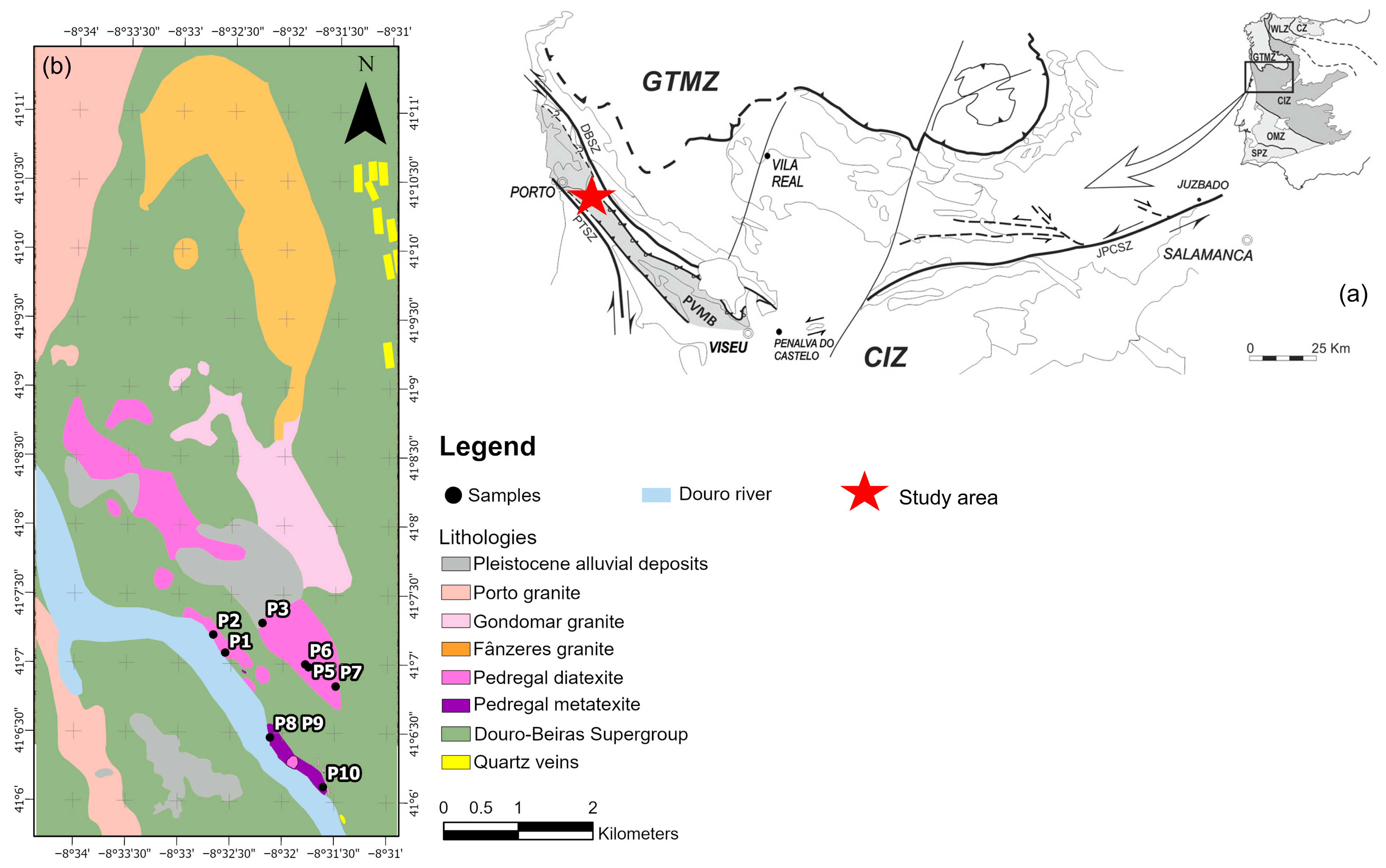
At NW of the Porto–Viseu belt, specifically in the eastern border of the Porto metropolitan area, occurs the Pedregal Migmatitic Complex (PMC) (Figure 1b). The PMC comprises a small, elongated diatexitic body (appoximately 3 km2) [13] and metatexitic rocks hosted by staurolite micaschists belonging to the Douro–Beiras Supergroup [30]. Synorogenic granites are spatially associated with the migmatitic complex. These include the Porto granite, a medium-grained two-mica granite with a zircon/monazite age of 306 ± 7 Ma [31]; the Gondomar granite, a coarse-grained tourmaline-rich granite; and the Fânzeres granite, a foliated garnet-rich granite with a Rb-Sr age of 332 ± 11 Ma [32].
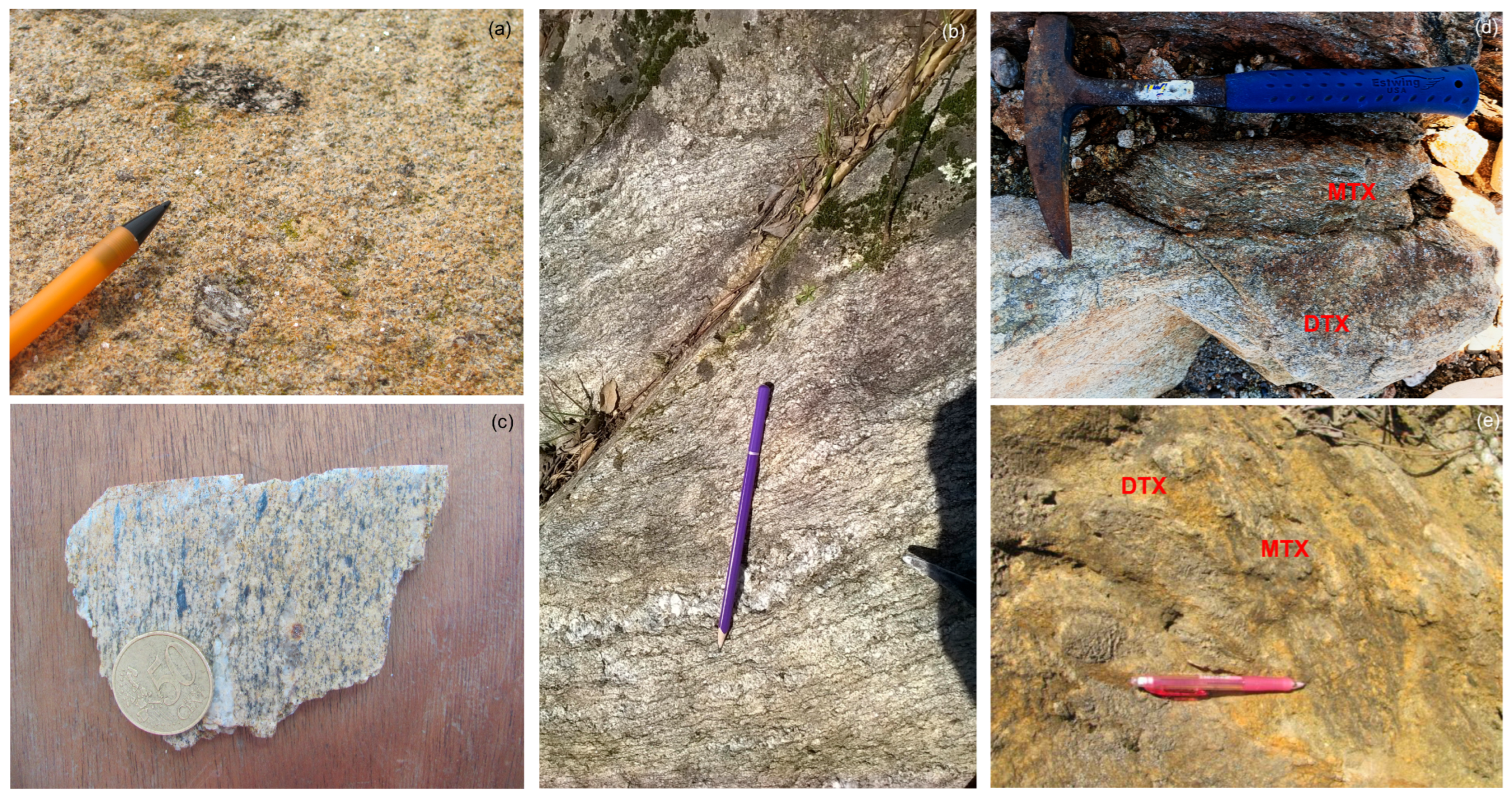
The Pedregal diatexites have a homogeneous, igneous appearance and a fine-to-medium-grained texture. They contain small biotitic nodules/schlieren structures (1–2 cm), which exhibit internal foliation ranging in direction from NE–SW to E–W (Figure 2a).
This trend is opposite to regional NW-SE metamorphic structure of the staurolitic micaschists and to the elongation of the main diatexitic body. The diatexites also expose inclusions of metasedimentary enclaves.
In the border of the diatexitic outcrops appear banded gneiss–migmatite rocks with metatexitic aspect. These banded rocks show a stromatic texture predominantly defined by unfoliated quartz–feldspathic leucosomes alternating with pre-partial melting structures composed by micaceous paleosomes (Figure 2b). The orientation of this compositional layering is N100° to N130°, subvertical in concordance with diatexitic elongation and the foliation of the host micaschists. The metatexites show crystals of garnet intergrowth with quartz in the quartz–feldspathic leucosomes (Figure 2c).
The contact between the two types of migmatite is sharp (Figure 2d), as the transition from metatexite to diatexite is abrupt. Locally, this contact is marked by breccia-like structures containing clasts of metatexite within a diatexitic matrix. These structures are also known as agmatite (Figure 2e).

3. Petrography

3.1. Diatexite

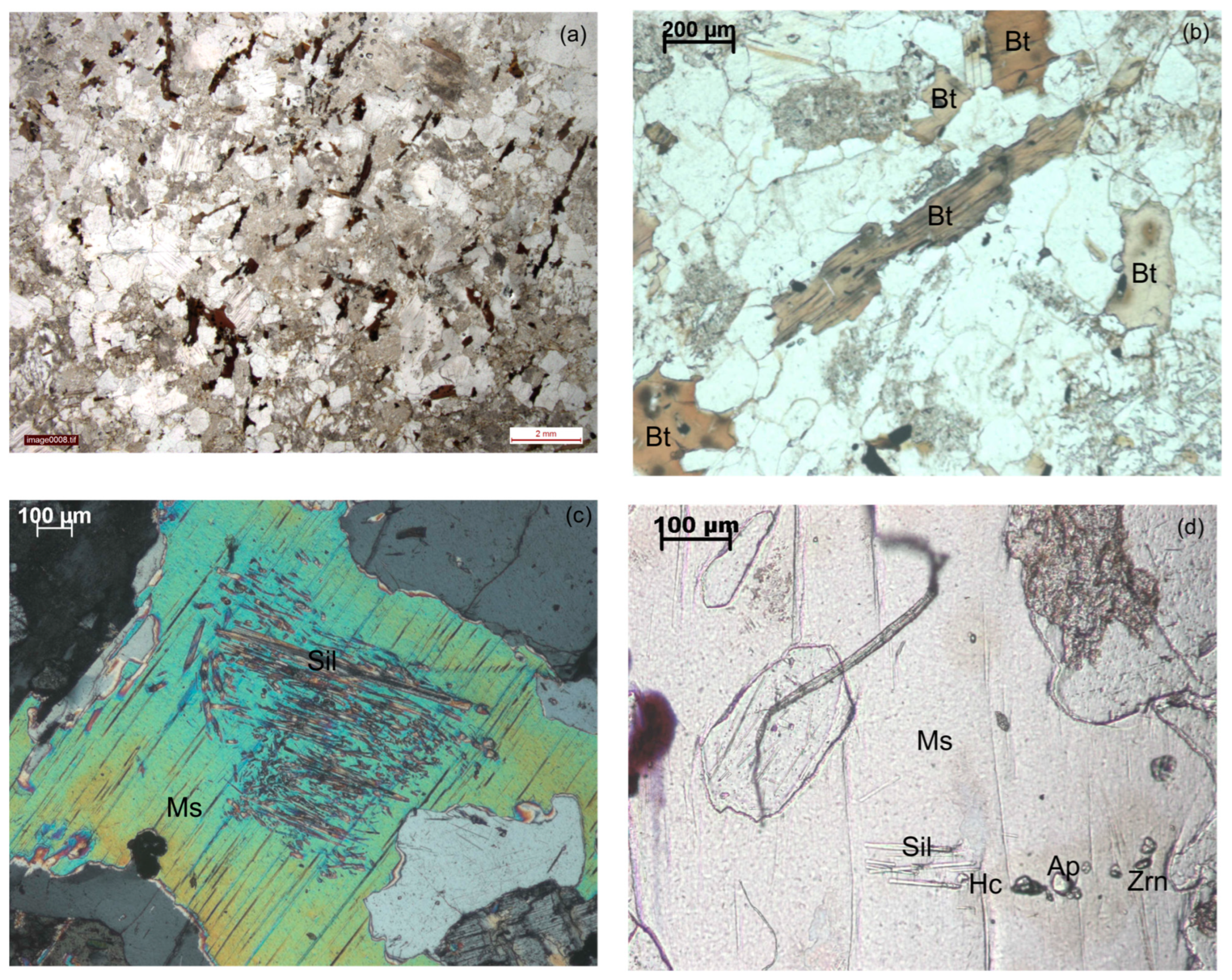
The Pedregal diatexite exhibits a granoblastic texture (Figure 3a) where the large crystals of muscovite stand out. The mineral assemblage of the diatexite is quartz + plagioclase + K-feldspar + biotite + muscovite + zircon + apatite + monazite + rutile ± sillimanite ± allanite ± Zn-rich hercynite.
The elongated and corroded biotite crystals define a preferential alignment, as evidenced by their shape anisotropy and homogeneous distribution (Figure 3b). The biotite–quartz and biotite–plagioclase intergranular boundaries indicate textural disequilibrium, suggesting that biotite may be a residual phase. The subhedral biotite crystals are often chloritized and contain small zircon and rutile needle-like inclusions. Small grains of unaltered biotite are included in subhedral muscovite. In the small nodules, the biotite is subhedral and less corroded than the elongated crystals. These nodules exhibit compositional banding characterised by the presence of biotite and secondary muscovite.
The quartz is subhedral to anhedral, and when included in other minerals such as muscovite and plagioclase, it takes the form of droplets. Quartz crystals frequently show inclusions of sillimanite and rutile needles. Besides the rutile needles, rutile also occurs in the matrix as isolated grains with euhedral to subhedral shape.
Regarding the feldspars, K-feldspar has greater dimensions, but plagioclase is more abundant. Plagioclase crystals are subhedral, and their polysynthetic twinning is usually obliterated by muscovite (muscovitization).
The muscovite has a secondary/retrograde character (Figure 3c), distinguishing two types: a subhedral muscovite, which shows irregular borders and quartz droplet inclusions, and a euhedral muscovite, with anomalous birefringence. Both types of muscovite have zircon, sillimanite, and hercynite inclusions (Figure 3d).

3.2. Metatexite

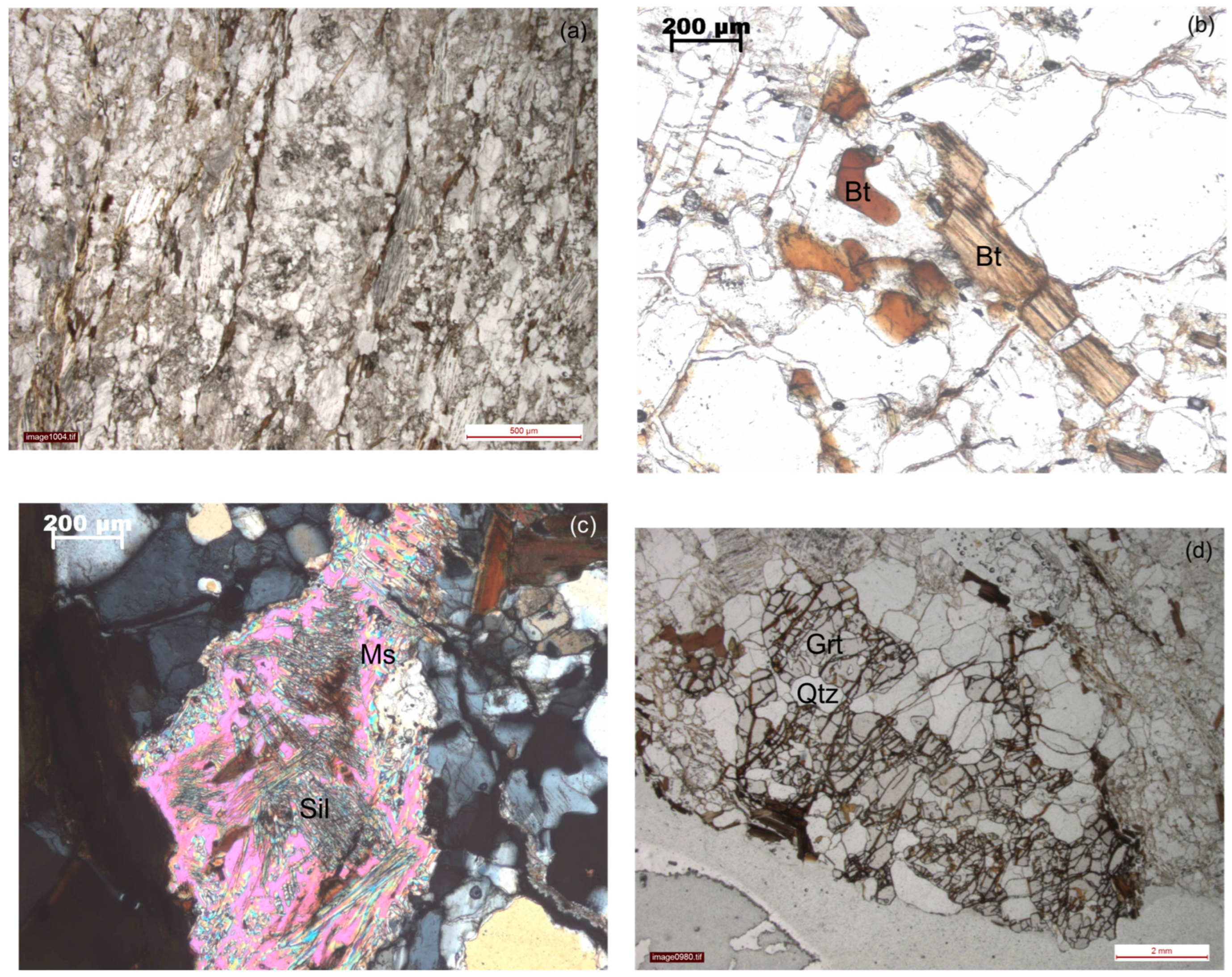
Metatexitic rocks show a granolepidoblastic and heterogranular medium-grained texture (Figure 4a). The mineral assemblage consists of quartz + plagioclase + K-feldspar + biotite + muscovite + garnet. The biotite and muscovite define an alignment and a preferential orientation. In these rocks are also visible a compositional banding defined by the scarce micaceous bands (melanosome) and the predominant quartz–feldspathic bands, where the quartz–K-feldspar–plagioclase association is observed (leucosome).
Two generations of subhedral biotite are founded in the metatexites (Figure 4b), a first generation that shows a light brown colour and a second generation with reddish brown colour, typically an igneous biotite crystallized from residual melt. Sometimes, the biotite crystals show inclusions of rutile needles and a slight chloritization.
The subhedral muscovite grow occurs conditioned by the other minerals showing its secondary/retrograde character and frequently having inclusions of sillimanite (Figure 4c).
In general, the quartz grains are subhedral, but when they are included in the plagioclase and K-feldspar, they show a rounded shape. The garnet occurs occasionally in large crystals intergrowing with quartz (Figure 4d).

4. Analythical Methods

4.1. Whole-Rock Geochemistry

The whole-rock geochemistry analyses were conducted in the Activation Lab (Activation Laboratories Ltd., Ancaster, ON, Canada) in order to determine the major and trace element composition. The selected analytical package was 4Litho (11+) Major Elements Fusion ICP (WRA)/Trace Elements Fusion ICP/MS (WRA4B2). This package include the following trace elements analyses: Sc, Be, V, Ba, Sr, Y, Zr, Cr, Co, Ni, Cu, Zn, Ga, Ge, As, Rb, Nb, Mo, Ag, In, Sn, Sb, Cs, La, Ce, Pr, Nd, Sm, Eu, Gd, Tb, Dy, Ho, Er, Tm, Yb, Lu, Hf, Ta, W, Tl, Pb, Bi, Th, U (Table 1). Lithogeochemical analyses required lithium metaborate/tetraborate fusion, followed by inductively coupled plasma mass spectrometry (FUS-ICP-MS). Fused sample is diluted and analyzed by Perkin Elmer Sciex ELAN 6000, 6100, or 9000 ICP/MS. Three blanks and five controls (three before sample group and two after) are analyzed per group of samples. Duplicates are fused and analyzed every 15 samples. Instrument is recalibrated every 40 samples (http://www.actlabs.com/). The geochemical diagrams containing whole-rock geochemical data were created using the open-source software GCDkit (version 4.1.3) [33].

4.2. Isotopic (Sr-Nd) Geochemistry

The isotopic Sr-Nd signatures were determined in the Laboratory of Isotope Geology of the University of Aveiro (Portugal) for five samples of Pedregal diatexite and three samples of metatexite. After the sample dissolution, the target elements were purified using ion chromatography at two stages: (1) separation of Sr and REE on a cation exchange column with AG8 50 W Bio-Rad resin and (2) purification of Nd relative to the other lanthanides with Ln Resin (EiChrom Technologies) columns. The values of 87Sr/86Sr and 143Nd/144Nd were obtained using thermal ionization mass spectrometer VG Sector 54. The isotopic ratios were corrected for mass fractionation considering 88Sr/86Sr = 0.1194 and 146Nd/144Nd = 0.7219. During this study, the SRM 987 and the JNdi-1 standards gave average values of 87Sr/86Sr = 0.710263(16) (N = 14; conf.lim = 95%) and 143Nd/144Nd = 0.5121030(68) (N = 13; conf.lim = 95%). The Rb and Sr concentrations of the samples with higher Rb/Sr ratios were determined by isotopic dilution using a spike of 87Rb/84Sr.

4.3. Rutile Geochemistry

Twenty-five rutile grains of a Pedregal diatexite sample (P2) were analysed on a mount to obtain trace elements compositions.
Selected capsules in which large areas of crystal-free glass were observed were used for in situ trace element determinations by laser ablation inductively coupled plasma mass spectrometry (LA-ICP-MS) at the University of Granada (Spain). LA-ICP-MS analyses were performed with a 213 nm Mercantek Nd-YAG laser coupled to an Agilent 7500 ICP-MS system with a shielded plasma torch, using the NIST-610 glass as standard. The ablation was carried out in a He atmosphere. The laser beam was fixed on a 95 μm-wide square section. The spot was pre-ablated for 45 s using a laser repetition rate of 10 Hz and 40% output energy. Then, the spot was ablated for 60 s at 10 Hz with laser output energy of 75%; see [34] for analytical details on standards.

4.4. U-Pb Geochronology

One sample of the Pedregal diatexite was selected for U-Pb zircon geochronology (P2 sample). The U-Pb analyses were done using a Sensitive High Resolution Ion Microprobe (SHRIMP IIe/mc) at IBERSIMS lab (University of Granada). Hand-picked zircons from the studied sample, several grains of the TEMORA and one grain of the SL13 zircons standards, plus a few grains of the GAL zircon, were cast on a 3.5 cm-diameter epoxy mount (megamount), polished and documented using optical (reflected and transmitted light) and scanning electron microscopy (secondary electrons and cathodoluminescence). After extensive cleaning, mounts were coated with gold (80 microns thickness) and inserted into the SHRIMP for analysis. Each selected spot was rastered with the primary beam during 120 s prior to the analysis and then analyzed during six scans following the isotope peak sequence 196Zr2O, 204Pb, 204.1 background, 206Pb, 207Pb, 208Pb, 238U, 248ThO, 254UO. Every peak of every scan was measured sequentially 10 times with the following total counting times per scan: 2 s for mass 196; 5 s for masses 238, 248, and 254; 15 s for masses 204, 206, and 208; and 20 s for mass 207. The primary beam, composed of 16O16O2+, is set to an intensity of 4 to 5 pA, with a Kohler aperture of 120 microns, which generates 17 × 20 micron elliptical spots on the target. The secondary beam exit slit was fixed at 80 microns, achieving a resolution of about 5000 at 1% peak height. All calibration procedures were done on the standards included on the same mount. Mass calibration was done on the GAL zircon (c.a 480 Ma, very high U, Th, and common lead content) [35]. Analytical sessions started measuring the SL13 zircon [36], which was used for isotope concentration standard (238 ppm U). The TEMORA zircon (417 Ma, [37]), used as isotope ratios standard, is then measured every four unknowns. Data reduction is done with the SHRIMPTOOLS software (available from www.ugr.es/~fbea), specifically developed for IBERSIMS by F. Bea. Errors (95% confidence level) are calculated as the standard error of the linear prediction at the mid-point of the analysis. 206Pb/238U is calculated from the measured 206Pb+/238U+ and UO+/U+ following the method described by [38]. For high-U zircons (U > 2500 ppm), 206Pb/238U is further corrected using the algorithm of [39]. Though seldom necessary, the software also permits corrections for instrumental drift with time using the sequence of replicate measurements of the TEMORA zircon. These are also used for calculating the point-to-point error for the analytical session, to which the error for the final age calculations must be expanded.

4.5. Zircon Oxygen Isotopes

Following U-Pb analysis, the mounts were cleaned, re-polished, and coated with a 30 nm-thick gold layer for oxygen isotope analyses. For this purpose, the SHRIMP primary ion optics were set with a 120 µm Kohler aperture to produce a ~18 µm diameter spot on the mount surface. The Cs gun was set to yield a ~8 nA Cs+ beam. The e-gun to neutralize Cs ions on nonconductive materials was set to an intensity of about 1 µA. The spots to be analyzed were burned for around 5 min before measurements. During this time, the secondary beam and the e-gun were fully optimised to maximise the 16O signal. Measurements were performed in 2 sets of 10 scans each. Each scan lasted 10 s, meaning the real data collection time was 200 s per spot. The EISIE (electron induced secondary ion emission) background was recorded for 10 s before and after each set and was subtracted from the 18O and 16O counts. We used the TEMORA-II zircon as a standard, measuring it every 3 unknowns and cross-checking the 91500 zircon again every 20 unknowns. The reproducibility of the standards was excellent: ∂18O = 8.22 ± 0.08 (2 s) for the TEMORA and ∂18O = 9.98 ± 0.26 (2 s), respectively. Data reduction was performed using the POXY program, which was developed by P. Lanc and P. Holden at the Australian National University.

5. Results

5.1. Whole-Rock Geochemistry

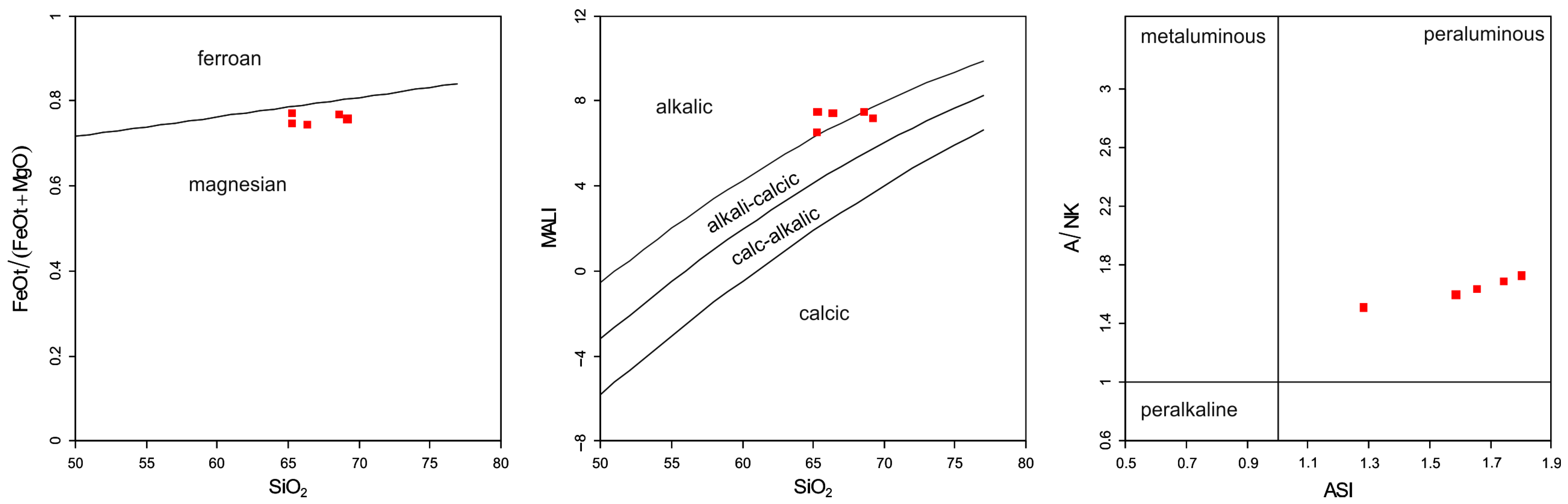
The diatexites are peraluminous, with an A/CNK parameter ranging from 1.18 to 1.62 and an ASI ranging from 1.23 to 1.71. They have a magnesian and alkali to alkali–calcic signature (Figure 5).
However, the diatexites peraluminosity is probably influenced by alteration effects, since the LOI is higher than 2 wt.% [41].
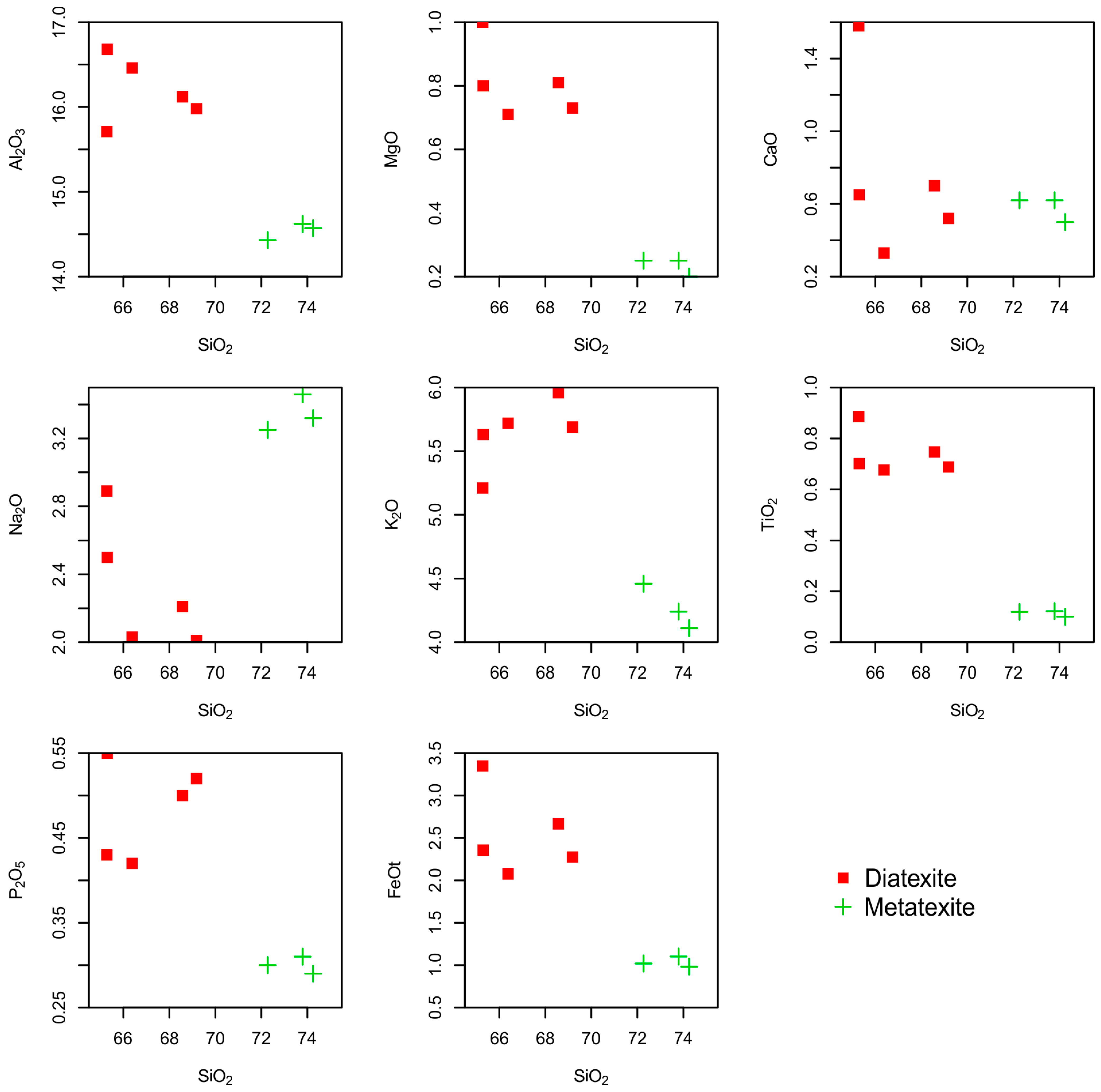
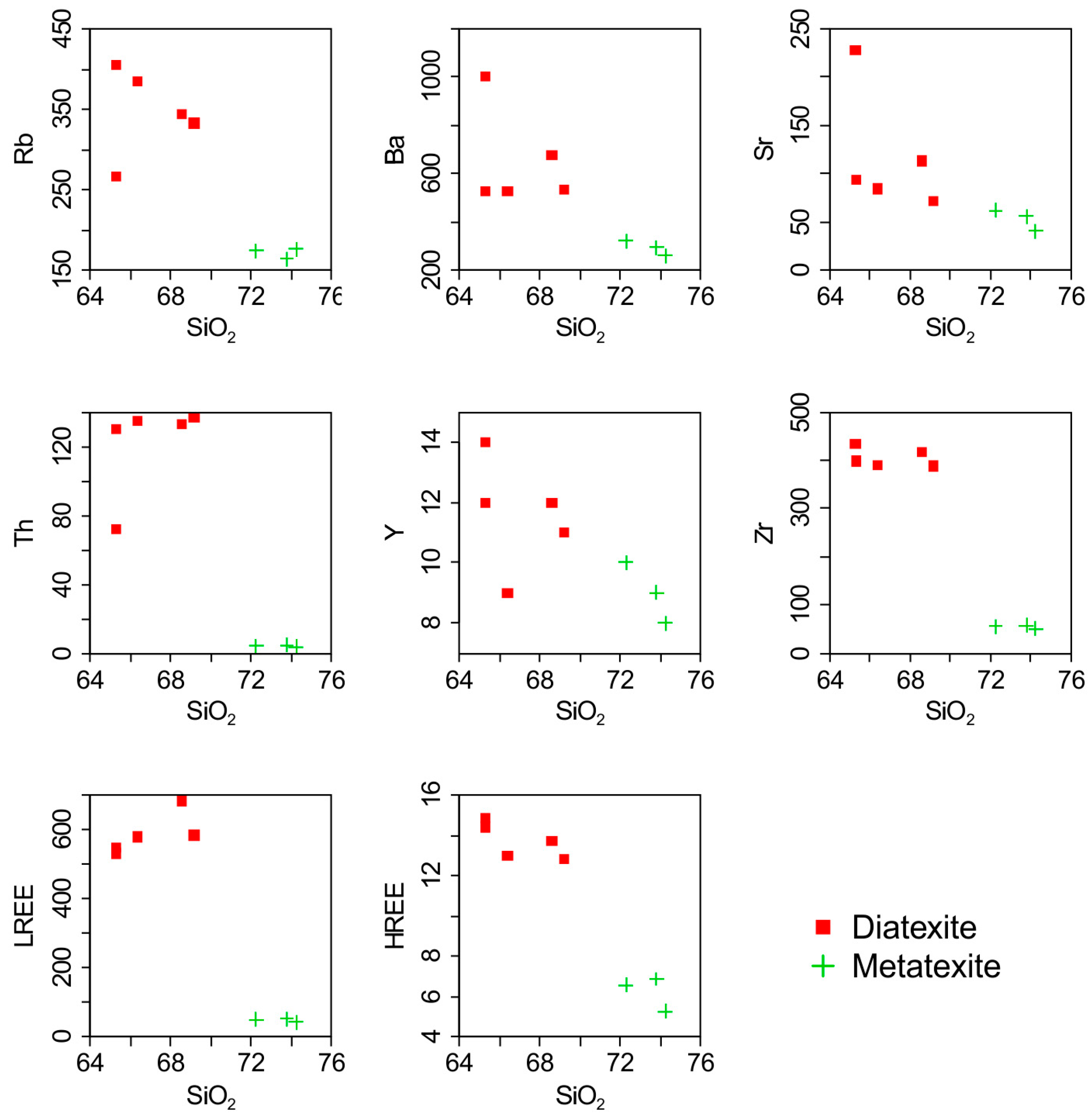
The major elements composition of the diatexites (Figure 6; Table 1) shows concentrations of SiO2 ranging from 65 to 69 wt.%, as well as high concentrations of Al2O3 (15.71–16.68 wt.%) and K2O (5.21–5.96 wt.%). Diatexites also have high content of minor elements; for instance, TiO2 (0.676–0.886 wt.%) and P2O5 (0.42–0.55 wt.%). The trace element composition (Figure 7) shows that the diatexites are enriched in Zr (388–435 ppm), La (91.6–130 ppm), Ce (243–320 ppm), and Th (72.3–137 ppm).
The metatexites are more siliceous, SiO2 (72–74 wt.%), than diatexites. These rocks yield high content of Al2O3 (14–15 wt.%), although these concentrations are lower in diatexites. High concentrations of Na2O (3.3–3.5 wt.%) are observed in metatexites, oppositely to diatexites (Na2O = 2.01–2.89 wt.%). The minor elements composition of the metatexites are very different from the diatexites because they have low values of TiO2 (0.10–0.12 wt.%). The trace elements composition of these rocks is clearly lower than that of the diatexites for Zr (51–57 ppm), La (8–10 ppm), and Ce (16–21 ppm).
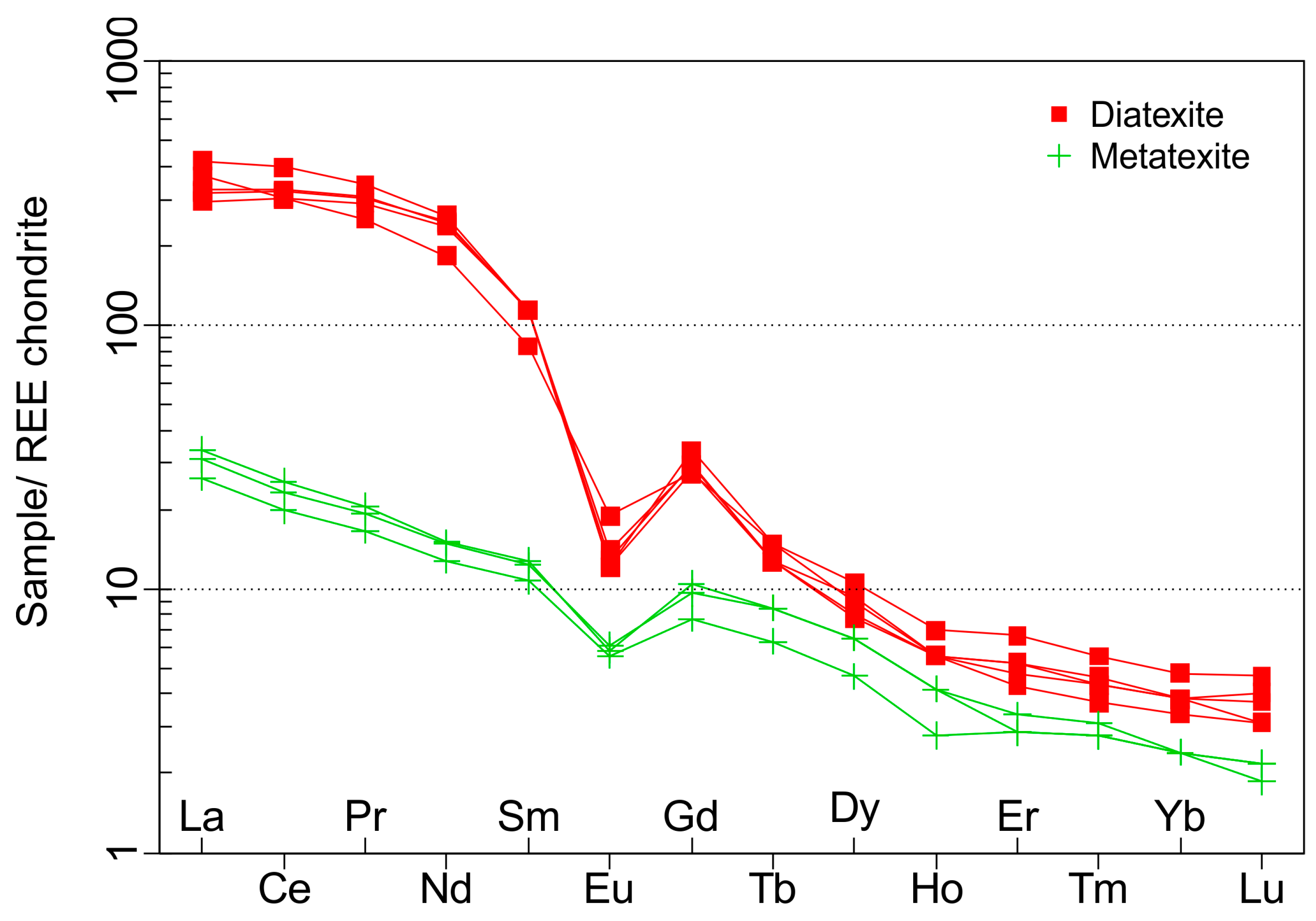
The rare earth elements (REE) signature of the diatexites exhibits an almost flat pattern from La to Pr (Figure 8), but it does not continue towards Sm without significant fractionation of the light rare earth elements (LREE–La/SmN = 2.59–4.43). The heavy rare earth elements (HREE) show a slightly more fractionated pattern (Gd/Yb)N = 5.74–8.89). The negative Eu anomaly (Eu/Eu* = 0.20–0.40) is also evident. The low HREE content contrasts with the high Zr concentrations, suggesting different mineralogical controls. Conversely, the high LREE composition and Th content could be controlled by the presence of monazite [42]. By contrast, the REE abundances in the metatexites are lower than in diatexites, showing a fractionation of the LREE (La/Sm)N = 2.46–2.62) and HREE (Gd/Yb)N = 3.23–4.36), as well as a less pronounced negative Eu anomaly (Eu/Eu* = 0.51–0.61).
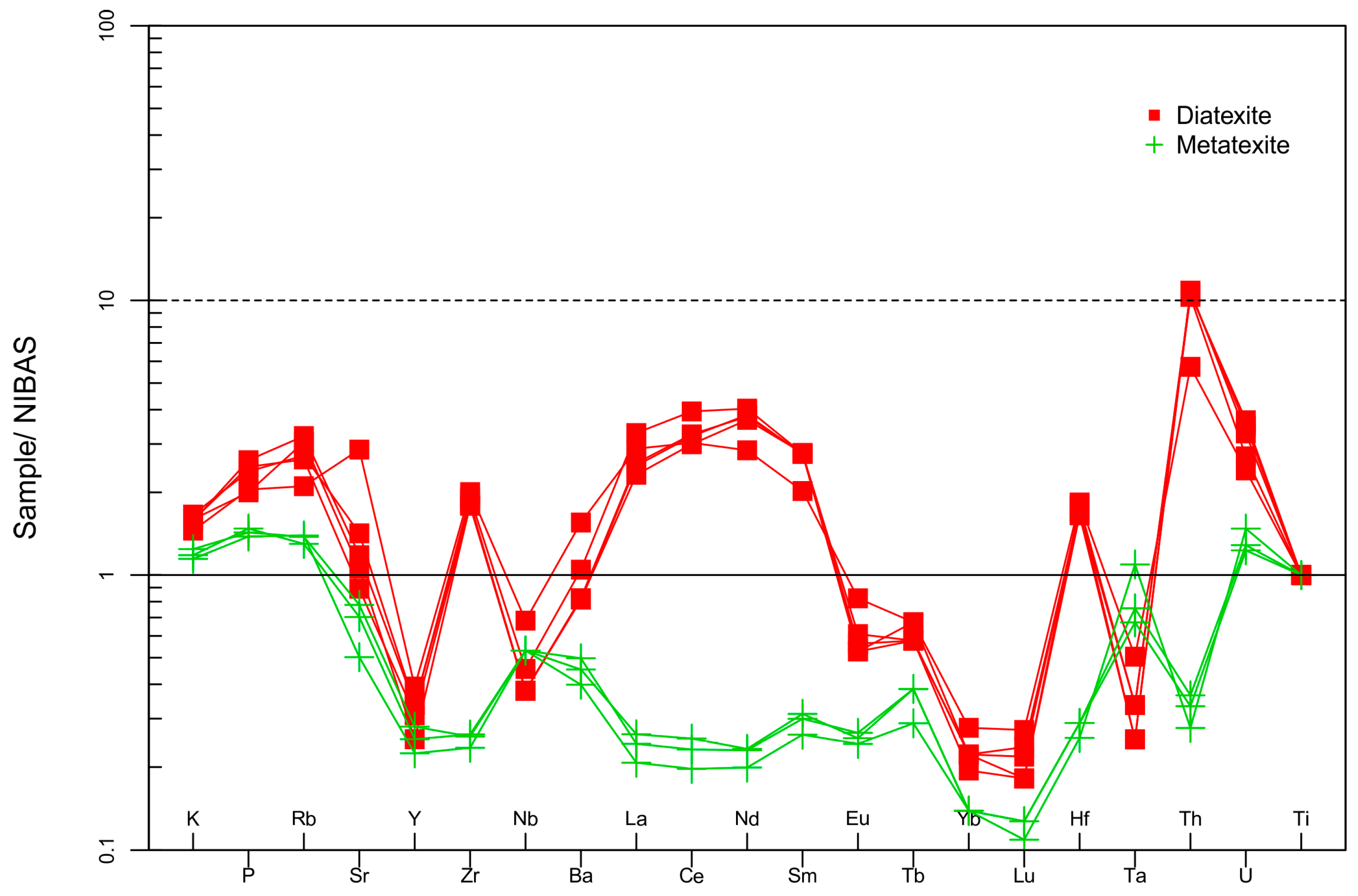
The trace element contents of the Pedregal diatexites and metatexites were compared with the average composition of materials similar to the country rocks of the Douro–Beiras Supergroup: NIBAS (Neoproterozoic Iberian Average Shale) [44]. The diatexites show a positive anomaly for Zr, LREE, Hf, Th, and U, and a negative anomaly for Y, Yb, Lu, and Ta in the multi-element diagram. Notably, the metatexites exhibit opposite behaviour for the elements in which the diatexites are enriched (Figure 9).

5.2. Sr-Nd Isotopic Geochemistry

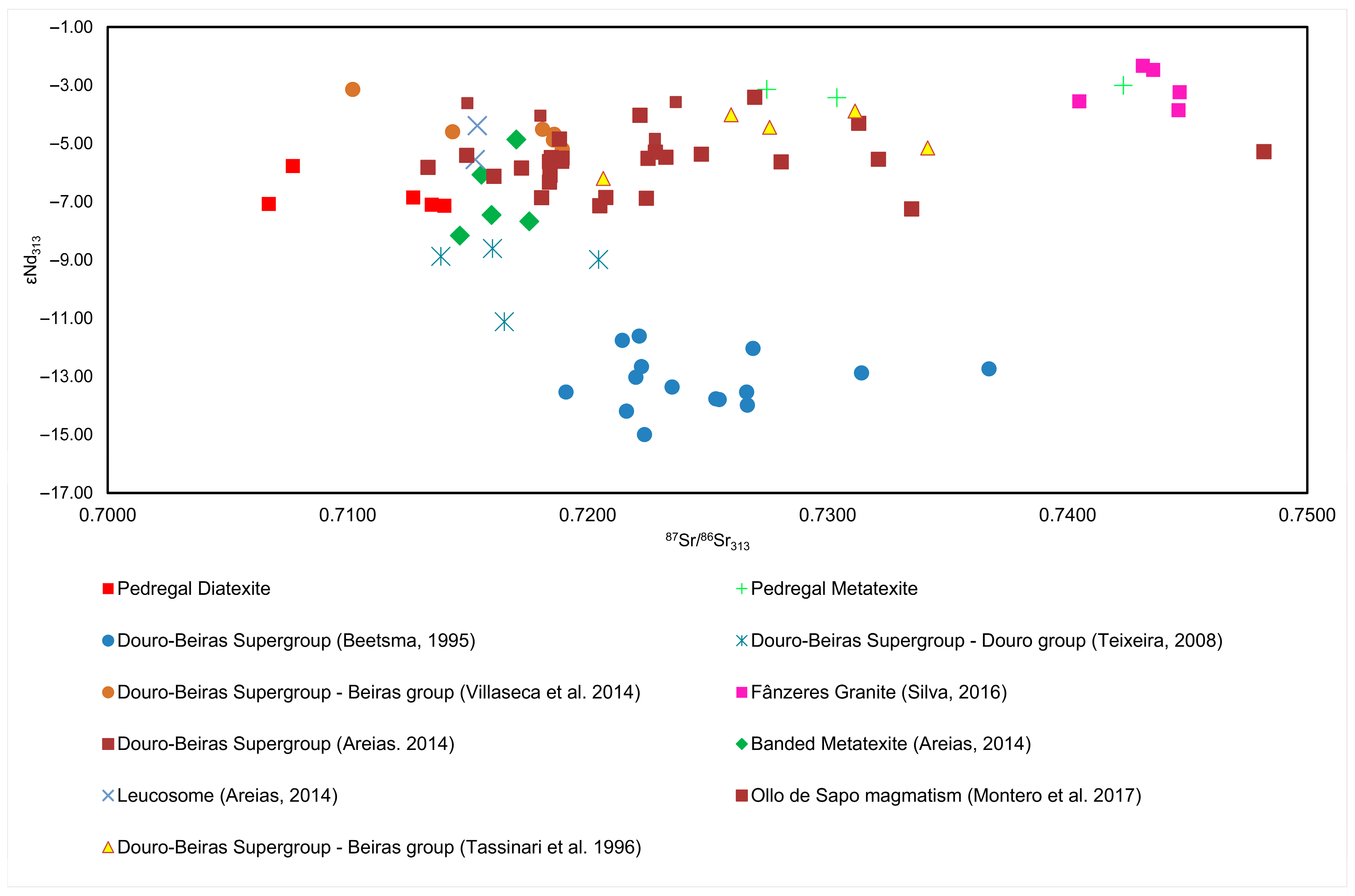
The initial Sr-Nd ratios were recalculated using the 313 Ma age given by the analyzed zircons of the Pedregal diatexite (Figure 10; Table 2).
The metatexites have Rb (164–174 ppm), Sr (37–62 ppm), Sm (2.1–2.5 ppm), and Nd (7.7–9 ppm) compositions considerably lower than the diatexite (Rb: 266–403 ppm; Sr: 68–228 ppm; Sm: 16.2–22.2 ppm; Nd: 110–156 ppm). The 87Sr/86Sr313 (0.7067–0.7140) and εNd313 (−5.78 to −7.14) for the diatexites are low comparatively to the metatexites (87Sr/86Sr313: 0.727–0.7423; εNd313: −3.00 to −3.43), revealing a divergence between both lithologies. This fact was not expected considering the field, petrographic, and geochemical features of the Pedregal diatexites and metatexites [13]. The 147Sm/144Nd ratio of the metatexites (0.1631–0.1680) is close to the mean for the Iberian Massif metasediments (0.120) [45] probably because of the paleosomatic contribution of the Douro–Beiras Supergroup metasediments in the metatexites. However, this isotopic ratio is slightly higher, which is probably related to the garnet content of the metatexites. Diatexites and metatexites yield slightly different two-stage Nd model ages (diatexites TDM2: 1.45–1.59 Ga; metatexites TDM2: 1.27–1.30 Ga).

5.3. Rutile Trace Elements Composition

The analysed rutiles from the Pedregal diatexite exhibit subhedral to euhedral grains, sometimes with an oval shape and a brownish colour. In the diatexite, rutile occurs as single grains in the matrix between the rock-forming minerals and as needle shape inclusions in the quartz and biotite. The needle-like morphology implies that rutile grew during prograde metamorphism and with the increasing of the metamorphic grade the rutile assumes a grain morphology [54].
In general, the rutile is a host of Cr and high-field-strength elements, mainly Nb, Ta, and Zr. In the Pedregal diatexite, Cr contents in rutile grains vary from 17 to 30 ppm, while Nb concentrations exhibit a large range with values between 104 and 8711 ppm. Tantalum also reveals a large spread varying from 5 to 106 ppm. The Zr composition of the rutile is roughly constant (60–86 ppm) with exception of two outliers with 4671 and 770 ppm. Hafnium presents the same behaviour of Zr, with concentration of 4 to 6 ppm and the same outliers with higher contents (19 ppm and 25 ppm). Curiously, high values of LREE and Th are shown by at least for 6 grains.
The Zr-in-rutile geothermometer was calculated, and three geothermometers were tested to understand if there were relevant differences (Table 3). Zack et al. [55] present a Zr-in-rutile thermometer that gave temperatures from 513 to 559 °C for the rutile grains in this study. Watson et al. [56] modified the geothermometer considering experimental data at ~10 kbar, which results in temperatures between 528 and 551 °C for the analysed grains. At last, Tomkins et al. [57] calibrated three pressure dependent Zr-in-rutile thermometers for the α-quartz, β-quartz, and coesite field. Here, the β-quartz field thermometer was chosen because this is a high-temperature quartz, and in this study, we are working with high-temperature lithologies. Additionally, β-quartz field the thermometer was tested for three different pressures (6, 8, and 10 kbar), which are acceptable pressures for the Variscan HT-LP Barrovian metamorphism type. For the 6 kbar pressure, the temperatures are between 523 and 545 °C. When increasing the pressure for 8 kbar, the temperatures slightly increase for 531–553 °C. At 10 kbar, once again, the temperatures lightly rise to values between 540 and 562 °C. In each Zr-in-rutile geothermometer exposed in this work, there are two outliers (point 20 and 23 of Table 3) that correspond to the analyzed grains with higher Zr and Hf contents. These outliers are not considered in the discussion. Despite the application of the Zr-in-rutile thermometers from different authors, the resulting temperatures are very similar with a minimum temperature of 513 °C and a maximum temperature of 562 °C.

5.4. U-Pb Geochronology

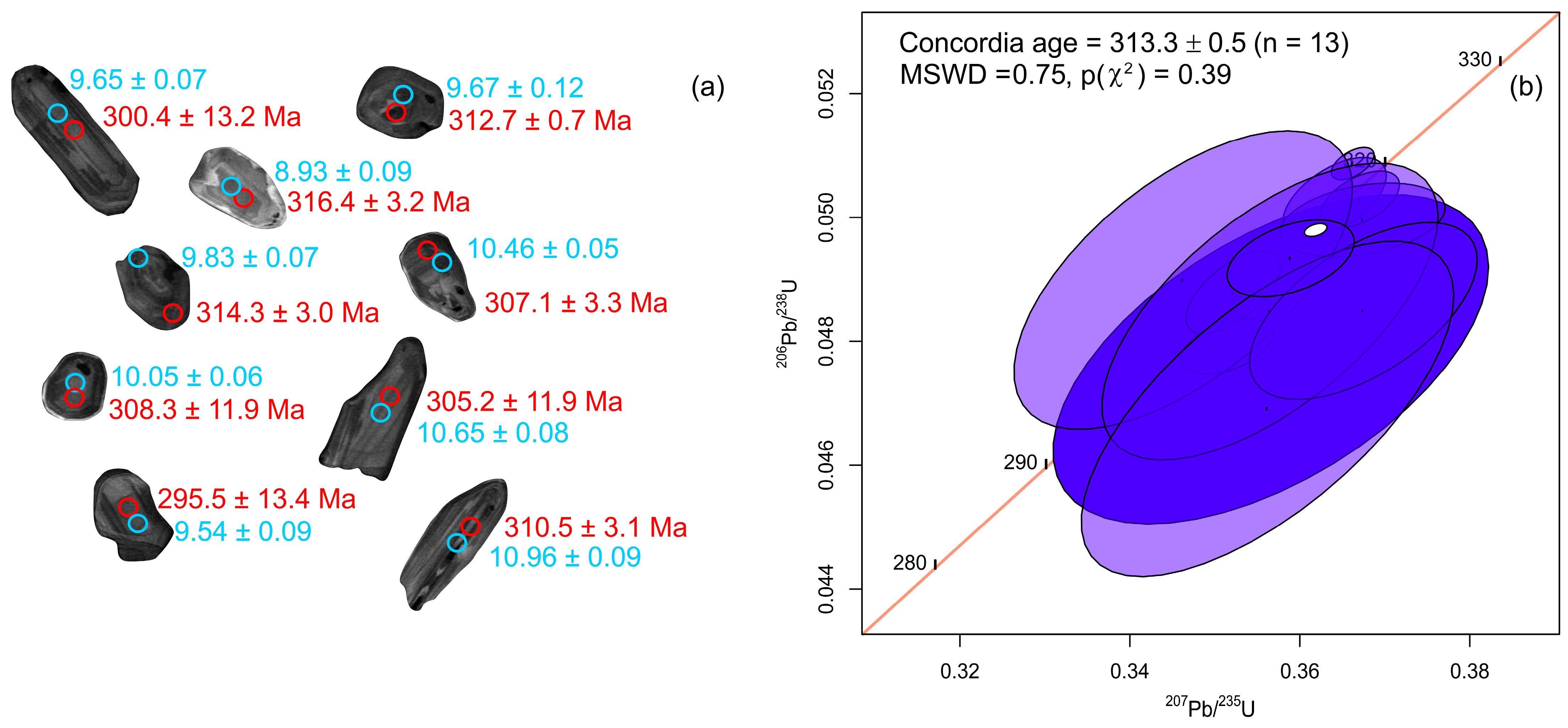
The analysed zircons (30 grains) do not reveal a homogeneous morphology exhibiting rounded, oval, and prismatic crystals (Figure 11a). As crystal shape, the zircon internal textures are also heterogeneous, exhibiting oscillatory zoning typical of igneous zircon, convoluted zoning, and recrystallized borders typical of high-temperature metamorphism [58,59,60]. Some zircon crystals include xenocrystic cores.
The analysed zircons are characterized by a wide range of values for U (295–1084 ppm) and Th (39–424 ppm) with Th/U ratios between 0.05–0.41 (Table 4).
The 206Pb/238U ages of the Pedregal diatexite was defined from 13 concordant points, which gives a concordia age of 313.3 ± 0.5 Ma (MSWD = 0.75) (Figure 11b). The inherited zircon (10 concordant ages) exhibits a group of ages around 600 Ma (545–618 Ma; Ediacaran age) and other two groups with minor representation with ages around 900 Ma (Neoproterozoic age) and 1700 Ma (upper Paleoproterozoic age; Table 4).

5.5. Zircon Oxygen Isotopes

The zircon oxygen isotopes results (δ18O) range from 2.70 to 11.94 ‰ (n = 46). The low δ18O values (2.70–5.29 ‰; n = 8) are associated to fractures/inclusions in the zircon crystals, and they must not be considered to further interpretations. Thus, in the discussion, we will only consider the δ18O range between 6.34 and 11.94 ‰, with an average of 9.58 ± 0.08 ‰ (n = 38; Table 5) as the original zircon isotope composition of the studied diatexite.

6. Discussion

6.1. Petrogenesis of the Pedregal Migmatites

The geological setting, petrological characteristics, whole-rock geochemistry, and rutile trace element geochemistry provide insights into the partial melting process that formed the Pedregal migmatites. In addition to the field association of the Pedregal diatexites and metatexites (e.g., field contacts and local breccia-like structure; Figure 2d,e), the geochemical features of the Pedregal Migmatitic Complex suggest a possible genetic relation resulting from the sequential melting processes between the lithologies and a progressive residuum-melt separation. This process of melt segregation and separation from the residuum is manifested through the negative correlation in the Harker diagrams (Figure 6 and Figure 7), and it is also evidenced in the multi-elements diagram (Figure 9), particularly for the LREE, Zr, Hf, and Th, which are enriched in diatexites and depleted in metatexites (Table 1). Yet the Pedregal diatexites reveal higher contents of FeO, MgO, and TiO2 and lower concentrations of SiO2 (Figure 6) when compared with the metatexites, suggesting that the diatexites are enriched in residual biotite (Figure 3b). In addition, the whole-rock geochemical composition of the diatexites shows an enrichment in high-field-strength elements (HFSE) such as LREE, Hf, Zr, Ti, Nb, Ta, Th, and U compared to the metatexites. All these aspects point to the residual character of the Pedregal diatexites [61,62]. The SiO2 enrichment of the Pedregal metatexites relative to the diatexites can be explained by melt injection into the foliation plans of the host metasediments [62,63], giving origin to micaschist-derived metatexites. The melt injected into the host micaschists of the Douro–Beiras Supergroup corresponds to a first stage of melting, leaving a residual melt that corresponds to the Pedregal diatexites.
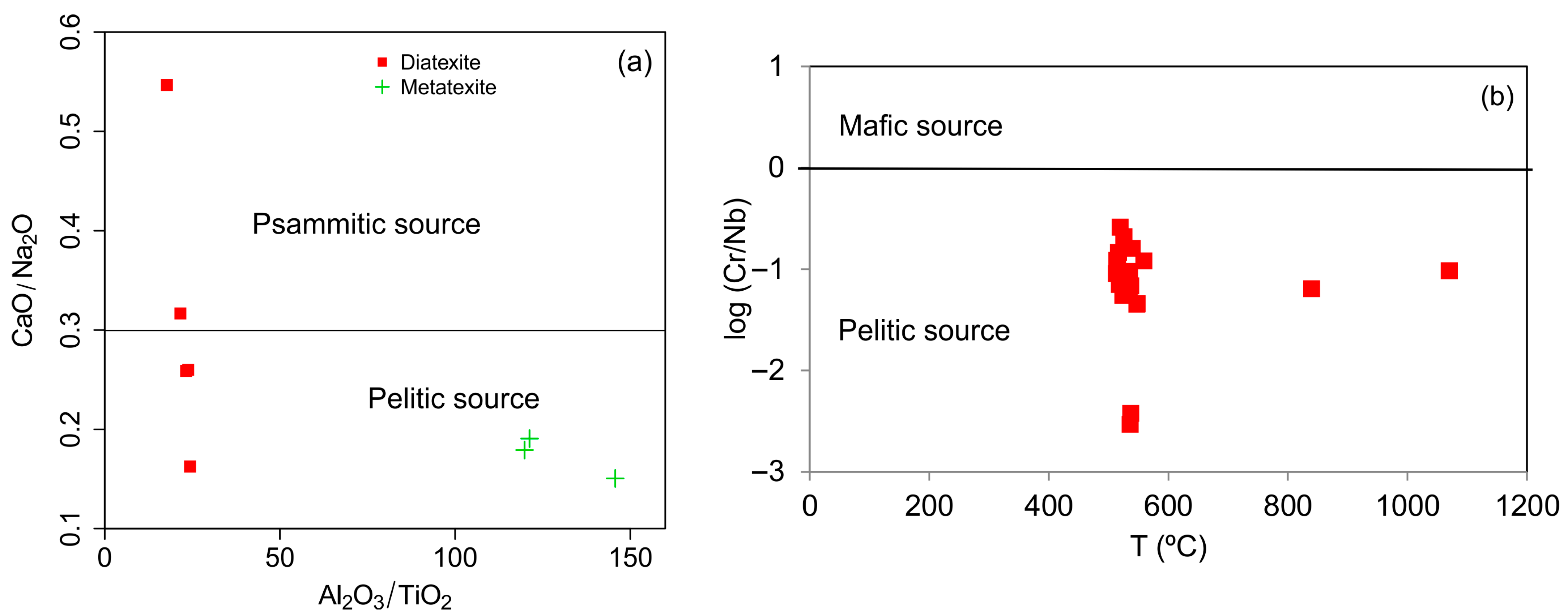
Considering the host rocks of the migmatites are of metapelitic character, it seems that partial melting reactions occurred through the melting of metapelitic rocks. Although the major elements signature, specially the Al2O3/TiO2 vs. CaO/Na2O (e.g., [14]), indicates that the metatexites have a metapelitic source, while the diatexites reveal a mixture between the metapelitic and psammitic source (Figure 12a) [64]. Nevertheless, rutile trace element composition, particularly log (Cr/Nb), indicates a pelitic provenance for the Pedregal diatexites (Figure 12b) [65].
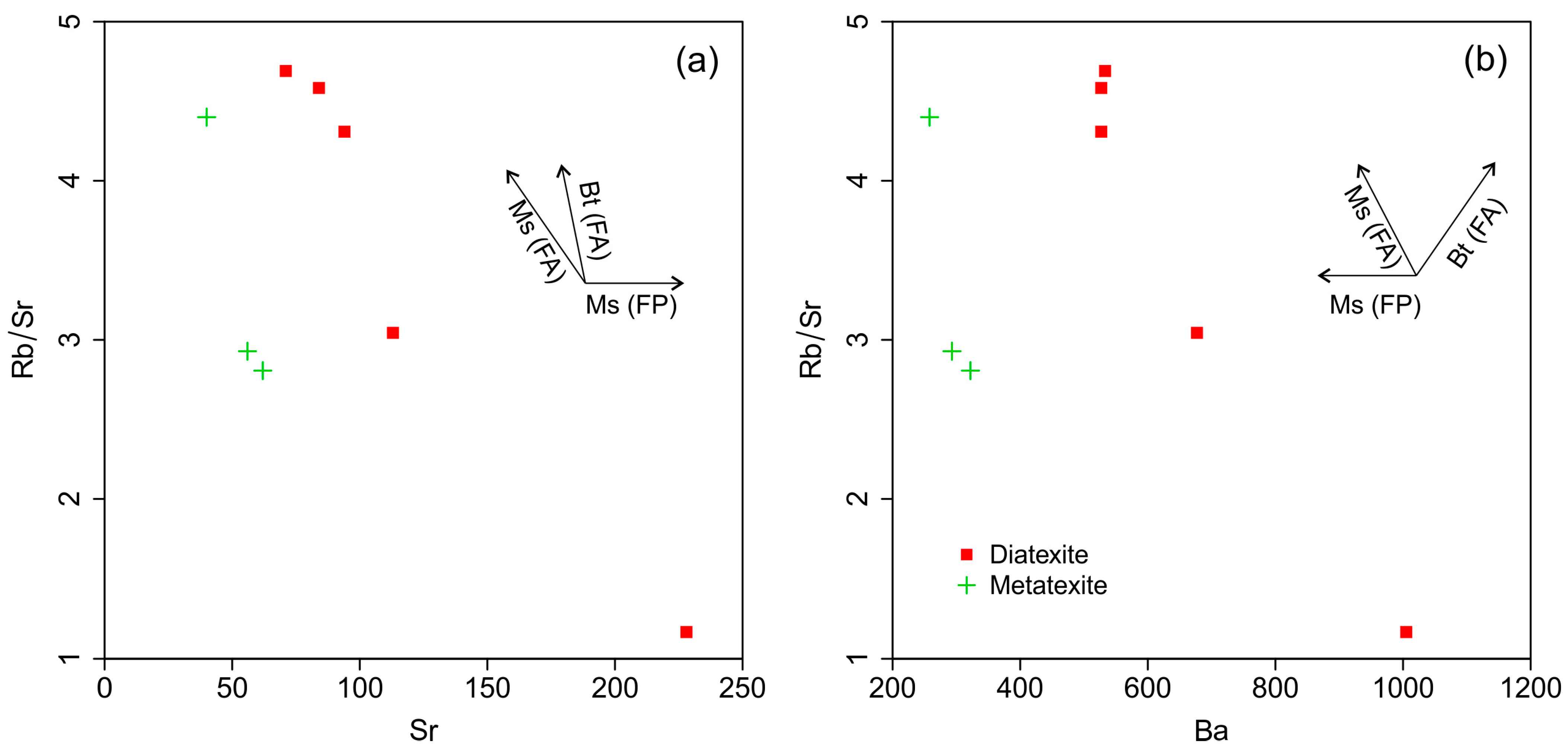
The partial melting conditions of the potential metapelitic source to form the Pedregal migmatites involved the dehydration melting of muscovite and biotite at high temperatures (~800 °C) [66]. The migmatites reveal a depletion in Sr and Ba compositions as the Rb/Sr ratio increases, which match with the fluid-absent melting of muscovite and culminate with the biotite melting as well (Figure 13) [14,67]. The dehydration melting of muscovite is also noticed by the massive occurrence of secondary muscovite in the migmatites, which indicates the melting of the primary muscovite during the prograde path, and the secondary muscovite grew in the retrograde one. Still, at the thin section scale, the dehydration melting of biotite is observed by the corroded aspect of biotite. Moreover, this observation is supported by the petrographic observations since the metatexites exhibit garnet, K-feldspar, and sillimanite as peritectic minerals, which are products of the dehydration melting of biotite and muscovite, respectively. In the case of diatexites, garnet is not observed, but the K-feldspar and sillimanite are still present (muscovite dehydration melt products), plus hercynite spinel (biotite dehydration melt product). The hercynite can be a product of the reaction biotite + sillimanite, but also from the reaction garnet + sillimanite [68,69]. Thus, probably, the garnet is not a peritectic mineral in diatexites because it was consumed during the reaction to form hercynite. It is important to mention that near the study area occurs a gneiss–migmatite outcrop (Lavadores–Madalena) where hercynite is also present in its mineral assemblage [11]. The presence of the hercynite and the absence of garnet in the Pedregal diatexites are indicators of high-temperature, low-pressure metamorphism [70], as observed for the other anatectic complexes in the CIZ [11].
The zircon saturation temperatures (TsatZr) [71] for the metatexites are around 720 °C and higher for the diatexites that are approximately 900 °C (Table 1). The TsatZr estimated for the metatexites are closer to the metamorphic peak temperatures obtained for the metatexites of the Porto–Viseu Metamorphic Belt (769–812 °C; [28]) and to the minimum metamorphic peak conditions of another CIZ anatectic complex, the Figueira de Castelo Rodrigo–Lumbrales Anatectic Complex (T = 761 ± 50 °C; [15]). For the last anatectic complex, Ferreira et al. [71] estimated maximum metamorphic peak temperatures between 716 ± 48 °C and 869 ± 21 °C. The zircon saturation temperatures estimated to the Pedregal migmatites correspond to a maximum approximation of the melting temperatures, especially for the diatexites, which exhibit a relative higher proportion of inherited zircon (33–10 of 30 analysed grains; [72]) and an anomalous Zr whole-rock concentration (388–433 ppm), which can contribute for the overestimation of the TsatZr for the diatexites [73]. Yet the presence of hercynite in the diatexites cannot be ignored, indicating that the dehydration melting of biotite (800–850 °C; [74]) probably reached a maximum melting temperature of 900 °C [5,68,69,75]. Moreover, the 900 °C melting temperature is not too far from the 869 ± 21 °C calculated for the diatexites of the Figueira de Castelo Rodrigo-Lumbrales Anatectic Complex [76]. The retrograde reaction temperatures are registered in the analysed rutiles. When applied, the different Zr-in-rutile thermometers agree with a retrograde temperature around 550 °C (Table 3).

6.2. Significance of the U-Pb Age

The U-Pb geochronological data point to a Variscan age of (313.3 ± 0.5 Ma) for the Pedregal diatexite matching with ages of the syn Variscan magmatism of the CIZ. The most important meaning of this result is that the migmatization age in the CIZ probably must be redefined. The U-Pb results in this work reveal that the migmatization in the study area occurred during the D3 deformation phase and not exclusively in the D2 as established until the moment for the CIZ migmatites [25]. For the migmatites of the Porto-Viseu Metamorphic Belt, it has been considered that the metamorphic peak occurred during the D2 and the retrograde/cooling took place during the D3 phase [77]. In contrast, the Pedregal diatexite reveals a peak metamorphic age synchronous with the D3 deformation phase and the emplacement of syn-tectonic granites, as observed for other migmatites and anatectic areas of the CIZ [76,78]. In the Figueira de Castelo Rodrigo Anatectic Complex, Ferreira et al. [71] estimated U-Pb migmatization ages between 343.7 ± 2.5 and 314.8 ± 1.3 Ma, and a peak metamorphic age of 316.8 ± 2.0 Ma, implying that anatexis event in the CIZ started during the D2 and culminated during the D3 Variscan phase. In the same case study, Valverde-Vaquero et al. [79] also concluded that the HT–LP metamorphism is not synchronous in the CIZ, and some of this metamorphism occurred between 316–314 Ma, synchronous with the D3 granite emplacement.
The group of ages ~600 Ma confirms the existence of zircons with inherited cores, and this age should correspond to restitic cores in the anatectic process of the detrital zircons that belong to Douro–Beiras Supergroup metasedimentary sequence in the CIZ [80]. The detrital zircon ages of the Pedregal diatexite around 600 Ma are compatible with the youngest zircon ages (630–545 Ma) of the Ediacaran metasedimentary sequence of Iberia [81]. This metasedimentary sequence represents the late Cadomian flysch, where there could exist contribution of zircons resulting from the arc-magmatism and/or Cadomian orogeny.

6.3. Source of Migmatites

In order to assess the most probable protolith of the migmatites, the Sr-Nd isotopic compositions recalculated for migmatization age (313 Ma) and the two-stage Nd model ages of the Pedregal Migmatitic Complex (Table 2) were compared with the following formations and anatectic complexes (Figure 10): Douro–Beiras Supergroup [16,45,46,47,48], which represents the host rocks of the anatectic complex; Ollo de Sapo magmatism [49]; stromatic metatexites and leucosomes of the Mindelo Migmatitic Complex [16], which is located in the NW limit of the Porto–Viseu Belt in the same alignment of the Pedregal Migmatitic Complex; and the Fânzeres granite, which occurs in the Pedregal geological context (Figure 1b), and it has a migmatite character and a whole-rock geochemical composition akin to the Pedregal metatexites [82].
For comparison, the Pedregal diatexites reveal isotopic affinities with the Ollo de Sapo formation and the Mindelo stromatic metatexites and leucosomes. Conversely, the metatexites are similar to the Fânzeres granite, the Douro–Beiras Supergroup, particularly for the Beiras Group, and also to the Ollo de Sapo magmatic formation.
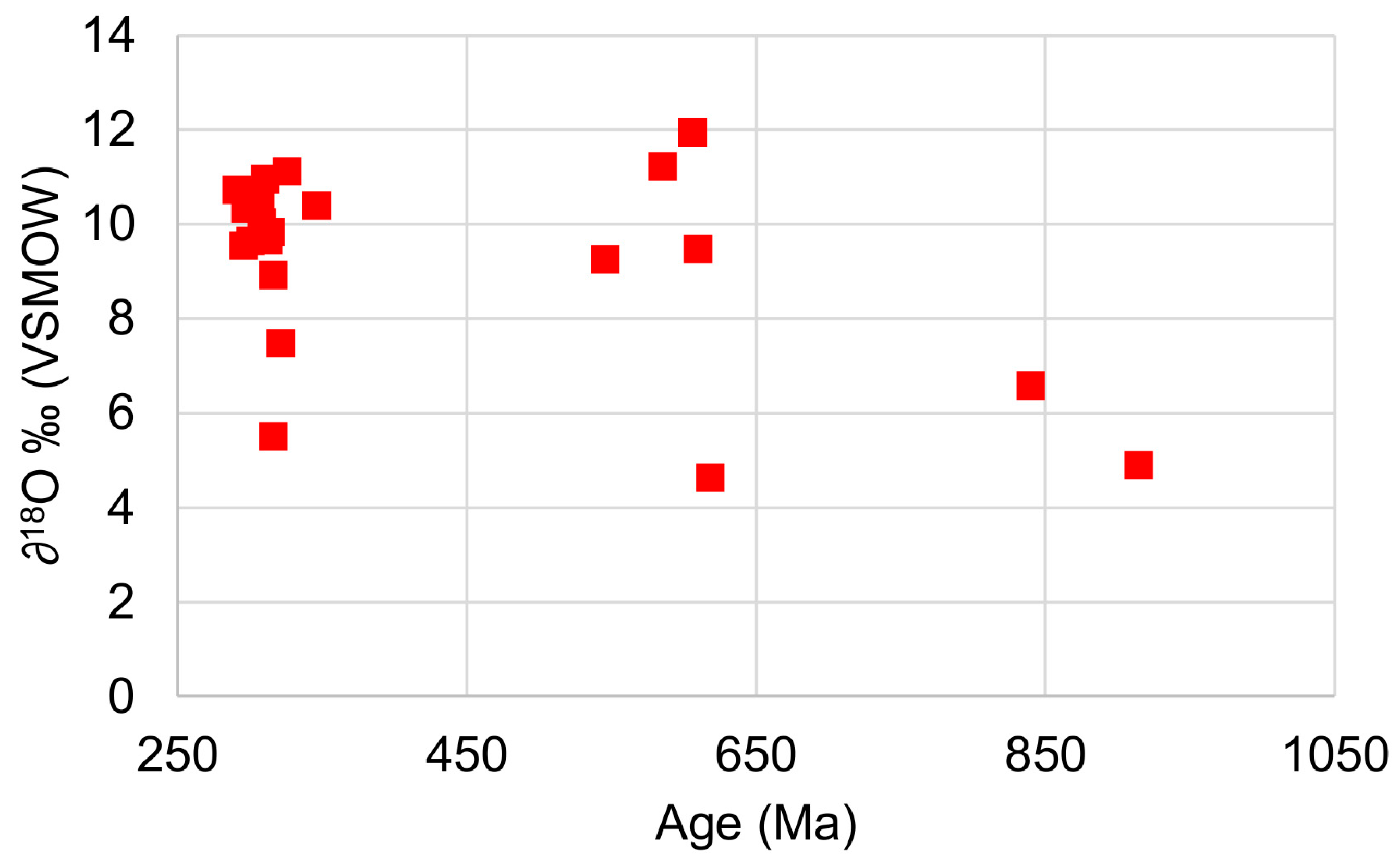
Additionally, the zircon δ18O compositions for the Pedregal diatexite reflect an upper crustal origin of the source materials, and they are similar to zircon δ18O compositions from melts derived from metasedimentary protoliths and also S-type granites ([83] and references therein). The δ18O (VSMOW) vs. zircon U-Pb age (Figure 14) reveal that the Variscan zircon ages have a similar oxygen isotopic signature to the detrital zircons, particularly to the population between ca. 550–650 Ma (Douro–Beiras Supergroup depositional ages). Thus, zircon oxygen isotopes also indicate the Douro–Beiras Supergroup (Beiras group) as a possible source for the Pedregal diatexite. This is also supported by the Ediacaran inherited ages of the Pedregal diatexite (545–618 Ma), which are within the range of maximum depositional ages for the Beiras Group (544–578 Ma; [26,80]). Moreover, these data are corroborated by the Portugal Geological Map at 1/500,000 scale (north sheet), where the metasedimentary sequence of the Douro–Beiras Supergroup that hosts the Pedregal migmatites is mapped as Beiras group [84].
The field association and the trace element composition indicate a genetic link between the Pedregal migmatites, exhibiting a process of residuum-melt separation as mentioned before. However, the initial Sr-Nd isotopic composition suggests no petrogenetic relation between the two groups of migmatites (metatexite to diatexite) for having different isotopic ratios. Moreover, the Pedregal diatexite does not exhibit affinity with the Sr-Nd composition of the Douro–Beiras Supergroup datasets (Figure 10), which is the opposite of what is demonstrated with the zircon δ18O compositions and zircon-inherited ages. Nevertheless, isotopic disequilibrium during the partial melting process can explain the dissimilarities between the Pedregal diatexites and metatexites and the possible protolith.

6.4. Isotopic Disequilibrium During Partial Melting

Sr and Nd isotopic systems are widely applied to study the petrogenetic links between metamorphic and magmatic rocks because they often preserve their initial signatures and the nature of the protolith. Partial melting can generate melts in isotopic disequilibrium with their source rocks. This disequilibrium melting and, consequently, isotopic disequilibrium during anatexis can be explained by several factors [70,85,86,87,88,89,90,91,92]: (i) melt–segregation and extraction rates higher than the rate of chemical equilibration between melt and the residual solid; (ii) accessory phases dissolution was not sufficient to saturate the melt; (iii) the isotopic composition of the reactant minerals and the stoichiometry of the melting reactions involved in the partial melting process; (iv) heterogeneous source; (v) tectonic setting (syntectonic anatexis can favor disequilibrium melting).
The Sr-Nd initial isotopic compositions of the Pedregal diatexites and metatexites reveal differences and isotopic variability, up to four orders of magnitude for εNd313 and 0.04 for 87Sr/86Sr313, where the metatexites are more radiogenic (Figure 10). Looking at the actual isotopic compositions, the differences remain for the Nd compositions, but the measured Sr isotopic ratios display more similar values between metatexites and diatexites (Table 2). Despite the Sr-Nd initial composition, the field and geochemical characteristics of the Pedregal Migmatitic Complex suggest a possible genetic relation between the lithologies, resulting from the sequential melting processes and a progressive residuum-melt separation, which gave origin to the metatexites and residual diatexites.
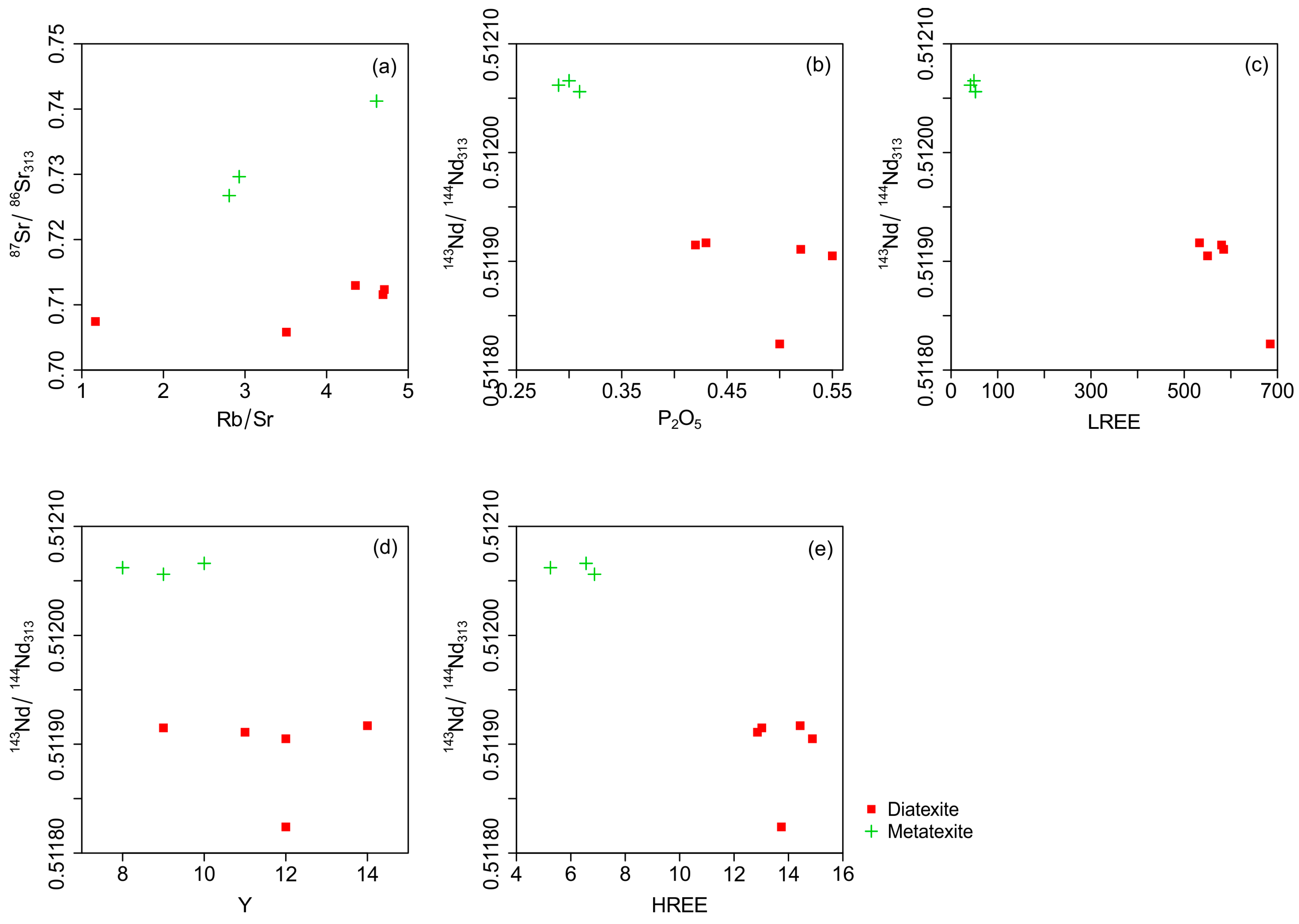
The variability of the Sr and Nd isotopes in granites and migmatites can be attributed to the anatexis of different metasedimentary components through different melting reactions involving micas and accessory phases, suggesting that partial melting occurred under disequilibrium conditions causing isotopic disequilibrium [93]. The dehydration melting of micas can cause a disequilibrium on the Rb-Sr isotopic system and influence the Rb/Sr ratio of the melt, depending on which mica, muscovite, or biotite has more intervention in the melting reactions [4,92]. The Rb- and Sr-bearing minerals (e.g., muscovite and biotite; plagioclase, and K-feldspar, respectively) control the Rb-Sr system [89]. The progression from muscovite to biotite dehydration melting increases the 87Sr/86Sr in the melt due to the highly radiogenic character of biotite (high Rb/Sr ratio compared to muscovite; [92,94]). The diatexites reveal an 87Sr/86Sr313 less radiogenic than the metatexites (Figure 15a), which is not expected since the biotite breakdown was more present in the diatexites genesis at higher temperatures. Such Sr isotopic disequilibrium could be caused by the presence of residual biotite in the Pedregal migmatites, which retain their isotopic composition during partial melting reactions [95]. This is particularly pertinent given the residual nature of the diatexites, as discussed previously.
The presence in the melt of the LREE rich minerals has important implications for trace element and Nd isotopic compositions (e.g., monazite and apatite) of the products of crustal anatexis [86,89,96]. The high values of P2O5 and LREE of the Pedregal diatexite and the correlation between εNd313 vs. P2O5 (Figure 15b) and LREE (Figure 15c) of the migmatites point to the influence of the monazite and apatite in the εNd313 concentrations. However, the diatexites are less radiogenic than the metatexitic rocks. The opposite was expected because the diatexites are more melt-enriched than the metatexites. The dehydration reactions favoured the dissolution of apatite to the melt that gave origin to the diatexites, and the metatexites have a lack of accessory minerals compared to the diatexites. As mentioned before, the dehydration melting of micas are involved in the origin of the migmatites, and these reactions dissolve apatite over monazite [21]. The last one is preferentially dissolved in the fluid-present reactions [89]. For this reason, the monazite present in the diatexites is probably causing the Nd isotopic disequilibrium because it behaved as a refractory mineral during the partial melting and inherited the isotopic signature of the source. Another reason for the difference in Sm/Nd isotopic composition between the migmatites is the presence of garnet in the metatexites. Besides monazite, garnet also affects the Nd isotopic disequilibrium since its retention in the residuum or its separation from a segregated melt arise melts with low Sm/Nd isotopic ratio [96]. Garnet remains in the residuum after residuum-melt segregation, and part of it was consumed during the partial melting to form hercynite present in the Pedregal diatexites, which also explain the lower Nd radiogenic composition of these rocks. The diatexites yield higher contents of Y (Figure 15d) and HREE (Figure 15e) comparatively with the metatexites, but it is not related with the garnet, which is absent in the diatexites but rather incorporated in zircon [42].
The whole-rock and isotopic composition similarities among other lithologies of the studied area (Figure 10), for instance, between the Pedregal metatexites and the Fânzeres granite [82], confirm that sequential melting processes and, consequently, residuum-melt separation [5] took place in the Pedregal Migmatitic Complex and indicates that there exists a genetic link between the region lithologies. Thus, the Pedregal diatexite isotopic dissimilarities are reinforced by an isotopic disequilibrium process that, as discussed before, were caused by the dehydration melting of micas and the residual character of accessory minerals.

7. Conclusions

The autochthonous domain of the Iberian massif (CIZ) was affected by high-temperature metamorphism during the Variscan orogeny. Several anatectic complexes are distributed along the CIZ, where migmatites and S-type granites association are observed. The Pedregal Migmatitic Complex occurs at the NW limit of the Porto–Viseu Metamorphic Belt, and it is characterised by the occurrence of diatexites and metatexites hosted by a Ediacaran–Cambrian metasedimentary sequence (Douro–Beiras Supergroup).
The petrogenesis of the Pedregal migmatites implied the partial melting of a pelitic source with melt-residuum separation through the dehydration melting of muscovite and biotite. Particularly for the diatexites, the dehydration melting of biotite also involved the sillimanite and garnet to produce hercynite. The metamorphic peak occurred at 313.5 ± 0.5 Ma during the D3 and coeval with the syn-D3 granite emplacement, reaching maximum melting temperatures around 800–900 °C.
The geological setting, zircon oxygen isotope, detrital zircon ages, and isotopic compositions indicate the metasediments of the Douro–Beiras Supergroup, particularly the Beiras group, as the most probable source of the Pedregal migmatites, with some contribution of the Ollo de Sapo magmatism. Considering the residual character of the diatexites, the dissimilar isotopic compositions of the Pedregal migmatites suggest a disequilibrium melting and consequent isotopic disequilibrium caused by the residual mineral phases, which control the radiogenic composition. For the Rb-Sr isotopic system, the residual biotite is responsible for the whole-rock isotopic disequilibrium retaining the isotopic composition of the source. The same is observed for the Sm-Nd isotopic composition where the residual monazite and garnet in the source retains the Nd radiogenic content, causing the disequilibrium between the diatexites (lower εNd313) and metatexites (higher εNd313).

Author Contributions

Conceptualization, J.A.F., H.C.B.M. and M.d.A.R.; methodology, J.A.F. and J.F.d.S.; validation, H.C.B.M., M.d.A.R. and J.F.d.S.; formal analysis, J.F.d.S.; investigation, J.A.F., H.C.B.M. and M.d.A.R.; resources, H.C.B.M., M.d.A.R. and J.F.d.S.; writing—original draft preparation, J.A.F.; writing—review and editing, H.C.B.M. and M.d.A.R.; visualization, J.A.F., H.C.B.M. and M.d.A.R.; supervision, H.C.B.M. and M.d.A.R.; funding acquisition, H.C.B.M., M.d.A.R. and J.F.d.S. All authors have read and agreed to the published version of the manuscript.

Funding

The authors acknowledge the financial support provided to the Institute of Earth Sciences (ICT) through the multi-annual funding contract with the Foundation for Science and Technology (FCT), under project UID/04683/2025 with the DOI https://doi.org/10.54499/UID/04683/2025. Isotope analysis done at the University of Aveiro was financially supported by project Geobiotec (UIDB/04035/2020), funded by the Portuguese Foundation for Science and Technology (FCT).

Data Availability Statement

The original contributions presented in this study are included in the article. Further inquiries can be directed to the corresponding author.

Conflicts of Interest

The authors declare no conflicts of interest.

References

  1. Brown, M. Introduction to a Virtual Special Issue on Crustal Melting. J. Metamorph. Geol. 2012, 30, 453–456. [Google Scholar] [CrossRef]
  2. Clemens, J. Melting of the Continental Crust: Fluid Regimes, Melting Reactions, and Source-Rock Fertility; Cambridge University Press: Cambridge, UK, 2006. [Google Scholar] [CrossRef]
  3. Brown, M.; Korhonen, F.J.; Siddoway, C.S. Organizing Melt Flow through the Crust. Elements 2011, 7, 261–266. [Google Scholar] [CrossRef]
  4. Solar, G.S.; Brown, M. Petrogenesis of Migmatites in Maine, USA: Possible Source of Peraluminous Leucogranite in Plutons? J. Petrol. 2001, 42, 789–823. [Google Scholar] [CrossRef]
  5. Milord, I.; Sawyer, E.W.; Brown, M. Formation of Diatexite Migmatite and Granite Magma during Anatexis of Semi-Pelitic Metasedimentary Rocks: An Example from St. Malo, France. J. Petrol. 2001, 42, 487–505. [Google Scholar] [CrossRef]
  6. Villaros, A.; Laurent, O.; Couzinié, S.; Moyen, J.-F.; Mintrone, M. Plutons and Domes: The Consequences of Anatectic Magma Extraction—Example from the Southeastern French Massif Central. Int. J. Earth Sci. 2018, 107, 2819–2842. [Google Scholar] [CrossRef]
  7. Trap, P.; Roger, F.; Cenki-Tok, B.; Paquette, J.L. Timing and Duration of Partial Melting and Magmatism in the Variscan Montagne Noire Gneiss Dome (French Massif Central). Int. J. Earth Sci. 2017, 106, 453–476. [Google Scholar] [CrossRef]
  8. Vanderhaeghe, O. Migmatites, Granites and Orogeny: Flow Modes of Partially-Molten Rocks and Magmas Associated with Melt/Solid Segregation in Orogenic Belts. Tectonophysics 2009, 477, 119–134. [Google Scholar] [CrossRef]
  9. Holtz, F.; Barbey, P. Genesis of Peraluminous Granites II. Mineralogy and Chemistry of the Tourem Complex (North Portugal). Sequential Melting vs. Restite Unmixing. J. Petrol. 1991, 32, 959–978. [Google Scholar] [CrossRef]
  10. Valle Aguado, B.; Azevedo, M.R.; Santos, J.; Nolan, J. O Complexo Migmatítico de Mundão (Viseu, Norte de Portugal). VIII Congr. Nac. Geol. 2010, 16, 1–4. [Google Scholar]
  11. Ribeiro, M.A.; Sant’Ovaia, H.; Dória, A. Litologias Gnaisso-Migmatíticas Da Faixa Lavadores-Madalena: Possível Significado Das Paragéneses Com Hercinite. Simpósio Model. Sist. Geológicos 2011, 343–351. [Google Scholar]
  12. Areias, M.; Ribeiro, M.A.; Santos, J.F.; Dória, A. LP-HT Anatectic Processes and Lithological Heterogeneity in the Mindelo Migmatite Complex (NW Portugal). Estud. Geológicos 2014, 70, e017. [Google Scholar] [CrossRef]
  13. Ferreira, J.A.; Ribeiro, M.A.; Martins, H.C.B. The Pedregal Granite (Portugal): Petrographic and Geochemical Characterization of a Peculiar Granitoid. Estud. Geológicos 2014, 70, e019. [Google Scholar] [CrossRef]
  14. Ferreira, J.A.; Mata, J.; Bento dos Santos, T.; Pereira, I. The Role of Melting on the Geochemical Evolution and Isotopic Variability of an Anatectic Complex in the Iberian Variscides. Lithos 2020, 378–379, 105769. [Google Scholar] [CrossRef]
  15. Pereira, I.; Dias, R.; Bento dos Santos, T.; Mata, J. Exhumation of a Migmatite Complex along a Transpressive Shear Zone: Inferences from the Variscan Juzbado-Penalva Do Castelo Shear Zone (Central Iberian Zone). J. Geol. Soc. 2017, 174, 1004–1018. [Google Scholar] [CrossRef]
  16. Areias, M. Petrogenesis of a Variscan Migmatite Complex (NW Portugal): Petrography, Geochemistry and Fluids. Ph.D. Thesis, University of Porto, Porto, Portugal, 2014. [Google Scholar]
  17. Damas, A. O Complexo Migmatítico de Bemposta (NE Portugal): Alguns Dados Petrográficos, Geoquímicos e Isotópicos. Master’s Thesis, University of Aveiro, Aveiro, Portugal, 2017. [Google Scholar]
  18. Zeng, L. Nd Isotope Disequilibrium during Crustal Anatexis: A Record from the Goat Ranch Migmatite Complex, Southern Sierra Nevada Batholith, California. Geology 2005, 33, 53–56. [Google Scholar] [CrossRef]
  19. Iles, K.A. Isotopic Disequilibrium in Granitic Systems: The Origins of Heterogeneity in Granites and Implications for Partial Melting in the Crust and Petrogenetic Models. Ph.D. Thesis, University of Melboune, Melbourne, Australia, 2017. [Google Scholar]
  20. Wolf, M.; Romer, R.L.; Glodny, J. Isotope Disequilibrium during Partial Melting of Metasedimentary Rocks. Geochim. Cosmochim. Acta 2019, 257, 163–183. [Google Scholar] [CrossRef]
  21. Yang, L.; Wang, J.M.; Liu, X.C.; Khanal, G.P.; Wu, F.Y. Sr-Nd-Hf Isotopic Disequilibrium During the Partial Melting of Metasediments: Insight From Himalayan Leucosome. Front. Earth Sci. 2022, 10, 891960. [Google Scholar] [CrossRef]
  22. Barbero, L.; Villaseca, C.; Rogers, G.; Brown, P.E. Geochemical and Isotopic Disequilibrium in Crustal Melting: An Insight from the Anatectic Granitoids from Toledo, Spain. J. Geophys. Res. 1995, 100, 15745–15765. [Google Scholar] [CrossRef]
  23. Martínez Catalán, J.R.; Rubio Pascual, F.J.; Montes, A.D.; Fernández, R.D.; Barreiro, J.G.; Dias Da Silva, Í.; Clavijo, E.G.; Ayarza, P.; Alcock, J.E. The Late Variscan HT/LP Metamorphic Event in NW and Central Iberia: Relationships to Crustal Thickening, Extension, Orocline Development and Crustal Evolution. Geol. Soc. Lond. Spec. Publ. 2014, 405, 225–247. [Google Scholar] [CrossRef]
  24. Costa, M.M.; Neiva, A.M.R.; Azevedo, M.R.; Corfu, F. Distinct Sources for Syntectonic Variscan Granitoids: Insights from the Aguiar Da Beira Region, Central Portugal. Lithos 2014, 196–197, 83–98. [Google Scholar] [CrossRef]
  25. Azevedo, M.R.; Valle Aguado, B. Origem e Instalação de Granitóides Variscos Na Zona Centro-Ibérica. In Geologia de Portugal. Volume I—Geologia Pré-mesozóica de Portugal; Dias, R., Araújo, A., Terrinha, P., Kullberg, J.C., Eds.; Escolar Editora: Lisbon, Portugal, 2013; pp. 377–401. [Google Scholar]
  26. Talavera, C.; Montero, P.; Martínez Poyatos, D.; Williams, I.S. Ediacaran to Lower Ordovician Age for Rocks Ascribed to the Schist–Graywacke Complex (Iberian Massif, Spain): Evidence from Detrital Zircon SHRIMP U–Pb Geochronology. Gondwana Res. 2012, 22, 928–942. [Google Scholar] [CrossRef]
  27. Sousa, M.B.; Sequeira, A.J.D. O Limite Precâmbrico—Câmbrico Na Zona Centro Ibérica, Em Portugal. XII Reun. Geol. Oeste Penins. 1993, I, 17–28. [Google Scholar]
  28. Bento dos Santos, T.; Rodrigues, J.F.; Castro, P.; Cotrim, B.; Pereira, I.; Ferreira, J.A.; Meireles, C.; Ferreira, N.; Ferreira, P.; Ribeiro, A.; et al. Exhumation of an Anatectic Complex by Channel Flow and Extrusion Tectonics: Structural and Metamorphic Evidence from the Porto–Viseu Metamorphic Belt, Central-Iberian Zone. Int. J. Earth Sci. 2021, 110, 2179–2201. [Google Scholar] [CrossRef]
  29. Ribeiro, M.A.; Martins, H.C.B.; Sant’ovaia, H.; Dória, A.; Ferreira, J.; Areias, M. Evolução Tectono-Metamórfica, Migmatização e Magmatismo Sin-Tectónico Na Região Do Porto (NW Portugal) Tectono-Metamorphic Evolution, Migmatization and Syn-Tectonic Magmatism from Porto Region (NW Portugal). Comun. Geológicas 2014, 101, 297–300. [Google Scholar]
  30. Sousa, M.B.; Sequeira, A.J.D. Carta Geológica de Portugal Na Escala 1/50.000; Notícia Explicativa Da Folha 10-D (Alijó); Serviços Geologicos de Portugal: Lisboa, Portugal, 1987. [Google Scholar]
  31. Almeida, A.; Santos, J.F.; Noronha, F. Contribution of Sm-Nd and RB-Sr Isotope Systems to the Petrogenetic Study of the Peraluminous Two-Mica Granite Pluton in Oporto Town (Nw Portugal). Comun. Geol. 2014, 101, 27–30. [Google Scholar]
  32. Pinto, M.S. O Granito Gnáissico de Fânzeres (Porto, Portugal)—Idade e Caracterização Geoquímica Geral. Mem. e Not. Mus. Lab. Mineral. Geol. Univ. Coimbra. 1984, 98, 231–242. [Google Scholar]
  33. Janoušek, V.; Farrow, C.M.; Erban, V. Interpretation of Whole-Rock Geochemical Data in Igneous Geochemistry: Introducing Geochemical Data Toolkit (GCDkit). J. Petrol. 2006, 47, 1255–1259. [Google Scholar] [CrossRef]
  34. Bea, F.; Fershtater, G.B.; Montero, P.; Smirnov, V.N.; Molina, J.F. Deformation-Driven Differentiation of Granitic Magma: The Stepninsk Pluton of the Uralides, Russia. Lithos 2005, 81, 209–233. [Google Scholar] [CrossRef]
  35. Montero, M.P.; Bea, F.; Corretge, L.G.; Floor, P.; Whitehouse, M.J. U-Pb Ion Microprobe Dating and Sr-Nd Isotope Geology of the Galiñeiro Igneous Complex. A Model for the Peraluminous/Peralkaline Duality of the Cambro-Ordovician Magmatism of Iberia. Lithos 2008, 107, 227–238. [Google Scholar] [CrossRef]
  36. Claoue-Long, J.C.; Compston, W.; Roberts, J.; Fanning, C.M. Two Carboniferous Ages: A Comparison of SHRIMP Zircon Dating with Conventional Zircon Ages and 40Ar/39Ar Analysis. In Geochronology Time Scales and Global Stratigraphic Correlation; Berggren, W.A., Kent, D.V., Aubry, M.P., Hardenbol, J., Eds.; SEPM (Society for Sedimentary Geology) Special Publication: Tulsa, OK, USA, 1995; pp. 3–21. [Google Scholar]
  37. Black, L.P.; Kamo, S.L.; Allen, C.M.; Aleinikoff, J.A.; Davis, D.W.; Korsch, J.R.; Foudolis, C. TEMORA 1: A New Zircon Standard for Phanerozoic U-Pb Geochronology. Chem. Geol. 2003, 200, 155–170. [Google Scholar] [CrossRef]
  38. Williams, I.S. U-Th-Pb Geochronology by Ion Microprobe. In Applications of Microanalytical Techniques to Understanding Mineralizing Processes; McKibben, M.A., Shanks, W.C., III, Ridley, W.I., Eds.; Reviews in Economic Geology: Littleton, CO, USA, 1998; pp. 1–35. [Google Scholar]
  39. Williams, I.S.; Hergt, J.M. U-Pb Dating of Tasmanian Dolerites: A Cautionary Tale of SHRIMP Analysis of High-U Zircon. In Proceedings of the Beyond 2000: New Frontiers in Isotope Geoscience; Woodhead, J.D., Hergt, J.M., Noble, W.P., Eds.; New Frontiers in Isotope Geoscienc: Victoria, Australia, 2000; pp. 185–188. [Google Scholar]
  40. Frost, B.R. A Geochemical Classification for Granitic Rocks. Journal of Petrology 2001, 42, 2033–2048. [Google Scholar] [CrossRef]
  41. Bonin, B.; Janoušek, V.; Moyen, J.-F. Chemical Variation, Modal Composition and Classification of Granitoids. Geol. Soc. Lond. Spec. Publ. 2020, 491, 9–51. [Google Scholar] [CrossRef]
  42. Bea, F. Residence of REE, Y, Th and U in Granites and Crustal Protoliths; Implications for the Chemistry of Crustal Melts. J. Petrol. 1996, 37, 521–552. [Google Scholar] [CrossRef]
  43. Boynton, W.V. Cosmochemistry of the Rare Earth Elements: Meteorite Studies. In Developments in Geochemistry; Elsevier: Amsterdam, The Netherlands, 1984; pp. 63–114. [Google Scholar]
  44. Ugidos, J.M.; Sánchez-Santos, J.M.; Barba, P.; Valladares, M.I. Upper Neoproterozoic Series in the Central Iberian, Cantabrian and West Asturian Leonese Zones (Spain): Geochemical Data and Statistical Results as Evidence for a Shared Homogenised Source Area. Precambrian Res. 2010, 178, 51–58. [Google Scholar] [CrossRef]
  45. Beetsma, J. The Late Proterozoic/Paleozoic and Hercynian Crustal Evolution of the Iberian Massif, N Portugal. Ph.D. Thesis, Vrije University, Amsterdam, The Netherlands, 1995. [Google Scholar]
  46. Teixeira, R.J.S. Mineralogia, Petrologia e Geoquímica Dos Granitos e Seus Encraves Da Região de Carrazeda de Ansiães. Ph.D. Thesis, Universidade de Trás-os-Montes e Alto Douro, Vila Real, Portugal, 2008. [Google Scholar]
  47. Villaseca, C.; Merino, E.; Oyarzun, R.; Orejana, D.; Pérez-Soba, C.; Chicharro, E. Contrasting Chemical and Isotopic Signatures from Neoproterozoic Metasedimentary Rocks in the Central Iberian Zone (Spain) of Pre-Variscan Europe: Implications for Terrane Analysis and Early Ordovician Magmatic Belts. Precambrian Res. 2014, 245, 131–145. [Google Scholar] [CrossRef]
  48. Tassinari, C.C.G.; Medina, J.; Pinto, M.S. Rb-Sr and Sm-Nd geochronology and isotope geochemistry of Central Iberian metasedimentary rocks (Portugal). Neth. J. Geosci. 1996, 75, 69–79. [Google Scholar]
  49. Montero, P.; Talavera, C.; Bea, F. Geochemical, Isotopic, and Zircon (U-Pb, O, Hf Isotopes) Evidence for the Magmatic Sources of the Volcano-Plutonic Ollo de Sapo Formation, Central Iberia. Geol. Acta 2017, 15, 245–260. [Google Scholar] [CrossRef]
  50. Nebel, O.; Scherer, E.E.; Mezger, K. Evaluation of the 87Rb Decay Constant by Age Comparison against the U–Pb System. Earth Planet. Sci. Lett. 2011, 301, 1–8. [Google Scholar] [CrossRef]
  51. Lugmair, G.W.; Marti, K. Lunar Initial 143Nd/144Nd: Differential Evolution of the Lunar Crust and Mantle. Earth Planet. Sci. Lett. 1978, 39, 349–357. [Google Scholar] [CrossRef]
  52. Jacobsen, S.B.; Wasserburg, G.J. Sm-Nd Isotopic Evolution of Chondrites. Earth Planet. Sci. Lett. 1980, 50, 139–155. [Google Scholar] [CrossRef]
  53. Liew, T.; Hofmann, A. Precambrian Crustal Components, Plutonic Associations, Plate Environment of the Hercynian Fold Belt of Central Europe: Indications from a Nd and Sr Isotopic Study. Contrib. Mineral. Petrol. 1988, 98, 129–138. [Google Scholar] [CrossRef]
  54. Meinhold, G. Rutile and Its Applications in Earth Sciences. Earth. Sci. Rev. 2010, 102, 1–28. [Google Scholar] [CrossRef]
  55. Zack, T.; Moraes, R.; Kronz, A. Temperature Dependence of Zr in Rutile: Empirical Calibration of a Rutile Thermometer. Contrib. Mineral. Petrol. 2004, 148, 471–488. [Google Scholar] [CrossRef]
  56. Watson, E.B.; Wark, D.A.; Thomas, J.B. Crystallization Thermometers for Zircon and Rutile. Contrib. Mineral. Petrol. 2006, 151, 413–433. [Google Scholar] [CrossRef]
  57. Tomkins, H.S.; Powell, R.; Ellis, D.J. The Pressure Dependence of the Zirconium-in-Rutile Thermometer. J. Metamorph. Geol. 2007, 25, 703–713. [Google Scholar] [CrossRef]
  58. Corfu, F.; Hanchar, J.M.; Hoskin, P.W.O. Atlas of Zircon Textures. Rev. Miner. Geochem. 2003, 53, 469–500. [Google Scholar] [CrossRef]
  59. Harley, S.L.; Kelly, N.M.; Möller, A. Zircon Behaviour and the Thermal Histories of Mountain Chains. Elements 2007, 3, 25–30. [Google Scholar] [CrossRef]
  60. Zheng, D.; Wu, S.; Ma, C.; Xiang, L.; Hou, L.; Chen, A.; Hou, M. Zircon Classification from Cathodoluminescence Images Using Deep Learning. Geosci. Front. 2022, 13, 101436. [Google Scholar] [CrossRef]
  61. Milord, I.; Sawyer, E.W. Schlieren Formation in Diatexite Migmatite: Examples from the St Malo Migmatite Terrane, France. J. Metamorph. Geol. 2003, 21, 347–362. [Google Scholar] [CrossRef]
  62. Vernon, R.H.; Clarke, G.L. Principles of Metamorphic Petrology; Cambridge University Press: Cambridge, UK, 2008. [Google Scholar]
  63. Sawyer, E.W. Atlas of Migmatites; NRC Research Press and Mineralogical Association of Canada: Ottawa, ON, Canada, 2008. [Google Scholar]
  64. Sylvester, P.J. Post-Collisional Strongly Peraluminous Granites. Lithos 1998, 45, 29–44. [Google Scholar] [CrossRef]
  65. Triebold, S.; von Eynatten, H.; Luvizotto, G.L.; Zack, T. Deducing Source Rock Lithology from Detrital Rutile Geochemistry: An Example from the Erzgebirge, Germany. Chem. Geol. 2007, 244, 421–436. [Google Scholar] [CrossRef]
  66. Clemens, J.D.; Stevens, G.; Bryan, S.E. Conditions during the Formation of Granitic Magmas by Crustal Melting—Hot or Cold; Drenched, Damp or Dry? Earth Sci. Rev. 2020, 200, 102982. [Google Scholar] [CrossRef]
  67. Inger, S.; Harris, N. Geochemical Constraints on Leukogranite Magmatism in the Langtang Valley, Nepal Himalaya. J. Petrol. 1993, 34, 345–368. [Google Scholar] [CrossRef]
  68. Montel, J.M.; Weber, C.; Pichavant, M. Biotite-Sillimanite-Spinel Assemblages in High-Grade Metamorphic Rocks: Occurrences, Chemographic Analysis and Thermobarometric Interest. Bull. Mineral. 1986, 109, 555–573. [Google Scholar] [CrossRef]
  69. Bucher, K.; Grapes, R. Petrogenesis of Metamorphic Rocks, 8th ed.; Springer: Berlin/Heidelberg, Germany, 2011; Volume 53. [Google Scholar]
  70. Gaeta, M.; Giuliani, A.; Di Rocco, T.; Tecchiato, V.; Perinelli, C.; Kamenetsky, V.S. Isotopic Disequilibrium in Migmatitic Hornfels of the Gennargentu Igneous Complex (Sardinia, Italy) Records the Formation of Low 87Sr/86Sr Melts from a Mica-Rich Source. J. Petrol. 2018, 59, 1309–1328. [Google Scholar] [CrossRef]
  71. Watson, E.B.; Harrison, T.M. Zircon Saturation Revisited: Temperature and Composition Effects in a Variety of Crustal Magma Types. Earth Planet. Sci. Lett. 1983, 64, 295–304. [Google Scholar] [CrossRef]
  72. Miller, C.F.; McDowell, S.M.; Mapes, R.W. Hot and Cold Granites: Implications of Zircon Saturation Temperatures and Preservation of Inheritance. Geology 2003, 31, 529–532. [Google Scholar] [CrossRef]
  73. Li, Y.; Xie, H.; Dong, C.; Wang, S.; Wan, Y. Zircon Evolution from Migmatite to Crustally-Derived Granite: A Case Study of Late Neoarchean Migmatite in the Yishan Area, Western Shandong, North China Craton. Gondwana Res. 2022, 112, 82–104. [Google Scholar] [CrossRef]
  74. Sawyer, E.W.; Cesare, B.; Brown, M. When the Continental Crust Melts. Elements 2011, 7, 229–234. [Google Scholar] [CrossRef]
  75. Rao, C.V.D. Metapelitic Migmatites From Pangidi Granulite Complex, Eastern Ghats Belt, India: Petrological Constraints on Crustal Melting and Tectonic Exhumation. Gondwana Res. 2000, 3, 105–117. [Google Scholar] [CrossRef]
  76. Ferreira, J.A.; Pereira, I.; Bento dos Santos, T.; Mata, J. U–Pb Age Constraints on the Protolith, Cooling and Exhumation of a Variscan Middle Crust Migmatite Complex from the Central Iberian Zone: Insights into the Variscan Metamorphic Evolution and Ediacaran Palaeogeographic Implications. J. Geol. Soc. 2022, 179, jgs2021-072. [Google Scholar] [CrossRef]
  77. Valle Aguado, B.; Azevedo, M.R.; Schaltegger, U.; Martínez Catalán, J.R.; Nolan, J. U-Pb Zircon and Monazite Geochronology of Variscan Magmatism Related to Syn-Convergence Extension in Central Northern Portugal. Lithos 2005, 82, 169–184. [Google Scholar] [CrossRef]
  78. Alcock, J.E.; Martínez, J.R.; Rubio, F.J.; Díez, A.; Díez, R.; Gómez, J.; Arenas, R.; Dias, Í.; González, E. Tectonophysics 2-D Thermal Modeling of HT—LP Metamorphism in NW and Central Iberia: Implications for Variscan Magmatism, Rheology of the Lithosphere and Orogenic Evolution. Tectonophysics 2015, 657, 21–37. [Google Scholar] [CrossRef]
  79. Valverde-Vaquero, P.; Díez Balda, M.A.; Díez Montes, A.; Dörr, W.; Escuder-Viruete, J.; González-Clavijo, E.; Maluski, H.; Rodríguez-Fernández, L.R.; Rubio, F.; Villar, P. Timing of Variscan Metamorphism and the Central Iberian Paradox. Geophys. Res. Abstr. Eur. Geosci. Union 2006, 8, 01309. [Google Scholar]
  80. Pereira, M.F.; Linnemann, U.; Hofmann, M.; Chichorro, M.; Solá, A.R.; Medina, J.; Silva, J.B. The Provenance of Late Ediacaran and Early Ordovician Siliciclastic Rocks in the Southwest Central Iberian Zone: Constraints from Detrital Zircon Data on Northern Gondwana Margin Evolution during the Late Neoproterozoic. Precambrian Res. 2012, 192–195, 166–189. [Google Scholar] [CrossRef]
  81. Pereira, M.F. Potential Sources of Ediacaran Strata of Iberia: A Review. Geodin. Acta 2015, 27, 1–14. [Google Scholar] [CrossRef]
  82. Silva, D.; Rodrigues, E.; Martins, H.C.B.; Ribeiro, M.A. New Insights into Structure, Petrography and Geochemistry of Fânzeres Granite (Porto, NW Portugal) Novos Dados Sobre a Estrutura, Petrografia e Geoquímica Do Granito de Fânzeres (Porto, NW de Portugal). Comun. Geológicas 2016, 103, 131–135. [Google Scholar]
  83. Hartnady, M.I.H.; Kirkland, C.L.; Martin, L.; Clark, C.; Smithies, R.H.; Spaggiari, C. V Zircon Oxygen and Hafnium Isotope Decoupling during Regional Metamorphism: Implications for the Generation of Low Δ18O Magmas. Contrib. Mineral. Petrol. 2019, 175, 9. [Google Scholar] [CrossRef]
  84. Oliveira, J.T.; Pereira, E.; Ramalho, M.; Antunes, M.T.; Monteiro, J.H. Geological Map of Portugal at 1/500,000 Scale—North Sheet; Geologic Survey of Portugal: Amadora, Portugal, 1992. [Google Scholar]
  85. Barbero, L. Granulite-Facies Metamorphism in the Anatectic Complex of Toledo, Spain: Late Hercynian Tectonic Evolution by Crustal Extension. J. Geol. Soc. 1995, 152, 365–382. [Google Scholar] [CrossRef]
  86. Ayres, M.; Harris, N. REE Fractionation and Nd-Isotope Disequilibrium during Crustal Anatexis: Constraints from Himalayan Leucogranites. Chem. Geol. 1997, 139, 249–269. [Google Scholar] [CrossRef]
  87. Davies, G.R.; Tommasini, S. Isotopic Disequilibrium during Rapid Crustal Anatexis: Implications for Petrogenetic Studies of Magmatic Processes. Chem. Geol. 2000, 162, 169–191. [Google Scholar] [CrossRef]
  88. Jung, S. Isotopic Equilibrium/Disequilibrium in Granites, Metasedimentary Rocks and Migmatites (Damara Orogen, Namibia)—A Consequence of Polymetamorphism and Melting. Lithos 2005, 84, 168–184. [Google Scholar] [CrossRef]
  89. Zeng, L.; Asimow, P.D.; Saleeby, J.B. Coupling of Anatectic Reactions and Dissolution of Accessory Phases and the Sr and Nd Isotope Systematics of Anatectic Melts from a Metasedimentary Source. Geochim. Cosmochim. Acta 2005, 69, 3671–3682. [Google Scholar] [CrossRef]
  90. Perini, G.; Cesare, B.; Gömez-Pugnaire, M.T.; Ghezzi, L.; Tommasini, S. Armouring Effect on Sr-Nd Isotopes during Disequilibrium Crustal Melting: The Case Study of Frozen Migmatites from El Hoyazo and Mazarrón, SE Spain. Eur. J. Mineral. 2009, 21, 117–131. [Google Scholar] [CrossRef]
  91. Villaros, A.; Stevens, G.; Moyen, J.F.; Buick, I.S. The Trace Element Compositions of S-Type Granites: Evidence for Disequilibrium Melting and Accessory Phase Entrainment in the Source. Contrib. Mineral. Petrol. 2009, 158, 543–561. [Google Scholar] [CrossRef]
  92. Farina, F.; Stevens, G. Lithos Source Controlled 87 Sr / 86 Sr Isotope Variability in Granitic Magmas: The Inevitable Consequence of Mineral-Scale Isotopic Disequilibrium in the Protolith. Lithos 2011, 122, 189–200. [Google Scholar] [CrossRef]
  93. Macera, P.; Di Pisa, A.; Gasperini, D. Geochemical and Sr-Nd Isotope Disequilibria during Multi-Stage Anatexis in a Metasedimentary Hercynian Crust. Eur. J. Mineral. 2011, 23, 207–222. [Google Scholar] [CrossRef]
  94. Bea, F.; Pereira, M.D.; Stroh, A. Mineral/Leucosome Trace-Element Partitioning in a Peraluminous Migmatite (a Laser Ablation-ICP-MS Study). Chem. Geol. 1994, 117, 291–312. [Google Scholar] [CrossRef]
  95. Bea, F. Controls on the Trace Element Composition of Crustal Melts. Trans. R Soc. Edinb. Earth Sci. 1996, 87, 33–41. [Google Scholar] [CrossRef]
  96. Bea, F.; Montero, P.; Barcos, L.; Cambeses, A.; Molina, J.F.; Morales, I. Understanding Nd Model Ages of Granite Rocks: The Effects of the 147Sm/144Nd Variability during Partial Melting and Crystallization. Lithos 2023, 436–437, 106940. [Google Scholar] [CrossRef]
Figure 1. (a) Location of the Pedregal Migmatitic Complex in the Iberian Variscan Belt and within of the Porto–Viseu Metamorphic Belt (PVMB) (adapted from [28]); (b) Geological setting of the Pedregal Migmatitic Complex and sample location.
Geosciences 16 00152 g001
Figure 2. (a) Biotitic nodules of the Pedregal diatexite; (b) Stromatic texture of the Pedregal metatexite; (c) Crystal of garnet intergrowth with quartz within the metatexite leucosome; (d) contact between metatexites (MTX) and diatexite (DTX); (e) breccia-like structure (agmatite).
Geosciences 16 00152 g002
Figure 3. Microphotographs of textural features of the Pedregal diatexite: (a) granoblastic texture; (b) Corroded biotite; (c) Secondary character of muscovite; (d) The association sillimanite, hercynite, apatite and zircon included in muscovite. Bt—biotite; Ms—muscovite; Sil—sillimanite; Hc—hercynite; Ap—apatite; Zrn—zircon. All microphotographs are with plane-polarized light except (c) with cross-polarized light.
Geosciences 16 00152 g003
Figure 4. Microphotographs of textural features of the Pedregal metatexite: (a) granolepidoblastic texture; (b) Two generations of biotite; (c) Secondary character of muscovite; (d) Intergrowth of garnet and quartz. Bt—biotite; Ms—muscovite; Sil—sillimanite; Qtz—quartz; Grt—garnet. All microphotographs are with plane-polarized light except (c) with cross-polarized light.
Geosciences 16 00152 g004
Figure 5. Geochemical classification diagrams of Frost et al. [40] applied to Pedregal diatexites.
Geosciences 16 00152 g005
Figure 6. Harker diagrams for major and minor elements expressed in weight percentage (wt.%) of the Pedregal Migmatitic Complex.
Geosciences 16 00152 g006
Figure 7. Harker diagrams for trace elements expressed in parts per million (ppm) and SiO2 in weight percentage (wt.%) of the Pedregal Migmatitic Complex.
Geosciences 16 00152 g007
Figure 8. REE diagrams for the of the Pedregal migmatite rocks. Chondrite normalization values after [43].
Geosciences 16 00152 g008
Figure 9. Multi-element diagram of the Pedregal migmatite rocks. Neoproterozoic Iberian Average Shale (NIBAS) normalization values after [44].
Geosciences 16 00152 g009
Figure 10. 87Sr/86Sr313 vs. εNd313 diagram for the Pedregal Migmatitic Complex compared with other geological contexts of the CIZ: Douro-Beiras Supergroup [16,45,46,47,48]; Ollo de Sapo magmatism [49]; metatexites and leucosomes of the Mindelo Migmatitic Complex [16].
Geosciences 16 00152 g010
Figure 11. (a) Cathodoluminescence images of representative zircon grains of the Pedregal diatexite with the U-Pb ages spots at red and the δ18O isotopes spots at blue; (b) Wetherill Concordia diagram showing the U–Pb migmatization age of the Pedregal diatexite.
Geosciences 16 00152 g011
Figure 12. (a) Al2O3/TiO2 vs. CaO/Na2O source characterization diagram (after [64]) for the Pedregal Migmatitic Complex; (b) Temperature (°C) vs. log (Cr/Nb) source characterization diagram based on rutile trace element composition (after [65]) for the Pedregal diatexite.
Geosciences 16 00152 g012
Figure 13. (a) Rb/Sr vs. Sr (ppm) and (b) Rb/Sr vs. Ba (ppm) for the Pedregal Migmatitic Complex. The vectors represent the compositional variation of melts derived from distinct partial melting reactions (Inger and Harris 1993 [67]): Ms (FP)—fluid-present muscovite melting; Ms (FA)—fluid-absent muscovite melting; Bi (FA)—fluid-absent biotite melting.
Geosciences 16 00152 g013
Figure 14. δ18O (‰) vs. zircon ages (Ma) for the Pedregal diatexite.
Geosciences 16 00152 g014
Figure 15. (a) 87Sr/86Sr313 vs. Rb/Sr (ppm); (b) 143Nd/144Nd313 vs. P2O5 (wt.%); (c) 143Nd/144Nd313 vs. LREE (ppm); (d) 143Nd/144Nd313 vs. Y (ppm) and (e) 143Nd/144Nd313 vs. HREE (ppm) for the Pedregal Migmatitic Complex.
Geosciences 16 00152 g015
Table 1. Whole-rock chemical composition of the Pedregal Migmatitic Complex (DTX—diatexite; MTX—metatexite). Major and minor elements in weight percentage (wt.%) and the trace elements expressed in parts per million (ppm).
SampleP1P2P3P6P7P8P9P10
LithologyDTXDTXDTXDTXDTXMTXMTXMTX
Longitude−8°32′37.79″−8°32′44.53″−8°32′16.44″−8°31′51.60″−8°31′33.98″−8°32′11.34″−8°32′11.34″−8°31′40.77″
Latitude41°7′10.55″41°7′18.27″41°7′23.53″41°7′5.62″41°6′56.22″41°6′33.78″41°6′33.78″41°6′12.33″
SiO265.2868.5769.1865.3066.3872.2773.7974.25
Al2O315.7116.1215.9816.6816.4614.4314.6214.57
Fe2O3t3.682.932.502.592.281.121.211.08
MnO0.040.020.010.020.010.020.020.02
MgO1.000.810.730.800.710.250.250.20
CaO1.580.700.520.650.330.620.620.50
FeO3.352.672.282.362.071.021.100.98
Na2O2.892.212.012.502.033.253.463.32
K2O5.215.965.695.635.724.464.244.11
TiO20.890.750.690.700.680.120.120.10
P2O50.430.500.520.550.420.300.310.29
LOI1.742.302.552.793.301.291.501.40
Total98.44100.90100.4098.2198.3398.12100.1099.84
Ba1005677533527527322293258
Sr228113719484625640
Y1412111291098
Zr435416388398389565751
Cr5030605040<20<20<20
Co64233111
Ni<20<20<20<20<20<20<20<20
Cu<10<10<10<10<10<10<10<10
Zn50160120140110506040
Ga2629292828171717
Ge12121222
As<5<5853<5<5<5<5
Rb266344333405385174164176
Nb96555777
Mo<2<2<2<2<2<2<2<2
Ag3.63.13.33.83.4<0.50.6<0.5
In<0.2<0.2<0.2<0.2<0.2<0.2<0.2<0.2
Sn<123546610
Sb<0.50.72.61.91.2<0.5<0.5<0.5
Cs5.54.94.463.86.17.87.67.3
La11413010191.698.99.610.48.2
Ce24632026424326018.820.616
Pr30.741.537.635.337.12.372.512.03
Nd1101561461421488.997.7
Sm16.222.222.222.322.12.42.52.1
Eu1.391.030.890.890.950.450.430.41
Gd7.17.67.28.77.72.52.72
Tb0.70.60.60.70.60.40.40.3
Dy3.432.62.92.52.12.11.5
Ho0.50.40.40.40.40.30.30.2
Er1.41.111.10.90.60.70.6
Tm0.180.140.140.150.120.090.10.09
Yb10.80.80.80.70.50.50.5
Lu0.150.10.120.130.10.070.070.06
Hf10.810.510.3109.71.71.71.5
Ta0.60.40.30.40.30.80.91.3
W<123<1<11<12
Tl1.52.12.12.62.310.91
Pb5747563932313428
Bi<0.4<0.4<0.4<0.4<0.410.71
Th72.31331371301354.24.63.5
U8.813.4129.912.84.54.75.4
Table 2. Whole-rock Sr and Nd of the Pedregal Migmatitic Complex (DTX—diatexite; MTX—metatexite).
SampleP1P2P3P6P7P8P9P10
LithologyDTXDTXDTXDTXDTXMTXMTXMTX
Rb (ppm)266383321403383174164171
Sr (ppm)228109689382625637
87Rb/86Sr3.380410.190013.707412.669513.65818.16398.522813.4654
±2δ0.100.290.390.360.390.230.240.38
87Sr/86Sr0.722490.751250.773400.769400.772410.763140.767630.80116
±2δ0.000020.000020.000020.000020.000030.000020.000030.00002
87Sr/86Sr3130.70770.70670.71350.71400.71270.72750.73040.7423
Sm (ppm)16.222.222.222.322.12.42.52.1
Nd (ppm)1101561461421488.997.7
147Sm/144Nd0.08910.08610.09200.09500.09030.16310.16800.1650
±2δ0.0030.0020.0030.0030.0030.0120.0120.009
143Nd/144Nd0.51210.51200.51210.51210.51210.51240.51240.5124
±2δ0.000020.000020.000010.000010.000010.000010.000020.00001
εNd313−5.78−7.08−7.10−7.14−6.85−3.14−3.43−3.00
TDM1 (Ma)12071263130813341280201822252057
TDM2 (Ma)14851587158915911569127813011267
λRb [50], λSm [51], 147Sm/144NdCHUR and 143Nd/144NdCHUR [52], 147Sm/144NdDM, 143Nd/144NdDM, and 147Sm/144NdCC [53], TDM1 = 1/λ × ln(143Nd/144Nd − 143Nd/144NdDM)/(147Sm/144Nd − 147Sm/144NdDM) + 1), TDM2 = 1/λ × ln(143Nd/144Nd −(eλt − 1) × (147Sm/144Nd − 147Sm/144NdCC), 143Nd/144NdDM/(147Sm/144NdCC147Sm/144NdDM) + 1).
Table 3. Rutile trace elements composition and respective Zr-in-rutile thermometer results for the Pedregal diatexite.
PointsNb
(ppm)
Ta
(ppm)
Cr
(ppm)
Zr
(ppm)
Hf
(ppm)
LREE (ppm)Th
(ppm)
T (°C) [55]T (°C) [56] T (°C) [57] P = 6T (°C) [57] P = 8T (°C) [57] P = 10
16642.2682.5625.0772.214.930.210.15537539534543551
2397.4832.1127.0672.395.130.060.23537540534543551
38710.66105.5425.5971.714.990.050.09536539534542551
4221.4914.4118.6367.524.750.160.15528535530538547
5176.6512.0221.4560.254.57286.0093.22514528523532540
6276.1421.8824.8362.804.3734.499.83519531526534543
7116.265.1230.0362.993.770.533.03519531526534543
8360.3430.7425.3762.234.410.160.10518530525533542
9335.1228.0925.7566.594.821.922.59527534529538546
10495.7639.1727.3765.084.775.601.63524533528536545
11489.3036.6426.9769.714.960.160.05532537532540549
12219.2313.2519.6959.974.112161.58606.02513528523531540
13276.6720.8722.8565.114.644937.092366.31524533528536545
14119.125.5117.3561.543.800.090.67516529524533541
15187.288.1520.5560.804.2647.0311.62515529524532541
16103.635.2921.6166.224.530.290.08526534529537546
17473.1756.9521.5978.635.476346.643479.42548545539548557
18430.1238.7219.3178.465.650.750.10548545539548556
19348.1632.8720.3470.825.420.510.34534538533541550
20204.4412.3319.614671.2219.41370.96279.311070938907919932
21156.187.5224.9673.825.220.020.10540541535544553
22136.685.4624.8065.874.520.020.04525534528537546
23423.9435.5227.01770.0724.98645.1953.30839726710721731
24220.4814.0620.8871.215.241.300.28535538533542550
25251.3818.5930.2585.846.271.091.00559551545553562
Table 4. SHRIMP U–Pb zircon data of the Pedregal diatexite.
Common-Lead UncorrectedVariscan Final Ages (Ma)
IDU (ppm)Th (ppm)Th/U207Pb/235U±2σ206Pb/238U±2σRho *206Pb/238U±2σ207Pb/235U±2σConcordance (%) **
P2-1.1438.54111.940.260.356580.020620.047710.002140.55922300133101697
P2-12.1641.72214.850.340.364090.004900.050310.000530.5612631633154100
P2-14.2669.21161.190.250.351420.004340.047920.000360.440803022306399
P2-20.1523.48125.990.250.362640.001990.049700.000110.2791131313142100
P2-21.1646.92105.690.170.367090.003730.050290.000370.5197531623183100
P2-23.1319.3859.590.190.367400.007800.049960.000480.326313143318699
P2-24.2667.59133.070.200.366220.002020.050870.000210.5407832013172101
P2-3.1569.74107.250.190.352140.004460.048790.000540.6278530733063100
P2-5.1545.45124.500.230.346280.016030.048990.001940.616103081230212102
P2-6.1467.7892.700.200.356490.015920.048480.001930.64032305123101299
P2-8.1759.53177.770.240.367480.010780.048490.001150.579843057318896
P2-8.2364.41148.060.420.356200.017640.046910.002180.67581296133091396
P2-9.1515.34191.550.380.358920.006020.049340.000500.4373431133115100
Common-Lead UncorrectedInherited Final Ages (Ma)
IDU (ppm)Th (ppm)Th/U207Pb/206Pb±2σ207Pb/235U±2σ206Pb/238U±2σRho *206Pb/238U±2σ207Pb/235U±2σ207Pb/206Pb±2σConcordance (%) **
P2-10.1179.10164.870.940.060220.000860.835570.032380.100640.003600.66536618216171861131100
P2-11.1228.86343.071.540.061470.000450.841070.010330.099230.000900.53425610562066561698
P2-13.1338.63190.710.580.061320.000440.799910.008900.094610.000730.49734583459756511598
P2-15.1756.04304.450.410.059880.000780.729020.016140.088290.001550.569655459556105992898
P2-17.1665.98269.520.420.072500.003161.390820.066750.139140.002750.29604840168852910008695
P2-18.1187.86137.250.750.060260.000930.818870.015760.098550.001070.405486066607961333100
P2-18.2526.20401.420.780.061610.000410.803280.011020.094560.001080.59907582659966611497
P2-2.2163.45112.180.700.110330.003194.444070.250070.292130.014070.6162216527117214818055296
P2-22.1268.9598.350.380.058890.000590.771910.009870.095060.000670.397115854581656322101
P2-7.1129.8379.450.630.071350.000901.499430.043540.152430.003950.6425291522930189672698
* Rho is calculated by SHRIMPTOOLS software, and it corresponds to the correlation between the given errors of the 207Pb/235U and 206Pb/238U ratio. ** Concordance = (206Pb/238U age)/(207Pb/235U age) × 100.
Table 5. δ18O (‰) results of the Pedregal diatexite and normalised to VSMOW.
IDδ18O (‰)±Error (95%)18O/16OError (95%)Comment206Pb/238U Age (Ma)±2σ
P2-1.19.650.067460.002020.00000014-30013
P2-10.14.630.129620.002010.00000026fracture or inclusion61821
P2-11.19.470.072640.002020.00000015-6105
P2-12.18.930.085260.002020.00000017-3163
P2-13.210.980.091690.002030.00000019---
P2-14.14.650.067940.002010.00000014fracture or inclusion--
P2-15.19.250.086280.002020.00000017-5459
P2-16.111.130.076820.002030.00000016-3264
P2-17.16.580.093850.002020.00000019-84016
P2-18.111.940.113930.002030.00000023-6066
P2-19.110.730.084360.002030.00000017-2914
P2-2.110.400.096620.002030.00000020---
P2-20.19.670.123260.002020.00000025-3131
P2-21.15.520.073760.002020.00000015fracture or inclusion3162
P2-22.111.230.067840.002030.00000014-5854
P2-23.19.830.068930.002020.00000014-3143
P2-24.17.480.057210.002020.00000012-3216
P2-25.19.390.092170.002020.00000019---
P2-26.16.340.079650.002020.00000016---
P2-27.110.980.097000.002030.00000020---
P2-28.17.120.097800.002020.00000020---
P2-29.110.550.062170.002030.00000013---
P2-3.110.460.049130.002030.00000010-3073
P2-30.110.510.114720.002030.00000023---
P2-31.17.850.072520.002020.00000015---
P2-32.17.010.064680.002020.00000013---
P2-33.110.130.074070.002030.00000015---
P2-34.19.540.102520.002020.00000021---
P2-35.110.130.053940.002030.00000011---
P2-36.19.720.087800.002020.00000018---
P2-37.18.770.076160.002020.00000015---
P2-38.19.570.102580.002020.00000021---
P2-39.19.320.062200.002020.00000013---
P2-4.110.340.078040.002030.00000016---
P2-40.13.800.150000.002010.00000030fracture or inclusion--
P2-41.15.290.053770.002020.00000011fracture or inclusion--
P2-41.24.600.087300.002010.00000018fracture or inclusion--
P2-42.19.470.069310.002020.00000014---
P2-43.19.390.102780.002020.00000021---
P2-44.18.940.073770.002020.00000015---
P2-45.12.700.210000.002010.00000042fracture or inclusion--
P2-5.110.050.064550.002030.00000013-30812
P2-6.110.650.078050.002030.00000016-30512
P2-7.14.900.083370.002020.00000017fracture or inclusion91522
P2-8.29.540.087940.002020.00000018-29613
P2-9.110.960.087970.002030.00000018-3113
Disclaimer/Publisher’s Note: The statements, opinions and data contained in all publications are solely those of the individual author(s) and contributor(s) and not of MDPI and/or the editor(s). MDPI and/or the editor(s) disclaim responsibility for any injury to people or property resulting from any ideas, methods, instructions or products referred to in the content.