


Abstract
Sandstone uranium deposits exhibit stratabound mineralization and strong vertical heterogeneity in geological space, which complicates the identification of uranium anomaly layers and their integration into deposit-scale 3D models using borehole datasets. In this paper, we propose a UAPC Fourier layer identification (UFLI) method for uranium anomaly layer identification. The method is based on multi-log feature construction, random forest-based estimation of a depth continuous uranium anomaly probability curve (UAPC), and improved Fourier vertical variation analysis. We used 19 boreholes arranged on four exploration lines (ZKA-ZKD) of the Daying uranium deposit in the northern Ordos Basin (north central China), for the validation. The proposed UFLI method identified 51 uranium anomaly layers at a 5 m sampling interval, forming discrete vertical clusters within the drilled successions. The results indicate that anomalies are overwhelmingly concentrated in the Middle Jurassic Zhiluo Formation, particularly within the lower Zhiluo member, with an anomaly-bearing depth range of approximately 550–745 m. Comparison with known mineralization records shows that both industrial and ordinary mineralization intervals are captured within the anomaly layers. Then, based on inter-borehole continuity of anomaly layers, we reconstructed five uranium orebodies (orebodies 1–5) and describe their distribution characteristics. The proposed method provides a technical means for subsurface visualization and exploration targeting in sandstone uranium systems.
1. Introduction
Uranium is a critical raw material for nuclear energy systems, and a stable supply of uranium resources is essential for long-term energy planning. Sandstone uranium deposits are the most economically attractive uranium resources because they are moderately buried, laterally extensive, and generally associated with relatively low mining costs [1,2]. Accordingly, sandstone uranium deposits constitute a major component of the uranium resource base [3], and continued methodological advances in their exploration and characterization are practically and scientifically important [4,5].
Over the past decades, sandstone uranium mineralization has been widely recognized in several sedimentary basins in China [6,7,8], including the Ordos [9], Erlian [10,11], Qaidam [12], Songliao [13] and other basins [14,15], where same deposits have reached large or superlarge resource scales. The northern Ordos Basin is one of the most productive uranium provinces and hosts several major deposits and ore fields [16], like Daying, Nalingou, and Dongsheng. This study focuses on the Daying uranium deposit as a case study; it contains industrial orebodies mainly hosted by Jurassic strata, particularly the Zhiluo Formation [17]. Many scholars have provided a solid foundation on sedimentary architecture [5], reservoir properties [18], ore-forming fluids [7], provenance and tectonic setting [4], and ore-controlling factors [19]. However, quantitatively delineating uranium anomaly layers from borehole datasets and translating the delineation into deposit-scale spatial representations still face challenges [20], especially in a reproducible manner that supports cross-borehole correlation and subsequent 3D interpretation [21]. This difficulty is closely related to the intrinsic characteristics of sandstone uranium mineralization [22]. Uranium transport and accumulation in sedimentary basins are governed by coupled tectono-stratigraphic conditions and basin-scale fluid circulation, and mineralization commonly occurs through redox-driven precipitation within interlayer oxidation zones and their neighboring environments [23]. Consequently, uranium mineralization has the characteristics of being layer-bound and vertically heterogeneous, which manifests as discrete mineralized sandstone intervals interbedded with barren strata [24,25]. Such discontinuity and local concentration mean that exploration and evaluation need to integrate multi-log information, characterize vertical variability objectively, and correlate mineralization-prone intervals between boreholes [26,27] and then construct 3D orebody geometries that can directly support resource assessment and exploration targeting.
Traditional borehole logging methods have long relied on manual correlation and expert judgment, making it difficult to capture the fine details and subtle anomalies in geological features [28]. This reliance has led to inconsistencies and potential inaccuracies in subsurface modeling, rendering these methods less effective when dealing with large, complex datasets [29]. In recent years, machine learning methods have been widely adopted in geological research [30], providing advanced tools for automating the analysis of subsurface data [31]. Wei et al. [32] developed an unsupervised anomaly detection method for borehole strain data using CNNs and VAEs. By integrating deep learning with frequency-based tools, they enhanced the identification of anomalies in large datasets. Chi et al. [33] applied machine learning to anomaly detection in borehole strain data, combining machine learning and frequency decomposition, which helps identify early anomalies that are crucial for geological hazard detection. Al-Fakih et al. [34] introduced an ensemble generative adversarial network (EGAN) framework for detecting anomalies in logging curves. Mitelman et al. [35] used random forests and clustering to analyze large-scale borehole datasets, demonstrating improved geological insight and stability in pattern recognition even when data volumes were reduced. Although these methods have been applied to anomaly detection and classification, they still face challenges in detecting complex vertical anomaly layers, particularly with respect to vertical oscillatory patterns and the spatial continuity of layers across multiple boreholes. In our previous research, we proposed several methods for identifying uranium anomaly layers [6,20].
To address the research gaps in more depth, we propose a UAPC-Fourier Layer Identification (UFLI) method for the identification and analysis of uranium anomaly layers. We integrate multiple borehole geophysical logs and associated geological information to construct depth features, including standardized log, gradient indicators for lithological variation or mineralization, and physically informed transformations (e.g., reciprocal resistivity and absolute SP responses), which can enhance anomaly detectability. We also use a random forest algorithm to estimate the uranium anomaly probability at each depth sample, yielding a continuous uranium anomaly probability curve (UAPC) for each borehole. Building on this probabilistic representation, Fourier analysis is applied to quantify vertical oscillation and heterogeneity for the UAPC, and a vertical layer variation metric is derived to delineate uranium anomaly layers based on threshold criteria. Finally, the anomaly layers are integrated across boreholes and exploration lines to enable 3D orebody reconstruction, generating intuitive 3D volumes that clarify the spatial distribution and geometry of mineralized zones. The proposed UFLI method provides a geologically interpretable approach for delineating uranium anomaly layers, which can support subsequent multi-borehole comparison and spatial analysis. It is expected to improve the consistency and interpretability of uranium anomaly layer identification from borehole datasets and enhance the predictive capability for concealed mineralization within sedimentary basins.
2. Geological Setting
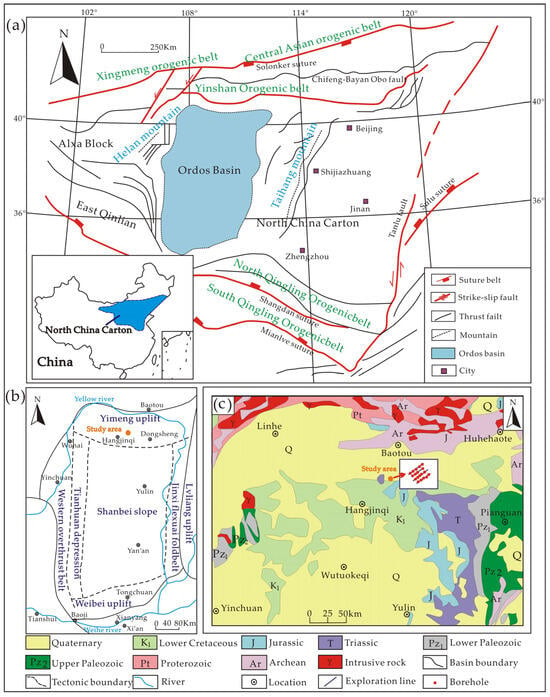
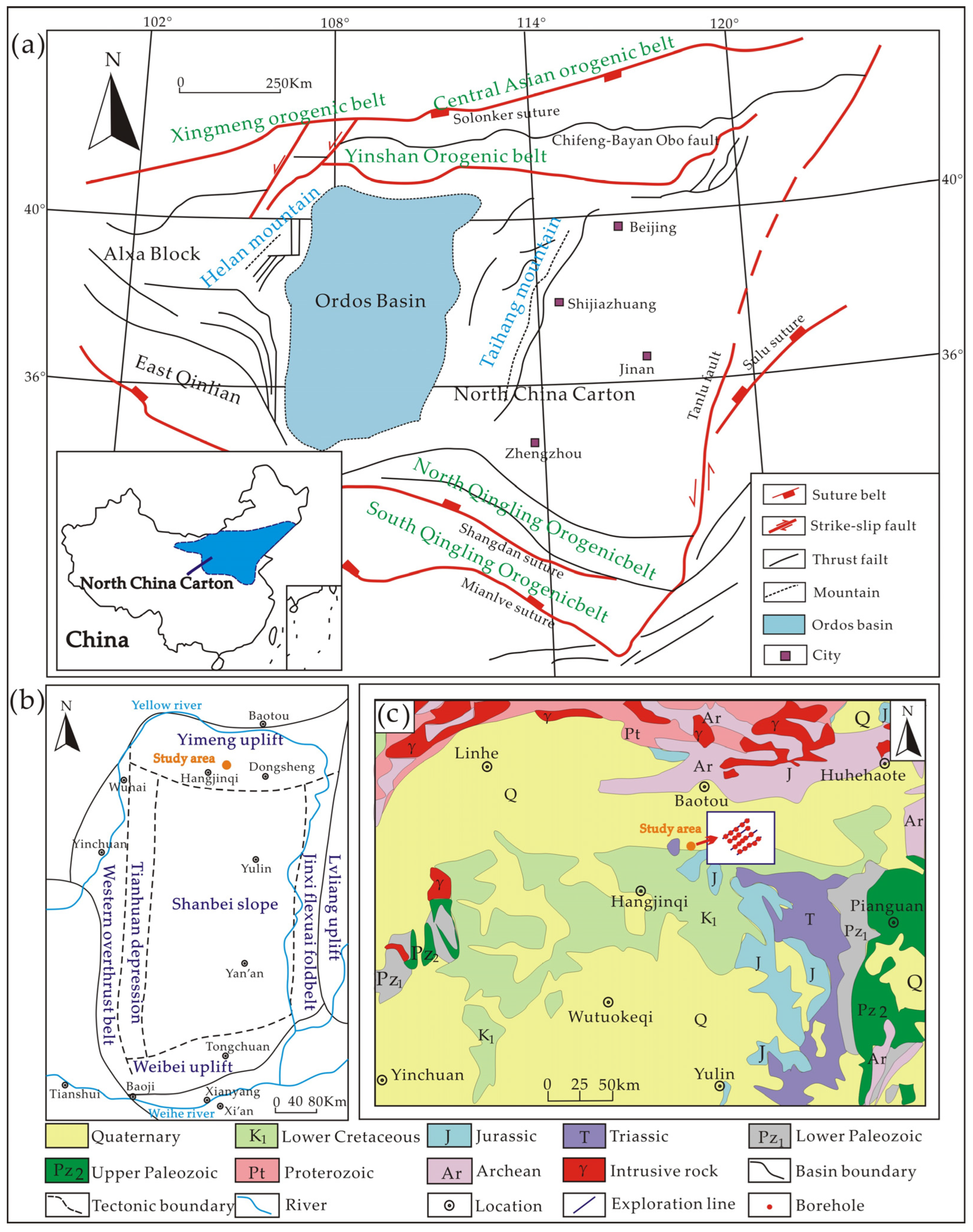
The Ordos Basin, located within the North China Craton [36], is a large cratonic basin situated on a stable crystalline basement [37,38] covering an area of 2.51 × 10⁵ km2. The basin is rich in energy and mineral resources, including petroleum, natural gas, coal, and uranium deposits [39]. Tectonically, it is a Mesozoic–Cenozoic superimposed basin [40]. Although it experienced Mesozoic–Cenozoic superimposed tectono-sedimentary evolution [41], the Ordos Basin retains a relatively stable cratonic architecture characterized by broad gentle slopes and long-term subsidence [42], whereas deformation is generally more pronounced along the basin margins than in the interior [43,44]. As shown in Figure 1a, the basin is surrounded by several orogenic systems and major structural lineaments. To the north, it is adjacent to the Yinshan Orogenic Belt and elements of the Central Asian Orogenic Belt, where the Solonker Suture and Chifeng-Bayan Obo Fault are developed; to the west, it is linked to the Helan Mountain Belt and the Alxa Block; to the east, it borders the Taihang Mountain Belt, influenced by the Tanlu Fault System; and to the south, it is associated with the Qinling Orogenic System, where the Shangdan Suture and Mianlue Suture occur [45]. This tectonic configuration exhibits a strong contrast between active basin margins and a relatively stable basin interior, providing the structural framework for basin evolution and associated mineral systems [46].
Figure 1.
Tectono-stratigraphic setting of the northern Ordos Basin. (a) Regional tectonic context in north central China; (b) tectonic provinces within the Ordos Basin; (c) geological overview of the northern Ordos Basin with the Daying uranium deposit marked.
As shown in Figure 1b, the Ordos Basin is divided into several main second-order tectonic units. To the north lies the Yimeng Uplift, while the Shanbei Slope extends across the north-central sector. The Western Overthrust Belt and the Tianhuan Depression are situated in the western part of the basin. To the east, the Jinxi Flexural Fold Belt and Lvliang Uplift are distributed, with the Weibei Uplift located in the southern sector [47,48,49]. The Daying uranium deposit, located in the northern Ordos Basin (Figure 1b), is the transition zone between marginal tectonic influence and the relatively stable basin interior [50], which is favorable for fluid focusing and ore-related element migration at the basin scale [51].
Stratigraphically, the region exhibits a basement-cover framework (Figure 1c), with Archean (Ar), Proterozoic (Pt), and Paleozoic strata (Pz1–Pz2), locally exposed [52,53,54], overlain by Triassic (T), Jurassic (J), and Lower Cretaceous (K1) successions and extensively covered by Quaternary deposits (Q). Intrusive rocks (γ) are also present and tend to occur near structural boundaries or basement cover transition zones (Figure 1c). In the northern Ordos Basin, previous studies have emphasized that the Jurassic is the interval for uranium enrichment and mineralization, which also constitutes an important stratum for energy accumulation (e.g., coal and hydrocarbons) [17,55,56,57]. In the Daying study area, the spatial association between the uranium deposit and the Jurassic Belt (Figure 1c) suggests that the strata are coupled with basin-scale pathways for fluid circulation [58], which are critical for uranium transport and deposition [59].
The Daying uranium deposit is located in the northern Ordos Basin (Figure 1c) at 108°54′24″–109°03′20″ E and 39°55′55″–40°06′15″ N, with elevations ranging from 1000 to 1500 m [6]. Exploration lines and boreholes are distributed across the deposit area (Figure 1c). Basement-related structures (e.g., fractures, folds, and faults) may exert first-order control on magmatism, sedimentation, and diagenesis, as well as subsequent tectonic modification [60], which influences fluid migration and ore localization [61]. These tectono-stratigraphic features can provide essential geological conditions for uranium enrichment and mineralization at the Daying uranium deposit [62,63].
3. Methods
3.1. Multi-Log Borehole Feature Construction and Uranium Anomaly Probability Estimation
Sandstone uranium deposits are typically hosted in discrete, stratified sandstone layers, often exhibiting localized mineralization rather than continuous zones [64,65]. To accurately characterize uranium anomalies, it is essential to integrate geophysical measurements from multiple boreholes. This approach helps capture variations in mineralization across different layers and depths, providing a more comprehensive understanding of the deposit’s structure. In this paper, the borehole data used included natural gamma irradiation rate, apparent resistivity, aperture, and spontaneous potential.
For the k-th borehole along an exploration line, the borehole data can be represented as follows:
where M is the number of borehole variables and Nk is the number of sampling points in the k-th borehole.
To eliminate scale differences among variables and enhance anomaly detectability [6,20], each variable is normalized using the following formula:
where and are the mean and standard deviation of the j-th variable in the k-th borehole.
where w is the half-width of the sliding window. To capture sharp transitions at lithological or mineralization boundaries, gradient features are calculated as follows:
Physical knowledge is further incorporated to construct additional features: the reciprocal of apparent resistivity highlights low-resistivity zones typical of mineralized sandstone, as follows:
and the absolute value of spontaneous potential emphasizes electrochemical anomalies, as follows:
All features are integrated into a feature vector for each depth point:
A random forest classifier [66,67] is subsequently applied to predict the uranium anomaly probability at each sampling point:
where T denotes the total number of trees, and is the prediction generated by the t-th tree. The resulting uranium anomaly probability curve (UAPC) along the k-th borehole is represented as a column vector:
This column vector can be directly visualized against depth and forms the basis for subsequent vertical layer analysis.
3.2. Fourier-Based Vertical Layer Variation Analysis
Uranium mineralization in sandstone is typically discontinuous and oscillatory, reflecting discrete high-grade layers interbedded with barren sandstone. To quantify vertical heterogeneity, we apply Fourier theory [68,69] performance improvements to the UAPC.
Define the sampling interval of borehole data as Δz. The discrete depth function of the k-th borehole is as follows:
where z is the depth along the borehole. provides signal values collected at different depths, capturing variations in mineralization, an essential characteristic for identifying vertical oscillatory patterns. The discrete Fourier transform (DFT) is then computed as follows:
The DFT transforms the depth domain signal into the frequency domain, decomposing the data into its constituent frequency components. This approach characterizes the oscillatory characteristics of uranium-bearing layers in geological space and helps identify the frequency components in the borehole data that reflect the underlying geological structures. Following the DFT, the frequency range is constrained to focus on the relevant components of the geological signal, after which the inverse DFT (IDFT) is applied to reconstruct the signal in the vertical band domain:
The IDFT can be described as a band-limited reconstruction, where the frequency components from the DFT are filtered to retain the low frequency components associated with the layered oscillatory signals, corresponding to geological features like mineralization layers. By removing the high frequency noise, which often lacks meaningful geological information, this step ensures that the reconstructed signal accurately represents the underlying geological features, providing a clearer signal for subsequent analysis. The vertical layer variation value indicates the deviation of each depth from the average response, and can be defined as
represents the absolute variation in the geological signal at each depth, indicating changes in mineralization. By calculating the absolute deviation between the reconstructed signal and the mean value, this metric quantifies the signal variation at each depth. High values indicate potential uranium mineralized layers. Depths satisfying are identified as mineralization-prone zones, where θ is an empirically or statistically defined threshold and serves as the critical parameter for identifying significant anomalies. In this paper, the threshold is adjusted based on prior knowledge of the expected variability in the geological data, enabling a more accurate definition of anomalies corresponding to mineralized zones. This process transforms the probabilistic UAPC into a geologically interpretable vertical heterogeneity curve, highlighting the discrete and oscillatory nature of sandstone uranium deposits and achieving a comprehensive analysis of borehole data.
4. Borehole Data
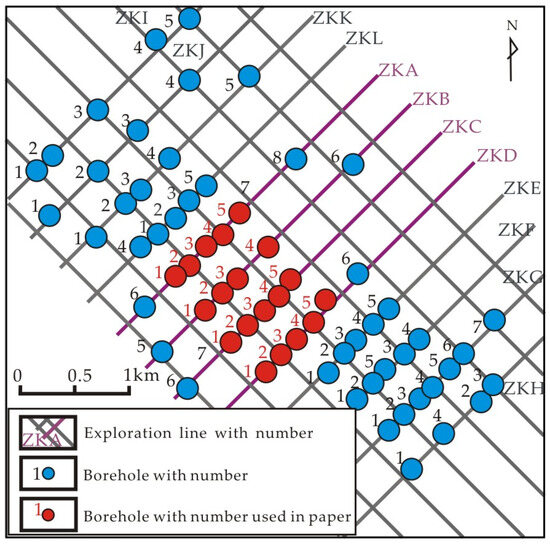
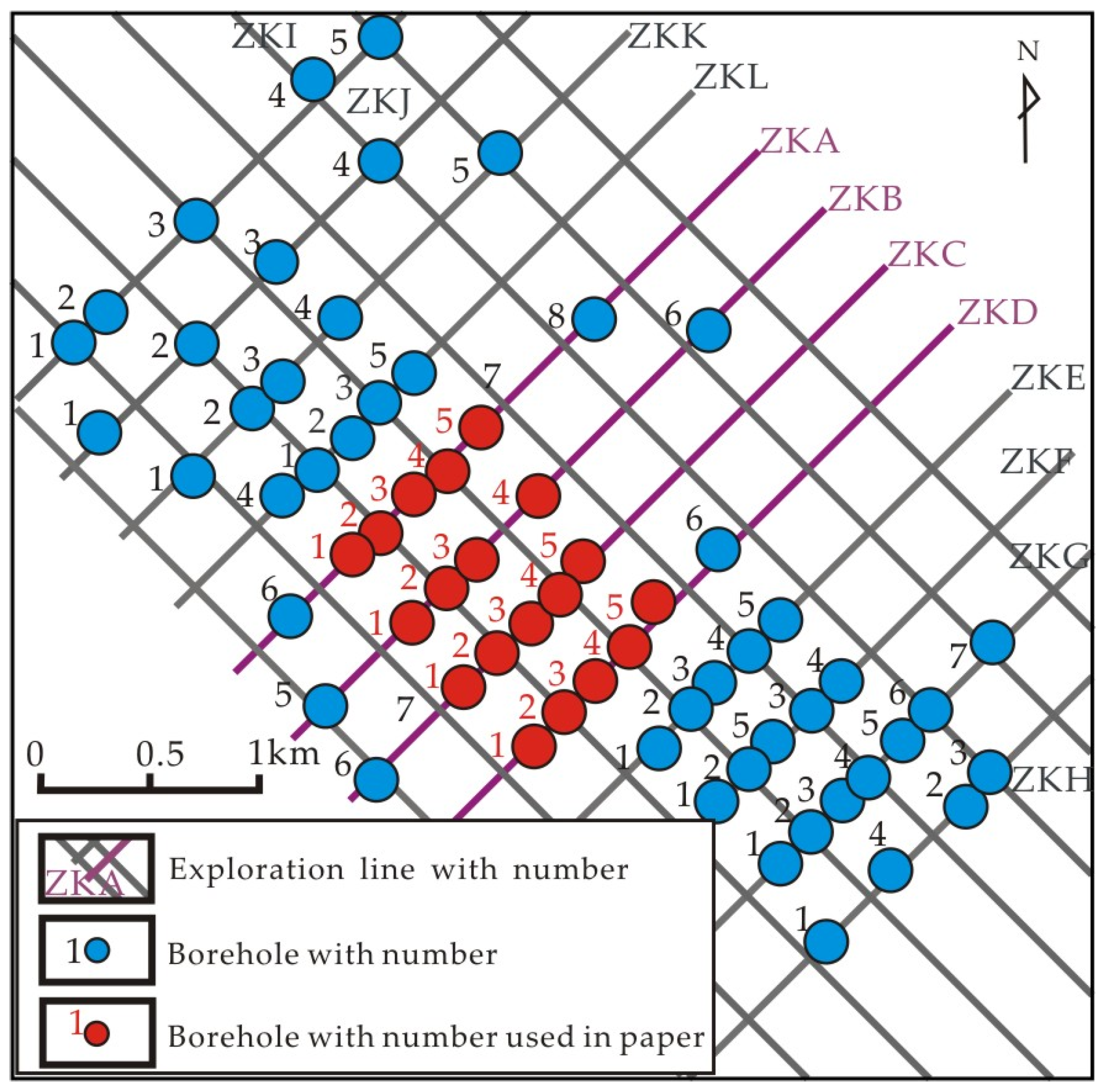
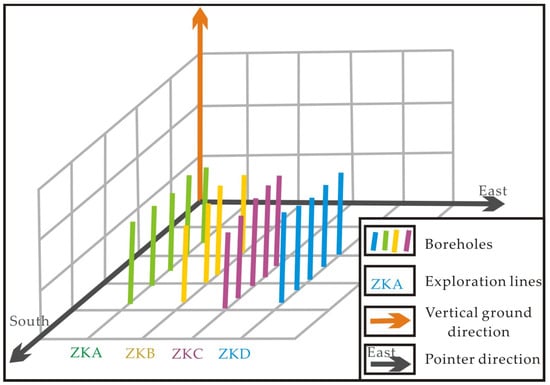
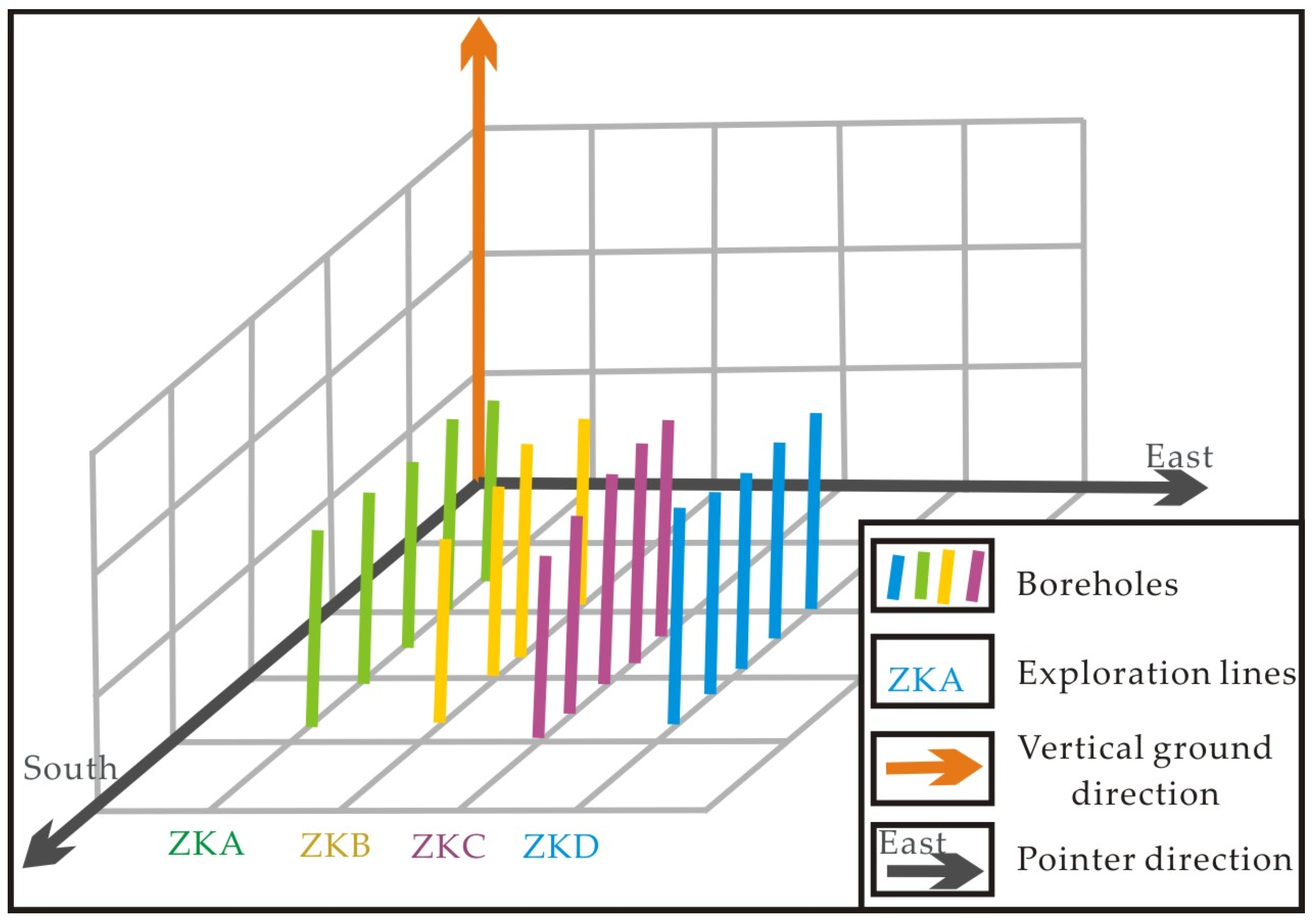
The borehole data used in this study were sourced from the Daying uranium deposit. Drilling within the deposit was arranged along a regular exploration network, where boreholes are distributed across multiple intersecting exploration lines, forming a grid-like pattern. As shown in Figure 2, the final dataset comprises 19 boreholes from four exploration lines, namely, ZKA, ZKB, ZKC, and ZKD (Table 1).
Figure 2.
Borehole layout along the four exploration lines of the study area.
Table 1.
Borehole layout along the four exploration lines in the Daying uranium deposit.
Line ZKA includes five boreholes (ZKA-1 to ZKA-5), line ZKB includes four boreholes (ZKB-1 to ZKB-4), and lines ZKC and ZKD each include five boreholes (ZKC-1 to ZKC-5; ZKD-1 to ZKD-5). Figure 3 presents a simplified diagram of the 3D distribution of boreholes, which constitutes the primary dataset for stratigraphic correlation and subsequent analyses.
Figure 3.
3D spatial arrangement of boreholes and exploration lines in the Daying uranium deposit.
Stratigraphically, all selected boreholes penetrate from the lower Cretaceous (K1) downward to the lower part of the Zhiluo Formation (J2z1), providing a consistent basis for correlation across the study area. In contrast, only a subset of the boreholes extends further downward into the Yan’an Formation (J2y). For stratigraphic description and correlation, the Zhiluo Formation (J2z) is subdivided into an upper member (J2z2) and a lower member (J2z1). Furthermore, the lower member (J2z1) is divided into two subunits, J2z1-2 (upper subunit) and J2z1-1 (lower subunit), in accordance with the stratigraphic scheme summarized in Table 2. This subdivision is applied throughout the paper to ensure consistent borehole comparisons and to support interpretations of lithostratigraphic variability within the deposit.
Table 2.
Stratigraphic intersections of the studied boreholes with vertical depth ranges.
5. Results and Discussion
5.1. Distribution and Validation of UFLI-Delineated Uranium Anomaly Layers
Using a 5 m vertical sampling interval, the proposed UFLI method delineated 51 uranium anomaly layers from 19 boreholes distributed along four exploration lines (ZKA-ZKD) in the Daying uranium deposit. The identified anomaly layers (including top and bottom depths) are summarized in Table 3, along with their host formation and the known industrial or ordinary uranium mineralization (top and bottom depth). Comparison between the identified anomaly layers and the known mineralization reveals that the proposed UFLI method successfully identifies all known industrial and ordinary mineralization layers, while accurately delineating the vertical distribution and depth of these mineralized layers. This capability of the UFLI method ensures the accurate detection of anomaly layers and validates its reliability for delineating subsurface mineralized zones. Meanwhile, the research results indicate that uranium anomalies exhibit pronounced stratigraphic clustering and strong vertical heterogeneity, which is consistent with the layered nature of sandstone uranium mineralization. These phenomena are likely influenced by the sedimentary facies, with continuous mineralization layers associated with specific sedimentary environments, indicating a strong relationship between orebody morphology and the surrounding sedimentary environment. Additionally, the vertical zoning of uranium mineralization, characterized by gradual changes in mineralization intensity at different depths, is influenced by structural factors such as fault zones or fractures. These factors may reflect the evolution of mineralizing fluids within the geological space.
Table 3.
Uranium-bearing layers and mineralization along the ZKA to ZKD exploration line.
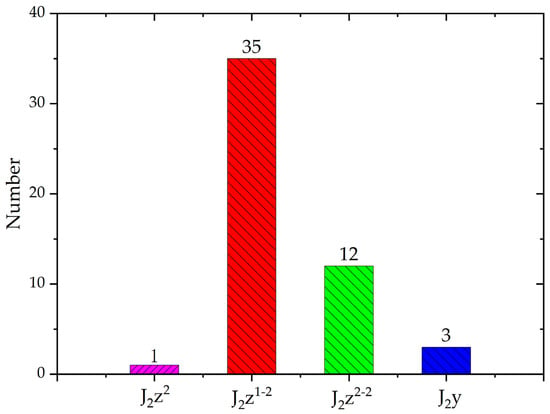
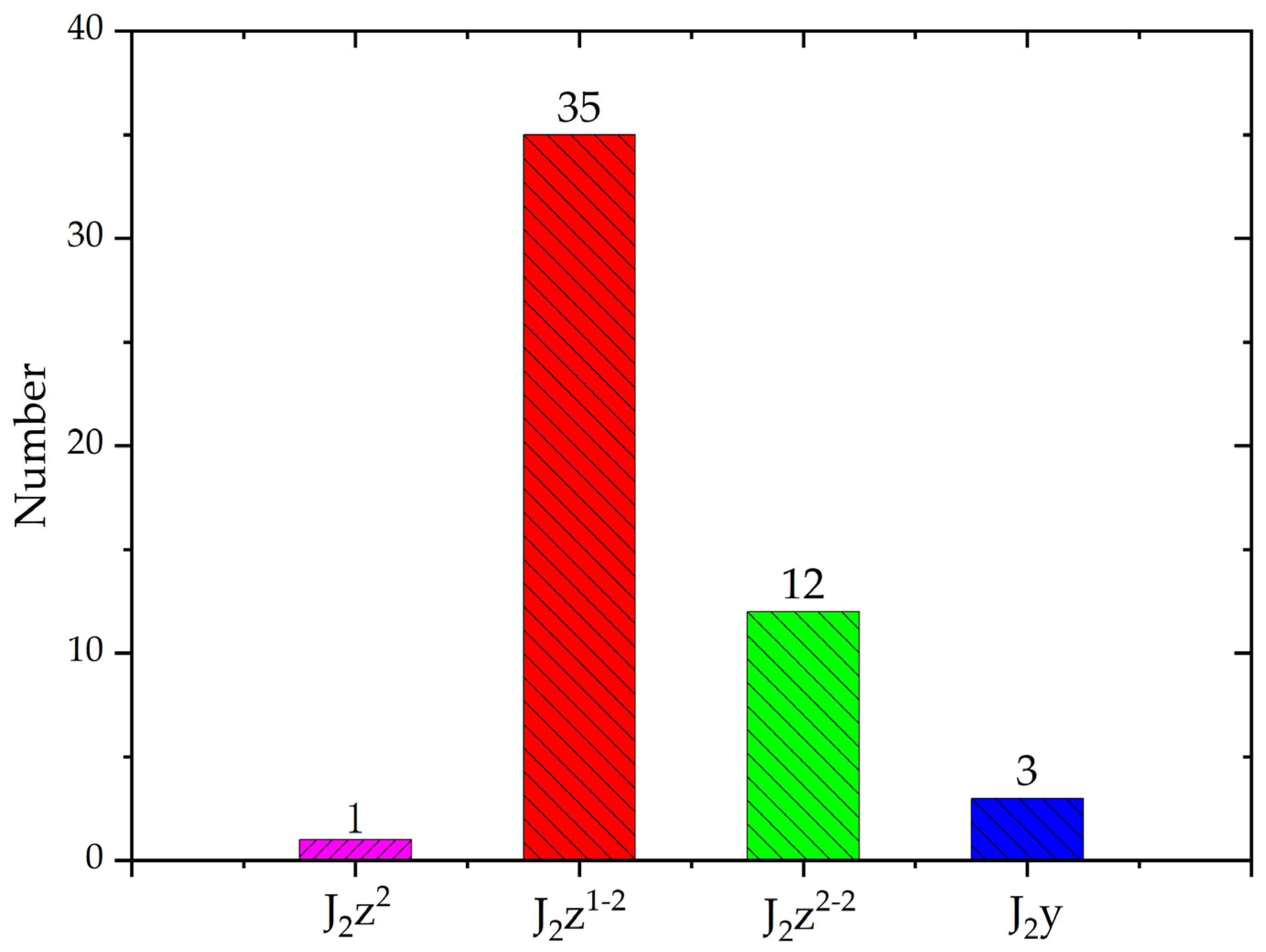
Stratigraphically, the anomaly layers are strongly concentrated in the Zhiluo Formation (Middle Jurassic), particularly within the lower Zhiluo Formation (J2z1). Among the 51 anomaly layers, 35 layers (68.63%) occur in the upper subunit J2z1-2, and 12 layers (23.53%) occur in the lower subunit J2z1-1, together accounting for 92.16% for all identified layers. Only a limited number of anomaly layers are delineated in the Yan’an Formation (J2y; three layers, 5.88%) and the upper Zhiluo member (J2z2; one layer, 1.96%), and no uranium anomaly layers were detected in the Lower Cretaceous (K1). This distribution indicates that uranium anomalies in the Daying deposit are strongly controlled by the Zhiluo stratigraphic, where J2z1-2 represents the dominant anomaly prone horizon, while deeper anomalies in J2z1-1 and J2y reflect localized downward extension rather than a basin-wide, continuous mineralized interval. Figure 4 presents a stratigraphic distribution indicating that J2z1-2 is the primary anomaly-bearing interval in the study area, whereas anomaly occurrence in J2z1-1 and J2y is comparatively limited.
Figure 4.
Stratigraphic distribution of uranium anomaly layers for UFLI method.
In the vertical domain, the delineated anomaly layers span an approximate depth range from 550 m to 745 m. The anomaly layers are not uniformly distributed with the depth but instead occur as discrete clusters within the stratigraphic intervals described above. The anomaly layers occur within J2z1, which broadly occupies the mid-depth portion of the drilled boreholes. Layers assigned to J2z1-1 extend the anomaly-bearing interval downward from J2z1-2, and a small number of anomaly layers are also delineated in J2y. This depth distribution provides the basis for subsequent borehole comparison and stratigraphic correlation.
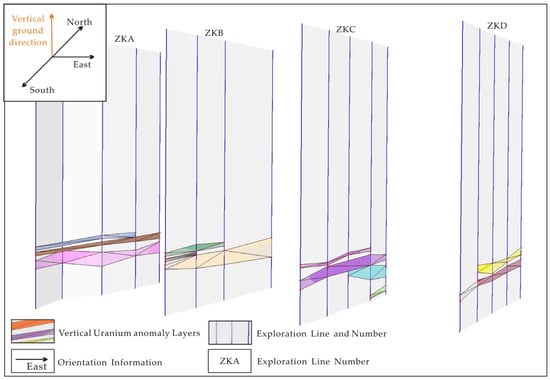
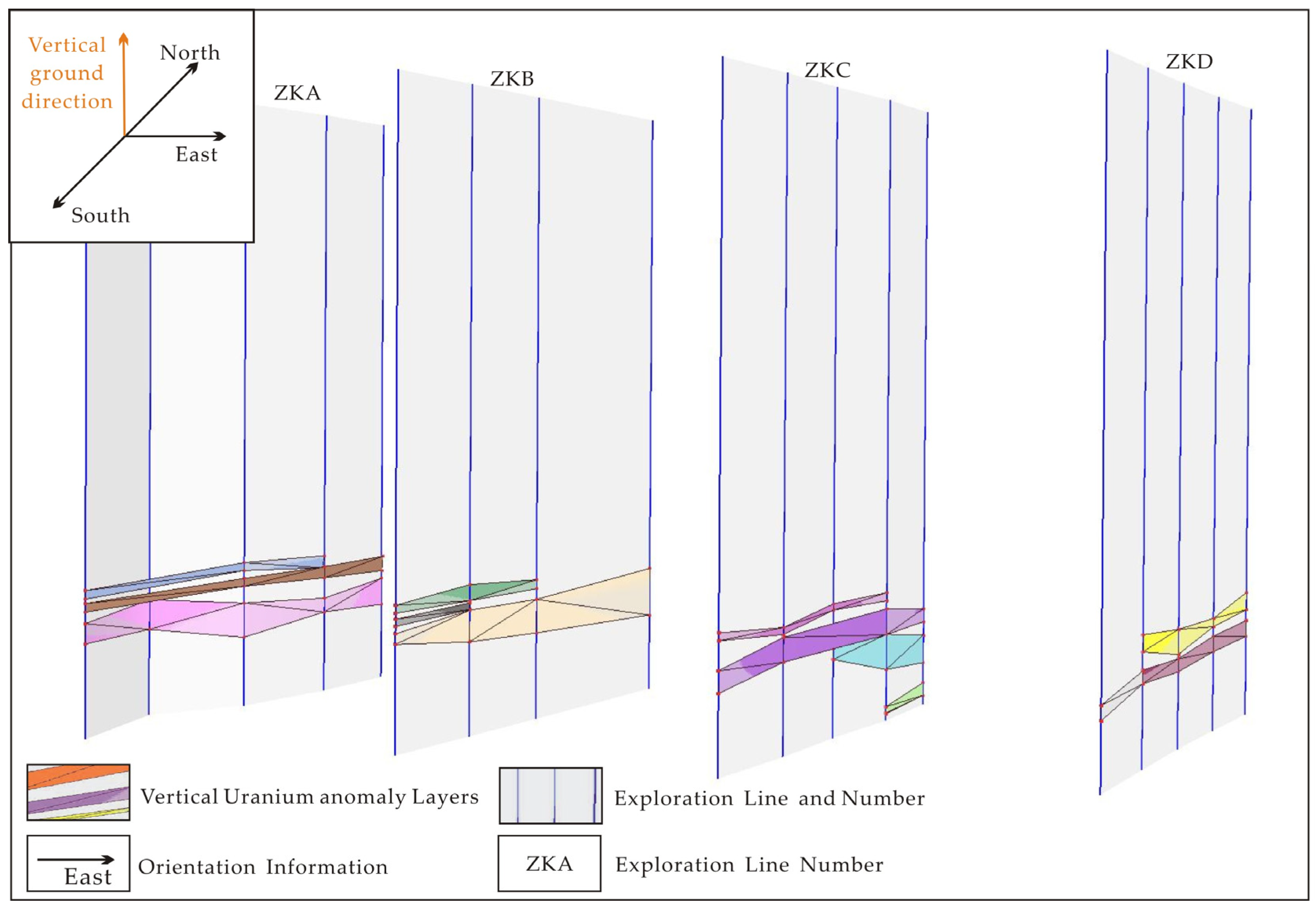
Across the four exploration lines, the number of continuous anomaly layers varies (Table 3): 16 layers on ZKA, 13 layers on ZKB, 12 layers on ZKC and 10 layers on ZKD. Although J2z1-2 dominates across the four exploration lines, the relative contribution of deeper anomalies varies, especially in J2z1-1 and J2y, suggesting that the vertical extent of anomaly intervals is not laterally uniform at the deposit scale. Such contrasts are consistent with heterogeneous sedimentary architecture and/or local controls on fluid focusing and redox interfaces, and they directly motivate the construction of line-based correlation sections. As is shown in Figure 5, the delineated anomaly layers are projected onto exploration-line profiles to visualize their distribution and continuity.
Figure 5.
Spatial distribution map of exploration line-based occurrence of uranium anomaly layers for UFLI method.
A comparison with the industrial and ordinary mineralization (97 layers) reveals that all industrial and ordinary layers, including 67 industrial and 30 ordinary intersections (Table 3), are distributed in 51 anomaly layers. This demonstrates that the proposed UFLI method can highlight mineralization horizons from borehole data. The remaining few anomaly layers not recorded in industrial and ordinary layers should not be interpreted solely as false detections because the availability and resolution of mineralization records may vary among boreholes, and some anomaly layers may represent weakly mineralized or unverified prospective intervals. From an exploration standpoint, these “unmatched” anomaly layers provide candidates for follow up verification (e.g., closer sampling, re-assaying, or targeted infill drilling), particularly where they display consistent stratigraphic positions or show continuity across adjacent boreholes on the same exploration line.
5.2. 3D Orebody Reconstruction Constrained by UFLI-Delineated Uranium Anomaly Layers
Based on the proposed UFLI method, we delineated uranium anomaly layers and their continuity between adjacent boreholes, and identified anomaly intervals corresponding to five uranium orebodies (orebodies 1–5). This process is based on both spatial proximity and stratigraphic continuity and involves strong human factors; we define the spatial proximity criterion by considering the horizontal and vertical distance between adjacent anomaly layers. If two anomaly layers are within a certain distance threshold, they are considered part of the same orebody. As is shown in Table 4, the contributing boreholes for each orebody are summarized, including the reconstructed top and bottom boundaries (start/end) and the intersected thickness in each borehole. In terms of 3D spatial distribution, the reconstructed orebodies occupy a vertical domain of approximately 550 m–745 m, which documents a clear progression from shallower, broadly linked bodies (orebodies 1–3) to deeper, more spatially restricted bodies (orebodies 4–5).
Table 4.
Borehole locations and depth positions of uranium orebodies.
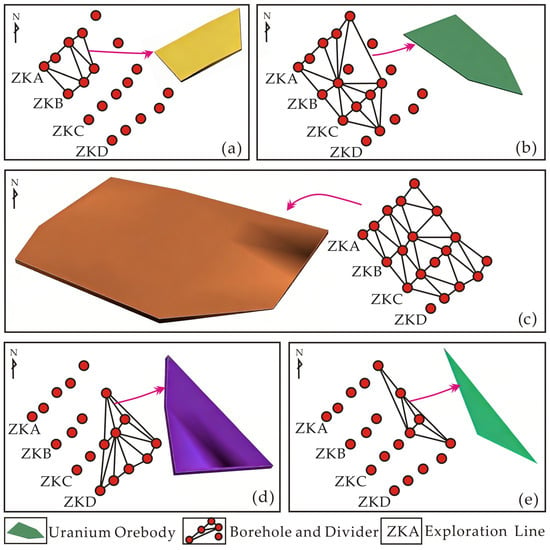
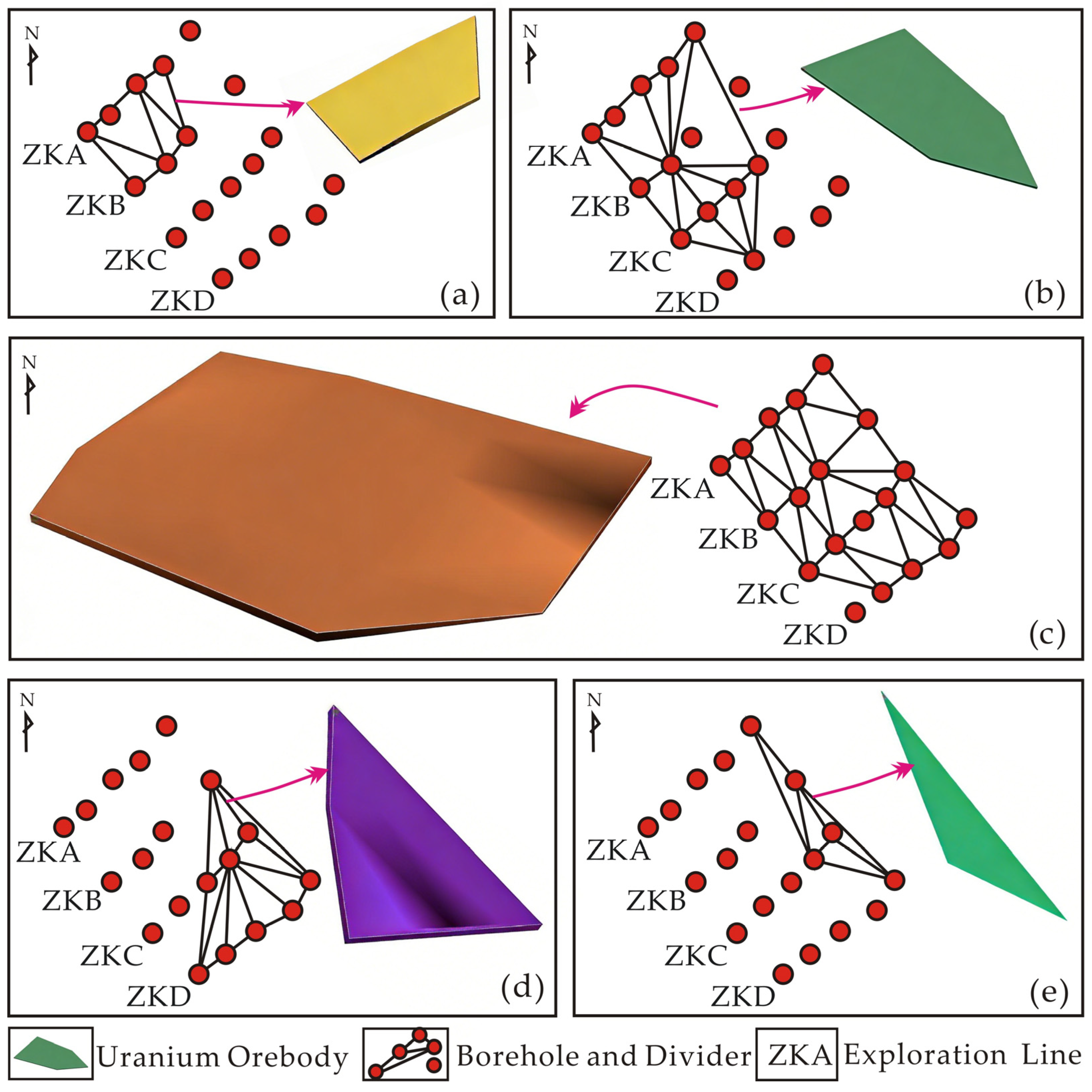
Orebody 1 includes six boreholes on the ZKA and ZKB exploration lines (Figure 6a). It is distributed in a relatively narrow depth interval of approximately 550 m–575 m, and individual borehole thicknesses range from 10 m to 25 m (e.g., 10 m in ZKA-1/ZKA-3/ZKB-1/ZKB-3 and up to 25 m in ZKB-2). The start depths are clustered near 550 m–560 m across the contributing boreholes, and the thickness varies between holes, indicating differences in vertical development within the same depth band.
Figure 6.
3D models of the five reconstructed uranium orebodies constrained by UFLI method in the Daying uranium deposit. (a) Orebody 1; (b) orebody 2; (c) orebody 3; (d) orebody 4; (e) orebody 5.
Orebody 2 is reconstructed from seven boreholes spanning four exploration lines (ZKA, ZKB, ZKC, and ZKD). As shown in Figure 6b, it extends from approximately 565.95 m to 600 m, with thicknesses ranging from 5 m (ZKC-3) to 20 m (ZKA-5). The distribution across multiple lines and the moderate thickness suggest that orebody 2 is a laterally extensive and vertically modest anomaly package, where thinning and thickening occur between boreholes.
Orebody 3 has the largest number of boreholes, as shown in Figure 6c, involving 17 boreholes distributed across ZKA-ZKD. It occupies an intermediate depth interval from 584.95 m to 645 m, and the thicknesses are the most widely spread among the five orebodies, ranging from 9.99 m (ZKD-4) to 45 m (ZKA-3), with many boreholes recording thicknesses from 30 m to 40 m (e.g., ZKA-2 is 34.95 m; ZKB-2 is 40 m). The broad borehole width distribution and large thickness indicate that orebody 3 is the principal reconstructed volume in the study area within the mid-depth anomaly domain (Table 4).
Orebody 4 occurs at greater depths and is constrained by nine boreholes, mainly from the ZKB, ZKC, and ZKD (Figure 6d). It spans from 625 m to 699.87 m. In all boreholes, orebody 4 is relatively thick, with measurements including 42.2 m in ZKC-4 and 34.87 m in ZKC-5, whereas other boreholes commonly intersect with thickness of 15 m to 25 m. Its depth position and thickness distribution indicate that orebody 4 is a deeper, comparatively robust anomaly volume within the reconstructed system.
Orebody 5 is located at the deepest interval in the study area and is constrained by five boreholes from ZKA to ZKD. As shown in Figure 6e, it extends from 680 m to 745 m, and thicknesses are uneven across boreholes (e.g., 15 m in ZKA-5 and ZKB-4, 13.9 m in ZKC-5, and only 3.7 m and 5 m in ZKC-4 and ZKD-5, respectively). Compared to the shallower orebodies, orebody 5 is more spatially limited and vertically patchy.
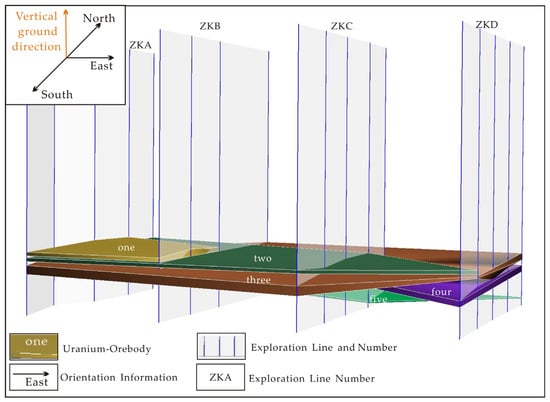
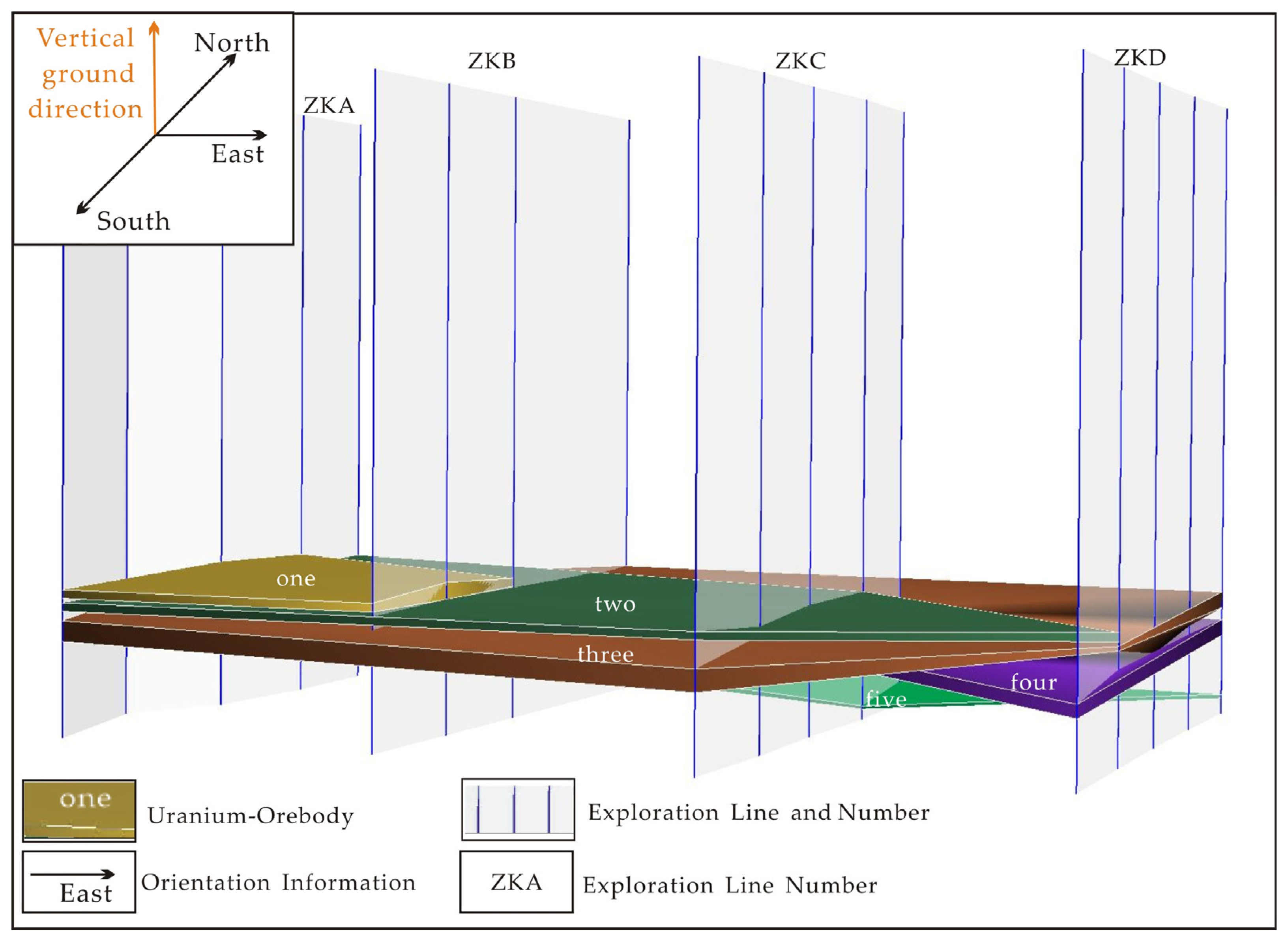
Figure 7 presents the 3D visualization of the reconstructed uranium orebodies (orebodies 1–5) in the Daying uranium deposit. Orebodies 1–3 occupy the main mid-depth interval (approximately 550 m–645 m) and exhibit increasing spatial extent and thickness variability from orebody 1 to orebody 3. Orebody 4 and orebody 5 occur at greater depths (approximately 625 m–745 m) and show limited spatial development. These reconstructed volumes provide a clear 3D geometric representation of the uranium anomaly layers identified by the proposed UFLI method. This representation can serve as a foundation for visualizing and comparing orebody distributions across different exploration lines.
Figure 7.
3D visualization of the reconstructed uranium orebodies (orebodies 1–5).
6. Conclusions
In this paper, we propose a UFLI method to recognize the uranium anomaly layers using borehole datasets and reconstruct 3D orebodies in sandstone uranium. The proposed UFLI method integrates multi-log feature construction with a random forest-derived uranium anomaly probability curve (UAPC) and applies Fourier vertical variation analysis to identify the uranium anomaly layers.
We used the Daying uranium deposit as the study area (19 boreholes on four exploration lines; 5 m sampling interval). With the proposed UFLI method, we obtained 51 uranium anomaly layers characterized by pronounced stratigraphic clustering and strong vertical heterogeneity. Anomaly layers are overwhelmingly concentrated in the Middle Jurassic Zhiluo Formation (J2), especially within the lower Zhiluo member (J2z1). The anomaly layers recognized in J2z1-2 and J2z1-1 together account for 92.16% of all identified layers. The anomaly vertical domain of the layers spans from 550 m to 745 m. All known industrial and ordinary mineralization layers are included in the identified anomalous areas, indicating that the anomaly layers effectively capture the principal mineralization horizons and provide additional anomaly targets for further verification. In addition, we reconstructed five orebodies (orebodies 1–5), revealing depth-related 3D features that progress from shallower, more broadly connected volumes (orebodies 1–3) to deeper, more spatially restricted volumes (orebodies 4–5), thereby clarifying the subsurface distribution and geometry of anomaly-related bodies at the deposit scale.
The UFLI method is constrained by borehole density and the completeness/resolution of existing mineralization records; the sensitivity of the UFLI method to borehole spacing and the criteria for anomaly layer merging should be acknowledged. The spacing between boreholes can affect the resolution of orebody reconstruction, with wider spacing potentially leading to less precise delineation of orebody boundaries. Moreover, the merging rules, particularly the thresholds for spatial proximity and continuity, may influence how orebodies are represented. While we have established rigorous criteria to minimize these uncertainties, further refinement of these parameters could further enhance the accuracy and reliability of the method. Future work should further test the sensitivity of delineation to sampling intervals and threshold settings, and incorporate additional geological constraints (e.g., facies and redox indicators) to strengthen the reliability of 3D orebody reconstruction and exploration targeting.
Author Contributions
Conceptualization, Y.T.; methodology, Y.T., J.H. and L.L.; validation, L.P. and B.C.; formal analysis, J.H. and T.L.; investigation, B.C. and L.Z.; data curation, L.L.; writing—original draft preparation, Y.T.; writing—review and editing, Y.T. and L.P.; visualization, Y.T. and T.L.; supervision, L.P. and L.Z.; funding acquisition, Y.T. All authors have read and agreed to the published version of the manuscript.
Funding
This research was funded by the Jilin Province Natural Science Foundation of Jilin Province Science and Technology Development Plan (20230101311JC) and the National Science and Technology Major Project (2024ZD1001003).
Data Availability Statement
The data supporting this study’s findings are available from the corresponding author upon request.
Acknowledgments
The authors would like to express their gratitude to the editor and reviewers for their detailed and valuable feedback, which significantly contributed to the improvement of the manuscript.
Conflicts of Interest
The authors declare no conflicts of interest.
References
- Zhang, B.; Cheng, Y.H.; Xiao, K.Y.; Yu, R.; Chen, Y.; Zhu, Q.; Wen, S. Prediction of Sandstone-Type Uranium Deposits Based on Data from Oilfield Drilling and Its Mineralization Regularity: A Case Study of Jingchuan Uranium Deposit, SW Ordos Basin. Appl. Sci. 2025, 15, 11268. [Google Scholar] [CrossRef] [Scilit]
- Liu, Z.Y.; Peng, S.P.; Qin, M.K.; Huang, S.H.; Geng, Y.Y.; He, Z.B. Constraints on Sandstone-Type Uranium Deposits by the Tectonic Uplift and Denudation Process in the Eastern Junggar Basin, Northwest China: Evidence from Apatite Fission Track and Detrital Zircon U-Pb Ages. Minerals 2022, 12, 905. [Google Scholar] [CrossRef] [Scilit]
- Yang, Q.; Liu, C.Y.; Zhao, J.F.; He, F.Q.; Zhang, W.; Ma, Y.P.; Yang, L.H.; Shao, D.Y.; Du, N.; Chen, F.Y. Long-Distance Lateral Migration, Accumulation and Dissipation of Natural Gas in the Northeastern Ordos Basin, China. Gondwana Res. 2026, 150, 119–153. [Google Scholar]
- Hu, X.W.; Ling, M.X.; Yang, X.Y.; Li, Q.C.; Cao, M.Q. Discovery of Trogtalite (CoSe2) in the Qianjiadian Sandstone-Type Uranium Deposit in China. Resour. Geol. 2025, 75, e70002. [Google Scholar] [CrossRef] [Scilit]
- Aizhulov, D.; Tungatarova, M.; Kaltayev, A. Streamlines Based Stochastic Methods and Reactive Transport Simulation Applied to Resource Estimation of Roll-Front Uranium Deposits Exploited by In-Situ Leaching. Minerals 2022, 12, 1209. [Google Scholar] [CrossRef] [Scilit]
- Tan, Y.L.; Lu, L.J.; Yang, C.; Zhao, J.; Ding, Y. Uranium-Bearing Layers of Sandstone Type Uranium Deposits Identification and Three-Dimensional Reconstruction in the Northern Ordos Basin, North-Central China. Minerals 2023, 13, 834. [Google Scholar] [CrossRef] [Scilit]
- Zhang, C.Y.; Xia, F.; Deng, W.; Liu, X.; Zhang, Q.X.; Shi, B.B.; Li, H.X.; Fu, Y.K. The Migration Pattern of Oxidation Fluids and Its Constraints on Uranium Mineralization in the Tamusu Sandstone-Type Uranium Deposit of the Bayingobi Basin, China. Sediment. Geol. 2025, 478, 106823. [Google Scholar] [CrossRef] [Scilit]
- Wu, M.; Qiu, K.; Yang, J. Ferrous Iron (Fe2+) Released From Iron-Rich Chlorite as a Reductant for Unconformity-Related Uranium Mineralization: Insights From Reactive Fluid Flow Modeling. J. Geophys. Res. Solid Earth 2024, 129, e2024JB030063. [Google Scholar] [CrossRef] [Scilit]
- Liu, C.Y.; Wang, J.Q.; Zhang, D.D.; Zhao, H.G.; Zhao, J.F.; Huang, L.; Wang, W.Q.; Qin, Y. Genesis of Rich Hydrocarbon Resources and their Occurrence and Accumulation Characteristics in the Ordos Basin. Oil Gas Geol. 2021, 42, 1011–1029. [Google Scholar]
- Pan, Z.; Qiao, B.; Huang, W. The study on vibrator seismic data acquisition and processing for sandstone type uranium prospecting in Erlian Basin. J. Phys. Conf. Ser. 2024, 2895, 012010. [Google Scholar] [CrossRef] [Scilit]
- Xu, Z.L.; Tang, C.; Liu, H.J.; Duan, M. The Relationship between Sedimentary Facies and Sequence Stratigraphy of SaihanTala Formation and Sandstone-Type Mineralization in the Luhai Uranium Deposit of Erlian Basin. Ore Geol. Rev. 2026, 188, 107032. [Google Scholar] [CrossRef] [Scilit]
- Lin, Y.H.; Fan, M.S.; Ni, P.; Pan, J.Y.; Chi, Z.; Cheng, Z.L.; Wu, W.Y.; Zhang, C.; Qi, B.D.; Wei, X.B. A Novel Mechanism of Uranium Mineralization: The Role of Zircon Adsorption at the Qigequan Deposit, Qaidam Basin, NW China. Sediment. Geol. 2026, 493, 107027. [Google Scholar] [CrossRef] [Scilit]
- Xiao, K.; Xu, Y.C.; Yang, Y.X.; Hu, X.D.; Luo, Q.B.; Duan, Z.Y.; Jiao, C.W.; Chen, M.S.; Yin, D.N. Study on Logging Identification of Sandstone-Type Uranium Deposits Based on Ensemble Learning in the Songliao Basin in Northeast China. Nucl. Sci. Eng. 2025, 199, 1246–1262. [Google Scholar] [CrossRef] [Scilit]
- He, T.P.; Zhou, Y.Q.; Li, Y.H.; Chen, Z.B. 3D Modeling of Tectonostratigraphic, Petrophysical, and Uranium Mineralization Properties for Sandstone-Type Uranium Reserve Assessment in the Shawan Formation, Chepaizi Area, Junggar Basin. Nat. Resour. Res. 2026, 1–28. [Google Scholar] [CrossRef] [Scilit]
- Li, W.H.; Xu, D.R.; Yang, J.B.; Fan, Q.S.; Yan, Z.K.; Zhang, C.Y.; Li, Z.H. Provenance and Uranium Source of the Lower Cretaceous Sedimentary Rocks in Northern Sichuan Basin: Evidence from Sedimentary Facies Analysis and Detrital Zircon U-Pb Geochronology. J. Asian Earth Sci. X 2025, 14, 100201. [Google Scholar] [CrossRef] [Scilit]
- Luo, X.N.; Peng, S.P.; Li, Z.Y.; He, F.; Li, X.D.; Zhang, Z.L. Petrography and Geochemistry of Sandstones from the Middle Jurassic Zhiluo Formation in the Northern Margin, Ordos Basin: Implications for Provenance, Tectonic Setting, Paleoweathering, Paleoclimate, and Sandstone-Type Uranium Mineralization. Front. Earth Sci. 2025, 13, 1573609. [Google Scholar] [CrossRef] [Scilit]
- Yu, R.; Chen, Y.; Zhu, Q.; Wang, S.B. Key Ore-Controlling Factor of Sandstone-Type Uranium Deposits in Northern Ordos Basin, Constrains on Uranium Metallisation and Exploration. Geol. J. 2025, 60, 2964–2983. [Google Scholar] [CrossRef] [Scilit]
- Jin, R.S.; Feng, X.X.; Teng, X.M.; Nie, F.J.; Cao, H.Y.; Hou, H.Q.; Liu, H.X.; Miao, P.S.; Zhao, H.L.; Chen, L.L. Genesis of Green Sandstone/Mudstone from Middle Jurassic Zhiluo Formation in the Dongsheng Uranium Orefield, Ordos Basin and its Enlightenment for Uranium Mineralization. China Geol. 2020, 3, 52–66. [Google Scholar] [CrossRef] [Scilit]
- Cao, M.X. Research and Application on Geospatial Digital Spectrum Model. Ph.D. Thesis, Jilin University, Changchun, China, 2017. [Google Scholar]
- Tan, Y.L. Research on the Vertical Spatial Zoning and Ore-Bearing Layers Recognition of Sandstone Uranium Deposit—A Case Study of the Daying Uranium Deposit in Northern Ordos Basin. Ph.D. Thesis, Jilin University, Changchun, China, 2021. [Google Scholar]
- Zhou, P.; Tang, B. Experimental Study of the Influence of Borehole Parameters on Prompt Fission Neutron Uranium Logging and Its Corrections. Nucl. Eng. Technol. 2024, 56, 3090–3096. [Google Scholar] [CrossRef] [Scilit]
- Hu, X.W.; Ling, M.X.; Xu, J.B.; Gong, Q.; Yang, X.Y.; Li, H.M.; Lu, C.; Li, Z.C.; Wang, L.H.; Ren, Z.Y.; et al. Petrological, Mineralogical, Carbonate C-O and Sulfide S Isotope Study of the Bayinqinggeli Sandstone-Hosted Uranium Deposit in the Northern Ordos Basin. Ore Geol. Rev. 2024, 174, 106334. [Google Scholar] [CrossRef] [Scilit]
- Si, Q.H.; Teng, X.M.; Zhu, Q.; Li, J.G.; Zhao, H.L.; Wang, G.M.; Tong, H.K.; Dang, H.L. The Origin and Migration Laws of Hydrocarbons in Uranium-bearing Luohe Formation, Pengyang Area, SW Ordos Basin. Geol. J. 2024, 59, 2703–2719. [Google Scholar] [CrossRef] [Scilit]
- Rawat, T.P.S.; Roy, M.; Joshi, G.B. Hydrothermal Fracture Controlled Vein-Type Uranium Mineralization in the Paleoproterozoic Bijawar Group of Rocks, Sonrai Basin, Lalitpur District, U.P.—Fresh Findings from Subsurface Borehole Data. J. Geol. Soc. India 2018, 91, 25–31. [Google Scholar] [CrossRef] [Scilit]
- Xue, X.; Guo, M.; Chen, D.; Peng, Y.Y.; Li, J.L.; Li, E.; Ma, C.Y.; Nie, X.Q.; Dong, F.Q. Calcium-Phosphate Mediated Green Remediation of Uranium Mine Water: Sulfur-Fixing Ash Enhanced Phosphorus Leaching from Phosphogypsum for Targeted Uranium Mineralization. J. Water Process Eng. 2026, 81, 109213. [Google Scholar]
- Xu, K.; Li, G.; Zhang, H.; Dong, W.; Liu, X.; Zhang, X.; Wu, B.; Wang, R. Uranium and u-bearing minerals in the husab uranium deposit in namibia: Occurrence, composition, age, and implications for uranium mineralization process. Ore Geol. Rev. 2025, 182, 106642. [Google Scholar] [CrossRef] [Scilit]
- Cui, Y.; Chen, X.L.; Xu, D.R.; Zou, S.H.; Zhang, H.S.; Fan, Z.H.; Luo, L.F. Geochemical Characteristics and Petrogenesis of Uranium-Bearing and Barren Granites in the Miao’ershan Batholith, South China: Implications for U Mineralization. J. Geochem. Explor. 2025, 278, 107829. [Google Scholar]
- Bappa, M.; Kalachand, S. Semi-automated Rock Layer Recognition from Borehole Log Data Using Combined Wavelet and Fourier Transform: A Case Study in the KG basin, India. J. Geol. Soc. India 2023, 99, 1659–1670. [Google Scholar] [CrossRef] [Scilit]
- Gama, P.H.T.; Faria, J.; Sena, J.; Neves, F.; Riffel, V.R.R.; Perez, L.; Korenchendler, A. Imputation in Well Log Data: A Benchmark for Machine Learning Methods. Comput. Geosci. 2025, 145, 105789. [Google Scholar] [CrossRef] [Scilit]
- Koeshidayatullah, A.; Al-Fakih, A.; Kaka, S.I. Toward basin-agnostic well log imputation and anomaly detection via a pre-trained time-series foundation model. Energy Geosci. 2026, 2, 100536. [Google Scholar] [CrossRef] [Scilit]
- Bondarenko, N.; Ankul, A.; Goldberg, C.; Williams-Stroud, S.; Makhnenko, R. Machine Learning-Driven Analysis of Geophysical Wellbore Data for Underground Storage Applications. Sci. Rep. 2025, 15, 1–15. [Google Scholar] [CrossRef] [Scilit]
- Wei, X.L.; Liu, Q.J.; Pan, Z. Anomaly Detection in Borehole Strain Data with CNN and Frequency-Aware VAE. J. Adv. Comput. Intell. Intell. Inform. 2025, 29, 1390–1395. [Google Scholar] [CrossRef] [Scilit]
- Chi, C.Q.; Li, C.Y.; Han, Y.; Yu, Z.; Li, X.; Zhang, D.W. Pre-earthquake Anomaly Extraction From Borehole Strain Data Using Machine Learning. Sci. Rep. 2023, 13, 20095. [Google Scholar] [CrossRef] [Scilit] [PubMed]
- Al-Fakih, A.; Koeshidayatullah, A.; Mukerji, T.; Kaka, S.I. Enhanced anomaly detection in well log data through the application of ensemble GANs. Appl. Comput. Geosci. 2026, 29, 100316. [Google Scholar] [CrossRef] [Scilit]
- Mitelman, A. Machine Learning Analysis of Borehole Data for Geotechnical Insights. Geotechnics 2024, 4, 1175–1188. [Google Scholar] [CrossRef] [Scilit]
- Chen, R.; Wang, F.; Li, Z.; Evans, N.J.; Chen, H.; Wei, X. Late Paleozoic Provenance Shift in the East-central Ordos Basin: Implications for the Tectonic Evolution of the North China Craton. J. Asian Earth Sci. 2021, 215, 104799. [Google Scholar] [CrossRef] [Scilit]
- Hu, X.W.; Ling, M.X.; Xu, J.B.; Wei, Q.; Yang, X.Y.; Lu, C.; Wang, L.H.; Zhang, F.; Jiang, X.J.; Zhao, Z. Petrological and Geochemical Research on the Telaaobao Sandstone–Hosted Uranium Deposit in the North-Western Ordos Basin, China: Implications of Multiple Sources. Geol. J. 2025, 60, 1909–1927. [Google Scholar] [CrossRef] [Scilit]
- Deng, J.; Wang, Q.F.; Gao, B.F.; Huang, D.H.; Yang, L.Q.; Xu, H.; Zhou, Y.H. Evolution of the Ordos Basin and its Distribution of Various Energy and Mineral Resources. Geoscience 2005, 19, 538–545. [Google Scholar]
- Zhang, X.; Che, J.F.; Nie, F.J.; Miao, A.S.; Yan, Z.B.; Zhang, C.Y.; Hu, Y.J. Provenance and Uranium Sources in the Lower Cretaceous Huanhe Formation of Northern Ordos Basin: Constraints from Detrital Zircon U–Pb Geochronology and Hf Isotopes. Minerals 2025, 15, 1079. [Google Scholar] [CrossRef] [Scilit]
- Fan, B.; Dai, X.; Wang, C. Gas Desorption Characteristics of the Chang 7 Member Shale in the Triassic Yanchang Formation, Yan’an Area, Ordos Basin. Minerals 2023, 13, 622. [Google Scholar] [CrossRef] [Scilit]
- Jiang, L.; Qiu, Z.; Wang, Q.C.; Guo, Y.S.; Wu, C.F.; Wu, Z.J.; Xue, Z.H. Joint Development and Tectonic Stress Field Evolution in the Southeastern Mesozoic Ordos Basin, West Part of North China. J. Asian Earth Sci. 2016, 127, 47–62. [Google Scholar] [CrossRef] [Scilit]
- Wu, T.P.; Su, X.B.; Zhao, L.X.; Hou, C.R.; Wang, Q.L.; Zhou, C.Z.; Zou, Y.H.; Jiang, G.P. The Geological Characteristics of Low-Permeability Sandstone Uranium Deposit in Ordos Basin, North China: Implications of Cause of Low Permeability and Corresponding In Situ Leaching Methods. Geol. J. 2025, 60, 1721–1735. [Google Scholar] [CrossRef] [Scilit]
- Ritts, B.D.; Hanson, A.D.; Darby, B.J.; Nanson, L.; Berry, A. Sedimentary Record of Triassic Intraplate Extension in North China: Evidence from the Nonmarine NW Ordos Basin, Helan Shan and Zhuozi Shan. Tectonophysics 2004, 386, 177–202. [Google Scholar] [CrossRef] [Scilit]
- Quan, H.; Yu, Z.; Qiao, Z.F.; Li, C.Q.; Xia, P.; Su, Z.T.; Wen, H.G.; Qin, M.; Ning, M. Sedimentary and Early Diagenetic Responses to the Huaiyuan Movement During the Early–Middle Ordovician Transition in the Ordos Basin, North China. Geosciences 2025, 15, 219. [Google Scholar] [CrossRef] [Scilit]
- Chen, L.L.; Feng, X.X.; Sima, X.Z.; Li, J.G.; Guo, H.; Chen, Y.; Zhao, H.L.; Tang, C.; Wang, G.; Liu, Z.R. Occurrence Forms of the Uranium Minerals in the Nalinggou Area of the Ordos Basin and Geological Implications. Geol. Explor. 2017, 53, 632–642. [Google Scholar]
- Wang, X.P.; Liu, K.P.; Chen, H.B.; Gong, B.L.; Yu, H.W.; Gong, Q.F.; Han, D. Sedimentary Characteristics of the Jurassic Zhiluo Formation and Uranium Deposits in Zhiluo-Diantou Area, Southern Ordos Basin. J. Paleogeogr. 2020, 22, 295–307. [Google Scholar]
- Sun, D.; Xia, F.; Meng, F.M.; Nie, F.J.; Liu, X.; Zhang, W.W.; Wang, Q. Petrology of the Sandstone-Type Uranium Target Layer and Its Uranium Existence Form in the Telaaobao Mineral Area, Ordos Basin. ACS Omega 2025, 10, 912–928. [Google Scholar] [CrossRef] [Scilit] [PubMed]
- Liu, Y.; Xu, Q.; Li, X.; Zhan, W.; Guo, J.; Xiao, J. A Small-Sample Borehole Fluvial Facies Identification Method Using Generative Adversarial Networks in the Context of Gas-Fired Power Generation, with the Hangjinqi Gas Field in the Ordos Basin as an Example. Energies 2023, 16, 1361. [Google Scholar] [CrossRef] [Scilit]
- Zhu, Q.; Li, J.G.; Miao, P.S. Reservoir Characteristics of Luohe Formation and Metallogenic Geological Conditions of Deep Uranium in the Southwestern Margin of Ordos Basin, China. J. Earth Sci. Environ. 2019, 41, 675–690. [Google Scholar]
- Cao, H.F.; Liu, H.N.; Du, P.; Peng, X.H. Characteristics of Shuanglong Uranium Deposit and the Types of Uranium Mineral in the Southern Margin of Ordos Basin. Geol. Sci. Technol. Inf. 2018, 37, 148–153. [Google Scholar]
- Xu, M.L.; Yang, Y.B.; Deng, Y.M.; Sun, C.Y.; Su, Z.N.; Feng, C.H.; Shi, S.L. Geophysics Indicator of Sandstone-Type Uranium Mineralization in the Northern Ordos Basin, China: Analysis From Gravity and Magnetic Data. Earth Space Sci. 2025, 12, e2024EA003521. [Google Scholar] [CrossRef] [Scilit]
- Cui, L.; Peng, N.; Liu, Y.; Qiao, D.; Liu, Y. Sedimentary Filling Evolution under Paleoclimate Transition—A Case Study from the Middle Jurassic Zhiluo Formation, Ordos Basin. Minerals 2023, 13, 314. [Google Scholar] [CrossRef] [Scilit]
- Zhang, F.; Jiao, Y.Q.; Wu, L.Q.; Rong, H.; Wang, J.Y.; Zhang, C.C. Geochemical Characteristics of Uranium-Rich Dispersed Organic Matter and Their Geological Significance for Uranium Mineralization: A Case Study from the Ordos Basin. J. Geochem. Explor. 2024, 264, 107528. [Google Scholar] [CrossRef] [Scilit]
- Zhao, J.F.; Liu, C.Y.; Yu, L.; Huang, L.; Liu, Y.T.; Gao, F. Distributional and Sedimentary Characteristics of Sandstones in Jurassic Zhiluo Formation, Ordos Basin. Acta Sedimentol. Sin. 2007, 25, 535–544. [Google Scholar]
- Yan, T.; Wang, W.; Chen, L.; Wang, Z.H.; Ren, Y.Z. Hydrological Effects of the Underground Hydraulic Curtain with Different Design Parameters Based on Numerical Modeling for a Co-Exploitation of Coal and Uranium. Int. J. Coal Geol. 2022, 257, 104011. [Google Scholar] [CrossRef] [Scilit]
- Xie, Y.; Wang, J.; Li, L.X.; Xie, Z.W.; Deng, G.S.; Li, M.H.; Jiang, X.H. Distribution of the Cretaceous Clay Minerals in Ordos Basin, China and Its Implication for Sedimentary and Diagenetic Environment. Geol. Bull. China 2010, 29, 93–104. [Google Scholar]
- Liu, C.Y.; Zhao, H.G.; Zhao, J.F.; Wang, J.Q.; Zhang, D.D.; Yang, M.H. Temporospatial Coordinates of Evolution of the Ordos Basin and Its Mineralization Responses. Acta Geol. Sin. 2006, 82, 1229–1243. [Google Scholar]
- Lin, Y.H.; Fan, M.S.; Ni, P.; Pan, J.Y.; Jin, R.S.; Cheng, Y.H.; Cui, J.M.; Cheng, Z.L.; Li, W.S.; Zhu, Q.; et al. New Insights into Uranium Source and Mineralization Process of the World-Class Jingchuan Sandstone-Hosted Uranium Deposit, Ordos Basin, China: Evidence from Geology, Carbonate Textures and Geochemistry. Ore Geol. Rev. 2025, 185, 106795. [Google Scholar] [CrossRef] [Scilit]
- Shu, X.C.; Tao, R.; Li, D.L.; Meng, F.W. Using Detrital Zircon Systematics to Trace the Sediment Sources of Jurassic Uranium-Bearing Sandstones in the Western Ordos Basin, China: Implications for Uranium Exploration in a Sedimentary Basin. Int. Geol. Rev. 2024, 66, 1165–1183. [Google Scholar] [CrossRef] [Scilit]
- Sun, Y.H.; Jiao, Y.Q.; Cuney, M.; Wu, L.Q.; Mercadier, J.; Rong, H.; Liu, Y.; Tao, Z.P. Sulfur Isotope and Trace Element Constraints on the Conditions of Pyrite Formation from the Diantou-Shuanglong Sandstone-Hosted Uranium Deposit, Ordos Basin, China: Implications for Uranium Mineralization. Ore Geol. Rev. 2024, 165, 105921. [Google Scholar] [CrossRef] [Scilit]
- Sun, D.; Li, H.M.; Xia, F.; Nie, F.J.; Huang, G.W.; Zhang, Z.B.; Meng, F.M.; Pan, J.Y.; Hu, Y.J. Provenance and Tectonic Setting of the Lower Cretaceous Huanhe Formation in the Northwestern Ordos Basin and Its Implications for Uranium Mineralization. ACS Omega 2024, 9, 3324–3341. [Google Scholar] [CrossRef] [Scilit]
- Sun, Y.H.; Wu, L.Q.; Jiao, Y.Q.; Rong, H.; Zhang, F. Alteration and Elements Migration of Detrital Zircons from the Daying Uranium Deposit in the Ordos Basin, China. Ore Geol. Rev. 2021, 139, 104418. [Google Scholar] [CrossRef] [Scilit]
- Li, Q.; Wu, B.L.; Luo, J.J.; Yang, S.L.; Wang, M.; Liu, M.Y.; Lin, Z.Y.; Zhang, X.R.; Zhang, L.; Wang, J.Q.; et al. Characters and Metallogenetic Significance of Organic Matter in Coal from the Daying Sandstone-Hosted Uranium Deposit in the Northern Ordos Basin, China. Minerals 2023, 13, 1002. [Google Scholar] [CrossRef] [Scilit]
- Feng, M.; Deng, J.Z.; Yu, H.; Chen, H.; Wei, Y.N.; Wang, Y.G.; Chen, X.; Ai, H.B.; Su, K.J. Volcanic–Intrusive System Controls on the Uranium Metallogenesis in the Xiangshan Volcanic Basin Based on 3-D Joint Inversion of Gravity and Magnetic Data. Geophys. J. Int. 2025, 243, ggaf370. [Google Scholar] [CrossRef] [Scilit]
- Liang, Y.; Jiao, Y.Q.; Wu, L.Q.; Rong, H. Framboidal Pyrite in Dongsheng Sandstone-Hosted Uranium Deposit, Northern Ordos Basin: Implications for Fluid Evolution and Uranium Mineralization. Ore Geol. Rev. 2024, 174, 106303. [Google Scholar] [CrossRef] [Scilit]
- Jun, B.M.; Chae, S.H.; Kim, D.; Jung, J.Y.; Kim, T.J.; Nam, S.N.; Yoon, Y.; Park, C.; Rho, H.J. Adsorption of Uranyl Ion on Hexagonal Boron Nitride for Remediation of Real U-Contaminated Soil and Its Interpretation Using Random Forest. J. Hazard. Mater. 2024, 469, 134072. [Google Scholar] [CrossRef] [Scilit]
- Paasche, H.; Wang, Y.; Baranwal, V.C.; Brönner, M. Computation of a Probabilistic Uranium Concentration Map of Norway: A Digital Expert Elicitation Approach Employing Random Forests and Artificial Neural Networks. Heliyon 2023, 9, e21791. [Google Scholar] [CrossRef] [Scilit] [PubMed]
- Cooley, J.W.; Tukey, J.W. An Algorithm for the Machine of Complex Fourier Series. Math. Comput. 1965, 19, 297. [Google Scholar] [CrossRef]
- Boehme, T.K. The Fourier Transform and its Applications. Am. Math. Mon. 1966, 73, 685. [Google Scholar] [CrossRef] [Scilit]

Disclaimer/Publisher’s Note: The statements, opinions and data contained in all publications are solely those of the individual author(s) and contributor(s) and not of MDPI and/or the editor(s). MDPI and/or the editor(s) disclaim responsibility for any injury to people or property resulting from any ideas, methods, instructions or products referred to in the content. |
© 2026 by the authors. Licensee MDPI, Basel, Switzerland. This article is an open access article distributed under the terms and conditions of the Creative Commons Attribution (CC BY) license.