Article

Topsoil Geochemistry and Land-Use-Related Metal(loid) Risks on Maio Island, Cape Verde

1
Independent Researcher, 1749-016 Lisboa, Portugal
2
Instituto Dom Luiz (IDL), Faculdade de Ciências, Universidade de Lisboa, 1749-016 Lisboa, Portugal
3
GeoBioTec Research Centre/Departamento de Geociências, Universidade de Aveiro, Campus de Santiago, 3810-193 Aveiro, Portugal
4
Timor-Leste Institute of Geosciences of Timor-Leste, Government Organization Ministry of Petroleum and Mineral Resources CITY 8, CBD, 2nd Floor Rua Has Laran, Manleuana Dili, Timor-Leste
5
Centro de Recursos Naturais e Ambiente (CERENA), Departamento de Engenharia de Recursos Minerais e Energéticos (DER), Instituto Superior Técnico, Universidade de Lisboa, Av. Rovisco Pais, 1049-001 Lisboa, Portugal
*
Authors to whom correspondence should be addressed.
Geosciences 2026, 16(3), 109; https://doi.org/10.3390/geosciences16030109
Submission received: 31 January 2026 / Revised: 25 February 2026 / Accepted: 27 February 2026 / Published: 6 March 2026

Abstract

Soil provides essential ecosystem services and is pivotal for achieving multiple United Nations (UN) Sustainable Development Goals amid growing population pressures and resource demands. In arid to semi-arid regions such as Maio Island (Cape Verde), nutrient-poor soils and unsustainable land-use practices increase agricultural vulnerability, while volcanic geochemistry introduces elements that are not human friendly, further challenging environmental quality and long-term sustainability. Assessing soil (physical–chemical–biological) condition is therefore crucial for informed environmental and land-use planning. Here, Maio’s topsoil was evaluated using protocols adapted from Santiago, the largest Cape Verdean island. Estimated Background Values (EBVs) indicated naturally elevated V, Cr, Ni, Co, and Cu concentrations, consistent with mafic volcanic terrains. Robust Principal Component Analysis (rPCA) revealed geochemical groupings linked to volcanic–sedimentary units, with the dominant component (PC1) defined by Co–V–Cu–Mn–Ni versus As–Cd. Environmental Risk Indices (ERIs) and Multi-Element ERIs (ME–ERIs) quantified elemental enrichment relative to international land-use standards (residential and agricultural) and subsequently to Maio’s EBVs. The highest exceedances were observed for Cr, Co, Ni, V, and Cu, whereas As, Cd, Hg, Pb, and Zn fell within thresholds. The EBV-based assessment identified fewer exceedances than stricter international guidelines, though a few multi-element “hotspots” persist, highlighting potential land-use constraints and the need for preventive management. Overall, the integrated EBV/ERI/ME–ERI framework establishes an environmental geochemical baseline for Maio and offers a screening tool applicable across the entire archipelago.

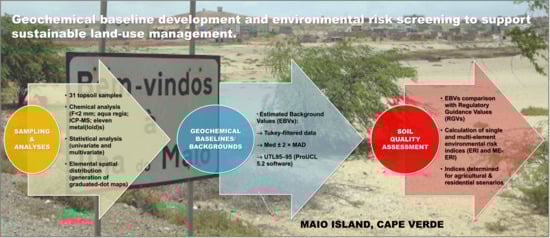
Graphical Abstract

1. Introduction

Soil quality and soil health, often used interchangeably [1], are fundamental to sustainable development, environmental protection, and human welfare. Currently, around 75% of soils worldwide are degraded, affecting 3.2 billion people [2], with this figure projected to reach 90% by 2050 [3], thereby threatening biodiversity, land use, and human societies [4]. In response, soil stewardship has become an international priority, reflected in major initiatives such as the Global Soil Partnership (established in 2012), World Soil Day (5 December; since 2014), the International Decade of Soils declared by the International Union of Soil Sciences (IUSS) [5], and the European Commission’s Mission Soil, which targets healthy soils and land degradation neutrality by 2030 (https://soill2030.eu/about-mission-soil, accessed on 3 December 2025). This momentum is reinforced by the EU Soil Monitoring Law, the first Union-wide soil legislation, entering into force on 16 December 2025 and addressing multiple forms of soil degradation [6]. At the global level, UNESCO’s International Decade of Sciences for Sustainable Development (IDSSD), proclaimed by the UN General Assembly in 2023, aims to strengthen scientific cooperation, alongside initiatives such as the IUSS-led Decade of Soil Sciences for Sustainable Development (2025–2034; Ref. [7]). UNESCO’s planned “World Soil Health Index” also underscores the need for robust and comparable soil assessment frameworks. Collectively, these efforts highlight the central role of reliable soil assessment tools in supporting evidence-based policy, sound land-use planning, and effective remediation strategies.
Geochemical soil mapping provides one such tool, as it characterizes elemental distributions across landscapes and supports applications ranging from mineral exploration and agriculture to environmental monitoring and public health. High-density surveys offer detailed, local-scale information but are often limited in national or continental programs due to cost and logistical constraints. Consequently, low-density surveys, typically one site per 200–18,000 km2 [8], have become widely adopted, particularly when analyzing the <2 mm fraction and using aqua regia extraction [9]. Even so, a recent review of African geochemical studies shows that ~80% remain local in scale, with only 20% extending to regional or larger frameworks [10]. Low-density surveys enable the identification of broad natural geochemical patterns and background values [11,12], whereas high-density studies capture local heterogeneities and can pinpoint anthropogenic contamination in industrial or urban settings [13]. Combining both approaches is thus essential for fully resolving geochemical variability and linking regional patterns with site-specific environmental risk assessments.
Despite progress in global mapping, small island states and remote volcanic regions remain significantly underrepresented. Their distinctive geological and climatic settings generate unique soil-forming processes and elemental cycles that differ markedly from continental systems, making these regions highly valuable for geochemical research [14]. The Cape Verde archipelago, a volcanic hotspot in the eastern Atlantic, exemplifies this gap. While systematic soil and stream-sediment surveys were conducted on Santiago, Fogo, Brava, and Sal [15,16,17,18,19,20,21], several islands, including Maio, are still unmapped. Historically, low industrialization in Cape Verde has contributed to relatively unimpacted soils, offering valuable conditions for establishing natural geochemical baselines. Yet, increasing pressures from urbanization, traffic-related emissions, and tourism, mainly on Santiago, where the national capital is located, are progressively reducing the availability of pristine reference sites and degrading soil quality in the archipelago [17].
Soil quality constitutes an important determinant of land use for agricultural, industrial, and urban purposes. Rather than being restricted to contamination levels, soil quality is broadly defined as “the capacity of a soil to function within ecosystem and land-use boundaries to sustain biological productivity, maintain environmental quality, and promote plant and animal health” [22,23]. This definition reflects the complexity, site specificity, and multifunctionality of soils, whose quality underpins plant growth, regulates water, and buffers contaminants. In doing so, soil quality supports both agroecosystem productivity and the conservation of natural ecosystems (Refs. [1,24] and is therefore a core element of the One Health framework, which recognizes the interconnected health of humans, animals, and ecosystems [25] and its extension under the Relational One Health perspective [26]. However, soil properties (along with any thresholds used to interpret them) are greatly influenced by parent material, climate, topography, and hydrology. These factors create substantial spatial variability, making universal soil-quality thresholds impractical [1]. Accordingly, soil quality assessments must rely on locally relevant baseline or reference values that account for natural variability and distinguish land-use effects. In this context, and given that contamination is a major threat to soil and its functions—alongside erosion, organic matter depletion, biodiversity loss, sealing, compaction, salinization, acidification, and landslides [24,27]—, determining soil geochemical background values is key to differentiating natural from anthropogenic element sources. This is extremely important for priority metal(loid)s (e.g., As, Cd, Cr, Hg, and Pb), which are persistent, toxic, and bioavailable at high concentrations [28,29,30]. Regionally derived reference values provide critical benchmarks for evaluating soil quality and form a scientific foundation for environmental protection policies and legislation [31]. Yet, their establishment is hampered by diffuse atmospheric inputs from urban, agricultural, industrial, and vehicular sources, which often obscure natural geochemical patterns, notably in topsoil [32]. To address this, the IGCP 360 Global Geochemical Baselines project introduced the geochemical baseline concept [33]. Unlike traditional background values, restricted to pre-industrial or uncontaminated levels controlled solely by bedrock mineralogy, baselines incorporate the natural spatial variability of element concentrations at a given place and time while acknowledging low-level anthropogenic contributions. A geochemical baseline thus denotes the present-day concentration of a chemical substance in an environmental medium, providing a reference against which future changes can be quantified [34,35]. Considering the lack of a universally accepted method for establishing background or baseline values, researchers adopt approaches based on regional context, data availability, and study objectives, broadly classified as direct (geochemical), indirect (statistical), or integrated [36].
Building on the geochemical approach of [17] for Santiago Island, this study aims to: (i) establish an environmental geochemical baseline for Maio Island topsoils through the determination of estimated background values (EBVs) for key metal(loid)s (As, Cd, Co, Cr, Cu, Hg, Mn, Ni, Pb, V, Zn); (ii) assess their spatial distribution and potential anomalies; and (iii) provide data to support environmental monitoring, land-use planning, and future geoscientific research. Through these objectives, the study enhances understanding of local soil quality (chemical status) and contributes to the expansion of global geochemical mapping efforts to small island territories.

2. Materials and Methods

2.1. Study Area: Cape Verde and Maio Island

2.1.1. Geographical Setting, Climate, and Socioeconomic Framework

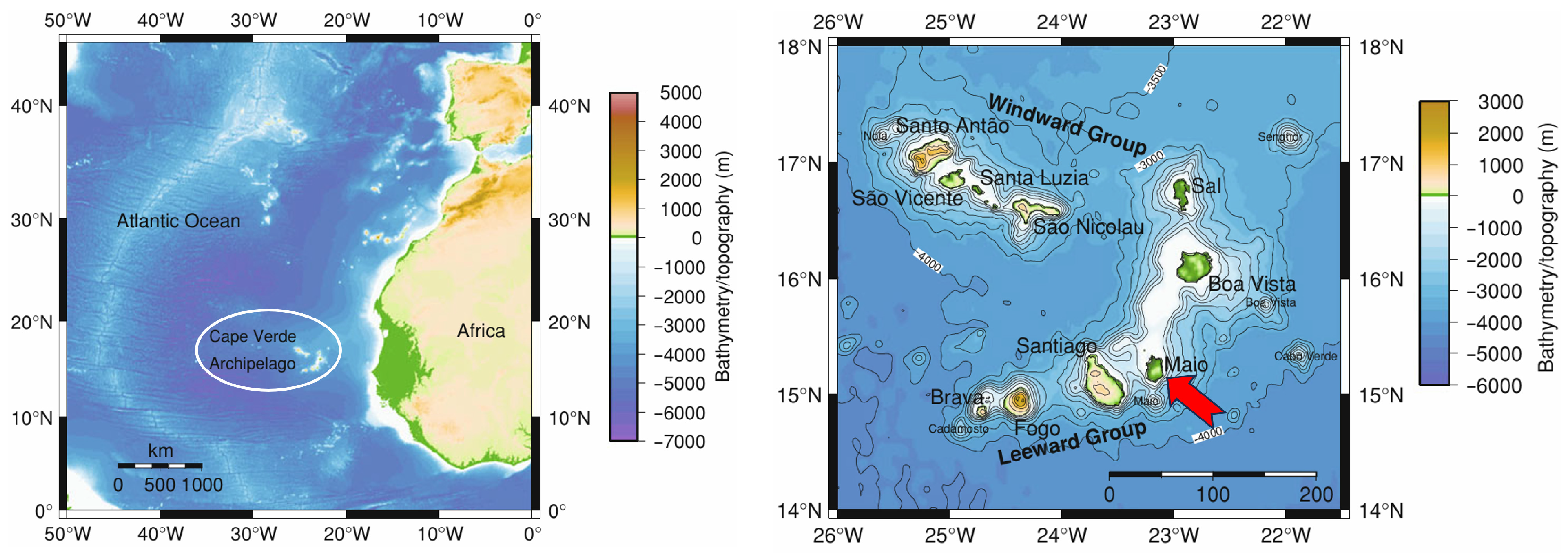
The Cape Verde intraplate archipelago, on the Nubian Plate in the eastern Central Atlantic, lies 600–900 km off West Africa above ~130 Ma oceanic lithosphere [37]. It comprises ten main volcanic islands in a semicircle, interpreted as the surface expression of a long-lived mantle plume beneath an essentially stationary plate [38]. The archipelago is divided into two volcanic chains: the SE–NW-trending northern (Windward) group and the NE–SW-trending southern (Leeward) group (Figure 1). Although the region experiences a tropical oceanic climate, its location within the Sahelian arid belt results in lower rainfall than mainland West Africa, producing an arid to semi-arid regime with limited but intense rainfall during a short-wet season from August to October [39]. Precipitation is influenced by the Intertropical Convergence Zone (ITCZ) and subtropical high-pressure systems, which bring southeast trade winds and occasional atmospheric disturbances. Average annual temperatures are around 25 °C at the coast and drop to ~19 °C above 1000 m above sea level (a.s.l.), ranging from ~20 °C in January–April to over 27 °C in August–September, with relative humidity typically ~60% during warm daytime hours and ~90% at night or during cloudy and rainy periods [40]. Persistent northeasterly trade winds drive an energetic, asymmetric marine erosion regime, with windward coasts experiencing the highest wave energy and erosion rates [39]. Analysis of rainfall time series for Santiago Island indicates that wet-year precipitation is primarily driven by southwestern winds and eastward-moving frontal systems rather than the ITCZ or African squall lines, whereas northeasterly winds dominate dry years. Decadal-scale variability appears linked to the Pacific Decadal Oscillation (PDO), providing a mechanistic and predictive understanding of rainfall patterns [41]. Rainfall throughout the archipelago is highly variable: low-lying islands such as Sal, Boa Vista, and Maio receive less than 100 mm annually, whereas mountainous islands like Santiago, Fogo, and Santo Antão may exceed 600 mm. Recent decades have seen a marked decline in rainfall, with prolonged dry periods in the early 2000s and between 2017 and 2020 ranking among the most severe in four decades, comparable to the catastrophic 1977 drought. These events underscore the growing impact of climate change, as extended dry periods increasingly threaten food and water security [42,43].
As of 2021, Cape Verde had a population of 491,233, with 74% residing in urban areas [44]. From 2011 to 2021, the national economy remained service-dependent, with services contributing 69.2% of the gross domestic product (GDP), including 20% from tourism, followed by industry (21.8%) and agriculture (7.8%) [45]. Agricultural activity in Cape Verde is inhibited by scarce natural resources, insular fragmentation, and the limited availability of arable land—only about 10% of the national territory is considered suitable for cultivation. In 2017, Cape Verde’s total agricultural area was estimated at 36,456 ha, approximately 87% rainfed, 10.7% irrigated, and 2.3% under mixed practices, with sugarcane Saccharum officinarum L. dominating the irrigated sector, covering over 3000 ha (about 62%) despite its elevated water requirements [46]. Population-driven intensive land use has led to meaningful soil degradation, with erosion under traditional cropping systems (e.g., maize Zea mays L. and beans Phaseolus vulgaris L.) estimated at 7.8 t ha−1 yr−1 [47]. Owing to these restraints, the country is greatly dependent on food imports, with 34.3% of the population considered vulnerable to food insecurity [48].
Maio Island, located southeast of Santiago in the Leeward group (Figure 1), extends between 15°07′ and 15°20′ N and 23°05′ and 23°15′ W, being one of the oldest islands in the archipelago (19–12 Ma; Ref. [49]). It is also among the smallest, covering approximately 269 km2, with an elliptical shape measuring about 24 km north–south and 16 km east–west [50]. The island’s landscape is predominantly flat, shaped by prolonged erosion and marine abrasion that have reduced its original landmass by nearly half [51]. Low-lying coastal platforms dominate, interspersed with residual volcanic structures such as Monte Penoso (~436 m a.s.l.), the eroded remnant of a stratovolcano and the island’s highest point. Surface water resources are extremely limited (~4.7 × 10⁶ m3 yr−1; Ref. [50]), and drainage channels are ephemeral, flowing briefly during the short rainy season and subject to a flash flood regime.
Maio continues to be one of the least industrialized and least populated islands of the archipelago, with 6330 inhabitants (~23.5 inhabitants per km2), representing about 1.3% of the national population [44]. The capital, Cidade do Porto Inglês (former Vila do Porto Inglês or Vila do Maio), lies on the southwestern coast and is served by a small aerodrome located 3 km north of the urban center. Human settlements are mainly concentrated along the coastal fringe, where livelihoods depend on artisanal fisheries and small-scale agriculture. However, many croplands have been progressively abandoned due to increasing water scarcity and soil salinization, processes that risk driving entire ecosystems towards collapse. The total agricultural area is estimated at 466 ha, comprising 73 ha of irrigated land, 316 ha of rainfed cropland, and 77 ha under mixed agricultural practices [46]. Despite its arid conditions, Maio hosts Cape Verde’s largest forested area, the Calheta Forest (3500 ha), established to restore ecological balance, support agroforestry, enhance landscape value, and provide renewable energy resources for local communities [52].

2.1.2. Geological and Soil Setting of Maio Island

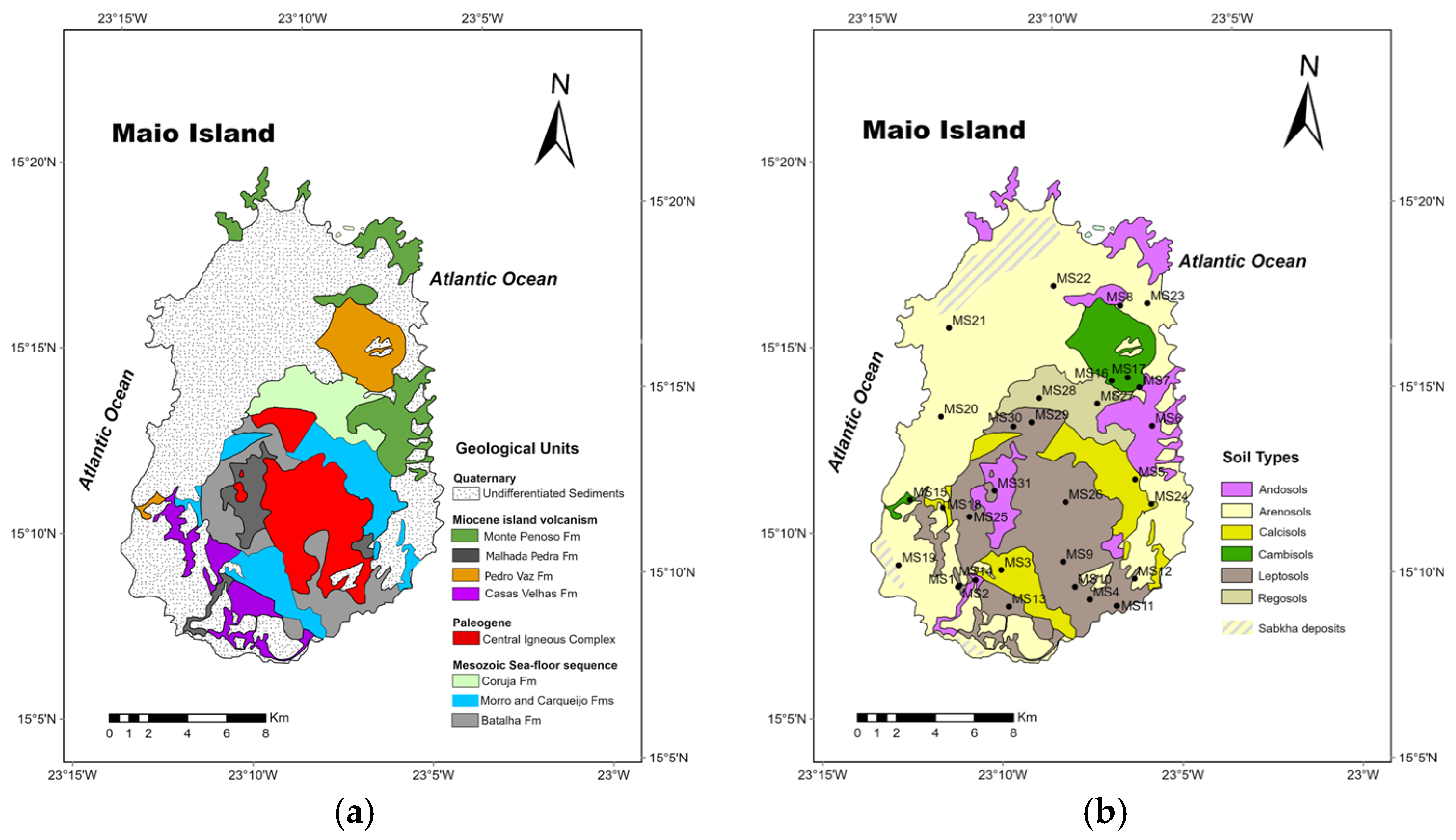
The Cabo Verde archipelago is an oceanic island chain formed by alkaline intraplate magmatism, with islands differing in age, erosion, and uplift–subsidence histories [39]. Maio, volcanically inactive, preserves complex lithologies from successive plutonic and volcanic episodes since the early Miocene (Figure 2a; Ref. [53]). Geochronology indicates that magmatism ceased around 7–6.5 Ma, broadly contemporaneous with the emergence of neighboring Santiago Island [49], followed by the accumulation of extensive post-eruptive sediments covering nearly half of Maio, mainly on the leeward side.
Recently, ref. [54] described the current state of knowledge about the geology of Maio, which can be summarized into three major units (Figure 2a): (1) Mesozoic Basement Complex (MBC)—A Lower Cretaceous, raised seafloor sequence comprising mid-ocean ridge basaltic pillow lavas and breccias (MORB; Ref. [55]), the Batalha Formation (BFm), overlain by Cretaceous deep-marine fossiliferous limestones and marls of the Morro formation, Carqueijo (black shale–equivalent deposits), and Coruja (CFm; volcaniclastic sediments comprising tuffs, sandstones, and conglomerates with crossbedding and channel structures) formations [55,56]. (2) Central Igneous Complex (CIC)—A Paleogene intrusive alkaline complex predominantly formed of gabbros, essexites, and pyroxenites, with minor nepheline monzosyenites (≤5% of the complex; Ref. [49]), crosscut by basanitic, ankaramitic, trachytic, and carbonatite dykes, forming a dome-like structure within the older rocks, and interpreted as partially exhumed magma chamber(s), extending down to ~7 km depth [57]. And (3) Extrusive volcanic and sedimentary sequence, unconformably overlying the CIC and MBC—Initially submarine, later subaerial, this unit comprises: (i) Casas Velhas formation (CVFm; composed of ankaramite lavas; SW Maio), (ii) Pedro Vaz formation (PVFm; comprising volcaniclastic sediments, tuffs, and local ankaramite lavas; NE Maio), and (iii) Malhada Pedra and Monte Penoso formations (MPFm and MoPFm; consisting of olivine-nephelinites, melilitites, and interbedded pyroclastic deposits [58]. Volcanics of the latter two formations are interpreted as resulting from decompression-induced mantle melting triggered by major island flank collapses between 8.7 and 6.7 Ma. All units are intersected by numerous dykes, especially in older terrains, with carbonatite dykes occurring predominantly in pelagic limestones and CIC intrusives. These primary units are overlain by Pliocene–Quaternary deposits (QS), including elevated beach terraces (up to 70 m a.s.l.), aeolian calcarenites, tsunami-related conglomerates and sandstones, recent alluvial fan deposits, aeolian sands, and sabkha sediments partially mantling the main volcano–sedimentary formations [51,53]. Sabkha deposits often host efflorescent halite crusts and sulphate- and carbonate-dominated evaporites, strongly influencing soil chemistry and hydrology [59].
Maio’s soil remains poorly characterized. The only existing soil map [60] was produced at a scale of 1:30,000 using an outdated classification system; this was later partially harmonized with the World Reference Base for Soil Resources [61] by [62]. Based on the available data, a provisional map of the island’s main soil groups is presented (Figure 2b), which should be interpreted cautiously since it mostly reflects the distribution of underlying volcanic and sedimentary substrates. They comprise: Arenosols: Quartz-rich, low-clay soils associated with the QS unit; Andosols: Ash- and tephra-derived soils developed on MPFm and MoPFm, enriched in olivine and nepheline; Cambisols: Moderately weathered soils on volcanic terrains (e.g., PVFm), containing quartz, feldspar, montmorillonite, and illite; Regosols: Poorly developed soils derived from tuffaceous and conglomeratic deposits (e.g., CFm), enriched in quartz and mica; Calcisols: Semi-arid lowland and coastal soils featuring calcite, gypsum, and clay accumulations, linked to the Morro and Carqueijo formations (MCFms); and Leptosols: Shallow, stony soils developed on MORB-type basalts (BFm) occurring over the CIC and CVFm units. Furthermore, although saline soils are not depicted as a distinct unit, they are locally reported [60] within several mapped soil groups, mainly in low-lying coastal and endorheic settings.

2.2. Sampling and Chemical Analysis

A total of 31 composite soil samples (0–15 cm depth; MS1–MS31) were collected across Maio Island during two field campaigns (2019 and 2022), encompassing all major geological units. The selected depth represents the topsoil, the biologically active surface horizon most relevant to pedogenic processes and potential human and ecological exposure and is conceptually equivalent to depths used in international geochemical mapping programs, supporting comparability with regional and global datasets. The number of samples per unit was: BFm (4), MCFms (3), CFm (2), CIC (5), CVFm (2), PVFm (4), MPFm (1), MoPFm (1), and QS (9), the latter reflecting its broader spatial extent (Figure 2a). Sampling density averaged one site per 9 km2. Site selection followed the International Geochemical Mapping Project guidelines (IGCP 259; Ref. [63]), prioritizing low-disturbance areas and avoiding potential contamination sources (e.g., tourist facilities, agricultural land, and major roads). At each site, five subsamples from a 100 m2 area were composited into a ~1 kg sample, sealed in polyethylene bags, and transported to the laboratory. Field duplicates were collected to assess sampling consistency and reproducibility.
Soil samples were air-dried at room temperature, cleared of stones and plant debris, sieved to <2 mm, and homogenized. Analyses were conducted at the accredited ACME Analytical Laboratories (Vancouver, Canada). Subsamples (0.5 g) were digested with aqua regia (95 °C, 1 h) and analyzed by Inductively Coupled Plasma–Mass Spectrometry (ICP–MS) for major, minor, and trace elements. This study targets As, Cd, Co, Cr, Cu, Hg, Mn, Ni, Pb, V, and Zn for regulatory relevance and comparison with the Santiago dataset [17]. Detection limits ranged from 0.005 mg kg−1 (Hg) to 1 mg kg−1 (Mn, V). Approximately 13% of Hg results below the detection limit (DL) were substituted with one-half the DL for statistical analysis. Quality control included blanks, certified reference materials, and duplicate samples (every tenth sample). Reproducibility was better than 5% for all 11 elements.
Soil pH and electrical conductivity (EC) were measured in a 1:2.5 soil–water suspension (m/v) after 20 min of agitation using a HI 9126 pH/ORP meter (CAL Check™) and a HI 9033 Multi-Range Conductivity Meter. Soil salinity was estimated by deriving saturated paste electrical conductivity (ECe, dS m−1) from EC1:2.5 using empirical regression models from [64]. In the absence of site-specific texture data, the linear equation for combined soil textures was applied.

2.3. Statistical Analysis

2.3.1. Univariate and Multivariate Methods

Data was processed in Excel 2021, with further analyses performed using STATISTICA 10 (StatSoft Inc., Tulsa, OK, USA) and JMP Pro 19.0.0 (SAS Institute Inc., Cary, NC, USA), with significance set at p < 0.05. Descriptive statistics included minimum (Min), maximum (Max), mean (Me), standard deviation (SD), median (Med), median absolute deviation (MAD = median (|xi − median(x)|)), coefficient of variation (%CV = SD/Me × 100), robust coefficient of variation (%rCV = MAD/Med × 100), skewness (Sk), and kurtosis (Krt). Data normality was assessed with the Shapiro–Wilk test. Data dispersion was also characterized using four range-based estimators: (i) Observed Range [Min–Max]; (ii) Tukey Range [Q1 − 1.5 × IQR; Q3 + 1.5 × IQR], where IQR = Q3 − Q1 [65]; (iii) Median ± 2 × MAD Range; and (iv) Percentile Range [P5–P95]. This multi-criteria approach enabled systematic evaluation of variability, skewness, and extreme values, supporting the identification of representative intervals for geochemical baselines.
A robust Principal Component Analysis (rPCA) was applied to identify major compositional structures while mitigating outlier effects. Prior to analysis, the data were subjected to a centered log-ratio (clr) transformation, accounting for the compositional nature of geochemical data [66]. PCA biplots of the first two components (PC1 and PC2), capturing most variance, were used to visualize relative element associations and infer lithological, pedological, or anthropogenic controls.

2.3.2. Geochemical Baselines and Estimated Background Values (EBVs)

Geochemical baselines were established as reference values to assess soil metal(loid) levels and to help distinguish natural signatures from those potentially influenced by human activities. The EBV approach of [17] for Santiago Island was applied to the Maio dataset in accordance with the principles outlined by [33]. Owing to the smaller Maio sample size (N = 31) versus Santiago (N = 249), a single island-wide baseline per element was derived instead of lithology-specific baselines. Three EBVs were tested to maintain comparability with earlier work and strengthen methodological robustness: EBV–M1, the median of the Tukey-filtered dataset (outliers removed within the non-anomalous range), following [17]; EBV–M2, the upper limit of Med ± 2 × MAD [67]; and EBV–M3, the 95–95 upper tolerance limit (UTL95–95; 95% confidence, 95% coverage; Refs. [31,36]). The UTL95–95 represents the upper one-sided tolerance limit covering 95% of the population with 95% confidence. It was calculated using ProUCL 5.2 [68], which applies distribution-specific estimators based on goodness-of-fit testing (normal, lognormal, gamma, or nonparametric). If multiple distributions fit, normal is preferred; lognormal is used only when no suitable parametric model exists, otherwise a nonparametric UTL95–95 is applied [68].

2.3.3. Geochemical Mapping and Spatial Analysis

Topsoil metal(loid) distributions were evaluated using point-based maps, with interpolated maps intended for broader patterns. Sampling adequacy and spatial dependence were examined in ArcGIS Pro 3.2. Spatial structure was investigated via experimental semivariograms (range and nugget-to-sill ratios) [69,70] and Moran’s I [71,72]. Geostatistical interpolation methods, including Inverse Distance Weighting (IDW) and kriging approaches, were explored, with feasibility determined following spatial analysis. Model performance, via comparison of predicted and measured values, was planned contingent on interpolation feasibility.

2.3.4. Soil Quality Standards, Regulatory Thresholds, and Land-Use Related Risk Assessment

To evaluate the environmental significance of Maio Island soil EBVs for metal(loid)s and identify exceedances relative to precautionary thresholds/critical concentrations, EBVs were compared with internationally recognized soil quality standards and topsoil regulatory guidance values (RGVs) in the absence of national benchmarks. These RGVs, expressed in mg kg−1 dry weight, indicate levels above which regulatory or management actions are advised or mandated, with the significance of exceedances depending on threshold stringency and site-specific risk context.
The comparison encompassed soil quality guidelines from several countries: Argentina [73], the Netherlands [74], Italy ([75]), Finland [76], South Africa [77], Iran (Deputy Minister of Human Environment, Water and Soil Office, 2013, as cited in [78]), Poland (RMŚ, 2016, as cited in [79]), China (national risk screening values GB 15618–2019; MEE, 2018, as cited in [80]), and Canada, including both provincial (Ontario Soil, Groundwater, and Sediment Standards [81]) and federal (Canadian Soil Quality Guidelines [82]). World median RGVs [83,84] and Santiago Island EBVs [17] were also included to provide global and regional (inter-island) reference contexts.
After [17], site-specific metal(loid) concentrations were used to compute the Environmental Risk Index (ERI):
ERI = Ci/P
where Ci is the measured concentration of a metal(loid) at site i, and P is the corresponding permissible concentration defined by land-use-specific soil quality standards (e.g., agricultural, residential, commercial, or industrial). ERI < 1 indicates compliance with the applicable benchmark, ERI = 1 represents the compliance boundary, and ERI > 1 indicates exceedance relative to that standard. Ontario soil quality standards [81] were adopted as the primary regulatory reference due to their comprehensiveness, explicit land-use differentiation, international recognition, and alignment with the Santiago survey framework. Metal(loid)s lacking established guideline values were excluded from ERI-based calculations to maintain regulatory comparability and methodological consistency.
Co-occurring metal(loid) enrichment was assessed using the Multi-Element Environmental Risk Index (ME–ERI):
ME ERI   =   ( E R I i ) / n
where ERIi denotes the single-element ERI at a given sampling site and n is the total number of metal(loid)s exhibiting recurrent exceedances relative to the selected reference value [17]. By keeping n constant across all sites, this normalization prevents artificial attenuation of the composite index and allows comparability throughout the study area.
A functional framework was established to interpret ERI and ME–ERI values, with thresholds indicating proportional departure from reference values. Single-element ERI was categorized as follows: Class 1 (ERI < 1): compliant, negligible risk; Class 2 (1.0–2.0): slight exceedance, low-level concern; Class 3 (2.0–3.0): moderate exceedance, monitoring recommend; and Class 4 (>3.0): strong exceedance, probable “hotspot” requiring site-specific investigation. ME–ERI values were classified using an expanded six-tier structure to account for averaging effects: Class 1 (<1.0): no overall enrichment, low concern; Class 2 (1.0–2.0): minor enrichment; Class 3: (2.0–3.0): moderate enrichment; Class 4 (3.0–4.0): notable enrichment, emerging concern; Class 5 (4.0–5.0): substantial enrichment, priority management suggested; and Class 6 (>5.0): extreme enrichment, probable multi-element “hotspot” demanding detailed follow-up of contaminant speciation, bioavailability, and concentrations in biota. This classification system delivers a screening-level assessment of soil contamination, supporting site-specific risk evaluation and land-use management. Importantly, both ERI and ME–ERI signal potential concern relative to the chosen reference, without directly indicating bioavailability, exposure, or toxicity.

3. Results and Discussion

3.1. Soil Physico-Chemical Characteristics: pH and Salinity Indicators

Topsoil pH (H2O) across Maio Island ranged from 6.9 to 9.1, spanning neutral (6.6–7.3) to very strongly alkaline (>9.0) conditions according to United States Department of Agriculture (USDA) classification [85]. Most samples were strongly (8.5–9.0; 32%) or moderately (7.9–8.4; 29%) alkaline, reflecting the island’s geological setting. Like elsewhere in the Cape Verde archipelago, Maio’s soils are predominantly derived from alkaline, strongly SiO2-undersaturated lavas produced by deep partial melting of a compositionally heterogeneous mantle source [37,39]. This geochemical context places Maio among the most alkaline volcanic provinces of the Atlantic basin [55], with parent materials producing persistently alkaline soil reactions, consistent with measured island-wide pH values.
Soil EC1:2.5 values ranged from 0.02 to 8.26 dS m−1, with a median of 0.40 dS m−1 (N = 27). Based on ECe values estimated from EC1:2.5 as screening-level indicators, only one sample with recorded EC data (MS2) surpassed the threshold for saline soils (ECe ≥ 4 dS m−1; Ref. [86]). This points to localized salt accumulation, likely associated with endorheic conditions or shallow saline groundwater under arid to semi-arid climates. It should be noted that the estimated ECe value for MS2 (39.36 dS m−1) represents an extrapolation beyond the calibration range of the predictive model, and its absolute magnitude should therefore be interpreted with caution [64]; however, the relative salinity signal remains informative.
Besides its agronomic implications, elevated salt levels also enhance metal(loid) mobility, representing an additional environmental concern [87]. Mobilization depends on metal-specific behavior, concentration, and salt composition, with ionic strength and sorption-site competition dominating in alkaline soils. For Cd2+, Pb2+, and Zn2+, Ca2+ competition is primary, followed by sulphate and chloride complexation; Cu2+ mobility is mainly regulated by sulphate and secondarily by cation competition (Mg2+ > Ca2+) [87]. At MS2, high EC1:2.5 and elevated Ca (31.0%) coincide with low Cd (0.04 mg kg−1), Pb (0.9 mg kg−1), and Zn (10.7 mg kg−1), consistent with Ca-rich saline conditions promoting enhanced mobility and reduced retention. In Maio’s thin, weakly buffered soils, rapid percolation further increases the risk of metal(loid) transfer to groundwater (~0.5 × 10⁶ m3 yr−1 exploitable during the dry season; Ref. [50]), especially under limited water availability. Though ECe at MS2 is extrapolated, its high relative EC supports elevated salinity as a co-factor in metal(loid) mobility, highlighting the importance of considering salinity when assessing land-use suitability and environmental risk in arid to semi-arid settings like Maio, where stabilizing farming systems, maintaining sustainable yields, and protecting groundwater are key for fostering resilience.

3.2. Elemental Composition of Topsoils

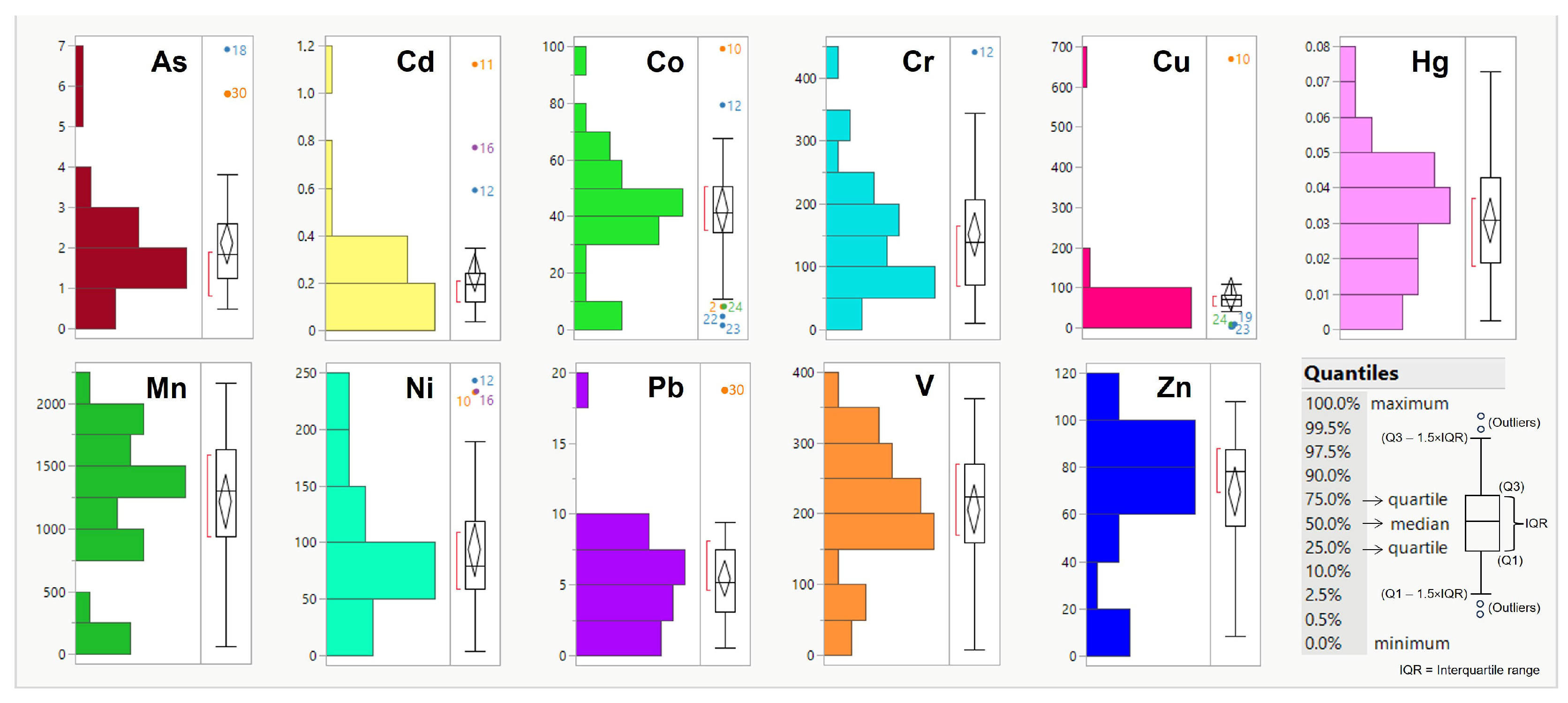
Descriptive statistics (Table 1) show non-overlapping mean and median values for most elements, except Hg, indicating asymmetric distributions. Normality was not rejected for Mn, Hg, V, and Co (Shapiro–Wilk test, p > 0.05). Histograms and Tukey boxplots (Figure 3) reveal non-normal behavior and multiple outliers: upper outliers for Cd (3), Ni (3), As (2), Co (2), Cu (1), Cr (1), and Pb (1), and lower outliers for Co (4) and Cu (3), reflecting natural soil heterogeneity. High skewness (>1.5) for Cu, Cd, Pb, and As indicates strongly right-skewed distributions, likely linked to local geochemical enrichment or lithological contrasts. Most elements are leptokurtic, with heavy tails and broad spread, whereas Hg, Mn, and V are platykurtic, showing flatter distributions largely devoid of extremes.
Median element concentrations in Maio decrease as Mn (1302 mg kg−1) > V (224 mg kg−1) > Cr (138.7 mg kg−1) > Ni (79.1 mg kg−1) > Zn (78.5 mg kg−1) > Cu (69.4 mg kg−1) > Co (41.2 mg kg−1), with remaining elements ranging from 5.2 mg kg−1 (Pb) to 0.031 mg kg−1 (Hg). This hierarchy mainly reflects the island’s mixed volcanic–sedimentary lithology, which favors enrichment of V, Cr, Ni, and Co in topsoils, in line with geochemical trends reported for volcanic regions worldwide [80,88].
Vanadium in soils is largely inherited from parent materials and mobilized during weathering of pyroxenes (ortho- and clinopyroxene), olivine, and amphibole, subsequently adsorbing onto clay minerals. In mafic rocks (~260 mg kg−1 V), it occurs mainly via isomorphic substitution for Fe, Al, and Ti in accessory phases such as Ti-rich magnetite, ulvöspinel, and ilmenite, with appreciable V3+/V4+ admixtures in dark rock-forming minerals [89], making these lithologies primary V sources in soils and derived sediments, including shale and unconsolidated alluvial or aeolian deposits [90]. The Cr–Ni–Co triad similarly occurs in ferromagnesian minerals of ultramafic–mafic rocks, including olivine (Ni-bearing), pyroxene (Cr-bearing), amphibole, mica, garnet, and spinel; the latter may contain Cr concentrations several orders of magnitude higher than pyroxene and Ni contents, particularly in chromite, comparable to those of olivine. In these minerals, Cr, Ni, and Co predominantly substitute for Fe or Mg in the crystal lattice, with Ni2+ preferentially occupying Mg2+ sites in olivine and Cr3+ likely substituting for Al3+ in pyroxene [91]. Nanosized hematite was found to play a major role in retaining Cr in the topsoils of Fogo Island, where no Fe oxyhydroxides were detected [19]. Regarding Co, studies from São Miguel Island (Azores, Portugal) revealed a distinct distribution pattern across the island’s volcanic regions: soils developed on low-SiO2 volcanic rocks (basalts and trachybasalts) contain significantly higher Co concentrations (>10 mg kg−1) than those formed on high-SiO2 rocks (trachytes and rhyolites) (<5 mg kg−1), stressing the strong influence of parent-rock geochemistry on Co distribution [92].
Comparing median metal(loid) concentrations between Maio (Table 1) and Santiago, Sal, Brava, and Fogo (Table 2) offers valuable insight, especially in view of the differing analytical methodologies employed. Values for Maio (Table 1), Santiago *, and Sal * (Table 2; see Table 2 footnotes for * details) were obtained by aqua regia digestion, yielding concentrations that predominantly reflect the more labile and environmentally available fraction (i.e., the geoavailable fraction, the portion of total metal content potentially mobilizable and capable of contributing to bioavailability; [93]). In contrast, datasets marked with ** in Table 2, including those for Santiago, Sal, Brava, and Fogo [18,20,94], report total elemental concentrations that also incorporate silicate-bound lithogenic fractions. Elements typically enriched in mafic–ultramafic materials show higher medians in the total-digestion datasets compared with aqua regia counterparts for the same islands, exemplified by Cr in Santiago (120 mg kg−1 vs. 590 mg kg−1) and Sal (82 mg kg−1 vs. 410 mg kg−1). This may be attributed to the incomplete dissolution of major Cr-bearing minerals by the selective acid attack with aqua regia, namely Cr-rich spinels, (FeMg)(Cr,Al)2O4), and chromite, (FeCr2O4) [95,96]—a highly weathering- and oxidation-resistant phase (Ref. [97], reported in some gabbros of the CIC at Sal, where it occurs within olivine [49]—and pyroxenes (e.g., augite and enstatite) [98]. The lower Cr recovery in partial digestion suggests that a substantial proportion of Cr is hosted in refractory mineral phases. Conversely, the similarity in median Co values across digestion methods for both islands (40.0–59.8 mg kg−1) is compatible with Co being largely associated with relatively soluble mineral phases, namely Fe, and Mn oxides/hydroxides, the latter displaying a strong affinity for Co in soils, as already referred. This interpretation aligns with the documented high Mn concentrations in Cape Verdean soils and with findings from São Miguel Island (Azores) [92,99]. On Santiago Island, ref. [18] reported a general trend of Co geoavailability irrespective of lithology.
In the total-digestion datasets (Santiago, Sal, Brava, and Fogo), Brava shows the lowest median Co and Cr concentrations (Co: 22.7 mg kg−1; Cr: 87.4 mg kg−1), likely reflecting the relatively felsic character of the island within the Cape Verde archipelago [49], while displaying the highest median Mn and Zn concentrations (Mn: 2238 mg kg−1; Zn: 172.0 mg kg−1). In contrast, the aqua regia datasets (Maio, Santiago, and Sal) show higher median Cr, Cu, and V in Maio (Cr: 138.7 mg kg−1; Cu: 69.4 mg kg−1; V: 224.0 mg kg−1) and lower Ni (79.1 mg kg−1). Median As is uniformly low (aqua regia: 0.6–4.4 mg kg−1; total: 2.0–4.4 mg kg−1) and Hg is <0.05 mg kg−1 in Maio and Santiago, supporting the dominance of natural geochemical processes. Overall, the inter-island comparison reveals coherent geochemical patterns across Cape Verde’s topsoils, in agreement with previous observations by [94]. Focusing on Maio, high variability (%rCV > 30%) in As, Cd, Cr, Hg, Ni, and Pb indicates pronounced spatial heterogeneity, likely reflecting the influence of multiple sources and/or secondary redistribution processes, as discussed below. In contrast, Zn, Co, Cu, V, and Mn display lower variability (12.2–26.6%), suggesting a comparatively more homogeneous spatial distribution.

3.3. Environmental Geochemical Baselines and Spatial Distribution of Topsoil Metal(loid)s

Geochemical baselines, or background levels, are, by definition, expressed as ranges, reflecting the natural variability of soils and geological materials [100]. However, legislative and regulatory frameworks usually require a single representative value for a region or country [21], as this simplifies the establishment of soil quality standards, environmental guidelines, and permissible contaminant limits. This methodological dilemma is evident in Table 3, where the wide variation ranges for each metal(loid) underline the difficulty of defining a benchmark baseline.
To address the issue, three island-wide EBVs were calculated using the Tukey-filtered data, the Med ± 2 × MAD interval, and the UTL95–95 (ProUCL 5.2). EBV–M1 (Tukey median) gave the most conservative values, EBV–M2 (Med ± 2 × MAD upper limit) was intermediate, and EBV–M3 (UTL95–95) the highest. Although UTL95–95 is widely regarded as the most appropriate method for defining upper thresholds [31,36], its application here was limited by dataset constraints. Non-parametric tolerance limits require larger datasets to reliably estimate population upper bounds; in small, skewed datasets, ProUCL defaults to the maximum observed concentration [68], a conservative approach that avoids underestimating extreme values but inflates thresholds and reduces sensitivity to true anomalies. As a result, for Hg, Mn, Ni, and V UTL95–95 could not be reliably calculated, and alternative ProUCL methods also failed to yield statistically robust estimates. Hence, EBV–M3 values for these elements, as well as for metal(loid)s with non-discernible distributions, are not reported in Table 3. While the Med ± 2 × MAD method usually yields lower baseline values than other approaches, in this case it represents a balanced compromise between robustness to outliers and a realistic depiction of central tendency and natural variability. This makes it suitable for environmental assessments where extreme values or small sample sizes could distort upper-limit estimators, as observed here with UTL95–95. Since UTL95–95 did not produce a complete and internally consistent set of baseline values across all elements, only EBV–M1 and EBV–M2 were retained for subsequent analysis.
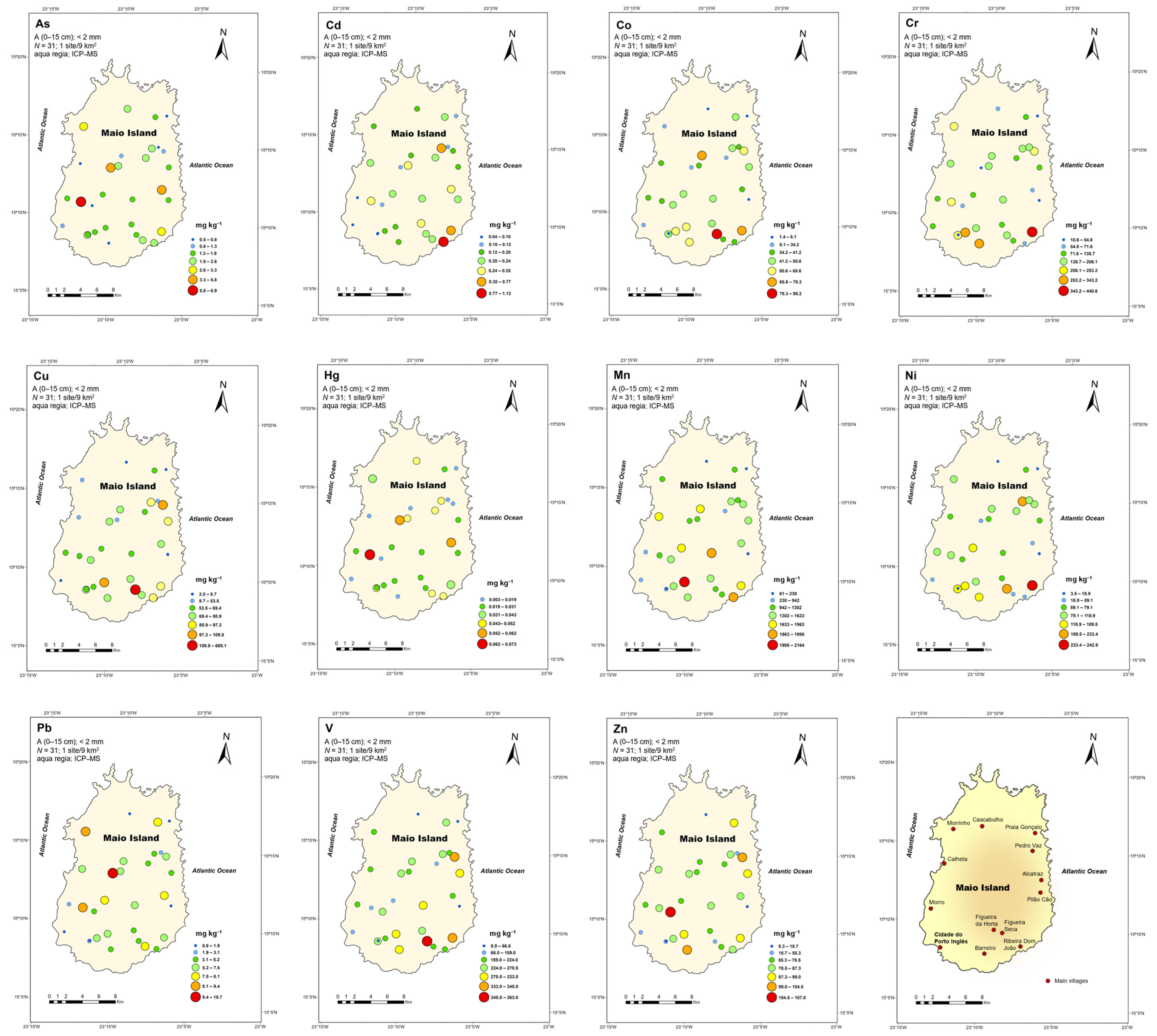
No spatial dependence was detected in the Maio topsoil dataset. Semivariograms were nugget-dominated (nugget-to-sill ratios ≥ 0.8) with no structured increase in semivariance, indicating the absence of spatial continuity at the sampling scale. Global Moran’s I was non-significant (p > 0.05), confirming the lack of spatial autocorrelation. Geostatistical interpolation would not provide reliable predictions and was therefore not applied. Concentrations are presented as graduated point maps (Figure 4) using percentile-based classes, progressing from [Min–P10[ to [P10–P25[, [P25–P50[, [P50–P75[, [P75–P90[, [P90–P95[, and finally [P95–Max]. For Hg, six classes were used because Min and P10 coincided.
Spatial patterns confirm pronounced heterogeneity in metal(loid) distributions across Maio (Figure 4). Arsenic, Hg, and Zn reach their highest concentrations in the southwest (MS18 and MS25, E–SE of Morro), associated with Arenosols and Leptosols developed on QS and BFm deposits, while at MS18, Pb, Cd, and Cr fall within the upper percentile ranges (P90–P95 for Pb; P75–P90 for Cd and Cr). By contrast, Cd, Co, Cu, Cr, Ni, and V attain their maximum values in the southwest of the island, surrounding Figueiras (Figueira da Horta and Figueira Seca) and Ribeira Dom João (MS10–MS12), on Leptosols derived from CIC and BFm and Arenosols developed on QS, whereas Pb peaks in the central area (MS30; BFm, Leptosols). Higher concentrations (P90–P95 range) of Cu, V, and Zn at MS7, and of Cd and Ni at MS16, are also observed in the northeast, south of Pedro Vaz (PVFm; Cambisols). Even though the sampling sites were chosen to represent minimally impacted conditions, the most elevated levels occur between Figueiras and Ribeira Dom João, where documented active farming and animal-rearing [52] may create potential exposure pathways for both residents and livestock. Figueira da Horta stands out as Maio’s primary agricultural zone and a main source of local livelihood. The traditional Cape Verdean alcoholic beverage, Grogue, made from sugarcane, is produced in warehouses known as trapiches, three of which are located near Figueira [52].
The overall spatial heterogeneity of Maio’s topsoils appears to be primarily governed by intrinsic factors, notably the island’s complex geological framework and the mixing of materials from coexisting lithologies, with extrinsic processes, such as erosive surface runoff, redistributing material through the radiating hydrographic network. In addition, the semi-arid climate, predominantly flat terrain, and frequent windy conditions (calm days < 4%; Ref. [101]) promote resuspension of particulate matter (PM) from outcropping bedrock and bare soils, enhancing near-surface redistribution. Dryland areas act as efficient sources of mineral dust, chiefly where desiccation destabilizes otherwise stable surfaces due to hydrological changes [102], with dust serving as a key vector for the transfer and biogeochemical cycling of metal(loid)s. Land-use disturbances intensify further these processes by increasing soil erodibility and atmospheric mobilization [103].
Superimposed on these local controls, PM variability on Maio could also reflect regional and long-range atmospheric inputs, as Cape Verde lies along a major land-to-ocean dust corridor in the tropical eastern North Atlantic. Long-term, size-resolved aerosol measurements at the Cape Verde Atmospheric Observatory (CVAO; Calhau, São Vicente Island) indicate contributions from Saharan, Sahelian, European, and North American air masses. Saharan and continental African sources account for ~55% of annual aerosol loads, peaking in winter [104], with strong seasonality driven by the Bodélé Depression (December–May) and supplemental North African sources [105]. Metals relevant to this study (e.g., Zn, Cu, Cr) were highest in air masses from North America, whereas Mn was enriched in European and Canary Islands air masses [104]. Lead concentrations remained invariably low, in line with the global phase-out (a milestone only completed in 2021 by Algeria’s ban) of leaded fuels in road vehicles. Finer aerosol (submicron size) fractions preferentially host Cr, Ni, Cu, Zn, Pb, and V (with varying anthropogenic influences), favoring long-range transport and deposition, whereas Co and Mn (mainly of crustal origin) are mainly associated with coarser particles (>1 µm) [104]. Although such atmospheric inputs may contribute to metal deposition on exposed or poorly developed island soils, their magnitude (<10 pg m−3 for Co to <3.26 ng m−3 for Zn [104]) is negligible relative to lithogenic sources and, as such, it is unlikely to alter topsoil metal (loid) concentrations. Hence, the topsoil geochemistry of Maio largely reflects lithogenic signatures and surface redistribution processes, with aeolian deposition acting only as a marginal modifier. The interplay among geogenic controls, local redistribution, and limited atmospheric inputs offers a robust framework for interpreting spatial variability and potential environmental and human exposure pathways.

3.4. Elemental Associations and Geochemical Controls (rPCA)

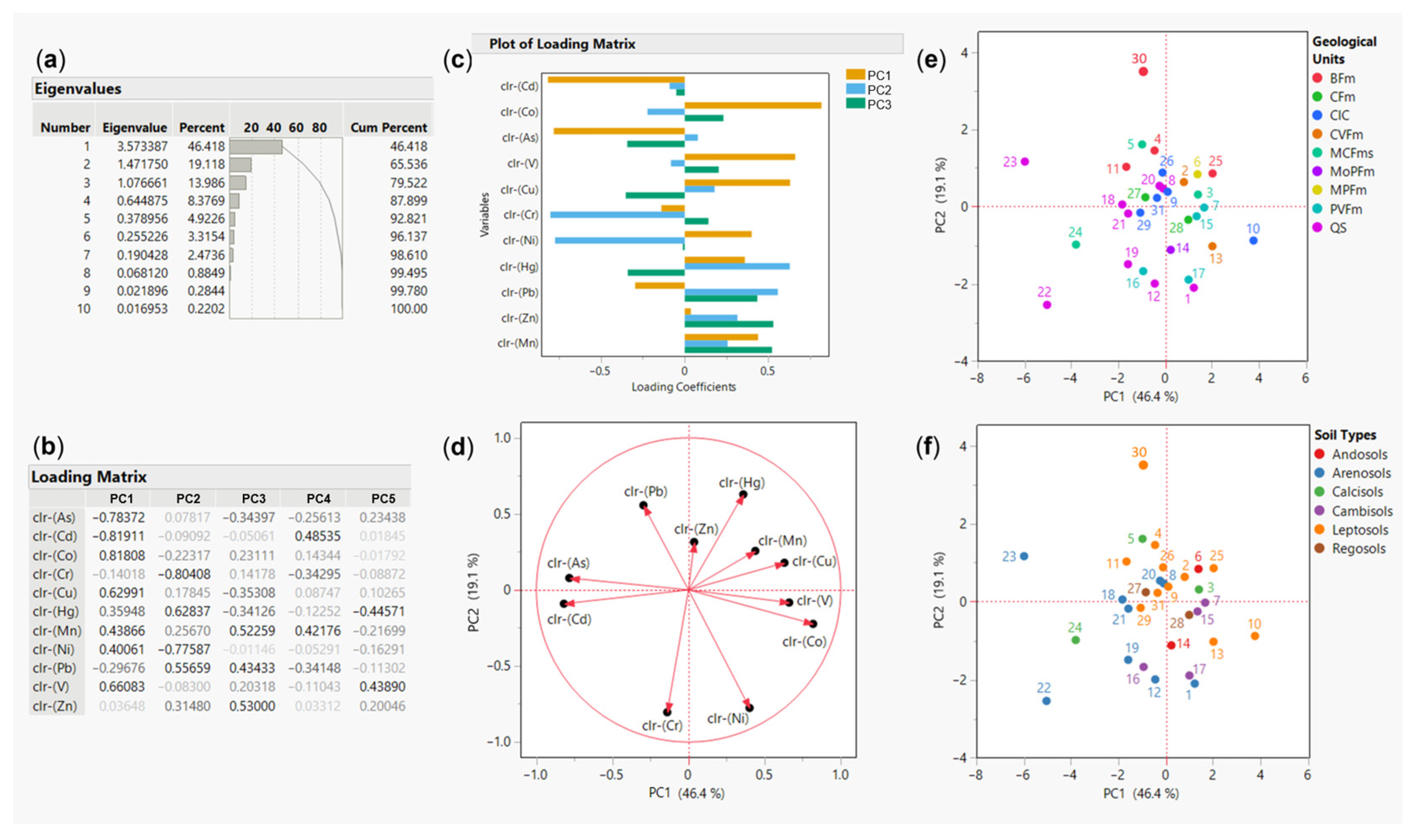
Examining multiple elements together allows identification of coherent geochemical groupings, revealing the influence of natural or anthropogenic sources, each characterized by distinct chemical signatures. Figure 5 summarizes the rPCA results, providing a compositional overview that identifies coherent proportional element groupings reflecting the geochemical structure of Maio Island. Under the Kaiser criterion (eigenvalues > 1; Ref. [106]), the first three components are significant. PC1 and PC2 together represent 65.5% of the total variance, with the first three explaining nearly 80% (Figure 5a). The loading matrix (Figure 5b), bar plot (Figure 5c), and variable correlation circle (Figure 5d) highlight the elemental relationships underlying this variance. The magnitude of the clr loadings indicates that Cd, Co, Cr, As, Ni, V, Cu, and Hg dominate the proportional variance, whereas Pb, Mn, and Zn contribute minimally (Figure 5b).
PC1 (46.4% of total clr variance) separates two main compositional groups: a Co–V–Cu–Mn assemblage (positive axis) that covaries proportionally, compatible with mafic volcanic parent materials, and an As–Cd sub-composition (negative axis), which shows a contrasting proportional pattern. This indicates an inverse relationship, whereby samples enriched in the primary volcanic suite are proportionally depleted in As and Cd, and vice versa, reflecting distinct mineralogical hosts or fractionation processes. PC2 (19.1% of clr variance) decouples Cr and Ni (strong negative loadings) from a Hg–Pb–Zn association (positive loadings). The clustering of Cr and Ni, defining a mafic-driven subspace, is geochemically coherent and likely reflects specific mineral phases, as already argued in Section 3.2. The opposition of Hg, Pb, and Zn as isolated clr vectors suggests that this group is governed by a different spatial or source factor, potentially related to localized enrichment distinct from the Cr–Ni background. For completeness, rPCA conducted on raw concentrations showed similar groupings, confirming that clr preserves primary geochemical associations, mitigates closure effects, and enhances resolution of metal(loid)s like As, Cd, and Pb (results not shown).
Score plots projected by geological units (Figure 5e) and soil types (Figure 5f) show no clear clustering, with substantial overlap among samples, indicating that the main compositional variability occurs at finer, intra-unit scales. A small subset of samples (MS22–MS24) defines compositional extremes characterized by depletion in lithogenic elements (Co, V, Cu, Mn), consistent with their low-end outlier status in the univariate distributions of Co (MS22–MS24) and Cu (MS23–MS24) (Figure 3). This depletion increases the relative influence of As and Cd. Conversely, MS30 trends toward positive PC2 due to proportionally higher Pb, while MS10 shifts toward positive PC1, reflecting proportionally enriched Cu; both samples represent upper statistical outliers for these elements (Figure 3). The lack of clustering observed here mirrors results from Brava and Santiago [18,20], where multivariate analyses applied to a broader elemental dataset, likewise failed to separate soils by geological unit. The consistency across islands suggests that the absence of lithological discrimination does not stem from element selection but rather reflects intrinsic fine-scale geochemical heterogeneity.

3.5. Environmental Risk Assessment in Relation to Land-Use Scenarios

Table 4 presents the selected topsoil RGVs, enabling comparison of permissible metal(loid) concentrations across regulatory frameworks and land-use categories. Substantial variability among national thresholds reflects differences in soil properties, risk assessment models, and policy approaches [107].
Maio’s EBVs for Cr, Ni, Co, and V exceed several international RGVs, with bold values indicating exceedances for both EBV–M1 and EBV–M2. Some frameworks do not provide values for certain elements (e.g., Mn and V), which are less commonly regulated in surface soils [84]. Maio’s EBVs for As, Cd, Cu, Hg, Pb, and Zn fall below world median RGVs, whereas Cr, Co, Mn, and Ni diverge between EBV–M1 and EBV–M2, with EBV–M1 generally lower due to its more stringent upper bound. Vanadium exceeds the world median RGV in both EBVs, indicating naturally elevated background levels. Comparisons with Santiago Island (EBV–S) show that Maio has higher concentrations of As, Cr, Cu, Hg, Mn, and V, particularly under EBV–M2, while Cd remains lower (Table 4). These differences reflect both contrasts in parent materials and the methods used to derive EBVs.
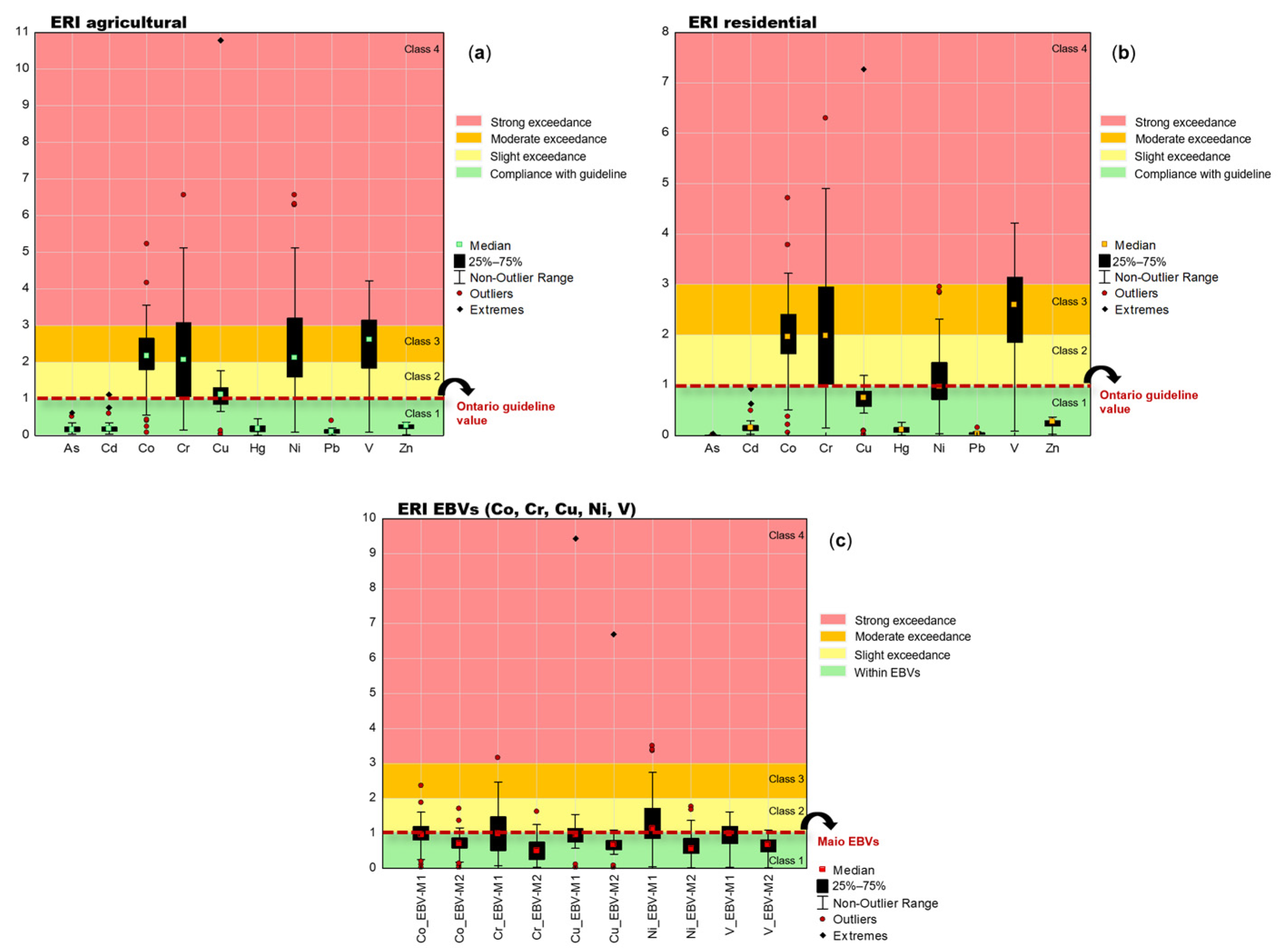
ERI distributions, expressed as single-element exceedance ratios relative to Ontario guideline concentrations for agricultural and residential purposes (Ref. [81]; Table 4), are shown in Figure 6a,b, except for Mn, which lacks applicable reference values. Patterns are broadly consistent among most metal(loid)s, with Cr, Ni, Co, V, and Cu showing the greatest variability, paralleling trends in Santiago, where Ni records the highest exceedances under the agricultural scenario (ERI_agricultural = 7–14) [17]. Residential ERI distributions for Cu and Ni are narrower due to higher permissible thresholds, whereas V and Zn share identical limits across the two land-use categories (Table 4). Median ERI values for Cr, Ni, Co, and V equal or surpass Ontario guideline concentrations under agricultural and residential scenarios (Cr: 2.1_agricultural/2.0_residential; Ni: 2.1/1.0; Co: 2.2/2.0; V: 2.6), while Cu exceeds guidelines only in the agricultural scenario (median = 1.1). Wide interquartile ranges, outliers, and maximum ERI values (Class 4; >3) denote the presence of localized “hotspots” that merit further site-specific investigation. Though elevated concentrations largely reflect natural geochemical heterogeneity, these metals may still pose environmental or human-health concerns under agricultural or residential use.
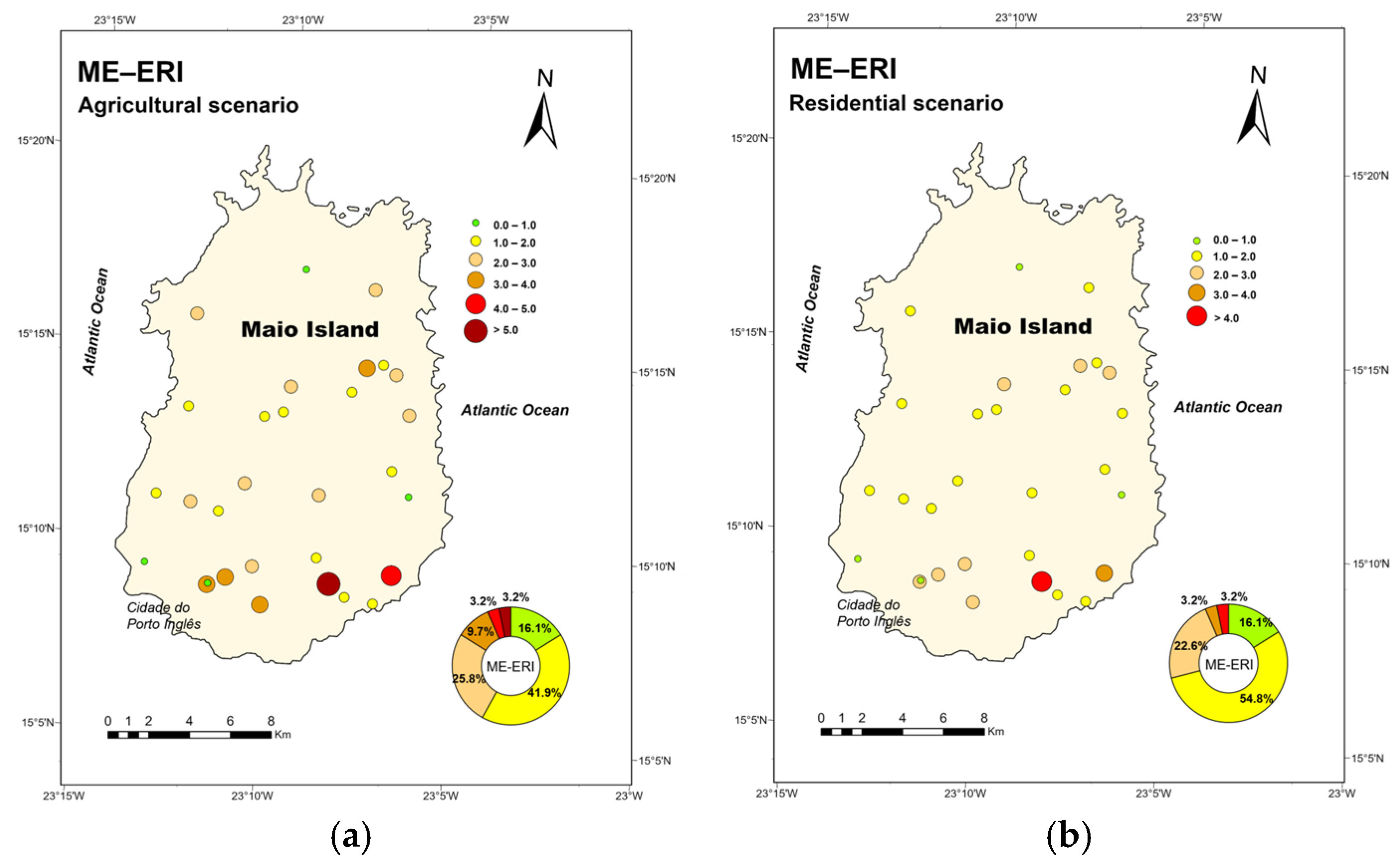
Figure 7 depicts maps of multi-element enrichment (ME–ERI) for the two intended land uses: agricultural and residential. The ME–ERI metric highlights sites with co-occurring exceedances while minimizing the influence of isolated extreme ERI values, based on the operational limits proposed in this study.
The ME–ERI maps reveal distinct spatial patterns between scenarios (Figure 7), despite ~84% of sites being classified as unsuitable under Ontario guidelines, like Santiago, where nearly the entire island exceeds guideline limits [17]. Under the agricultural scenario (Figure 7a), minor to moderate enrichment occurs at ~68% of sites, notable enrichment at ~10%, with two “hotspots”: MS12 (QS) showing considerable enrichment and MS10 (CIC) extreme enrichment. These locations may warrant management measures or cultivation restrictions, regardless of the natural geochemical origin. In the residential scenario (Figure 7b), minor enrichment is more widespread (54.8%) at the expense of moderate enrichment (22.6%), with no extreme enrichment and MS10 as the sole “hotspot.” These differences arise from stricter Ontario agricultural thresholds for certain metals, namely Cu and Ni, which classify soils as unsuitable for food or feed production but still compliant with less restrictive residential standards.
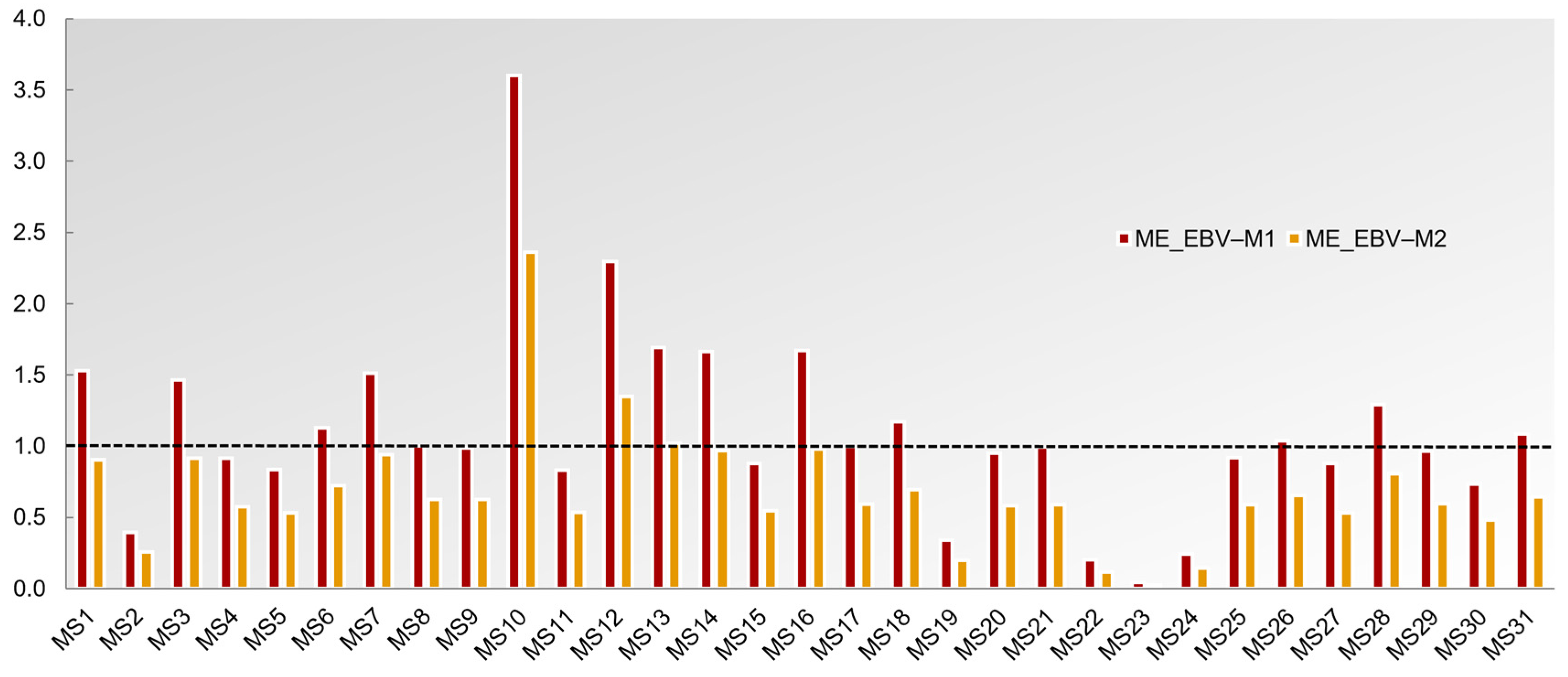
The proportion of sites exceeding multi-element enrichment limits drops from 42% under EBV–M1 to ~10% under EBV–M2 (Figure 8), highlighting the influence of background-value selection. Maio-specific EBVs thus better represent local soil quality regarding metal(loid) contamination than international regulatory thresholds, corroborating previous findings [36,80]. The core issue is that maximum allowable limits in general standards target anthropogenic contamination under default human health assumptions [107] and do not account for geogenic enrichment of metal(loid)s. On Maio, Cr, Ni, Co, V, and Cu are largely lithogenic, reflecting the island’s geochemical baseline. While geogenic origin, per se, does not preclude risk, hazards depend strongly on solid-phase partitioning. As observed in Santiago and Sal, environmental mobility varies among metals, with Cr (and likely Ni, according to rPCA) preferentially partitioning into refractory, low-solubility phases relative to Co. This reduces their geoavailable fraction (operationally measured by aqua regia extraction [12]) and subsequent bioavailability via soil–plant, soil–water, and dust/soil ingestion pathways. Even so, geogenic enrichments on Maio (and Santiago) could justify proportionate, context-specific evaluation of potential chronic exposure.

3.6. Limitations and Future Work

Notwithstanding its contributions, this study has limitations that suggest directions for future research. The low number and uneven distribution of topsoil samples restricted UTL95–95 baseline determination and precluded kriging, limiting predictive assessment of metal(loid)s. Expanding sample density and improving spatial coverage could strengthen geostatistical reliability and might help clarify rPCA-identified spatial patterns (Figure 5e,f).
Accurate multi-element quantification may require multiple extraction treatments per sample to capture metal(loid)s in both labile and refractory phases, whose crystallinity, grain size, and solubility influence measured concentrations. Complementary speciation analyses (e.g., Cr3+/Cr6+) and bioaccessibility tests [108] are recommended to better constrain bioavailability and associated ecological and human-health risks, particularly for the most enriched metals. Integrating geochemical and mineralogical investigations (e.g., on Fogo Island; Ref. [109]) can elucidate mineral hosts, weathering pathways, and mechanisms controlling metal(loid) mobility, consistent with the “lines of evidence” approach for oral bioaccessibility testing [110].
From an interpretative standpoint, ERI-based assessments relied on internationally recognized RGVs (Ontario) due to the absence of national soil quality thresholds. However, Maio (and Santiago [17]) exemplify how lithology, pedogenesis, and climate can generate natural topsoil geochemical background concentrations far exceeding generic screening values, independent of anthropogenic inputs. When parent-rock composition drives elevated metal(loid) levels, broad RGVs may misrepresent naturally enriched soils. This is illustrated by comparing Ontario guidelines with Maio’s EBVs (applied as site-specific thresholds), which flag potentially “unacceptable” risks in ERI and ME–ERI assessments despite their geogenic origin. Misinterpreting such exceedances—often of low bioavailability and minimal health risk—can result in flawed evaluations, unnecessary regulatory burdens, and ineffective remediation, as soils cannot feasibly be restored below natural background levels [107]. These challenges are especially acute in small island developing states (SIDS) such as Cape Verde, where limited technical and financial capacity hampers responses to environmental and climate-related pressures [43]. At the same time, recognizing Maio as a high-geochemical background area (HGBA; Ref. [80]) highlights the importance of preventing additional anthropogenic metal inputs to agricultural soils. While elevated baseline levels reflect parent-rock composition and pedogenesis, avoiding incremental anthropogenic enrichment remains essential. Practices such as agricultural waste recycling must be wisely managed to prevent cumulative metal loading while maintaining benefits for soil structure, nutrient cycling, and fertilizer-use efficiency [91]. Together, these considerations reinforce the need for context-specific evaluation frameworks, including soil quality guidelines calibrated to Cape Verdean lithologies and climatic–pedogenic regimes. In this context, the EBVs established for Maio and Santiago provide a scientifically defensible, empirically grounded basis for developing future national standards that balance environmental protection, agricultural productivity, and socio-economic feasibility.
Finally, while ME–ERI facilitates the visualization of multi-element enrichment patterns and inter-island comparisons, it treats all exceeding elements equally. Future research could explore toxicity-weighted or cumulative formulations, incorporate maximum ERI metrics, or consider sub-threshold contributors (ERI < 1) to improve sensitivity, ecological interpretability, and soil protection management across Cape Verde.

4. Conclusions

This study derives the first island-wide geochemical baseline for Maio topsoils, based on multi-element analyses of samples collected between 2019 and 2022 throughout volcanic–sedimentary sequences and Pliocene–Quaternary deposits. Results indicate naturally elevated concentrations of Co, Cr, Ni, Cu, and V, while As, Cd, Hg, Pb, and Zn remain low. Robust compositional multivariate analysis (rPCA) reveals coherent elemental groupings aligned with dominant lithogenic controls. Incorporating island-specific EBVs into ERI and ME–ERIs allows natural topsoil geochemical enrichment to be properly accounted for in land-use-related environmental risk assessments, while underlining the limitations of applying generic international guideline values to geochemically enriched volcanic terrains. By defining a reliable reference for Maio’s soil conditions, this work supports evidence-based land-use planning and the development of adapted soil protection strategies for the Cape Verde archipelago, ensuring that management and remediation decisions are informed by the unique geochemical context of each island.

Author Contributions

Conceptualization, F.M.; methodology, F.M. and M.C.P.; software, F.M.; validation, M.C.P. and O.N.; formal analysis, F.M.; investigation, F.M., O.N. and R.N.; resources, M.C.P.; data curation, M.C.P.; writing—original draft preparation, F.M. and M.C.P.; writing—review and editing, F.M., M.C.P., O.N. and R.N.; visualization, F.M.; supervision, M.C.P.; funding acquisition, M.C.P. All authors have read and agreed to the published version of the manuscript.

Funding

This study was partly supported by the GeoBioTec Research Unit (UIDB/04035).

Data Availability Statement

The raw data supporting the conclusions of this article will be made available by the authors on request.

Acknowledgments

The authors sincerely thank Gelson Carlos, Diogo Medeiros, and Pedro Dias for their continuous support. F.M. acknowledges the invaluable assistance of João Moreno. We also thank the Reviewers for their careful reading and constructive comments, which greatly improved the manuscript.

Conflicts of Interest

The authors declare no conflicts of interest.

References

  1. Bünemann, E.K.; Bongiorno, G.; Bai, Z.; Creamer, R.E.; De Deyn, G.; de Goede, R.; Fleskens, L.; Geissen, V.; Kuyper, T.W.; Mäder, P.; et al. Soil quality—A critical review. Soil Biol. Biochem. 2018, 120, 105–125. [Google Scholar] [CrossRef]
  2. Cherlet, M.; Hutchinson, C.; Reynolds, J.; Hill, J.; Sommer, S.; von Maltitz, G. World Atlas of Desertification; Publication Office of the European Union: Luxembourg, 2018; Available online: https://wad.jrc.ec.europa.eu/ (accessed on 2 December 2025).
  3. UNESCO. UNESCO Raises Global Alarm on the Rapid Degradation of Soils. 2024. Available online: https://www.unesco.org/en/articles/unesco-raises-global-alarm-rapid-degradation-soils (accessed on 2 December 2025).
  4. Kundu, P.; Biswas, S. Securing soil health as the foundation for strengthening planetary health. Soil Secur. 2025, 21, 100205. [Google Scholar] [CrossRef]
  5. IUSS. International Decade of Soils. 2015. Available online: https://www.iuss.org/wp-content/uploads/2024/01/ids_general_intro_for_egu_and_web_v3.pdf (accessed on 29 November 2025).
  6. European Commission. First EU Law on Soil Set to Enter into Force. 2025. Available online: https://environment.ec.europa.eu/news/first-eu-law-soil-set-enter-force-2025-12-05_en (accessed on 15 December 2025).
  7. Costantini, E.A.C.; International Science Council. 2025–2034: Decade of Soil Sciences for Sustainable Development. 2025. Available online: https://council.science/blog/2025-2034-decade-of-soil-sciences-for-sustainable-development/ (accessed on 30 October 2025).
  8. Smith, D.B.; Reimann, C. Low-density geochemical mapping and the robustness of geochemical patterns. Geochem. Explor. Environ. Anal. 2008, 8, 219–227. [Google Scholar] [CrossRef]
  9. Reimann, C. Experiences from 30 years of low-density geochemical mapping at the subcontinental to continental scale in Europe. Geochem.: Explor. Environ. Anal. 2022, 22. [Google Scholar] [CrossRef]
  10. Kome, G.K.; Kundu, C.A.; Okon, M.A.; Enang, R.K.; Mesele, S.A.; Opio, J.; Asamoah, E.; Khurshid, C. Soil pollution mapping across Africa: Potential tool for soil health monitoring. Pollutants 2025, 5, 38. [Google Scholar] [CrossRef]
  11. Inácio, M.; Pereira, V.; Pinto, M. The soil geochemical atlas of Portugal: Overview and applications. J. Geochem. Explor. 2008, 98, 22–33. [Google Scholar] [CrossRef]
  12. Neves, O.; Moreno, F.; Pinheiro, D.; Cabral Pinto, M.; Inácio, M. Soil low-density geochemical mapping of technology-critical elements (TCEs) and its environmental implications: The case of lithium in Portugal. Sci. Total Environ. 2024, 934, 173207. [Google Scholar] [CrossRef] [PubMed]
  13. Birke, M.; Rauch, U.; Stummeyer, J. How robust are geochemical patterns? A comparison of low and high sample density geochemical mapping in Germany. J. Geochem. Explor. 2015, 154, 105–128. [Google Scholar] [CrossRef]
  14. Bi, R.; Fu, W.; Fu, X. Heavy metal spatial variation mechanism and ecological health risk assessment in volcanic island soils: A case study of Weizhou island, China. Land 2025, 14, 35. [Google Scholar] [CrossRef]
  15. Cabral Pinto, M.M.S.; Ferreira da Silva, E.A.; Silva, M.M.V.G.; Melo-Gonçalves, P.; Hernández, R.; Marinho, A.P.; Inácio, M.; Rocha, F. Mapping of estimated geochemical background values of some harmful metals in soils of Santiago Island (Cape Verde archipelago). In Progress on Heavy Metals in the Environment; Nriagu, J., Szefer, P., Pacyna, J., Markert, B., Wünschmann, S., Eds.; MARALTEBOOKS-D-11-00053R1 Cap. 10; Maralte Books: Amsterdam, Netherlands, 2012; pp. 101–122. [Google Scholar] [CrossRef]
  16. Cabral Pinto, M.M.S.; Ferreira da Silva, E.A.; Silva, M.M.V.G.; Melo-Gonçalves, P.; Candeias, C. Environmental risk assessment based on high-resolution spatial maps of potentially toxic elements sampled on stream sediments of Santiago, Cape Verde. Geosciences 2014, 4, 297–315. [Google Scholar] [CrossRef]
  17. Cabral Pinto, M.M.S.; Ferreira da Silva, E.A.; Silva, M.M.V.G.; Melo-Gonçalves, P. Heavy metals of Santiago Island (Cape Verde) topsoils: Estimated Background Value maps and environmental risk assessment. J. Afr. Earth Sci. 2015, 101, 162–176. [Google Scholar] [CrossRef]
  18. Marques, R.; Prudêncio, M.I.; Rocha, F.; Cabral Pinto, M.M.S.; Silva, M.M.V.G.; Ferreira da Silva, E. REE and other trace and major elements in the topsoil layer of Santiago Island, Cape Verde. J. Afr. Earth Sci. 2012, 64, 20–33. [Google Scholar] [CrossRef]
  19. Marques, R.; Waerenborgh, J.C.; Prudêncio, M.I.; Dias, M.I.; Rocha, F.; Ferreira da Silva, E. Iron speciation in volcanic topsoils from Fogo Island (Cape Verde)—Iron oxide nanoparticles and trace elements concentrations. Catena 2014, 113, 95–106. [Google Scholar] [CrossRef]
  20. Marques, R.; Prudêncio, M.I.; Waerenborgh, J.C.; Rocha, F.; Ferreira da Silva, E.; Dias, M.I.; Madeira, J.; Vieira, B.J.C.; Marques, J.G. Geochemical fingerprints in topsoils of the volcanic Brava Island, Cape Verde. Catena 2016, 147, 522–535. [Google Scholar] [CrossRef]
  21. Diniz, L.; Carlos, G.; Miranda, C.; Dinis, P.; Marques, R.; Rocha, F.T.; Silva, E.F.d.; Almeida, A.; Cabral Pinto, M. Soil geochemical mapping of the Sal Island (Cape Verde): Ecological and Human Health Risk Assessment. Land 2024, 13, 1139. [Google Scholar] [CrossRef]
  22. Doran, J.W.; Parkin, T.B. Defining and assessing soil quality. In Defining Soil Quality for a Sustainable Environment; Doran, J.W., Coleman, D.C., Bezdicek, D.F., Stewart, B.A., Eds.; Soil Science Society of America, Inc.: Madison, WI, USA, 1994; pp. 3–21. [Google Scholar] [CrossRef]
  23. Doran, J.W.; Parkin, T.B. Quantitative indicators of soil quality: A minimum data set. In Methods for Assessing Soil Quality; Doran, J.W., Jones, A.J., Eds.; Soil Science Society of America: Madison, WI, USA, 1996; pp. 25–37. [Google Scholar] [CrossRef]
  24. Garrigues, E.; Corson, M.S.; Angers, D.A.; van der Werf, H.M.G.; Walter, C. Soil quality in life cycle assessment: Towards development of an indicator. Ecol. Indic. 2012, 18, 434–442. [Google Scholar] [CrossRef]
  25. Subramanian, S.M.; Payyappallimana, U. Environment, biodiversity, and planetary health: Links between natural systems and human health. In Handbook of Global Health; Haring, R., Kickbusch, I., Ganten, D., Moeti, M., Eds.; Springer: Berlin/Heidelberg, Germany, 2020; pp. 1–14. [Google Scholar] [CrossRef]
  26. Meisner, J.; Mcleland, H.; Traylor, E.E.; Hermesh, B.; Berg, T.; Roess, A.; Van Patter, L.; Rosenthal, A.; Davidovitch, N.; Rabinowitz, P.M. Relational One Health: A more-than-biomedical framework for more-than-human health, and lessons learned from Brazil, Ethiopia, and Israel. One Health 2024, 18, 100676. [Google Scholar] [CrossRef]
  27. European Commission. Communication from the Commission to the Council, the European Parliament, the European Economic and Social Committee and the Committee of the Regions—Thematic Strategy for Soil Protection; COM(2006)231 Final; Publications Office of the European Union: Luxembourg, 2006; 12p, Available online: https://eur-lex.europa.eu/LexUriServ/LexUriServ.do?uri=COM:2006:0231:FIN:EN:PDF (accessed on 29 October 2025).
  28. USEPA. Exposure Factors Handbook—General Factors; U.S. Environmental Protection Agency: Washington, DC, USA, 1997; Volume 1. Available online: https://nepis.epa.gov/Exe/ZyPDF.cgi/3000284R.PDF?Dockey=3000284R.PDF (accessed on 15 November 2025).
  29. Adriano, D.C. Trace Elements in Terrestrial Environments. In Biogeochemistry, Bioavailability and Risks of Metals, 2nd ed.; Springer: New York, NY, USA, 2001; 867p. [Google Scholar]
  30. Kabata-Pendias, A.; Mukherjee, A.B. Trace Elements from Soil to Human; Springer: Berlin/Heidelberg, Germany, 2007; 550p. [Google Scholar]
  31. Lo Medico, F.; Miola, M.; Scopelliti, G.; Varrica, D.; Zuccolini, M.V.; Alaimo, M.G. Geochemical baseline values and spatial distribution of major, trace, and rare earth elements in unpolluted soils of the Sicily region (Italy). Environ. Geochem. Health 2025, 47, 167. [Google Scholar] [CrossRef]
  32. Santos-Francés, F.; Martinez-Graña, A.; Rojo, P.A.; Sánchez, A.G. Geochemical background and baseline values determination and spatial distribution of heavy metal pollution in soils of the Andes Mountain range (Cajamarca-Huancavelica, Peru). Int. J. Environ. Res. Public Health 2017, 14, 859. [Google Scholar] [CrossRef] [PubMed]
  33. Salminen, R.; Tarvainen, T. The problem of defining geochemical baselines. A case study of selected elements and geological materials in Finland. J. Geochem. Explor. 1997, 60, 91–98. [Google Scholar] [CrossRef]
  34. Garrett, R.G. The Management, Analysis and Display of Geochemical Data. Exploration Geochemistry Workshop; Open File 2390; Geological Survey of Canada: Ottawa, ON, Canada, 1991; pp. 9-1–9-41. Available online: https://geochem.nrcan.gc.ca/ftp/data/publications/pub_00225/of2390.pdf (accessed on 17 November 2025).
  35. Reimann, C.; Garret, R.G. Geochemical background: Concept and reality. Sci. Total Environ. 2005, 350, 12–27. [Google Scholar] [CrossRef]
  36. Varrica, D.; Lo Medico, F.; Zuccolini, M.V.; Miola, M.; Alaimo, M.G. Geochemical baseline values determination and spatial distribution of trace elements in topsoils: An application in Sicily region (Italy). Sci. Total Environ. 2024, 955, 176951. [Google Scholar] [CrossRef] [PubMed]
  37. Carvalho, J.; Bonadio, R.; Silveira, G.; Lebedev, S.; Mata, J.; Arroucau, P.; Meier, T.; Celli, N.L. Evidence for high temperature in the upper mantle beneath Cape Verde archipelago from Rayleigh-wave phase-velocity measurements. Tectonophysics 2019, 770, 228225. [Google Scholar] [CrossRef]
  38. Vales, D.; Dias, N.A.; Rio, I.; Matias, L.; Silveira, G.; Madeira, J.; Weber, M.; Carrilho, F.; Haberland, C. Intraplate seismicity across the Cape Verde swell: A contribution from a temporary seismic network. Tectonophysics 2014, 636, 325–337. [Google Scholar] [CrossRef]
  39. Ramalho, R.A.S. Building the Cape Verde Islands; Springer: Berlin/Heidelberg, Germany, 2011; 207p. [Google Scholar]
  40. Correia, F.V.; Brito, E.A.; Soares, E.F.S.; Moniz, C.A.; Pile, E.; Morais, L.E.L.; Neves, A.R.D.L.; Carvalho, M.L.S. Second National Communication of Cape Verde. United Nations Framework Convention for Climate Change; Ministry of Environment Rural Development and Marine Resources, National Institute of Meteorology and Geophysics, Republic of Cape Verde: Praia, Cape Verde, 2010; 144p. [Google Scholar]
  41. Varela-Lopes, G.E.; Molion, L.C.B. Precipitation patterns in Cape Verde Islands: Santiago Island case study. ACS 2014, 4, 854–865. [Google Scholar] [CrossRef]
  42. Freire, A.C. Climate Action in Cape Verde: Historical Trends and Future Projections. 2024. Available online: https://portaldoclima.gov.cv/en/2024/08/02/climate-action-in-cape-verde-historical-trends-and-future-projections/ (accessed on 30 November 2025).
  43. Matos, P.A. Enhancing climate resilience in Cabo Verde: Strategies, challenges, and opportunities. In Climate Policies—Modern Risk-Based Assessment of Investments in Mitigation, Adaptation, and Recovery from Residual Harm; Yohe, G., Smith, J., Eds.; IntechOpen: London, UK, 2024; pp. 1–26. [Google Scholar] [CrossRef]
  44. INE-CV. Maio em Números. V Recenseamento Geral da População e Habitação (RGPH-2021); Instituto Nacional de Estatística: Praia, Cabo Verde, 2022; 112p, Available online: https://bdmi.ine.cv/site_deploy_api/Uploads/20251126_152716_0d3153b4-40c9-4f72-8d4c-fa2daac850d0.pdf (accessed on 26 February 2026).
  45. ADB, African Development Bank. Country Focus Report 2023—Cabo Verde—Mobilizing Private Sector Financing for Climate and Green Growth; African Development Bank Group: Abidjan, Côte d’Ivoire, 2023; 48p. [Google Scholar]
  46. Sequeira, E.; Leão de Sousa, P.; Correia, A.M.; Rolim, J. The current status of irrigated agriculture in Cape Verde and its link to water scarcity. Agronomy 2025, 15, 1625. [Google Scholar] [CrossRef]
  47. SIERA. Systematic Inventory Evaluation for Risk Assessment. Relatório Final—Cabo Verde; Republic of Cabo Verde/Ministry of Environment, Housing, and Territory (MAHOT): Praia, Cabo Verde, 2013; 45p. Available online: https://portaldoclima.gov.cv/wp-content/uploads/2023/11/Relatorio-SIERA_Cabo-Verde-Risk-2013.pdf (accessed on 2 December 2025).
  48. FAO; IFAD; UNICEF; WFP; WHO. The State of Food Security and Nutrition in the World 2024—Financing to End Hunger, Food Insecurity and Malnutrition in All Its Forms; FAO: Rome, Italy, 2024; 250p. [Google Scholar] [CrossRef]
  49. Villaseca, C.; Orejana, D.; Huertas, M.J.; Ancochea, E.; de Ignacio, C.; Mata, J.; Caldeira, R.; García-Rodríguez, M.; Moreno, J.A.; Pérez-Sob, C. The old central igneous complexes of Sal, Boa Vista and Maio islands: Implications for 17 Ma of isotopic evolution of the Cape Verde archipelago. Lithos 2025, 498–499. [Google Scholar] [CrossRef]
  50. Gomes, A.M. Hidrogeologia e Recursos Hídricos da Ilha de Santiago (Cabo Verde). Ph.D. Thesis, University of Aveiro, Aveiro, Portugal, 2007; 296p. [Google Scholar]
  51. Madeira, J.; Ramalho, R.S.; Hoffmann, D.L.; Mata, J.; Moreira, M. A geological record of multiple Pleistocene tsunami inundations in an oceanic island: The case of Maio, Cape Verde. Sedimentology 2020, 67, 1529–1552. [Google Scholar] [CrossRef]
  52. Agues, J.; Freire, S.; Loizos, H.; Morais, A.; Navas, M.; Phillips, R.; Santos, D.; Teixidor, A. Guia de Recursos Naturais e Patrimoniais da Ilha do Maio, Cabo Verde; Fundação Maio Biodiversidade: Cidade do Porto Inglês, Cabo Verde, 2018; 71p. [Google Scholar]
  53. Ramalho, R.; Helffrich, G.; Schmidt, D.N.; Vance, D. Tracers of uplift and subsidence in the Cape Verde Archipelago. J. Geol. Soc. 2010, 167, 519–538. [Google Scholar] [CrossRef]
  54. Moreira, M.; Mata, J.; Madeira, J.; Represas, P.; Martins, S. Age dependent variation of the magnetic fabric of dike swarms and implications for the volcanic structure of ocean islands: The example of the Maio Island, Cabo Verde archipelago. Geophys. J. Int. 2025, 243, ggaf293. [Google Scholar] [CrossRef]
  55. Paepe, P.D.; Klerkx, J.; Hertogen, J.; Plinke, P. Oceanic tholeiites on the Cape Verde Islands: Petrochemical and geochemical evidence. Earth Planet. Sci. Lett. 1974, 22, 347–354. [Google Scholar] [CrossRef]
  56. Serralheiro, A. Geologia do Ilha de Maio (Cabo Verde); Junta Investigação do Ultramar: Lisboa, Portugal, 1970; 103p. [Google Scholar]
  57. Represas, P.; Catalão, J.; Montesinos, F.G.; Madeira, J.; Mata, J.; Antunes, C.; Moreira, M. Constraints on the structure of Maio Island (Cape Verde) by a 3D gravity model: Imaging partially exhumed magma chambers. Geophys. J. Int. 2012, 190, 931–940. [Google Scholar] [CrossRef]
  58. Samrock, L.K.; Hansteen, T.H.; Dullo, W.-C.; Wartho, J.-A. Internal igneous growth, doming and rapid erosion of a mature ocean island: The Miocene evolution of Maio (Cabo Verde). Int. J. Earth Sci. 2022, 111, 1129–1148. [Google Scholar] [CrossRef]
  59. El-Omla, M.M.; Aboulela, H.A. Environmental and mineralogical studies of the sabkhas soil at Ismailia—Suez Roadbed, southern of Suez Canal District, Egypt. Open J. Geol. 2012, 2, 165–181. [Google Scholar] [CrossRef][Green Version]
  60. Faria, F.X. Os Solos da Ilha do Maio (República de Cabo Verde); Estudos, Ensaios e Documentos nº 147; Instituto de Investigação Científica Tropical: Lisboa, Portugal, 1987; 88p. [Google Scholar]
  61. WRB. World Reference Base for Soil Resources 2006. In A Framework for International Classification, Correlation and Communication, 2006 Edition; World Soil Resources Reports Nº. 103; IUSS Working Group, FAO: Rome, Italy, 2006; 103p. [Google Scholar]
  62. Madeira, M.; Ricardo, R.P. Os solos de Cabo Verde. Seu enquadramento no sistema de referência mundial de solos. Rev. Ciênc. Agrár. 2013, 36, 377–392. [Google Scholar]
  63. Darnley, A.G.; Björklund, A.; Bolviken, B.; Gustavsson, N.; Koval, P.V.; Plant, J.A.; Steenfelt, A.; Tauchid, M.; Xie, X.; Garrett, R.G.; et al. A Global Geochemical Database for Environmental and Resource Management. Recommendations for International Geochemical Mapping; Final report of IGCP-project 259; UNESCO Publishing: Paris, France, 1995; 122p, Available online: https://www.globalgeochemicalbaselines.eu/datafiles/file/Blue_Book_GGD_IGCP259.pdf (accessed on 1 November 2025).
  64. Hossain, M.S.; Rahman, G.K.M.M.; Solaiman, A.R.M.; Alam, M.S.; Rahman, M.M.; Mia, M.A.B. Estimating electrical conductivity for soil salinity monitoring using various soil-water ratios depending on soil texture. Commun. Soil Sci. Plant Anal. 2020, 51, 635–644. [Google Scholar] [CrossRef]
  65. Tukey, J.W. Exploratory Data Analysis; Addison-Wesley Publishing Company: Boston, MA, USA, 1977; 688p. [Google Scholar]
  66. Aitchison, J. The Statistical Analysis of Compositional Data; Monographs on Statistics and Applied Probability; The Blackburn Press: Caldwell, NJ, USA, 1986; 416p. [Google Scholar]
  67. Reimann, C.; Filzmoser, P.; Garrett, R.G. Background and threshold: Critical comparison of methods of determination. Sci. Total Environ. 2005, 346, 1–16. [Google Scholar] [CrossRef]
  68. USEPA. ProUCL, Version 5.2; Statistical Software for Environmental Applications for Data Sets with and Without Nondetect Observations; U.S. Environmental Protection Agency: Washington, DC, USA, 2022. Available online: https://www.epa.gov/land-research/proucl-software (accessed on 5 November 2025).
  69. Goovaerts, P. Geostatistics for Natural Resources Evaluation; Oxford University Press: Oxford, UK, 1997; 483p. [Google Scholar]
  70. Webster, R.; Oliver, M.A. Geostatistics for Environmental Scientists, 2nd ed.; John Wiley & Sons: Chichester, UK, 2007; 315p. [Google Scholar]
  71. Moran, P.A.P. Notes on continuous stochastic phenomena. Biometrika 1950, 37, 17–23. [Google Scholar] [CrossRef] [PubMed]
  72. Dale, M.R.T.; Fortin, M.-J. Spatial Analysis—A Guide for Ecologists, 2nd ed.; Cambridge University Press: Cambridge, UK, 2014; 438p. [Google Scholar]
  73. Decreto Nacional Reglamentario 831/93. National Law 24.051, Régimen de Desechos Peligrosos., Anexo II, Tabla 9. Secretaría de Ambiente y Desarrollo Sustentable, Poder Ejecutivo Nacional. Available online: https://exactas.uba.ar/higieneyseguridad/wp-content/uploads/2019/08/Decreto-831-1993-Reglamentaci%C3%B3n-de-la-ley-24.051.pdf (accessed on 10 November 2025).
  74. Ministry of Housing, Spatial Planning and the Environment. Circular on Target Values and Intervention Values for Soil Remediation; The Netherlands Government Gazette, Nº. 39; Directorate General for Environmental Protection, Department of Soil Protection: Hague, The Netherlands, 2000; Available online: http://www.esdat.net/Environmental%20Standards/Dutch/annexS_I2000Dutch%20Environmental%20Standards.pdf (accessed on 10 November 2025).
  75. Legislative Decree Nº. 152/2006. Norme in materia ambientale. Allegato 5, Parte IV, Tabella 1. Gazzetta Ufficiale n. 88 del 11 aprile 2006. Supplemento Ordinario n. 96. Available online: https://www.bosettiegatti.eu/info/norme/statali/2006_0152.htm (accessed on 10 November 2025).
  76. Ministry of the Environment, Finland. Government Decree on the Assessment of Soil Contamination and Remediation Needs 214/2007. Available online: https://www.finlex.fi/en/legislation/translations/2007/eng/214 (accessed on 11 November 2025).
  77. Department of Environmental Affairs. South Africa Legislation. 2010. Available online: https://cer.org.za/wp-content/uploads/2014/02/natl-norms-and-stds-for-remediation-of-contaminated-land-and-soil-quality.pdf (accessed on 11 November 2025).
  78. Soltani-Gerdefaramarzi, S.; Ghasemi, M.; Ghanbarian, B. Geogenic and anthropogenic sources identification and ecological risk assessment of heavy metals in the urban soil of Yazd, central Iran. PLoS ONE 2021, 16, e0260418. [Google Scholar] [CrossRef]
  79. Uchmanowicz, D.; Pyssa, J.; Gajec, M.; Styszko, K. Assessment of potentially toxic elements in agricultural and urban soils of lesser Poland using ICP-MS and uncertainty estimation. Sci. Rep. 2025, 15, 36795. [Google Scholar] [CrossRef]
  80. Yang, J.; Sunc, Y.; Wang, Z.; Gong, J.; Gao, J.; Tang, S.; Ma, S.; Duan, Z. Heavy metal pollution in agricultural soils of a typical volcanic area: Risk assessment and source appointment. Chemosphere 2022, 304, 135340. [Google Scholar] [CrossRef] [PubMed]
  81. Ministry of the Environment. Soil, Ground Water and Sediment Standards for Use Under Part XV.1 of the Environmental Protection Act. 2011. Available online: https://www.ontario.ca/page/soil-ground-water-and-sediment-standards-use-under-part-xv1-environmental-protection-act (accessed on 12 November 2025).
  82. Canadian Council of Ministries of the Environment (CCME). Soil Quality Guidelines for the Protection of Environmental and Human Health Agricultural, Residential/Parkland, Commercial, Industrial. 2025. Available online: https://ccme.ca/en/summary-table (accessed on 13 November 2025).
  83. Jennings, A.A. Analysis of worldwide regulatory guidance values for the most commonly regulated elemental surface soil contamination. J. Environ. Manag. 2013, 118, 72–95. [Google Scholar] [CrossRef]
  84. Jennings, A.A. Analysis of worldwide Regulatory Guidance Values for less frequently regulated elemental surface soil contaminants. J. Environ. Manag. 2013, 128, 561–585. [Google Scholar] [CrossRef]
  85. USDA. Soil Survey Manual. In Agriculture Handbook Nº. 18; United States Department of Agriculture: Washington, DC, USA, 2018. Available online: https://www.nrcs.usda.gov/sites/default/files/2022-09/The-Soil-Survey-Manual.pdf (accessed on 21 November 2025).
  86. Negacz, K.; Malek, Ž.; de Vos, A.; Vellinga, P. Saline soils worldwide: Identifying the most promising areas for saline agriculture. J. Arid Environ. 2022, 203, 104775. [Google Scholar] [CrossRef]
  87. Acosta, J.A.; Jansen, B.; Kalbitz, K.; Faz, A.; Martínez-Martínez, S. Salinity increases mobility of heavy metals in soils. Chemosphere 2011, 85, 1318–1324. [Google Scholar] [CrossRef]
  88. Dœlsch, E.; Macary, H.S.; Van de Kerchove, V. Sources of very high heavy metal content in soils of volcanic island (La Réunion). J. Geochem. Explor. 2006, 88, 194–197. [Google Scholar] [CrossRef]
  89. Mikulski, S.Z.; Sadłowska, K.; Wiszniewska, J.; Małek, R. Vanadium and cobalt occurrence in the Fe-Ti-V oxide deposits related to Mesoproterozoic AMCG complex in NE Poland. Appl. Sci. 2022, 12, 6277. [Google Scholar] [CrossRef]
  90. Smith, D.B.; Solano, F.; Woodruff, L.G.; Cannon, W.F.; Ellefsen, K.J. Geochemical and Mineralogical Maps, with Interpretation, for Soils of the Conterminous United States. U.S. Geol. Surv. Sci. Investig. Rep. 2019. [Google Scholar] [CrossRef]
  91. Kierczak, J.; Pietranik, A.; Pędziwiatr, A. Ultramafic geoecosystems as a natural source of Ni, Cr, and Co to the environment: A review. Sci. Total Environ. 2021, 755, 142620. [Google Scholar] [CrossRef]
  92. Linhares, D.; Pimentel, A.; Borges, C.; Cruz, J.V.; Garcia, P.; Rodrigues, A. Cobalt distribution in the soils of São Miguel Island (Azores): From volcanoes to health effects. Sci. Total Environ. 2019, 684, 715–721. [Google Scholar] [CrossRef] [PubMed]
  93. Plumlee, G.S. The environmental geology of mineral deposits. In The Environmental Geochemistry of Mineral Deposits, Part A. Processes, Techniques, and Health Issues; Plumlee, G.S., Logsdon, M.J., Eds.; Reviews in Economic Geology, v. 6A; Society of Economic Geologists: Littleton, CO, USA, 1999; pp. 71–116. [Google Scholar]
  94. Marques, R.; Prudêncio, M.I.; Rocha, F.; Ferreira da Silva, E.A.; Russo, D.; Costa, C.; Cerqueira, Â. Geoquímica da camada superficial de solos da Ilha do Sal (Cabo Verde). In Proceedings of the XII Congresso Ibérico de Geoquímica/XX Semana de Geoquímica, Évora, Portugal, 22–26 September 2019. [Google Scholar]
  95. Smith, O.C. Identification and Qualitative Chemical Analysis of Minerals; D. Van Nostrand Company, Inc.: New York, NY, USA, 1946; 331p. [Google Scholar]
  96. Robinson, P. GGR Handbook of Rock and Mineral Analysis Chapter 2 (Part 1)—Analysis of Geological Materials—1: Sample Preparation Methods. Geostand. Geoanalytical Res. 2025, 49, 9–50. [Google Scholar] [CrossRef]
  97. Hua, T.; Li, Y.; Hou, B.; Du, Y.; Lu, A.; Li, Y. Chromium immobilization as Cr-spinel by regulation of Fe(II) and Fe(III) concentrations. Minerals 2024, 14, 1024. [Google Scholar] [CrossRef]
  98. Oze, C.; Fendorf, S.; Bird, D.K.; Coleman, R.G. Chromium geochemistry in serpentinized ultramafic rocks and serpentine soils from the Franciscan complex of California. Am. J. Sci. 2004, 304, 67–101. [Google Scholar] [CrossRef]
  99. Linhares, D.P.S.; Garcia, P.V.; Rodrigues, A.S. Trace elements in volcanic environments and human health effects. In Trace Metals in the Environment—New Approaches and Recent Advances; Murillo-Tovar, M.A., Saldarriaga-Noreña, H., Saeid, A., Eds.; IntechOpen: London, UK, 2021. [Google Scholar] [CrossRef][Green Version]
  100. Cicchella, D.; De Vivo, B.; Lima, A. Background and baseline concentration values of elements harmful to human health in the volcanic soils of the metropolitan and provincial areas of Napoli (Italy). Geochem. Explor. Environ. Anal. 2005, 5, 29–40. [Google Scholar] [CrossRef]
  101. SCVZ. The Cape Verde Islands; Sociedade Caboverdiana de Zoologia: Mindelo, Cabo Verde, 2017; Available online: https://www.scvz.org/cverde.html (accessed on 3 December 2025).
  102. Gill, T.E. Eolian sediments generated by anthropogenic disturbance of playas: Human impacts on the geomorphic system and geomorphic impacts on the human system. Geomorphology 1996, 17, 207–228. [Google Scholar] [CrossRef]
  103. Ziyaee, A.; Hirmas, D.R.; Karimi, A.; Kehl, M.; Macpherson, A.L.; Roshanizarmehri, M. Geogenic and anthropogenic sources of potentially toxic elements in airborne dust in northeastern Iran. Aeolian Res. 2019, 41, 100540. [Google Scholar] [CrossRef]
  104. Fomba, K.W.; Müeller, K.; van Pinxteren, D.; Herrmann, H. Aerosol size-resolved trace metal composition in remote northern tropical Atlantic marine environment: Case study Cape Verde islands. Atmos. Chem. Phys. 2013, 13, 4801–4814. [Google Scholar] [CrossRef]
  105. Gama, C.; Tchepel, O.; Baldasano, J.M.; Basart, S.; Ferreira, J.; Pio, C.; Cardoso, J.; Borrego, C. Seasonal patterns of Saharan dust over Cape Verde—A combined approach using observations and modelling. Tellus Ser. B Chem. Phys. Meteorol. 2015, 67, 24410. [Google Scholar] [CrossRef]
  106. Kaiser, H.F. A second-generation Little Jiffy. Psychometrika 1970, 35, 401–415. [Google Scholar] [CrossRef]
  107. Armiento, G.; Cremisini, C.; Nardi, E.; Pacifico, R. High geochemical background of potentially harmful elements in soils and sediments: Implications for the remediation of contaminated sites. Chem. Ecol. 2011, 27, 131–141. [Google Scholar] [CrossRef]
  108. Griggs, J.L.; Thomas, D.J.; Fry, R.; Bradham, K.D. Improving the predictive value of bioaccessibility assays and their use to provide mechanistic insights into bioavailability for toxic metals/metalloids. J. Toxicol. Environ. Health B Crit. Rev. 2021, 24, 307–324. [Google Scholar] [CrossRef] [PubMed]
  109. Cabral Pinto, M.M.S.; Saha, N.; Ordens, C.M.; Pitta-Grós, D.; Carlos, N.; Dinis, P.; Marques, R.; Prudêncio, I.; Rocha, F.; Ferreira da Silva, E.A. Integrated geochemical and mineralogical investigation of soil from the volcanic Fogo Island (Cape Verde): Implications for ecological and probabilistic human health risks. Expo. Health 2023, 15, 1–17. [Google Scholar] [CrossRef]
  110. CIEH. Professional Practice Note: Reviewing Human Health Risk Assessment Reports Invoking Contaminant Oral Bioavailability Measurements or Estimates; Chartered Institute of Environmental Health: London, UK, 2009; 16p, Available online: https://www.iaeg.info/wp-content/uploads/2019/01/c20_doc-cieh_ppn_bioavailability_final_june09.pdf (accessed on 28 December 2025).
Figure 1. Location of Maio Island (indicated by red arrow in right panel) within the Cape Verde archipelago (adapted from [39]).
Geosciences 16 00109 g001
Figure 2. (a) Simplified geological map of Maio Island showing the main formations (based on [39]). (b) Conceptual schematic of the major soil types in relation to underlying lithologies (sabkha deposits adapted from [51]), and the locations of topsoil samples collected for the present work.
Geosciences 16 00109 g002
Figure 3. Histograms and Tukey boxplots of topsoil metal(loid) concentrations on Maio Island. Dots indicate lower and upper outliers. Numbers correspond to the respective samples (see Figure 2b) and are colored according to soil type (Blue: Arenosols; Orange: Leptosols; Purple: Cambisols; Green: Calcisols), using the same color scheme as in Figure 5f.
Geosciences 16 00109 g003
Figure 4. Spatial distribution of As, Cd, Co, Cr, Cu, Hg, Mn, Ni, Pb, V, and Zn in Maio’s topsoils, showing main village locations (bottom-right panel).
Geosciences 16 00109 g004
Figure 5. Summary of the main outcomes of the rPCA applied to clr-transformed topsoil composition: (a) Eigenvalues and variance explained by each principal component (PC); (b) Numerical loading matrix (PCs 1–5); (c) Bar plot of clr loadings (PCs 1–3); (d) Loading biplot (PC1 vs. PC2); (e) Score plot (PC1 vs. PC2) colored by geological units; (f) Score plot (PC1 vs. PC2) colored by soil types. Numbers in panels (e,f) denote individual samples (corresponding to M1–M31 in Figure 2b).
Geosciences 16 00109 g005
Figure 6. Environmental Risk Index (ERI) for Maio topsoils under agricultural (a) and residential (b) scenarios (regulatory thresholds) and (c) relative to Maio-specific EBVs (EBV–M1, EBV–M2). Values are shown on a four-class color-coded scale (Classes 1–4; see text). Non-outlier range = Tukey range; outliers < Q1 − 1.5 × IQR or >Q3 + 1.5 × IQR; extremes < Q1 − 3 × IQR or >Q3 + 3 × IQR (Q1 = 25th percentile, Q3 = 75th percentile, IQR = Q3 − Q1).
Geosciences 16 00109 g006
Figure 7. Maps of ME–ERI for agricultural (a) and residential (b) scenarios. The annular chart shows the percentage of samples in each ME–ERI class, as defined in Section 2.3.4.
Geosciences 16 00109 g007
Figure 8. ME_EBV–M1 vs. ME_EBV–M2 for soil samples, indicating multi-element enrichment relative to the two Maio-specific EBVs (EBV–M1 and EBV–M2). The dashed horizontal line marks ME_EBV = 1, the unity threshold indicating overall multi-element enrichment relative to background.
Geosciences 16 00109 g008
Table 1. Descriptive statistics for selected metal(loid) concentrations in Maio Island topsoil samples.
Metal(loid)MinMeanSDMedMADGeo MeanMax%CV%rCVSkKrt
As0.52.11.391.90.751.86.966.540.51.974.82
Cd0.040.20.220.20.070.21.189.935.92.869.10
Co1.442.121.6241.28.6033.099.251.320.90.180.79
Cr10.6151.196.68138.767.10120.8440.664.048.41.151.53
Cu2.082.7112.4269.415.1352.7669.1135.921.85.0026.84
Hg0.0030.0310.020.0310.010.020.0759.638.70.13−0.06
Mn61.01217.3587.801302.0346.00957.92164.048.326.6−0.52−0.42
Ni3.593.264.9379.129.4069.3242.969.737.21.020.38
Pb0.65.43.525.22.204.318.764.842.31.635.58
V8.0206.194.55224.054.00169.2363.045.924.1−0.37−0.43
Zn8.369.728.5978.59.5559.0107.841.012.2−1.050.16
Min = Minimum; SD = Standard Deviation; Med = Median; MAD = Median Absolute Deviation; Geo Mean = Geometric Mean; Max = Maximum; %CV = Coefficient of Variation; %rCV = Robust Coefficient of Variation; Sk = Skewness; Krt = Kurtosis.
Table 2. Median metal(loid) concentrations from other Cape Verde islands (literature values) for comparison with Maio topsoil results in Table 1.
Metal(loid)Med
Santiago *
Med
Sal *
Med
Santiago **
Med
Sal **
Med
Brava **
Med
Fogo **
As0.61.52.84.42.72.0
Cd0.2
Co46.140.059.846.622.745.2
Cr120.082.0590.0410.087.4117.0
Cu51.247.0
Hg0.02
Mn1300.01803.01518.02238.01518.0
Ni136.7165.0
Pb5.04.2
V170.0102.0
Zn80.065.1157.082.2172.0129.0
Med Santiago *: Santiago ([17], N = 249, aqua regia, ICP–MS); Med Sal *: Sal ([21], N = 69, aqua regia, ICP–MS); Med Santiago: ** Santiago ([18], N = 63, INAA); Med Sal: ** Sal ([94], N = 53, INAA, XRF); Med Brava: ** Brava ([20], N = 43, INAA); Med Fogo: ** Fogo ([94]).
Table 3. Variation ranges (observed, Tukey-filtered, Med ± 2 × MAD, P5–P95) and baseline estimators used to derive island-wide geochemical baseline values for metal(loid)s: Median of Tukey-filtered data (EBV–M1), Med + 2 × MAD (EBV–M2), and UTL95–95 (EBV–M3).
Metal(loid)Observed RangeTukey RangeMed ± 2 × MADP5–P95 RangeEBV–M1EBV–M2EBV–M3
As6.43.33.05.31.73.45.7 *
Cd1.10.30.30.70.20.30.8 **
Co97.856.834.474.742.158.489.6 ***
Cr430.0332.6268.4302.7138.6272.9363.6 ***
Cu667.068.760.5107.070.699.7(a)
Hg0.040.070.050.060.0310.05(b)
Mn2103.02103.01384.01878.01302.01994.0(b)
Ni239.4186.0117.6218.168.6137.9(b)
Pb18.28.98.88.85.09.613.2 ***
V355.0355.0216.0314.0224.0332.0(b)
Zn99.598.738.294.477.997.6(a)
* Background statistics assuming Gamma distribution; ** Background statistics assuming lognormal distribution; *** Background statistics assuming normal distribution; (a) Not derived: data do not follow a discernible distribution; (b) Not derived: UTL95–95 defaults to the maximum observed value in the dataset as a conservative upper-bound estimate.
Table 4. RGVs (mg kg−1) for various countries, with Santiago Island values included for comparison. Bold indicates elements for which Maio EBVs exceed corresponding standards or Santiago values.
International RGVsLand Use TypesAsCdCoCrCuHgMnNiPbVZn
ArgentineanAgricultural203407501500.8150375200600
(1993)Residential305502501002100500200500
Industrial50203008005002050010001500
Dutch (2000)Target value290.89100360.3358542140
Intervention value551224038019010210530250 *720
Italian (2006)Public/Private green areas and residential sites20220150120112010090150
Industrial areas5015250800600550010002501500
Finnish (2007)Threshold51201001000.55060100200
Lower guideline value5010 (e)100 (e)200 (e)150 (e)2 (e)100 (e)200 (t)150 (e)250 (e)
Higher guideline value100202503002005150750250400
South African (2010)All land uses/Protective of the water resource5.87.5300160.937409120150240
Ontario (2011)Agricultural111.01967620.16374586290
Residential/Parkland/Commercial/Community Property use181.22170920.278212086290
Iran (2013)All land uses/Protective of the water resource182401101005050200
Polish (2016)Residential252502002005150200500
Agricultural & allotment gardens (1)102201501002100100300
Agricultural (2)203303001504150250500
Agricultural (3)5055050030053005001000
Forests, historic sites, & protected green areas5010100500300103005001000
Industrial10015200500600305006002000
Chinese (2018)Agricultural (pH ≤ 5.5)400.3150501.36070200
Agricultural (pH 5.5–6.5)400.3150501.87090200
Agricultural (pH 6.5–7.5)300.32001002.4100120250
Agricultural (pH > 7.5)250.62501003.4190170300
Canadian (2025)Agricultural121.44064636.64570130250
Residential/Parkland12105064636.645113130250
Commercial122230087912489154130410
Industrial122230087915089600130410
World Median RGVs (2013) 20750100 */250 **2003.51560112260150600
EBVs Santiago (2015)EBV–S0.60.946118510.021300136516979
EBVs MaioEBV–M120.242139710.03130269522478
EBV–M230.3582731000.0619941381033298
Dutch legislation: Intervention values indicate contamination levels that seriously impair soil function for humans, plants, and animals, while target values define sustainable soil quality and the levels needed to restore full functionality as long-term environmental benchmarks. Values refer to standard soil (10% OM, 25% clay). * Indicative level for serious soil contamination [74]. Italian legislation: Intervention thresholds [75]. Finnish legislation: Guideline values are defined according to ecological (e) or human health (t) risk [76]. South African legislation: Values correspond to Soil Screening Value 1, representing soil quality protective of human health and ecotoxicological risk across multiple exposure pathways, including contaminant migration to water [77]. Polish legislation: Agricultural land and allotment gardens are classified into three soil groups based on texture, pH (KCl), and organic carbon [79]. World Median RGVs: * Cr6+; ** Cr3+ [83].
Disclaimer/Publisher’s Note: The statements, opinions and data contained in all publications are solely those of the individual author(s) and contributor(s) and not of MDPI and/or the editor(s). MDPI and/or the editor(s) disclaim responsibility for any injury to people or property resulting from any ideas, methods, instructions or products referred to in the content.