

Article

CSFM: A Novel Framework for Stratigraphic Forward Modeling of Clastic Systems
1
BGP Inc., China National Petroleum Corporation, Zhuozhou 072750, China
2
National Engineering Research Center of Oil and Gas Exploration Computer Software, Zhuozhou 072750, China
*
Author to whom correspondence should be addressed.
Geosciences 2026, 16(3), 108; https://doi.org/10.3390/geosciences16030108
Submission received: 22 January 2026 / Revised: 24 February 2026 / Accepted: 28 February 2026 / Published: 5 March 2026
(This article belongs to the Section Sedimentology, Stratigraphy and Palaeontology)

Abstract

Stratigraphic forward modeling (SFM) is a numerical approach used to reconstruct sedimentary basin evolution by simulating the infilling and tectonic evolution process of strata. The challenge is that existing approaches inevitably require trade-offs among modeling fidelity and computational cost. We present a novel clastic stratigraphic forward modeling (CSFM) approach to reducing computational cost while retaining key flow and transport behaviors relevant to stratigraphic architecture. In CSFM, Lagrangian water particles affect momentum and sediment, while a fixed Eulerian grid stores topographic elevation and lithologic fractions. A simplified form of the Navier–Stokes equations is proposed to compute the trajectories of fluid particles, which can greatly reduce the computational cost. Sediment dynamics are represented by coupled suspended load and bedload modules. To validate CSFM, we constructed a synthetic alluvial fan model and performed stratigraphic forward modeling on it. Five lake-level cycles were imposed and results showed that cyclic sand–clay couplets and isolated channel sand bodies were formed during repeated progradation and backstepping. These results are consistent with established sedimentological knowledge, confirming the geological plausibility of CSFM.

1. Introduction

Stratigraphic forward modeling (SFM) is a computational approach aimed at recreating the evolution process of sedimentary basins through numerical simulation methods. Its core lies in simulating the interactions among key controlling factors such as sea level (or base-level) changes, topography, and sediment supply [1]. The main value of this method does not lie in providing deterministic conclusions, but in constructing a quantitative analysis platform that can be used to test geological hypotheses, validate seismic interpretation schemes, and visualize potential stratigraphic structures [2]. From a geological perspective, the credibility of SFM results should be evaluated against established clastic-sedimentology and sequence-stratigraphic concepts. Classical studies by Mutti and Ricci Lucchi provide process-based facies/architectural frameworks for clastic systems, especially for interpreting depositional elements, sand-body geometry, and the organization of clastic successions from observable facies associations [3,4,5]. At the basin to system scale, the sequence-stratigraphic concepts pioneered by Vail and colleagues link relative sea-level change to sequences and predictable stacking patterns [6,7], while the syntheses by Catuneanu further standardize the terminology and emphasize the combined roles of accommodation and sediment supply in generating stratigraphic architectures across different clastic settings [8,9]. These widely used geological frameworks provide practical benchmarks for assessing whether numerical simulations produce geologically plausible architectures rather than merely numerically stable results.
Currently, there are various modeling methods in this field, and each method needs to make different degrees of trade-offs between the complexity of physical processes, modeling accuracy and computational cost [10]. These methods range some efficient geometric two-dimensional models (such as SEDPAK [11,12] suitable for preliminary basin analysis and teaching) to complex three-dimensional process simulators (such as DIONISOS [13,14] and SEDSIM [15,16,17,18]). DIONISOS is a 3D basin-scale stratigraphic forward model that solves mass conservation by diffusion-based approximation to track multiple sediment components and their controls through time. It provides quantitative 3D reconstructions of sequence infill and depositional-system geometry. However, owing to the limitation imposed by grid resolution, etc., simulated results can only represent lithofacies distributions at the facies and subfacies scales and cannot be resolved at the microfacies scale (meter scale) [19]. This limitation restricts its applicability to the characterization and development of hydrocarbon reservoirs. SEDSIM uses simplified Navier–Stokes equations to update hydrodynamics with time and then solves sediment transport, deposition, and erosion equations. Its advantage is that of high fidelity. Experiments support its ability to reproduce sequence-stratigraphic architectures driven primarily by relative sea-level change [20]. Its limitation is computation cost, and basin-scale and long-term simulations are difficult. Simplification is often required, which reduces applicability. In view of the above, it remains necessary to develop new models that can inherit the merits of existing approaches while effectively circumventing their inherent shortcomings.
This paper introduces a new clastic stratigraphy forward modeling method (CSFM). In this method, a unified simulation framework was established with reference to the particle-in-cell method. Then a simplified Navier–Stokes formulation was developed to calculate the water-flow field. This treatment maintains the high-fidelity advantage of the full Navier–Stokes equations while greatly reducing the computational cost, thereby making the method applicable to simulations over larger spatial scales and longer time periods. Furthermore, a sediment erosion, transport, and deposition simulation algorithm was proposed based on classical fluvial sediment dynamics. Finally, we verify the effectiveness of the algorithm by simulating the generation process of an alluvial fan–lacustrine delta system. It should be noted that the purpose of this simulation is not to precisely replicate a known field instance, but mainly to test the stability and feasibility of this method by comparing modeling results with some general understandings in sedimentology regarding the growth of deltas. This work can provide a specific, complete, and operational alternative technical solution in the field of stratigraphic forward modeling. For petroleum geological application, we believe that our model can provide a quantitative tool to simulate the sand-body architecture in rift basins, such as the Bohai Bay Basin, complementing the geochemical and sedimentological frameworks established by recent studies (e.g., [21]) in order to strengthen the relevance of the model to basin analysis and petroleum geology.

2. Methodology

2.1. Basic Principle of Simulation

The Particle-in-Cell Method (PIC) was first proposed by [22] and is an important method in computational fluid dynamics. The core idea of this method is to discretize the fluid into a series of Lagrangian particles, where each particle represents a basic unit of fluid mass. In our method, these particles representing the fluid are specifically referred to as “water particles”. The movement of these water particles is tracked in a fixed Eulerian grid that discretizes the simulation area. Each water particle has its own attributes, such as position, velocity, sediment content, etc. The distribution and movement of water particles within a grid cell are influenced by multiple factors, including the initial flow state, terrain gradient, the speed of surrounding particles, and riverbed friction, etc. Unlike pure Lagrangian methods (e.g., SPH), the PIC method utilizes a hybrid approach. The fixed Eulerian grid is ideal for storing and updating topographic and stratigraphic data, while Lagrangian particles efficiently simulate fluid dynamics. This avoids the high computational overhead SPH faces when dealing with large-scale static boundaries (the riverbed) in stratigraphic modeling.
The computational process of CSFM mainly consists of three key operational steps. Firstly, the simulation area is discretized into regular grid cells, and initial attributes such as terrain elevation, water depth, and grain size fraction are assigned to each grid cell. Secondly, the motion trajectories of each fluid particle within the simulation area are calculated based on the principles of fluid dynamics. Finally, quantitative calculations are performed on the erosion and deposition results caused by the particle motion. In the third step, the main basis emerges from the relevant theories of river sediment dynamics and sedimentology.
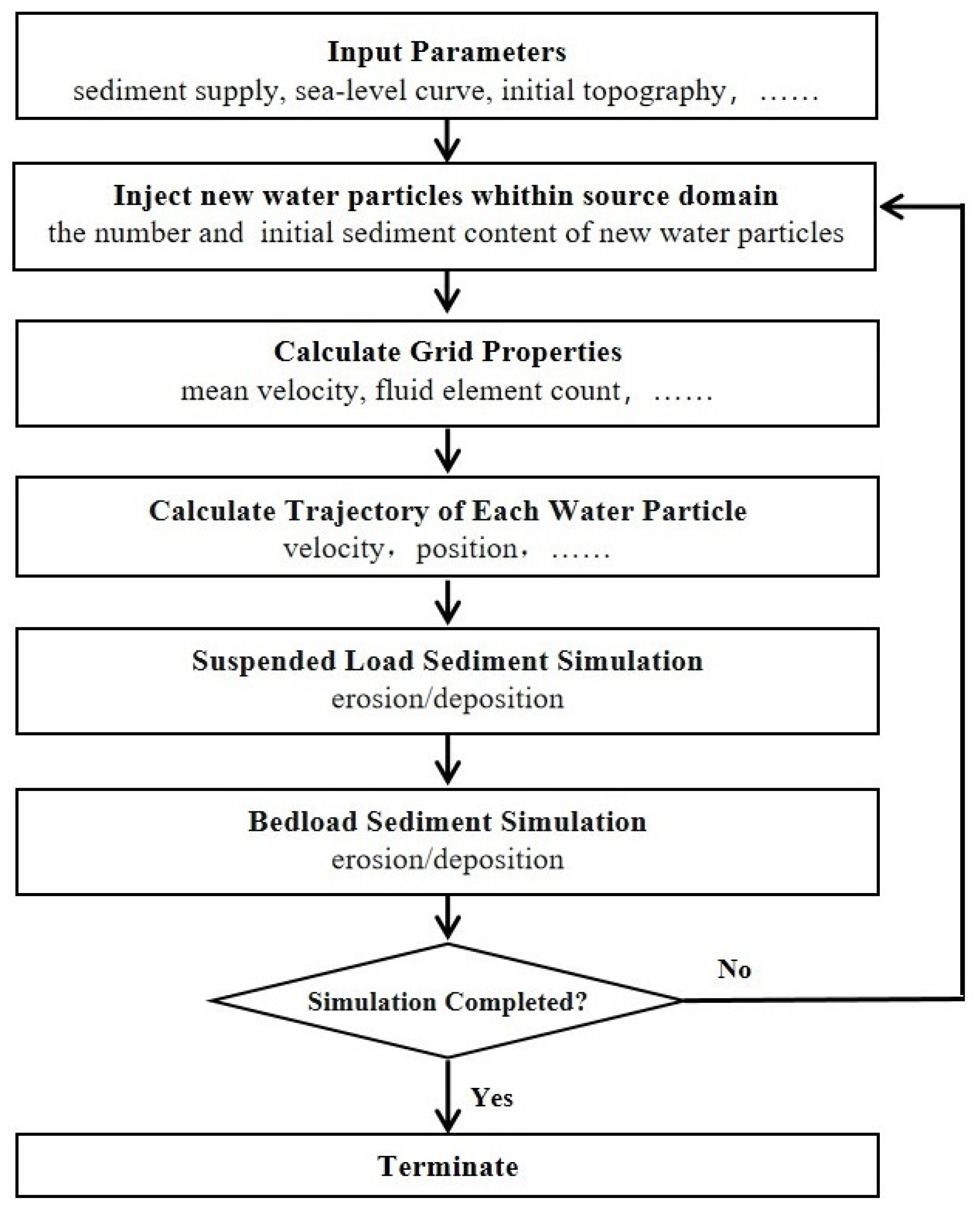
Figure 1 shows the algorithm flowchart of the CSFM method. The main input parameters of this method include the sediment and water supply in source domains, the sea/lake level change curves, and the initial state of the ancient topography. The simulation is carried out iteratively in a time-stepping manner. At the beginning of each time step, a set number of water particles containing sediment were injected in the source domain. The newly introduced water particles, together with those already present in the system, jointly constitute the water flow within the simulated domain. Then parameters which affect fluid flow and sediment movement in the current state are first obtained, such as the local terrain slope, the average particle velocity within each grid cell, and the bed friction resistance. Subsequently, the flow simulation algorithm based on the simplified form of the Navier–Stokes equations is used to calculate the movement trajectory of every water particle in the next time step. Then, the sediment erosion, transportation, and deposition algorithms are examined. This algorithm calculates the erosion/deposition rate of suspended and bedload sediments based on the local flow conditions and sediment transport capacity of water particles. Based on this, the sediment load carried by each particle and the sediment distribution within each grid cell, as well as the terrain elevation, are updated. These steps constitute a simulation within a time step, including the movement process of fluid particles and the corresponding deposition and erosion processes of sediments. Subsequently, the simulation process is repeated in the next time step, and this iteration continues until the set total simulation time is reached.

2.2. Simulating Water Flow

In this simulation method, the movement trajectory of each water particle is calculated using the Navier–Stokes equation of fluid dynamics. The Navier–Stokes equation is an important equation in computational fluid dynamics, which describes the flow of fluids in three-dimensional space. This equation forms a set of partial differential equations, and solving it has always been a complex problem [23]. The conventional solutions often have the drawback of requiring a large amount of computer time [16]. In large-scale and long-term geological simulations, each time step often requires computing the trajectories of tens of thousands, or even hundreds of thousands, of water particles. Conventional solutions of Navier–Stokes equations would result in unacceptably high computational costs. Therefore, we have proposed an efficient method for simplifying the solution of Navier–Stokes equations.
For an incompressible fluid, the governing equations of Navier–Stokes equation are as follows:
q = 0
q t + ( q ) q = p ρ + μ ρ 2 q + g
where q is the fluid velocity vector, p is the fluid pressure, g is the gravitational acceleration, μ is the dynamic viscosity, and ρ is the fluid density. In addition, (q∙▽)q is gained as follows:
( q ) q = u q x + v q y + w q z
where velocity vector is defined as q = (u, v, w), with u, v, and w representing the velocity components in the x, y, and z directions, respectively.
With reference to the approach of Tetzlaff (1989) [15], a modified approach is proposed in this study to simplify the Navier–Stokes equation through the following steps. Firstly, two main boundary conditions are set: one is the free surface with stress-free condition (the water–air interface), and the other is the impermeable bottom bed (riverbed or seabed). Then an assumption is made about the vertical distribution of the water flow velocity, assuming that velocity is zero at the bottom, but immediately above and for the rest of the section upward is constant; this assumption aligns with observations of the vertical flow velocity distribution in natural streams [15]. Further, the shear friction force ( τ b ) between the fluid and the bottom bed is calculated by empirical formulas in [24]:
τ b = ρ C f q 2
where C f is the dimensionless friction coefficient:
C f = g n 2 R 1 / 3
R is the hydraulic radius which is used to characterize the efficiency of flow in a channel. This is defined as the cross-sectional area of the flow divided by the wetted perimeter. n is the Manning roughness coefficient, which is a fundamental empirical coefficient used in Manning’s equation to quantify the resistance or friction that a channel (or pipe) exerts against the flow of the water bottom.
Based on the above simplifications, the final simplified form of the Navier–Stokes equation for calculating the trajectory of water particles is obtained:
q t + ( q ) q = g H + c 1 μ ρ ( 2 q ( ( 2 × ( T ) · ) q + q 2 T ) h 0.5 × q ( q · ) T h gn 2 q q hR 1 / 3
where H is the water surface elevation, and h is the water depth at a grid. T is the water bottom elevation. c1 is the diffusion coefficient, which characterizes the diffusion effect and momentum exchange between water particles, simulating internal viscous resistance and turbulent mixing.
Equation (6) retains the main driving factors of the flow-inertia, pressure gradient (resulting from the water surface slope), and bed friction, while avoiding the direct solution of the vertical structure or pressure. This simplification is most applicable to shallow-water environments where the horizontal scale significantly exceeds the vertical scale (e.g., rivers, deltas, and shallow lakes). By assuming a vertical velocity profile and neglecting complex vertical pressure gradients, the model retains core fluid dynamics (inertia, gravity, and bed friction) while drastically reducing computational costs for long-term simulations. This simplified solution method is the core of the water flow simulation algorithm, significantly reducing the computing time required for the simulation.

2.3. Sediment Dynamics: Erosion, Transport and Deposition Algorithms

This section mainly introduces the core algorithms in the CSFM to simulate the sediment dynamics process, including erosion, transportation, and deposition. These algorithms form the basis for constructing synthetic strata. The basic principles and calculation formulas used in this section mainly refer to the relevant theories in the current field of river sediment transport mechanics [25,26].

2.3.1. Basic Concepts and Framework

The modes of sediment transportation: In nature, sediment is usually transported in three modes: suspended load, bedload, and dissolved load. Since the purpose of this study is to simulate the clastic sedimentary strata, we mainly simulate suspended load and bedload.
Suspended Load: This mainly refers to sediment suspended in water under the turbulent action of the current and movement along with water particles. When the water’s ability to carry sediment decreases, these sediments will settle down and deposit on the strata.
Bedload: This mainly refers to coarse particles that move by rolling, sliding, or jumping on the riverbed surface. Only when the shear force of the water flow on the riverbed exceeds a certain critical value will these coarse particles start to move.

2.3.2. Control Equations and Critical Thresholds

The model determines whether the sediment within each grid cell will move by calculating the key hydraulic parameters in each cell.
Suspended sediment transport capacity and erosion: The ability of water flow to carry suspended sediment (S) is calculated using an empirical formula [18]:
S = 1.07 q 2.25 R 0.74 ω 0.77
where q represents the fluid velocity vector, R represents the hydraulic radius, and ω represents the sediment settling velocity in water. To allow new sediments to enter the water to form suspended load, the water flow velocity needs to exceed the critical initiation flow velocity (q_c) corresponding to the substrate. The formula for calculating qc is as follows:
q _ c = A k z g ( h d ) 1 6 ω
where A = d 1 / 6 n , n represents the Manning roughness coefficient, h denotes the water depth, d indicates the sediment particle size of the sediment, and k is the Karman constant.
Bedload Initiation and Transport: Bedload transport is initiated when the average velocity of all fluid particles within a grid cell exceeds the critical shear velocity (Uc) of the water bottom strata. A common formulation is as follows:
U c = ( d h ) 0.14 [ 17.6 ρ m ρ ρ + 0.000000605 10 + h d 0.72 ] 0.5
where ρ m and ρ are the bulk density of sediment grain and water, respectively. Bedload transport rate (Mb) is calculated by the following:
M b = 0.95 d 0.5 ( U U c ) 3 ( U U c ) 3 ( d h ) 0.25
where U is average velocity of all fluid particles within a grid cell.

2.3.3. Partitioning and Sequential Processing of Different Sediment Components

Clay is strictly treated as suspended load. In contrast, sand and gravel possess dual attributes, they are dynamically partitioned between suspended load and bedload based on local water flow velocity. In high-energy conditions, sand and gravel enters the suspended load. While in lower-energy states, they move primarily as bedload.
Erosion Logic (Sequential Stripping within a Depth Limit): The model restricts erosion in each time step to a predefined depth range of the substrate within each grid cell (simulating the “active layer”). The erosion follows a hierarchical sequence. In suspended load erosion, when the carrying capacity S exceeds the sediment concentration C, the model first strips clay from the grid cell within the specified depth range. If S remains greater than C after all clay in this depth range is exhausted, the model then proceeds to erode sand, and finally gravel, until the carrying capacity S is satisfied or the depth limit is reached. Similarly, within the specified depth range, bedload erosion preferentially initiates the movement of sand. If the required transport volume exceeds the available sand content within this depth, the remaining capacity is filled by eroding the gravel fraction.
Deposition Logic: In suspended load deposition, when C > S, sediment fractions settle according to their size and density in the order of Gravel > Sand > Clay. Within a single time step, the deposition of a coarser fractions must be completed before the next finer fractions begins to settle. Bedload sediments are treated as a unified “package” of mixed components. This package moves along the calculated trajectory and is deposited in its entirety once it reaches the target grid cell.
This hierarchical logic, constrained by a specific erosion depth, ensures that the model realistically reflects the selective sorting and surface-stripping processes observed in natural sedimentary systems.

2.4. Algorithm Execution Flow

Within each time step Δt, the sediment-related calculation program performs the following operations for each water particle and the associated grid cell.
Suspended Load Algorithm
(1)
Deposition: For a water particle, if its sediment concentration C is greater than the sediment carrying capacity S, the excess sediment will undergo deposition. The total amount of sediment that undergoes deposition will be evenly distributed among all the grids that the particle flows through within the time interval Δt. The strata elevation of these grids will rise accordingly, while the sediment concentration C of the water particle will decrease accordingly.
(2)
Erosion: If C < S and q > q_c (the water flow velocity q is greater than the critical initiation flow velocity q_c) erosion occurs. A certain amount of sediment is stripped from the strata and added to the water particles. This amount is added to C and, at the same time, the strata elevation of the corresponding grid decreases.
Bedload algorithm
This process only acts on the bottom bed.
(1)
Initiation: For each grid with water, if its average flow velocity U is greater than the critical shear velocity Uc, a certain amount of sediment will be initiated from the bottom bed of that grid.
(2)
Transport path: The initiated sediment is regarded as an independent “package”. Based on U, Uc and the local riverbed slope, the transport trajectory of it within Δt time is calculated, thereby determining its target grid (which may be downstream or an adjacent grid).
(3)
Resettlement: The mass Mb is subtracted from the bottom bed of the source grid and added to the bottom bed of the target grid. At the same time, the elevation and grain size composition of these two grids are updated.
The suspension and transport algorithms run simultaneously at each time step. The suspended load algorithm interacts directly with the properties of water particles, while the bedload algorithm independently modifies the bed properties. All changes in strata elevation and sediment composition are recorded in the background grid. This results in a cumulative record of net erosion and deposition over time, forming an evolving composite stratum. Compaction can be incorporated as a post-depositional process, reducing the stratum thickness based on depth and composition.

3. Proof-of-Concept: Application to a Synthetic Alluvial Fan–Lacustrine System

We selected a synthetic alluvial fan–lacustrine delta system to test CSFM’s performance and assess the realism of its predictions. The choice of this depositional setting is motivated by the fact that geomorphic and stratigraphic responses to base-level fluctuations in such systems are relatively well documented in the literature [27].

3.1. Model Setup and Parameters

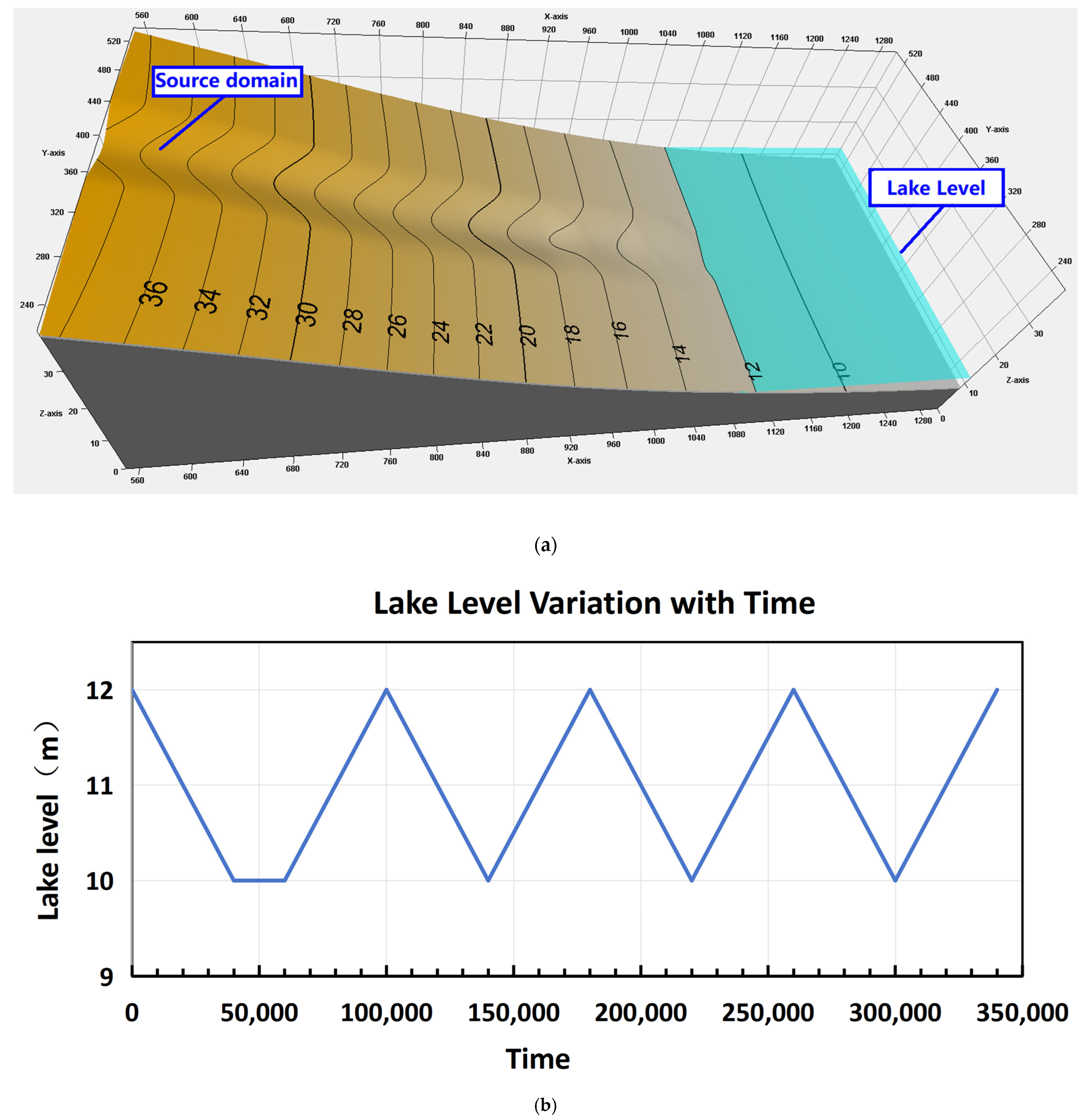
A synthetic topography was constructed to represent an alluvial fan with an average slope of 0.04, adjacent to a lake basin (Figure 2a). Lake-level fluctuations with five fall–rise cycles are shown in Figure 2b. Table 1 summarizes the key input parameters used in the simulation. In the following, simulation time t is reported in dimensionless model-time units rather than physical seconds; therefore, all time values shown in the text and figures should be interpreted as model time and can be dimensionalized only after selecting appropriate scaling parameters. At the start of the simulation, all grid cells contained a mixed sediment of gravel, sand, and clay. Sediment supply consisted of sand and clay delivered continuously with water through a source zone positioned at the alluvial fan apex. The model was run for a duration sufficient to complete multiple lake-level fluctuations, allowing us to track the morphological and sedimentary evolution of the system through time.

3.2. Geomorphic Evolution and Sediment Distribution

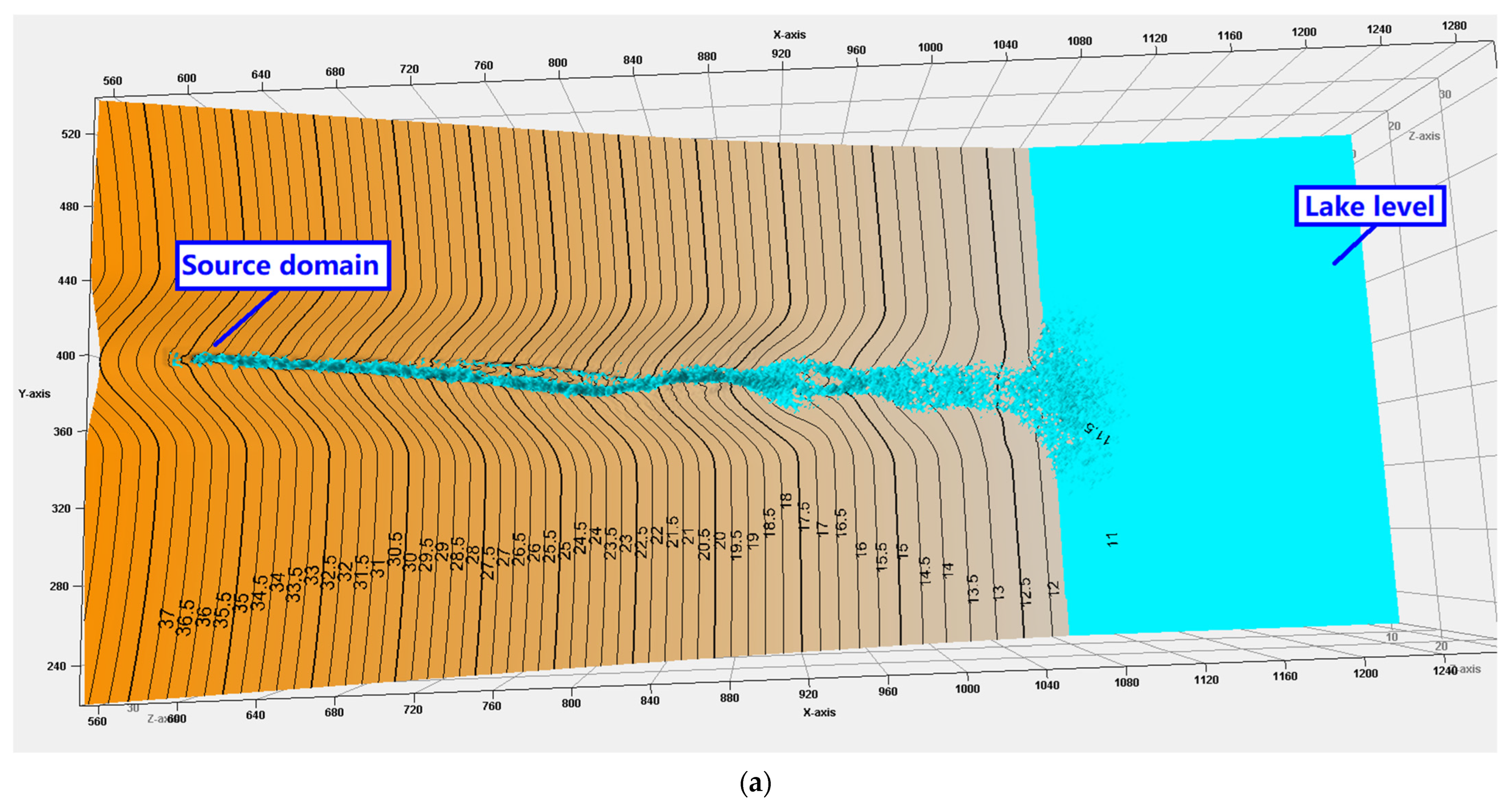
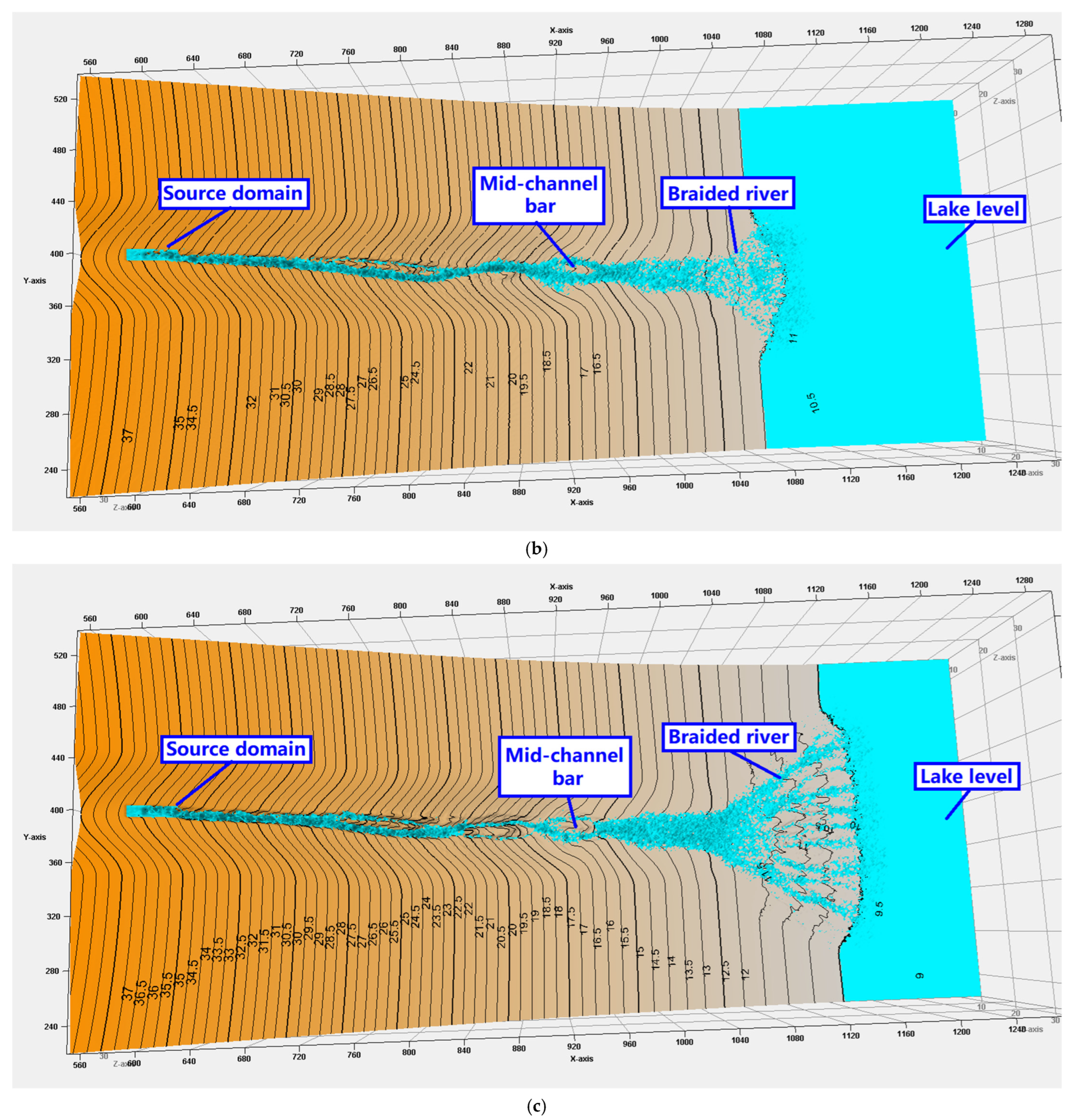
Figure 3 shows the modeled flow field during lake-level decline (5 × 10³–4 × 10⁴). The system splits into two distinct hydrodynamic domains at the slope break near the fan toe. On the alluvial fan (initial slope = 0.04), flow stays confined in a single channel. The model calculates sustained bed erosion here, which deepens and narrows the feeder channel. At the fan margin, as slope decreases sharply, flow velocity drops at this point and the channel loses confinement. Sediment transport capacity decreases substantially, which makes this location a transition zone in the routing system. Downstream on the low-gradient delta plain (slope < 0.005), flow becomes distributive and forms a braided network.
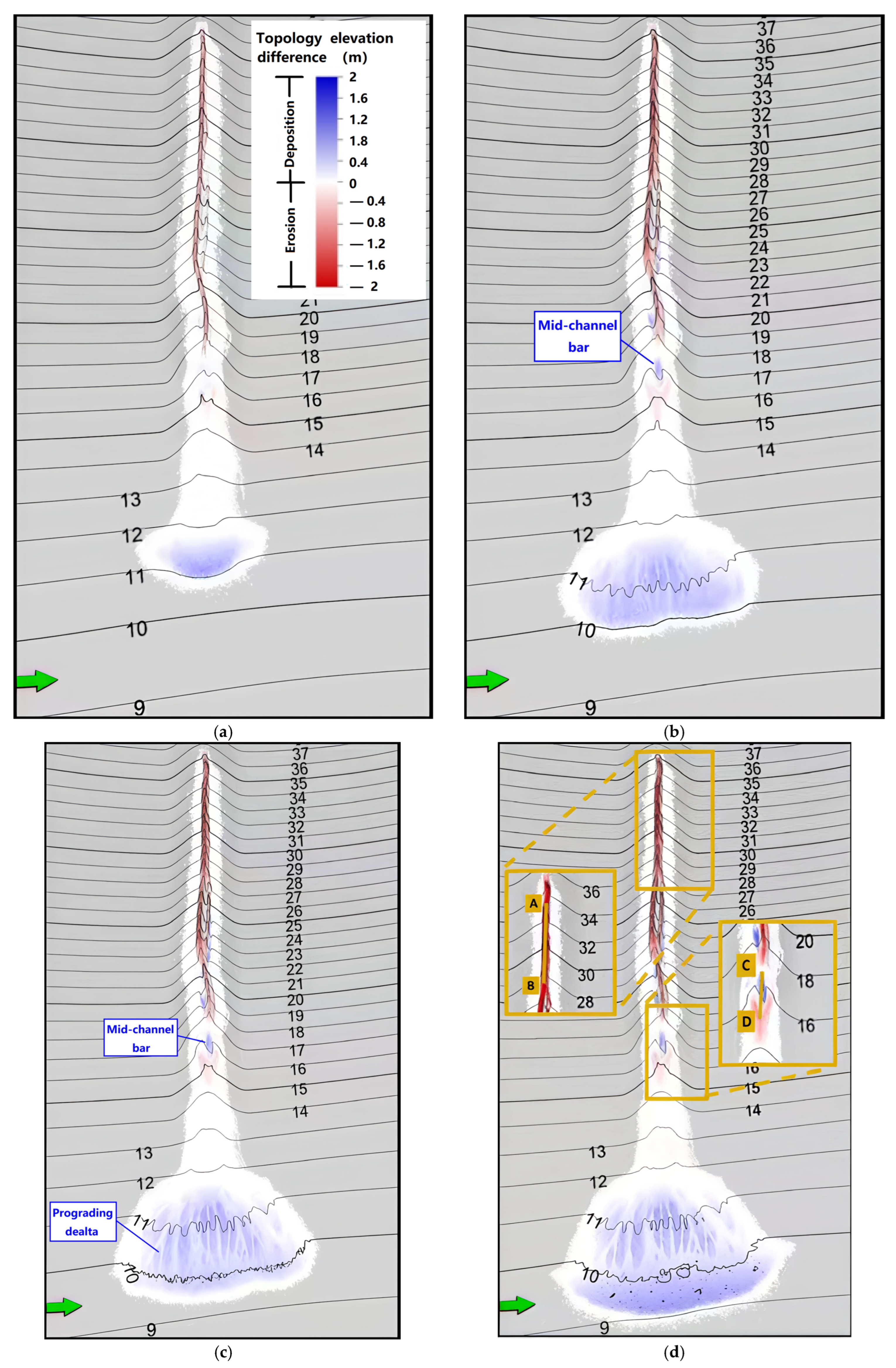
Figure 4 shows topographic evolution and flow patterns from t = 5 × 10³ to t = 6 × 10⁴. The model calculates sustained erosion in the upstream fan area. Coarser sediment (gravel and sand) moves through the incised channel and deposits at the fan toe to form a mid-channel bar (Figure 4b) at this location in response to the drop in transport capacity. Flow splits around this mid-channel bar and creates a braided pattern. We interpret this as a slope-break braidplain—an aggradational unit between the incised fan and the flat delta plain. Finer sediment continues downstream and spreads across the delta plain through the distributary channels.
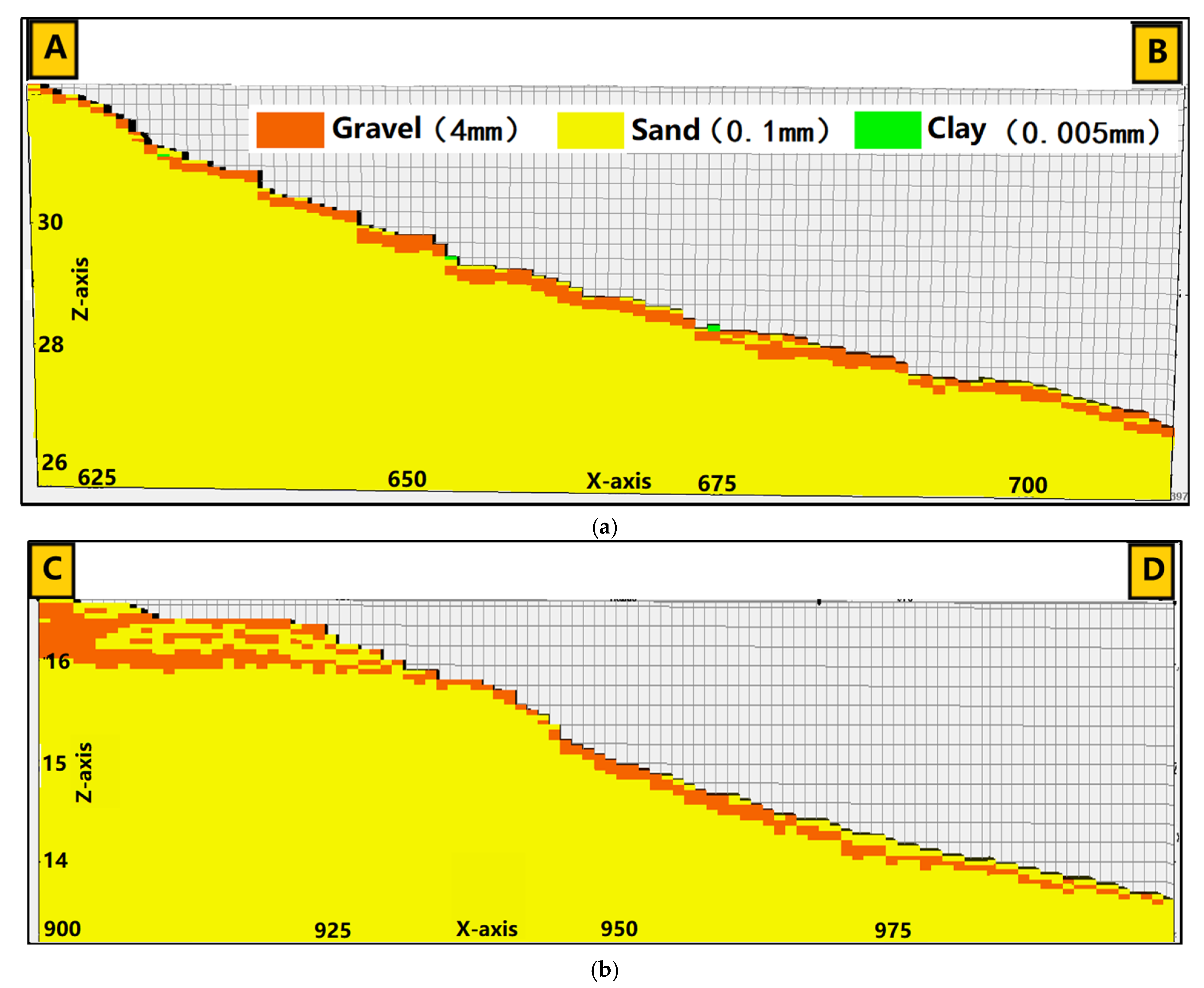
Figure 5 examines the grain size sedimentary distribution along two transects—the AB section (main channel) and the CD section (mid-channel bar) in Figure 4d. In the steep AB section, high flow velocities drive strong erosion, which maintains and likely deepens the channel. Figure 5a shows that the channel floor is dominated by gravel. Even though the initial strata contained gravel, sand, and clay, flow scouring has preferentially removed the finer fractions, leaving behind what we interpret as a lag deposit composed mainly of gravel.
In the CD section (Figure 5b), sediment accumulates as the slope decreases. The internal architecture here seems to record shifts in flow energy: thicker, coarser gravel layers face upstream where the flow is most vigorous, while grain size fines downward into sand toward the lee side. This “upstream-coarse, downstream-fine” grain size distribution pattern is consistent with the mid-channel bar deposits observed in the field.
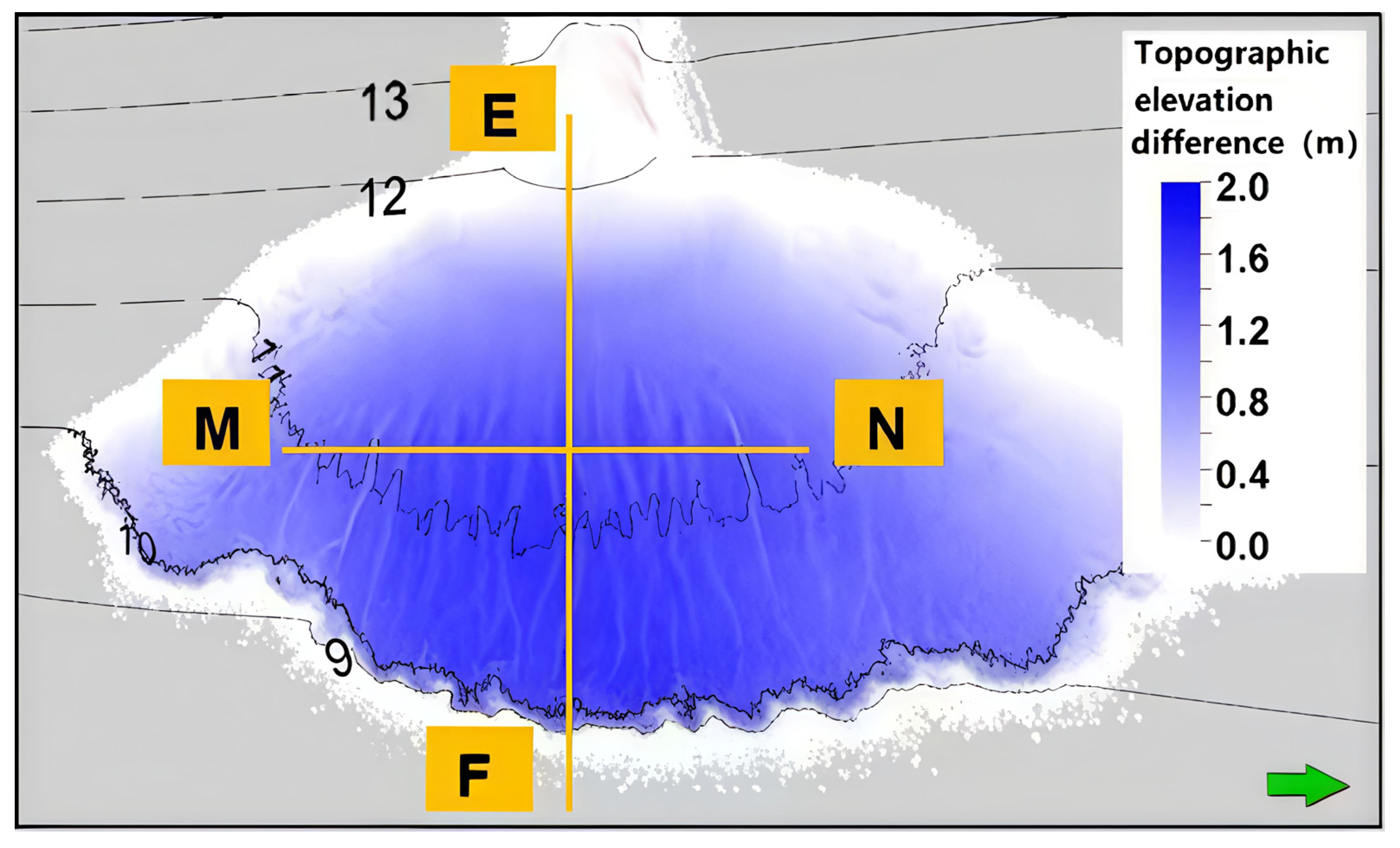
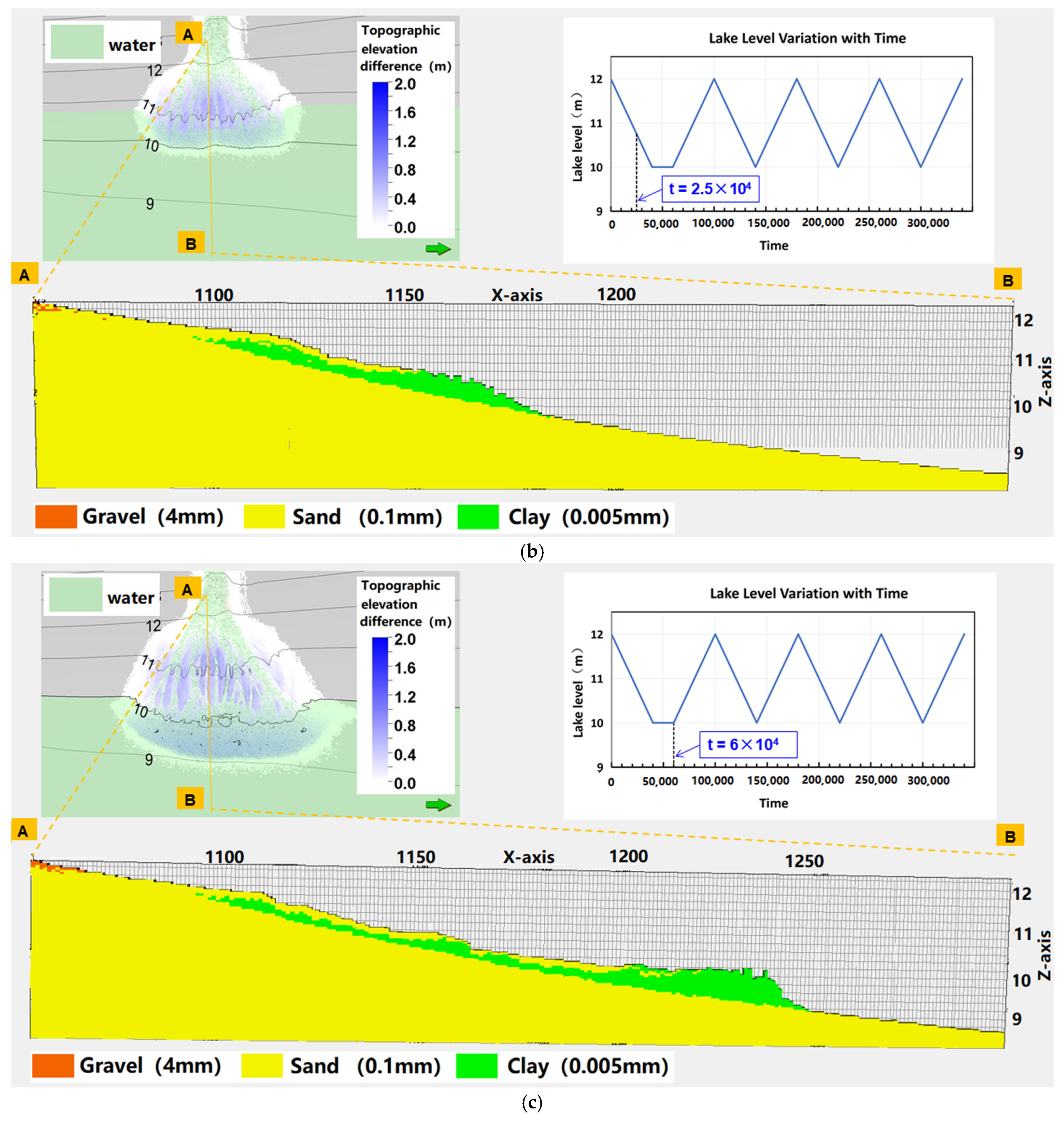
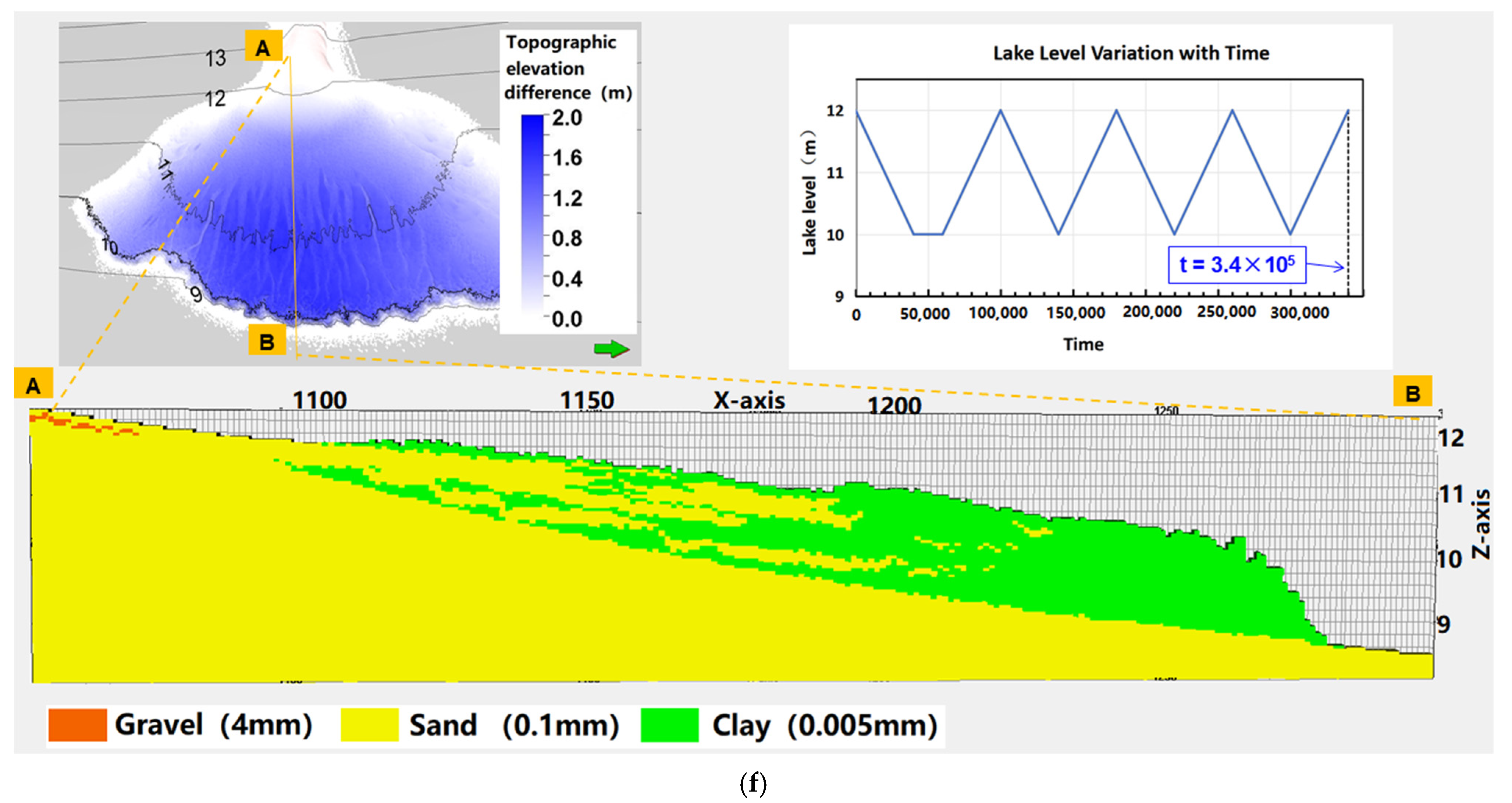
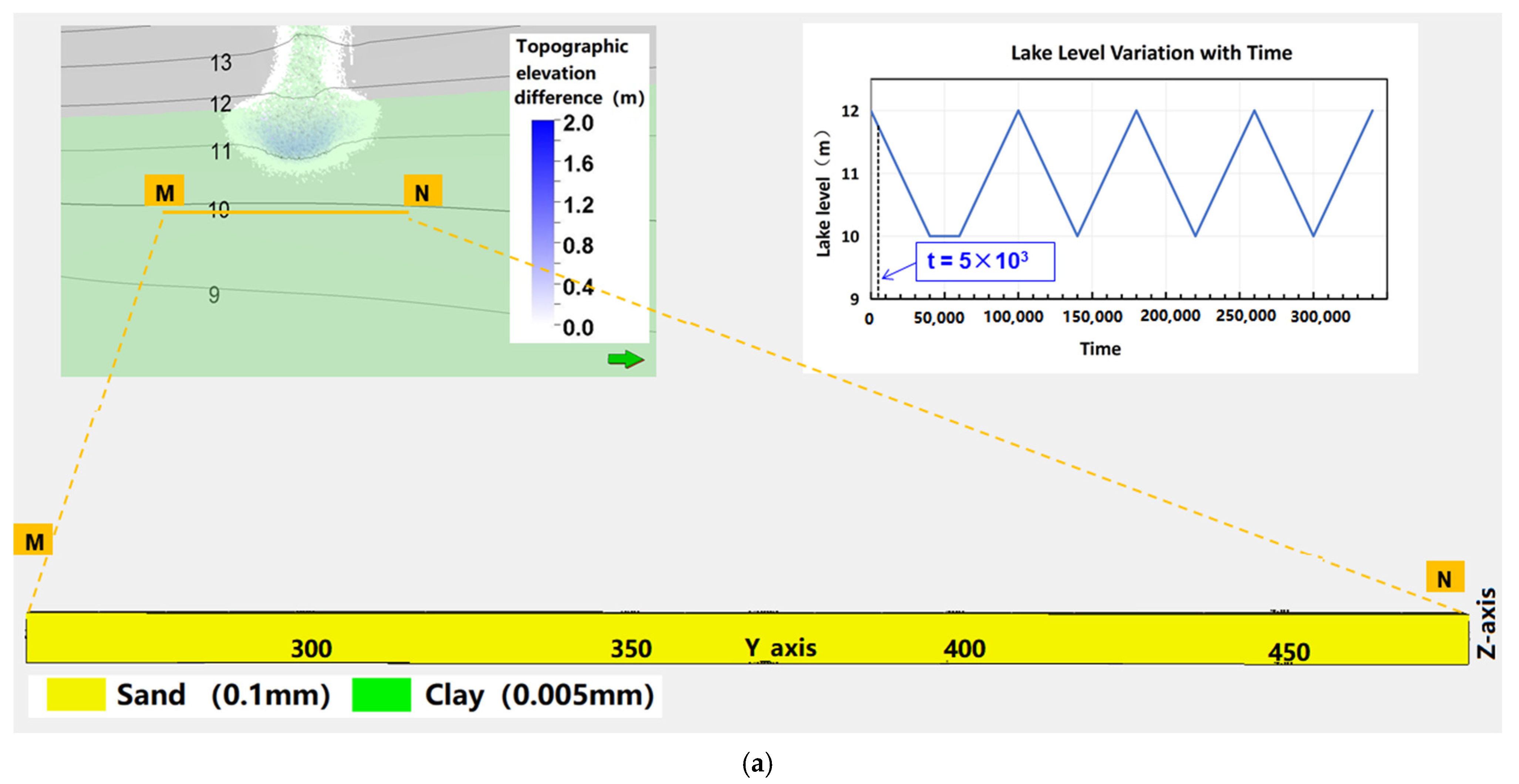
At t = 3.4 × 10⁵, after five lake level fall-rise cycles a laterally extensive deltaic deposit has formed (Figure 6). Several active distributary channels dissect the deposit and show a braided planform at this stage. We examine internal facies organization of the delta by checking evolution process of grain size sedimentary distribution along a downdip longitudinal section (EF) and along a transverse section (MN) across the delta plain.
(1)
Downdip evolution along Section EF
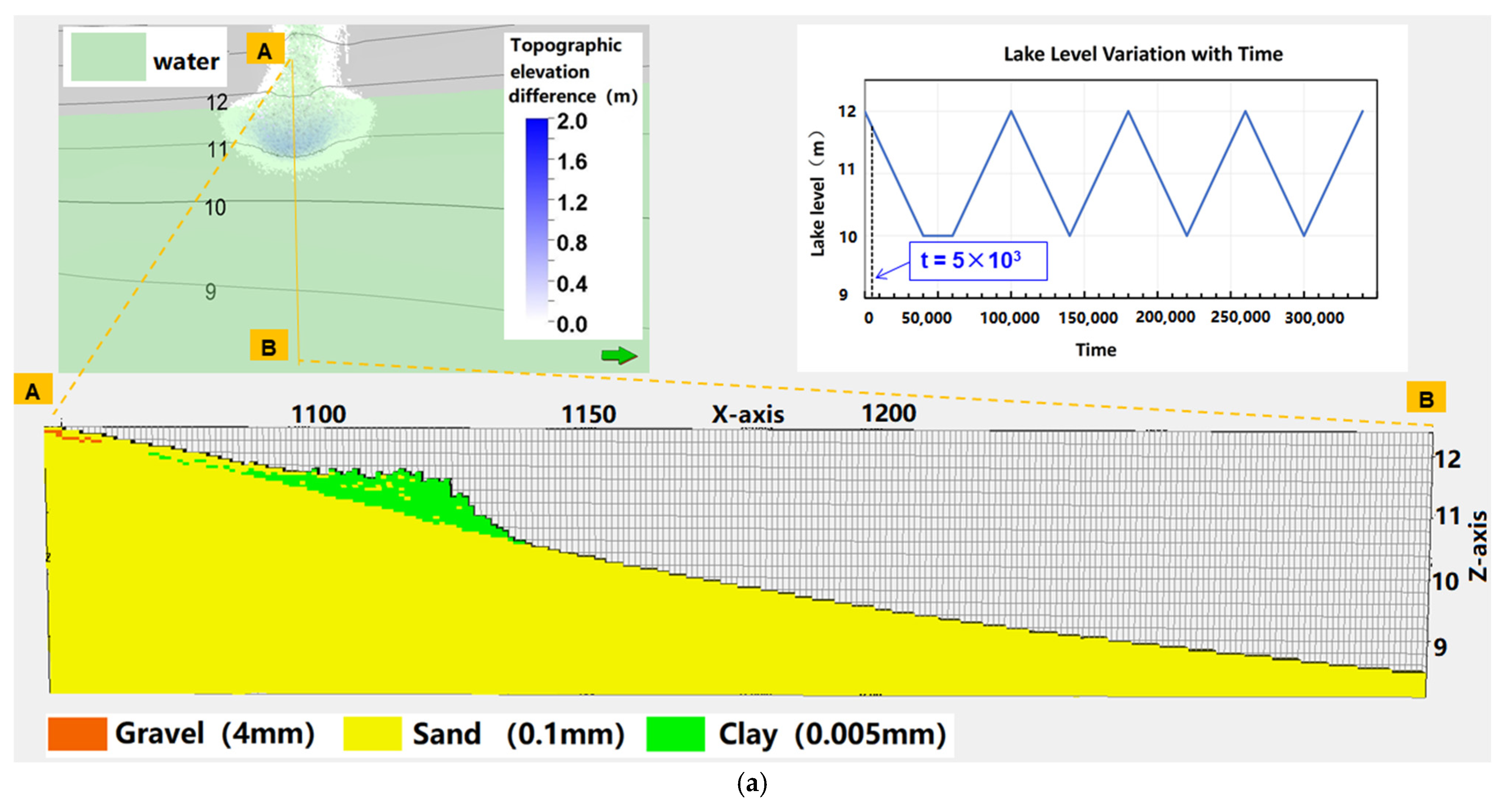
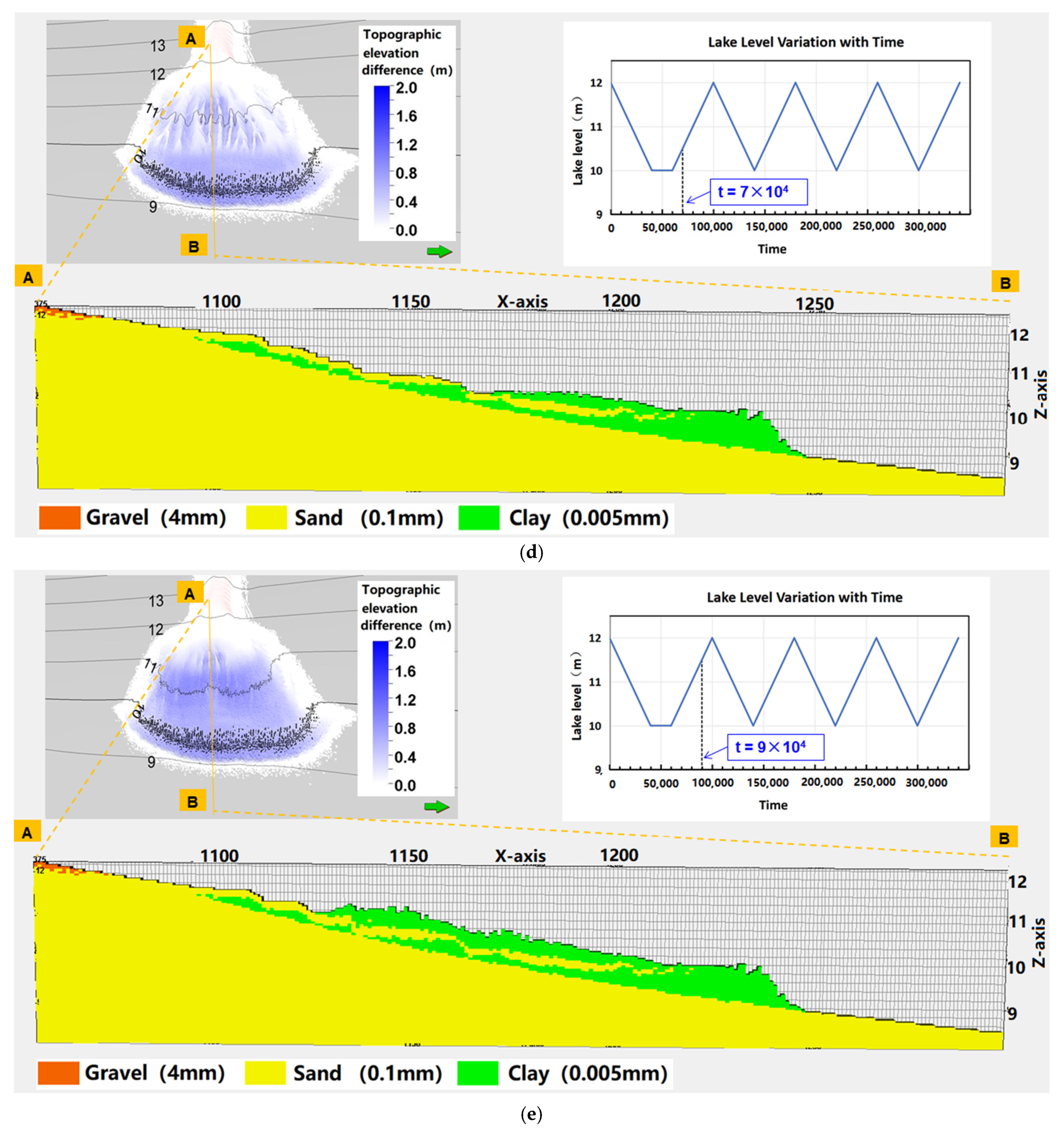
Section EF (Figure 7) illustrates how the delta stratigraphy varies through the imposed base-level cycles. During the lake-level fall from 12 m to 10 m and the following stillstand (Figure 8a–c), the delta prograded basinward. This interval is characterized by sand-dominated deposits on the delta plain and increasingly clay-dominated deposits toward the delta front, producing a sand-to-clay transition downdip. Sand deposition then overlain earlier clay units.
As lake level rose again (Figure 7d,e), the system backstepped. Clay deposition is then overlain on earlier sandier units, generating a vertical alternation between sand-rich and clay-rich packages. After five lake-level cycles (Figure 7f), the resulting stratigraphy along EF consists of repeated sand–clay couplets that record the cyclic progradation and retrogradation of sediments.
(2)
Transverse evolution at Section MN
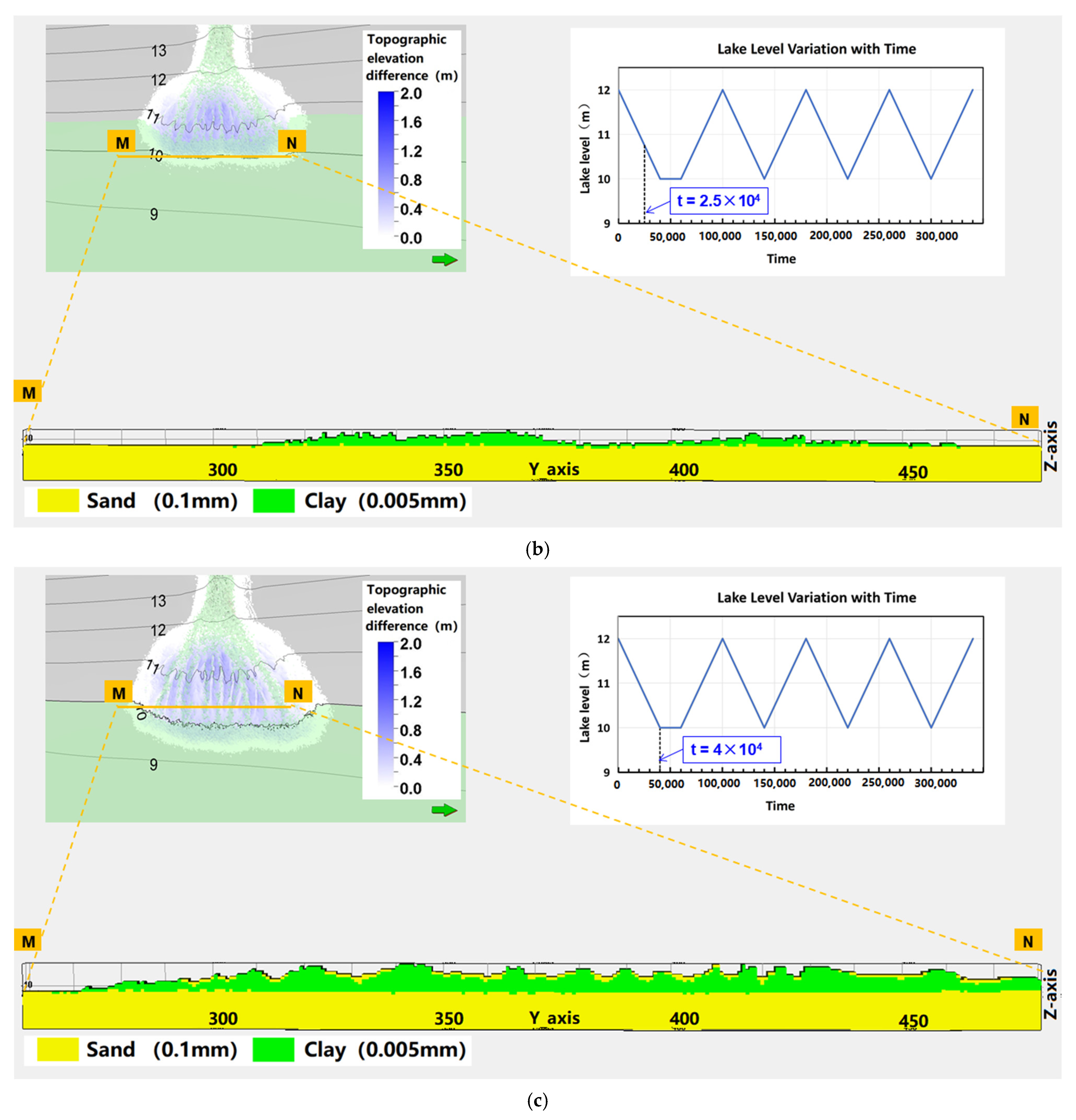
Figure 8 provides a fixed-location section MN record of grain size sedimentary distribution change through time. At ~5 × 10³, section MN was still part of the pre-existing sand dominated substrate, and substantial deltaic accumulation had not reached this point (Figure 8a). By 2.5 × 10⁴, as delta advanced, MN became delta front where clay accumulation dominated (Figure 8b).
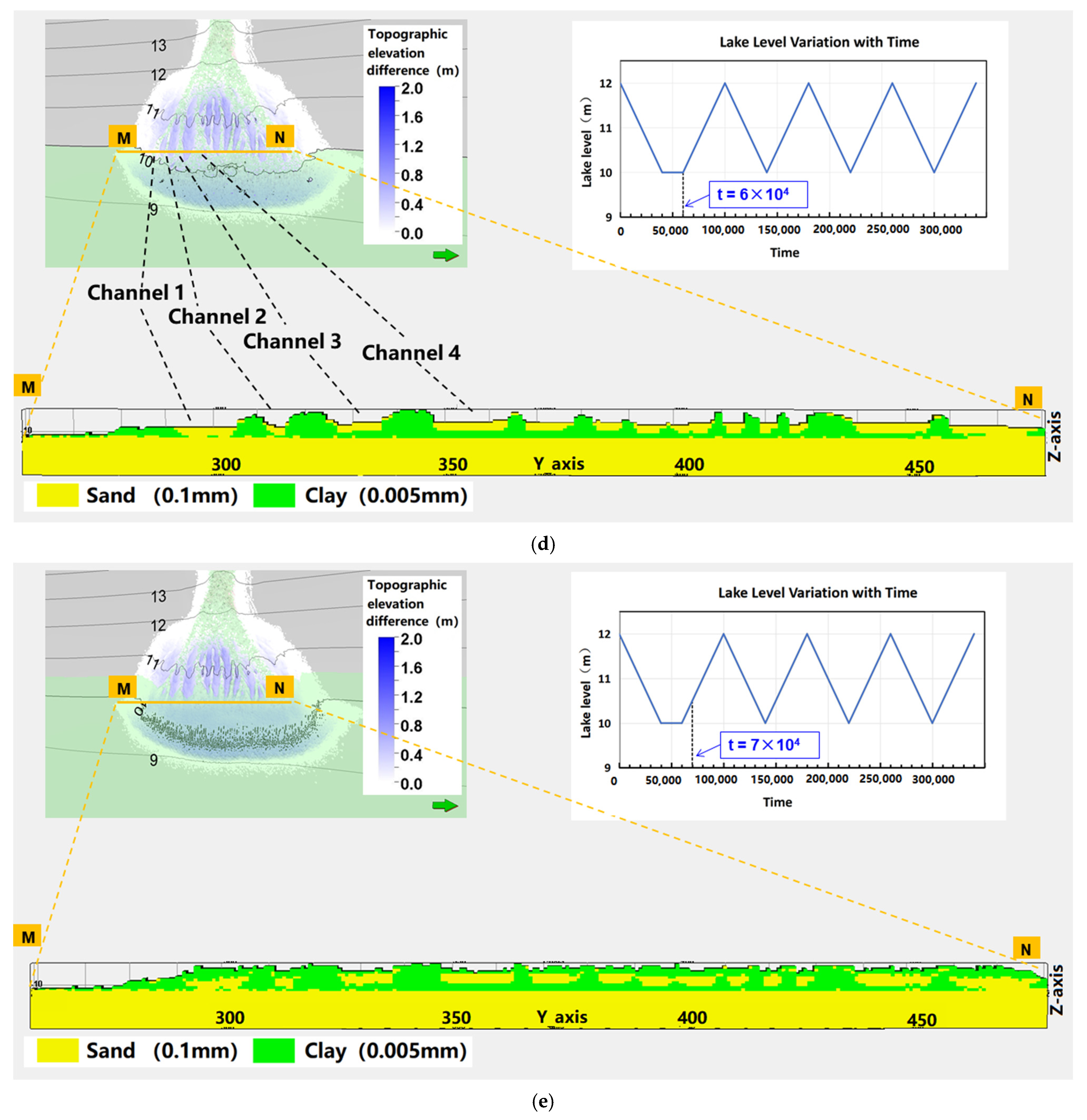
Following the lake-level fall at ~4 × 10⁴, section MN transitioned to an upper delta-plain setting. Braided channels were developed on the delta plain. At this stage, a distributary channel system developed on the delta plain. These channels incised the earlier clay dominated deposits and formed channel-sand bodies (Figure 8c–d). During the following stillstand, channels widened and deepened, further scouring earlier clay dominated deposits and producing thicker channel-sand bodies. Over this interval, grain size partitioning becomes clearer, with sand concentrated in channels and clay accumulating in inter-channel areas.
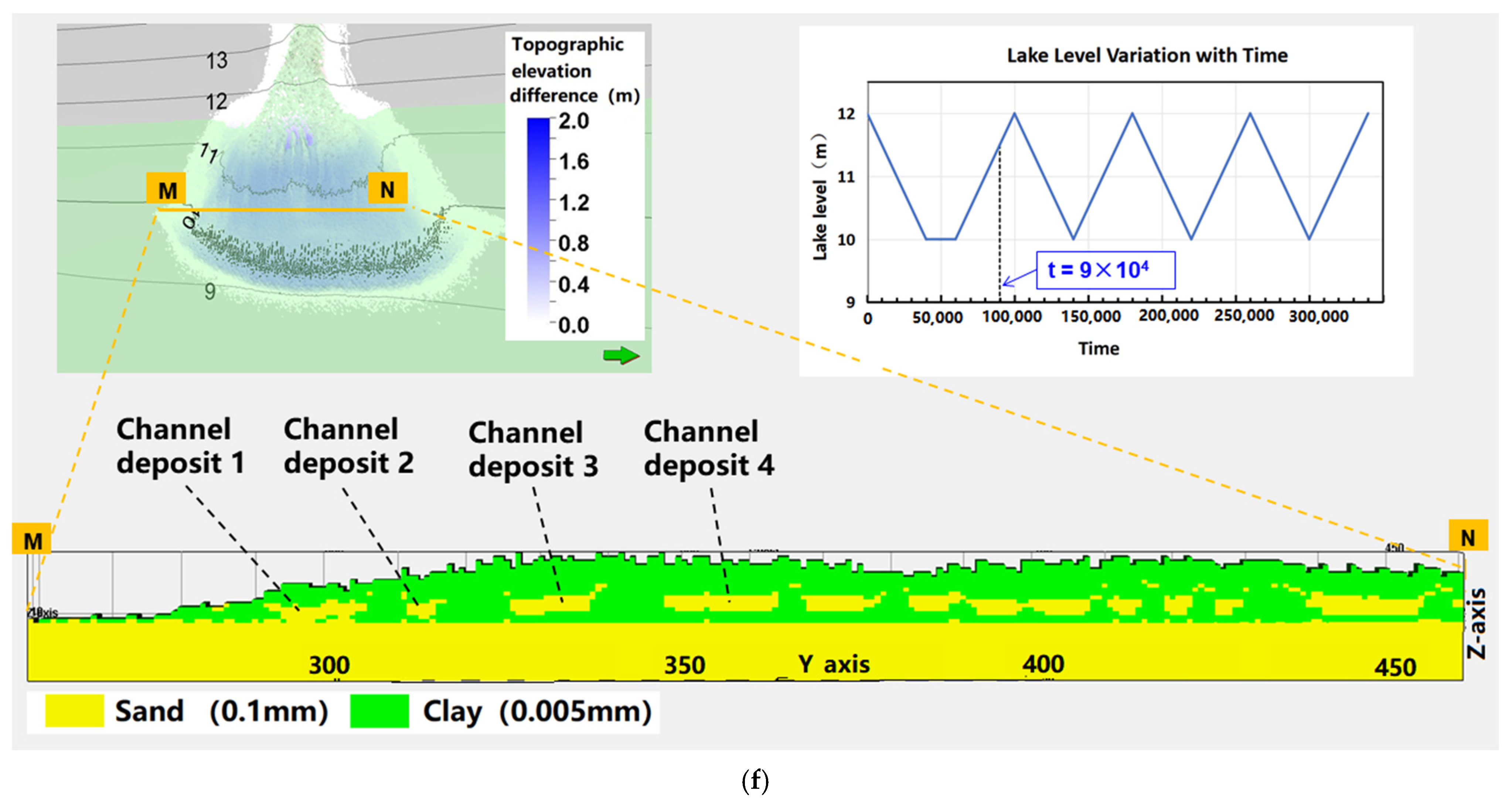
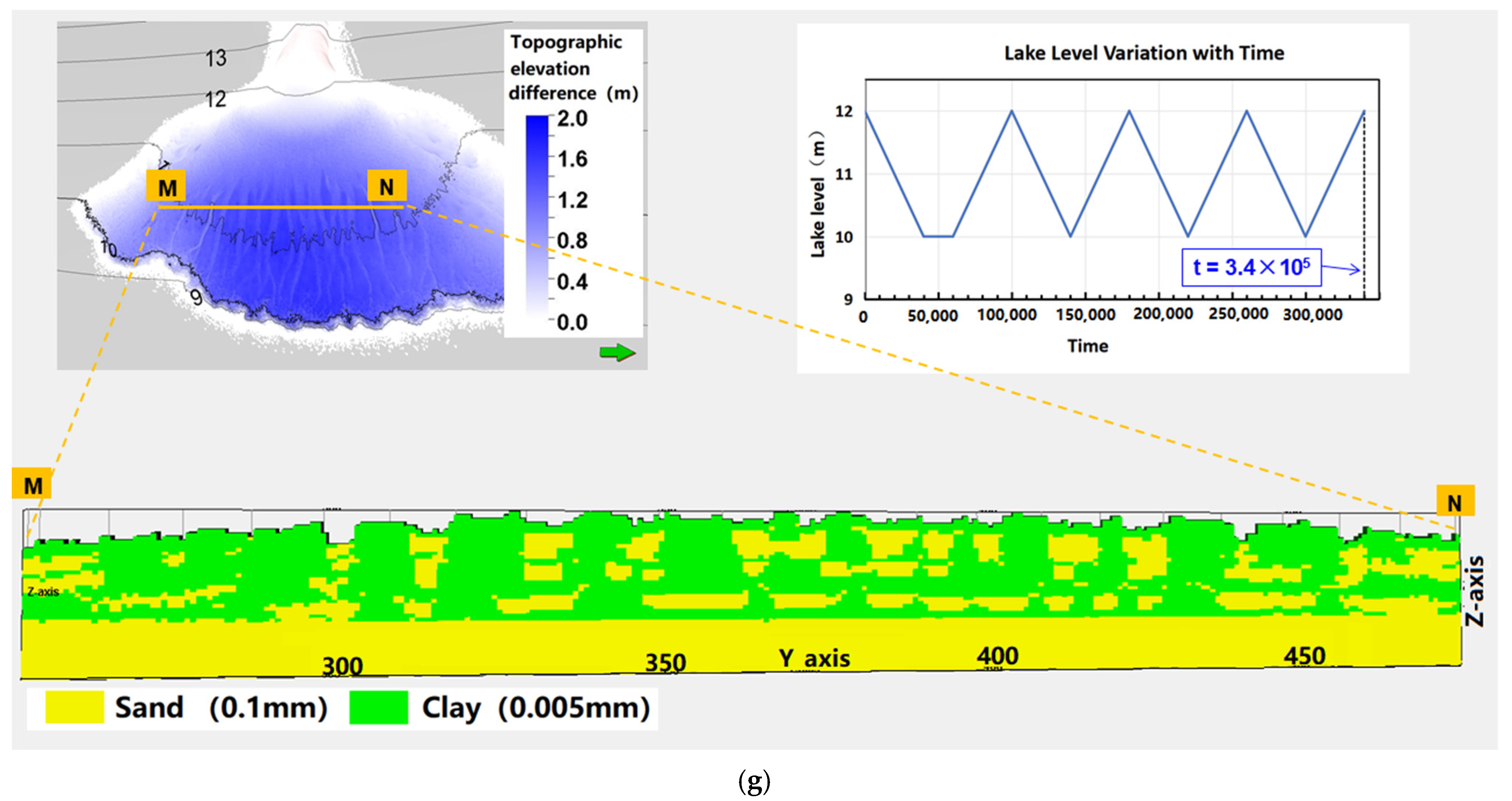
As lake level rose again (~7 × 10⁴ to 9 × 10⁴), section MN shifted from a lower delta-plain position back toward delta-front position. Earlier channel-sand bodies were covered by clay, leaving discrete sand bodies enclosed within clay dominated deposits (Figure 8e–g). By 3.4 × 10⁵, after five lake-level cycles, multiple channel-sand bodies are preserved within a clay dominated matrix (Figure 8g).
Overall, the simulations show cyclic progradation during lake-level fall and landward shift of clay deposition during lake-level rise, and they preserve channel sand bodies within clay-rich deposits on the delta plain.

4. Conclusions

This paper introduces the Clastic Stratigraphy Forward modeling (CSFM) approach, a numerical model developed to simulate the evolution process of sediment transport. We tested the model on a synthetic system consisting of an alluvial fan feeding into a lake with fluctuating water levels—this represents a simplified, idealized fan-delta system experiencing several lake-level cycles.
The simulation results generally match established sedimentological knowledge of delta formation. We observed a transition from a single, relatively confined channel on the steeper fan (slope around 0.03–0.05) to a network of distributary and braided channels on the delta plain where the gradient is much lower (around 0.005). This transition is driven by the abrupt reduction in flow confinement and transport capacity as the system crosses the slope break. The resulting rapid sediment deceleration and deposition trigger the development of mid-channel bars, which subsequently force flow divergence and the establishment of the distributary network.
Over the five lake-level cycles we ran, the resulting deposition variation pattern shows the expected alternating pattern: progradation during lake lowstands and backstepping when the lake level rises. When the lake-level declines, sand-dominated deposits spread widely across the delta plain, while clay-rich sediments accumulate mainly at the delta front. When the lake-level rises again, the sedimentary system backsteps, and newly formed deposits bury the older ones. This leads to two common stratigraphic outcomes. First, clay-rich sediments bury earlier channel-sand bodies, producing isolated sand bodies that appear to “float” within a clay dominated matrix. Second, in many locations the cyclic lake-level changes create interbedded sand-clay sequences. Both geometries are commonly observed in field studies of lacustrine delta systems, which demonstrated the geological validity of the CSFM method.
The current version (v1.0) of CSFM focuses primarily on fluvial-driven clastic systems. It does not yet account for marine wave-base interactions or tidal currents. Future work will integrate wave-base models and non-uniform subsidence modules to simulate a broader range of marine and complex tectonic settings. Meanwhile, incorporating high-performance parallel computing and hardware acceleration techniques to improve the modeling efficiency is also the focus of our subsequent research.

Author Contributions

Conceptualization, Y.Z., J.C. and L.L.; methodology, Y.Z., J.C., M.C., L.L. and W.W.; supervision, M.C. and R.H.; project administration, M.C., J.C. and R.H.; validation, Y.Z., W.W. and R.H.; visualization, M.C. and W.W.; funding acquisition, Y.Z. and L.L. All authors have read and agreed to the published version of the manuscript.

Funding

This research was funded by China Postdoctoral Science Foundation, grant number: 2024M763651.

Institutional Review Board Statement

Not applicable.

Informed Consent Statement

Not applicable.

Data Availability Statement

The data that support the findings of this study are available from the corresponding author upon reasonable request.

Conflicts of Interest

The authors Lei Li, Ruidong Han and Ruidong Han are affiliated with the company BGP Inc., China National Petroleum Corporation. The other authors declare no conflicts of interest.

Nomenclature

The primary mathematical symbols used in the theoretical models are listed below.
SymbolDescriptionUnit
Csediment concentration of the a water particle kg/m3
c1diffusion coefficient which characterize the interaction between the a water particle and the surrounding water particles-
ddiameter of sedimentm
ggravitational accelerationm/s2
Hwater surface elevationm
hwater depth at a gridm
kKarman constant-
nManning roughness coefficient of water bottom-
pfluid pressurePa
qfluid velocitym/s
q_ccritical initiation flow velocity over which sediments begin to suspend in the water flowm/s
Rhydraulic radiusm
Sthe capacity of water flow to carry suspended sedimentkg/m3
Twater bottom elevationm
ttimes
Uaverage velocity of all fluid particles within a grid cellm/s
Uccritical shear velocity over which sediment in riverbed begin to move in bedload modem/s
ucomponent of q in the x directionsm/s
vcomponent of q in the y directionsm/s
wcomponent of q in the z directionsm/s
μdynamic viscosity of the fluid Pa⋅s
ρ fluid bulk density kg/m3
ρ m bulk density of the sediment grainkg/m3
τ b shear friction force between the fluid and the water bottom bedN/m2
ωsediment settling velocity in waterm/s

References

  1. Lawrence, D.T.; Doyle, M.; Aigner, T. Stratigraphic simulation of sedimentary basins: Concepts and calibration. AAPG Bull. 1990, 74, 273–295. [Google Scholar] [CrossRef]
  2. Griffiths, C. Adaptive Stratigraphic Forward modeling: Making Forward modeling Adapt to Conditional Data. In Proceedings of the AAPG Annual Convention and Exhibition, Calgary, AB, Canada, 19–22 June 2016. [Google Scholar]
  3. Mutti, E.; Ricci Lucchi, F. Turbidites of the northern Apennines: Introduction to facies analysis. Int. Geol. Rev. 1978, 20, 125–166. [Google Scholar] [CrossRef]
  4. Mutti, E.; Lucchi, F.R.; Seguret, M.; Zanzucchi, G. Seismoturbidites: A new group of resedimented deposits. Mar. Geol. 1984, 55, 103–116. [Google Scholar] [CrossRef]
  5. Mutti, E.; Bernoulli, D.; Lucchi, F.R.; Tinterri, R. Turbidites and turbidity currents from Alpine ‘flysch’ to the exploration of continental margins. Sedimentology 2009, 56, 267–318. [Google Scholar] [CrossRef]
  6. Posamentier, H.W.; Jercey, M.J.; Vail, P.R. Eustatic controls on clastic deposition I-conceptual frame work. In Sea-Level Changes: An Integrated Approach; Society of Economic Paleontologists and Mineralogists, Special Publication; SEPM: Tulsa, OK, USA, 1988; Volume 42, pp. 109–124. [Google Scholar]
  7. Vail, P.R. Eustatic controls on clastic deposition. II Sequence and systems tract models. In Sea-Level Changes: An Integrated Approach; SEPM (Society for Sedimentary Geology) Special Publication; SEPM: Tulsa, OK, USA, 1988; Volume 42, pp. 125–154. [Google Scholar]
  8. Catuneanu, O. Sequence stratigraphy of clastic systems: Concepts, merits, and pitfalls. J. Afr. Earth Sci. 2002, 35, 1–43. [Google Scholar] [CrossRef]
  9. Catuneanu, O.; Abreu, V.; Bhattacharya, J.; Blum, M.D.; Dalrymple, R.; Eriksson, P.; Fielding, C.; Fisher, W.; Galloway, W.; Gibling, M.; et al. Towards the standardization of sequence stratigraphy. Earth-Sci. Rev. 2009, 92, 1–33. [Google Scholar] [CrossRef]
  10. Duan, T.; Griffiths, C.M.; Johnsen, S.O. High-Frequency Sequence Stratigraphy Using Syntactic Methods and Clustering Applied to the Upper Limestone Coal Group (Pendleian, E1) of the Kincardine Basin, United Kingdom. Math. Geol. 2001, 33, 825–844. [Google Scholar] [CrossRef]
  11. Kendall, C.G.S.C.; Strobel, J.; Cannon, R.; Bezdek, J.; Biswas, G. The Simulation of the Sedimentary Fill of Basins. J. Geophys. Res. Solid Earth 1991, 96, 6911–6929. [Google Scholar] [CrossRef]
  12. Liu, K.; Liang, T.C.; Paterson, L.; Kendall, C.G. Computer Simulation of the Influence of Basin Physiography on Condensed Section Deposition and Maximum Flooding. Sediment. Geol. 1998, 122, 181–191. [Google Scholar] [CrossRef]
  13. Granjeon, D.; Joseph, P. Concepts and Applications of a 3D Multiple Lithology, Diffusive Model in Stratigraphic modeling. In Numerical Experiments in Stratigraphy: Recent Advances in Stratigraphic and Sedimentologic Computer Simulations; SEPM (Society for Sedimentary Geology): Tulsa, OK, USA, 1999; pp. 197–210. [Google Scholar]
  14. Granjeon, D.; Cacas, M.C.; Eschard, R.; Joseph, P. Stratigraphic modeling: A New Tool to Construct 3D Geological Models for Basin modeling Purposes. In Proceedings of the American Association of Petroleum Geologists Annual Meeting, Houston, TX, USA, 10–13 March 2002. [Google Scholar]
  15. Tetzlaff, D.M.; Harbaugh, J.W. Simulating Clastic Sedimentation; Springer: Berlin/Heidelberg, Germany, 1989. [Google Scholar]
  16. Tetzlaff, D.; Priddy, G. Sedimentary Process modeling: From Academia to Industry. In Geologic modeling and Simulation: Sedimentary Systems; Merriam, D.F., Davis, J.C., Eds.; Springer: Boston, MA, USA, 2001; pp. 45–69. [Google Scholar]
  17. Tetzlaff, D.M. Input Uncertainty and Conditioning in Siliciclastic Process modeling. Geol. Soc. Lond. Spec. Publ. 2004, 239, 95–109. [Google Scholar] [CrossRef]
  18. Tetzlaff, D.M. Modelling Coastal Sedimentation Through Geologic Time. Coast. Res. 2005, 21, 610–617. [Google Scholar]
  19. Shao, L.; Wang, L.; Lian, H. Current status and progress in nonmarine sequence architecture and sedimentary modeling. J. Palaeogeogr. (Chin. Ed.) 2025, 27, 1–15. [Google Scholar] [CrossRef]
  20. Song, Y.; Yin, T.; Zhang, C.; Wang, N.; Hou, X. Application of sedimentary numerical simulation in sequence stratigraphy study. Arab. J. Geosci. 2020, 13, 267. [Google Scholar] [CrossRef]
  21. Liu, Q.; Shi, J.; Shen, Y.; Liang, X.; Jin, Z.; Li, P.; Zhang, X.; Zhu, D.; Meng, Q.; Xu, H.; et al. Volcanics-driven episodic events enhancing organic carbon accumulation in black shale during the Middle Eocen. Geochim. Cosmochim. Acta 2025, 12, 911–929. [Google Scholar]
  22. Harlow, F.H.; Amsden, A.A. The Particle-In-Cell Method for the Simulation of Plasmas. J. Comput. Phys. 1975, 16, 329–348. [Google Scholar]
  23. Girault, V.; Raviart, P.A. Finite Element Methods for Navier-Stokes Equations; Springer Series in Computational Mathematics; Springer: Berlin/Heidelberg, Germany, 1986; Volume 5. [Google Scholar]
  24. Richard, H. Open-Channel Hydraulics; McGraw-Hill: Columbus, OH, USA, 1985. [Google Scholar]
  25. Rowan, J.S.; Duck, R.W.; Werritty, A. Sediment Dynamics and the Hydromorphology of Fluvial Systems; International Association of Hydrological Sciences: Wallingford, UK, 2006. [Google Scholar]
  26. Zhang, R. (Ed.) River Sediment Dynamics, 2nd ed.; China Water & Power Press: Beijing, China, 2007. (In Chinese) [Google Scholar]
  27. Shaw, J.B.; Estep, J.D.; Whaling, A.R.; Sanks, K.M.; Edmonds, D.A. Measuring subaqueous progradation of the Wax Lake Delta with a model of flow direction divergence. Earth Surf. Dyn. 2018, 6, 1155–1168. [Google Scholar] [CrossRef]
Figure 1. Clastic stratigraphy forward modeling approach (CSFM) algorithm flowchart.
Geosciences 16 00108 g001
Figure 2. (a) Synthetic initial topography; (b) Lake-level curve.
Geosciences 16 00108 g002
Figure 3. Simulated surface water flow distribution. (a) t = 5 × 10³ (lake-level: 11.75 m); (b) t = 1 × 10⁴ (lake-level: 11.5 m); (c) t = 4 × 10⁴ (lake-level: 10 m).
Geosciences 16 00108 g003aGeosciences 16 00108 g003b
Figure 4. Simulated topographic elevation difference compared with initial topography from t = 5 × 10³ s to 6 × 10⁴. (a) t = 5 × 10³ (lake-level: 11.75 m); (b) t = 1 × 10⁴ (lake-level: 11.5 m); (c) t = 4 × 10⁴ (lake-level: 10 m); (d) t = 6 × 10⁴ (lake-level: 10 m).
Geosciences 16 00108 g004
Figure 5. (a) Grain size sedimentary distribution in longitudinal profile AB (river channel in Figure 4d) at t = 6 × 10⁴; (b) Grain size sedimentary distribution in longitudinal profile CD (mid-channel bar in Figure 4d) at t = 6 × 10⁴.
Geosciences 16 00108 g005
Figure 6. Topographic elevation difference of the simulated delta compared with initial topography.
Geosciences 16 00108 g006
Figure 7. Simulated evolution and grain size sedimentary distribution along section EF. (a) t = 5 × 10³ s; (b) t = 2.5 × 10⁴ s; (c) t = 6 × 10⁴ s; (d) t = 7 × 10⁴ s; (e) t = 9 × 10⁴ s; (f) t = 3.4 × 10⁵ s.
Geosciences 16 00108 g007aGeosciences 16 00108 g007bGeosciences 16 00108 g007cGeosciences 16 00108 g007d
Figure 8. Simulated evolution and grain size sedimentary distribution along section MN. (a) t = 5 × 10³; (b) t = 2.5 × 10⁴; (c) t = 4 × 10⁴; (d) t = 6 × 10⁴; (e) t = 7 × 10⁴; (f) t = 9 × 10⁴; (g) t = 3.4 × 10⁵.
Geosciences 16 00108 g008aGeosciences 16 00108 g008bGeosciences 16 00108 g008cGeosciences 16 00108 g008dGeosciences 16 00108 g008e
Table 1. Main input parameters.
source water discharge rate7 m3 per unit time
source water sediment loadSand (φ = 0.1 mm) 0.7%
Clay (φ = 0.005 mm) 2%
composition of the substrateGravel (φ = 4 mm) 30%,
Sand (φ = 0.1 mm) 50%,
Clay (φ = 0.005 mm) 20%
average slope gradient0.04
grid dimension700 × 320 cells
cell size1 m × 1 m
total simulation duration3.4 × 105 model time units
time step (Δt)5 model time unit
Disclaimer/Publisher’s Note: The statements, opinions and data contained in all publications are solely those of the individual author(s) and contributor(s) and not of MDPI and/or the editor(s). MDPI and/or the editor(s) disclaim responsibility for any injury to people or property resulting from any ideas, methods, instructions or products referred to in the content.