
Article

Radioanalytical Assessment and Mineral Chemistry Investigations in the Pegmatites of Eastern Desert, Egypt: Implications for Mining and Radiation Protection


by
Mohamed M. Ghoneim
1,*,
Mohamed Mitwalli
2,3,*,
Hanaa A. El-Dokouny
4,
Mai A. El-Lithy
4,
Maher Dawoud
4,
Yue-Yue Liu
5,
Tariq Al-Abdullah
2,6 and
Abdelhalim S. Mahmoud
7
1
Nuclear Materials Authority, Cairo 11936, Egypt
2
Interdisciplinary Research Center for Industrial Nuclear Energy (IRC-INE), King Fahd University of Petroleum and Minerals (KFUPM), Dhahran 31261, Saudi Arabia
3
Nuclear, Radiation and High Energy Physics Laboratory, Physics Department, Faculty of Science, Mansoura University, Mansoura 35516, Egypt
4
Faculty of Science, Menofia University, Shebin El Koum 32511, Egypt
5
Hefei Institutes of Physical Science, Chinese Academy of Sciences, Hefei 230031, China
6
Department of Physics, King Fahd University of Petroleum and Mineral (KFUPM), Dhahran 31261, Saudi Arabia
7
Faculty of Science, Fayoum University, Al-Fayoum 63514, Egypt
*
Authors to whom correspondence should be addressed.
Geosciences 2026, 16(2), 69; https://doi.org/10.3390/geosciences16020069
Submission received: 19 November 2025 / Revised: 24 December 2025 / Accepted: 26 December 2025 / Published: 5 February 2026

Abstract

This study is carried out to investigate the radiological characteristics and mineralogical controls of natural radioisotopes (238U, 226Ra, 232Th, and 40K) in granitic pegmatites from Abu Zawal Area (AZA) in the Eastern Desert of Egypt. The analyzed pegmatites, containing thorite, zircon, monazite, ferrocolumbite, and fergusonite, exhibit exceptionally high radioactivity concentrations of 238U ≤ 568; 232Th ≤ 674; 226Ra ≤ 170 (Bq kg−1), significantly exceeding the world average permissible limits (35, 30, 30, and 400 Bq kg−1 for 238U, 226Ra, 232Th, and 40K, respectively). Comprehensive radiological assessment reveals severely elevated radiological impact associated with Raeq ≤ 1243 (Bq kg−1) and hazard indices (Hex≤ 3.36; ELCR ≤ 12.2 × 10⁻³) surpassing international safety thresholds (Hex ≤ 1; ELCR ≤ 1 × 10⁻³). The observed disequilibrium between 238U and 226Ra (with 226Ra activities approximately half those of 238U) is attributed to the geochemical mobility of radium and potential selective leaching during late-stage hydrothermal alteration, while the overall enrichment of the uranium series over the thorium series is linked to the predominance of uranium-bearing minerals like zircon and fergusonite in these pegmatites. Mineralogical analysis demonstrates distinct radiation patterns: thorite and monazite dominate Th-derived gamma radiation and radon/thoron exhalation, while zircon and fergusonite control U enrichment and decay chain disequilibrium. Notably, nominally low-activity minerals like ferrocolumbite contribute to localized radiation hotspots through U/Th co-concentrations. The calculated absorbed dose rates ranged from 182 to 978 (nGy h−1) and annual effective doses show extreme spatial variability correlated with Th-rich mineral assemblages.

1. Introduction

Terrestrial background radiation arises from the decay of radionuclides, mostly 40K, 232Th, and 238U. Their contents and spatial distribution are controlled by the mineralogical composition and geological history of the local bedrock. Given the potential for continued human exposure to these elements, quantifying their activity concentrations in various lithologies is a significant focus of environmental radiation protection assessment [1]. To assess this risk, several standardized radiological hazard indices are used, including the Radium Equivalent Activity (Raeq), the External and Internal Hazard Indices (Hex and Hin), the Absorbed Dose Rate (DR), the Annual Effective Dose Equivalent (AEDE), and the Excess Lifetime Cancer Risk (ELCR). These will be defined in Section 2.
The Arabian-Nubian Shield (ANS) is considered as a major Neoproterozoic tectonic province extending from the Eastern Desert of the Egyptian territories across the Red Sea to the Arabian Peninsula, characterized by a complex multi-phase geological evolution. The shield’s formation encompassed various levels of oceanic arc accretion, continental block collision, and extensive syn- to post-orogenic magmatic and metamorphic processes spanning approximately 900–550 Ma [2,3]. The final stage of ANS evolution was marked by the widespread emplacement of highly evolved, peraluminous granitoids during the late Neoproterozoic to early Paleozoic periods through extreme magmatic differentiation, with the Eastern Desert of Egypt hosting particularly well-developed examples [2]. While these pegmatite bodies host economically rare metals-including niobium, tantalum, beryllium, lithium, cesium, and rare earth elements they at the same time exhibit elevated concentrations of Naturally Occurring Radioactive Materials (NORM) [4,5,6,7,8,9,10,11,12,13,14,15,16]. The identified radiological signatures linked to these pegmatitic systems highlight the need for thorough radiological characterization to assess possible environmental and occupational health risks. The mineralogical diversity of ANS pegmatites is indicative of their origins from highly evolved residual melts that have been enhanced through extreme fractional crystallization and fluid-rock interactions [17,18,19,20]. These accessory minerals act as primary reservoirs for 238U and 232Th, resulting in localized radioactivity anomalies [16].
The pegmatite formations at Abu Zawal (AZ) exhibit notably high radioelement concentrations, with measured uranium (238U) contents reaching 500 ppm and thorium levels exceeding 1000 ppm—values that significantly surpass those typical of the upper continental crust (U: 2.8 ppm; Th: 10.7 ppm; K: 2.5%) [21]. Despite the geochemical importance of such anomalies, limited research has established integrated methodologies that directly correlate mineralogical composition with comprehensive radiological hazard assessments [12,14,16,19]. This study investigates the distribution and behavior of radioactive elements within the granitic pegmatites of Abu Zawal to elucidate the processes controlling the evolution of these pegmatite systems. Furthermore, it evaluates the radiological safety criteria, as well as the potential environmental and human health impacts associated with anorogenic pegmatites. By establishing connections between specific mineral assemblages and measured radiation levels, the study bridges mineralogical characterization and radiological evaluation, thus contributing to a refined understanding of naturally occurring radioactive materials (NORM) and advancing sustainable approaches to resource management and radiation protection.

Geological Setting

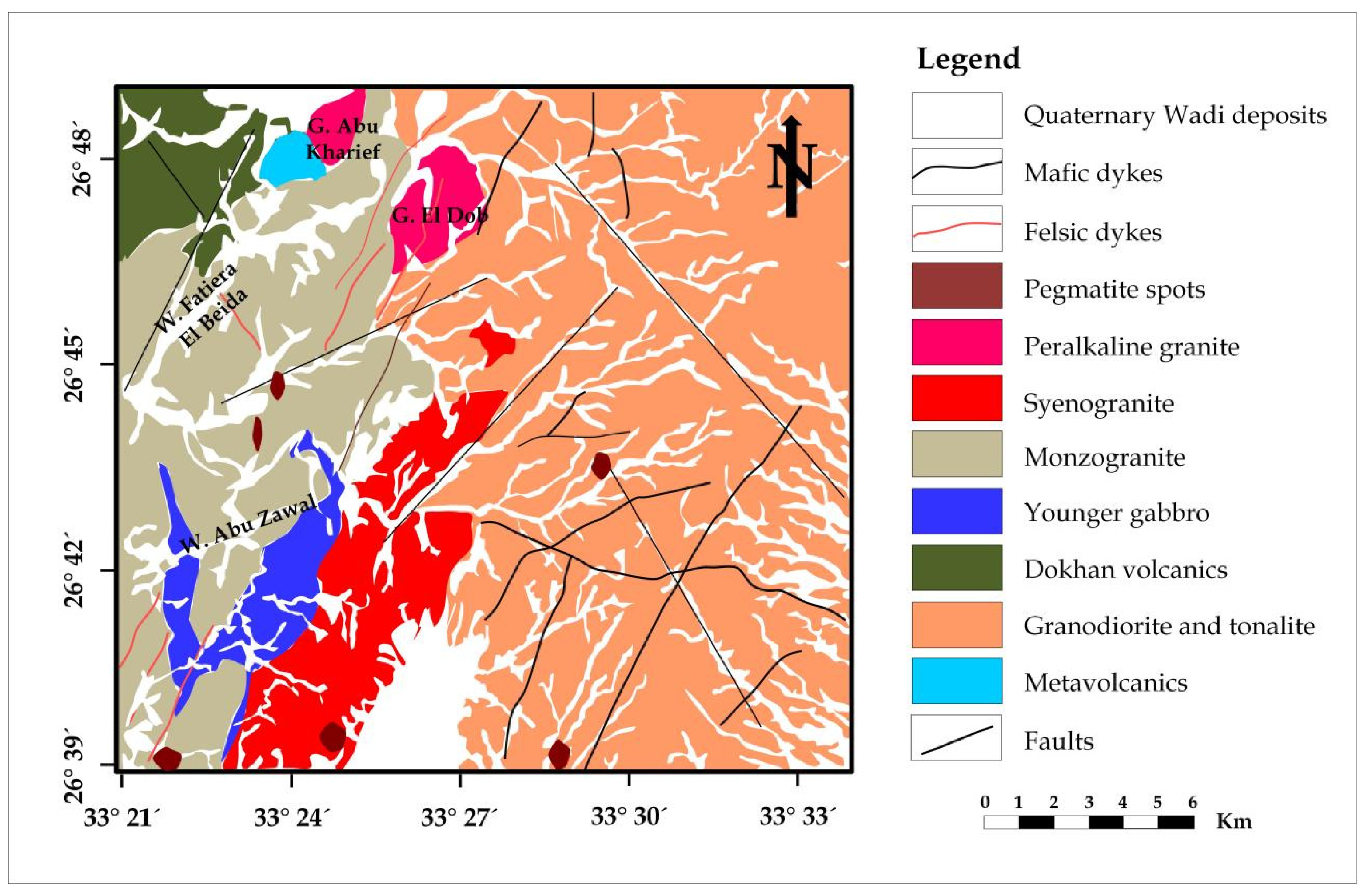
The investigated Wadi AZA consists of highly sheared metavolcanics within a ductile shear zone, along with intrusions of older granites, post-tectonic gabbroic rocks, and younger granitic intrusions. The rocks in the area include older granites of tonalite and granodiorite associations, gabbroic rocks, and younger granitic rocks dissected by various dikes, quartz veins, aplites, and pegmatites (Figure 1).
The older granites in the area are part of a large mass extending across the Eastern Desert and have been studied extensively. These granites form large masses with moderate relief, varying in color and texture. They are highly sheared and joined, with well-developed foliation and occasional mafic enclaves. The younger gabbros are intruded within the older granites and form separate bodies in the region, exhibiting medium-grained, black rocks with xenoliths and granitic veinlets. The Dokhan Volcanics are prominently exposed in moderate to high relief terrains within the northwestern sector of the mapped area, where they form a small outcrop along a narrow tributary of Wadi Abu Kharif [22]. The volcanic units constitute a diverse magmatic suite, ranging from intermediate andesitic compositions through silica-rich dacites to highly evolved rhyolitic varieties. Post-orogenic granitoid intrusions encompass both monzogranitic and syenogranitic phases, which collectively contribute to the distinctive mountainous topography through their cross-cutting relationships with older lithologies. Pegmatites, aplites, and quartz veins are abundant in Wadi AZA, particularly in its southern region (Figure 1). The bodies manifest either as dike-like intrusions or planar lenses aligned with regional fabric elements.
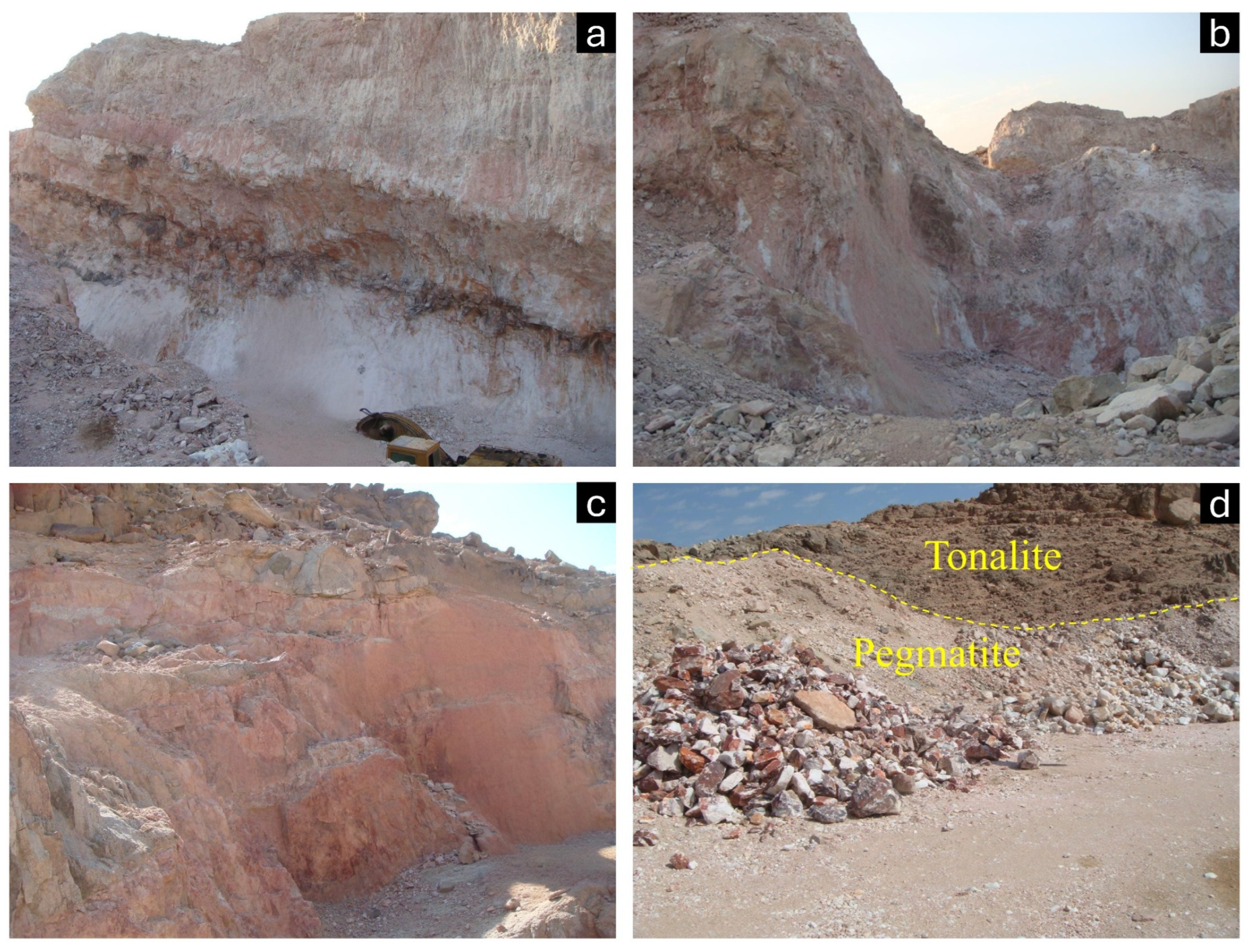
Pegmatites exhibit zoning variability and grain size heterogeneity. Notably, two large pegmatite masses currently exploited for feldspar and quartz extraction are localized within Wadi AZA. These approximately semicircular to oval-shaped intrusions are hosted within older granite and display a slight NNE orientation. They lack distinct internal zoning and contain conspicuously large feldspar, quartz, and mica crystals. One of these pegmatite masses is mineralized with uranium, thorium, and rare earth elements, exhibiting diverse hydrothermal alteration assemblages, particularly proximal to the granite contacts. Radioactivity measurements reveal abrupt variations in 238U and 232Th concentrations over short distances along some contacts between the pegmatite and surrounding granite. Mineralized zones tend to be small (<1 m in length and width), structurally fractured, and altered by hematite, kaolinite, and epidote. Field observations identify conspicuous secondary uranium-bearing yellow phases coating exposed pegmatite surfaces, accompanied by dark radioactive minerals concentrated within structural discontinuities. These fracture-hosted mineralization displays characteristic oxidation halos dominated by iron oxide minerals, especially hematite. AZ pegmatite intrusion is morphologically unique, distinguished by its pink hue and wide ellipsoidal shape [11,12]. Thorough research indicates a systematic internal structure comprising three concentric lithological zones: a periphery marginal zone, an intermediate transitional zone, and a central core. The central core region is predominantly composed of milky white quartz (Figure 2a–d).
This systematic mineral distribution pattern documents the progressive crystallization sequence and geochemical differentiation processes that operated during pegmatite consolidation [23]. The rose-colored feldspar domain constitutes the volumetrically predominant component of AZ pegmatite system, comprising approximately 80% of the total rock mass. Alkali feldspar crystals within this zone display impressive euhedral development, attaining lengths greater than 15 cm and widths approaching 10 cm. Mica aggregates exhibiting diverse morphological characteristics occur as enclosed enclaves throughout the feldspar-dominated matrix. Notably, opaque radioactive mineral phases show strong spatial association with these mica concentrations while also occurring as disseminated grains distributed throughout the rose feldspar assemblage [11].

2. Materials and Methods

2.1. Sample Collection and Preparation

Twenty-six representative pegmatite samples (2–3 kg each) were collected from Wadi AZA. All samples were air-dried and then oven-dried at 105 °C for 24 h to ensure homogenization and prevent sticking during processing. The dried material was sequentially crushed using a jaw crusher and pulverized to <200 mesh in a ball mill. To achieve secular equilibrium between 238U, 226Ra, and its short-lived decay products (e.g., 214Pb and 214Bi, whose gamma emissions are used for quantification), 200 ± 1 g aliquots of each sample were carefully weighed and packaged in gas-tight polyethylene Marinelli beakers. These beakers were sealed and stored for 40 days prior to gamma spectrometry measurements to ensure this equilibrium was reached [12,24,25,26].

2.2. Gamma Spectrometry and Quality Control

Radiometric quantifications of radionuclides were performed using an NaI(Tl) gamma-ray spectrometer 3″ × 3″ scintillation detector. The system was calibrated using certified reference materials (CRM) from the international atomic energy agency CRM-IAEA (RGU-1 for 238U, RGTh-1 for 232Th, and RGK-1 for 40K), with geometries and densities matched to the sample conditions. The spectrometer was configured to detect characteristic gamma lines energies: 1460 keV for 40K (10.66% abundance), 1764 keV for 232Th, and 186 keV for 238U decay products. The photopeak at 186 keV in the acquired spectra is a composite of the 186.2 keV emission from 226Ra, a daughter radionuclide in the 238U decay series, and the 185.7 keV emission from 235 U. To obtain the net activity of 226Ra, this region was analyzed by spectral deconvolution, in which the overlapping contributions of 226Ra and 235 U were separated using their known gamma-ray energies, emission probabilities, and the detector response function, and the calculated 235 U component was subtracted from the total peak area. The resulting net counts attributed to226Ra were then used as a proxy for the 238U series activity. A storage period of approximately 40 days prior to measurement was applied to ensure secular equilibrium between 226Ra and its short-lived gamma-emitting progeny (214Pb and 214Bi), which is required so that the activities derived from these daughter lines reliably represent the activity of 226Ra, and, under equilibrium conditions, that of the parent 238U. Each sample was counted for 20,000 s to achieve optimal statistical precision and avoid tolerance. Background was measured for 50,000 s to achieve low uncertainty. The optimal statistical precision was defined as <5% relative uncertainty at the 95% confidence level for all photopeaks [25]. The background spectra were collected under identical conditions, and the full calibration description was published elsewhere [19,23,25]. The minimum detectable activity (MDA) was calculated according to the equation:
M D A = ( 2.71 + 4.65 B ) M   ε   I γ t
where B represents the background counts under the photopeak, M is the sample mass (kg), ε denotes the detector efficiency at a specific gamma-line energy, Iγ is the gamma emission probability, and t is the counting time (seconds). For the implemented counting geometry and efficiency transfer with duration, the established MDAs for 238U, 232Th, and 40K were 2, 4, and 12 Bq kg−1, respectively. The total measurement uncertainty, incorporating both systematic (0.5–2%) and random (≤5%) error components, was propagated through all subsequent calculations. Activity concentrations were derived using the established conversion factors: 313 Bq kg−1 for 40K%, 12.3 Bq kg−1 for 238U ppm, and 4.06 Bq kg−1 for 232Th ppm, respectively [12].

2.3. Radiological Risk Characterization

The measured specific activity concentrations (A) served as the foundation for calculating multiple radiological safety indices, with all computations performed using internationally standardized assessment procedures. These included: Radium equivalent activity (Raeq); Absorbed dose rate (DR); Annual effective dose equivalent (AEDE); External (Hex) and internal (Hin) hazard indices; and Excess lifetime cancer risk (ELCR). All calculations were performed using standardized conversion coefficients and dose assessment models as prescribed by IAEA, ICRP, and UNSCEAR recommendations [25,27,28]. These indices, mentioned in the introduction, are defined as follows: Radium equivalent activity (Raeq): A weighted sum of activities used to compare the total radioactivity of materials containing different amounts of 226Ra,232Th, and 40K.
Absorbed dose rate (DR): The rate at which energy is deposited by ionizing radiation in matter per unit mass.
Annual effective dose equivalent (AEDE): The estimated effective dose received by an individual over one year.
External (Hex) and internal (Hin) hazard indices: Indices to evaluate radiation hazard from external exposure and internal exposure via inhalation/ingestion, respectively.
Excess lifetime cancer risk (ELCR): The probability of developing cancer over a lifetime from radiation exposure.
The formulas used are:
External   Hazard   Index :   H e x = A R a 370 + A K 4810 + A T h 259
Internal   Hazard   Index :   H i n = A R a 185 + A K 259 + A T h 4810
Gamma-ray   Index :   I γ = A R a 300 + A T h 200 + A K 3000
Alpha   Index   I α = A R a 200
Dose   Rate   D R = 0.0417 A K + 0.621 A T h + 0.462 A R a n G y h
where ARa, AK, and ATh are the activity concentration (Bq kg−1) of 226Ra, 40K, and 232Th, respectively.
Annual   Effective   Dose   AED indoor = 0.8 × 0.7 × 8760 × D R × 10
Annual   Effective   Dose   AED outdoor = 0.2 × 0.7 × 8760 × D R × 10
The Excess Lifetime Cancer Risk (ELCR) is calculated based on the annual effective dose AED. The chance of developing deadly cancer per Sv disseminated to the public is indicated as one of the hazard factors.
Excess   Lifetime   Cancer   Risk   E L C R = D L × R F × A E D
where DL is life expectancy (70 years), RF risk factor (50.0 mSv).

2.4. Microchemical Characterization of Rare Metal Mineralization

To gain a deeper understanding of the mineralogy and rare-metal mineralization in the monzogranite samples, we integrated electron probe microanalysis (EPMA) with petrographic analysis. Furthermore, to detect primary and accessory minerals as well as any secondary alteration phases, the examination started with a thorough petrographic analysis of 42 thin slices using a polarizing microscope. Rare-metal-containing minerals were then studied in further detail.
To understand the mineralogy and rare-metal mineralization, we integrated electron probe microanalysis (EPMA) with petrographic analysis. The examination started with petrographic analysis of 42 thin sections. Rare-metal minerals were studied using a scanning electron microscope (SEM) with an EDS system, followed by quantitative EPMA using a JEOL JXA-8200 microprobe, microprobemanufactured by JEOL Ltd. (Tokyo, Japan). Analyses were conducted with an accelerating voltage of 15 kV, a beam current of 15 nA, and a beam diameter of 1–2 μm. Data were collected using wavelength-dispersive spectrometers (WDS). Calibration employed natural and synthetic standards. A secondary internal standard was reanalyzed periodically to monitor instrumental drift.
An initial screening was carried out using a scanning electron microscope (SEM; EDAX Pegasus 4000 EDS system), manufactured by EDAX Inc. (Mahwah, NJ, USA), followed by quantitative analyses performed with a JEOL JXA-8200 electron microprobe at the Geomodel Laboratories, Saint Petersburg State University. Twenty-six polished thin sections were analyzed under consistent conditions: an accelerating voltage of 15 kV, a beam current of 15 nA, and a beam diameter of 1–2 μm. Elemental data were collected using wavelength-dispersive spectrometers (WDS), with peak and background counting times of 10 and 5 s, respectively.
To ensure data accuracy, rigorous calibration and quality control procedures were applied across all concentration ranges. Calibration employed both natural and synthetic standards, comprising albite (Na, Al), orthoclase (Si, K), hematite (Fe), fluorite (F), and monazite (P, Ca, Yb), alongside synthetic compounds such as UO2 (U), ThO2 (Th), ZrO2 (Zr), PbCrO4 (Pb), and various rare earth element oxides (Ce, Nd, Sm, Gd, Dy, Y). A secondary internal standard was reanalyzed after every 20 measurement points to evaluate potential instrumental drift. Under these conditions, the minimum detection limits for the majority of components varied from 0.01 to 0.05 wt%. Analytical precision, confirmed through repeated measurements of standards, exceeded ±1–2% for main elements and ±5 10% for trace elements near detection limits.

3. Results and Discussion

3.1. Characteristics of Petrographic

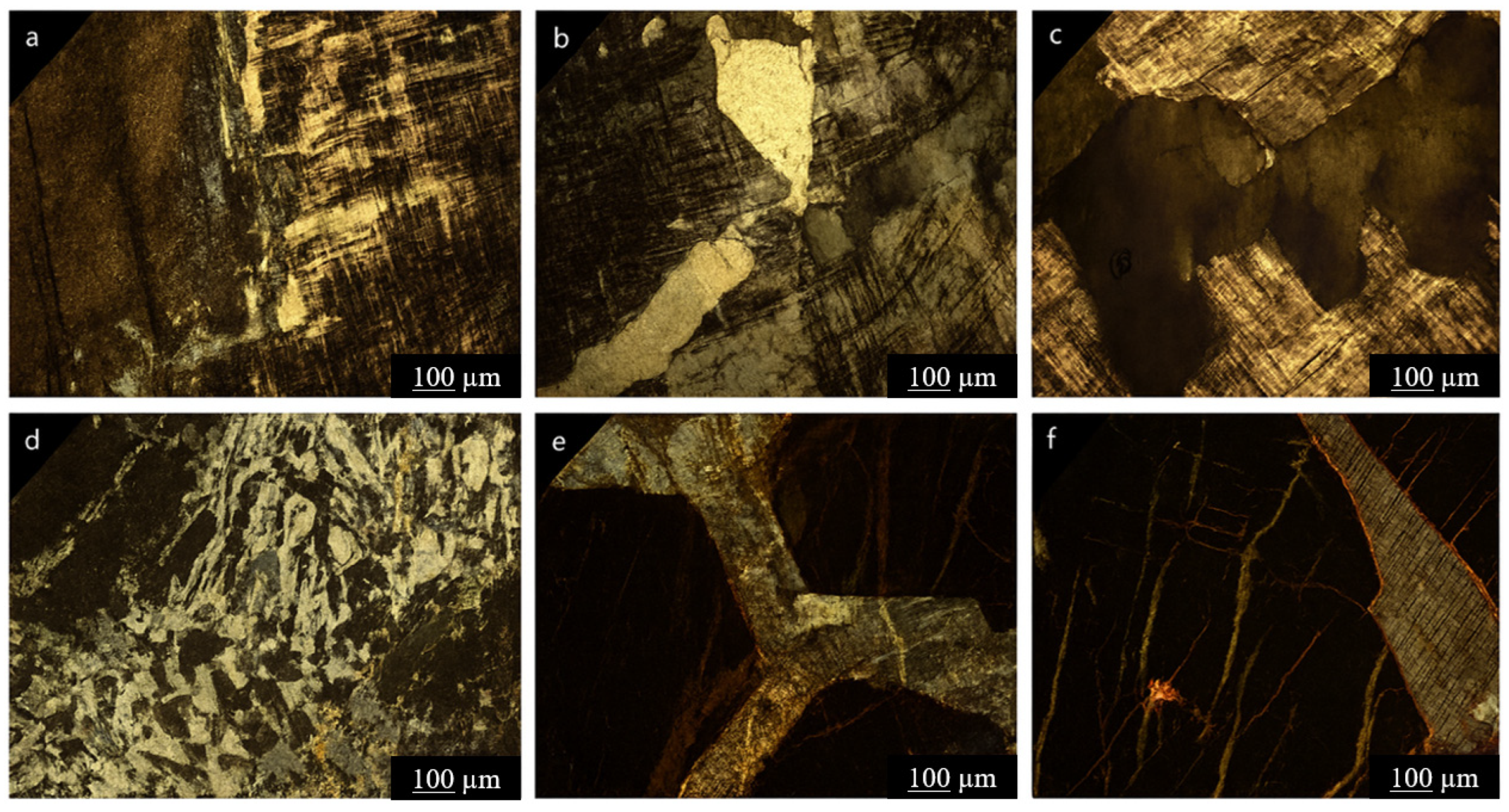
The primary mineral composition of the studied granitic pegmatite includes quartz (35–45%), alkali feldspars (30–40%), and micas (10–15%), among accessory minerals such zircon, monazite, tourmaline, and iron oxides (Figure 3). Feldspar megacrysts show characteristic growth patterns, with microcline forming large crystals intergrown with both plagioclase (Figure 3a) and quartz (Figure 3b). The occurrence of graphic textures exhibiting consistent intergrowths of quartz and feldspar (Figure 3c) signifies concurrent fast crystallization of both minerals in pegmatitic settings. Occurrences of tourmaline, tightly linked with plagioclase and iron oxides, frequently contain zircon inclusions surrounded by muscovite halos, suggesting crystallization at elevated temperatures (>600 °C) and early zircon saturation, in accordance with fracture-filling textures that denote subsequent growth phases [29].
Additionally, mica minerals like muscovite and biotite exhibit spatial and textural relationships, including syn-kinematic crystallization and partial hydrothermal alteration to chlorite, as recorded in analogous pegmatite environments, with crystallographic alignments suggesting growth during deformation [29].
Zircon exists both as inclusions in tourmaline and as independent euhedral grains in the groundmass. The existence of graphic intergrowths (Figure 3d) and tourmaline–zircon relationships (Figure 3f) indicate an initial high-temperature magmatic phase, succeeded by subsequent mineral growth events under varying physicochemical conditions. Skeletal quartz textures suggest episodes of fast crystal formation, probably induced by variations in temperature or fluid composition. The extensive alteration characteristics document late-stage hydrothermal modifications that transformed the original mineral assemblage [29].

3.2. Mineral Chemistry

3.2.1. Zircon

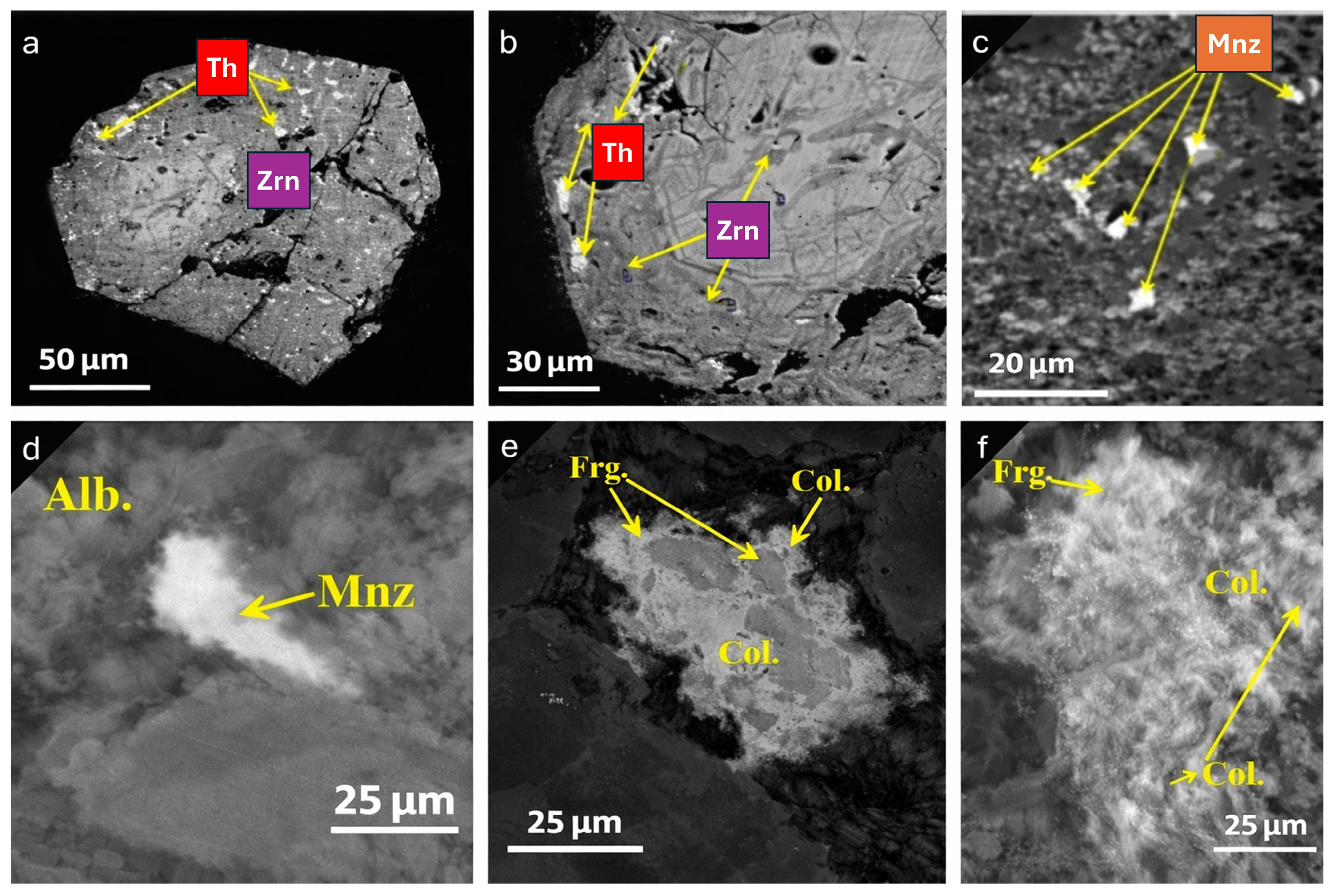
Zircon grains occur as angular to sub-rounded fragments with irregular edges and abundant fractures, reflecting mechanical stress or deformation. Internal zoning (Figure 4a) in BSE images suggests compositional variations or growth zoning during crystallization. Representative chemical compositions are listed in Supplementary Table S1. The zircon from the AZ pegmatite closely aligns with the ideal ZrSiO4 stoichiometry, with zirconium and silicon concentrations (0.96–0.99 atoms per formula unit, apfu). Hafnium (0.01–0.02 apfu) consistently replaces zirconium, indicating their same chemical properties. Minor departures from optimal stoichiometry are observed in zircons with elevated actinide concentrations, suggesting slight post-crystallization modification or fluid interaction. These differences are characteristic of zircon derived from developed pegmatitic melts, where the inclusion of trace elements is contingent upon charge balance and compatibility of ionic radii [30,31,32].

3.2.2. Thorite

Thorite within the analyzed pegmatite samples is present as fine inclusions within zircon (Figure 4b). The chemical compositions of specific thorite crystals are outlined in Supplementary Table S2. The samples demonstrate increased ThO2 concentrations, between 65.8 and 72.1 wt%, whereas UO2 content fluctuates from 1.5 to 6.0 wt%. SiO2 exhibits a consistent range, varying between 16.5 and 19.0 wt% as presented in Supplementary Table S2.

3.2.3. Monazite

In backscattered electron (BSE) imaging, monazite appears as tiny, sub-rounded to rounded grains spread throughout the rock matrix. There are two different generations found, indicating different crystallization conditions: the first generation has smaller, irregularly formed crystals, while the second generation has larger, more elongated to wedge-shaped grains. Albite and monazite are commonly found together as illustrated in (Figure 4c,d). Its inclusion in an albite-dominated matrix suggests that it was generated either concurrently with or subsequent to the crystallization of the host rock from residual melts or hydrothermal fluids. Localized factors, including temperature, pressure, fluid composition, and interactions with adjacent minerals, influence the crystal morphology and distribution [33,34]. Supplementary Table S3 lists the chemical makeup of representative monazite crystals. EPMA findings indicate that monazite from the AZ pegmatite is typical monazite-(Ce), distinguished by elevated quantities of LREE oxides (Ce2O3 = 25.2–33 wt%; La2O3 = 18.3–22.5 wt%; Nd2O3 = 7.2–10 wt%; Pr2O3 = 2.2–3.3 wt%) and P2O5 (25.2–29.3 wt%). The samples demonstrate significant actinide enrichment (ThO2 = 3.8–6 wt%; UO2 = 0.1–1.8 wt%), aligning with pegmatitic monazite characteristics. Low SiO2 (0.4–0.9 wt%) signifies minimal silicate substitution. Minor CaO (0.6–1.1 wt%) and Fe2O3 (0.2–2.4 wt%) are interpreted to reflect minor secondary alteration or inclusions [5].

3.2.4. Ferrocolumbite

The ferrocolumbite grains in the analyzed pegmatite have diverse morphologies, ranging from irregular to subhedral shapes, with grain borders that are either sharp or somewhat rounded. They typically occur as compact aggregates and are often intergrown with fergusonite. The texture is primarily granular, exhibiting smooth to slightly irregular surfaces (Figure 4e,f). Detailed chemical analyses of representative columbite crystals are presented in Supplementary Table S4. The ferrocolumbite from the AZ pegmatite is dominated by Nb–Ta–Fe–Mn components, with minor substitutions of Ti, Sn, and W. Nb2O5 is consistently the major oxide (63–67 wt%; 0.89–0.96 apfu), while Ta2O5 varies between 6 and 9.5 wt% (0.04–0.11 apfu).

3.2.5. Fergusonite

Fergusonite appears as elongated or irregularly shaped grains with sharp edges. The grains are often associated with columbite (Col.), forming intergrowths or adjacent clusters. Fergusonite grains exhibit a relatively homogeneous texture, with no visible zoning (Figure 4e,f). Their correlation with columbite implies a genetic connection or co-crystallization phenomenon. The chemical compositions of select fergusonite crystals are delineated in Supplementary Table S5. The examined samples exhibit elevated levels of Y2O3 (26.8–51.9 wt%) and Nb2O5 (45.5–48.0 wt%), substantiating Y3+ (0.711–1.374 apfu) and Nb5+ (1.023–1.076 apfu) as the predominant cations.

3.3. Radiological Impact and Associated Hazards

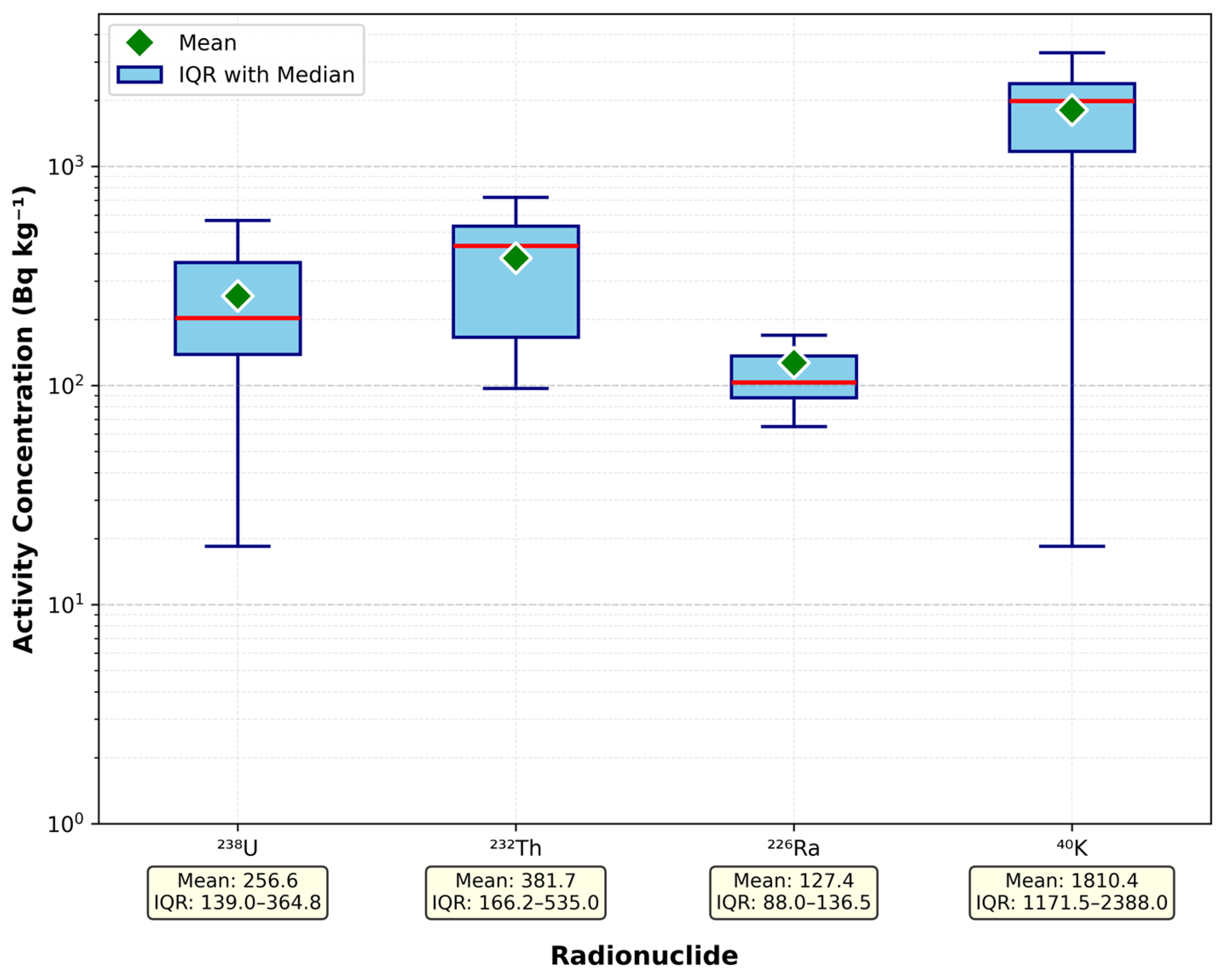
Table S6 in the Supplementary Materials provides insights into the activity concentrations of naturally occurring radionuclides (specifically 238U, 232Th, and 226Ra) across 26 samples. On the other hand, Table S7 in the Supplementary Materials and Figure 5 summarize the descriptive statistics of activity concentrations for four naturally occurring radionuclides (238U, 232Th, 226Ra, and 40K) measured in Bq kg−1. The investigated samples are enriched in natural radionuclides, with measured values surpassing global reference levels. The mean activity concentrations of 238U (283 Bq kg−1), 232Th (377 Bq kg−1), and 226Ra (108 Bq kg−1) significantly exceed the global averages (33, 45, and 32 Bq kg−1, respectively) [35]. The measured activity concentration of 40K (1992 Bq kg−1) significantly exceeds the reference value of 420 Bq kg−1. Figure 5 presents a box plot showing the activity levels of 238U, 232Th, 226Ra, and 40K in the pegmatite samples analyzed. The radium equivalent activity (Raeq = 785 Bq kg−1) and hazard indices (Hex = 2.1, Hin = 2.2) are above the safety thresholds (Raeq ≤ 370 Bq kg−1; Hex ≤ 1; Hin ≤ 1) [35,36], indicating potential radiological hazards. The estimated annual effective dose outside (AEDout = 0.48 mSv y−1) is still below ICRP limit of 1 mSv y−1 [37].
The annual gonadal dose equivalent (AGDE = 0.3 µSvy−1) also remains under the permissible limit of 1 mSv/y. However, the excess lifetime cancer risk (ELCR = 8.1× 10⁻³) surpasses the ICRP [37] acceptable limit (≤1 × 10⁻³), pointing to possible long-term health risks for local residents, as detailed in Table 1. The excess lifetime cancer risk (ELCR = 8.01× 10⁻³) surpasses the ICRP [37] safety threshold (≤1 × 10⁻³), indicating potential long-term health issues for the local populace. These findings underscore the necessity for more evaluation and possible regulatory interventions in the studied region.
The normalized values in Table 1 (activity measured relative to the reference limits) reveal significant exceedances for all radionuclides examined. Among them, 232Th has the highest ratio at 12.5, followed by 238U at 8.09, 40K at 4.9, and 226Ra at 3.6. These elevated ratios demonstrate that the sampled environment contains radioactivity levels well above the recommended safety thresholds, especially for 232Th and 238U. The notably high normalized value for 232Th (around 12.7 times the standard limit) suggests geogenic enrichment from 232Th-bearing minerals like monazite or thorite [16]. The heightened quantities of 238U (8.73 times the permissible limit) may suggest uranium mineralization or a disruption in the radioactive decay series. Despite 40K having a naturally elevated reference limit of 400 Bq kg−1, attributed to thorite prevalence in the Earth’s crust, the observed average of 1992 Bq kg−1 exceeds this threshold by over sixfold, and is possibly associated with potassium-rich lithologies such as granites or feldspar deposits [12].The disequilibrium between 238U and its daughter 226Ra (226Ra~½ 238U) is attributed to the geochemical mobility of radium, which can be selectively leached by late-stage hydrothermal fluids, and the incorporation of uranium into resistant mineral phases like zircon, which retains parent nuclides but may lose daughter products over time [38,39].
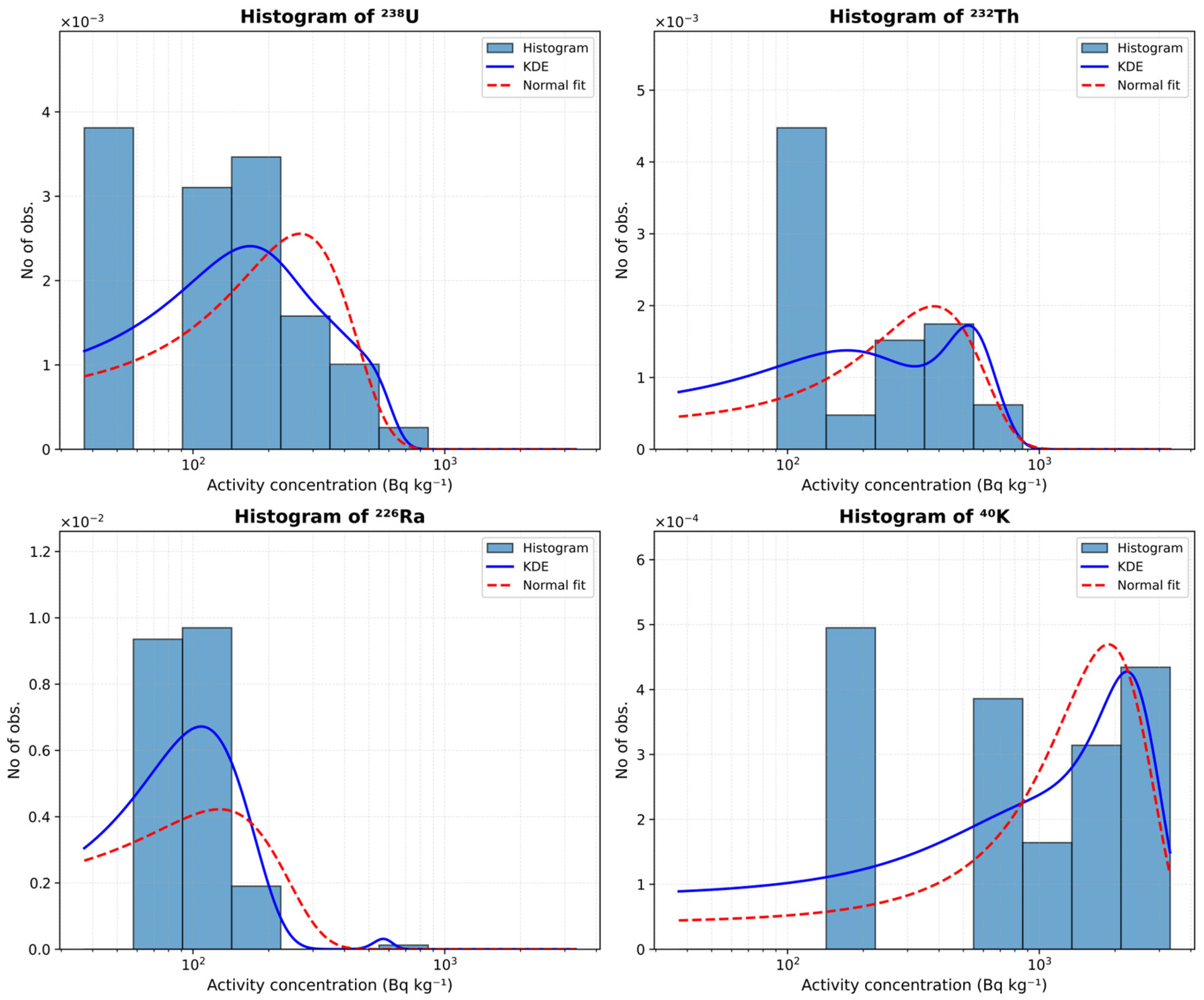
The increased 226Ra values exhibit the lowest normalized ratio (3.6), potentially indicating its mobility in water and heterogeneous distribution. These findings underscore a possible radiological hazard, especially from 232Th and 238U, which substantially contribute to gamma radiation exposure and inhalation dosages. Additional inquiry, encompassing dose-rate modeling and epidemiological research, is essential to evaluate health concerns for affected populations. Regulatory measures, such as regulated land use or remediation, may be necessary in regions exhibiting these heightened activity levels. Figure 6 displays histograms depicting the frequency distributions of activity concentrations for 226Ra, 238U, 232Th, and 40K in pegmatite samples from AZA. The distribution for 226Ra is characterized by a high number of samples with low activity (mostly between 0 and 200 Bq kg−1), with a steep decline beyond this range, suggesting 226Ra predominates at lower concentrations in the pegmatites. Conversely, 238U exhibits a wider distribution encompassing low to mid-range concentrations (200–600 Bq kg−1) with a scarcity of higher-concentration samples. The distribution of 232Th is rather uniform across a broad range (100–700 Bq kg−1), signifying a consistent dispersion of 232Th in the samples. The distribution of 40K is biased towards lower values, with a notable decline above 400 Bq kg−1. These patterns are essential for understanding the geological processes and conditions that lead to pegmatite development in AZA.
The prevalence of low concentration 226Ra samples may indicate particular geological settings or mechanisms that promote radium occurrence. These observations enhance comprehension of radiation levels and mineralization traits in AZA pegmatites. Figure 6 also shows that 238U exhibits a unimodal distribution most values fall below 500 Bq kg−1, but some outliers reach much higher. 232Th exhibits a bimodal distribution predominantly beneath 600 Bq kg−1, 226Ra shows a unimodal distribution with most values (80% of samples) between 65–200 Bq kg−1, and 40K demonstrates significant positive skew primarily attributable to an exceptionally high value of 13,800 Bq kg−1.

3.4. Descriptive Statistics and Correlation Analysis

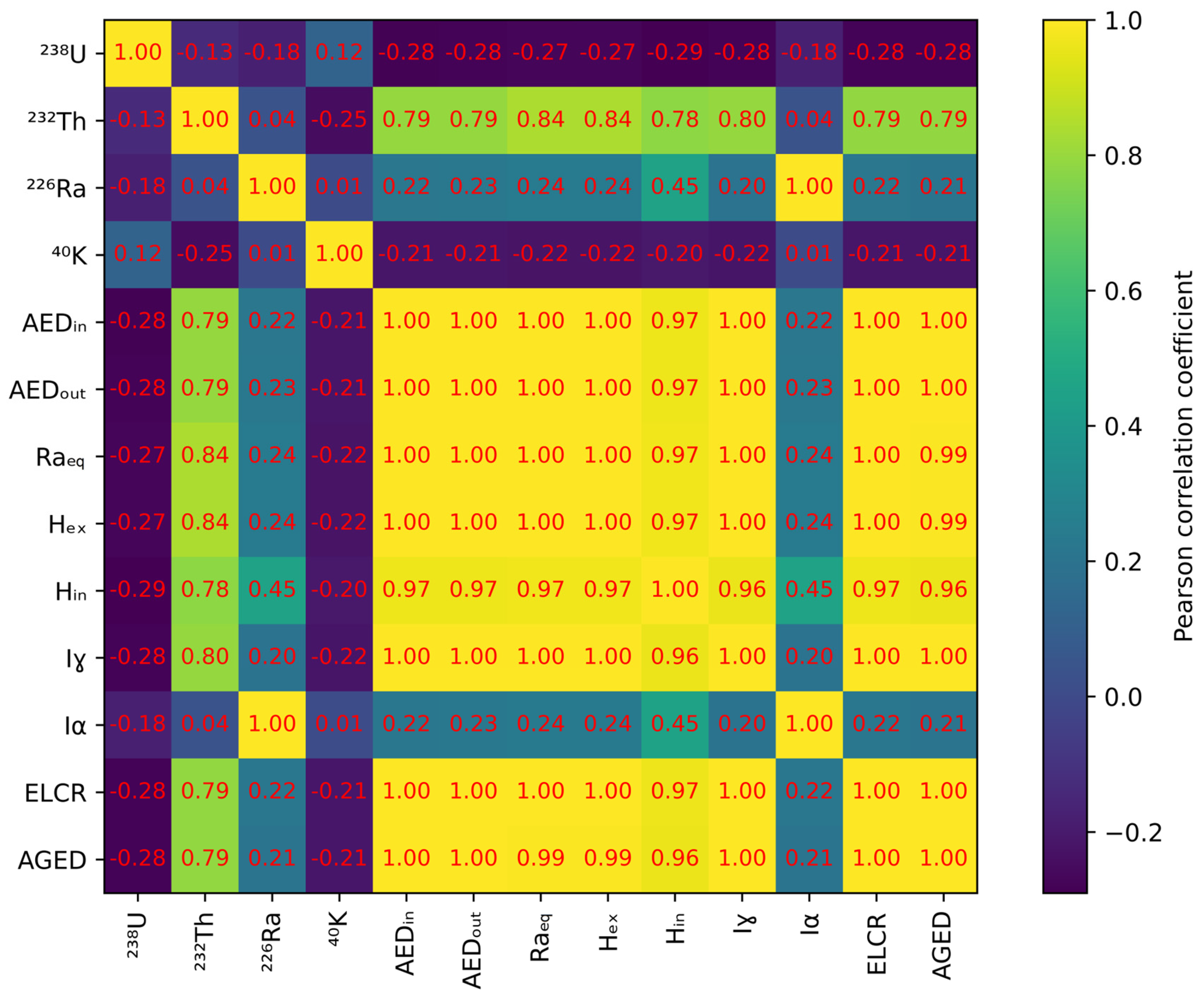
From the heatmap presented in Figure 7, the correlation matrix reveals strong positive interrelationships among the majority of radiological indices. A near-perfect linear relationship exists between indoor and outdoor annual effective dose rates (AED), as evidenced by a correlation coefficient of 0.95. Furthermore, the radium equivalent activity (Raeq) demonstrates a very strong predictive capacity for both AEDin and AEDout, with correlations of 0.98 and 0.96, respectively. The exterior and interior hazard indices (Hex, Hin) exhibit a strong correlation with effective dose rates, highlighting the substantial impact of both external and internal radiation pathways on total exposure. The gamma and alpha indices (Iγ and Iα), although demonstrating somewhat weaker correlations, are nonetheless significantly associated with the dose rates, validating their relevance in a whole radiological risk evaluation.
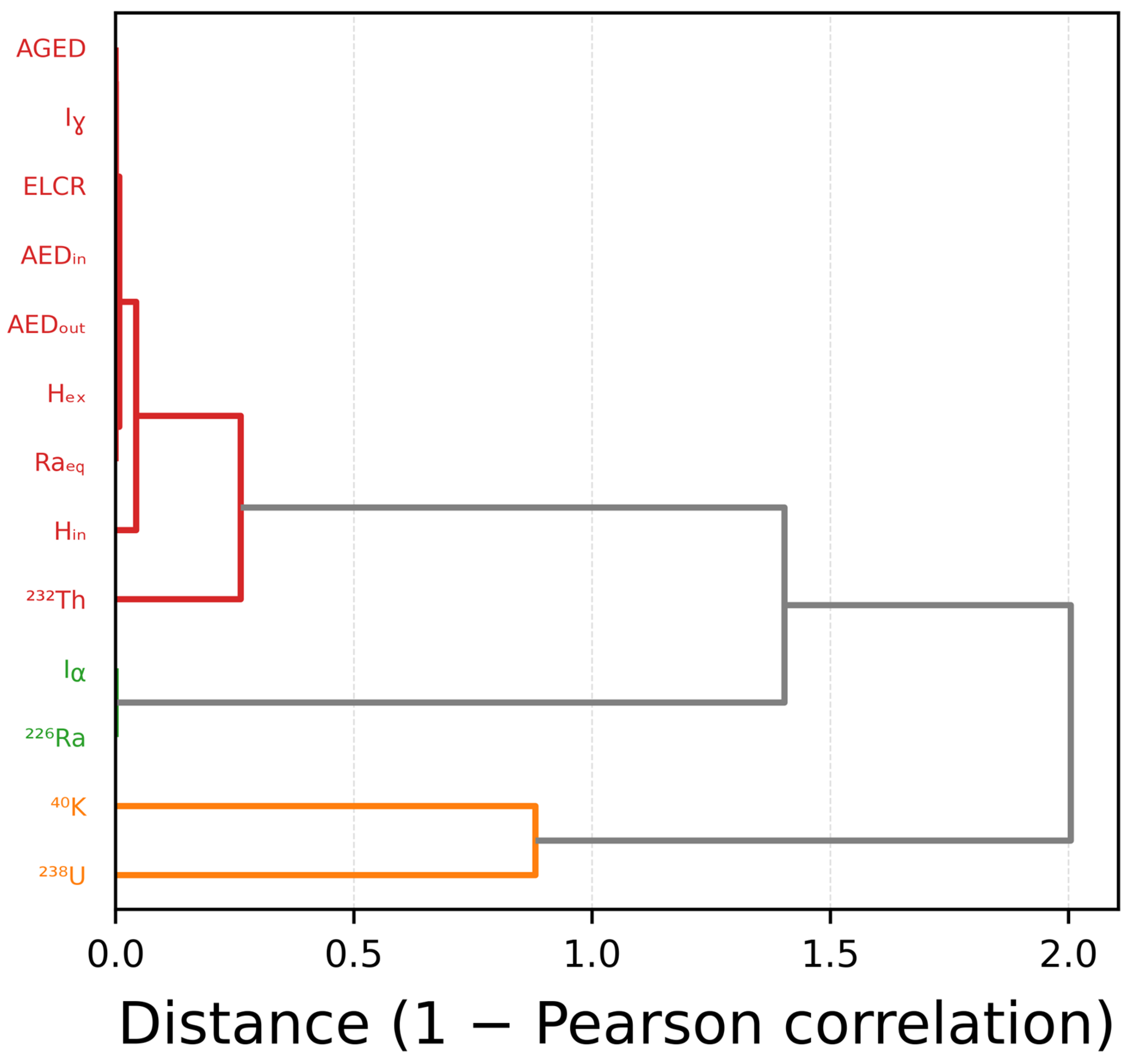
The heatmap is a crucial instrument for understanding the correlations among different radiological hazard indices and for identifying which indices exhibit the most significant correlation with radiation exposure levels. Statistical analysis revealed strong positive correlations among 238U, 226Ra, and derived hazard indices (Raeq, AED, Hex, Hin, ELCR) clustering together in hierarchical analysis. This cluster reflects the dominance of uranium-bearing minerals (zircon, fergusonite) in controlling overall radiation exposure. In contrast, 232Th correlates strongly with internal dose indices and clusters separately, indicative of its association with thorite and monazite. 40K clusters independently, consistent with its residence in primary silicates. These patterns underscore that radiological risk is not homogenous but mineralogically partitioned. Consequently, risk assessment and mitigation strategies must transition from bulk-rock approaches to mineral-specific models, prioritizing zones enriched in thorite, monazite, zircon, or fergusonite [16].
Figure 8 illustrates a hierarchical clustering dendrogram that highlights the relationships among different radiological hazard parameters in the analyzed pegmatite samples. The hierarchical cluster analysis (using single linkage and Euclidean distance) of radiological variables. Figure 8 displays a hierarchical clustering dendrogram that delineates the links among diverse radiological hazard characteristics in the analyzed pegmatite samples. The hierarchical cluster demonstrates a clear segmentation that may be directly attributed to the predominant mineralogy of AZA pegmatites. The strong clustering of 238U, 226Ra, and other related hazard indices (AEDout, ELCR, Hex, Hin) highlights the predominant influence of uranium-bearing accessory minerals.
This correlation is mineralogically evidenced by the incorporation of actinides within near-stoichiometric zircon and, more significantly, by the presence of thorite inclusions a phase characterized by exceptionally high ThO2 (65.8–72.1 wt%) and variable UO2 (1.5–6.0 wt%) within these zircon grains. 232Th, specifically concerning the internal dose (AEDin), can be attributed to its prevalence within thorium-rich phases, predominantly thorite and, to a lesser extent, monazite (Ce). The metamictization observed in these thorite specimens underscores the potential for increased radionuclide mobility, thereby significantly heightening the risk associated with inhalation exposure. In contrast, the notable disparity of 40K substantiates its geochemical dissociation from the 238U and 232Th series, indicative of its occurrence within primary rock-forming minerals such as microcline and muscovite. These interrelations elucidate that the radiological hazard is fundamentally influenced by the spatial distribution of particular mineral hosts. Indoor radon is a leading cause of lung cancer in the general population [40].

4. Conclusions

This comprehensive study of the mineralogy and radiation at AZA granitic pegmatites in Egypt’s Eastern Desert uncovers a complex environment of Naturally Occurring Radioactive Material (NORM). The increased radiation risk is closely associated with the distribution of rare metal-bearing accessory minerals, resulting in the following key findings:
(i) The investigated pegmatites show radioactive levels with 238U reaching up to 568 Bq kg−1 and 232Th reaching up to 674 Bq kg−1 and 226Ra reaching up to 170 Bq kg−1, which surpass global standards by tenfold. The concentration of radioactive elements causes major safety concerns through Radium Equivalent Activity values that reach 1243 Bq kg−1 and external hazard indices (Hex) values that reach 3.36 which exceed the international safety standards of 1 by a wide margin. The computed Excess Lifetime Cancer Risk (ELCR) maximum observed value of 12.2 × 10⁻³ is around 12 times greater than the ICR permissible threshold of 1 × 10⁻³ [37], signifying a considerable long-term health hazard for persons subjected to extended exposure.
(ii) The exceptionally high 232Th activity and its strong correlation with internal hazard indices are predominantly governed by the presence of thorite and, to a lesser extent, monazite-(Ce). The thorium series gamma radiation originates mainly from these minerals, which also determines 222Rn and 220Rn exhalation potential. The metamictization process in thorite minerals enhances alteration resistance and increases the mobility of radioactive particles, hence elevating the risk of inhalation of these particles.
(iii) Elevated 238U concentrations are primarily hosted by zircon and fergusonite (Y). The detected imbalance in the 238U decay chain is ascribed to the geochemical durability of zircon and the intricate crystallization history of fergusonite, which may result in the selective incorporation or subsequent loss of uranium and its progeny.
(iv) The calculated absorbed dose rates (182–978 nGyh−1) and annual effective doses exhibit extreme spatial variability directly correlated with the occurrence of Th-rich mineral assemblages.
(v) The conventional practice of bulk-rock radioactivity assessment is insufficient for ensuring occupational health and safety in the mining of these pegmatites. The severe and mineral-specific risks necessitate a transformation towards safety procedures guided by mineralogy.
Considering the substantial radioactive risks associated with AZA granitic pegmatites, it is highly advisable that forthcoming exploration and mining endeavors implement a radiological management approach grounded in mineralogical knowledge. Traditional bulk-rock gamma measurements alone are insufficient to assess localized radioactive areas associated with thorite, monazite (Ce), zircon, and fergusonite (Y). Future work should integrate in-situ gamma spectrometry, radon/thoron exhalation mapping, and high-resolution mineralogical characterization to precisely delineate high-risk zones before excavation.

Supplementary Materials

The following supporting information can be downloaded at: https://www.mdpi.com/article/10.3390/geosciences16020069/s1, Tables S1–S7: Radioanalytical data of investigated samples.

Author Contributions

Writing—original draft, M.M.G., M.M. and A.S.M.; Conceptualization, M.M.G. and M.M.; Methodology, M.M.G., M.M., H.A.E.-D., M.A.E.-L., M.D. and A.S.M.; Software, M.M.G. and M.M.; Validation, M.M.G., M.M., H.A.E.-D., M.A.E.-L., M.D., Y.-Y.L., T.A.-A. and A.S.M.; Formal analysis, M.M.G. and M.M.; Investigation, M.M.G., M.M., H.A.E.-D., M.A.E.-L., M.D., Y.-Y.L., T.A.-A. and A.S.M.; Resources, M.M.G., M.M. and A.S.M.; Data curation, M.M.G., M.M. and A.S.M.; Writing—review & editing, M.M.G., M.M., Y.-Y.L., T.A.-A. and A.S.M.; Visualization, M.M.G. and M.M.; Supervision, M.M.G., M.M. and M.D.; Project administration, M.M.G. and M.M.; Funding acquisition, M.M. and T.A.-A. All authors have read and agreed to the published version of the manuscript.

Funding

This research support by King Fahd University of Petroleum and Minerals (KFUPM), Dhahran, Saudi Arabia and no external funding for others.

Data Availability Statement

Data is contained within the article.

Acknowledgments

The authors are thankful to the Deanship of Research and Interdisciplinary Research Center for Industrial Nuclear Energy (IRC-INE ) at King Fahd University of Petroleum and Minerals (KFUPM), Saudi Arabia for supporting this work through the Fast-Track Scientific Research Program under project ID: INNE2403.

Conflicts of Interest

The author declares no competing interests.

References

  1. Aberikae, E.A.; Nyantakyi, E.K.; Kpeglo, D.O.; Abubakar, M.; Gbeddy, G.; Ackerson, N.O.B.; Yeboah, S.I.I.K.; Domfeh, M.K.; Atta-Darkwa, T.; Amankwah, E.; et al. Baseline assessment of naturally occurring radionuclides in borehole water of Asikam-gold mining community in Ghana. Sci. Afr. 2023, 20, e01730. [Google Scholar] [CrossRef]
  2. Fowler, A.R.; Hamimi, Z. Lithospheric delamination in models of post-collision tectonics in the Egyptian Eastern Desert and Sinai: Claims versus evidence. J. Afr. Earth Sci. 2023, 203, 104948. [Google Scholar] [CrossRef]
  3. Surour, A.A. Sn-W-Ta-Mo-U-REE Mineralizations Associated with Alkali Granite Magmatism in Egyptian Nubian Shield. In The Geology of the Egyptian Nubian Shield; Hamimi, Z., El-Barkooky, A., Martínez Frías, J., Fritz, H., Abd El-Rahman, Y., Eds.; Springer International Publishing: Cham, Switzerland, 2020; pp. 593–604. [Google Scholar] [CrossRef]
  4. Ibrahim, M.E.; Saleh, G.M.; Dawood, M.I.; Kamar, M.S.; Saleh, S.M.; Mahmoud, M.A.; El-Tohamy, A.M. Rare Metals Mineralization in Pegmatite at Abu Rusheid Area, South Eastern Desert, Egypt. Int. J. Min. Sci. 2017, 3, 44–63. [Google Scholar] [CrossRef]
  5. Ali, M.A.; Abdel Gawad, A.E.; Ghoneim, M.M. Geology and mineral chemistry of uranium and thorium-bearing minerals in rare-metal (NYF) pegmatites of Um Solimate, South Eastern Desert of Egypt. Acta Geol. Sin. 2021, 95, 1568–1582. [Google Scholar] [CrossRef]
  6. Sidique, E.; Elhaddad, M.A.; Sami, M.; Sanislav, I.V.; Alshehri, F.; Ahmed, M.S.; Abbas, H. Geochemical characteristics, hazards impact assessment and radiogenic heat production of the alkaline rocks. Sci. Rep. 2024, 14, 9121. [Google Scholar] [CrossRef]
  7. Zakaly, H.M.; Awad, H.A.; El Saeed, R.L.; Issa, S.A.; Elsaman, R.; Khandaker, M.U.; Al-awah, H.; Fathy, D.; Sami, M. Radiometric and petrographic characterization of El-Yatima granite: Evaluating radiological risks and mineralogical features. Radiat. Phys. Chem. 2024, 224, 111992. [Google Scholar] [CrossRef]
  8. Sami, M.; Osman, H.; Ahmed, A.F.; Zaky, K.S.; Abart, R.; Sanislav, I.V.; Abdelrahman, K.; Fnais, M.S.; Xiao, W.; Abbas, H. Magmatic Evolution and Rare Metal Mineralization in Mount El-Sibai Peralkaline Granites, Central Eastern Desert, Egypt: Insights from Whole-Rock Geochemistry and Mineral Chemistry Data. Minerals 2023, 13, 1039. [Google Scholar] [CrossRef]
  9. El-Sherif, A.M. Mineralogical and radioactive characterization of Gabal El-Urf pegmatites, Central Eastern Desert, Egypt. Al-Azhar Bull. Sci. 2015, 26, 85–96. [Google Scholar] [CrossRef]
  10. Abu Elatta, S.A. Geology, mineralogy and mineral chemistry of the NYF-type pegmatites at the Gabal El Faliq area, South Eastern Desert, Egypt. J. Earth Syst. Sci. 2019, 128, 156. [Google Scholar] [CrossRef]
  11. Abdel Hamid, A.A.; Abdel Hamid, H.M. Field features, mineral assemblages and geochemistry of radioactive pegmatite in the Wadi Abu Zawal area, North Eastern Desert, Egypt. Egypt. J. Geol. 2021, 65, 91–103. [Google Scholar] [CrossRef]
  12. El Dabe, M.M.; Ismail, A.M.; Metwaly, M.; Taalab, S.A.; Hanfi, M.Y.; Ene, A. Hazards of radioactive mineralization associated with pegmatites used as decorative and building materials. Materials 2022, 15, 1224. [Google Scholar] [CrossRef] [PubMed]
  13. Khaleal, F.M.; Saleh, G.M.; Lasheen, E.S.R.; Alzahrani, A.M.; Kamh, S.Z. Exploration and petrogenesis of corundum-bearing pegmatites: A case study in Migif-Hafafit area, Egypt. Front. Earth Sci. 2022, 10, 869828. [Google Scholar] [CrossRef]
  14. Heikal, M.T.S.; Shereif, A.S.; Csámer, Á.; Deshesh, F. Radiation Assessment and Geochemical Characteristics of 238U, 226Ra, 232Th, and 40K of Selected Specialized Granitic Occurrences, Saudi Arabia, Arabian Shield. Toxics 2025, 13, 612. [Google Scholar] [CrossRef] [PubMed]
  15. Ghoneim, M.M.; Abdel Gawad, A.E.; El-Dokouny, H.A.; Dawoud, M.; Panova, E.G.; El-Lithy, M.A.; Mahmoud, A.S. Petrogenesis and geodynamic evolution of A-type granite bearing rare metals mineralization in Egypt: Insights from geochemistry and mineral chemistry. Minerals 2024, 14, 583. [Google Scholar] [CrossRef]
  16. Abdel Gawad, A.E.; Panova, E.G.; Ghoneim, M.M.; Yanson, S.Y.; Alsufyani, S.J.; Saftah, A.; Alresheedi, N.M.; Hanfi, M.Y. Radioactive assessment and Th-, Nb-Ta-, Zr-, REE-bearing minerals in alkaline syenite: Environmental implications for radiological safety. Geosciences 2025, 15, 138. [Google Scholar] [CrossRef]
  17. Diab, M. Mineralogical Insights and Upgrading of Rare-Metal, Rare-Earth, and Radioactive Minerals in Abu Zawal Pegmatite, Egypt. Can. Metall. Q. 2025, 1–16. [Google Scholar] [CrossRef]
  18. Asran, A.; El-Mansi, M.M.; Ibrahim, M.E.; Abdelghani, I. Pegmatites of Gabal El Urf, Central Eastern Desert. In Proceedings of the 7th International Conference on the Geology of Africa, Assiut, Egypt, 24–26 November 2013. [Google Scholar]
  19. Heikal, M.T.S.; Shereif, A.S.; Azer, M.K. Gamma Activity Concentrations (226Ra, 232Th, 40K) of Mineralized Homret Akarem Composite Granitic Pluton, Egyptian Nubian Shield: Environmental Hazards Assessment. Euro-Mediterr. J. Environ. Integr. 2024, 9, 1629–1658. [Google Scholar] [CrossRef]
  20. El Gharbawy, R.I.; El Feky, M.G.; El Galy, M.M.; El Maadawy, W.M. Petrological and mineralogical characteristics of younger granites and pegmatites in the Wadi Haleifiya area, southeastern Sinai, Egypt. Chin. J. Geochem. 2011, 30, 304–316. [Google Scholar] [CrossRef]
  21. Rudnick, R.L.; Gao, S. Composition of the Continental Crust. In Treatise on Geochemistry; Holland, H.D., Turekian, K.K., Eds.; Elsevier: Oxford, UK, 2014; pp. 1–51. [Google Scholar] [CrossRef]
  22. El Sundoly, H.I. Impact of tectonic factors on the emplacement of the radioactive mineralized pegmatites of Wadi Abu Zawal area, North Eastern Desert, Egypt. Curr. Sci. Int. 2021, 10, 178–199. [Google Scholar] [CrossRef]
  23. Saleh, G.M.; Afify, A.M.; Emad, B.M.; Dawoud, M.I.; Shahin, H.A.; Khaleal, F.M. Mineralogical and geochemical characterization of radioactive minerals and rare earth elements in granitic pegmatites at G. El Fereyid, South Eastern Desert, Egypt. J. Afr. Earth Sci. 2019, 160, 103651. [Google Scholar] [CrossRef]
  24. Surour, A.A.; El-Tohamy, A.; Mohamady, F.A.; Shaban, A.M.; Abdulnabi, M. Towards a safety code and assessment of radiation hazards in commercial brands of ornamental granites from Egypt. Appl. Radiat. Isot. 2025, 226, 112154. [Google Scholar] [CrossRef] [PubMed]
  25. Mitwalli, M.; Qabeeli, F.; El-Khatib, A.; Abbas, M.; Saleh, G. Radionuclides determination and computing radiobiological dose for TENORM exposure using NaI(Tl) gamma-ray spectrometer. Arab J. Nucl. Sci. Appl. 2023, 56, 114–126. [Google Scholar] [CrossRef]
  26. Ugbede, F.O.; Okanigbuan, P.N.; Nwabuoku, A.O. Radon concentration and radiation dose assessment of sachet water produced in Asaba, Nigeria. Discov. Environ. 2025, 3, 244. [Google Scholar] [CrossRef]
  27. NEA-OECD. Exposure to Radiation from Natural Radioactivity in Building Materials; NEA Group of Experts, OECD: Paris, France, 1979. [Google Scholar]
  28. UNSCEAR. Sources and Effects of Ionizing Radiation; United Nations: New York, NY, USA, 2000; pp. 1–10. [Google Scholar]
  29. Buriánek, D.; Hanžl, P.; Hrdličková, K. Pegmatite dykes and quartz veins with tourmaline: An example of partial melting in the contact aureole of the Chandman Massif intrusion, SW Mongolia. J. Geosci. 2011, 56, 201–213. [Google Scholar] [CrossRef][Green Version]
  30. Breiter, K. Monazite and zircon as major carriers of Th, U, and Y in peraluminous granites: Examples from the Bohemian Massif. Mineral. Petrol. 2016, 110, 767–785. [Google Scholar] [CrossRef]
  31. Hoskin, P.W.O.; Schaltegger, U. The composition of zircon and igneous and metamorphic petrogenesis. Rev. Mineral. Geochem. 2003, 53, 27–62. [Google Scholar] [CrossRef]
  32. Pidgeon, R.T.; Nemchin, A.A.; Roberts, M.P.; Guagliardo, P.; Fougerouse, D. Reliability of petrogenetic information obtained from the distribution of trace elements in zircon in light of the complex infusion by foreign-element-bearing low temperature solutions. Chem. Geol. 2023, 621, 121357. [Google Scholar] [CrossRef]
  33. Förster, H.J. Composition and origin of intermediate solid solutions in the system thorite–xenotime–zircon–coffinite. Lithos 2006, 88, 35–55. [Google Scholar] [CrossRef]
  34. Xie, M.; Fan, H.; Sakyi, P.A.; Yang, K.; Li, X.; She, H.; Liang, G.; Han, C. Mineralizations of Nb-Ta-Rb-Zr and rare-earth elements in Boziguoer, South Tianshan, NW China: Geochronology and geochemistry of monazite and bastnäsite. Ore Geol. Rev. 2024, 168, 106034. [Google Scholar] [CrossRef]
  35. UNSCEAR. Sources and Effects of Ionizing Radiation—Exposures of the Public and Workers from Various Sources of Radiation; United Nations: New York, NY, USA, 2010. [Google Scholar]
  36. IAEA. Radiation Protection and Safety of Radiation Sources: International Basic Safety Standards; IAEA Safety Standards Series No. GSR Part 3; IAEA: Vienna, Austria, 2021. [Google Scholar]
  37. ICRP. Recommendations of the International Commission on Radiological Protection. Ann. ICRP 2007, 37, 1–332. [Google Scholar]
  38. Ram, R.; Owen, N.D.; Kalnins, C.; Cook, N.J.; Ehrig, K.; Etschmann, B.; Rollog, M.; Fu, W.; Vaughan, J.; Pring, A.; et al. Understanding the mobility and retention of uranium and its daughter products. J. Hazard. Mater. 2021, 410, 124553. [Google Scholar] [CrossRef]
  39. Carvalho, F.P.; Oliveira, J.M.; Malta, M.; Lemos, M.E. Radioanalytical assessment of environmental contamination around non-remediated uranium mining legacy site and radium mobility. J. Radioanal. Nucl. Chem. 2014, 299, 119–125. [Google Scholar] [CrossRef]
  40. WHO. Handbook on Indoor Radon: A Public Health Perspective; World Health Organization: Geneva, Switzerland, 2009. [Google Scholar]
Figure 1. Geological map of the investigated Abu Zawal area (AZA), Eastern Desert, Egypt (modified from El Sundoly, 2021) [22].
Geosciences 16 00069 g001
Figure 2. Field photos of the study area, (a) Zoned pegmatite in the study area, (b) Large trench in the shear zone of pegmatite pockets, (c) K feldspar in the studied pegmatite, (d) contact between pegmatite and host granites.
Geosciences 16 00069 g002
Figure 3. Photomicrographs in the investigated pegmatite of the study area showing: (a) Megacrystal of microcline and plagioclase; (b) Megacrystal of microcline and quartz; (c) Skeletal quartz associated with microcline; (d) Graphic texture in quartz; (e) Tourmaline associated with plagioclase and iron oxides; (f) Zircon included in tourmaline with muscovite in the peripheries and fractures.
Geosciences 16 00069 g003
Figure 4. (a) Fractured zircon grains with thorite inclusions, illustrating the complex internal structures and the presence of thorite within the zircon matrix. (b) Zoned and cracked zircon (Zrn) including thorite, (c) Fine-grained disseminated monazite (Mnz) (d) Monazite grain associated with albite matrix (Alb) (e) Association between columbite (Col.) and fergusonite (Frg.), indicating genetic link within the pegmatite. (f) Fergusonsite and columbite intergrowth.
Geosciences 16 00069 g004
Figure 5. Box plot for 238U, 232Th, 226Ra, and 40K radioactivity for the studied pegmatite samples. The red line—indicate the median values of each radionuclide.
Geosciences 16 00069 g005
Figure 6. Activity concentration (Bq kg−1) of radionuclides in AZA pegmatites samples.
Geosciences 16 00069 g006
Figure 7. Pearson correlation heatmap for calculated radiological parameters.
Geosciences 16 00069 g007
Figure 8. The hierarchical clustering dendrogram of radiological parameters in studied pegmatite.
Geosciences 16 00069 g008
Table 1. Activity concentration (Bq kg−1) for investigated samples.
RadionuclideAverage
(Bq kg−1)
Limit [35,36]
(Bq kg−1)
Normalization
(Measured/Limit)
238U283358.09
226Ra108303.6
232Th3773012.5
40K19924004.9
Disclaimer/Publisher’s Note: The statements, opinions and data contained in all publications are solely those of the individual author(s) and contributor(s) and not of MDPI and/or the editor(s). MDPI and/or the editor(s) disclaim responsibility for any injury to people or property resulting from any ideas, methods, instructions or products referred to in the content.