

Background Seismicity Highlights Tectonic Asperities


Abstract
1. Introduction
2. Geological Frameworks
3. Seismic Data
4. SPAD Algorithm
- Declustering of the seismic catalog and detection of background seismicity.
- Fuzzy clustering of background seismicity.
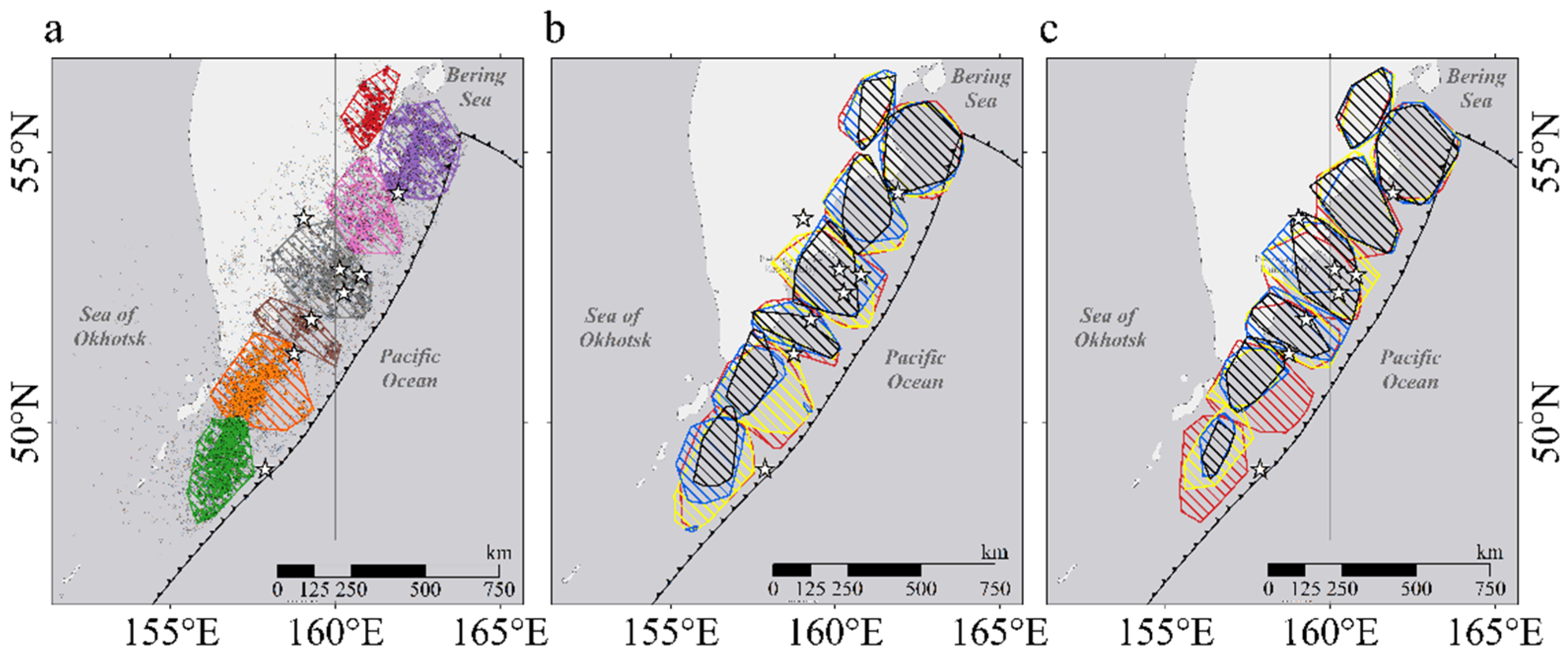
- Mapping seismogenic patches.
4.1. Background Seismicity
4.2. Fuzzy Clustering
- Since earthquake localization is predetermined by asperities with fractal roughness at the km scale, one should select a configuration, out of all the possible configurations, for which the number of clusters and the number of events in these clusters are maximized. This configuration of dense sets best represents the current state.
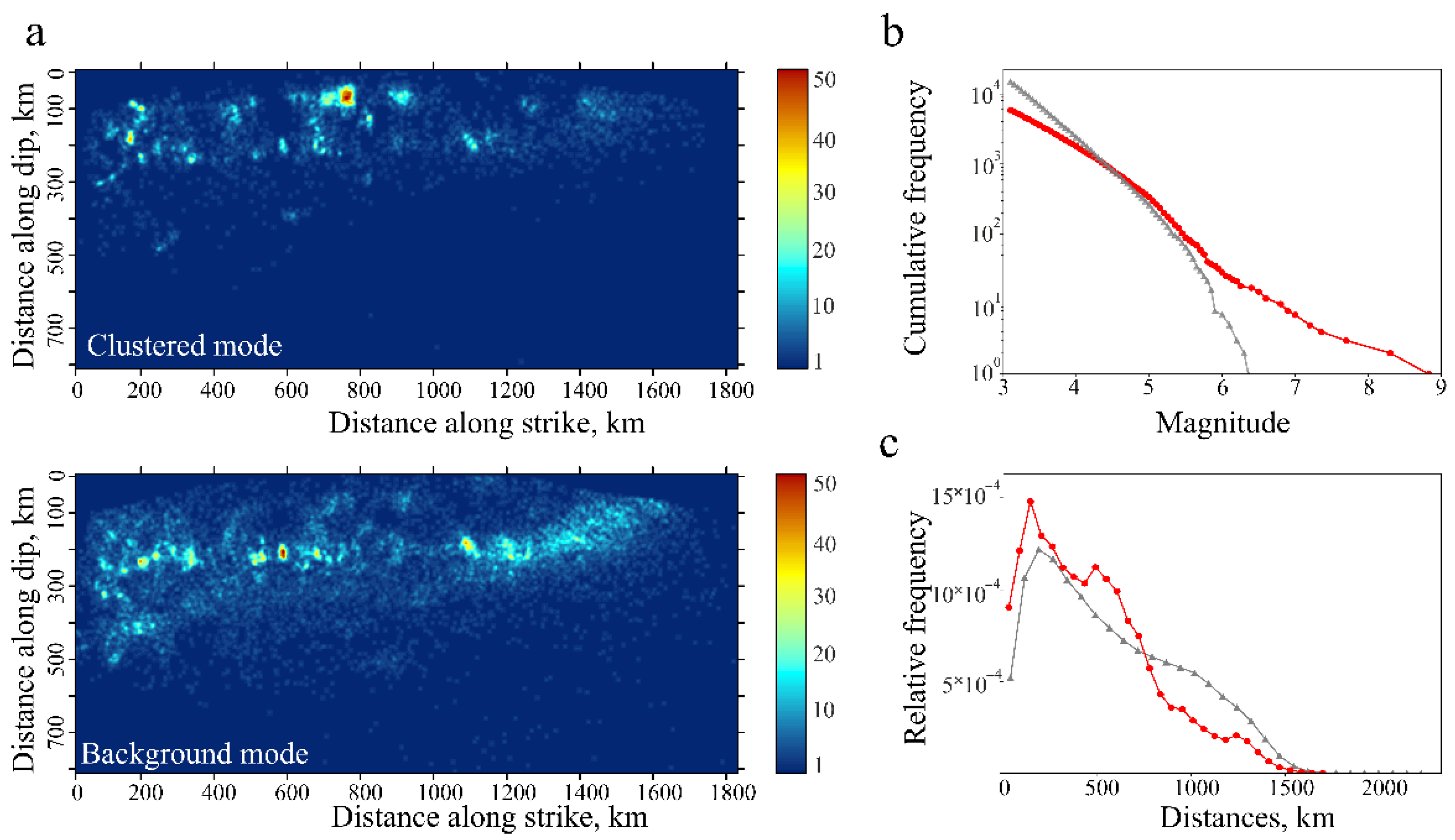
- If there are several configurations with identical numbers of dense clusters and events in the clusters, the optimal configuration is determined via the analysis of pairwise distances between events in dense clusters. Dense clusters localize in zones of tectonic asperity localization; hence, the characteristic distance between events, which form dense sets, should correspond to the maximum distribution of distance between all the background events (Figure 4c).
4.3. Mapping Seismogenic Patches
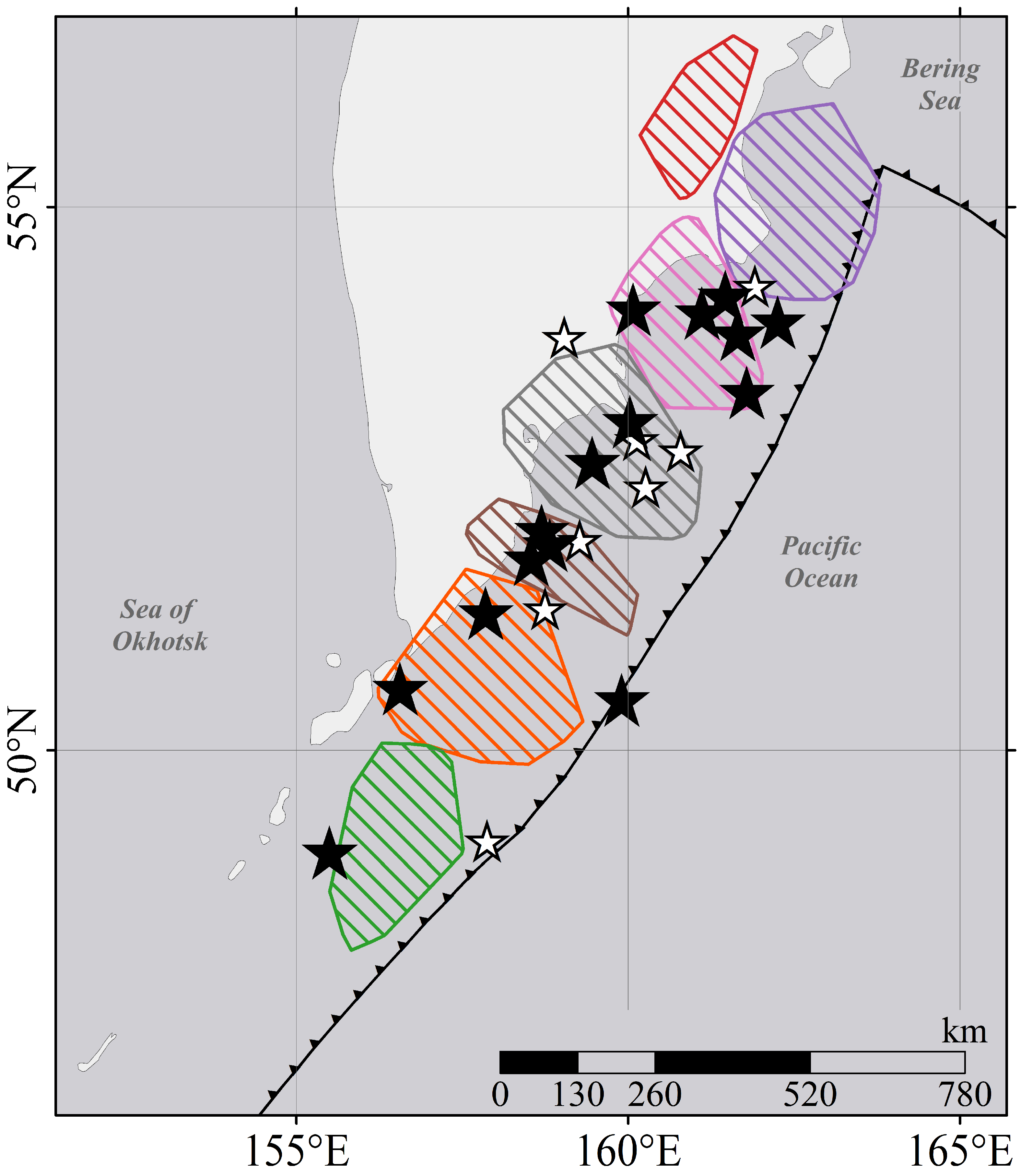
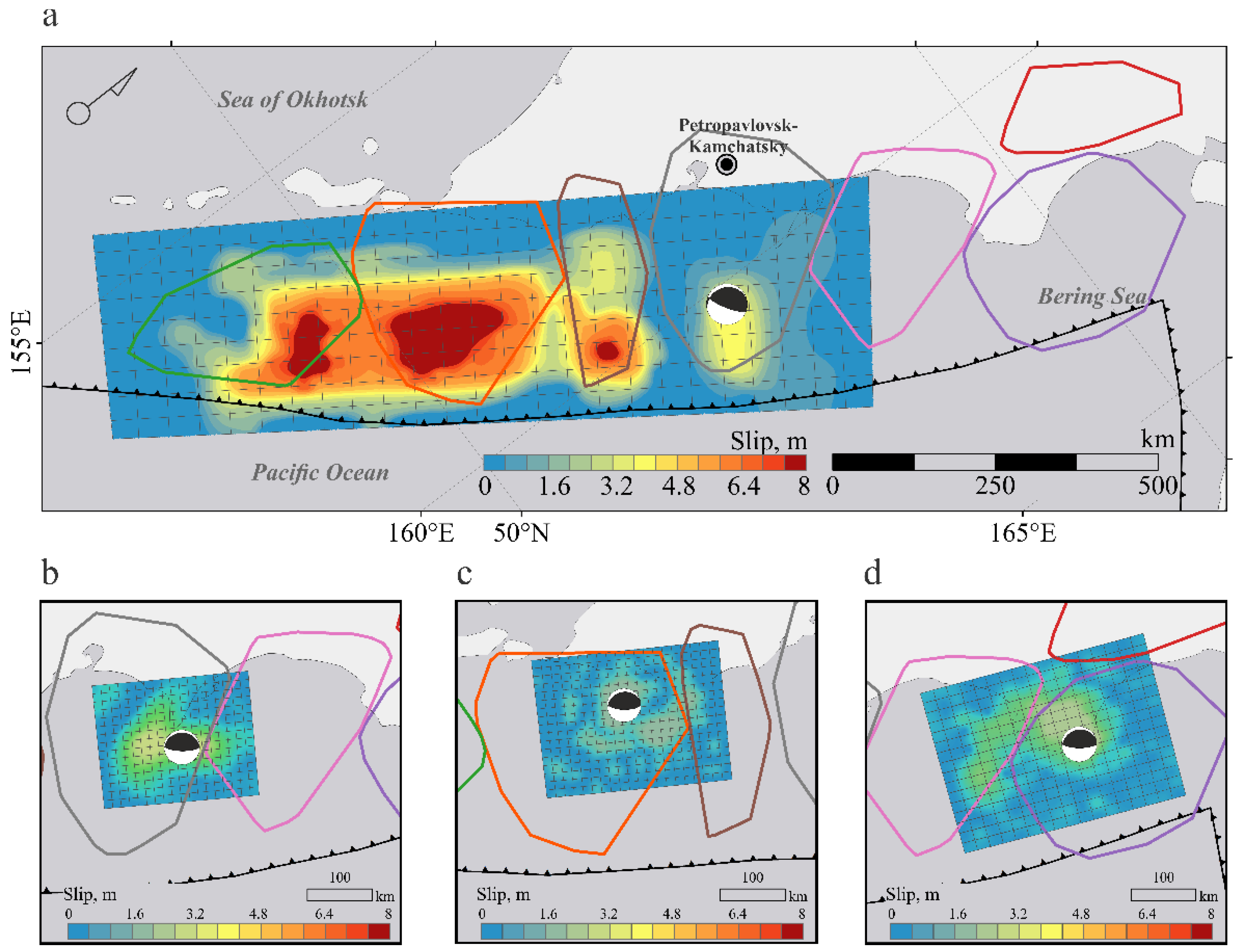
5. Localization of the Strongest Earthquakes
6. Discussion
7. Conclusions
Supplementary Materials
Author Contributions
Funding
Data Availability Statement
Conflicts of Interest
References
- Keilis-Borok, V.I.; Kossobokov, V.G. Premonitory activation of earthquake flow: Algorithm M8. Phys. Earth Planet. Inter. 1990, 61, 73–83. [Google Scholar] [CrossRef] [Scilit]
- Peresan, A.; Kossobokov, V.; Romashkova, L.; Panza, G.F. Intermediate-term middle-range earthquake predictions in Italy: A review. Earth-Sci. Rev. 2005, 69, 97–132. [Google Scholar] [CrossRef] [Scilit]
- Vijay, R.K.; Nanda, S.J.; Sharma, A. A review on clustering algorithms for spatiotemporal seismicity analysis. Artif. Intell. Rev. 2025, 58, 231. [Google Scholar] [CrossRef] [Scilit]
- Mignan, A.; Broccardo, M. Neural Network Applications in Earthquake Prediction (1994–2019): Meta-Analytic and Statistical Insights on Their Limitations. Seismol. Res. Lett. 2020, 91, 2330–2342. [Google Scholar] [CrossRef] [Scilit]
- Ruff, L.; Kanamori, H. Seismicity and the subduction process. Phys. Earth Planet. Inter. 1980, 23, 240–252. [Google Scholar] [CrossRef] [Scilit]
- Kanamori, H. Lessons from the 2004 Sumatra–Andaman earthquake. Philos. Trans. R. Soc. A 2006, 364, 1927–1945. [Google Scholar] [CrossRef] [Scilit] [PubMed]
- Bletery, Q.; Thomas, A.M.; Rempel, A.W.; Karlstrom, L.; Sladen, A.; De Barros, L. Mega-earthquakes rupture flat megathrusts. Science 2016, 354, 1027–1031. [Google Scholar] [CrossRef] [Scilit] [PubMed]
- McCaffrey, R. Global frequency of magnitude 9 earthquakes. Geology 2008, 36, 263–266. [Google Scholar] [CrossRef] [Scilit]
- Lay, T.; Kanamori, H.; Ruff, L. The Asperity Model and the Nature of Large Subduction Zone Earthquakes. Earthq. Predict. Res. 1982, 1, 3–71. [Google Scholar]
- Gzovsky, M.V. Foundation of Tectonophysics; Nauka: Moscow, Russia, 1975; p. 536. (In Russian) [Google Scholar]
- Sagy, A.; Brodsky, E.E.; Axen, G.J. Evolution of fault-surface roughness with slip. Geology 2007, 35, 283–286. [Google Scholar] [CrossRef] [Scilit]
- Candela, T.; Renard, F.; Klinger, Y.; Mair, K.; Schmittbuhl, J.; Brodsky, E.E. Roughness of Fault Surfaces over Nine Decades of Length Scales. J. Geophys. Res. 2012, 117, B08409. [Google Scholar] [CrossRef] [Scilit]
- Zielke, O.; Galis, M.; Mai, P.M. Fault roughness and strength heterogeneity control earthquake size and stress drop. Geophys. Res. Lett. 2017, 44, 777–783. [Google Scholar] [CrossRef] [Scilit]
- Byerlee, J.D. Frictional characteristics of granite under high contining pressure. J. Geophys. Res. 1967, 72, 3639–3648. [Google Scholar] [CrossRef] [Scilit]
- Engelder, J.T.; Scholz, C.H. The role of asperity indentation and ploughing in rock friction—II: Influence of relative hardness and normal load. Int. J. Rock Mech. Min. Sci. 1976, 13, 155–163. [Google Scholar] [CrossRef] [Scilit]
- Kaproth, B.M.; Marone, C. Slow Earthquakes, Preseismic Velocity Changes, and the Origin of Slow Frictional Stick-Slip. Science 2013, 341, 1229–1232. [Google Scholar] [CrossRef] [Scilit]
- Fagereng, A.; Beall, A. Is Complex Fault Zone Behaviour a Reflection of Rheological Heterogeneity? Phil. Trans. R. Soc. A 2021, 379, 20190421. [Google Scholar] [CrossRef] [Scilit]
- Collettini, C.; Barchi, M.R.; De Paola, N.; Trippetta, F.; Tinti, E. Rock and fault rheology explain differences between on fault and distributed seismicity. Nat. Commun. 2022, 13, 5627. [Google Scholar] [CrossRef] [Scilit] [PubMed]
- Collettini, C.; Tesei, T.; Scuderi, M.M.; Carpenter, B.M.; Viti, C. Beyond Byerlee friction, weak faults, and implications for slip behavior. Earth Planet. Sci. Lett. 2019, 519, 245–263. [Google Scholar] [CrossRef] [Scilit]
- Ruzhich, V.V.; Kocharyan, G.G.; Ostapchuk, A.A.; Shilko, E.V. Different-Scale Heterogeneities in Segments of Active Faults and Their Influence on Slip Modes. Phys. Mesomech. 2024, 27, 217–228. [Google Scholar] [CrossRef] [Scilit]
- Fagereng, A. Frequency-size distribution of competent lenses in a block-in-matrix mélange: Imposed length scales of brittle deformation? J. Geophys. Res. 2011, 116, B05302. [Google Scholar] [CrossRef] [Scilit]
- Dublanchet, P.; Bernard, P.; Favreau, P. Interactions and triggering in a 3-D rate-and-state asperity model. J. Geophys. Res. 2013, 118, 2225–2245. [Google Scholar] [CrossRef] [Scilit]
- Gounon, A.; Latour, S.; Letort, J.; El Arem, S. Rupture nucleation on a periodically heterogeneous interface. Geophys. Res. Lett. 2022, 49, e2021GL096816. [Google Scholar] [CrossRef] [Scilit]
- Bedford, J.D.; Faulkner, D.R.; Lapusta, N. Fault rock heterogeneity can produce fault weakness and reduce fault stability. Nat. Commun. 2022, 13, 326. [Google Scholar] [CrossRef] [Scilit]
- Gridin, G.A.; Kocharyan, G.G.; Morozova, K.G.; Novikova, E.V.; Ostapchuk, A.A.; Pavlov, D.V. Evolution of Sliding Along a Heterogenous Fault. A Large-Scale Laboratory Experiment. Izv. Phys. Solid Earth 2023, 59, 139–147. [Google Scholar] [CrossRef] [Scilit]
- Scholz, C.H.; Campos, J. The Seismic Coupling of Subduction Zones Revisited. J. Geophys. Res. 2012, 117, B05310. [Google Scholar] [CrossRef] [Scilit]
- Frank, W.B.; Shapiro, N.M.; Husker, A.L.; Kostoglodov, V.; Gusev, A.A.; Campillo, M. The evolving interaction of low-frequency earthquakes during transient slip. Sci. Adv. 2016, 2, e1501616. [Google Scholar] [CrossRef] [Scilit]
- Ostapchuk, A.A.; Morozova, K.G.; Besedina, A.N.; Gridin, G.A.; Grygoryeva, A.; Pavlov, D. Features of seismicity triggered by ripple-fired explosions at the Korobkovskoye iron ore deposit. Russ. J. Earth Sci. 2024, 24, 5013. [Google Scholar] [CrossRef] [Scilit]
- Luo, Y.; Ampuero, J.P. Stability of faults with heterogeneous friction properties and effective normal stress. Tectonophysics 2018, 733, 257–272. [Google Scholar] [CrossRef] [Scilit]
- Ide, S. Modeling fast and slow earthquakes at various scales. Proc. Jpn. Acad. Ser. B 2014, 90, 259–277. [Google Scholar] [CrossRef] [Scilit]
- Noda, H.; Lapusta, N. Stable creeping fault segments can become destructive as a result of dynamic weakening. Nature 2013, 493, 518–521. [Google Scholar] [CrossRef] [Scilit]
- Kositsky, A.P.; Avouac, J.-P. Inverting geodetic time series with a principal component analysis-based inversion method. J. Geophys. Res. 2010, 115, B03401. [Google Scholar] [CrossRef] [Scilit]
- Chlieh, M.; Mothes, P.A.; Nocquet, J.-M.; Jarrin, P.; Charvis, P.; Cisneros, D.; Font, Y.; Collot, J.-Y.; Villegas-Lanza, J.-C.; Rolandone, F.; et al. Distribution of discrete seismic asperities and aseismic slip along the Ecuadorian megathrust. Earth Planet. Sci. Lett. 2014, 400, 292–301. [Google Scholar] [CrossRef] [Scilit]
- Li, Y.; Shan, X.; Gao, Z.; Huang, X. Interseismic coupling, asperity distribution, and earthquake potential on major faults in southeastern Tibet. Geophys. Res. Lett. 2023, 50, e2022GL101209. [Google Scholar] [CrossRef] [Scilit]
- Métois, M.; Vigny, C.; Socquet, A. Interseismic Coupling, Megathrust Earthquakes and Seismic Swarms along the Chilean Subduction Zone (38°–18°S). Pure Appl. Geophys. 2016, 173, 1431–1449. [Google Scholar] [CrossRef] [Scilit]
- Hikima, K.; Koketsu, K. Rupture processes of the 2004 Chuetsu (mid-Niigata prefecture) earthquake, Japan: A series of events in a complex fault system. Geophys. Res. Lett. 2005, 32, L18303. [Google Scholar] [CrossRef] [Scilit]
- Cirella, A.; Piatanesi, A.; Tinti, E.; Chini, M.; Cocco, M. Complexity of the rupture process during the 2009 L’Aquila, Italy, earthquake. Geophys. J. Int. 2012, 190, 607–621. [Google Scholar] [CrossRef] [Scilit]
- Yoshida, S.; Koketsu, K.; Shibazaki, B.; Sagiya, T.; Kato, T.; Yoshida, Y. Joint Inversion of Near- and Far-field Waveforms and Geodetic Data for the Rupture Process of the 1995 Kobe Earthquake. J. Phys. Earth 1996, 44, 437–454. [Google Scholar] [CrossRef] [Scilit]
- Guo, R.; Tang, X.; Zhang, Y.; Qin, M.; Xu, J.; Zhou, J.; Zou, X.; Sun, H. Seismic versus aseismic slip for the 2023 Kahramanmaraş earthquake doublet. Nat. Commun. 2025, 16, 959. [Google Scholar] [CrossRef] [Scilit]
- Kocharyan, G.G.; Ostapchuk, A.A.; Gridin, G.A.; Kishkina, S.B. The Role of Sliding Surface Macrostructure in the Nucleation and Development of Dynamic Instability in the Upper Part of the Earth’s Crust. Izv. Phys. Solid Earth 2025, 61, 691–702. [Google Scholar] [CrossRef] [Scilit]
- Taymaz, T.; Tan, O.; Yolsal, S. Sumatra Earthquake (Mw~9.3) of December 26, 2004 Source Rupture Processes and Slip Distribution Modeling: Preliminary Rupture Model. Available online: http://web.itu.edu.tr/taymaz/sumatra/index.html (accessed on 11 December 2025).
- Lee, S.-J.; Huang, B.-S.; Ando, M.; Chiu, H.-C.; Wang, J.-H. Evidence of large scale repeating slip during the 2011 Tohoku-Oki earthquake. Geophys. Res. Lett. 2011, 38, L19306. [Google Scholar] [CrossRef] [Scilit]
- Lee, S.-J.; Yeh, T.-Y.; Lin, T.-C.; Lin, Y.-Y.; Song, T.-R.A.; Huang, B.-S. Two-stage composite megathrust rupture of the 2015 Mw8.4 Illapel, Chile, earthquake identified by spectral-element inversion of teleseismic waves. Geophys. Res. Lett. 2016, 43, 4979–4985. [Google Scholar] [CrossRef] [Scilit]
- Lin, Y.-Y.; Lapusta, N. Microseismicity simulated on asperity-like fault patches: On scaling of seismic moment with duration and seismological estimates of stress drops. Geophys. Res. Lett. 2018, 45, 8145–8155. [Google Scholar] [CrossRef] [Scilit]
- Valoroso, L.; Chiaraluce, L.; Collettini, C. Earthquakes and fault zone structure. Geology 2014, 42, 343–346. [Google Scholar] [CrossRef] [Scilit]
- Trugman, D.T.; Ross, Z.E. Pervasive foreshock activity across southern California. Geophys. Res. Lett. 2019, 46, 8772–8781. [Google Scholar] [CrossRef] [Scilit]
- Ostapchuk, A.; Polyatykin, V.; Popov, M.; Kocharyan, G. Seismogenic Patches in a Tectonic Fault Interface. Front. Earth Sci. 2022, 10, 904814. [Google Scholar] [CrossRef] [Scilit]
- Chalumeau, C.; Agurto-Detzel, H.; Rietbrock, A.; Frietsch, M.; Oncken, O.; Segovia, M.; Galve, A. Seismological evidence for a multifault network at the subduction interface. Nature 2024, 628, 558–562. [Google Scholar] [CrossRef] [Scilit]
- Ostapchuk, A.A. Displaying the Structure and Rheological Properties of a Fault Zone in the Characteristics of Background Seismicity. Dokl. Earth Sci. 2025, 523, 31. [Google Scholar] [CrossRef] [Scilit]
- Kanamori, H. The energy release in great earthquakes. J. Geophys. Res. 1977, 82, 2981–2987. [Google Scholar] [CrossRef] [Scilit]
- Walker, K.T.; Ishii, M.; Shearer, P.M. Rupture details of the 28 March 2005 Sumatra Mw 8.6 earthquake imaged with teleseismic P waves. Geophys. Res. Lett. 2005, 32, L24303. [Google Scholar] [CrossRef] [Scilit]
- Lay, T. A review of the rupture characteristics of the 2011 Tohoku-oki Mw 9.1 earthquake. Tectonophysics 2018, 733, 4–36. [Google Scholar] [CrossRef] [Scilit]
- Wirth, E.A.; Sahakian, V.J.; Wallace, L.M.; Melnick, D. The occurrence and hazards of great subduction zone earthquakes. Nat. Rev. Earth Environ. 2022, 3, 125–140. [Google Scholar] [CrossRef] [Scilit]
- Bushenkova, N.; Koulakov, I.; Bergal-Kuvikas, O.; Shapiro, N.; Gordeev, E.I.; Chebrov, D.V.; Abkadyrov, I.; Jakovlev, A.; Stupina, T.; Novgorodova, A.; et al. Connections between arc volcanoes in Central Kamchatka and the subducting slab inferred from local earthquake seismic tomography. J. Volcanol. Geotherm. Res. 2023, 435, 107768. [Google Scholar] [CrossRef] [Scilit]
- Fedotov, S.A.; Solomatin, A.V.; Chernyshev, S.D. A Long-Term Earthquake Forecast for the Kuril–Kamchatka Arc for the Period from September 2010 to August 2015 and the Reliability of Previous Forecasts, as well as their Applications. J. Volcanol. Seismol. 2011, 5, 75–99. [Google Scholar] [CrossRef] [Scilit]
- Hindle, D.; Fujita, K.; Mackey, K. Deformation of the Northwestern Okhotsk Plate: How is it happening? Stephan Mueller Spec. Publ. Ser. 2009, 4, 147–156. [Google Scholar] [CrossRef] [Scilit]
- Gordeev, E.I.; Bergal-Kuvikas, O.V. Structure of subduction zone and volcanism on Kamchatka. Dokl. Earth Sci. 2022, 502, 21–24. [Google Scholar] [CrossRef] [Scilit]
- Tibaldi, A. Recent surface faulting investigated in Kamchatka volcanic arc. Eos Trans. AGU 2004, 85, 133–141. [Google Scholar] [CrossRef] [Scilit]
- DeMets, C.; Gordon, R.G.; Argus, D.F.; Stein, S. Current plate motions. Geophys. J. Int. 1990, 101, 425–478. [Google Scholar] [CrossRef] [Scilit]
- Steblov, G.M.; Kogan, M.G.; King, R.W.; Scholz, C.H.; Bürgmann, R.; Frolov, D.I. Imprint of the North American plate in Siberia revealed by GPS. Geophys. Res. Lett. 2003, 30, 1924. [Google Scholar] [CrossRef] [Scilit]
- Fedotov, S.A. Seismicheskoje Rajonirovanie S.S.S.R.; Nauka: Moscow, Russia, 1968; pp. 121–150. [Google Scholar]
- Fedotov, S.A.; Solomatin, A.V. Long-Term Earthquake Prediction (LTEP) for the Kuril–Kamchatka island arc, June 2019 to May 2024; Properties of Preceding Seismicity from January 2017 to May 2019. The Development and Practical Application of the LTEP Method. J. Volcanol. Seismol. 2019, 13, 349–362. [Google Scholar] [CrossRef] [Scilit]
- Johnson, J.; Satake, K. Asperity Distribution of the 1952 Great Kamchatka Earthquake and its Relation to Future Earthquake Potential in Kamchatka. Pure Appl. Geophys. 1999, 154, 541–553. [Google Scholar] [CrossRef] [Scilit]
- MacInnes, B.T.; Weiss, R.; Bourgeois, J.; Pinegina, T.K. Slip Distribution of the 1952 Kamchatka Great Earthquake Based on Near-Field Tsunami Deposits and Historical Records. Bull. Seismol. Soc. Am. 2010, 100, 1695–1709. [Google Scholar] [CrossRef] [Scilit]
- Droznin, D.V.; Droznina, S.Y.; Senyukov, S.L.; Chebrov, D.V.; Shapiro, N.M.; Shebalin, P.N. Probabilistic Estimates of Hypocenters from the Data of Kamchatka Seismic Network Stations. Izv. Phys. Solid Earth 2019, 55, 677–687. [Google Scholar] [CrossRef] [Scilit]
- Wiemer, S.; Wyss, M. Minimum Magnitude of Completeness in Earthquake Catalogs: Examples from Alaska, the Western United States, and Japan. Bull. Seismol. Soc. Am. 2000, 90, 859–869. [Google Scholar] [CrossRef] [Scilit]
- Gutenberg, R.; Richter, C.F. Frequency of Earthquakes in California. Bull. Seismol. Soc. Am. 1944, 34, 185. [Google Scholar] [CrossRef] [Scilit]
- Bushenkova, N.; Kuchay, O.A. Focal mechanisms of earthquakes in the subduction zone of the Western Pacific plate. Geodyn. Tectonophys. 2022, 13, 0639. [Google Scholar] [CrossRef] [Scilit]
- Hayes, G.P.; Moore, G.L.; Portner, D.E.; Hearne, M.; Flamme, H.; Furtney, M.; Smoczyk, G.M. Slab2, a comprehensive subduction zone geometry model. Science 2018, 362, 58–61. [Google Scholar] [CrossRef] [Scilit]
- Brune, J.N. Tectonic stress and the spectra of seismic shear waves from earthquakes. J. Geophys. Res. 1970, 75, 4997–5009. [Google Scholar] [CrossRef] [Scilit]
- Kuksenko, V.S.; Lyashkov, A.I.; Mirzoev, K.M.; Negmatullaev, S.H.; Stanchits, S.A.; Frolov, D.I. Relation between sizes of the cracks formed under load and duration of elastic energy release. Dokl. AN SSSR 1982, 264, 846–848. [Google Scholar]
- King, G.C.P. Speculations on the geometry of the initiation and termination processes of earthquake rupture and its relation to morphology and geological structure. Pure Appl. Geophys. 1986, 124, 567–585. [Google Scholar] [CrossRef] [Scilit]
- Behr, W.M.; Bürgmann, R. What’s downthere? The structures, materials and environment of deep-seated slow slip and tremor. Phil. Trans. R. Soc. A 2021, 379, 20200218. [Google Scholar] [CrossRef] [Scilit]
- Seno, T. Fractal Asperities, Invasion of Barriers, and Interplate Earthquakes. Earth Planets Space 2003, 55, 649–665. [Google Scholar] [CrossRef] [Scilit]
- Kocharyan, G.G.; Ostapchuk, A.A. Mesostructure of a Tectonic Fault Slip Zone. Phys. Mesomech. 2023, 26, 82–92. [Google Scholar] [CrossRef] [Scilit]
- Baiesi, M.; Paczuski, M. Scale-free Networks of Earthquakes and Aftershocks. Phys. Rev. E 2004, 69, 066106. [Google Scholar] [CrossRef] [Scilit]
- Shebalin, P.; Narteau, C. Depth Dependent Stress Revealed by Aftershocks. Nat. Commun. 2017, 8, 1317. [Google Scholar] [CrossRef] [Scilit]
- Zaliapin, I.; Ben-Zion, Y. A global classification and characterization of earthquake clusters. Geophys. J. Int. 2016, 207, 608–634. [Google Scholar] [CrossRef] [Scilit]
- Alaei, B.; Torabi, A. Fault asperity and roughness, insight from faults in 3D reflection seismic data. Mar. Pet. Geol. 2024, 170, 107145. [Google Scholar] [CrossRef] [Scilit]
- Cochran, E.S.; Page, M.T.; van der Elst, N.J.; Ross, Z.E.; Trugman, D.T. Fault Roughness at Seismogenic Depths and Links to Earthquake Behavior. Seism. Rec. 2023, 3, 37–47. [Google Scholar] [CrossRef] [Scilit]
- Agayan, S.M.; Bogoutdinov, S.R.; Dobrovolsky, M.N. Discrete Perfect Sets and Their Application in Cluster Analysis. Cybern. Syst. Anal. 2014, 50, 176–190. [Google Scholar] [CrossRef] [Scilit]
- Agayan, S.M.; Bogoutdinov, S.R.; Dzeboev, B.A.; Dzeranov, B.V.; Kamaev, D.A.; Osipov, M.O. DPS Clustering: New Results. Appl. Sci. 2022, 12, 9335. [Google Scholar] [CrossRef] [Scilit]
- Soloviev, A.A.; Gvishiani, A.D.; Gorshkov, A.I.; Dobrovolsky, M.N.; Novikova, O.V. Recognition of earthquake-prone areas: Methodology and analysis of the results. Izv. Phys. Solid Earth 2014, 50, 151–168. [Google Scholar] [CrossRef] [Scilit]
- Gvishiani, A.D.; Dzeboev, B.A.; Dzeranov, B.V.; Kedrov, E.O.; Skorkina, A.A.; Nikitina, I.M. Strong Earthquake-Prone Areas in the Eastern Sector of the Arctic Zone of the Russian Federation. Appl. Sci. 2022, 12, 11990. [Google Scholar] [CrossRef] [Scilit]
- Jain, A.K.; Murty, M.N.; Flynn, P.J. Data clustering: A review. ACM Comput. Surv. 1999, 31, 264–323. [Google Scholar] [CrossRef] [Scilit]
- Chan, T.M. Optimal output-sensitive convex hull algorithms in two and three dimensions. Discrete Comput. Geom. 1996, 16, 361–368. [Google Scholar] [CrossRef] [Scilit]
- Kocharyan, G.G.; Kishkina, S.B. The Physical Mesomechanics of the Earthquake Source. Phys. Mesomech 2021, 24, 343–356. [Google Scholar] [CrossRef] [Scilit]
- Pacheco, J.F.; Sykes, L.R. Seismic moment catalog of karge shallow earthquakes, 1900 to 1989. Bull. Seismol. Soc. Am. 1992, 82, 1306–1349. [Google Scholar] [CrossRef] [Scilit]
- Vallée, M.; Douet, V. A new database of Source Time Functions (STFs) extracted from the SCARDEC method. Phys. Earth Planet. Int. 2016, 257, 149–157. [Google Scholar] [CrossRef] [Scilit]
- Ye, L.; Kanamori, H.; Lay, T. Global variations of large megathrust earthquake rupture characteristics. Sci. Adv. 2018, 4, eaao4915. [Google Scholar] [CrossRef] [Scilit] [PubMed]
- Xu, D.; Wang, W.; Ren, Z. Preliminary slip distribution of the July 29, 2025 Mw 8.8 Kamchatka, Russia earthquake. Earthq. Res. Adv. 2025; in press. [CrossRef] [Scilit]
- Bergen, K.J.; Johnson, P.A.; de Hoop, M.V.; Beroza, G.C. Machine learning for data-driven discovery in solid Earth geoscience. Science 2019, 363, eaau0323. [Google Scholar] [CrossRef] [Scilit]
- Ren, C.X.; Hulbert, C.; Johnson, P.A.; Rouet-Leduc, B. Machine learning and fault rupture: A review. Adv. Geophys. 2020, 61, 57–107. [Google Scholar] [CrossRef] [Scilit]
- McCann, W.R.; Nishenko, S.P.; Sykes, L.R.; Krause, J. Seismic gaps and plate tectonics: Seismic potential for major boundaries. Pure Appl. Geophys. 1979, 117, 1082–1147. [Google Scholar] [CrossRef] [Scilit]
- Lay, T.; Nishenko, S.P. Updated concepts of seismic gaps and asperities to assess great earthquake hazard along South America. Proc. Natl. Acad. Sci. USA 2022, 119, e2216843119. [Google Scholar] [CrossRef] [Scilit]
- Ide, S. Frequent observations of identical onsets of large and small earthquakes. Nature 2019, 573, 112–116. [Google Scholar] [CrossRef] [Scilit]
- Gelfand, I.M.; Guberman, S.A.; Keilis-Borok, V.I.; Knopoff, L.; Press, F.S.; Ranzman, E.Y.; Rotwain, I.M.; Sadovsky, A.M. Pattern recognition applied to earthquakes epicenters in California. Phys. Earth Planet. Inter. 1976, 11, 227–283. [Google Scholar] [CrossRef] [Scilit]
- Kossobokov, V.G.; Soloviev, A.A. Pattern recognition in problems of seismic hazard assessment. Chebyshevskii Sb. 2018, 19, 55–90. (In Russian) [Google Scholar] [CrossRef] [Scilit]
- Yamanaka, Y.; Kikuchi, M. Asperity Map along the Subduction Zone in Northeastern Japan Inferred from Regional Seismic Data. J. Geophys. Res. 2004, 109, B07307. [Google Scholar] [CrossRef] [Scilit]
- Kanamori, H.; McNally, K.C. Variable rupture mode of the subduction zone along the Ecuador-Colombia coast. Bull. Seismol. Soc. Am. 1982, 72, 1241–1253. [Google Scholar]



| No. | Data | Magnitude, Mw | Source |
|---|---|---|---|
| 1 | 8 July 1993 | 7.5 | https://earthquake.usgs.gov/earthquakes/eventpage/usp0005u7b/finite-fault (accessed on 8 January 2026) |
| 2 | 5 December 1997 | 7.8 | https://earthquake.usgs.gov/earthquakes/eventpage/usp0008btk/finite-fault (accessed on 8 January 2026) |
| 3 | 29 July 2025 | 8.8 | [91] |
| 4 | 13 September 2025 | 7.5 | https://earthquake.usgs.gov/earthquakes/eventpage/us7000qx2g/finite-fault (accessed on 8 January 2026) |
Disclaimer/Publisher’s Note: The statements, opinions and data contained in all publications are solely those of the individual author(s) and contributor(s) and not of MDPI and/or the editor(s). MDPI and/or the editor(s) disclaim responsibility for any injury to people or property resulting from any ideas, methods, instructions or products referred to in the content. |
© 2026 by the authors. Licensee MDPI, Basel, Switzerland. This article is an open access article distributed under the terms and conditions of the Creative Commons Attribution (CC BY) license.
Share and Cite
Ostapchuk, A.; Nugmanov, I. Background Seismicity Highlights Tectonic Asperities. Geosciences 2026, 16, 38. https://doi.org/10.3390/geosciences16010038
Ostapchuk A, Nugmanov I. Background Seismicity Highlights Tectonic Asperities. Geosciences. 2026; 16(1):38. https://doi.org/10.3390/geosciences16010038
Chicago/Turabian StyleOstapchuk, Alexey, and Ilmir Nugmanov. 2026. "Background Seismicity Highlights Tectonic Asperities" Geosciences 16, no. 1: 38. https://doi.org/10.3390/geosciences16010038
APA StyleOstapchuk, A., & Nugmanov, I. (2026). Background Seismicity Highlights Tectonic Asperities. Geosciences, 16(1), 38. https://doi.org/10.3390/geosciences16010038