1. Introduction
The current process of climate change, which is intensifying extreme atmospheric events, has revealed the complexity of how societies coexist with natural hazards. This situation highlights the need to educate the population so that they understand the level of risk in the areas they inhabit and know how to act in emergency situations. The Sixth Assessment Report of the Intergovernmental Panel on Climate Change [
1] emphasizes the importance of addressing these phenomena comprehensively within the framework of disaster-risk actions included in the Sustainable Development Goals (SDGs 4, 9, 11, and 13) proposed by the United Nations [
2]. Furthermore, the concept of climate-resilient development has been introduced to describe the need for social and economic development that is healthy, equitable, and just throughout efforts to reduce the current global warming trend [
2].
Comprehensive disaster-risk management is a complex challenge that combines physical-environmental, social, and economic processes, along with political circumstances and the urgency derived from climate change [
3]. A clear example of this complexity is the cut-off low that affected Valencia (Spain) on 29 October 2024, revealing the extreme vulnerability of the Mediterranean region [
4,
5,
6]. In Mediterranean areas, floods represent a recurrent hazard, intensified by urban expansion in zones with insufficient drainage, which increases the vulnerability of populations and infrastructures to episodes of heavy rainfall [
7,
8,
9].
Statistics highlight this reality: between 2000 and 2023, 1174 deaths from natural disasters were recorded in Spain, mainly due to heat waves and floods [
10]. To this figure must be added the 237 victims of the 2024 cut-off low (229 in Valencia), an event that has significantly reshaped social perceptions of risk [
7] and is considered the second most destructive in the country since the mid-20th century [
5], surpassed only by the Vallés floods (Catalonia) in 1962 [
11].
The 2024 catastrophe was intensified by factors such as the rapid overflow of ravines, accelerated urbanization [
9], and the absence of effective alert systems and citizen preparedness [
12]. These elements underscore the need to implement stronger preventive policies and to promote a culture of resilience [
13].
In this context, the educational sphere emerges as a fundamental pillar for building resilient societies. This study highlights the urgency of preparing the school community to face such circumstances [
14]. Schools must integrate actions of prevention, response, and recovery that strengthen collective adaptation and transform experiences into meaningful learning [
15,
16,
17,
18]. Likewise, strengthening geographic [
19,
20] and environmental education [
21] is essential to address future climate challenges.
Within risk education, the current context of climate change makes it essential to incorporate into schools the teaching of extreme atmospheric phenomena as well as those of geological and biological origin. An important reference in this regard is the Fifth Assessment Report of the IPCC [
22], which highlighted the need to promote educational processes that facilitate understanding and preparation for these challenges. As noted, international frameworks such as the UN Sustainable Development Goals [
2] and the Sendai Framework for Disaster Risk Reduction [
23] emphasize the role of education in reducing social vulnerability and fostering a culture of prevention and resilience.
In Spain, education has traditionally not been viewed as a key factor in reducing social vulnerability to natural hazards. However, in recent years, multiple initiatives have been promoted to increase public knowledge about climate change and its associated risks [
24]. In this regard, significant progress has been made in risk-related educational legislation related, such as Law 7/2021 of 20 May on climate change, which includes specific educational measures in Title VIII [
25]. Furthermore, the education law LOMLOE (2020) has expanded the inclusion of climate change into curricula, overcoming the limitations of the LOMCE [
13].
Natural risk has been defined in multiple ways, but from a geographical perspective it is understood as the territorial outcome of unsuitable human interventions in areas prone to natural hazards. This approach integrates hazard, vulnerability, and exposure, and emphasizes that it is often human action that transforms a potentially dangerous environment into a risk space [
26]. Natural risk does not depend solely on the natural phenomenon—such as earthquakes, floods, or wildfires—but on how natural processes interact with the social, economic, and territorial conditions of communities, meaning its origin lies less in the event itself and more in the context in which it occurs.
The General Objective (GO) of this study is to identify and analyze the presence of knowledge related to natural hazards in the current official curriculum of the Spanish education system, covering the stages of Secondary Education (ages 12–16) and Baccalaureate (ages 16–18). Based on the analysis of the Royal Decrees (2022) that regulate the minimum teachings at each level, the study aims to:
- -
Specific Objective 1 (SO1): examine in which subjects and blocks of foundational knowledge natural hazards are addressed.
- -
Specific Objective 2 (SO2): identify the Specific Competencies (SC) related to this topic.
- -
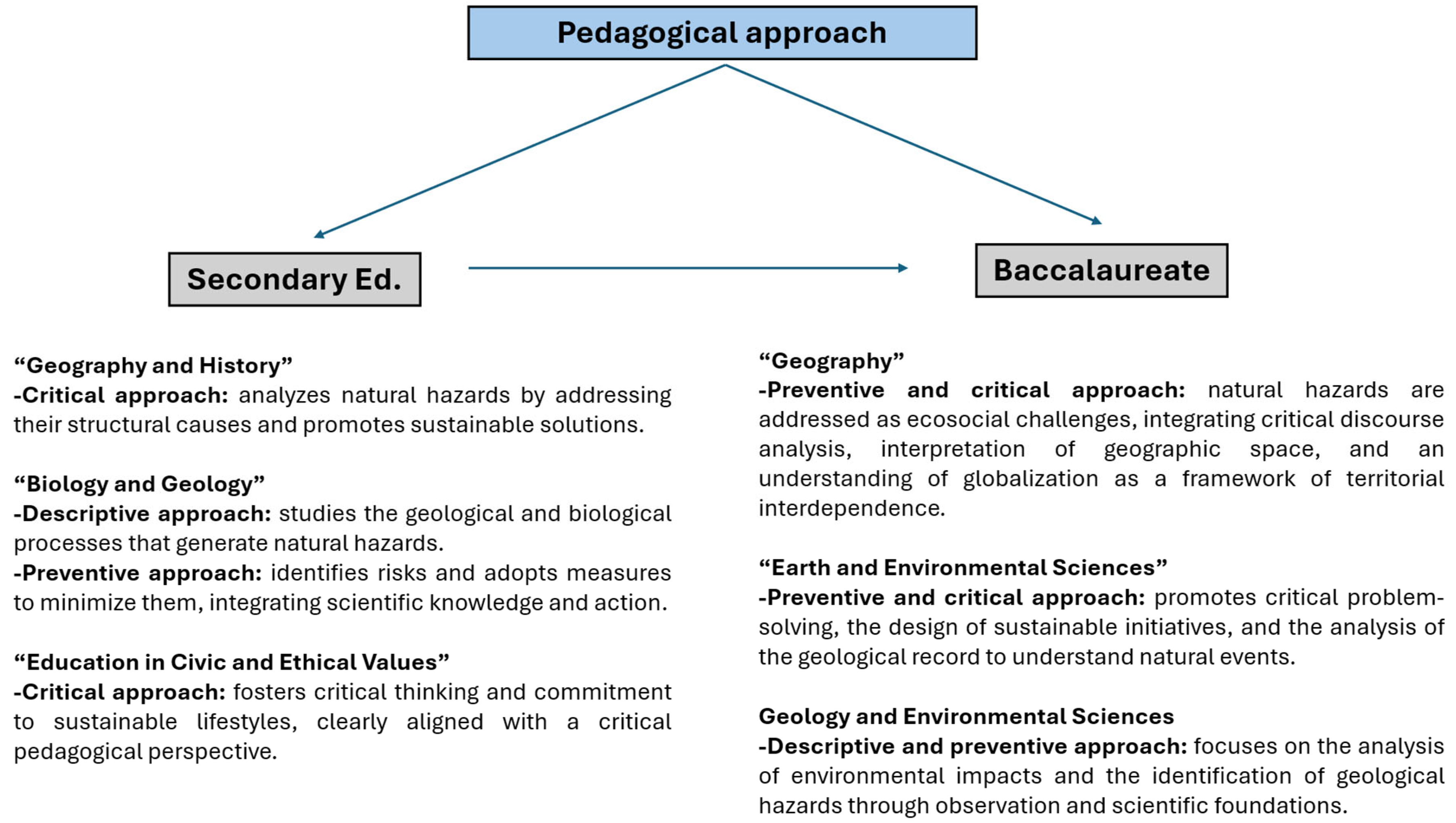
Specific Objective 3 (SO3): analyze the pedagogical approach applied to these contents (descriptive, preventive, or critical).
To address these objectives, three hypotheses are proposed:
Hypothesis 1 (H1): the presence of foundational knowledge related to natural hazards in the current official curriculum of the Spanish education system is limited and concentrated mainly in specific areas such as Natural and Social Sciences, with little transversal integration across other disciplines. Moreover, this knowledge does not appear to be adapted to the school ages at which it is taught, which may lead to misconceptions about their territorial relevance, effects, and the guidelines for managing extreme events that should be organized at each educational stage.
Hypothesis 2 (H2). the SC show a certain degree of curricular transversality in the teaching of natural hazards, implying that different subject areas contribute complementarily to their educational treatment.
Hypothesis 3 (H3). the predominant pedagogical approach is mainly descriptive, with limited orientation toward prevention, action, and critical reflection, which constrains the development of civic competencies in the face of natural disasters.
4. Discussion and Conclusions
This study emerges from the need to strengthen territorial education, especially in the wake of events such as the 2024 cut-off low in Valencia, which revealed shortcomings in geographic literacy and the culture of prevention. Its objective was to propose a more coherent, transversal, and contextualized curricular integration that prepares students to face current and future climate challenges. The analysis of the Royal Decrees regulating the minimum teaching requirements in Secondary Education and Baccalaureate has made it possible to clearly identify not only the potential and progress achieved, but also the limitations and opportunities regarding the treatment of natural hazards in the Spanish educational system.
With respect to Hypothesis 1 (H1), the findings confirm that foundational knowledge related to natural hazards is limited and concentrated in “Geography”. Although the curriculum recognizes the need to understand natural phenomena and their relationship with human activity, cross-disciplinary integration remains relatively weak. There is a tendency to relegate these contents to scientific subjects, which prevents a comprehensive understanding of risk as a social, environmental, and cultural phenomenon. Therefore, H1 is confirmed: natural hazards are addressed within specific disciplinary areas, without yet achieving full interdisciplinary integration.
Nonetheless, progress can also be observed in the articulation between educational levels, showing a conceptual and competence-based progression rooted in experiential learning. In this regard, stronger coordination between theoretical content and practical student work across subjects dealing with natural hazards would be highly valuable, while respecting the specific contributions each discipline: more analytical in “Geology and Environmental Sciences” and “Earth and Environmental Sciences”, and more social and territorial in “Geography”. Developing a shared portfolio of practical activities would be a highly valuable didactic initiative.
Hypothesis 2 (H2), which posited a degree of transversal integration in the SC related to natural hazards, is partially confirmed. Competencies across different stages show a coherent competence-based approach that fosters the development of scientific thinking, ethical reflection, and responsible action in the face of adverse natural phenomena. In Secondary Education, the competencies of “Geography and History” and “Biology and Geology” combine territorial and scientific perspective on risk, while “Education in Civic and Ethical Values” consolidate ethical reflection on vulnerability, shared responsibility, and sustainability. Although, this convergence is not always fully coordinated at the curricular level, it nonetheless represents progress toward transversality, partially confirming H2. At the Baccalaureate level, the competencies of “Geography”, “Earth and Environmental Sciences”, and “Geology and Environmental Sciences” consolidate this trend, integrating scientific understanding with social critique and responsible decision-making.
With respect Hypothesis 3 (H3), the findings confirm a gradual incorporation of preventive and critical perspectives as students advance through the system. Subjects such as “Geography” or “Education in Civic and Ethical Values” enable risks to be contextualized socially and environmentally, fostering reflection on environmental justice and civic co-responsibility. In this sense, H3 is partially confirmed: a preventive approach is consolidated at intermediate stages, while a more critical perspective emerges in the later years.
Overall, the results reveal a coherent, though uneven, curricular progression. Nevertheless, the lack of genuine transversality and the limited continuity between stages persist as structural weaknesses. Incorporating an ecosocial approach that connects scientific knowledge with ethical and civic dimensions would allow for the consolidation of a truly transformative education, as suggested by González-Reyes and Gómez-Chuliá [
29].
These findings are aligned with recent literature in environmental and risk education, which calls for moving beyond descriptive models toward critical, participatory pedagogies that foster action and community resilience against climate change [
14,
34,
35]. Education must prepare students to interpret, prevent, and confront natural phenomena through collective co-responsibility, in coherence with the culture and particularities of each territory [
36]. The urgent need to strengthen geographic [
19,
20], environmental education [
21], and the training of future teachers in risk education—especially in the current context of climate change [
34]—is clearly highlighted. Likewise, it is essential to incorporate, from the earliest educational stages, knowledge that enables students to understand their environment, anticipate risks, and act in an informed manner, thereby ensuring curricular coherence and continuity [
37].
This study identifies several areas for improving the curricular integration of natural hazards. Thus, it recommends fostering interdisciplinary approaches that connect scientific, ethical, and territorial knowledge; employing active methodologies such as projects and case studies; adapting content to the local context; strengthening the ecosocial dimension across all stages; developing specific teaching resources; training teachers in environmental education; and assessing integrated competencies. These actions would enable a deeper, more critical, and more committed understanding of natural hazards from the perspective of active and responsible citizenship. Furthermore, transversality must be promoted across all disciplines involved (Geography, History, Biology, Geology, etc.), under the coordination of Geography, the discipline in which the comprehensive study of natural hazards, physical, human, economic and environmental, originated.
Meiyuyang [
38] emphasizes the importance of competency-oriented climate change education, highlighting transversal skills such as critical thinking and problem-solving. This aligns with the findings of the present study, which reveal fragmented curricular treatment of natural hazards in Spain. Similarly, Buckler and Creech [
39], in their final report on the UN Decade of Education for Sustainable Development, stress the need for coherence, integration, and transformative approaches across educational systems. Together, these works reinforce the argument that risk education must be transversal, locally grounded, and action-oriented, bridging descriptive knowledge with preventive and critical reflection to strengthen resilience among students.
Nevertheless, the research has limitations, as it focuses exclusively on Royal Decrees establishing minimum teaching requirements, without considering regional adaptations. These are particularly significant in regions such as the Valencian Community, where flood risk is frequent and could be more explicitly represented in regional curricula. Future research should therefore examine Early Childhood Education (up to age 6) and Primary Education (ages 6 to 12); as well as compare regional curricula to identify how natural hazards are contextualized according to the geographic and social characteristics of each territory.
Future research should address several key challenges to deepen understanding of how natural hazards are integrated into education. Incorporating empirical evidence from schools directly affected by extreme events—such as those impacted by the 2024 cut-off low in Valencia—would provide valuable insights into how curricular guidelines translate into real classroom practices. Longitudinal studies could further illuminate how students’ preventive and critical competencies evolve across educational stages.
Furthermore, the study should be expanded at the internationally, contrasting the Spanish curriculum with those of countries that have developed more advanced educational models in risk management and climate resilience, such as Chile, Japan [
40], New Zealand or Australia [
41]. Such comparison would allow the identification of good practices, alternative competence frameworks, and pedagogical strategies that could be adapted to the Spanish context [
42]. Together, these lines of research would contribute to enriching the curricular debate and consolidating an education that is better prepared, contextualized, and committed to global climate challenges [
43,
44]. Advancing these lines of inquiry will contribute to designing more coherent, equitable, and territorially grounded educational responses to current and future climate challenges.
Extreme climate events, such as the 2024 cut-off low in Valencia, reflect a global environmental crisis that directly affects society [
45]. In this context, education becomes a strategic tool for understanding, anticipating, and managing risks from a territorial and civic perspective. The curriculum must explicitly and transversally integrate content on natural hazards, climate change, and resilience, revising competencies and methodologies across all educational stages. Ultimately, educating climate risk is both an ethical and pedagogical responsibility. Preparing students for future extreme events means preparing them to care for, understand, and transform their environment. Education is a fundamental pillar for building more informed and safer societies, capable of responding rationally to increasing risks and ensuring prevention and resilience in the current context of climate change.