
Article

Cl-Bearing Mineral Microinclusions in Arc Lavas: An Overview of Recent Findings with Some Metallogenic Implications


by
Pavel Kepezhinskas
1,*,
Nikolai Berdnikov
1,
Irina Voinova
1,
Nikita Kepezhinskas
2,
Nadezhda Potapova
1 and
Valeria Krutikova
1
1
Institute of Tectonics and Geophysics, Russian Academy of Sciences, Khabarovsk 680000, Russia
2
Tetra Tech Inc., Chantilly, VA 20151, USA
*
Author to whom correspondence should be addressed.
Geosciences 2026, 16(1), 40; https://doi.org/10.3390/geosciences16010040
Submission received: 13 November 2025 / Revised: 30 December 2025 / Accepted: 5 January 2026 / Published: 12 January 2026

Abstract

Quaternary lavas (ankaramite, basalt, basaltic andesite, andesite, dacite) from the Kamchatka, Kurile, Ecuador and Cascade volcanic arcs contain Cl-bearing mineral microinclusions in rock-forming minerals and groundmass volcanic glass. They are represented by chlorargyrite (with a variable amount of native Ag), Cu, Ag, Sn, and Zn compounds with Cl and S, Sn- and Pb-Sb oxychlorides compositionally similar to abhurite and nadorite, as well as bismoclite and Cl-F-apatite. The Cl-bearing compounds with chalcophile metals are best approximated by mixtures of chlorargyrite with Cu sulfides, malachite, or azurite. Some Cl-bearing solid microinclusions in magmatic rock-forming minerals could have formed from Cl-rich melts exsolved from arc magmas during differentiation. Alternatively, specific magmatic microinclusions may record the decomposition of primary sulfides in the presence of Cl-bearing magmatic volatiles. Post-magmatic Cl microminerals found in fractures, pores, grain contacts, and groundmass glass are most probably precipitated from hydrothermal fluids accompanying their emplacement at the surface and post-eruption transformations in active fumarole fields. Assemblages of Cl-bearing microminerals with native metal, alloy, sulfide, oxide, and sulfate microinclusions in arc lavas potentially record late-magmatic to post-magmatic stages of formation of the epithermal and possibly porphyry mineralization beneath arc volcanoes.

1. Introduction

Magmatic volatiles play a fundamental role in the processes of mantle melting and metasomatism, differentiation of mantle and crustal melts, explosive volcanic eruptions, as well as the formation of associated ore deposits [1,2,3,4]. Although water and, to a lesser extent, carbon dioxide are principal components of magmatic volatiles, they also contain variable amounts of sulfur, chlorine and fluorine, as well as various trace and ore metals [5,6,7]. Slab- and asthenospheric mantle-derived volatiles control the mobility and transport of chemical elements during crust–mantle interactions in subduction-related and within-plate tectonic settings, while metal-rich fluids exsolved from evolving plutonic and volcanic systems may, under certain conditions, lead to the formation of hydrothermal ore deposits in the upper crust [8,9,10,11]. During these ore-forming crustal events, various volatile components form diverse complex compounds with many economic metals to facilitate their transport into porphyry and epithermal environments, where sharp changes in physico-chemical conditions may possibly lead to ore mineral precipitation and the accumulation of economically valuable metal deposits [12,13,14].
Chlorine is one of the most intriguing volatile elements in subduction-related and intraplate environments due to its (1) high solubility in high-temperature melts and fluids within a wide range of pressures, temperatures, and magma compositions [15,16] and (2) ability to form complexes with many chalcophile and siderophile ore metals [12,14,17,18,19]. Both properties promote the importance of chlorine for fluid-phase behavior, metal transport in mineralizing fluids, magma degassing processes, and the composition of volcanic emissions [20]. In mid-ocean ridge basalts (MORBs), back-arc basin basalts (BABBs), and ocean island basalts (OIBs), chlorine behaves as a highly incompatible element and increases with the gradual decrease in basaltic MgO content with differentiation [21,22,23]. Chlorine is commonly found at tens to thousands of ppm levels in melt inclusions from minerals of arc-related volcanic rocks [24,25,26]. Variations in chlorine content and chlorine isotope composition in arc lavas indicate that chlorine in subduction-related magmas is controlled by the stability of accessory phases in the subducted slab with serpentinites and altered oceanic crust representing major sources for halogen elements [27,28]. Several studies suggested that seawater recycling in subduction zones has possibly played an important role in arc-related magma- and ore-forming processes [29,30]. Besides fluid and melt inclusions, this geochemically important halogen element is frequently incorporated into the crystal structure of igneous amphibole, mica, and apatite, reflecting the compositional evolution of the associated magmatic volatile phase [31,32]. Solid microinclusions of chloride salts, such as halite (NaCl), sylvite (KCl), and Fe-chlorides, are present in hydrothermal deposits [33,34], kimberlites (where they are frequently associated with crustal contamination [35,36,37]), carbonatites [38,39], and some layered mafic-ultramafic intrusions, like the Stillwater Complex [40]). Salt inclusions are very rare in subduction- and collision-related magmatic rocks, although their occurrence in granitic systems was predicted experimentally [41,42]. The few examples include solid halite and sylvite inclusions in magmatic quartz and feldspars from Late Cambrian–Early Ordovician post-collisional felsic granitoids of the Sierra Norte-Ambargasta batholith in Argentina [43], bismuth-antimony-lead-copper-silver chloride, along with halite–sylvite microinclusions in Triassic arc subduction-related ultramafic plutonic rocks from the Stanovoy Superterrane in the Russian Far East [44,45] and cotunnite (PbCl2) microinclusions in the explosive Taragai Peridotite Complex from the Bureya terrane of the Russian Far East [46]. We have also previously reported the occurrence of silver chloride microinclusions in Early Cretaceous post-collisional adakites from the Stanovoy Superterrane and Pliocene–Pleistocene adakites from the Kamchatka volcanic arc [47], but in all of these cases, and until recently, chloride microinclusions were observed only in magmatic rocks from the paleo-convergent margin settings.
This study focuses on mineral microparticles first microns to first tens of microns in size, which are found in some igneous rocks during detailed electron microscope investigations. These mineral microinclusions carry important information about geochemical specialization and the ore potential of magmatic rocks, as well as characteristics of the associated fluids and redox conditions of their formation and evolution [11,37,39,43,44,45,46,47]. We use the term “magmatic” throughout this study to describe solid microinclusions (microminerals) formed together (and possibly simultaneously) with magmatic rock-forming minerals. The term “post-magmatic” is being applied to the solid microinclusions, which were formed during the post-magmatic (hydrothermal) evolution of the investigated rocks. The main criteria for the magmatic classification of mineral microinclusions is their paragenetic association with primary magmatic minerals, with additional evidence for possible co-crystallization from a melt. In several cases, the magmatic origin may be indicated by the microinclusion shape and morphology, e.g., droplet-like shape of some sulfide, oxide, native metal, and metal alloy microinclusions. Occasionally, a late-magmatic affinity can be assigned to a particular microinclusion, especially in the case of a close textural association with late-magmatic silicate phases such as amphibole. Post-magmatic solid microinclusions are related to the secondary hydrothermal–metasomatic (autometasomatic) processes and are either associated with hydrothermal minerals or are observed in late-stage defects in the host lava, such as microfractures, micropores, and microvoids. In some cases, it is difficult to classify solid microinclusions in igneous rocks into magmatic and post-magmatic types. Some examples of this ambiguous origin include microminerals located in a groundmass volcanic glass or on the walls of gas vesicles and voids in a groundmass glass, as well as microminerals observed at the contact between magmatic minerals. These uncertain cases will be discussed separately, preferably taking into account additional criteria for primary and secondary origins, such as the physico-chemical conditions of the formation of both solid microinclusions and their host minerals.
This paper presents an overview of recent findings of chlorine-bearing microinclusions (microminerals) in silicate minerals and groundmass glass in modern arc lavas from Kamchatka, Kuriles, Ecuador and Cascades, with an attempt to (1) document different (magmatic versus late- and post-magmatic) textural and compositional types of Cl-bearing microinclusions, (2) evaluate the geochemical fingerprints of associated magmatic-hydrothermal fluids, and (3) provide some insights into the metallogeny and ore-forming potential of volcanic arc magmas.

2. Geologic Background

2.1. Kamchatka

The Kamchatka active margin reflects a protracted history of subduction, arc–continent collision, and terrane accretion along the northeastern edge of the Eurasian continental mass (Figure 1a). The current Kamchatka subduction zone geometry was formed in the Late Pleistocene in response to the northwestern subduction of the Mesozoic Pacific oceanic lithosphere [48]. The Kamchatka margin is segmented into northern, central, and southern segments (Figure 1a). The central segment of Kamchatka comprises the Sredinny Range remnant arc, the Central Depression intra-arc rift, and the active Eastern Volcanic Front (Figure 1a). The central segment of Kamchatka is underlain by a thickened mafic to felsic crust, terminated in the south by the Petropavlovsk-Malkinsky Fault Zone (PMFZ) [49]. The southern segment of the Kamchatka margin south of the PMFZ shows clear structural and geological ties with the northern segment of the Kurile arc and includes several active calc-alkaline to tholeiitic volcanoes such as Mutnovsky, Gorely, Ksudach, and others.
We have analyzed Quaternary lavas from four Kamchatka volcanoes—Avachinsky, Bakening, Mutnovsky, and Gorely—for the purpose of this study. The Avachinsky volcano is a prominent somma-type volcano, which erupted arcs ankaramite, basalt, basaltic andesite, and andesite throughout its history [53]. Bakening is a dormant volcano on the southern tip of the Central Kamchatka Depression located at the rear of the modern Eastern Volcanic Front (Figure 1a). The Bakening stratocone is composed of two principal petrographic lava types: (1) plagioclase-pyroxene-phyric andesite and (2) amphibole dacite [54]. Mutnovsky is a frontal arc volcano within the southern segment of the Kamchatka arc (Figure 1a) composed of four (Mutnovsky I to IV) stratocones that have been active since the Late Pleistocene [55]. The composition of eruptive Holocene products ranges from olivine basalt to dacite derived from the mantle wedge, slab fluids, eclogite-facies melts, and minor sediment sources [55]. The rear-arc Gorely volcano (Figure 1a) is composed of the Old Gorely shield volcano (700–361 ka) and a Young Gorely composite stratocone (361 and 38 ka) [56]. The high-precision O-Sr-Nd-Hf-Pb isotope data suggest that there is a hydrous sediment melt-modified mantle source for Gorely lavas [57].
Studies of thermal waters, fumaroles, and gas emissions at Mutnovsky, Gorely, and Avachinsky volcanoes in Kamchatka indicate that chlorine (typically 1–2 wt.% of HCl), along with water vapor, carbon, and sulfur dioxides, is a common geochemical component of magmatic volatiles [58,59,60]. Metal chlorides such as halite, sylvite, chlorargyrite, cotunnite (Pb-chloride), and tolbachite (Cu-chloride) are present in Kamchatka fumarole deposits, along with some other exotic and rare chlorine-bearing mineral phases [61,62,63]. In general, it appears that chlorine is an important component in magmatic volatiles that accompany crustal evolution, emplacement, and the post-eruptive transformation of volcanic arc magmas in Kamchatka.

2.2. The Kuriles

The Kurile island arc reflects the northwestward subduction of the Aptian to Turonian (118–90 ma) Pacific oceanic plate under the Okhotsk microplate along the Kurile deep-sea trench with a rate of 8.3–8.5 cm/year [50]. The Kurile arc is usually subdivided into northern, central, and southern segments composed of a predominantly mafic crust, with crustal thicknesses varying from 28–33 km under the southern segment, through 25–30 km under the central segment, and to 32–36 km under the northern segment [64]. The Oligocene–Pleistocene back-arc volcanism in the back-arc Kurile Basin is represented by high-K calc-alkaline basalts, basaltic andesites, and andesites broadly compositionally similar to the rear-arc volcanic series of the Kurile arc [65]. The Kurile arc comprises 36 active volcanoes and 116 Quaternary submarine volcanoes, which belong to the arcs tholeiite, calc-akaline, and alkaline (shoshonitic) magma series generated from variably depleted mantle wedge sources metasomatized by slab fluids and melts [50,66].
The Bogdan Khmelnitsky volcano on Iturup Island is a typical stratocone, which erupted two-pyroxene basalts and andesites with minor dacites, possibly reflecting crystal fractionation and mixing processes in a sub-volcanic magmatic conduit beneath the Khmelnitsky stratocone [67]. The last eruptions occurred in 1843 and 1860, and current activity includes several active fumarolic fields near the summit crater [67]. The Yankitch Island represents the summit of an almost fully submerged Ushishir volcano with a 1 km-wide, hydrothermally active basaltic andesite crater with three small dacitic domes located inside of the crater [68]. The Zavaritsky volcano on Simushir Island is a major caldera center, which erupted numerous Holocene low-K basaltic andesites, andesites, dacites, and rhyolites. Current activity at the Zavaritsky volcano is mostly fumarolic [67]. The Prevo (Prevo Peak) volcano in the middle of Simushir Island is composed of the Holocene low-K olivine-plagioclase-pyroxene-phyric basalts and basaltic andesites. The last basaltic cinder eruptions apparently happened in the XVIII and XIX centuries, and there are reports of some fumarolic activity in 1914 [67]. The Krenitsyn volcano on the Onekotan Island (Figure 1b) includes a caldera formed at 7040 BP [67] composed of olivine-pyroxene basalts and two-pyroxene basaltic andesites and the post-caldera Krenitsyn stratocone composed of plagioclase-pyroxene-phyric andesite lavas and pyroclastic rocks. Current activity at the Krenitsyn volcano is manifested by the fumaroles in the main crater as well as mineralized thermal springs associated with the 1952 cumuldome [67]. The Alaid volcano on the Atlasova Island (Figure 1b) consists of the Upper Pleistocene “Older Alaid” cone and the “Younger Alaid” Holocene stratocone [69]. With frequent summit crater events and major Taketomi (1933–1934) and Olympic (1972) side vent eruptions, Alaid is among the most active volcanic centers in the Kuriles, which produced mantle-derived medium-K calc-alkaline and high-K (shoshonitic) basalts [50,66].
The composition of the Kurile volcanic gases is dominated by water vapor, with minor CO2, SO2, H2S, and HCl and trace HF, N2, Ar, He, and CH4 [70]. Some fumaroles at the Kudryavy (Iturup Island) and Pallas (Ketoy Island) volcanoes contain highly variable (ppb to ppm) amounts of Ag, As, Au, Pd, B, Be, Bi, Cd, Cu, Ir, Li, Mo, Pb, Sb, Sn, W, and Zn [70]. Volcanic sublimates near the summit crater of the Alaid stratocone contain native gold, palladium, silver, copper, and zinc along with Au-Pd, Cu-Zn, and Cu-W alloys [71]. Native Au and Ag along with abundant Cu-Ag-Au alloys were detected in high-temperature fumarolic gases from the Kudryavy volcano [72], possibly manifesting a high volatile metal output from the Kurile subduction zone volcanoes.

2.3. Ecuador

The Ecuadorian segment of the Northern Andean Volcanic Zone was formed in response to the oceanic Nazca plate beneath the northwestern margin of the South American continent ([51]; Figure 1c). The broad volcanic arc, caused by subduction of the thick and buoyant Carnegie Ridge, includes more than 80 Quaternary volcanoes (21 with Holocene eruptions). The Ecuadorian arc rests on a series of Mesozoic crustal terranes accreted to the Andean margin in the Late Cretaceous and Paleocene [73]. Current subduction-related volcanism in Ecuador started at ~1.3 Ma, and volcanic activity increased dramatically around ~0.6 Ma [51]. Many Quaternary andesites and dacites in Ecuador display adakite-like geochemical characteristics attributed to the flat subduction of the relatively young (10–20 Ma) and thick oceanic crust of the Carnegie Ridge [74].
The Quilotoa volcano is the westernmost active volcano located in the frontal part (Western Cordillera) of the Ecuador volcanic arc approximately 120 km from the trench (Figure 1a–c). The volcano is composed of the lake-filled caldera surrounded by older andesitic and younger dacitic domes [75]. The Quilotoa caldera lake is characterized by elevated Cl, SO4, and HCO3 contents and the precipitation of alunite, which suggests that there have been recent emissions of HCl- and S-bearing magmatic gases from the Quilotoa volcano.
The Holocene Cotopaxi volcano erupted lavas ranging in composition from basaltic andesite and andesite to dacite and rhyolite with low Y contents (<16 ppm), elevated La/Yb ratios (>5), and excess 230Th concentrations consistent with the garnet-bearing magmatic source [76]. Remote Fourier-transform infrared (FTIR) analysis of the gas plume composition during the 2015 Cotopaxi eruption suggested the presence of large quantities of sulfur dioxide along with minor chlorine and bromine [77].
The Tungurahua volcano is composed of Tungurahua I andesitic stratovolcano, Tungurahua II andesitic-dacitic volcanic edifice (14,000 to 2995 BP), and the modern Tungurahua III volcano constructed through numerous andesite-dacite pyroclastic explosions and the extrusion of several dacitic lava flows [78]. Petrologic considerations suggest that Tungurahua magmas were water-rich, averaging 6 wt.% H2O, and that the present volcanic system frequently experienced injections of volatile-rich melt pulses from petrologically distinct magma reservoirs [78]. Recent long-term observations suggest that the Tungurahua volcanic emissions are dominated by water vapor (>98%) with SO2 and minor amounts of bromine and chlorine [79].

2.4. The Cascades

The Cascades’ magmatic arc reflects the eastward subduction of the young (<10 Ma) oceanic lithosphere of the Juan de Fuca and Gorda microplates beneath the North American lithospheric plate (Figure 1d). The arc is subdivided into the Eocene–Miocene ancestral (Western Cascades), initiated through the docking of Siletzia terrane against the North American continent and the Pliocene–Recent modern (High Cascades) arc, which reflects post-Miocene plate configuration [52]. The modern arc is dominated by calc-alkaline basalts, MORB-like low-K tholeiites, and OIB-like, Nb-enriched basalts [80]. The young age (5–10 Ma) of the Juan de Fuca plate and possible tear of the downgoing slab in the Cascadia subduction zone possibly resulted in localized slab melting and the eruption of some young adakitic dacites at the Mt. St. Helens volcano [81].
Mount Hood is a long-lived volcanic center in the central Cascades arc, which erupted repeatedly over the last one and a half million years (Figure 1d). The older (pre-300 ka to 150 ka) volcanic rocks underlying the young stratocone include andesites and basaltic andesites [82]. The main cone (<150 ka) is composed of basaltic andesite lava flows and scoria cones, as well as andesitic to dacitic lava domes and pyroclastic flows younger than 30 ka [82]. Silicic melt inclusions in the minerals of andesites and dacites from the young Mt. Hood stratocone contain 0.2–0.36 wt.% Cl, while S concentrations are at the detection limit of the ion probe method [83].

3. Samples and Methods

We have studied 61 samples of modern volcanic rocks, which are distributed among four arc systems as follows: 27 samples from Kamchatka, 15 from the Kuriles, 11 from Ecuador, and 8 from the Cascades. Kamchatka samples represent caldera-forming andesite and post-caldera ankaramite from the Avachinsky volcano; amphibole dacite lava flows on the eastern side of the Bakening volcano; basalt, basaltic andesite, andesite, and dacite from the youngest volcanic edifices within the Mutnovsky volcano; and basalt, andesite, and dacite from the Young Gorely composite cone.
In our investigation, we used a collection of modern arc lavas from six active volcanoes along the strike of the Kurile Island arc (Figure 1b): Khmelnitsky (Iturup Island), Ushishir (Yankicha Island), Zavaritsky and Prevo (Simushir Island), Krenitsyn (Onekotan Island), and Alaid (Atlasov Island). We have sampled several basaltic lava flows within the main stratocone of the Bogdan Khmelnitsky volcano. A single sample of basaltic andesite was taken from the base of the Ushishir crater wall. Also we have sampled two basaltic andesite lava flows at the base of the Holocene Zavaritsky stratocone. A single sample of basaltic andesite lava was collected on the northwestern side of the Prevo volcano. Three samples were taken from several caldera-forming basaltic and basaltic andesite lava flows at the Krenitsyn volcano. We have collected basaltic lava from the Taketomi and Olympic side vents of the Alaid volcano.
We have sampled three Quaternary volcanic centers, Quilotoa, Cotopaxi, and Tungurahua, across the entire width of the Ecuadorian volcanic arc (Figure 1c). Two samples of pyroxene-plagioclase-phyric andesites were collected on the southwestern side of the Quilotoa caldera lake. Four samples were taken from young lava flows on the southern side of the Cotopaxi stratocone, and five samples were collected from amphibole dacite lava flows on the western side of the Tugurahua volcano.
We have collected two samples of amphibole-plagioclase-phyric andesite from the base of the young Mt. Hood volcanic cone.
All petrographic, electron microscopic, and most of the geochemical analytical work was carried out at the Khabarovosk Innovation-Analytical Center of the Institute of Tectonics and Geophysics, Far East Branch of the Russian Academy of Science, Khabarovsk, Russian Federation.
Petrographic study of volcanic rocks was completed using the Imager A2m microscope (Carl Zeiss, Jena, Germany). Investigation of morphology and chemical composition of minerals, mineral microinclusions, and native metals and their alloys was conducted using a Vega 3 LMH (Tescan, Brno, Czech Republic) scanning electron microscope (SEM) equipped with X-Max 80 (Oxford Instruments, Abingdon, UK) energy dispersive spectrometer (EDS) with the following operating conditions: accelerating voltage of 20 kV, beam current ~500 nA, and beam diameter of 0.2 µm. An extensive database of reference samples for all chemical elements incorporated into the Aztec Advanced AztecEnergy software as well as the co-standard Oxford Instruments No. 6864-15 were used as standards during our SEM study. Accuracy of the EDS analyses was estimated to be ±0.1 wt.%. X-ray spectra of microinclusions of less than 5 µm in size, besides the spectral response from the inclusion itself, typically include some excitation spectra from a host mineral. A correction method proposed in [84] was used to interpret mixed spectra for ultra-small metal and mineral microinclusions.
Major elements were measured on pressed pellets using a S4 Pioneer XRF spectrometer (Bruker, Leipzig, Germany). International LDI-3 (gabbro) and WMG-1a (mineralized gabbro) reference materials were used for calibration. The analytical accuracy for major elements was ±10%. Abundances of trace elements were determined with an ELAN 9000 ICP-MS spectrometer (Perkin Elmer, Woodbridge, ON, Canada) after the acid digestion of a powdered sample. In addition to the above listed standards, geochemical reference samples BHVO-2 (USGS; Hawaiian basalt) and JB-3 (Geological Survey of Japan; Fuji basalt), along with Perkin Elmer standard solutions PE# N9300231-9300234 for internal calibration, were used to control the accuracy of analytical measurements. The accuracy was ±5% for trace element abundances of >20 ppm and ±10% for chemical elements with abundances of <20 ppm [46]. Additional trace elements in volcanic rocks from the Kuriles and the Cascades were acquired using the Agilent 8800 ICP-MS instrument (Agilent Technologies, Santa Clara, CA, USA) in the Laboratory of Analytical Chemistry, Analytical Center of the Far East Geological Institute, Far East Branch of the Russian Academy of Sciences, Vladivostok, Russia.

4. Results

4.1. Petrology and Geochemistry of Host Arc Lavas

All subduction-related lavas in this study represent Quaternary (Holocene in most cases) eruptions of active volcanoes in Kamchatka, the Kuriles, Ecuador, and the Cascades, are free of any significant alteration, and frequently contain fresh volcanic glass in the groundmass.
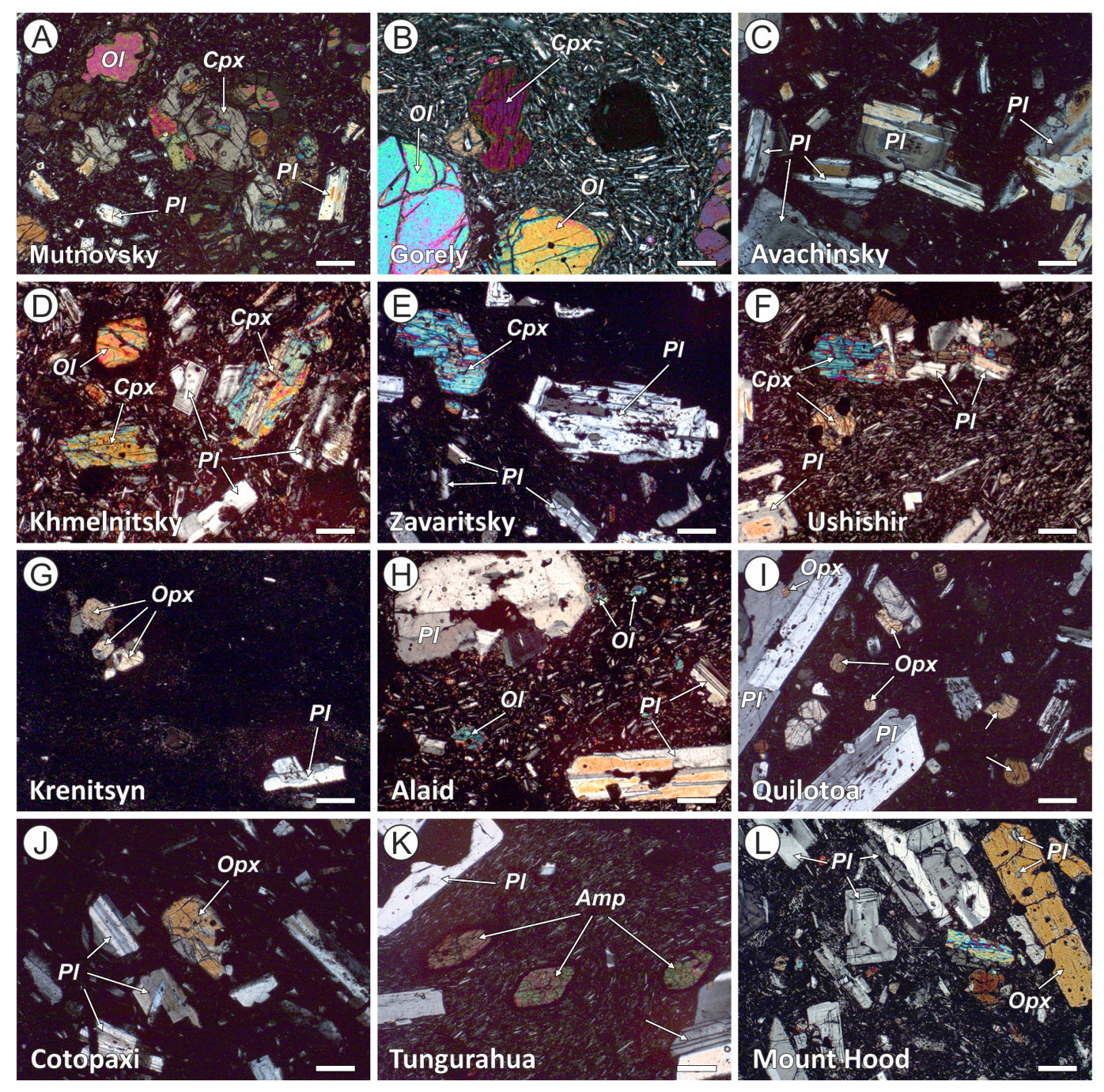
Volcanic samples from Kamchatka are porphyritic basalts (Figure 2A,B), basaltic andesites, and andesites (Figure 2C) with olivine, clinopyroxene, orthopyroxene, and plagioclase as the principal phenocrysts in a hyalopilitic to microlitic (basalts, basaltic andesites) and hypocrystalline to holohyaline (andesites) groundmass. Dacites from the Bakening volcano in Kamchatka contain hornblende phenocrysts, occasionally with opacitic rims. Basalts from the Mutnovsky volcano frequently carry plagioclase-pyroxene crystal clots (Figure 2A). Euhedral olivine phenocrysts in magnesian basalts from the Gorely volcano contain equant spinel inclusions (Figure 2B). Euhedral plagioclase dominates both phenocryst and microlite populations in andesite lava from the Avachinsky volcano (Figure 2C). Accessory minerals in Kamchatka lavas include Al-Fe-Mg-Cr spinel, titanomagnetite, ilmenite, apatite (frequently with chlorine and fluorine), and zircon.
Basalts from the Khmelnitsky volcano (Iturup Island) are intensely porphyritic, with phenocrysts composed of euhedral to subhedral olivine, clinopyroxene, orthopyroxene, and plagioclase in a hyalopilitic groundmass (Figure 2D). Clinopyroxene frequently forms glomerocrysts with calcic (bitownite to andesine) plagioclase and titanomagnetite. Basaltic andesite lavas from the Zavaritsky volcano (Simushir Island) contain large subhedral clinopyroxene and optically zoned euhedral plagioclase phenocrysts embedded in a predominantly glassy, holohyaline groundmass (Figure 2E). Dacites from the Ushishir volcano (Yankich Island) display a porphyritic texture with clinopyroxene and plagioclase phenocrysts (Figure 2E,F). Groundmass in the Ushishir dacites is commonly hyalopilitic, composed of silicic volcanic glass with plagioclase (mostly andesine-oligoclase), magnetite, and apatite microlites. Basalts and basaltic andesites from the Krenitsyn volcano (Onekotan Island) typically have low-phenocryst content (around 1–3 percent) and a glassy holohyaline groundmass (Figure 2G). Phenocrysts are primarily composed of pyroxenes and plagioclase, and the glassy groundmass contains some plagioclase microlites with accessory apatite and Fe oxides. Basalts from the Alaid volcano (Atlasov Island) are highly porphyritic, with large phenocrysts of euhedral and partially resorbed plagioclase and smaller anhedral olivine (Figure 2H). Olivine, spinel, and some clinopyroxene occur as microphenocrysts in hyalopilitic groundmass along with plagioclase microlites and minor apatite, titanomagnetite, and ilmenite.
Modern Ecuadorian lavas investigated in this study are very fresh, moderately to highly porphyritic andesites and dacites. Andesites from the Quilotoa caldera contain large crudely zoned plagioclase phenocrysts frequently associated with smaller orthopyroxene and plagioclase microphenocrysts (Figure 2I). The groundmass typically has a hyalopilitic texture composed of glass and plagioclase microlites, with some accessory Fe oxides. Porphyritic andesites from the Cotopaxi volcano usually contain approximately equal amounts of orthopyroxene and plagioclase (labradorite-andesine) phenocrysts (Figure 2J). Minor clinopyroxene and rare amphibole are also observed. Accessory minerals include titanomagnetite, F-apatite, and zircon. Dacites from the historic eruptions of the Tungurahua volcano are porphyritic lavas dominated by euhedral amphibole megacrysts, phenocrysts, and microphenocrysts (Figure 2K). Some amphibole grains display distinct opaque rims. Plagioclase also shows some evidence of chemical corrosion (Figure 2K). Accessory minerals in Tungurahua dacites include apatite, zircon, and Fe-Ti oxides.
Andesites from the Mount Hood volcano in the Cascades arc are highly porphyritic lavas with phenocrysts composed of andesine-labradorite plagioclase, amphibole, and minor orthopyroxene (Figure 2L). Orthopyroxene frequently contains inclusions of plagioclase and titanomagnetite (Figure 2L). Apatite, titanomagnetite, and magnetite are common accessory minerals in the intermediate Mt. Hood lavas.
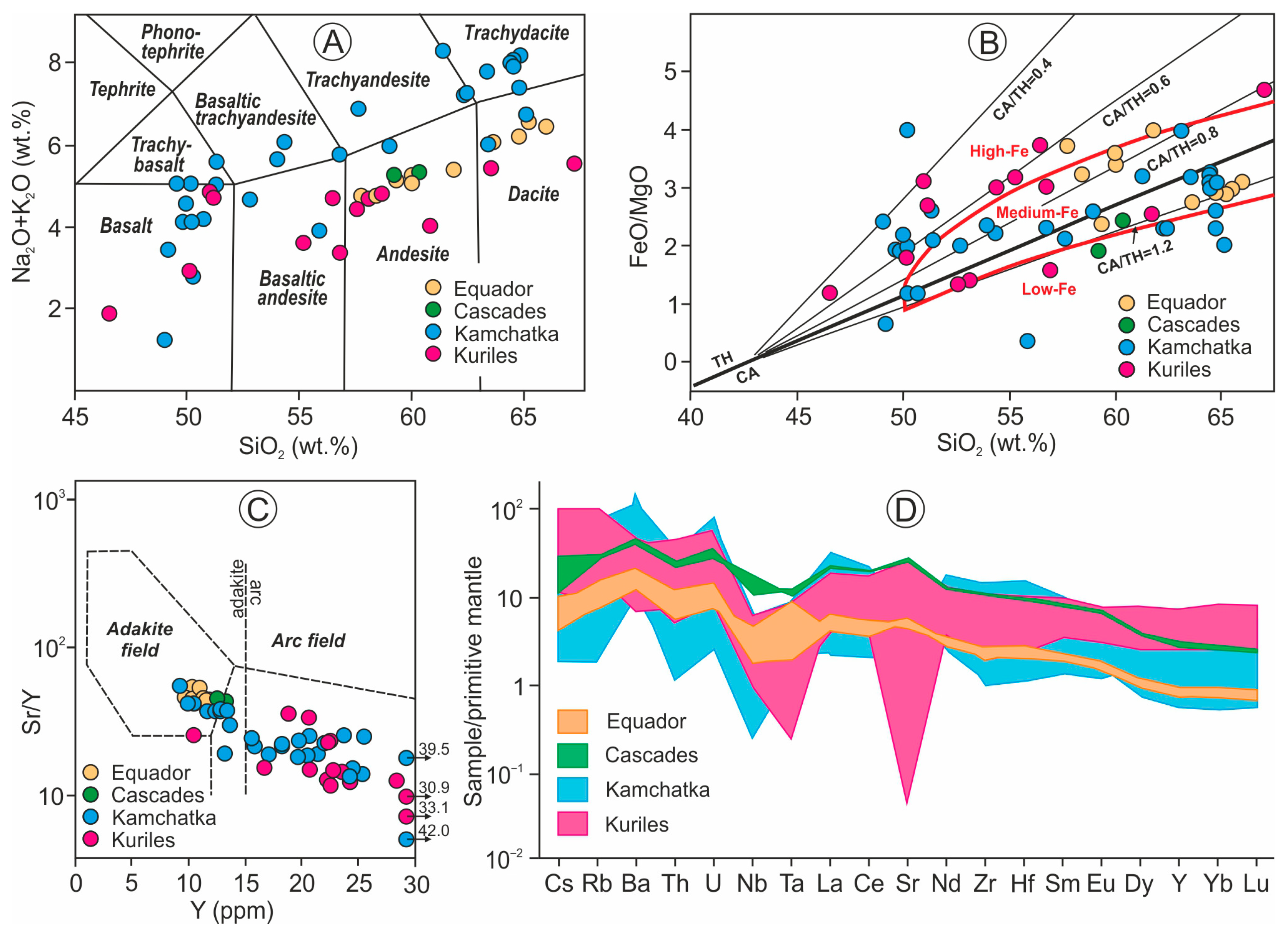
Representative major oxide and trace element compositions of volcanic rocks from the Kamchatka, Kuriles, Ecuador, and the Cascades are listed in Table S1. Most samples plot into the fields of basalt, basaltic andesite, andesite, and dacite on the total alkali–silica (TAS) diagram (Figure 3A). Some lavas from the Gorely volcano in Kamchatka and the Alaid volcano in the Kurile arc display elevated alkali (especially K2O) contents and can be classified as trachybasalts, basaltic trachyandesites, trachyandesites, and trachydacites (Figure 3A). Most arc lavas in this study display mixed tholeiitic to calc-alkaline differentiation trends (Figure 3B). Lavas from the Mutnovsky and Gorely volcanoes in Kamchatka, Quilotoa, and Cotopaxi volcanoes in Ecuador and most Kurile volcanoes display a tholeiitic compositional character and a CA/TH ratio (“tholeiitic index”) of less than 0.8 (Figure 3B). Ankaramites, andesites, and dacites from the Avachinsky and Bakening volcanoes (Kamchatka), some basaltic andesites and andesites from the Kuriles (Zavaritsky and Khmelnitsky volcanoes), dacites from the Tungurahua volcano (Ecuador), and andesites from the Mt. Hood volcano (Cascade arc) are characterized by a CA/TH ratio of >1 and plot into the calc-alkaline field on the total Feo/MgO–SiO2 classification diagram (Figure 3B). Although most analyzed volcanic rocks classify as typical mantle-derived arc lavas, andesites and dacites from Ecuador, dacites from the Bakening volcano in Kamchatka, and Mt. Hood andesites display low Y contents accompanied by elevated Sr/Y ratios and are classified as adakites (Figure 3C). Their adakitic compositional character is also emphasized by the common presence of amphibole in phenocryst assemblages, elevated Sr and light rare-earth element (LREE) contents combined with low heavy rare-earth element (HREE) abundances and elevated La/Yb ratios (Table S1). Primitive mantle-normalized trace element patterns are typical of subduction-related volcanic rocks with variable enrichments in large-ion lithophile elements (LILE) and depletions in high-field strength elements (HFSE) (Figure 3D). Some mafic lavas in the Kurile arc exhibit pronounced negative Sr anomalies.

4.2. Cl-Bearing and Associated Mineral Microinclusions in Arc Lavas

Chlorine-bearing mineral microinclusions were detected in all studied samples frequently in association with other microminerals represented by native metals and their alloys, sulfides, cassiterites, and barites.

4.2.1. Kamchatka

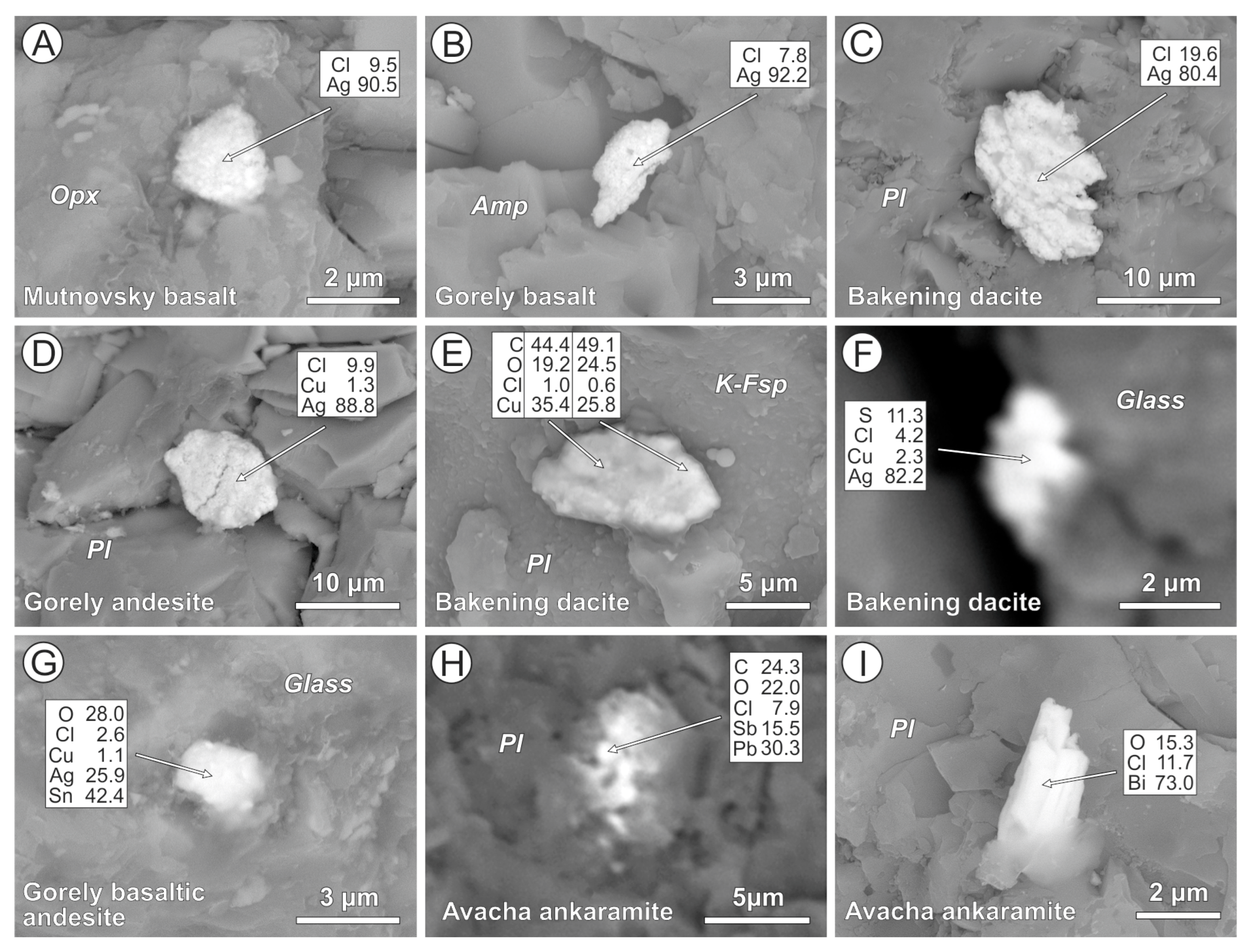
Chlorine-bearing mineral microinclusions in Quaternary Kamchatka lavas from the Avachinsky, Bakening, Mutnovsky, and Gorely volcanoes are found enclosed in magmatic minerals such olivine, orthopyroxene, clinopyroxene, plagioclase, anorthoclase, and quartz, as well as observed near the secondary fractures and voids in magmatic silicates or in the differentiated volcanic glass. Some chlorine-bearing microminerals are also located at the contact between several silicate mineral phases. The most common chlorine-bearing microparticles in Kamchatka arc lavas are microinclusions of Ag-Cl composition and observed inside orthopyroxene in basalt from the Mutnovsky volcano (Figure 4A), amphibole in basalt from the Gorely volcano (Figure 4B), and plagioclase in dacite from the Bakening volcano (Figure 4C). Such microinclusions are best explained as intergrowths of silver chloride and native silver. Plagioclase in andesite lava from the Gorely volcano contains an equant micrograin of the Cu-Ag-Cl composition (Figure 4D), most likely corresponding to aggregate of chlorargyrite and cupriferous silver. Microparticles composed of copper, oxygen, carbon and chlorine are observed in the feldspar-dominated matrix in dacite from the Bakening volcano. Chlorine and copper concentrations appear to decrease from the center towards the rim of this particle, accompanied by an increase in carbon and oxygen content (Figure 4E). This composite particle is chemically reminiscent of a mixture of malachite or azurite with atacamite, which is consistent with its secondary textural position at the contact between sodic plagioclase and potassic feldspar in the groundmass of the Bakening dacite lava. In addition, a Cu-Ag-S-Cl microinclusion (probably cupriferous silver with acantite and chlorargyrite) has been identified in the groundmass of a Bakening dacite (Figure 4F) and a microparticle of the Cu-Ag-Sn-oxychloride composition is observed imbedded in the andesitic groundmass at the Gorely volcano (Figure 4G). Plagioclase crystals in ankaramitic lavas from the Avachinsky volcano contain microinclusions of Pb-Sb-oxychloride (Figure 4H) and elongated euhedral bismoclite (Figure 4I), which appear to be completely enclosed in the host plagioclase structure.
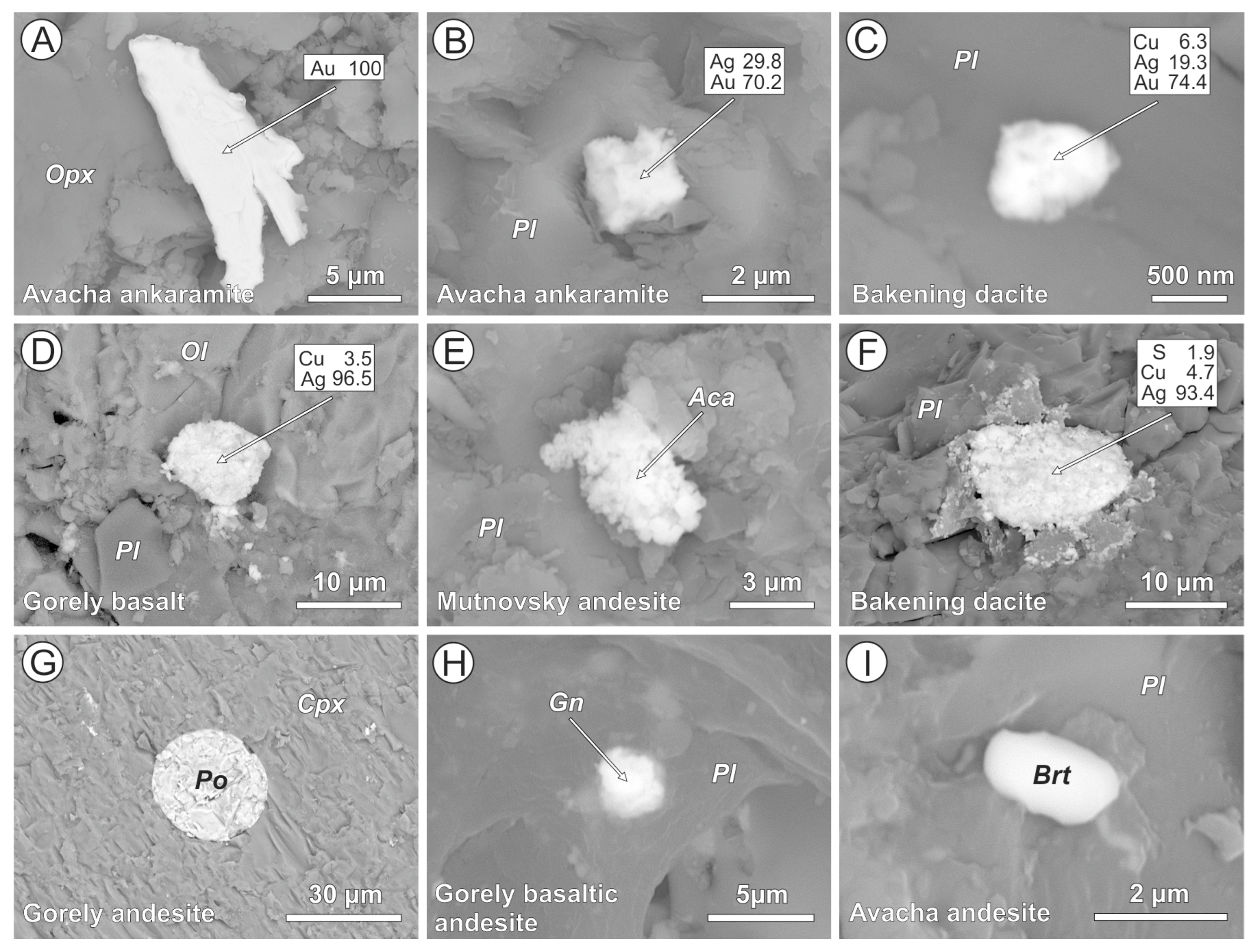
Cl-bearing microinclusions observed in Kamchatka lavas are associated with a wide range of other metal and mineral microparticles including chalcophile and siderophile metals, their alloys and sulfides, as well as zincite, bismite, cassiterite, barite, and monazite. Native metals in association with Cl-bearing microminerals in Kamchatka lavas include native gold (Figure 5A), silver, platinum, copper, and zinc along with Ag-Au (Figure 5B), Cu-Ag-Au (Figure 5C), Zn-Cu-Ag, Sn-Cu, Fe-W and Co-W alloys. Silver frequently occurs as cupriferous silver microinclusions in olivine (Figure 5D), pyroxenes, amphibole, anorthoclase, and groundmass glass and is present in all rock types from ankaramite to dacite. Acanthite (Figure 5E) and cupriferous silver with sulfide (Figure 5F) are also present as microinclusions in plagioclase (most common), amphibole, anorthoclase, and volcanic glass. Most common sulfides accompanying Cl-bearing microinclusions in Kamchatka lavas are pyrrhotite (Figure 5G) and galena (Figure 5F), with additional chalcopyrite, arsenopyrite, pyrite, covellite, and the Zn-Pb-Sb-Cu-S and Cu-Zn-Ag-S composite compounds. Barite is typically present in the groundmass and plagioclase (Figure 5I), occasionally together with cassiterite, bismite, and zincite, in evolved lavas such as andesite from the Avachinsky volcano and dacite from the Bakening volcano.

4.2.2. Kuriles

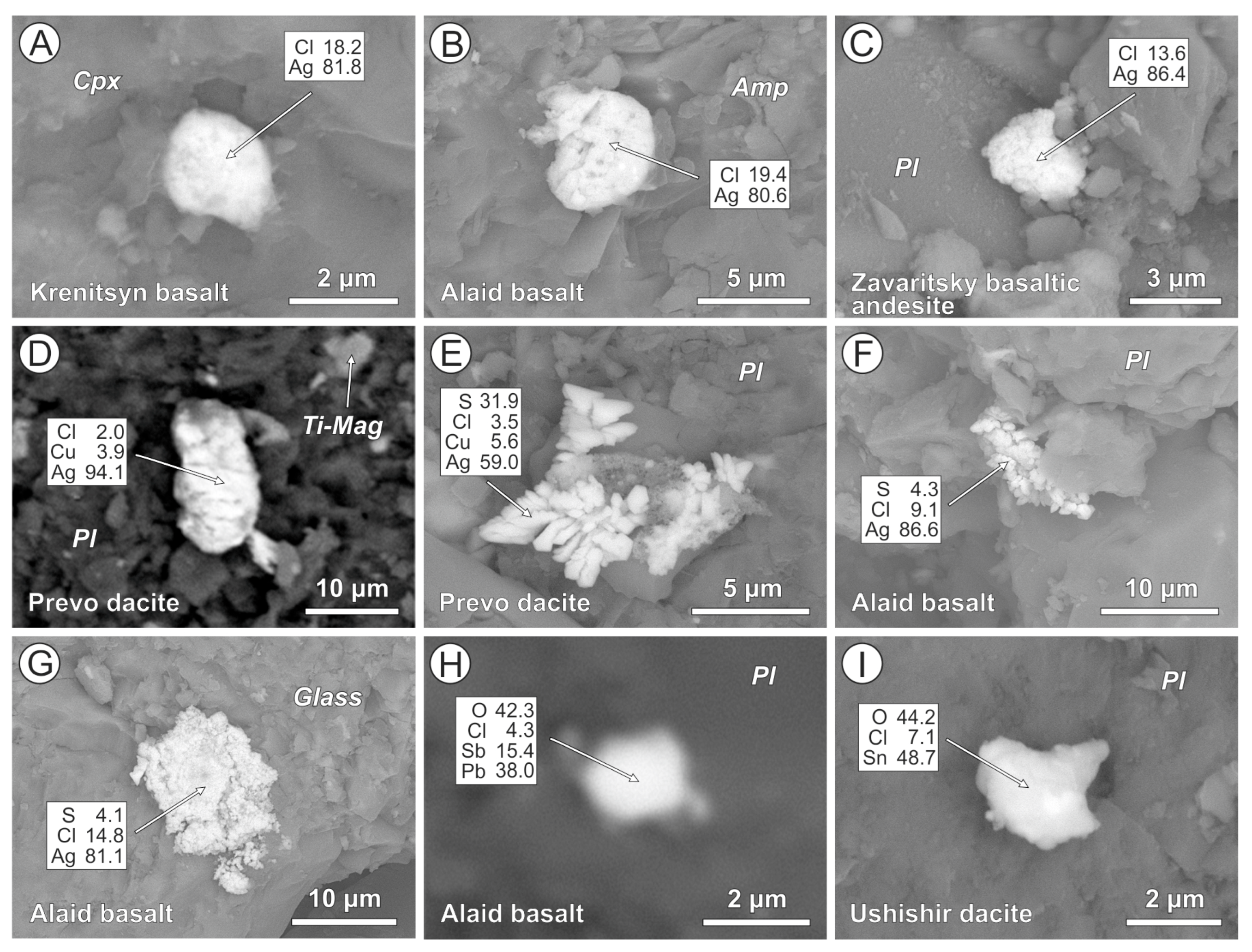
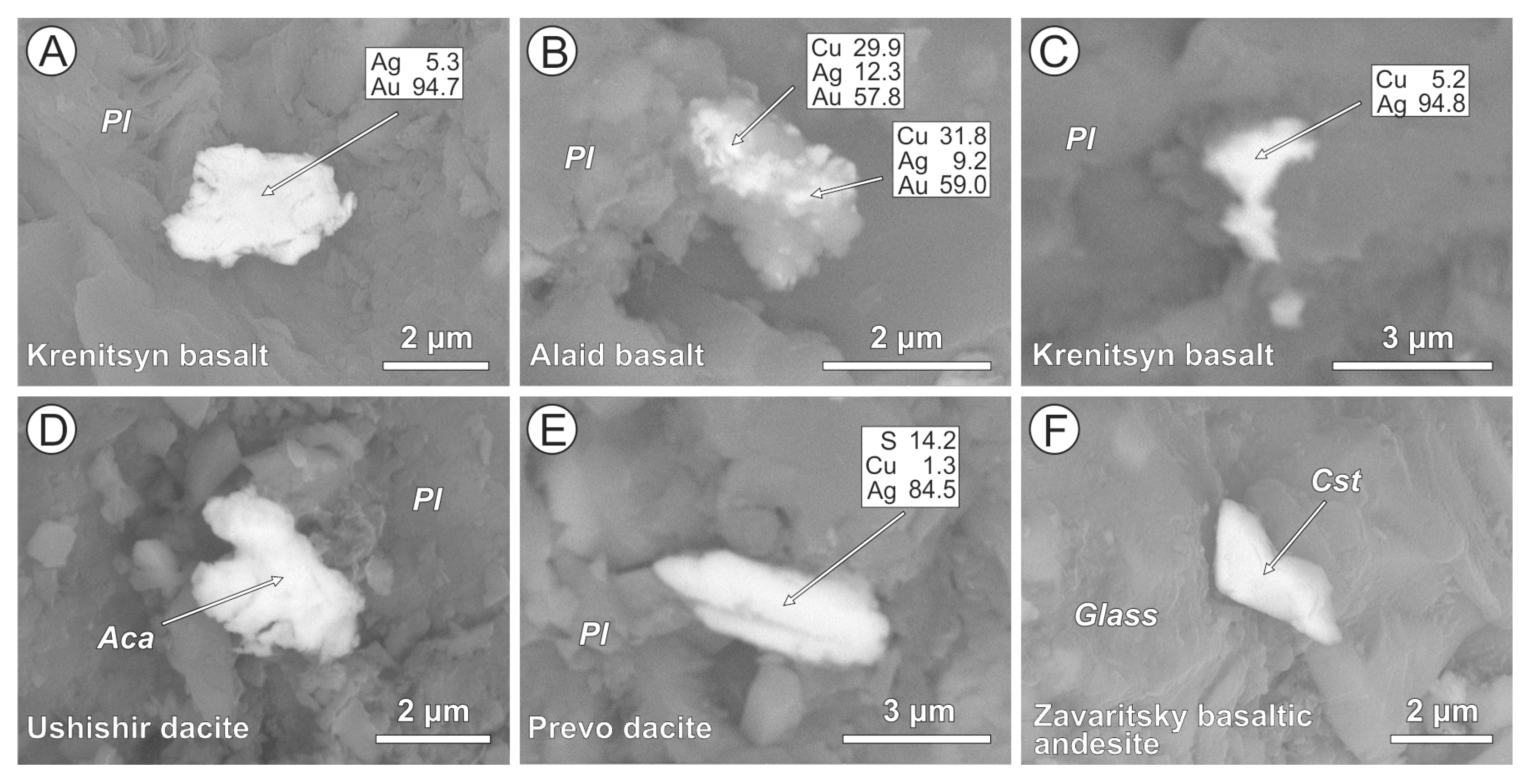
Rock-forming silicates and groundmass volcanic glass in basalts, basaltic andesites, and dacites from the Kurile arc contain numerous chlorine-bearing microminerals of chalcophile elements (Figure 6A–I). Clinopyroxene in basalt from the Krenitsyn volcano on the Onekotan Island contains an equant microparticle composed of native silver and chlorargyrite (Figure 6A). Basalt from the Alaid volcano and basaltic andesite from the Zavaritsky volcano contain similar microaggregates of native silver and silver chloride included in amphibole (Figure 6B) and plagioclase (Figure 6C). Dacitic lava from the Prevo volcano contains a microparticle of cupriferous silver, likely covered by a very thin chloride film (Figure 6D). The same dacite sample contains a cluster of copper and silver chloride and sulfide microcrystals (Figure 6E). Basalts from the rear arc Alaid volcano on the Atlasov Island contain microinclusions composed of chlorargyrite, acanthite, and, possibly, native silver in plagioclase (Figure 6F) and in the glassy groundmass (Figure 6G), along with equant anhedral micrograins of Pb-Sb-oxychloride included in plagioclase (Figure 6H). The Pb-Sb-oxychloride microinclusion is broadly comparable to nadorite (PbSbO2Cl). Plagioclase in dacitic lava from the Ushishir volcano (Yankich Island) contains an anhedral micrograin of Sn-oxychloride (Figure 6I), which compositionally resembles abhurite (Sn21Cl16(OH)14O6) from the atacamite mineral group.
Chlorine-bearing microminerals in the Kurile lavas are associated with microinclusions of native metals and alloys, sulfides, and oxides. Anhedral gold alloys and cupriferous silver are present in plagioclase from the basaltic lavas of Krenitsyn and Alaid volcanoes (Figure 7A–C). Acanthite and Cu-bearing acanthite form euhedral to anhedral inclusions in plagioclase from dacites of the Ushishir and Prevo volcanoes (Figure 7D,E). A single euhedral microinclusion of cassiterite was detected in the glassy groundmass of the basaltic andesite from the Zavaritsky volcano on the Simushir Island (Figure 7F). In general, it appears that the metal and mineral microinclusions associated with Cl-bearing phases in the Kurile lavas are less diverse then the assemblages of microinclusions in Kamchatka volcanic rocks.

4.2.3. Ecuador

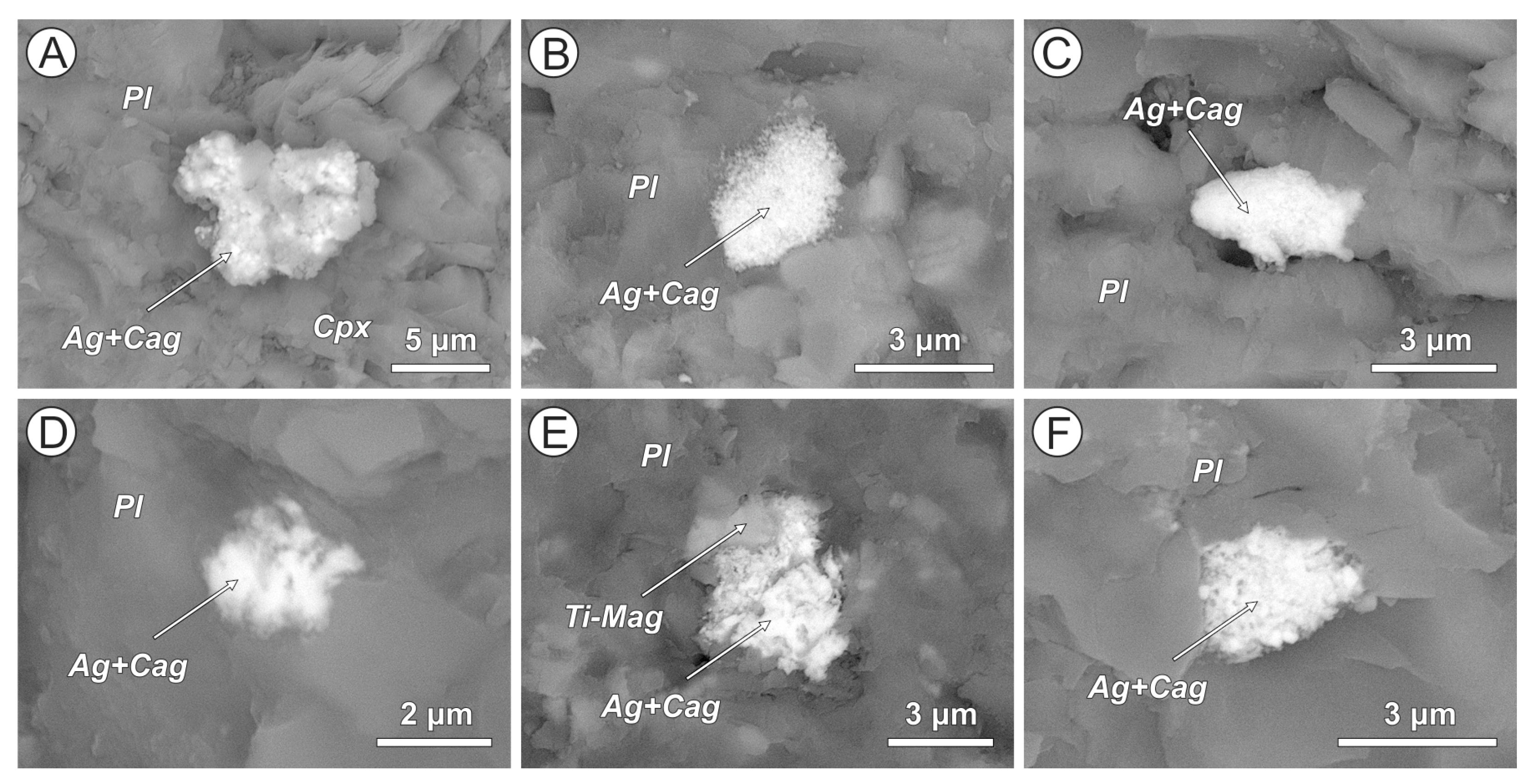
Chlorine-bearing microinclusions in andesitic and dacitic lavas from the Quilotoa, Cotopaxi, and Tungurahua volcanoes in Ecuador are represented exclusively by native silver–silver chloride compounds included in plagioclase or the plagioclase–clinopyroxene matrix (Figure 8). Most Ag-Cl microinclusions form anhedral grains with a characteristic porous appearance (Figure 8A–D), intergrowths with titanomagnetite (Figure 8E), and a semi-spherical microinclusion in plagioclase (Figure 8F). All of them represent mineral aggregates or clusters of native silver and silver chloride microcrystals. Most composite Ag-Cl microinclusions are fully enclosed in their host plagioclase crystals. However, one Ag-Cl microinclusion in Figure 8C appears to be texturally associated with either a partially sealed crack in the plagioclase host or the contact between two or more plagioclase grains, indicating its possible later-stage, secondary formation.
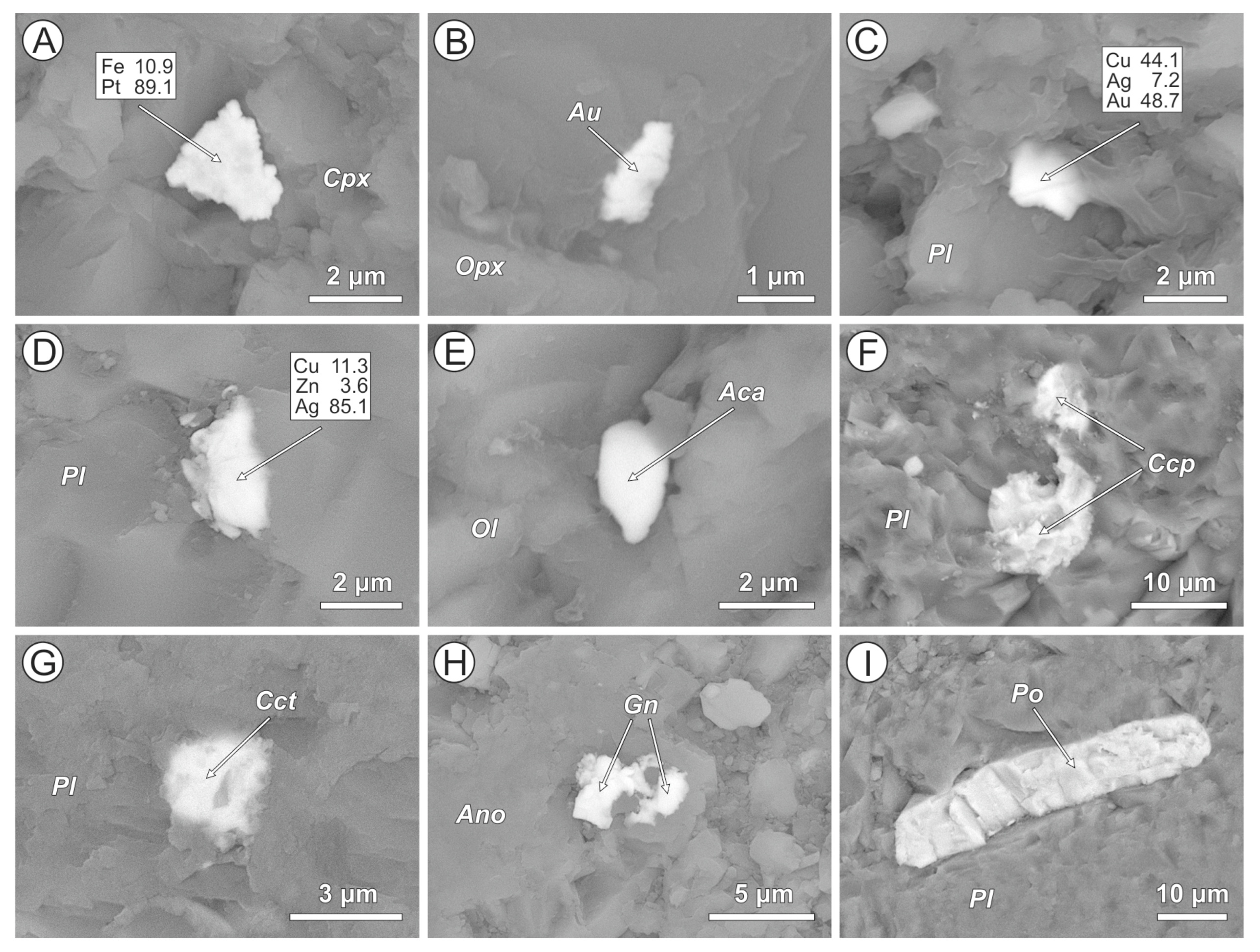
Chlorine-bearing microinclusions in andesites and dacites from the Quilotoa, Cotopaxi, and Tungurahua volcanoes are associated with various siderophile and chalcophile metals and their alloys (Figure 9A–D) and sulfides (Figure 9E–I). Andesites contain subhedral microinclusions (1–2 µm in size) of ferroplatinum in clinopyroxene (Figure 9A) and native gold in orthopyroxene (Figure 9B). Some Ecuadorian lavas contain microinclusions of Cu-Ag-Au (clearly intergrown with the host plagioclase; Figure 9C) and Cu-Zn-Ag (Figure 9D) alloys. Sulfides are represented by subhedral acanthite in olivine (Figure 9E), anhedral chalcopyrite in plagioclase (Figure 9F), equant chalcocite in plagioclase (Figure 9G), galena in anorthoclase (Figure 9H), and prismatic euhedral pyrrhotite in plagioclase (Figure 9I). Again, most metal and sulfide microinclusions appear to be fully enclosed in their host minerals, with the exception of the Cu-Zn-Ag alloy in Figure 9D and acanthite in Figure 9E, which are possibly associated with contact between two plagioclase grains or a partially sealed fracture in olivine, respectively.

4.2.4. Cascades

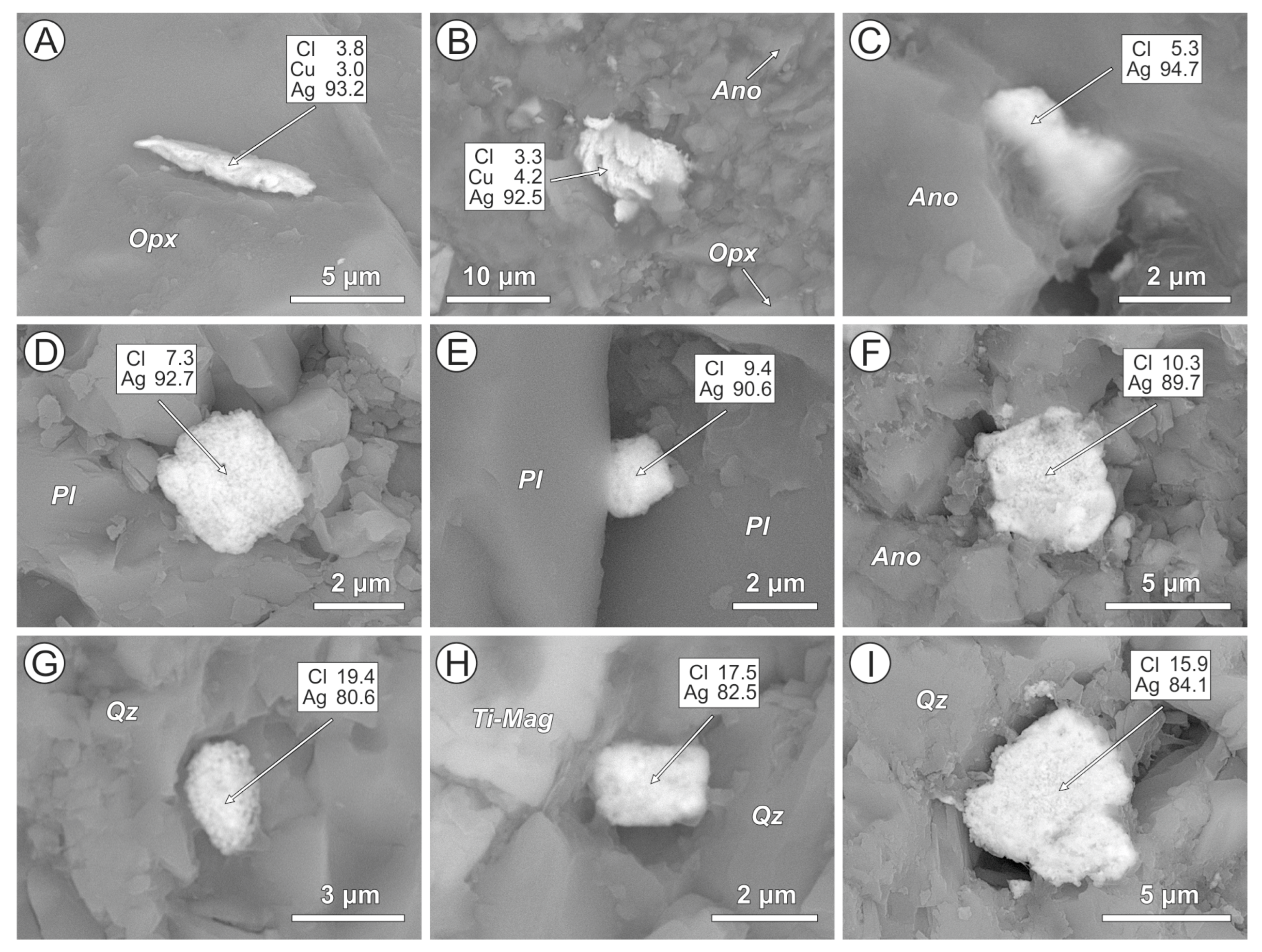
Microinclusions of the Cu-Ag-Cl composition are found in orthopyroxene, plagioclase, anorthoclase, and quartz in adakitic andesites from the Mt. Hood volcano (Figure 10). An elongated euhedral Cu-Ag-Cl microparticle (possibly a cupriferous silver + silver chloride mixture) rests on top of a broken orthopyroxene crystal (Figure 10A). A cluster of flaky Cu-Ag-Cl micrograins is included in an anorthoclase–orthopyroxene matrix (Figure 10B). Anhedral Ag-Cl microinclusion is intergrown with anorthoclase in Figure 10C. Subhedral Ag-Cl micrograins with a characteristic cubic appearance of chlorargyrite are included in plagioclase (Figure 10D) and anorthoclase (Figure 10F). A cubic Ag-Cl micrograin is observed at the contact site between two plagioclase crystals (Figure 10E). Anhedral to euhedral Ag-Cl micrograins, occasionally in association with titanomagnetite (Figure 10H), are included in quartz (Figure 10G–I). All Ag-Cl microinclusions in Mt. Hood andesites (Figure 10C–I) have a characteristic porous appearance typical of composite native silver—chlorargyrite microinclusions in magmatic rocks. On the other hand, Cu-Ag-Cl composite microinclusions display a solid, compact exterior and lack of any visible surficial porosity (Figure 10A,B).
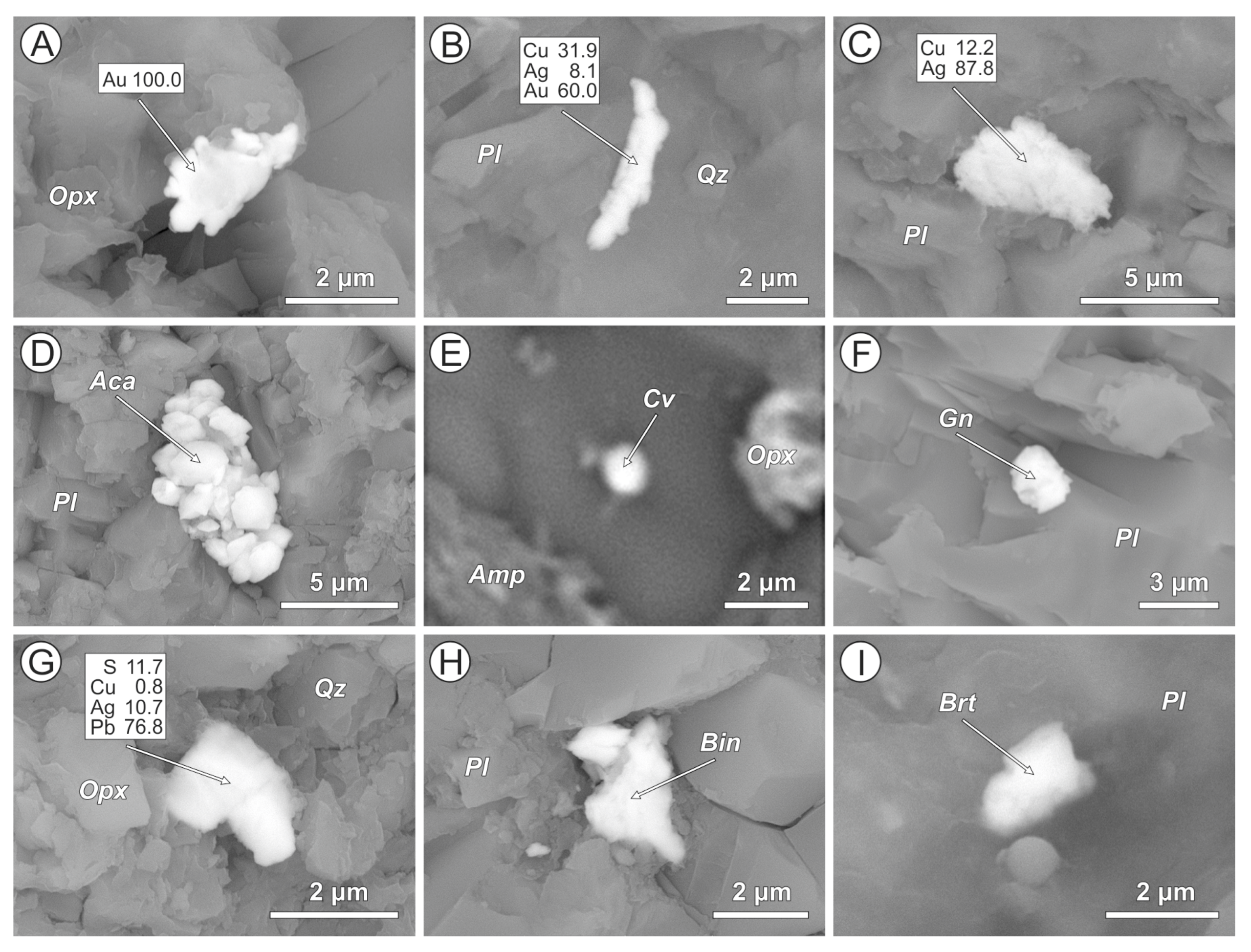
Chlorine-bearing microminerals in Mt. Hood andesite are associated with native precious metals and their alloys, chalcophile sulfides, and oxides, as well as barites (Figure 11). Precious metals are represented by a dendritic gold micrograin in orthopyroxene (Figure 11A), blade-shaped Cu-Ag-Au microinclusion in the quartz–plagioclase matrix (Figure 11B), and a “fluff-like” lumpy microinclusion of cupriferous silver in plagioclase (Figure 11C). Sulfides in association with Cl-bearing microminerals in Mt. Hood include acanthite (Figure 11D), covellite (Figure 11E), galena (Figure 11F), a Cu-Ag-Pb-S compound (Figure 11G), and bismuthinite (Figure 11H). A single microinclusion of anhedral barite is observed in plagioclase (Figure 11I).

5. Discussion

Chlorine-bearing mineral microinclusions observed in arc lavas from Kamchatka, Kuriles, Ecuador, and Cascades are represented by Ag-Cl (>90 percent of all Cl microminerals), Cu-Ag-Cl, Ag-Cl-S, Cu-Ag-Cl-S, Zn-Cu-Ag-Cl, and Cu-O-C-Cl compounds, as well as Sr-Sn-Pb-Sb-Bi-oxychlorides, bismoclite, and chlorapatite (Figure 4, Figure 6, Figure 8 and Figure 10; Table 1).
We have shown, earlier on, the basis of available compositional and experimental data that Ag-Cl microinclusions observed in some igneous rocks represent a mixture of native silver and chlorargyrite formed through the gradual loss of chlorine during the exposure of a rock sample to daylight prior to the SEM investigations [45]. This is consistent with the general porous appearance of AgCl microinclusions (Figure 6A–C, Figure 8A,B and Figure 10D,G–I). Some earlier studies [90] reported the formation of 50–150 nm-sized metallic silver particles on the surface of silver chloride crystals exposed to light. This silver nanolayer is highly reflective and may effectively screen the rest of silver chloride from further loss of chlorine. Chlorine compounds with sulfur, silver, and additional metals such as copper and zinc, can be interpreted as composite mixtures of native silver (or cupriferous silver), chlorargyrite, copper sulfides, sphalerite, and, in the case of some oxygen, possibly zincite. Metal compounds with sulfur and chlorine (as well as with iodine and bromine), such as mutnovskite, tazieffite, etc., were detected in active fumaroles from the Mutnovsky volcano [61]. All other minerals mentioned above are also present in fumarolic exhalates associated with the Kurile–Kamchatka volcanoes [62,63,71,72]. It was suggested that Cl-bearing microminerals and associated S-rich phases (sulfides, sulfates, and sulfosalts) precipitate from Cl-S-bearing fluids that accompany crustal evolution, differentiation, emplacement, and the post-emplacement transformation of arc magmas [58,61,63,91]. Although these fluids are predominantly composed of water and some carbon dioxide [5,25,26,58,59,60], the chlorine component (present at the first thousands of ppm level) is important due to its general reactive characteristics and ability to dissolve and transport chalcophile metals [3,6,14,18,19].

5.1. Cl-Bearing Solid Microinclusions in Magmatic Minerals

Some solid Cl-bearing microinclusions in arc-related volcanic rocks are observed completely enclosed by their host magmatic minerals, such as olivine, clinopyroxene, orthopyroxene, amphibole, plagioclase, etc., away from internal cracks, fractures, voids, and other secondary textural features. These microinclusions formed together and possibly simultaneously with their host magmatic silicates. Specific examples include Ag-Cl microinclusions in Kamchatka (Figure 4A–C), the Kuriles (Figure 6A–C), Ecuador (Figure 8D–F), and the Cascades (Figure 11D). In addition, late-magmatic plagioclase in ankaramite lava from the Avachinsky volcano in Kamchatka contains micrograins of Pb-Sb-oxychloride (Figure 4H) and bismoclite (Figure 4I).
The relatively low melting temperature of chlorargyrite (455 °C) is hard to reconcile with its direct crystallization from a metal-rich silicate melt. The AgCl is highly soluble in water vapor at 300–360 °C [92] and, consequently, is efficiently transported by water vapor-rich magmatic volatiles in magmatic-hydrothermal geologic environments [16,18,20]. Based on the fact that chlorine solubility in silicate melts is, to large degree, controlled by melt composition [16,42], Webster and DeVivo [93] proposed that the crystallization of volatile-free phases from mafic melt at the Somma–Vesuvius volcano caused an increase in total volatile content and a reduction of chlorine solubility. They state that, in turn, “the increasing abundance of volatiles and concurrent reduction in Cl solubility may have forced the exsolution of a hydrous chloride melt directly from the Cl-enriched mafic magmas. It is likely that the exsolution of hydrous chloride melt may occur in other Cl-enriched magmas, because Cl solubility depends so strongly on melt composition” [93,94]. Co-existing hydrous copper chloride, sulfide, and silicate melts were found in a magnesio-hornblende cumulate from the TUBAF seamount in Papua New Guinea [95]. The exsolved (immiscible) chlorine-rich melt was most probably enriched in chalcophile metals due to their remarkable capacity to form complex compounds with chlorine [96]. Yin and Zajacz [18] have experimentally shown that silver contents in silicate melts systematically decrease with an increasing degree of crystallization in both closed and open systems, suggesting the partitioning of silver into the co-existing high-temperature volatile phase (Figure 12 in [18]). Based on all of the above, we speculate that Ag-Cl microinclusions in the studied lavas might have precipitated primarily as AgCl (chlorargyrite) from immiscible chlorine- and metal-rich liquids that accompany the differentiation of Cl-S-bearing silicate magmas in shallow conduits beneath arc volcanoes.
An alternative explanation involves the early crystallization of magmatic sulfides from sulfur-bearing, arc-related melts [97], followed by their decomposition due to increasing water content and oxidation or a decrease in pressure and temperature and the formation of late-magmatic metal chlorides in the presence of chlorine [98]. This is consistent with the presence of sulfides in the studied volcanic rocks from Kamchatka (Figure 4F,G), Kuriles (Figure 7D,E), Ecuador (Figure 10F,G,I), and the Cascades (Figure 11D). Also, this process may be recorded in some composite Ag-S-Cl microinclusions in glass and plagioclase in lavas from the Kurile–Kamchatka volcanic province (e.g., Figure 4F and Figure 6E–G). However, the preservation of metal chlorides together with native metals in several samples from Kamchatka possibly indicates that this model might not be applicable to all occurrences of metal chlorides in arc lavas. In addition, sulfide and metal chloride phases co-exist in some samples of arc-related igneous rocks, suggesting that sulfur and chlorine may have taken different pathways during the crustal evolution of volcanic arc magmas [44,45,95].
Bismoclite from the Avachinsky volcano ankaramite in Kamchatka is partially enclosed in host plagioclase, indicating high-temperature origins (Figure 4I). Although bismoclite is typically viewed as a rare secondary oxidation mineral in some hydrothermal deposits [99], a recent study reported the occurrence of bismoclite in a mineralized magmatic breccia from the Bi-Au-Cu deposit in the Argentinian Andes [100]. This study, together with bismoclite occurrence in the Strathcona magmatic Ni-Cu-Fe-sulfide deposit in Sudbury (Ontario), suggests that bismoclite can form through the oxidation of bismuth sulfides, such as bismuthinite, and bismuth sulfosalts by chlorine-rich fluids at elevated temperatures [100]. Ankaramite from the Avachinsky volcano also contains Pb-Sb-oxychloride completely enclosed in host magmatic plagioclase (Figure 4H). This Pb-Sb-O-Cl microinclusion compositionally resembles nadorite PbSbO2Cl, a rare mineral phase found in some oxidized ore deposits and sedimentary environments. In particular, nadorite was reported in association with galena and boulangerite in high-sulfidation mineralized veins in the Kutná Hora ore district in Czech Republic, where it appears to be a product of the oxidation of galena and antimony sulfides [101]. It appears likely that both bismoclite and Pb-Sb-oxychloride microinclusions in ankaramite lava from the Avachinsky volcano were formed through oxidation of the earlier formed bismuth, lead, and antimony sulfides in the presence of the chlorine-bearing fluids.

5.2. Post-Magmatic Cl-Bearing Mineral Microinclusions

Most solid Cl-bearing microinclusions shown in Figure 4, Figure 6, Figure 8 and Figure 11 are observed within or near secondary fractures and pores in magmatic minerals at the contact site between two or more grains of rock-forming and accessory minerals, while some are included in the glassy groundmass of host lavas. Some examples include Cu-O-C-Cl (Figure 4E) and Cu-Ag-S-Cl (Figure 4F) microparticles in Kamchatka (Figure 4E,F); Cu-Ag-Cl (Figure 6A), Pb-Sb-oxychloride (Figure 6H), and Sn-oxychloride microinclusions in the Kuriles; and composite native silver + chlorargyrite microinclusions in Ecuador (Figure 8C,E) and the Cascades (Figure 11E,G,H). The post-magmatic Cl-bearing microinclusions are commonly associated with post-magmatic native metals (native Au in Figures 10B and 12A; cupriferous Ag in Figures 7C and 12C), sulfides (Cu-Ag-sulfide in Figure 7E; acanthite in Figure 7D; Cu-Ag-Pb-sulfide in Figure 11G; covellite in Figure 11E; and galena in Figure 11F), oxides (cassiterite in Figure 7F), and sulfates (barite in Figure 11I).
Assemblages of post-magmatic Cl-bearing microinclusions and associated native metals, alloys, sulfides, oxides, and sulfates, in many aspects, resemble the mineralogy of active fumarole fields in the Kurile–Kamchatka volcanic region. Mineral phases such as chlorargyrite, acanthite, covellite, chalcocite, galena, malachite, azurite, atacamite, and barite are common in fumaroles at the Mutnovsky, Avachinsky, and Tolbachik volcanoes in Kamchatka [61,62,63]. Bismuthinite (Bi2S2) has been observed in exhalates from the Mutnovsky volcano [61], while cassiterite frequently occurs with hematite, Pb, Ag, Sb, and Bi sulfosalts and barite in the Arsenatnaya and Yadovitaya fumaroles at the Tolbachik volcano in Kamchatka [62]. Exhalates on the slopes of the Alaid volcano in the Kurile arc contain acanthite, atacamite, and physical mixtures of other Cu chlorides (tolbachite, nantokite, etc.) with opal and Fe-Cu hydroxides associated with native Au and Ag (±Cu), W-bearing alloys, natural brass, and bronze [71]. Fumaroles of Kudryavy (Iturup Island) and Ebeko (Paramushir Island) in the Kuriles contain native Au, Ag-Au and Cu-Ag-Au alloys, galena, sphalerite, bismuthinite, bismoclite, and Pb-Bi-sulfosalts [72]. Volcanic gases emitted from the volcanoes of the Kurile–Kamchatka arc, besides sulfur and chlorine, frequently contain Cu, Zn, Pb, Sb, Bi, and Sn [58,70]. Thus, we propose that post-magmatic Cl-bearing microinclusions and associated metals, sulfides, and oxides in arc lavas precipitated from metal-rich, Cl- and S-bearing hydrothermal fluids accompanied their emplacement at the surface, followed by post-emplacement transformations in active fumarole fields.

5.3. Comparisons with Arc-Related Epithermal and Porphyry Mineralization

Two of the studied arcs, Kamchatka and Ecuador, host numerous epithermal and porphyry ore deposits [47,102,103,104]. Epithermal-type precious metal mineralization in the Kurile arc is limited to the Miocene diorite–granodiorite-hosted Prasolovsky Au-Ag deposit in the Kunashir Island and the gold-bearing, rhenium-rich “ore fumaroles” of the Kudriyavy volcano [72,105]. Epithermal and porphyry mineralization in the broader Cascades area is restricted to the older, “ancestral” Cascades arc in western Nevada and eastern California regions [106]. The younger lavas from the Mount Hood area are characterized only by a very limited hydrothermal alteration associated with some disseminated, epithermal-type mineralization [107]. Both Kamchatka and Ecuador also host several Cenozoic Cu-Au (±Ag, Mo) porphyry systems [47,104].
Assemblages of Cl-bearing microminerals and associated metal and mineral microinclusions are summarized in Table 2 and compared with the ore mineralogy of epithermal and porphyry mineralization in Kamchatka, Kuriles, Ecuador, and the Cascades.
The most common (>90% of all occurrences) Cl-bearing microinclusion types in arc lavas are represented by chlorargyrite in combination with native silver, both of which occur in epithermal ore deposits in the Kamchatka–Kurile volcanic province (Table 2). Chlorargyrite + native silver microinclusions in arc lavas are accompanied by various sulfide minerals such as pyrite, pyrrhotite, chalcopyrite, chalcocite, covellite, galena, and sphalerite, as well as various Cu, Sn, Zn, Ag, and Au alloys, which are also present in epithermal and porphyry deposits in Kamchatka, Kuriles, and Ecuador (Table 2). Silver in arc lavas is also observed as native metal, Ag-Au and Cu-Ag-Au alloys, cupriferous silver, and acanthite, which is paralleled by the abundant and diverse silver mineral associations in epithermal deposits. Finally, barite and cassiterite are found in both arc lavas and arc-related hydrothermal deposits (Table 2). These preliminary comparisons, despite their broad and qualitative nature, appear to suggest that observed microminerals in arc lavas may potentially represent early stages of epithermal and porphyry ore formation beneath arc volcanoes assisted by magmatic-hydrothermal Cl-S-bearing fluids.

5.4. Implications for Ore Element Mobility in Volcanic Arcs

Some lavas from Kurile–Kamchatka volcanoes are characterized by elevated concentrations of various chalcophile elements (e.g., Sn, Sb, As, and Pb) in comparison to mid-ocean ridge basalts (MORBs) and intra-oceanic island arcs [108]. Our samples from the Avachinsky, Bakening, Mutnovsky, and Gorely volcanoes display Ag, Sn, Sb, W, and Bi concentrations [109], which are systematically higher than previously reported for the Kamchatka volcanic rocks [108]. Similar trace element characteristics have been previously interpreted as arc mantle source enrichment by slab-derived fluids, which carry a substantial amount of recycled ore metals from the altered subducted oceanic crust and pelagic sediment [6,7,8,11,19,30]. This is consistent with assemblages of ore minerals in mantle wedge xenoliths from the Avachinsky volcano in Kamchatka, which are broadly similar to microinclusions in arc lavas reported in this paper [110].
The presence of Cl-bearing mineral microinclusions in arc lavas may indicate the involvement of chlorine-bearing magmatic-hydrothermal fluids (and possibly immiscible chlorine-rich melts [41,93,94] in their crustal differentiation, emplacement at the surface, and post-eruption transformation. Experimental data suggest that most chalcophile elements, such as silver, tin, antimony, bismuth, etc., are highly mobile in presence of Cl-bearing fluids and will preferentially partition into a Cl-rich volatile phase during magmatic differentiation [13,14,17,18,19]. Chlorine-rich melts and fluids exsolved from volcanic arc magmas will contain substantial amounts of chalcophile metals that they will deliver into the upper crustal porphyry and epithermal environments [15,16,30,33,34,108]. Sulfur has the same effect upon chalcophile metal mobility, as evidenced by both the occurrence of diverse sulfide inclusions in arc lavas [97,109,111,112] and the abundance of experimental data [3,11,12]. Elevated contents of some ore metals and observed microinclusion assemblages in arc lavas from Kamchatka, Kuriles, Ecuador, and the Cascades indicate the enhanced mobility of chalcophile elements in the presence of Cl- and S-bearing melts and fluids in subduction zones.

6. Conclusions

1.
Arc ankaramite, basalt, basaltic andesite, andesite, and dacite in the Kamchatka, the Kuriles, Ecuador, and the Cascades contain microinclusions of chlorine-bearing minerals represented primarily by chalcophile metal chlorides, oxychlorides and their composites with native metals, alloys, and sulfides, as well as apatite with variable amounts of chlorine and fluorine.
2.
The Cl-bearing microminerals are commonly associated with microinclusions of precious and base metals, their alloys, sulfides (pyrrhotite, chalcopyrite, chalcocite, covellite, bornite, galena, and other composite chalcophile sulfides), oxides (titanomagnetite, ilmenite, rutile, and cassiterite), and sulfates (barite).
3.
Some Cl-bearing microinclusions are enclosed in magmatic rock-forming minerals such as olivine, ortho- and clinopyroxenes, amphibole, plagioclase, anorthoclase, and quartz and could have crystallized from the immiscible Cl-rich melts exsolved from volcanic arc magmas during their differentiation in the sub-arc crust. Alternatively, specific microinclusions with Ag-S-Cl compositions may record the oxidation and decomposition of earlier magmatic sulfides in the presence of Cl-bearing magmatic volatiles.
4.
Post-magmatic Cl-bearing microminerals and associated metal, sulfide, oxide, and sulfate microinclusions are observed in secondary fractures and cracks, pores and voids, and intergranular contacts and spaces, as well as in groundmass volcanic glass. These post-magmatic microinclusion assemblages most likely precipitated from hydrothermal fluids that accompanied emplacement and post-eruption transformations of host volcanic rocks.
5.
Assemblages of Cl-bearing and associated microinclusions in arc lavas in many aspects resemble ore mineral associations in subduction-related, magmatic-hydrothermal Cu-Ag-Au deposits, suggesting that the former may possibly record the initial stages of epithermal and porphyry ore formation beneath arc volcanoes.
6.
Elevated ore metal contents in some volcanic rocks from Kamchatka, Kuriles, Ecuador, and the Cascades may indicate the enhanced mobility of chalcophile metals in the presence of Cl-S fluids in subduction zones.

Supplementary Materials

The following supporting information can be downloaded at: https://www.mdpi.com/article/10.3390/geosciences16010040/s1, Table S1: Representative major oxide (wt.%) and trace element (ppm) compositions of Quaternary lavas from Kamchatka, the Kuriles, Ecuador, and the Cascades.

Author Contributions

Conceptualization, P.K. and N.B.; methodology, P.K. and N.B.; software, N.B.; validation, P.K., N.B., I.V. and N.K.; formal analysis, P.K., N.B., I.V. and N.K. investigation, P.K., N.B., I.V., N.K., N.P. and V.K.; resources, N.B., N.P. and V.K.; data curation, P.K., N.B., N.P. and V.K.; writing—original draft preparation, P.K. and N.B.; writing—review and editing, P.K., N.B., I.V. and N.K.; visualization, N.B., N.P. and V.K.; supervision, P.K. and N.B.; project administration, P.K. and N.B.; funding acquisition, N.B. All authors have read and agreed to the published version of the manuscript.

Funding

This work was supported by the Russian Science Foundation, project no. 25-17-68001 (continuation of the project no. 22-17-00023). Basic financial support was provided by the state assignment of the Institute of Tectonics and Geophysics, Far Eastern Branch, Russian Academy of Sciences.

Data Availability Statement

Data are available upon request from the senior author.

Acknowledgments

We appreciate support and logistical help from Svetlana Kepezhinskas during our fieldwork in Ecuador in 2023. We acknowledge the detailed comments from two anonymous reviewers and the Journal’s editor, which allowed us to significantly improve this manuscript.

Conflicts of Interest

Author Nikita Kepezhinskas was employed by the company Tetra Tech Inc. The remaining authors declare that the research was conducted in the absence of any commercial or financial relationships that could be construed as a potential conflict of interest.

References

  1. Wyllie, P.J. Magmas and volatile components. Am. Mineral. 1979, 64, 469–500. [Google Scholar]
  2. Hedenquist, J.W.; Lowenstern, J.B. The role of magmas in the formation of hydrothermal ore deposits. Nature 1994, 370, 519–527. [Google Scholar] [CrossRef]
  3. Audétat, A. The metal content of magmatic-hydrothermal fluids and its relationships to mineralization potential. Econ. Geol. 2019, 114, 1033–1056. [Google Scholar] [CrossRef]
  4. Stock, M.J.; Humphreys, M.C.S.; Smith, V.C.; Isaia, R.; Pyle, D.M. Late-stage volatile saturation as a potential trigger for explosive volcanic eruptions. Nat. Geosci. 2016, 9, 249–254. [Google Scholar] [CrossRef]
  5. Harris, D.M.; Anderson, A.T., Jr. Volatiles H2O2, CO2, and Cl in a subduction related basalt. Contrib. Mineral. Petrol. 1984, 87, 120–128. [Google Scholar] [CrossRef]
  6. Keppler, H. Fluids and trace element transport in subduction zones. Am. Mineral. 2017, 102, 5–20. [Google Scholar] [CrossRef]
  7. Ferrando, S.; Petrelli, M.; Frezzotti, M.L. Gradual and selective trace-element enrichment in slab-released fluids at sub-arc depths. Sci. Rep. 2019, 9, 16393. [Google Scholar] [CrossRef]
  8. Spandler, C.; Pirard, C. Element recycling from subducting slabs to arc crust: A review. Lithos 2013, 170, 208–223. [Google Scholar] [CrossRef]
  9. Richards, J.R. Magmatic to hydrothermal metal fluxes in convergent and collided magmas. Ore Geol. Rev. 2011, 40, 1–26. [Google Scholar] [CrossRef]
  10. Cox, D.; Watt, S.F.L.; Jenner, F.E.; Hastie, A.R.; Hammond, S.J.; Kunz, B.E. Elevated magma fluxes deliver high-Cu magmas to the upper crust. Geology 2020, 48, 957–960. [Google Scholar] [CrossRef]
  11. Schettino, E.; González-Jiménez, J.M.; Marchesi, C.; Palozza, F.; Blanco-Quintero, I.F.; Gervilla, F.; Braga, R.; Garrido, C.J.; Fiorentini, M. Mantle-to-crust metal transfer by nanomelts. Commun. Earth Environ. 2023, 4, 256. [Google Scholar] [CrossRef]
  12. Pokrovski, G.S.; Borisova, A.Y.; Bychkov, A.Y. Speciation and transport of metals and metalloids in geological vapors. Rev. Mineral. Geochem. 2013, 76, 165–218. [Google Scholar] [CrossRef]
  13. Zhong, R.; Brugger, J.; Chen, Y.; Li, W. Contrasting regimes of Cu, Zn and Pb transport in ore-forming hydrothermal fluids. Chem. Geol. 2015, 395, 154–164. [Google Scholar] [CrossRef]
  14. Guan, Q.; Mei, Y.; Liu, W.; Brugger, J. Different metal coordination in sub- and super-critical fluids: Do molybdenum(IV) chloride complexes contribute to mass transfer in magmatic systems? Geochim. Cosmochim. Acta 2023, 354, 240–251. [Google Scholar] [CrossRef]
  15. Webster, J.D.; Kinzler, R.J.; Mathez, E.A. Chloride and water solubility in basalt and andesite melts and implications for magmatic degassing. Geochim. Cosmochim. Acta 1999, 63, 729–738. [Google Scholar] [CrossRef]
  16. Thomas, R.W.; Wood, B.J. The effect of composition on chlorine solubility and behavior in silicate melts. Am. Mineral. 2023, 108, 814–825. [Google Scholar] [CrossRef]
  17. Frank, M.R.; Candela, P.A.; Piccoli, P.M.; Glascock, M.D. Gold solubility, speciation, and partitioning as a function of HCl in the brine-silicate melt-metallic gold system at 800 °C and 100 MPa. Geochim. Cosmochim. Acta 2002, 66, 3719–3732. [Google Scholar] [CrossRef]
  18. Yin, Y.; Zajacz, Z. The solubility of silver in magmatic fluids: Implications for silver transfer to the magmatic-hydrothermal ore-forming environment. Geochim. Cosmochim. Acta 2018, 238, 235–251. [Google Scholar] [CrossRef]
  19. Tattitch, B.; Chelle-Michou, C.; Blundy, J.; Loucks, R.R. Chemical feedbacks during magma degassing control chlorine partitioning and metal extraction in volcanic arcs. Nat. Commun. 2021, 12, 1774. [Google Scholar] [CrossRef]
  20. Webster, J.D. Chloride solubility in felsic melts and the role of chloride in magmatic degassing. J. Petrol. 1997, 38, 1793–1807. [Google Scholar] [CrossRef]
  21. Michael, P.J.; Schilling, J.-G. Chlorine in mid-ocean ridge magmas: Evidence for assimilation of seawater-influenced components. Geochim. Cosmochim. Acta 1989, 53, 3131–3143. [Google Scholar] [CrossRef]
  22. Kent, A.J.R.; Peate, D.W.; Newman, S.; Stolper, E.M.; Pearce, J. Chlorine in submarine glasses from the Lau Basin: Seawater contamination and constraints on the composition of slab-derived fluids. Earth Planet. Sci. Lett. 2002, 202, 361–377. [Google Scholar] [CrossRef]
  23. Stroncik, N.A.; Haase, K.M. Chlorine in oceanic intraplate basalts: Constraints on mantle sources and recycling processes. Geology 2004, 32, 945–948. [Google Scholar] [CrossRef]
  24. Straub, S.M.; Layne, G.D. The systematics of chlorine, fluorine, and water in Izu arc front volcanic rocks: Implications for volatile recycling in subduction zones. Geochim. Cosmochim. Acta 2003, 67, 4179–4203. [Google Scholar] [CrossRef]
  25. Portnyagin, M.; Hoernle, K.; Plechov, P.; Mironov, N.; Khubunaya, S. Constraints on mantle melting and composition and nature of slab components in volcanic arcs from volatiles (H2O, S, Cl, F) and trace elements in melt inclusions from the Kamchatka Arc. Earth Planet. Sci. Lett. 2007, 255, 53–69. [Google Scholar] [CrossRef]
  26. Brahm, R.; Coulthard, D., Jr.; Zellmer, G.; Kuritani, T.; Sakamoto, N.; Taniuchi, H.; Yurimoto, H.; Nakagawa, M.; Sato, E. Olivine-hosted melt inclusions track progressive dehydration reactions in subducting slabs across volcanic arcs. J. Petrol. 2024, 65, egae017. [Google Scholar] [CrossRef]
  27. Sharp, Z.D.; Barnes, J.D. Water-soluble chlorides in massive seafloor serpentinites: A source of chloride in subduction zones. Earth Planet. Sci. Lett. 2004, 226, 243–254. [Google Scholar] [CrossRef]
  28. Manzini, M.; Bouvier, A.-S.; Barnes, J.D.; Bonifacie, M.; Rose-Koga, E.F.; Ulmer, P.; Métrich, N.; Bardoux, G.; Williams, J.; Layne, G.D.; et al. SIMS chlorine isotope analyses in melt inclusions from arc settings. Chem. Geol. 2017, 449, 112–122. [Google Scholar] [CrossRef]
  29. Ransom, B.; Spivack, A.J.; Kastner, M. Stable Cl isotopes in subduction-zone pore waters: Implications for fluid-rock reactions and the cycling of chlorine. Geology 1995, 23, 715–718. [Google Scholar] [CrossRef]
  30. Castillo, P.R. Arc magmatism and porphyry-ore deposition are primarily controlled by chlorine from seawater. Chem. Geol. 2022, 589, 120683. [Google Scholar] [CrossRef]
  31. Piccoli, P.M.; Candela, P.A. Apatite in igneous systems. Rev. Mineral. Geochem. 2002, 48, 255–292. [Google Scholar] [CrossRef]
  32. Jenkins, D.M. The incorporation of chlorine into calcium amphibole. Am. Mineral. 2019, 104, 514–524. [Google Scholar] [CrossRef]
  33. Mernagh, T.P.; Mavrogenes, J. Significance of high temperature fluids and melts in the Grasberg porphyry copper-gold deposit. Chem. Geol. 2019, 508, 210–224. [Google Scholar] [CrossRef]
  34. Xu, X.; Bain, W.M.; Tornos, F.; Hanchar, J.M.; Lamadrid, H.; Lehmann, B.; Xu, X.; Steadman, J.A.; Bottrill, R.S.; Soleymani, M.; et al. Magnetite-apatite ores record widespread involvement of molten salts. Geology 2024, 52, 417–422. [Google Scholar] [CrossRef]
  35. Kepezhinskas, N.; Kjarsgaard, B.A.; Sarkar, C.; Luo, Y.; Locock, A.J.; Pearson, D.G. Petrology, geochemistry, and geochronology of the Mel Kimberlites, Nunavut, Canada and their relationship to Neoproterozoic to Cambrian magmatism in North America. Mineral. Petrol. 2024, 119, 1023–1042. [Google Scholar] [CrossRef]
  36. Kepezhinskas, N.; Kjarsgaard, B.A.; Sarkar, C.; Luo, Y.; Locock, A.J.; Pearson, D.G. Petrology, geochemistry, and Triassic eruption age of the Dharma kimberlite, Northwest Territories. Mineral. Petrol. 2025, 119, 987–1004. [Google Scholar] [CrossRef]
  37. Golovin, A.V. Unusual mineralogy of kimberlites: Alkali carbonates, sulfates, and chlorides among groundmass minerals from unserpentinized coherent kimberlite of the Udachnaya-East pipe, Siberian craton. Minerals 2025, 15, 586. [Google Scholar] [CrossRef]
  38. Nesbitt, B.E.; Kelly, W.C. Magmatic and hydrothermal inclusions in carbonatite of the Magnet Cove complex, Arkansas. Contrib. Mineral. Petrol. 1977, 63, 271–294. [Google Scholar] [CrossRef]
  39. Prokopyev, I.; Doroshkevich, A.; Redina, A. Brine-melts and fluids of the Fe-F-P-(Ba)-(Sr)-REE Central Asian carbonatite province (Southern Siberia and Mongolia): The petrogenetic aspects. Minerals 2023, 13, 573. [Google Scholar] [CrossRef]
  40. Hanley, J.J.; Mungall, J.E.; Pettke, T.; Spooner, E.T.C.; Bray, C.J. Fluid and halide melt inclusions of magmatic origin in the Ultramafic and Lower Banded Series, Stillwater Complex, Montana, USA. J. Petrol. 2008, 49, 1133–1160. [Google Scholar] [CrossRef]
  41. Webster, J.D. Fluid-melt interactions involving Cl-rich granites: Experimental study from 2 to 8 kbar. Geochim. Cosmochim. Acta 1992, 56, 659–678. [Google Scholar] [CrossRef]
  42. Webster, J.D. The exsolution of magmatic hydrosaline chloride liquids. Chem. Geol. 2004, 210, 33–48. [Google Scholar] [CrossRef]
  43. Lira, R.; Poklepovic, M.F.; Darais, M.J. Solid inclusions of magmatic halite and sylvite in felsic granitoids, Sierra Norte, Córdoba, Argentina. Lithos 2007, 99, 363–384. [Google Scholar] [CrossRef]
  44. Kepezhinskas, P.K.; Kepezhinskas, N.P.; Berdnikov, N.V.; Krutikova, V.O. Native metals and intermetallic compounds in subduction-related ultramafic rocks from the Stanovoy mobile belt (Russian Far East): Implications for redox heterogeneity in subduction zones. Ore Geol. Rev. 2020, 127, 103800. [Google Scholar] [CrossRef]
  45. Kepezhinskas, P.; Berdnikov, N.; Kepezhinskas, N.; Krutikova, V.; Astapov, I. Magmatic-hydrothermal transport of metals at arc plutonic roots: Insights from the Ildeus mafic-ultramafic complex, Stanovoy suture zone (Russian Far East). Minerals 2023, 13, 878. [Google Scholar] [CrossRef]
  46. Berdnikov, N.; Kepezhinskas, P.; Nevstruev, V.; Krutikova, V.; Konovalova, N. Explosive ultramafic volcanism in Phanerozoic accreted terranes: A case study of the Taragai peridotite complex (Russian Far East). J. Asian Earth Sci. 2025, 281, 106503. [Google Scholar] [CrossRef]
  47. Kepezhinskas, P.; Berdnikov, N.; Kepezhinskas, N.; Konovalova, N. Adakites, high-Nb basalts and copper-gold deposits in magmatic arcs and collisional orogens: An overview. Geosciences 2022, 12, 29. [Google Scholar] [CrossRef]
  48. Erlich, E.N.; Gorshkov, G.S. Quaternary volcanism and tectonics in Kamchatka. Bull. Volcanol. 1979, 42, 13–43. [Google Scholar]
  49. Kepezhinskas, P.; McDermott, F.; Defant, M.J.; Hochstaedter, A.; Drummond, M.S.; Hawkesworth, C.J.; Koloskov, A.; Maury, R.; Bellon, H. Trace element and Sr-Nd-Pb isotopic constraints on a three-component model of Kamchatka Arc petrogenesis. Geochim. Cosmochim. Acta 1997, 60, 577–600. [Google Scholar] [CrossRef]
  50. Martynov, Y.A.; Khanchuk, A.I.; Kimura, J.I.; Rybin, A.V.; Martynov, A.Y. Geochemistry and petrogenesis of volcanic rocks in the Kuril Island Arc. Petrology 2010, 18, 489–513. [Google Scholar] [CrossRef]
  51. Santamaria, S.; Quidelleur, X.; Samaniego, P.; Audin, L.; Le Pennec, J.-L.; Hidalgo, S.; Liorzou, C.; Guillou, H. Timing of Quaternary volcanism and its relationship with tectonics in the central segment of the Ecuadorian Andes. J. Volcanol. Geotherm. Res. 2023, 442, 107895. [Google Scholar] [CrossRef]
  52. Humphreys, E.D.; Grunder, A.L. Tectonic controls on the origin and segmentation of the Cascade Arc, USA. Bull. Volcanol. 2022, 84, 102. [Google Scholar] [CrossRef]
  53. Viccaro, M.; Giuffrida, M.; Nicotra, E.; Ozerov, A.Y. Magma storage, ascent and recharge history prior to the 1991 eruption at Avachinsky Volcano, Kamchatka, Russia: Inferences on the plumbing system geometry. Lithos 2012, 140–141, 11–24. [Google Scholar] [CrossRef]
  54. Dorendorf, F.; Churikova, T.; Koloskov, A.; Wörner, G. Late Pleistocene to Holocene activity at Bakening volcano and surrounding monogenetic centers (Kamchatka): Volcanic geology and geochemical evolution. J. Volcanol. Geotherm. Res. 2000, 104, 131–151. [Google Scholar] [CrossRef]
  55. Simon, A.; Yogodzinski, G.M.; Robertson, K.; Smith, E.; Selyangin, O.; Kiryukhin, A.; Mulcahy, S.R.; Walker, J.D. Evolution and genesis of volcanic rocks from Mutnovsky Volcano, Kamchatka. J. Volcanol. Geotherm. Res. 2014, 286, 116–137. [Google Scholar] [CrossRef]
  56. Gavrilenko, M.; Ozerov, A.; Kyle, P.R.; Carr, M.J.; Nikulin, A.; Vidito, C.; Danyushevsky, L. Abrupt transition from fractional crystallization to magma mixing at Gorely volcano (Kamchatka) after caldera collapse. Bull. Volcanol. 2016, 78, 47. [Google Scholar] [CrossRef]
  57. Duggen, S.; Portnyagin, M.; Baker, J.; Ulfbeck, D.; Hoernle, K.; Garbe-Schönberg, D.; Grassineau, N. Drastic shifts in lava geochemistry in the volcanic-front to rear-arc region of the Southern Kamchatkan subduction zone: Evidence for the transition from slab surface dehydration to sediment melting. Geochim. Cosmochim. Acta 2007, 71, 452–480. [Google Scholar] [CrossRef]
  58. Taran, Y.A. Geochemistry of volcanic and hydrothermal fluids and volatile budget of the Kamchatka-Kuril subduction zone. Geochim. Cosmochim. Acta 2009, 73, 1067–1094. [Google Scholar] [CrossRef]
  59. Zelenski, M.; Taran, Y. Geochemistry of volcanic and hydrothermal gases of Mutnovsky volcano, Kamchatka: Evidence for mantle, slab and atmosphere contributions to fluids of a typical arc volcano. Bull. Volcanol. 2011, 73, 373–394. [Google Scholar] [CrossRef]
  60. Aiuppa, A.; Giudice, G.; Liuzzo, M.; Tamburello, G.; Allard, P.; Calabrese, S.; Chaplygin, I.; McGonigle, A.J.S.; Taran, Y. First volatile inventory for Gorely volcano, Kamchatka. Geophys. Res. Lett. 2012, 39. [Google Scholar] [CrossRef]
  61. Zelenski, M.; Bortnikova, S. Sublimate speciation at Mutnovsky volcano, Kamchatka. Eur. J. Mineral. 2005, 17, 107–118. [Google Scholar] [CrossRef]
  62. Pekov, I.V.; Agakhanov, A.A.; Zubkova, N.V.; Koshlyakova, N.N.; Shchipalkina, N.V.; Sandalov, F.D.; Yapaskurt, V.O.; Turchkova, A.G.; Sidorov, E.G. Oxidizing-type fumaroles of the Tolbachik volcano, a mineralogical and geochemical unique. Russ. Geol. Geophys. 2020, 61, 675–688. [Google Scholar] [CrossRef]
  63. Plutakhina, E.Y.; Malik, N.A.; Nikolaeva, I.Y. The chemical and phase composition of high temperature sublimates: Avachinsky volcano, Kamchatka. J. Volcanol. Seismol. 2025, 19, 319–336. [Google Scholar] [CrossRef]
  64. Zlobin, T.K.; Piskunov, B.N.; Frolova, T.I. New data on the Earth’s crust structure in the central part of the Kurile Island arc. Dokl. Akad. Nauk. SSSR 1987, 293, 185–187. [Google Scholar]
  65. Werner, R.; Baranov, B.; Hoernle, K.; van der Bogaard, P.; Hauff, F.; Tararin, I. Discovery of ancient volcanoes in the Okhotsk Sea (Russia): New constraints on the opening history of the Kurile back-arc basin. Geosciences 2020, 10, 442. [Google Scholar] [CrossRef]
  66. Bailey, J.C.; Frolova, T.I.; Burikova, I.A. Geochemistry and petrogenesis of Kuril island-arc basalts. Contrib. Mineral. Petrol. 1989, 102, 265–280. [Google Scholar] [CrossRef]
  67. Gorshkov, G.S. Volcanism of the Kurile Island Arc; Nauka Publishers: Moscow, Russia, 1967; pp. 1–183. (In Russian) [Google Scholar]
  68. Taran, Y.; Kalacheva, E. Seawater hydrothermal system in the middle of the Kuril Arc: Yankich Island, Ushishir Archipelago. J. Volcanol. Geotherm. Res. 2023, 436, 107784. [Google Scholar] [CrossRef]
  69. Didenko, A.N.; Rashidov, V.A.; Markov, G.P.; Trusenko, M.S.; Petrova, V.V.; Anikin, L.P. Petromagnetic and geochemical descriptions of volcanics discharged by Alaid volcano, Kuril Islands, in 2015–2016. J. Volcanol. Seismol. 2021, 15, 1–18. [Google Scholar] [CrossRef]
  70. Taran, Y.; Zelenski, M.; Chaplygin, I.; Malik, N.; Campion, R.; Inguaggiato, S.; Pokrovsky, B.; Kalacheva, E.; Melnikov, D.; Kazahaya, R.; et al. Gas emissions from volcanoes of the Kuril island arc (NW Pacific): Geochemistry and fluxes. Geochem. Geophys. Geosys 2018, 19, 1859–1880. [Google Scholar] [CrossRef]
  71. Petrova, V.V.; Rashidov, V.A.; Perepelov, A.B.; Silaev, V.I.; Anikin, L.P.; Gorkova, N.V.; Mikheev, V.V. Ore elements and minerals in the sublimates of Alaid volcano, Kuril island arc. J. Volcanol. Seismol. 2024, 18, 180–200. [Google Scholar] [CrossRef]
  72. Yudovskaya, M.A.; Distler, V.V.; Chaplygin, I.V.; Mokhov, A.V.; Trubkin, N.V.; Gorbacheva, S.A. Gaseous transport and deposition of gold in magmatic fluid: Evidence from the active Kudryavy volcano, Kurile Islands. Miner. Depos. 2006, 40, 828–848. [Google Scholar] [CrossRef]
  73. Jaillard, E.; Lapierre, H.; Ordoñez, M.; Toro Álava, J.; Amórtegui, A.; Vanmelle, J. Accreted oceanic terranes in Ecuador: Southern edge of the Caribbean Plate? Geol. Soc. Lond. Spec. Publ. 2009, 328, 469–485. [Google Scholar] [CrossRef]
  74. Beate, B.; Monzier, M.; Spikings, R.; Cotton, J.; Silva, J.; Bourdon, E.; Eissen, J.P. Mio-Pliocene adakite generation related to flat subduction in southern Ecuador: The Quimsacocha volcanic center. Earth Planet. Sci. Lett. 2001, 192, 561–570. [Google Scholar] [CrossRef]
  75. Hall, M.L.; Mothes, P.A. Quilotoa volcano—Ecuador: An overview of young dacitic volcanism in a lake-filled caldera. J. Geotherm. Volcanol. Res. 2008, 176, 44–55. [Google Scholar] [CrossRef]
  76. Garrison, J.M.; Davidson, J.P.; Hall, M.; Mothes, P. Geochemistry and petrology of the most recent deposits from Cotopaxi volcano, Northern Volcanic Zone, Ecuador. J. Petrol. 2011, 52, 1641–1678. [Google Scholar] [CrossRef]
  77. Hidalgo, S.; Battaglia, J.; Arellano, S.; Sierra, D.; Bernard, B.; Parra, R.; Kelly, P.; Dinger, F.; Barrington, C.; Samaniego, P. Evolution of the 2015 Cotopaxi eruption revealed by combined geochemical and seismic observations. Geochem. Geophys. Geosys. 2018, 19, 2087–2108. [Google Scholar] [CrossRef]
  78. Abdújar, J.; Martel, C.; Pichavant, M.; Samaniego, P.; Scaillet, B.; Molina, I. Structure of the plumbing system at Tungurahua volcano, Ecuador: Insights from phase equilibrium experiments on July-August 2006 eruption products. J. Petrol. 2017, 58, 1249–1278. [Google Scholar] [CrossRef]
  79. Warnach, S.; Bobrowski, N.; Hidalgo, S.; Arellano, S.; Sihler, H.; Dinger, F.; Lübcke, P.; Battaglia, J.; Steele, A.; Galle, B.; et al. Variation of the BrO/SO2 molar ratio in the plume of Tungurahua volcano between 2007 and 2017 and its relationships to volcanic activity. Front. Earth Sci. 2019, 7, 132. [Google Scholar] [CrossRef]
  80. Leeman, W.P.; Smith, D.R.; Hildreth, W.; Palacz, Z.; Rogers, N. Compositional diversity of Late Cenozoic basalts in a transect across the southern Washington Cascades: Implications for subduction zone magmatism. J. Geophys. Res. 1990, 95, 19561–19582. [Google Scholar] [CrossRef]
  81. Defant, M.J.; Drummond, M.S. Mount St. Helens: Potential example of the partial melting of the subducted lithosphere in a volcanic arc. Geology 1993, 21, 547–550. [Google Scholar] [CrossRef]
  82. Scott, W.E.; Gardner, C.A.; Tilling, R.I.; Lanphere, M.A. Geologic History of Mount Hood Volcano, Oregon—A Field-Trip Guidebook; (NO. 97-263) USGS Open-File Reports; US Geological Survey: Reston, VA, USA, 1997; pp. 1–40.
  83. Koleszar, A.M.; Kent, A.J.R.; Wallace, P.J.; Scott, W.E. Controls on long-term low explosivity at andesitic arc volcanoes: Insights from Mount Hood, Oregon. J. Volcanol. Geotherm. Res. 2012, 219–220, 1–14. [Google Scholar] [CrossRef]
  84. Krutikova, V.O.; Berdnikov, N.V.; Kepezhinskas, P.K. Microminerals as complimentary guides into metallogeny and the ore-forming potential of igneous rocks: Evidence from the Stanovoy superterrane (Russian Far East). Minerals 2025, 15, 504. [Google Scholar] [CrossRef]
  85. Le Bas, M.J.; Le Maitre, R.W.; Streckeisen, A.; Zanettin, B. A chemical classification of volcanic rocks based on the total alkalie-silica diagram. J. Petrol. 1986, 27, 745–750. [Google Scholar] [CrossRef]
  86. Miyashiro, A. Volcanic rock series in island arcs and active continental margins. Am. J. Sci. 1974, 274, 321–355. [Google Scholar] [CrossRef]
  87. Arculus, R.J. Use and abuse of the terms calcalkaline and calcalkalic. J. Petrol. 2003, 44, 929–935. [Google Scholar] [CrossRef]
  88. Hora, J.M.; Singer, B.S.; Wörner, G.; Beard, B.L.; Jicha, B.R.; Johnson, C.M. Shallow and deep crustal control on differentiation of calc-alkaline and tholeiitic magma. Earth Planet. Sci. Lett. 2009, 285, 75–86. [Google Scholar] [CrossRef]
  89. McDonough, W.F.; Sun, S.-s. The composition of the Earth. Chem. Geol. 1995, 120, 223–253. [Google Scholar] [CrossRef]
  90. de Seave, V.; Languille, M.-A.; Kociak, M.; Beling, S.; Ablett, J.; Andraud, C.; Stéphan, O.; Rueff, J.-P.; Fonda, E.; Lavedrine, B. Spectroscopies and electron microscopies unravel the origin of the first color photographs. Angew. Chem. 2020, 59, 9113–9119. [Google Scholar] [CrossRef]
  91. Kepezhinskas, P.; Berdnikov, N.; Krutikova, V.; Kozhemyako, N. Iron-titanium oxide-apatite-sulfide-sulfate microinclusions in gabbro and adakite from the Russian Far East indicate possible magmatic links to iron oxide-apatite and iron oxide-copper-gold deposits. Minerals 2024, 14, 188. [Google Scholar] [CrossRef]
  92. Migdisov, A.A.; Williams-Jones, A.E.; Suleimenov, O.M. Solubility of chlorargyrite (AgCl) in water vapor at elevated temperatures and pressures. Geochim. Cosmochim. Acta 1999, 63, 3817–3827. [Google Scholar] [CrossRef]
  93. Webster, J.D.; De Vivo, B. Experimental and modeled solubility of chlorine in aluminosilicate melts, consequences of magma evolution, and implications for exsolution of hydrous chloride melt at Somma-Vesuvius. Am. Mineral. 2002, 87, 1046–1061. [Google Scholar] [CrossRef]
  94. Webster, J.D.; Vetere, F.; Botcharnikov, R.E.; Goldoff, B.; McBirney, A.; Doherty, A.L. Experimental and modeled chlorine solubilities in aluminosilicate melts at 1 to 7000 bars and 700 to 1250 °C: Applications to magmas of Augustine Volcano, Alaska. Am. Mineral. 2015, 100, 522–535. [Google Scholar] [CrossRef]
  95. Renno, A.D.; Franz, L.; Witzke, T.; Herzig, P.M. The coexistence of melts of hydrous copper chloride, sulfide and silicate compositions in a magnesiohornblende cumulate, TUBAF seamount, Papua New Guinea. Can. Mineral. 2004, 42, 1–16. [Google Scholar] [CrossRef][Green Version]
  96. Alex, A.; Zajacz, Z. The solubility of Cu, Ag and Au in magmatic sulfur-bearing fluids as a function of oxygen fugacity. Geochim. Cosmochim. Acta 2022, 330, 93–115. [Google Scholar] [CrossRef]
  97. Georgatou, A.; Chiaradia, M.; Rezeau, H.; Walle, M. Magmatic sulphides in Quaternary Ecuadorian arc magmas. Lithos 2018, 296–299, 580–599. [Google Scholar] [CrossRef]
  98. Li, S.; Chu, F.; Zhu, J.; Ding, Y.; Zhu, Z.; Liu, J.; Wang, H.; Li, X.; Dong, Y.; Zhao, D. Magmatic sulfide formation and oxidative dissolution in the SW Okinawa Trough: A precursor to metal-bearing magmatic fluid. Geochim. Cosmochim. Acta 2019, 258, 138–155. [Google Scholar] [CrossRef]
  99. Kondratieva, L.A.; Anisimova, G.S.; Kardashevskaia, V.N. Ore mineralogy and typomorphism of native gold of the Spokoininsky cluster of the Aldan-Stanovoy gold province. Minerals 2023, 13, 543. [Google Scholar] [CrossRef]
  100. Testa, F.J.; Cooke, D.R.; Zhang, L.; Mas, G.R. Bismoclite (BiOCl) in the San Francisco de los Andes Bi-Cu-Au deposit, Argentina. First occurrence of a bismuth oxychloride in a magmatic-hydrothermal breccia pipe and its usefulness as an indicator phase in mineral exploration. Minerals 2016, 6, 62. [Google Scholar] [CrossRef]
  101. Pazout, R.; Sejkora, J. Nadorite, PbSb3+O2Cl, from ore veins in the Kutná Hora ore district—The first occurrence in Czech Republic. Bull. Mineral. Petrolog. Odd Nár. Muz. 2015, 23, 214–217. (In Czech) [Google Scholar]
  102. Bortnikov, N.S.; Tolstykh, N.D. Epithermal deposits of Kamchatka, Russia. Geol. Ore Depos. 2023, 65, 124–152. [Google Scholar] [CrossRef]
  103. Leary, S.; Sillitoe, R.H.; Stewart, P.W.; Roa, R.J.; Nicolson, B.E. Discovery, geology, and origin of the Frute del Norte epithermal gold-silver deposit, Southeastern Ecuador. Econ. Geol. 2016, 111, 1043–1072. [Google Scholar] [CrossRef]
  104. Schütte, P.; Chiaradia, M.; Barra, F.; Villagómez, D.; Beate, B. Metallogenic features of Miocene porphyry Cu and porphyry-related mineral deposits in Ecuador revealed by Re-Os, 40Ar/39Ar, and U-Pb geochronology. Miner. Depos. 2012, 47, 383–410. [Google Scholar] [CrossRef]
  105. So, C.-S.; Dunchenko, V.Y.; Yun, S.-T.; Park, M.-E.; Choi, S.-G.; Shelton, K.L. Te- and Se-bearing epithermal Au-Ag mineralization, Prasolovskoye, Kunashir Island, Kuril island arc. Econ. Geol. 1995, 90, 105–117. [Google Scholar] [CrossRef]
  106. Du Bray, E.A.; John, D.A. Petrologic, tectonics, and metallogenic evolution of the Ancestral Cascades magmatic arc, Washington, Oregon, and northern California. Geosphere 2011, 7, 1102–1133. [Google Scholar] [CrossRef]
  107. Bargar, K.E.; Keith, T.E.C.; Beeson, M.H. Hydrothermal alteration in the Mount Hood area, Oregon. U.S. Geol. Surv. Bull. 1993, 2054, 1–70. [Google Scholar]
  108. Li, H.; Xiao, Y.; Sun, H.; Tong, F.; Heuser, A.; Churikova, T.; Wörner, G. Trace element and Li isotope compositions across the Kamchatka arc: Constraints on slab-derived fluid sources. J. Geophys. Res. 2021, 125, e2019JB019237. [Google Scholar] [CrossRef]
  109. Kepezhinskas, P.K.; Potapova, N.V.; Berdnikov, N.V. Microminerals as evidence for metallogenic specialization and ore potential of Quaternary lavas from the Gorely volcano (Kamchatka). J. Volcanol. Seismol. 2025, 5, 72–88. [Google Scholar] [CrossRef]
  110. Kepezhinskas, P.; Berdnikov, N.; Kepezhinskas, N.; Konovalova, N. Metals in Avachinsky peridotite xenoliths with implications for redox heterogeneity and metal enrichment in the Kamchatka mantle wedge. Lithos 2022, 412–413, 106610. [Google Scholar] [CrossRef]
  111. Kepezhinskas, P.; Berdnikov, N.; Konovalova, N.; Kepezhinskas, N.; Krutikova, V.; Kirichenko, E. Native metals and alloys in trachytes and shoshonite from the continental United States and high-K dacite from the Bolivian Andes: Magmatic origins of ore metals in convergent and within-plate tectonic settings. Rus. J. Pacific Geol. 2023, 16, 405–426. [Google Scholar] [CrossRef]
  112. Keith, M.; Haase, K.M.; Klemd, R.; Schwarz-Schampera, U.; Franke, H. Systematic variations in magmatic sulphide chemistry from mid-ocean ridges, back-arc basins and island arcs. Chem. Geol. 2017, 451, 67–77. [Google Scholar] [CrossRef]
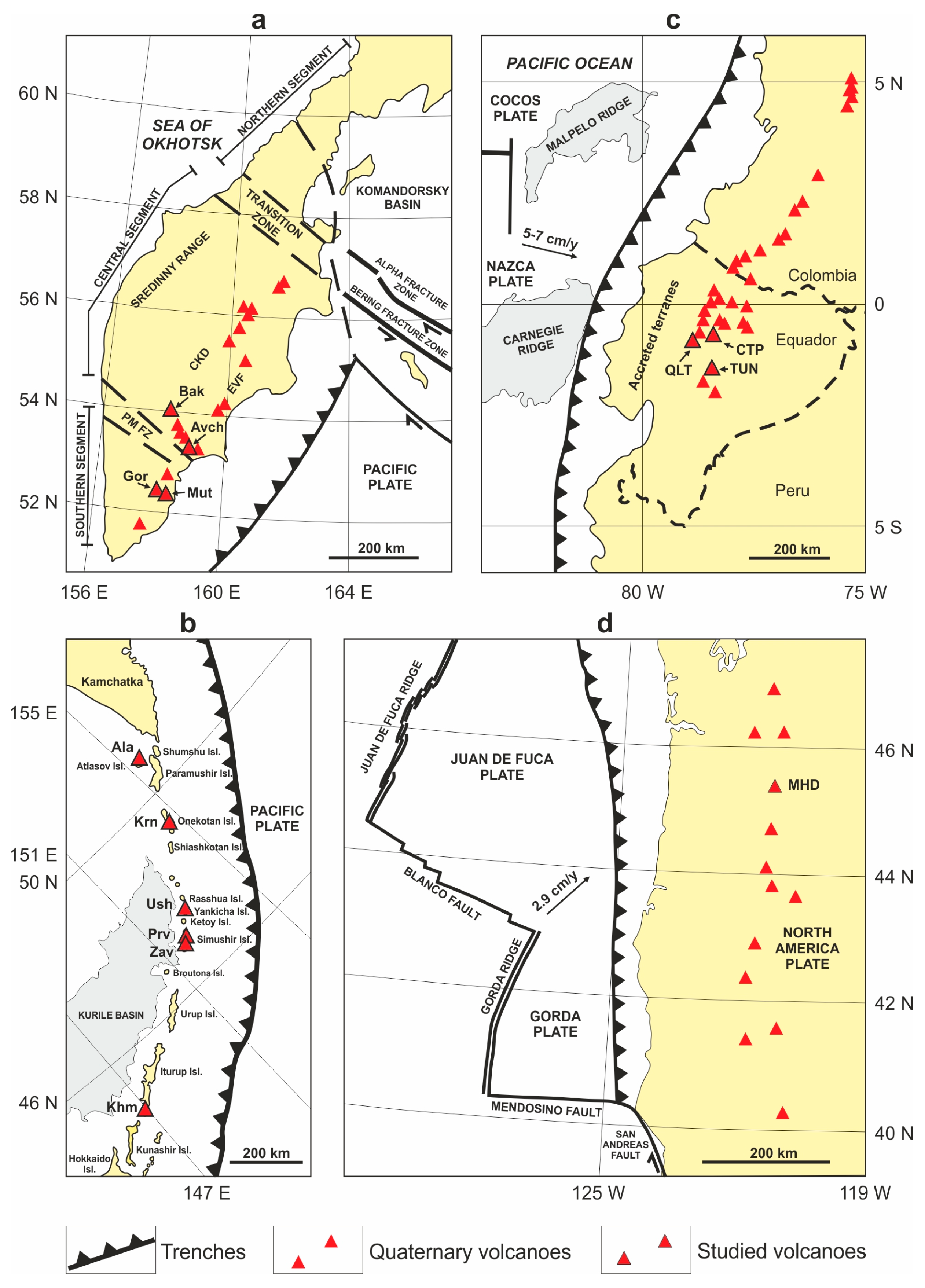
Figure 1. Tectonic setting of the Kamchatka active margin (a) modified from [47], the Kuriles (b) modified from [50], Ecuador (c) modified from [51], and the Cascades (d) modified from [52]. (a) CKD—Central Kamchatka Depression, EVF—Eastern Volcanic Front, and PMFZ—Petropavlovsk-Malkinsky Fault Zone. Volcanoes: Mut—Mutnovsky, Gor—Gorely, Avch—Avachinsky, and Bak—Bakening. (b) Volcanoes: Khm—Bogdan Khmelnitsky, Zav—Zavaritsky, Prv—Prevo, Ush—Ushishir, Krn—Krenitsyn, and Ala—Alaid. (c) Volcanoes: Qlt—Quilotoa, Ctp—Cotopaxi, and Tun—Tungurahua. (d) Volcano: MHD—Mount Hood.
Geosciences 16 00040 g001
Figure 2. Photomicrographs of petrographic features of modern arc lavas from Kamchatka (AC), the Kuriles (DH), Ecuador (IK), and the Cascades (L). (A) Basalt, Mutnovsky volcano. (B) Basalt, Gorely volcano. (C) Andesite, Avachinsky volcano. (D) Basalt, Khmelnitsky volcano (Iturup Island). (E) Basaltic andesite, Zavaritsky volcano (Simushir Island). (F) Dacite, Ushishir volcano (Yankich Island). (G) Basaltic andesite, Krenitsyn volcano (Onekotan Island). (H) Basalt, Alaid volcano (Atlasov Island). (I) Andesite, Quilotoa volcano. (J) Andesite, Cotopaxi volcano. (K) Dacite, Tungurahua volcano. (L) Andesite, Mt. Hood volcano. All microphotographs were taken in cross-polarized light. Mineral abbreviations: Ol—olivine, Opx—otrhopyroxene, Cpx—clinopyroxene, Amp—amphibole, and Pl—plagioclase. Scale bar in all photos is 20 µm.
Geosciences 16 00040 g002
Figure 3. Geochemistry of arc lavas from Kamchatka, Kuriles, Ecuador, and Cascades. (A) Alkali–silica (TAS) from [85]. (B) Diagram total FeO/MgO versus SiO2. Line discriminating between tholeiitic (TH) and calc-alkaline (CA) volcanic series is from [86]. The red solid lines delineate the fields of high-Fe, medium-Fe, and low-Fe, according to [87]. The thin black solid lines indicate different CA/TH indexes from [88]. (C) Sr/Y versus Y (ppm) diagram after [47]. (D) Primitive mantle-normalized incompatible trace element patterns for Kamchatka, Kuriles, Ecuador, and Cascades lavas. Normalizing values are from [89].
Geosciences 16 00040 g003
Figure 4. BSE (backscattered electrons) images of Cl-bearing mineral microinclusions in Kamchatka lavas. (AC). Anhedral non-stoichiometric silver chloride (native silver + chlorargyrite composite) inclusions in orthopyroxene from the Mutnovsky volcano basalt (A), amphibole from the Gorely volcano basalt (B), and plagioclase in the adakitic dacite from the Bakening volcano (C). (D) An equant Cu-Ag-Cl microinclusion in plagioclase from andesite, the Gorely volcano. (E) A zoned composite Cu-O-C-Cl microinclusion in potassic feldspar, dacite, Bakening volcano. (F) Anhedral Cu-Ag-Cl-S microinclusion in groundmass glass, dacite, Bakening volcano. (G) An equant Cu-Ag-Sn-oxychloride microinclusion in groundmass glass, basaltic andesite, Gorely volcano. (H) Anhedral Pb-Sb-oxychloride microinclusion in plagioclase and (I) euhedral bismoclite microinclusion in plagioclase, ankaramite, Avachinsky volcano. Mineral abbreviations: Amp—amphibole, K-Fsp—potassic feldspar, Opx—orthopyroxene, and Pl—plagioclase.
Geosciences 16 00040 g004
Figure 5. BSE images of metal and mineral microinclusions associated with Cl-bearing microminerals in Kamchatka lavas. (A). Euhedral native gold microinclusion in orthopyroxene and (B) an equant microinclusion of Ag-Au alloy in plagioclase, ankaramite, Avachinsky volcano. (C) An equant, subhedral microinclusion of Cu-Ag-Au alloy in plagioclase, dacite, Bakening volcano. (D) An equant cupriferous silver microinclusion at the contact between olivine and plagioclase crystals, basalt, Gorely volcano. (E) A porous acanthite microinclusion in plagioclase, andesite, Mutnovsky volcano. (F) Cupriferous silver with sulfide microinclusion in plagioclase, dacite, Bakening volcano. (G) Droplet-shaped pyrrhotite inclusion in clinopyroxene, andesite, Gorely volcano. (H) Anhedral galena microinclusion in plagioclase, basaltic andesite, Gorely volcano. (I) Subhedral barite microinclusion, andesite, Avachinsky volcano. Mineral abbreviations: Aca—acanthite, Brt—barite, Cpx—clinopyroxene, Gn—galena, Ol—olivine, Opx—orthopyroxene, Pl—plagioclase, and Po—pyrrhotite.
Geosciences 16 00040 g005
Figure 6. BSE images of Cl-bearing microminerals in modern lavas from the Kurile Island arc. (AC) Anhedral to subhedral composite microinclusions of native silver and chlorargyrite in (A) clinopyroxene from basalt, Krenitsyn volcano (Onekotan Island); (B) amphibole from basalt, Alaid volcano (Atlasov Island); (C) plagioclase from basaltic andesite, Zavaritsky volcano (Simushir Island). (D,E) Microminerals in dacite from the Prevo volcano (Simushir Island): (D) anhedral composite of cupriferous silver with chloride film and titanomagnetite in plagioclase in dacite; (E) an angular-shaped composite of copper and silver chloride and sulfide. (FH) Chlorine-bearing microminerals in basalt, Alaid volcano (Atlasov Island): (F) cluster of prismatic euhedral acanthite and chlorargyrite (probably with native silver) microcrystals in plagioclase; (G) the same in groundmass glass. (H) An equant Pb-Sb-oxychloride (nadorite?) microinclusion in plagioclase. (I) An angular-shaped Sn-oxychloride microinclusion in plagioclase from dacite, Ushishir volcano (Yankich Island). Mineral abbreviations: Amp—amphibole, Cpx—clinopyroxene, Pl—plagioclase, Ti-Mag—titanomagnetite, and Glass—groundmass glass.
Geosciences 16 00040 g006
Figure 7. BSE images of metal and mineral microinclusions associated with Cl-bearing microminerals in modern lavas from the Kurile Island arc. (A) Microinclusion of subhedral Ag-Au alloy in plagioclase, basalt, Krenitsyn volcano (Onekotan Island). (B) Microinclusion of anhedral Cu-Ag-Au alloy in plagioclase, basalt, Alaid volcano (Atlasov Island). (C) Dendrite-like cupriferous silver microinclusion in plagioclase, basalt, Krenitsyn volcano (Onekotan Island). (D) Anhedral acanthite microinclusion in plagioclase, dacite, Ushishir volcano (Yankich Island). (E) Euhedral Cu-bearing acanthite micromineral in plagioclase, dacite, Prevo volcano (Simushir Island). (F) Euhedral angular cassiterite microinclusion in the groundmass glass, basaltic andesite, Zavaritsky volcano (Simushir Volcano). Mineral abbreviations: Aca—acanthite, Cst—cassiterite, Pl—plagioclase, and Glass—groundmass glass.
Geosciences 16 00040 g007
Figure 8. BSE images of the composite Cl-bearing silver microinclusions in Ecuadorian lavas. All represent anhedral, native silver (Ag) + chlorargyrite (Cag) composite microinclusions in plagioclase (Pl). Plagioclase in (A) also contains inclusion of clinopyroxene (Cpx). Silver + silver chloride microinclusion in (E) is intergrown with titanomagnetite (Ti-Mag). Ag + Cag composite microinclusions in (D,E) contain small amounts of copper (0.3 and 0.5 at.%, accordingly).
Geosciences 16 00040 g008
Figure 9. BSE images of native metal, alloy, and sulfide microinclusions associated with Cl-bearing microminerals in Ecuadorian lavas. (A) Euhedral ferroplatinum in clinopyroxene. (B) Subhedral native gold in orthopyroxene. (C) Anhedral Cu-Ag-Au alloy in plagioclase. (D) Subhedral Cu-Zn-Ag alloy in plagioclase. (E) Subhedral acanthite in olivine. (F) Anhedral chalcopyrite in plagioclase. (G) An equant subhedral chalcocite in plagioclase. (H) Anhedral galena in anorthoclase. (I) Subhedral pyrrhotite in plagioclase. Mineral abbreviations: Aca—acanthite, Ano—anorthoclase, Ccp—chalcopyrite, Cct—chalcocite, Cpx—clinopyroxene, Gn—galena, Ol—olivine, Opx—orthopyroxene, Pl—plagioclase, and Po—pyrrhotite.
Geosciences 16 00040 g009
Figure 10. BSE images of chlorine-bearing microinclusions in Mt. Hood andesite. (A,B) Euhedral, plate-like Cu-Ag-Cl microinclusions in orthopyroxene (A) and orthopyroxene–anorthoclase matrix (B). (CF) Euhedral to subhedral Ag-Cl microinclusions in anorthoclase (C,F) and plagioclase (D,E). (GI) Euhedral to subhedral Ag-Cl microinclusions in quartz (G,I), in association with euhedral titanomagnetite (H). Mineral abbreviations: Ano—anorthoclase, Opx—orthopyroxene, Pl—plagioclase, Qz—quartz, and Ti-Mag—titanomagnetite.
Geosciences 16 00040 g010
Figure 11. BSE images of metal and mineral microinclusions in Mt. Hood andesite. (A) Sawtooth-shaped native gold microinclusion in orthopyroxene. (B) Elongated euhedral Cu-Ag-Au microinclusion in the quartz–plagioclase matrix. (C) Anhedral microinclusion of cupriferous silver in plagioclase. (D) Cluster of euhedral to subhedral acanthite microcrystals in plagioclase. (E) An equant spherical covellite microinclusion in association with amphibole and orthopyroxene. (F) An equant galena microinclusion in plagioclase. (G) Subhedral microinclusion of composite Cu-Ag-Pb-sulfide in quartz–orthopyroxene matrix. (H) Subhedral bismuthinite microinclusion in plagioclase. (I) Anhedral barite microinclusion in plagioclase. Mineral abbreviations: Aca—acanthite, Amp—amphibole, Bin—bismuthinite, Brt—barite, Cv—covellite, Gn—galena, Opx—orthopyroxene, Pl—plagioclase, and Qz—quartz.
Geosciences 16 00040 g011
Table 1. Chlorine-bearing mineral microinclusions in arc lavas from Kamchatka, Kuriles, Ecuador, and Cascades.
ArcVolcanoRock TypeCl-Bearing MineralsHost PhasesAssociated Metal and Mineral Microinclusions
KamchatkaAvachinskyAnkaramiteAgCl (1), bismoclite, Pb-Sb-oxychloride, and Cl-F-apatiteClinopyroxene, orthopyroxene, and plagioclaseNative Pt (2) and Au, Ag-Au, Ag-Cu-Au, and Sn-Cu alloys, bismite, cassiterite, acanthite, Cu-Ag-sulfide, arsenopyrite, Zn-Pb-Sb-Cu-sulfide, barite, and monazite
AndesiteAgCl, Cl-apatiteOrthopyroxene, plagioclase, and volcanic glassCupriferous Ag, Fe-W and Cu-Ag-Au alloys, sphalerite, smithsonite, cassiterite, bismite, Pb and Sb oxides, and barite
BakeningDaciteAg-Cl, Cu-Ag-Cl composite, AgCl + Cu-sulfide and malachite + atakamite (?) composites, Sr-Bi-oxychloride, and Cl-apatite Amphibole, plagioclase, anorthoclase, K-feldspar, quartz, and volcanic glassCupriferous Ag, Ag-Au, Cu-Ag-Au, Co-W, and Sn-Cu alloys, acanthite, Cu-Ag-sulfide, pyrrhotite, pyrite, chalcopyrite, covellite, zincite, bismite, cassiterite, barite, and monazite
MutnovskyBasaltAgCl, Cu-Ag-Cl and zincite + AgCl compositesOrthopyroxene, amphibole, and plagioclaseCu-Sn alloy, acanthite, Cu-Ag-sulfide, and barite
Basaltic andesiteAgCl, Cu-Ag-Cl, and Zn-Cu-Ag-Cl and AgCl + Cu-sulfide compositesOrthopyroxene, amphibole, plagioclase, titanomagnetite, and volcanic glassCupriferous Ag, Zn-Cu-Ag alloy, Cu-Ag-sulfide, acanthite, and barite
AndesiteAgClPlagioclaseCu-Ag-sulfide
DaciteAgClAmphibole, anorthoclase, and volcanic glassCu-Zn alloy, acanthite, Cu-Ag-sulfide, bismite, and Cu-Zn-Ag-sulfide
GorelyBasaltAgCl, Cu-Ag-Cl compositeOlivine, orthopyroxene, clinopyroxene, amphibole, plagioclase, K-feldspar, and volcanic glassCupriferous Ag, Cu-Ag-sulfide, acanthite, Fe-W alloy, and cassiterite
Basaltic andesiteAgCl, AgCl + cassiterite compositePlagioclase, volcanic glassNative Au, Sn-Cu alloy, acanthite, Cu-Ag-sulfide, galena, and barite
AndesiteAgCl, AgCl + Cu-sulfide compositeAnorthoclase, volcanic glassNative Ag, cupriferous Ag, Cu-Ag-sulfide, Sn-Cu alloy, and galena
DaciteAgCl, Cl-apatiteAmphibole, anortoclase, K-feldspar, and titanomagnetiteCupriferous Ag, native Fe, and pyrrhotite
KurilesUshishirDaciteAg-Cl-S and Cu-Ag-Cl-S, Sn-oxychloridePlagioclaseNi-Cu-Au alloy, cupriferous Ag, acanthite, and Cu-Ag-sulfide
ZavaritskyBasaltic andesiteAgCl, Cu-Ag-Cl-SPlagioclase, volcanic glassNative Pt (2), cupriferous Ag, Cu-Ag-sulfide, and cassiterite
PrevoDaciteCu-Ag-Cl, Ag-Cl-S, and Cu-Ag-Cl-SPlagioclaseCu-Ag-sulfide
KrenitsynBasaltAgClClinopyroxene, plagioclaseNative Pt (2), Ag-Au, Cu-Ag-Au, Ni-Cu-Ag-Au, Rh-Cu-Au and Rh-Zn-Ni-Cu-Au alloys, Fe-W and Sn-Cu alloys, acanthite, Cu-Ag-sulfide, chalcocite, and chalcopyrite
Basaltic andesiteAgClPlagioclaseAcanthite, Cu-Ag-sulfide, and sphalerite
AlaidBasaltAgCl, Ag-Cl-S, Cu-Ag-Cl-S, and Pb-Sb-oxychloridePlagioclase, volcanic glassNative Pt, Cu-Ag-U and Pb-Sb (2) alloys, acanthite, Cu-Ag-sulfide, cassiterite, and W-carbide
EcuadorQuilotoaAndesiteAgClClinopyroxene, plagioclaseCu-Pt, Fe-Pt, native Au, cupriferous Ag, Zn-Cu-Ag alloy, Cu-Ag-sulfide, and chalcocite
CotopaxiAndesiteAgCl, Cu-Ag-ClAmphibole, plagioclase, and volcanic glassNative Pt, Ag-Au, Zn-Cu-Ag and Sn-Cu alloys, cupriferous Ag, Cu-Ag-sulfide, pyrrhotite (±Cu), chalcopyrite, and chalcocite
TungurahuaDaciteCu-Ag-Cl, Cl- and Cl-F-apatitePlagioclase, anorthoclase, and titanomagnetiteCu-Ni, Cu-Zn-Ag and Cu-Ag-Au alloys, cupriferous Ag, Cu-Ag-sulfide, monazite, galena, chalcopyrite, and pyrrhotite
CascadesMt. HoodAndesiteAgCl, Cu-Ag-ClOrthopyroxene, plagioclase, anorthoclase, titanomagnetite, and quartzNative Au, Fe-W, Cu-Zn, Cu-Au, Ni-Cu-Au, Ni-Cu-Ag-Au and Cu-Ag-Au alloys, cupriferous Ag, acanthite, Cu-Ag- and Ag-Pb sulfides, galena, bismuthinite, covellite, barite, cassiterite, monazite, and W-carbide
(1) Native silver—chlorargyrite composite. Please see Discussion for details. (2) Oxidized.
Table 2. Comparison of mineral microinclusions in arc lavas with ore mineral assemblages in proximal epithermal and porphyry Cu-Ag-Au mineralizations.
ArcRock TypesMicroinclusions in LavasEpithermal
Mineralization
Porphyry
Mineralization
KamchatkaAnkaramite, basalt, basaltic andesite, andesite, and daciteCag, Cu-Ag-Cl, Cu-Ag-S-Cl, Cu-O-C-Cl, Sr-Bi-O-Cl, Zn-O-Cl, Zn-Cu-Ag-Cl, Sn-Ag-O-Cl, Bmc, Pb-Sb-oxychloride, Pt, Au, Ag, Cu-Ag, Cu-Zn, Zn-Cu-Ag, Fe-W, Co-W, Sn-Cu, Cu-Ag-Au, Cu-Ag-sulfide, Aca, Cu-Zn-Ag-sulfide, Gn, Sp, Apy, Zn-Pb-Sb-Cu-sulfide, Py, Po, Ccp, Cv, Cst, Mnz, Pb-Sb oxides, Brt, and Clap Au, Ag, Cu-Ag, Cu-Zn, Ag-Au, Cu-Ag-Au alloys, Cag, Aca, Plb, Gn, Sp, Ccp, Cv, Apy, Ttr, Ttn, Pyg, Alt, Hes, Sb-sulfides, Py, Ag-sulfosalts, tellurides and selenides, Sn, Sb and As sulfosalts, Ag-Au-Pb bismutides and antimonides, Cin, Cst, Brt, and ClapAu (±Cu, Pd), Pt, Ccp, Bn, Cct, Po, Gn, Sp, Mol, Dg, Azu, Mla, and Brt
KurilesBasalt, basaltic andesite, andesite, and daciteCag, Cu-Ag-Cl, Ag-Cl-S, Cu-Ag-Cl-S, Sn-oxychloride, Pb-S-oxychloride, Pt, Ag-Au, Cu-Ag, Ni-Cu-Ag-Au, Rh-Cu-Au, Rh-Zn-Ni-Cu-Au, Cu-Ag-Au, Fe-W, Sn-Cu alloys, Aca, Cu-Ag-sulfide, Ccp, Cct, Sp, Cst, and W-carbide Ag, Cu-Ag, Hem, Cag, Aca, Cu, Py, Sp, Gn, Cct, Cv, Apy, Ttr, Ttn, Bin, Bis, Bit, Alt, Hes, Gf, Prs, Plb, Knn Stn, Cst, and Brt
EcuadorAndesite, daciteCag, Cu-Ag-Cl, Au, Ag, Pt (± Fe, Cu), Ag-Au, Cu-Ag, Cu-Ni, Sn-Cu, Cu-Zn-Ag, Cu-Ag-Au alloys, Po (± Cu), Cu-Ag-sulfide, Ccp, Cct, Gn, Mnz, and Cl-F ApAu, Ag, Ag-Au alloys, Py, Po, Ccp, Sp, Gn, Aca, Brt, Hem, Ttr, Ag-sulfosalts, Prs, Pyg, Fb, Ja, Bou, Cin, and SbnAu, Py, Po, Ccp, Bn, Cv, Eng, Sp, Gn, Mol, Ttr, Tnt, Aca, Brt, and Luz
CascadesAndesiteAg, Au, Cag, Cu-Ag-Cl, Fe-W, Cu-Zn, Cu-Au, Ni-Cu-Ag-Au, Cu-Ag-Au alloys, Cu-Ag, Aca, Cu-Ag and Ag-Pb-sulfides, Gn, Bin, Cv, Cst, Brt, Mnz, and W-carbidesAg, Cu, Py, Ccp, Gn, Sp, and Ccl
Data sources: Kamchatka: epithermal [102], porphyry [47]; Kuriles: epithermal [105]; Ecuador: epithermal [103], porphyry [104]; and Cascades: epithermal [107]. Mineral abbreviations: Aca—acanthite, Ag—native silver, Alt—altaite, Ap—apatite, Au—native gold, Azu—azurite, Bin—bismuthinite, Bis—bismite, Bit—bismutite, Bn—bornite, Bmc—bismoclite, Bou—boulangerite, Brt—barite, Cag—chlorargyrite, Ccl—chrysocolla, Ccp—chalcopyrite, Cct—chalcocite, Cin—cinnabar, Clap—chlorapatite, Cu—native copper, Cu-Ag—cupriferous silver, Cv—covellite, Dg—digenite, Eng—enargite, Fb—freibergite, Ja—jamesonite, Gf—goldfieldite, Gn—galena, Hem—hematite, Hes—hessite, Mnz—monazite, Knn—krennerite, Luz—luzonite, Mla—malachite, Mol—molybdenite, Plb—polybasite, Po—pyrrhotite, Prs—proustite, Pt—native platinum, Py—pyrite, Pyg—pyrargyrite, Sbn—stibnite, Sp—sphalerite, Stn—stannite, Tnt—tennantite, and Ttr—tetrahedrite.
Disclaimer/Publisher’s Note: The statements, opinions and data contained in all publications are solely those of the individual author(s) and contributor(s) and not of MDPI and/or the editor(s). MDPI and/or the editor(s) disclaim responsibility for any injury to people or property resulting from any ideas, methods, instructions or products referred to in the content.