
Interpretable AI for Site-Adaptive Soil Liquefaction Assessment


Abstract
1. Introduction
2. Materials and Methods
2.1. Data
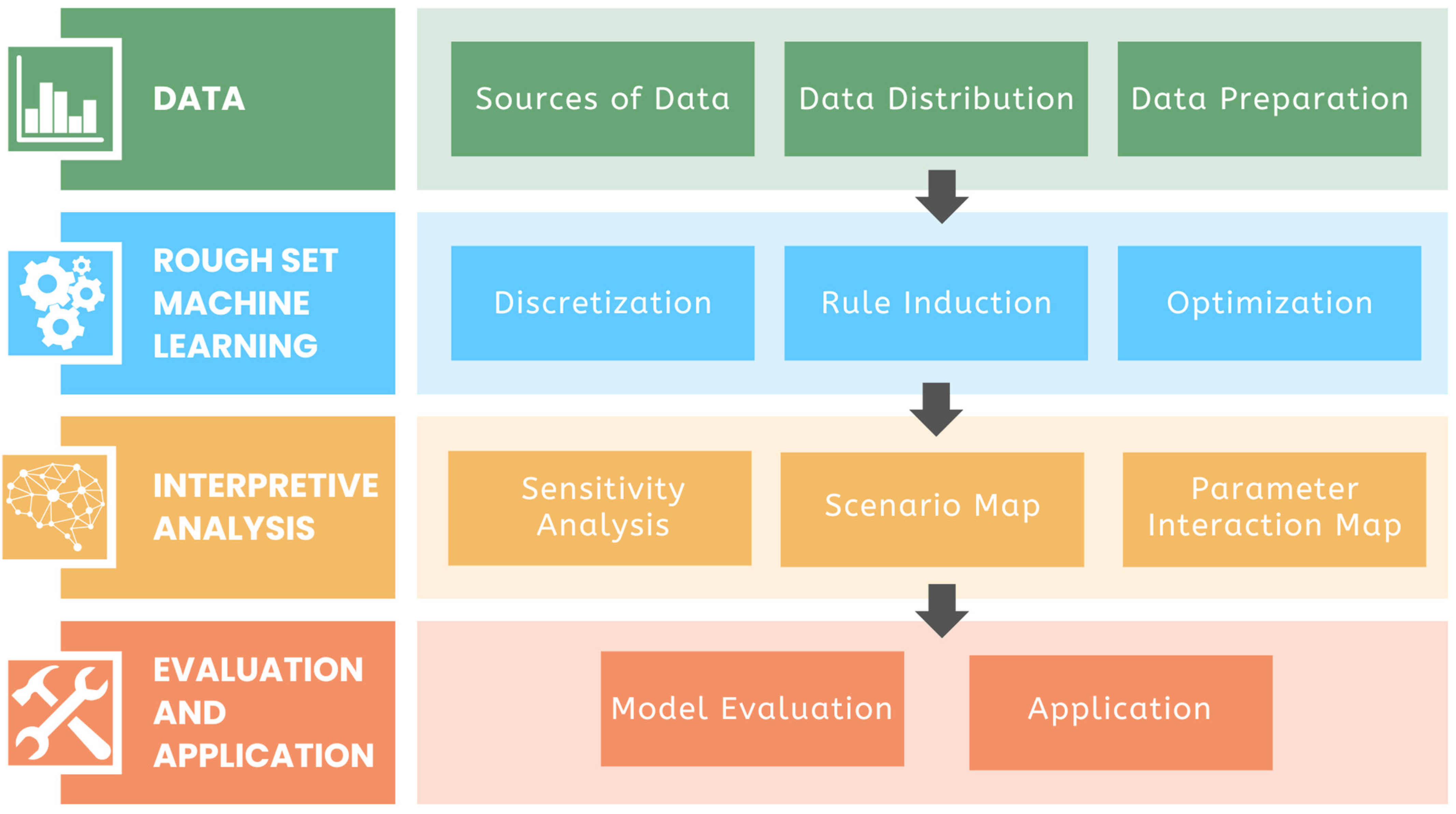
2.2. Rough Set Machine Learning
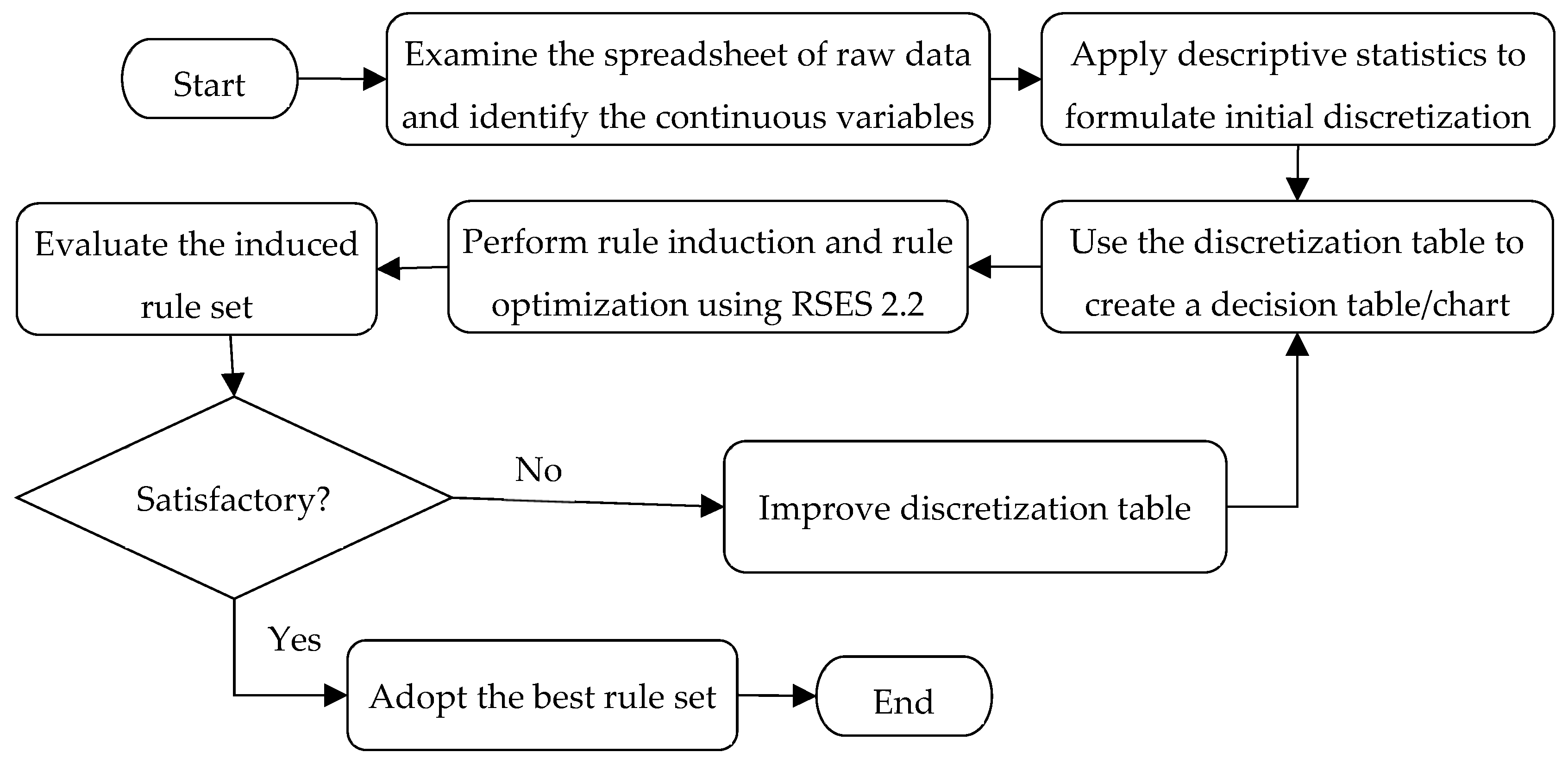
- Data Examination: The raw dataset was reviewed for completeness, ensuring each seismic event included all necessary geotechnical parameters. Independent (condition) and dependent (decision) attributes were identified (see Table 2).
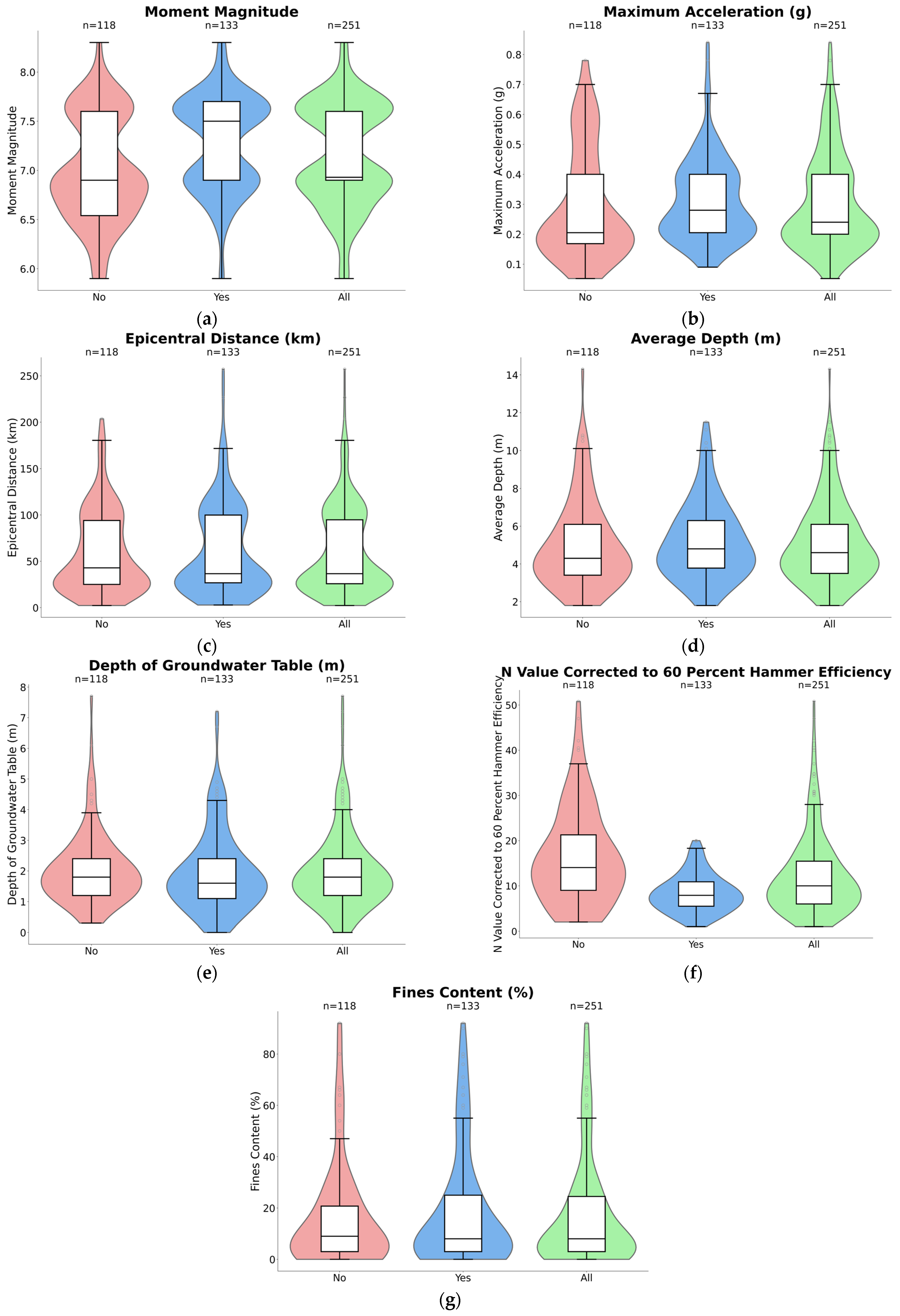
- Initial Discretization of Continuous Variables: As RST requires categorical inputs, continuous parameters were discretized into bins using thresholds based on median values. Extreme values (i.e., outliers) were labeled “Very Low” or “Very High” to address skewed distributions. Median-based discretization has been shown to be an effective binning approach in previous liquefaction studies [26,27]. Geotechnical parameters are often characterized by skewed distributions, for which the median provides a more representative measure of central tendency than the mean, as it is less sensitive to outliers and extreme values [27,31,32]. Consequently, median-based thresholds offer a robust and physically interpretable basis for discretizing continuous variables in liquefaction assessment.
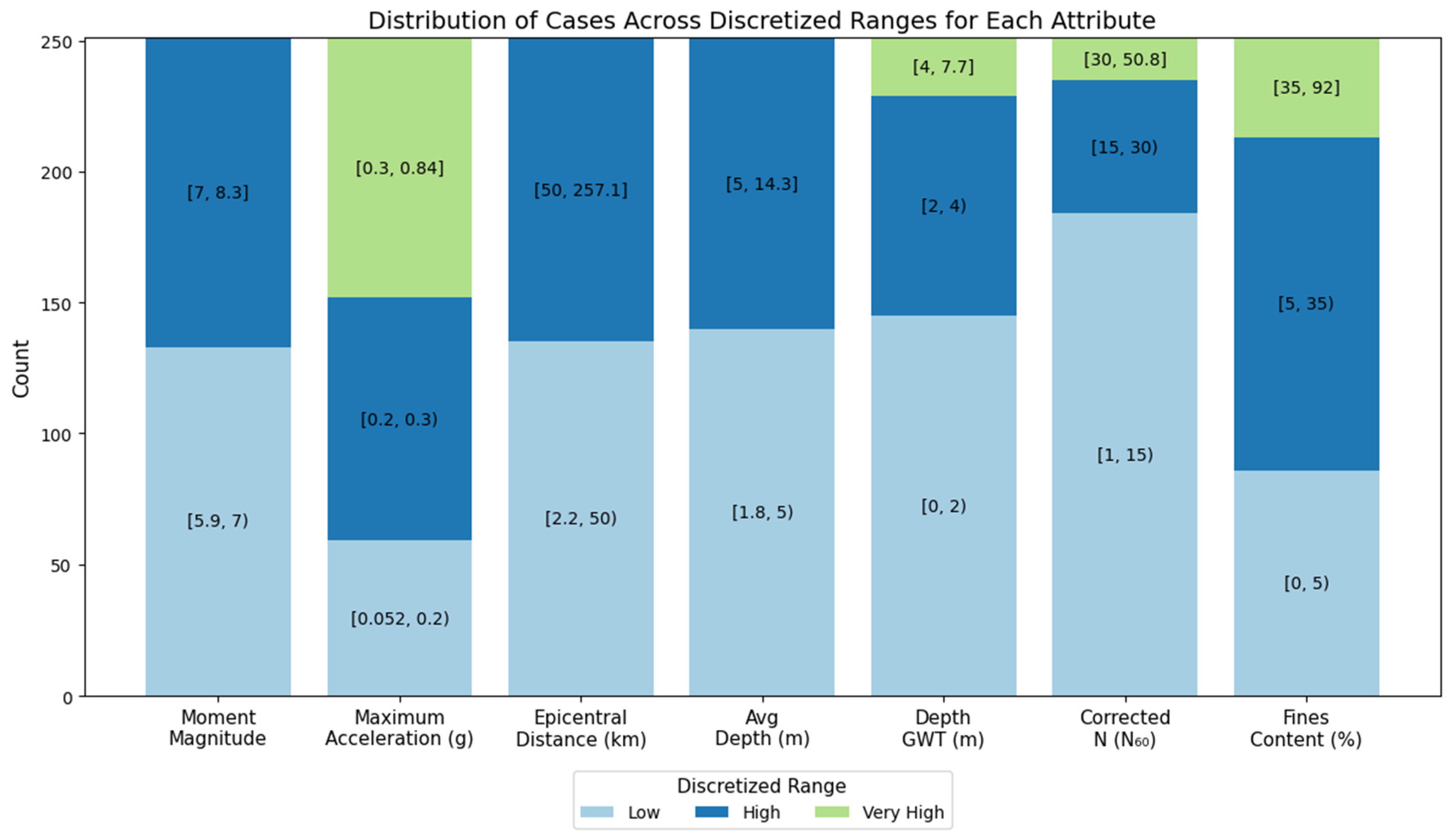
- Creation of Decision Tables: Discretized data were organized into decision tables, forming the basis for rule induction (Table 3 provides a sample format). The qualitative labels used in Table 3 (e.g., ‘low,’ ‘high,’ ‘very high’) correspond to discretized ranges of each continuous parameter as defined by the rule-based model. For clarity, the numerical thresholds that delineate these categories (e.g., the specific range of classified as ‘high’) are provided in Figure 4. These thresholds allow consistent interpretation and implementation of the qualitative descriptors.
- Rule Induction: Decision rules were generated using the exhaustive algorithm in RSES 2.2, which yielded optimal accuracy and coverage.
- Rule Optimization: Redundant or weak rules were removed through filtering and shortening features of RSES 2.2, retaining only those that captured essential parameter interactions.
- Rule Set Evaluation: Rule sets were assessed by their accuracy, coverage, and size, balancing generalization and predictive strength.
- Final Optimization: Discretization thresholds were iteratively refined using statistical feedback (i.e., balancing accuracy and coverage) and geotechnical literature. Figure 4 shows the final discretization adopted in this study. The resulting rule set represents a framework for liquefaction assessment.
2.3. Interpretive Analysis
2.3.1. Sensitivity Analysis Using Ablation
2.3.2. Scenario and Parameter Interaction Maps
2.4. Evaluation and Application
3. Results and Discussion
3.1. Data
3.2. Rough Set Machine Learning
3.2.1. The Best Rule Set
3.2.2. Interpretation of Rules
3.3. Interpretive Analysis
3.3.1. Sensitivity Analysis
3.3.2. Scenario Map
3.3.3. Parameter Interaction Map
3.4. Evaluation and Application
3.4.1. Rule-Based Predictive Model
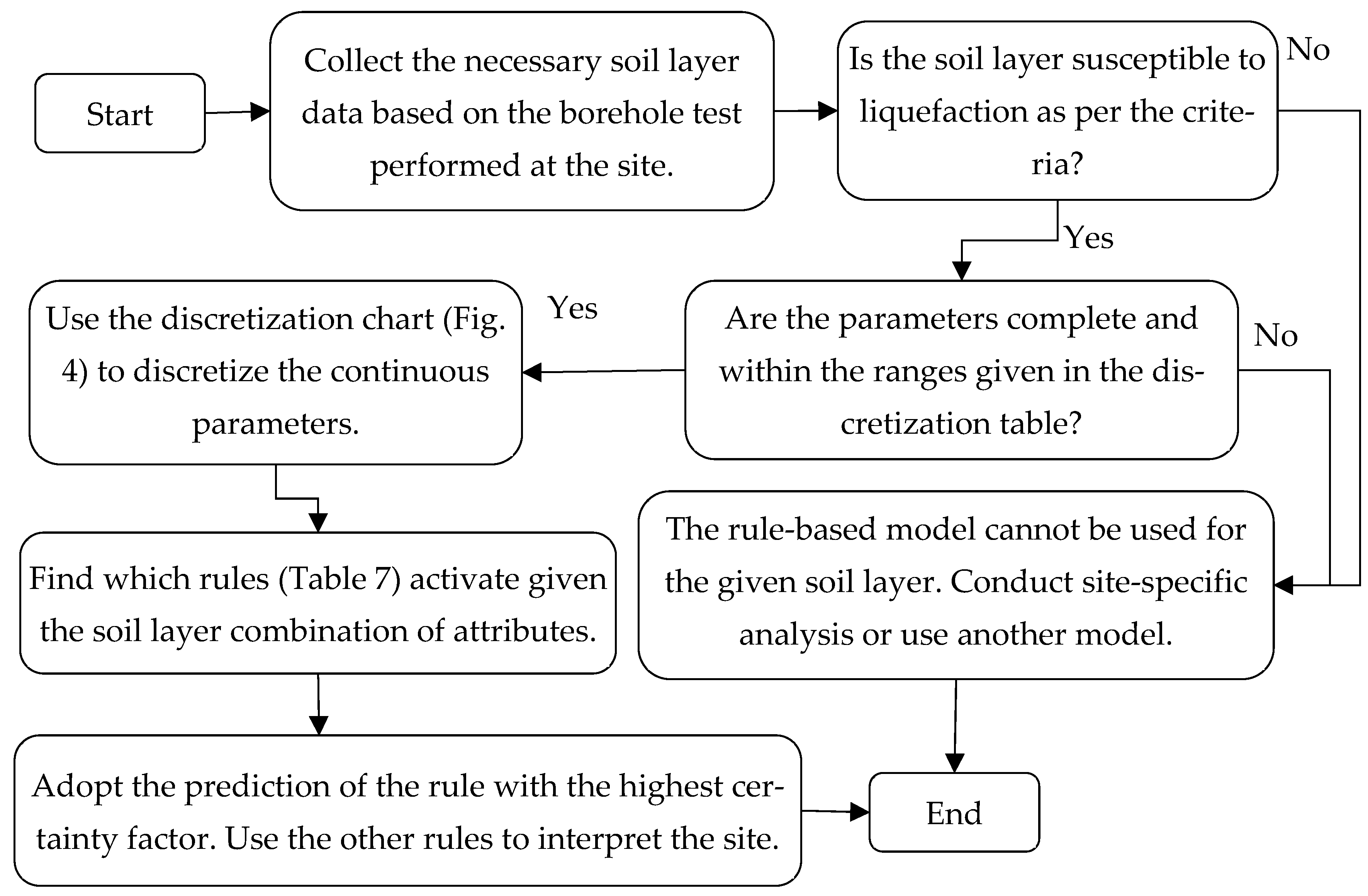
- Data Collection: All parameters required for liquefaction assessment are collected, as described in Section 2.2.
- Susceptibility Screening: Soil layers that are not susceptible to liquefaction are excluded from further analysis. These include:
- (1)
- layers located below the groundwater table,
- (2)
- layers classified as high-plasticity soils, and
- (3)
- layers with raw SPT -values greater than 30.
- Completeness of Parameters: Borehole sites with incomplete parameter sets are excluded from the analysis, and alternative site-specific liquefaction investigation methods are recommended for such cases.
- Discretization of Parameters: Continuous input variables are discretized using the parameter discretization scheme shown in Figure 4.
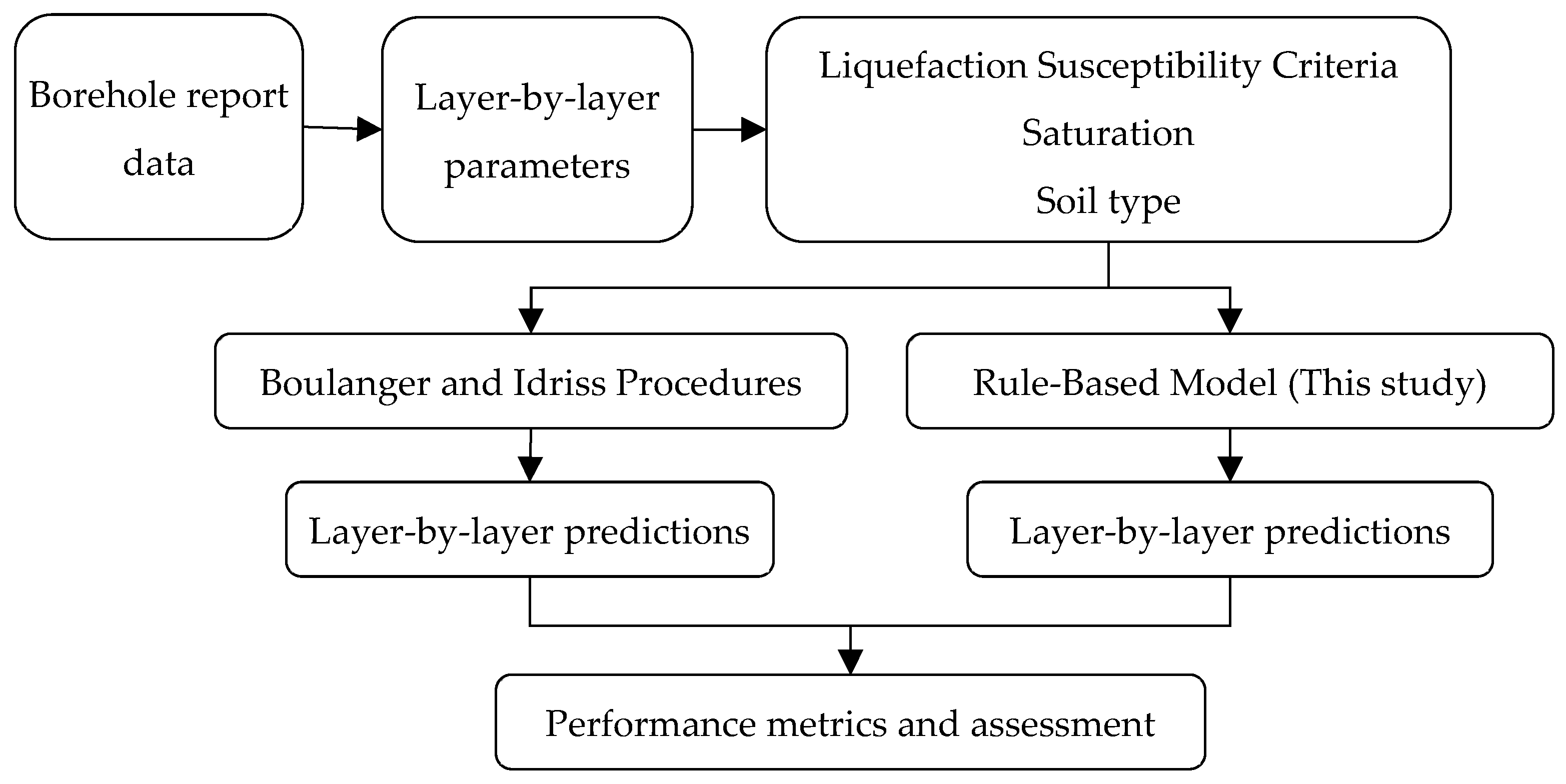
- Activated Rule Determination: The discretized parameters of each soil layer are compared against the rule set generated by the RSML (Table 7). All rules that are satisfied by the input conditions are identified as activated rules.
- Prediction and Interpretation: The final liquefaction prediction is determined by the activated rule with the highest certainty factor. Any remaining activated rules are used to aid interpretation of the site conditions. If no rule is activated, this indicates that similar site conditions are not represented in the historical dataset, and the rule-based model is considered not applicable for that site.
3.4.2. Model Evaluation
3.4.3. Rule-Based Model Application on the 2023 Turkey Earthquake
3.4.4. Practical Applications
3.5. Discussion
3.5.1. Core Findings of the Study
3.5.2. Methodological Advantages and Comparison with the Existing Models
3.5.3. Limitations and Opportunities for Improvement
4. Conclusions
Supplementary Materials
Author Contributions
Funding
Data Availability Statement
Acknowledgments
Conflicts of Interest
References
- Seed, H.B.; Idriss, I.M. Simplified Procedure for Evaluating Soil Liquefaction Potential. J. Soil. Mech. Found. Div. 1971, 97, 1249–1273. [Google Scholar] [CrossRef]
- Boulanger, R.W.; Idriss, I.M. CPT and SPT Based Liquefaction Triggering Procedures; Center for Geotechnical Modeling Department of Civil and Environmental Engineering University of California Davis: Davis, CA, USA, 2014. [Google Scholar]
- Cetin, K.O.; Seed, R.B.; Kayen, R.E.; Moss, R.E.S.; Bilge, H.T.; Ilgac, M.; Chowdhury, K. Dataset on SPT-based seismic soil liquefaction. Data Brief. 2018, 20, 544–548. [Google Scholar] [CrossRef]
- Youd, T.L.; Idriss, I.M.; Andrus, R.D.; Arango, I.; Castro, G.; Christian, J.T.; Dobry, R.; Finn, W.D.L.; Harder, L.F.; Hynes, M.E.; et al. Liquefaction Resistance of Soils: Summary Report from the 1996 NCEER and 1998 NCEER/NSF Workshops on Evaluation of Liquefaction Resistance of Soils. J. Geotech. Geoenviron. Eng. 2001, 127, 817–833. [Google Scholar] [CrossRef]
- Green, R.A.; Bommer, J.J.; Rodriguez-Marek, A.; Maurer, B.W.; Stafford, P.J.; Edwards, B.; Kruiver, P.P.; De Lange, G.; Van Elk, J. Addressing limitations in existing ‘simplified’ liquefaction triggering evaluation procedures: Application to induced seismicity in the Groningen gas field. Bull. Earthq. Eng. 2019, 17, 4539–4557. [Google Scholar] [CrossRef]
- Upadhyaya, S.; Green, R.A.; Rodriguez-Marek, A.; Maurer, B.W. True Liquefaction Triggering Curve. J. Geotech. Geoenviron. Eng. 2023, 149, 04023005. [Google Scholar] [CrossRef]
- Tsaparli, V.; Kontoe, S.; Taborda, D.M.G.; Potts, D.M. A case study of liquefaction: Demonstrating the application of an advanced model and understanding the pitfalls of the simplified procedure. Géotechnique 2020, 70, 538–558. [Google Scholar] [CrossRef]
- Cubrinovski, M.; Rhodes, A.; Ntritsos, N.; Van Ballegooy, S. System response of liquefiable deposits. Soil Dyn. Earthq. Eng. 2019, 124, 212–229. [Google Scholar] [CrossRef]
- Kennedy, S.; Alabbood, M.; Jaafar, I.M. Evaluating seismic liquefaction potential using shear wave velocity using machine learning. In Proceedings of the The 9th World Congress on Civil, Structural, and Environmental Engineering, London, UK, 14–16 April 2024. [Google Scholar]
- Fadliansyah, F.; Faris, F.; Wilopo, W. Implementation of machine learning classification models considering the optimum data ratio in predicting soil liquefaction susceptibility. IOP Conf. Ser. Earth Environ. Sci. 2024, 1416, 012012. [Google Scholar] [CrossRef]
- Samui, P.; Sitharam, T.G. Machine learning modelling for predicting soil liquefaction susceptibility. Nat. Hazards Earth Syst. Sci. 2011, 11, 1–9. [Google Scholar] [CrossRef]
- Kurnaz, T.F.; Erden, C.; Kökçam, A.H.; Dağdeviren, U.; Demir, A.S. A hyper parameterized artificial neural network approach for prediction of the factor of safety against liquefaction. Eng. Geol. 2023, 319, 107109. [Google Scholar] [CrossRef]
- Chou, J.-S.; Pham, T.-B.-Q. Enhancing soil liquefaction risk assessment with metaheuristics and hybrid learning techniques. Georisk 2024, 19, 115–133. [Google Scholar] [CrossRef]
- Demir, A.S.; Kurnaz, T.F.; Kökçam, A.H.; Erden, C.; Dağdeviren, U. A comparative analysis of ensemble learning algorithms with hyperparameter optimization for soil liquefaction prediction. Environ. Earth Sci. 2024, 83, 289. [Google Scholar] [CrossRef]
- Demir, S.; Sahin, E.K. An investigation of feature selection methods for soil liquefaction prediction based on tree-based ensemble algorithms using AdaBoost, gradient boosting, and XGBoost. Neural Comput. Appl. 2023, 35, 3173–3190. [Google Scholar] [CrossRef]
- Jas, K.; Mangalathu, S.; Dodagoudar, G.R. Evaluation and analysis of liquefaction potential of gravelly soils using explainable probabilistic machine learning model. Comput. Geotech. 2024, 167, 106051. [Google Scholar] [CrossRef]
- Kökçam, A.H.; Erden, C.; Demir, A.S.; Kurnaz, T.F. Bibliometric analysis of artificial intelligence techniques for predicting soil liquefaction: Insights and MCDM evaluation. Nat. Hazards 2024, 120, 11153–11181. [Google Scholar] [CrossRef]
- Maurer, B.W.; Sanger, M.D. Why “AI” models for predicting soil liquefaction have been ignored, plus some that shouldn’t be. Earthq. Spectra 2023, 39, 1883–1910. [Google Scholar] [CrossRef]
- Cheng, K.; Ziotopoulou, K. Machine Learning Applications in Geotechnical Earthquake Engineering: Progress, Gaps, and Opportunities. In Proceedings of the Geo-Congress 2023; American Society of Civil Engineers: Vancouver, BC, Canada, 2023; Volume 2023, pp. 493–505. [Google Scholar]
- Rudin, C.; Chen, C.; Chen, Z.; Huang, H.; Semenova, L.; Zhong, C. Interpretable machine learning: Fundamental principles and 10 grand challenges. Statist. Surv. 2022, 16, 1–85. [Google Scholar] [CrossRef]
- Hansen, T.F. Can We Trust the Machine Learning Based Geotechnical Model? In Information Technology in Geo-Engineering; Springer Series in Geomechanics and Geoengineering; Springer Nature Switzerland: Cham, Switzerland, 2025; pp. 332–340. ISBN 978-3-031-76527-8. [Google Scholar]
- Liu, W.; Liu, F.; Fang, W.; Love, P.E.D. Causal discovery and reasoning for geotechnical risk analysis. Reliab. Eng. Syst. Saf. 2024, 241, 109659. [Google Scholar] [CrossRef]
- Zhang, P.; Yin, Z.-Y.; Sheil, B. Interpretable data-driven constitutive modelling of soils with sparse data. Comput. Geotech. 2023, 160, 105511. [Google Scholar] [CrossRef]
- Cubrinovski, M.; Ntritsos, N.; Dhakai, R.; Rhodes, A. Key aspects in the engineering assessment of soil liquefaction. In Earthquake Geotechnical Engineering for Protection and Development of Environment and Constructions; CRC Press: Boca Raton, FL, USA, 2019; pp. 189–208. ISBN 978-0-367-14328-2. [Google Scholar]
- Arabani, M.; Pirouz, M. Liquefaction Prediction Using Rough Set Theory. Sci. Iran. 2017, 26, 779–788. [Google Scholar] [CrossRef]
- Torres, E.; Dungca, J. Prediction of Soil Liquefaction Triggering Using Rule-Based Interpretable Machine Learning. Geosciences 2024, 14, 156. [Google Scholar] [CrossRef]
- Torres, E.S.; Dungca, J.R. An Interpretable Machine Learning Approach in Understanding Lateral Spreading Case Histories. Int. J. GEOMATE 2024, 26, 110–117. [Google Scholar] [CrossRef]
- Pawlak, Z. Rough sets. Int. J. Comput. Inf. Sci. 1982, 11, 341–356. [Google Scholar] [CrossRef]
- Bazan, J.G.; Szczuka, M. The Rough Set Exploration System. In Transactions on Rough Sets III; Peters, J.F., Skowron, A., Eds.; Lecture Notes in Computer Science; Springer: Berlin/Heidelberg, Germany, 2005; Volume 3400, pp. 37–56. ISBN 978-3-540-25998-5. [Google Scholar]
- Bazan, J.G.; Szczuka, M. RSES 2.2 User’s Guide; Warsaw University: Warszawa, Poland, 2005. [Google Scholar]
- Ntritsos, N.; Cubrinovski, M. Ground-motion effects on liquefaction response. Soil Dyn. Earthq. Eng. 2024, 177, 108392. [Google Scholar] [CrossRef]
- Idriss, I.M.; Boulanger, R.W. SPT-Based Liquefaction Triggering Procedures; Center for Geotechnical Modeling Department of Civil and Environmental Engineering University of California Davis: Davis, CA, USA, 2010. [Google Scholar]
- Allen, G.I.; Gan, L.; Zheng, L. Interpretable Machine Learning for Discovery: Statistical Challenges and Opportunities. Annu. Rev. Stat. Its Appl. 2024, 11, 97–121. [Google Scholar] [CrossRef]
- Doshi-Velez, F.; Kim, B. Towards A Rigorous Science of Interpretable Machine Learning. arXiv 2017, arXiv:1702.08608. [Google Scholar] [CrossRef]
- Galupino, J.; Dungca, J. Estimating Liquefaction Susceptibility Using Machine Learning Algorithms with a Case of Metro Manila, Philippines. Appl. Sci. 2023, 13, 6549. [Google Scholar] [CrossRef]
- Liao, S.S.C.; Whitman, R.V. Overburden Correction Factors for SPT in Sand. J. Geotech. Engrg. 1986, 112, 373–377. [Google Scholar] [CrossRef]
- Dungca, J.R.; Chua, R.A.D. Development of a Probabilistic Liquefaction Potential Map for Metro Manila. Int. J. GEOMATE 2016, 10, 1804–1809. [Google Scholar] [CrossRef]
- Moreno, J.J.H.; Dean, A.; Ahmad, M.; Del Mundo, C.R.; Vea Kathrynn, G.; Sarmiento, R.; Abejuro, L.H.C.; Emmanuel, C.; Endaya, J.; Valdez, R.L.C.; et al. Reliability Analysis of Earthquake-Induced Liquefaction in Manila using Monte Carlo Simulation. In Proceedings of the 2022 IEEE 14th International Conference on Humanoid, Nanotechnology, Information Technology, Communication and Control, Environment, and Management (HNICEM), Boracay Island, Philippines, 1–4 December 2022; IEEE: Boracay Island, Philippines, 2022; pp. 1–6. [Google Scholar]
- Eslami, A.; Ghorbani, A. Assessment of Near-Field Strong Ground Motion Effects on Offshore Wind Turbines Resting on Liquefiable Soils Using Fully Coupled Nonlinear Dynamic Analysis. J. Geotech. Geoenviron. Eng. 2023, 149, 04023095. [Google Scholar] [CrossRef]
- Wang, C.-Y.; Manga, M. Liquefaction. In Water and Earthquakes; Lecture Notes in Earth System Sciences; Springer International Publishing: Cham, Switzerland, 2021; pp. 301–321. ISBN 978-3-030-64307-2. [Google Scholar]
- Kramer, S.L. Geotechnical Earthquake Engineering; Prentice-Hall International Series in Civil Engineering and Engineering Mechanics; Prentice Hall: Upper Saddle River, NJ, USA, 1996; ISBN 978-0-13-374943-4. [Google Scholar]
- Murdoch, W.J.; Singh, C.; Kumbier, K.; Abbasi-Asl, R.; Yu, B. Definitions, methods, and applications in interpretable machine learning. Proc. Natl. Acad. Sci. USA 2019, 116, 22071–22080. [Google Scholar] [CrossRef] [PubMed]
- Quigley, M.; Duffy, B. Effects of Earthquakes on Flood Hazards: A Case Study From Christchurch, New Zealand. Geosciences 2020, 10, 114. [Google Scholar] [CrossRef]
- Holzer, T.L.; Bennett, M.J.; Ponti, D.J.; Tinsley Iii, J.C. Liquefaction and Soil Failure During 1994 Northridge Earthquake. J. Geotech. Geoenviron. Eng. 1999, 125, 438–452. [Google Scholar] [CrossRef]
- Boulanger, R.W.; Idriss, I.M. Evaluating the Potential for Liquefaction or Cyclic Failure of Silts and Clays; Center for Geotechnical Modeling Department of Civil & Environmental Engineering University of California Davis: Davis, CA, USA, 2004. [Google Scholar]
- Bray, J.D.; Sancio, R.B.; Durgunoglu, T.; Onalp, A.; Youd, T.L.; Stewart, J.P.; Seed, R.B.; Cetin, O.K.; Bol, E.; Baturay, M.B.; et al. Subsurface Characterization at Ground Failure Sites in Adapazari, Turkey. J. Geotech. Geoenviron. Eng. 2004, 130, 673–685. [Google Scholar] [CrossRef]
- Bray, J.D.; Sancio, R.B. Assessment of the Liquefaction Susceptibility of Fine-Grained Soils. J. Geotech. Geoenviron. Eng. 2006, 132, 1165–1177. [Google Scholar] [CrossRef]
- Hu, X.; Zhang, Y.; Guo, L.; Wang, J.; Cai, Y.; Fu, H.; Cai, Y. Cyclic behavior of saturated soft clay under stress path with bidirectional shear stresses. Soil Dyn. Earthq. Eng. 2018, 104, 319–328. [Google Scholar] [CrossRef]
- Sun, L.; Gu, C.; Wang, P. Effects of cyclic confining pressure on the deformation characteristics of natural soft clay. Soil Dyn. Earthq. Eng. 2015, 78, 99–109. [Google Scholar] [CrossRef]
- Wei, Y.; Zhu, Y.; Ni, J. Experimental Study on the Combined Effect of Cyclic and Static Loads on the Mechanical Properties of the Saturated Soft Clay Material. Key Eng. Mater. 2016, 723, 843–848. [Google Scholar] [CrossRef]
- Cetin, K.O.; Soylemez, B.; Guzel, H.; Cakir, E. Soil liquefaction sites following the February 6, 2023, Kahramanmaraş-Türkiye earthquake sequence. Bull. Earthq. Eng. 2024, 23, 921–944. [Google Scholar] [CrossRef]
- Baziar, M.H.; Rostami, H. Earthquake Demand Energy Attenuation Model for Liquefaction Potential Assessment. Earthq. Spectra 2017, 33, 757–780. [Google Scholar] [CrossRef]
- Kayen, R.E.; Mitchell, J.K. Assessment of Liquefaction Potential during Earthquakes by Arias Intensity. J. Geotech. Geoenviron. Eng. 1997, 123, 1162–1174. [Google Scholar] [CrossRef]
- Kumar, K.; Samui, P.; Choudhary, S.S. Assessment of maximum liquefaction distance using soft computing approaches. Geomech. Eng. 2024, 37, 395–418. [Google Scholar] [CrossRef]
- Boulanger, R.W.; Idriss, I.M. Cyclic Strength Evaluation Criteria for Sand-Like, Clay-Like, and Intermediate Soils. In Proceedings of the Geo-Congress 2024; American Society of Civil Engineers: Vancouver, BC, Canada, 2024; pp. 456–466. [Google Scholar]
- Boulanger, R.W.; Idriss, I.M. Evaluation of Cyclic Softening in Silts and Clays. J. Geotech. Geoenviron. Eng. 2007, 133, 641–652. [Google Scholar] [CrossRef]
- Zeybek, A.; Yıldız, Ö.; Sönmezer, Y.B. Post-earthquake assessment of liquefaction in Gölbaşı-Adıyaman following the 6 February 2023 Kahramanmaraş earthquakes: Field observations, SPT-based analysis, and laboratory testing of soil ejecta. Nat. Hazards 2025, 121, 24157–24206. [Google Scholar] [CrossRef]



| ID | Event | M | amax (g) | R (km) | Avg Depth (m) | Depth GWT (m) | N60 | FC | Liq? |
|---|---|---|---|---|---|---|---|---|---|
| 1 | 1944 Tohnankai | 8.1 | 0.2 | 171.5 | 5.2 | 2.1 | 5.9 | 10 | Yes |
| 2 | 1944 Tohnankai | 8.1 | 0.2 | 167.5 | 4.3 | 2.4 | 2.3 | 30 | Yes |
| 3 | 1944 Tohnankai | 8.1 | 0.2 | 170.1 | 3.7 | 2.1 | 1 | 27 | Yes |
| 4 | 1948 Fukui | 7 | 0.4 | 3.4 | 4 | 1.2 | 8 | 0 | Yes |
| 5 | 1948 Fukui | 7 | 0.35 | 6.8 | 7.5 | 3.7 | 17.3 | 4 | Yes |
| 6 | 1964 Niigata | 7.6 | 0.09 | 158.6 | 3.3 | 1 | 2.6 | 5 | Yes |
| Attributes | Definition | Condition or Decision | Range of Values | Continuous or Categorical |
|---|---|---|---|---|
| M | Moment Magnitude | Condition | 5.9 to 8.3 | Continuous |
| amax (g) | Maximum Acceleration | Condition | 0.052 to 0.84 | Continuous |
| R (km) | Epicentral Distance | Condition | 2.2 to 257.1 | Continuous |
| Avg depth (m) | Average Depth | Condition | 1.8 to 14.3 | Continuous |
| Depth GWT (m) | Depth of Groundwater Table | Condition | 0 to 7.7 | Continuous |
| N60 | SPT N-value corrected to 60% Hammer Efficiency | Condition | 1.0 to 50.8 | Continuous |
| FC (%) | Fines Content | Condition | 0 to 92 | Continuous |
| Liq? | No or Yes | Decision | N/A | Categorical |
| M | amax (g) | R (km) | Avg Depth (m) | Depth GWT (m) | N60 | FC (%) | Liq? |
|---|---|---|---|---|---|---|---|
| High | High | High | High | High | Low | High | No |
| High | High | High | Low | High | Low | High | No |
| High | High | High | Low | High | Low | High | No |
| High | Very High | Low | Low | Low | Low | Low | No |
| High | Very High | Low | High | High | High | Low | No |
| High | Low | High | Low | Low | Low | High | No |
| High | Low | High | High | Low | Low | Low | No |
| Parameters | Manila City | Quezon City |
|---|---|---|
| Number of borehole data | 88 | 63 |
| Moment magnitude | 7.5 | |
| Maximum horizontal acceleration | 0.38 g | 0.39 g |
| Epicentral distance (from the Marikina West Valley Fault) | 10.65 km | 4.34 km |
| Hammer efficiency correction (CE) | 1.25 | |
| Borehole diameter correction (CB) | 1.00 | |
| Rod length correction (CR) | 3–4 m (10–13 ft) 4–6 m (13–20 ft) 6–10 m (20–30 ft) >10 m (>30 ft) | 0.75 0.85 0.95 1.00 |
| Sampling method correction (CS) | 1.20 | |
| Correction due to overburden pressure (CN) | Liao and Whitman (m = 0.5) | |
| Statistic | M | amax (g) | R (km) | Avg Depth (m) | Depth GWT (m) | N60 | FC (%) |
|---|---|---|---|---|---|---|---|
| Minimum | 5.90 | 0.05 | 2.23 | 1.80 | 0.00 | 1.00 | 0.00 |
| Maximum | 8.30 | 0.84 | 257.05 | 14.30 | 7.70 | 50.80 | 92.00 |
| Range | 2.40 | 0.79 | 254.82 | 12.50 | 7.70 | 49.80 | 92.00 |
| Median | 6.93 | 0.24 | 36.60 | 4.60 | 1.80 | 10.00 | 8.00 |
| Mean | 7.15 | 0.30 | 60.01 | 5.10 | 1.98 | 12.15 | 17.58 |
| Standard deviation (n-1) | 0.52 | 0.16 | 46.09 | 2.15 | 1.24 | 8.78 | 21.77 |
| Skewness (Pearson) | −0.18 | 1.01 | 1.17 | 1.05 | 1.49 | 1.58 | 1.69 |
| Rule Set Characteristics | Initial Discretization | Selected Best Rule Set |
|---|---|---|
| Shortening Ratio | 0.8 | 0.8 |
| Minimum Number of Supports per Rule | 5 | 5 |
| Number of Rules | 30 | 25 |
| Accuracy (All Data) | 86.8% | 86.2% |
| Coverage (All Data) | 87.3% | 86.4% |
| Accuracy (90/10 Split) | 82.6% | 86.4% |
| Coverage (90/10 Split) | 88.5% | 84.6% |
| Rules | M | amax (g) | R (km) | Avg Depth (m) | GWT | Avg Nm | FC (%) | Liq |
|---|---|---|---|---|---|---|---|---|
| 1 | Very High | Low | Yes | |||||
| 2 | High | Low | High | Yes | ||||
| 3 | High | Low | High | Yes | ||||
| 4 | High | High | Low | Yes | ||||
| 5 | High | Low | Low | Yes | ||||
| 6 | High | High | Low | Yes | ||||
| 7 | Very High | Low | Yes | |||||
| 8 | Very High | Very High | Yes | |||||
| 9 | High | Very High | Yes | |||||
| 10 | High | Low | Low | Low | Yes | |||
| 11 | Low | High | Low | Yes | ||||
| 12 | Low | Low | Low | Yes | ||||
| 13 | High | Low | Low | Yes | ||||
| 14 | High | High | Low | Yes | ||||
| 15 | High | Low | High | Yes | ||||
| 16 | Very High | No | ||||||
| 17 | Low | High | No | |||||
| 18 | High | High | No | |||||
| 19 | Low | High | No | |||||
| 20 | High | High | No | |||||
| 21 | Low | Low | No | |||||
| 22 | Low | High | No | |||||
| 23 | High | Low | No | |||||
| 24 | Low | High | No | |||||
| 25 | Low | Low | High | High | No |
| Attribute Removed | Total Accuracy (k = 10 Folds) | Total Accuracy (k = 100 Folds) |
|---|---|---|
| No Attribute Removed | 78.8 | 79.5 |
| Moment Magnitude | 76.0 | 77.5 |
| Maximum Acceleration | 71.2 | 70.5 |
| Epicentral Distance | 75.2 | 75.0 |
| Average Depth | 76.0 | 76.0 |
| Depth of Groundwater Table | 76.0 | 76.0 |
| N value corrected to 60% Hammer Efficiency | 53.2 | 50.0 |
| Fines Content | 78.4 | 78.5 |
| Metrics | Formula | Solution | Value |
|---|---|---|---|
| Accuracy | (TP + TN)/(TP + TN + FP + FN) | (466 + 565)/(1099) | 93.81% |
| Precision | TP/(TP + FP) | 466/(466 + 32) | 93.57% |
| Recall | TP/(TP + FN) | 466/(466 + 36) | 92.83% |
| Specificity | TN/(TN + FP) | 565/(565 + 32) | 94.64% |
| F1 Score | 2 × (Precision × Recall)/(Precision + Recall) | 93.20% | |
| Parameters | Boulanger and Idriss Model | Rule-Based Model |
|---|---|---|
| Moment magnitude | 7.8 (Pazarcik) & 7.6 (Elbistan) | |
| Maximum horizontal acceleration | 0.45 g | |
| Epicentral distance | - | 85 km (Pazarcik) 55 km (Elbistan) |
| Average depth | 1.50–19.50 m | |
| Depth of Groundwater Table | 1.9 m | |
| SPT N-value corrected to 60% Hammer Efficiency | 8–23 | |
| Fines Content | 35% | |
| Liquefied? (in Actual) | Yes | |
| Tool/Tool Combination | Proposed Applications |
|---|---|
| Decision Rules |
|
| Scenario Maps |
|
| Interaction Maps |
|
| Decision Rules + Scenario Maps |
|
| Decision Rules + Parameter Interaction Maps |
|
| Scenario + Parameter Interaction Maps |
|
| All Three Tools Combined |
|
Disclaimer/Publisher’s Note: The statements, opinions and data contained in all publications are solely those of the individual author(s) and contributor(s) and not of MDPI and/or the editor(s). MDPI and/or the editor(s) disclaim responsibility for any injury to people or property resulting from any ideas, methods, instructions or products referred to in the content. |
© 2026 by the authors. Licensee MDPI, Basel, Switzerland. This article is an open access article distributed under the terms and conditions of the Creative Commons Attribution (CC BY) license.
Share and Cite
Torres, E.; Dungca, J. Interpretable AI for Site-Adaptive Soil Liquefaction Assessment. Geosciences 2026, 16, 25. https://doi.org/10.3390/geosciences16010025
Torres E, Dungca J. Interpretable AI for Site-Adaptive Soil Liquefaction Assessment. Geosciences. 2026; 16(1):25. https://doi.org/10.3390/geosciences16010025
Chicago/Turabian StyleTorres, Emerzon, and Jonathan Dungca. 2026. "Interpretable AI for Site-Adaptive Soil Liquefaction Assessment" Geosciences 16, no. 1: 25. https://doi.org/10.3390/geosciences16010025
APA StyleTorres, E., & Dungca, J. (2026). Interpretable AI for Site-Adaptive Soil Liquefaction Assessment. Geosciences, 16(1), 25. https://doi.org/10.3390/geosciences16010025