Article

Integrating PCA and Fractal Modeling for Identifying Geochemical Anomalies in the Tropics: The Malang–Lumajang Volcanic Arc, Indonesia


by
Wahyu Widodo
1,*,
Ernowo Ernowo
1,
Ridho Nanda Pratama
2,
Mochamad Rifat Noor
3,
Denni Widhiyatna
4,
Edya Putra
4,
Arifudin Idrus
5,
Bambang Pardiarto
1,
Zach Boakes
6,
Martua Raja Parningotan
1,
Triswan Suseno
1,
Retno Damayanti
1,
Purnama Sendjaja
1,
Dwi Rachmawati
7 and
Ayumi Hana Putri Ramadani
8
1
Geological Resources Research Center, National Research and Innovation Agency, Bandung 40135, Indonesia
2
Research Center of Environment and Clean Technology, National Research and Innovation Agency, Kota Tangerang Selatan 15314, Indonesia
3
Research Center for Mineral Technology, National Research and Innovation Agency, Kota Tangerang Selatan 15314, Indonesia
4
Center for Mineral, Coal and Geothermal Resources, Geological Agency, Bandung 40254, Indonesia
5
Department of Geological Engineering, Universitas Gadjah Mada, Yogyakarta 55281, Indonesia
6
Research Center for Climate and Atmosphere, National Research and Innovation Agency, Bandung 40135, Indonesia
7
Jenderal Soedirman University, Purbalingga 53371, Indonesia
8
Geological Engineering, Yogyakarta National Institute of Technology, Yogyakarta 55281, Indonesia
*
Author to whom correspondence should be addressed.
Geosciences 2025, 15(12), 470; https://doi.org/10.3390/geosciences15120470
Submission received: 13 October 2025 / Revised: 26 November 2025 / Accepted: 27 November 2025 / Published: 12 December 2025
(This article belongs to the Section Geochemistry)

Abstract

Intense chemical weathering in tropical environments poses challenges for conventional geochemical exploration, as primary lithological signatures become heavily altered. Stream sediment geochemistry provides a robust alternative for detecting anomalous geochemical patterns under these conditions. In this study, 636 stream sediment samples and 15 rock samples were evaluated using Principal Component Analysis (PCA), Median + 2 Median Absolute Deviation (MAD), and Concentration–Area (C–A) fractal modeling to identify potential anomaly zones. These results were compared with the traditional Mean plus 2 Standard Deviation (SD) approach. The findings indicated that Mean + 2SD offers a conservative threshold but overlooks anomalies in heterogeneous datasets, while Median + 2MAD provides robustness against outliers. The C-A fractal model effectively characterizes low- and high-order anomalies by capturing multiscale variability. Elements such as Au–Ag–Hg–Se–Sb–As form a system indicating low- to intermediate-sulphated epithermal mineralization. Au–Pb points to polymetallic hydrothermal mineralization along intrusive contacts. The southern region is a primary mineralization center controlled by an intrusive–volcanic boundary, whereas the east and west areas exhibit secondary mineralization, characterized by altered lava breccia. The correlation between shallow epithermal and deeper intrusive-related porphyry systems, especially regarding Au–Ag, offers new insights into the metallogenic landscape of the Sunda–Banda arc. Beyond regional significance, this research presents a geostatistical workflow designed to mitigate exploration uncertainty in geochemically complex zones, providing a structured approach applicable to volcanic-arc mineralized provinces worldwide.

1. Introduction

Geochemical anomaly mapping in tropical regions is particularly challenging due to the intense chemical weathering that extensively alters primary rock signatures. This condition makes it difficult to identify subtle chemical signatures associated with underlying mineral deposits. A fundamental method in mineral exploration, developed in the 20th century, is stream sediment geochemistry. Specifically, it is used to cost-effectively detect geochemical anomalies indicative of mineralization [1]. This method identifies active dispersion patterns of elements linked to ore minerals in rocks, river sediments, and soils [2,3,4]. These dispersion patterns combine geochemical and geological data, enabling the identification of target areas for exploration [5]. However, the method faces challenges in complex geological settings, such as volcanic arcs. These challenges stem from factors such as overlapping mineralization, multi-stage hydrothermal processes, and structurally controlled alteration zones [6,7].
Host rocks contain elements that undergo secondary dispersion, influenced by several factors, including erosion, transportation, and redeposition, resulting in skewed geochemical distributions that complicate statistical processing [1]. The Mean + 2 Standard Deviation (SD) method, a classical method [8,9], assumes a normal distribution and is not suitable for heterogeneous datasets. Anomalies in this method are often overlooked, resulting in the loss of undetected geostatistical signals that are geologically meaningful. Other geostatistical methods to address the limitations of previous methods include the use of Median + 2 Median Absolute Deviation (MAD) [10], Principal Component Analysis (PCA) [1], and fractal-based Concentration–Area (C–A) modeling [11]. Each method has complementary advantages: PCA reduces dimensionality and highlights multi-element associations [12], MAD provides robustness to outliers [10], and fractal models capture multi-scale variability in spatial data [11]. The use of these methods is expected to address the challenges encountered in volcanic arcs, where little is known about the underlying processes.
The Sunda–Banda Arc of Indonesia, which stretches across Sumatra, Java, and the Banda Sea, is formed by the subduction mechanisms of the Indian Ocean Plate and the Eurasian Plate, making it an ideal location to test these methodological challenges [13,14]. This area contains highly prospective mineral deposits, comprising low- to medium-sulfidation Au–Ag epithermal systems and Cu–Au porphyry mineralization [15,16,17]. Within this arc, the Malang–Lumajang Area in East Java, Indonesia, is particularly interesting because it consists of Cretaceous metamorphic basement rocks [18], intruded by Miocene igneous diorites and granodiorites [6,19], overlain by Oligo-Miocene volcanic and sedimentary sequences [18,20], and overlain by Quaternary volcanic rocks from Semeru, Buring, and Kawi-Butak [21,22,23]. Geochemical anomaly maps have not been fully developed, with previous studies focusing solely on the geological features of alteration, sulfide-bearing breccias, and polymetallic veins [17,19]. A substantial portion of the mineralization prospects identified through field observations do not coincide with detectable stream sediment geochemical anomalies. This presents a challenge in utilizing geochemical analysis data to identify exploration target areas with limited mineralization data.
This research aims to evaluate the comparative performance of parametric and non-parametric geostatistical methods for delineating geochemical anomalies within a volcanogenic setting, providing an adaptable workflow for exploration targeting in similar metallogenic provinces. Furthermore, these anomalies will be targeted for further exploration to discover precious metal and/or base metal ore deposits, assuming that the element anomalies are closely related to the host rocks in the area around or upstream of the river. Through geologic analysis and methodological comparisons, this study enhances the understanding of the Sunda–Banda Arc metallogeny and offers a comprehensive approach to mineralized regions worldwide.

2. Geology and Mineralization of the Research Area

2.1. Geology

The lithology forming the Southern Mountains of East Java can be classified into the following four rock groups: metamorphic rocks, sedimentary rocks, volcanic rocks, and intrusive rocks from various geological ages, all of which are covered by alluvial deposits. The basement rock comprises Cretaceous metamorphic rocks, which are intruded by Eocene diorite.
The Cretaceous metamorphic rock group, characterized by amphibole–mica–glaucophane schist [18], is found in the northwestern part of the southern mountains of East Java. Then, the group of Eocene, Oligo-Miocene sedimentary rocks, and Oligo-Miocene volcanic rocks is intruded by Pliocene andesite [18,20]. Three radiometric dates from an intrusion–volcanic complex west of Lumajang give ages of 19.6 + 1.3, 17.8 + 2.5, and 18.2 + 1.5 Ma [19]. At Lumajang, an andesite intrusion has been dated to 23.7 ± 3.5 million years ago [19]. In East Java, the Upper Miocene volcanics units are represented by the Wuni Formation, which is widespread in the Blitar and Lumajang areas. There is only one radiometric dating result for the Wuni Formation, i.e., 10.1 ± 0.5 Ma for a dacite intrusion [19]. All of these rock groups are overlain by Quaternary volcanic rocks and alluvial deposits. Alluvial deposits consist of river alluvial and coastal deposits are composed of mud, sand, gravel, and pebbles.
All the sedimentary and volcanic rocks are a result of the subduction activities of the Indian Ocean plate beneath the Eurasian plate, which have evolved [13,14]. The igneous rocks intrude into the older rock groups.
Three structural patterns developed in Java Island, as follows: (a). northeast–southwest trending (Late Cretaceous–Early Eocene), which is in line with the Meratus structural pattern; (b). north–south trending (Early Eocene–Early Oligocene) in line with the Sunda structural pattern; and (c). the Java pattern is characterized by a west–east trending orientation (Early Oligocene) [24].
The geological structure is mostly developed as a fold with a nearly W–E trend and a fault with the main trend NE–SW to SE–NW. The faults are assumed to be mineralization control in this area, as evidenced by numerous base metal quartz veins containing galena, chalcopyrite, sphalerite, and pyrite, which are exposed in the western part of the Southern Mountains in East Java, including the areas of Pacitan, Wonogiri, and Ponorogo [19]. However, in the eastern part, the development of medium- to very-high-grade mineralization in Bukit Tujuh, Banyuwangi, generally occurred in normal fault zones caused by the strike-slip faulting system, with relatively NW–SE and N–S orientations on the releasing bend and releasing stepover geometry.
The research area is located in the Sunda–Banda arc, which extends from Sumatra Island through to Java Island and the Nusa Tenggara Islands, ultimately reaching the Banda Islands. This arc is part of the volcanic belt in Indonesia and hosts several mineralized areas. In the segment from Java Island to the Nusa Tenggara Islands, numerous gold and copper mineralizations have been identified. Most of the Oligocene–Miocene magmatic intrusions along the Sunda Arc contribute to the mineralization system [17]. In the western part of this belt, epithermal gold–copper mineralizations have been identified at Cibaliung, Cikotok, Pongkor, and Ciemas, as well as Pb-Zn mineralization at Gunung Sawal. In the eastern section, from Selogiri, Tumpang Pitu, Batu Hijau, and Huu, Au-Cu porphyry mineralizations have been found [15,16,23] (Figure 1).
The research area spans approximately 2887 km2, which is administratively included in the Malang and Lumajang Regencies, East Java Province, Indonesia. The lithology forming the Southern Mountains of East Java can be classified into the following four rock groups: (1). Cretaceous metamorphic rocks form as basement, which is intruded by Eocene diorite [18]. (2) Oligo-Miocene of sedimentary rocks and Oligo-Miocene volcanic rocks that are intruded by Pliocene andesite. Intrusion in Lumajang with an age of 23.7 ± 3.5 million years [19,20]. (3) Diorite, granodiorite intrusion—Miocene age (Radiometric 24–16 million years ago), and radiometric ages were also carried out in the Purwodadi granodiorite with an age of 17.8 million years ago, in addition to that in the past [6,19]. Intrusive rocks intrude into older rock groups [9]. Radiometric dating of granodiorite andesite, dacite, and diorite porphyry samples from several locations was conducted, which indicated a Miocene age. (4) Quaternary volcanic rocks originating from Semeru, Buring, and Kawi-Butak volcanics [25,26,27]. All of those rock groups are overlain by Quaternary volcanic rocks and alluvial deposits. Alluvial deposits consist of river alluvial and coastal deposits composed of mud, sand, gravel, and pebbles.
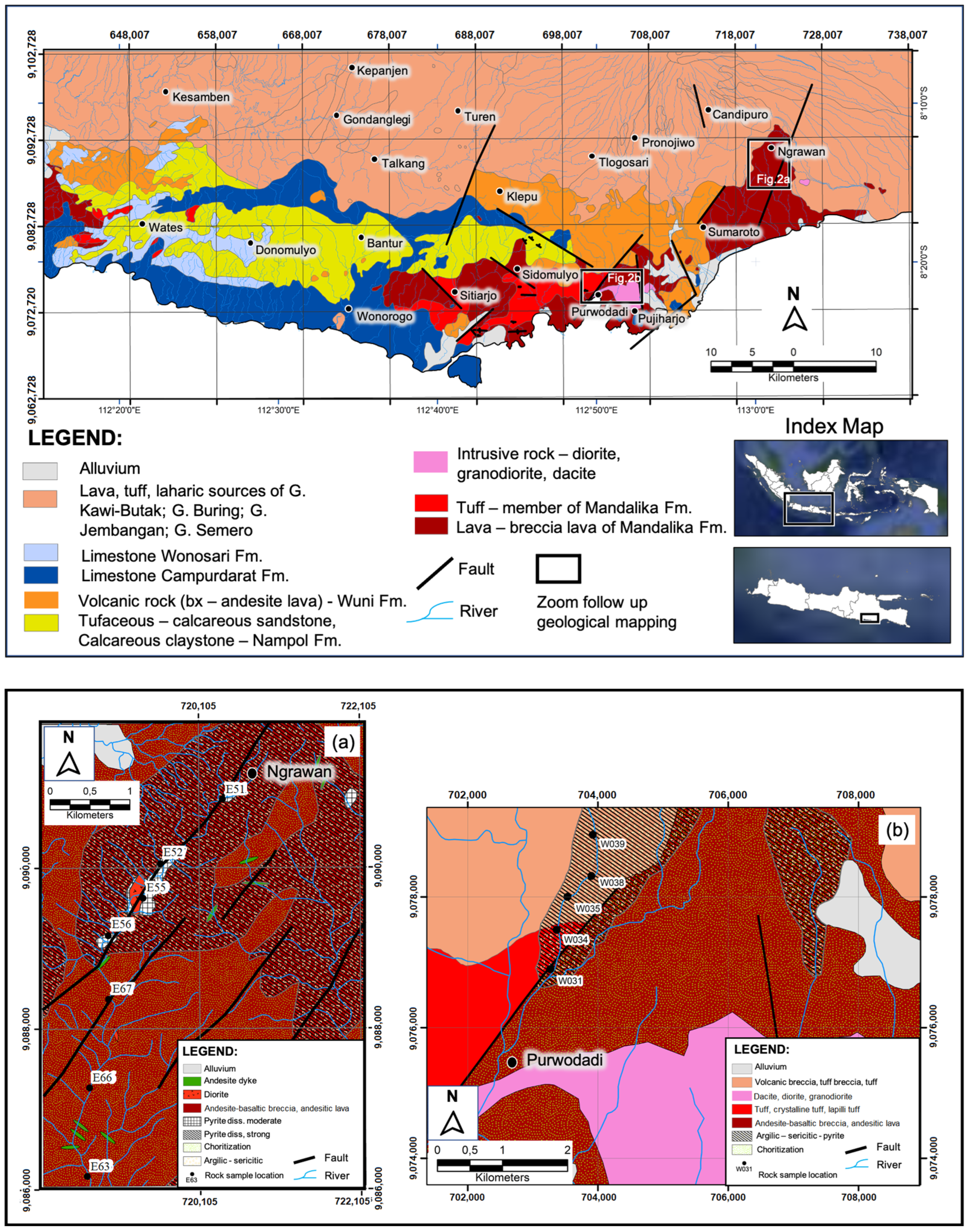
The volcanic rock unit consists of andesitic–basaltic lava and andesitic–basaltic lava breccia at the bottom and extends into a tuff unit consisting of andesitic tuff and crystalline tuff at the top. Both rock units are the oldest rock and generally propilitized, which can be correlated with the Mandalika Formation of Oligocene in age [17,26]. The Mandalika Formation was previously known as the Old Andesite Formation [28]. This rock unit is intruded by diorite and granodiorite rocks of Oligocene–Miocene age, exposed in the Benelan River at the upper reaches of the Kunir River and the Purwo River [26]. The latest field observations in Ngrawan and Purwodadi reveal rock groups dominated by andesitic–basaltic breccias, which are generally chloritized. In some places, argillaceous sericite alteration is observed, accompanied by moderate to strong scattered pyrite. These rock groups are intruded by diorite, granodiorite, and andesite rocks (Figure 2a,b).
The relatively younger rock units consist of layered sandstone, tuffaceous mudstone, and carbonate units that intercalate laterally with volcanic rock units consisting of andesite breccia, lava, and tuff breccia. Both units are correlated with the Nampol Formation and Wuni Formation, respectively, of Middle Miocene age [26]. The limestone unit is dominated by crystalline limestone and sandy limestone, which is correlated with the Campurdarat Formation [25] and the Wonosari Formation of Upper Miocene age [25,26]. Late Miocene porphyritic diorite intrusive rocks [27] intrude the Mandalika Formation and are overlain by Quaternary volcanic rock deposits. Unconformably overlying the older rock units are volcanic rock units of Pleistocene–Holocene in age, consisting of breccia, as well as lava, lahar deposits, and tuff, which are derived from several sources, including Gunung Semeru, Gunung Jembangan, Gunung Buring, and Gunung Kawi-Butak [25,26,27]. The youngest surface deposits are alluvial deposits, consisting of sediments from rivers and coastal areas, dating back to the Holocene and recent periods.
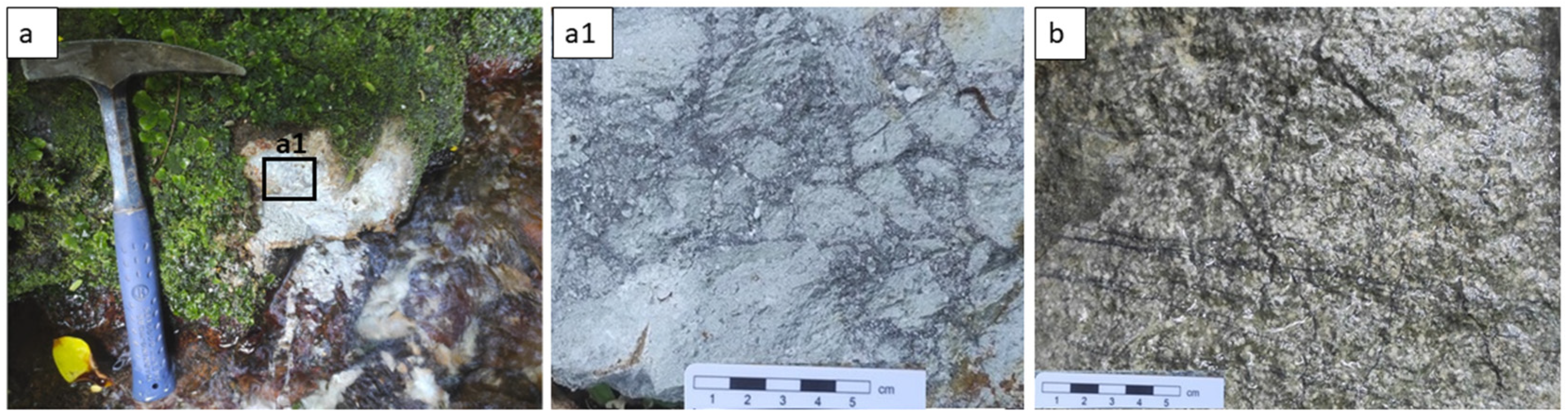
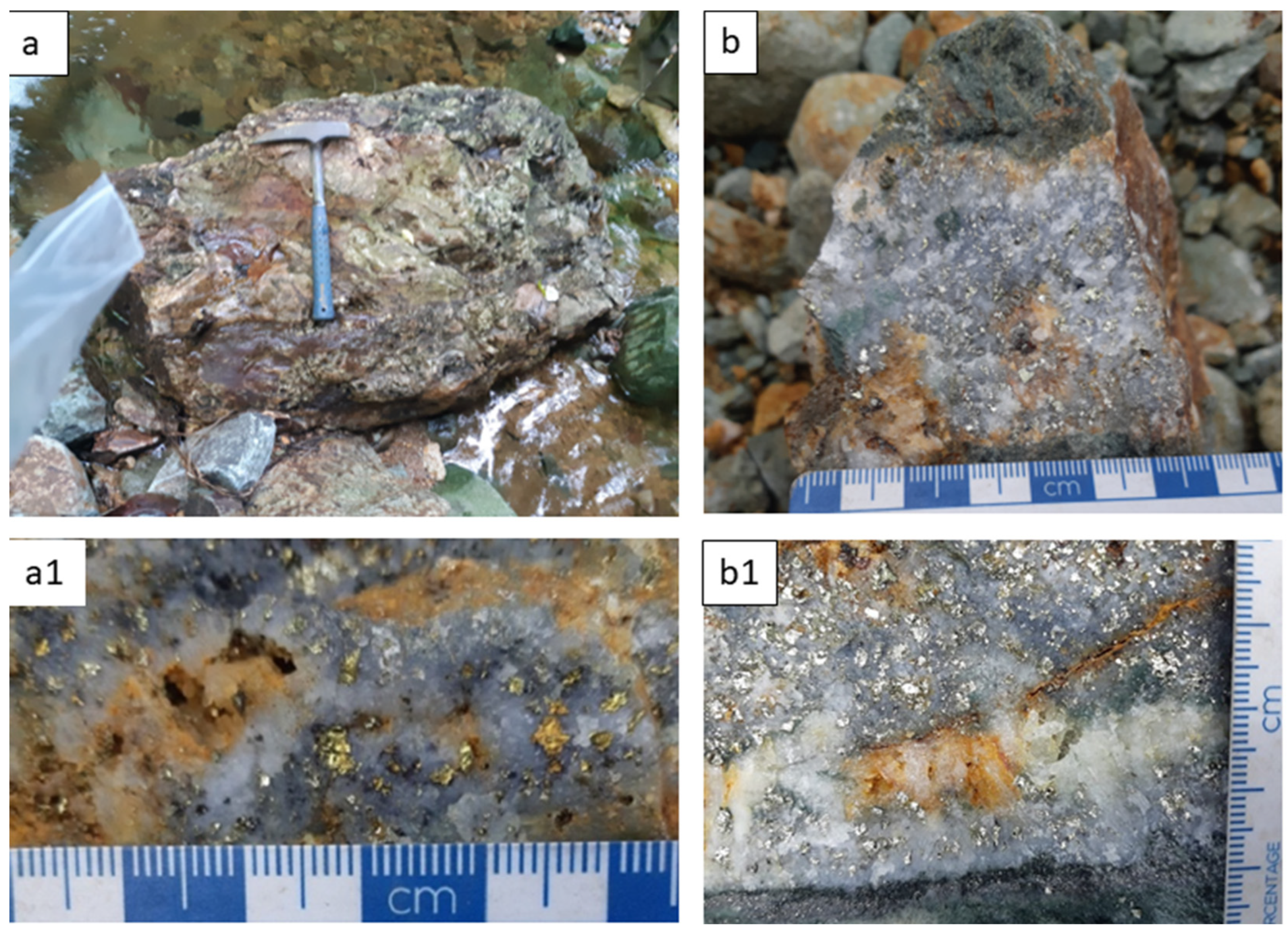
Mineralization indications found in Ngrawan include the presence of argillaceous sericite alteration with moderate to strong pyrite content, hydrothermal breccia with scattered pyrite, and weak- to moderate-intensity magnetic veinlets in pyritic diorite rocks (Figure 3). Further evidence of mineralization is observed in altered rock outcrops, which consist of silicification, argillization, propylitization, and rock floats containing pyrite, chalcopyrite, and sphalerite (Figure 4). These mineralized outcrops are specifically located in the upper reaches of the Kunir River.

2.2. Geological Controls for Mineralization

There are geological factors that control where mineral deposits form, which are known as mineral systems. A mineral system is a geological framework that explains the formation of mineral deposits. This concept links the source of the metals, the fluids that transport them, the pathways they travel, and the traps where they accumulate, providing a predictive model for mineral exploration [30,31].
It is difficult to define the metal source, and for the hydrothermal system associated with volcanic rocks, the contribution of magmatic fluids to the metal budget is a key issue in subduction-related systems [32,33,34]. The interplay between hydrothermal fluids and metal sources, combined with suitable conditions for transport and deposition, causes the enrichment of these elements [35,36].
Faults and associated fractures are the primary pathways for the transport of mineralizing hydrothermal fluids. Flow and focus of metal-rich fluids and ore deposits, which are all strictly controlled by faults, typically form in specific locations where physical or chemical changes cause the dissolved minerals to precipitate [37,38].

3. Materials and Methods

3.1. Materials

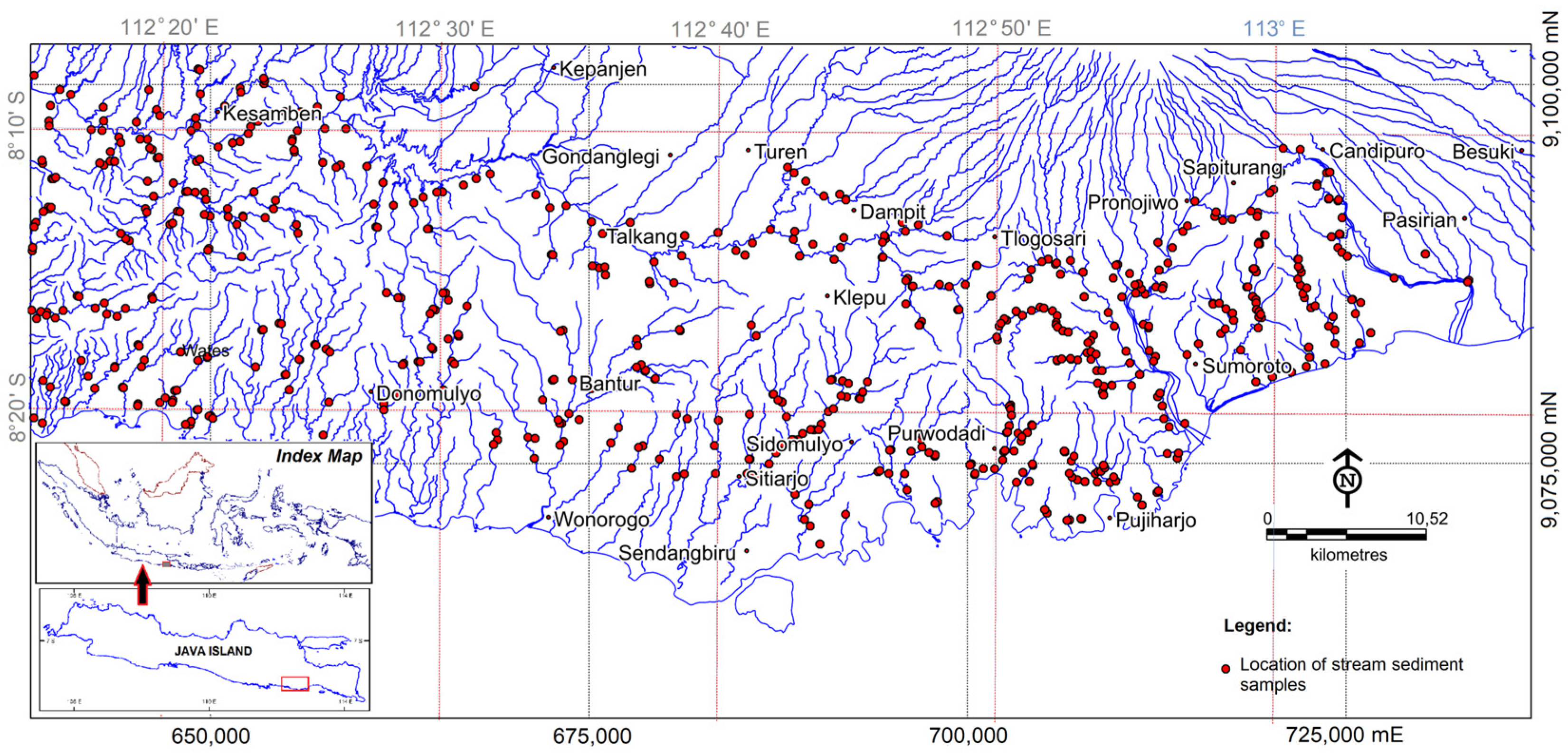
A total of 636 stream sediment samples were collected from second- and third-order active streams within the research area, which spans approximately 2887 square kilometers (Figure 5 and Table 1). Stream sediment samples were taken at a river bank at a depth of 10–20 cm under surface water where mud to fine sand materials were deposited. Each stream sediment sample weighed between 100 and 500 g, and all were sieved through a minus 80-mesh screen, placed into plastic bags, and then dried in the base camp at a temperature below 35 °C. After drying, the samples were disaggregated and sieved to <200 mesh for laboratory analysis. Duplicate samples were collected at 22 locations to evaluate sampling precision and analytical error. Duplicate samples for quality control were taken every 25 samples with serial numbers. The samples were leached by four acids near total digestion. A total of 12 representative outcrops and float samples were collected from selected mineralized areas (Purwodadi–Pujiharjo, Ngrawan) to serve as a ground-truth comparison for evaluating the field evidence of geochemical anomalies and the sediment samples.

3.2. Analysis Methods

Rock samples received similar treatment, being ground down to fine powders so samples would be representative. For each solid sample, 0.25 g per test, we digested them in 2% HNO3 using a closed-vessel microwave system. For silicate materials, we added HF along with HNO3–HCl, then diluted everything with 2% HNO3. An ICP-MS was used to measure major and trace elements in each sample. For a few selected elements, AAS and colorimetric methods were also used. In the laboratory of ALS Chemec, Canada, the methodology used is laboratory analysis of element content, with testing performed using analysis, as follows: (a). Inductively Coupled Plasma–Mass Spectrometry (ICP-MS) on stream sediment samples and mineralized rocks to determine the content of noble metals and base metals related to the theme to be discussed, namely Au, Ag, Cu, Hg, and As, Pb. Zn, and Sb, and Mn, Fe, S, Te, Ba, and Se; (b). rock samples were analyzed at Chemical Laboratory of Center of Mineral, Coal and Geothermal Resources (PSDMBP) Bandung using the atomic absorption spectrometry (AAS) method for the elements Au, Ag, Cu, Pb, and Zn, while As and Sb use the Conventional Calorimetry method. These samples were leached by four acid “near-total” digestion. For each analytical batch, accuracy and precision were checked using method detection limits (MDLs) and analyte-specific limits of quantification (LOQs). If a result fell below the MDL, it was reported as “<MDL.” When less than 10% of the data were censored, those low values were replaced with MDL/2 for statistical summaries. If censoring exceeded 10%, this was switched to Kaplan–Meier estimation.
The stream sediment samples were analyzed at ALS Chemex, Canada, where the Au content was determined using the gravimetric method, Hg content was determined using the cold vapor ICP method, and other elements were determined using the ICP–MS method with AQ256-Ultratrace type by ICP Mass Spec. Detection limits were 0.2 ng/g Au, 2 ng/g Ag, 0.1 µg/g As, 0.1 µg/g Cu, 0.01% Fe, 5 ng/g Hg, 1 µg/g Mn, and 0.5 µg/g Ba, respectively. The ICP-MS uses Rh and Ir as internal standards, with correction for spectral interference on most isotopes measured.
Rock samples were analyzed at the PSDMBP laboratory, Bandung, Indonesia with detection limits for the AAS method of 15 ng/g Au, 0.03 µg/g Ag, 0.4 µg/g Cu, 2 µg/g Pb, and 3 µg/g Zn. For Conventional Calorimetry method, the limits were 2 µg/g As and 2 µg/g Sb, respectively. The internal standards AAS method was applied to Au using LK-ML-7.2.02 and to Ag, Cu, Pb, Zn, Mn and Fe using LK-ML-7.2.03.

3.3. Statistical Analysis Methods

  • Principal Component Analysis (PCA):
Principal Component Analysis (PCA) is a powerful multivariate statistical method employed to identify relationships between multiple geochemical elements that may indicate the presence of various types of gold mineralization [39]. This technique was chosen due to its ability to reduce the dimensionality of complex datasets, allowing for the extraction of significant patterns and associations that are not immediately apparent in raw geochemical data [12]. Given the compositional nature of the data, where elements are represented as proportions of a whole and are constrained by the closure problem, the first step in our analysis was to apply the Centered Log-Ratio (CLR) transformation to the data. As recommended by Aitchison [40], this transformation corrects for the inherent mathematical limitations of compositional data, ensuring that each element’s relative concentration is accurately represented without distorting correlations due to the fixed sum of the data.
For PCA, R 2025-09.1 software was utilized as the primary tool for data processing and analysis. R is a widely used and highly flexible software platform, offering robust packages and functions specifically designed for performing PCA on complex datasets. After applying the CLR transformation, we conducted PCA on the transformed data to uncover underlying patterns in the geochemical associations of the elements.
To determine the number of principal components (PCs) to retain, we applied the Kaiser criterion [41], which suggests retaining only those components with eigenvalues greater than 1. This criterion ensures that each retained PC explains at least as much variation as a single original variable, thereby maintaining only the most significant components. By applying this method, we retained the first few principal components, which accounted for the majority of the total variance in the dataset, providing a concise yet effective summary of the geochemical data. Specifically, the first three PCs were retained, capturing over 70% of the total variance, which is considered sufficient to represent the key geochemical associations without overfitting the model.
In addition to the Kaiser criterion, we utilized Varimax orthogonal rotation [32] to improve the interpretability of the PCA results. Varimax rotation maximizes the variance of factor loadings, making it easier to associate each element with a specific principal component. This approach enhances the clarity of the results by ensuring that each element contributes distinctly to only one factor, thus allowing for more straightforward interpretation of the principal components. The rotated components helped reveal clear geochemical associations, particularly with elements such as Fe, Cu, Zn, and Mn, which were grouped together as indicators of base-metal mineralization, while As, Sb, and S were associated with epithermal processes [42].
The PCA results, with the appropriate rotation, not only clarified these geochemical relationships, but also provided valuable insights into the nature of mineralization in the study area. These results were subsequently used to guide exploration efforts, enhancing the ability to target zones with high potential for gold and base-metal deposits.
  • Mean + 2Standard Deviation (SD) and Median + 2Median Absolute Deviation (MAD):
The Median + 2MAD method was applied to both the raw and logarithmically transformed data in order to compare parametric and robust, non-parametric thresholds. MAD stands for Median Absolute Deviation, while SD stands for Standard Deviation [43]. Because most of the active stream sediment geochemical data from the Malang–Lumajang area deviate from a normal distribution, the Median + 2MAD criterion provides a more robust estimate of the background and anomaly cut-off.
For comparison with the conventional parametric approach, anomaly thresholds were also computed as the mean plus two standard deviations (Mean + 2SD). Prior to calculating these values, we applied a single-pass ± 3SD filter to each element to screen for extreme outliers. This procedure removed only 5 samples out of the 636 stream-sediment samples (<1% of the dataset), while all remaining observations were retained for subsequent analysis. The approximate normality of the trimmed data and of the log-transformed distributions was evaluated using the Shapiro–Wilk test [44], but no further iterative trimming was carried out. In the subsequent interpretation, the Mean + 2SD thresholds are used mainly as a conventional reference, whereas the Median + 2MAD and C–A fractal model constitute the primary basis for delineating and interpreting geochemical anomalies.
  • Concentration–Area (C–A) Fractal Model:
In this research, we employed the Concentration–Area (C–A) fractal model developed by Cheng et al. [11] to determine geochemical anomaly thresholds based on the spatial distribution of elements in stream sediments. The C–A model is widely used in mineral exploration because it captures the spatial variability of element concentrations over a mapped area and provides an objective way to separate background and anomalous populations.
For each element, the interpolated concentration raster was converted into a cumulative area function A(C ≥ c), defined as the total area where the concentration is greater than or equal to a given cut-off value c. The C–A relationship can be expressed as follows:
A C c C β
where A(C ≥ c) is the cumulative area above concentration c and β is the fractal exponent that characterizes the spatial distribution of the element. In practice, we used the logarithmic form of this relationship, as follows:
log A = α + β log C
where α is the intercept and β is the slope of the C–A line in log–log space.
To visualize and model the C–A relationships, the log A–log C data were sorted by concentration and plotted for each element. We then fitted piecewise linear models in log–log space using ordinary least squares. Candidate breakpoints were systematically scanned along the ordered concentration axis, subject to a minimum number of grid cells in each segment to avoid overfitting to only a few extreme pixels. For every candidate configuration (with one or two breakpoints), straight lines were fitted to the log A–log C data in each segment, and the residual sum of squares (RSS) and coefficient of determination (R2) were calculated.
The final C–A model for each element was selected as the piecewise linear configuration that minimized the total RSS and maximized the overall R2, while respecting the minimum-sample constraint per segment. In this way, the C–A curves were objectively partitioned into the following distinct geochemical domains: a background segment and one or two anomaly segments. The concentrations at the breakpoints between these segments were adopted as the C–A anomaly thresholds used in subsequent mapping and interpretation.
All statistical calculations for anomaly thresholds—including the computation of means, standard deviations, median absolute deviations (MADs), and Concentration–Area (C–A) fractal models—were carried out in Python 3.13.0 using in-house scripts built on NumPy, SciPy, and pandas for numerical processing and Matplotlib 3.10.7 for graphical visualization.

3.4. Methodology Workflow

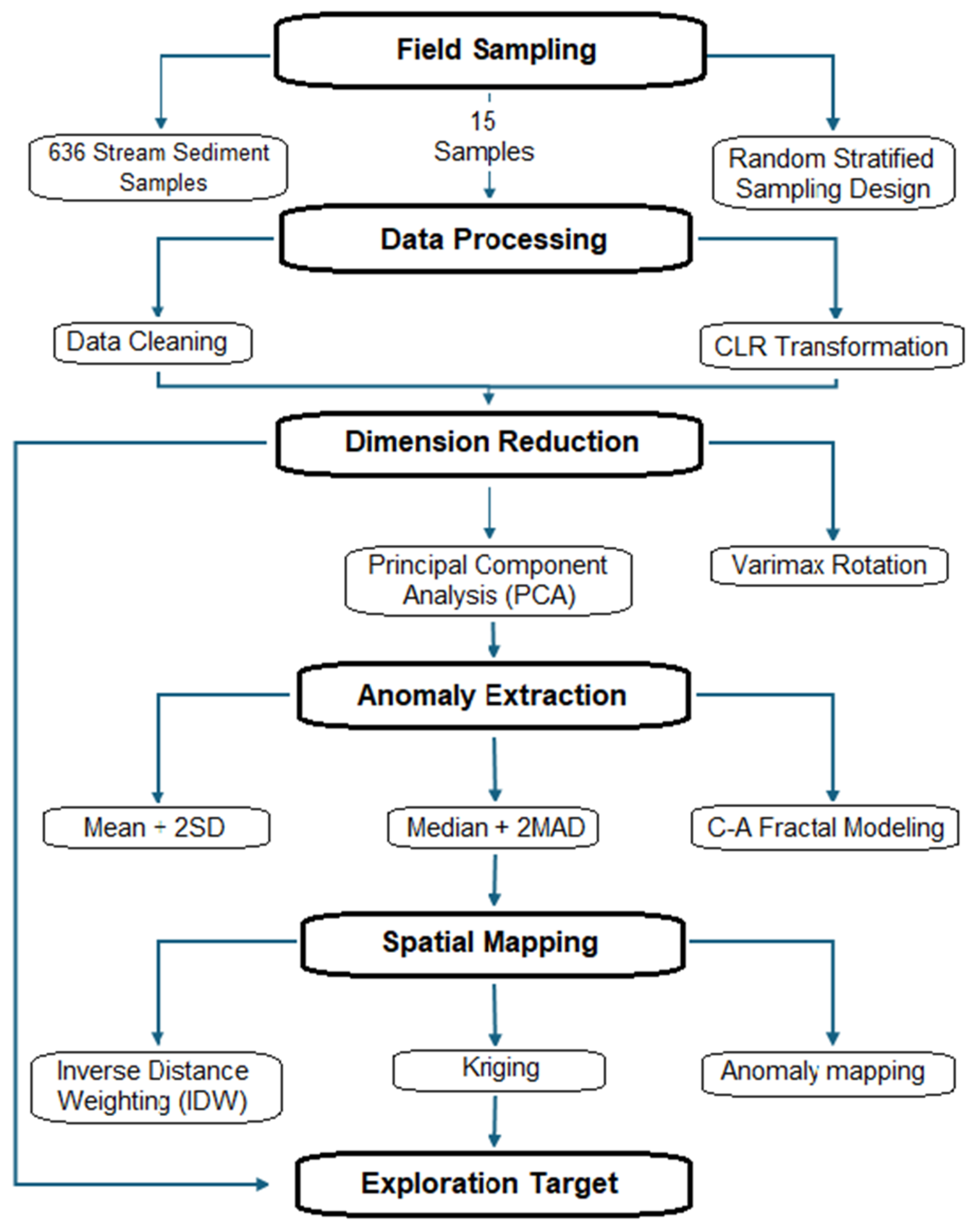
An integrated geostatistical workflow was developed to delineate multi-element geochemical anomalies from heterogeneous stream sediment datasets in the volcanic-arc setting of Malang–Lumajang. A total of 636 stream sediment samples were collected from second- and third-order active drainages across the 2887 km2 study area (sampling density ~1 per 4.5 km2), sieved to <80 mesh, and analyzed by ICP-MS for Au, Ag, Cu, Hg, As, Pb, Zn, Sb, Mn, Fe, S, Te, Ba, and Se. Fifteen mineralized rock samples from Ngrawan, Purwodadi–Pujiharjo, and Wates were assayed by ICP-MS, AAS (Au, Ag, Cu, Pb, and Zn), and colorimetry (As and Sb) to serve as ground-truth controls. Raw data, exhibiting strong positive skewness (Shapiro–Wilk p < 0.05), underwent centered log-ratio (CLR) transformation to mitigate closure effects before multivariate analysis.
PCA with Varimax rotation (eigenvalues > 1) identified three key associations (Au–Se–Hg, Fe–Mn–Cu–Zn, and As–Sb–S). Anomaly thresholds were derived using (i) Mean + 2SD on iteratively normalized data (outliers > 3σ removed), (ii) Median + 2MAD on raw/log-transformed data, and (iii) C–A fractal modeling via log–log plots with least-squares segmentation of background, low-, and high-order populations. To evaluate the robustness of the anomaly thresholds, we implemented a k-fold cross-validation scheme. All sediment samples (n = 636) were randomly partitioned into k equally sized folds (k = 10). For each iteration, k − 1 folds were used to calibrate the anomaly thresholds for the three methods (Mean + 2SD, Median + 2MAD, and C–A fractal), while the remaining fold served as an independent validation set. This procedure was repeated until each fold had been used once for validation, and the resulting performance statistics and threshold values were averaged across all folds to obtain a stable estimate of model behavior. Anomalies were interpolated by inverse distance weighting (IDW), overlain on a 1:100,000-scale geological framework (intrusive contacts, altered breccias, and NW–SE/NE–SW structures), and cross-validated with rock assays (up to 897 ng/g Au, 2.14% Cu) and field evidence of hydrothermal alteration and sulfides. This complete workflow is schematically illustrated in Figure 6.

4. Result

4.1. Secondary and Primary Data

Secondary data collected includes geological data from several sheets of 1:100,000-scale geological maps. These include maps of Yogyakarta, Surakarta, Pacitan, Blitar, Turen, and Lumajang. Regional mineralization data of Java Island are also used as discussion material for this paper. Primary data were collected through geochemical sampling of stream sediments, conducted in collaboration between the Indonesian and Japanese governments from 2002 to 2003. Additional primary data include rock data collection conducted in 2024 by the Center for Mineral, Coal, and Geothermal Resources—Geological Agency and the National Research and Innovation Agency in Pujiarjo–Purwodadi, Malang, and in Ngrawan, Lumajang Regency, East Java. The first author was involved in these activities.

4.2. Stream Sediment Geochemical Data

The study used stream sediment data to measure the levels of 14 different metals. Samples were collected from 636 locations across a 2887-square-kilometer area, with each sample covering an average of 4 to 5 square kilometers. The area is located between 112°15′13.12″ to 113°9′53.76″ east longitude and 8°28′33.64″ to 8°6′43.97″ south latitude or within UTM zone 49 South at coordinates 638,122 East to 738,461 East and 9,068,556 North to 9,103,034 North.
The metals were measured using a machine called ICP-MS. The amounts found in the samples are as follows: gold (1–690 ng/g), silver (0.01–0.68 µg/g), arsenic (0.2–326 µg/g), barium (67–2010 µg/g), copper (21.2–170.5 µg/g), iron (0.63–25 percent), manganese (126–4940 µg/g), lead (1.8–417 µg/g), sulfur (0.005–1.93 percent), antimony (0.03–9.29 µg/g), selenium (0.5–5 µg/g), tellurium (0.03–0.63 µg/g), zinc (13–688 µg/g), and mercury (0.005–0.83 µg/g µg/g).
Principal Component Analysis (PCA) was employed to explore geochemical associations and identify mineralization patterns in the Malang–Lumajang region. Given the compositional nature of the geochemical data, where elements are measured as proportions of a whole, the Centered Log-Ratio (CLR) transformation was applied as a crucial first step to address the closure problem. This transformation corrects for the proportional constraints inherent in compositional data, ensuring that relationships between elements are accurately represented without distortion due to the sum of proportions.
In the analysis, PCA on the raw data revealed significant correlations between key elements. The first principal component (PC1), explaining 23.4% of the total variance, was dominated by Fe, Zn, Cu, and Mn, suggesting a strong association with base-metal mineralization (Table 2 and Table S1, Supplementary Materials). The second principal component (PC2), accounting for 16.4% of the variance, was influenced by elements such as As, Sb, and S, which are typically linked to hydrothermal processes and epithermal mineralization (Table 2 and Table S1, Supplementary Materials). The PC1–PC2 biplot clearly illustrated the separation of the following three geochemical groups: Au-Se-Hg, As-Sb-S, and Fe-Mn-Cu, indicating distinct mineralization processes in the study area (Figure S1, Supplementary Materials). However, while the PCA on raw data provided important initial insights into the base-metal associations, it remained exploratory and was subsequently moved to the Supplementary Materials for further examination, as it did not offer the same clarity as the CLR-transformed results.
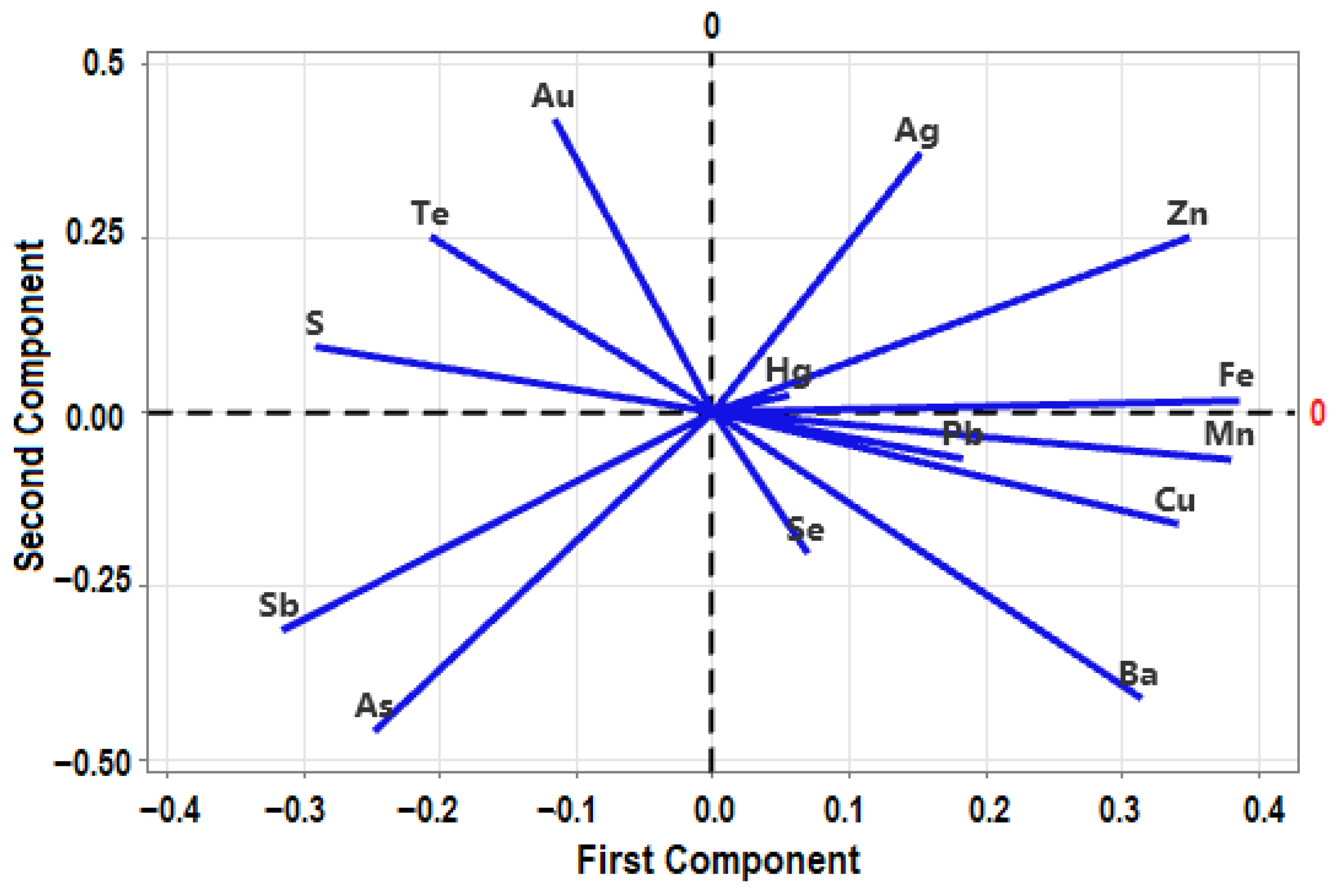
The CLR-transformed PCA, in contrast, provided a more structured and interpretable analysis, offering clear differentiation between mineralization styles. PC1 in the CLR-transformed data explained 37.1% of the total variance and was dominated by Fe, Mn, Zn, Cu, and Ba, elements strongly associated with base-metal mineralization (Table 2). The second principal component (PC2) explained 11.1% of the variance and reflected a clear separation between precious metals (Au and Ag) and hazardous elements (As and Sb), which are characteristic of epithermal systems (Table 2). The PC-A–PC-B biplot visually reinforced this separation, with base-metal elements clustering along the first principal component axis and precious metals and metalloids occupying a distinct position along the second axis (Figure 7). This separation enabled more precise identification of targeted mineralization zones, enhancing the ability to map both base-metal and precious-metal deposits for exploration purposes. The results from the PCA of CLR-transformed data were used for the final interpretations and mineralization mapping. The CLR transformation effectively clarified the relationships between elements and mineralization types, which was essential for defining high-potential areas for further exploration. Although PCA on raw data helped identify initial correlations, the clearer and more structured patterns in the CLR-transformed data were deemed more reliable for exploration targeting. To aid in the interpretation of these results, loading tables were included, showing the dominant elements for each principal component (Table 2 for both raw and CLR-transformed data; detailed raw data loadings are presented in Table S1, Supplementary Materials). For example, PC1 in the raw data was strongly influenced by Fe, Zn, Cu, and Mn, indicating base-metal associations, while PC2 reflected the influence of As, Sb, and S, associated with epithermal processes. Similarly, the CLR-transformed data showed that PC-A, dominated by Fe, Mn, Zn, Cu, and Ba, highlighted base-metal mineralization, while PC-B, separating Au, Ag, As, and Sb, emphasized precious-metal and epithermal associations.
This analysis revealed a more nuanced understanding of the geochemical landscape, demonstrating how both PCA approaches—raw and CLR-transformed—complemented each other. The final interpretation and mineralization mapping relied on the CLR-transformed PCA for its ability to provide clearer and more distinct groupings of elements, essential for precise targeting in the region’s mineral exploration efforts.

4.3. Rock Geochemical Analysis

Rock samples were taken from Ngrawan and Purwodadi–Pujiharjo. Geochemical analysis of samples from Purwodadi–Pujiharjo achieved the highest grade, with 560 ng/g Au, 32,100 µg/g (3.21%) Cu, and 277 µg/g Zn. Geochemical analyses of samples from Ngrawan yielded the highest value of 177 ng/g Au, 669 µg/g Cu, and 242 µg/g Zn (Table 3).

4.4. Statistical Parameter Analysis

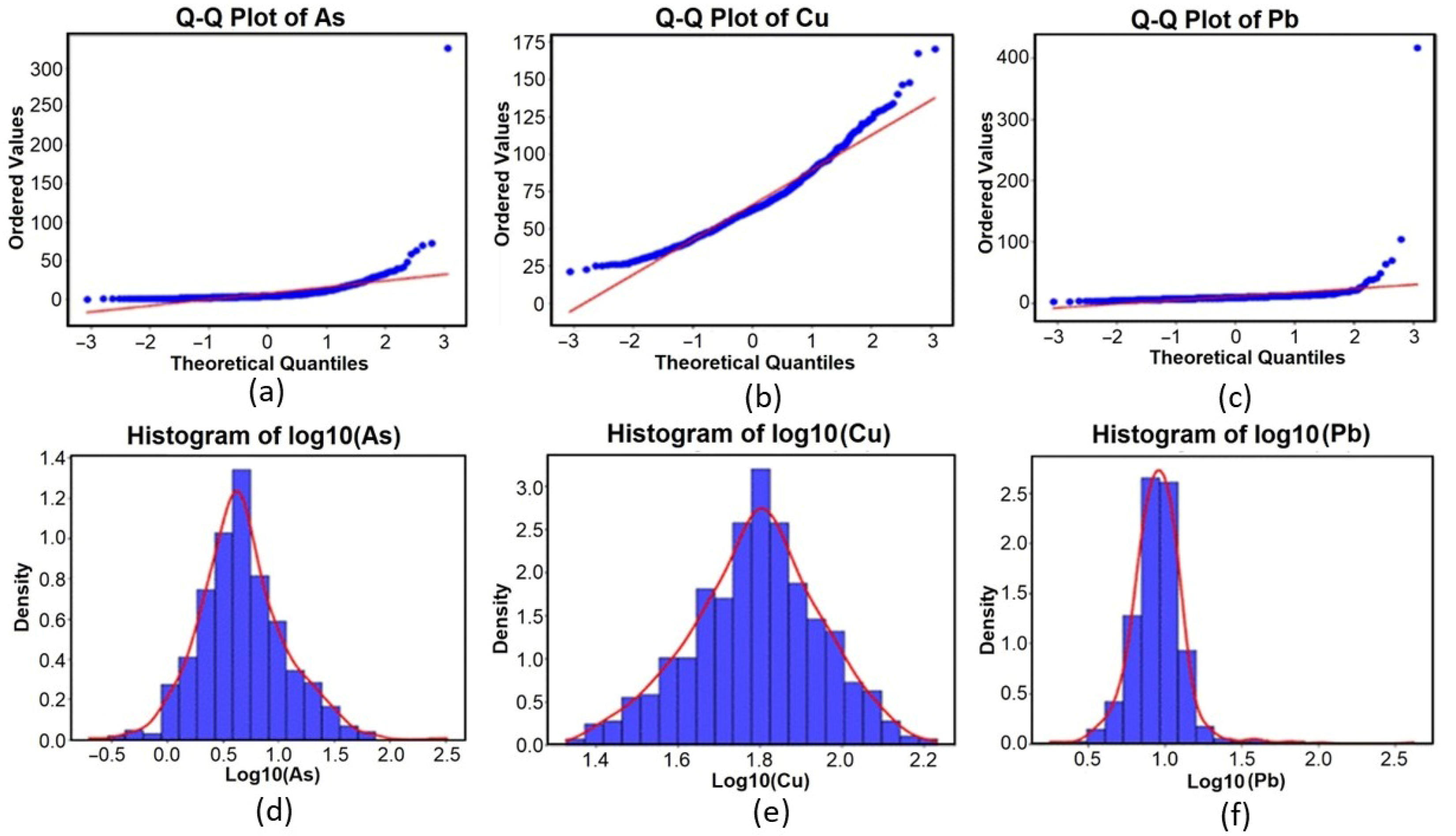
The concentration data of the raw elements show strongly right-skewed distributions (Table 4). Q-Q plots of the untransformed data indicate that the element concentrations do not follow a normal distribution (Figure 8a–c). However, applying a logarithmic transformation significantly reduces the skewness, resulting in more symmetrical distributions (Figure 8d–f).

4.5. Anomaly Threshold Value Analysis

In order to delineate anomalies in more detail and compare the anomalies of various variables determined by different methods, the concentration of each element was selected to calculate the anomaly threshold value. The anomaly threshold values calculated by different methods are presented in Table 5.
Logarithmic transformation of data raises threshold values (e.g., As: 22.01 µg/g, Mn: 3388.97 µg/g) compared with thresholds from raw data (e.g., As: 9.89 µg/g, Mn: 2801 µg/g). This indicates that log transformation reduces the impact of outliers, making anomaly patterns clearer in heterogeneous distributions (Table 6). Additionally, the Median + 2MAD method—a robust approach—often produces lower thresholds (Ag: 0.10 µg/g) than Mean + 2SD (Ag: 0.11 µg/g), confirming the advantage of robust statistics for non-normal data.
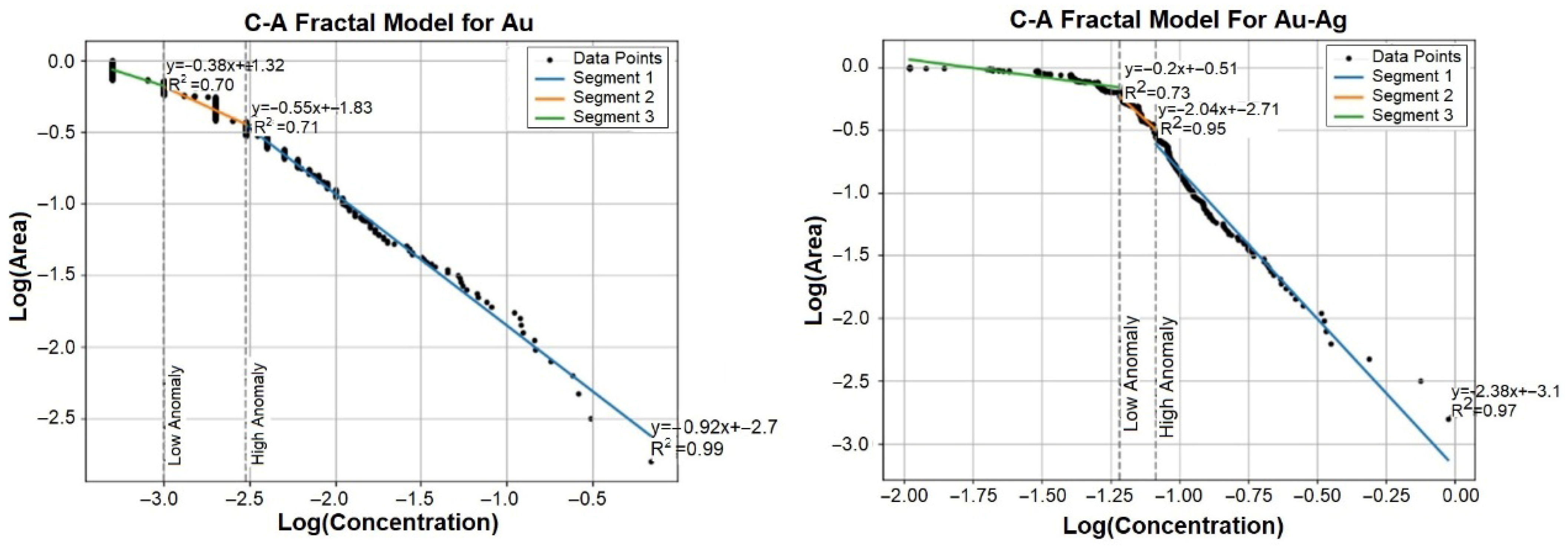
The C–A fractal model of element concentrations (where C stands for concentration and A for area) and their associations reveals the following three clusters: low anomalies, high anomalies, and background (Figure 9). This method produces broader low-threshold ranges for elements such as gold (Au, 1–3 ng/g) and the gold–silver association (Au-Ag, 60–80 ng/g), reflecting the spatial and genetic complexity of mineralization. These results align with prior studies demonstrating the fractal model’s superior ability to capture non-linear inter-element relationships and geological processes [5].
Some threshold values in the table are intentionally left blank. These omissions occur when the underlying data do not meet the statistical requirements of the method used. In several cases, the element distributions exhibit very low variance or contain many values close to the detection limit, resulting in unstable SD, MAD, or log-transformed values. For certain elements, the Concentration–Area (C–A) fractal plots also fail to produce distinct breakpoints, preventing the objective separation of background, low-anomaly, and high-anomaly domains. Rather than reporting thresholds that would be unreliable or misleading, these values are excluded to preserve the methodological integrity of the analysis.
The fitted C–A parameters (α, β and R2) for the main pathfinder elements are listed in Table 6. These parameters describe the background and anomalous domains and provide a quantitative basis for comparing the behavior of different elements in the Malang–Lumajang area.

5. Discussion

The integration of multiple geostatistical methods (Mean + 2SD, Median + 2MAD, and C–A Fractal Model) for determining anomaly thresholds provides critical insights into the spatial distribution of each element and its associations. The results highlight method-specific sensitivities and their implications for mineral exploration in complex geological settings.

5.1. Comparative Effectiveness of Methods

Analysis of the distribution of anomalous areas was conducted based on the statistical method Mean + 2SD [9,35]. The median and 2MAD [45] values, as well as the C-A Fractal Model, produced significant variations in the number and percentage of areas detected as anomalies [5] (Table 7).
The Mean + 2 SD gave low anomaly counts, especially for the raw data. For example, Au anomalies constituted just 6.61% (42 samples) of the dataset. This likely reflects its sensitivity to skewed data and outliers. In contrast, arsenic had even fewer anomalies (5.35% raw, 4.25% log), because extreme values raised the threshold (e.g., As: 9.88 raw, 22.01 log), hiding subtler anomalies. While simple to calculate, Mean + 2SD can underestimate mineralization in datasets with skewed or variable distributions, making it less reliable for elements that do not follow a normal distribution.
Median + 2MAD, a non-parametric method, demonstrated a superior robustness over Mean + 2SD. For Au, it identified 20.47% anomalies (130 samples), nearly triple the amount by Mean + 2SD. Threshold stability is evident for Au, as raw and log-transformed cutoffs (0.005 vs. 0.0050067) are nearly identical. Median + 2MAD optimally balances outlier resistance and anomaly detection for elements with moderate skewness (e.g., Cu: 14.02% anomalies raw vs. 8.35% log), outperforming Mean + 2SD. However, for highly skewed elements such as Fe, its conservative thresholds (e.g., 19.37% raw anomalies) may still miss spatially clustered mineralization signals relative to the mean plus two standard deviations (SDs).
The C–A Fractal Model outperformed parametric methods in anomaly volume, detecting 43.15% low and 29.61% high anomalies for Au. Its spatial multi-scale approach captured complex patterns, such as the strong Au-Ag association (30.08% high anomalies), which other methods missed. This aligns with its ability to integrate geochemical and spatial variability, which is critical for identifying multi-element mineralization (e.g., Fe-Cu-Mn, with high anomalies at 29.92%).

5.2. Multi-Element Associations and Mineralization Styles

The geochemical dataset reveals well-defined multi-element associations that correspond to different mineralization styles in the Malang–Lumajang corridor. Gold (Au) shows relatively low but significant anomaly thresholds, with C–A fractal values ranging between 1 and 3 ng/g. Au is spatially and statistically associated with Ag, Hg, Pb, and Se (e.g., Au–Hg, Au–Ag, Au–Pb, and Au–Se), and these element pairs show overlapping C–A anomaly ranges. Such combinations are characteristic of low- to intermediate-sulfidation epithermal systems in volcanic-arc settings, where Au commonly occurs with base-metal sulfides (Pb and Zn) and volatile elements such as Hg and Se in veins and hydrothermal breccias [46,47,48,49]. In particular, the Au–Se–Hg association (1.02–2.01 µg/g) indicates a magmatic–hydrothermal fluid enriched in volatile components, consistent with epithermal Au–Ag systems developed above calc-alkaline intrusions [46,50]. The location of these anomalies along the active volcanic chain and near mapped alteration zones further supports an epithermal interpretation rather than purely supergene enrichment.
Base metals define a coherent anomaly pattern that points to a deeper, intrusion-related source. Cu (58.1–73.5 µg/g), Zn (125–158 µg/g), Pb (8.40–10.60 µg/g), and the Fe–Cu–Mn group (1652.25–2122.60 µg/g) form overlapping anomaly fields that coincide with mapped intrusive bodies and major structural corridors. Elevated Fe and Mn in the Fe–Cu–Mn assemblage indicate precipitation of both sulfide and oxide phases in hydrothermal and supergene environments, as expected in the outer parts and caps of porphyry systems [47,48,49]. The Ag–Pb association (8.41–10.67 µg/g), together with Fe–Cu–Mn, is typical of the intermediate to distal halos of porphyry Cu–Au deposits, where Pb–Zn–Ag–Ba and Fe–Mn anomalies develop in veins and replacement bodies around the porphyry core [47,48]. This interpretation is consistent with the tectono-magmatic framework of the Malang–Lumajang area, which is dominated by calc-alkaline intrusions and volcanic centers capable of generating porphyry-style hydrothermal circulation [15,16,47,48,49].
Metalloids further help to distinguish mineralization styles. Arsenic (3.80–6.60 µg/g) and antimony (0.12 µg/g) show strong correlations with sulfur (0.02–0.04%) in the As–Sb–S assemblage (3.86–6.65 µg/g). This suite is a well-known geochemical signature of low-sulfidation epithermal systems, where As and Sb are concentrated in sulfosalt and sulfide minerals such as arsenopyrite, stibnite, and tetrahedrite hosted in volcanic–hydrothermal environments [50,51,52]. Selenium (1.0–2.0 µg/g) and tellurium (0.08 µg/g) form an additional Se–Te (±Au) association that is commonly linked to intermediate- to high-sulfidation epithermal Au–Ag deposits and Au–telluride mineralization [47,50]. In the Malang–Lumajang area, these metalloids and chalcophile elements occur preferentially along the young volcanic centers and fault-controlled zones, suggesting that the observed anomalies reflect magmatic–hydrothermal fluid flow rather than purely sedimentary or weathering processes.
The C–A fractal model highlights that key elements (Au, Ag, As, Cu, Pb, Zn, Fe, Mn, and Se) consistently exhibit two distinct anomaly levels (low and high), reflecting multiple geochemical populations. This pattern suggests the superposition of geochemical background with hydrothermal contributions. Stepwise anomaly transitions, such as those observed in As (3.80–6.60 µg/g) and Cu (58.1–73.5 µg/g), are consistent with evolving hydrothermal fluids under variable oxidation and pH conditions—likely controlled by volcanic–hydrothermal dynamics in the volcanic chain and adjacent intrusive systems.

5.3. Practical Implications for Exploration

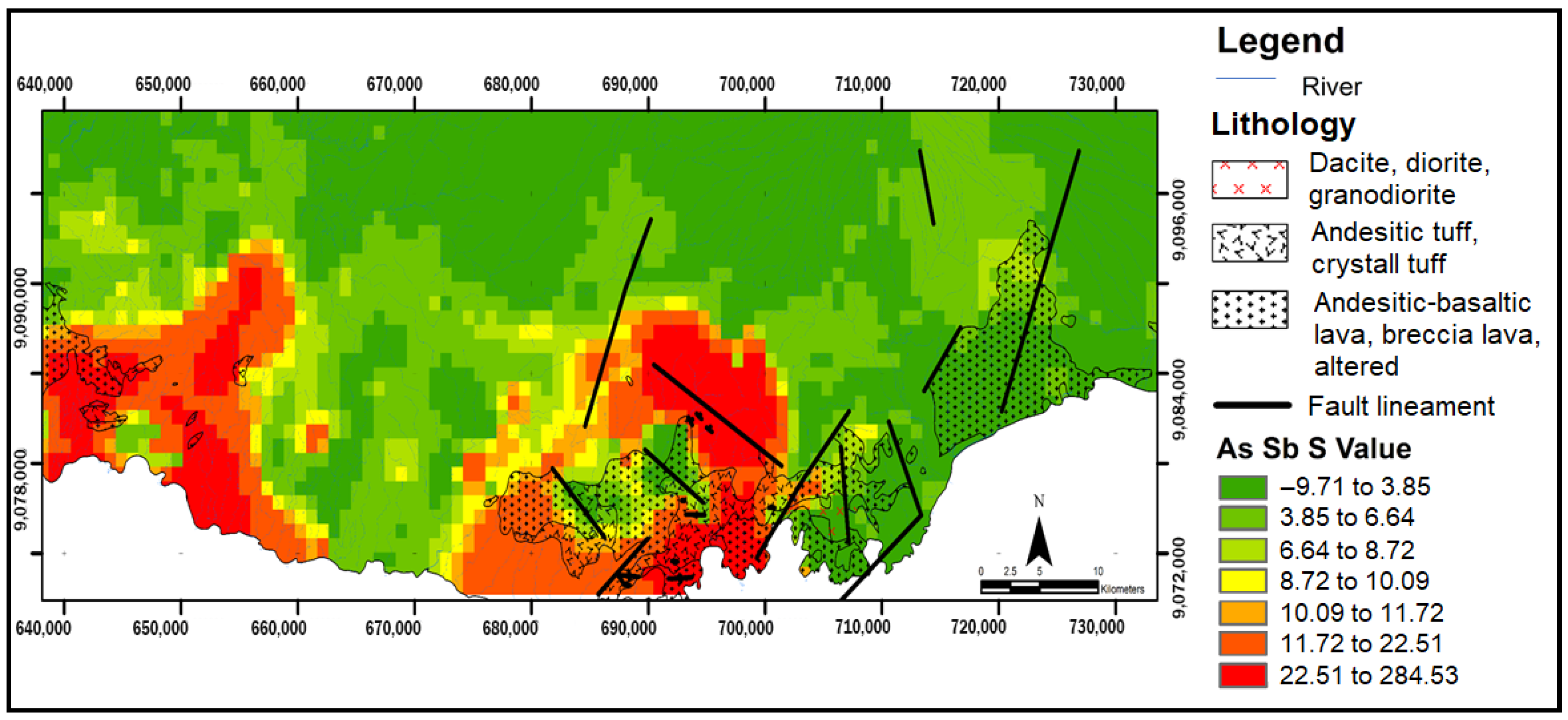
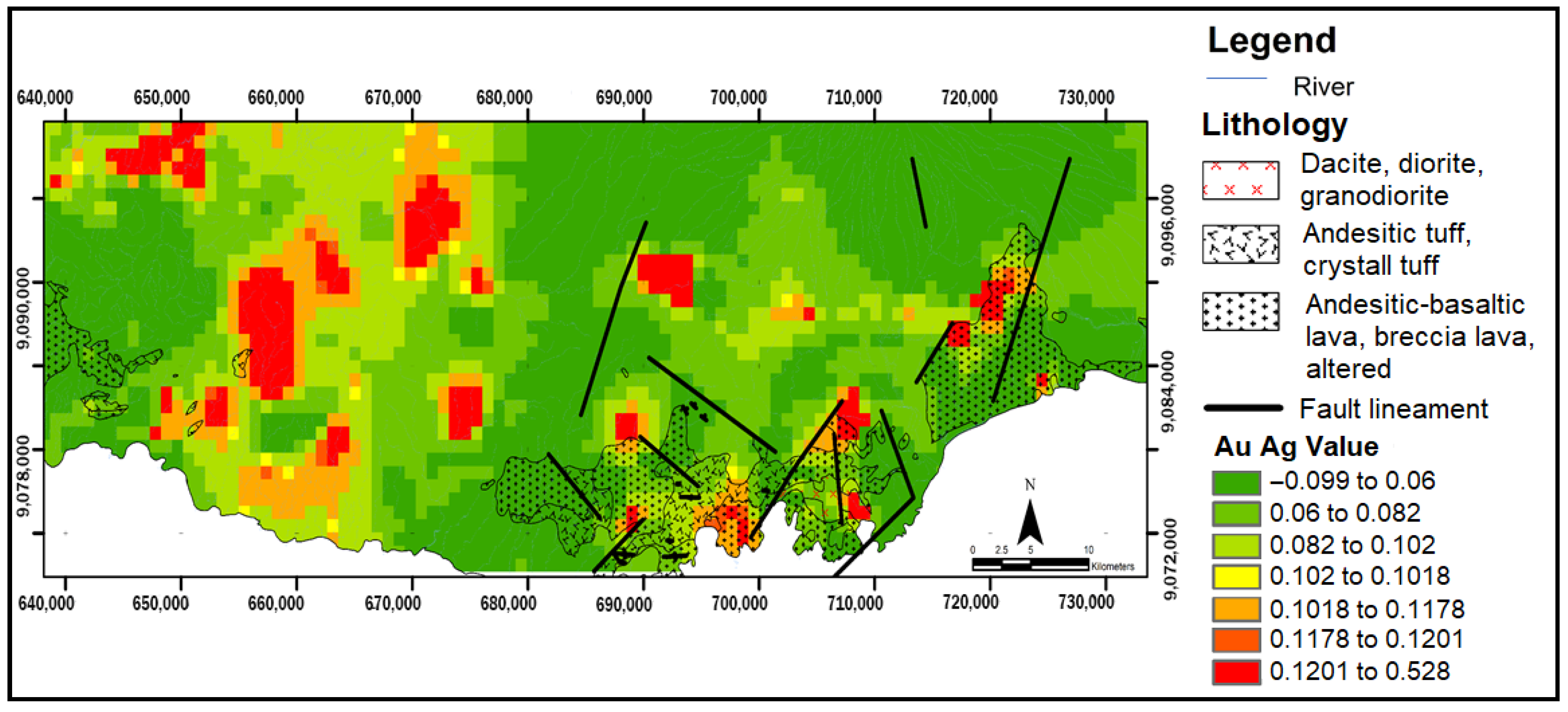
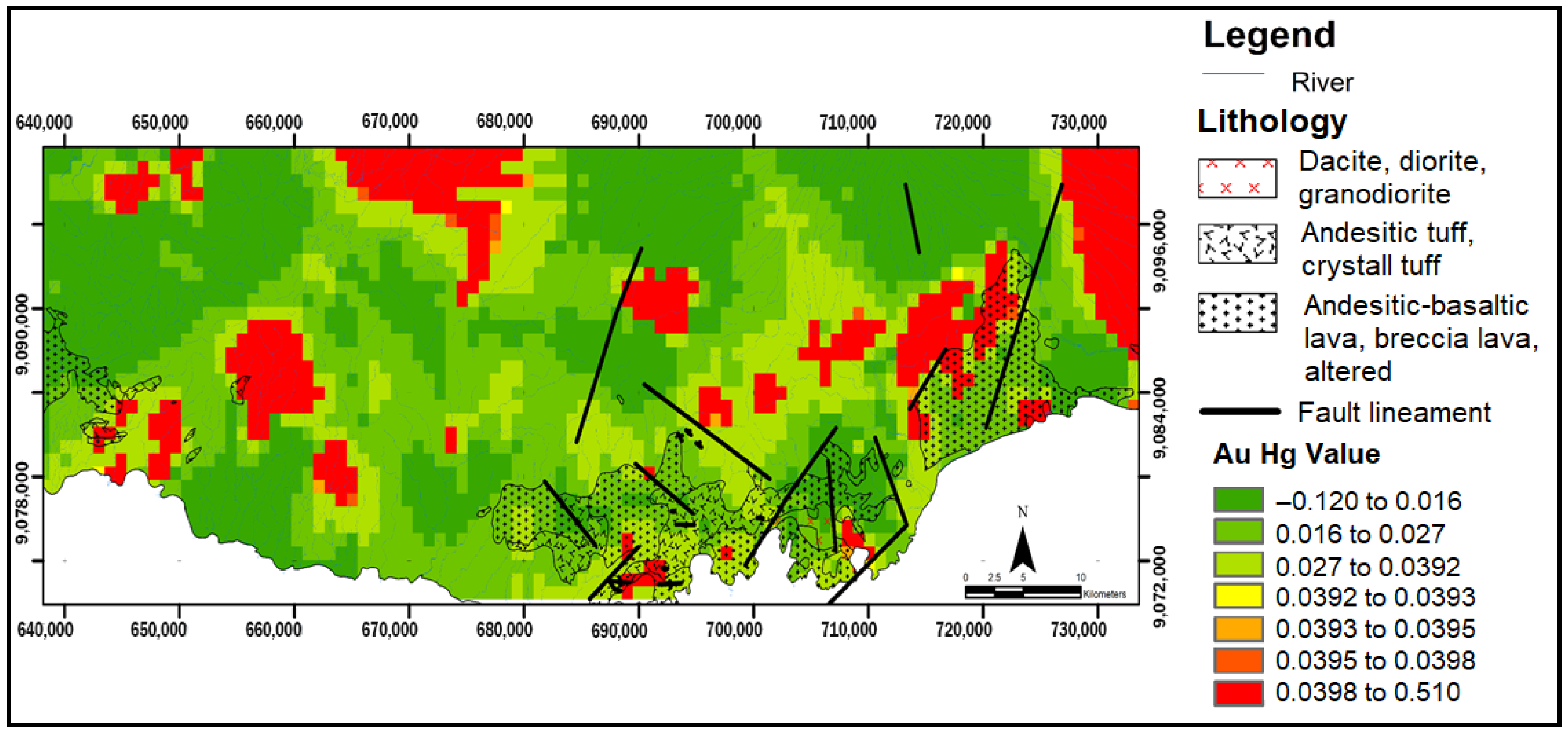
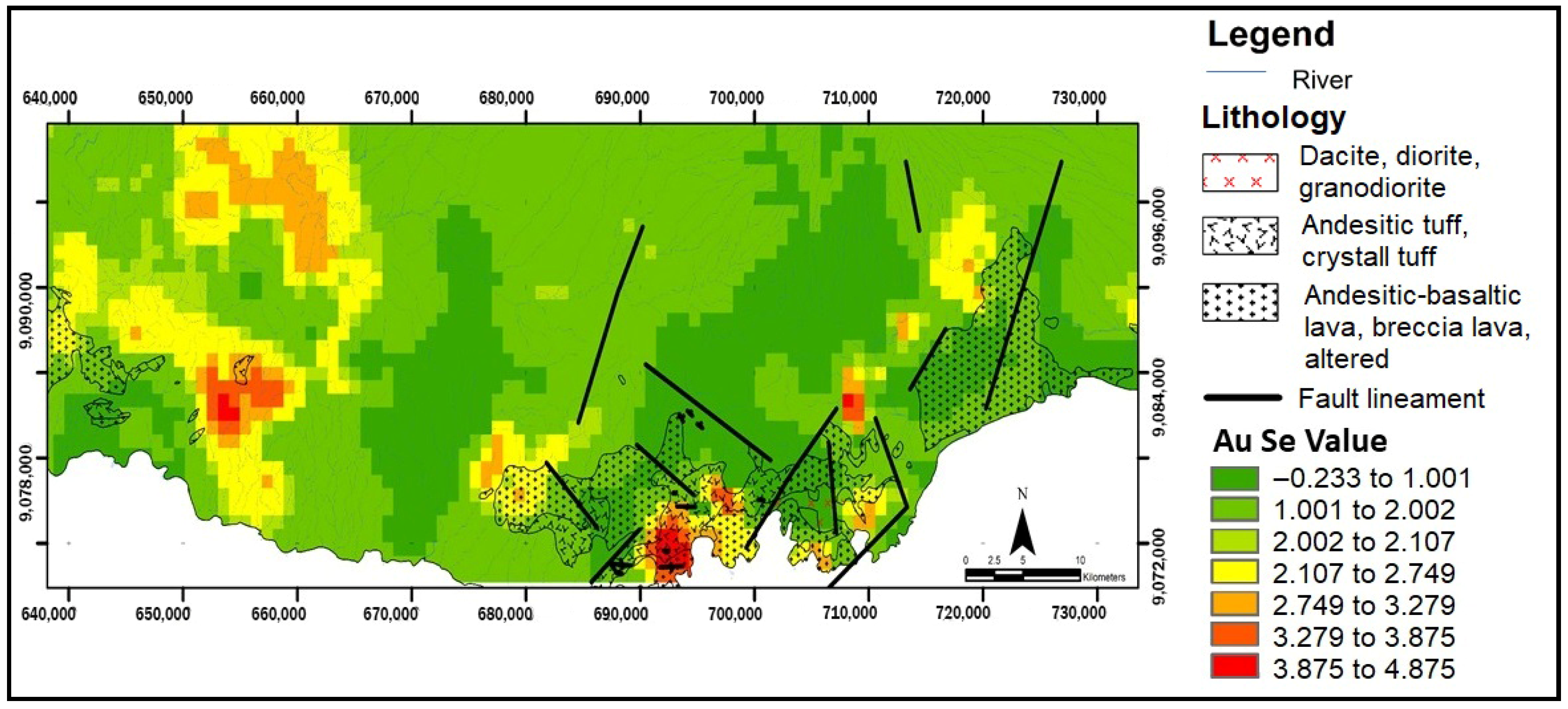
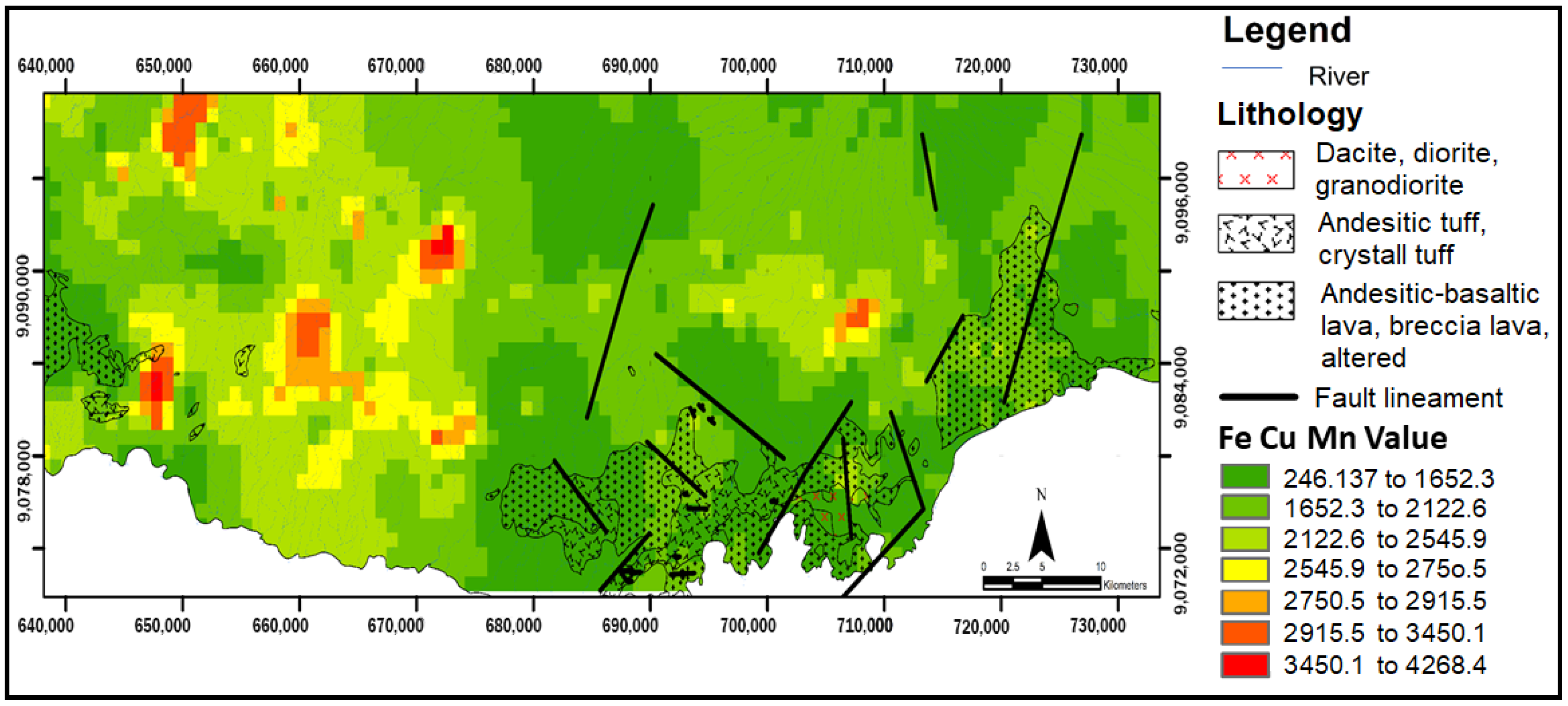
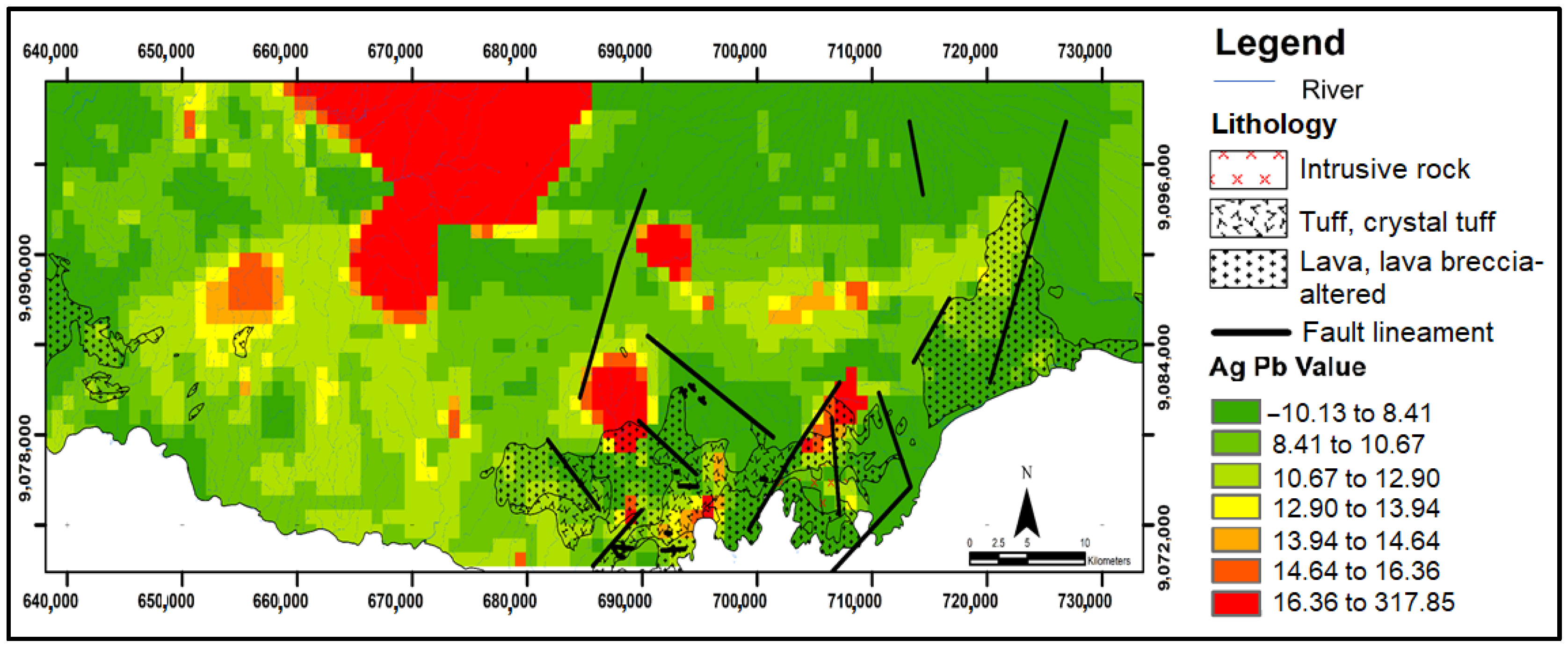
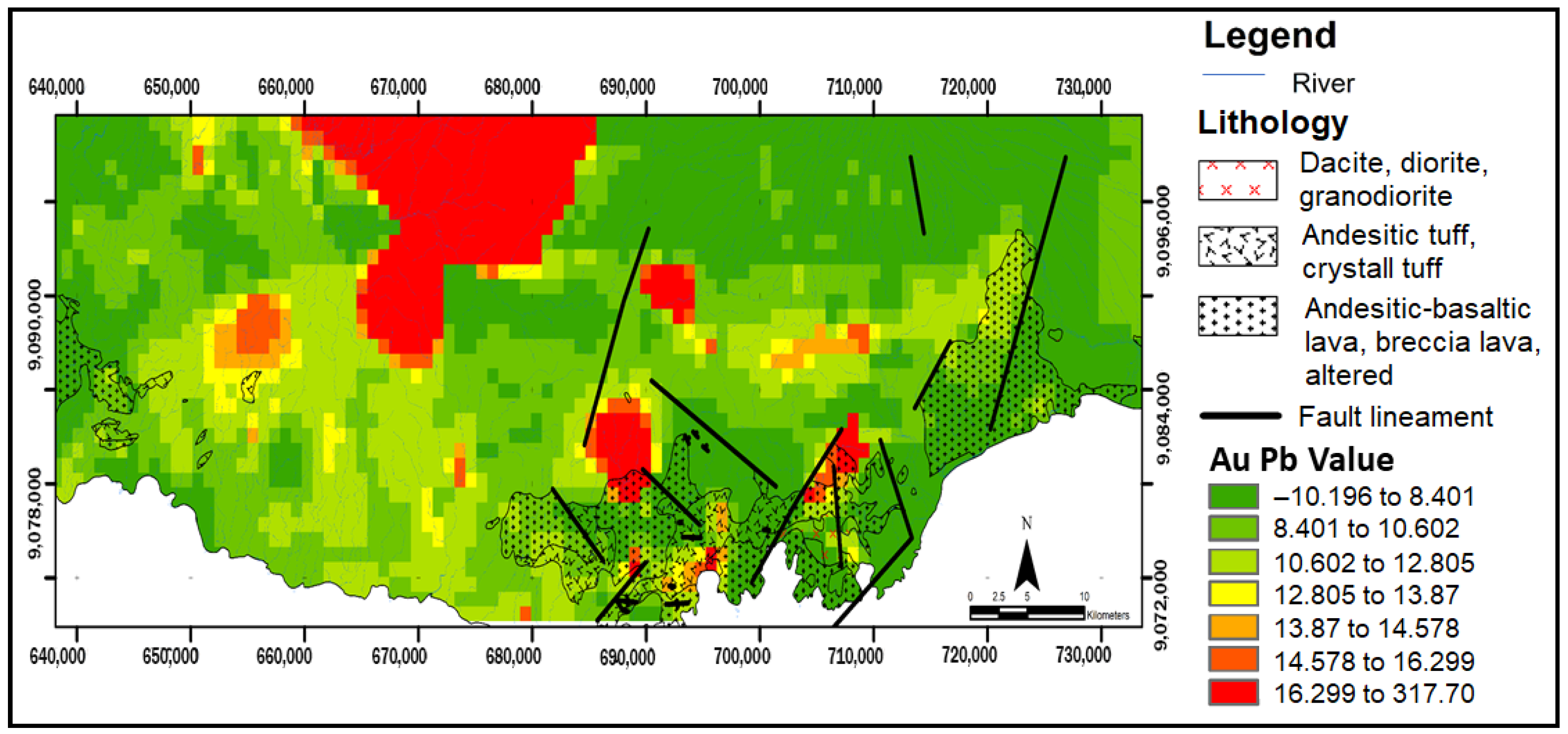
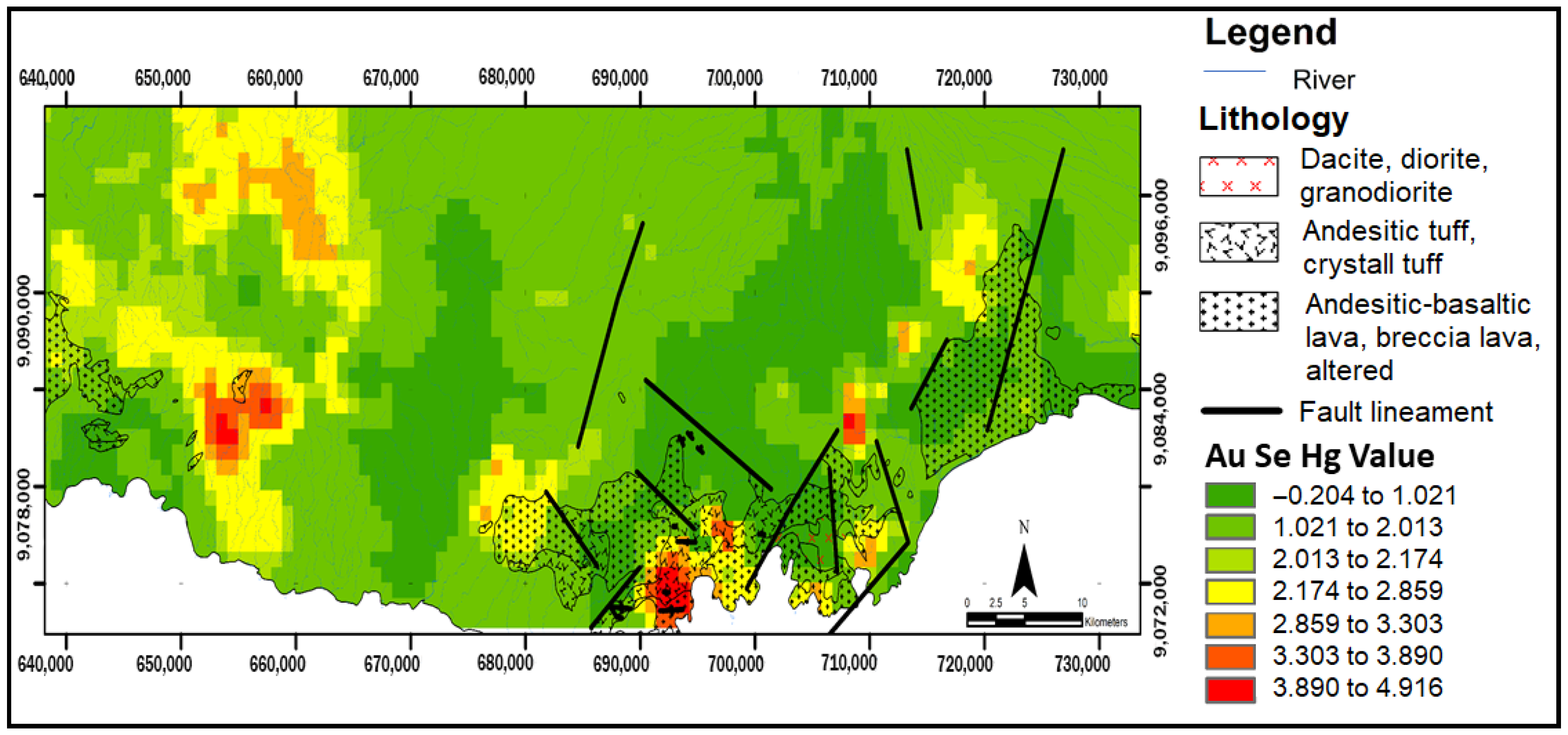
Exploring the Malang–Lumajang area requires a clear plan that utilizes data, local rock knowledge, and resource planning to be effective and accurate. Maps showing where unusual levels of elements occur were created using thresholds set by different data approaches, and these maps help focus exploration efforts. The maps, shown in Figure 9, Figure 10, Figure 11, Figure 12, Figure 13, Figure 14, Figure 15 and Figure 16, display where high amounts of Ag–Pb, As–Sb–S, Au–Ag, Au–Hg, Au–Pb, Au–Se, Au–Se–Hg, and Fe–Cu–Mn were found. There are three main areas of interest, as follows: the southern corridor, the eastern extension, and the western spread zone. Each area points to different processes involving hot fluids and offers a separate potential for finding resources.
The southern sector (690,000–710,000 E; 9,078,000–9,084,000 N) stands out as the most prospective zone. Here, multiple high-order anomalies—such as Ag–Pb, As–Sb–S, Au–Ag, Au–Hg, Au–Pb, Au–Se, Au–Se–Hg, and Cu–Mn (Figure 10, Figure 11, Figure 12, Figure 13, Figure 14, Figure 15, Figure 16 and Figure 17)—overlap, each marking zones of elevated concentrations that suggest the likely presence of corresponding mineralization. These anomalies overlap at intrusive contacts and within hydrothermally altered lava–breccia complexes, a configuration typically associated with ore formation. The identified pattern of co-enrichment in volatile pathfinders (Hg, Se, Sb, and As), noble metals (Au and Ag), and base metals (Pb) specifically indicates zones of metal deposition linked to vertical and lateral geochemical gradients—characteristic of low- to intermediate-sulfidation epithermal systems near surface and potential porphyry-type deposits at depth [48,52]. Structurally, major fracture networks control this corridor, forming high-permeability fluid channels likely responsible for the observed anomaly clustering. This combination of geochemical, lithological, and structural evidence highlights the southern corridor as the primary mineralization center, making it the highest-priority exploration target, which merits immediate drill testing with support from targeted alteration mapping, trenching, and geophysical surveys.
In the eastern extension (715,000–725,000 E; 9,082,000–9,090,000 N), significant anomalies are limited to Au–Ag (Figure 12) and Au–Hg (Figure 13), which are spatially associated with altered volcanic units along intrusive–volcanic boundaries. Notably, Au closely overlaps with Ag and Hg—this overlap is diagnostic of low- to high-sulfidation epithermal systems. In these settings, Hg is typically mobilized at shallow crustal levels, and Ag often accompanies Au in swarm veins. The absence of stronger base-metal or metalloid anomalies supports the interpretation that the eastern zone forms a secondary mineralized corridor, likely controlled by fluid leakage along structural conduits rather than a primary hydrothermal center [53]. Although the anomalies are less intense than in the south, this extension remains a promising, medium-priority exploration target; thus, systematic grid geochemistry, trenching, and structural mapping are warranted to evaluate continuity before drill testing.
The western anomalies (650,000–660,000 E; 9,078,000–9,090,000 N) show moderate values in As–Sb–S (Figure 11), Au–Ag (Figure 12), Au–Hg (Figure 13), Au–Pb (Figure 14), Au–Se (Figure 15), Au–Se–Hg (Figure 16), and Fe–Cu–Mn (Figure 17). These values spread across tuffaceous units and distal volcanic facies. Unlike the focused clustering in the south and east, these anomalies are diffuse and lower in magnitude. This pattern indicates they are leakage halos or distal dispersion zones linked to concealed hydrothermal systems. Both epithermal pathfinders and base-metal enrichments suggest that feeder structures may exist at depth [54], despite weak surface expression. This zone does not warrant immediate drilling but serves as a vector area to guide exploration for hidden mineralization. Geophysical methods, such as IP and resistivity, should be utilized to aid in detecting feeder zones beneath the dispersion halo.
Across all anomaly maps, intrusive contacts (boundaries where magma has intruded into older rock), altered volcanic units (volcanic rocks altered by heat or fluids), and brecciated lava sequences (lava broken into angular fragments) emerge as the dominant lithological controls on mineralization. These lithologies provide both permeability (the ability for fluids to flow through rocks) and chemical reactivity, enhancing fluid–rock interaction and metal precipitation. Structural corridors trending NW–SE and NE–SW (zones of crustal weakness in specified directions) consistently coincide with the strongest anomalies, confirming their role as primary hydrothermal conduits. The repeated overlap of multi-element anomalies along these structural–lithological intersections indicates that the Malang–Lumajang mineralization system is multi-episodic, with overlapping hydrothermal events generating mixed geochemical populations (background, low anomaly, high anomaly).
The integrated geochemical and spatial analysis supports a tiered exploration model, as follows:
  • Advance the southern corridor (690,000–710,000 E; 9,078,000–9,084,000 N) to drill-ready status immediately. Support this process with focused geophysics and detailed alteration mapping.
  • Initiate systematic geochemical and structural surveys in the eastern extension (715,000–725,000 E; 9,082,000–9,090,000 N), where Au–Ag and Au–Hg anomalies indicate a structurally controlled corridor. Complete these steps before drilling begins. The methods section, including sampling techniques, analytical procedures, and static analysis methods, must be thoroughly detailed.
  • Integrate geochemistry with geophysics in the western dispersion zone (650,000–660,000 E; 9,078,000–9,090,000 N) to delineate feeder structures and vector toward concealed systems at depth.
The geochemical synthesis confirms that the Malang–Lumajang area hosts two distinct but overlapping mineralization styles. The first is a low- to high-sulfidation epithermal Au–Ag system, characterized by the strong association of Au–Ag–Hg–Se–Sb–As within volcanic and brecciated host rocks, which reflects the influence of volatile-rich magmatic–hydrothermal fluids in shallow crustal environments. The second is a porphyry system, as evidenced by Fe–Cu–Mn and Au–Pb enrichments that are spatially aligned with intrusive contacts and deeper hydrothermal pathways, consistent with vein-type mineralization. Together, these systems demonstrate a clear pattern of vertical and lateral zonation typical of volcanic-arc hydrothermal environments in Southeast Asia, where epithermal veins dominate the volcanic carapace while deeper intrusive-related polymetallic mineralization develops at depth [52]. From an exploration perspective, this duality highlights the need to target both shallow epithermal vein swarms and porphyry systems, thereby offering significant opportunities for discovering both precious- and base-metal deposits within the Malang–Lumajang region.
Samples from Purwodadi and Ngrawan are silicified and contain sulfide minerals, including chalcopyrite, pyrite, galena, and sphalerite indicating a porphyry–epithermal system mineralization, as recognized such in Masara Gold District, Philippines [55], and Wafi-Golpu Mineral District, Papua New Guinea [56]. Specifically, the Ngrawan area is identified as a porphyry system, characterized by the presence of magnetite veinlets cross-cutting diorite [57] (Figure 3b). Geochemical analysis reveals that the grades of precious and base metals exceed the average levels found in the Earth’s crust [22]. Both areas show anomalous multi-element values, including Ag-Pb, Au-Ag, and Au-Pb associations (Figure 10, Figure 12 and Figure 14). These associations are typical of hydrothermal mineralization systems [45,58]. The geology of both areas also supports mineralization, as rocks include volcanic tuff and breccia, which are favorable host rocks [15,39,59,60]. Intrusive rocks such as dacite, diorite, and granodiorite, which have emerged in these areas, could be sources of mineralization fluids [61,62].

6. Conclusions and Recommendations

6.1. Conclusions

This study demonstrates that integrating robust geostatistical approaches (Mean + 2SD, Median + 2MAD, and the C–A fractal model) with geological contextualization significantly improves the identification and interpretation of geochemical anomalies in the Malang–Lumajang corridor. Logarithmic transformation proved useful in reducing data skewness and clarifying anomaly thresholds for elements with near-normal distributions. In contrast, the Median + 2MAD method was more effective for skewed datasets, offering resilience against outliers. The C–A fractal model outperformed parametric approaches by delineating both low- and high-order anomalies and capturing multi-scale geochemical variability, making it particularly effective for recognizing concealed mineralization. Cross-validation between conservative (Mean + 2SD) and sensitive (C–A fractal) thresholds minimized the risk of over or underestimating anomalies, thereby providing more reliable criteria for anomaly prioritization.
Spatial anomaly grouping highlights key contrasts among the three sectors. The southern sector (690,000–710,000 E; 9,078,000–9,084,000 N) is the primary mineralization center, characterized by overlapping gold–silver, gold–mercury, gold–lead, gold–selenium–mercury, and iron–copper–manganese anomalies, which are aligned with intrusive contacts and altered lava–breccia rocks. In comparison, the eastern sector (715,000–725,000 E; 9,082,000–9,090,000 N) has only gold–silver and gold–mercury anomalies, forming a secondary corridor along volcanic boundaries. The western sector (650,000–660,000 E; 9,078,0000–9,090,000 N) exhibits moderate, diffuse anomalies, suggesting distant dispersion or leakage zones associated with hidden feeder systems. This threefold pattern clarifies sectoral variation in mineralization and emphasizes the influence of intrusive boundaries, alteration zones, and structural intersections.
The geochemical synthesis further confirms the co-existence of the following two types of mineralization style:
  • Low to high sulfidation epithermal Au–Ag systems—where “epithermal” refers to mineral deposits formed by hot fluids near the Earth’s surface and “low- to high-sulfidation” describes the amount and type of sulfur involved in forming the minerals. The association of Au (gold), Ag (silver), Hg (mercury), Se (selenium), Sb (antimony), and As (arsenic) occurs in volcanic and brecciated (broken) host rocks, reflecting volatile-rich magmatic–hydrothermal activity occurring in shallow parts of the crust.
  • Porphyry systems, which are large mineral deposits associated with porphyritic intrusive rocks (rocks containing large crystals), are reflected by Fe (iron), Cu (copper), and Mn (manganese) and Au–Pb (gold–lead) enrichments along intrusive rock boundaries and deeper fluid pathways. These geochemical patterns are consistent with vein-type hydrothermal systems.
This duality illustrates a clear vertical (changing with depth) and lateral (changing across horizontal distances) zonation, typical of volcanic-arc hydrothermal environments found in Southeast Asia. In these environments, shallow epithermal veins (shallow fluid-filled fractures containing minerals) and deeper, intrusive-related polymetallic mineralization (mineral deposits linked to intrusive rocks containing multiple metals) co-exist within the same metallogenic (ore-forming) framework.

6.2. Recommendations for Exploration Are as Follows

Immediate, high-priority exploration should focus on the southern corridor, where clusters of multiple elements consistently converge. Advanced work is warranted, including trenching (excavating shallow ditches to expose geology), alteration mapping (identifying zones of mineral change), geophysical surveys like IP/resistivity (measuring electrical properties of rocks), and initial drill testing (preliminary boreholes to sample subsurface material).
Prompt, medium-priority exploration is required in the eastern corridor. Here, Au–Ag and Au–Hg anomalies define structurally controlled mineralization. Systematic soil geochemistry, trenching, and structural mapping must be employed to urgently assess vein continuity before drill testing.
Lower-priority exploration applies to the western dispersion zone. This area should be treated as a vectoring domain toward concealed systems. Integration of geochemistry with geophysics is needed to identify feeder structures beneath leakage halos.
In conclusion, the integrated geochemical and geological approach has elevated the Malang–Lumajang corridor from reconnaissance-level geochemistry to drill-ready prospect evaluation. The dual mineralization styles identified provide significant opportunities for both precious- and base-metal discoveries, positioning this corridor as a strategic exploration target within the Sunda–Banda arc.

Supplementary Materials

The following supporting information can be downloaded at: https://www.mdpi.com/article/10.3390/geosciences15120470/s1.

Author Contributions

W.W. Conceptualization, methodology, investigation, writing—original draft, writing—review and editing; E.E. Conceptualization, methodology, writing—original draft, writing—review and editing, R.N.P. Methodology, software, formal analysis, writing—original draft, M.R.N. Methodology, software, visualization, writing—original draft; D.W. Conceptualization, methodology, writing—original draft; E.P. Investigation, methodology, writing—original draft; A.I. Resources, writing—review and editing, validation; B.P. Resources, writing—review and editing, validation; Z.B. Validation, writing—review and editing, validation; M.R.P. Investigation, formal analysis, writing—original draft; T.S. Software, formal analysis, writing—original draft; R.D. Resources, software, formal analysis; P.S. Methodology, writing—review and editing; D.R. Resources, visualization, writing—review and editing; and A.H.P.R. Investigation, software, visualization. All authors have read and agreed to the published version of the manuscript.

Funding

Stream sediment data source from collaboration between the Indonesian Geological Agency and JICA-JOGMEG Japan from 2001 to 2004, the first author was directly involved in the activities. Rock geochemical data from collaboration between PSDMBP/Geological Agency and PRSDG/BRIN in 2024, the first author was directly involved in the activities.

Data Availability Statement

The original contributions presented in this study are included in the article and the Supplementary Materials. Further inquiries can be directed to the corresponding author.

Acknowledgments

We thank JICA–JOGMEC and the Center for Mineral, Coal, and Geothermal Resources, Geological Agency, for their collaboration on mineral exploration in the Southern Mountains of East Java. This work resulted in the collection of stream sediment data. The author was directly involved in these activities, and both parties provided funding. We also appreciate the involvement in research in Malang and Lumajang Regencies in 2024, as part of a research collaboration between the Center for Mineral, Coal, and Geothermal Resources, the Geological Agency, and the Research Center for Geological Resources, National Research and Innovation Agency. Thus, the rock samples collected can support the discussion in this article. We are grateful to all researchers involved, who contributed to data collection, statistical processing, analysis, interpretation, and other aspects of the project. During the preparation of this manuscript/study, the author(s) used Grok 4 for the purposes of minor idea brainstorming. The authors have reviewed and edited the output and take full responsibility for the content of this publication.

Conflicts of Interest

The authors have no conflicts of interest in writing this article.

References

  1. Tang, C.; Xu, Z.; Duan, M.; Meng, L.; Liu, H.; Wei, J.; Zhang, C.; Zhao, L. Genetic model of the Luhai sandstone-type uranium deposit: Insights from sedimentological and geochemical evidence. Minerals 2025, 15, 294. [Google Scholar] [CrossRef]
  2. Ngozi-Chika, C.S.; Mhlongo, S.E. Mapping and analysis of stream sediment heavy mineral fractions for mineral exploration: A case study of a portion of North-Central Nigeria. Discov. Miner. 2025, 2, 2. [Google Scholar] [CrossRef]
  3. Bourdeau, J.E.; Zhang, S.E.; Nwaila, G.T.; Ghorbani, Y. Data generation for exploration geochemistry: Past, present, and future perspectives. Appl. Geochem. 2024, 161, 106124. [Google Scholar] [CrossRef]
  4. Kidder, J.A.; Garrett, R.G.; McClenaghan, M.B.; Beckett-Brown, C.E.; Day, S.J.A. Exploration Hydrogeochemistry: Case Studies 1935 to 2024 (Geological Survey of Canada, Open File 9186); Geochemistry: Exploration, Environment, Analysis; Natural Resources Canada: Ottawa, ON, Canada, 2024; Volume 12, pp. 435–442. [Google Scholar] [CrossRef]
  5. Doherty, M.E.; Arndtm, K.; Chang, Z.; Kelley, K.; Lavin, O. Stream sediment geochemistry in mineral exploration: A review of fine-fraction, Clay-fraction, Bulk leach gold, Heavy mineral concentrate and indicator mineral chemistry. Geochem. Explor. Environ. Anal. 2023, 23, geochem2022-039. [Google Scholar] [CrossRef]
  6. Japan International Cooperation Agency and Metal Mining of Japan. Phase 2 Report on the Mineral Exploration in the East Java Area; Refs. Indonesia, Unpublished Internal Report; Japan International Cooperation Agency: Tokyo, Japan, 2003. [Google Scholar]
  7. Sidorov, A.A.; Volkov, A.V.; Savva, N.E. Volcanism and epithermal deposits. J. Volcanol. Seismol. 2015, 9, 349–357. [Google Scholar] [CrossRef]
  8. Pacifico, L.R.; Guarino, A.; Iannone, A.; Albanese, S. Accounting for the compositional nature of geochemical data to improve the interpretation of their univariate and multivariate spatial patterns: A case study from the Campania region (Italy). Geosciences 2025, 15, 20. [Google Scholar] [CrossRef]
  9. Kahrazeh, M.G.; You, H. Systematic Geochemical Exp Sediments for Gol Area (SE Zahedan). J. Biochem. Technol. 2019, 19. [Google Scholar]
  10. Guerra-Urzola, R.; Van Deun, K.; Vera, J.C.; Sijtsma, K. A Guide for Sparse PCA: Model Comparison and Applications. Psychometrika 2021, 86, 893–919. [Google Scholar] [CrossRef]
  11. Safari, M.; Haji, B.A.; Daya, A.; Manouchehriniya, M. Separating geochemical anomalies by concentration-area, concentration-perimeter, and concentration-number fractal models in the Qaen region, East of Iran. Iran. J. Earth Sci. 2021, 14, 271–284. [Google Scholar] [CrossRef]
  12. Nforba, M.T.; Egbenchung, K.A.; Berinyuy, N.L.; Mimba, M.E.; Tangko, E.T.; Nono, G.D.K. Statistical evaluation of stream sediment geochemical data from Tchangue-Bikoui drainage system, Southern Cameroon: A regional perspective. Geol. Ecol. Landsc. 2020, 6, 1–13. [Google Scholar] [CrossRef]
  13. Katili, J.A. Evolution of the Southeast Asian arc complex. Geol. Indones. 1989, 12, 113. [Google Scholar]
  14. Soeria Atmadja, R.; Maury, R.C.; Bellon, H.; Pringgoprawiro, H.; Polve, M.; Priadi, B. Tertiary magmatic belts in Java. J. Southeast Asian Earth Sci. 1994, 9, 13–27. [Google Scholar] [CrossRef]
  15. Mulja, T.; Heriawan, M.N.; Hawu Hede, A.N. Porphyry and skarn Cu prospectivity of Sumatra with GIS spatial modelling techniques. Appl. Earth Sci. 2024, 133, 4–29. [Google Scholar] [CrossRef]
  16. Putra, M.D.; Yudha, R.A.M.; Watania, O.M.L.; Wiloso, D.A. Characteristics and paragenesis of porphyry copper deposit in Sidomulyo, Trenggalek, East Java: Multiple intrusions, hydrothermal alteration, and vein association. Indones. J. Econ. Geol. (IJEG) 2025, 1, 14–32. [Google Scholar]
  17. Zhang, L.-Z.; Gao, W.-S.; Deng, X.-D. Geology and geochronology of magmatic-hydrothermal breccia pipes in the Yixingzhai gold deposit: Implications for ore genesis and regional exploration. Minerals 2024, 14, 496. [Google Scholar] [CrossRef]
  18. Amin, T.C.; Ratman, N.; Gafoer, S. Peta Geologi Lembar Jawa Bagian Tengah. Skala 1: 500.000; Puslitbang Geologi; Kementerian Energi dan Sumber Daya Mineral: Bandung, Indonesia, 1999. [Google Scholar]
  19. Japan International Cooperation Agency and Metal Mining of Japan. Phase 3 Report on The Mineral Exploration in the East Java Area; Indonesia, Unpublished Internal Report; Japan International Cooperation Agency: Tokyo, Japan, 2004. [Google Scholar]
  20. Gafoer, S.; Ratman, N. Peta Geologi Regional Jawa Bagian Timur, Skala 1: 500.000; Pusat Penelitian dan Pengembangan Geologi; Kementerian Energi dan Sumber Daya Mineral: Bandung, Indonesia, 1999. [Google Scholar]
  21. Wartono, R.; Rumidi, S.; Rosidi, H.M.D. Peta Geologi Lembar Yogyakarta, Jawa, Skala 1: 100000; Pusat Penelitian dan Pengembangan Geologi; Kementerian Energi dan Sumber Daya Mineral: Bandung, Indonesia, 1977. [Google Scholar]
  22. Samodera, H.; Suharsono, S.G.; Suwarti, T. Peta Geologi Lembar Tulungagung Skala 1: 100.000; Pusat Penelitian dan Pengembangan Geologi; Kementerian Energi dan Sumber Daya Mineral: Bandung, Indonesia, 1992. [Google Scholar]
  23. Sutarto, S.; Idrus, A.; Harijoko, A.; Setijadji, L.D.; Sindern, S. Mineralization style of the Randu Kuning porphyry Cu–Au and intermediate sulphidation epithermal Au–base metals deposits at Selogiri area, Central Java, Indonesia. AIP Conf. Proc. 2020, 2245, 020050. [Google Scholar] [CrossRef]
  24. Pulunggono, A.; Martodjojo, S. The Tectonic Changes During Paleogene-Neogene were the Most Important Tectonic Phenomenon in Java Island. In Proceedings of the Seminar on Geology and Tectonics of Java Island, from the Late Mesozoic to Quaternary; Geology and Tectonics of Java Island, from the Late Mesozoic to Quaternary Conference; Universitas Gajah Mada: Yogyakarta, Indonesia; 1994, pp. 1–14.
  25. Sjarifudin, M.Z.; Hamidi, S. Geology of the Blitar Quadrangle, Jawa (Quad. 1507-6), 1: 100.000; Pusat Penelitian dan Pengembangan Geologi; Kementerian Energi dan Sumber Daya Mineral: Bandung, Indonesia, 1992. [Google Scholar]
  26. Sujanto, R.; Hadisantono, R.; Chaniago, R.; Baharuddin, R. Geological Map of The Turen Quadrangle, Jawa; Geological Research and Development Centre: Bandung, Indonesia, 1992. [Google Scholar]
  27. Suwarti, T.; Suharsono. Geological Map of the Lumajang Quadrangle, Jawa, 1607-5; Kementerian Energi dan Sumber Daya Mineral: Bandung, Indonesia, 1992. [Google Scholar]
  28. Van Bemmelen, R.W. General Geology of Indonesia and adjacent archipelagos. In The Geology of Indonesia; Government Printing Office: The Hague, The Netherlands, 1949. [Google Scholar]
  29. Surono, B.T.; Sudarno, I.; Wiryosujono, S. Geology of the Surakarta Giritontro Quadrangles, Java; Geological Research and Development Center: Bandung, Indonesia, 1992. [Google Scholar]
  30. Groves, D.I.; Santosh, M.; Müller, D.; Zhang, L.; Deng, J.; Yang, L.Q.; Wang, Q.F. Mineral systems: Their advantages in terms of developing holistic genetic models and for target generation in global mineral exploration. Geosyst. Geoenviron 2022, 1, 100001. [Google Scholar] [CrossRef]
  31. Groves, D.I.; Santosh, M. Mineral Systems, Earth Evolution, and Global Metallogeny; Elsevier: Amsterdam, The Netherlands, 2023. [Google Scholar]
  32. Richards, J.P. Magmatic to hydrothermal metal fluxes in convergent and collided margins. Ore Geol. Rev. 2011, 40, 1–26. [Google Scholar] [CrossRef]
  33. Keith, M.; Smith, D.J.; Jenkin, G.R.; Holwell, D.A.; Dye, M.D. A review of Te and Se systematics in hydrothermal pyrite from precious metal deposits: Insights into ore-forming processes. Ore Geol. Rev. 2018, 96, 269–282. [Google Scholar] [CrossRef]
  34. Falkenberg, J.J.; Keith, M.; Haase, K.M.; Sporer, C.; Bach, W.; Klemd, R.; Strauss, H.; Storch, B.; Peters, C.; Rubin, K.H.; et al. Spatial variations in magmatic volatile influx and fluid boiling in the submarine hydrothermal systems of niuatahi caldera, Tonga rear-arc. Geochem. Geophys. Geosyst. 2022, 23, e2021GC010259. [Google Scholar] [CrossRef]
  35. Hemley, J.J.; Hunt, J.P. Hydrothermal ore-forming processes in the light of studies in rock-buffered systems; II, Some general geologic applications. Econ. Geol. 1992, 87, 23–43. [Google Scholar] [CrossRef]
  36. Hedenquist, J.W.; Lowenstern, J.B. The role of magmas in the formation of hydrothermal ore deposits. Nature 1994, 370, 519–527. [Google Scholar] [CrossRef]
  37. Zhang, X.; Sanderson, D.J. Numerical modelling of the effects of fault slip on fluid flow around extensional faults. J. Struct. Geol. 1996, 18, 109–119. [Google Scholar] [CrossRef]
  38. Wei, D.; Gao, Z.; Fan, T.; Niu, Y.; Gou, R. Volcanic events—Related hydrothermal dolomitization and silicification controlled by intra-cratonic strike slip fault systems: Insights from the northern slope of the Tazhong Uplift, Tarim Basin, China. Basin Res. 2021, 33, 2411–2434. [Google Scholar] [CrossRef]
  39. Mbiatso Yimgnia, T.; Takodjou Wambo, J.D.; Ntouala, R.F.D.; Mvondo Ondoa, J. Spatial modelling of multi-element associations from stream sediment in the Lingbim-Zimbi area (Boden district, Eastern Cameroon). Arab. J. Geosci. 2021, 14, 2157. [Google Scholar] [CrossRef]
  40. Štefelová, N.; Palarea-Albaladejo, J.; Hron, K.; Gába, A.; Dygrýn, J. Compositional PLS biplot based on pivoting balances: An application to explore the association between 24-h movement behaviours and adiposity. Comput. Stat. 2024, 39, 835–863. [Google Scholar] [CrossRef]
  41. Rohe, K.; Zeng, M. Vintage factor analysis with Varimax performs statistical estimation in latent variable models. J. R. Stat. Soc. Ser. B Stat. Methodol. 2023, 85, 1037–1060. [Google Scholar] [CrossRef]
  42. Tolstykh, N.; Bortnikov, N.; Zhukova, I.; Stepanov, A.; Palyanova, G.; Shapovalova, M.; Zhao, K. Trace elements in pyrite from AuAg epithermal deposits of Kamchatka, Russia: Comparison with geochemical features of mineral systems. J. Geochem. Explor. 2025, 275, 107774. [Google Scholar] [CrossRef]
  43. Mehta, V.; Batra, N.; Poonam, G.S.; Kaur, A.; Dudekula, K.V.; Victor, J.G. Machine-learning-based exploratory data analysis (EDA) for chronic kidney disease diagnosis. Phat. Proc. Inst. Eng. (India) Ser. E 2023, 104, 1–10. [Google Scholar] [CrossRef]
  44. González-Estrada, E.; Cosmes, W. Shapiro–Wilk test for skew normal distributions based on data transformations. J. Stat. Comput. Simul. 2019, 89, 3258–3272. [Google Scholar] [CrossRef]
  45. Zhang, H.; Chen, W.; Tan, Z.; Zhang, L.; Dong, Z.; Cui, W.; Zhao, K.; Wang, H.; Jing, H.; Cao, R. A role of low-density lipoprotein receptor-related protein 4 (LRP4) in astrocytic Aβ clearance. J. Neurosci. 2020, 40, 5347–5361. [Google Scholar] [CrossRef]
  46. Mulja, T.; Heriawan, M.N. The Miwah high sulphidation epithermal Au–Ag deposit, Aceh, Indonesia: Dynamics of hydrothermal alteration mineralization interpreted from principal component analysis of lithogeochemical data. Ore Geol. Rev. 2022, 147, 104988. [Google Scholar] [CrossRef]
  47. Taylor, R.D.; Graham, G.E.; Lowers, H.A. Hydrothermal monazite and xenotime chemistry as genetic discriminators for intrusion-related and orogenic gold deposits: Implications for an orogenic origin of the Pogo Gold Deposit, Alaska. Miner. Depos. 2024, 59, 949–967. [Google Scholar] [CrossRef]
  48. Phillips, G.N.; Vearncombe, J.R.; Clemens, J.D.; Day, A.; Kisters, A.F.M.; Von der Heyden, B.P. Formation of Cu–Au porphyry deposits: Hydraulic quartz veins, magmatic processes and constraints from chlorine. Aust. J. Earth Sci. 2023, 70, 1010–1033. [Google Scholar] [CrossRef]
  49. Marcelissen, M. Magmatic Minerals of the Eastern Sunda Arc, Indonesia. Master’s Thesis, Lakehead University, Thunder Bay, ON, Canada, 2023. [Google Scholar]
  50. Kelley, K.; Spry, P.; McLemore, V.; Fey, D.; Anderson, E. Alkalic-Type Epithermal Gold Deposit Model: Chapter R of Mineral Deposit Models for Resource Assessment; USGS: Reston, VA, USA, 2020. [Google Scholar]
  51. Van Leeuwen, T.M.; Rompo, I. High Sulfidation Au (-Ag-Cu) Deposits in Indonesia: A Review; IAGI-MGEI: Jakarta, Indonesia, 2023; pp. 1–66. ISBN 978-979-8126-47-5. Available online: https://www.iagi.or.id/web/digital/73/Book-complete.pdf (accessed on 1 September 2025).
  52. Li, X.; Xie, G.; Gleeson, S.A.; Mao, J.; Ye, Z.; Jin, Y. Palladium, platinum, selenium, and tellurium enrichment in the Jiguanzui–Taohuazui Cu–Au Deposit, Edong Ore District: Distribution and comparison with Cu–Mo deposits. Ore Geol. Rev. 2023, 154, 105335. [Google Scholar] [CrossRef]
  53. Abd Ellatif, M.; Elkhateeb, S.O.; Hegab, M.A.-R.; Shebl, A.; Mohamed, G.; Mahdi, A.M. Revealing porphyry mineralization Cu–Au signatures via analyzing aeromagnetic and remote sensing data of Dara-Monqul area, Egypt. Sci. Rep. 2025, 15, 26903. [Google Scholar] [CrossRef]
  54. Naglik, B.; Sosnal, A.; Dumańska-Słowik, M.; Toboła, T.; Dimitrova, D.; Habryn, R.; Derkowski, P.; Czupyt, Z.; Włoszczyna, M.; Markowiak, M.; et al. Constraints on ore vectoring from geochemical fingerprints of porphyry-style pyrite. Sci. Rep. 2025, 15, 18696. [Google Scholar] [CrossRef] [PubMed]
  55. Gabo-Ratio, J.A.; Buena, A.E.; Villaplaza, B.R.B.; Payot, B.D.; Dimalanta, C.B.; Queaño, K.L.; Andal, E.S.; Yumul, G.P., Jr. Epithermal Mineralization of the Bonanza-Sandy Vein System, Masara Gold District, Mindanao, Philippines. J. Asian Earth Sci. X 2020, 4, 100041. [Google Scholar] [CrossRef]
  56. Lunge, M.; Espi, J.O. Trace Element Geochemistry of Chalcopyrites and Pyrites from Golpu and Nambonga North Porphyry Cu-Au Deposits, Wafi-Golpu Mineral District, Papua New Guinea. Geosciences 2021, 11, 335. [Google Scholar] [CrossRef]
  57. Mavrogonatos, C.; Voudouris, P.; Berndt, J.; Klemme, S.; Zaccarini, F.; Spry, P.G.; Melfos, V.; Tarantola, A.; Keith, M.; Klemd, R.; et al. Trace elements in magnetite from the Pagoni Rachi porphyry prospect, NE Greece: Implications for ore genesis and exploration. Minerals 2019, 9, 725. [Google Scholar] [CrossRef]
  58. Alfonso, P.; Ccolqque, E.; Garcia-Valles, M.; Martínez, A.; Yubero, M.T.; Anticoi, H.; Sidki-Rius, N. Mineralogy and mineral chemistry of the Au-Ag-Te-(Bi-Se) San Luis Alta deposit, mid-south Peru. Minerals 2023, 13, 568. [Google Scholar] [CrossRef]
  59. Li, B.; Shi, X.; Li, C.; Wang, S.; Ye, J.; Yan, Q.; Dang, Y.; Fang, X. Biogeochemical sulfide mineralization in the volcanic-hosted Tongguan hydrothermal field, southern Mid-Atlantic Ridge. Front. Mar. Sci. 2025, 12, 1562763. [Google Scholar] [CrossRef]
  60. Chen, J.; Huang, Z.; Yang, R.; Du, L.; Liao, M. Gold and antimony metallogenic relations and ore-forming process of Qinglong Sb(Au) deposit in Youjiang basin, SW China: Sulfide trace elements and sulfur isotopes. Geosci. Front. 2020, 12, 605. [Google Scholar] [CrossRef]
  61. Shapovalova, M.; Shaparenko, E.; Tolstykh, N. Geochemistry and fluid inclusion of epithermal Au–Ag deposits in Kamchatka, Russia. Minerals 2025, 15, 2. [Google Scholar] [CrossRef]
  62. Wang, L.; Chiaradia, M.; Qin, K.Z.; Hui, K.X.; Li, Z.Z.; Cao, M.J.; Li, G.M. Magmatic Controls on Au-and Ag-Rich Intermediate-Sulfidation Epithermal Deposits from Northeast China. Econ. Geol. 2024, 119, 1913–1936. [Google Scholar] [CrossRef]
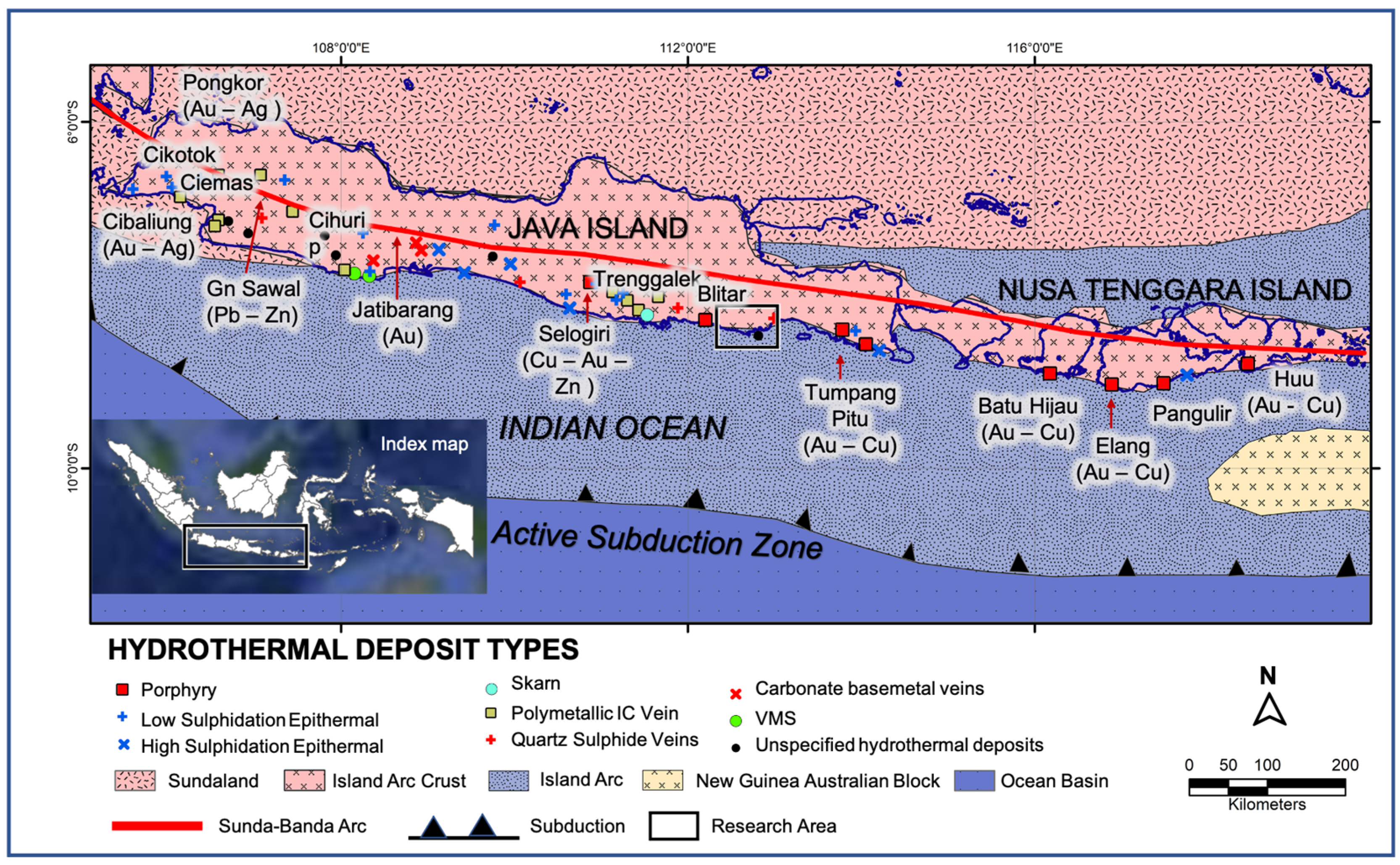
Figure 1. The mineralization types in Jawa–Nusa Tenggara Island, western part, are dominated by Au-Ag epithermal deposits, while the eastern part features Au-Cu porphyry deposit types (Compiled from [15,16,17,23]).
Geosciences 15 00470 g001
Figure 2. Geological Map of the Southern Mountains of East Java, Modified from [17,21,25,26,27,29]. Geological and alteration map of Ngrawan (a) and Geological and alteration map of Purwodadi-Pujiharjo (b).
Geosciences 15 00470 g002
Figure 3. Photograph of outcrop in the upper reaches of the Ngrawan River (a): (a1) hydrothermal breccia zoom photo of part of (a) with scattered fine pyrite and diorite showing veinlets of magnetite (b).
Geosciences 15 00470 g003
Figure 4. Photograph of rock float samples from Purwodadi River: (a,b) rock float, containing pyrite, chalcopyrite, sphalerite (a1) and containing pyrite-dominated (b1).
Geosciences 15 00470 g004
Figure 5. Stream sediments sample location map, Malang–Lumajang, East Java, Indonesia.
Geosciences 15 00470 g005
Figure 6. Workflow is schematically illustrated.
Geosciences 15 00470 g006
Figure 7. CLR-transformed data.
Geosciences 15 00470 g007
Figure 8. Q–Q plots of raw data for (a) As, (b) Cu, and (c) Pb and log-transformed data histograms for (d) As, (e) Cu, and (f) Pb for regional stream sediment geological data from the Malang–Lumajang region.
Geosciences 15 00470 g008
Figure 9. Log–log (base e) plots showing the relationship between area Au and Au-Ag, generated using the C–A fractal model. Segmentation was performed via the least squares method.
Geosciences 15 00470 g009
Figure 10. Spatial distributions of anomalies of Ag + Pb in Malang–Lumajang stream sediment samples.
Geosciences 15 00470 g010
Figure 11. Spatial distributions of anomalies of As–Sb–S of Malang–Lumajang stream sediment samples.
Geosciences 15 00470 g011
Figure 12. Spatial distributions of anomalies of Au–Ag in Malang–Lumajang stream sediment samples.
Geosciences 15 00470 g012
Figure 13. Spatial distributions of anomalies of Au–Hg in Malang–Lumajang stream sediment samples.
Geosciences 15 00470 g013
Figure 14. Spatial distributions of anomalies of Au–Pb in Malang–Lumajang stream sediment samples.
Geosciences 15 00470 g014
Figure 15. Spatial distributions of anomalies of Au–Se in Malang–Lumajang stream sediment samples.
Geosciences 15 00470 g015
Figure 16. Spatial distributions of anomalies Au–Se–Hg of Malang–Lumajang stream sediment samples.
Geosciences 15 00470 g016
Figure 17. Spatial distributions of anomalies of Fe–Cu–Mn of Malang–Lumajang stream sediment samples.
Geosciences 15 00470 g017
Table 1. List of stream sediment sample locations based on the rock distribution environment.
No.Rocks EnvironmentAmount%
1Alluvium172.67
2Quaternary volcanic rocks21333.49
3Miocene volcanic10216.04
4Miocene sedimentary rocks9414.78
5Miocene Limestone7111.16
6Oligocene Intrusive rocks81.26
7Oligocene volcanic rocks13120.60
Total636100
Table 2. Results of PC analysis of raw and CLR-transformed data of stream sediment geochemical from Malang–Lumajang.
VariableRaw DataTransform Data
PC-1PC-2PC-APC-B
Au0.030.18−0.120.42
Ag0.100.300.150.42
As−0.330.42−0.25−0.46
Cu0.320.160.34−0.16
Fe0.400.200.390.02
Pb0.130.290.180.07
S−0.300.39−0.290.09
Sb−0.330.40−0.32−0.31
Te−0.230.23−0.210.25
Zn0.310.270.350.25
Hg0.030.130.060.02
Mn0.400.180.38−0.07
Se0.010.130.07−0.20
Ba0.320.210.32−0.41
Eigenvalue3.282.305.191.56
Proportion0.230.160.370.11
Cumulative0.230.400.370.48
Table 3. Results geochemical analysis of rock sample.
No.SampleAreaAuAgCuPbZnAsSb
ng/gµg/gµg/gµg/gµg/gµg/gµg/g
1W 031Purwodadi–Pujiharjo3921,4002027734
2W 0343532,100264926
3W 035342665017534
4W 03856035462041104
5W 03931010,30020156<LD10
6E 051Ngrawan<LD22553973<LD
7E052<LD211056183<LD2
8E 055177<LD66943190<LD4
9E 056174<LD50237165<LD4
10E 063133<LD535329<LD4
11E 066102<LD52039130<LD4
12E 067114349842242<LD4
Note: LD (Limit Detection).
Table 4. Statistical parameters of element concentrations of stream sediment geochemical data in the Malang–Lumajang area.
ElementAuAgAsBaCuFeMnPbSSbSeTeZnHg
Number of Samples635635635635635635635635635635635635635635
Mean0.010.077.61290.665.6810.76178810.530.050.151.490.08145.530.02
Standard
Deviation
0.037040.0415.20136.523.815.01552.7417.400.130.430.950.0958.440.04
Minimum0.000.010.206721.200.631261.800.010.030.500.03130.01
P250.000.052.7019548.757.0813957.200.010.030.500.031120.01
Median0.000.064.4027062.609.24173590.020.0610.051370.02
P750.000.087.6537077.8513.53213511.200.050.1520.091680.02
P900.010.1015.8044696.5017.69247013.060.100.3230.16208.600.03
P950.020.1223.18493111.5021.16275315.030.160.4730.25242.300.04
P980.070.15334.38560125.3025306321.280.360.6940.35289.640.05
Maximum0.690.683262010170.502549404171.939.2950.636880.83
Skewness12.605.9115.123.580.891.030.7520.579.9816.220.813.202.6419.51
Kurtoses204.769.42305.2338.861.180.652.25472.92127.97323.840.2913.0216.13443.21
Table 5. Anomaly threshold values, calculated using various methods, for stream sediment data from the Malang–Lumajang region.
ElementMean + 2SDMedian + 2MADC-A Fractal Model
Raw DataLog-Transformed DataRaw DataLog-Transformed DataLow AnomalyHigh Anomaly
Au0.0050.0050.0050.0050.0010.003
Ag0.110.120.100.100.060.08
As9.8922.018.6011.153.806.60
Ba511.10607.69432506.90230350
Cu108.79126.8691.80100.6858.1073.50
Fe20.7723.0614.7617.028.3112.50
Mn2801.343387.9724692664.2115752040
Pb14.5716.2812.8013.878.4010.60
S0.070.070.040.040.020.04
Sb0.180.180.130.13-0.12
Se3.283.862.002.5612
Te0.130.130.100.10-0.08
Zn224.27288.83193205.96125158
Hg0.030.030.040.040.010.02
As-Sb-S10.0922.528.7311.733.866.65
As-Se-Hg3.303.892.172.861.022.01
Ag-Pb14.6516.3612.9013.948.4110.67
Fe-Cu-Mn2915.483450.122545.872750.551652.252122.60
Au-Se3.283.882.112.7512
Au-Hg0.040.040.040.040.020.03
Au-Ag0.120.120.100.100.060.08
Au-Pb14.5816.30-13.878.4010.60
Note: SD—Standard Deviation; MAD—Median Absolute Deviation.
Table 6. Fitted parameters of the Concentration–Area (C–A) fractal models for pathfinder elements (α, β, R2).
Element/AssocSegmentαβR2
AuBackground−1.32−0.380.70
Low Anomaly−1.83−0.550.71
High Anomaly−2.77−0.920.99
AgBackground−0.48−0.260.71
Low Anomaly−2.60−1.900.81
High Anomaly−4.04−3.070.95
AsBackground−0.01−0.270.80
Low Anomaly+0.53−1.291.00
High Anomaly+0.83−1.580.97
BaBackground+1.26−0.610.84
Low Anomaly+3.56−1.590.98
High Anomaly+11.41−4.680.90
CuBackground+0.91−0.610.89
Low Anomaly+4.93−2.911.00
High Anomaly+9.50−5.310.96
FeBackground+0.18−0.350.55
Low Anomaly+1.25−1.601.00
High Anomaly+4.27−4.270.88
MnBackground+0.90−0.320.43
Low Anomaly+8.65−2.770.99
High Anomaly+21.82−6.730.98
PbBackground+0.32−0.520.73
Low Anomaly+2.38−2.810.99
High Anomaly+1.39−2.050.81
SBackground−0.63−0.260.87
Low Anomaly−1.54−0.750.82
High Anomaly−2.34−1.310.99
SbBackground−0.97−0.540.85
Low Anomaly
High Anomaly−1.74−1.430.96
SeBackground−0.19−0.390.56
Low Anomaly−0.26−0.520.74
High Anomaly+0.39−3.400.81
HgBackground−0.82−0.350.41
Low Anomaly−1.20−0.480.49
High Anomaly−3.97−2.010.87
As–Sb–SBackground−0.01−0.280.81
Low Anomaly+0.56−1.311.00
High Anomaly+0.85−1.580.97
As–Se–HgBackground−0.20−0.440.64
Low Anomaly−0.25−0.550.75
High Anomaly+0.45−3.480.83
Ag–PbBackground+0.33−0.530.73
Low Anomaly+2.41−2.830.99
High Anomaly+1.40−2.060.81
Fe–Cu–MnBackground+1.08−0.380.49
Low Anomaly+8.87−2.820.99
High Anomaly+22.60−6.950.97
Au–SeBackground−0.20−0.400.59
Low Anomaly−0.26−0.530.75
High Anomaly+0.42−3.430.82
Au–HgBackground−1.00−0.450.70
Low Anomaly−3.31−1.770.82
High Anomaly−3.16−2.370.96
Au–AgBackground−0.51−0.290.73
Low Anomaly−2.71−2.040.95
High Anomaly−3.10−2.380.97
Au–PbBackground+0.32−0.520.73
Low Anomaly+2.38−2.810.99
High Anomaly+1.39−2.050.81
Table 7. Anomaly areas determined by different methods and their spatial distributions.
Mean + 2SD Median + 2MAD C-A Fractal Model
Raw Data Log-Transformed Data Raw Data Log-Transformed Data Low Anomaly High Anomaly
Quantity (%) Quantity (%) Quantity (%) Quantity (%) Quantity (%) Quantity (%)
Au426.61426.6113020.4713020.47274 18829.61
Ag203.15203.157912.44538.3519029.9220632.44
As345.35274.2514022.0510015.7519330.3919130.08
Ba233.6271.108012.60304.7217527.5619630.87
Cu284.41132.058914.02538.3519430.5518929.76
Fe365.67243.7812319.377111.1819230.2419029.92
Mn203.1530.476610.39406.3019130.0819230.24
Pb182.83142.207211.34487.5618829.6119430.55
S497.72497.7217527.5617527.5613521.2617527.56
Sb375.83325.0417327.2417327.2400.0019831.18
Se121.89162.528914.028813.8613821.7329546.46
Te365.67365.6712319.3712319.3700.0019931.34
Zn264.09152.368914.027011.0218629.2919630.87
Hg213.31213.31253.94253.9444770.3914022.05
As-Sb-S355.51274.2514723.159615.1219130.0819130.08
Au-Se-Hg121.89172.689214.498813.8619230.2420031.50
Ag-Pb182.83142.207211.34487.5619130.0819130.08
Fe-Cu-Mn223.4630.476810.71457.0919230.2419029.92
Au-Se111.73162.529214.498813.8618929.7620632.44
Au-Hg253.94253.947611.977611.9719130.0819029.92
Au-Ag223.46233.628613.548613.5421233.3919130.08
Au-Pb182.83142.207411.65497.7218729.4519130.08
Disclaimer/Publisher’s Note: The statements, opinions and data contained in all publications are solely those of the individual author(s) and contributor(s) and not of MDPI and/or the editor(s). MDPI and/or the editor(s) disclaim responsibility for any injury to people or property resulting from any ideas, methods, instructions or products referred to in the content.