
Analysis of Cenozoic Structural Evolution and Basin Formation Models in the Nanpu Sag, Bohai Bay Basin, China


Abstract
1. Introduction
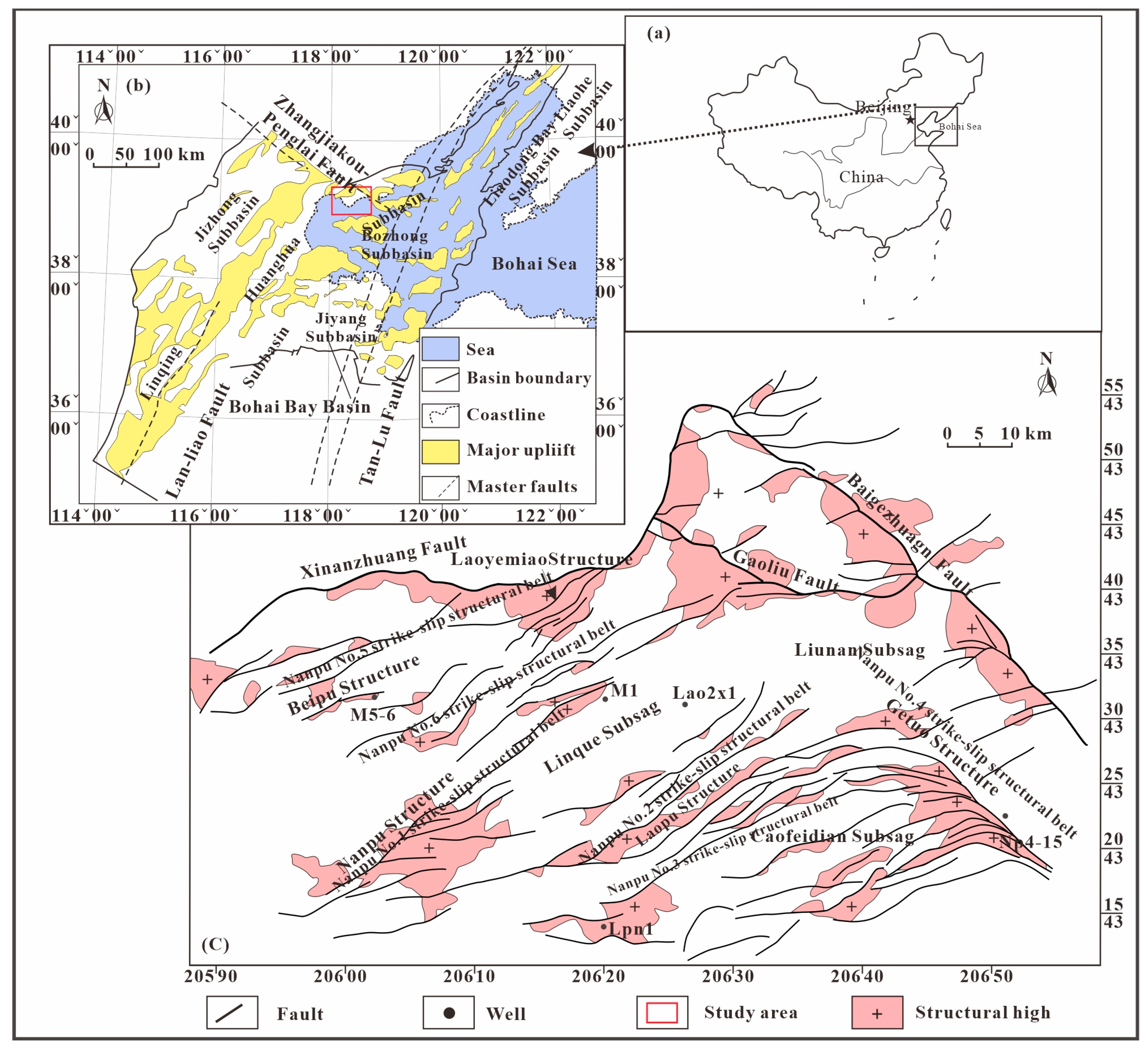
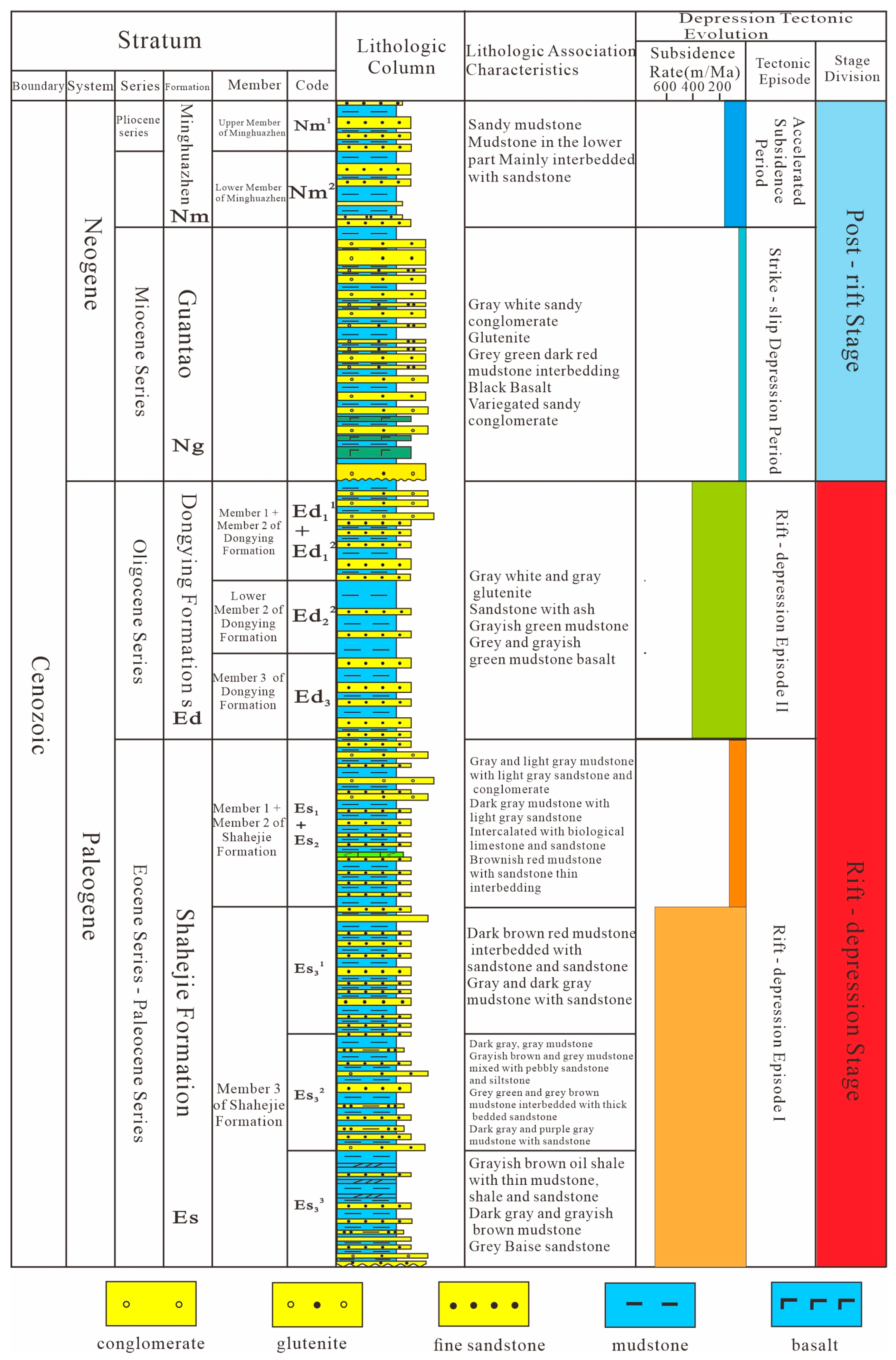
2. Geologic Background


3. Data and Methodology
4. Quantitative Analysis of Basin Tectonic Activity
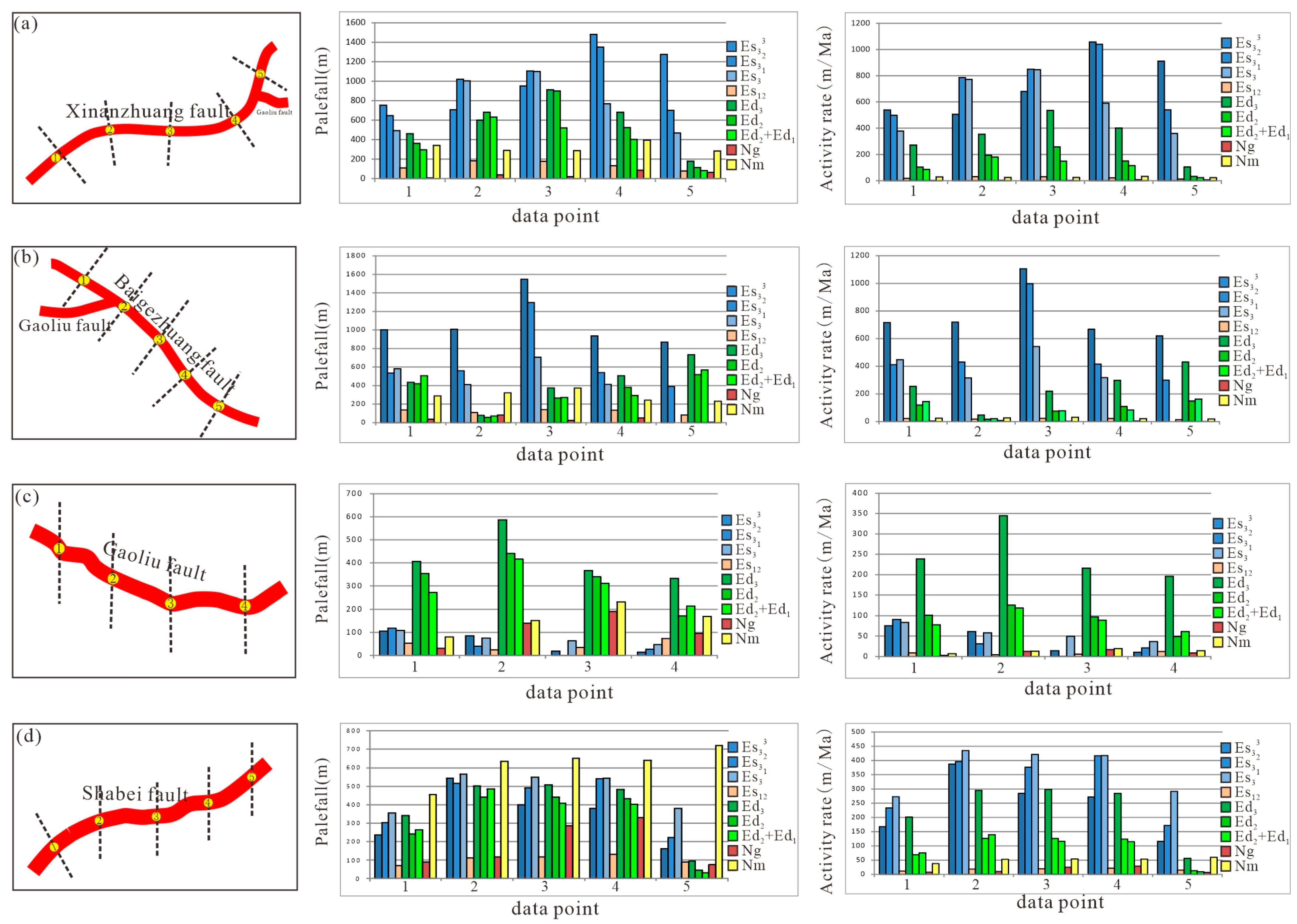
4.1. Analysis of the Activity of Main Faults
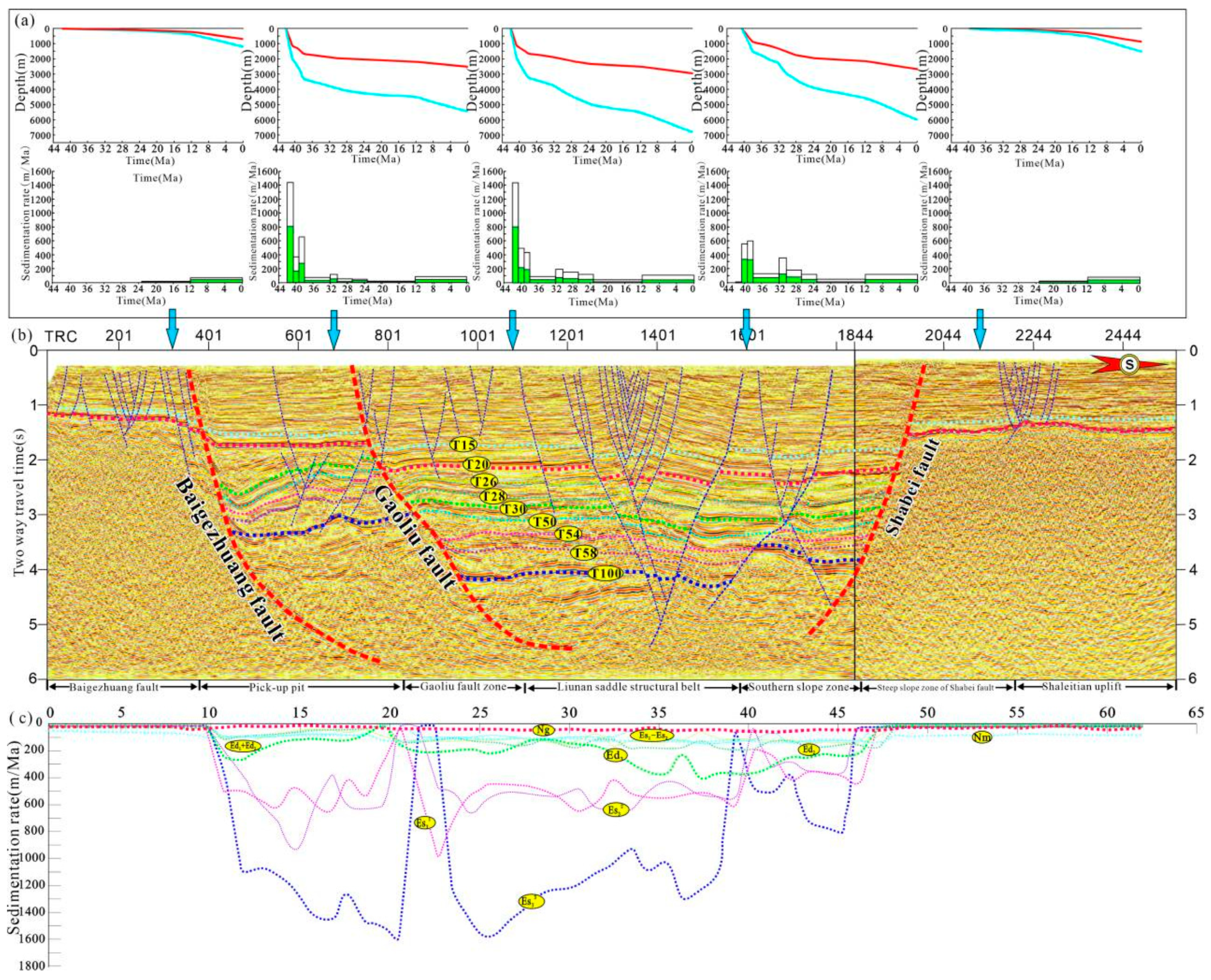
4.2. Settlement History Analysis
4.3. Structural Evolution Analysis of Nanpu Sag
5. The Main Structural Framework and Developmental Patterns of the Nanpu Sag During Various Geological Periods
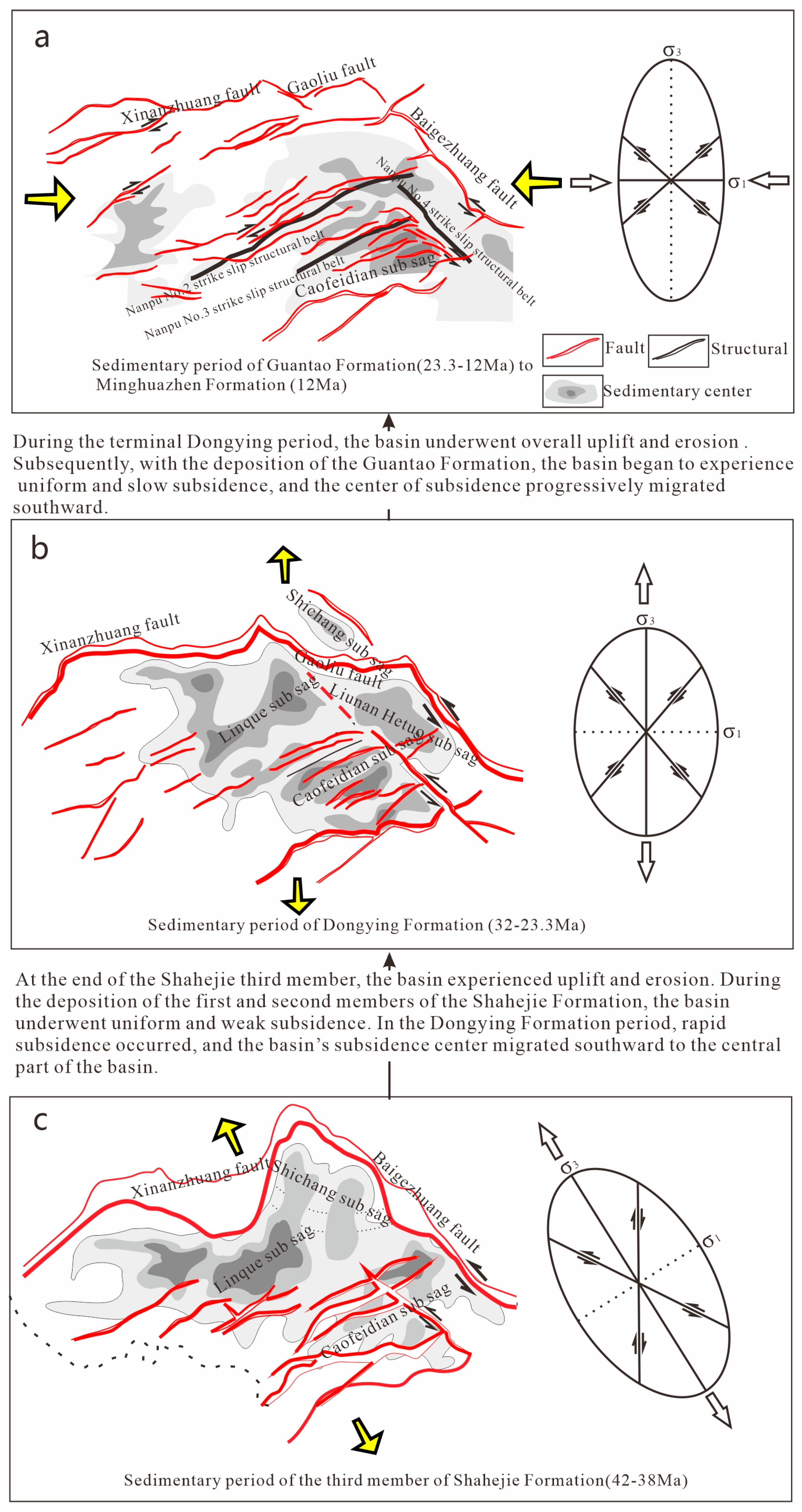
5.1. Rift Stage I—Sedimentary Period of the Third Member of Shahejie Formation
5.2. Rift Stage II—Dongying Formation Sedimentary Period
5.3. Thermal Subsidence Curtain and Accelerated Subsidence Curtain—Sedimentary Periods of Guantao Formation and Minghuazhen Formation
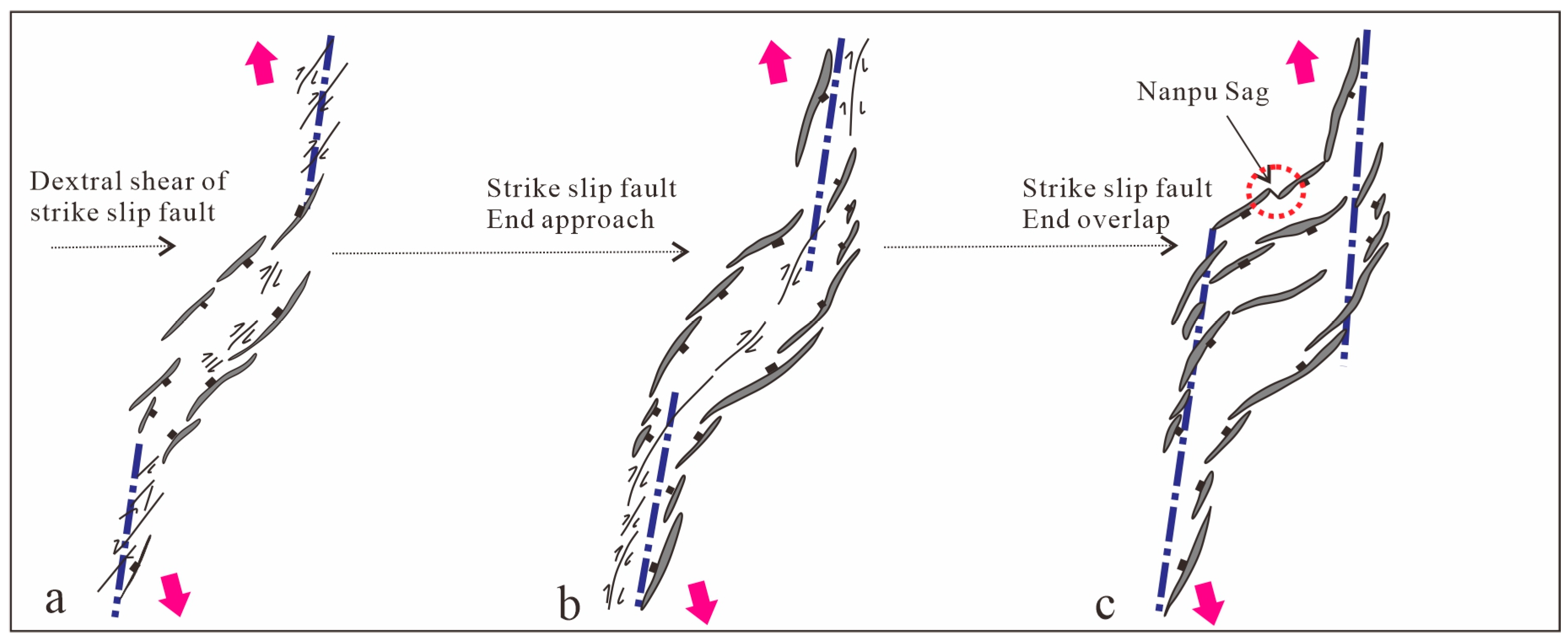
5.4. Development and Evolution Model of Nanpu Sag
6. Discussion and Conclusions
6.1. Discussion
6.2. Conclusions
- (1)
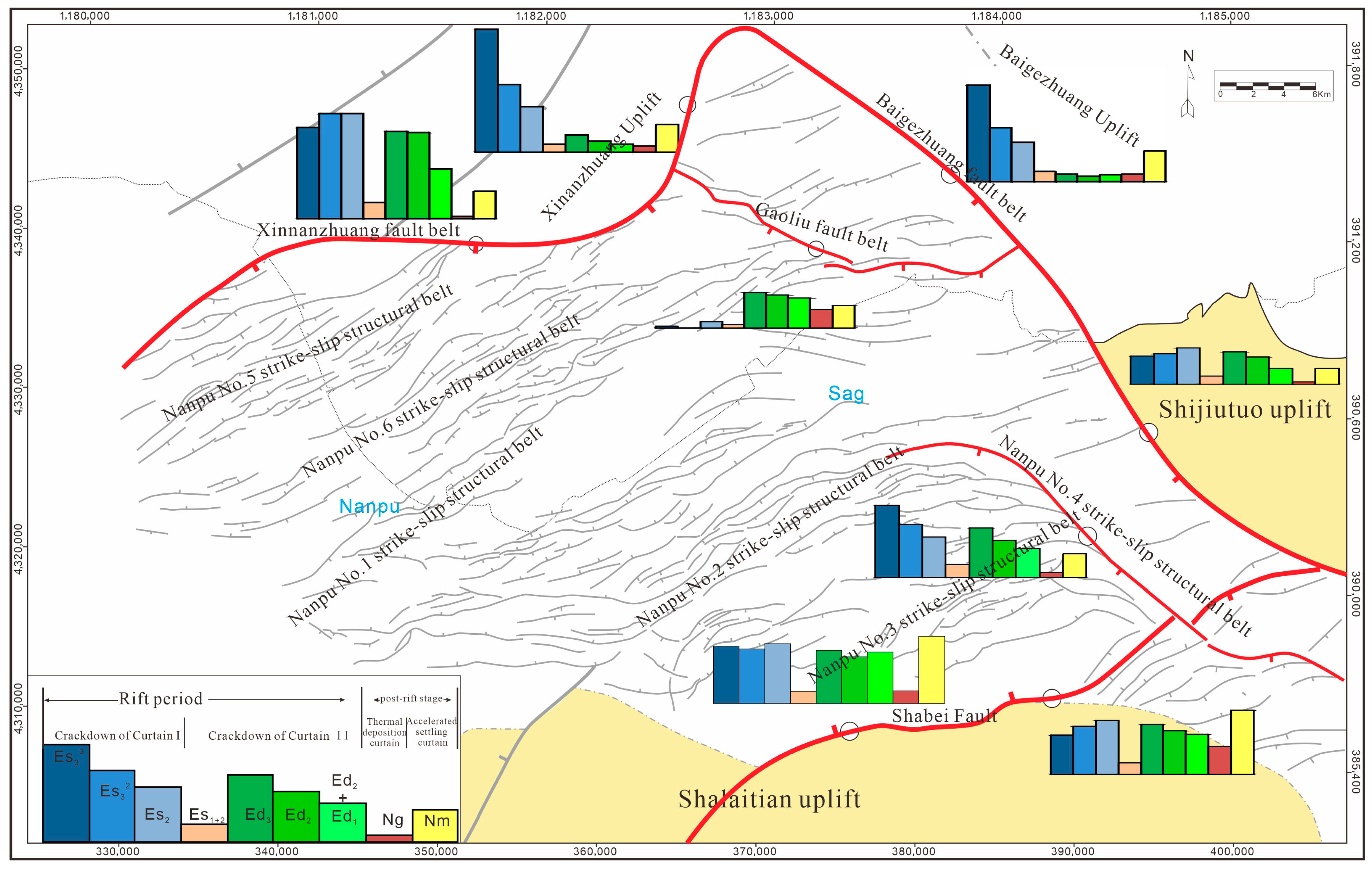
- Episodic activity of major boundary faults shows the southward migration of the subsidence center. The Xinan Zhuang, Baigezhuang, Gaoliu, and Shabei faults exhibit episodic behavior characterized by alternating periods of activity and quiescence. During the deposition of the Sha-3 Member (42–38 Ma), intense activity along the boundary faults resulted in the formation of a northern subsidence center. In the Dongying Formation period (32–23.3 Ma), fault activity migrated southward, focusing on the arcuate fault system comprising the Xinan Zhuang–Gaoliu–Baigezhuang belt and Shabei Fault, which led to the relocation of the subsidence center toward the central part of the sag. In the post-rift period (23.3 Ma to present), conjugate strike-slip faulting further accompanied the southward shift in the subsidence center into the Caofeidian sub-sag.
- (2)
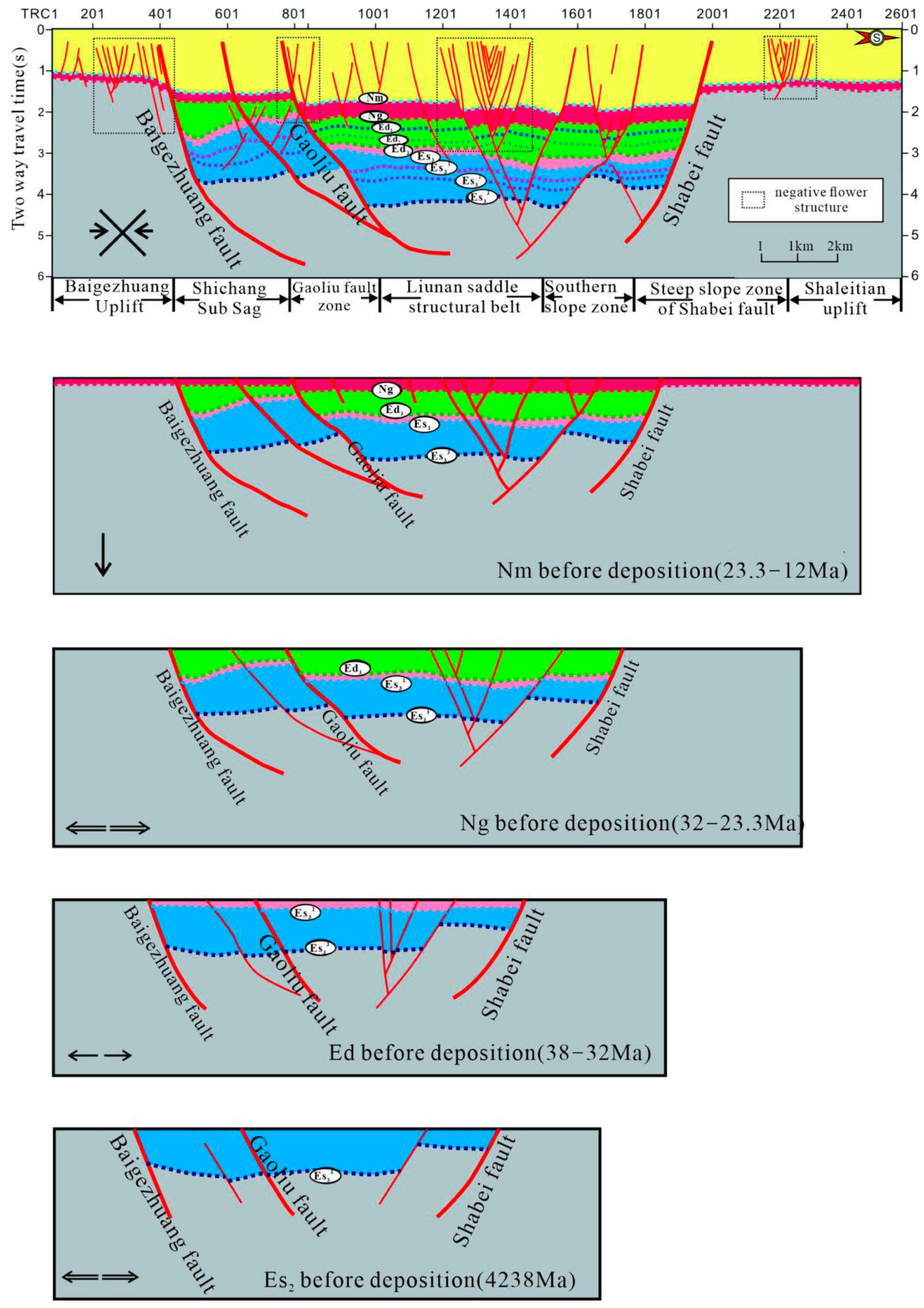
- Two episodes of rifting correspond to regional stress field rotation. The Cenozoic evolution of the Nanpu Sag can be divided into a syn-rift stage (42–23.3 Ma) and a post-rift stage (23.3 Ma to present). The syn-rift stage is further subdivided by the T50 surface at the base of the Sha-2 Member into two episodes: Rift Episode I (Sha-3 Member) was governed by NW–SE-oriented extensional stress, resulting in the development of NE-trending fault systems; Rift Episode II (Dongying Formation) was dominated by a clockwise-rotating stress field that became nearly SN-oriented, leading to the activation of the Gaoliu Fault and its linkage with the Xinan Zhuang–Baigezhuang faults to form an arcuate fault belt, which controlled the formation of an approximately EW-trending basin structure. This evolutionary process reflects the episodic accompanied exerted by the right-lateral pull-apart system of the Bohai Bay Basin.
- (3)
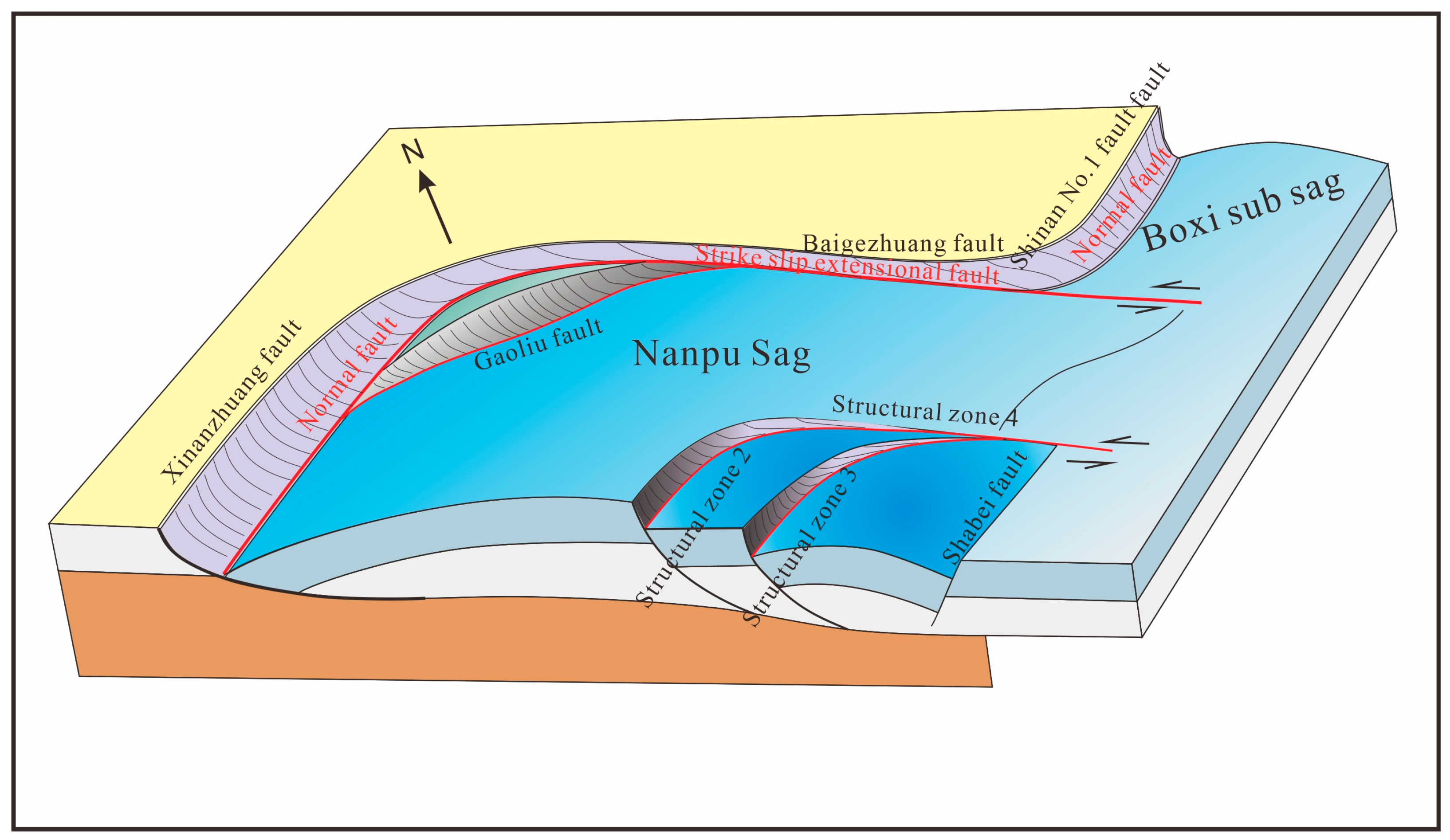
- Using fault kinematics, subsidence migration, and stress field control analysis, Nanpu Sag is characterized as a strike-slip extensional fault terminal basin. The left-lateral strike-slip movement of the Baigezhuang fault caused the basement block to shift southward (normal extension), leading to the formation of an extensional basin.
Author Contributions
Funding
Data Availability Statement
Conflicts of Interest
References
- Zhou, H.M.; Wei, Z.W.; Cao, Z.H.; Cong, L.Z. Relationship between formation, evolution and hydrocarbon in Nanpu Sag. Oil Gas Geol. 2000, 21, 345–349. [Google Scholar]
- Tong, H.M.; Zhao, B.Y.; Cao, Z.; Liu, G.X.; Dun, X.M.; Zhao, D. Structural analysis of faulting system origin in the Nanpu Sag, Bohai Bay Basin. Acta Geol. Sin. 2013, 87, 1647–1661. [Google Scholar]
- Liu, L.; Sun, Y.H.; Chen, C.; Lou, R.; Wang, Q. Fault reactivation in No.4 structural zone and its control on oil and gas accumulation in Nanpu Sag, Bohai Bay Basin, China. Pet. Explor. Dev. 2022, 49, 716–727. [Google Scholar] [CrossRef]
- Qi, J.F.; Deng, R.J.; Zhou, X.H.; Zhang, K.X. Structure of the Tan Lu Fault Zone in the Cenozoic Basin of the Bohai Sea. Sci. China (Terrae) 2008, 38 (Suppl. S1), 22–32. [Google Scholar]
- Liu, X.F.; Dong, Y.X.; Wang, H. Antiformal negative flower structure in Nanpu Sag, Bohai Bay Basin. Earth Sci. 2010, 35, 1029–1034. [Google Scholar]
- Wang, Y.H.; Yu, F.S.; Song, L.; Wang, D.D.; Zhao, B.Y.; Qi, Y.L.; Meng, L.J. Genesis analysis of the Nanpu Sag, Bohai Bay Basin: Insights from seismic data interpretation and 3D sandbox analogue modelling. Acta Geol. Sin. 2025, 99, 2597–2620. [Google Scholar]
- Zhao, B.Y.; Yang, X.L.; Xu, Y.X.; Meng, L.J.; Cui, Z.X.; Wang, F.L.; Liu, J.L.; Yu, F.S. Characteristics and reservoir control of Cenozoic tectonic evolution of Nanpu Sag, Bohai Bay Basin. Lithol. Reserv. 2025, 37, 59–69. [Google Scholar]
- Qi, J.F.; Zhang, Y.W.; Lu, K.Z.; Yang, Q.; Chen, F.J. Extensional pattern and dynamic process of the Cenozoic rifting basin in the Bohai Bay. Pet. Geol. Exp. 1995, 17, 316–323. [Google Scholar]
- Allen, M.B.; MacDonald, D.I.M.; Zhao, X.; Vincent, S.J.; Brouet-Menzies, C. Early Cenozoic two-phase extension and late Cenozoic thermal subsidence and inversion of the Bohai Basin, northern China. Mar. Pet. Geol. 1997, 14, 951–972. [Google Scholar] [CrossRef]
- Yu, F.S.; Koyi, H. Cenozoic tectonic model of the Bohai Bay Basin in China. Geol. Mag. 2016, 153, 866–886. [Google Scholar] [CrossRef]
- Pang, X.J.; Li, J.P.; Wang, G.M.; Wang, Y.; Zhou, X.F. Characteristics and controlling effect of fault activity of Paleogene in Shinan area of Bozhong Depression on sedimentary facies. J. Xi’an Shiyou Univ. (Nat. Sci. Ed.) 2012, 27, 11–16. [Google Scholar]
- Morley, C.K.; Haranya, C.; Phoosongsee, W.; Pongwapee, S.; Kornsawan, A.; Wonganan, N. Activation of rift oblique and rift parallel pre-existing fabrics during extension and their effect on deformation style: Examples from the rifts of Thailand. J. Struct. Geol. 2004, 26, 1803–1829. [Google Scholar] [CrossRef]
- Zhao, J.; Tang, X.J.; Jiang, Y.M.; Zou, W.; Liu, Y.R. Confirmation and genesis of the Middle Eocene tectonic transformation in northwestern margin of Xihu Depression, East China Sea Basin. Bull. Geol. Sci. Technol. 2020, 39, 58–67. [Google Scholar]
- Xu, A.N.; Zheng, H.J.; Dong, Y.X.; Wang, Z.C.; Yin, J.F.; Yan, W.P. Sequence stratigraphic framework and sedimentary facies prediction in Dongying Formation of Nanpu Sag. Pet. Explor. Dev. 2006, 33, 437–443. [Google Scholar]
- Dong, Y.X.; Wang, Z.C.; Zheng, H.J.; Xu, A.N. Control of strike-slip faulting on reservoir formation of oil and gas in Nanpu Sag. Pet. Explor. Dev. 2008, 35, 424–430. [Google Scholar] [CrossRef]
- Zhou, T.W.; Zhou, J.X.; Dong, Y.X.; Wang, X.D.; Chang, H.W. Formation mechanism of Cenozoic fault system of Nanpu Sag in Bohai Bay Basin. J. China Univ. Pet. (Nat. Sci. Ed.) 2009, 33, 12–17. [Google Scholar]
- Liang, J.; Yu, F.S.; Liu, G.X.; Wang, T.K.; Li, D.H.; Ma, K. Deformation superimposition characteristics resulting from stretching direction changes in Nanpu Sag: Insight from physical modeling. Geoscience 2014, 28, 139–148. [Google Scholar]
- Zhang, C.M.; Liu, X.F. The boundary faults and basin-formation mechanism of Nanpu Sag. Acta Petrol. Sin. 2012, 33, 581–587. [Google Scholar]
- Wang, H.; Jiang, H.; Lin, Z.L.; Zhao, S.E. Relations between synsedimentary tectonic activity and sedimentary framework of Dongying Formation in Nanpu Sag. J. Earth Sci. Environ. 2011, 33, 70–77. [Google Scholar]
- Du, Q.X.; Guo, S.B.; Shen, X.L.; Cao, Z.; Zhang, X.; Li, Y. Paleo-water characteristics of the Member 1 of Paleogene Shahejie Formation in southern Nanpu Sag, Bohai Bay Basin. J. Palaeogeogr. (Chin. Ed.) 2016, 18, 173–183. [Google Scholar]
- Gai, C.C.; Zhao, Z.X.; Ren, L.; Yan, Y.; Hou, B. Research and application of well location deployment parameters for cluster development of medium-deep hydrothermal geothermal resources: A case study of HTC geothermal field. Pet. Reserv. Eval. Dev. 2024, 14, 638–646. [Google Scholar]
- Tang, H.Y.; Xian, B.Z.; Li, C.; Wang, P.Y.; Chen, L.; Chen, S.R.; Yang, R.C.; Tian, R.H. Quality difference and genesis of clastic reservoirs in the Nanpu Sag: A case study of the Paleogene in the No.4 structural belt. Acta Sedimentol. Sin. 2025, 43, 288–300. [Google Scholar]
- Jiang, H.; Wang, H.; Lin, Z.L.; Fang, X.X.; Zhao, S.E.; Ren, G.Y. Periodic rifting activity and its controlling on sedimentary filling of Paleogene period in Nanpu Sag. Acta Sedimentol. Sin. 2009, 27, 976–982. [Google Scholar]
- Liu, J.Y.; Lü, J.; Wang, L. An approach to the quantitative fault description. Comput. Tech. Geophys. Geochem. Explor. 2002, 24, 328–331. [Google Scholar]
- Ren, J.Y. Genetic dynamics of China offshore Cenozoic basins. Earth Sci. 2018, 43, 3337–3361. [Google Scholar]
- Wang, Y.L.; Chen, S.G. Tectonic-sedimentary analysis of Shabei area in Bozhong depression. Pet. Geol. Recovery Effic. 2015, 22, 26–32. [Google Scholar]
- Umhoefer, P.J.; Schwennicke, T.; Del Margo, M.T.; Ruiz-Geraldo, G.; Ingle, J.C., Jr.; McIntosh, W. Transtensional fault-termination basins: An important basin type illustrated by the Pliocene San Jose Island basin and related basins in the southern Gulf of California, Mexico. Basin Res. 2007, 19, 297–322. [Google Scholar] [CrossRef]
- Busby, C.; Ingersoll, R.V. Tectonics of Sedimentary Basins; Wiley: Hoboken, NJ, USA, 2011. [Google Scholar]
- Cemen, I.; Yeats, R.S. San Cayetano fault: Near surface expression of a midcrustal thrust in the California Transverse Ranges. Geol. Soc. Am. Abstr. Programs 1985, 17. [Google Scholar]
- Cemen, I.; Wright, L.A.; Drake, R.E.; Johnson, F.C. Cenozoic Sedimentation and Sequence of Deformational Events at Southeastern End of the Furnace Creek Strike-Slip Fault Zone, Death Valley Region, California; Society of Economic Paleontologists and Mineralogists: Tulsa, OK, USA, 1985. [Google Scholar]
- Dooley, T.P.; Schreurs, G. Analogue modelling of intraplate strike-slip tectonics: A review and new experimental results. Tectonophysics 2012, 574–575, 1–71. [Google Scholar] [CrossRef]
- Mann, P. Model for the formation of large, transtensional basins in zones of tectonic escape. Geology 1997, 25, 211–214. [Google Scholar] [CrossRef]
- Koukouvelas, I.K.; Aydin, A. Fault structure and related basins of the North Aegean Sea and its surroundings. Tectonics 2002, 21, 10–11. [Google Scholar] [CrossRef]
- Hou, G.T. The origin of the Bohai Bay Basin. Acta Sci. Nat. Univ. Pekin. 1998, 34, 503–509. [Google Scholar]
- Qi, J.F.; Zhou, X.H.; Wang, Q.S. Structural model and Cenozoic kinematics of Tan-Lu deep fracture zone in Bohai Sea area. Geol. China 2010, 37, 1231–1242. [Google Scholar]
- Qi, J.F.; Yang, Q. Dynamic analysis of continental rifting basin. Earth Sci. Front. 2012, 19, 19–26. [Google Scholar]





| Model | Single Stretch Model | Single Strike-Slip Model | Multi Stage Deformation Superposition Model | Lateral Strike-Slip and Normal Tension Model |
|---|---|---|---|---|
| Direction of stress field | Jurassic Cretaceous NE extension, Eocene NW extension | NW sinistral extensional torsion in Paleogene and NE dextral compressional torsion in Neogene | Eocene NW stretching, Neogene Sn stretching | NW stretching in Eocene (at this time, the Baigezhuang fault and the main fault of No. 4 structure are tensioned and twisted to the left), and Sn stretching in Oligocene (the Baigezhuang fault and the main fault of No. 4 structure continue to be tensioned and twisted to the left) |
| Migration of settlement center | Jurassic Cretaceous migrated NE along the main fault, and Eocene migrated NW along the main fault | It migrated NW along the Baigezhuang fault in Paleogene and NE along the Xinanzhuang fault in Neogene | The main fault migrated NW in Eocene and SN in Neogene | The main fault migrated NW in Eocene and SN in Oligocene |
| Strike-slip displacement | Very small | more | less | more |
| Can it be more comprehensively adapted to the tectonic conditions of the basin | It can adapt well to the normal faults in NW and NE directions of the basin, but can not reasonably explain the EW trending faults and the large-scale strike-slip faults in the basin | It can adapt well to the widely developed strike-slip faults in different periods in the basin, but it does not match the problems of large fault displacement, small fault dip angle and asymmetric basin of the main faults controlling the basin | It can better adapt to the normal faults in NE and EW directions of the basin, but does not explain the existence of the NW high-angle Baigezhuang fault | It is proposed that the pre-existing faults in the basin are broom like faults at the end of large-scale tension torsion faults, and then NW trending normal faults and NW trending tension torsion faults are formed by NW trending normal extension and lateral strike slip, and then Sn trending extension, resulting in inherited strike slip and extension activities of the existing NE trending normal faults and NW trending tension torsion faults, and forming EW trending normal faults, which can adapt to the strike-slip faults and normal faults in all directions formed in the basin |
Disclaimer/Publisher’s Note: The statements, opinions and data contained in all publications are solely those of the individual author(s) and contributor(s) and not of MDPI and/or the editor(s). MDPI and/or the editor(s) disclaim responsibility for any injury to people or property resulting from any ideas, methods, instructions or products referred to in the content. |
© 2025 by the authors. Licensee MDPI, Basel, Switzerland. This article is an open access article distributed under the terms and conditions of the Creative Commons Attribution (CC BY) license (https://creativecommons.org/licenses/by/4.0/).
Share and Cite
Xiong, L.; Yu, H.; Xu, J.; Zhu, R.; Lei, Z.; Du, W. Analysis of Cenozoic Structural Evolution and Basin Formation Models in the Nanpu Sag, Bohai Bay Basin, China. Geosciences 2025, 15, 466. https://doi.org/10.3390/geosciences15120466
Xiong L, Yu H, Xu J, Zhu R, Lei Z, Du W. Analysis of Cenozoic Structural Evolution and Basin Formation Models in the Nanpu Sag, Bohai Bay Basin, China. Geosciences. 2025; 15(12):466. https://doi.org/10.3390/geosciences15120466
Chicago/Turabian StyleXiong, Liangli, Han Yu, Junjie Xu, Rongwei Zhu, Zhangshu Lei, and Wenbo Du. 2025. "Analysis of Cenozoic Structural Evolution and Basin Formation Models in the Nanpu Sag, Bohai Bay Basin, China" Geosciences 15, no. 12: 466. https://doi.org/10.3390/geosciences15120466
APA StyleXiong, L., Yu, H., Xu, J., Zhu, R., Lei, Z., & Du, W. (2025). Analysis of Cenozoic Structural Evolution and Basin Formation Models in the Nanpu Sag, Bohai Bay Basin, China. Geosciences, 15(12), 466. https://doi.org/10.3390/geosciences15120466