Article

Rapid Evaluation of Coastal Sinking and Management Issues in Sayung, Central Java, Indonesia

by
Dewayany Sutrisno
1,
Ratih Dewanti Dimyati
2,
Rizatus Shofiyati
2,
Yosef Prihanto
3,*,
Janthy Trilusianthy Hidayat
4,
Mulyanto Darmawan
2,
Syamsul Bahri Agus
5,
Muhammad Helmi
6,
Heri Sadmono
2 and
Nanin Anggraini
7
1
Research Center for Conservation of Marine and Inland Water Resources, Research Organization for Earth and Maritime (ORKM), National Research and Innovation Agency (BRIN), Cibinong 16911, Indonesia
2
Research Center for Geoinformatics (PRGI), Research Organization for Electronics and Informatics (OREI), National Research and Innovation Agency (BRIN), Bandung 40135, Indonesia
3
Research Center for Climate and Atmospheric Research (PRIA), Research Organization for Earth and Maritime (ORKM), National Research and Innovation Agency (BRIN), Bandung 40135, Indonesia
4
Study Program Urban and Regional Planning, Pakuan University, Bogor 16129, Indonesia
5
Division of Marine Remote Sensing and GIS, Department of Marine Science and Technology, Faculty of Fisheries and Marine Science (FPIK), Bogor Agricultural Institute (IPB), Bogor 16680, Indonesia
6
Faculty of Fisheries and Marine Sciences, Universitas Diponegoro, Semarang 50275, Indonesia
7
Research Center for Ecology, Research Organization for Life Sciences and Environment (ORHL), National Research and Innovation Agency (BRIN), Cibinong 16911, Indonesia
*
Author to whom correspondence should be addressed.
Geosciences 2025, 15(12), 455; https://doi.org/10.3390/geosciences15120455 (registering DOI)
Submission received: 9 October 2025 / Revised: 26 November 2025 / Accepted: 27 November 2025 / Published: 1 December 2025

Abstract

Coastal flooding driven by sea-level rise and land subsidence poses severe risks to low-lying communities. This study evaluates the causes and impacts of coastal sinking in Sayung, Demak, Central Java, using multi-temporal Landsat imagery (1977, 2024), tidal gauge data, and GPS measurements. A set of spectral indices—Normalized Difference Vegetation Index (NDVI), Weighted Modified Normalized Difference Water Index (WMNDWI), Land Surface Water Index (LSWI), and Normalized Difference Built-up Index (NDBI)—were calculated and integrated as input features for a Random Forest machine learning model to detect and classify environmental changes. Results indicated an average land subsidence rate of approximately 6 cm/year ± 0.8 cm/year, validated against InSAR-based measurements, and a classification accuracy of 91% (RMSE of 0.8 cm/year). A substantial decline in vegetation indices was observed, reflecting the conversion of agricultural land into built-up areas and water bodies. Extensive flooding and shoreline retreat were documented, with high-risk zones concentrated along densely developed coastlines. These findings highlight the urgent need for integrated management strategies, including stricter groundwater regulation, continuous remote-sensing-based monitoring, and large-scale mangrove restoration, to safeguard ecological functions and enhance the socio-economic resilience of coastal communities in the face of accelerating climate change impacts.

1. Introduction

Spatial planning is a key instrument in decision-making to accommodate human activities and their impacts on land systems, especially in coastal ecosystems. Effective spatial planning ensures that communities benefit from essential ecosystem services and helps mitigate the adverse impacts of environmental changes [1]. Land-use patterns in coastal areas are highly dynamic, often experiencing significant shoreline alterations due to accretion and erosion processes [2]. The interplay between physical, social, economic, and ecological factors in coastal regions results in complex and iterative challenges, necessitating innovative, participatory, and timely management approaches [3].
Coastal subsidence and associated flooding have emerged as urgent global issues, intensifying the risks faced by low-lying communities [4,5]. Across the globe, deltaic and coastal cities including Jakarta, Venice, Bangkok, and New Orleans are increasingly threatened by land sinking. Anthropogenic drivers, especially groundwater overextraction, have been identified as the leading cause of land subsidence in approximately 28% of major cities worldwide, surpassing impacts from construction loading or oil/gas extraction [5,6]. Other significant factors include land cover change, urban expansion, and the conversion of wetlands or mangroves to settlements and industrial estates, often exacerbated by sea-level rise and extreme weather events [7,8]. Disentangling these drivers is challenging due to their spatial variability and mutual interactions, leaving gaps in our understanding of their cumulative effects.
Recent studies have shown that even modest subsidence rates can dramatically increase flood exposure. For example, parts of O’ahu, Hawaii, with land subsidence exceeding 25.0 ± 1.0 mm/yr—outpacing long-term sea-level rise—could see flood exposure increase by 53% by 2050 [4]. In densely populated deltas, land subsidence already contributes to routine tidal flooding. The northern coast of Central Java, Indonesia, is a compelling example, exhibiting both significant subsidence and shoreline retreat [9]. Jakarta is sinking by up to 28 cm/year, while Semarang, Demak, and Pekalongan record rates of 5–15 cm/year [6,10,11]. Specifically, DInSAR-based observations in Sayung Sub-district indicate an average rate of 4.6 cm/year [12]. These environmental phenomena are closely linked to socio-economic decline and reduced quality of life in coastal communities [13,14,15]. Without intervention, many coastal cities in Southeast Asia are projected to fall below sea level [16,17].
Various mitigation and adaptation strategies have been explored, including infrastructure investment (sea walls, drainage), policy innovation, and “building with nature” approaches [18,19,20]. However, the optimal combination of measures remains debated, with many studies focusing on single dominant factors—most often geodetic/GNSS methods for subsidence [6]. Integrated approaches that concurrently consider land-use change, groundwater extraction, geological variability, and multiple adaptation measures are still limited [21,22]. Comprehensive synthesis and quantitative validation of both soft and hybrid coastal defense measures remain rare in the literature.
Remote sensing has emerged as a vital tool for monitoring, understanding, and managing coastal sinking. Multi-temporal analysis of satellite imagery enables researchers to detect the drivers of subsidence, assess environmental change, and support mitigation and adaptation planning. Techniques such as SAR (e.g., Sentinel-1A), Lidar, and the integration of optical and radar datasets have proven effective for capturing both spatial and temporal variations in coastal environments [23,24]. Recently, machine learning approaches have been used to generate high-resolution global maps of pumping-induced subsidence [4]. While some studies have utilized index-based methods (e.g., NDVI and NDBI), most rely on non-open access data and require extensive processing [25,26]. There is thus a clear need for rapid, open access, and data-driven methodologies to efficiently assess the drivers of coastal sinking.
Accordingly, this study aims to achieve the following:
(1)
Develop and demonstrate a rapid, open access, remote-sensing-based method to identify the drivers of coastal sinking in Sayung Sub-district, Central Java;
(2)
Quantitatively validate these findings using ground-based measurements and uncertainty analysis;
(3)
Assess the extent to which evidence-based recommendations for coastal management can be derived from such analysis.
The novelty of this approach lies in the integration of multi-temporal satellite-derived indices (NDVI, WMNDWI, LSWI, NDBI) with machine learning classification and validation using field measurements, providing both unprecedented temporal depth and a reproducible workflow for this region. The findings are intended to improve understanding of coastal vulnerability and support the implementation of innovative management measures to reduce risk and enhance resilience.

2. Materials and Methods

2.1. Study Area

The Sayung Sub-district is situated along the northern coast of Central Java, Indonesia, directly bordering Semarang City and Demak City (Figure 1). The coastline is characterized by extensive ponds and muddy beaches in the northern section, while rice fields dominate the southern landscape. Notably, over 50% of the paddy fields in the southern portion have been converted into industrial and residential areas in recent decades [27].
Geologically, Sayung consists of recent alluvial deposits that are still undergoing natural compaction [28]. The region is subject to intense erosion and frequent flooding, leading to significant shoreline changes [29]. Recent studies attribute the persistent drowning of the area to a combination of land conversion, mangrove ecosystem disruption, and land subsidence [30,31]. Coastal flooding, especially tidal flooding (locally termed “rob”), occurs daily. Although various adaptation and mitigation strategies—including Associated Mangrove Aquaculture (AMA), settlement relocation, and mangrove restoration—have been implemented [9,32], chronic flooding and socio-economic vulnerability remain pressing issues [13,33,34,35]. The Sayung Sub-district thus provides a valuable case for evaluating rapid, integrated, remote-sensing-based approaches to inform adaptation and management strategies.
The novelty of our study is the use of integrated, multi-temporal, satellite-derived indices (NDVI, WMNDWI, LSWI, NDBI) in combination with machine learning to detect and attribute environmental changes over an unprecedented temporal scale for the region and to relate those changes to both physical processes (subsidence, flooding/tidal inundation) and human interventions.

2.2. Methods

2.2.1. Data

This study utilizes various datasets of the Sayung Sub-district area, including the following:
  • Level-2 Landsat 5 data acquired on 14 July 1997 and Level-2 Landsat 9 data acquired on 16 July 2024. All satellite data were obtained from the United States Geological Survey (USGS) through the Earth Explorer data platform (https://earthexplorer.usgs.gov accessed on 25 September 2024). Each selected image underwent a standard preprocessing workflow before the analysis, such as radiometric and atmospheric corrections. The projection of the data was WGS 84/UTM Zone 49 S. The year 1997 marked the onset of land conversion for aquaculture, driven by the demand of the global market.
  • Additional data include tidal gauge record data based on the K1 tidal projection model up to 2024 provided by the Geospatial Information Agency of Indonesia (Badan Informasi Geospasial—BIG) (https://srgi.big.go.id accessed on 10 October 2023). The K1 tidal constituents are closely related to the dynamics of shoreline changes. Diurnal variations are caused by the gravitational pull of the moon and the sun. Tidal data play a crucial role in projecting the extent of tidal flooding in coastal areas.
  • Furthermore, Global Positioning System (GPS) data from the Continuously Operating Reference Station (CORS) network, specifically covering the Sayung region and its vicinity, were obtained from BIG (2024), also from the same platform of tidal data (https://srgi.big.go.id accessed on 12 Agust 2024). GPS data play a crucial role by enabling precise monitoring of land subsidence; mapping shoreline changes caused by erosion, sedimentation, or inundation; and supporting accurate modeling of tidal height when integrated with gauge data.

2.2.2. Data Processing

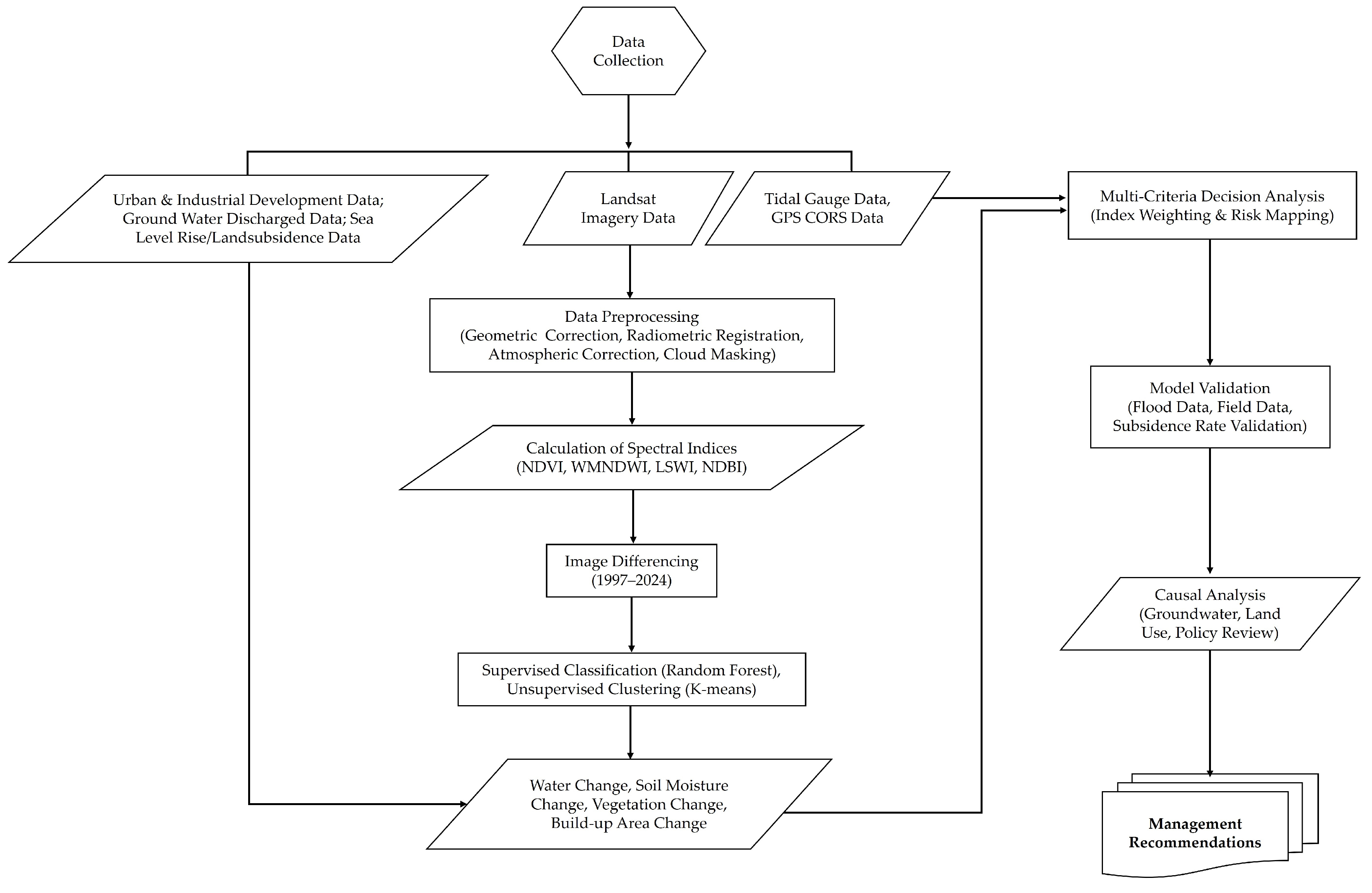
The coastal sinking review approach is based on coastal change detection and image differencing to identify the triggers of the sinking coast, where land-use change becomes the main issue of concern. The sources of change detection are the index-based methods on water bodies, vegetation, soil moisture, and built-up areas. According to recent studies [23,36,37], this approach is among the most accurate and widely adopted for detecting land surface changes using remote sensing data. Land-use change can be approached through four main objects: water, vegetation, buildings, and open space. The steps involved in this analysis are illustrated in Figure 2.
Multi-temporal Landsat images (1997, 2024) from USGS, combined with tidal gauge and GPS data from the BIG, were used to analyze shoreline change, subsidence, and tidal flooding in Sayung Sub-district. All images were preprocessed through radiometric and atmospheric corrections. Change detection employed four spectral indices (WMNDWI, LSWI, NDVI, NDBI), with image differencing between 1997 and 2024 to quantify transitions in water, vegetation, soil moisture, and built-up areas. Land cover changes were classified using supervised machine learning supported by training samples from high-resolution imagery and further refined with unsupervised K-means clustering. A multi-criteria decision analysis weighted the indices, emphasizing WMNDWI for shoreline dynamics. Model performance was validated with flood records, disaster reports, and field observations. The integrated framework linked land-use transitions, groundwater extraction, and subsidence with coastal flooding while also providing a basis to evaluate adaptation and mitigation strategies.
Below is a description of each step in the process.
A.
Coastal change analysis
One approach for assessing changes in coastal sinking or coastal recession is the water change detection method [38]. Multi-temporal remote sensing data from Landsat 5 TM (1997) and Landsat 9 OLI (2024) are utilized to quantify spatial temporal changes in landcover characteristics. All images are atmospherically corrected using surface reflectance products and cloud masking using quality assurance (QA) bands. Four spectral indices are computed in combination with machine learning and the MCA method. Spectral indices provide an efficient and effective approach for monitoring coastal sinking using remote sensing data. By combining various indices such as NDVI, WMNDWI, LSWI, and NDBI, the analysis of changes in the coastal environment can be conducted with greater accuracy. The methods are as follows:
Index Spectral Calculation of Imageries from 1997 and 2024
At this stage, the MNDWI, LSWI, NDVI, and NDBI values are computed for each year. Each index is derived from specific band combinations that emphasize distinct surface characteristics, thereby facilitating the detection of changes in vegetation cover, surface water, and built-up areas. The formulas for each index, along with the corresponding band references for Landsat 5 TM and Landsat 9, are presented as follows:
  • The WMNDWI is selected as it is considered the most effective method for monitoring shoreline changes and land subsidence due to its enhanced accuracy in distinguishing water from non-water features. By incorporating the SWIR band, MNDWI provides higher sensitivity to water bodies compared to the NIR used in the standard NDWI, making it particularly suitable for complex coastal and urban environments. SWIR effectively reduces reflectance from built-up areas and vegetation, minimizing misclassification and ensuring clearer detection of inundated areas. Additionally, MNDWI excels in identifying small-scale changes in water extent and shoreline dynamics, enabling detailed monitoring of erosion, accretion, and gradual submersion due to sea-level rise or land subsidence. However, in this case, we use the WMNDWI to access more accurate information about the water changes.
  • LSWI helps to detect persistent surface moisture, waterlogged soil conditions, and hydrological stress associated with land subsidence in low-lying regions. The calculation uses NIR and SWIR bands.
  • NDVI helps to monitor changes in vegetation cover, which could indicate shifts in the environment due to coastal environmental change or flooding. The calculation is made using Visible red and NIR bands.
The formula below clarifies the preceding stages for MNDWI [39], and is then modified to WMNDWI, NDVI [40], and LSWI [41].
N D V I = B r e d B N I R B r e d + B N I R
M N D W I = 0.3   B G r e e n 0.7   B S W I R 0.3   B G r e e n + 0.7   B S W I R
L S W I = B N I R B S W I R B N I R + B S W I R
The development of residential and industrial areas on land with young alluvial rock formations poses a potential risk of land subsidence [42]. Additionally, the expansion of industries and residential zones increases water demand, leading to excessive groundwater extraction, which is widely recognized as a key factor contributing to coastal subsidence or the sinking coast [21]. Changes in residential and industrial zones can be effectively analyzed using the NDBI formula [38] and the image differencing method. The formula is as follows:
N D B I =   B S W I R B N I R B S W I R +   B N I R
NDBI is based on the short-wave infrared and near-infrared bands. Next, the image differencing approach is used to identify any changes by employing the same formula as in (4).
  • Land surface change analysis using index differencing method
For each index, a change detection or image differencing ( I d i ) value was calculated by subtracting the 1997 value from the 2024 value, and can be described by the following formula:
I d i =   I 1 x , y   I 2 x , y
where Idi is the image differencing between each pixel of image-1 or year-1 and image-2 or year-2 differencing for i = WMNDWI, LSWI, NDVI, and NDBI.
Positive and negative values of image differencing indicate the direction and magnitude of land surface change, either for water bodies, waterlogged soil conditions, vegetation, or built-up areas.
B.
Training data and ground truth
Training polygons representing three distinct land transition classes, inundated areas, new built-up zones and stable zones, and transition, were digitized through visual interpretation of recent high-resolution images derived from Google Earth images. Each training sample was attributed with a class label and used as reference input for the machine learning model.
C.
Machine learning classification analysis
To complement the machine learning classification analysis, a composite ( I d i ) was created. In this case, two methods were used to categorize the sinking phenomenon:
(1)
Using an MCDA framework, the indices were combined with specific weights, depending on the significance of each index in the analysis. Since the sinking cities phenomenon heavily considers changes in water bodies, WMNDWI was assigned greater importance compared to NDBI and NDVI, as represented in the formula below:
I n t e g r a t e d C C = w 1 · I M d e f N D V I + w 2 · I M d e f L S W I + w 3 · I M d e f M N D W I + w 4 ·   I M d e f N D B I
where w 1 ,   w 2 ,   w 3 ,   a n d   w 4 represent the weights assigned to each index, depending on the significance of each analysis.
The Integratedcc was first normalized to a common scale between 0 and 1 to ensure comparability across variables. Each weighted criterion was then assigned to reflect the relative influence of each index on sinking risk, based on prior empirical findings and expert judgment. In this case, positive (>1) reflects anthropogenic and hydrological pressure, negative (<0) accounts for non-sinking landscapes, and in between reflects the area of transition or possible sinking.
(2)
Unsupervised machine learning approach: The core of the classification process involved implementing a supervised machine learning model to distinguish between land change dynamics associated with coastal sinking. However, this method applied an unsupervised approach to explore patterns of spectral change in the absence of labeled training data in order to obtain faster results and in the absence of training data. The unsupervised method was applied to the multi-band composite raster constructed from four spectral indices using K-means clustering due to its computational efficiency. The number of clusters (k) was observed at k = 4, then each resulting cluster was spatially interpreted and assigned a semantic meaning based on its spectral signature, such as the following:
  • Increase in WMNDWI and LSWI: change to water;
  • Increase in NDBI and decline in NDVI: change to built-up area;
  • Increase in LSWI and decline in NDVI: potential change to water;
  • Increase in NDVI and decline in WMNDWI and LSWI: possible change to vegetation or stable land.
D.
Evaluation metric
To evaluate the sinking coast model, an empirical approach was employed by integrating delta spectral indices of the sinking coast into historical flood incident records, village-level disaster reports, secondary data from coastal management authorities, and field observations. A binary True–False method was employed, where logical conditions were represented numerically, with True assigned a value of 1 and False assigned a value of 0. The True logic representation allowed the model to capture conditions that satisfied predetermined thresholds or criteria.
E.
The analysis of the root causes of sinking coasts
The underlying causes of sinking cities can be examined through the methods outlined above, all of which focus on land-use changes and their contributing factors. As illustrated in the methods above, sinking coasts are not solely driven by natural hydrological processes but are compounded by anthropogenic land-use transitions and surface moisture dynamics. The ancillary data are also used to support the root causes of the sinking coast. Therefore, the integrated geospatial framework is used for this assessment by leveraging multi-temporal satellite imageries to detect patterns and identify areas at risk. The analysis is further reinforced by integrating datasets on sea level, land subsidence, and groundwater extraction, providing a more robust understanding of the factors driving the sinking cities phenomenon. By adopting this integrated approach, researchers gain a comprehensive understanding of the interactions between human activities, environmental processes, and land dynamics, enabling the formulation of effective strategies to address coastal flooding, ecosystem degradation, and urban vulnerabilities.
F.
Review of adaptation and mitigation
This stage evaluates the extent to which communities and local governments implement adaptation and mitigation strategies, comparing these actions to measures derived from the analysis of remote sensing data and the evaluation of the root causes of sinking cities, including land-use changes, sea-level rise, land subsidence, and groundwater extractions. The method employs a descriptive, deduction-based analysis, focusing on evaluating the effectiveness and feasibility of current strategies, such as land-use zoning, water management practices, infrastructure adaptation, and policy enforcement. By aligning these efforts with spatial and temporal data trends, this approach aims to generate actionable insights for strengthening urban resilience and minimizing vulnerabilities to subsidence and flooding risks.

3. Results

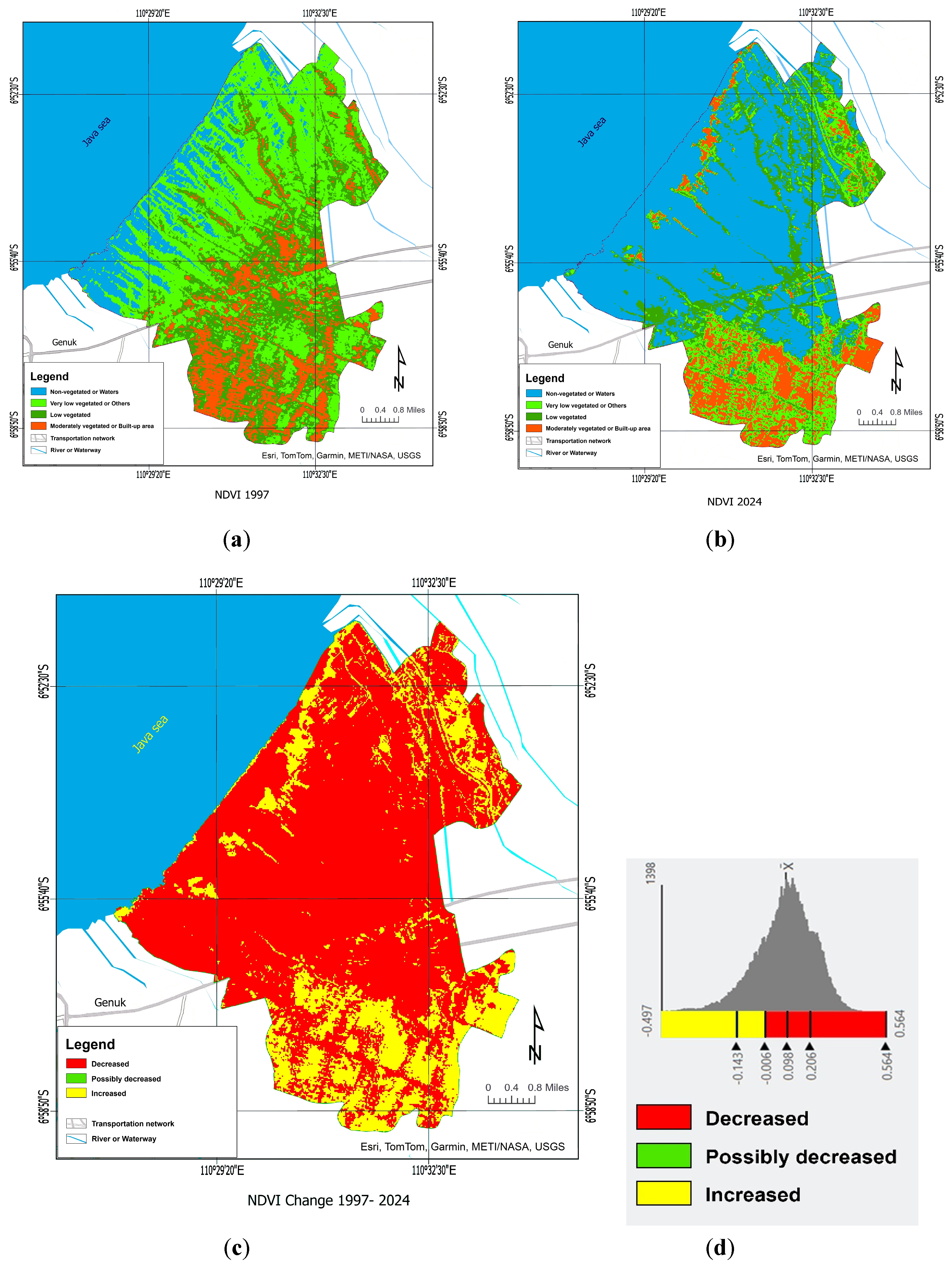
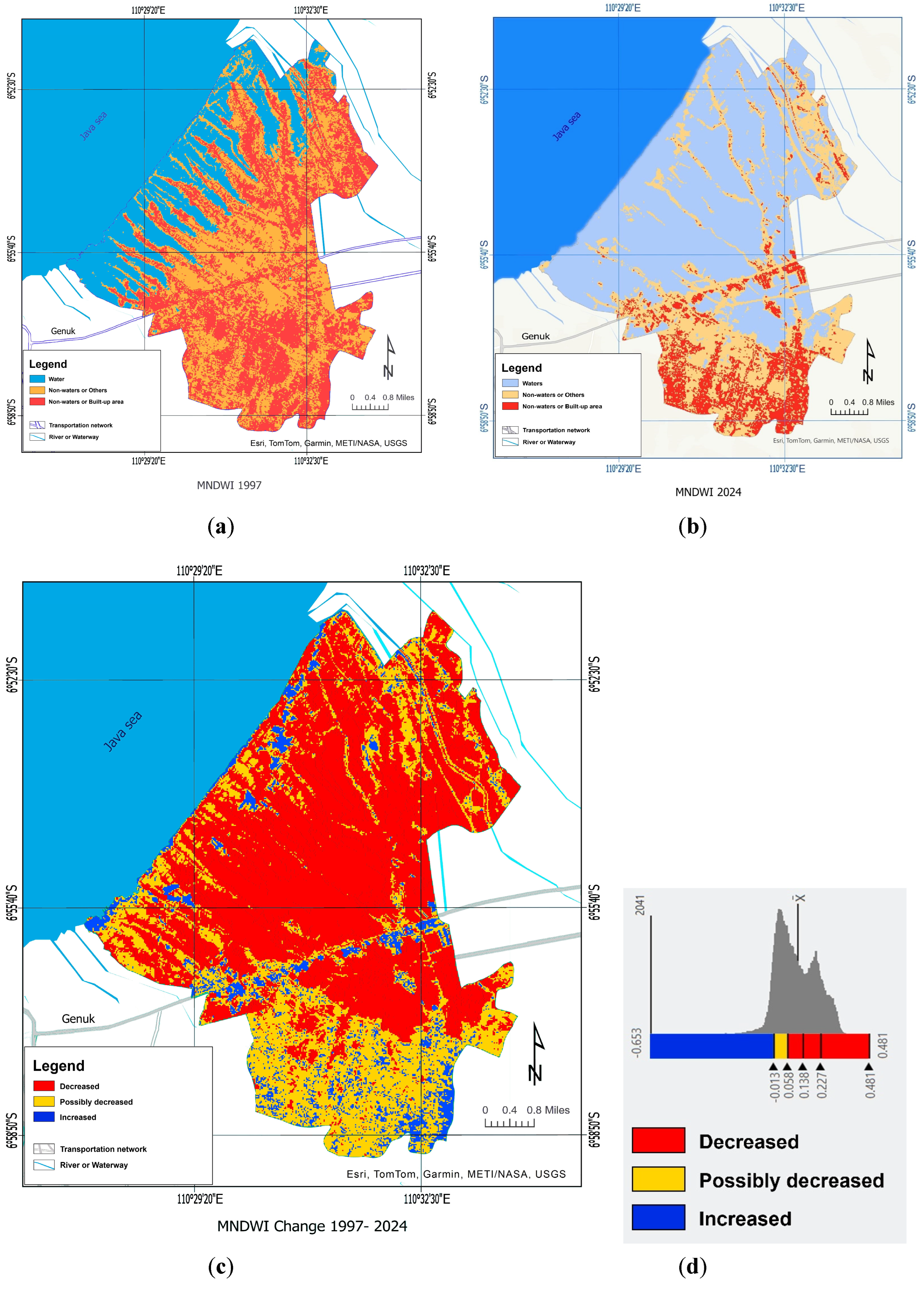
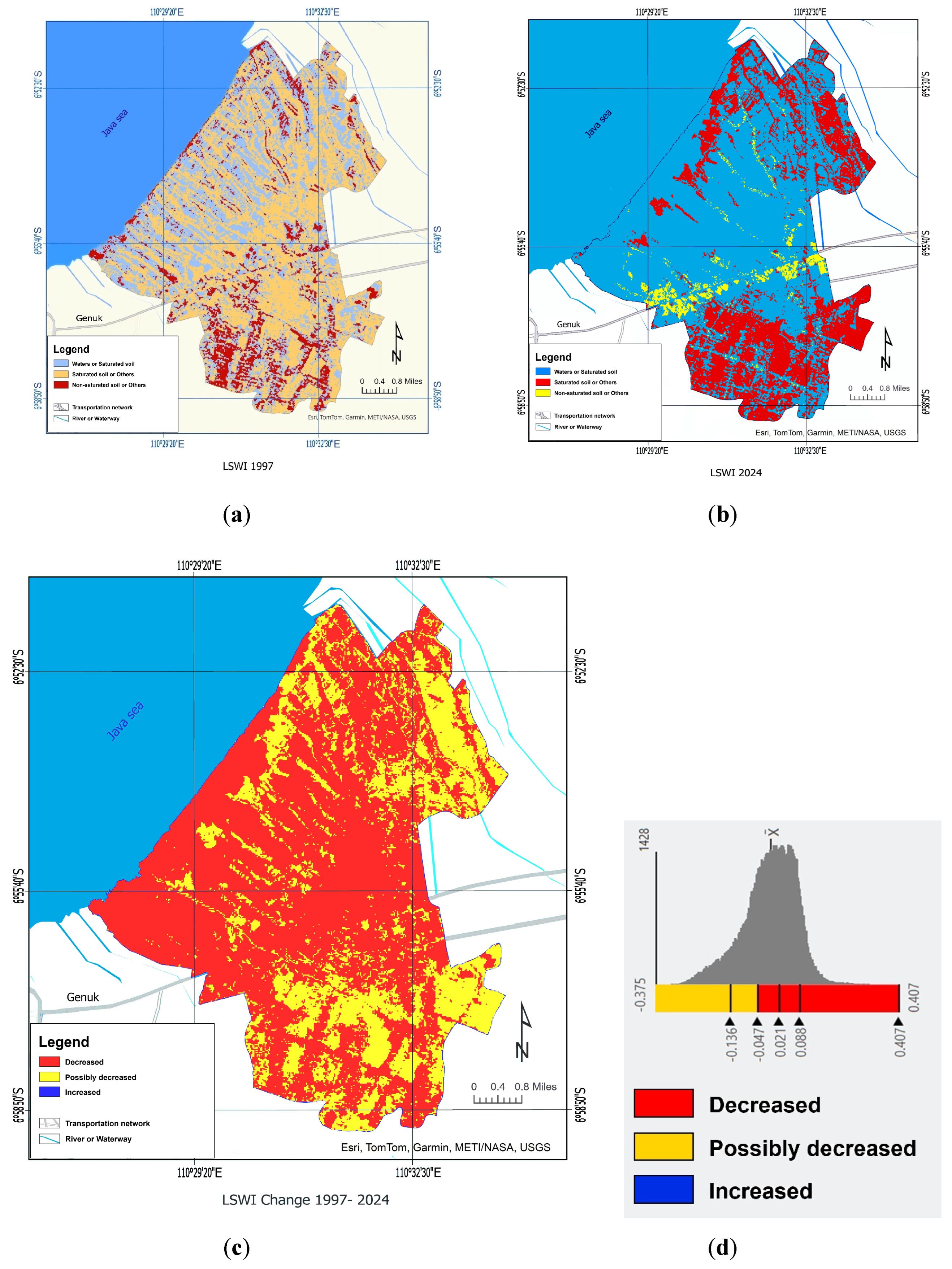
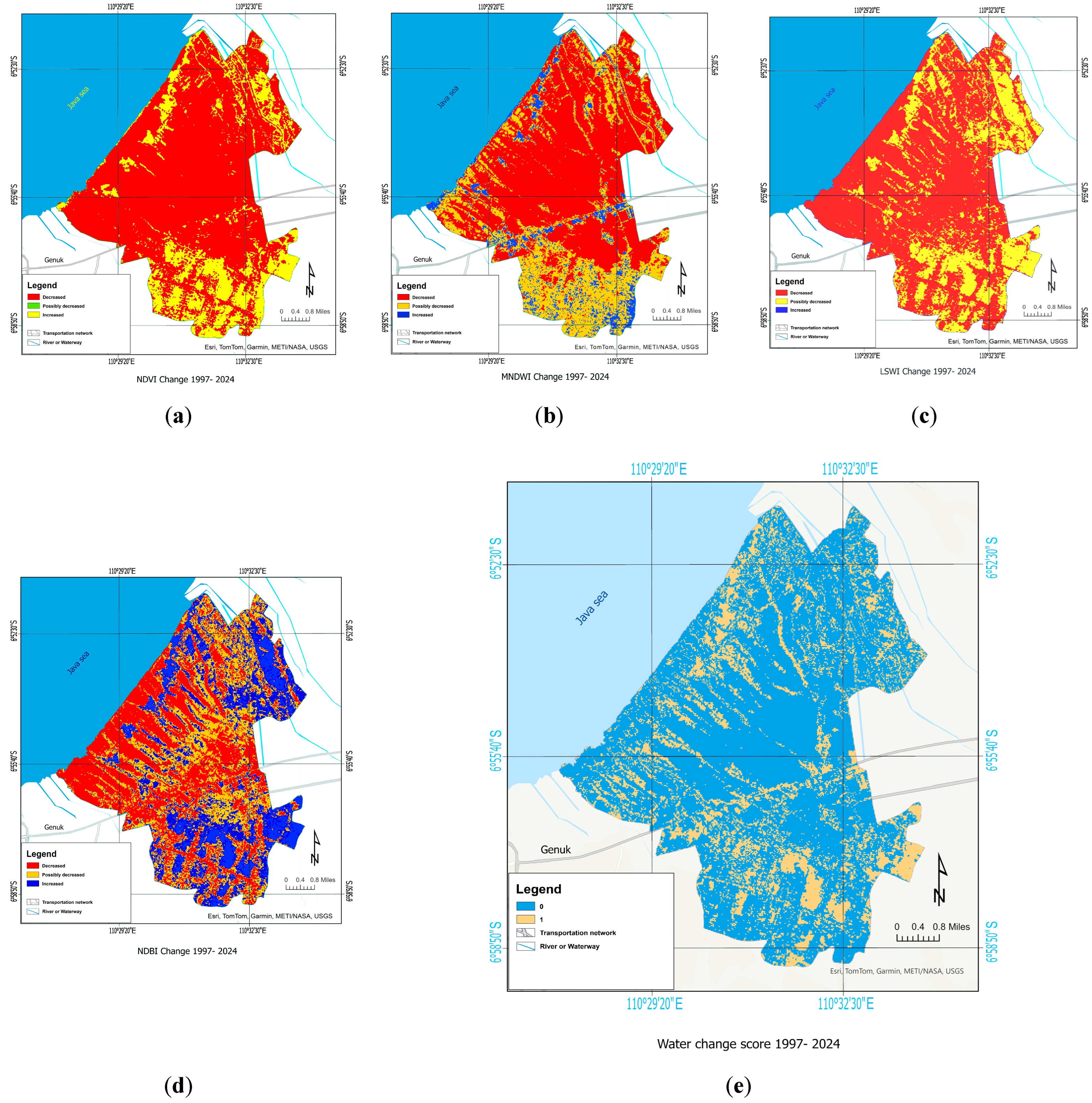
The analysis of multi-temporal environmental indices, including NDVI, MNDWI, NDBI, and LSWI, and the changes from 1997 to 2024, reveals substantial changes in land cover and surface conditions across Sayung Sub-district. The spatial and quantitative variations in vegetation cover, surface water extent, built-up areas, and soil moisture content are systematically presented in Figure 3, Figure 4, Figure 5 and Figure 6.
Vegetation Loss and NDVI Dynamics. Figure 3a,b show the spatiotemporal dynamics of NDVI, highlighting a decline in vegetation and conversion to water bodies and built-up areas over nearly three decades. Image differencing analysis (∆NDVI) indicates a widespread reduction in vegetative vigor, particularly in regions subject to urban expansion or hydrological transformation. Specifically, ∆NDVI ≤ 0 denotes decreased vegetation, ∆NDVI > 0.1 marks increased vegetation, and 0 < ∆NDVI < 0.1 reflects areas of potential vegetation loss. The most pronounced declines are evident along periurban corridors, coastal wetlands, and agricultural belts, demonstrating stress from both land-use change and inundation. This trend suggests not only the physical removal of vegetation but also broader ecological degradation.
Expansion of Surface Water (WMNDWI Analysis). Figure 4 presents the conversion to surface water features as captured by WMNDWI, indicating patterns of inundation and water body expansion. Areas with previously low surface water reflectance in 1997, especially along the shoreline and intertidal zones, show significantly higher WMNDWI values by 2024. Specifically, WMNDWI values < 0 indicate non-water bodies, >0.1 indicate water bodies, and 0 < WMNDWI < 0.1 represent potential inundation. The positive shift in WMNDWI indicates a substantial land-to-water transition, particularly in reclaimed or poorly drained zones—signaling increased hydrological pressure and chronic inundation risk.
Soil Moisture Fluctuations (LSWI Analysis). Figure 5 highlights fluctuations in land surface moisture derived from LSWI, further contextualizing hydrological transformation. Positive ∆LSWI values correspond to increased soil water content or groundwater resurgence—early warnings of subsoil instability and potential subsidence. These increases frequently overlap with former agricultural fields, mangrove fringes, and coastal settlements.
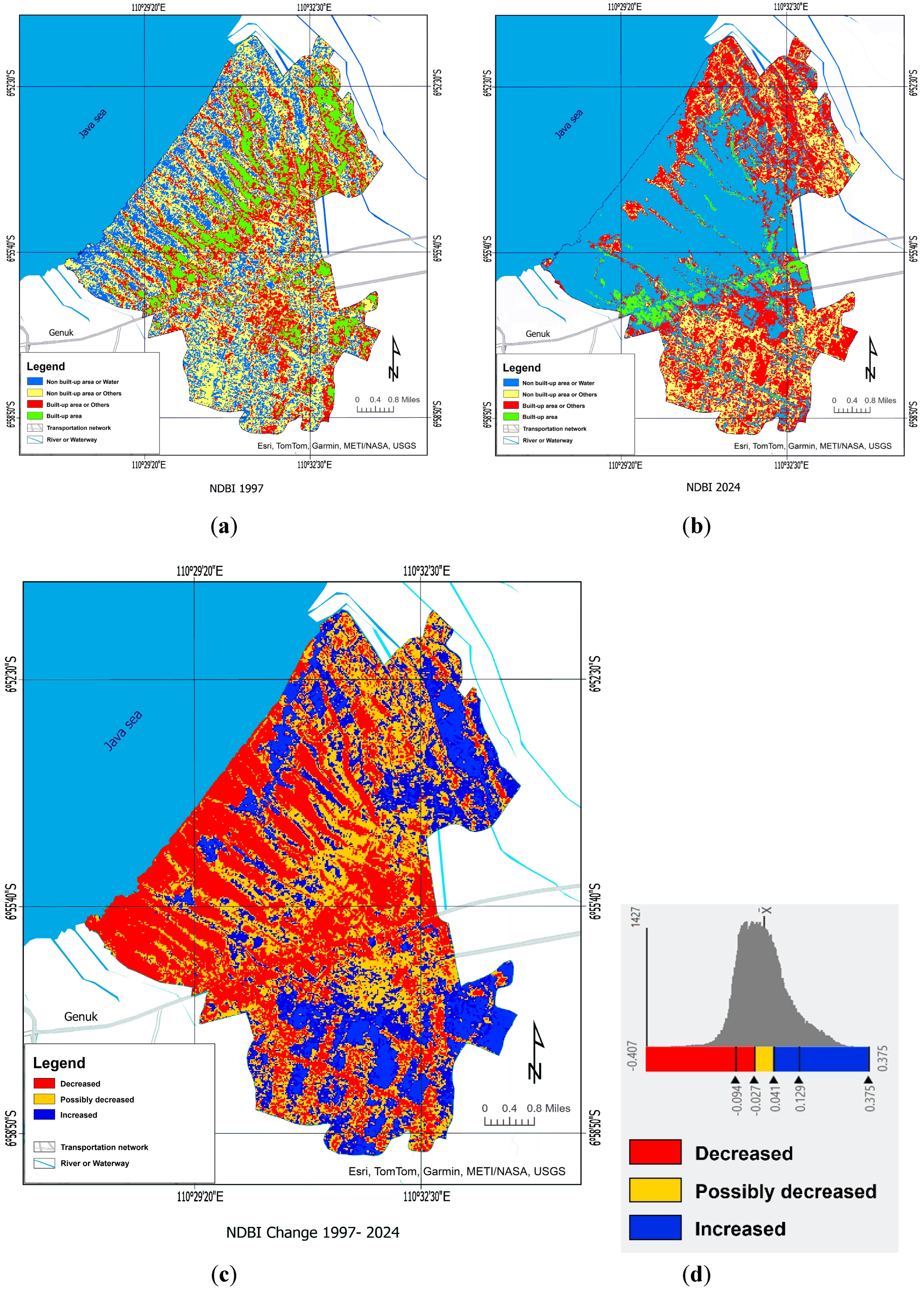
Urban Expansion and NDBI Trends. Figure 6 details changes in built-up areas using NDBI. Strong positive ∆NDBI values are concentrated in inland zones, reflecting urban expansion, whereas coastal cores show stagnation or decline, likely due to inundation or policy-driven land-use restrictions. Notably, some areas show simultaneous decreases in NDBI and increases in WMNDWI and LSWI, indicating the conversion of built-up areas to water bodies—a sign of severe hydrological stress.
Integrated Change Detection and Classification Accuracy. Figure 7 presents an integrated change detection analysis using combined NDVI, WMNDWI, NDBI, and LSWI indices. High-risk submergence zones are characterized by concurrent increases in WMNDWI and LSWI and declines in NDVI and NDBI. The machine learning-based classification (Random Forest model) delineates four dominant land transformation classes:
  • Recently inundated or water-encroached zones;
  • Vegetation-to-built-up transitions (urban sprawl);
  • Stable land cover;
  • Drying or reclaimed areas.
Model evaluation shows a classification accuracy of 91% (RMSE = 0.8 cm/year), validated against ground truth flood records and disaster reports. Average land subsidence is estimated at 6.0 ± 0.8 cm/year, consistent with independent InSAR studies.
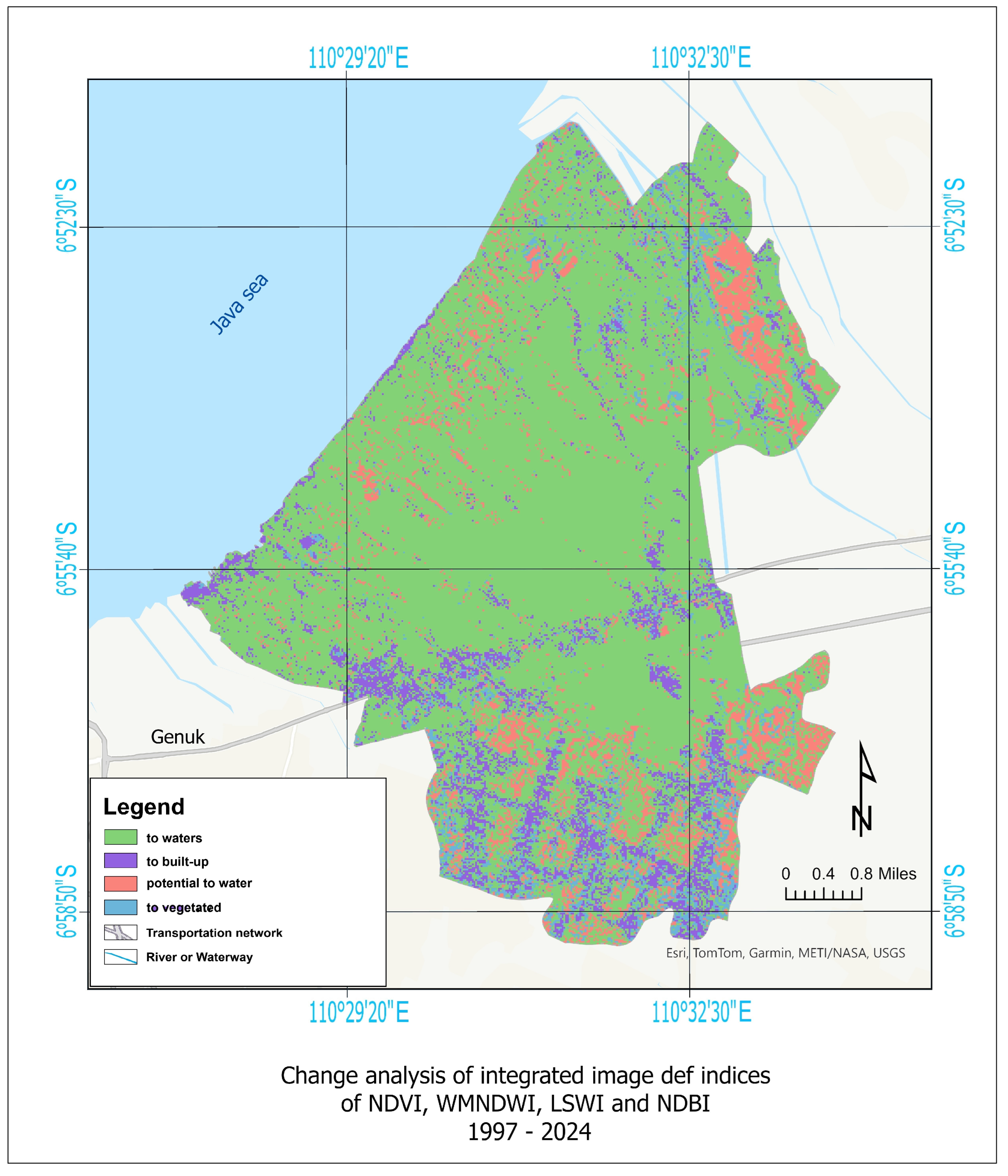
The machine learning-based classification using the composite of I d W M N D W I , I d L S W I , I d N D V I , and I d N D B I delineates a distinct land transformation zone associated with coastal subsidence. The output map reveals four dominant classes of land trajectories, i.e., class-1 exhibited a strong positive response in I d W M N D W I and I d L S W I , suggesting recent inundation and increased surface wetness, indicative of water encroachment or tidal flooding; class-2, concentrated in periurban and transitional zones, was characterized by increased I d N D B I and decreased I d N D V I values, representing vegetation-to-built-up transition consistent with urban sprawl; class-3 showed minimal spectral changes across all indices and was interpreted as stable land cover, encompassing both natural and built-up areas with negligible alteration between 1997 and 2024. Meanwhile, class-4 corresponded to areas with declining I d W M N D W I and I d L S W I , suggesting drying trends potentially linked to land reclamation or the drainage of wetlands (see Figure 8 and Table 1).

4. Discussion

The analysis of the environmental indices using the combination of integrated indices of the NDVI, MNDWI, NDBI, and LSWI; image differencing; MCA; and machine learning of iso-cluster methods reveals significant transformations within the study area from 1997 to 2024. The combined method offers rapid analysis of coastal sinking, including zones with a high potential for future inundation. The basic index method has been widely utilized in remote sensing to monitor environmental changes and urban dynamics [43,44,45,46] such as coastal sinking, but is rarely further combined or implemented with other methods, such as spatial analysis using MCA and machine learning.
NDVI identifies changes in vegetation cover, which often indicate early signs of erosion or land subsidence. I d N D V I shows the decrease in the NDVI value, high conversion mainly to waterlogged environments, and also urban development (Figure 3). The NDVI study by [47] supports the issue in the coastal environment that the declining NDVI term is commonly associated with deforestation due to ponds and urban expansions. The combining indices, such as WMNDWI, detect changes in water extent, reflecting sea-level rise, flooding, or sedimentation along the shoreline, while LSWI effectively captures persistent soil moisture. This progressive rise in I d W M N D W I values (Figure 4) reveals increased water coverage over time, underscoring significant inundation and rising water body extents, while LSWI analysis (Figure 6) reveals considerable variability in soil moisture levels, correlating directly with the changes in I d N D V I and I d W M N D W I . Chandrasekar in [48] supports the case that increasing soil moisture levels identified via LSWI corresponds to the elevated WMNDWI, indicating potential waterlogging and environmental degradation scenarios due to improper drainage, rising groundwater levels, and urban development impacts on hydrological regimes. Additionally, the progressive rise in I d W M N D W I strongly indicates persistent flooding and waterlogging issues, exacerbated by land subsidence and sea-level rise, prevalent in coastal urban areas globally [49]. Such transformation can be attributed to natural phenomena, such as climatic variability and anthropogenic activities like groundwater extraction and land subsidence, contributing extensively to urban flooding and inundation [50]. Dealing with groundwater extraction, the NDBI analysis (Figure 5) highlights the urban expansion within the study area. The consistent rise in I d N D B I suggests extensive built-up area development and urbanization pressure, commonly associated with population growth, industrialization, and infrastructure development [51]. These urbanization patterns not only compromise ecological integrity but also significantly influence local hydrology and land subsidence, increasing flood vulnerability in densely populated coastal zones [52].
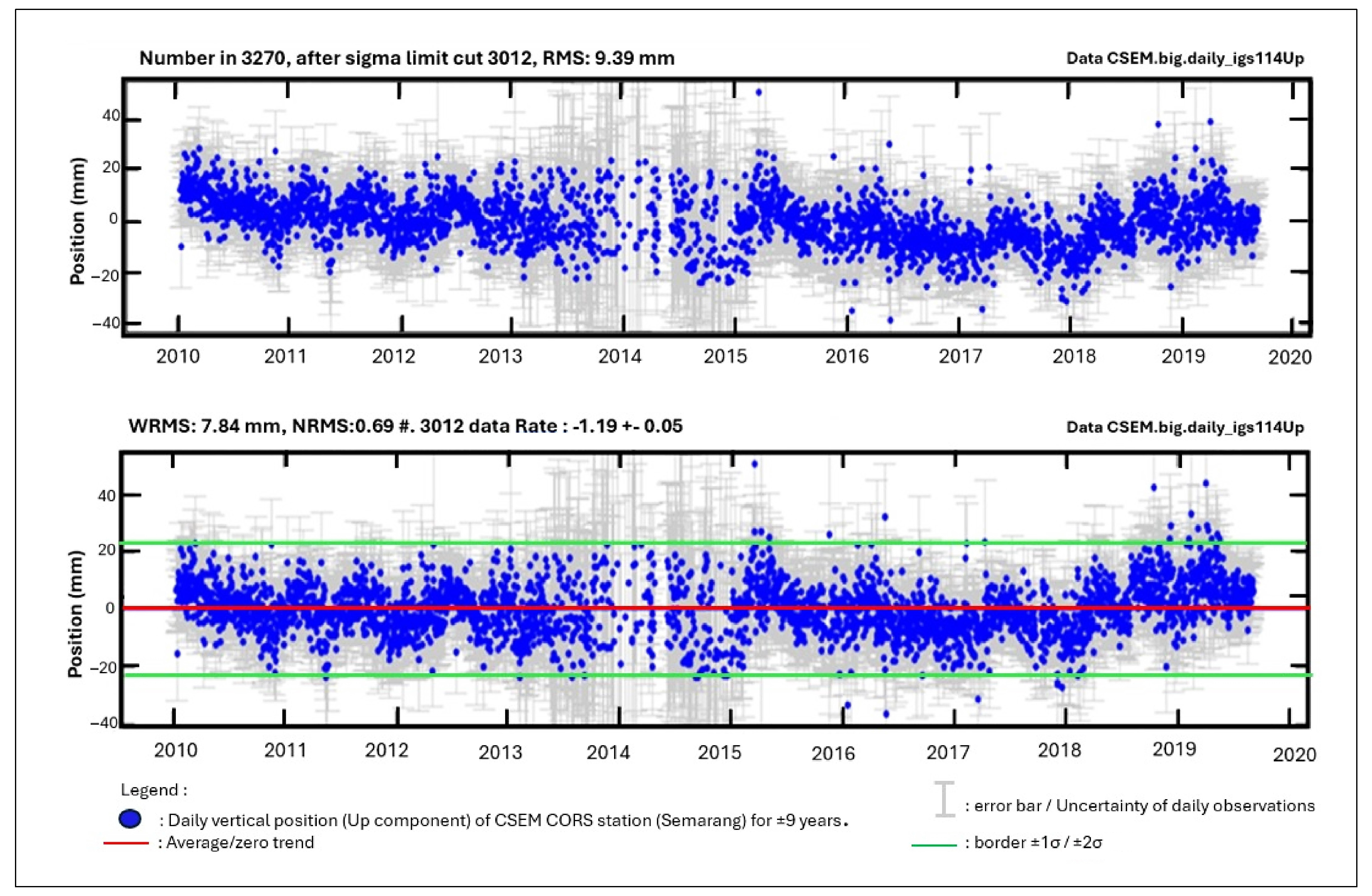
The analysis of daily GNSS vertical position time series from 2010 to 2019 at the CSEM CORS station in Semarang reveals a persistent land subsidence trend. These data were obtained through continuous GNSS observations recorded at permanently operating reference stations in Semarang. The CORS collected high-frequency satellite measurements (carrier phase, pseudorange, and Doppler), which were stored in daily RINEX files. These raw data were processed using geodetic software (RTKLib 2.4.3) to estimate precise daily or weekly station coordinates. The vertical component (Up) from this long-term coordinate time series reflected land-level changes over time. Noise filtering, cycle-slip removal, atmospheric corrections, and tidal loading adjustments were applied to ensure millimeter-level accuracy. The estimated vertical velocity indicates a subsidence rate of −1.19 ± 0.05 mm/year, reflecting long-term ground deformation. The Root Mean Square (RMS) value of 9.39 mm represents the typical daily vertical fluctuation inherent in GNSS observations. After applying a sigma limit cut for outlier removal, data quality improved, as evidenced by a reduced Weighted RMS (WRMS) of 7.84 mm. Furthermore, the Normalized RMS (NRMS) value of 0.69 indicates a strong model fit and high reliability of the estimated vertical trend. The observed daily variability, together with measurement uncertainties, confirms that the detected subsidence signal is statistically significant and temporally stable (Figure 9). Abidin in [53] also reported subsidence rates in the vicinity of Semarang for the period 2008–2011, where the area, characterized by a dominant geological structure of alluvium deposits, exhibited higher rates with an average of approximately 6 to 7 cm/year and maximum rates reaching 14–19 cm/year.
The most significant factor in land subsidence is groundwater discharge, which is caused by an increase in the number of built-up areas (Figure 6), as well as an increase in the demand for water from commercial and industrial areas. Groundwater pumping for agricultural, urban, and industrial water use has resulted in a significant drop in the water table, leading to land subsidence and the development of earth fissures [54,55]. Sayung is a Demak Sub-district that functions as an industrial hub; it is located next to Semarang City and is traversed by the Semarang–Demak toll road. The Demak District administration has a policy to expand the industrial area in the region given its strategic location, such as in Sayung, which is one of the five localities where industrial development is most concentrated [56]. The development of industrial areas has caused a number of problems in the surrounding area, including the threat of a clean water crisis and land subsidence [57]. Several researchers have also reported that the number of registered wells in the vicinity of Semarang has gradually increased since 1900 from 16 to 950 wells in 1996 and 1050 wells in 2000 [58].
Another issue exacerbating the submergence of the Sayung coastal area is the conversion of the mangrove ecosystem back to high tide (rob). These factors cause daily flooding and erosion along the coast. Indeed, Muskananfola in [59] states that the hydrodynamic characteristic model of Sayung indicates that during the lowest tide period, the dominant current velocity ranges from 0.01 to 0.07 m/s in the southwest direction towards Demak Waters. During the highest tide period, the prevailing current speed ranges from 0.01 to 0.1 m/s towards the northeast of Demak Waters. In the west–east season, the wave height varies from 0.5 to 1.25 m, with an average height of 0.5–0.79 m in the west–east direction. The heights of the daily tidal waves above 1 m are sufficient to submerge the average Sayung coastline, which is located below sea level.
Based on the above analysis, it can be inferred that the primary drivers of sinking land subsidence are the rapid expansion of industrial and residential areas, which exert excessive pressure on groundwater discharge, widely recognized as a key contributor to land subsidence. This condition is further exacerbated by the large-scale conversion of mangrove forests into aquaculture ponds, settlements, and industrial complexes, leading to the loss of natural buffers that regulate coastal hydrodynamics. As a consequence, the coastal zone experiences accelerated land subsidence, compounded by the presence of unconsolidated alluvial deposits that are highly susceptible to compaction. Climate change further intensifies this phenomenon by altering tidal regimes, increasing wave energy, and destabilizing coastal sedimentation patterns. The apparent sea-level rise observed in the region is therefore largely relative, rather than being absolute eustatic sea-level rise.
These interlinked drivers underscore the urgent need for integrated policy responses that address both anthropogenic pressure and environmental vulnerability. Policy implications include the enforcement of groundwater discharge regulations, restoration of the mangrove ecosystem, implementation of land-use zoning in subsidence-prone areas, and investment in early warning systems and adaptive infrastructure. Without timely and coordinated mitigation strategies, the compounded risk of land subsidence and coastal flooding will continue to threaten the long-term sustainability and habitability of vulnerable coastal regions.
The trends and existing land-use changes within the coastal area, as well as the future sinking area, can be seen in Figure 7 and Figure 8. They synthesize the multi-index change detection and machine-learning classification to reveal the spatial pattern and intensity of coastal transformation in Sayung between 1997 and 2024. Evaluation of the results shows 91 percent accuracy of the model, indicating that the method can be accepted. Figure 7 highlights zones of vegetation loss, rising soil moisture, and expanding surface water that signal a high risk of subsidence and tidal flooding, while inland areas with higher NDBI reveal continued built-up development. Figure 8 refines this analysis by grouping the landscape into four classes—recently inundated land, vegetation-to-settlement transition, stable zones, and drying or reclaimed areas—providing a concise picture of shoreline retreat and land transformation that supports adaptive spatial planning and stricter groundwater management in the Sayung Sub-district.
The Demak Regency Spatial Plan (RTRW 2011–2031) divides the coast into mangrove protection belts, aquaculture, settlements, and industrial corridors, yet multi-temporal analyses show many of these zones already face chronic inundation and subsidence of up to about 6 cm per year. Protected buffers overlap with persistently flooded areas, and proposed industrial and toll road corridors coincide with high soil moisture and rapid shoreline retreat. These findings call for dynamic spatial planning that revises protected area boundaries to match current and projected shorelines, enforces groundwater use limits, creates no-build setback zones, and prioritizes mangrove restoration and hybrid coastal defenses so that future land-use reflects the reality of a sinking coast.
Sayung Sub-district, the most affected area, illustrates these gaps clearly. Much of its designated aquaculture and settlement land now experience persistent flooding and significant subsidence, while former mangrove zones have been converted to ponds and industry. Despite these risks, the RTRW still permits new development along the Semarang–Demak toll corridor, directly conflicting with environmental conditions. Updating the RTRW with recent satellite data and hazard assessments—incorporating shoreline change, land subsidence rates, and flood exposure—would enable inland relocation strategies, stricter groundwater regulation, and ecosystem-based coastal protection, ensuring that spatial policy keeps pace with rapid coastal change.
So, some issues of adaptation and mitigation have also been recommended, both including engineering and nature based solutions (NBSs), such as desalinization of sea water for industrial and settlement areas nearby to mitigate the impact of groundwater discharge that may cause land subsidence; protection of the coastline using hybrid engineering, continuing with Associated Mangrove Aquaculture (AMA) and large-scale mangrove replanting as an NBS approach to mitigate erosion and coastal recession and creating embankment toll roads as an engineering approach to mitigate erosion; relocation of the community; and the enforcement of coastal zoning ordinances in Semarang and Demak as a regional initiative approach. Quantitative frameworks, such as that developed by [58], provide a robust basis for estimating shoreline retreat and sand replenishment needs under scenarios of sea-level rise. Applying such frameworks to vulnerable areas like Sayung can inform more precise interventions and resource allocation for erosion control. Regional studies further highlight the importance of integrated management, combining hydrological, ecological, and social dimensions to build coastal resilience [60]. The findings and proposed mitigation suggestions may serve as valuable input for the evaluation of the existing spatial plans, considering that the assessment of this rapid projection method still indicates the likelihood of continued coastal submergence in several areas if no mitigation efforts are undertaken.
Offering a synthesized spatial interpretation of land surface changes between 1997 and 2024, the composite index captures multidimensional dynamics in vegetation cover, water presence, urban expansion, and soil moisture variations (Figure 7). This analysis delineates zones that are highly susceptible to inundation, particularly in built-up areas. Areas exhibiting simultaneous decreases in NDVI and NDBI alongside increases in WMNDWI and LSWI are identified as high-risk zones for submergence, suggesting processes such as vegetation loss, urban retreat, and the encroachment of water bodies [61,62]. Compared to earlier studies, which typically used fewer indices or isolated approaches, this integration methodology presents a significant advancement by capturing and interpreting multiple dimensions simultaneously, enhancing spatial targeting decision-making.
From the extensive explanation above, several key points can be succinctly summarized as follows: The integrated use of NDVI, WMNDWI, NDBI, and LSWI, combined with multi-criteria analysis and machine learning, enables rapid, robust assessment of coastal sinking dynamics. The findings highlight a substantial decline in vegetated land, ongoing conversion to water bodies, and significant expansion of built-up zones—especially in inland areas. These spatial trends are aligned with increased hydrological stress, persistent inundation, and land subsidence measured by GPS CORSs (1.19–6 cm/year).
The primary drivers of these transformations include the following: (a) excessive groundwater extraction (linked to increased built-up area and industrial expansion); (b) large-scale mangrove loss and land conversion (reducing natural coastal buffers); and (c) alluvial soil compaction and relative sea-level rise (accelerated by climate change).
These drivers are interlinked and mutually reinforcing, leading to chronic flooding and ecosystem degradation. This study’s approach—integrating open access remote sensing data, index-based change detection, and machine learning—enables reproducible, cost-efficient monitoring suitable for data-limited contexts.
The results also underscore the limitations of current land-use planning (RTRW). Many designated aquaculture, settlement, and industrial zones already face chronic inundation and land loss. Updating spatial plans using recent satellite and hazard data is essential to support effective adaptation, including the following: (a) revision of protected area boundaries; (b) enforcement of groundwater regulations; (c) creation of no-build setback zones; (d) systematic mangrove and ecosystem restoration; and (e) deployment of hybrid coastal protection and adaptive infrastructure.

5. Conclusions

This research demonstrates that Sayung Sub-district is experiencing significant coastal degradation, driven by synergistic anthropogenic and natural processes.
  • Multi-temporal Landsat analysis (1997–2024), validated by tidal gauge and GPS data, reveals marked vegetation loss, persistent inundation, and urban expansion.
  • Land subsidence averages 6.0 ± 0.8 cm/year, with model accuracy of 91%—confirming the robustness of the rapid evaluation approach.
  • Combined spectral indices and machine learning provide strong evidence of hydrological encroachment, with built-up areas transitioning to waterlogged or submerged states.
For sustainable management, integrated solutions are essential:
  • Rigorous groundwater extraction controls;
  • Land-use zoning to limit development in high-risk areas;
  • Systematic mangrove restoration and hybrid protection infrastructure;
  • Ongoing geospatial monitoring to enable adaptive governance and early warning.
The rapid evaluation methodology is transferable and can support coastal management in other vulnerable regions. Without prompt action, ongoing land loss and socio-economic disruption in Sayung and similar areas are inevitable.

Author Contributions

Conceptualization, D.S., R.D.D., R.S. and Y.P.; methodology, D.S. and R.D.D.; software, Y.P. and N.A.; validation, R.S., Y.P., N.A., and H.S.; formal analysis, D.S. and R.D.D.; investigation, D.S., R.S., Y.P., J.T.H. and M.D.; resources, R.S., J.T.H., M.D., S.B.A. and M.H.; data curation, J.T.H., M.D., S.B.A., M.H. and H.S.; writing—original draft preparation, D.S. and R.D.D.; writing—review and editing, Y.P., R.S., J.T.H., H.S., S.B.A., M.H. and N.A.; visualization, M.D., S.B.A., M.H. and H.S.; supervision, D.S. and R.D.D.; project administration, D.S., Y.P. and N.A.; funding acquisition, D.S. and R.D.D. All authors have read and agreed to the published version of the manuscript.

Funding

This research is supported by the Research and Innovation for Advanced Indonesia (RIIM) Batch 4 Program 2023–2026; the Research and Innovation Agency (BRIN); and funding from the Education Fund Management Institution (LPDP), no. (37/II.7/HK/2023), Ministry of Finance, Republic of Indonesia.

Data Availability Statement

The original contributions presented in this study are included in the article. For further information, please contact the corresponding author.

Acknowledgments

We would like to thank the local authorities who facilitated the fieldwork.

Conflicts of Interest

The authors declare no conflicts of interest.

Abbreviations

The following abbreviations are used in this manuscript:
AMAAssociated Mangrove Aquaculture
BIGBadan Informasi Geospasial
CORSContinuously Operating Reference Station
GNSSGlobal Navigation Satellite System
GPSGlobal Positioning System
LSWILand Surface Water Index
MCDAMultiple-Criteria Decision Analysis
MSSMulti-Spectral Scanner
NDBINormalized Difference Built-up Index
NDVINormalized Difference Vegetation Index
NIRNear Infra Red
OLIOperational Land Imager
RTKLibReal-Time Kinematics Library
RTRWRencana Tata Ruang Wilayah/Regional Spatial Planning Document/Spatial Plan
SWIRShort-Wave Infrared
TMThematic Mapper
USGSUnited States Geological Survey
WMNDWIWeighted Modified Normalized Difference Water Index

References

  1. Jaligot, R.; Chenal, J. Stakeholders’ Perspectives to Support the Integration of Ecosystem Services in Spatial Planning in Switzerland. Environments 2019, 6, 88. [Google Scholar] [CrossRef]
  2. Lo, K.; Gunasiri, C. Impact of Coastal Land Use Change on Shoreline Dynamics in Yunlin County, Taiwan. Environments 2014, 1, 124–136. [Google Scholar] [CrossRef]
  3. Cicin-Sain, B.; Belfiore, S. Linking marine protected areas to Integrated Coastal and Ocean Management: A Review of Theory and Practice. Ocean Coast. Manag. 2005, 48, 847–868. [Google Scholar] [CrossRef]
  4. Murray, K.; Barbee, M.; Thompson, P.; Fletcher, C. Coastal land subsidence accelerates timelines for future flood exposure in Hawai’i. Commun. Earth Environ. 2025, 6, 123. [Google Scholar] [CrossRef]
  5. Pedretti, L.; Giarola, A.; Korff, M.; Lambert, J.; Meisina, C. Comprehensive database of land subsidence in 143 major coastal cities around the world: Overview of issues, causes, and future challenges. Front. Earth Sci. 2024, 12, 1351581. [Google Scholar] [CrossRef]
  6. Susilo, S.; Salman, R.; Hermawan, W.; Widyaningrum, R.; Wibowo, S.T.; Lumban-Gaol, Y.A.; Meilano, I.; Yun, S.H. GNSS land subsidence observations along the northern coastline of Java, Indonesia. Sci. Data 2023, 10, 421. [Google Scholar] [CrossRef]
  7. Wei, S.; Zhang, H.; Xu, Z.; Lin, G.; Lin, Y.; Liang, X.; Ling, J.; Wee, A.K.S.; Lin, H.; Zhou, Y.; et al. Coastal urbanization may indirectly positively impact the growth of mangrove forests. Commun. Earth Environ. 2024, 5, 608. [Google Scholar] [CrossRef]
  8. Ideki, O.; Ajoku, O. Scenario Analysis of Shorelines, Coastal Erosion, and Land Use/Land Cover Changes and Their Implication for Climate Migration in East and West Africa. J. Mar. Sci. Eng. 2024, 12, 1081. [Google Scholar] [CrossRef]
  9. Solihuddin, T.; Husrin, S.; Salim, H.L.; Kepel, T.L.; Mustikasari, E.; Heriati, A.; Ati, R.N.A.; Purbani, D.; Mbay, L.O.N.; Indriasari, V.Y.; et al. Coastal erosion on the north coast of Java: Adaptation strategies and coastal management. IOP Conf. Ser. Earth Environ. Sci. 2021, 777, 012035. [Google Scholar] [CrossRef]
  10. Agustan, A.; Ito, T.; Purwana, R.; Ardiyanto, R.; Santosa, B.H.; Sadmono, H. Time Series InSAR for Ground Deformation Observation in the Semarang Area, Central Java. In Proceedings of the 2023 8th Asia-Pacific Conference on Synthetic Aperture Radar (APSAR), Bali, Indonesia, 23–27 October 2023; pp. 1–5. [Google Scholar] [CrossRef]
  11. Chaussard, E.; Amelung, F.; Abidin, H.; Hong, S.H. Sinking cities in Indonesia: ALOS PALSAR detects rapid subsidence due to groundwater and gas extraction. Remote Sens. Environ. 2013, 128, 150–161. [Google Scholar] [CrossRef]
  12. Dwiakram, N.; Amarrohman, F.J.; Prasetyo, Y. Studi Penurunan Muka Tanah Menggunakan Dinsar Tahun 2017–2020 (Studi Kasus: Pesisir Kecamatan Sayung, Demak). J. Geod. Undip 2021, 10, 269–276. [Google Scholar]
  13. Rahman, B.; Wicaksono, N.A.B.; Karmila, M.; Ridlo, M.A. Analysis of community adaptation to sinking coastal settlements in the Sriwulan, Demak Regency, Indonesia. IOP Conf. Ser. Earth Environ. Sci. 2022, 1116, 012070. [Google Scholar] [CrossRef]
  14. Sutrisno, D.; Rahadiati, A.; Bin Hashim, M.; Shih, P.T.; Qin, R.; Helmi, M.; Yusmur, A.; Zhang, L. Spatial Planning-based ecosystem adaptation (SPBEA) as a Method to Mitigate the Impact of Climate Change: The Effectiveness of Hybrid Training and participatory workshops during a Pandemic in Indonesia. APN Sci. Bull. 2022, 12, 29–43. [Google Scholar] [CrossRef]
  15. Solecki, W.; Friedman, E. At the Water’s Edge: Coastal Settlement, Transformative Adaptation, and Well-Being in an Era of Dynamic Climate Risk. Annu. Rev. Public Health 2021, 42, 211–232. [Google Scholar] [CrossRef]
  16. Erkens, G.; Bucx, T.; Dam, R.; De Lange, G.; Lambert, J. Sinking Coastal Cities. Proc. IAHS 2015, 372, 189–198. [Google Scholar] [CrossRef]
  17. Takagi, H.; Esteban, M.; Mikami, T.; Pratama, M.B.; Valenzuela, V.P.B.; Avelino, J.E. People’s perception of Land Subsidence, Floods, and Their Connection: A Note Based on Recent Surveys in a sinking coastal community in Jakarta. Ocean Coast. Manag. 2021, 211, 105753. [Google Scholar] [CrossRef]
  18. Church, J.A.; White, N.J. Sea-Level Rise from the Late 19th to the Early 21st Century. Surv. Geophys. 2011, 32, 585–602. [Google Scholar] [CrossRef]
  19. Castelle, B.; Guillot, B.; Marieu, V.; Chaumillon, E.; Hanquiez, V.; Bujan, S.; Poppeschi, C. Spatial and Temporal Patterns of Shoreline Change of a 280-km High-energy disrupted sandy coast from 1950 to 2014: SW France. Estuar. Coast. Shelf Sci. 2018, 200, 212–223. [Google Scholar] [CrossRef]
  20. Tonneijck, F.; Van der Goot, F.; Pearce, F. Building with Nature in Indonesia: Restoring an Eroding Coastline and Inspiring Action at Scale; Wetlands International and Ecoshape Foundation: Amersfoort, The Netherlands, 2022. [Google Scholar]
  21. Buffardi, C.; Ruberti, D. The Issue of Land Subsidence in Coastal and Alluvial Plains: A Bibliometric Review. Remote Sens. 2023, 15, 2409. [Google Scholar] [CrossRef]
  22. Huynh, L.T.M.; Su, J.; Wang, Q.; Stringer, L.C.; Switzer, A.D.; Gasparatos, A. Meta-analysis indicates better climate adaptation and mitigation performance of hybrid engineering-natural coastal defense measures. Nat. Commun. 2024, 15, 2870. [Google Scholar] [CrossRef] [PubMed]
  23. Usha, S.; Alabdulkreem, E.; Alruwais, N.; Almukadi, W.S. Monitoring land subsidence using Sentinel-1A, persistent scatterer InSAR, and machine learning techniques. J. South Am. Earth Sci. 2025, 155, 105433. [Google Scholar] [CrossRef]
  24. Holzner, J.; Strunz, G.; Martinis, S.; Plank, S. Analyzing coastal dynamics by means of multi-sensor satellite imagery at the East Frisian Island of Langeoog, Germany. Sci. Rep. 2025, 15, 7372. [Google Scholar] [CrossRef]
  25. Roukounis, C.N.; Tsoukala, V.K.; Tsihrintzis, V.A. An Index-Based Method to Assess the Resilience of Urban Areas to Coastal Flooding: The Case of Attica, Greece. J. Mar. Sci. Eng. 2023, 11, 1776. [Google Scholar] [CrossRef]
  26. Kshetri, T.K. NDVI, NDBI, and NDWI calculation using LANDSAT 7 and 8. GeoWorld Geomat. Sustain. Dev. 2018, 2, 32–34. [Google Scholar]
  27. Rudiarto, I.; Handayani, W.; Wijaya, H.B.; Insani, T.D. Land resource availability and climate change disasters in the rural coastal areas of Central Java—Indonesia. IOP Conf. Ser. Earth Environ. Sci. 2018, 202, 012029. [Google Scholar] [CrossRef]
  28. Gemilang, W.A.; Wisha, U.J.; Solihuddin, T.; Arman, A.; Ondara, K. Sediment Accumulation Rate in Sayung Coast, Demak, Central Java Using Unsupported 210Pb Isotope. Atom Indonesia 2020, 46, 25. [Google Scholar] [CrossRef]
  29. Asiyah, S.; Rindarjono, M.G.; Muryani, C. Analisis Perubahan Permukiman dan Karakteristik Permukiman Kumuh Akibat Abrasi dan Inundasi di Pesisir Kecamatan Sayung Kabupaten Demak Tahun 2003–2013. J. GeoEco 2015, 1, 83–100. [Google Scholar]
  30. Pramudito, W.A.; Suprijanto, J.; Soenardjo, N. Perubahan Luasan Vegetasi Mangrove di Desa Bedono Kecamatan Sayung Kabupaten Demak Tahun 2009 dan 2019 Menggunakan Citra Satelit Landsat. J. Mar. Res. 2020, 9, 131–136. [Google Scholar] [CrossRef]
  31. Irsadi, A.; Martuti, N.K.T.; Abdullah, M.; Hadiyanti, L.N. Abrasion and Accretion Analysis in Demak, Indonesia Coastal for Mitigation and Environmental Adaptation. Nat. Environ. Poll. Technol. 2022, 21, 633–641. [Google Scholar] [CrossRef]
  32. Bosma, R.H.; Debrot, A.O.; Tonneijck, F.H.; Rejeki, S. Technical Guidance: Associated Mangrove Aquaculture Farms; Building with Nature to Restore Eroding Tropical Muddy Coasts; Ecoshape: Amersfoort, The Netherlands, 2020. [Google Scholar]
  33. Mahroini, Z. Local Government Managament and Local Communty Mitigation of Tidal Flooding in Sayung Sub-District Demak Regency, Central Java Province, Indonesia. 2021. Available online: https://www.researchgate.net/publication/352978073_Local_Government_Managament_and_Local_Communty_Mitigation_ff_Tidal_Flooding_in_Sayung_Sub-District_Demak_Regency_Central_Java_Province_Indonesia (accessed on 26 November 2025).
  34. Marfai, M.A.; Rahayu, E.; Triyanti, A. The Role of Local Wisdom and Social Capital in Disaster Risk Reduction and Development of Coastal Area; Gadjah Mada University Press: Bulaksumur, Yogyakarta, 2015. [Google Scholar]
  35. Sutrisno, D.; Darmawan, M.; Rahadiati, A.; Helmi, M.; Yusmur, A.; Hashim, M.; Shih, P.T.Y.; Qin, R.; Zhang, L. Spatial-Planning-Based Ecosystem Adaptation (SPBEA): A Concept and Modeling of Prone Shoreline Retreat Areas. ISPRS Int. J. Geo-Inf. 2021, 10, 176. [Google Scholar] [CrossRef]
  36. Chughtai, A.H.; Abbasi, H.; Karas, I.R. A review on change detection method and accuracy assessment for land use land cover. Remote Sens. Appl. Soc. Environ. 2021, 22, 100482. [Google Scholar] [CrossRef]
  37. Sun, S.; Xue, Q.; Xing, X.; Zhao, H.; Zhang, F. Remote Sensing Image Interpretation for Coastal Zones: A Review. Remote Sens. 2024, 16, 4701. [Google Scholar] [CrossRef]
  38. Hidayat, T.A.; Helmi, M.; Widada, S.; Satriadi, A.; Setiyono, H.; Ismanto, A.; Yusuf, M. Pengolahan Data Satelit Sentinel-1 dan Pasut untuk Mengkaji Area Genangan Akibat Banjir Pasang di Kecamatan Sayung, Kabupaten Demak. Indones. J. Oceanogr. 2020, 2, 306–312. [Google Scholar] [CrossRef]
  39. Ashok, A.; Rani, H.P.; Jayakumar, K.V. Monitoring of dynamic wetland changes using NDVI and NDWI based landsat imagery. Remote Sens. Appl. Soc. Environ. 2021, 23, 100547. [Google Scholar] [CrossRef]
  40. Lillesand, T.M.; Kiefer, R.W.; Chipman, J.W. Remote Sensing and Image Interpretation; John Wiley & Sons: New York, NY, USA, 2004. [Google Scholar]
  41. Dong, G.; Chen, S.; Liu, K.; Wang, W.; Hou, H.; Gao, L.; Zhang, F.; Su, H. Spatiotemporal Variation in Sensitivity of urban vegetation growth and Greenness to vegetation water content: Evidence from Chinese Megacities. Sci. Total Environ. 2023, 905, 167090. [Google Scholar] [CrossRef]
  42. Wang, Y.Q.; Wang, Z.F.; Cheng, W.C. A Review on land subsidence caused by Groundwater Withdrawal in Xi’an, China. Bull. Eng. Geol. Environ. 2019, 78, 2851–2863. [Google Scholar] [CrossRef]
  43. Xu, H. Modification of normalised difference water index (NDWI) to enhance open water features in remotely sensed imagery. Int. J. Remote Sens. 2006, 27, 3025–3033. [Google Scholar] [CrossRef]
  44. Javed, A.; Cheng, Q.; Peng, H.; Altan, O.; Li, Y.; Ara, I.; Huq, E.; Ali, Y.; Saleem, N. Review of Spectral Indices for Urban Remote Sensing. Photogramm. Eng. Remote Sens. 2021, 87, 513–524. [Google Scholar] [CrossRef]
  45. Liu, Z. Empirical Examinations of Whether Rural Population Decline Improves the Rural Eco-Environmental Quality in a Chinese Context. Remote Sens. 2022, 14, 5217. [Google Scholar] [CrossRef]
  46. Gao, B. NDWI—A normalized difference water index for Remote Sensing of vegetation liquid water from Space. Remote Sens. Environ. 1996, 58, 257–266. [Google Scholar] [CrossRef]
  47. Li, X.; He, H.; Wang, D.; Sun, Y.; Qin, Y.; Wang, K.; Han, Y.; Tang, J.; Qiao, W. Spatiotemporal dynamics of the normalized difference vegetation index and its multidimensional drivers in a rapidly urbanizing coastal city: A case study of Lianyungang, China (2000−2023). Ecol. Inform. 2025, 91, 103397. [Google Scholar] [CrossRef]
  48. Chandrasekar, K.; Srikanth, P.; Chakraborty, A.; Choudhary, K.; Ramana, K.V. Response of crop water indices to soil wetness and vegetation water content. Adv. Space Res. 2024, 73, 1316–1330. [Google Scholar] [CrossRef]
  49. Lumban-Gaol, J.; Sumantyo, J.T.S.; Tambunan, E.; Situmorang, D.; Antara, I.M.O.G.; Sinurat, M.E.; Suhita, N.P.A.R.; Osawa, T.; Arhatin, R.E. Sea Level Rise, Land Subsidence, and Flood Disaster Vulnerability Assessment: A Case Study in Medan City, Indonesia. Remote Sens. 2024, 16, 865. [Google Scholar] [CrossRef]
  50. Triana, K.; Wahyudi, A.J. Sea Level Rise in Indonesia: The Drivers and the Combined Impacts from Land Subsidence. ASEAN J. Sci. Technol. Dev. 2020, 37, 3. [Google Scholar] [CrossRef]
  51. Zha, Y.; Gao, J.; Ni, S. Use of normalized difference built-up index in automatically mapping urban areas from TM imagery. Int. J. Remote Sens. 2003, 24, 583–594. [Google Scholar] [CrossRef]
  52. Patel, N.N.; Angiuli, E.; Gamba, P.; Gaughan, A.; Lisini, G.; Stevens, F.R.; Tatem, A.J.; Trianni, G. Multitemporal settlement and population mapping from Landsat using Google Earth Engine. Int. J. Appl. Earth Obs. Geoinf. 2015, 35, 199–208. [Google Scholar] [CrossRef]
  53. Abidin, H.Z.; Andreas, H.; Gumilar, I.; Sidiq, T.P.; Fukuda, Y. Land subsidence in coastal city of Semarang (Indonesia): Characteristics, impacts, and causes. Geomat. Nat. Hazards Risk 2013, 4, 226–240. [Google Scholar] [CrossRef]
  54. Taftazani, R.; Kazama, S.; Takizawa, S. Spatial Analysis of Groundwater Abstraction and Land Subsidence for Planning the Piped Water Supply in Jakarta, Indonesia. Water 2022, 14, 3197. [Google Scholar] [CrossRef]
  55. Conway, B.D. Land subsidence and earth fissures in south-central and southern Arizona, USA. Hydrogeol. J. 2016, 24, 649–655. [Google Scholar] [CrossRef]
  56. Desiana, R.; Pigawati, B. Suitability of Location and Reach of Industrial Pollution in Sayung District, Demak Regency. Tek. PWK (Perenc. Wil. Kota) 2018, 7, 56–69. [Google Scholar]
  57. Murdohardono, D.; Tobing, T.M.H.L.; Sayekti, A. Overpumping of Groundwater as One of the Causes of Seawater Inundation in Semarang City. In Proceedings of the International Symposium and Workshop on Current Problems in Groundwater Management and Related Water Resources Issues, Bali, Indonesia, 3–8 December 2007. [Google Scholar]
  58. Muskananfola, M.R.; Febrianto, S. Spatio-temporal analysis of shoreline change along the coast of Sayung Demak, Indonesia using Digital Shoreline Analysis System. Reg. Stud. Mar. Sci. 2020, 34, 101060. [Google Scholar] [CrossRef]
  59. Aguilera-Vidal, M.; Muñoz-Perez, J.J.; Contreras, A.; Contreras, F.; Lopez-Garcia, P.; Jigena, B. Increase in the Erosion Rate Due to the Impact of Climate Change on Sea Level Rise: Victoria Beach, a Case Study. J. Mar. Sci. Eng. 2022, 10, 1912. [Google Scholar] [CrossRef]
  60. Marfai, M.A.; King, L. Potential vulnerability implications of coastal inundation due to sea level rise for the coastal zone of Semarang city, Indonesia. Environ. Geol. 2008, 54, 1235–1245. [Google Scholar] [CrossRef]
  61. Chandrasekar, K.; Sesha Sai, M.V.R.; Roy, P.S.; Dwevedi, R.S. Land Surface Water Index (LSWI) response to rainfall and NDVI using the MODIS Vegetation Index product. Int. J. Remote Sens. 2010, 31, 3987–4005. [Google Scholar] [CrossRef]
  62. Yasin, M.Y.; Abdullah, J.; Noor, N.M.; Yusoff, M.M.; Noor, N.M. Landsat observation of urban growth and land use change using NDVI and NDBI analysis. IOP Conf. Ser. Earth Environ. Sci. 2022, 1067, 012037. [Google Scholar] [CrossRef]
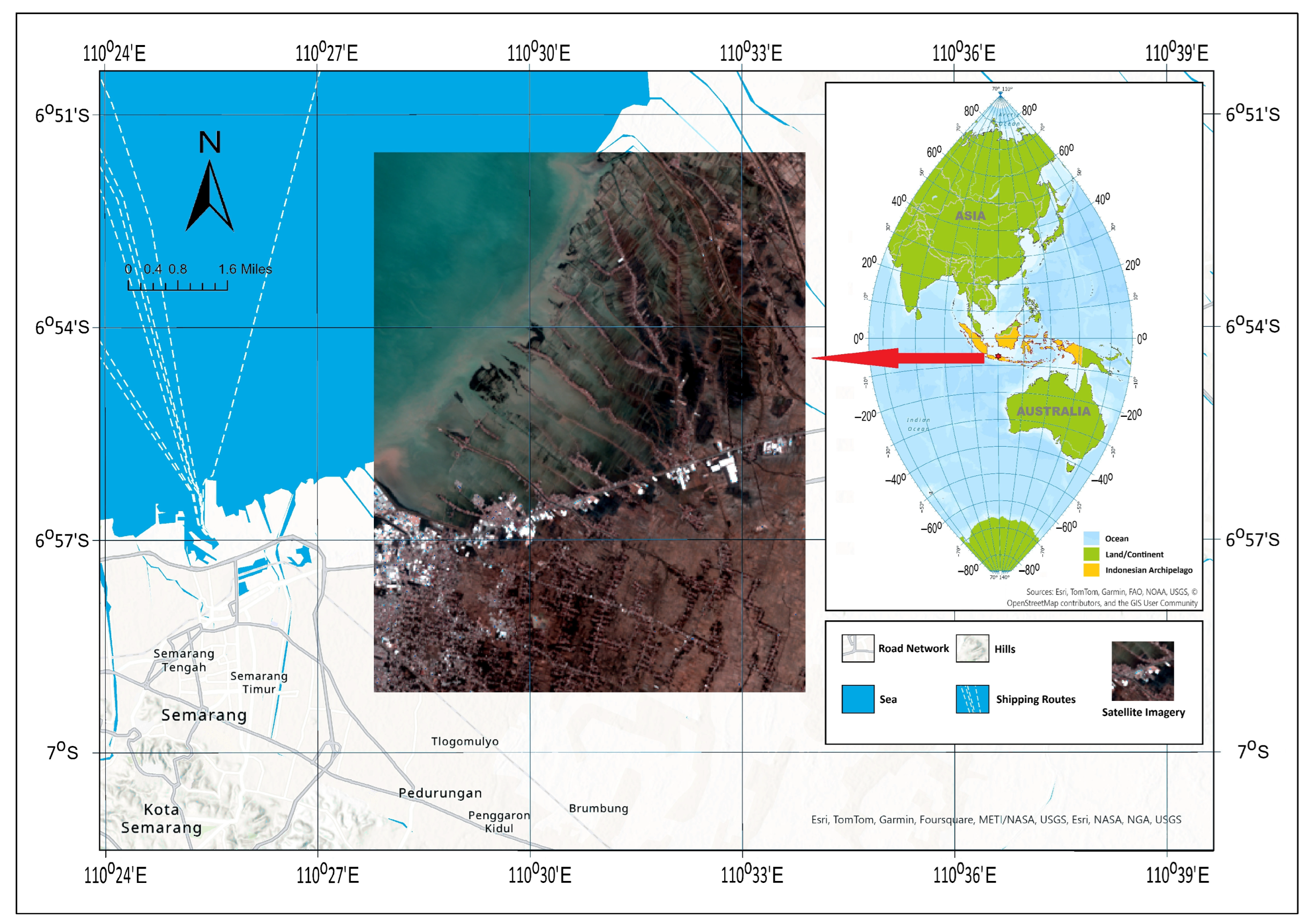
Figure 1. Study area: Sayung Sub-district, Demak, Central Java, Indonesia.
Geosciences 15 00455 g001
Figure 2. The steps of coastal change detection analysis.
Geosciences 15 00455 g002
Figure 3. The analysis of NDVI in 1997–2024 and the changes.
Geosciences 15 00455 g003
Figure 4. The analysis of WMNDWI in 1997–2024 and the changes.
Geosciences 15 00455 g004
Figure 5. The analysis of LSWI in 1997–2024 and the changes.
Geosciences 15 00455 g005
Figure 6. The analysis of NDBI in 1997–2024 and the changes.
Geosciences 15 00455 g006
Figure 7. The result of index scoring of integrated index changes using the MCA method in 1997 and 2024.
Geosciences 15 00455 g007
Figure 8. Existing and potential change analysis using the combined method of image differencing composite and machine learning.
Geosciences 15 00455 g008
Figure 9. Time Series of Vertical Land Subsidence at CSEM CORS Station, Semarang, Derived from Daily GNSS Observations (2010–2019).
Geosciences 15 00455 g009
Table 1. Analysis on integrated image indices of NDVI, WMNDWI, LSWI, and NDBI.
Change CategoryArea (km2)
To water71,233
To built-up8467
Potentially to water9970
To vegetated5979
Disclaimer/Publisher’s Note: The statements, opinions and data contained in all publications are solely those of the individual author(s) and contributor(s) and not of MDPI and/or the editor(s). MDPI and/or the editor(s) disclaim responsibility for any injury to people or property resulting from any ideas, methods, instructions or products referred to in the content.