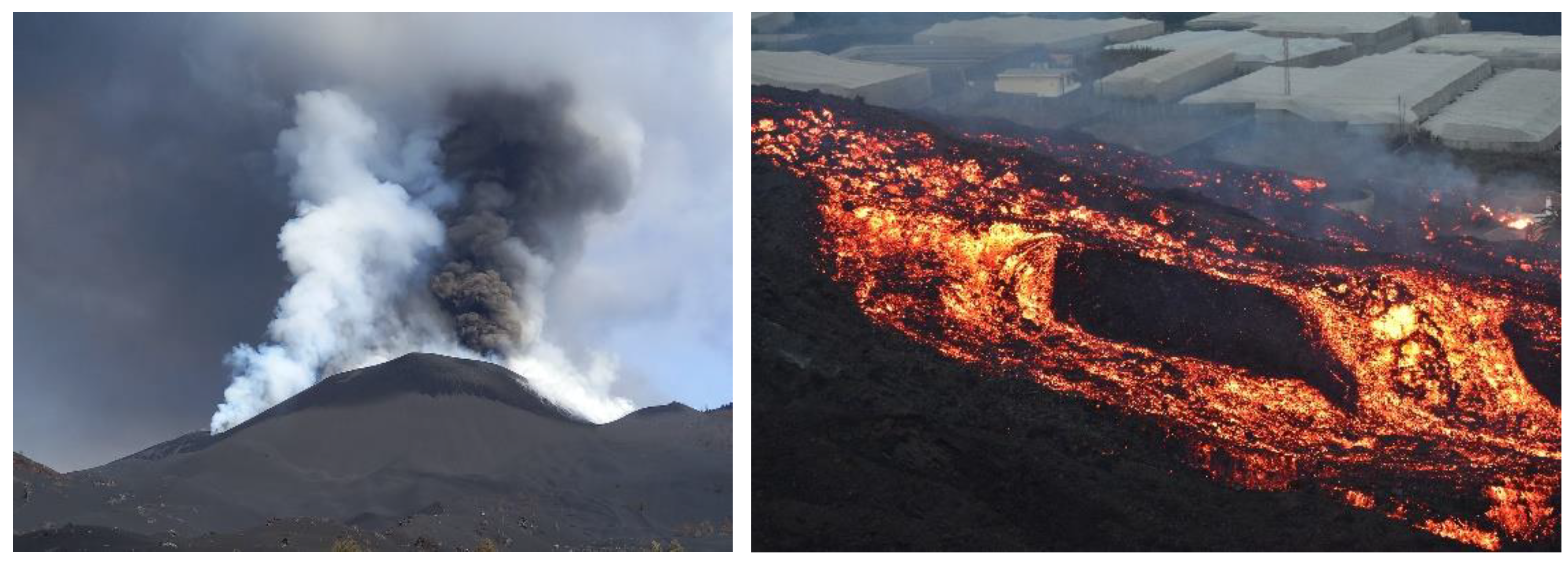
Editorial of the Special Issue “Geomorphology, Geoheritage, Geoparks and Geotourism in Volcanic Areas”


Funding
Conflicts of Interest
References
- Quesada-Roman, A.; Perez-Umaña, D. State of the art of geodiversity, geoconservation and geotourism in Costa Rica. Geosciences 2020, 10, 211. [Google Scholar] [CrossRef]
- Becerra-Ramírez, R.; Gosálvez, R.; Escobar, E.; González, E.; Serrano-Patón, M.; Guevara, D. Characterization and Geotourist Resources of the Campo de Calatrava Volcanic Region (Ciudad Real, Castilla-La Mancha, Spain) to Develop a UNESCO Global Geopark Project. Geosciences 2020, 10, 441. [Google Scholar] [CrossRef]
- Megerle, H. Geoheritage and Geotourism in Regions with Extinct Volcanism in Germany; Case Study Southwest Germany with UNESCO Global Geopark Swabian Alb. Geosciences 2020, 10, 445. [Google Scholar] [CrossRef]
- Beltrán-Yanes, E.; Dóniz-Páez, J.; Esquivel-Sigut, I. Chinyero Volcanic Landscape Trail (Canary Islands, Spain): A Geotourism Proposal to Identify Natural and Cultural Heritage in Volcanic Areas. Geosciences 2020, 10, 453. [Google Scholar] [CrossRef]
- Parkes, M.; Gatley, S.; Gallagher, V. Old Volcanic Stories—Bringing Ancient Volcanoes to Life in Ireland’s Geological Heritage Sites. Geosciences 2020, 10, 52. [Google Scholar] [CrossRef]
- Carrión-Mero, P.; Montalván-Burbano, N.; Paz-Salas, N.; Morante-Carballo, F. Volcanic Geomorphology: A Review of Worldwide Research. Geosciences 2020, 10, 347. [Google Scholar] [CrossRef]
- Dóniz-Páez, J.; Beltrán-Yanes, E.; Becerra-Ramírez, R.; Pérez, N.; Hernández, P.; Hernández, W. Diversity of Volcanic Geoheritage in the Canary Islands, Spain. Geosciences 2020, 10, 390. [Google Scholar] [CrossRef]
- Vörö, F.; Pál, M.; Van Wyk De Vries, B.; Székely, B. Development of a New Type of Geodiversity System for the Scoria Cones of the Chaîne des Puys Based on Geomorphometric Studies. Geosciences 2020, 10, 58. [Google Scholar] [CrossRef]
- Moretti, R.; Moune, S.; Jessop, D.; Glynn, C.; Robert, V.; Deroussi, S. The Basse-Terre Island of Guadeloupe (Eastern Caribbean, France) and Its Volcanic-Hydrothermal Geodiversity: A Case Study of Challenges, Perspectives, and New Paradigms for Resilience and Sustainability on Volcanic Islands. Geosciences 2020, 10, 454. [Google Scholar] [CrossRef]
- Ureta, G.; Németh, K.; Aguilera, F.; González, R. Features That Favor the Prediction of the Emplacement Location of Maar Volcanoes: A Case Study in the Central Andes, Northern Chile. Geosciences 2020, 10, 507. [Google Scholar] [CrossRef]
- Santo, A. A New Magma Type in the Continental Collision Zone. The Case of Capraia Island (Tuscany, Italy). Geosciences 2020, 11, 104. [Google Scholar] [CrossRef]

Publisher’s Note: MDPI stays neutral with regard to jurisdictional claims in published maps and institutional affiliations. |
© 2022 by the author. Licensee MDPI, Basel, Switzerland. This article is an open access article distributed under the terms and conditions of the Creative Commons Attribution (CC BY) license (https://creativecommons.org/licenses/by/4.0/).
Share and Cite
Dóniz-Páez, J. Editorial of the Special Issue “Geomorphology, Geoheritage, Geoparks and Geotourism in Volcanic Areas”. Geosciences 2022, 12, 85. https://doi.org/10.3390/geosciences12020085
Dóniz-Páez J. Editorial of the Special Issue “Geomorphology, Geoheritage, Geoparks and Geotourism in Volcanic Areas”. Geosciences. 2022; 12(2):85. https://doi.org/10.3390/geosciences12020085
Chicago/Turabian StyleDóniz-Páez, Javier. 2022. "Editorial of the Special Issue “Geomorphology, Geoheritage, Geoparks and Geotourism in Volcanic Areas”" Geosciences 12, no. 2: 85. https://doi.org/10.3390/geosciences12020085
APA StyleDóniz-Páez, J. (2022). Editorial of the Special Issue “Geomorphology, Geoheritage, Geoparks and Geotourism in Volcanic Areas”. Geosciences, 12(2), 85. https://doi.org/10.3390/geosciences12020085