1. Introduction
Water buffalo (
Bubalus bubalis) production has been recognized as a production model that converts low-quality roughage into high-quality animal products, thanks to the species’ high resistance to climatic and climate-change-related temperature stress [
1,
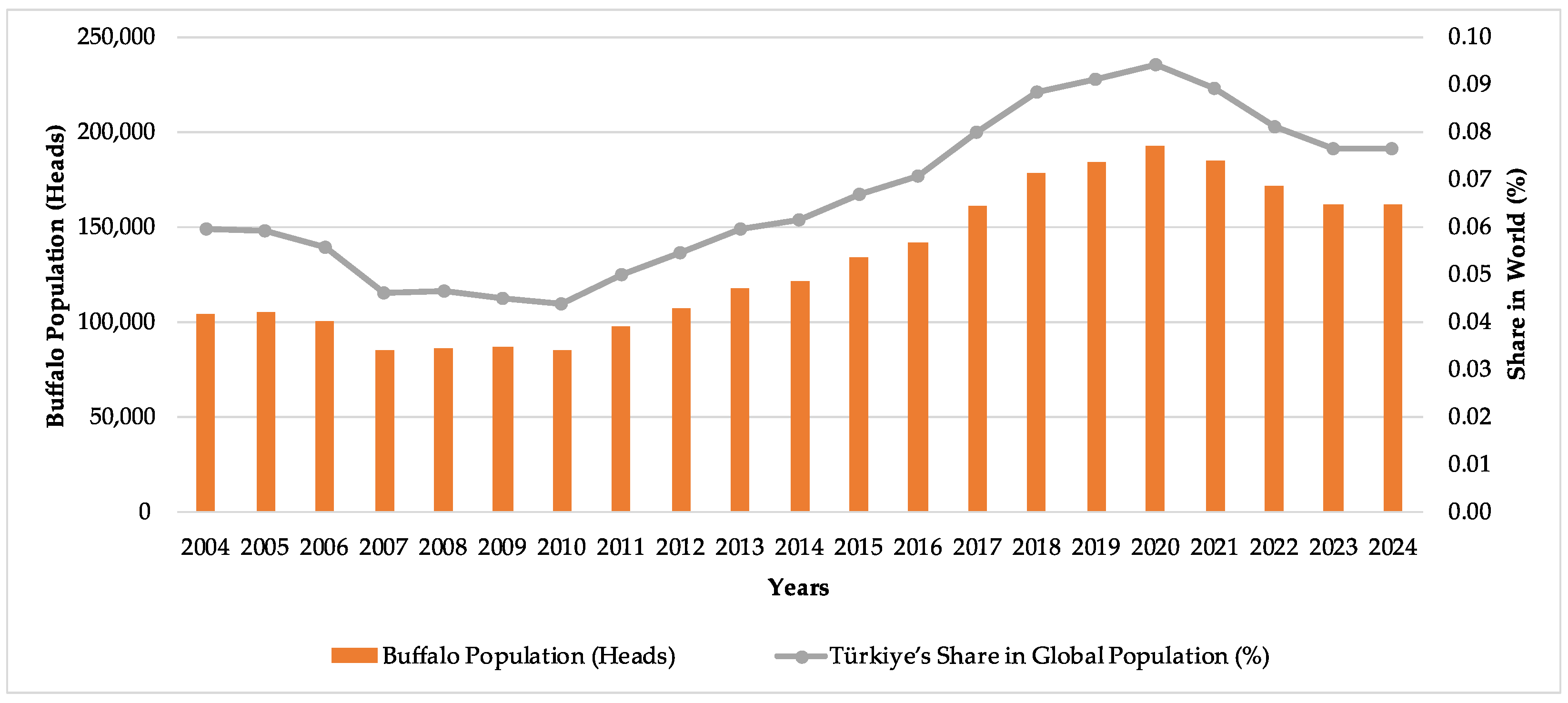
2]. Amid increasing global population pressure, growing pressure on natural resources, and volatile market conditions, it was established that food security was determined not only by production volumes but also by the sustainability and resilience of production systems. In Türkiye, breeding projects and public support that have been implemented since 2010 have resulted in sectoral revitalization. The water buffalo population increased from 84,726 head in 2010 to 192,489 head in 2020 (an increase of 127%), and Türkiye’s share of the world water buffalo population rose from 0.04% to 0.09%, making Türkiye a production center both in Europe and globally [
3]. However, as illustrated in
Figure 1, the declining trend that began in 2020 led to the buffalo population falling to 162,051 head in 2024, suggesting that quantitative expansion alone may not be sufficient without structural sustainability. The contraction observed after 2020 coincides with a period characterized by the COVID-19 pandemic, increased macroeconomic volatility, and persistently high inflation in Türkiye. Since livestock support schemes are predominantly structured as per-head payments, the real value of these supports has eroded under inflationary pressures, thereby weakening their capacity to sustain herd expansion. In addition, compared to dairy cattle breeds, water buffalo exhibit relatively lower milk yield levels, which may limit their competitive position within the dairy market. These structural and economic factors collectively appear to have contributed to the slowdown and partial reversal of the growth trend observed during the previous decade. These findings suggest that transforming this biological and quantitative potential into a lasting economic model depends directly on technical knowledge at the farm level, managerial competence, and sustainable, highly resilient outcomes. In particular, the future of this sector, viewed as a resilient element of the traditional family-farm structure within rural household economies, warrants research into resource-use efficiency and productivity.
These developments highlight the importance of evaluating production performance not only in terms of quantitative expansion but also in terms of resource-use efficiency and long-term sustainability. In this context, technical efficiency provides a fundamental analytical lens for assessing how effectively production units transform inputs into outputs under existing technological conditions [
4]. Numerous studies have examined efficiency measurement in the broader livestock sector [
5,
6,
7,
8,
9,
10,
11,
12,
13,
14,
15,
16,
17,
18]. However, within water buffalo production systems, empirical evidence remains comparatively limited [
19,
20,
21,
22,
23,
24,
25,
26].
In this context, socio-economic determinants of milk production in the Thanamalwila veterinary region of Sri Lanka were identified, and the technical efficiency of production was estimated [
19]. The economic structure and efficiency of dairy water buffalo farms in the Çatalca district of Istanbul, Türkiye, were examined [
20]. The economic efficiency of water buffalo farming conducted under the herdsman system in Indonesia was determined [
21]. Production costs and technical efficiency levels of water buffalo milk farms in Iğdır Province, Türkiye, were determined [
22]. The effect of cooperative membership on the technical and marketing efficiencies of water buffalo milk producers was investigated in the Philippines [
23]. The efficiency of water buffalo farms operating under a semi-intensive system in Balıkesir Province was analyzed [
24]. The efficiency scores of dairy water buffalo farms in the Philippine province of Nueva Ecija were measured [
25]. The impact of development programs on water buffalo milk producers in the swampy regions of Iraq was evaluated, focusing on productivity levels and living standards [
26].
Overall, these studies primarily emphasize input–output optimization and cross-sectional efficiency comparisons, while offering limited evidence on whether efficiency differentials translate into multidimensional sustainability outcomes in water buffalo farming.
Against this background, sustainability was presented as a broader evaluative perspective for livestock systems that extended beyond productivity performance. In a broad sense, it was considered to encompass economic, social, and environmental dimensions. Economic sustainability was associated with the ability of production systems to remain viable and resilient over time; social sustainability was linked to the continuity of rural livelihoods, social structures, and community well-being; and environmental sustainability was defined in relation to the responsible use and preservation of natural resources in ways that did not compromise ecological balance in the long run.
From a broader sustainability perspective, the sustainability of livestock systems has been analyzed in the literature using multidimensional methodologies that include economic, social, and environmental dimensions, as well as institutional and technological components, in accordance with regional dynamics [
27,
28,
29,
30,
31,
32,
33,
34,
35,
36,
37,
38,
39,
40,
41,
42,
43,
44]. In this context, integrated assessment methods were developed for small-scale dairy farms in India [
27]; the sustainability status of cattle breeding in Indonesia was examined using Multidimensional Scaling (MDS) [
28]; and the sustainability of cattle breeding was evaluated through key indicators [
29]. Within the framework of geographical and ecosystem-focused approaches, indicators were produced using participatory rural assessment techniques in South Africa [
30], and fuzzy logic-based decision support systems were defined in the Pantanal wetlands of Brazil [
31]. In studies that employed greater methodological diversity, the sustainability status of dairy farming areas was analyzed [
32], conventional and organic production units were compared using the MESMIS methodology [
33], and general frameworks for sustainability indices of integrated facilities were presented [
34]. Integrated sustainability indicators for milk production systems were proposed in Colombia [
35], and comprehensive scoring methods based on scientific information were developed for beef production systems [
36]. In European and Latin American examples, researchers compared extensive farms in Spain according to their organic orientation [
37], analyzed silvopastoral systems in Mexico using the SAFA framework, and developed unique indicators for production models in the Brazilian Amazon [
38,
39]. Studies conducted in Türkiye characterized the heterogeneity of water buffalo breeding systems in the Marmara Region [
40] and determined the effect of farm size on the sustainability of beef cattle farms in Samsun Province [
41]. Recent research re-evaluated cattle production systems within the MESMIS framework [
42], designed nonlinear regression models to measure rural sustainability [
43], and analyzed cattle integration using the RAP-Integration approach [
44].
Although sustainability has been widely examined in livestock systems using multidimensional assessment frameworks, empirical studies explicitly measuring sustainability performance in water buffalo production remain relatively limited. Moreover, existing research rarely integrates technical efficiency analysis with multidimensional sustainability assessment within a unified empirical framework. While technical efficiency is generally associated with improved resource allocation and is often considered a necessary condition for sustainable production, it does not automatically ensure balanced outcomes across economic, social, and environmental sustainability dimensions. In this sense, efficiency and sustainability can be viewed as analytically related yet structurally distinct constructs that may reinforce—but do not inevitably guarantee—one another.
Against this background, the relationship between farms’ technical efficiency (operational performance) and their multidimensional sustainability outcomes remains insufficiently understood, particularly with respect to whether efficiency gains are consistently reflected across economic, social, and environmental dimensions.
Rather than presuming a direct correspondence between efficiency gains and sustainability outcomes, this study explores whether a structural disconnection may exist between productivity-oriented performance and multidimensional sustainability achievements in water buffalo farming.
Accordingly, the primary objective of this study was to assess the technical efficiency levels of water buffalo farms using Data Envelopment Analysis and to evaluate their multidimensional sustainability performance through a composite index framework. In addition, it was examined whether farms with different efficiency levels exhibited systematic differences in economic, social, and environmental sustainability outcomes. Furthermore, the structural and socio-economic determinants of inefficiency were identified using a Tobit model in order to better understand the factors shaping performance variation within the Turkish buffalo production context. The analysis was conducted using farm-level data from Türkiye, thereby providing insights relevant to similar low-input livestock systems.
3. Results
Descriptive statistics for the farms included in the study are summarized in
Table 4. Gross value of production (GPV) was used as the output variable in the efficiency analysis, while roughage, concentrate feed, Livestock Units (AU), labor, and veterinary costs were used as input variables. According to the results, the average GPV per farm was
$13,800.57. However, production values across farms varied between
$3015.19 and
$52,692.72, indicating substantial variability. Examination of input usage levels revealed significant differences among farms, particularly in feeding practices. The average roughage usage per farm was 39,833.97 kg, and the average concentrate feed usage per farm was 13,151.11 kg. The standard deviations of the input variables were found to be considerably higher than their means, indicating heterogeneity in the regional production system. The minimum values for concentrate feed use (0.01 kg) and labor input (34.5 h) were observed to be substantially lower than the corresponding sample averages. Considerable variation across farms was detected, particularly with respect to pasture utilization levels. Farm sizes were standardized using LU coefficients, and the average farm size was determined to be 22.37 LU. Farm sizes ranged from 4.50 LU to 83.56 LU. In water buffalo breeding, an average of 1614.25 h of labor was used per farm, while the amount spent on veterinary services was approximately
$509.97.
The frequency distribution and summary statistics of the technical efficiency (TE) scores of water buffalo farms in the research area are presented in
Table 5. According to the DEA results, the farms’ average technical efficiency score was 0.717. This value indicated that, under current production technologies and management conditions, farms could reduce input usage by an average of 28.3% without changing output levels.
The distribution of efficiency scores ranged from a minimum of 0.221 to a maximum of 1.000. Out of the 72 farms analyzed, 14 (19.4%) were found to be technically efficient (efficiency score = 1.000). The high standard deviation (0.236) indicated substantial disparities between farms in managerial success and resource-utilization skills.
The frequency distribution indicated that 43.06% (31 sampled farms) had high efficiency scores (0.75–1.00). In contrast, 29.17% (21 farms) performed poorly, falling below 0.50. The percentage of farms showing moderate efficiency (0.51–0.74) was 27.78% (20 farms). The results revealed that a significant proportion of farms in the region required radical improvements in their production processes to catch up with best-practice peers.
The economic sustainability indices of the farms included in the research and the findings related to the sub-components of these indices are summarized in
Table 6, classified according to their technical efficiency levels. Based on the calculations, the average Economic Sustainability Index across all farms was 0.45.
When the technical efficiency groups were examined, the Economic Sustainability Index was 0.43 in the “inefficient” group, increased to 0.47 in the “moderately efficient” group, and reached 0.46 in the “efficient” group. However, the Kruskal–Wallis test indicated that the observed fluctuations between groups were not statistically significant (p = 0.276).
Upon detailed examination of the sub-components, the “relative profit” indicator was 0.40 in efficient farms, compared to 0.16 and 0.29 in the other groups, respectively. In contrast, the “income–expense record-keeping” indicator was 0.10 in the efficient group. The production cost index was calculated as 0.75 in the moderately efficient group and 0.71 in the efficient group. The “forage crop production” index was 0.90 across all groups, regardless of the technical efficiency level.
The levels of social sustainability of farms in the research area and the sub-parameters comprising this index were analyzed across technical efficiency groups and summarized in
Table 7. Based on the calculations, the region’s average Social Sustainability Index was 0.44.
When examined by technical efficiency groups, the Social Sustainability Index was 0.43 for inefficient and moderately efficient farms and 0.45 for efficient farms. However, the Kruskal–Wallis test revealed that this observed difference between groups was not statistically significant (p = 0.304).
Detailed analysis of the sub-indicators showed that the highest score was observed in “access to veterinary and other health services” (0.99), followed by “agricultural organization” and “the importance of the family idea in the decision-making process for water buffalo breeding,” both with scores of 0.94. However, a striking paradox was observed: while the level of “agricultural organization” was 1.00 (full participation) in efficient farms, the level of “participation in agricultural extension activities” was 0.00 in the same group.
The weakest links negatively affecting social sustainability were agricultural extension activities (0.04) and social activities (0.07). Furthermore, the “satisfaction with social life” level remained at 0.17 in the overall average.
One of the largest numerical differences between technical efficiency groups was observed for access to infrastructure, although this difference was not statistically significant. The adequacy of transportation and infrastructure services was measured at 0.67 for inefficient farms and 0.84 for efficient farms.
Table 8 presents the environmental sustainability levels of farms in the research area and the index scores of the sub-indicators comprising this dimension. According to the results, the overall Environmental Sustainability Index averaged 0.50 points. When technical efficiency groups were examined, the Environmental Sustainability Index score increased from 0.47 in inefficient farms to 0.53 in efficient farms, with 0.49 in moderately efficient farms. The Kruskal–Wallis test indicated no statistically significant differences (
p = 0.341).
When the environmental indicators were examined in detail, a substantial gap was observed between the farmers’ perceived awareness indices and their implementation indices. Farms were found to have index scores close to the maximum (1.00) in the indicators of “paying attention to environmentally friendly practices in cultivation” (0.97) and “paying attention to the hygiene of tools and equipment” (0.99). However, the “presence of manure pits” index remained extremely low, with an overall average of 0.15.
The most significant proportional divergence between the efficiency groups was observed in the infrastructure indices. The manure pit presence index was 0.05 in inefficient farms and increased to 0.29 in efficient farms. Similarly, the perception index regarding “sufficiency of pasture areas” reached 0.52 points in efficient farms, compared to 0.38 points in inefficient farms. The indicator “Considering livestock farming important for biodiversity” was reflected in a score of 0.78. However, the “covered space per animal” index was measured at 0.08.
The results of the Composite Sustainability Index (CSI), which integrates economic, social, and environmental dimensions within a holistic framework, were presented in
Table 9. Based on the calculations, the Composite Sustainability Index of water buffalo-breeding farms in the research area averaged 0.41. According to the reference ranges defined in the Methodology section, this value corresponded to the “moderate” sustainability level (0.41–0.60).
A comparison of sub-dimensions indicated that the environmental dimension contributed the highest score (0.50), followed by the economic dimension (0.45). The lowest contribution was observed in the social sustainability dimension, with a score of 0.44.
When the effect of technical efficiency on sustainability performance was examined using the Kruskal–Wallis test, no statistically significant differences were identified between efficiency groups in any dimension, including the Composite Sustainability Index (
p = 0.103), economic (
p = 0.276), social (
p = 0.304), and environmental (
p = 0.341) dimensions. The Kruskal–Wallis test results are presented in
Table 10.
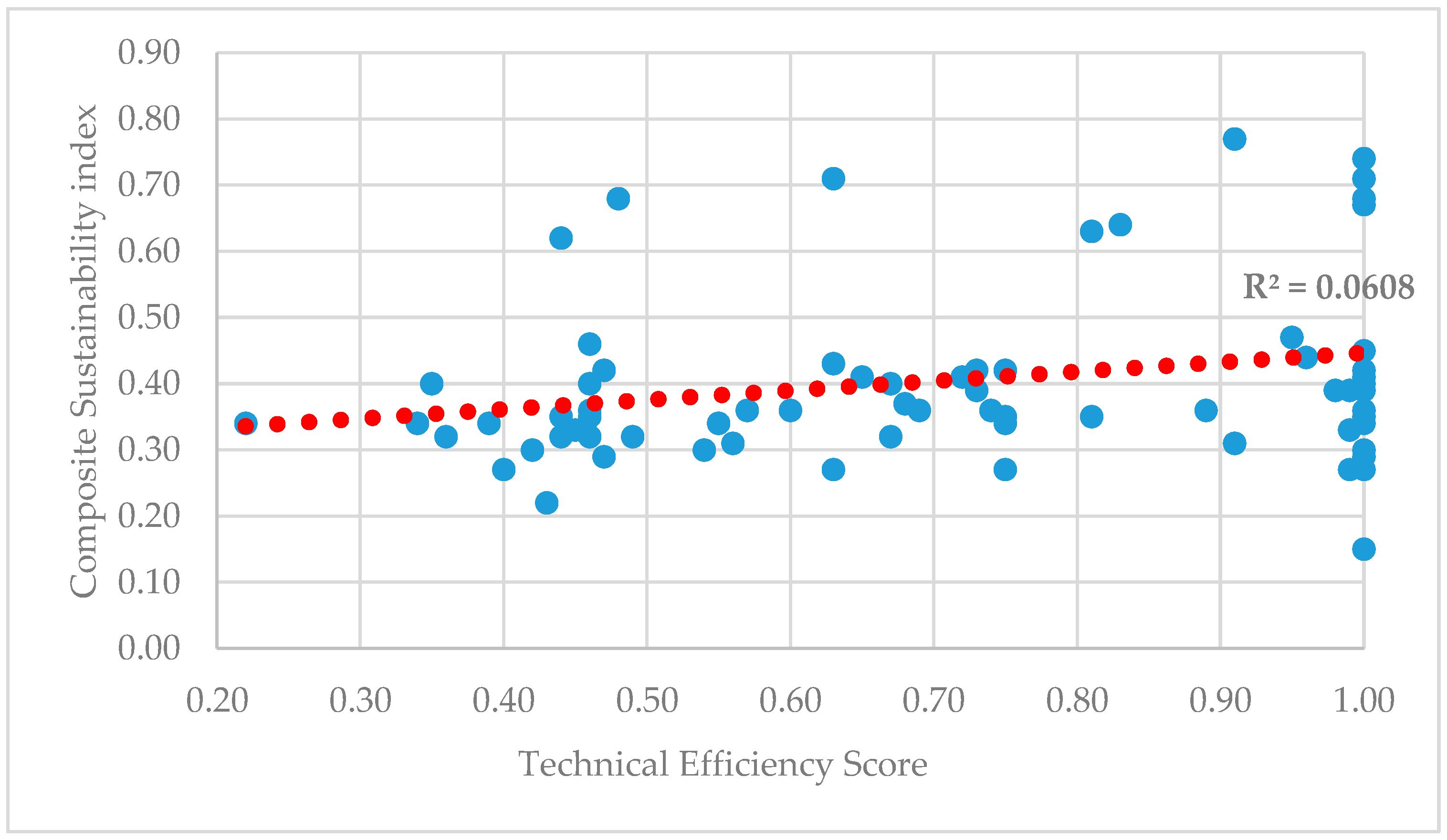
The scatter plot illustrating the relationship between farms’ technical efficiency scores and composite sustainability index scores was presented in
Figure 2. The distribution of the data points exhibited a dispersed pattern rather than a clear linear association, and the fitted regression line appeared approximately horizontal.
The calculated coefficient of determination (R2 ≈ 0.06) indicated that variations in technical efficiency accounted for only a very small proportion of the variation in sustainability performance. This simple linear regression was presented for descriptive and exploratory purposes to visualize the pattern of association between the two variables.
The primary inferential assessment of differences in sustainability performance across technical efficiency groups was conducted using the Kruskal–Wallis test. Consistent with these test results, no statistically significant relationship was identified between technical efficiency and composite sustainability.
Descriptive statistics for the variables used in the Tobit model were presented in
Table 11. Farmers had an average of 32.75 years of experience in crop production and 32.46 years of experience in livestock breeding.
The mean education level was 2.56, corresponding approximately to lower-to-upper secondary education.
Regarding economic characteristics, 48.6% of the farmers reported having non-farm income, while 70.8% were classified as indebted.
In terms of digital infrastructure, 62.5% of the farms had access to a computer, and 75.0% reported having an internet connection.
Table 12 presents the Tobit regression estimates and the corresponding average marginal effects (AME) for the determinants of technical efficiency in water buffalo breeding farms. The likelihood ratio statistic indicated that the model was jointly significant (LR χ
2(7) = 29.23,
p < 0.01), confirming that the explanatory variables jointly explain variations in efficiency. The presence of right-censoring (14 out of 72 observations) supported the appropriateness of the Tobit specification. Diagnostic tests indicated no multicollinearity problem, as all centered variance inflation factors (VIFs) were below the conventional threshold of 5. The White heteroskedasticity test failed to reject the null hypothesis of homoskedasticity (
p > 0.05), indicating no evidence of heteroskedasticity.
Experience in plant production was negatively and statistically significantly associated with technical efficiency at the 1% level (AME = −0.011). This result indicated that an additional year of crop production experience was associated with a 0.011 decrease in the efficiency score.
Non-farm income was positively associated with technical efficiency and was statistically significant at the 1% level. The average marginal effect (0.206) suggested that farms with alternative income sources were associated with, on average, a 0.206-point higher efficiency score compared to those without non-farm income.
Experience in livestock breeding was positively and statistically significantly associated with technical efficiency (AME = 0.013, p < 0.01). Each additional year of livestock experience was associated with an approximately 0.013-point higher efficiency score.
Indebtedness status was negatively associated with technical efficiency and was statistically significant at the 1% level (AME = −0.164). Farms with outstanding debt exhibited lower efficiency levels relative to non-indebted farms.
With regard to digital variables, internet access exhibited a positive and statistically significant association with technical efficiency at the 5% level (AME = 0.142). This finding suggested that farms with internet access were associated with, on average, a 0.142-point higher efficiency score compared to those without internet connectivity.
In contrast, computer ownership did not show a statistically significant association with technical efficiency (p > 0.10), indicating that mere access to hardware is not sufficient to generate measurable efficiency gains.
4. Discussion
4.1. Technical Efficiency Performance
The average technical efficiency score of 0.717 suggests that, under prevailing production technologies and managerial conditions, water buffalo farms in the study area were operating below the efficiency frontier, with considerable scope remaining for input optimization.
When compared with findings reported in the national and international literature, the efficiency level observed in this study can be positioned within an intermediate range of the broader empirical distribution. When studies conducted specifically in Türkiye are considered, one study analyzing farms in Iğdır Province reported average technical efficiency scores of 0.84 under constant returns to scale (CRS) and 0.95 under variable returns to scale (VRS) using the input-oriented DEA model [
22]. These values were higher than those reported in the current study. These differences may be attributable to variations in production scale, technological adoption levels, access to extension services, and regional market integration.
In contrast, another study examining semi-intensive farms in Balıkesir Province reported pure technical efficiency (VRSTE) of 0.668 and total technical efficiency (CRSTE) of 0.463 in the output-oriented model [
24]. Relative to these findings, the performance of farms in the present study may be regarded as comparatively stronger, although still below the frontier observed in more advanced production environments.
Results in the international literature show considerable variation. In a study examining farms in Sri Lanka, the average technical efficiency was reported as 0.868 [
19], whereas in another study conducted in the Philippines, this value was determined to be 0.505 using the SFA method [
23]. In a further study conducted in the Philippines, overall technical efficiency was estimated at 0.80; however, small-scale farms (0.76) were found to perform worse than commercial farms (0.99) [
25]. A recent study of water buffalo farmers in Iraq found the average technical efficiency to be 0.74; this rate increased to 0.78 among those who adopted modern technologies but remained at 0.55 among those who did not [
26].
Taken together, these comparisons indicate that measured efficiency outcomes are likely influenced by technological adoption, scale effects, and methodological differences (DEA versus SFA; input- versus output-oriented specifications).
Therefore, the efficiency score of 0.717 achieved in the present study may be interpreted as falling within the upper-middle range of the global distribution reported in the literature while simultaneously reflecting substantial potential for improved resource allocation and productivity enhancement.
4.2. Sustainability
The absence of statistically significant differences in economic sustainability across technical efficiency groups suggested that technical efficiency alone may not directly translate into higher economic sustainability performance.
Although efficient farms achieved higher scores in the “relative profit” indicator, their comparatively low performance in “income–expense record-keeping” indicates potential managerial weaknesses. The relatively stronger performance of moderately efficient farms in record-keeping practices appeared to have contributed to their higher composite index scores. This finding highlighted the importance of managerial discipline alongside production efficiency.
Furthermore, the consistently high “forage crop production” index across all efficiency levels suggested that forage crop cultivation has been widely adopted as a standard agricultural practice in the region, independent of technical efficiency status.
Overall, these findings indicated that while technical efficiency enhanced physical production performance, it did not automatically ensure superior economic sustainability outcomes. Managerial capacity, particularly in financial record-keeping and cost management, emerged as a critical complementary factor in strengthening overall economic sustainability.
The absence of statistically significant differences across technical efficiency groups suggested that social sustainability challenges in the region may be structural rather than directly linked to farm-level efficiency performance. The relatively uniform social sustainability scores across groups indicated that broader regional development dynamics may play a determining role.
The paradox between high formal membership in agricultural organizations and zero participation in agricultural extension activities highlighted potential dysfunction within institutional structures. Although membership levels appeared high, the limited provision of technical knowledge and extension services suggested that these organizations may not be effectively fulfilling their developmental role.
The very low levels observed in agricultural extension activities and social activities pointed to systemic weaknesses in knowledge dissemination and social capital formation. The low satisfaction with social life further indicated potential constraints related to rural welfare conditions. Although infrastructure and transportation services were measured at higher levels in efficient farms, the absence of statistical significance suggested that physical infrastructure alone may not be sufficient to ensure stronger social sustainability outcomes.
Overall, while access to veterinary services and family solidarity appeared strong in the region, the inadequacy of extension services and limited social engagement emerged as key vulnerabilities that may threaten the long-term social sustainability of regional water buffalo production systems.
Although an apparent increasing trend across groups was observed, the absence of statistically significant differences suggested that improvements in technical efficiency may not automatically translate into statistically distinguishable environmental performance gains.
The marked discrepancy between awareness-based indicators and implementation-based indicators indicated a structural gap between environmental intentions and actual practice. Despite high awareness scores, the extremely low manure pit index suggested constraints related to infrastructure availability and financial capacity.
The fact that even efficient farms did not reach the “sustainable” threshold (above 0.60) in infrastructure-related indicators supported the interpretation that environmental sustainability challenges may be rooted in regional infrastructure deficiencies rather than purely farm-level managerial differences.
Similarly, while livestock farming is widely perceived as important for biodiversity, the very low “covered space per animal” index highlighted deficiencies in compliance with animal welfare standards.
In conclusion, farms in the region demonstrated relatively high environmental awareness; however, this awareness did not appear to have been fully translated into holistic environmental performance due to limitations in physical infrastructure, particularly manure management systems and shelter conditions.
The overall CSI value of 0.41 placed the production system at the lower bound of the “moderate” sustainability category, suggesting a structurally fragile configuration.
The CSI score obtained in this study was compared with the value of 0.49 reported for cattle breeding in Türkiye [
41,
51]. In the broader literature, sustainability scores have been reported to range between 0.45 and 0.50 in small-scale operations in India [
27,
29] and between 37% and 41% in Indonesia and South Africa [
28,
30].
However, such cross-study comparisons should be interpreted with caution. Differences in indicator selection, weighting schemes, aggregation procedures, sampling frameworks, and even livestock species may limit the methodological comparability of CSI values across studies. Therefore, the numerical similarities or differences reported in the literature should be regarded as indicative rather than strictly equivalent benchmarks.
The finding that the social sustainability dimension emerged as the weakest component was consistent with patterns observed in several small-scale livestock systems in developing countries [
30], suggesting that institutional and social constraints may represent a common structural vulnerability.
Furthermore, the absence of statistically significant differences between technical efficiency groups indicated that improvements in production efficiency alone may not be sufficient to generate measurable gains in composite sustainability under existing infrastructural and market conditions.
4.3. Determinants of Technical Efficiency
The empirical findings indicated that technical efficiency in water buffalo breeding was systematically related to several farm-level characteristics. The overall pattern of results suggested that efficiency was primarily associated with farmers’ managerial orientation, financial conditions, and access to information. In particular, the significance and direction of the experience, income, indebtedness, and digital variables revealed that both managerial allocation and financial capacity play decisive roles in shaping technical performance.
The negative and statistically significant effect of crop production experience indicated that as farmers concentrate more on crop production, the labor, time, and managerial attention allocated to buffalo breeding may decrease. This result suggested that greater engagement in crop production may reduce the managerial attention and resource allocation devoted to buffalo breeding, thereby lowering branch-specific technical efficiency within the farm. In contrast, experience in livestock breeding exerted a positive and statistically significant effect on technical efficiency. This finding implied that accumulated herd management knowledge, husbandry skills, and sector-specific experience enhanced production performance. The cumulative effect of practical livestock experience appeared to be more decisive for improving technical efficiency than experience acquired in other agricultural activities.
The positive and statistically significant coefficient of non-farm income suggested that alternative income sources contributed positively to technical efficiency. Non-farm income may ease cash-flow constraints, enable timely procurement of feed and other inputs, and improve farmers’ ability to manage market risks. In this context, income diversification appeared to function as a stabilizing mechanism that supports operational efficiency under volatile economic conditions.
One of the most striking findings concerns the financial structure of farms. The negative and statistically significant effect of indebtedness status indicated that indebted farmers tended to exhibit lower technical efficiency compared to non-indebted farmers. Debt obligations may constrain managerial flexibility, distort optimal input combinations, and reduce farmers’ ability to allocate resources efficiently, ultimately lowering technical efficiency levels.
With regard to digital factors, internet access positively and significantly influenced technical efficiency, indicating that connectivity enhanced access to market information, extension services, and technical knowledge. However, computer ownership did not show a statistically significant effect, suggesting that infrastructure alone did not guarantee productivity gains unless it was effectively utilized for production- and management-related purposes. These results implied that functional access to information networks was more critical than mere ownership of technological equipment. Nevertheless, the positive association between internet access and technical efficiency should be interpreted with caution. It is possible that more efficient farms are also more likely to adopt digital tools, suggesting potential reverse causality. Moreover, internet access may proxy for unobserved factors such as farm scale, market integration, or managerial openness to innovation. Therefore, the results should be viewed as associative rather than strictly causal.
Finally, although the coefficient of education level was negative and only marginally significant, the results indicate that formal schooling did not produce a statistically meaningful improvement in technical efficiency among buffalo farmers. This finding partially contradicts previous studies reporting a positive association between education and farm performance [
5,
24]. However, in the present sample, the limited variation in formal education levels and the dominance of traditional production practices may explain why formal schooling does not translate into measurable efficiency gains. In traditional buffalo breeding systems, experiential knowledge and practical expertise appear to outweigh formal educational attainment in shaping production performance.
The findings revealed that technical efficiency in water buffalo breeding was primarily shaped by sector-specific experience, financial resilience, and effective access to information rather than by general demographic characteristics. While some results were consistent with the existing literature, others highlighted context-specific dynamics that differentiate buffalo breeding farms from other livestock production systems. These outcomes underscored the importance of managerial specialization, balanced financial structures, and functional digital access in enhancing efficiency within traditional buffalo farming environments.
4.4. Limitations and Future Directions
Several limitations of this study should be acknowledged. First, the empirical analysis was limited to a single province, which may constrain the generalizability of the findings to other water buffalo farming regions characterized by different structural, institutional, and market conditions. Second, the cross-sectional design restricts the ability to establish causal relationships among the variables examined; therefore, the findings should be interpreted as associative rather than causal. In addition, the relatively limited variation in formal education levels within the sample and potential measurement constraints regarding educational attainment may have reduced the statistical power to detect a clearer effect of education on technical efficiency. Third, due to data constraints, the environmental dimension does not include direct indicators of greenhouse gas emissions or water-use intensity, which are increasingly recognized as critical components of livestock sustainability assessments.
Building on these limitations, future research could adopt longitudinal designs and panel data approaches across different provinces in Türkiye to examine dynamic changes in sustainability performance and institutional evolution over time. Comparative analyses across Mediterranean water buffalo farming regions may also provide deeper insights into how diverse policy frameworks and market structures influence sustainability outcomes. Moreover, integrating additional environmental indicators—such as greenhouse gas emissions and water footprint measures—would further strengthen the robustness and external validity of composite sustainability assessments in traditional, low-input livestock systems.
5. Conclusions
The empirical findings indicate that the average technical efficiency score was 0.717, while the Composite Sustainability Index (CSI) averaged 0.41. Moreover, no statistically significant relationship was identified between technical efficiency and composite sustainability performance. This study demonstrated that while achieving technical efficiency in water buffalo breeding provided the basis for a sustainable production model, it was insufficient on its own under current market and infrastructure conditions. The farms in the research area exhibited a fragile structure, remaining at the lower end of the “moderate” level with a Composite Sustainability Index. More importantly, contrary to the theoretical assumption that increasing technical efficiency at the farm level would automatically improve sustainability performance, a structural disconnect between technical efficiency and sustainability performance was found in regional water buffalo breeding. The inability of even the most efficient farms to differentiate themselves from other groups in terms of financial record-keeping, organizational strength, and environmental investment suggested that the problem stemmed from macro-level structural bottlenecks rather than micro-level management errors. The analysis revealed two fundamental structural vulnerabilities specific to the region. Firstly, there was a substantial gap between environmental intentions and concrete practices. Although farmers were found to have a high level of environmental awareness, insufficient capital accumulation and deficient infrastructure prevented this awareness from translating into investments such as manure management. The second issue is dysfunctional organization: despite seemingly high cooperative rates on paper, the inability to provide farmers with technical information and to disseminate knowledge was identified as the most critical factor weakening social sustainability. Furthermore, it was determined that using digital tools solely for social interaction, rather than as sources of agricultural information, created information asymmetry that reduces productivity. Conversely, external financing sources were a critical solution for overcoming input constraints. For the sector to escape its current “fragile middle” status and achieve lasting sustainability, it is deemed essential for policymakers to shift from quantity-focused support to a structural transformation-focused model. While current quantity-focused support (per-animal payments, etc.) encouraged farms to increase physical capacity, its failure to reward sustainability criteria such as record-keeping, waste management, and professional organization deepened this structural disconnect. At the national level, existing support schemes primarily emphasize production and capacity expansion, reinforcing the need to integrate explicit sustainability criteria into public support frameworks. In this context, we recommend that policymakers shift from quantity-focused support mechanisms toward a structural transformation model that transforms agricultural organizations into active extension centers that provide financial literacy and technical knowledge for farmers and direct public support towards modernization projects that translate environmental awareness into action. These policy implications are directly grounded in the empirical findings, particularly the absence of a statistically significant relationship between efficiency and sustainability, the negative association of indebtedness with technical efficiency, and the identified gaps in environmental and organizational performance.
Finally, although the empirical findings of this study are specific to the regional water buffalo production system examined, the structural patterns identified—such as institutional weaknesses, limited financial literacy, gaps between environmental awareness and implementation, and information asymmetry within producer organizations—are not unique to this context. Similar structural constraints are observed in other small- and medium-scale water buffalo farming regions in Türkiye as well as in traditional, low-input livestock systems operating under comparable institutional and infrastructural conditions. However, since the empirical evidence is derived from a single province, strict national-level generalization should be approached with caution. Nevertheless, the findings may provide indicative insights for regions facing similar structural, institutional, and market conditions.