Next Article in Journal
EgLDH as a Novel Target: Design and Preliminary Efficacy Assessment of a DNA Vaccine
Previous Article in Journal
Correction: Lin et al. Unraveling Fish Community Assembly Rules in Coastal China Seas Based on Hierarchical Modeling of Species Communities. Animals 2025, 15, 3108
Previous Article in Special Issue
Integrating Beach Monitoring and Satellite Telemetry to Estimate Loggerhead Clutch Frequency in Brazil
 
 
Due to scheduled maintenance work on our servers, there may be short service disruptions on this website between 11:00 and 12:00 CEST on March 28th.
Article

Warming and Change in Ocean Productivity Alter Phenology of an Expanding Loggerhead Population in Cabo Verde


1
Department of Biology, School of Biological and Behavioural Sciences, Queen Mary University of London, London E1 4NS, UK
2
Associação Projeto Biodiversidade, Santa Maria 4111, Sal, Cabo Verde
3
Associação de Defesa de Tartarugas Marinhas e seu Ambiente—SOS Tartarugas, Santa Maria 4111, Sal, Cabo Verde
4
School of Biological Sciences, University of Aberdeen, Aberdeen AB24 2TZ, UK
5
Royal Society for the Protection of Birds Centre for Conservation Science, The Lodge, Sandy SG19 2DL, UK
*
Author to whom correspondence should be addressed.
These authors contributed equally to this work.
Animals 2026, 16(4), 552; https://doi.org/10.3390/ani16040552
Submission received: 22 December 2025 / Revised: 19 January 2026 / Accepted: 30 January 2026 / Published: 11 February 2026
(This article belongs to the Special Issue Sea Turtle Nesting Behavior and Habitat Conservation)

Simple Summary

The diverse responses of sea turtles to climate warming highlight the need for population-specific studies. Here, we used long-term monitoring data from one of the largest loggerhead turtle nesting populations in the world to investigate the reproductive phenology and output in relation to climate warming. We found that warmer years were associated with earlier phenology and longer nesting seasons. At the same time, increased temperatures reduced ocean productivity, which prolonged foraging periods and consequently decreased clutch frequency and size. This decline in reproductive output may ultimately compromise population resilience and slow recovery in the face of ongoing climate warming.

Abstract

Climate warming can alter reproductive timing of species, yet the capacity for phenological adjustment in long-lived species, particularly marine ones, remains elusive. Using 17 years of monitoring data from one of the largest loggerhead turtle (Caretta caretta) populations, we investigated the environmental drivers of reproductive phenology and output. We found that warmer sea surface temperatures (SST) in both the feeding ground and the nesting ground advanced the start, peak, and end of the nesting season. We provide evidence for waves of arrival at the nesting ground, suggesting more turtles produce fewer clutches than previously thought. Inter-nesting intervals were shorter during episodes of higher SST, particularly in larger females, likely underpinned by metabolic scaling variation in reproductive pacing. Conversely, remigration intervals lengthened over time in all size classes, reflecting the detected continuous decrease in productivity in the feeding ground. As a result of reduced ocean productivity, both clutch size and clutch frequency also declined over the study period. Moreover, the declining trend in body size further reduces reproductive output, as smaller females produce smaller clutch sizes. Overall, we show that sea turtle population dynamics correlate with environmental parameters. The sustained decline in reproductive output underscores the need to mitigate the impacts of climate warming on the foraging area to safeguard this population, which, given its size, holds global significance.

1. Introduction

Climate change reshapes biological systems, influencing the behaviour, physiology, and distribution of many species across the globe [1]. Organisms may respond to these changes through various adaptive mechanisms, including shifts in the timing and the location of life-history events, or change in genetic composition [2,3]. Among these, phenological adjustments, defined as the timing of biological activities within and across years, are among the most pervasive [4,5]. Such changes occur across diverse taxa and life-history events, such as the timing of plant flowering and insect flight [6], bird breeding [7], amphibian breeding [8], fish-spawning [9], and mammals parturition [10].
Failure to track environmental change can lead to phenological mismatch, where critical life-history events no longer align with peak resource availability, with consequences for reproductive success and population persistence [11,12,13]. In sea turtles, however, phenological mismatch with food resources is rarely the proximate concern [14]. Instead, nesting phenology is tightly coupled to thermal conditions, as local climatic temperatures influence the timing of nesting, incubation duration, hatchling success, and sex ratios [14,15]. Sea turtles show evidence of phenological plasticity, though the extent of these shifts varies geographically [16,17]. Changes in nesting timing are often associated with sea surface temperatures (SST), yet both the direction and strength of the relationship, and whether it reflects SST from breeding or foraging grounds, or particular phenological metric (e.g., start, median, or end of nesting) differ among species and populations [18,19,20,21]. This context dependence highlights the need for population-specific studies to understand the environmental drivers of nesting phenology and improve local predictions under future climate scenarios.
To initiate nesting, sea turtles undertake migrations from foraging grounds that can be located thousands of kilometres away from breeding sites [22]. These migrations are thought to be triggered by temperature cues [23], suggesting that temperature variations can modulate both migration and nesting activity. However, conditions at breeding grounds also play a role. Some studies suggest that turtles arrive early to mate and complete egg development, with nesting subsequently timed to coincide with favourable environmental conditions [24,25,26].
Within nesting seasons, the inter-nesting interval varies among species and correlates with SST [27,28,29,30,31]. Although previously assumed to reflect yolk development time, vitellogenesis is completed prior to arrival at nesting beaches [32,33,34], and females can store sperm throughout the season [35,36]. Inter-nesting intervals therefore likely reflect the final stages of egg formation [37] and metabolic recovery [38]. Thermal inertia in larger individuals may buffer against temperature fluctuations, whereas smaller turtles may respond more rapidly to temperature change [39,40]. Thus, both body size and environmental factors interact to shape the timing of clutch production.
Beyond timing, reproductive output, including clutch size, is influenced by the availability of resources at foraging sites [41]. As capital breeders, sea turtles rely on energy accumulated prior to migration; access to rich foraging habitats enhances energy storage, facilitates migration and supports greater reproductive investment [42]. Productive foraging areas may also shorten the time needed to reach energetic thresholds, thereby influencing remigration intervals. Clutch size correlates with body size [43], which in turn reflects foraging success [44,45] and energy budgets [46]. Because resource abundance is itself modulated by temperature [47,48], interactions among temperature, resource acquisition, and body condition may jointly determine reproductive traits such as clutch size, frequency and remigration intervals.
The Cabo Verde archipelago hosts one of the world’s largest loggerhead turtle (Caretta caretta) populations, with hundreds of thousands of nests laid annually [49]. Research there has focused on population dynamics [50,51], population genetic structure [52,53], disease ecology [54], habitat vulnerability [55], and feeding ecology [42]. Collectively, these studies highlight the ecological and evolutionary significance of the Cabo Verde rookery and provide essential foundations for conservation. Despite these advances, the influence of climate warming on nesting phenology and reproduction dynamics in this globally important population is poorly understood. To address this gap, we combined long-term monitoring and tagging data to evaluate environmental and biological drivers of nesting timing reproductive output. Specifically, we hypothesize (1) that temperature is associated with phenology; (2) that temperature interacts with female body size to influence inter-nesting intervals; (3) and that foraging productivity interacts with temperature and body size to influence remigration intervals and clutch size.

2. Materials and Methods

2.1. Study System and Sea Turtle Monitoring

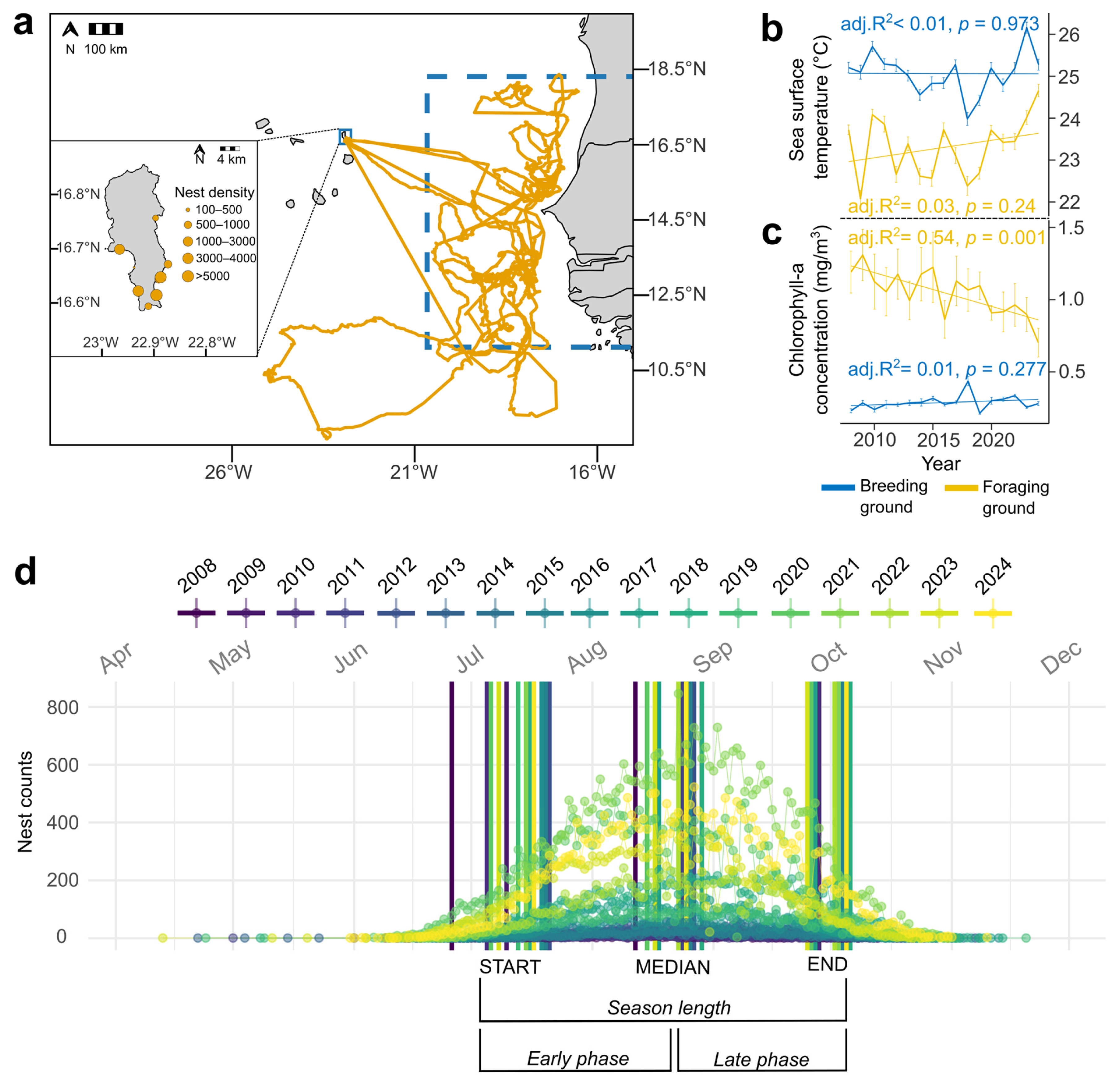
This study was conducted on Sal Island, Republic of Cabo Verde, located ~600 km off the African coast (Figure 1a). Nightly foot patrols and morning surveys were carried out during nesting seasons, from June to November, between 2008 and 2024. During night patrols, all nests were recorded, regardless of whether a turtle was directly observed. When a nesting turtle was encountered, she was checked for the presence of metal tags or a passive integrated transponder (PIT), and the GPS coordinates of the nesting site was recorded. Untagged turtles were fitted with metal tags on both flippers and/or a new tag (PIT) on the right flipper for the years 2008–2018, and from 2019 on, a new tag (PIT) only. Curved carapace length (CCL) was measured with a tape to the nearest 0.1 cm. From 2008 to 2015, CCL was recorded from notch-to-tip, whereas from 2017 onward, it was measured from notch-to-notch. In 2016, both methods were used, enabling us to calculate the mean difference between measurement methods. To standardize measurements over the full dataset, this mean difference was subtracted from all notch-to-tip values recorded before 2016. Clutch size was recorded each time nests required relocation, either in situ or into a hatchery.
Over 17 years of monitoring, we recorded 178,566 nests and tagged 14,162 individuals. Tagging data were used to derive life-history traits for each individual in each year: (1) neophyte vs. remigrant status, (2) number of clutches per season (clutch frequency), (3) interval between successive clutches (inter-nesting interval), and (4) interval between nesting seasons for remigrants (remigration interval).

2.2. Determination of Nesting Phenology and Season Duration

Defining the start and end of the season based on the first and last observed nest might be obscured by the arrival of sporadic nesting females or by the fact that we may miss some activities early and late in the season. To minimize this possible bias, we used a percentile-based approach: the start of the season was defined as the day by which 5% of total nests were laid, the median as the 50th percentile, and the end as the 95th percentile (Figure 1d). Season length was calculated as the number of days between the 5th and 95th percentiles. The start duration (early phase) corresponded to the period between the 5th and 50th percentiles, and the end duration (late phase) between the 50th and 95th percentiles.

2.3. Determination of Inter-Nesting and Remigration Interval and Clutch Frequency and Size

The inter-nesting interval was defined as the number of days between successive clutches. We first included all inter-nesting intervals ranging from 9 to 84 days in the analyses. To reduce possible errors from potential misidentification or missed nesting observations, we also performed the same analysis excluding inter-nesting intervals shorter than 9 days and longer than 20 days [27,56]. The remigration interval, on the other hand, refers to the time between two reproductive migrations. Clutch frequency was the total number of clutches laid by an individual within a single nesting season, and clutch size was the mean number of eggs per clutch for that individual. When multiple CCL measurements were available for a turtle in a season, their average was used in the analyses.

2.4. Estimated Chronology of Nesting Activities

It is important to identify the chronology of reproduction to identify the right environmental drivers responsible for the specific reproductive traits. Ovulation for the season is induced by mating [57], but whether females mate immediately upon arrival at the nesting grounds in Cabo Verde remain unclear. Ovulation and gravidity likely occur 11–14 days [27,57] before laying eggs. Given that nesting typically begins in June–July (Supplementary Figure S1), females must reach the breeding grounds by mid-May or mid-June to allow sufficient time for ovulation and egg development.
Based on telemetry data from 5 tracked females returning from nesting to foraging grounds (2011 and 2022), migration may last up to two months, implying departure from foraging areas between late March and April (Supplementary Figure S1). Therefore, environmental cues during March–April may influence migration timing.
From this estimated chronology, we formulated the following hypotheses:
  • Nesting phenology: The start of nesting correlates with SST at the foraging grounds during March–April and/or at the breeding ground during May–June. Median nesting dates may correlate with SST at the breeding ground during June–August, and season end with SST at the breeding ground during September–October.
  • Inter-nesting interval: Inter-nesting intervals correlate with SST and chlorophyll-a (CHL) at the breeding grounds and with body size, as egg maturation between clutches is temperature-dependent and potentially size-mediated.
  • Remigration intervals: Remigration intervals correlate with SST and CHL at the foraging grounds (November–May) and body size, as energy accumulation for reproduction depends on resource availability and temperature-driven habitat use. CHL reflects ocean primary productivity and is linked to loggerhead foraging resources, given that higher CHL often indicates greater abundance of planktonic food webs that support their prey [58,59].
  • Clutch Frequency: Clutch frequency correlates with SST at breeding grounds (June–October), CHL at foraging grounds (November–May), and body size, since both temperature and energy reserves can influence the number of clutches per season.
  • Clutch size: Clutch size correlates with SST at breeding grounds, CHL at foraging grounds, body size, and clutch frequency.

2.5. Environmental Data

Sea surface temperature (SST) and chlorophyll-a concentration (CHL) were taken from both foraging (11.12–18.31° N, −14.50–−20.66° W) and breeding grounds (16.5–16.9° N, −23.1–−22.7° W). All environmental data were retrieved from Copernicus Marine Service (https://marine.copernicus.eu/). For the phenological analyses, SST data were obtained from https://data.marine.copernicus.eu/product/SST_GLO_SST_L4_NRT_OBSERVATIONS_010_001/description (accessed on 29 January 2025) at a 5 km spatial resolution and CHL data were obtained from https://data.marine.copernicus.eu/product/OCEANCOLOUR_GLO_BGC_L4_MY_009_108/description (accessed on 17 March 2025) at a 4 km spatial resolution. For the inter-nesting interval analyses, daily CHL data were retrieved from https://data.marine.copernicus.eu/product/OCEANCOLOUR_GLO_BGC_L3_MY_009_107/description (accessed on 12 June 2025) at a 4 km spatial resolution and daily SST were obtained from the same sources as SST for phenological analyses.
For remigrant turtles, because we know how long they have stayed in the foraging ground, the mean CHL and SST were calculated for that specific period. For example, if a turtle returned to nest in 2010 after being recorded nesting in 2008, the average CHL and SST during the foraging period were calculated from 1 November 2008 to 31 May 2010. For first-time nesters, however, because the duration of their time in the foraging ground is unknown, we calculate the mean CHL and SST over the four years preceding the year in which they were first recorded nesting. In the inter-nesting intervals analyses, mean CHL and SST were calculated over the interval between the date of the initial observed nesting event and the date of the subsequent observed nesting event.

2.6. Statistical Analyses

2.6.1. Temporal Trends and Female Number Estimate

We analyzed the following phenological parameters: start, median, end of season, total duration, start duration, end duration, remigration intervals, inter-nesting intervals, clutch frequency, and clutch size. Temporal trends were assessed using linear regression models (LMs). LMs were also used to examine the relationships between phenological parameters and their environmental predictors. Differences between neophytes and remigrants in inter-nesting intervals, clutch frequency, and clutch size were tested with Wilcoxon rank sum tests.
The number of female nesters was estimated using a rolling window approach. Based on the observed inter-nesting intervals, a 14-day rolling window was applied to the daily nest count data, shifting forward every two days throughout the nesting season. Each window was assumed to represent a distinct set of individuals. For comparison, if the average number of clutches per female is three, the number of individuals can alternatively be estimated using a 28-day rolling window, which allows us to estimate the maximum number of turtles nesting at any given time on the basis of 3 nests per turtle. This approach is then shifted forward every two days across the season to maintain comparability with the 14-day window estimates.

2.6.2. Predictors of Reproductive Parameters

Prior to model fitting, data for remigration interval, inter-nesting interval, clutch frequency, and clutch size were evaluated for linearity, normality, multicollinearity, and homoscedasticity. Linearity was assessed using residual-versus-fitted plots and component-plus-residual plots, normality of residuals was formally tested with the Shapiro–Wilk test, multicollinearity was evaluated using Variance Inflation Factors (VIF), and homoscedasticity was tested with the Breusch–Pagan test. Predictors with high multicollinearity (VIF > 10) were standardized (mean = 0, SD = 1) using the scale() function in R version 4.2.2 [60].
Pairwise Pearson correlations were used to test the correlation among predictors. When strong correlations were detected, we removed the shared variation by retaining residuals from a linear model. For example, sea surface temperature (SST) and chlorophyll-a (CHL) concentration in the feeding grounds were highly correlated; in the remigration interval analysis, we included only the portion of CHL not explained by SST, obtained using the resid() function.

2.6.3. Model Selection

We first fitted LMs for each response variable to evaluate assumptions of linearity, normality, and homoscedasticity. When these assumptions were violated, we selected an appropriate model family based on the distribution and nature of the response variable. For example, positive continuous data were modelled using a Gamma distribution, while discrete counts were modelled using Poisson or negative binomial distributions.
For each response variable, we then fitted a set of candidate-generalized linear mixed models (GLMMs), including fixed effects for SST, CHL, and curved carapace length (CCL), as well as relevant interactions. Turtle identity (ID) was included as a random effect to account for repeated measurements and retained only if the estimated variance was greater than zero; otherwise, we fitted a generalized linear model (GLM) without the random effect.
Candidate models were compared using Akaike’s Information Criterion (AIC), and the model with the lowest AIC was selected as the best-supported model. The significance of fixed effects was assessed using likelihood-ratio tests. For GLMs, we used chi-square tests, whereas for GLMMs, type II likelihood-ratio tests were applied to account for the random effect from turtle ID. To control for multiple testing, Bonferroni-adjusted p-values were calculated by multiplying the raw p-values by the number of terms tested within each model. All analyses were conducted in R version 4.2.2 [60].

3. Results

Some nesting activity was detected as early as February; however, these were either false crawls (abandoned digs) or U-turns, where turtles came ashore but returned to the sea without digging. The earliest recorded nests were in April, and the latest were in November (Figure 1d). Throughout our monitoring period, from 2008 to 2024, there were three nests laid in April and nine in May, but the numbers increased to 2158 in June and jumped to 36,304 in July, peaking at 74,081 and 56,210 in August and September, respectively, and declined to 9771 in October and 30 in November (Supplementary Figure S2). The season length ranged from 75 to 93 days and, overall, 14,162 unique turtles were tagged. Regarding environmental conditions, there were no significant temperature trends in either foraging or breeding ground (Figure 1b); however, a decrease in chlorophyll-a concentrations at the foraging site was significant (linear model, LM, adjusted R2 = 0.54, F(1,15) = 19.91, p < 0.001; see Figure 1c), suggesting that resource availability may not positively influence reproductive parameters in this population in recent years.

3.1. Drivers of Nesting Phenology and Season Length

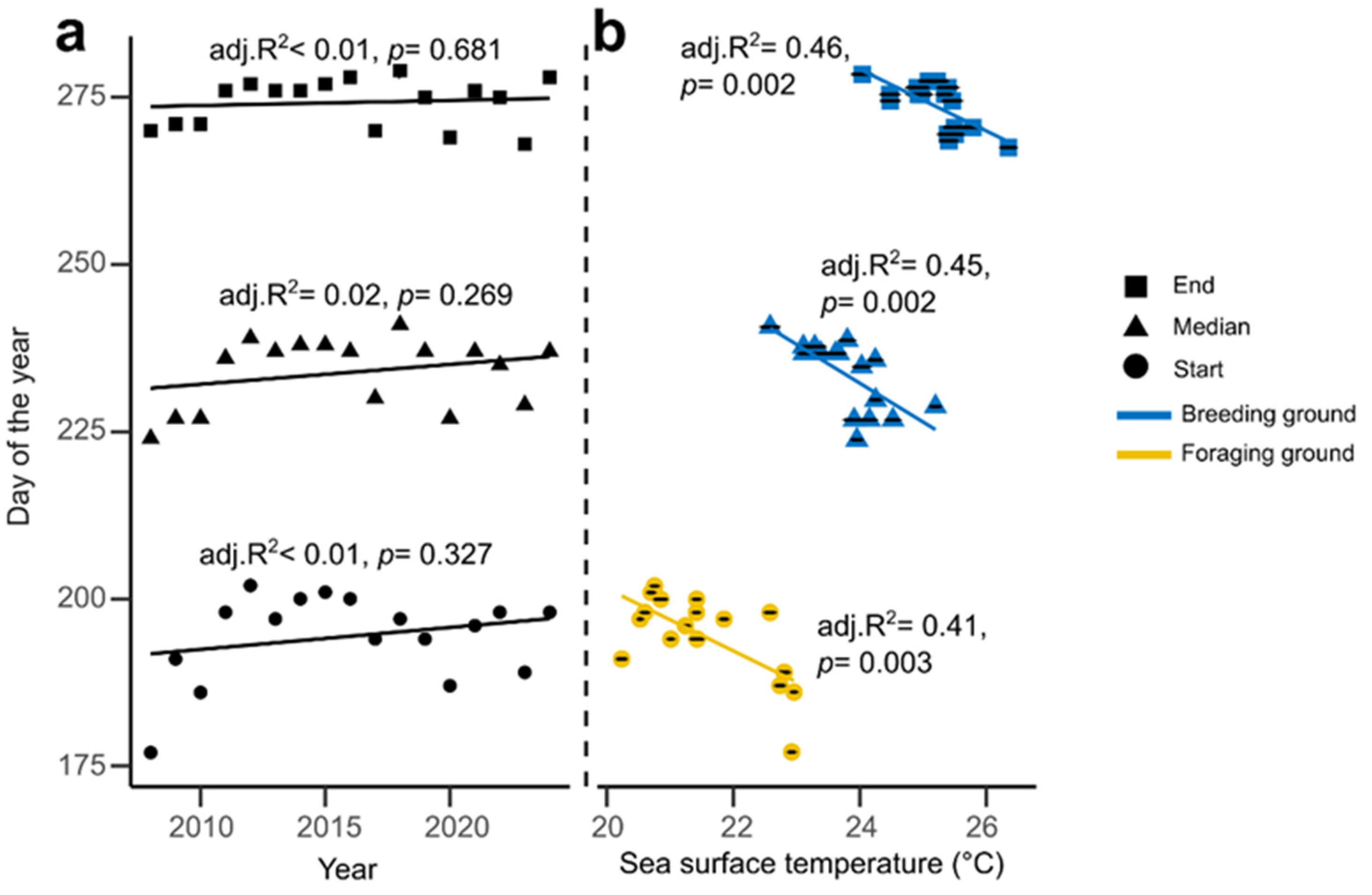
We detected no temporal patterns in nesting phenology (Figure 2a). However, the start, median and end dates were each significantly and negatively correlated with SST at breeding or foraging ground (Figure 2b). Specifically, the start of the season correlated with the average SST of March–April in the foraging ground (linear model, LM, adjusted R2 = 0.41, F(1,15) = 12.04, p = 0.003), the median with SST of June–July in the breeding ground (LM, adjusted R2 = 0.45, F(1,15) = 14.15, p = 0.002) and the end with SST of June–September in the breeding ground (LM, adjusted R2 = 0.46, F(1,15) = 14.58, p = 0.002). All these relationships show that warmer temperatures are associated with earlier phenology.
The season length showed no change over the monitored period (LM, adjusted R2 = 0.028, F(1,15) = 1.453, p = 0.247; see Supplementary Figure S3a) but was best predicted by the seasons’ start (LM, adjusted R2 = 0.733, F(1,15) = 44.93, p < 0.001; see Supplementary Figure S3b). Specifically, a late start (=when 5% of a season’s nests were counted) was associated with an earlier end (=95% of a season’s nests). The early and late phases showed no significant difference (Wilcoxon signed-rank test, two-sided: V = 43.5, p = 0.2121) suggesting that variability in the total of season length is not driven by disproportionate changes in just the early or the late phase of the season. As expected under the evolution of phenology in the face of global warming, warmer years had a faster start (LM, adjusted R2 = 0.398, F(1,15) = 11.58, p = 0.004; see Supplementary Figure S3c), while higher September SST was associated with extended ends of the nesting seasons (LM, adjusted R2 = 0.239, F(1,15) = 6.036, p = 0.027; see Supplementary Figure S3d).

3.2. Inter-Nesting Intervals

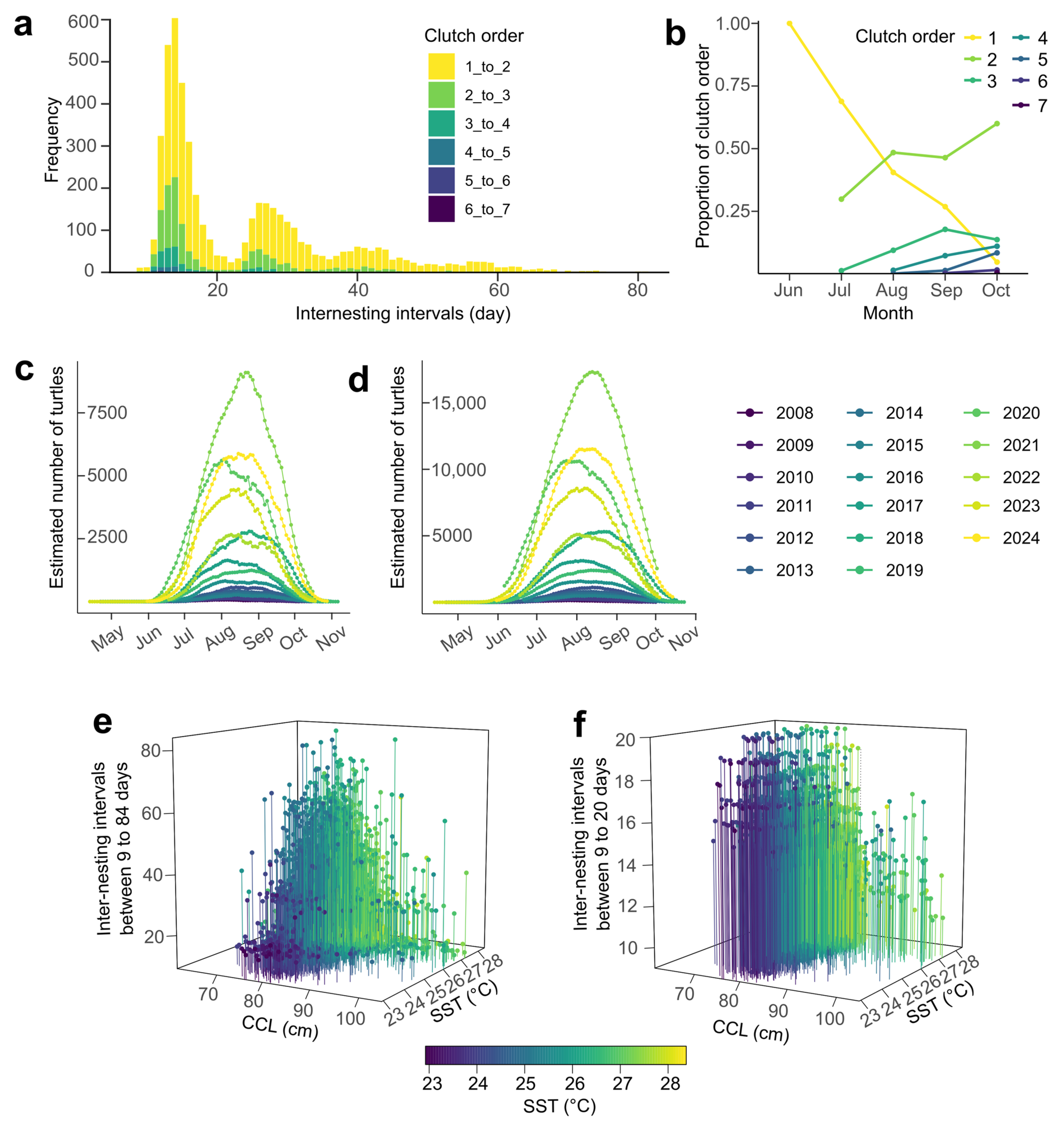
Based on metal and PIT tags, we found that the inter-nesting intervals ranged from 9 to 84 days, with three clearly identifiable peaks in the distribution, suggestive of highly variable inter-nesting intervals or undetected intermediate nesting events (Figure 3a). Overall, comparing the number of nests to the number of tags detected/deployed per night, across the entire period of the study, patrols tagged on average 22% of daily nesting turtles (Supplementary Figure S4b).
The average inter-nesting intervals was 24.17 ± 13.38 days (mean ± SD, n = 5009). The best model linking inter-nesting intervals to environmental parameters included an interaction of SST, CHL, CCL (GLMM, AIC = 9284.4, BIC = 35,633, log-likelihood = −17,806.5, random intercept variance for turtle ID = 0.1649, SD = 0.406; see Supplementary Table S1). The SST at the breeding ground by CCL interaction was significant (Type II Wald χ2(1) = 15.26, Bonferroni-adjusted p < 0.001; see Figure 3e) with larger turtles showing shorter intervals at higher SST. No other terms were significant.
Restricting the inter-nesting intervals to 9–20 days yielded 14.43 ± 2.01 days (mean ± SD, n = 2744). There was no temporal change in the mean inter-nesting interval (LM, adjusted R2 = 0.099, F(1,14) = 2.652, p = 0.126; see Supplementary Figure S5a), and neophytes exhibited slightly shorter inter-nesting periods than remigrants (Wilcoxon rank sum test, two-sided: W = 290,175, p = 0.0021; see Supplementary Figure S5b). Interestingly, the proportion of turtles observed for the first time decreases linearly over the course of the nesting season, until a slower rate is detected between August and September, suggesting a detectable wave of newly arrived turtles (Figure 3b). Using the observed average of inter-nesting intervals, the estimated number of females nesting in Sal was approximately between 9000 and 17,000 at the peak of the nesting activity (Figure 3c,d).
Furthermore, the best model linking inter-nesting intervals to environmental parameters included a three-way interaction between SST, CHL, and CCL (GLMM, AIC = 9284.4, BIC = 9343.4, log-likelihood = −4632.2, random intercept variance for turtle ID = 0.00964, SD = 0.098; see Supplementary Table S2). In this model, the same interaction between SST and turtle size was significantly and negatively associated with inter-nesting interval (Type II Wald chi-square test: χ2(1) = 18.26, Bonferroni-adjusted p < 0.001; see Figure 3f), with larger turtles showing shorter intervals at higher SST. The detected positive correlation between CHL and inter-nesting intervals in this model (Type II Wald chi-square test: χ2(1) = 12.26, Bonferroni-adjusted p = 0.003; see Supplementary Table S2) may indicate that cooler periods (reflected by higher CHL) lengthen inter-nesting intervals.

3.3. Remigration Intervals

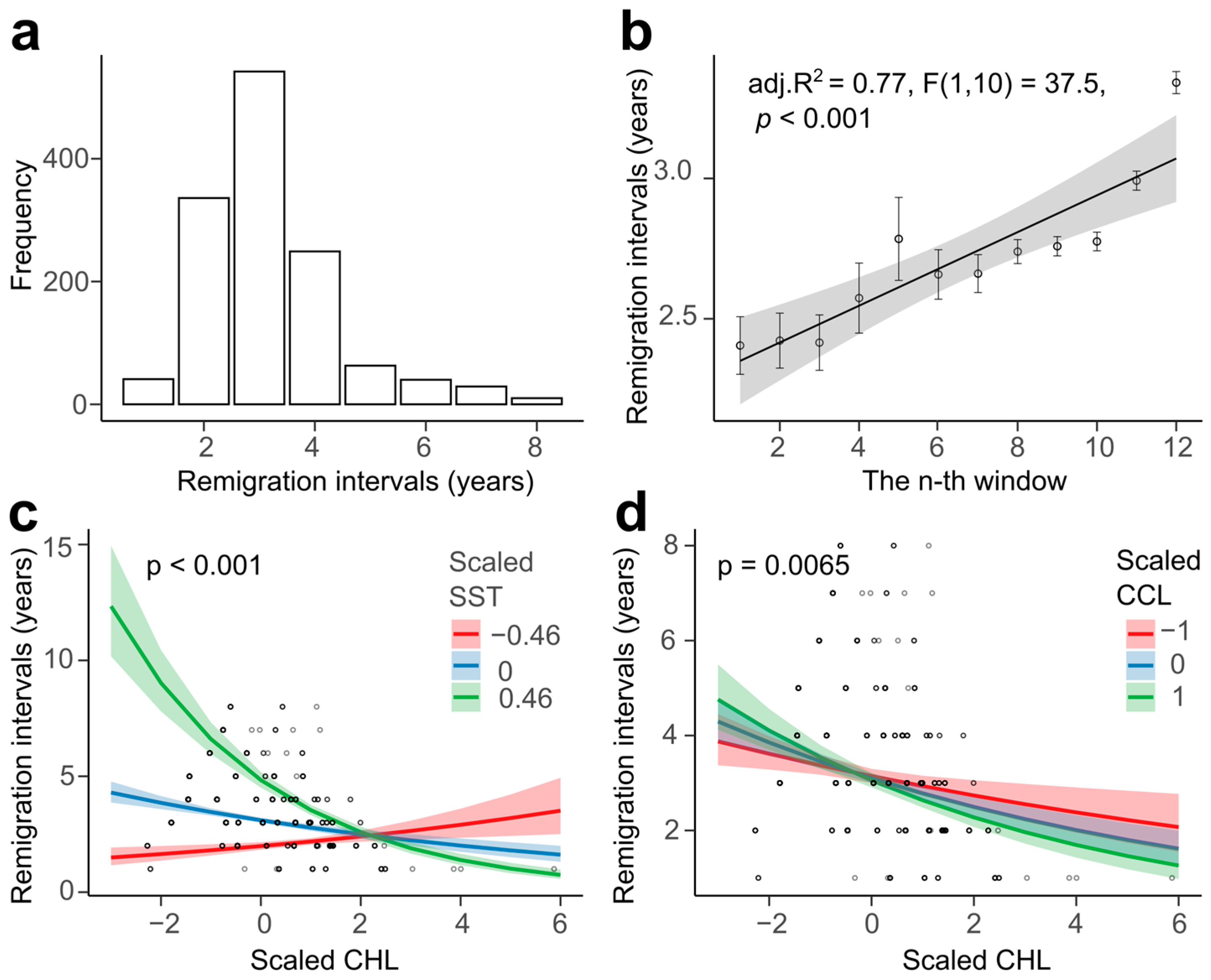
Remigration intervals ranged from 1 to 8 years with an average of 3.18 ± 1.24 years (mean ± SD, n = 1310) (Figure 4a). We found a positive trend over time in remigration intervals (LM, adjusted R2 = 0.769, F(1,10) = 37.54, p < 0.001), suggesting turtles stay longer in their feeding ground now than they did at the start of the monitoring period (Figure 4b), even after accounting for interannual variation in nesting density (Supplementary Table S3).
Remigration interval was best explained by a model involving a three-way interaction between CHL at the foraging ground, residuals of SST at the foraging ground, and turtle size (GLM, AIC = 3887.6; residual deviance = 265.04 on 1199 degrees of freedom; see Supplementary Table S4). In this model, the interaction between SST and CHL was significant (ΔDeviance = 86.28, Bonferroni-adjusted p < 0.001; see Figure 4c). This result shows that higher ocean productivity at the foraging grounds shortens the foraging period. The interaction between CHL and turtle size was also significant (ΔDeviance = 7.41, Bonferroni-adjusted p = 0.045; see Figure 4d), showing that bigger turtles have shorter remigration intervals than smaller turtles as ocean productivity increases.

3.4. Clutch Frequency and Size

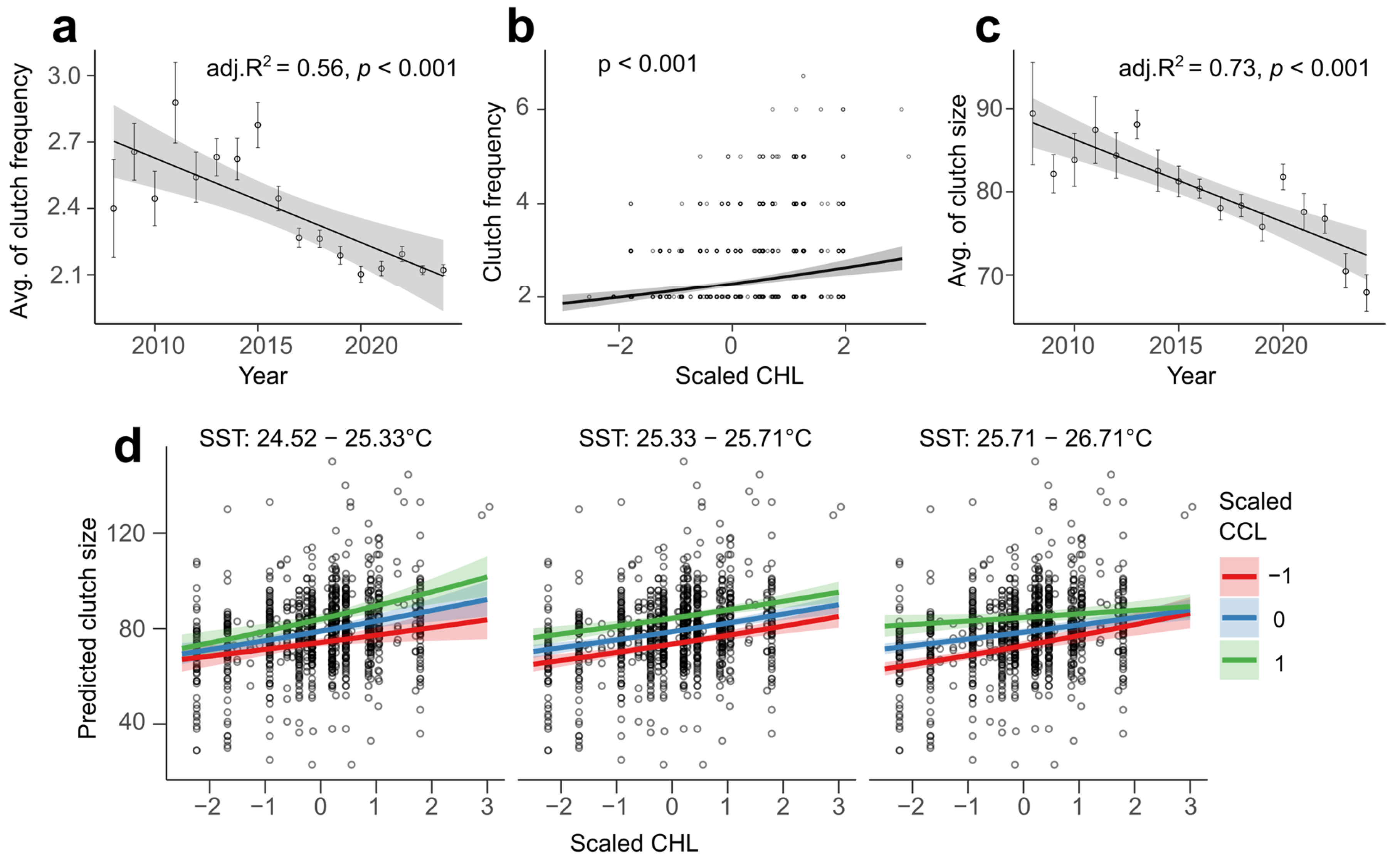
Over the course of the monitoring period, the observed mean clutch frequency in this population was 2.31 ± 0.67 (mean ± SD, range = 2–8, n = 2126; see Supplementary Figure S6a), but we detected a decline over time (LM, adjusted R2 = 0.562, F(1,15) = 21.52, p < 0.001; see Figure 5a).
Clutch frequency was best explained by a model including an interaction between CHL at the foraging ground and turtle size (GLM, AIC = 6060; residual deviance = 306.43 on 2107 degrees of freedom; see Supplementary Table S5), with only CHL showing a significant effect (ΔDeviance = 29.38, Bonferroni-adjusted p < 0.001; see Figure S5b). When remigration interval was included in the model, the best model uncovered a positive correlation between clutch frequency and CHL in the foraging ground (ΔDeviance = 4.08, p = 0.043; see Supplementary Figure S6b and Table S6).
Over the course of the monitoring, the mean clutch size in this population was 79.03 ± 15.66 (mean ± SD, range: 23–150, n = 1003; see Supplementary Figure S6d). Similarly to the number of clutches, clutch size declined (LM, adjusted R2 = 0.732, F(1,15) = 44.71, p < 0.001; see Figure 5c). But this effect was not linked to an increased in neophytes over the years since they produced comparable clutch sizes to remigrants (Wilcoxon rank sum test, two-sided: W = 30,042, p = 0.10; see Supplementary Figure S6c). Clutch size declined by approximately one egg per week over the course of the season (LM, adjusted R2 = 0.04, F(1,5085) = 238.7, p < 0.001), with smaller turtles showing a faster rate of decline, suggesting a depletion of stored energy (Supplementary Figure S7).
Clutch size was best predicted by a model including a three-way interaction between SST at breeding ground, CHL at foraging ground and turtle size (GLM, AIC = 8185; residual deviance = 35.09 on 989 degrees of freedom; see Supplementary Table S7). In this model, the three-way interaction term was significant (ΔDeviance = 0.23, Bonferroni-adjusted p = 0.047; see Figure 5d). Specifically, independent of temperature, higher chlorophyll was associated with a higher clutch size. The effect was, however, levelled by turtle size, with larger turtles producing larger clutch sizes.

3.5. Trends in Body Size

Body size was significantly associated with reproductive parameters: larger females tended to have shorter inter-nesting (Figure 3) and remigration intervals (Figure 4) and larger clutches (Figure 5). Female size ranges from 60 to 111.8 cm, with the average of 79.6 ± 4.0 cm (n = 18,939). Mean female size declined over time (LM, adjusted R2 = 0.709, F(1,14) = 37.51, p < 0.001), suggesting an influx of neophytes. As expected, neophytes were smaller than remigrants (Wilcoxon rank sum: p < 0.0001) with both neophyte and remigrant shows decline in size (Supplementary Figure S8b). These shifts in size structure have direct implications for reproductive timing and output.

4. Discussion

Climate change has pervasive impacts on biological systems, influencing phenology and reproductive output across taxa [61,62,63]. These effects are especially pronounced in long-lived, capital breeding ectotherms such as sea turtles, whose reproductive success depends heavily on thermal conditions and resource availability. Using our extensive, continuous datasets for loggerhead turtles (Caretta caretta) nesting in Sal (Cabo Verde), we show clear relationships between environmental parameters and reproductive phenology and outputs: warmer SST was associated with earlier nesting phenology and shortened interval between clutches, while reduced productivity at foraging grounds correlated with increased remigration intervals and lowered clutch frequency and size. Together, these results demonstrate that climate warming acts through multiple, interacting pathways to influence reproductive timing and success in sea turtles, providing essential empirical evidence to guide climate-responsive conservation of one of the world’s largest loggerhead populations.

4.1. Phenology and Season Length

Although no long-term change in nesting phenology was detected, we found that the timing of reproduction was strongly linked to ocean temperature. Warmer SST at the foraging ground in the months preceding the nesting season was associated with an earlier seasonal start, suggesting that females begin migrating sooner and/or shorten their pre-nesting residence at the breeding site [64]. Once the nesting season started, higher SST at breeding beaches was associated with earlier median and end of the season, likely accelerating the rate of physiological processes involved in ovulation and egg development [31]. These findings support the idea that both foraging and breeding SST influence phenological timing [18,19,20,21,65], even though the direction and magnitude of such responses can vary among populations [66].
Interestingly, while temperature shaped the timing of phenology, it did not affect the total season length, unlike in other loggerhead populations at Canaveral National Seashore on the Atlantic coast of central Florida [65] and at northern Gulf of Mexico [18]. Instead, season length was best predicted by the timing of start: years with later starts also tended to end earlier. Because both variables derive from percentile-based definitions, part of this relationship may reflect statistical coupling, yet biological explanations remain plausible. Warmer years were characterized by faster increases in nesting activity early in the season, followed by slower declines later in the year. Such asymmetric seasonal dynamics suggest that higher temperatures not only enhance reproductive readiness at the start of the season but also prolong favourable nesting conditions into the late season. Access to nearshore warmer water (i.e., facilitated by reduced human presence) has been linked to an increase in the number of clutches laid per season, indicating an extension of nesting period under favourable environmental conditions [67]. Furthermore, warming can lengthen the thermal window for successful incubation and hatchling emergence [15,41]. Collectively, these results reveal that temperature does not simply shift nesting seasons earlier or later, but can reshape their structure, compress the start and extend the tail end of reproductive effort.

4.2. Timing of Arrival and Estimates of Population Size

Continuous tagging over nearly two decades also provided insights into nesting season dynamics. Generally, females reached nesting beaches for their first nest throughout a major part of the nesting season [17,66]. Indeed, we observed that the overall proportion of newly recorded individuals declined steadily after mid-season but never ceased entirely, indicating sustained recruitment, with a detected increase in newly recorded individuals suggesting continuous arrival to the nesting grounds. This could imply that since turtles use different feeding grounds, timing to initiate the migration is asynchronous and locality-specific [68], making them arrive at different times. It is important to note that part of this pattern may be reflected by the detection of previously untagged/undetected turtles rather than being solely due to late-season first-time arrivals. Recapture rates remained stable over the monitoring period except during the 2020–2021 COVID-impacted years. On average, patrols tagged 22% of daily nesting turtles, translating to roughly a 53% probability of detecting an individual at least once over three clutches within a season. Using this probability window, we can start to estimate the number of turtles, with Sal Island alone hosting approximately 9000 to 17,000 nesting females at the peak of the nesting trend. As Sal is the second-largest aggregation in Cabo Verde, these figures reaffirm that Cabo Verde supports one of the largest loggerhead nesting populations globally [49] and underscore the conservation importance of maintaining the integrity of this rookery [69].

4.3. Inter-Nesting Intervals

Inter-nesting intervals, the time between successive clutches, integrate both physiological and environmental constraints on reproduction [29,38]. In this population, intervals ranged widely (9–84 days) with a multimodal distribution. The longer intervals recorded early in the season corresponded to cooler temperatures and earlier arrival timing, supporting the hypothesis that egg maturation is thermally limited [27,70]. Restricting analyses to turtles where we are unlikely to have missed a nesting event (9–20 days) revealed a clear negative correlation between SST and interval length. The negative effect of SST on inter-nesting intervals has been widely documented across several sea turtle species [27,29,30,71]. In our study, we also found that this relationship was size-dependent. Larger females exhibited shorter inter-nesting intervals in warmer waters but longer intervals during cooler periods, suggesting the influence of thermal inertia in this ectothermic species [39]. Under warmer conditions, their elevated and sustained body temperatures may accelerate egg development and reduce the resting period between clutches. Smaller turtles, on the other hand, may gain and lose heat more under fluctuating conditions. These interacting effects suggest that thermal conditions and morphology jointly shape reproductive pacing. If the trend toward smaller average female size observed since 2014 continues [72], the population may experience longer mean inter-nesting intervals, potentially lowering annual fecundity.

4.4. Remigration Intervals

Although some individuals exhibited unusually short or long remigration intervals, most turtles typically returned to nest after about three years of foraging. It is consistent with other Atlantic populations [73] but longer than those in the Pacific [74]. We detected an increasing trend over time, indicated that females now spend longer at foraging ground before returning to breed. Although such a trend may partially reflect sampling effort relative to nesting density, we found no evidence that variations in nest abundance confound this relationship. The increased remigration interval is consistent with the continuous decline in ocean productivity detected over the course of this study. As expected, warmer years that reduced ocean productivity led to longer remigration intervals. Comparable patterns have been reported in green turtles from Costa Rica, where low ocean productivity during El Niño events delayed remigration [75].
Furthermore, the influence of resource availability on remigration intervals varied with turtle size, with smaller individuals being more affected by limited resources than larger ones [74]. This mirrors Japanese populations, where small, oceanic foragers have longer remigration intervals than large, benthic-foraging females [46,74]. The progressive lengthening of remigration intervals in Cabo Verde therefore likely reflects declining productivity in combination with demographic shifts toward smaller females. Monitoring of resource availability, and possibly feeding ground shift is important, as these extended non-breeding intervals could slow population growth and alter generational turnover.

4.5. Clutch Frequency and Size

We discovered that the observed mean clutch frequency of 2.3 clutches per female lies at the lower end of global estimates derived from recapture and satellite telemetry studies, with 3.5–4.5 clutches in average in southeast USA [76,77]; up to 5.4 in Oman [78]; 2.4–3.8 in Greece [79]; or 1.8 in Cyprus [56]. In previous estimates from Boa Vista in Cabo Verde, the observed mean clutch frequency was lower (1.4), ranging from one to six [28]. Such difference may stem from Cabo Verde sea turtles being smaller than turtles from other Atlantic populations, and being more comparable in size to Mediterranean populations [53]. Furthermore, the clear positive association between clutch frequency and foraging ground productivity suggests a biological mechanism. Females foraging in productive waters can accumulate larger fat reserves [42], sustain near-complete fasting during the nesting season and produce a greater number of clutches. The absence of a difference between neophytes and remigrants implies that energy availability, rather than age or reproductive experience, governs clutch frequency.
As expected, clutch size was strongly correlated with female size, e.g., refs. [43,56,80]. Clutch size also correlated with foraging ground ocean productivity [41]. Our results are consistent with previous isotopic studies that showed positive correlations between δ15N and δ13C signatures (indicators of trophic level and foraging habitat productivity) and clutch size in loggerheads [42]. Here, we add the knowledge that during the warmest years, the positive correlation between size and clutch size weakened, suggesting that thermal stress or energetic limitations constrains investment in reproduction.
The overall decline in clutch size through time likely results from both environmental and demographic processes, such as reduced foraging productivity, and a growing proportion of smaller, first-time nesters since 2013 [72]. Because clutch size contributes directly to population fecundity, such reductions may have compounding effects on future recruitment, even in this currently growing population. Monitoring shifts in female body size structure therefore provides an important early warning indicator of population-level reproductive change. Ultimately, monitoring in the feeding ground should continue and investigating migration routes will provide better guidance for future conservation efforts.

5. Conclusions

All five hypotheses were supported. Using 17 years of continuous monitoring and tagging data, we demonstrate that the phenology of loggerhead nesting in Sal, Cabo Verde, is associated with sea surface temperature (SST) in both feeding and breeding grounds. Specifically, warmer years advanced the start, median, and end of the nesting season. Inter-nesting intervals were shorter during warmer SST, particularly in larger females. There has been a significant decline in ocean productivity in the feeding grounds, which is associated with longer foraging periods and reduced clutch sizes. Furthermore, with the decline in body size in the population due to neophyte influx, reproductive output decreased further, as smaller females produced smaller clutches.
From a conservation perspective, our findings highlight the need to incorporate climate-driven variability in phenology and reproductive output into management and monitoring strategies for loggerhead turtles in Cabo Verde. Continued long-term monitoring at nesting beaches remains essential but should be complemented by sustained observation of foraging grounds, where declining productivity appears to have cascading effects on remigration intervals, clutch frequency, and clutch size. Future research involving systematic assessment of foraging grounds and migration routes will be essential to identify critical feeding areas, detect shifts in habitat use, and prioritize protection of key productivity hotspots. Given the observed demographic shift toward smaller females and its implications for fecundity, monitoring changes in female body-size distribution remains critical, as these metrics provide early-warning indicators of population-level reproductive change under ongoing ocean warming and declining productivity.

Supplementary Materials

The following supporting information can be downloaded at https://www.mdpi.com/article/10.3390/ani16040552/s1, Figure S1: Hypothesized chronogram of reproductive activities of loggerhead nesting on Sal Island, Cabo Verde; Figure S2: Monthly observed nest counts in all seasons shows when the typical nesting season starts; Figure S3: Season length and sea surface temperature (SST) correlations; Figure S4: Inter-nesting intervals and recapture rates; Figure S5: Inter-nesting intervals trend and structure among different status of individuals; Figure S6: Clutch frequency and size trend; Figure S7: Clutch size trend throughout the season in loggerhead population nesting in Sal Island; Figure S8: Size trend in loggerhead population nesting in Sal Island; Table S1: Summary of the model predicting inter-nesting intervals with all data set (9–84 days); Table S2: Summary of the model predicting inter-nesting intervals between 9–20 days; Table S3: Summary of the model predicting remigration intervals trends over time accounting for annual variation in nest counts; Table S4: Summary of the model predicting remigration intervals; Table S5: Summary of the model predicting clutch frequency excluding remigration intervals as the predictor; Table S6: Summary of the model predicting clutch frequency including remigration intervals as one of the predictors; Table S7: Summary of the model predicting clutch size. SSTbg = SST at breeding ground, CHLfg = CHL at foraging ground.

Author Contributions

Conceptualization, C.E., K.F. and F.A.D.N.; methodology, F.A.D.N., R.A., K.F. and C.E.; validation, K.F., A.T. and C.E.; formal analysis, F.A.D.N. and R.A.; data curation, A.L. (Artur Lopes), A.L. (Anice Lopes), B.R., A.T., K.F. and C.E.; writing—original draft preparation, F.A.D.N. and C.E.; writing—review and editing, all authors; supervision, C.E.; funding acquisition, A.T. and C.E. All authors have read and agreed to the published version of the manuscript.

Funding

Project Biodiversity was funded by U.S. Fish and Wildlife Service (USFWS), The Regional Partnership for Coastal and Marine Conservation in West Africa (PRCM), RIU Hotels, Tui Care Foundation. This research was also partly funded by Queen Mary University of London, as well as UKRI Natural Environment Research Council grants NE/V001469/1 and NE/X012077/1 to C.E. F.A.D.N. fellowship (FR202403000977) is funded by Beasiswa Pendidikan Indonesia (Indonesian Education Scholarship, Center for Higher Education Funding and Assessment and Indonesian Endowment Fund for Education).

Institutional Review Board Statement

Permits were granted by the Cabo Verde Government through the partnership agreement between Associação Projeto Biodiversidade and the Ministry of Agriculture and Environment. For this study, members of the Eizaguirre lab operated under permit numbers 215/DNA/2024 and 474/DNA/2025.

Informed Consent Statement

Not applicable.

Data Availability Statement

The original contributions presented in this study are included in the article/Supplementary Materials. Further inquiries can be directed to the corresponding author.

Acknowledgments

We are grateful to Project Biodiversity and SOS Tartarugas patrol teams, and the volunteers for their continuous field monitoring of sea turtles on Sal Island. We acknowledge Victor Stiebens and Perla Roman Torres for support with turtle movement tracking.

Conflicts of Interest

The authors declare no conflicts of interest.

References

  1. Weiskopf, S.R.; Rubenstein, M.A.; Crozier, L.G.; Gaichas, S.; Griffis, R.; Halofsky, J.E.; Hyde, K.J.W.; Morelli, T.L.; Morisette, J.T.; Muñoz, R.C.; et al. Climate Change Effects on Biodiversity, Ecosystems, Ecosystem Services, and Natural Resource Management in the United States. Sci. Total Environ. 2020, 733, 137782. [Google Scholar] [CrossRef] [PubMed]
  2. Parmesan, C.; Yohe, G. A Globally Coherent Fingerprint of Climate Change Impacts Across Natural Systems. Nature 2003, 421, 37–42. [Google Scholar] [CrossRef] [PubMed]
  3. Root, T.L.; Price, J.T.; Hall, K.R.; Schneider, S.H.; Rosenzweig, C.; Pounds, J.A. Fingerprints of Global Warming on Wild Animals and Plants. Nature 2003, 421, 57–60. [Google Scholar] [CrossRef]
  4. Hickinbotham, E.J.; Ridley, F.A.; Rushton, S.P.; Pattison, Z. 30 Years of Climate Related Phenological Research: Themes and Trends. Int. J. Biometeorol. 2025, 69, 1459–1473. [Google Scholar] [CrossRef] [PubMed]
  5. Inouye, D.W. Climate Change and Phenology. WIREs Clim. Change 2022, 13, e764. [Google Scholar] [CrossRef]
  6. Li, D.; Belitz, M.; Campbell, L.; Guralnick, R. Extreme Weather Events Have Strong but Different Impacts on Plant and Insect Phenology. Nat. Clim. Change 2025, 15, 321–328. [Google Scholar] [CrossRef]
  7. Neate-Clegg, M.H.C.; Tonelli, B.A.; Tingley, M.W. Advances in Breeding Phenology Outpace Latitudinal and Elevational Shifts for North American Birds Tracking Temperature. Nat. Ecol. Evol. 2024, 8, 2027–2036. [Google Scholar] [CrossRef]
  8. Benard, M.F.; Greenwald, K.R. Environmental Drivers of Amphibian Breeding Phenology Across Multiple Sites. Diversity 2023, 15, 253. [Google Scholar] [CrossRef]
  9. Koenigbauer, S.T.; Cubbage, M.L.; Warren, L.D.; Tellier, J.M.; Selz, O.M.; Sass, G.G.; Höök, T.O. Fish Reproductive Phenology Shifts with Increasing Temperature and Year. Biol. Lett. 2025, 21, 20240240. [Google Scholar] [CrossRef]
  10. Peláez, M.; Gaillard, J.; Bollmann, K.; Heurich, M.; Rehnus, M. Large-Scale Variation in Birth Timing and Synchrony of a Large Herbivore Along the Latitudinal and Altitudinal Gradients. J. Anim. Ecol. 2020, 89, 1906–1917. [Google Scholar] [CrossRef]
  11. Plard, F.; Gaillard, J.-M.; Coulson, T.; Hewison, A.J.M.; Delorme, D.; Warnant, C.; Bonenfant, C. Mismatch Between Birth Date and Vegetation Phenology Slows the Demography of Roe Deer. PLoS Biol. 2014, 12, e1001828. [Google Scholar] [CrossRef]
  12. Vázquez, D.P.; Vitale, N.; Dorado, J.; Amico, G.; Stevani, E.L. Phenological Mismatches and the Demography of Solitary Bees. Proc. R. Soc. B 2023, 290, 20221847. [Google Scholar] [CrossRef]
  13. Youngflesh, C.; Montgomery, G.A.; Saracco, J.F.; Miller, D.A.W.; Guralnick, R.P.; Hurlbert, A.H.; Siegel, R.B.; LaFrance, R.; Tingley, M.W. Demographic Consequences of Phenological Asynchrony for North American Songbirds. Proc. Natl. Acad. Sci. USA 2023, 120, e2221961120. [Google Scholar] [CrossRef] [PubMed]
  14. Fuentes, M.M.P.B.; Santos, A.J.B.; Abreu-Grobois, A.; Briseño-Dueñas, R.; Al-Khayat, J.; Hamza, S.; Saliba, S.; Anderson, D.; Rusenko, K.W.; Mitchell, N.J.; et al. Adaptation of Sea Turtles to Climate Warming: Will Phenological Responses Be Sufficient to Counteract Changes in Reproductive Output? Glob. Change Biol. 2024, 30, e16991. [Google Scholar] [CrossRef] [PubMed]
  15. Rutledge, M.L.; Paladino, F.V.; Spotila, J.R.; Santidrián Tomillo, P. Shifting Thermal Tolerance Windows throughout Incubation Affects Sea Turtle Hatching Success: Implications for Hatchery Management and Conservation. Mar. Biol. 2024, 171, 94. [Google Scholar] [CrossRef]
  16. Mazaris, A.D.; Kallimanis, A.S.; Pantis, J.D.; Hays, G.C. Phenological Response of Sea Turtles to Environmental Variation Across a Species’ Northern Range. Proc. R. Soc. B 2013, 280, 20122397. [Google Scholar] [CrossRef]
  17. Rickwood, M.L.; Tucker, E.; Beton, D.; Davey, S.; Godley, B.J.; Snape, R.T.E.; Postma, E.; Broderick, A.C. Individual Plasticity in Response to Rising Sea Temperatures Contributes to an Advancement in Green Turtle Nesting Phenology. Proc. R. Soc. B 2025, 292, 20241809. [Google Scholar] [CrossRef]
  18. Lamont, M.M.; Fujisaki, I. Effects of Ocean Temperature on Nesting Phenology and Fecundity of the Loggerhead Sea Turtle (Caretta caretta). J. Herpetol. 2014, 48, 98–102. [Google Scholar] [CrossRef]
  19. Monsinjon, J.; Lopez, M.; Lara, P.; Santos, A.; Dei Marcovaldi, M.; Girondot, M.; Fuentes, M. Effects of Temperature and Demography on the Phenology of Loggerhead Sea Turtles in Brazil. Mar. Ecol. Prog. Ser. 2019, 623, 209–219. [Google Scholar] [CrossRef]
  20. Neeman, N.; Robinson, N.J.; Paladino, F.V.; Spotila, J.R.; O’Connor, M.P. Phenology Shifts in Leatherback Turtles (Dermochelys coriacea) Due to Changes in Sea Surface Temperature. J. Exp. Mar. Biol. Ecol. 2015, 462, 113–120. [Google Scholar] [CrossRef]
  21. Weishampel, J.; Bagley, D.; Ehrhart, L.; Weishampel, A. Nesting Phenologies of Two Sympatric Sea Turtle Species Related to Sea Surface Temperatures. Endang. Species. Res. 2010, 12, 41–47. [Google Scholar] [CrossRef]
  22. Boyle, M.C.; FitzSimmons, N.N.; Limpus, C.J.; Kelez, S.; Velez-Zuazo, X.; Waycott, M. Evidence for Transoceanic Migrations by Loggerhead Sea Turtles in the Southern Pacific Ocean. Proc. R. Soc. B 2009, 276, 1993–1999. [Google Scholar] [CrossRef] [PubMed]
  23. Mazaris, A.D.; Kallimanis, A.S.; Tzanopoulos, J.; Sgardelis, S.P.; Pantis, J.D. Sea Surface Temperature Variations in Core Foraging Grounds Drive Nesting Trends and Phenology of Loggerhead Turtles in the Mediterranean Sea. J. Exp. Mar. Biol. Ecol. 2009, 379, 23–27. [Google Scholar] [CrossRef]
  24. Bond, E.P.; James, M.C. Pre-Nesting Movements of Leatherback Sea Turtles, Dermochelys coriacea, in the Western Atlantic. Front. Mar. Sci. 2017, 4, 223. [Google Scholar] [CrossRef]
  25. Eckert, K.L.; Eckert, S.A. Pre-Reproductive Movements of Leatherback Sea Turtles (Dermochelys coriacea) Nesting in the Caribbean. Copeia 1988, 1988, 400. [Google Scholar] [CrossRef]
  26. Mazaris, A.D.; Kallimanis, A.S.; Sgardelis, S.P.; Pantis, J.D. Do Long-Term Changes in Sea Surface Temperature at the Breeding Areas Affect the Breeding Dates and Reproduction Performance of Mediterranean Loggerhead Turtles? Implications for Climate Change. J. Exp. Mar. Biol. Ecol. 2008, 367, 219–226. [Google Scholar] [CrossRef]
  27. Hays, G.C.; Broderick, A.C.; Glen, F.; Godley, B.J.; Houghton, J.D.R.; Metcalfe, J.D. Water Temperature and Internesting Intervals for Loggerhead (Caretta caretta) and Green (Chelonia mydas) Sea Turtles. J. Therm. Biol. 2002, 27, 429–432. [Google Scholar] [CrossRef]
  28. Raposo, A.; Rebelo, R.; Marco, A. Internesting Period and Clutch Frequency of the Endangered Loggerhead Turtle Population of Cabo Verde. Aquat. Conserv. 2025, 35, e70075. [Google Scholar] [CrossRef]
  29. Robinson, N.J.; Sanfèlix, M.M.; Blanco, G.S.; Clyde-Brockway, C.; Hill, J.E.; Paladino, F.V.; Tomás, J.; Tomillo, P.S. Effect of Water Temperature on the Duration of the Internesting Interval across Sea Turtle Species. J. Therm. Biol. 2022, 110, 103342. [Google Scholar] [CrossRef]
  30. Sato, K.; Matsuzawa, Y.; Tanaka, H.; Bando, T.; Minamikawa, S.; Sakamoto, W.; Naito, Y. Internesting Intervals for Loggerhead Turtles, Caretta caretta, and Green Turtles, Chelonia mydas, Are Affected by Temperature. Can. J. Zool. 1998, 76, 1651–1662. [Google Scholar] [CrossRef]
  31. Valverde-Cantillo, V.; Robinson, N.J.; Santidrián Tomillo, P. Influence of Oceanographic Conditions on Nesting Abundance, Phenology and Internesting Periods of East Pacific Green Turtles. Mar. Biol. 2019, 166, 93. [Google Scholar] [CrossRef]
  32. Rostal, D.C.; Paladino, F.V.; Patterson, R.M.; Spotila, J.R. Reproductive Physiology of Nesting Leatherback Turtles (Dermochelys coriacea) at Las Baulas National Park, Costa Rica. Chelonian Conserv. Biol. 1996, 2, 230–236. [Google Scholar]
  33. Rostal, D.C.; Owens, D.W.; Grumbles, J.S.; MacKenzie, D.S.; Amoss, M.S. Seasonal Reproductive Cycle of the Kemp’s Ridley Sea Turtle (Lepidochelys kempi). Gen. Comp. Endocrinol. 1998, 109, 232–243. [Google Scholar] [CrossRef] [PubMed]
  34. Wibbels, T.; Owens, D.W.; Limpus, C.J.; Reed, P.C.; Amoss, M.S. Seasonal Changes in Serum Gonadal Steroids Associated with Migration, Mating, and Nesting in the Loggerhead Sea Turtle (Caretta caretta). Gen. Comp. Endocrinol. 1990, 79, 154–164. [Google Scholar] [CrossRef] [PubMed]
  35. Owens, D.W. The Comparative Reproductive Physiology of Sea Turtles. Am. Zool. 1980, 20, 549–563. [Google Scholar] [CrossRef]
  36. Sakaoka, K.; Sakai, F.; Yoshii, M.; Okamoto, H.; Nagasawa, K. Estimation of Sperm Storage Duration in Captive Loggerhead Turtles (Caretta caretta). J. Exp. Mar. Biol. Ecol. 2013, 439, 136–142. [Google Scholar] [CrossRef]
  37. Aitken, R.N.C.; Solomon, S.E. Observations on the Ultrastructure of the Oviduct of the Costa Rican Green Turtle (Chelonia mydas L.). J. Exp. Mar. Biol. Ecol. 1976, 21, 75–90. [Google Scholar] [CrossRef]
  38. Price, E.R.; Sotherland, P.R.; Wallace, B.P.; Spotila, J.R.; Dzialowski, E.M. Physiological Determinants of the Internesting Interval in Sea Turtles: A Novel ‘Water-Limitation’ Hypothesis. Biol. Lett. 2019, 15, 20190248. [Google Scholar] [CrossRef]
  39. Paladino, F.V.; O’Connor, M.P.; Spotila, J.R. Metabolism of Leatherback Turtles, Gigantothermy, and Thermoregulation of Dinosaurs. Nature 1990, 344, 858–860. [Google Scholar] [CrossRef]
  40. Sato, K.; Sakamoto, W.; Matsuzawa, Y.; Tanaka, H.; Minamikawa, S.; Naito, Y. Body Temperature Independence of Solar Radiation in Free-Ranging Loggerhead Turtles, Caretta caretta, During Internesting Periods. Mar. Biol. 1995, 123, 197–205. [Google Scholar] [CrossRef]
  41. Cardona, L.; Clusa, M.; Eder, E.; Demetropoulos, A.; Margaritoulis, D.; Rees, A.; Hamza, A.; Khalil, M.; Levy, Y.; Türkozan, O.; et al. Distribution Patterns and Foraging Ground Productivity Determine Clutch Size in Mediterranean Loggerhead Turtles. Mar. Ecol. Prog. Ser. 2014, 497, 229–241. [Google Scholar] [CrossRef]
  42. Fouda, L.; Negus, S.R.B.; Lockley, E.C.; Fairweather, K.; Lopes, A.; Lopes, A.; Correia, S.M.; Taxonera, A.; Schofield, G.; Eizaguirre, C. Productive Foraging Grounds Enhance Maternal Condition and Offspring Quality in a Capital Breeding Species. Ecol. Evol. 2024, 14, e70137. [Google Scholar] [CrossRef] [PubMed]
  43. Le Gouvello, D.Z.M.; Nel, R.; Cloete, A.E. The Influence of Individual Size on Clutch Size and Hatchling Fitness Traits in Sea Turtles. J. Exp. Mar. Biol. Ecol. 2020, 527, 151372. [Google Scholar] [CrossRef]
  44. Hatase, H.; Goto, K.; Sato, K.; Bando, T.; Matsuzawa, Y.; Sakamoto, W. Using Annual Body Size Fluctuations to Explore Potential Causes for the Decline in a Nesting Population of the Loggerhead Turtle Caretta caretta at Senri Beach, Japan. Mar. Ecol. Prog. Ser. 2002, 245, 299–304. [Google Scholar] [CrossRef]
  45. Hatase, H.; Omuta, K.; Tsukamoto, K. Bottom or Midwater: Alternative Foraging Behaviours in Adult Female Loggerhead Sea Turtles. J. Zool. 2007, 273, 46–55. [Google Scholar] [CrossRef]
  46. Hatase, H.; Tsukamoto, K. Smaller Longer, Larger Shorter: Energy Budget Calculations Explain Intrapopulation Variation in Remigration Intervals for Loggerhead Sea Turtles (Caretta caretta). Can. J. Zool. 2008, 86, 595–600. [Google Scholar] [CrossRef]
  47. Jordà, G.; Marbà, N.; Duarte, C.M. Mediterranean Seagrass Vulnerable to Regional Climate Warming. Nat. Clim. Change 2012, 2, 821–824. [Google Scholar] [CrossRef]
  48. Marbà, N.; Duarte, C.M. Mediterranean Warming Triggers Seagrass (Posidonia oceanica) Shoot Mortality. Glob. Change Biol. 2010, 16, 2366–2375. [Google Scholar] [CrossRef]
  49. Taxonera, A.; Fairweather, K.; Airton, J.; Gonzalves, A.; Queiruga, A.; Lima, A.; Varela-da-Veiga, A.; Oujo, C.; Lopes, C.; da Cruz, J.H.G.; et al. Cabo Verde: Sea Turtles “In Abundance”. SWOT Rep. 2022, 17, 7–9. [Google Scholar]
  50. Laloë, J.; Cozens, J.; Renom, B.; Taxonera, A.; Hays, G.C. Climate Change and Temperature-linked Hatchling Mortality at a Globally Important Sea Turtle Nesting Site. Glob. Change Biol. 2017, 23, 4922–4931. [Google Scholar] [CrossRef]
  51. Laloë, J.-O.; Cozens, J.; Renom, B.; Taxonera, A.; Hays, G.C. Effects of Rising Temperature on the Viability of an Important Sea Turtle Rookery. Nat. Clim. Change 2014, 4, 513–518. [Google Scholar] [CrossRef]
  52. Baltazar-Soares, M.; Klein, J.D.; Correia, S.M.; Reischig, T.; Taxonera, A.; Roque, S.M.; Dos Passos, L.; Durão, J.; Lomba, J.P.; Dinis, H.; et al. Distribution of Genetic Diversity Reveals Colonization Patterns and Philopatry of the Loggerhead Sea Turtles across Geographic Scales. Sci. Rep. 2020, 10, 18001. [Google Scholar] [CrossRef] [PubMed]
  53. Stiebens, V.A.; Merino, S.E.; Chain, F.J.J.; Eizaguirre, C. Evolution of MHC Class I Genes in the Endangered Loggerhead Sea Turtle (Caretta caretta) Revealed by 454 Amplicon Sequencing. BMC Evol. Biol. 2013, 13, 95. [Google Scholar] [CrossRef] [PubMed]
  54. Lockley, E.C.; Fouda, L.; Correia, S.M.; Taxonera, A.; Nash, L.N.; Fairweather, K.; Reischig, T.; Durão, J.; Dinis, H.; Roque, S.M.; et al. Long-Term Survey of Sea Turtles (Caretta caretta) Reveals Correlations Between Parasite Infection, Feeding Ecology, Reproductive Success and Population Dynamics. Sci. Rep. 2020, 10, 18569. [Google Scholar] [CrossRef] [PubMed]
  55. Sousa-Guedes, D.; Marco, A.; Neves, E.; Medina, M.; Taxonera, A.; Fairweather, K.; Queiruga, A.; Veiga, J.; Patino-Martinez, J.; Alírio, J.; et al. How Vulnerable Are the Nesting Sites of Loggerhead Turtles in Cabo Verde? Reg. Environ. Change 2025, 25, 39. [Google Scholar] [CrossRef]
  56. Broderick, A.C.; Glen, F.; Godley, B.J.; Hays, G.C. Estimating the Number of Green and Loggerhead Turtles Nesting Annually in the Mediterranean. Oryx 2002, 36, 227–235. [Google Scholar] [CrossRef]
  57. Manire, C.A.; Byrd, L.; Therrien, C.L.; Martin, K. Mating-induced Ovulation in Loggerhead Sea Turtles, Caretta caretta. Zoo Biol. 2008, 27, 213–225. [Google Scholar] [CrossRef]
  58. Maglietta, R.; Caccioppoli, R.; Piazzolla, D.; Saccotelli, L.; Cherubini, C.; Scagnoli, E.; Piermattei, V.; Marcelli, M.; De Lucia, G.A.; Lecci, R.; et al. Habitat Suitability Modeling of Loggerhead Sea Turtles in the Central-Eastern Mediterranean Sea: A Machine Learning Approach Using Satellite Tracking Data. Front. Mar. Sci. 2024, 11, 1493598. [Google Scholar] [CrossRef]
  59. McCarthy, A.L.; Heppell, S.; Royer, F.; Freitas, C.; Dellinger, T. Identification of Likely Foraging Habitat of Pelagic Loggerhead Sea Turtles (Caretta caretta) in the North Atlantic through Analysis of Telemetry Track Sinuosity. Prog. Oceanogr. 2010, 86, 224–231. [Google Scholar] [CrossRef]
  60. R Core Team. R: A Language and Environment for Statistical Computing, version 4.2.2; R Foundation for Statistical Computing: Vienna, Austria, 2021; Available online: https://www.R-project.org/ (accessed on 29 January 2026).
  61. Halupka, L.; Arlt, D.; Tolvanen, J.; Millon, A.; Bize, P.; Adamík, P.; Albert, P.; Arendt, W.J.; Artemyev, A.V.; Baglione, V.; et al. The Effect of Climate Change on Avian Offspring Production: A Global Meta-Analysis. Proc. Natl. Acad. Sci. USA 2023, 120, e2208389120. [Google Scholar] [CrossRef]
  62. Massot, M.; Legendre, S.; Fédérici, P.; Clobert, J. Climate Warming: A Loss of Variation in Populations Can Accompany Reproductive Shifts. Ecol. Lett. 2017, 20, 1140–1147. [Google Scholar] [CrossRef]
  63. Macgregor, C.J.; Thomas, C.D.; Roy, D.B.; Beaumont, M.A.; Bell, J.R.; Brereton, T.; Bridle, J.R.; Dytham, C.; Fox, R.; Gotthard, K.; et al. Climate-Induced Phenology Shifts Linked to Range Expansions in Species with Multiple Reproductive Cycles per Year. Nat. Commun. 2019, 10, 4455. [Google Scholar] [CrossRef]
  64. Schofield, G.; Scott, R.; Dimadi, A.; Fossette, S.; Katselidis, K.A.; Koutsoubas, D.; Lilley, M.K.S.; Pantis, J.D.; Karagouni, A.D.; Hays, G.C. Evidence-Based Marine Protected Area Planning for a Highly Mobile Endangered Marine Vertebrate. Biol. Conserv. 2013, 161, 101–109. [Google Scholar] [CrossRef]
  65. Pike, D.A.; Antworth, R.L.; Stiner, J.C. Earlier Nesting Contributes to Shorter Nesting Seasons for the Loggerhead Seaturtle, Caretta caretta. J. Herpetol. 2006, 40, 91–94. [Google Scholar] [CrossRef]
  66. Dalleau, M.; Ciccione, S.; Mortimer, J.A.; Garnier, J.; Benhamou, S.; Bourjea, J. Nesting Phenology of Marine Turtles: Insights from a Regional Comparative Analysis on Green Turtle (Chelonia mydas). PLoS ONE 2012, 7, e46920. [Google Scholar] [CrossRef] [PubMed]
  67. Schofield, G.; Dickson, L.C.D.; Westover, L.; Dujon, A.M.; Katselidis, K.A. COVID-19 Disruption Reveals Mass-tourism Pressure on Nearshore Sea Turtle Distributions and Access to Optimal Breeding Habitat. Evol. Appl. 2021, 14, 2516–2526. [Google Scholar] [CrossRef]
  68. Dujon, A.M.; Schofield, G.; Lester, R.E.; Esteban, N.; Hays, G.C. Fastloc-GPS Reveals Daytime Departure and Arrival during Long-Distance Migration and the Use of Different Resting Strategies in Sea Turtles. Mar. Biol. 2017, 164, 187. [Google Scholar] [CrossRef]
  69. Wallace, B.; Bandimere, A.; Abreu-Grobois, F.; Acosta, H.; Akiti, J.; Akomedi, M.; Alfaro-Shigueto, J.; Allen, C.; Angenda, D.; Ayissi, I.; et al. Updated Global Conservation Status and Priorities for Marine Turtles. Endang. Species. Res. 2025, 56, 247–276. [Google Scholar] [CrossRef]
  70. Weber, S.B.; Blount, J.D.; Godley, B.J.; Witt, M.J.; Broderick, A.C. Rate of Egg Maturation in Marine Turtles Exhibits ‘Universal Temperature Dependence’: Temperature Dependence of Egg Maturation. J. Anim. Ecol. 2011, 80, 1034–1041. [Google Scholar] [CrossRef]
  71. Fuentes-Tejada, L.; Santidrián Tomillo, P.; Durr, C.E.; Oliveira Cutrim, D.; Valverde-Cantillo, V.; Paladino, F.V.; Robinson, N.J. Higher Temperatures Shorten Inter-Nesting Periods in Olive Ridley Turtles. J. Therm. Biol. 2025, 132, 104249. [Google Scholar] [CrossRef]
  72. Hays, G.C.; Taxonera, A.; Renom, B.; Fairweather, K.; Lopes, A.; Cozens, J.; Laloë, J.-O. Changes in Mean Body Size in an Expanding Population of a Threatened Species. Proc. R. Soc. B 2022, 289, 20220696. [Google Scholar] [CrossRef] [PubMed]
  73. Tucker, A.D. Nest Site Fidelity and Clutch Frequency of Loggerhead Turtles Are Better Elucidated by Satellite Telemetry than by Nocturnal Tagging Efforts: Implications for Stock Estimation. J. Exp. Mar. Biol. Ecol. 2010, 383, 48–55. [Google Scholar] [CrossRef]
  74. Hatase, H.; Matsuzawa, Y.; Sato, K.; Bando, T.; Goto, K. Remigration and Growth of Loggerhead Turtles (Caretta caretta) Nesting on Senri Beach in Minabe, Japan: Life-History Polymorphism in a Sea Turtle Population. Mar. Biol. 2004, 144, 807–811. [Google Scholar] [CrossRef]
  75. Ramírez, H.; Valverde-Cantillo, V.; Santidrián Tomillo, P. El Niño Events and Chlorophyll Levels Affect the Reproductive Frequency but Not the Seasonal Reproductive Output of East Pacific Green Turtles. Mar. Ecol. Prog. Ser. 2021, 659, 237–246. [Google Scholar] [CrossRef]
  76. Frazer, N.B.; Richardson, J.I. The Relationship of Clutch Size and Frequency to Body Size in Loggerhead Turtles, Caretta caretta. J. Herpetol. 1986, 20, 81. [Google Scholar] [CrossRef]
  77. Shamblin, B.M.; Dodd, M.G.; Griffin, D.B.; Pate, S.M.; Godfrey, M.H.; Coyne, M.S.; Williams, K.L.; Pfaller, J.B.; Ondich, B.L.; Andrews, K.M.; et al. Improved Female Abundance and Reproductive Parameter Estimates Through Subpopulation-Scale Genetic Capture-Recapture of Loggerhead Turtles. Mar. Biol. 2017, 164, 138. [Google Scholar] [CrossRef]
  78. Tucker, A.D.; Baldwin, R.; Willson, A.; Al Kiyumi, A.; Al Harthi, S.; Schroeder, B.; Possardt, E.; Witherington, B. Revised Clutch Frequency Estimates for Masirah Island Loggerhead Turtles (Caretta caretta). Herpetol. Conserv. Biol. 2018, 13, 158–166. [Google Scholar]
  79. Rees, A.F.; Theodorou, P.; Margaritoulis, D. Clutch Frequency for Loggerhead Turtles (Caretta caretta) Nesting in Kyparissia Bay, Greece. Herpetol. Conserv. Biol. 2020, 15, 131–138. [Google Scholar]
  80. Bjorndal, K.A.; Carr, A. Variation in Clutch Size and Egg Size in the Green Turtle Nesting Population at Tortuguero, Costa Rica. Herpetologica 1989, 45, 181–189. [Google Scholar]
Figure 1. Study location, environmental trends at foraging and breeding grounds, and temporal distribution of nesting. (a) Map showing C. caretta nesting and foraging areas associated with the Sal Island’s aggregation in Cabo Verde. Orange lines represent satellite-tracked females migrating from Sal Island to their foraging grounds along the West African coast. The blue dashed box indicates the main foraging area from which environmental data were extracted. The inset shows Sal Island, where the breeding beaches are located; environmental data for the breeding ground was derived from this area. Circles denote relative nest density across beaches. (b) Interannual variation in seasonal sea surface temperature (SST) at the breeding (blue) and foraging (yellow) grounds. No significant trend was detected for either region. (c) Interannual variation in seasonal chlorophyll-a (CHL) concentration, showing a significant decline in the foraging grounds. Seasonal values for the foraging grounds correspond to November of year n to May of year n + 1; for breeding grounds, June–October of the same year. (d) Daily nest counts and phenology of loggerhead nesting on Sal Island from 2008 to 2024. Each point represents the number of nests recorded per day, with colours distinguishing seasons. Vertical lines mark the 5th, 50th, and 95th percentiles of cumulative nest counts, defining the start, median, and end of each nesting season, respectively. Season duration corresponds to the period between the 5th and 95th percentiles, with the early and the late phases representing the increasing and decreasing portions of the nesting curve.
Animals 16 00552 g001
Figure 2. Temporal trends and environmental drivers of nesting phenology. (a) Temporal variation in the start (circles), median (triangles), and end (squares) of the nesting season from 2008 to 2024 on Sal Island. No significant long-term trends were detected for any phenological metric. (b) Relationship between nesting phenology and seasonal sea surface temperature (SST) in the foraging (yellow) and breeding (blue) grounds. Warmer SSTs were significantly associated with earlier nesting across all phenological metrics, indicating that higher temperatures at either site advance the timing of the season.
Animals 16 00552 g002
Figure 3. Patterns and predictors of inter-nesting intervals in loggerhead turtle from Sal Island. (a) Distribution of inter-nesting intervals (>8 days) within the study period, with bars representing the frequency of intervals grouped by clutch order (1–7). (b) Proportion of each clutch order per month, highlighting a decline in first clutches, but with a slower rate of decline between August and September. (c,d) Estimated number of females using intervals in the 14-day and 28-day windows, respectively. (e) Two-way interaction of sea surface temperature (SST) and curved carapace length (CCL) for the whole dataset and (f) for intervals between 9 and 20 days.
Animals 16 00552 g003
Figure 4. Patterns and predictors of remigration intervals in loggerhead turtle from Sal Island. (a) Distribution of remigration intervals. (b) Remigration intervals based on a rolling window approach of 5 nesting seasons rolling by 1 season step. (c) Two-way interaction of CHL and SST from foraging ground and (d) of CHL and turtle size between both predictors of remigration intervals. Shaded areas represent 95% confidence intervals.
Animals 16 00552 g004
Figure 5. Trends and predictors of clutch frequency and size in loggerhead turtle from Sal Island. (a) Negative trend observed in clutch frequency between 2008 and 2024. (b) Clutch frequency is best predicted by chlorophyll-a (CHL) at foraging ground. (c) Declining trend in clutch size from 2008 to 2024. (d) Three-way interaction plot showing the trade-off between chlorophyll-a (CHL) at the foraging ground, turtle curved carapace length (CCL) and sea surface temperature (SST). GLMM: Bonferroni-adjusted p-value: 0.047. Shaded areas represent 95% confidence intervals.
Animals 16 00552 g005
Disclaimer/Publisher’s Note: The statements, opinions and data contained in all publications are solely those of the individual author(s) and contributor(s) and not of MDPI and/or the editor(s). MDPI and/or the editor(s) disclaim responsibility for any injury to people or property resulting from any ideas, methods, instructions or products referred to in the content.