1. Introduction
Today’s hyper-convenient lifestyles are paradoxically plagued by the costs of digital addiction [
1,
2], sedentary behaviour [
3], social disconnection [
4], and a disproportionate time spent indoors [
5,
6,
7], affecting not only people but also the dogs (
Canis familiaris) [
8,
9], who share the lives and environments of humans. We are living through simultaneous epidemics of loneliness [
4,
10], digital addiction [
1]; mental health struggles [
11], physical inactivity [
12,
13], and obesity [
14], which, through shared anthropogenic environments and lifestyles, collectively affect both humans [
11,
15] and pet dogs [
5,
11] worldwide. As stated soberly by Barton et al. [
13] (p. 23), “Never in human history have humans, as a species, moved bodies so far with so little physical effort.” Amid rising rates of chronic, debilitating and non-communicable diseases, emotional dysregulation, and social isolation across these species, the need for low-cost, accessible strategies that promote physical and emotional well-being in both humans and dogs is timely and urgent.
Ways of living are increasingly characterized by indoor and urban living. In North America and Europe, people spend approximately 90% of their time indoors with only about 6% spent outside [
6,
7,
16,
17]. Nearly one-third of Canadians report not spending any time outside on a typical day, and among those who do, the average duration is under an hour [
6]. These figures are not entirely surprising, given the sharp rise in urbanization. Globally, 55% of the population currently lives in urban areas, a figure projected to rise to 68% by 2050 [
18]. These shifts have profound implications for physical activity, access to green space, and social connection. The 2025 Position Statement on Active Outdoor Play [
12] (p. 1) states “Active outdoor play promotes holistic health and well-being for people of all ages, communities, and environments, and for our entire planet. It is critical given the multiple global challenges we face today”.
Humans form layered relationships with animals—from ecological and working partnerships, to domestic companionships, to the deeply integrated bond shared with dogs. Throughout human history, relationships with animals have played a vital ecological, cultural and emotional role [
19]. Our fascination with animals is reflected in their common appearance in ancient rock art [
20], and as protagonists in story and myth [
21]. In our daily lives, humans have long relied on animals for sustenance, labour, protection, and companionship, and these multi-species relationships have shaped both our evolution [
11] and our psychology [
22]). From horses kept for transportation, sport or companionship, to livestock that sustain our survival, to pets who share our homes as companions, our interactions with animals reflect a wide interdependence.
One species in particular stands out–
Canis familiaris, the domestic dog. Today there are an estimated 470 million pet dogs worldwide, including nearly 90 million in the United States (where 46% of households own a dog) [
23], 10 million in Spain [
24], 8 million in Canada [
25], and 13 million in the United Kingdom where 31% of households own a dog [
26]. Many dogs are considered by their owners to be a member of the family [
27,
28,
29]. Recently, jurisdictions such as British Columbia and New York City have legally recognized pet dogs as family members rather than possessions. Similarly, dog ownership has been equated with an increase in life satisfaction equivalent to that derived from earning an additional £70,000 per year [
30].
Humans and dogs sharing lives and lifestyles is not a recent development. Dogs were the first domesticated species, sharing some 15,000–30,000 years of evolutionary history with humans [
31], and today remain uniquely and emotionally integrated into our lives. Like all human–animal partnerships, this relationship carries cultural and ethical complexities [
11]. However, its depth of attunement and co-regulation remains unparalleled. Dogs’ ability to form strong attachment bonds, synchronize behaviour, and share living environments with humans sets them apart from all other domestic species [
15,
32]. This enduring and ubiquitous human–dog partnership provides a distinctive model for exploring how interspecies relationships influence health and well-being [
11,
33].
Indeed, the costs of modern lifestyle are not confined to humans. Pet dogs, who share human homes and routines, mirror this sedentary, indoor existence and its associated health consequences [
34]. Rising rates of canine obesity [
14], orthopedic disease, cancer [
34], allergy [
35], and behavioural stress [
36] have paralleled human trends, underscoring that dogs are not neutral bystanders but affected members of a shared psychosocial environment and this modern crisis. These outcomes are not only physical but psychological [
11,
36].
As Martin et al. [
22] describe, in both humans and dogs, healthy psychological function requires autonomy, competence, and relatedness. When these core needs are unmet, such as being in an understimulated and unenriched environment, maladaptive outcomes may arise. As dogs live in human-managed environments, their ability to exercise choice (autonomy), feel capable and effective (competence), and regulate their emotional and attachment level (relatedness) depends almost entirely on their human caregivers [
22,
37]. This dependence makes dogs vulnerable to the same effects of a sedentary, indoor lifestyle that undermines human well-being. Similarly, this shared susceptibility and shared environment make dogs a particularly relevant and responsive partner species through which to explore accessible, health-promoting interventions at the individual and population level [
34].
This human–animal vulnerability aligns with the concept of One Health, which, as defined by the World Health Organization (WHO), “is an integrated, unifying approach that aims to sustainably balance and optimize the health of people, animals and ecosystems” [
38] (paragraph 1). Importantly, global leaders—including WHO, the Food and Agriculture Organization of the United Nations, the United Nations Environment Programme, and the World Organization for Animal Health (WOAH)—have recently stated the urgency of advancing One Health as essential for sustainably addressing health risks at the human–animal–environment interface [
39].
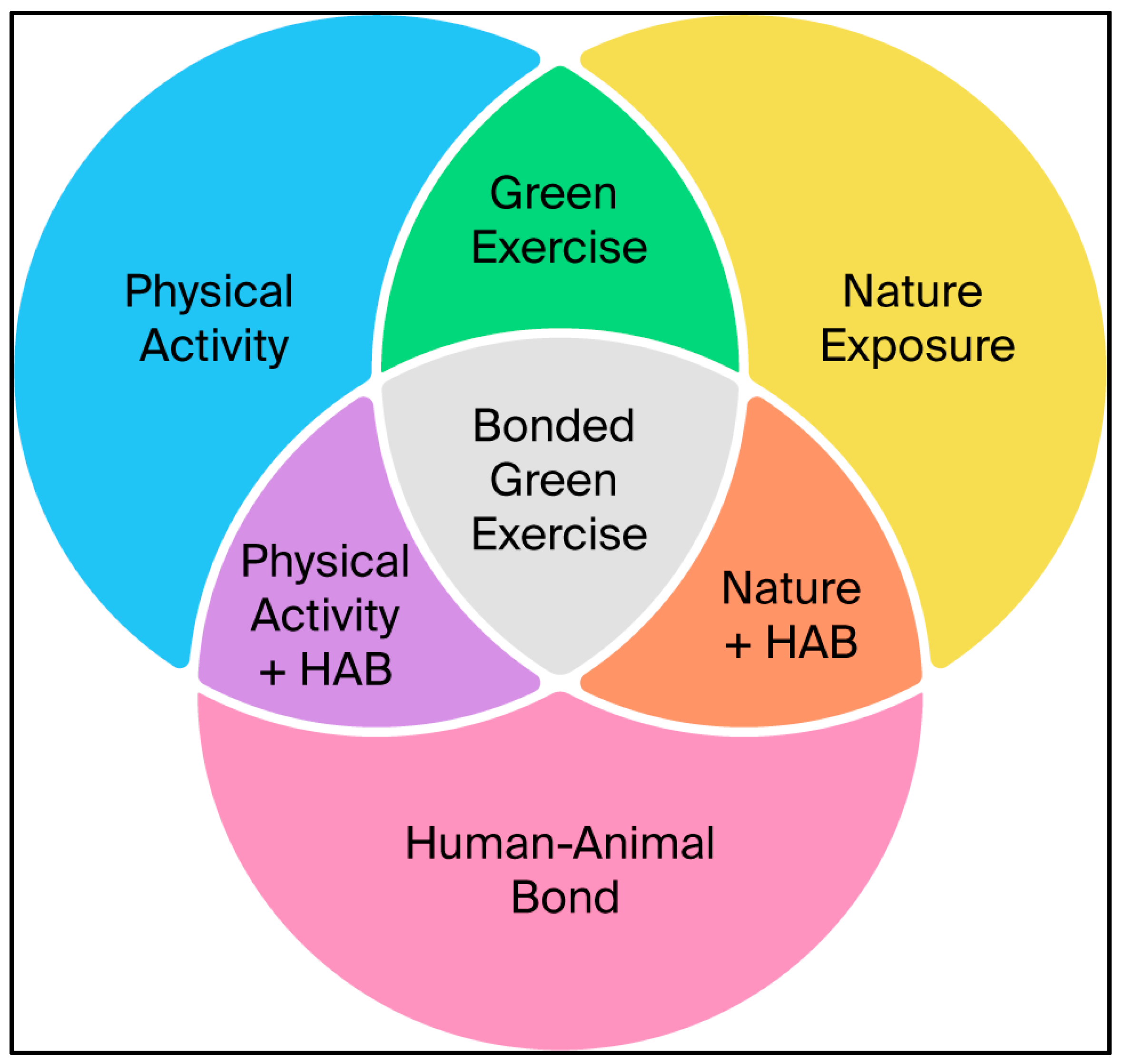
In light of the above, and in the face of today’s multitude of global lifestyle crises, a substantial body of existing and emerging evidence supports the positive human and/or canine health outcomes associated with each of the following three key domains: (1) nature exposure, (2) physical activity, and (3) the human–animal bond (HAB).
Nature exposure improves many aspects of health, including stress regulation, cognition, sleep, mental health, and immune function [
40]. Physical activity enhances cardiovascular, metabolic, and emotional health, as well as body condition score [
41]. The human–animal bond confers stress regulation [
32,
42,
43,
44,
45], social buffering [
32,
46], co-regulatory benefits [
15,
32,
33,
44,
45,
47], and increased motivation to exercise [
48,
49,
50], including a positive correlation between strength of the attachment bond and the distance owners walk their dogs [
51].
Furthermore, as noted by Pretty [
52], humans form multi-layered relationships with the world around them, ranging from whole-place attachments to ecosystems, landscapes, and multispecies communities, to individuated emotional bonds with other beings, including dogs. Just as community-level connection and social capital have well-documented health benefits for humans, so do close interpersonal relationships. The HAB, in this light, represents an interspecific form of “togetherness”, a construct often aligned with social capital [
52]. Such multi-level togetherness, from communities to cross-species bonds, has been linked to increased life satisfaction and longevity through mechanisms of social capital and mutual care [
52,
53,
54].
Despite the wealth of research on these three individual domains, they have rarely been studied as an integrated triad [
55]. While paired combinations, such as nature + exercise (coined green exercise by Pretty et al. [
56]), have received extensive attention [
49,
57,
58] and demonstrate synergistic benefits [
56,
59], a surprising gap remains in understanding what occurs when all three are experienced simultaneously by a human and their dog. Yet this is precisely what occurs when people and their dogs engage in shared outdoor activities such as walking, hiking, or adventuring together–a behaviour that is free, accessible, and enjoyed by many people worldwide.
Recent studies [
55,
60] have begun to explore shared outdoor exercise between humans and dogs, and note that this research gap exists. To our knowledge, no conceptual model has yet been proposed to examine the full triadic interaction of nature exposure, physical activity, and the human–animal bond within a human–dog dyad. Bonded green exercise is therefore proposed as a hypothesis-generating framework that integrates three well-established domains into a single, testable, One Health concept to guide empirical studies.
Here we present a conceptualized and testable model for intentional shared activity in nature as the primary unit through which physical, environmental, and relational processes may co-occur and may plausibly shape one another. Treating the shared dyadic activity itself as a coherent behavioural system allows bonded green exercise to be explored as a distinct cross-species context with hypothesized implications for motivation, adherence, emotional regulation, and well-being.
Large-scale nature-based and mind–body interventions [
61] have already demonstrated measurable public-health benefits and substantial cost savings. Given the global prevalence of dog ownership and the ubiquity of public green spaces, a comparable intervention incorporating human–dog activity in nature would be predicted to plausibly confer similar population-level health and economic returns.
1.1. Framework Overview
In this paper, we propose the novel concept of bonded green exercise to describe this triadic interaction: shared physical activity in nature between a human and a dog. This framework builds on the well-established concept of green exercise by explicitly integrating the human–animal bond as a third, co-active domain. Bonded green exercise therefore treats shared human–dog activity in natural settings as a single integrated behavioural context, rather than as outcomes distributed across adjacent domains. Importantly, we present this framework as a provisional model to guide future studies, rather than as an empirical conclusion.
Synergistic Effects
Based on this conceptual framework, bonded green exercise is posited to, at a minimum, potentially confer meaningful additive health outcomes to both species, associated with all three domains. Moreover, we hypothesize that the simultaneous engagement of the domain triad may plausibly yield benefits that are synergistic and co-regulatory.
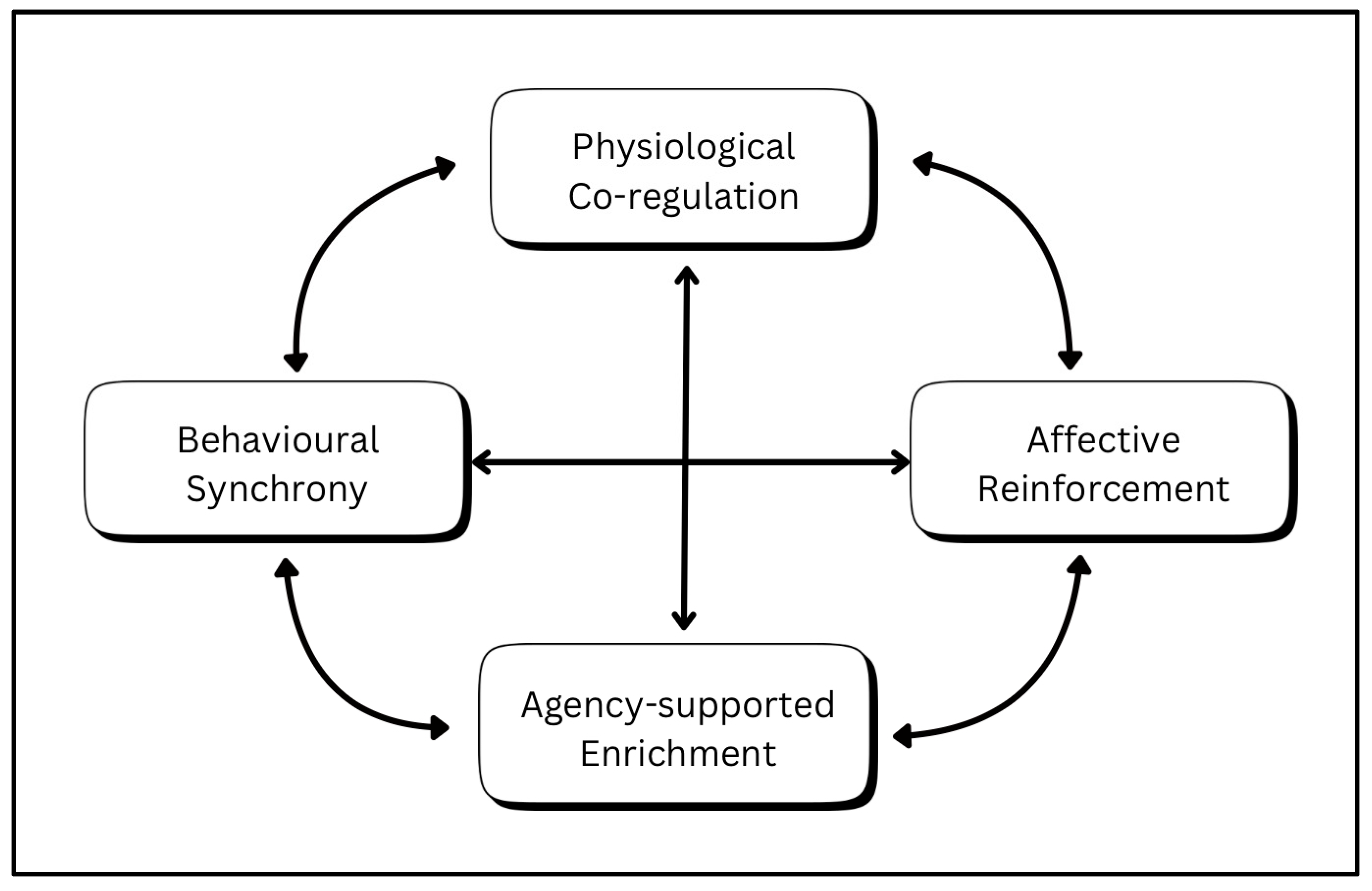
In both biological and behavioural systems, synergistic interactions may arise when two or more factors act in concert, through interactive or mutually reinforcing processes (such as physiological or behavioural positive feedback loops), to produce an amplified effect compared to the sum of effects of the individual factors [
62,
63]. In the context of bonded green exercise, we posit that synergistic effects may plausibly emerge through shared physiological pathways and/or through behavioural reinforcement, whereby engagement in one domain may plausibly enhance the intensity, duration, or quality of engagement in the others.
While evolutionary theory [
11,
42,
64] lends biological plausibility for this synergistic potential, its hypothesized expression in bonded green exercise contexts remains an empirical question. Humans and dogs co-evolved over tens of thousands of years as cooperative partners in physically active tasks within natural environments, including hunting, herding, gathering, and migration [
31,
64,
65,
66,
67,
68]. This long history of shared activities and cohabitation is believed to have shaped dogs not only by convergent evolution, but also through the domestication process [
11], jointly selecting for the uniquely interspecific attachment bond recently identified between dogs and humans [
69,
70].
These same evolutionary pressures are thought to have likely also favoured cross-species synchrony of emotions [
71,
72,
73], behaviour [
66,
72,
74,
75,
76,
77], and physiology [
45,
78,
79,
80], allowing dogs and humans to co-regulate in alignment with shared tasks and environments [
15,
33,
47,
64]. For example, the reciprocal oxytocin (OT) feedback loop between humans and dogs facilitates powerful interspecific stress co-regulation [
45], potentially offering emotional buffering that is especially meaningful amid widespread mental health challenges.
Yet while evolutionary theory offers compelling hypotheses on the foundations of these interspecies dynamics, we argue that bonded green exercise is not a genetically predetermined behaviour. We propose that evolution plausibly provided the template for this deep connection, and hypothesize that bonded green exercise may be an accessible way to intentionally activate this pathway in a modern context. Human–dog partnerships are shaped by both biology and culture; emergent from choices, relationships, and environmental affordances. As Graeber and Wengrow [
81] emphasize, human systems evolve through agency as much as through adaptation. Framing bonded green exercise as an intentional lifestyle shift opens space for proactive public health interventions.
As such, we argue that these processes are shaped not only by evolutionary inheritance but also by human and canine choice within social and cultural contexts. While the biophilia hypothesis [
42,
82] proposes an innate human tendency to affiliate with nature and animals, this should be viewed not as a deterministic effect, but as an evolved potential and one that is modulated by context, choice, and culture [
52].
1.2. Our Hypotheses
Bonded green exercise may plausibly represent a uniquely potent, low-cost, and biologically familiar behaviour. By integrating shared movement in a natural setting, we posit that bonded green exercise may plausibly provide a prime context for activating sensorimotor synchrony, emotional connection, and evolutionarily preserved pathways of well-being in both humans and dogs. As such, we propose the following testable hypotheses:
Triadic synergy hypothesis (H1). That simultaneous engagement of nature exposure, physical activity, and HAB will produce greater health benefits for both humans and dogs than the additive benefits of the domains experienced individually, due to potential interaction among shared regulatory and motivational systems.
Heterospecific benefit hypothesis (H2). That bonded green exercise yields physical and emotional health benefits in both humans and dogs, consistent with the goals of One Health.
Behavioural amplification hypothesis (H3). That dogs may act as catalysts for increased human engagement in physical activity in nature, thereby increasing the motivation and frequency of green exercise participation by humans.
Scalable health promotion hypothesis (H4). That given its low cost and accessible nature, bonded green exercise may represent a scalable public-health strategy to improve population-level mental and physical health in both species.
This novel framework bridges systemic and individual forms of connection, linking the ecosystem-level benefits of green exercise with the interpersonal benefits of the human–animal bond. Bonded green exercise further imparts relevance for multiple disciplines, including canine science [
83], veterinary behavioural health, public health, HAB and HAI science, exercise physiology, evolutionary biology, environmental psychology, and One Health.
By naming and defining bonded green exercise and outlining testable hypotheses, we invite scientific investigation into an existing yet underexplored dyadic behaviour, with the plausible potential to enhance physical, mental, and emotional health across species.
7. Limitations and Future Research Directions
Bonded green exercise is proposed here as a provisional conceptual framework with testable hypotheses, rather than a prescriptive intervention or methodological protocol. Accordingly, the considerations below delineate conditions and moderating factors for empirical investigation, rather than specifying standardized methods or outcomes. As with any heterospecific model, its application and evaluation must account for contextual, relational, and biological variability.
7.1. Moderating Factors Within the Human–Dog Dyad
The effects of bonded green exercise are expected to be moderated by characteristics of the human–dog relationship itself. Outcomes may be influenced by factors such as bond quality and duration, attachment style, canine temperament, and breed-linked traits, as well as by the human’s attentiveness and responsiveness during shared activity. For instance, an owner’s personality and attachment style (e.g., secure vs. avoidant) have been shown to affect the strength of the bond as well as the behaviour and anxiety levels of their dog [
22,
152]. Similarly, some dog breeds (e.g., Shepherds) are inherently more likely to be human-focused during shared activity—and this may affect their level of engagement with their owner [
147]. While these factors are plausibly expected to shape the
magnitude and expression of observed effects, bonded green exercise is still hypothesized to confer
net positive outcomes to the dyad, based on the aforementioned mechanisms including the strengthening of the bond through intentional shared activity.
Physical characteristics and conditioning of both partners also warrant consideration. The type, intensity, and duration of shared activity should be appropriate to the dog’s age, breed, health status, and physical capacity, as well as to the human’s abilities. As bonded green exercise is adaptive and context-dependent, inherent heterogeneity across dyads should therefore be understood not as a limitation of the framework, but as a feature that shapes its expression.
7.2. Ethical and Welfare Considerations
Shared human–dog activity in nature requires responsible management to ensure the welfare of the dog, the human, and the surrounding environment. Considerations include physical limitations, as well as preventing overexertion or overheating of the dog, mitigating stress or fear responses, complying with leash regulations, practicing “leave no trace” principles, and avoiding disruption to wildlife and ecological systems.
These responsibilities are not unique to bonded green exercise but reflect best practices inherent to any outdoor engagement with companion animals, and are essential considerations for ethical public health applications, particularly when welfare-supportive activities are intentionally promoted.
While such considerations necessarily focus on preventing adverse outcomes, contemporary welfare frameworks emphasize that positive states—including agency, engagement, positive affect, and a strong human–animal bond—are equally essential components of a dog’s well-being [
153,
154], and we posit that such states may be supported through appropriately designed bonded green exercise.
7.3. Contextual and Accessibility Limitations
Access to suitable green space and to canine companionship is unevenly distributed across geographic, socioeconomic, and cultural settings. Although large natural landscapes may not be universally available, aforementioned evidence suggests that even modest urban green spaces—such as neighbourhood parks, community gardens, or tree-lined walking paths—can elicit measurable physiological and psychological benefits. This supports the relevance of bonded green exercise within urban environments, where opportunities for nature exposure and physical activity may otherwise be limited and highlights its potential applicability within population-level One Health initiatives.
The emphasis on low-cost, accessible, and everyday contexts suggests that the bonded green exercise framework may be compatible with population-level public health promotion and One Health initiatives, without requiring specialized infrastructure.
Having said this, bonded green exercise is also not universally applicable. Across cultures and individuals, not every human wishes to own or interact with dogs, and not all dogs are suited to shared outdoor activity in all settings. For individuals without access to a companion dog, community-based initiatives such as shelter-dog walking or hiking programmes may offer partial opportunities for shared outdoor activity. While such relationships are typically less established than long-term cohabitating dyads, existing evidence suggests they may still confer physiological and affective benefits for both species [
57,
132].
7.4. Empirical Testing and Methodological Considerations
As a conceptual framework, bonded green exercise is intended to guide, rather than prescribe, empirical investigation. Researchers across disciplines may employ diverse methodological approaches reflecting differences in research questions, study populations, and measurement advancements.
Conceptually, empirical studies on bonded green exercise may wish to compare conditions in which all three domains are present versus conditions in which one or more components are selectively absent. For example, within-subject or crossover designs could compare shared human–dog activity in nature with paired conditions in which one domain is absent (e.g., green exercise with versus without a dog; dog-walking while being ‘present’ versus while being ‘distracted’ on one’s smartphone; or human–dog interaction in nature with versus without physical activity). This framing offers a simple organizing heuristic—shared, active, and green—through which the hypothesized effects of bonded green exercise may be isolated and tested.
Across such designs, outcomes of interest may include physiological indicators (e.g., stress regulation or autonomic balance), behavioural outcomes (e.g., activity synchrony; social referencing), affective or psychological measures in both humans and dogs, and subjective attachment scores.
The following provides illustrative criteria through which the four hypotheses presented here may be empirically investigated:
Hypothesis 1 (triadic synergy) would be supported if shared activity in nature produces effects to one or both members of the human–dog dyad that are greater in magnitude, more persistent, or qualitatively distinct compared to those observed when physical activity, nature exposure, or human–dog interaction are experienced in isolation. Conversely, equivalent or lesser effects would constitute disconfirming evidence and help to refine the framework’s scope.
Hypothesis 2 (parallel benefits) may be examined through concurrent assessment of physiological, behavioural, or affective outcomes in both members of the human–dog dyad, such as cortisol or heart rate variability measurements, synchrony of activity patterns, or shared affective responses.
Hypothesis 3 (behaviour amplification) may be evaluated through indicators of motivation, adherence, and affective reward, including increased frequency or duration of shared activity, sustained engagement over time, or self-reported and observed enjoyment relative to non-bonded or non-natural activity contexts.
Hypothesis 4 (scalability and accessibility) may be informed by studies conducted across diverse environmental settings, demographic groups, and dyad characteristics, including urban green spaces and varied relationship contexts, without requiring ‘backcountry’ natural environments or specialized physical activities. For example, bonded green exercise may be examined within everyday human–dog routines by studying dyads engaging in intentional, shared activity within locally accessible green spaces, such as an intentionally shared walk in a neighbourhood park, thereby allowing investigation of scalability under conditions that are widely available and minimally resource-intensive.
Reported outcomes across HAB/HAI research remain inconsistent, most likely reflecting differences in study design, measurement, and context [
53,
125,
155,
156]. Additionally, differences in breed attributes, such as the inherent level of human-directed attention, should be taken into account during study design. In Martin et al. [
22], the authors provide a discussion of limitations of, and recent advancements in, HAI methodology. Furthermore, the recent availability of activity trackers for humans and pets mitigates motion artefacts of physiological measurements during free-moving activities [
146,
148,
157].
Future investigations of bonded green exercise should therefore prioritize standardized constructs and outcome measures to strengthen reproducibility and cross-study coherence [
155], as well as implement best-practices of canine welfare to mitigate stress levels and enhance well-being [
143,
158]. By integrating these methodological insights, bonded green exercise research may also contribute to improving methodological rigour within HAB and HAI science.
8. Conclusions
In this manuscript we discussed the parallel health costs to humans and dogs of industrialized society’s screen-addicted, sedentary, indoor lifestyle, and introduced the first conceptual framework that integrates nature exposure, physical activity, and the human–animal bond into a single model of shared human–dog activity—bonded green exercise. Importantly, we posited that this testable framework may plausibly confer meaningful health outcomes through concurrent, additive effects of these three well-studied domains, independent of any hypothesized synergistic amplification.
We proposed that this One Health conceptual framework may have the potential to enhance health and lifespan across species. We hypothesized the plausible physiological and behavioural underpinnings of synergistic benefits to dogs and humans, as well as how dogs may potentially act as a catalyst, motivating their humans to be active together outdoors. Finally, we discussed how bonded green exercise is potentially low-cost, widely accessible, and scalable to enhance public and canine health in industrialized societies worldwide.
Grounded in their shared evolutionary history and consistent with One Health principles, we suggested that bonded green exercise may plausibly represent a biologically coherent and accessible behaviour that may potentially improve human and canine physical, emotional, and relational well-being, including fostering the human–animal bond. Furthermore, since canine welfare depends not only on physical health but also on environmental quality, expression of natural behavioural, opportunities for agency, positive affective experiences, and the quality of the human–animal bond [
153,
154], bonded green exercise may plausibly provide a practical and scalable pathway for improving everyday welfare in companion dogs.
Overall, this novel provisional framework may offer potential for broad-reaching implications for future public health policies and One Health practice. This testable framework and its hypotheses invite empirical research and interdisciplinary studies exploring how shared nature-based physical activity may promote the health, welfare, and relational well-being of both humans and dogs.