1. Introduction
The escalating frequency and intensity of heat waves driven by global climate change have become critical challenges to livestock sustainability, especially in tropical and subtropical areas where environmental temperatures go beyond the thermoneutral range of ruminants [
1,
2]. Among ruminant species, water buffaloes (
Bubalus bubalis) are especially vulnerable to heat stress owing to inherent physiological limitations: the sparse sweat gland distribution, dense epidermal layers, and melanin-rich pelage collectively impair thermoregulatory efficiency by hindering evaporative and radiative heat loss [
3,
4]. Chronic heat exposure triggers a cascade of pathological responses, including hyperthermia, oxidative stress-mediated cellular damage, and immune suppression, which ultimately compromise lactation productivity [
5,
6].
To mitigate these adverse effects, bioactive dietary interventions have emerged as practical and sustainable strategies. Rosemary (
Rosmarinus officinalis L.), a perennial aromatic herb of the
Lamiaceae family, is rich in bioactive constituents like carnosic acid, carnosol, and rosmarinic acid, properties that have fueled its widespread use in the cosmetics, food, and pharmaceutical industries [
7]. Beyond these fields, rosemary’s antibacterial, antioxidative, and anti-inflammatory properties have extended its application to livestock production [
8,
9]. For monogastric animals, extensive research has confirmed that dietary rosemary extract (RE) supplementation improves growth traits, enhances antioxidative capacity, regulates gut microbial composition, and modulates humoral immune function [
10,
11,
12,
13]. In ruminants, the antioxidative activity of rosemary was first confirmed via the administration of an acute dose to sheep through a duodenal T-cannula. Nevertheless, the unique rumen ecosystem of ruminants, characterized by complex microbial fermentation, may alter the bioavailability and efficacy of RE, thereby influencing its final biological effects. Subsequent feeding trials have demonstrated that incorporating rosemary or its by-products into ruminant diets improves lactation performance in dairy sheep, goats, and cows [
14,
15,
16]. This is particularly relevant for dairy ruminants, which are inherently prone to oxidative stress due to high metabolic demands (e.g., lactation) and environmental factors like heat stress; factors that not only impair rumen function but also disrupt milk production [
17]. Moreover, multi-omics studies have further highlighted that the ruminal microbial community structure and function profiles are tightly coupled to lactation performance and overall health in dairy ruminants [
18,
19]. While RE has shown promise in modulating rumen microbiota and enhancing antioxidant status in various dairy animals, its effects on dairy buffaloes, especially under heat stress conditions, remain understudied.
Therefore, this research was designed to explore the impacts of supplementing RE in the diet on milk production performance, antioxidative capacity, immune function, rumen fermentation profiles, and ruminal microbial composition of dairy buffaloes in hot environments. By addressing this key research gap, the findings may provide evidence-based recommendations for optimizing dairy buffalo production and resilience in challenging environmental contexts.
2. Materials and Methods
2.1. Animal Ethics
All experimental protocols involving animals were endorsed by the Animal Ethics and Welfare Committee of the Guangxi Buffalo Research Institute (Nanning, China) under the authorization No. 20240801L.
2.2. Rosemary Extract
The RE was supplied by Hunan Zhizhiyuan Biotechnology Co., Ltd. (Luxi, China), which was prepared via solvent extraction from locally sourced rosemary leaves. The extraction method of RE and the detection protocol for its functional components (carnosic acid and rosmarinic acid) were performed according to the method described by Kong et al. [
16]. The concentrations of carnosic acid and rosmarinic acid in the RE were determined to be 42.28 g/kg and 1.59 g/kg, respectively.
2.3. Animals and Experimental Design
The experiment was carried out from August to September at the Guangxi Buffalo Research Institute, situated in Nanning, South China (22°53′22.59″ N, 108°21′51.19″ E). Twenty
Mediterranean dairy buffaloes with an average BW of 605 ± 22 kg, parity of 2.63 ± 1.26, and lactation stage of 118 ± 19 d were selected and assigned to two dietary treatments using a completely randomized design stratified by pre-experimental milk production and parity: a control group (CON) receiving a basal diet, and a RE-supplemented group (RE) fed the basal diet supplemented with 20 g/d of RE per buffalo. Daily top-dressing of RE was conducted by mixing it with a small portion of the total mixed ration (TMR) during morning feeding (prior to milking), and each experimental buffalo was observed continuously after feeding to ensure 100% consumption of the supplement. Daily feed orts of individual buffaloes were recorded to monitor feed intake. The experiment spanned 35 days, with a 7-day adaptation period included. Detailed feeding and housing management practices were consistent with those reported in our previous study [
20]. The chemical composition of the basal diet is shown in
Table 1. Individual dry matter intake (DMI) was computed daily by weighing the provided feed and orts per animal.
2.4. Assessment of Thermal Comfort Status
The physiological index (P3) model developed by Li et al. [
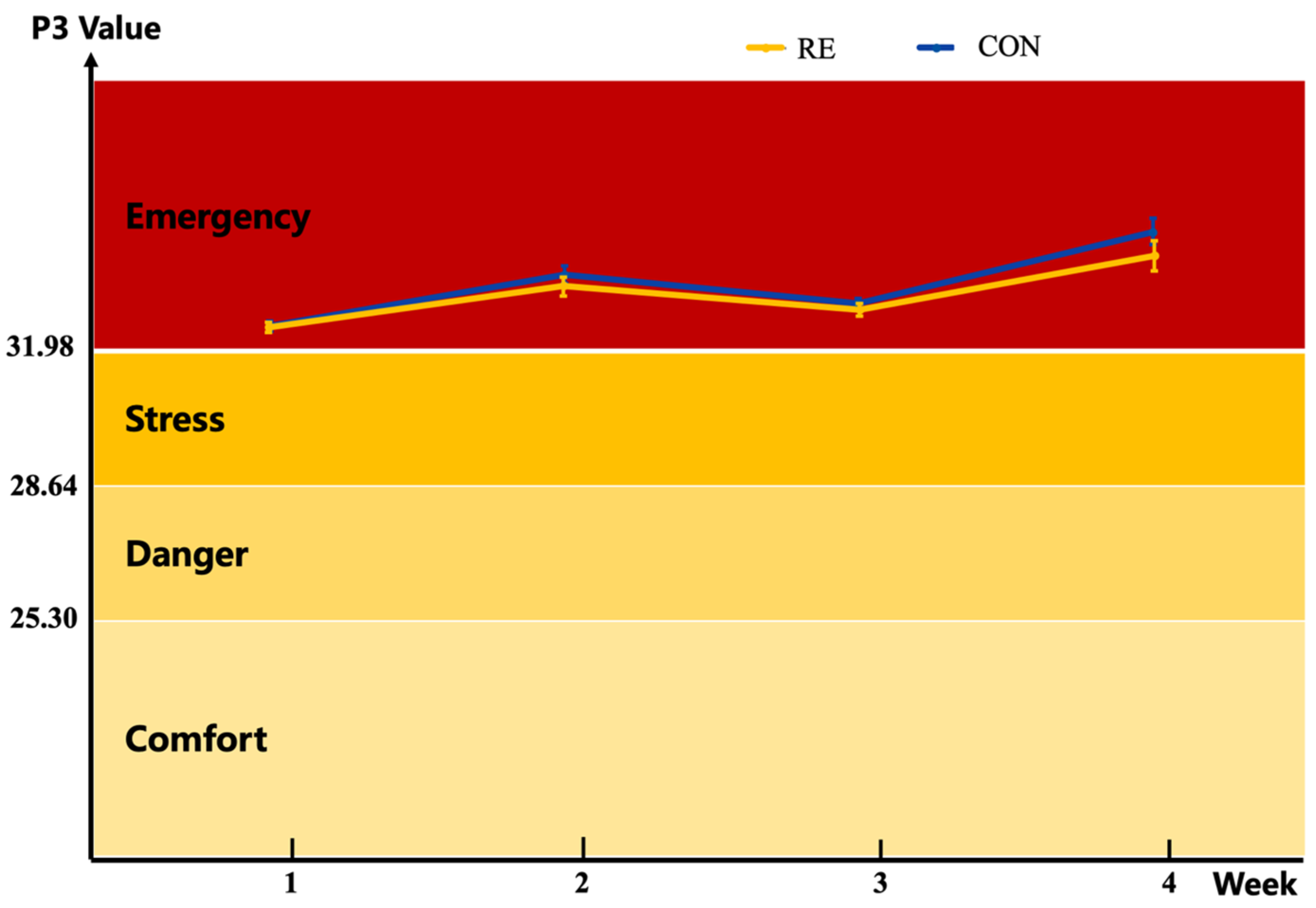
21], validated for evaluating the thermal status of buffaloes in hot and humid environments, was adopted to assess their thermal comfort. The P3 index is computed using the formula: P3 = 0.654 × BST (°C) + 0.381 × RR (breaths/min). Based on the P3 values, thermal comfort is classified into four grades: comfort (P3 ≤ 25.30), danger (25.30 < P3 ≤ 28.64), stress (28.64 < P3 < 31.98), and emergency (P3 ≥ 31.98).
2.5. Recording of Physiological Parameters
Physiological parameters were measured twice weekly (Monday and Thursday) in the morning (08:00–09:00) and afternoon (14:30–15:30). Respiratory rate (RR, breaths/min) was manually counted: chest and abdominal movements were observed for 2 min with a stopwatch, and the average movements per minute were recorded. Body surface temperature (BST, °C) was measured using an infrared thermometer (HRQ-S60, Haorunqi Electronic Technology Co., Ltd., Zhengzhou, Henan, China), with the average temperature of the forehead, left chest, and left abdomen taken as the BST value. Rectal temperature (RT, °C) was assessed via a rectal thermometer (GLA 700, GLA Co., San Luis Obispo, CA, USA), which was retained in the rectum for 2 min to record the stabilized maximum temperature.
2.6. Feed and Fecal Samples Collection and Analysis
Feed samples were collected once weekly throughout the experimental period and immediately stored at −20 °C. Fecal samples were collected during the final 3 consecutive days of the experimental period. Fresh feces were weighed and homogenized daily, after which 10 mL of 10% (
v/
v) sulfuric acid (H
2SO
4) was added to each daily composite fecal sample to fix nitrogen; the samples were then stored at −20 °C for subsequent analysis. Subsequently, the frozen samples were thawed, dried in a forced-air oven at 65 °C to a constant weight, and ground to pass through a 40-mesh sieve. The nutrient composition, including crude protein (CP), neutral detergent fiber (NDF), acid detergent fiber (ADF), and ether extract (EE), was analyzed following the procedures described by the Association of Official Analytical Chemists (AOAC, 2005) [
22], and gross energy (GE) was measured using an oxygen bomb calorimeter (SDACM3100, Hunan Sande Technology Co., Ltd., Xiangtan, China). The apparent total tract digestibility of each nutrient was calculated using acid-insoluble ash as an internal marker.
2.7. Milk Sample Collection and Analysis
Buffaloes were milked twice daily (05:00 and 14:00), with milk production recorded at each session. Weekly milk samples were collected for composition analysis, including milk fat, protein, lactose, solids-not-fat (SNF), total solids (TS), milk urea nitrogen (MUN), and free fatty acids (FFA), using an automatic milk composition analyzer (MilkoScan F120, FOSS, Hillerød, Denmark). The 4% fat-corrected milk (4% FCM) was computed via the following formula: 4% FCM = 0.4 × milk production (kg/d) + 0.15 × milk fat percentage (%) × milk production (kg/d). Milk samples for medium- and long-chain fatty acid profile analysis were collected and analyzed via GC-MS following our recently described method [
20], with a total of 38 primary fatty acids quantified, including 15 saturated fatty acids (SFA), 10 monounsaturated fatty acids (MUFA), and 13 polyunsaturated fatty acids (PUFA).
2.8. Blood Samples Collection and Analysis
On the final day of the experiment, prior to morning feeding, blood samples (approximately 20 mL) were collected via the coccygeal vein of the buffaloes using the disposable vacuum blood collection tubes (non-anticoagulant tubes), and centrifuged to separate serum and plasma, respectively. Serum levels of total protein (TP), albumin (ALB), alkaline phosphatase (ALP), creatine kinase (CK), lactate dehydrogenase (LDH), aspartate aminotransferase (AST), alanine transaminase (ALT), urea nitrogen (UN), glucose (GLU), triglyceride (TG), total cholesterol (TC), immunoglobulin A (IgA), IgG, IgM, triiodothyronine (T3), tetraiodothyronine (T4), and insulin (INS) were quantified using an automatic blood biochemical analyzer (Cobas c311, Roche, Switzerland) with matching biochemical Kits. For plasma samples, the activities of catalase (CAT), glutathione peroxidase (GSH-PX), and superoxide dismutase (SOD), as well as total antioxidant capacity (T-AOC) and malondialdehyde (MDA) concentrations, were assayed using commercial kits purchased from Nanjing Jiancheng Bioengineering Institute (Nanjing, China). Additionally, serum concentrations of heat shock protein 70 (HSP70), serum amyloid A (SAA), interleukin-1beta (IL-1β), IL-2, IL-6, tumor necrosis factor-α (TNF-α), and interferon-γ (IFN-γ) were detected via ELISA kits (Jiangsu Jingmei Biotechnology, Taixing, China) following the manufacturers’ protocols.
2.9. Ruminal Contents Collection and Analysis
On the final day of the experiment, prior to morning feeding, approximately 500 mL of ruminal contents was collected from each buffalo, strained through two layers of cheesecloth, and subsamples for the analysis of ruminal fluid pH, microbial crude protein (MCP), ammonia nitrogen (NH3-N), and volatile fatty acids (VFA) were stored at −20 °C and determined as previously described [
20]. Subsamples for DNA extraction were stored at −80 °C. Total genomic DNA was extracted from rumen fluid using an E.Z.N.A Soil DNA Kit (Omega Bio-Tek, Norcross, GA, USA), and subsequently, high-throughput Illumina MiSeq sequencing of the 16S rRNA gene V3–V4 region was performed as reported in our previous work [
20]. α-diversity indices (Chao 1, Ace, Shannon, Simpson) were calculated using QIIME 2. β-diversity was analyzed through Bray–Curtis distance matrices, principal coordinate analysis (PCoA), and analysis of similarities (ANOSIM). Linear discriminant analysis (LDA) effect size (LEfSe) was used to identify significantly differential taxa (LDA score > 2.5,
p < 0.05).
2.10. Statistical Analysis
All data were analyzed using the independent samples t-test in SPSS version 23 (IBM Corp., Armonk, NY, USA). Prior to statistical analysis, the normality of data distribution was verified using the Shapiro–Wilk test, and the homogeneity of variance was assessed via Levene’s test. For comparisons of microbial composition and α-diversity indices, Welch’s t-test was employed due to the presence of heterogeneous variances across groups. Results are presented as means ± standard error of the mean (SEM). Statistical significance was considered at p < 0.05, and a tendency was defined as 0.05 ≤ p < 0.10.
4. Discussion
During hot summer months, elevated ambient temperature and humidity create unfavorable conditions for dairy ruminants: metabolic heat cannot be dissipated promptly, leading to increased body temperature and ultimately heat stress [
23]. Although the temperature-humidity index is widely used to assess heat stress in cows, it is not applicable to buffaloes. Our laboratory recently developed and validated a thermal comfort assessment model for dairy buffaloes under hot and humid climates, with the model integrating RR and BST showing the highest accuracy in reflecting thermal status [
21]. In the current study, this model confirmed that both groups experienced severe and sustained heat stress, with the RE group showing partial relief, a finding consistent with previous reports that RE mitigates heat stress in broiler chickens [
24], supporting its broad potential as a heat stress modulator in livestock. Heat stress triggers adaptive thermoregulatory mechanisms, and elevated BST is a direct indicator of excess body heat accumulation when heat production exceeds heat-dissipating capacity [
25]. The tendency of RE to reduce BST provides direct evidence of its ability to alleviate thermal discomfort in heat-stressed dairy buffaloes, though it should be noted that this reduction only exhibited a statistical trend rather than a significant difference, which may be attributed to the relatively small sample size in the present study. However, a notable limitation of this study is the use of a single RE supplementation dose, which was referenced to the effective concentrations reported in previous Sanhe dairy cow studies [
19]. Without multiple dose gradients, we cannot establish a dose–response relationship or confirm whether this dose is optimal. This information is critical for practical feeding recommendations, as it helps balance efficacy and cost-effectiveness in dairy buffalo farms. Future research should include multiple RE dose levels to identify the optimal inclusion concentration and clarify its safety range for dairy buffaloes.
Heat stress poses a severe challenge to lactating buffaloes: high nutrient demands for milk synthesis increase metabolic heat production, and persistent high temperature/humidity exacerbate heat stress [
26]. Recent studies demonstrate that heat stress exerts a detrimental effect on milk protein concentration by inhibiting the synthesis of key proteins (e.g., α-casein, β-casein) and compromises milk nutritional value by lowering phospholipid content [
27]. Dietary phytogenic compounds (e.g., bupleurum, honeysuckle extracts) have been shown to mitigate these effects in dairy cows [
28,
29], and plant extracts can optimize milk fatty acid profiles in dairy ewes by reducing ruminal biohydrogenation of fatty acids [
30,
31]. In line with these previous findings, our study demonstrated increased milk production, 4% FCM, milk protein, lactose, and SNF concentrations in the RE group. Notably, RE supplementation reduced the proportions of milk SFAs (specifically C14:0 and C18:0) while increasing those of PUFAs (namely C22:5n3 [DPA] and C22:5n6). These observed fatty acid alterations may be indicative of a potential shift toward a more favorable milk fatty acid profile, though any inferences regarding corresponding implications for human nutritional value, such as putative anti-inflammatory and cardiovascular protective effects, still require further validation through targeted human nutrition studies. Importantly, no differences in DMI or nutrient digestibility were observed between groups, ruling out the possibility that RE’s effects on lactation were driven by increased feed intake or improved nutrient absorption. This aligns with Kholif et al. [
32], who reported that 10 g/d of whole rosemary plant improved milk yield in dairy goats without affecting feed intake. Collectively, these studies confirm the positive impact of rosemary supplementation on ruminant milk production, regardless of the forms (extract, raw plant, essential oil) or environmental conditions. It is notable that, as a methodological consideration, future studies could adopt linear mixed-effects models to better address the repeated-measure nature of the data (e.g., milk yield), thereby enhancing statistical rigor.
Heat stress induces oxidative stress, which contributes to dysregulated inflammatory responses in ruminants [
33]. Recognized as a safe food component by the European Food Safety Authority (EFSA), RE is enriched with polyphenols (carnosic acid, rosmarinic acid, carnosol) that enhance enzymatic (CAT, GSH-PX, SOD) and non-enzymatic (glutathione) antioxidant systems while suppressing systemic inflammation [
34]. Carnosic acid, the most abundant and potent antioxidant in RE, retains its efficacy in lambs even after ruminal fermentation [
35,
36], and intravenous infusion of carnosic acid modulates oxidative stress and inflammatory response in transition dairy cows, with the underlying mechanism linked to the activation of the PI3K/AKT/Nrf2 pathway [
37,
38]. Beyond direct antioxidant effects, HSP70 acts as a cellular “thermometer” that mediates heat stress signaling, supports thermotolerance, and coordinates oxidative damage sensing and immune function modulation [
39]. Tang et al. [
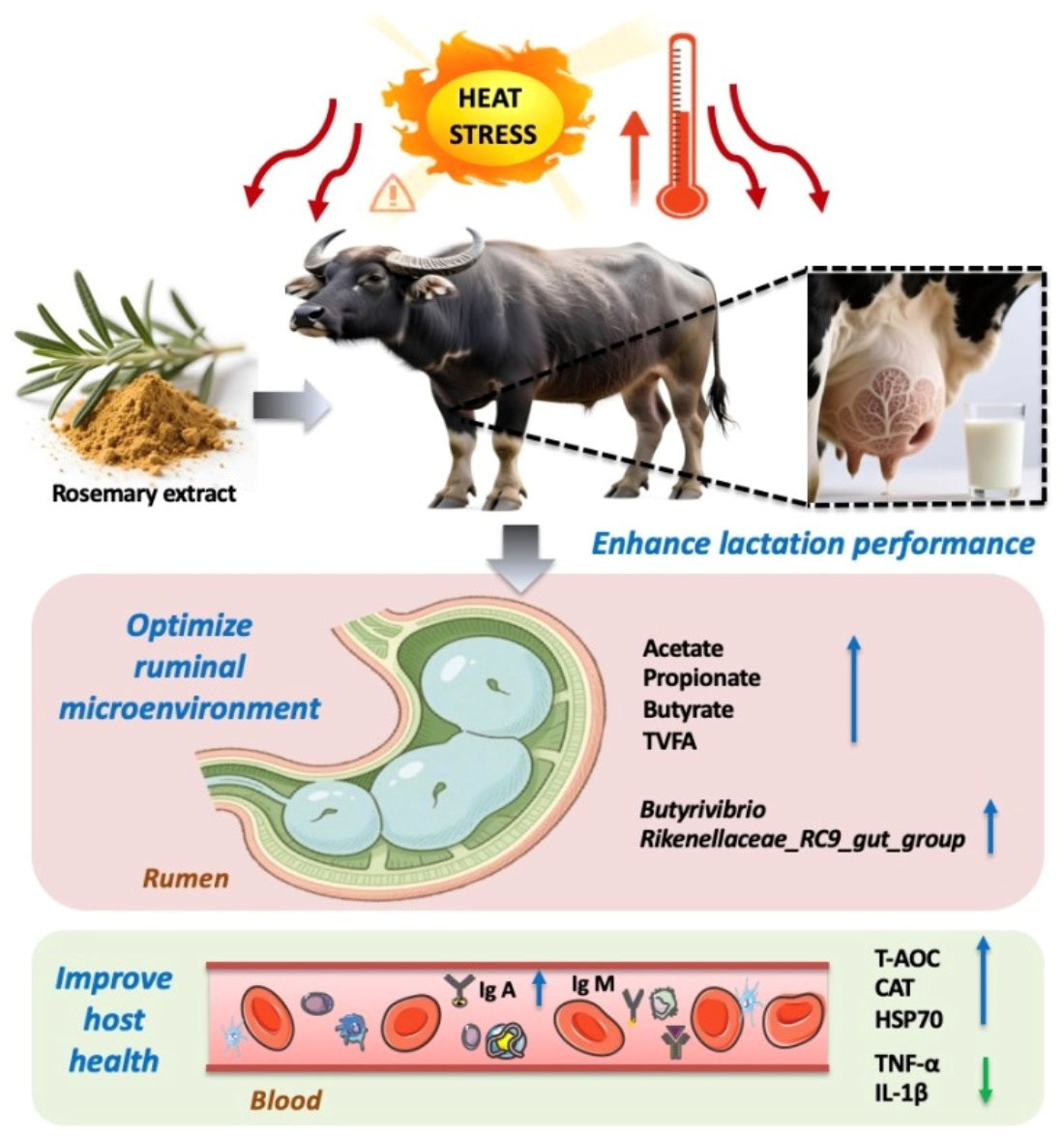
23] reported that purified RE supplementation enhances the antioxidant status and upregulates HSP70 expression in the heart of heat-stressed chicken, and our study similarly observed increases in serum CAT activity along with T-AOC and HSP70 concentrations in the RE group. Concomitantly, RE supplementation elevated serum IgA/IgM and reduced IL-1β/TNF-α, confirming improved antioxidant homeostasis and immune function, effects that align with Kong et al. [
16], who reported comparable benefits in high-producing dairy cows. A key limitation of this study, however, is the single-time-point blood sampling at the end of the experiment, which prevents tracking the temporal dynamics of these serum indicators.
Plant extracts act as rumen modifiers via selective antimicrobial activity [
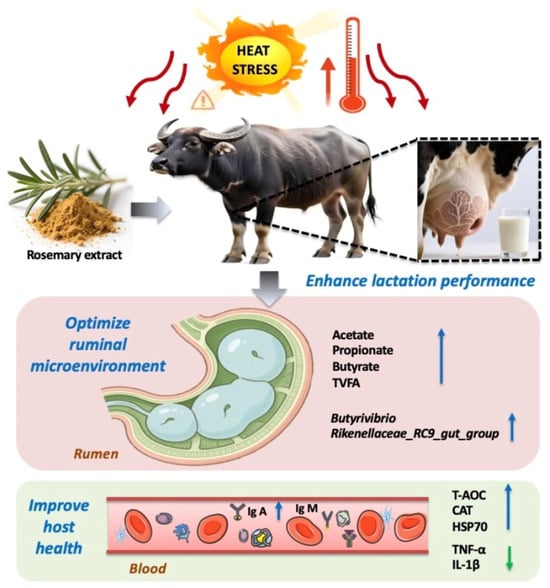
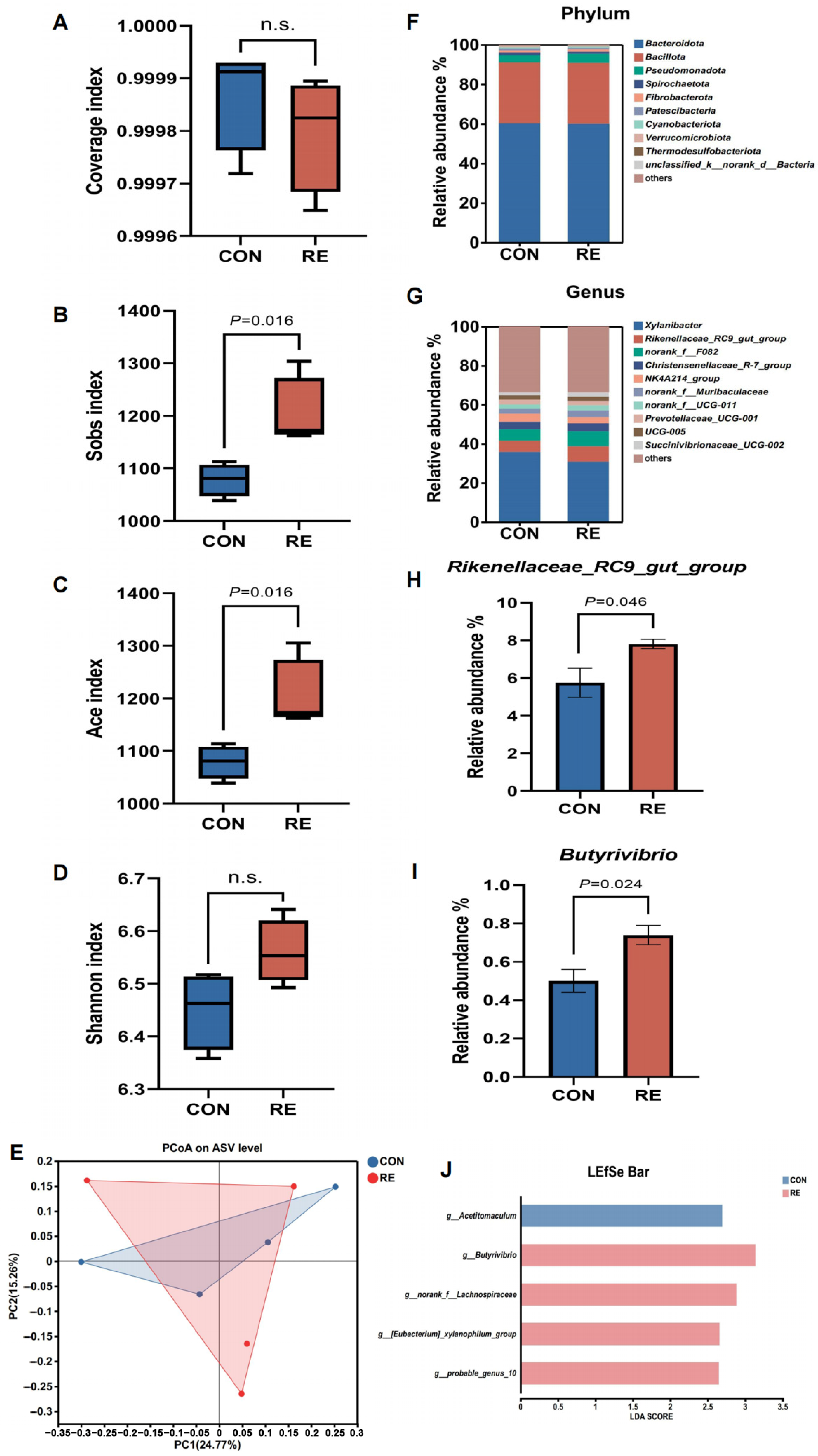
40], and our study showed that RE enriched several specific functional taxa in the rumen of dairy buffaloes, potentially associated with changes in VFA concentration and composition, rather than inducing a global shift in the rumen microbial community. Higher α-diversity (species richness indices-Sobs, Ace) in the RE group enhances rumen ecosystem resistance to heat stress-induced dysbiosis by providing functional redundancy [
41]. This ecological resilience was further supported by the unchanged rumen pH in our RE group, which aligns with previous findings in dairy cows and Damascus goats [
16,
32]. The VFA are typically regarded as the main carbon source for rumen microbes, accounting for approximately 70% of the digestible energy in ruminants [
42]. In the present study, the simultaneous increase in acetate, propionate, butyrate, and TVFA in the RE group reflects improved rumen function and nutrient utilization. Elevated propionate (the primary gluconeogenic precursor) was detected in the RE group, coinciding with higher milk lactose content. This observation supports the plausible hypothesis that increased propionate may facilitate hepatic glucose synthesis, which could, in turn, support mammary lactose synthesis and immune cell function [
43]. This finding aligns with the reports of Torres et al. [
43] and Kong et al. [
16], who documented increased propionate levels in sheep and dairy cows supplemented with essential oils (enriched with carnosic acid and carvacrol) or RE. Higher propionate production also suggests potential methane mitigation by competing with methanogenesis for hydrogen, redirecting metabolic flux to energy-efficient VFA synthesis [
44], though direct methane measurements in RE-supplemented dairy buffaloes are needed.
Beyond enhancing overall diversity, RE supplementation specifically enriched functionally critical bacterial genera.
Rikenellaceae_RC9_gut_group (
Rikenellaceae family) is known to specialize in structural carbohydrate degradation and producing acetate and propionate [
7,
45], with its abundance correlating positively with acetate concentration [
46].
Butyrivibrio spp. (family
Lachnospiraceae) can degrade both structural and non-structural carbohydrates and synthesizes butyrate (a VFA that promotes rumen epithelial proliferation and suppresses pro-inflammatory signaling [
47,
48]), hinting at a potential synergistic effect between the metabolism of this genus and RE’s anti-inflammatory properties. Under the co-enrichment of
Rikenellaceae_RC9_gut_group and
Butyrivibrio spp., increased production of “acetate + propionate + butyrate” was observed in the RE group. This co-occurrence suggests a plausible scenario where these microbial metabolites may provide sufficient substrates for milk component synthesis and contribute to rumen epithelial health. Future studies should integrate multi-omics analyses (metabolomics, metatranscriptomics) and in vitro validation experiments to confirm these potential mechanistic links. LEfSe analysis further identified that multiple bacterial genera within the family
Lachnospiraceae were enriched in the RE group. As a core taxonomic group in the rumen microbiota, the
Lachnospiraceae family plays well-documented roles in carbohydrate metabolism, VFA synthesis, and rumen barrier maintenance [
49,
50]. The enrichment of these functionally distinct genera in the RE group is associated with enhanced fermentation efficiency, optimized nutrient utilization, and strengthened physiological resilience to heat stress. These observations collectively support the formation of a potential “metabolic network” which may contribute to the stabilization of the rumen ecosystem.




 ,
,