Molecular Characterization and Epidemiology of Anaplasmataceae in Ticks and Domestic Animals in the Colombian Caribbean
 , ,
, ,
Simple Summary
Abstract
1. Introduction
2. Materials and Methods
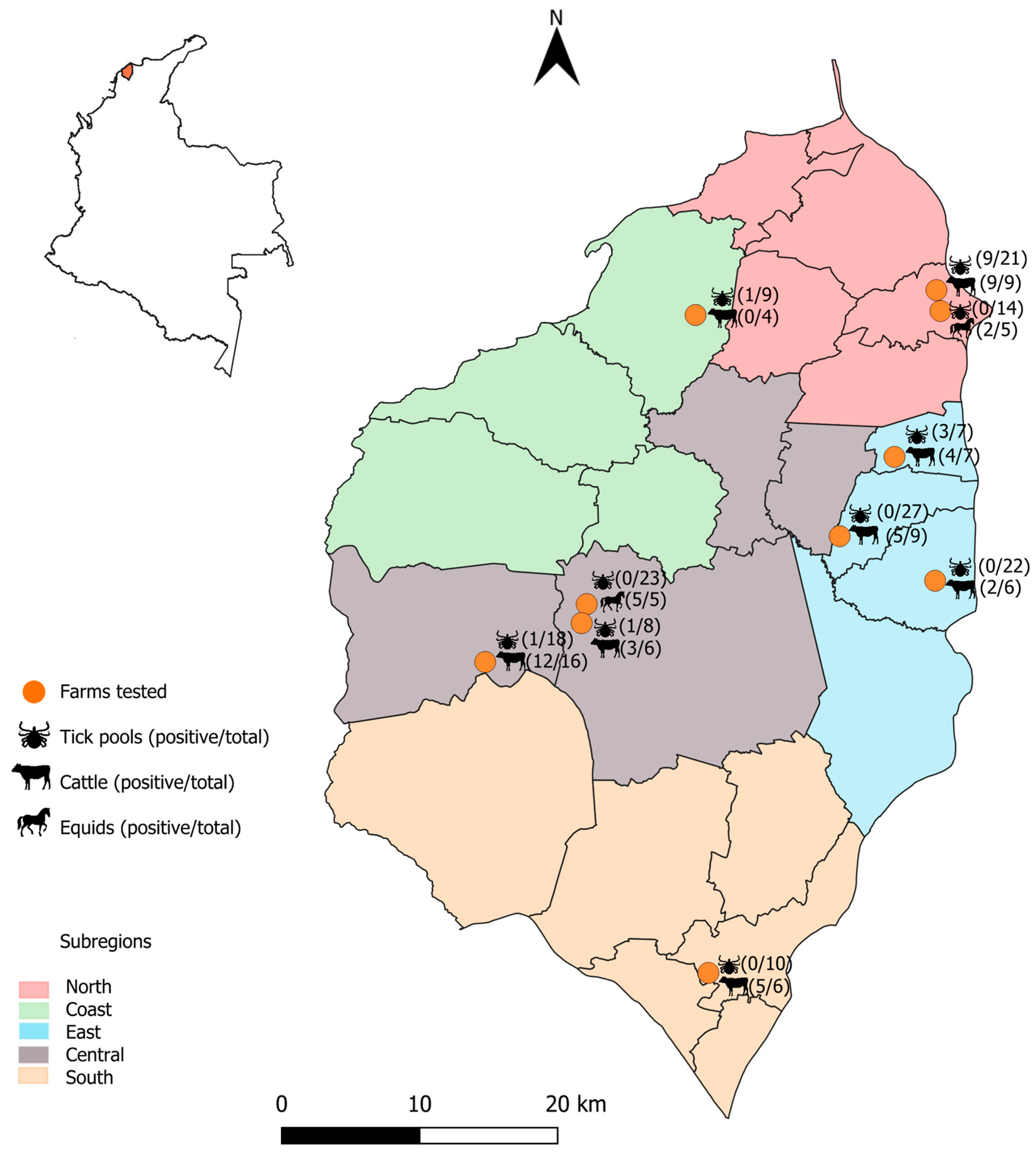
2.1. Study Design, Sampling, and Specimen Collection
2.2. Molecular Identification of Ticks and Molecular Analysis of Anaplasmataceae
2.3. Sequencing, Phylogenetic Analysis, and Genetic Divergence
2.4. Statistical Analysis
3. Results
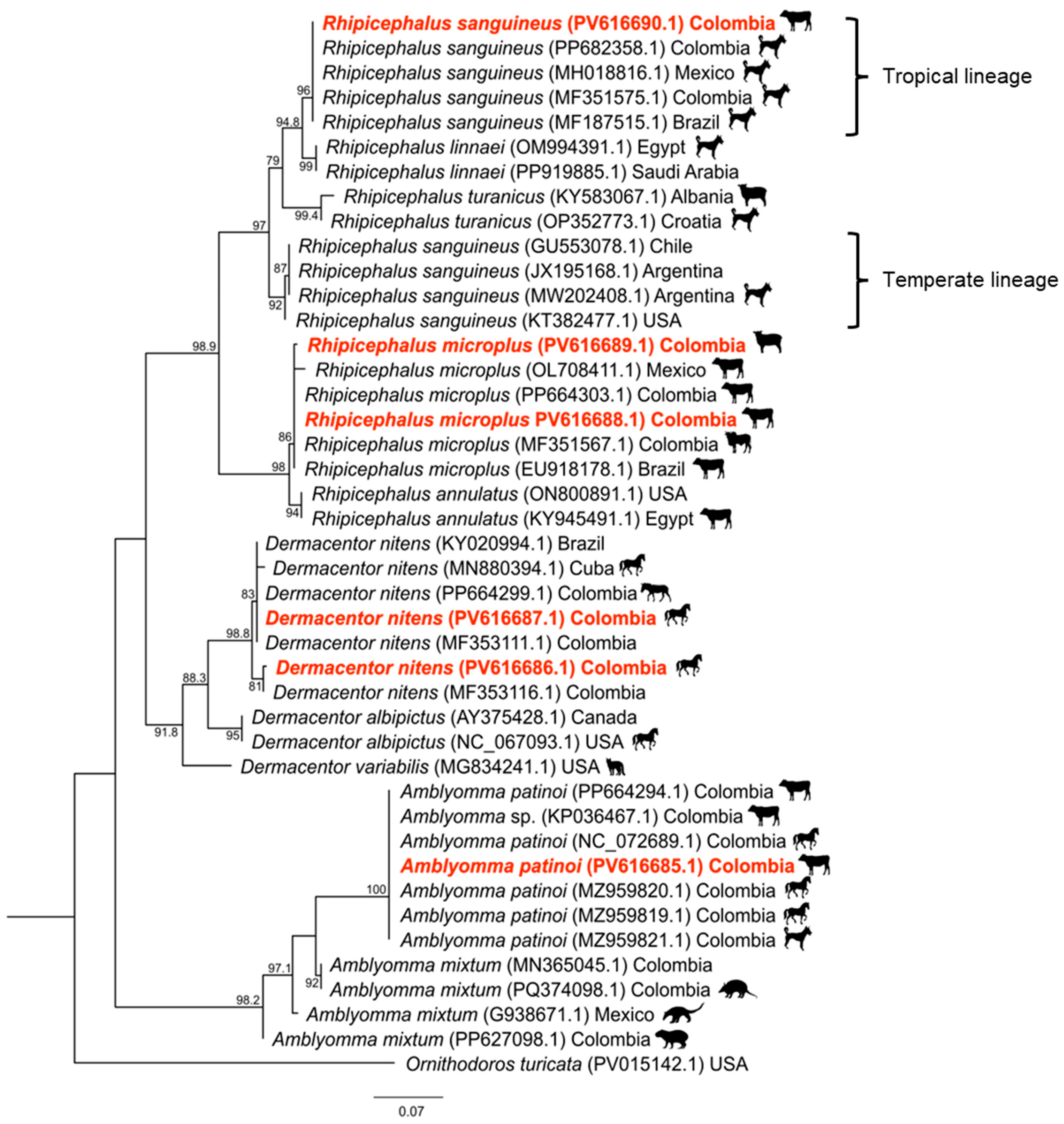
3.1. Identification and Molecular Characterization of Ticks
3.2. Anaplasmataceae in Ticks and Hosts
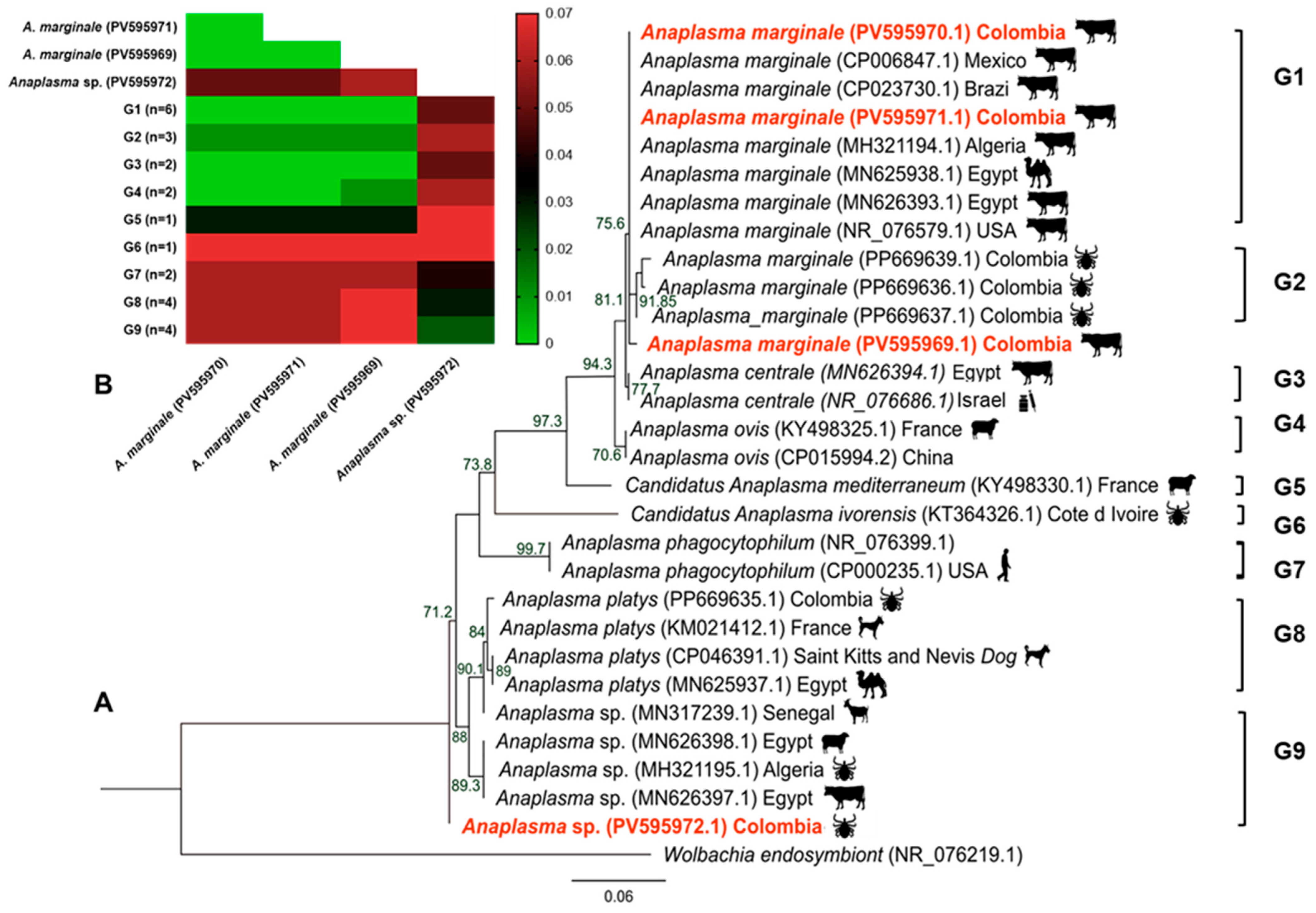
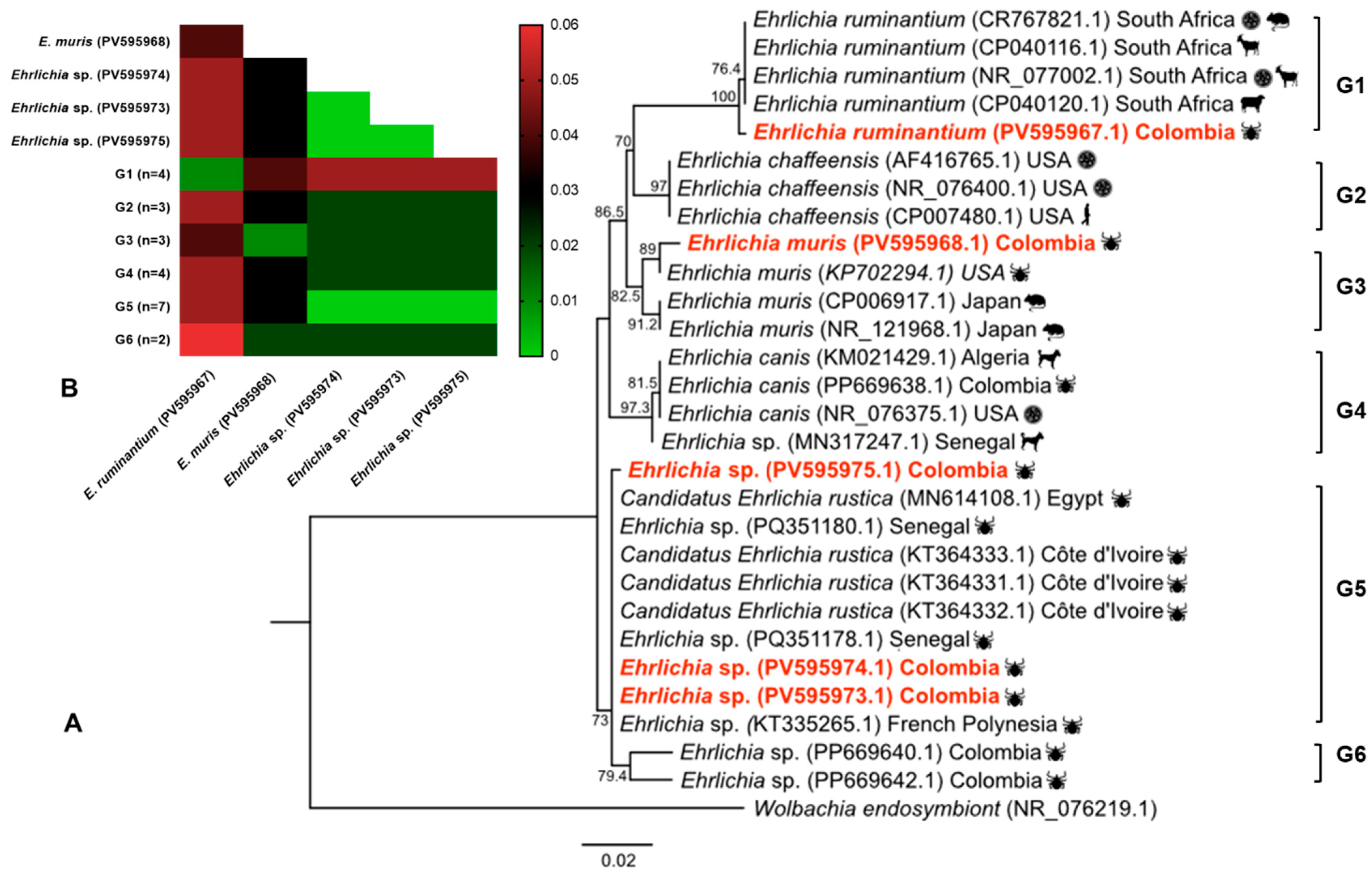
3.3. Identity, Phylogenetic, and Genetic Divergence of Anaplasmataceae
4. Discussion
5. Conclusions
Author Contributions
Funding
Institutional Review Board Statement
Informed Consent Statement
Data Availability Statement
Acknowledgments
Conflicts of Interest
References
- Rodríguez-Morales, A.J.; Bonilla-Aldana, D.K.; Idarraga-Bedoya, S.E.; García-Bustos, J.J.; Cardona-Ospina, J.A.; Faccini Martínez, Á.A. Epidemiology of zoonotic tick-borne diseases in Latin America: Are we just seeing the tip of the iceberg? F1000 Res. 2019, 31, 1988. [Google Scholar] [CrossRef]
- Eraso-Cadena, M.P.; Molina-Guzmán, L.P.; Cardona, X.; Cardona-Arias, J.A.; Ríos-Osorio, L.A.; Gutierrez-Builes, L.A. Serological evidence of exposure to some zoonotic microorganisms in cattle and humans with occupational exposure to livestock in Antioquia, Colombia. Cad. Saude Publica 2018, 34, 10. [Google Scholar] [CrossRef] [PubMed]
- Salih, O.; Chitanga, S.; Govinder, K.; Mukaratirwa, S. Modelling the burden of disease for cattle-A case of ticks and tick-borne diseases in cattle in a rural set-up in South Africa. PLoS ONE 2023, 18, 10. [Google Scholar] [CrossRef] [PubMed]
- Betancourt, J. Nueva vacuna para prevención y control de garrapatas en ganado. Periódico El Agro. 2017, 72, 421–434. [Google Scholar]
- Grisi, L.; Leite, R.C.; Martins, J.R.d.S.; de Barros, A.T.M.; Andreotti, R.; Cançado, P.H.D.; de León, A.A.P.; Pereira, J.B.; Villela, H.S. Reassessment of the potential economic impact of cattle parasites in Brazil. Rev. Bras. Parasitol. Vet. 2014, 23, 150–156. [Google Scholar] [CrossRef]
- Baker, R.E.; Mahmud, A.S.; Miller, I.F.; Rajeev, M.; Rasambainarivo, F.; Rice, B.L.; Takahashi, S.; Tatem, A.J.; Wagner, C.E.; Wang, L.-F.; et al. Infectious disease in an era of global change. Nat. Rev. Microbiol. 2021, 20, 193–205. [Google Scholar] [CrossRef]
- Gortazar, C.; Reperant, L.A.; Kuiken, T.; de la Fuente, J.; Boadella, M.; Martínez-Lopez, B.; Ruiz-Fons, F.; Estrada-Peña, A.; Drosten, C.; Medley, G.; et al. Crossing the Interspecies Barrier: Opening the Door to Zoonotic Pathogens. PLoS Pathog. 2014, 10, 6. [Google Scholar] [CrossRef] [PubMed]
- Ortiz, D.I.; Piche-Ovares, M.; Romero-Vega, L.M.; Wagman, J.; Troyo, A. The Impact of Deforestation, Urbanization, and Changing Land Use Patterns on the Ecology of Mosquito and Tick-Borne Diseases in Central America. Insects 2021, 13, 20. [Google Scholar] [CrossRef]
- Diuk-Wasser, M.A.; Vanacker, M.C.; Fernandez, M.P. Impact of Land Use Changes and Habitat Fragmentation on the Eco-epidemiology of Tick-Borne Diseases. J. Med. Entomol. 2021, 58, 1546–1564. [Google Scholar] [CrossRef]
- De la Fuente, J.; Estrada-Peña, A.; Rafael, M.; Almazán, C.; Bermúdez, S.; Abdelbaset, A.E.; Kasaija, P.D.; Kabi, F.; Akande, F.A.; Ajagbe, D.O.; et al. Perception of ticks and tick-borne diseases worldwide. Pathogens 2023, 12, 1258. [Google Scholar] [CrossRef]
- Springer, A.; Glass, A.; Probst, J.; Strube, C. Tick-borne zoonoses and commonly used diagnostic methods in human and veterinary medicine. Parasitol. Res. 2021, 120, 4075. [Google Scholar] [CrossRef]
- Rochlin, I.; Toledo, A. Emerging tick-borne pathogens of public health importance: A mini-review. J. Med. Microbiol. 2020, 69, 781. [Google Scholar] [CrossRef]
- Parola, P.; Paddock, C.D.; Socolovschi, C.; Labruna, M.B.; Mediannikov, O.; Kernif, T.; Abdad, M.Y.; Stenos, J.; Bitam, I.; Fournier, P.-E.; et al. Update on Tick-Borne Rickettsioses around the World: A Geographic Approach. Clin. Microbiol. Rev. 2013, 26, 657. [Google Scholar] [CrossRef] [PubMed]
- Bermúdez, C.S.; Zieman, E.A.; Tarragona, E.; Martins, T.F.; Faccini-Martínez, A.A.; Thomas, R.; Guzmán-Cornejo, C.; Muñoz-Leal, S. Tick-Borne Microorganisms in Neotropical Vertebrates. In Ecology of Wildlife Diseases in the Neotropics; Springer: Berlin/Heidelberg, Germany, 2024; pp. 345–379. [Google Scholar] [CrossRef]
- Rar, V.; Tkachev, S.; Tikunova, N. Genetic diversity of Anaplasma bacteria: Twenty years later. Infect. Genet. Evol. 2021, 91, 104833. [Google Scholar] [CrossRef] [PubMed]
- Guarnizo, T.R.M.; Alvarez, D.O.; Díaz-Sánchez, A.A.; Cabezas-Cruz, A.; Gutiérrez, L.Z.; Marrero, S.M.; Corona-González, B. Epidemiology and genetic diversity of Anaplasma marginale in Zamora-Chinchipe, Ecuador. Ticks Tick. Borne Dis. 2020, 11, 3. [Google Scholar] [CrossRef] [PubMed]
- Hurtado, C.; Torres, R.; Pérez-Macchi, S.; Sagredo, K.; Uberti, B.; Zanatto, D.C.d.S.; Machado, R.Z.; André, M.R.; Bittencourt, P.; Müller, A. Serological and molecular detection of Anaplasma phagocytophilum in Thoroughbred horses from Chilean racecourses. Ticks Tick. Borne Dis. 2020, 11, 4. [Google Scholar] [CrossRef]
- Maggi, R.G.; Krämer, F. A review on the occurrence of companion vector-borne diseases in pet animals in Latin America. Parasites Vectors 2019, 12, 145. [Google Scholar] [CrossRef]
- Gioia, G.V.; Vinueza, R.L.; Marsot, M.; Devillers, E.; Cruz, M.; Petit, E.; Boulouis, H.J.; Moutailler, S.; Monroy, F.; Coello, M.A.; et al. Bovine anaplasmosis and tick-borne pathogens in cattle of the Galapagos Islands. Transbound. Emerg. Dis. 2018, 65, 1262–1271. [Google Scholar] [CrossRef]
- Semenza, J. Vector-Borne Disease Emergence and Spread in the European Union-Global Health Impacts of Vector-Borne Diseases: Workshop Summary; National Academies Press: Washington, DC, USA, 2016. [Google Scholar]
- Bakken, J.S.; Dumler, J.S. Human granulocytic anaplasmosis. Infect. Dis. Clin. North Am. 2015, 29, 341–355. [Google Scholar] [CrossRef]
- Mattos Ferreira, G.C.; Andrighetto Canozzi, M.E.; Peripolli, V.; de Moura, G.P.; Sánchez, J.; Nogueira Martins, C.E. Prevalence of bovine Babesia spp., Anaplasma marginale, and their co-infections in Latin America: Systematic review-meta-analysis. Ticks Tick. Borne Dis. 2022, 13, 4. [Google Scholar] [CrossRef]
- Jaimes-Dueñez, J.; Triana-Chávez, O.; Mejía-Jaramillo, A.M. Parasitological and molecular surveys reveal high rates of infection with vector-borne pathogens and clinical anemia signs associated with infection in cattle from two important livestock areas in Colombia. Ticks Tick. Borne Dis. 2017, 8, 290–299. [Google Scholar] [CrossRef]
- Jaimes-Dueñez, J.; Tique-Oviedo, M.; Arias-Vega, L.; Castiblanco-Diaz, E.; Rivero-Rodriguez, L.; Marin-Cossio, L.; Gongora-Orjuela, A.; Jimenez-Leaño, A. Epidemiological assessment of Anaplasma marginale, Babesia bigemina, and Babesia bovis infections in Colombian creole cattle breeds: A molecular survey in northeastern Colombia. Vet. Parasitol. Reg. Stud. Reports 2024, 50, 101011. [Google Scholar] [CrossRef]
- Martínez Diaz, H.-C.; Gil-Mora, J.; Betancourt-Ruiz, P.; Silva-Ramos, C.R.; Matiz-González, J.M.; Villalba-Pérez, M.-A.; Ospina-Pinto, M.C.; Ramirez-Hernández, A.; Olaya-M, L.-A.; Bolaños, E.; et al. Molecular detection of tick-borne rickettsial pathogens in ticks collected from domestic animals from Cauca, Colombia. Acta Trop. 2023, 238, 106773. [Google Scholar] [CrossRef] [PubMed]
- Cabrera, R.; Mendoza, W.; López-Mosquera, L.; Cano, M.A.; Ortiz, N.; Campo, V.; Keynan, Y.; López, L.; Rueda, Z.V.; Gutiérrez, L.A. Tick-Borne-Agents Detection in Patients with Acute Febrile Syndrome and Ticks from Magdalena Medio, Colombia. Pathogens 2022, 11, 10. [Google Scholar] [CrossRef] [PubMed]
- Arroyave, E.; Cornwell, E.R.; McBride, J.W.; Díaz, C.A.; Labruna, M.B.; Rodas, J.D. Detection of tick-borne rickettsial pathogens in naturally infected dogs and dog-associated ticks in Medellin, Colombia. Rev. Bras. De Parasitol. Veterinária 2020, 29, 3. [Google Scholar] [CrossRef]
- Cotes-Perdomo, A.P.; Oviedo, Á.; Castro, L.R. Molecular detection of pathogens in ticks associated with domestic animals from the Colombian Caribbean region. Exp. Appl. Acarol. 2020, 82, 137–150. [Google Scholar] [CrossRef] [PubMed]
- Santodomingo, A.; Sierra-Orozco, K.; Cotes-Perdomo, A.; Castro, L.R. Molecular detection of Rickettsia spp., Anaplasma platys and Theileria equi in ticks collected from horses in Tayrona National Park, Colombia. Exp. Appl. Acarol. 2019, 77, 411–423. [Google Scholar] [CrossRef]
- Bonilla-Aldana, D.K.; Gutiérrez-Grajales, E.J.; Martínez-Arboleda, J.P.; Reina-Mora, M.A.; Trejos-Mendoza, A.E.; Pérez-Vargas, S.; Valencia-Mejía, L.; Marín-Arboleda, L.F.; Osorio-Navia, D.; Chacón-Peña, M.; et al. Seroprevalence canine survey for selected vector-borne pathogens and its relationship with poverty in metropolitan Pereira, Colombia, 2020. Parasite Epidemiol Control. 2022, 17, e00249. [Google Scholar] [CrossRef]
- Forero-Becerra, E.; Patel, J.; Martínez-Díaz, H.-C.; Betancourt-Ruiz, P.; Benavides, E.; Durán, S.; Olaya-Másmela, L.-A.; Bolaños, E.; Hidalgo, M.; McBride, J.W. Seroprevalence and Genotypic Analysis of Ehrlichia canis Infection in Dogs and Humans in Cauca, Colombia. Am. J. Trop. Med. Hyg. 2021, 104, 1771–1776. [Google Scholar] [CrossRef]
- Badillo-Viloria, M.; Díaz-Pérez, A.; Orozco-Sánchez, C.; de Lavalle-Galvis, R. Infection by Ehrlichia canis and Anaplasma sp. in dogs attended in veterinary clinics, Barranquilla, Colombia. Rev. MVZ Córdoba 2017, 22, 6023–6033. [Google Scholar] [CrossRef]
- González-Quintero, R.; Barahona-Rosales, R.; Bolívar-Vergara, D.M.; Chirinda, N.; Arango, J.; Pantévez, H.A.; Correa-Londoño, G.; Sánchez-Pinzón, M.S. Technical and environmental characterization of dual-purpose cattle farms and ways of improving production: A case study in Colombia. Pastoralism 2020, 10, 19. [Google Scholar] [CrossRef]
- ICA. Censos Pecuarios Nacional. Instituto Colombiano Agropecuario. 2025. Available online: https://www.ica.gov.co/areas/pecuaria/servicios/epidemiologia-veterinaria/censos-2016/censo-2018 (accessed on 21 July 2025).
- IDEAM. Instituto de Hidrología, Meteorología y Estudios Ambientales. 2023. Available online: http://www.ideam.gov.co/ (accessed on 19 June 2023).
- Heylen, D.J.A.; Kumsa, B.; Kimbita, E.; Frank, M.N.; Muhanguzi, D.; Jongejan, F.; Adehan, S.B.; Toure, A.; Aboagye-Antwi, F.; Ogo, N.I.; et al. Tick-borne pathogens and body condition of cattle in smallholder rural livestock production systems in East and West Africa. Parasit. Vectors 2023, 16, 117. [Google Scholar] [CrossRef]
- Battesti, D.M.B.; Arzua, M.; Bechara, G.H. Carrapatos De Importância Médico-Veterinária Da Região Neotropical: Um Guia Ilustrado Para Identificação De Espécies; Instituto Butantan: São Paulo, Brazil, 2006; p. 223. [Google Scholar]
- Dantas-Torres, F.; Martins, T.F.; Muñoz-Leal, S.; Onofrio, V.C.; Barros-Battesti, D.M. Ticks (Ixodida: Argasidae, Ixodidae) of Brazil: Updated species checklist and taxonomic keys. Ticks Tick. Borne Dis. 2019, 10, 6. [Google Scholar] [CrossRef]
- Nava, S.; Venzal, J.M.; González-Acuña, D.; Martins, T.F.; Guglielmone, A.A. Morphological Keys for Genera and Species of Ixodidae and Argasidae. In Ticks of the Southern Cone of America; Academic Press: Cambridge, MA, USA, 2017; pp. 323–336. [Google Scholar] [CrossRef]
- Badillo-Viloria, M.; Mattar, S.; Remesar, S.; de la Rosa-Jaramillo, S.; García-Bocanegra, I.; Miranda, J.; Portillo, A.; Cervera-Acedo, C.; Oteo, J.A.; Cano-Terriza, D. Rickettsia spp. and Anaplasmataceae in Ticks from Domestic Animals in Northern Colombia. Zoonoses Public. Health 2025, 72, 421–434. [Google Scholar] [CrossRef]
- Norris, D.E.; Klompen, J.S.H.; Keirans, J.E.; Black IV, W.C. Population Genetics of Ixodes scapularis (Acari: Ixodidae) Based on Mitochondrial 16S and 12S Genes. J. Med. Entomol. 1996, 33, 78–89. [Google Scholar] [CrossRef]
- Inokuma, H.; Raoult, D.; Brouqui, P. Detection of Ehrlichia platys DNA in brown dog ticks (Rhipicephalus sanguineus) in Okinawa Island, Japan. J. Clin. Microbiol. 2000, 38, 4219–4221. [Google Scholar] [CrossRef]
- Dahmani, M.; Marié, J.-L.; Mediannikov, O.; Raoult, D.; Davoust, B. First identification of Anaplasma platys in the blood of dogs from French Guiana. Vector Borne Zoonotic Dis. 2015, 15, 170–172. [Google Scholar] [CrossRef] [PubMed]
- Kumar, S.; Stecher, G.; Li, M.; Knyaz, C.; Tamura, K. MEGA X: Molecular Evolutionary Genetics Analysis across Computing Platforms. Mol. Biol. Evol. 2018, 35, 1547. [Google Scholar] [CrossRef] [PubMed]
- Okonechnikov, K.; Golosova, O.; Fursov, M.; Varlamov, A.; Vaskin, Y.; Efremov, I. Unipro UGENE: A unified bioinformatics toolkit. Bioinformatics 2012, 28, 1166–1167. [Google Scholar] [CrossRef]
- Hoang, D.T.; Chernomor, O.; von Haeseler, A.; Minh, B.Q.; Vinh, L.S. UFBoot2: Improving the Ultrafast Bootstrap Approximation. Mol. Biol. Evol. 2018, 35, m518–m522. [Google Scholar] [CrossRef] [PubMed]
- Hosmer, D.W.; Lemeshow, S. Applied Logistic Regression; Wiley & Sons, Inc.: Hoboken, NJ, USA, 2000. [Google Scholar] [CrossRef]
- Zaid, T.; Ereqat, S.; Nasereddin, A.; Al-Jawabreh, A.; Abdelkader, A.; Abdeen, Z. Molecular characterization of Anaplasma and Ehrlichia in ixodid ticks and reservoir hosts from Palestine: A pilot survey. Vet. Med. Sci. 2019, 5, 230. [Google Scholar] [CrossRef]
- Murcia-Mono, C.A.; Falla-Tapias, S.; Morales Cabrera, A.F.; Navia Álvarez, L.C.; Rivera-Sánchez, L.; Gómez Vargas, Y.; Burgos-Paz, W.O. Risk Factors Associated with Hemoparasites in Dual-Purpose Cattle of Colombia. Pathogens 2025, 14, 62. [Google Scholar] [CrossRef]
- Pierce, K.A.; Paddock, C.D.; Sumner, J.W.; Nicholson, W.L. Pathogen prevalence and blood meal identification in Amblyomma ticks as a means of reservoir host determination for ehrlichial pathogens. Clin. Microbiol. Infect. 2009, 15, 37–38. [Google Scholar] [CrossRef] [PubMed]
- Segura, J.A.; Isaza, J.P.; Botero, L.E.; Alzate, J.F.; Gutiérrez, L.A. Assessment of bacterial diversity of Rhipicephalus microplus ticks from two livestock agroecosystems in Antioquia, Colombia. PLoS ONE 2020, 15, e0234005. [Google Scholar] [CrossRef] [PubMed]
- Pérez, A.E.; Guillemi, E.C.; Sarmiento, N.F.; Cantón, G.J.; Farber, M.D. Rhipicephalus microplus and Its Impact on Anaplasma marginale Multistrain Infections in Contrasting Epidemiological Contexts. Pathogens 2025, 14, 160. [Google Scholar] [CrossRef]
- De la Fournière, S.; Guillemi, E.C.; Paoletta, M.S.; Pérez, A.; Obregón, D.; Cabezas-Cruz, A.; Sarmiento, N.F.; Farber, M.D. Transovarial Transmission of Anaplasma marginale in Rhipicephalus (Boophilus) microplus Ticks Results in a Bottleneck for Strain Diversity. Pathogens 2023, 12, 1010. [Google Scholar] [CrossRef] [PubMed]
- Mor, N.H.; Tavera, J.V.M.; Tobón, J.C.; Barragán, B.L.G.; López, G.B.; Duarte, J.J.V.; Corredor, D.W.S.; Tafur-Gómez, G.A. Hemoparasitism in grazing cattle and risk factors associated with husbandry management in an endemic area of Eastern Colombia. J. Parasit. Dis. 2024, 48, 924–935. [Google Scholar] [CrossRef]
- Jaimes-Dueñez, J.; Triana-Chávez, O.; Mejía-Jaramillo, A.M. Genetic, host and environmental factors associated with a high prevalence of Anaplasma marginale. Ticks Tick. Borne Dis. 2018, 9, 1286–1295. [Google Scholar] [CrossRef]
- Blanco Martínez, R.; Cardona Álvarez, J.; Vargas Viloria, M. Prevalencia de parásitos hematrópicos endoglobulares en bovinos gyr puros en Córdoba, Colombia. Rev. Med. Vet. 2016, 31, 67–74. Available online: http://www.scielo.org.co/scielo.php?script=sci_arttext&pid=S0122-93542016000100007 (accessed on 13 March 2025). [CrossRef]
- Herrera, M.; Soto, M.Á.; Urrego, M.V.; Rivera, M.G.; Zapata, B.M.; Rios, L. Frecuencia de hemoparásitos en bovinos del bajo Cauca y alto San Jorge. 2000–2005. Rev. MVZ Córdoba 2008, 13, 1486–1494. [Google Scholar] [CrossRef][Green Version]
- Herrera, J.A.; Morales, A.S.; Dolz, G. Hemoparásitos en equinos de la Unidad de la Policía Montada del Ministerio de Seguridad Pública de Costa Rica. Ciencias Veterinarias 2023, 41, 1–13. [Google Scholar] [CrossRef]
- Teglas, M.; Matern, E.; Lein, S.; Foley, P.; Mahan, S.M.; Foley, J. Ticks and tick-borne disease in Guatemalan cattle and horses. Vet. Parasitol. 2005, 131, 119–127. [Google Scholar] [CrossRef]
- Costa, S.C.L.; Freitas, J.d.S.; Carvalho, F.S.; Pereira, M.J.S.; Cordeiro, M.D.; da Fonseca, A.H.; Jusi, M.M.G.; Machado, R.Z.; Munhoz, A.D. Frequency and factors associated of potential zoonotic pathogens (Borrelia spp., Rickettsia spp., Leishmania spp., and Anaplasma phagocytophilum) in equids in the state of Bahia, Brazil. Parasit. Vectors 2021, 14, 1–10. [Google Scholar] [CrossRef] [PubMed]
- Agudelo-Ruíz, Y.; Acevedo-Gutiérrez, L.; Montoya-Sanchéz, A.; Paternina, L.; Rodas, J. Molecular identification of tick-borne hemoparasites in equines from Northwestern Colombia. Rev. MVZ Cordoba 2017, 22, 6004–6013. [Google Scholar] [CrossRef][Green Version]
- Miranda, J.; Mattar, S. Molecular detection of Rickettsia bellii and Rickettsia sp. strain colombianensi in ticks from Cordoba, Colombia. Ticks Tick. Borne Dis. 2014, 5, 208–212. [Google Scholar] [CrossRef]
- Pereira, J.G.; Garcia, A.B.; Gonçalves, L.R.; Ramos, I.A.d.S.; Braga, M.D.S.C.O.; dos Santos, L.S.; Melo, F.A.; Santos, H.P.; Neta, A.V.d.C.; Rosário, C.J.R.M.D.; et al. High genetic diversity of Anaplasma marginale infecting dairy cattle in northeastern Brazil. Rev. Bras. Parasitol. Vet. 2021, 30, e014321. [Google Scholar] [CrossRef] [PubMed]
- Groenevelt, M.; Wijburg, S.R.; Sprong, H.; Kerkhof, K.; Stuen, S. Role of tick infestation in the progression of Anaplasma phagocytophilum infection in lambs. Ticks Tick. Borne Dis. 2025, 16, 102477. [Google Scholar] [CrossRef]
- de la Fuente, J.; Almazán, C.; Kocan, K.M. Subolesin: A 20-year path from discovery to an effective tick vaccine. Expert. Rev. Vaccines 2025, 24, 412–415. [Google Scholar] [CrossRef]
- Giunchetti, C.; Fuentes Zaldivar, M.; Goodwill Makwarela, T.; Seoraj-Pillai, N.; Nangammbi, T.C. Tick Control Strategies: Critical Insights into Chemical, Biological, Physical, and Integrated Approaches for Effective Hard Tick Management. Vet. Sciences 2025, 12, 114. [Google Scholar] [CrossRef]
- Pfeffer, M.; Król, N.; Obiegala, A. Prevention and Control of Tick-Borne Anaplasmosis, Cowdriosis and Babesiosis in the Cattle Industry in: Pests and Vector-Borne Diseases in the Livestock Industry; Wageningen Academic: Leiden, The Netherlands, 2018; pp. 175–194. [Google Scholar]
- Bonilla-Aldana, D.K.; Quintero-Rada, K.; Montoya-Posada, J.P.; Soler-Tovar, D.; Barato, P.; Arteaga-Livias, K.; Zambrano, L.I.; Faccini-Martínez, Á.A.; Rodriguez-Morales, A.J. Bovine Ehrlichiosis Prevalence: A Systematic Review and Meta-Analysis of Molecular Studies. World’s Vet. J. 2021, 11, 1–15. [Google Scholar] [CrossRef]
- Piloto-Sardiñas, E.; Foucault-Simonin, A.; Wu-Chuang, A.; Mateos-Hernández, L.; Marrero-Perera, R.; Abuin-Denis, L.; Roblejo-Arias, L.; Díaz-Corona, C.; Zając, Z.; Kulisz, J.; et al. Dynamics of Infections in Cattle and Rhipicephalus microplus: A Preliminary Study. Pathogens 2023, 12, 998. [Google Scholar] [CrossRef]
- Kocan, K.M.; De La Fuente, J.; Blouin, E.F.; Garcia-Garcia, J.C. Anaplasma marginale (Rickettsiales: Anaplasmataceae): Recent advances in defining host–pathogen adaptations of a tick-borne rickettsia. Parasitology 2004, 129, S285–S300. [Google Scholar] [CrossRef]
- De la Fuente, J.; Garcia-Garcia, J.C.; Blouin, E.F.; Saliki, J.T.; Kocan, K.M. Infection of tick cells and bovine erythrocytes with one genotype of the intracellular ehrlichia Anaplasma marginale excludes infection with other genotypes. Clin. Diagn. Lab. Immunol. 2002, 9, 658–668. [Google Scholar] [CrossRef]
- Barbet, A.F.; Yi, J.; Lundgren, A.; McEwen, B.R.; Blouin, E.F.; Kocan, K.M. Antigenic variation of Anaplasma marginale: Major surface protein 2 diversity during cyclic transmission between ticks and cattle. Infect. Immun. 2001, 69, 3057–3066. [Google Scholar] [CrossRef] [PubMed][Green Version]
- Eriks, I.S.; Stiller, D.; Palmer, G.H. Impact of persistent Anaplasma marginale rickettsemia on tick infection and transmission. J. Clin. Microbiol. 1993, 31, 2091. [Google Scholar] [CrossRef]
- Pohl, A.E.; Cabezas-Cruz, A.; Ribeiro, M.F.B.; da Silveira, J.A.G.; Silaghi, C.; Pfister, K.; Passos, L.M.F. Detection of genetic diversity of Anaplasma marginale isolates in Minas Gerais, Brazil. Rev. Bras. Parasitol. Vet. 2013, 22, 129–135. [Google Scholar] [CrossRef]
- Jimenez Ocampo, R.; Vega y Murguia, C.A.; Oviedo Ortega, N.; Rojas Ramírez, E.E.; Garcia Ortiz, M.A.; Preciado de la Torre, J.F.; Cruz, R.R.; García, D.I.D.; Camarillo, S.D.R. Genetic diversity of the msp1a gene variable region and msp4 gene of Anaplasma marginale strains from Mexico. Rev. Mex. Cienc. Pecu. 2012, 3, 373–386. Available online: https://cienciaspecuarias.inifap.gob.mx/index.php/Pecuarias/article/view/730/728 (accessed on 13 March 2025).
- Abdullah, H.H.A.M.; Amanzougaghene, N.; Dahmana, H.; Louni, M.; Raoult, D.; Mediannikov, O. Multiple vector-borne pathogens of domestic animals in Egypt. PLoS Negl. Trop. Dis. 2021, 15, e0009767. [Google Scholar] [CrossRef]
- Ben Said, M.; Belkahia, H.; El Mabrouk, N.; Saidani, M.; Alberti, A.; Zobba, R.; Cherif, A.; Mahjoub, T.; Bouattour, A.; Messadi, L. Anaplasma platys-like strains in ruminants from Tunisia. Infect. Genet. Evol. 2017, 49, 226–233. [Google Scholar] [CrossRef]
- Dahmani, M.; Davoust, B.; Sambou, M.; Bassene, H.; Scandola, P.; Ameur, T.; Raoult, D.; Fenollar, F.; Mediannikov, O. Molecular investigation and phylogeny of species of the Anaplasmataceae infecting animals and ticks in Senegal. Parasit. Vectors 2019, 12, 495. [Google Scholar] [CrossRef] [PubMed]
- Zobba, R.; Anfossi, A.G.; Parpaglia, M.L.P.; Dore, G.M.; Chessa, B.; Spezzigu, A.; Rocca, S.; Visco, S.; Pittau, M.; Alberti, A. Molecular Investigation and Phylogeny of Anaplasma spp. in Mediterranean Ruminants Reveal the Presence of Neutrophil-Tropic Strains Closely Related to A. platys. Appl. Environ. Microbiol. 2014, 80, 271. [Google Scholar] [CrossRef] [PubMed]
- Arraga-Alvarado, C.M.; Qurollo, B.A.; Parra, O.C.; Berrueta, M.A.; Hegarty, B.C.; Breitschwerdt, E.B. Molecular Evidence of Anaplasma platys Infection in Two Women from Venezuela. Am. J. Trop. Med. Hyg. 2014, 91, 1161. [Google Scholar] [CrossRef]
- Breitschwerdt, E.B.; Hegarty, B.C.; Qurollo, B.A.; Saito, T.B.; Maggi, R.G.; Blanton, L.S.; Bouyer, D.H. Intravascular persistence of Anaplasma platys, Ehrlichia chaffeensis, and Ehrlichia ewingii DNA in the blood of a dog and two family members. Parasit. Vectors 2014, 7, 1–7. [Google Scholar] [CrossRef]
- Maggi, R.G.; Mascarelli, P.E.; Havenga, L.N.; Naidoo, V.; Breitschwerdt, E.B. Co-infection with Anaplasma platys, Bartonella henselae and Candidatus Mycoplasma haematoparvum in a veterinarian. Parasit. Vectors 2013, 6, 1–10. [Google Scholar] [CrossRef]
- Pesapane, R.; Foley, J.; Thomas, R.; Castro, L.R. Molecular detection and characterization of Anaplasma platys and Ehrlichia canis in dogs from northern Colombia. Vet. Microbiol. 2019, 233, 184–189. [Google Scholar] [CrossRef] [PubMed]
- Vargas-Hernandez, G.; André, M.R.; Cendales, D.M.; de Sousa, K.C.M.; Gonçalves, L.R.; Rondelli, M.C.H.; Machado, R.Z.; Tinucci-Costa, M. Molecular detection of Anaplasma species in dogs in Colombia. Rev. Bras. Parasitol. Vet. 2016, 25, 459–464. [Google Scholar] [CrossRef] [PubMed]
- André, M.R.; Calchi, A.C.; Herrera, H.M.; Zanatto, D.C.d.S.; Horta, B.d.C.L.S.; Tasso, J.B.; Ramos, I.A.d.S.; de Mello, V.V.C.; Machado, R.Z. The co-infection with Ehrlichia minasensis, Anaplasma marginale and Anaplasma platys is not associated with anemia in beef cattle in the Brazilian Pantanal. Vet. Parasitol. Reg. Stud. Reports 2020, 21, 100437. [Google Scholar] [CrossRef]
- Thirumalapura, N.R.; Qin, X.; Kuriakose, J.A.; Walker, D.H. Complete Genome Sequence of Ehrlichia muris Strain AS145T, a Model Monocytotropic Ehrlichia Strain. Genome Announc. 2014, 2, e01234-e13. [Google Scholar] [CrossRef]
- Pritt, B.S.; Sloan, L.M.; Johnson, D.K.H.; Munderloh, U.G.; Paskewitz, S.M.; McElroy, K.M.; McFadden, J.D.; Binnicker, M.J.; Neitzel, D.F.; Liu, G.; et al. Emergence of a new pathogenic Ehrlichia species, Wisconsin and Minnesota, 2009. N Engl J Med. 2011, 365, 422–429. [Google Scholar] [CrossRef] [PubMed]
- Pritt, B.S.; Allerdice, M.E.J.; Sloan, L.M.; Paddock, C.D.; Munderloh, U.G.; Rikihisa, Y.; Tajima, T.; Paskewitz, S.M.; Neitzel, D.F.; Johnson, D.K.H.; et al. Proposal to reclassify Ehrlichia muris as Ehrlichia muris subsp. Muris subsp. nov. and description of Ehrlichia muris subsp. eauclairensis subsp. nov., a newly recognized tick-borne pathogen of humans. Int. J. Syst. Evol. Microbiol. 2017, 67, 2121–2126. [Google Scholar] [CrossRef]
- Liebenberg, J.; Steyn, H.C.; Josemans, A.I.; Faber, E.; Zweygarth, E. In vitro propagation and genome sequencing of three ‘atypical’ Ehrlichia ruminantium isolates. Onderstepoort J. Vet. Res. 2020, 87, 1769. [Google Scholar] [CrossRef]
- Laroche, M.; Marie, J.; Mediannikov, O.; Almeras, L.; Berenger, J.-M.; Musso, D.; Raoult, D.; Parola, P. A novel ehrlichial agent detected in tick in French Polynesia. Ticks Tick. Borne Dis. 2016, 7, 1203–1208. [Google Scholar] [CrossRef]
- Frutos, R.; Viari, A.; Ferraz, C.; Morgat, A.; Eychenié, S.; Kandassamy, Y.; Chantal, I.; Bensaid, A.; Coissac, E.; Vachiery, N.; et al. Comparative genomic analysis of three strains of Ehrlichia ruminantium reveals an active process of genome size plasticity. J. Bacteriol. 2006, 188, 2533–2542. [Google Scholar] [CrossRef]
- Onyiche, T.G.E.; MacLeod, E.T. Hard ticks (Acari: Ixodidae) and tick-borne diseases of sheep and goats in Africa: A review. Ticks Tick. Borne Dis. 2023, 14, 102232. [Google Scholar] [CrossRef]
- Allsopp, B.A. Heartwater–Ehrlichia ruminantium infection. OIE Rev. Sci. Tech. 2015, 34, 557–568. [Google Scholar] [CrossRef]
- Rar, V.; Golovljova, I. Anaplasma, Ehrlichia, and “Candidatus Neoehrlichia” bacteria: Pathogenicity, biodiversity, and molecular genetic characteristics, a review. Infect. Genet. Evolution 2011, 11, 1842–1861. [Google Scholar] [CrossRef]
- Osman, A.M.; Hassan-Kadle, A.A.; André, M.R.; Collere, F.C.M.; Córdova, A.S.A.; Montiani-Ferreira, F.; Vieira, T.S.W.J.; Ibrahim, A.M.; Yusuf, A.A.; Machado, R.Z.; et al. Ehrlichia Species in Dromedary Camels (Camelus dromedarius) and Ruminants from Somalia. Pathogens 2025, 14, 65. [Google Scholar] [CrossRef]
- Aguiar, D.M.; Ziliani, T.F.; Zhang, X.; Melo, A.L.; Braga, Í.A.; Witter, R.; Freitas, L.C.; Rondelli, A.L.; Luis, M.A.; Sorte, E.C.; et al. A novel Ehrlichia genotype strain distinguished by the TRP36 gene naturally infects cattle in Brazil and causes clinical manifestations associated with ehrlichiosis. Ticks Tick. Borne Dis. 2014, 5, 537–544. [Google Scholar] [CrossRef] [PubMed]
- Gajadhar, A.A.; Lobanov, V.; Scandrett, W.B.; Campbell, J.; Al-Adhami, B. A novel Ehrlichia genotype detected in naturally infected cattle in North America. Vet. Parasitol. 2010, 173, 324–329. [Google Scholar] [CrossRef]
- Iweriebor, B.C.; Mmbaga, E.J.; Adegborioye, A.; Igwaran, A.; Obi, L.C.; Okoh, A.I. Genetic profiling for Anaplasma and Ehrlichia species in ticks collected in the Eastern Cape Province of South Africa. BMC Microbiol. 2017, 17, 1–8. [Google Scholar] [CrossRef]
- Ehounoud, C.B.; Yao, K.P.; Dahmani, M.; Achi, Y.L.; Amanzougaghene, N.; N’douba, A.K.; N’guessan, J.D.; Raoult, D.; Fenollar, F.; Mediannikov, O. Multiple Pathogens Including Potential New Species in Tick Vectors in Côte d’Ivoire. PLoS Negl. Trop. Dis. 2016, 10, e0004367. [Google Scholar] [CrossRef] [PubMed]



| Ticks and Host Infected | n (%) (Developmental Stages) | No. Pools (%) | Positive (%) | CI95% | p-Value | |
|---|---|---|---|---|---|---|
| Tick species | Rhipicephalus sanguineus * (cattle) | 8 (0.7) (M:6, L:2) | 2 (1.3) | 0/2 (0.0) | 0.0–0.0 | <0.01 |
| Rhipicephalus microplus * | 497 (43.0) (M:153, F:299, N:45) | 82 (51.3) | 15/82 (18.3) | 10.0–27.0 | ||
| Dermacentor nitens ** | 643 (55.6) (M:302, F:150, N:136, L:55) | 70 (44.0) | 0/70 (0.0) | 0.0–0.0 | ||
| Amblyomma patinoi * | 8 (0.7) (M:1, F:7) | 5 (3.1) | 0/5 (0.0) | 0.0–0.0 | ||
| Total | 1156 (100) | 159 (100) | 15/159 (9.4) | 5.0–14.0 | ||
| Host species | Cattle | 56 (76.7) | - | 40 (71.4) | 59.0–84.0 | 0.02 |
| Horse | 14 (19.2) | - | 7 (50.0) | 15.0–67.0 | ||
| Mule | 3 (4.1) | - | 0 (0.0) | 0.0–0-0 | ||
| Total | 73 (100) | - | 47 (64.4) | 53.0–76.0 | ||
| Variable | Categories | Positive/Total | % | p |
|---|---|---|---|---|
| Host species | Cattle | 40/56 | 71.4 | 0.025 |
| Equids | 7/17 | 41.2 | ||
| Age | Juvenile (<3 years) | 19/31 | 61.3 | 0.409 |
| Adult (≥3 years) | 28/42 | 66.7 | ||
| Sex | Male | 10/19 | 52.6 | 0.167 |
| Female | 37/54 | 68.5 | ||
| Location | Metropolitan | 13/18 | 72.2 | 0.014 |
| Eastern | 8/17 | 47.1 | ||
| South | 6/7 | 85.7 | ||
| Central | 20/27 | 74.1 | ||
| Coast | 0/4 | 0.0 | ||
| Infested animals on the farm (%) | ≥78% | 28/35 | 80.0 | 0.017 |
| 50–78% | 12/21 | 57.1 | ||
| <50% | 7/17 | 41.2 | ||
| Management system | Extensive | 11/14 | 78.6 | 0.185 |
| Intensive | 25/37 | 67.6 | ||
| Semiextensive | 11/22 | 50.0 | ||
| Tick control measures | Pour on | 2/5 | 40.0 | 0.238 |
| Pour on and by injection | 45/68 | 66.2 | ||
| Grazing rotation | Yes | 38/64 | 59.4 | 0.014 |
| No | 9/9 | 100 | ||
| Contact with wildlife | Yes | 27/46 | 58.7 | 0.142 |
| No | 20/27 | 74.1 | ||
| Type of feed | Grass and forage | 13/23 | 56.5 | 0.244 |
| Grass and concentrate | 34/50 | 68.0 |
| Variable | Categories | p-Value | OR (95% CI) |
|---|---|---|---|
| Infested animals on the farm (%) | ≥78% 50–78% <50% | 0.002 0.160 a | 9.1 (2.2–37.6) 2.7 (0.7–10.8) a |
| Host species | Cattle Equids | 0.008 a | 5.7 (1.6–20.9) a |
Disclaimer/Publisher’s Note: The statements, opinions and data contained in all publications are solely those of the individual author(s) and contributor(s) and not of MDPI and/or the editor(s). MDPI and/or the editor(s) disclaim responsibility for any injury to people or property resulting from any ideas, methods, instructions or products referred to in the content. |
© 2025 by the authors. Licensee MDPI, Basel, Switzerland. This article is an open access article distributed under the terms and conditions of the Creative Commons Attribution (CC BY) license.
Share and Cite
Badillo-Viloria, M.; García-Bocanegra, I.; de la Rosa Jaramillo, S.; Mattar, S.; Frías-Casas, M.; Cano-Terriza, D. Molecular Characterization and Epidemiology of Anaplasmataceae in Ticks and Domestic Animals in the Colombian Caribbean. Animals 2026, 16, 8. https://doi.org/10.3390/ani16010008
Badillo-Viloria M, García-Bocanegra I, de la Rosa Jaramillo S, Mattar S, Frías-Casas M, Cano-Terriza D. Molecular Characterization and Epidemiology of Anaplasmataceae in Ticks and Domestic Animals in the Colombian Caribbean. Animals. 2026; 16(1):8. https://doi.org/10.3390/ani16010008
Chicago/Turabian StyleBadillo-Viloria, Maria, Ignacio García-Bocanegra, Steffania de la Rosa Jaramillo, Salim Mattar, Mario Frías-Casas, and David Cano-Terriza. 2026. "Molecular Characterization and Epidemiology of Anaplasmataceae in Ticks and Domestic Animals in the Colombian Caribbean" Animals 16, no. 1: 8. https://doi.org/10.3390/ani16010008
APA StyleBadillo-Viloria, M., García-Bocanegra, I., de la Rosa Jaramillo, S., Mattar, S., Frías-Casas, M., & Cano-Terriza, D. (2026). Molecular Characterization and Epidemiology of Anaplasmataceae in Ticks and Domestic Animals in the Colombian Caribbean. Animals, 16(1), 8. https://doi.org/10.3390/ani16010008