Article

Smaller Size of Nesting Loggerhead Sea Turtles in Northwest Florida

by
Matthew Ware
*,†,
Luna Oliveira de Mello Vieira
,
Laura Fuentes-Tejada
§,
Ian Silver-Gorges
and
Mariana M. P. B. Fuentes
Department of Earth, Ocean, and Atmospheric Science, Florida State University, Tallahassee, FL 32306, USA
*
Author to whom correspondence should be addressed.
Current address: Department of Biological Sciences, Florida Gulf Coast University, Fort Myers, FL 33965, USA.
Current address: College of Science and Engineering, James Cook University, Douglas, QLD 4814, Australia.
§
Current address: Facultat de Ciències de la Terra, Universitat de Barcelona, 08007 Barcelona, Spain.
Current address: Department of Biology, University of Central Florida, Orlando, FL 32816, USA.
Animals 2026, 16(1), 71; https://doi.org/10.3390/ani16010071 (registering DOI)
Submission received: 25 November 2025 / Revised: 17 December 2025 / Accepted: 21 December 2025 / Published: 26 December 2025
(This article belongs to the Special Issue Sea Turtle Nesting Behavior and Habitat Conservation)

Simple Summary

Tracking body size distribution within a population provides useful information on demography, population growth trajectory, and size class- or stage-specific threats. Using multi-decadal datasets, several sea turtle monitoring programs have reported a global declining trend in the average body size of adult female turtles. This is concerning as smaller sizes could be an indicator of reduced foraging habitat suitability, which could have implications for reproductive output. In numerically small populations, such changes in reproductive output have the potential to slow population growth rates. This project investigates the current body size distribution of loggerhead sea turtles nesting in northwest Florida—among the smallest populations (numerically) in the southeastern United States—as well as body size-related consequences for nest site selection and hatchling production. Since 2016, approximately 9% of encountered turtles were below the minimum size at reproductive maturity currently adopted by U.S. management agencies. In addition, larger turtles laid larger clutches but also lost more nests to wave wash-out. Understanding the cause of reduced adult body sizes in sea turtles and its potential consequences for population-scale hatchling production is crucial for informed conservation management of these imperiled species.

Abstract

The distribution of individual body sizes within a population can have substantial impacts on recovery estimates for endangered species. Recent studies have observed a reduction in the size of nesting sea turtles with potential implications for fecundity. To investigate the size of reproductive individuals and subsequent impacts on hatchling production for loggerhead turtles in northwest Florida, we evaluated a seven-year dataset from St. George Island, Florida, USA—the dominant nesting site in this region. Morphometric measurements and GPS locations were collected during nighttime surveys, whereas nest disturbances and hatchling production were reported from morning surveys. Mean minimum curved carapace length (CCLmin) was 94.3 cm ± 5.7 cm SD (range: 80.2–109.1 cm). Out of 232 individuals, 9.1% fell below the 87 cm CCLmin threshold currently adopted by U.S. agencies as the minimum size at maturity. For each 1 cm increase in CCLmin, an increase by 1 egg was observed in clutch size, and wash-out rates increased by 0.52%. Though the largest turtles laid the largest clutches, these nests also had a greater probability of wave wash-out, potentially moderating overall hatchling production from these individuals. These results highlight size-mediated factors related to fecundity—important elements for demographic modeling and management decisions.

1. Introduction

Body size varies significantly both among and within populations as an interaction between life history, habitat selection, foraging ecology, density dependence, environmental stochasticity, and individual variability [1,2,3,4,5,6,7]. Knowledge of the distribution of body sizes within a given population is crucial for accurate estimations of demography, evaluating trends in population growth, and quantifying size class- or stage-specific threats [8,9,10,11]. In particular, the minimum size at sexual maturity—the size at which individuals transition from nonreproductive juveniles to reproductively-capable adults—is a critical demarcation which influences reproductive outputs and impacts policy decisions for conservation actions [9,12,13,14,15,16]. For example, populations containing individuals who can reach sexual maturity sooner may have an increased lifetime reproductive output due to a longer reproductive stage duration. However, if the trade-off for this early maturation is a smaller body size, these individuals may experience lower fitness due to size-based competition for productive foraging sites and mates, greater risk of predation, and reduced fecundity per breeding event [17,18,19,20,21]. From a management perspective, if the transition into the “adult” stage is incorrectly defined, smaller reproductively-capable individuals may be at increased risk from threats because they may be misidentified in the field and misrepresented in population models, resulting in underestimates of both adult mortality and population-level reproductive output and overestimates of juvenile mortality rates [12,20,22,23,24,25,26].
In some species, life history characteristics may hinder our ability to collect such demographic data. For example, collection of morphological data from sea turtles (family Cheloniidae) is logistically challenging as they spend most of their life in the marine environment [12,27,28,29]. Therefore, most sea turtle population data is collected at nesting beaches when adult females come ashore to deposit eggs (e.g., [18,30,31,32,33,34,35]). Measurements of female carapace lengths collected on nesting beaches are then assumed to represent the range of possible body sizes for the “adult” life stage, an assumption extended to include unobserved adult males and non-reproductive adult females [36,37].
Size at maturity varies considerably amongst sea turtle species and populations and may change over time. For example, eastern Pacific and Mediterranean populations of leatherback (Dermochelys coriacea; Vandelli, 1761), green (Chelonia mydas; Linnaeus, 1758), and loggerhead turtles (Caretta caretta; Linnaeus, 1758) mature at smaller sizes than their western Pacific and Atlantic counterparts [34,38,39]. Gradients may be seen within a single basin as well, such as for Kemp’s ridley turtles (Lepidochelys kempii; Garman, 1880) and loggerhead turtles occupying the U.S. Gulf versus Atlantic seaboards [16,22]. Thus the “adult” body size threshold from one population may not accurately reflect other populations throughout the species’ range.
Recent publications have reported decreasing trends in mature female sea turtle body sizes across species, ranging from −0.5 cm/decade among hawksbill turtles (Eretmochelys imbricata; Linnaeus, 1766) on Milman Island, Australia [30], to −2.2 cm/decade among loggerhead turtles in Sal, Cabo Verde [18]. Such declining trends may be concerning as reproductive output is strongly correlated with maternal body size across taxa [17,40,41,42,43,44]. Smaller female turtles may thus have reduced fecundity compared to larger individuals [32,41,45,46]. The distribution of female body size within a population is not currently accounted for in sea turtle demographic models [14,37,47]. Typically, in stage-based modeling a singular mean clutch size per nest per female is used without explicitly including the relationship between body size and reproductive output (e.g., clutch size). However, with the declining trends in female body size reported across species and locations, this could result in an overestimation of the number of eggs laid each year and may misrepresent important or stochastic trends in model projections, including life stage-based threat assessments and relevant mitigation responses [48,49,50].
The interaction between body size, reproductive output, and habitat use or partitioning is another important consideration. Across taxa, larger individuals typically gain access to more productive foraging or breeding sites, which in turn improves offspring production or fitness [5,7,43,51]. Despite previous efforts relating female sea turtle body size to clutch and/or hatchling size (e.g., [45,52,53,54]) or individual preferences in nest microhabitat selection (e.g., [55,56,57,58]), there has been no exploration into how body size may affect fine-scale nest site selection. Poor intra-beach nest site selection by smaller, inexperienced, neophyte nesters or competitive exclusion of smaller turtles from higher quality sites could compound the physical limitations imposed by reduced body size on clutch size, resulting in further reductions in hatchling production or fitness.
Thus, an accurate definition of the minimum size at maturity and an understanding of the relationship between body size, habitat use, and hatchling production are crucial for informed population management [10,59,60]. For example, for loggerhead turtles in the northwest Atlantic Ocean, the U.S. National Marine Fisheries Service and U.S. Fish and Wildlife Service currently use a threshold size of 87 cm minimum curved carapace length (CCLmin; the length from the nuchal scute to the notch between the supracaudal scutes measured along the spine using a flexible measuring tape) to differentiate between “subadult”—i.e., nonreproductive juveniles which have recruited to the neritic environment—and reproductively-capable “adult” turtles [47]. This value was based on length-frequency observations of nesting females throughout the southeastern U.S. primarily in the 1980s and early 2000s [8,37,54,61,62,63,64]. Since then, declining body size trends have been reported in the southeast U.S. [33], with observations as low as 74 cm CCLmin reported in the Northern Gulf of Mexico Loggerhead Recovery Unit [65]. This unit is among the numerically smallest genetically discrete populations of loggerhead turtles in the region [66], and faces significant threats at its nesting beaches such as high wave exposure, mammalian predation, coastal development, and artificial light [67,68,69,70,71]. This reduced population size and associated low nest density has made population-specific demographic parameters for this Recovery Unit time- and labor-intensive to collect. However, applying such parameters from other, larger populations to this Recovery Unit may hinder the accurate assessment of population trends, threats, and associated conservation actions needed to conserve this susceptible population [65,72].
Given that demographic parameters and threat exposure may vary geographically and temporally, it is crucial to tailor management plans with updated Recovery Unit-specific data to ensure effective conservation [12,47,72]. In this study, data collected from St. George Island, Florida, USA (i.e., the largest nesting assemblage in the Northern Gulf of Mexico Loggerhead Recovery Unit) over seven years is used to (1) evaluate the current size distribution of nesting loggerhead females on the island to compare to the minimum size at sexual maturity adopted by U.S. federal wildlife management agencies and to distributions reported from other beaches in the southeast U.S., and (2) assess whether female loggerhead body size correlates with nest site selection and any associated implications for hatchling production.

2. Materials and Methods

2.1. Study Site

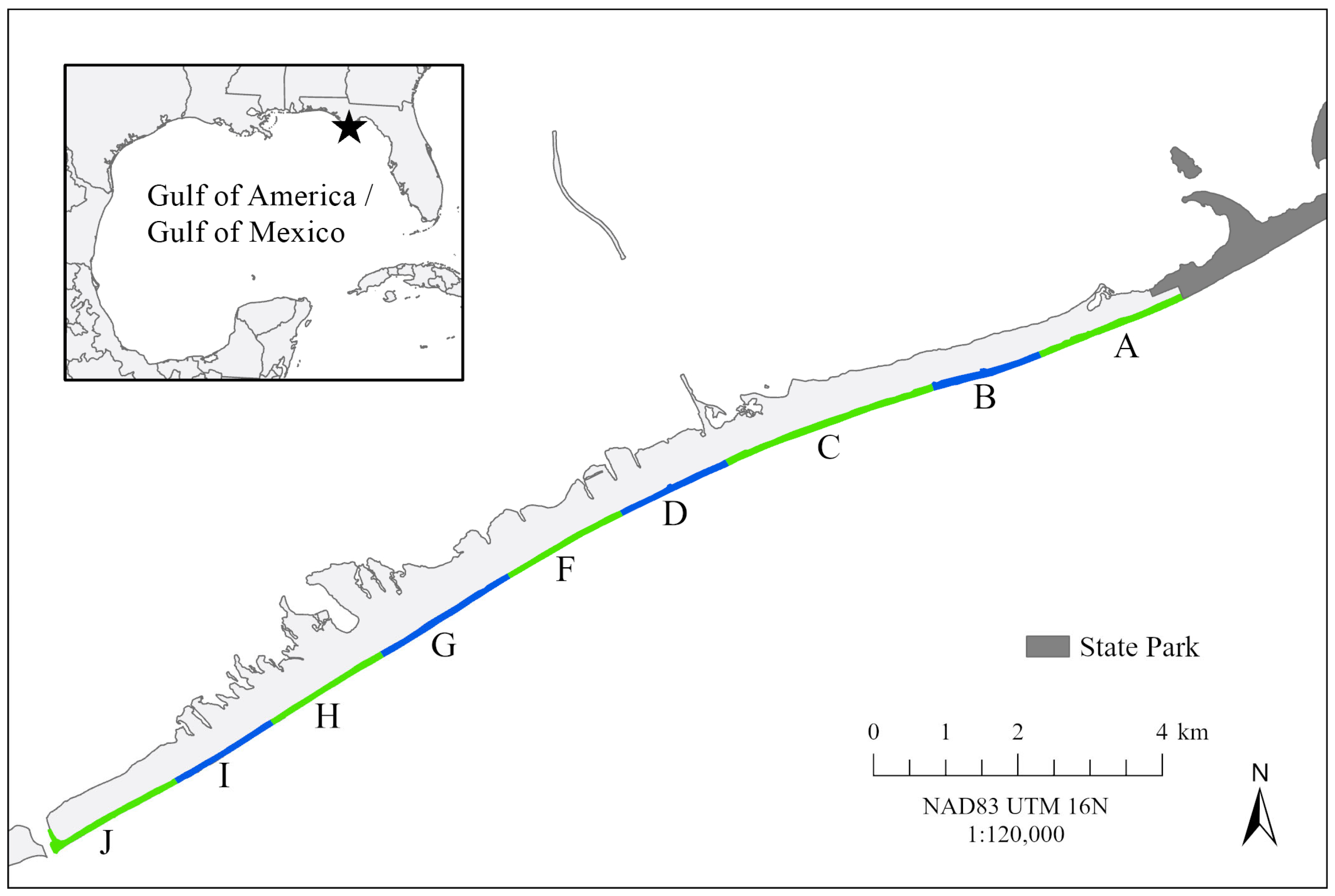
This study was conducted on St. George Island, Florida, USA (29.66° N, 84.86° W), a 33 km barrier island located in northwest Florida (Figure 1). The island is split into a 17.8 km populated region (western and central portion denoted by monitoring sections A–J in Figure 1) and the 15.2 km undeveloped Dr. Julian G. Bruce St. George Island State Park along its eastern portion. The populated portion of St. George Island hosts the most abundant nesting assemblage for the Northern Gulf of Mexico Loggerhead Recovery Unit with an average of 389.5 nests per year (±115.8 nests SD) [70,71,73]. Beaches on this part of the island are fairly uniform in profile with an average width of 58 m ± 5 m SD.

2.2. Beach Surveys

During the 2016–2024 nesting seasons (May–October, excluding 2020 and 2023), volunteers from the Apalachicola National Estuarine Research Reserve conducted morning nesting surveys within assigned sections of the beach (zones A–J in Figure 1). Each morning, they looked for new sea turtle crawls, demarcated new nests, and checked on existing nests following protocols established by the Florida Fish and Wildlife Conservation Commission [74]. If a nest was predated, washed over, washed out, or otherwise disturbed, volunteers noted the disturbance and provided commentary (e.g., how many eggs were lost, predator identity, name of the storm that caused the erosion). Predated nests were identified based on eggshells ejected onto the beach surface following consumption of the egg contents. Washed over nests were denoted by wet sand or the deposition of wrack material shoreward of the nest or active submersion of the nest was observed during morning patrols. A nest was considered washed out if it could not be found again after a high tide or storm event, and no subsequent hatchling emergence was observed from that nest location. Volunteers excavated nests either three days after emergence or at day 70 of incubation to calculate the clutch size (i.e., the number of eggs laid), hatching success (i.e., the number of hatched eggs divided by the number of eggs laid) and emergence success (i.e., the number of emerged hatchlings divided by the number of eggs laid) [74,75].
Female nesting rates peak on St. George Island starting in mid-June each year [70]. For one to two weeks during this time (Appendix A Table A1), morning surveys were supplemented by nighttime surveys conducted by the Florida State University Marine Turtle Research, Ecology, and Conservation Group (FSU MTRECG). From 21:00–04:00 local time, FSU MTRECG teams patrolled sections of the beach to intercept nesting females. For each turtle encountered, teams recorded the GPS location of turtle activities (e.g., nests, false crawls), checked for Inconel flipper and PIT tags, applied new tags as necessary, and recorded carapace measurements [76]. Carapace measurements collected with a flexible measuring tape included the minimum curved carapace length (CCLmin, distance from the nuchal scute to the notch between the supracaudal scutes along the midline), “standard” or “notch-to-tip” curved carapace length (distance from the nuchal scute to the tip of the longest supracaudal scute along the midline), and curved carapace width (distance between the widest points of the carapace perpendicular to the midline) [77] Beach sections were not patrolled uniformly by FSU MTRECG personnel across all years to maximize encounter rates (Appendix A Table A1). Only loggerhead turtle nests corresponding to FSU MTRECG-intercepted females and subsequently monitored by Apalachicola National Estuarine Research Reserve volunteers were included in this analysis.

2.3. Statistical and GIS Analyses

Individual female body sizes across all years were initially pooled to visualize the overall data distribution and compare to the 87 cm CCLmin minimum size at maturity threshold adopted by U.S. federal wildlife managements agencies. Any interannual trends in mean female size and the proportion of females ≤ 87 cm CCLmin by year were evaluated using binomial (size class) or gaussian (CCLmin) generalized linear models (GLMs). We excluded 23 repeated observations of the same individuals from the dataset and kept the smallest measurement for each turtle [31,78].
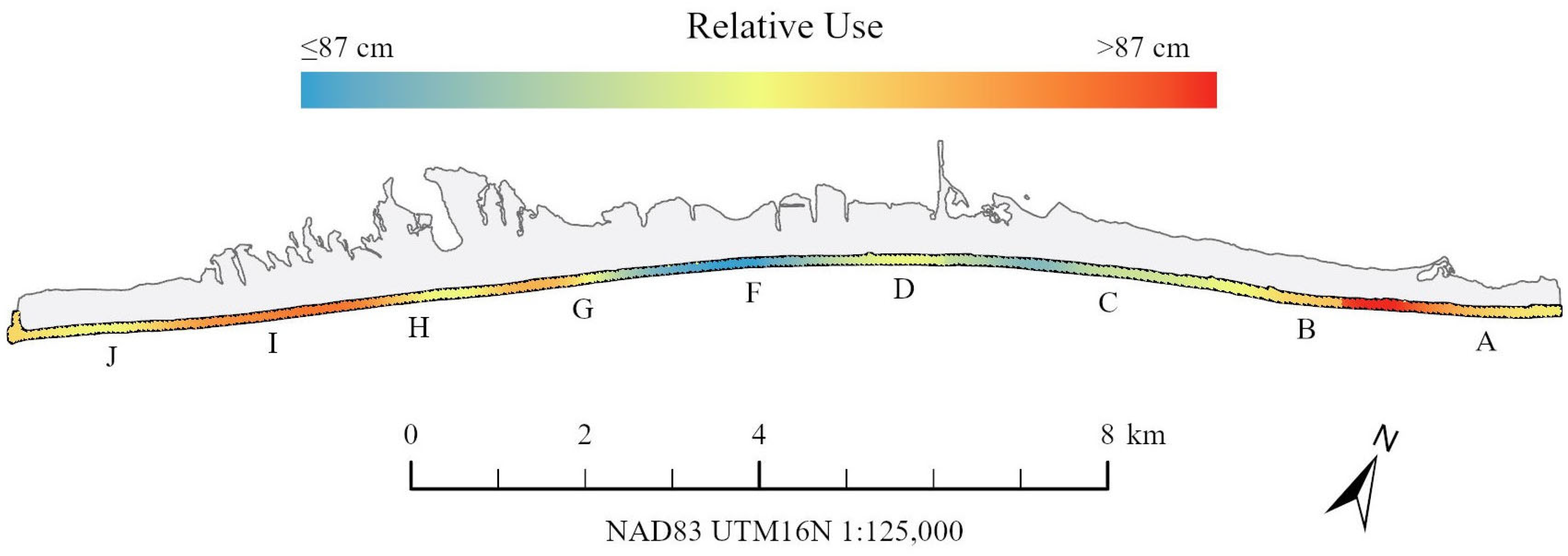
To describe general spatial patterns in the frequency of female emergences detected by size class across all years, rasterized kernel density estimates (KDEs) were generated with a search radius of 1300 m and a cell size of 25 m (each representing optimized values based on the observed dataset) using ≤87 cm and >87 cm size-class GPS observations separately in ArcGIS Pro v3.5.4 [79,80] (Esri; Redlands, CA, USA). The KDEs were then divided by the survey effort within each monitoring zone to generate spatial estimates per unit effort [81]. To account for differences in sample size between size classes, the resulting KDEs were then standardized to values between 0–1 using the equation:
K D E   c e l l   v a l u e m i n i m u m   K D E   v a l u e m a x i m u m   K D E   v a l u e m i n i m u m   K D E   v a l u e
The resulting KDEs thus represent relatively high- and low-density patterns in female emergence by size-class [81]. Differences in relative distribution were further visualized by subtracting the ≤87 cm size class standardized KDE from the >87 cm size class standardized KDE, such that more negative values suggest a greater relative use by the ≤87 cm size class and more positive values support greater >87 cm size class observations.
Spatial patterns in nesting female size were evaluated for statistical significance using generalized additive models (GAMs) including a spatial explanatory covariate in R v4.5.1 [82] (R Core Team; Vienna, Austria). GAMs were used to accommodate potential non-linear patterns associated with the spatial covariate in the form of a smoother. The GPS coordinates corresponding to females of a known size were transformed to the UTM 16N projected coordinate system to convert units from degrees to meters. The UTM coordinates were rotated clockwise 26.5°, the orientation of the long axis of St. George Island relative to the latitudinal parallel, to reduce the observed covariate dimensions from two (x- & y-axes) to one (x-axis only) [81]. Mean turtle size (continuous; CCLmin) and size class (binary; ≤87 cm vs. >87 cm) were evaluated as a function of the beach location measured in kilometers from the rotated western UTM boundary in either a gaussian (CCLmin) or binomial GAM (size class). Survey effort per monitoring zone was not included as a model offset in these GAMs as the models investigated the characteristics of encountered turtles, not their frequency of occurrence as in the KDE analyses, and the inclusion of effort resulted in reduced model performance and nonsensical units (e.g., mean CCLmin per unit effort).
The effect of female CCLmin or size class on hatchling production and threat exposure was explored through multiple metrics including clutch size, hatching success, emergence success, and rates of disturbance such as predation, invasion by sea oat (Uniola paniculate) roots, wave overwash, and wash-out. Depending on the form of the response variable, different GLM families were used including binomial (binary data such as predated vs. non-predated), negative binomial (count data such as clutch size), and beta (proportional data such as hatching and emergence success). Note that various disturbances are not mutually exclusive. For example, a clutch can be predated then washed over by a subsequent hurricane. A total of 29 nests (17.5%) were observed with multiple disturbances. When assessing rates of disturbance, such overlapping events were included to prevent undercounting disturbance rates. Few individuals (n = 10 out of 232 unique individuals) were observed laying multiple nests, so each nest was treated as a separate observation (i.e., maternal identity was not included as a random effect) as only one individual laid three nests, and the other nine individuals laid two nests each (representing a combined 13% of the available nesting data).
Additional assessments of nest distance from the mean higher high water elevation contour were conducted in ArcGIS Pro v3.5.4. Monitoring zone of a given nest was recorded during nighttime surveys; however, cross-shore nest distances from the recent high tide line or back-beach boundary were not. To extract cross-shore nest placement, nest GPS locations were measured to (1) the back-beach boundary (e.g., dune toe, upland construction) digitized from aerial imagery, and (2) the mean higher high water elevation contour derived from temporally averaged beach elevation profiles generated by repeated aerial LiDAR surveys [71,83]. Nest distance from the mean higher high water contour as a function of CCLmin was assessed using a gaussian linear model in R v4.5.1.
The statistical significance of explanatory variables was evaluated using likelihood ratio Chi squared, F-, T-, or Z-tests, as appropriate, comparing nested models with vs. without the variables of interest. A full description of the analyses, including model formulations and performance metrics, is available in the Supplementary Materials. Size class-based analyses are not included here in the hatchling productivity analyses given the low ≤ 87 cm sample sizes (Section 3.3, n = 12/166 nests, 7.2%); therefore, only analyses based on CCLmin are presented. Size class-based analyses are included in the Supplementary Materials with the understanding that results based on small sample sizes should be interpreted with caution.

3. Results

3.1. Proportion of Females < 87 cm CCLmin

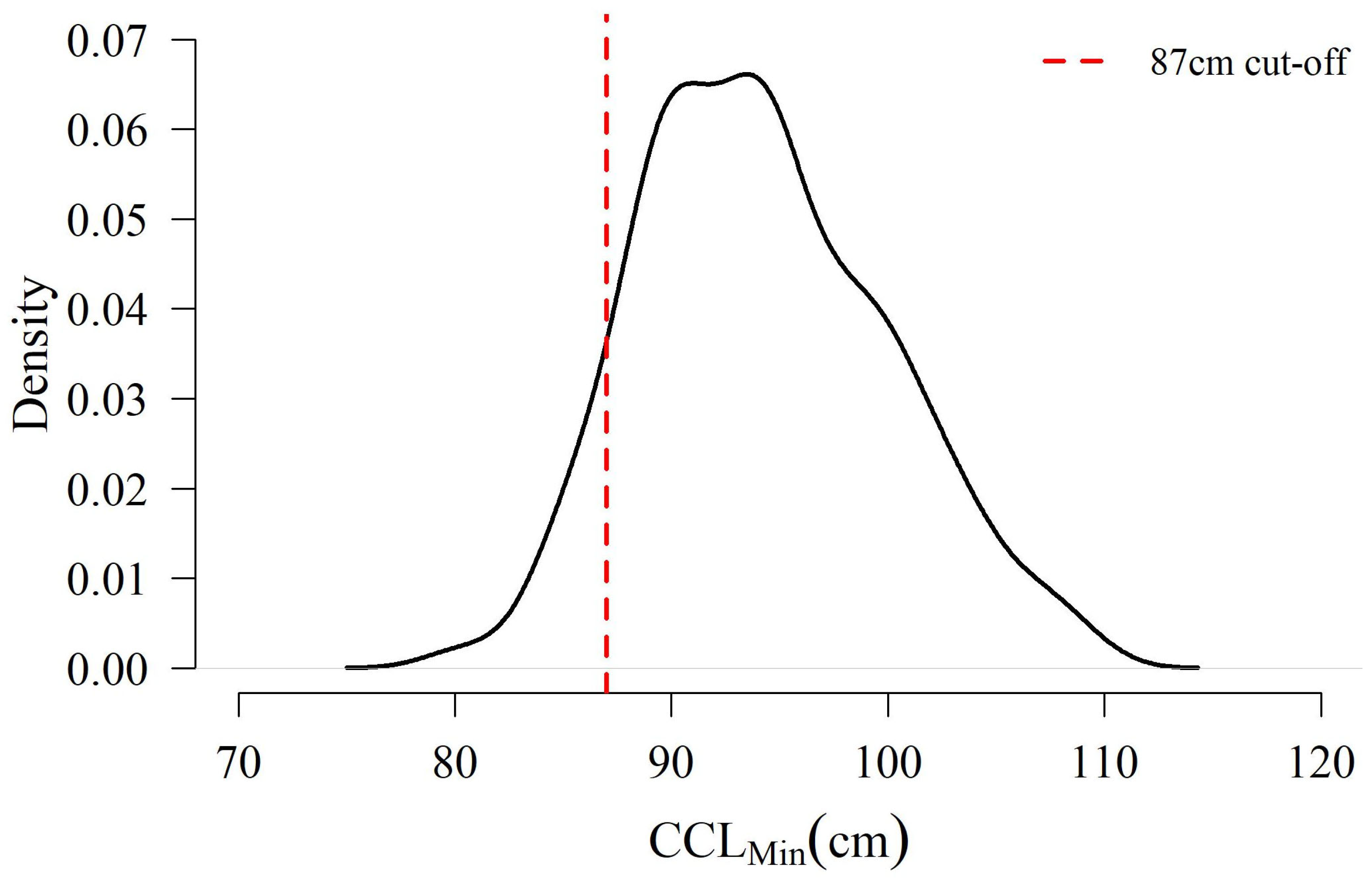
From 2016–2024, 232 unique turtles were available for analysis ranging in size from 80.2 cm to 109.1 cm CCLmin ( x ¯ = 94.3 ± 5.7 cm SD, Figure 2). Of these individuals, 21 (9.1%) fell into the ≤87 cm size class. This proportion varied from 0% (n = 0/17 in 2024) to 16.3% (n = 7/50 in 2019), but year was not a significant predictor of either size-class assignment (χ2 p = 0.365) or mean female size (F test p = 0.717).

3.2. Spatial Emergence Patterns

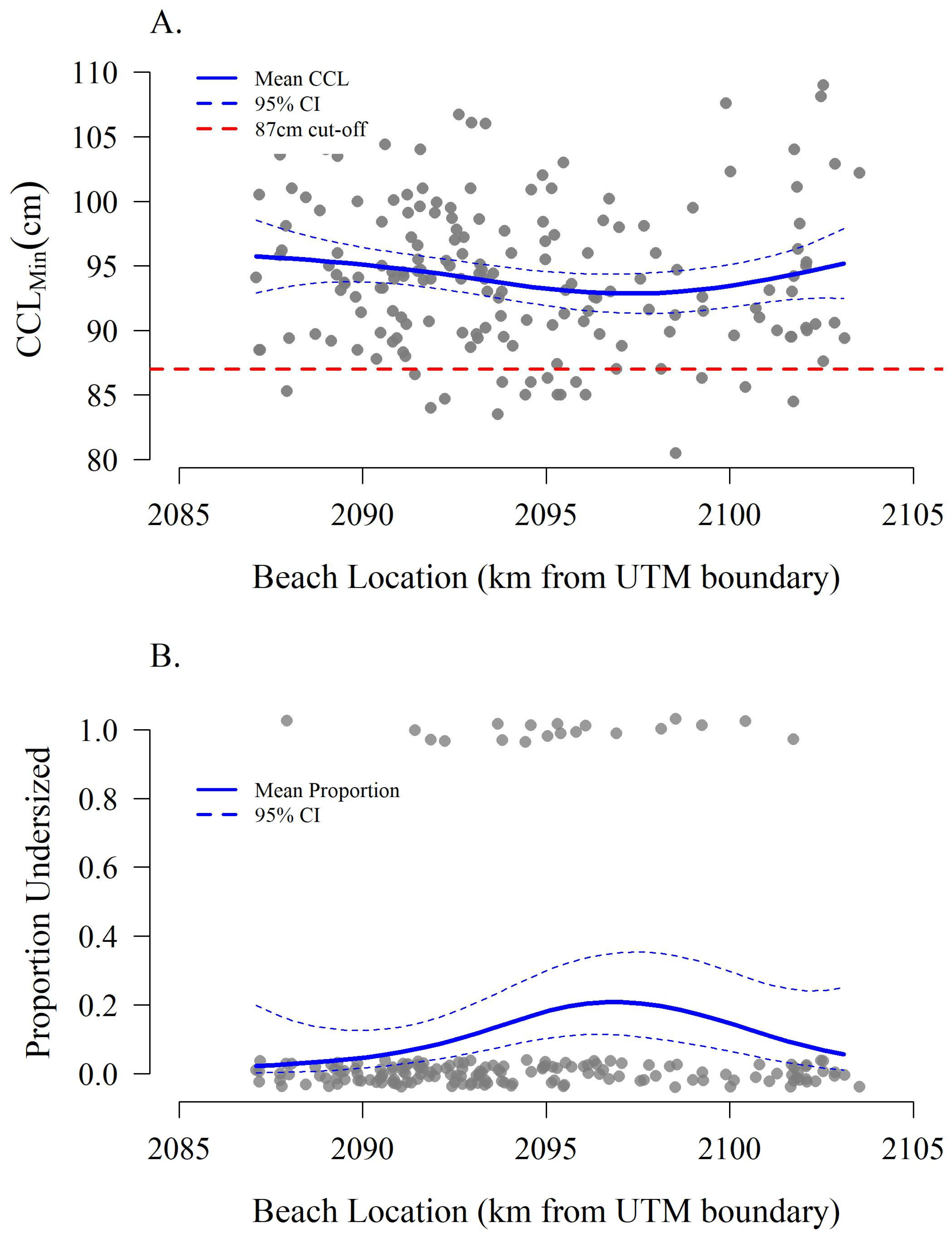
Of the 232 unique loggerhead turtles, 177 (76.3%) had GPS coordinates associated with their observations including 19 turtles ≤ 87 cm and 158 turtles > 87 cm. Standardized KDEs suggest potential differences in emergence location across the beach between size class with higher relative densities of ≤87 cm turtles emerging in the center-left portion of the island (zone F) versus the western (zones H–I) and eastern ends (zones A–B) for the >87 cm size class (Figure 3). Distances along the island corresponding to these zones show similar patterns in either mean CCLmin or proportion of ≤87 cm females (Figure 4). However, alongshore location was not statistically significant with respect to CCLmin (F test p = 0.170 by UTM distance, F test p = 0.375 by zone) or size class assignment by zone (χ2 p = 0.326 by Zone). Size class by UTM distance was probative (Figure 4B, χ2 p = 0.072).

3.3. Hatchling Production

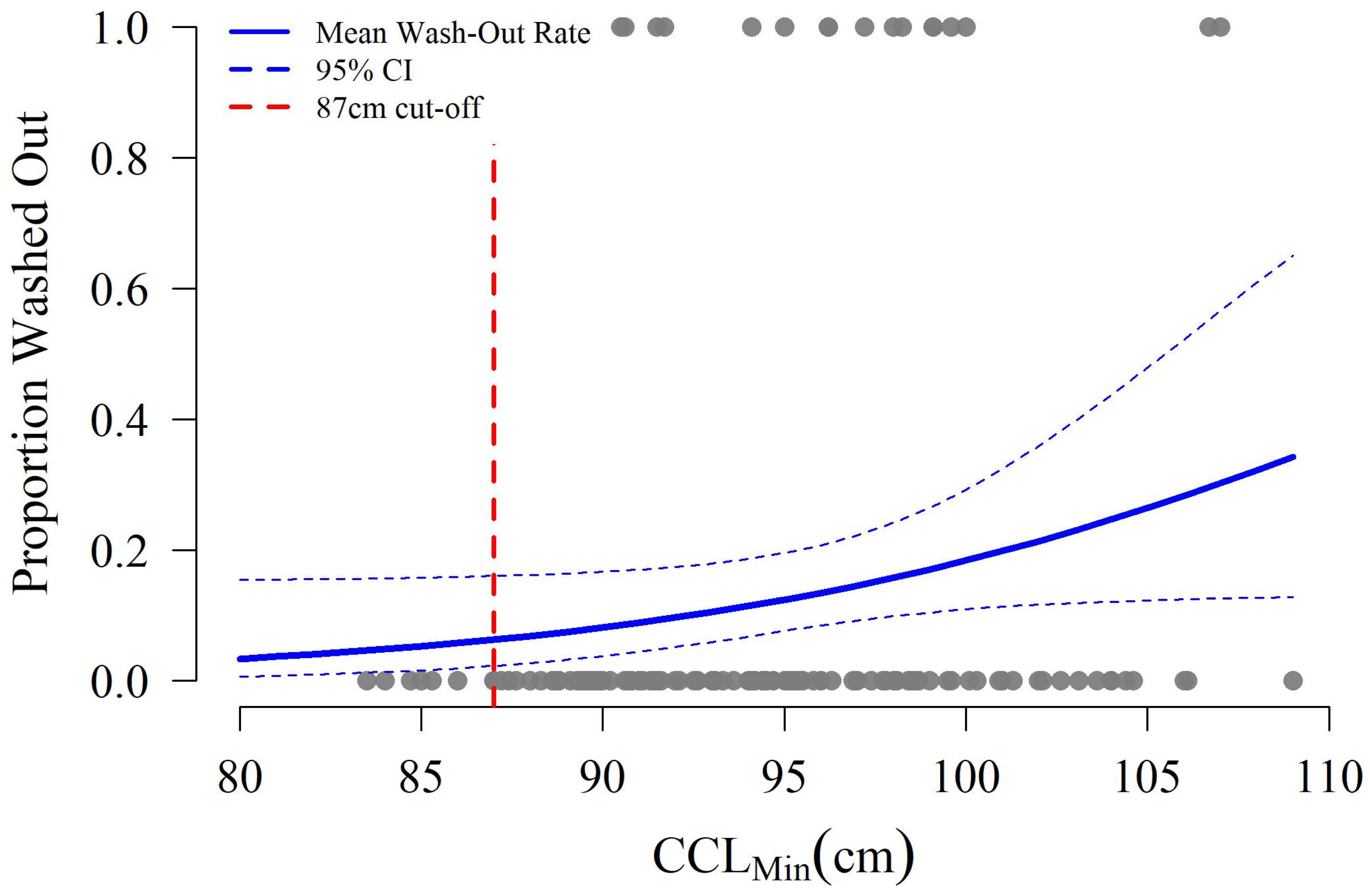
Most of the disturbances considered were not significantly related to turtle body size, including predation (Z test p = 0.951), root invasion (Z test p = 0.760), and wave overwash (Z test p = 0.374). The effect of CCLmin on exposure to disturbances was only suggestive with respect to wave wash-out rates (i.e., erosion, Z test p = 0.052), where modeled rates of wash-out increased by 0.52% per 1 cm increase in CCLmin (Figure 5). Based on this trend, the largest turtles (109 cm CCLmin) could lose 34.5% of their nests to wash-out compared to 3.4% for the smallest individuals (80.2 cm CCLmin). Wash-out rates were not linked to survey zone (all pairwise Z test p > 0.6), and larger turtles did not tend to nest closer to the mean higher high water elevation contour (T test p = 0.387).
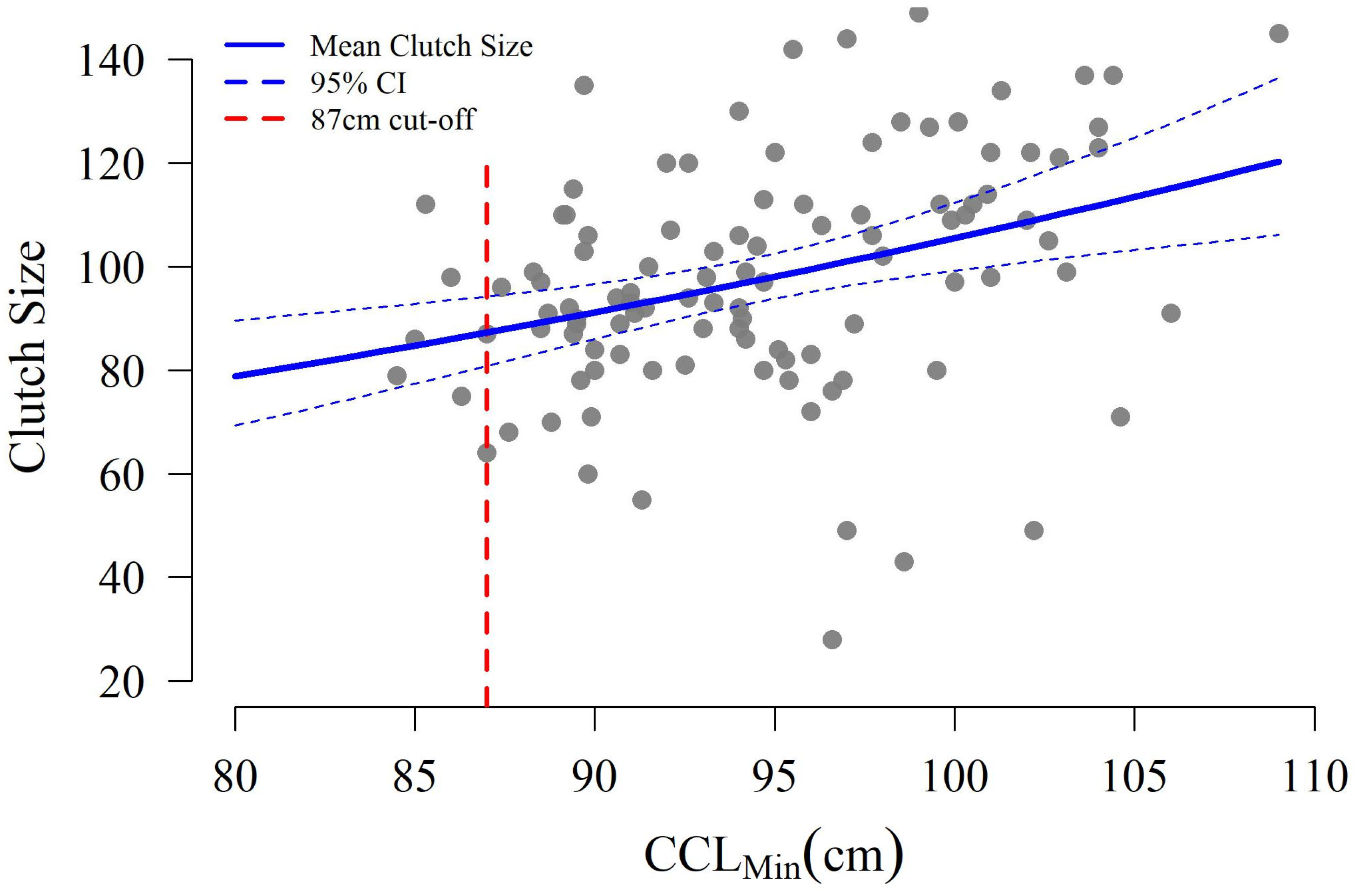
With respect to mean clutch size, nests which were predated (n = 39) or washed out (n = 16) were excluded as the initial clutch size pre-disturbance was not known, leaving 111 nests available for analysis. CCLmin was significantly related to clutch size (Z test p < 0.001), with clutch sizes increasing by 1 egg per 1 cm increase in CCLmin (Figure 6).
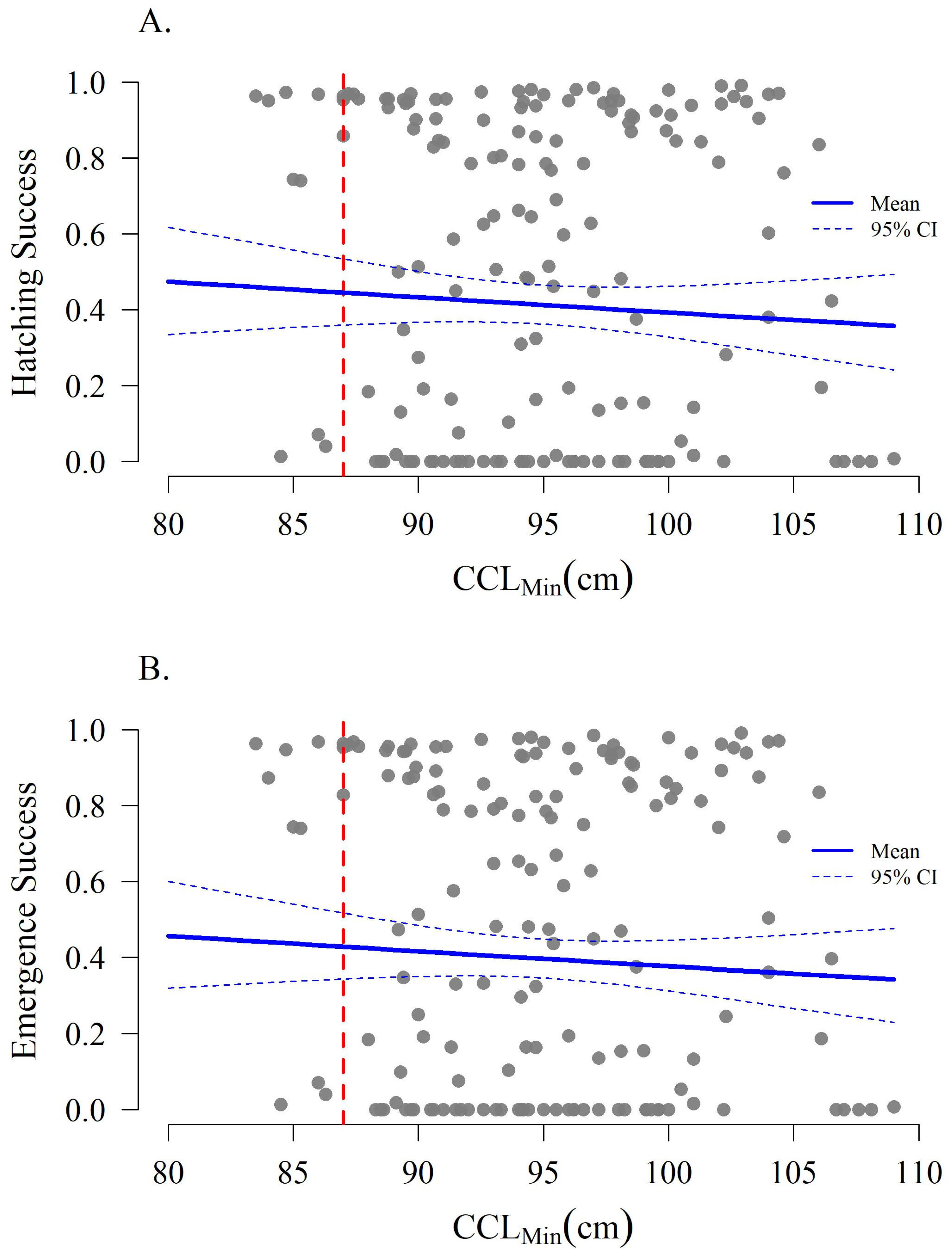
When considering completely undisturbed nests (n = 45), overall mean hatching success was 82.6% ± 22.6% SD and emergence success was 81.0% ± 22.4% SD. Minimum curved carapace length was not significantly related to either hatching (Z test p = 0.785) or emergence success (Z test p = 0.975). However, when disturbances were included, overall mean hatching and emergence success declined to 51.9% ± 40.4% SD and 49.9% ± 40.0% SD, respectively. Under these circumstances, hatching and emergence success trended −0.50% per 1 cm increase in body size but these trends were not statistically significant (Z test p = 0.369 and 0.371, respectively, Figure 7).

4. Discussion

Of the unique individuals identified nesting on St. George Island (n = 232), 9.1% were below the current threshold of 87 cm CCLmin used by U.S. federal wildlife management agencies to denote “adult” loggerhead turtles (Figure 2). This rate is consistent with another nesting site for this Recovery Unit in Gulf Shores, Alabama from 2011 to 2017, which observed 9.6% of nesting females to be ≤87 cm [65]. Taken together, this consistency suggests that the minimum size at reproductive maturity for loggerhead turtles in the region may need to be reconsidered [33,65,72]. Ensuring an accurate definition of the minimum size at sexual maturity is critical for population management as individual counts, threat assessments, mortality assignments, and fecundity estimates may be attributed to the wrong life stages, hindering viability projections [9,14,25]. This is particularly important for small or isolated populations, as their diminutive size or restricted connectivity increases their risk of local extinction [59,60].
The Northern Gulf of Mexico Loggerhead Recovery Unit is among the smallest in the Northwest Atlantic distinct population segment for loggerhead turtles and its range significantly overlaps several major threats including commercial trawling and oil and natural gas extraction [37,68]. To understand the population-level impacts of these activities and inform any necessary management action, the frequency and life stage of affected individuals must be accurately reflected in population model parameters such as survivorship. Previous modeling work has demonstrated that older juvenile and adult life stages hold a greater value for population recovery than eggs and hatchlings given their higher annual survival rates, but it is these later stages which are most impacted by threats in the region [8,9,15]. Misidentifying smaller reproductively-capable adults as non-reproductive subadults in such threat assessments will result in an overestimation of adult life stage survivorship and underestimation of population-level reproductive output, potentially leading to misaligned management priorities [24,49,50].
Using two standard deviations below the mean as an estimate for minimum size at maturity following Stewart et al. [34], our data suggests a revised threshold of 82.8 cm CCLmin would be suitable for the Northern Gulf of Mexico Loggerhead Recovery Unit, which is in line with an 82.0 cm threshold based on the Benscoter et al. [65] Gulf Shores data [84]. Such reductions in the established minimum size at maturity are not unique to this recovery unit: Phillips et al. [33] reported a threshold of 83.2 cm CCLmin (converted using Turtle Expert Working Group [37]) for loggerhead turtles and 94.8 cm CCLmin (converted using Goshe et al. [85]) for green turtles on Florida’s Atlantic coast based on two standard deviations below their almost 40-year mean, as well as declining trends in body size through time. Such an extended time series is not currently available for northwest Florida to investigate whether the observed body size distribution is a recent, persistent, or transient phenomenon. Therefore, sustained capture-mark-recapture efforts are required to support a longer-term trend analysis despite the logistical difficulties associated with monitoring a small population spread over a large geographic area [33,65,72]. If the observed female body size in the region trends smaller through time as in Phillips et al. [33], and if smaller turtles produce fewer eggs as demonstrated here, population-level hatchling production could be negatively affected without a concurrent increase in the number of reproductively active adults [17,31,32,35,44,45,86].
Sustained capture-mark-recapture work will also allow greater exploration of the interactions between female body size, nest site selection, and hatchling production. Maternal behavior can influence hatchling production and physical fitness through nest site and microhabitat selection. Since abiotic conditions drive embryonic development, sex determination, and hatchling fitness, it benefits the nesting female from the perspective of reproductive fitness to identify suitable nesting sites which maximize the production of “fit” hatchlings [51,57,87,88,89,90]. In this study, larger turtles laid larger clutches but also had higher rates of clutch loss due to wave wash-out (Figure 5 and Figure 6). A possible explanation for this is that larger turtles require more energy to crawl further away from the water, resulting in their nests being laid closer to the mean high tide line and thus these nests are more susceptible to the effects of hurricanes or extreme high tides [71,91,92]. This hypothesis runs counter to results from Cabo Verde and Australia where larger loggerhead females nested further from the water, potentially due to increased experience [58,89]. Given logistical limitations, saturation tagging of every individual nesting on St. George Island across the full season was not possible. Therefore, turtles intercepted without pre-existing tags could not be classified as “neophyte” nesters with confidence, regardless of body size. This, combined with the limited sampling window, means the cause of increased wash-out rates for larger turtles on St. George Island is ripe for future investigation. Future studies should consider methods to better quantify turtle experience (e.g., saturation tagging) and expand the sampling period to evaluate possible intra-season differences in the timing of nest deposition by body size and associated degree of overlap with the local hurricane season.
Previous work has highlighted repeatability in individual nest site selection (e.g., [55,57,88]) and the impacts of site selection on hatchling production (e.g., [56,58,89]), but the maternal size distribution is absent from these analyses. Emergence patterns between turtles who are above or below the 87 cm CCLmin threshold suggest there may be patterning in the use of the available nesting area on St. George Island (Figure 3 and Figure 4). The center of the island, with a greater prevalence of smaller nesters, tends to have higher rate of artificial lighting, nighttime beach activity, and rates of hatchling disorientation and thus may represent less suitable habitat [67,93]. Remigrant females have been credited with improved selection of suitable nesting habitat through increased experience [58,86]. However, without an obvious mechanism for adult females to evaluate hatchling output as a result of their nest site selection, the role of “experience” may be difficult to quantify. Further studies are needed to investigate spatial trends on St. George Island and any underlying mechanism such as nesting female experience, genetic effects, or competitive exclusion of the smaller size class from higher quality nesting sites or nearshore resting areas, along with any consequences this may have on hatchling production and survival [55,57,86,90,94].
Understanding the distribution of maternal body sizes in a population and any associated relationships this has with nest site selection and threat exposure in space and time may inform future management actions. For example, the trend between nest wash-out and turtle size (Figure 5) is particularly problematic as such erosion results in no hatchling production. Other disturbances including predation and wave overwash have the potential to produce at least a few hatchlings depending on the severity of the disturbance and were not related to female body size in this study [70,71,92,95,96,97]. Because larger turtles on St. George Island lay more eggs and their nests may be more likely to be washed out, management plans should focus on mitigating wash-outs in the area to maximize the population-scale benefits these individuals provide [70]. Such efforts range from the identification and maintenance of suitable nesting habitat to investigations of the logistical and ethical implications of interventionist nest management [71].
Given the observed or potential relationships between female body size, hatchling production, nest site selection, and threat exposure, the exact cause of the broadly observed decline in nesting female size warrants further consideration. For example, reduced habitat suitability or loss due to resource limitations or climate change could restrict juvenile growth rates and encourage early maturation at smaller body sizes [16,22,98,99,100] or direct harvest or incidental capture as bycatch could remove larger individuals from the population [24,101,102,103]. In either of these scenarios, management actions would be required to address the negative causes of the observed decline in body size. However, a positive explanation for reduced body size could be an influx of first-time nesters, which are typically smaller than remigrant nesters, indicating that past and present conservation actions have been effective [18,32,35,52]. At the population level, hatchling production each year is a product of the number of reproductive individuals, the number of eggs laid per individual, and the proportion of eggs lost to various causes. The influx of neophyte nesters may thus compensate for the effect of increased wash-out rate of larger individuals on overall hatchling production, particularly in years with frequent or severe hurricane activity. As this reduction is reported in other recovering rookeries, it may be a common feature of population recovery [18,31,32,34,35,52,104].

5. Conclusions

Stage-based population modeling has a long and fruitful history guiding sea turtle conservation (e.g., [8,9,15,64]). Accurately defining stages within models, often based on body size, is critical to the assignment of appropriate vital rates and relative threats [12,20,22,23,24,25,26]. This study supports others in the region [33,65] and globally (e.g., [35]) suggesting that sea turtles are reaching sexual maturity at smaller sizes, with important consequences for mean clutch sizes, nest site selection, and associated hatchling production. Pessimistically, smaller adult sizes may be a consequence of reduced foraging habitat suitability limiting juvenile growth rates [16,22]. Optimistically, the depression in average adult body size may be an artifact of increased recruitment of neophyte nesters within the population [18,35]. Nest counts in the southeastern United States have generally been increasing, suggesting possible recovery, but the exact relationship of nest counts to adult abundance complicates this interpretation [66,105,106]. Additional work confirming population recovery as a significant factor in the observed decline in nesting female body sizes would be welcome news for this threatened charismatic species.

Supplementary Materials

An R Markdown HTML file detailing the analysis process can be downloaded from https://github.com/DrMattWare/NestingSizeOnSGI/ (accessed on 24 November 2025).

Author Contributions

M.W. and M.M.P.B.F. conceived the underlying study and methodology. Formal analysis was carried out by L.O.d.M.V., L.F.-T. and M.W. The original draft was written by L.O.d.M.V., L.F.-T. and M.W. and revised by all authors. M.W. was responsible for project supervision under the administration of M.M.P.B.F. Funding was acquired by M.M.P.B.F., I.S.-G. and M.W. All authors have read and agreed to the published version of the manuscript.

Funding

The St. George Island nighttime tagging work was funded in whole or in part by grants awarded from the Sea Turtle Grants Program including Grant #18-021R, #20-015R, and #21-001R. The Sea Turtle Grants program is funded from proceeds from the sale of the Florida Sea Turtle License Plate. Learn more at www.helpingseaturtles.org. Additional funding for the nighttime surveys was donated by Waterlust (www.waterlust.com).

Institutional Review Board Statement

The nighttime surveys on St. George Island were conducted under Florida Fish and Wildlife Conservation Commission Marine Turtle Permit #239 with approval from the Florida State University Animal Care and Use Committee (Approval of Protocol #1534, 19 October 2015; and PROTO202100043, 25 June 2021). Morning surveys were conducted under applicable Florida Fish and Wildlife Conservation Commission Marine Turtle Permits.

Informed Consent Statement

Not applicable.

Data Availability Statement

The data underlying this study may be restricted due to state and/or federal permit requirements. Please direct all data requests to the corresponding author or the Florida Fish and Wildlife Conservation Commission.

Acknowledgments

We would like to thank the many volunteers within the St. George Island Sea turtle monitoring program whose dedication and hours of effort make this work possible, as well as members from the Florida State University Marine Turtle Research, Ecology, and Conservation Group who conducted the night surveys. In particular, we’d like to recognize Sharon and David Hutchinson, Kim Crossen, Tara Wah, and Janice Becker for their support of FSU MTRECG and broader sea turtle conservation efforts in the region.

Conflicts of Interest

The authors declare no conflicts of interest. The funders had no role in the design of the study; in the collection, analyses, or interpretation of data; in the writing of the manuscript; or in the decision to publish the results.

Abbreviations

The following abbreviations are used in this manuscript:
CCLminMinimum curved carapace length
FSU MTRECGFlorida State University Marine Turtle Research, Ecology, and Conservation Group

Appendix A

Table A1. Number of nighttime surveys within each monitoring zone by year.
Zone2016201720182019202120222024Total
A00001513028
B141014141513787
C1410141400759
D141014141513787
F141014141513787
G141014141513787
H141014141513787
I141014141513787
J141014141513080

References

  1. Blanckenhorn, W.U. Behavioral Causes and Consequences of Sexual Size Dimorphism. Ethology 2005, 111, 977–1016. [Google Scholar] [CrossRef]
  2. Calsbeek, R. Experimental Evidence That Competition and Habitat Use Shape the Individual Fitness Surface. J. Evol. Biol. 2009, 22, 97–108. [Google Scholar] [CrossRef] [PubMed]
  3. Garnick, S.; Di Stefano, J.; Elgar, M.A.; Coulson, G. Inter- and Intraspecific Effects of Body Size on Habitat Use among Sexually-Dimorphic Macropodids. Oikos 2014, 123, 984–992. [Google Scholar] [CrossRef]
  4. Kelleher, S.R.; Silla, A.J.; Dingemanse, N.J.; Byrne, P.G. Body Size Predicts Between-Individual Differences in Exploration Behaviour in the Southern Corroboree Frog. Anim. Behav. 2017, 129, 161–170. [Google Scholar] [CrossRef]
  5. Persson, L.; De Roos, A.M. Adaptive Habitat Use in Size-Structured Populations: Linking Individual Behavior to Population Processes. Ecology 2003, 84, 1129–1139. [Google Scholar] [CrossRef]
  6. Tershy, B.R. Body Size, Diet, Habitat Use, and Social Behavior of Balaenoptera Whales in the Gulf of California. J. Mammal. 1992, 73, 477–486. [Google Scholar] [CrossRef]
  7. Weise, M.J.; Harvey, J.T.; Costa, D.P. The Role of Body Size in Individual-Based Foraging Strategies of a Top Marine Predator. Ecology 2010, 91, 1004–1015. [Google Scholar] [CrossRef]
  8. Crouse, D.T.; Crowder, L.B.; Caswell, H. A Stage-based Population Model for Loggerhead Sea Turtles and Implications for Conservation. Ecology 1987, 68, 1412–1423. [Google Scholar] [CrossRef]
  9. Crowder, L.B.; Crouse, D.T.; Heppell, S.S. Predicting the Impact of Turtle Excluder Devices on Loggerhead Sea Turtle Populations. Ecol. Appl. 1994, 4, 437–445. [Google Scholar] [CrossRef]
  10. Heppell, S.S.; Crowder, L.B.; Crouse, D.T.; Epperley, S.P.; Frazier, N.B. Population Models for Atlantic Loggerheads: Past, Present, and Future. In Loggerhead Sea Turtles; Bolten, A.B., Witherington, B.E., Eds.; Smithsonian Institution: Washington, DC, USA, 2003; pp. 255–273. [Google Scholar]
  11. Piacenza, S.E.; Balazs, G.H.; Hargrove, S.K.; Richards, P.M.; Heppell, S.S. Trends and Variability in Demographic Indicators of a Recovering Population of Green Sea Turtles Chelonia Mydas. Endanger. Species Res. 2016, 31, 103–117. [Google Scholar] [CrossRef]
  12. Bjorndal, K.A.; Bowen, B.W.; Chaloupka, M.Y.; Crowder, L.B.; Heppell, S.S.; Jones, C.M.; Lutcavage, M.E.; Solow, A.R.; Witherington, B.E. Assessment of Sea-Turtle Status and Trends: Integrating Demography and Abundance; National Academies Press: Washington, DC, USA, 2010. [Google Scholar]
  13. Bjorndal, K.A.; Parsons, J.; Mustin, W.; Bolten, A.B. Variation in Age and Size at Sexual Maturity in Kemp’s Ridley Sea Turtles. Endanger. Species Res. 2014, 25, 57–67. [Google Scholar] [CrossRef]
  14. Hatch, J.M.; Haas, H.L.; Richards, P.M.; Rose, K.A. Life-history Constraints on Maximum Population Growth for Loggerhead Turtles in the Northwest Atlantic. Ecol. Evol. 2019, 9, 9442–9452. [Google Scholar] [CrossRef] [PubMed]
  15. Heppell, S.S.; Caswell, H.; Crowder, L.B. Life Histories and Elasticity Patterns: Perturbation Analysis for Species with Minimal Demographic Data. Ecology 2000, 81, 654–665. [Google Scholar] [CrossRef]
  16. Avens, L.; Lamont, M.M.; Foley, A.M.; Higgins, B.M.; Howell, L.N.; Lovewell, G.; Shaver, D.J.; Stacy, B.A.; Walker, J.S.; Clark, J.M.; et al. Regional Differentiation in Somatic Growth and Maturation Attributes for Loggerhead Sea Turtles (Caretta caretta) in the Northwest Atlantic. Mar. Biol. 2025, 172, 149. [Google Scholar] [CrossRef]
  17. Gatto, C.R.; Robinson, N.J.; Spotila, J.R.; Paladino, F.V.; Santidrián Tomillo, P. Body Size Constrains Maternal Investment in a Small Sea Turtle Species. Mar. Biol. 2020, 167, 182. [Google Scholar] [CrossRef]
  18. Hays, G.C.; Taxonera, A.; Renom, B.; Fairweather, K.; Lopes, A.; Cozens, J.; Laloë, J.-O. Changes in Mean Body Size in an Expanding Population of a Threatened Species. Proc. R. Soc. B Biol. Sci. 2022, 289, 20220696. [Google Scholar] [CrossRef]
  19. Heithaus, M.R.; Frid, A.; Dill, L.M. Shark-Inflicted Injury Frequencies, Escape Ability, and Habitat Use of Green and Loggerhead Turtles. Mar. Biol. 2002, 140, 229–236. [Google Scholar] [CrossRef]
  20. Van Buskirk, J.; Crowder, L.B. Life-History Variation in Marine Turtles. Copeia 1994, 1994, 66–81. [Google Scholar] [CrossRef]
  21. Das, A.K.; Mohapatra, S.K.; Tripathy, B.; Swain, A.; Mohapatra, A. Do Olive Ridley Turtles Select Mates Based on Size? An Investigation of Mate Size Preference at a Major Arribada Rookery. Ecosphere 2025, 16, e70264. [Google Scholar] [CrossRef]
  22. Avens, L.; Ramirez, M.D.; Hall, A.G.; Snover, M.L.; Haas, H.L.; Godfrey, M.H.; Goshe, L.R.; Cook, M.; Heppell, S.S. Regional Differences in Kemp’s Ridley Sea Turtle Growth Trajectories and Expected Age at Maturation. Mar. Ecol. Prog. Ser. 2020, 654, 143–161. [Google Scholar] [CrossRef]
  23. Bjorndal, K.A.; Bowen, B.W.; Chaloupka, M.Y.; Crowder, L.B.; Heppell, S.S.; Jones, C.M.; Lutcavage, M.E.; Policansky, D.; Solow, A.R.; Witherington, B.E. Better Science Needed for Restoration in the Gulf of Mexico. Science 2011, 331, 537–538. [Google Scholar] [CrossRef] [PubMed]
  24. Casale, P.; Heppell, S.S. How Much Sea Turtle Bycatch Is Too Much? A Stationary Age Distribution Model for Simulating Population Abundance and Potential Biological Removal in the Mediterranean. Endanger. Species Res. 2016, 29, 239–254. [Google Scholar] [CrossRef]
  25. Heppell, S.S.; Crouse, D.T.; Crowder, L.B.; Epperly, S.P.; Gabriel, W.; Henwood, T.; Marquez, R.; Thompson, N.B. A Population Model to Estimate Recovery Time, Population Size, and Management Impacts on Kemp’s Ridley Sea Turtles. Chelonian Conserv. Biol. 2005, 4, 767–773. [Google Scholar]
  26. Piacenza, S.E.; Richards, P.M.; Heppell, S.S. Fathoming Sea Turtles: Monitoring Strategy Evaluation to Improve Conservation Status Assessments. Ecol. Appl. 2019, 29, e01942. [Google Scholar] [CrossRef] [PubMed]
  27. Eaton, C.; McMichael, E.; Witherington, B.E.; Foley, A.M.; Hardy, R.; Meylan, A.B. In-Water Sea Turtle Research in Florida: Review and Recommendations; National Oceanic and Atmospheric Administration: St. Petersburg, FL, USA, 2008. [Google Scholar]
  28. Mansfield, K.L.; Wyneken, J.; Luo, J. First Atlantic Satellite Tracks of “lost Years” Green Turtles Support the Importance of the Sargasso Sea as a Sea Turtle Nursery. Proc. R. Soc. B Biol. Sci. 2021, 288, 20210057. [Google Scholar] [CrossRef]
  29. Stokes, H.J.; Mortimer, J.A.; Laloë, J.-O.; Hays, G.C.; Esteban, N. Synergistic Use of UAV Surveys, Satellite Tracking Data, and Mark-recapture to Estimate Abundance of Elusive Species. Ecosphere 2023, 14, e4444. [Google Scholar] [CrossRef]
  30. Bell, I.P.; Meager, J.J.; Eguchi, T.; Dobbs, K.A.; Miller, J.D.; Madden Hof, C.A. Twenty-Eight Years of Decline: Nesting Population Demographics and Trajectory of the North-East Queensland Endangered Hawksbill Turtle (Eretmochelys imbricata). Biol. Conserv. 2020, 241, 108376. [Google Scholar] [CrossRef]
  31. López-Castro, M.C.; Cuevas, E.; Guzmán Hernández, V.; Raymundo Sánchez, Á.; Martínez-Portugal, R.C.; Reyes, D.J.L.; Chio, J.Á.B. Trends in Reproductive Indicators of Green and Hawksbill Sea Turtles over a 30-Year Monitoring Period in the Southern Gulf of Mexico and Their Conservation Implications. Animals 2022, 12, 3280. [Google Scholar] [CrossRef]
  32. Mortimer, J.A.; Appoo, J.; Bautil, B.; Betts, M.; Burt, A.J.; Chapman, R.; Currie, J.C.; Doak, N.; Esteban, N.; Liljevik, A.; et al. Long-Term Changes in Adult Size of Green Turtles at Aldabra Atoll and Implications for Clutch Size, Sexual Dimorphism and Growth Rates. Mar. Biol. 2022, 169, 123. [Google Scholar] [CrossRef]
  33. Phillips, K.F.; Stahelin, G.D.; Chabot, R.M.; Mansfield, K.L. Long-Term Trends in Marine Turtle Size at Maturity at an Important Atlantic Rookery. Ecosphere 2021, 12, e03631. [Google Scholar] [CrossRef]
  34. Stewart, K.R.; Johnson, C.; Godfrey, M.H. The Minimum Size of Leatherbacks at Reproductive Maturity, with a Review of Sizes for Nesting Females from the Indian, Atlantic and Pacific Ocean Basins. Herpetol. J. 2007, 17, 123–128. [Google Scholar]
  35. Hays, G.C.; Rusli, M.U.; Booth, D.; Laloë, J.O. Global Decline in the Size of Sea Turtles. Glob. Change Biol. 2025, 31, e70225. [Google Scholar] [CrossRef] [PubMed]
  36. Monk, M.H.; Berkson, J.; Rivalan, P. Estimating Demographic Parameters for Loggerhead Sea Turtles Using Mark-Recapture Data and a Multistate Model. Popul. Ecol. 2010, 53, 165–174. [Google Scholar] [CrossRef]
  37. Turtle Expert Working Group. An Assessment of the Loggerhead Turtle Population in the Western North Atlantic Ocean; National Oceanic and Atmospheric Administration: Miami, FL, USA, 2009. [Google Scholar]
  38. Avens, L.; Snover, M.L. Age and Age Estimation in Sea Turtles. In The Biology of Sea Turtles, Volume 3; Wyneken, J., Lohmann, K.J., Musick, J.A., Eds.; CRC Press: Boca Raton, FL, USA, 2013; pp. 97–133. [Google Scholar]
  39. Piovano, S.; Clusa, M.; Carreras, C.; Giacoma, C.; Pascual, M.; Cardona, L. Different Growth Rates between Loggerhead Sea Turtles (Caretta caretta) of Mediterranean and Atlantic Origin in the Mediterranean Sea. Mar. Biol. 2011, 158, 2577–2587. [Google Scholar] [CrossRef]
  40. Berger, D.; Walters, R.; Gotthard, K. What Limits Insect Fecundity? Body Size- and Temperature-Dependent Egg Maturation and Oviposition in a Butterfly. Funct. Ecol. 2008, 22, 523–529. [Google Scholar] [CrossRef]
  41. Gould, J.; Beranek, C.; Valdez, J.; Mahony, M. Quantity versus Quality: A Balance between Egg and Clutch Size among Australian Amphibians in Relation to Other Life-History Variables. Austral Ecol. 2022, 47, 685–697. [Google Scholar] [CrossRef]
  42. Honěk, A. Intraspecific Variation in Body Size and Fecundity in Insects: A General Relationship. Oikos 1993, 66, 483–492. [Google Scholar] [CrossRef]
  43. Sand, H. Life History Patterns in Female Moose (Alces alces): The Relationship between Age, Body Size, Fecundity and Environmental Conditions. Oecologia 1996, 106, 212–220. [Google Scholar] [CrossRef] [PubMed]
  44. Wu, N.C.; Rusli, M.U.; Broderick, A.C.; Barneche, D.R. Size Scaling of Sea Turtle Reproduction May Reconcile Fundamental Ecology and Conservation Strategies at the Global Scale. Glob. Ecol. Biogeogr. 2022, 31, 1277–1289. [Google Scholar] [CrossRef]
  45. Broderick, A.C.; Glen, F.; Godley, B.J.; Hays, G.C. Variation in Reproductive Output of Marine Turtles. J. Exp. Mar. Biol. Ecol. 2003, 288, 95–109. [Google Scholar] [CrossRef]
  46. Le Gouvello, D.Z.M.; Nel, R.; Cloete, A.E. The Influence of Individual Size on Clutch Size and Hatchling Fitness Traits in Sea Turtles. J. Exp. Mar. Biol. Ecol. 2020, 527, 151372. [Google Scholar] [CrossRef]
  47. National Marine Fisheries Service; U.S. Fish and Wildlife Service. Recovery Plan for the Northwest Atlantic Population of the Loggerhead Sea Turtle (Caretta caretta), Second Revision; National Marine Fisheries Service: Silver Spring, MD, USA, 2008. [Google Scholar]
  48. Arendt, M.D.; Schwenter, J.A.; Owens, D.W. Climate-Mediated Population Dynamics for the World’s Most Endangered Sea Turtle Species. Sci. Rep. 2023, 13, 14444. [Google Scholar] [CrossRef] [PubMed]
  49. Mazaris, A.D.; Matsinos, Y.G. An Individual Based Model of Sea Turtles: Investigating the Effect of Temporal Variability on Population Dynamics. Ecol. Model. 2006, 194, 114–124. [Google Scholar] [CrossRef]
  50. Piacenza, S.E.; Richards, P.M.; Heppell, S.S. An Agent-Based Model to Evaluate Recovery Times and Monitoring Strategies to Increase Accuracy of Sea Turtle Population Assessments. Ecol. Model. 2017, 358, 25–39. [Google Scholar] [CrossRef]
  51. Bernardo, J. Maternal Effects in Animal Ecology. Am. Zool. 1996, 36, 83–105. [Google Scholar] [CrossRef]
  52. Le Gouvello, D.Z.M.; Girondot, M.; Bachoo, S.; Nel, R. The Good and Bad News of Long-Term Monitoring: An Increase in Abundance but Decreased Body Size Suggests Reduced Potential Fitness in Nesting Sea Turtles. Mar. Biol. 2020, 167, 112. [Google Scholar] [CrossRef]
  53. LeBlanc, A.M.; Rostal, D.C.; Drake, K.K.; Williams, K.L.; Frick, M.G.; Robinette, J.; Barnard-Keinath, D.E. The Influence of Maternal Size on the Eggs and Hatchlings of Loggerhead Sea Turtles. Southeast. Nat. 2014, 13, 587–599. [Google Scholar] [CrossRef]
  54. Witherington, B.E. Human and Natural Causes of Marine Turtle Clutch and Hatchling Mortality and Their Relationship to Hatchling Production on an Important Florida Nesting Beach. Master’s Thesis, University of Central Florida, Orlando, FL, USA, 1986. [Google Scholar]
  55. Kamel, S.J.; Mrosovsky, N. Nest Site Selection in Leatherbacks, Dermochelys coriacea: Individual Patterns and Their Consequences. Anim. Behav. 2004, 68, 357–366. [Google Scholar] [CrossRef]
  56. Marco, A.; Abella, E.; Martins, S.; López, O.; Patino-Martinez, J. Female Nesting Behaviour Affects Hatchling Survival and Sex Ratio in the Loggerhead Sea Turtle: Implications for Conservation Programmes. Ethol. Ecol. Evol. 2018, 30, 141–155. [Google Scholar] [CrossRef]
  57. Patrício, A.R.; Varela, M.R.; Barbosa, C.; Broderick, A.C.; Ferreira Airaud, M.B.; Godley, B.J.; Regalla, A.; Tilley, D.; Catry, P. Nest Site Selection Repeatability of Green Turtles, Chelonia mydas, and Consequences for Offspring. Anim. Behav. 2018, 139, 91–102. [Google Scholar] [CrossRef]
  58. Pfaller, J.B.; Limpus, C.J.; Bjorndal, K.A. Nest-Site Selection in Individual Loggerhead Turtles and Consequences for Doomed-Egg Relocation. Conserv. Biol. 2009, 23, 72–80. [Google Scholar] [CrossRef] [PubMed]
  59. Caughley, G. Directions in Conservation Biology. J. Anim. Ecol. 1994, 63, 215–244. [Google Scholar] [CrossRef]
  60. Traill, L.W.; Brook, B.W.; Frankham, R.R.; Bradshaw, C.J.A. Pragmatic Population Viability Targets in a Rapidly Changing World. Biol. Conserv. 2010, 143, 28–34. [Google Scholar] [CrossRef]
  61. Bjorndal, K.A.; Bolten, A.B.; Koike, B.; Schroeder, B.A.; Shaver, D.J.; Teas, W.G.; Witzell, W.N. Somatic Growth Function for Immature Loggerhead Sea Turtles, Caretta caretta, in Southeastern U.S. Waters. Fish. Bull. 2001, 99, 240–246. [Google Scholar]
  62. Byrd, J.; Murphy, S.; Von Harten, A. Morphometric Analysis of the Northern Subpopulation of Caretta caretta in South Carolina, USA. Mar. Turt. Newsl. 2005, 107, 1–4. [Google Scholar]
  63. Ehrhart, L.M. A Continuation of Base-Line Studies for Environmentally Monitoring Space Transport Systems at John F. Kennedy Space Center. Volume 4: Threatened and Endangered Species of the Kennedy Space Center: Marine Turtle Studies; National Aeronautics and Space Administration: Orlando, FL, USA, 1979. [Google Scholar]
  64. Frazer, N.B. Demography and Life History Evolution of the Atlantic Loggerhead Sea Turtle, Caretta caretta. Ph.D. Dissertation, University of Georgia, Athens, GA, USA, 1983. [Google Scholar]
  65. Benscoter, A.M.; Smith, B.J.; Hart, K.M. Loggerhead Marine Turtles (Caretta caretta) Nesting at Smaller Sizes than Expected in the Gulf of Mexico: Implications for Turtle Behavior, Population Dynamics, and Conservation. Conserv. Sci. Pract. 2022, 4, e581. [Google Scholar] [CrossRef]
  66. Ceriani, S.A.; Casale, P.; Brost, M.; Leone, E.H.; Witherington, B.E. Conservation Implications of Sea Turtle Nesting Trends: Elusive Recovery of a Globally Important Loggerhead Population. Ecosphere 2019, 10, e02936. [Google Scholar] [CrossRef]
  67. Drobes, E.M.; Ware, M.; Beckwith, V.K.; Fuentes, M.M.P.B. Beach Crabbing as a Possible Hindrance to Loggerhead Marine Turtle Nesting Success. Mar. Turt. Newsl. 2019, 159, 1–4. [Google Scholar]
  68. National Marine Fisheries Service; U.S. Fish and Wildlife Service. Loggerhead Sea Turtle (Caretta caretta) Northwest Atlantic Ocean DPS 5-Year Review: Summary and Evaluation; National Marine Fisheries Service: Silver Spring, MD, USA, 2023. [Google Scholar]
  69. Nelson Sella, K.A.; Fuentes, M.M.P.B. Exposure of Marine Turtle Nesting Grounds to Coastal Modifications: Implications for Management. Ocean Coast. Manag. 2019, 169, 182–190. [Google Scholar] [CrossRef]
  70. Silver-Gorges, I.; Ceriani, S.A.; Ware, M.; Lamb, M.; Lamont, M.M.; Becker, J.; Carthy, R.R.; Matechik, C.; Mitchell, J.; Pruner, R.; et al. Using Systems Thinking to Inform Management of Imperiled Species: A Case Study with Sea Turtles. Biol. Conserv. 2021, 260, 109201. [Google Scholar] [CrossRef]
  71. Ware, M.; Ceriani, S.A.; Long, J.W.; Fuentes, M.M.P.B. Exposure of Loggerhead Sea Turtle Nests to Waves in the Florida Panhandle. Remote Sens. 2021, 13, 2654. [Google Scholar] [CrossRef]
  72. Lamont, M.M.; Fujisaki, I.; Carthy, R.R. Estimates of Vital Rates for a Declining Loggerhead Turtle (Caretta caretta) Subpopulation: Implications for Management. Mar. Biol. 2014, 161, 2659–2668. [Google Scholar] [CrossRef]
  73. Shamblin, B.M.; Dodd, M.G.; Bagley, D.A.; Ehrhart, L.M.; Tucker, A.D.; Johnson, C.; Carthy, R.R.; Scarpino, R.A.; McMichael, E.; Addison, D.S.; et al. Genetic Structure of the Southeastern United States Loggerhead Turtle Nesting Aggregation: Evidence of Additional Structure within the Peninsular Florida Recovery Unit. Mar. Biol. 2011, 158, 571–587. [Google Scholar] [CrossRef]
  74. Florida Fish and Wildlife Conservation Commission. Marine Turtle Conservation Handbook; Florida Fish and Wildlife Conservation Commission: Tallahassee, FL, USA, 2016. [Google Scholar]
  75. Miller, J.D. Determining Clutch Size and Hatching Success. In Research and Management Techniques for the Conservation of Sea Turtles; Eckert, K.L., Bjorndal, K.A., Abreu-Grobois, F.A., Donnelly, M., Eds.; IUCN/SSC Marine Turtle Specialist Group: Washington, DC, USA, 1999; pp. 130–135. [Google Scholar]
  76. National Marine Fisheries Southeast Fisheries Science Center. Sea Turtle Research Techniques Manual; National Oceanic and Atmospheric Administration: Miami, FL, USA, 2008. [Google Scholar]
  77. Eckert, K.L.; Bjorndal, K.A.; Abreu-grobois, F.A.; Donnelly, M. (Eds.) Research and Management Techniques for the Conservation of Sea Turtles; Consolidated Graphic Communications: Blanchard, PA, USA, 1999; ISBN 2831703646. [Google Scholar]
  78. Sönmez, B. Morphological Variations in the Green Turtle (Chelonia mydas): A Field Study on an Eastern Mediterranean Nesting Population. Zool. Stud. 2019, 58, 16. [Google Scholar] [CrossRef]
  79. ArcGIS Pro, version 3.5.4; ESRI Inc.: Redlands, CA, USA, 2025.
  80. Silverman, B.W. Density Estimation for Statistics and Data Analysis; Chapman and Hall: New York, NY, USA, 1986; ISBN 9780412246203. [Google Scholar]
  81. Derville, S.; Constantine, R.; Baker, C.S.; Oremus, M.; Torres, L.G. Environmental Correlates of Nearshore Habitat Distribution by the Critically Endangered Maui Dolphin. Mar. Ecol. Prog. Ser. 2016, 551, 261–275. [Google Scholar] [CrossRef]
  82. R Core Team. R: A Language and Environment for Statistical Computing; R Core Team: Vienna, Austria, 2025. [Google Scholar]
  83. Ware, M.; Long, J.W.; Fuentes, M.M.P.B. Using Wave Runup Modeling to Inform Coastal Species Management: An Example Application for Sea Turtle Nest Relocation. Ocean Coast. Manag. 2019, 173, 17–25. [Google Scholar] [CrossRef]
  84. Benscoter, A.M.; Hart, K.M. Tagging Date, Site, Turtle Size, and Migration and Foraging Behavioral Data for Loggerheads (Caretta caretta) Nesting at Three Sites in the Gulf of Mexico from 2011–2019; Wetland and Aquatic Research Center: Gainesville, FL, USA, 2021. [Google Scholar]
  85. Goshe, L.R.; Avens, L.; Scharf, F.S.; Southwood, A.L. Estimation of Age at Maturation and Growth of Atlantic Green Turtles (Chelonia mydas) Using Skeletochronology. Mar. Biol. 2010, 157, 1725–1740. [Google Scholar] [CrossRef]
  86. Martins, S.; Cardona, L.; Abella, E.; Silva, E.; de Santos Loureiro, N.; Roast, M.; Marco, A. Effect of Body Size on the Long-Term Reproductive Output of East Atlantic Loggerhead Turtles Caretta caretta. Endanger. Species Res. 2022, 48, 175–189. [Google Scholar] [CrossRef]
  87. Brooks, R.J.; Bobyn, M.L.; Galbraith, D.A.; Layfield, J.A.; Nancekivell, E.G. Maternal and Environmental Influences on Growth and Survival of Embryonic and Hatchling Snapping Turtles (Chelydra serpentina). Can. J. Zool. 1991, 69, 2667–2676. [Google Scholar] [CrossRef]
  88. Kamel, S.J.; Mrosovsky, N. Repeatability of Nesting Preferences in the Hawksbill Sea Turtle, Eretmochelys imbricata, and Their Fitness Consequences. Anim. Behav. 2005, 70, 819–828. [Google Scholar] [CrossRef]
  89. Martins, S.; Patrício, A.R.; Clarke, L.J.; de Santos Loureiro, N.; Marco, A. High Variability in Nest Site Selection in a Loggerhead Turtle Rookery, in Boa Vista Island, Cabo Verde. J. Exp. Mar. Biol. Ecol. 2022, 556, 151798. [Google Scholar] [CrossRef]
  90. Roosenburg, W.M. Maternal Condition and Nest Site Choice: An Alternative for the Maintenance of Environmental Sex Determination? Am. Zool. 1996, 36, 157–168. [Google Scholar] [CrossRef]
  91. Limpus, C.J.; Miller, J.D.; Pfaller, J.B. Flooding-Induced Mortality of Loggerhead Sea Turtle Eggs. Wildl. Res. 2020, 48, 142–151. [Google Scholar] [CrossRef]
  92. Lyons, M.P.; von Holle, B.; Weishampel, J.F. Why Do Sea Turtle Nests Fail? Modeling Clutch Loss across the Southeastern United States. Ecosphere 2022, 13, e3988. [Google Scholar] [CrossRef]
  93. Price, J.T.; Drye, B.; Domangue, R.J.; Paladino, F.V. Exploring the Role of Artificial Lighting in Loggerhead Turtle (Caretta caretta) Nest-Site Selection and Hatchling Disorientation. Herpetol. Conserv. Biol. 2018, 13, 415–422. [Google Scholar]
  94. Reising, M.; Salmon, M.; Stapleton, S.P. Hawksbill Nest Site Selection Affects Hatchling Survival at a Rookery in Antigua, West Indies. Endanger. Species Res. 2015, 29, 179–187. [Google Scholar] [CrossRef]
  95. Bevan, E.; Wibbels, T.; Najera, B.M.Z.; Martinez, M.A.C.; Martinez, L.A.S.; Reyes, D.J.L.; Hernandez, M.H.; Gamez, D.G.; Pena, L.J.; Burchfield, P.M. In Situ Nest and Hatchling Survival at Rancho Nuevo, the Primary Nesting Beach of the Kemp’s Ridley Sea Turtle, Lepidochelys kempii. Herpetol. Conserv. Biol. 2014, 9, 563–577. [Google Scholar]
  96. Marco, A.; da Graça, J.; García-Cerdá, R.; Abella, E.; Freitas, R. Patterns and Intensity of Ghost Crab Predation on the Nests of an Important Endangered Loggerhead Turtle Population. J. Exp. Mar. Biol. Ecol. 2015, 468, 74–82. [Google Scholar] [CrossRef]
  97. Ware, M.; Fuentes, M.M.P.B. A Comparison of Methods Used to Monitor Groundwater Inundation of Sea Turtle Nests. J. Exp. Mar. Biol. Ecol. 2018, 503, 1–7. [Google Scholar] [CrossRef]
  98. Avens, L.; Goshe, L.R.; Coggins, L.; Shaver, D.J.; Higgins, B.M.; Landry, A.M., Jr.; Bailey, R. Variability in Age and Size at Maturation, Reproductive Longevity, and Long-Term Growth Dynamics for Kemp’s Ridley Sea Turtles in the Gulf of Mexico. PLoS ONE 2017, 12, e0173999. [Google Scholar] [CrossRef] [PubMed]
  99. Bjorndal, K.A.; Bolten, A.B.; Dellinger, T.; Delgado, C.; Martins, H.R. Compensatory Growth in Oceanic Loggerhead Sea Turtles: Response to a Stochastic Environment. Ecology 2003, 84, 1237–1249. [Google Scholar] [CrossRef]
  100. Tiwari, M.; Bjorndal, K.A. Variation in Morphology and Reproduction in Loggerheads, Caretta caretta, Nesting in the United States, Brazil, and Greece. Herpetologica 2000, 56, 343–356. [Google Scholar]
  101. Lagueux, C.J.; Campbell, C.L.; Strindberg, S. Artisanal Green Turtle, Chelonia mydas, Fishery of Caribbean Nicaragua: I. Catch Rates and Trends, 1991–2011. PLoS ONE 2014, 9, e94667. [Google Scholar] [CrossRef]
  102. Mancini, A.; Koch, V. Sea Turtle Consumption and Black Market Trade in Baja California Sur, Mexico. Endanger. Species Res. 2009, 7, 1–10. [Google Scholar] [CrossRef]
  103. Nada, M.; Casale, P. Sea Turtle Bycatch and Consumption in Egypt Threatens Mediterranean Turtle Populations. Oryx 2011, 45, 143–149. [Google Scholar] [CrossRef]
  104. Weber, S.B.; Weber, N.; Ellick, J.; Avery, A.; Frauenstein, R.; Godley, B.J.; Sim, J.; Williams, N.; Broderick, A.C. Recovery of the South Atlantic’s Largest Green Turtle Nesting Population. Biodivers. Conserv. 2014, 23, 3005–3018. [Google Scholar] [CrossRef]
  105. Conant, T.A.; Dutton, P.H.; Eguchi, T.; Epperly, S.P.; Fahy, C.C.; Godfrey, M.H.; MacPherson, S.L.; Possardt, E.E.; Schroeder, B.A.; Seminoff, J.A.; et al. Loggerhead Sea Turtle (Caretta caretta) 2009 Status Review Under the U.S. Endangered Species Act. Report of the Biological Review Team to the National Marine Fisheries Service; National Marine Fisheries Service: Silver Spring, MD, USA, 2009; pp. 167–222. [Google Scholar]
  106. Witherington, B.E.; Kubilis, P.; Brost, B.; Meylan, A.B. Decreasing Annual Nest Counts in a Globally Important Loggerhead Sea Turtle Population. Ecol. Appl. 2009, 19, 30–54. [Google Scholar] [CrossRef]
Figure 1. St. George Island, Florida, USA including the monitoring zones (A–J).
Animals 16 00071 g001
Figure 2. Distribution of 232 observed loggerhead minimum curved carapace lengths (CCLmin) on St. George Island from 2016–2024 including the 87 cm delineation (in red) between subadult and adult size classes defined by National Marine Fisheries Service & U.S. Fish and Wildlife Service [47].
Animals 16 00071 g002
Figure 3. Relative use by ≤87 cm vs. >87 cm CCLmin size classes of loggerhead turtles on St. George Island, Florida, USA. Lettering beneath the island denotes the monitoring zone.
Animals 16 00071 g003
Figure 4. Mean CCLmin (A) and size class (B) by beach location measured as kilometers from the rotated western UTM boundary. Increasing distance indicates a movement from west to east along the island.
Animals 16 00071 g004
Figure 5. Wash-out rates as a function of female size (CCLmin). The red dashed line denotes the current 87 cm threshold between subadult and adult size classes defined by National Marine Fisheries Service & U.S. Fish and Wildlife Service [47].
Animals 16 00071 g005
Figure 6. Clutch size as a function of female size (CCLmin). The red dashed line denotes the current 87 cm threshold between subadult and adult size classes defined by National Marine Fisheries Service & U.S. Fish and Wildlife Service [47].
Animals 16 00071 g006
Figure 7. Hatching (A) and emergence success (B) from and all available nests as a function of female size (CCLmin). The red dashed line denotes the current 87 cm threshold between subadult and adult size classes defined by National Marine Fisheries Service & U.S. Fish and Wildlife Service [47].
Animals 16 00071 g007
Disclaimer/Publisher’s Note: The statements, opinions and data contained in all publications are solely those of the individual author(s) and contributor(s) and not of MDPI and/or the editor(s). MDPI and/or the editor(s) disclaim responsibility for any injury to people or property resulting from any ideas, methods, instructions or products referred to in the content.