Longitudinal Study: Swine Inflammation and Necrosis Syndrome in Suckling and Weaned Piglets Is Associated with Tail Length and Integrity in Slaughter Pigs

Simple Summary
Abstract
1. Introduction
2. Materials and Methods
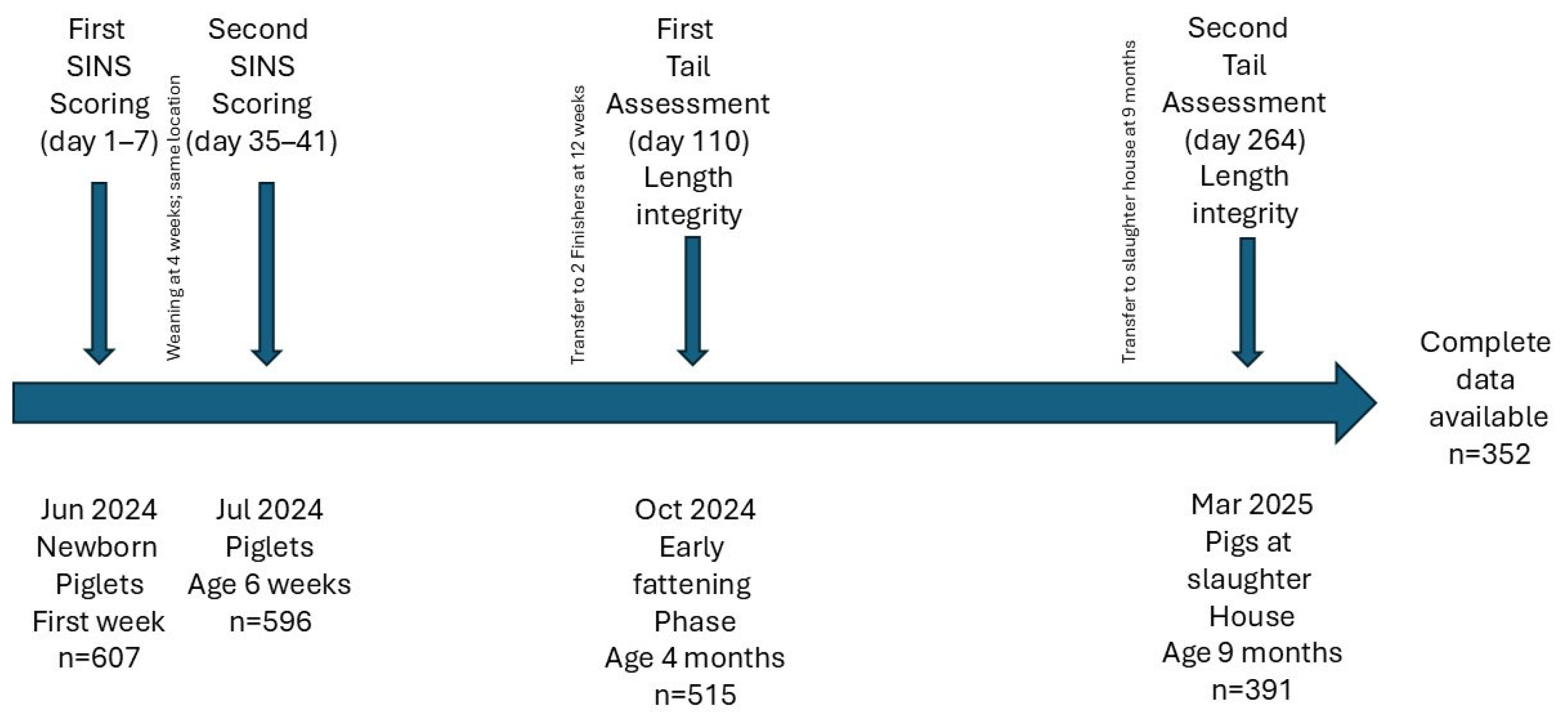
2.1. Study Design
2.2. Farm Characteristics
Finishing Units
2.3. Animal Assessment

| Tail base | Hairless | Less than normal or no hair visible |
| Redness | Redness of the skin is visible | |
| Swelling | Palpable subcutaneous oedema | |
| Exudate | Inflammatory liquid visible at the surface | |
| Necrosis | Necrotic tissue visible at the surface | |
| Bleeding | Blood is visible | |
| Tail tip | Redness | Redness of the skin is visible |
| Swelling | Palpable subcutaneous oedema | |
| Exudate | Inflammatory liquid is visible at the surface | |
| Necrosis | Necrotic tissue is visible at the surface | |
| Bleeding | Blood is visible | |
| Ear basis | Hairless | Less than normal or no hair is visible |
| Redness | Redness of the skin is visible | |
| Exudate | Inflammatory liquid visible at the surface | |
| Ear tip | Redness | Redness of the skin is visible |
| Coronary band | Redness | Redness of the skin is visible |
| Exudate | Inflammatory liquid is visible at the surface | |
| Swelling | Swollen tissue is visible | |
| Subcutaneous bleeding | Blood is visible | |
| Teats | Redness | Redness of the teats is visible |
| Swelling | Swollen tissue is visible | |
| Necrosis | Necrotic teats (black, dry) are visible |
| Score 1 | tail long and intact, with curl, no lesions |
| Score 2 | tail long and intact, but shorter, still with curl, no lesions |
| Score 3 | tail is shorter, no curl, healed, no acute lesions |
| Score 4 | tail long with acute lesion bite wound |
| Score 5 | tail is shorter, with acute lesion bite wound |
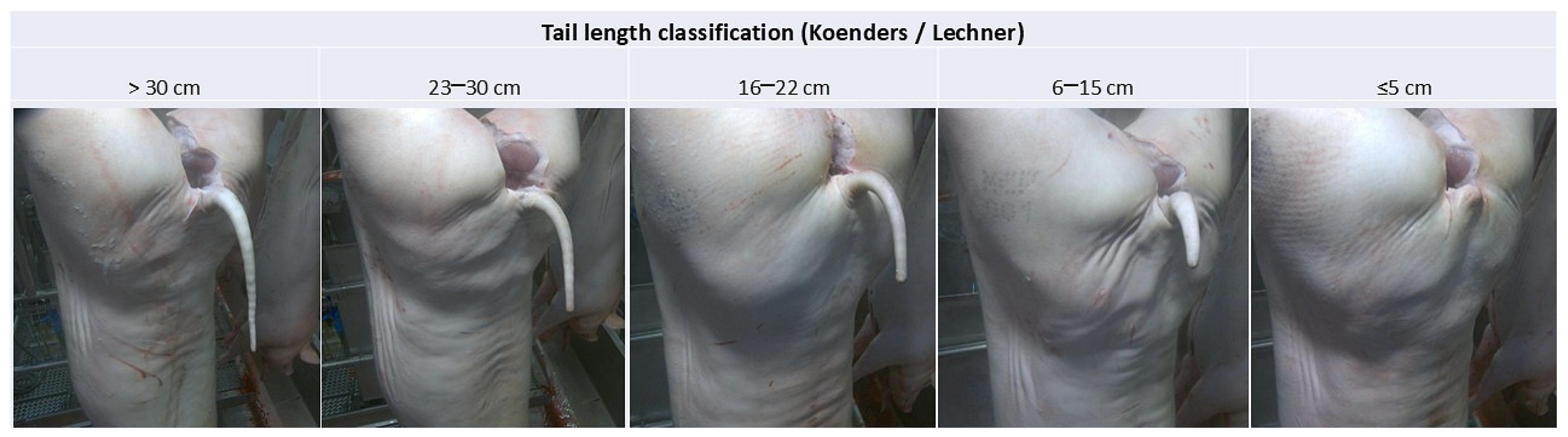
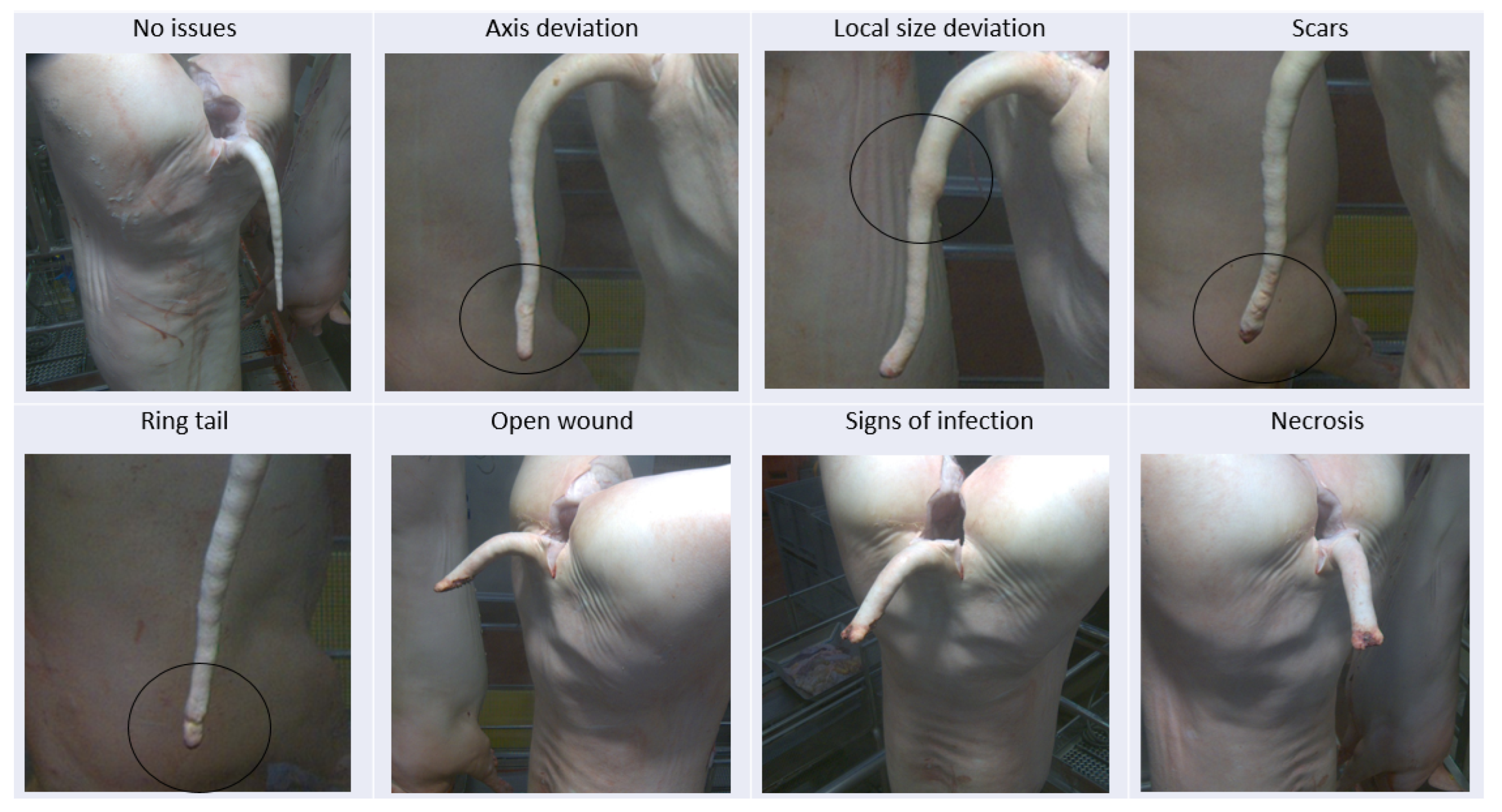
2.4. Tail Assessment at the Slaughterhouse
| Tail Lesion Categorization | Description |
|---|---|
| No issues | |
| Knick/Axis deviation | A deviation from the normal longitudinal shape of the tail: sideways deviation |
| Local size deviation | A deviation from the normal circumference of the tail: local thickening |
| Scars | Visible signs of healing process of the surface of the tail: uneven surface |
| Ring tail | A local constriction of the tail circumference |
| Open wound | Visible signs of lack of skin surface integrity |
| Signs of infection | Visible signs of (chronic) inflammatory reaction of the body such as swollen tissue and granulomatous tissue |
| Necrosis | Visible signs of dead tissue (discoloration, dry and hard tissue) |
2.5. Statistical Analysis
3. Results
3.1. SINS Signs in Suckling Piglets and Weaners
3.2. Tail Scores at Early Fattening Phase
3.3. Association Between SINS in Suckling Piglets and Weaners and Tail Score During Fattening Phase
3.4. Tail Scores at Slaughter
3.5. Association Between SINS Signs in Suckling Piglets and Weaners and Tail Scores at Slaughter
4. Discussion
4.1. SINS Prevalence and Scores
4.2. Tail Length and Integrity
4.3. Farm Effects, Management Factors and Practical Implications
5. Conclusions
Supplementary Materials
Author Contributions
Funding
Institutional Review Board Statement
Informed Consent Statement
Data Availability Statement
Conflicts of Interest
References
- European Union. Council Directive 2008/120/EC laying down minimum standards for the protection of pigs. OJL 2009, 47, 5–13. Available online: http://data.europa.eu/eli/dir/2008/120/oj (accessed on 20 November 2025).
- Wallgren, T.; Lundeheim, N.; Wallenbeck, A.; Westin, R.; Gunnarsson, S. Rearing Pigs with Intact Tails-Experiences and Practical Solutions in Sweden. Animals 2019, 9, 812. [Google Scholar] [CrossRef] [PubMed]
- Gomes, A.; Romeo, C.; Ghidini, S.; Vieira-Pinto, M. The Relationship between Carcass Condemnations and Tail Lesion in Swine Considering Different Production Systems and Tail Lengths. Animals 2022, 12, 949. [Google Scholar] [CrossRef] [PubMed]
- D’Eath, R.B.; Niemi, J.K.; Vosough Ahmadi, B.; Rutherford, K.M.; Ison, S.H.; Turner, S.P.; Anker, H.T.; Jensen, T.; Busch, M.E.; Jensen, K.K.; et al. Why are most EU pigs tail docked? Economic and ethical analysis of four pig housing and management scenarios in the light of EU legislation and animal welfare outcomes. Animal 2016, 10, 687–699. [Google Scholar] [CrossRef]
- EFSA AHAW Panel. Scientific Opinion: Multifactorial approach on the risk factors for tail-biting in pigs and approaches to reduce tail docking. EFSA J. 2014, 12, 3702. [Google Scholar]
- De Briyne, N.; Berg, C.; Blaha, T.; Palzer, A.; Temple, D. Phasing out pig tail docking in the EU—Present state, challenges and possibilities. Porc. Health Manag. 2018, 4, 27. [Google Scholar] [CrossRef]
- Hoste, R.; Hoofs, A.; Benus, M.; Vermeij, I.; van Asseldonk, M.; Verheijen, K. Towards Eliminating Tail Docking of Pigs in the Netherlands: Exploration of Economic Aspects and Opportunities for Implementation (Wageningen Economic Research Report 2023, 061ENG); Wageningen Economic Research: Wageningen, The Netherlands. [CrossRef]
- Scollo, A.; Contiero, B.; Gottardo, F. Frequency of tail lesions and risk factors for tail biting in heavy pig production from weaning to 170 kg live weight. Vet. J. 2016, 207, 92–98. [Google Scholar] [CrossRef]
- Lahrmann, H.P.; Busch, M.E.; D’Eath, R.B.; Forkman, B.; Hansen, C.F. More tail lesions among undocked than tail docked pigs in a con-ventional herd. Animal 2017, 11, 1825–1831. [Google Scholar] [CrossRef] [PubMed]
- Fjetland, O.; Kjastad, H.P. Tail biting in pigs. Nor. Vet. J. 2002, 114, 249–253. [Google Scholar]
- Holmgren, N.; Lundeheim, N. Risk factors for tail biting. In Proceedings of the 18th Congress of the International Pig Veterinary Society (IPVS), Hamburg, Germany, 27 June–1 July 2004; p. 786. [Google Scholar]
- Lundeheim, N.; Holmgren, N. Prevalance of lesions found at slaughter among Swedish fattening pigs. In Proceedings of the 21st International Pig Veterinary Society Congress (IPVS), Vancover, BC, Canada, 18–21 July 2010; p. 925. [Google Scholar]
- Carroll, G.A.; Boyle, L.A.; Teixeira, D.L.; van Staaveren, N.; Hanlon, A.; O’Connell, N.E. Effects of scalding and dehairing of pig carcasses at abattoirs on the visibility of welfare-related lesions. Animal 2016, 10, 460–467. [Google Scholar] [CrossRef] [PubMed]
- Van Staaveren, N.; Teixeira, D.L.; Hanlon, A.; Boyle, L.A. Pig carcass tail lesions: The influence of record keeping through an advisory service and the relationship with farm performance parameters. Animal 2017, 11, 140–146. [Google Scholar] [CrossRef]
- Vom Brocke, A.L.; Karnholz, C.; Madey-Rindermann, D.; Gauly, M.; Leeb, C.; Winckler, C.; Schrader, L.; Dippel, S. Tail lesions in fattening pigs: Relationships with postmortem meat inspection and influence of a tail biting management tool. Animal 2019, 13, 835–844. [Google Scholar] [CrossRef]
- Gerster, U.; Sidler, X.; Wechsler, B.; Nathues, C. Prevalence of tail lesions in Swiss finishing pigs. Schweiz. Arch. Tierheilkd. 2022, 164, 339–349. [Google Scholar] [CrossRef] [PubMed]
- Valros, A.; Ahlström, S.; Rintala, H.; Häkkinen, T.; Saloniemi, H. The prevalence of tail damage in slaughter pigs in Finland and associations to carcass condemnations. Acta Agric. Scand. Sect. A—Anim. Sci. 2004, 54, 213–219. [Google Scholar] [CrossRef]
- Heinonen, M.; Välimäki, E.; Laakkonen, A.M.; Toppari, I.; Vugts, J.; Fàbrega, E.; Valros, A. Evaluation of Tail Lesions of Finishing Pigs at the Slaughterhouse: Associations With Herd-Level Observations. Front. Vet. Sci. 2021, 8, 650590. [Google Scholar] [CrossRef] [PubMed]
- Valros, A. Review: The tale of the Finnish pig tail—How to manage non-docked pigs? Animal 2022, 16, 100353. [Google Scholar] [CrossRef]
- Harley, S.; More, S.J.; O’Connell, N.E.; Hanlon, A.; Teixeira, D.; Boyle, L. Evaluating the prevalence of tail biting and carcase condemnations in slaughter pigs in the Republic and Northern Ireland, and the potential of abattoir meat inspection as a welfare surveillance tool. Vet. Rec. 2012, 171, 621. [Google Scholar] [CrossRef]
- Teixeira, D.L.; Harley, S.; Hanlon, A.; O’Connell, N.E.; More, S.J.; Manzanilla, E.G.; Boyle, L.A. Study on the Association between Tail Lesion Score, Cold Carcass Weight, and Viscera Condemnations in Slaughter Pigs. Front. Vet. Sci. 2016, 3, 24. [Google Scholar] [CrossRef]
- Kongsted, H.; Foldager, L.; Sørensen, J.T. Data from routine meat inspection is a poor indicator of the prevalence of tail lesions in undocked pigs. Porc. Health Managem. 2020, 6, 10. [Google Scholar] [CrossRef]
- Reiner, G.; Kuehling, J.; Loewenstein, F.; Lechner, M.; Becker, S. Swine Inflammation and Necrosis Syndrome (SINS). Animals 2021, 11, 1670. [Google Scholar] [CrossRef]
- Kuehling, J.; Loewenstein, F.; Wenisch, S.; Kressin, M.; Herden, C.; Lechner, M.; Reiner, G. An in-depth diagnostic exploration of an inflammation and necrosis syndrome in a population of newborn piglets. Animal 2021, 15, 100078. [Google Scholar] [CrossRef]
- Koenders-van Gog, K.; Wijnands, T.; Lechner, M.; Reiner, G.; Fink-Gremmels, J. Screening of Piglets for Signs of Inflammation and Necrosis as Early Life Indicators of Animal Health and Welfare Hazards. Animals 2025, 15, 378. [Google Scholar] [CrossRef]
- Leite, N.G.; Knol, E.F.; Nuphaus, S.; Vogelzang, R.; Tsuruta, S.; Wittmann, M.; Lourenco, D. The genetic basis of swine inflammation and necrosis syndrome and its genetic association with post-weaning skin damage and production traits. J. Anim. Sci. 2023, 101, skad067. [Google Scholar] [CrossRef]
- Fortune, H.; Micout, S.; Monjouste, A. Évaluation de la prévalence du syndrome inflammatoire et nécrotique porcin dans les troupeaux français. J. Rech. Porc. 2024, 56, 301–302. [Google Scholar]
- Becker, S.; Kochendoerfer, E.; Kuehling, J.; Gerhards, K.; Lechner, M.; Zinner, S.; Lautner, M.; Reiner, G. Breed- and Line-Dependent Severity of Inflammation and Necrosis Syndrome in AI Boars, and the Related Risk of Inflammation and Necrosis in Their Progeny. Vet. Sci. 2025, 12, 967. [Google Scholar] [CrossRef] [PubMed]
- Micout, S.; Fortune, H.; Reiner, G. Prevalence and Consequences of Swine Inflammation and Necrosis Syndrome (SINS) in French Herds. Vet. Sci. 2025, 12, 853. [Google Scholar] [CrossRef]
- Gerhards, K.; Becker, S.; Kuehling, J.; Lechner, M.; Willems, H.; Ringseis, R.; Reiner, G. Screening for transcriptomic associations with Swine Inflammation and Necrosis Syndrome. BMC Vet. Res. 2025, 21, 26. [Google Scholar] [CrossRef]
- Kuehling, J.; Eisenhofer, K.; Lechner, M.; Becker, S.; Willems, H.; Reiner, G. The effects of boar on susceptibility to swine inflammation and necrosis syndrome in piglets. Porc. Health Manag. 2021, 7, 15. [Google Scholar] [CrossRef]
- Gerhards, K.; Becker, S.; Kühling, J.; Mickan, J.; Lechner, M.; Willems, H.; Reiner, G. Fine Mapping Identifies Candidate Genes Associated with Swine Inflammation and Necrosis Syndrome. Vet. Sci. 2025, 12, 508. [Google Scholar] [CrossRef]
- Consorzio del Prosciutto di Parma. Available online: https://www.prosciuttodiparma.com/wp-content/uploads/2025/08/Prosciutto_di_Parma_Specification_17_05_2025.pdf (accessed on 1 December 2025).
- LWK Niedersachsen. Schweine noch Schwerer Mästen? 2025. Available online: https://www.lwk-niedersachsen.de/lwk/news/42451_Schweine_noch_schwerer_maesten (accessed on 14 October 2025).
- Steckbriefe Zur Tierhaltung in Deutschland: Ferkelerzeugung und Schweinemast. Available online: https://www.openagrar.de/receive/openagrar_mods_00085228 (accessed on 2 December 2025).
- Dutch Slaughterhouses Are Slaughtering Fewer Pigs. Available online: https://www.tridge.com/news/dutch-slaughterhouses-are-slaughtering-fewer-hmrpwo? (accessed on 2 December 2025).
- Vinther, J. National Average Productivity of Danish Pig Farms 2022. SEGES No. 2315. 2023. Available online: https://www.landbrugsinfo.dk/-/media/landbrugsinfo/public/5/e/2/notat_2315_average_productivity_danish_pig_farms_2022.pdf (accessed on 14 October 2025).
- Kremer-Rücker, P.V.; Abel, K.M.; Lorenz, L.M.; Schmidt, C.; Lechner, M.; Schubert, K.F.; Köhler, A.A.; Meier, S.; Scholz, A.M. A pilot study: Tail tip lesions in dairy cows—An unnoticed animal welfare issue? Arch. Anim. Breed. 2024, 67, 271–284. [Google Scholar] [CrossRef]
- Recordati, C.; Basta, S.M.; Benedetti, L.; Baldin, F.; Capillo, M.; Scanziani, E.; Gobbi, A. Pathologic and Environmental Studies Provide New Pathogenetic Insights Into Ringtail of Laboratory Mice. Vet. Pathol. 2015, 52, 700–711. [Google Scholar] [CrossRef]
- Alban, L.; Petersen, J.V.; Busch, M.E. A comparison between lesions found during meat inspection of finishing pigs raised under organic/free-range conditions and conventional, indoor conditions. Porc. Health Manag. 2015, 1, 4. [Google Scholar] [CrossRef]
- Schrøder-Petersen, D.L.; Simonsen, H.B. Tail biting in pigs. Vet. J. 2001, 162, 196–210. [Google Scholar] [CrossRef]
- EFSA. Scientific Opinion of the Panel on Animal Health and Welfare on a request from Commission on the risks associated with tail biting in pigs and possible means to reduce the need for tail docking considering the different housing and husbandry systems. EFSA J. 2007, 5, 611. [Google Scholar] [CrossRef]
- Taylor, N.R.; Main, D.C.; Mendl, M.; Edwards, S.A. Tail-biting: A new perspective. Vet. J. 2010, 186, 137–147. [Google Scholar] [CrossRef]
- Zonderland, J.J.; Schepers, F.; Bracke, M.B.; den Hartog, L.A.; Kemp, B.; Spoolder, H.A. Characteristics of biter and victim piglets apparent before a tail-biting outbreak. Animal 2011, 5, 767–775. [Google Scholar] [CrossRef] [PubMed]
- Chou, J.Y.; Sandercock, D.A.; D’Eath, R.B.; O’Driscoll, K. A High Enrichment Replenishment Rate Reduces Damaging Behaviors and Increases Growth Rate in Undocked Pigs Kept in Fully Slatted Pens. Front. Vet. Sci. 2020, 7, 584706. [Google Scholar] [CrossRef] [PubMed]
- Bagaria, M.; Kuiper, L.; Meijer, E.; Sterck, E.H.M. Individual behavioral correlates of tail biting in prefinishing piglets. Front. Vet. Sci. 2022, 9, 1033463. [Google Scholar] [CrossRef]
- Valros, A.; Munsterhjelm, C.; Puolanne, E.; Ruusunen, M.; Heinonen, M.; Peltoniemi, O.A.; Pösö, A.R. Physiological indicators of stress and meat and carcass characteristics in tail bitten slaughter pigs. Acta Vet. Scand. 2013, 55, 75. [Google Scholar] [CrossRef]
- Viitasaari, E.; Raekallio, M.; Valros, A.; Peltoniemi, O.; Hänninen, L.; Heinonen, M. The effect of ketoprofen on feeding be-havior of tail-bitten pigs. Porc. Health Manag. 2015, 1, 11. [Google Scholar] [CrossRef]
- Di Giminiani, P.; Edwards, S.A.; Malcolm, E.M.; Leach, M.C.; Herskin, M.S.; Sandercock, D.A. Characterization of short- and long-term mechanical sensitisation following surgical tail amputation in pigs. Sci. Rep. 2017, 7, 4827. [Google Scholar] [CrossRef] [PubMed]
- Sandercock, D.A.; Barnett, M.W.; Coe, J.E.; Downing, A.C.; Nirmal, A.J.; Di Giminiani, P.; Edwards, S.A.; Freeman, T.C. Transcriptomics analysis of porcine caudal dorsal root ganglia in tail amputated pigs shows long-term effects on many pain-associated genes. Front. Vet. Sci. 2019, 6, 314. [Google Scholar] [CrossRef] [PubMed]
- Valros, A.; Välimäki, E.; Nordgren, H.; Vugts, J.; Fàbrega, E.; Heinonen, M. Intact Tails as a Welfare Indicator in Finishing Pigs? Scoring of Tail Lesions and Defining Intact Tails in Undocked Pigs at the Abattoir. Front. Vet. Sci. 2020, 7, 405. [Google Scholar] [CrossRef]
- Munsterhjelm, C.; Simola, O.; Keeling, L.; Valros, A.; Heinonen, M. Health parameters in tail biters and bitten pigs in a case-control study. Animal 2013, 7, 814–821. [Google Scholar] [CrossRef]
- Reiner, G.; Kuehling, J.; Lechner, M.; Schrade, H.J.; Saltzmann, J.; Muelling, C.; Daenicke, S.; Loewenstein, F. Swine Inflammation and Necrosis Syndrome is influenced by husbandry and quality of sow in suckling piglets, weaners and fattening pigs. Porc. Health Manag. 2020, 6, 32. [Google Scholar] [CrossRef] [PubMed]


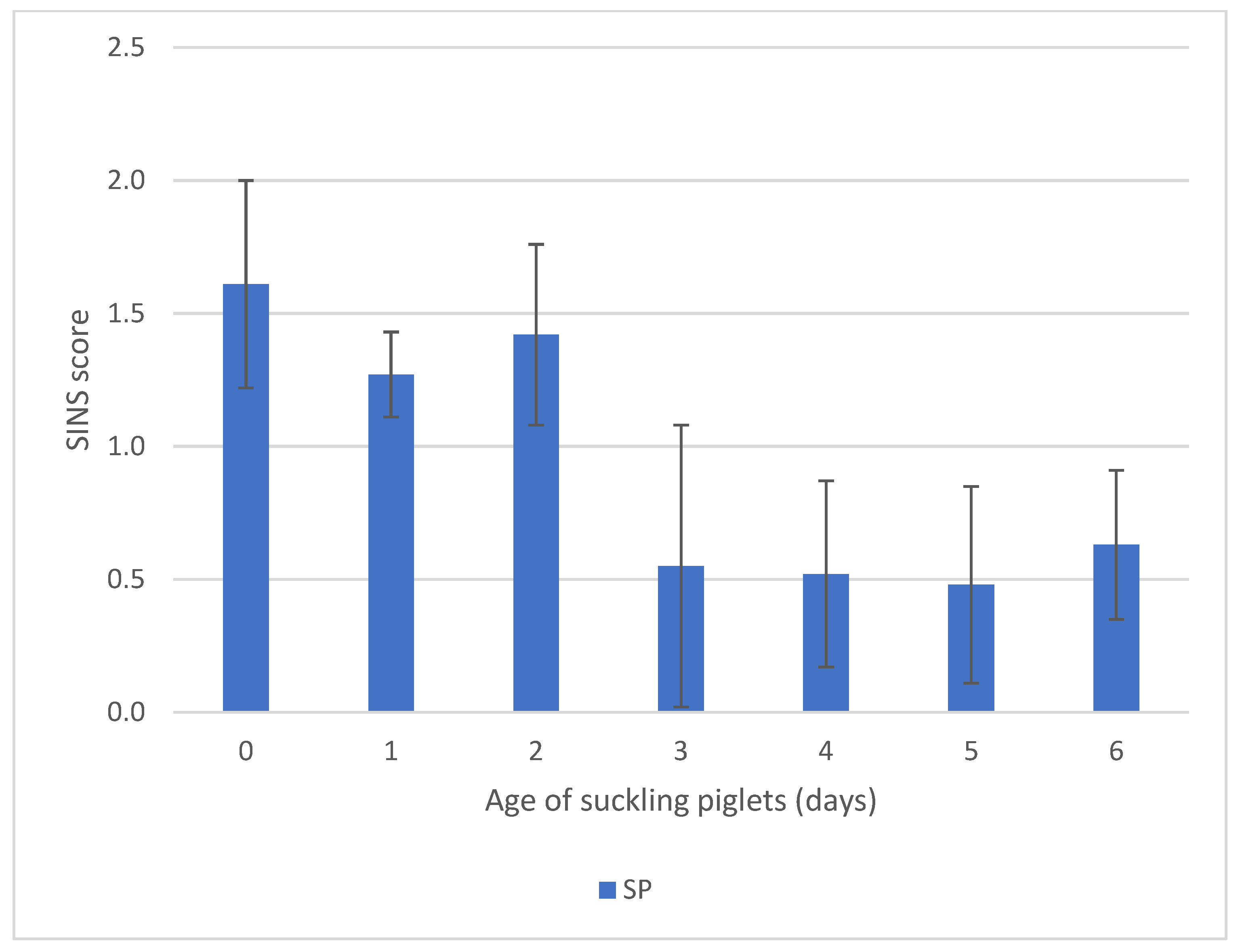
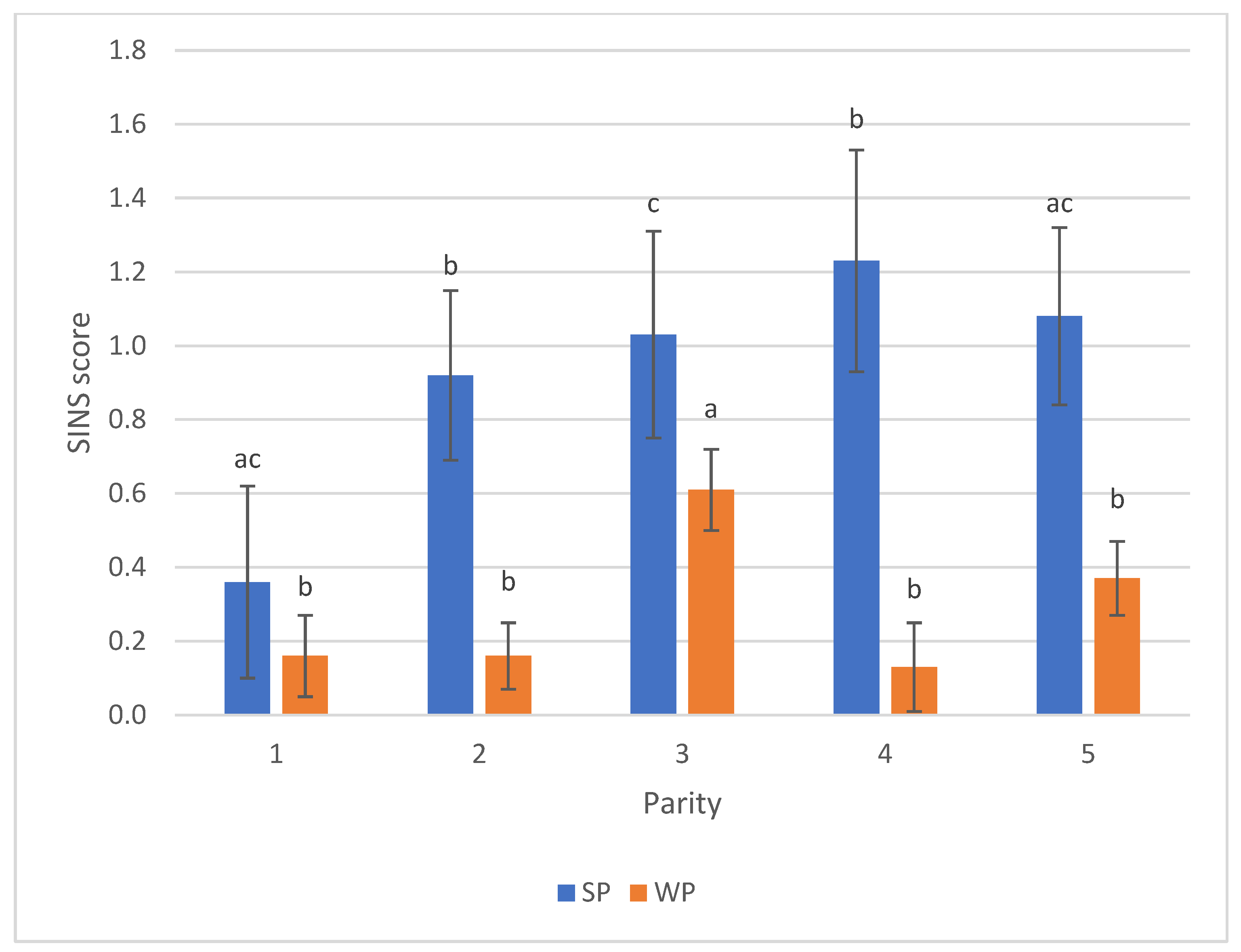
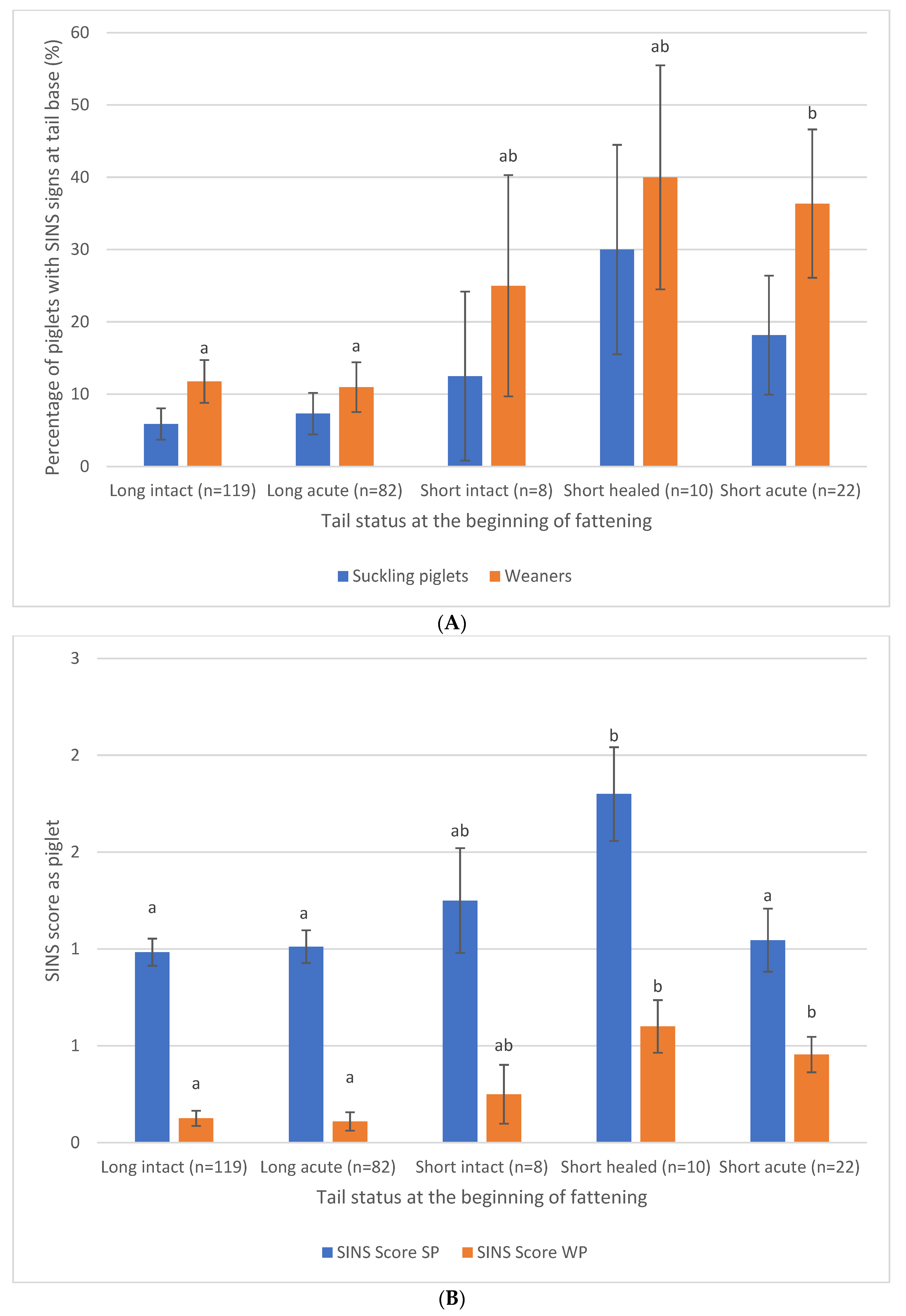
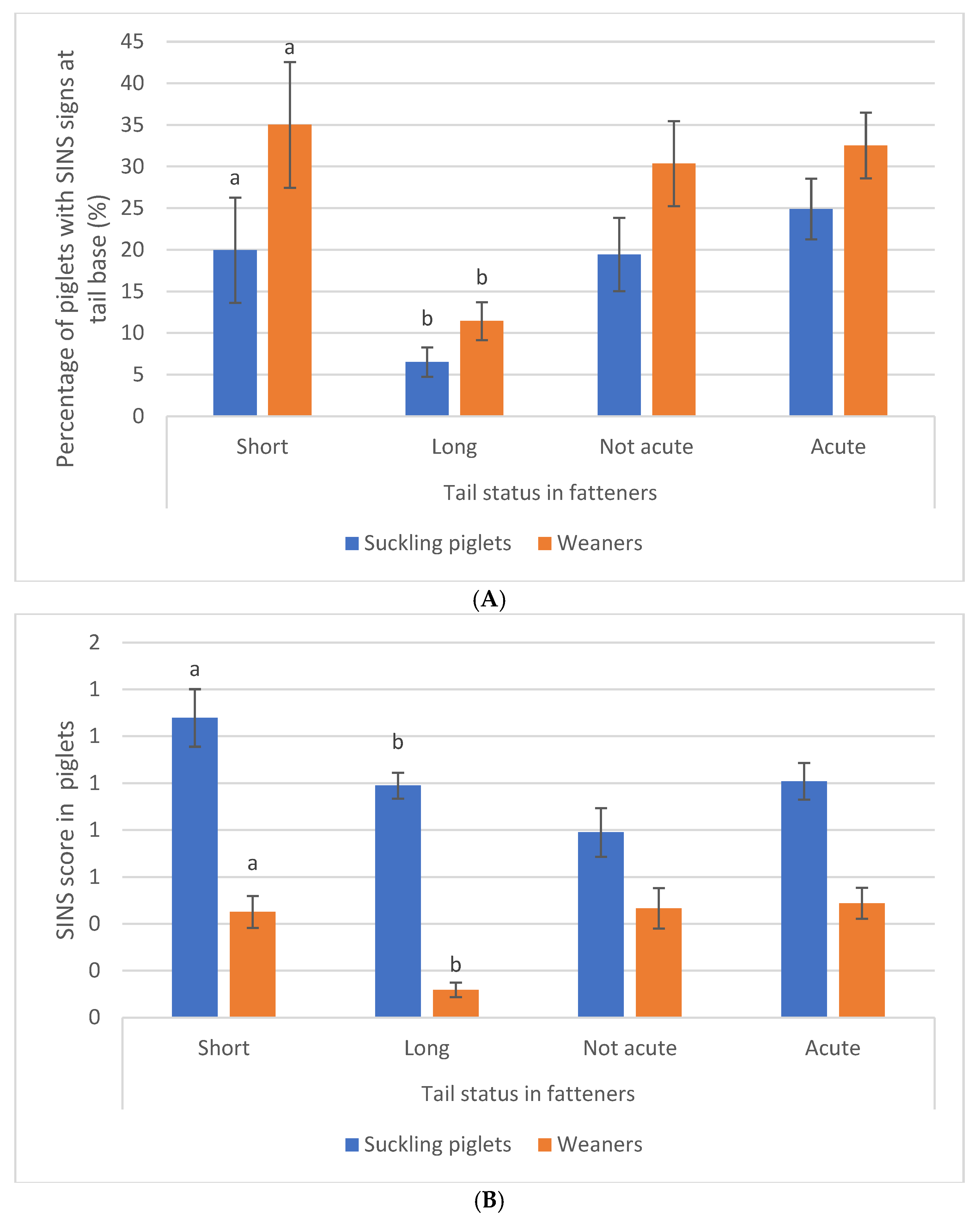
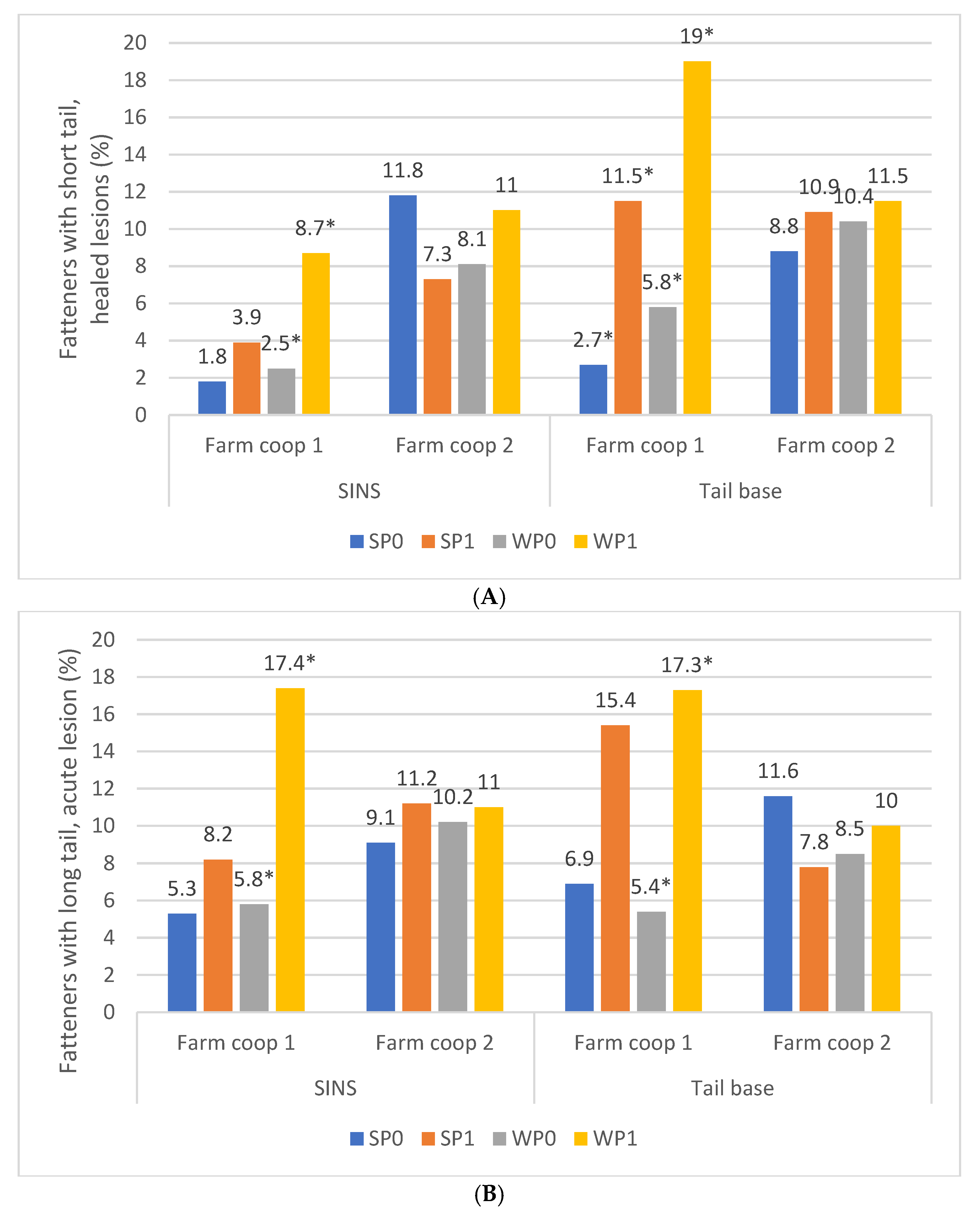
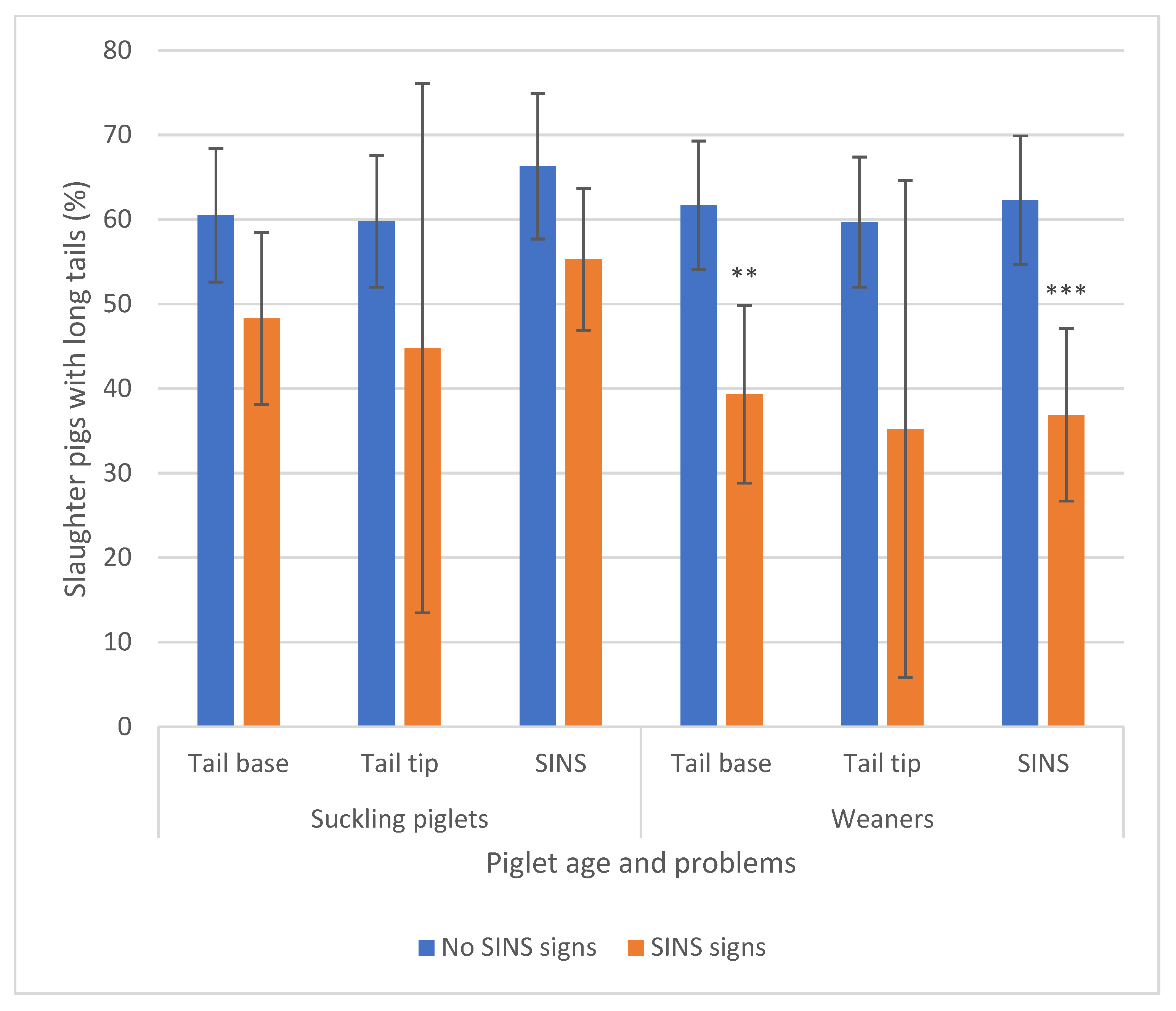
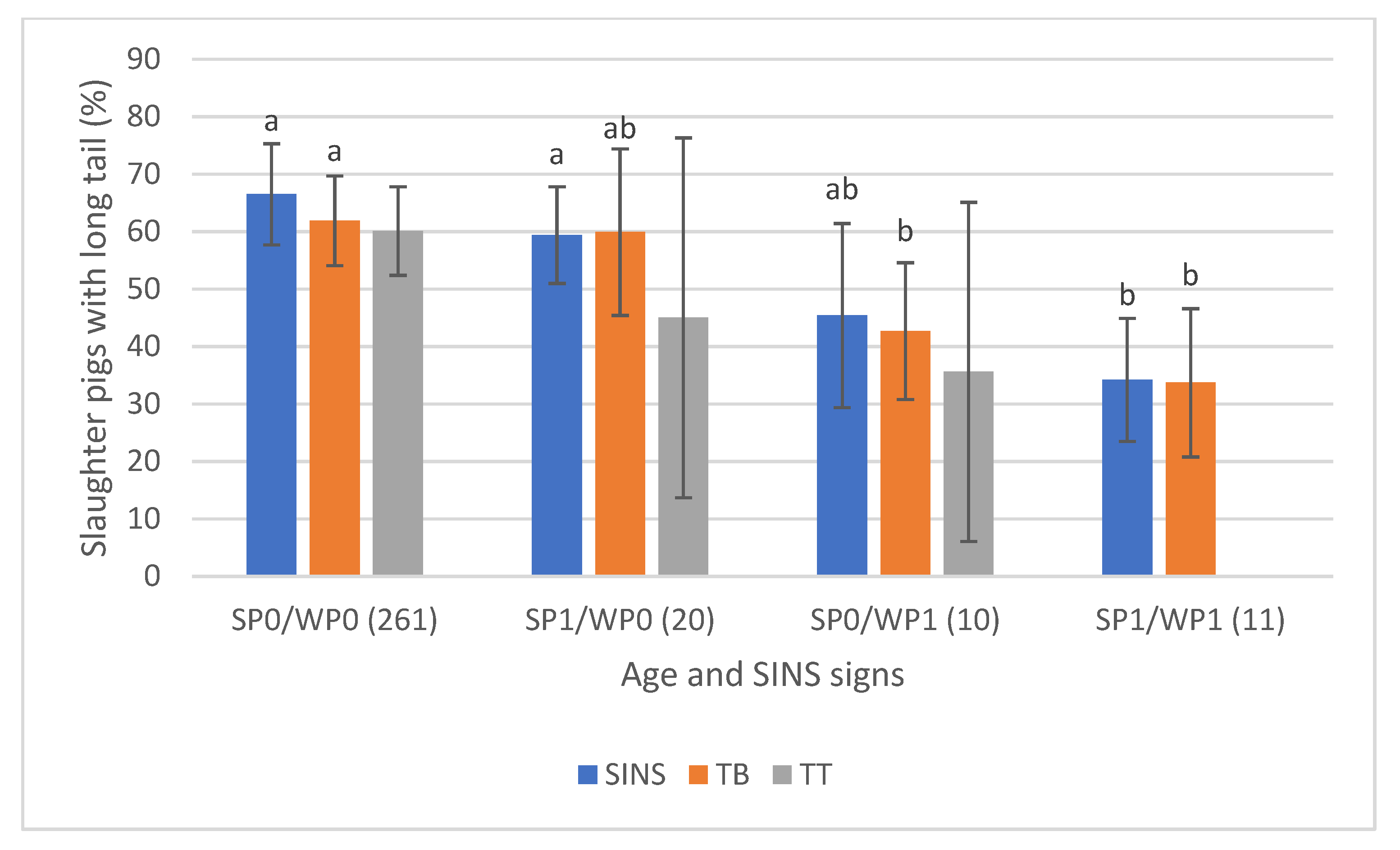
| Suckling Piglets | Weaners | ||
|---|---|---|---|
| Tail base | No bristles | 15.0 | 20.5 |
| Redness | 1.3 | 4.9 | |
| Swelling | 1.3 | 1.2 | |
| Exudation | 0.5 | 0.3 | |
| Necrosis | 0.0 | 0.2 | |
| Bleeding | 0.0 | 0.3 | |
| Tail tip | No bristles | 0.3 | 0.0 |
| Redness | 1.3 | 1.0 | |
| Swelling | 0.5 | 0.0 | |
| Exudation | 0.8 | 0.0 | |
| Necrosis | 0.5 | 0.2 | |
| Bleeding | 0.0 | 0.2 | |
| Ear base | No bristles | 0.5 | 0.0 |
| Redness | 1.0 | 0.0 | |
| Exudation | 1.2 | 8.4 | |
| Ear tip | Redness | 0.5 | 0.0 |
| Teats | Redness | 4.9 | 0.0 |
| Swelling | 0.7 | 0.0 | |
| Necrosis | 7.9 | 0.2 | |
| Coronary bands | Redness | 4.4 | 0.0 |
| Exudation | 58.0 | 0.0 | |
| Heels | Swelling | 1.8 | 0.0 |
| Redness | 16.1 | 0.0 |
| Suckling Piglets | Weaners | |
|---|---|---|
| Tail base | 16.64 | 21.81 |
| Tail tip | 1.81 | 1.17 |
| Ears | 2.8 | 8.39 |
| Teats | 12.85 | 0.17 |
| Coronary bands | 61.78 | 0 |
| Heels | 17.63 | 0 |
| SINS | 72.14 | 29.1 |
| Farm Coop (Sow and Nursery) | Sex | |||||||
|---|---|---|---|---|---|---|---|---|
| Total | F1 (n = 285) | F2 (n = 280) | p | Male (n = 283) | Female (n = 282) | p | ||
| Suckling piglets | Tail base | 0.12 ± 0.07 | 0.23 ± 0.07 | 0.08 ± 0.10 | n.s. | 0.11 ± 0.07 | 0.13 ± 0.07 | n.s. |
| Tail tip | 0.04 ± 0.03 | 0.02 ± 0.03 | 0.06 ± 0.04 | n.s. | 0.05 ± 0.03 | 0.03 ± 0.03 | n.s. | |
| Ear | 0.05 ± 0.02 | 0.04 ± 0.02 | 0.05 ± 0.03 | n.s. | 0.05 ± 0.02 | 0.05 ± 0.02 | n.s. | |
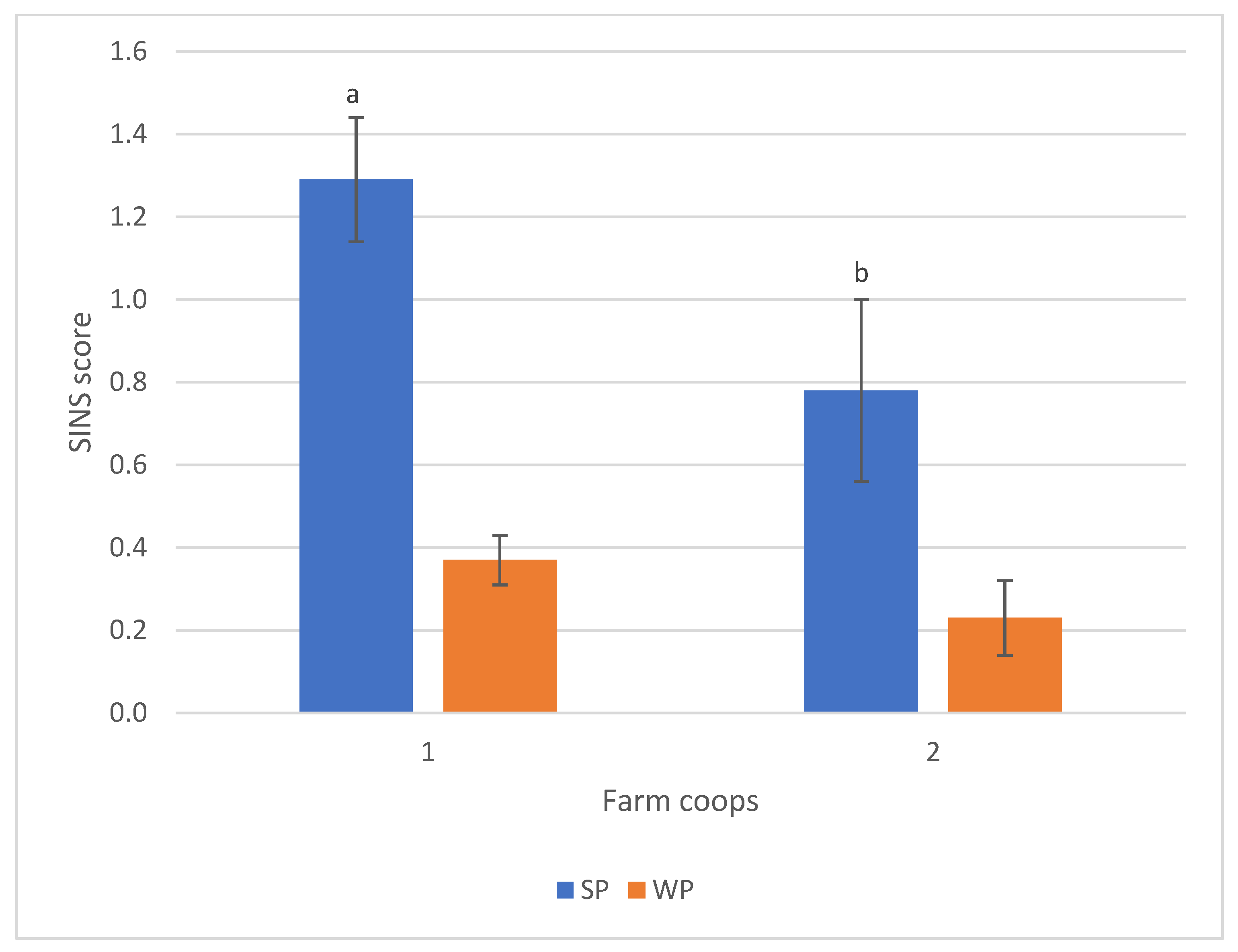
| Coronary bands | 0.63 ± 0.08 | 0.81 ± 0.07 a | 0.54 ± 0.11 b | 0.04 | 0.64 ± 0.08 | 0.61 ± 0.08 | n.s. | |
| Heels | 0.23 ± 0.05 | 0.16 ± 0.05 | 0.28 ± 0.08 | n.s. | 0.23 ± 0.06 | 0.24 ± 0.06 | n.s. | |
| Teats | 0.09 ± 0.07 | 0.19 ± 0.07 | 0.04 ± 0.10 | n.s. | 0.03 ± 0.07 | 0.14 ± 0.07 | <0.001 | |
| Weaners | Tail base | 0.24 ± 0.07 | 0.39 ± 0.06 | 0.19 ± 0.10 | n.s. | 0.24 ± 0.07 | 0.24 ± 0.07 | n.s. |
| Tail tip | 0.02 ± 0.01 | 0.01 ± 0.01 | 0.02 ± 0.02 | n.s. | 0.02 ± 0.02 | 0.02 ± 0.02 | n.s. | |
| Ear | 0.10 ± 0.04 | 0.01 ± 0.04 a | 0.14 ± 0.06 ab | n.s. | 0.08 ± 0.04 | 0.13 ± 0.04 | 0.015 | |
| Coronary bands | Not detected | |||||||
| Heels | Not detected | |||||||
| Teats | 0 ± 0 | 0 ± 0 | 0 ± 0.01 | n.s. | 0 ± 0 | 0.01 ± 0 | n.s. | |
| Farm Coop (Farrowing and Nursery/Finisher) | |||||
|---|---|---|---|---|---|
| Total | 1/1 (n = 289) | 2/2 (n = 192) | 2/3 (n = 96) | p | |
| Tail long intact | 44.8 ± 2.5 | 49.4 ± 3.2 a | 39.3 ± 4.1 b | 41.4 ± 5.3 ab | n.s. |
| Tail shorter, no lesions | 7.6 ± 1.4 | 3.3 ± 1.2 a | 7.6 ± 2.2 a | 19.5 ± 4.3 b | <0.001 |
| Tail shorter, healed lesions | 7.6 ± 1.3 | 4.1 ± 1.3 a | 9.0 ± 2.4 ab | 14.9 ± 3.8 b | 0.006. |
| Tail longer, acute lesions | 29.0 ± 2.4 | 34.0 ± 1.2 a | 29.4 ± 3.8 a | 14.9 ± 3.8 b | 0.005 |
| Tail short, acute lesions | 11.0 ± 1.6 | 9.1 ± 3.2 | 15.2 ± 3.0 | 9.2 ± 3.1 | n.s. |
| Farm Coop (Farrowing and Nursery/Finisher) | |||||
|---|---|---|---|---|---|
| Total | 1/1 (n = 208) | 2/2 (n = 61) | 2/3 (n = 94) | p | |
| No issue | 25.89 ± 6.48 | 56.37 ± 7.34 a | 7.21 ± 4.47 b | 29.8 ± 9.77 c | <0.001 |
| Kinks | 5.45 ± 2.89 | 7.58 ± 3.77 | 4.19 ± 3.57 | 5.07 ± 3.85 | n.s. |
| Size deviation | 6.54 ± 4.06 | 5.62 ± 3.19 | 5.15 ± 5.63 | 9.58 ± 9.07 | n.s. |
| Healed scars | 72.83 ± 7.13 | 39.37 ± 7.65 a | 92.68 ± 4.68 b | 70.07 ± 10.47 c | <0.001 |
| Ring formation | 4.24 ± 2.61 | 3.14 ± 1.85 | 6.76 ± 6.1 | 3.57 ± 3.28 | n.s. |
| Wounds | 3.65 ± 2.6 | 3.69 ± 2.45 | 3.59 ± 4.49 | 3.69 ± 4.15 | n.s. |
| Infection | 3.31 ± 2.42 | 3.32 ± 2.27 | 3.31 ± 4.18 | 3.3 ± 3.77 | n.s. |
| Necrosis | 3.31 ± 2.42 | 3.32 ± 2.27 | 3.31 ± 4.18 | 3.3 ± 3.77 | n.s. |
| Farm Coop (Farrowing and Nursery/Finisher) | |||||
|---|---|---|---|---|---|
| Total | 1/1 (n = 208) | 2/2 (n = 61) | 2/3 (n = 94) | p | |
| >30 cm (n = 112) | 10.86 ± 4.79 | 37.46 ± 9.01 a | 1.85 ± 2.06 b | 13.79 ± 6.78 b | <0.001 |
| 23–30 cm (n = 141) | 35.51 ± 6.37 | 41.44 ± 6.27 ab | 21.48 ± 8.36 a | 46.31 ± 10.3 b | 0.005 |
| 16–22 cm (n = 126) | 36.79 ± 7.17 | 16.78 ± 4.47 b | 62.64 ± 11.69 a | 35.5 ± 10.49 b | <0.001 |
| 6–15 cm (n = 12) | 5.91 ± 3.84 | 3.5 ± 2.15 | 11.63 ± 11.15 | 4.93 ± 5.19 | n.s. |
| <6 cm (n = 2) | 1.96 ± 1.54 | 2.49 ± 1.81 | 2.2 ± 2.7 | missing | n.s. |
| Tail Status | Tail Status as Fattener | ||||||
|---|---|---|---|---|---|---|---|
| At Slaughter | Average n = 241 | Long Intact n = 119 | Short Intact n = 8 | Short Healed n = 10 | Long Acute n = 82 | Short Acute n = 22 | p |
| Tail >23 cm | 68.6 ± 5.8 | 95.2 ± 2.1 a 1 | 57.1 ± 18.7 bc | 37.5 ± 17.1 b | 86.2 ± 4.3 c | 33.3 ± 13.6 b | <0.001 |
| Tail >30 cm | 0.4 ± 0.3 | 69.5 ± 4.5 a | 0.0 ± 0.0 bc | 12.5 ± 11.7 bc | 26.2 ± 5.5 c | 8.3 ± 8.0 b | <0.001 |
| Tail 16–23 cm | 27.7 ± 5.5 | 3.8 ± 1.9 a | 42.9 ± 18.7 bc | 50 ± 17.7 bc | 12.3 ± 4.1 c | 66.7 ± 13.6 b | <0.001 |
| Tail 6–15 cm | 0 ± 0.3 | 0 ± 0 | 0 ± 0 | 12.5 ± 11.7 | 3.1 ± 2.1 | 0 ± 0 | n.s |
| Tail < 6 cm | 0 ± 0 | 1 ± 0.9 | 0 ± 0 | 0 ± 0 | 0 ± 0 | 0 ± 0 | n.s |
| No issue | 46.5 ± 7.8 | 76.2 ± 4.2 a | 71.4 ± 17.1 a | 62.5 ± 17.1 a | 29.2 ± 5.6 b | 8.3 ± 8.0 b | <0.001 |
| Healed scars | 50 ± 7.9 | 15.2 ± 3.5 a | 28.6 ± 17.1 a | 37.5 ± 17.1 a | 67.7 ± 5.8 b | 91.7 ± 8 b | <0.001 |
| Kinks | 0.1 ± 0.9 | 4.8 ± 2.1 | 0 ± 0 | 12.5 ± 11.7 | 6.2 ± 3 | 8.3 ± 8 | n.s |
| Size deviation | 0 ± 0.4 | 5.7 ± 2.3 a | 0 ± 0 b | 0 ± 0 b | 4.6 ± 2.6 | 0 ± 0 b | 0.050 |
| Ringtail | 0.1 ± 0.6 | 1 ± 0.9 | 14.3 ± 13.2 | 25 ± 15.3 | 3.1 ± 2.1 | 0 ± 0 | n.s |
| wounds | 0 ± 0 | 1 ± 0.9 | 0 ± 0 | 0 ± 0 | 1.5 ± 1.5 | 0 ± 0 | n.s |
| infection | 0 ± 0 | 0 ± 0 | 0 ± 0 | 0 ± 0 | 1.5 ± 1.5 | 0 ± 0 | n.s |
| Necrosis | 0 ± 0 | 0 ± 0 | 0 ± 0 | 0 ± 0 | 1.5 ± 1.5 | 0 ± 0 | n.s |
| Tail Status at Fattening | ||||||
|---|---|---|---|---|---|---|
| Tail at Slaughter | Shorter | Longer | Not Acute | Acute | ||
| Tail >23 cm | 38.9 ± 9.6 | 91.6 ± 2.2 | <0.001 | 81.0 ± 5.1 | 62.0 ± 8.1 | 0.04 |
| >30 cm | 5.1 ± 3.7 | 47.6 ± 4.4 | <0.001 | 2.5 ± 1.9 | 8.9 ± 3.4 | <0.001 |
| 23–30 cm | 33.5 ± 9.5 | 42.1 ± 4 | n.s. | 39.1 ± 6.9 | 26.4 ± 4.7 | <0.001 |
| 16–22 cm | 57.5 ± 9.9 | 7.1 ± 2 | <0.001 | 49.8 ± 7 | 56.8 ± 5.3 | 0.029 |
| 6–15 cm | 3.4 ± 3.5 | 1.2 ± 0.8 | n.s. | 8 ± 3.9 | 4.2 ± 2.1 | n.s. |
| <6 cm | 0 ± 0 | 0 ± 0.6 | n.s. | 0 ± 0 | 0 ± 1.1 | n.s. |
| No issues | 34.8 ± 10.1 | 53.2 ± 4.5 | <0.001 | 18.2 ± 5.4 | 16 ± 4 | n.s. |
| Kinks | 7.5 ± 5.1 | 5.4 ± 1.8 | n.s. | 11.9 ± 4.6 | 4.5 ± 2.2 | n.s. |
| Local size deviation | 0 ± 0 | 5.1 ± 1.8 | 0.004 | 9.4 ± 4.1 | 3.4 ± 1.9 | 0.004 |
| Healed scars | 67 ± 10.3 | 38 ± 4.5 | 0.01 | 24.0 ±5.2 | 79.8 ± 5.3 | <0.001 |
| Ringtail | 10.8 ± 6 | 1.7 ± 1 | 0.021 | 4 ± 2.8 | 3.2 ± 1.9 | n.s. |
| Open wound | 0 ± 0 | 0 ± 0 | n.s. | 0 ± 0 | 0 ± 0 | n.s. |
| infection | 0 ± 0 | 0 ± 0 | n.s. | 0 ± 0 | 0 ± 0 | n.s. |
| Necrosis | 0 ± 0 | 0 ± 0 | n.s. | 0 ± 0 | 0 ± 0 | n.s. |
Disclaimer/Publisher’s Note: The statements, opinions and data contained in all publications are solely those of the individual author(s) and contributor(s) and not of MDPI and/or the editor(s). MDPI and/or the editor(s) disclaim responsibility for any injury to people or property resulting from any ideas, methods, instructions or products referred to in the content. |
© 2025 by the authors. Licensee MDPI, Basel, Switzerland. This article is an open access article distributed under the terms and conditions of the Creative Commons Attribution (CC BY) license.
Share and Cite
Koenders-van Gog, K.; Wijnands, T.; Lechner, M.; Reiner, G. Longitudinal Study: Swine Inflammation and Necrosis Syndrome in Suckling and Weaned Piglets Is Associated with Tail Length and Integrity in Slaughter Pigs. Animals 2026, 16, 56. https://doi.org/10.3390/ani16010056
Koenders-van Gog K, Wijnands T, Lechner M, Reiner G. Longitudinal Study: Swine Inflammation and Necrosis Syndrome in Suckling and Weaned Piglets Is Associated with Tail Length and Integrity in Slaughter Pigs. Animals. 2026; 16(1):56. https://doi.org/10.3390/ani16010056
Chicago/Turabian StyleKoenders-van Gog, Karien, Thomas Wijnands, Mirjam Lechner, and Gerald Reiner. 2026. "Longitudinal Study: Swine Inflammation and Necrosis Syndrome in Suckling and Weaned Piglets Is Associated with Tail Length and Integrity in Slaughter Pigs" Animals 16, no. 1: 56. https://doi.org/10.3390/ani16010056
APA StyleKoenders-van Gog, K., Wijnands, T., Lechner, M., & Reiner, G. (2026). Longitudinal Study: Swine Inflammation and Necrosis Syndrome in Suckling and Weaned Piglets Is Associated with Tail Length and Integrity in Slaughter Pigs. Animals, 16(1), 56. https://doi.org/10.3390/ani16010056