
Trophic Ecology of a Threatened Specialist: Implications of the Dependence on Pappostipa frigida for the Conservation of Chinchilla chinchilla


Simple Summary
Abstract
1. Introduction
2. Materials and Methods
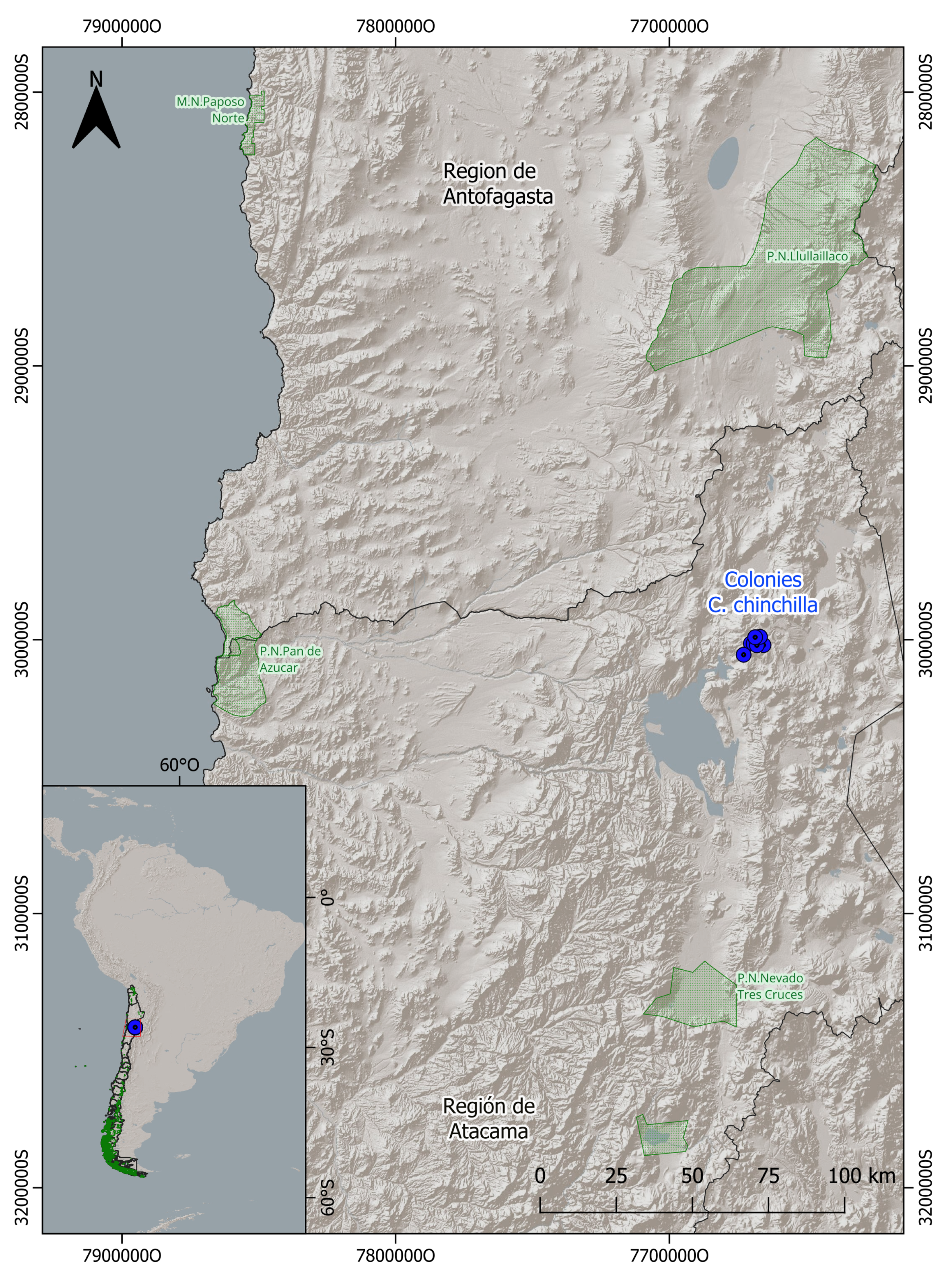
2.1. Study Area
2.2. Trophic Availability and Diet Analysis
2.3. Statistical Analysis
2.3.1. Trophic Niche Breadth and Diversity
2.3.2. Estimation of Seasonal Trophic Overlap
2.3.3. Estimation of Resource Selection
3. Results
3.1. Resource Availability and Vegetation Cover
3.2. Diet Composition and Trophic Diversity
3.3. Seasonal Trophic Overlap
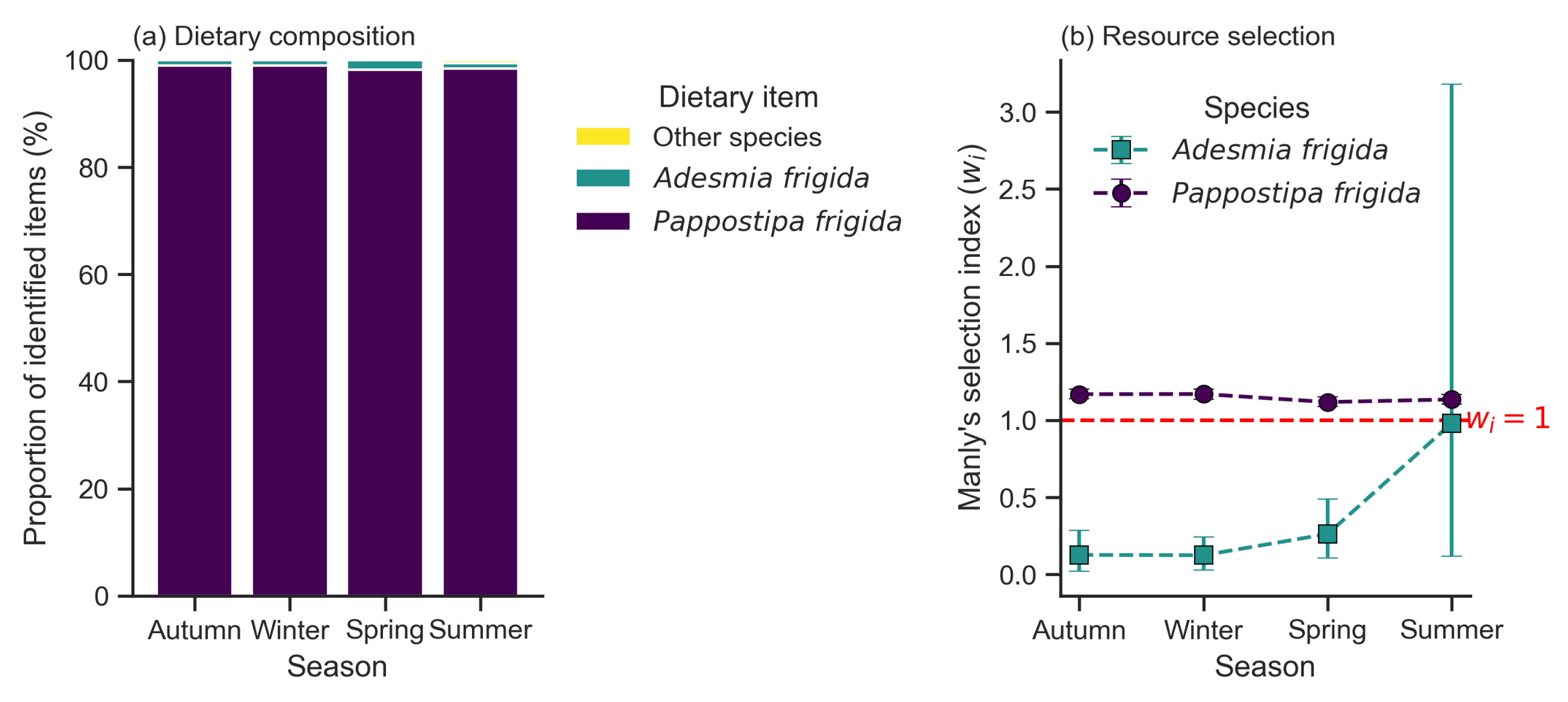
3.4. Resource Selection
4. Discussion
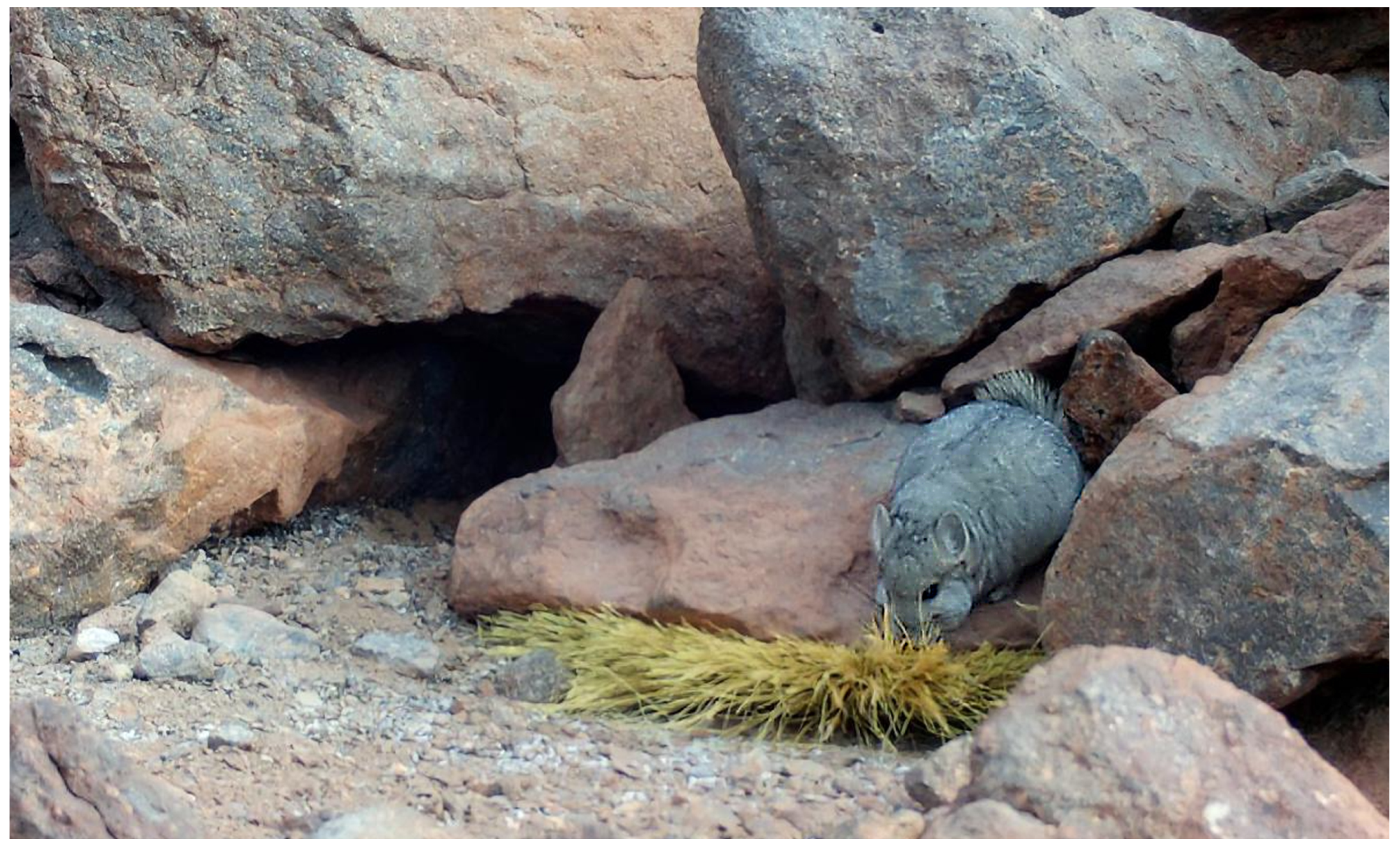
4.1. Trophic Strategy: A Specialist in a Low-Diversity Environment
4.2. Resource Selection and Foraging Strategy
4.3. Trophic Context and Relationships with Other Herbivores
4.4. Global Perspective and Methodological Approach
5. Conclusions
Author Contributions
Funding
Institutional Review Board Statement
Informed Consent Statement
Data Availability Statement
Acknowledgments
Conflicts of Interest
References
- Krebs, C.J. Ecological Methodology, 2nd ed.; Benjamin/Cummings: Menlo Park, CA, USA, 1999. [Google Scholar]
- Gordon, I.J.; Prins, H.H.T. The Ecology of Browsing and Grazing II; Springer Nature: Cham, Switzerland, 2019. [Google Scholar] [CrossRef]
- Facultad de Agronomía y Zootecnia, Universidad Nacional de Tucumán. Hábitos Dietarios de herbíVoros: Parámetros tróFicos, Selectividad y Amplitud del Nicho. Technical Report, Universidad Nacional de Tucumán, 2025. Documento Institucional. Available online: https://faz.unt.edu.ar/idehost/wp-content/uploads/2025/04/SD-92-FAZ-UNT-Habitos-dietariosMarcadores.pdf (accessed on 11 August 2025).
- Borgnia, M.; Vilá, B.L.; Cassini, M.H. Foraging ecology of Vicuña, Vicugna vicugna, in dry Puna of Argentina. Small Rumin. Res. 2010, 88, 44–53. [Google Scholar] [CrossRef]
- Stahl, P.; Mühlenberg, M. Composición botánica de las dietas de alpacas (Lama pacos) y llamas (Lama glama) en pastizales altoandinos de Chile. In Proceedings of the Tropentag 1999: Degradation and Rehabilitation of Agricultural Landscapes, Göttingen, Germany, 14–15 October 1999. [Google Scholar]
- Cortés, A.; Miranda, E.; Jiménez, J.E. Seasonal food habits of the endangered long-tailed chinchilla (Chinchilla lanigera): The effect of precipitation. Mamm. Biol. 2002, 67, 167–175. [Google Scholar] [CrossRef]
- Holechek, J.L. Sample preparation techniques for microhistological analysis. J. Range Manag. 1982, 35, 267–268. [Google Scholar] [CrossRef]
- Castellaro, G.L.; Orellana, C.L.; Escanilla, J.P.; Fuentes-Allende, N.; González, B.A. Preliminary Report on Diet Estimation of Taruka (Hippocamelus antisensis d’Orbigny, 1834) in an Agricultural Area of the Andean Foothills of the Tarapacá Region, Chile. Animals 2024, 14, 1814. [Google Scholar] [CrossRef]
- Puig, S.; Videla, F.; Méndez, E.; Cona, M. Summer and winter diet of the guanaco and food availability for a high Andean migratory population. Mamm. Biol. 2011, 76, 575–582. [Google Scholar] [CrossRef]
- Cortés, A.; Rau, J.R.; Miranda, E.; Jiménez, J.E. Food-habits of Lagidium viscacia and Abrocoma cinerea: Syntopic rodents in high Andean environments of northern Chile. Rev. Chil. Hist. Nat. 2002, 75, 583–593. [Google Scholar]
- Puig, S.; Rosi, M.I.; Videla, F.; Seitz, V.P. Diet selection and habitat use by the mountain vizcacha (Lagidium viscacia) in the Southern Andean Precordillera (Argentina). Mammalia 2020, 84, 323–335. [Google Scholar] [CrossRef]
- Ministerio del Medio Ambiente. Decreto Supremo N°13, Clasifica Especies Según Estado de Conservación, Noveno Proceso; Gobierno de Chile: Santiago, Chile, 2013. [Google Scholar]
- Jiménez, J.E. The extirpation and current status of wild chinchillas Chinchilla lanigera and C. brevicaudata. Biol. Conserv. 1996, 77, 1–6. [Google Scholar] [CrossRef]
- Navarro, S.M.; Barahona, P.P.; Ávila, J.M. Análisis de nuevos registros de la chinchilla de cola corta (Chinchilla chinchilla, Lichtenstein, 1829) en la Región de Atacama, Chile. Boletín Mus. Nac. Hist. Nat. 2019, 68, 57–71. [Google Scholar]
- Valladares, P.; Spotorno, A.; Zuleta, C. Natural history of the Chinchilla genus (Bennett 1829). Considerations of their ecology, taxonomy and conservation status. Gayana 2014, 78, 135–143. [Google Scholar] [CrossRef]
- Tirado, C.; Cortés, A.; Miranda-Urbina, E.; Carretero, M.A. Trophic preference in an assemblage of mammal herbivores from Andean Puna (Northern Chile). J. Arid Environ. 2012, 79, 8–12. [Google Scholar] [CrossRef]
- Cortés, A.; Tirado, C.; Rosenmann, M. Energy metabolism and thermoregulation in Chinchilla brevicaudata. J. Therm. Biol. 2003, 28, 489–495. [Google Scholar] [CrossRef]
- Gajardo, R. La VegetacióN Natural de Chile: Clasificación y DistribucióN GeográFica; Editorial Universitaria: Santiago, Chile, 1994. [Google Scholar]
- Juliá, C.; Montecinos, S.; Maldonado, A. Características Climáticas de la Región de Atacama. In Libro Rojo de la Flora Nativa y de los Sitios Prioritarios Para su Conservación: Región de Atacama; Ediciones Universidad de La Serena: La Serena, Chile, 2008; pp. 25–42. [Google Scholar]
- Chávez, R.O.; Christie, D.A.; Olea, M.; Anderson, T.G. A Multiscale Productivity Assessment of High Andean Peatlands across the Chilean Altiplano Using 31 Years of Landsat Imagery. Remote Sens. 2019, 11, 2955. [Google Scholar] [CrossRef]
- Mueller-Dombois, D.; Ellenberg, H. Aims and Methods of Vegetation Ecology; Wiley: New York, NY, USA, 1974. [Google Scholar]
- Holechek, J.L.; Vavra, M.; Pieper, R.D. Botanical composition determination of range herbivore diets: A review. J. Range Manag. 1982, 35, 309–315. [Google Scholar] [CrossRef]
- Williams, O. A technique for studying microtine food habits. J. Mammal. 1962, 43, 365–368. [Google Scholar] [CrossRef]
- Manly, B.; McDonald, L.; Thomas, D.; McDonald, T.; Erickson, W. Resource Selection by Animals: Statistical Design and Analysis for Field Studies, 2nd ed.; Kluwer Academic Publishers: Dordrecht, The Netherlands, 2002. [Google Scholar]
- Dirección Meteorológica de Chile. Reporte Anual de la Evolución del Clima en Chile 2018; Technical Report; Dirección Meteorológica de Chile: Santiago, Chile, 2018. [Google Scholar]
- Bravo-Naranjo, V.; Zuleta, C. Selección de recursos en colonias de Chinchilla lanigera (Rodentia: Chinchillidae) en la Reserva Nacional Las Chinchillas, Chile. Gayana 2023, 87, 1–11. [Google Scholar] [CrossRef]
- Huarancca, R. Evaluación Fenológica de Especies Forrajeras Altoandinas. Ph.D. Thesis, Universidad Nacional de San Cristóbal de Huamanga, Ayacucho, Peru, 2010. [Google Scholar]
- Morelli, F.; Hanson, J.O.; Benedetti, Y. Human pressures threaten diet-specialized mammal communities. Proc. R. Soc. B 2025, 292, 20241735. [Google Scholar] [CrossRef]
- Alvarez, M.E.; Maria, A.O.; Saad, J.R. Diuretic activity of Fabiana patagonica in rats. Phytother. Res. 2002, 16, 71–73. [Google Scholar] [CrossRef]
- Colles, A.; Liow, L.H.; Prinzing, A. Are specialists at risk under environmental change? Neoecological, paleoecological and phylogenetic approaches. Ecol. Lett. 2009, 12, 849–863. [Google Scholar] [CrossRef]
- Jones, K.E.; Purvis, A.; MacLarnon, A. Dietary specialization and extinction risk in primates: A paleontological perspective. Paleobiology 2009, 35, 371–382. [Google Scholar] [CrossRef]
- Hansson, L. Methods of morphological diet micro-analysis in rodents. Oikos 1970, 21, 255–266. [Google Scholar] [CrossRef]
- Johnson, M.; Wofford, H.; Pearson, H. Microhistological Techniques for Food Habits Analyses; Technical Report; USDA Forest Service: Fort Collins, CO, USA, 1983. [Google Scholar]
- Espunyes, J.; Espunya, C.; Chaves, S.; Calleja, J.A.; Bartolomé, J.; Serrano, E. Comparing the accuracy of PCR-capillary electrophoresis and cuticle microhistological analysis for assessing diet composition in ungulates: A case study with Pyrenean chamois. PLoS ONE 2019, 14, e0216345. [Google Scholar] [CrossRef] [PubMed]
- Li, Z.; Yao, Z.; Zhang, M.; Khattak, R.H.; Han, X.; Sun, J.; Li, Z.; Lang, J.; Chen, C.; Jin, J.; et al. Dietary patterns of water deer recently rediscovered in Northeast China show high similarity to those in other regions. Sci. Rep. 2025, 15, 15285. [Google Scholar] [CrossRef]
- Davidson, A.D.; Hamilton, M.J.; Boyer, A.G.; Brown, J.H.; Ceballos, G. Multiple ecological pathways to extinction in mammals. Proc. Natl. Acad. Sci. USA 2009, 106, 10702–10705. [Google Scholar] [CrossRef]


| Autumn 2017 | Winter 2017 | Spring 2017 | Summer 2018 | |||||
|---|---|---|---|---|---|---|---|---|
| Species | A% | R% | A% | R% | A% | R% | A% | R% |
| SHRUBS | ||||||||
| Baccharis tola | 0.00 | 0.00 | 0.00 | 0.00 | 0.00 | 0.00 | 0.00 | 0.00 |
| Senecio rahmeri | 0.00 | 0.00 | 0.00 | 0.00 | 0.00 | 0.00 | 0.07 | 4.35 |
| Fabiana bryoides | 0.73 | 7.05 | 0.73 | 7.05 | 0.79 | 5.22 | 0.13 | 8.70 |
| Adesmia frigida | 0.86 | 8.33 | 0.86 | 8.33 | 1.06 | 6.96 | 0.00 | 0.00 |
| HERBS | ||||||||
| Menonvillea cuneata | 0.00 | 0.00 | 0.00 | 0.00 | 0.00 | 0.00 | 0.07 | 4.35 |
| Pappostipa frigida | 8.71 | 84.62 | 8.71 | 84.62 | 13.33 | 87.83 | 1.25 | 82.60 |
| Cistanthe minuscula | 0.00 | 0.00 | 0.00 | 0.00 | 0.00 | 0.00 | 0.00 | 0.00 |
| Oxalis pycnophylla | 0.00 | 0.00 | 0.00 | 0.00 | 0.00 | 0.00 | 0.00 | 0.00 |
| Bare Soil | 89.70 | – | 89.70 | – | 84.82 | – | 98.48 | – |
| Autumn 2017 | Winter 2017 | Spring 2017 | Summer 2018 | |||||
|---|---|---|---|---|---|---|---|---|
| Dietary Item | Available % | Used % | Available % | Used % | Available % | Used % | Available % | Used % |
| Pappostipa frigida | 84.62 | 78.37 | 84.62 | 77.66 | 87.83 | 77.58 | 82.60 | 82.36 |
| Adesmia frigida | 8.33 | 0.83 | 8.33 | 0.81 | 6.96 | 1.44 | 0.00 | 0.86 |
| Cistanthe minuscula | 0.00 | 0.00 | 0.00 | 0.00 | 0.00 | 0.00 | 0.00 | 0.40 |
| Baccharis tola | 0.00 | 0.00 | 0.00 | 0.00 | 0.00 | 0.00 | 0.00 | 0.04 |
| Oxalis pycnophylla | 0.00 | 0.00 | 0.00 | 0.00 | 0.00 | 0.00 | 0.00 | 0.04 |
| Fabiana bryoides | 7.05 | 0.00 | 7.05 | 0.00 | 5.22 | 0.00 | 8.70 | 0.00 |
| Senecio rahmeri | 0.00 | 0.00 | 0.00 | 0.00 | 0.00 | 0.00 | 4.35 | 0.00 |
| Menonvillea cuneata | 0.00 | 0.00 | 0.00 | 0.00 | 0.00 | 0.00 | 4.35 | 0.00 |
| Unidentified fibers | – | 20.35 | – | 19.95 | – | 17.90 | – | 16.30 |
| Unrecognized material | – | 0.45 | – | 1.58 | – | 3.08 | – | 0.00 |
| Index and Comparison | Value | 95% CI |
|---|---|---|
| Shannon–Wiener Index () | ||
| H′ Availability | ||
| Autumn 2017 | 0.5353 | (0.4884–0.5777) |
| Winter 2017 | 0.5353 | (0.4882–0.5750) |
| Spring 2017 | 0.4536 | (0.4075–0.4965) |
| Summer 2018 | 0.5970 | (0.5345–0.6522) |
| H′ Diet | ||
| Autumn 2017 | 0.0583 | (0.0223–0.0980) |
| Winter 2017 | 0.0574 | (0.0223–0.0980) |
| Spring 2017 | 0.0909 | (0.0482–0.1347) |
| Summer 2018 | 0.0963 | (0.0438–0.1470) |
| Schoener’s Overlap Index () | ||
| Autumn vs. Winter | 0.9998 | (0.9867–1.0000) |
| Autumn vs. Spring | 0.9923 | (0.9783–1.0000) |
| Autumn vs. Summer | 0.9942 | (0.9800–0.9983) |
| Winter vs. Spring | 0.9921 | (0.9783–1.0000) |
| Winter vs. Summer | 0.9942 | (0.9800–0.9983) |
| Spring vs. Summer | 0.9921 | (0.9767–0.9967) |
| Species | Season | (95% CI) | Selection | ||
|---|---|---|---|---|---|
| Pappostipa frigida | Autumn | 0.9895 | 0.8462 | 1.169 (1.140–1.204) | (+) |
| Winter | 0.9897 | 0.8462 | 1.170 (1.137–1.204) | (+) | |
| Spring | 0.9818 | 0.8783 | 1.118 (1.089–1.150) | (+) | |
| Summer | 0.9840 | 0.8260 | 1.135 (1.104–1.168) | (+) | |
| Adesmia frigida | Autumn | 0.0105 | 0.0833 | 0.126 (0.019–0.285) | (−) |
| Winter | 0.0103 | 0.0833 | 0.124 (0.028–0.243) | (−) | |
| Spring | 0.0182 | 0.0696 | 0.262 (0.106–0.489) | (−) | |
| Summer | 0.0103 | 0.0100 a | 0.981 (0.116–3.179) | (ns) | |
| Fabiana bryoides | Autumn | 0.0000 | 0.0705 | 0.000 | (−) |
| Winter | 0.0000 | 0.0705 | 0.000 | (−) | |
| Spring | 0.0000 | 0.0522 | 0.000 | (−) | |
| Baccharis tola | Summer | 0.0005 | 0.0100 a | 0.048 (0.000–0.433) | (−) |
| Cistanthe minuscula | Summer | 0.0048 | 0.0100 a | 0.457 (0.000–1.718) | (ns) |
| Oxalis pycnophylla | Summer | 0.0005 | 0.0100 a | 0.048 (0.000–0.474) | (−) |
| Menonvillea cuneata | Summer | 0.0000 | 0.0435 | 0.000 | (−) |
| Senecio rahmeri | Summer | 0.0000 | 0.0435 | 0.000 | (−) |
Disclaimer/Publisher’s Note: The statements, opinions and data contained in all publications are solely those of the individual author(s) and contributor(s) and not of MDPI and/or the editor(s). MDPI and/or the editor(s) disclaim responsibility for any injury to people or property resulting from any ideas, methods, instructions or products referred to in the content. |
© 2025 by the authors. Licensee MDPI, Basel, Switzerland. This article is an open access article distributed under the terms and conditions of the Creative Commons Attribution (CC BY) license.
Share and Cite
Castillo, J.P.; Cortés, A.; Novoa, F. Trophic Ecology of a Threatened Specialist: Implications of the Dependence on Pappostipa frigida for the Conservation of Chinchilla chinchilla. Animals 2026, 16, 27. https://doi.org/10.3390/ani16010027
Castillo JP, Cortés A, Novoa F. Trophic Ecology of a Threatened Specialist: Implications of the Dependence on Pappostipa frigida for the Conservation of Chinchilla chinchilla. Animals. 2026; 16(1):27. https://doi.org/10.3390/ani16010027
Chicago/Turabian StyleCastillo, Juan Pablo, Arturo Cortés, and Fernando Novoa. 2026. "Trophic Ecology of a Threatened Specialist: Implications of the Dependence on Pappostipa frigida for the Conservation of Chinchilla chinchilla" Animals 16, no. 1: 27. https://doi.org/10.3390/ani16010027
APA StyleCastillo, J. P., Cortés, A., & Novoa, F. (2026). Trophic Ecology of a Threatened Specialist: Implications of the Dependence on Pappostipa frigida for the Conservation of Chinchilla chinchilla. Animals, 16(1), 27. https://doi.org/10.3390/ani16010027