


The Effect of High-Voltage Power Lines on Magnetic Orientation of Domestic Dogs

 ,
,  , , , , ,
Simple Summary
Abstract
1. Introduction
2. Materials and Methods
2.1. Data Collection
2.2. Statistical Analyses
3. Results
3.1. Differences in Alignment During Geomagnetic Calm and During the Periods of Geomagnetic Disturbances
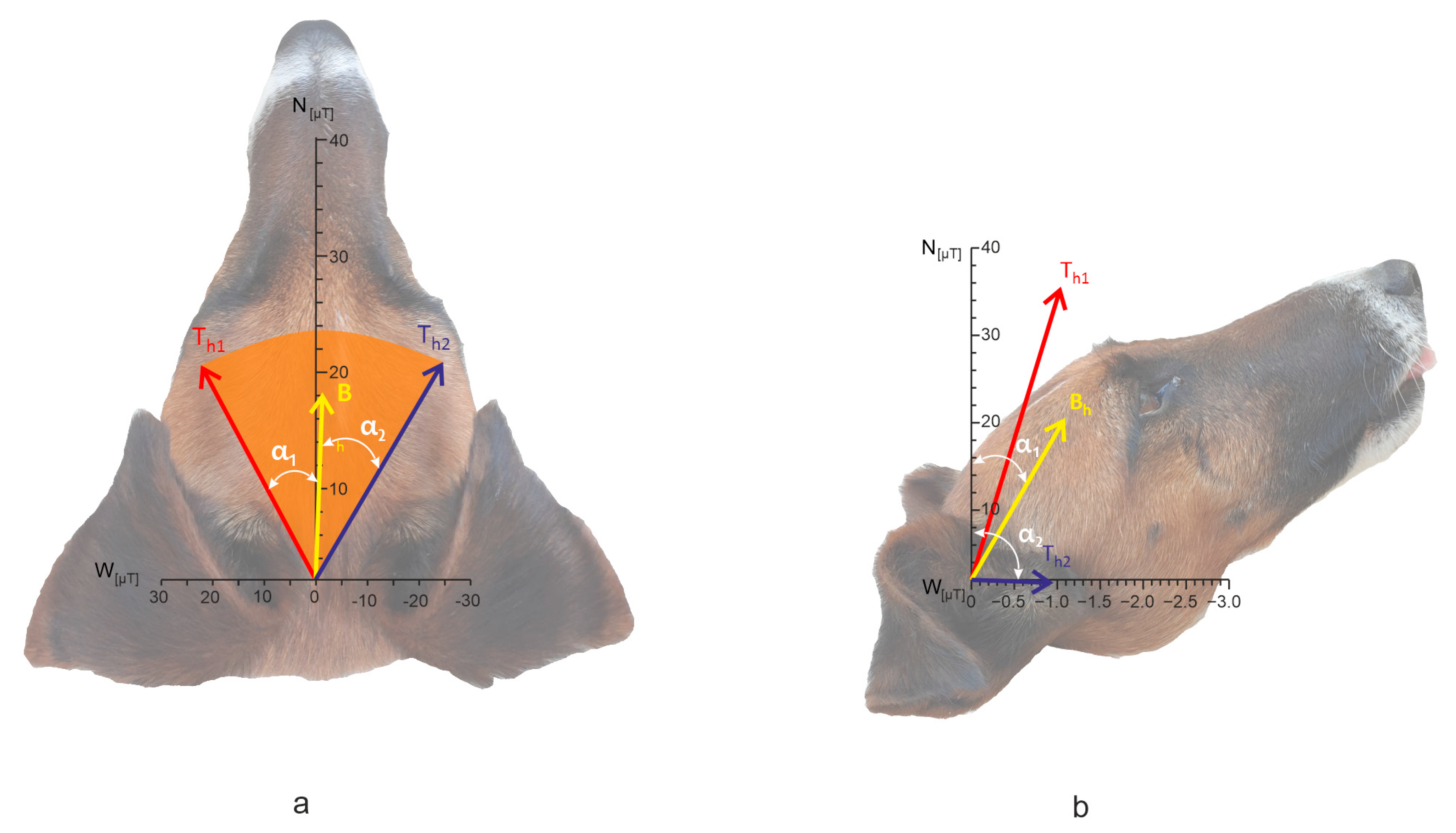
3.2. Predictions for the Total Magnetic Field Direction Under the Power Lines
3.3. Impact of Power Lines on Dogs’ Alignment
4. Discussion
5. Conclusions
- Our study provides further evidence of magnetoreceptive abilities in domestic dogs, expressed, among other behaviors, as spontaneous directional alignment. This alignment occurs consistently in the absence of magnetic sources other than the geomagnetic field (GMF) and demonstrates dogs’ sensitivity to minor variations in GMF declination.
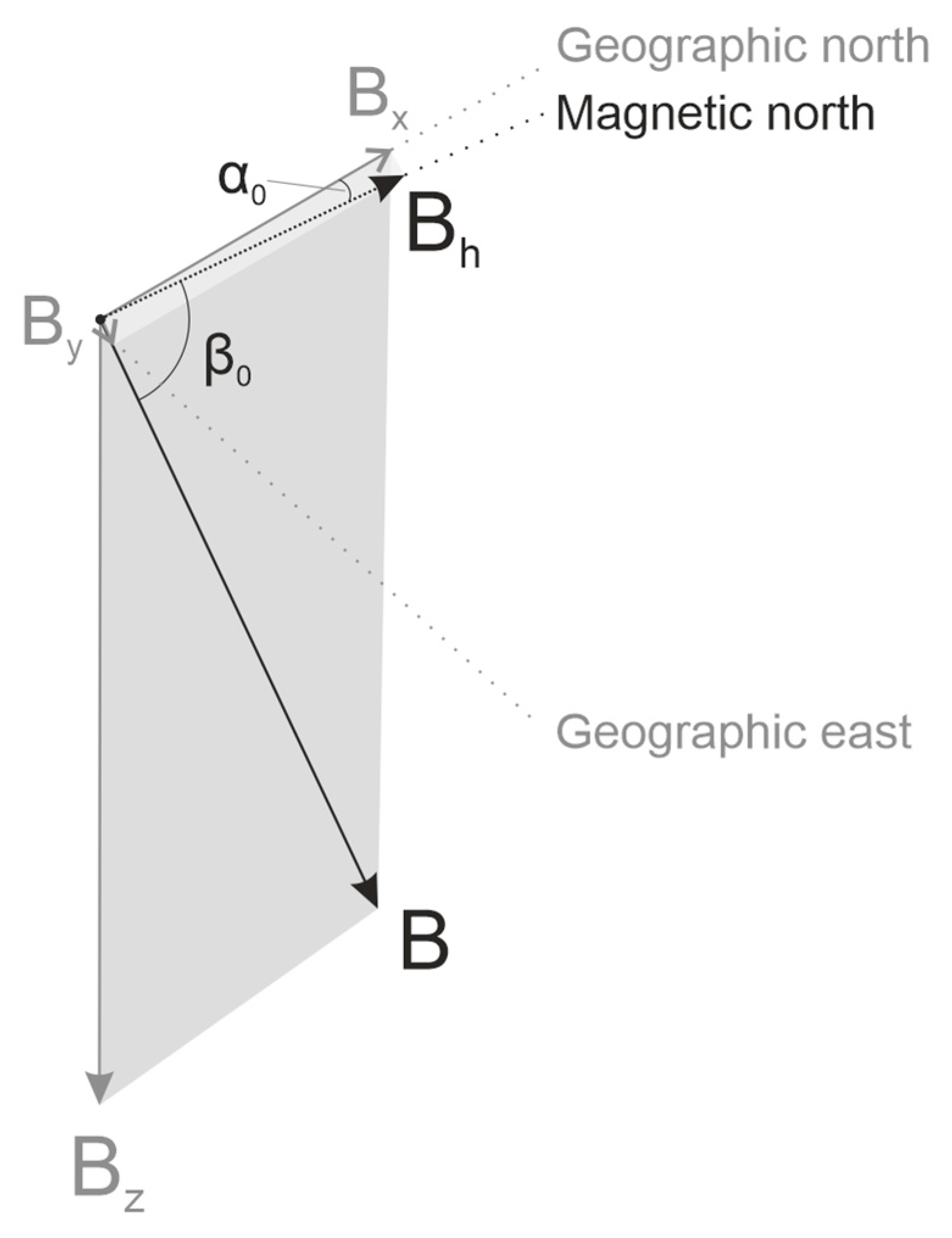
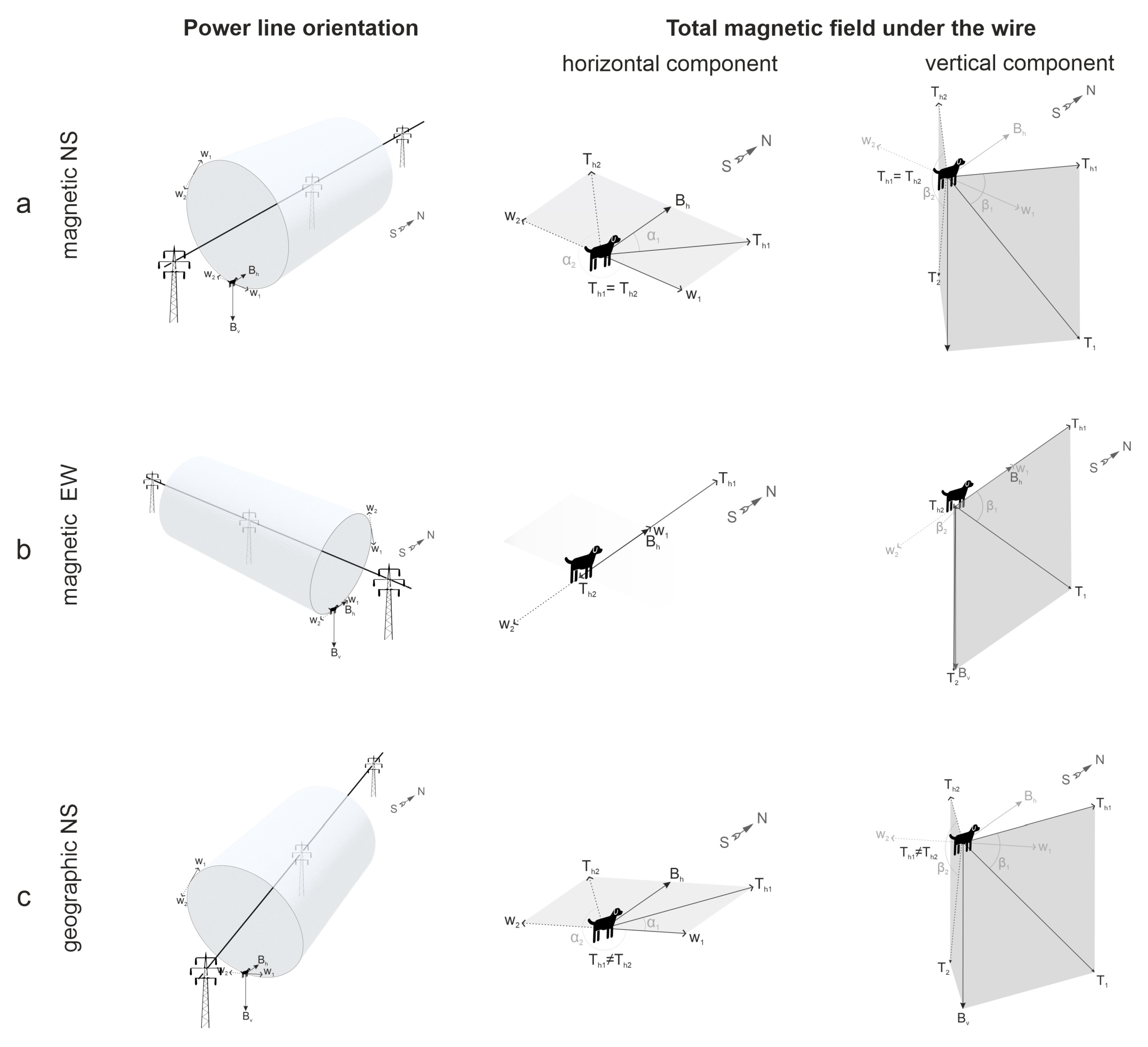
- Under the PL wires, dogs were exposed to an oscillating magnetic stimulus 1.24 times more intensive than the GMF, alternating at 50 Hz, in a direction differing from the GMF vector (41.5° and 311.5° relative to magnetic north under NS-directed PL, and 91.0° and 358.3° under EW-directed PL).
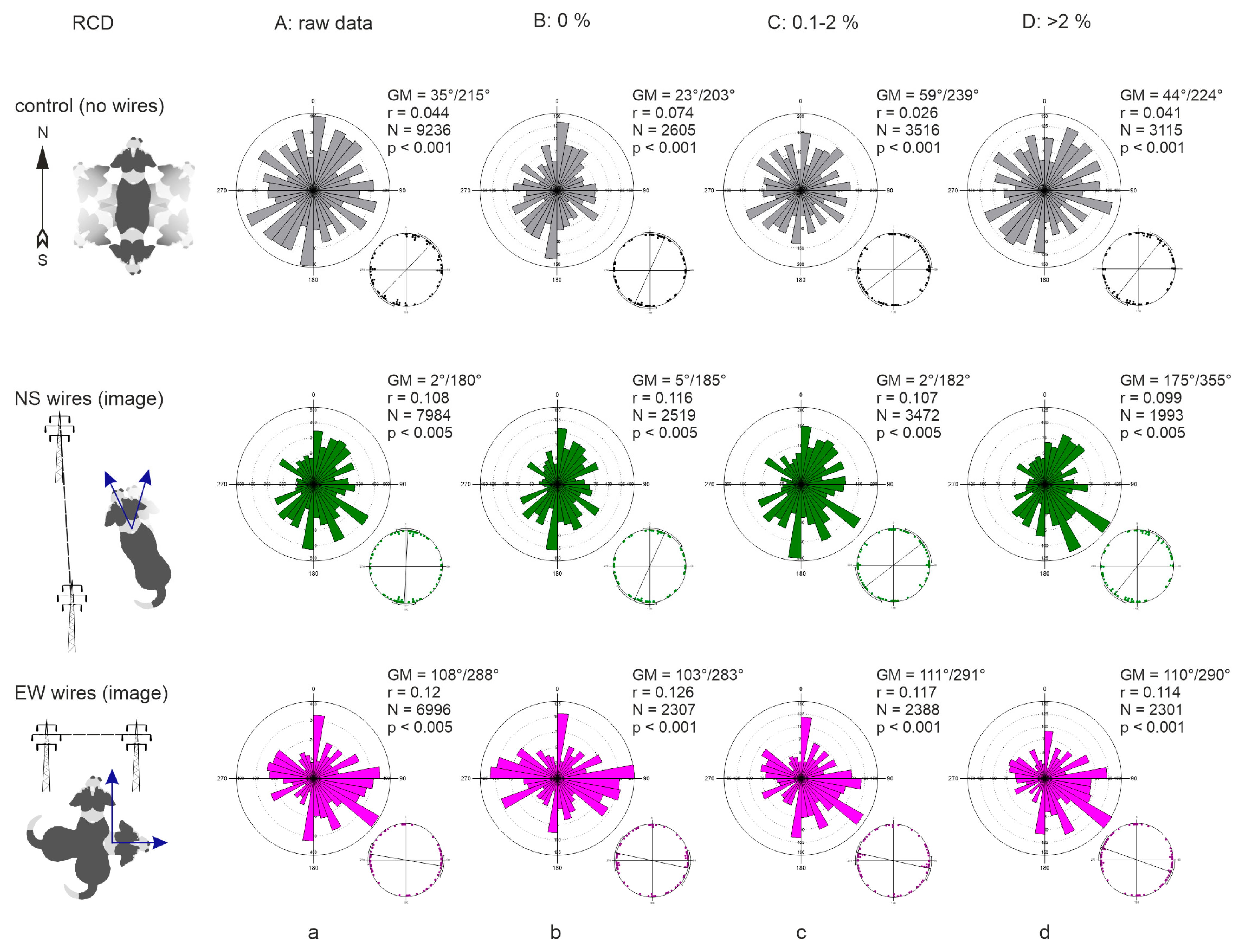
- Dogs maintain directional alignment under PL, unlike cattle and deer [49]. While the simplest explanation of this phenomenon would be a shift from magnetic to visual cues (like PL pylons) for orientation, the trimodal pattern observed under EW-directed PL (with both NS and EW components) suggests a more complex mechanism, not excluding a combination of magnetic and non-magnetic cues.
Supplementary Materials
Author Contributions
Funding
Institutional Review Board Statement
Informed Consent Statement
Data Availability Statement
Acknowledgments
Conflicts of Interest
Abbreviations
| GMF | Magnetic field of Earth/geomagnetic field |
| MF | Magnetic field |
| PL | Power lines |
| NS | North–south (direction) |
| EW | East–west (direction) |
References
- Ahlbom, A.; Day, N.; Feychting, M.; Roman, E.; Skinner, J.; Dockerty, J.; Linet, M.; McBride, M.; Michaelis, J.; Olsen, J.H.; et al. A pooled analysis of magnetic fields and childhood leukaemia. Br. J. Cancer. 2000, 83, 692–698. [Google Scholar] [CrossRef]
- Greenland, S.; Sheppard, A.R.; Kaune, W.T.; Poole, C.; Kelsh, M.A. A pooled analysis of magnetic fields, wire codes, and childhood leukemia. Childhood Leukemia-EMF Study Group. Epidemiology 2000, 11, 624–634. [Google Scholar] [CrossRef] [PubMed]
- Zhao, L.; Liu, X.; Wang, C.; Yan, K.; Lin, X.; Li, S.; Bao, H.; Liu, X. Magnetic fields exposure and childhood leukemia risk: A meta-analysis based on 11,699 cases and 13,194 controls. Leuk. Res. 2014, 38, 269–274. [Google Scholar] [CrossRef]
- Seomun, G.; Lee, J.; Park, J. Exposure to extremely low- frequency magnetic fields and childhood cancer: A systematic review and meta- analysis. PLoS ONE 2021, 16, e0251628. [Google Scholar] [CrossRef] [PubMed]
- Feigin, V.L.; Parmar, P.G.; Barker-Collo, S.; Bennett, D.A.; Anderson, C.S.; Thrift, A.G.; Stegmayr, B.; Rothwell, P.M.; Giroud, M.; Bejot, Y.; et al. Geomagnetic storms can trigger stroke: Evidence from 6 large population-based studies in Europe and Australasia. Stroke 2014, 45, 1639–1645. [Google Scholar] [CrossRef] [PubMed]
- Li, D.; Odouli, R.; Wi, S.; Janevic, T.; Golditch, I.; Bracken, T.D.; Senior, R.; Rankin, R.; Iriye, R. A population-based prospective cohort study of personal exposure to magnetic fields during pregnancy and the risk of miscarriage. Epidemiology 2002, 13, 9–20. [Google Scholar] [CrossRef]
- Lee, G.M.; Neutra, R.R.; Hristova, L.; Yost, M.; Hiatt, R.A. A nested case-control study of residential and personal magnetic field measures and miscarriages. Epidemiology 2002, 13, 21–31. [Google Scholar] [CrossRef]
- Li, D.; Chen, H.; Ferber, J.R.; Odouli, R.; Quesenberry, C. Exposure to magnetic field non-ionizing radiation and the risk of miscarriage: A prospective cohort study. Sci. Rep. 2017, 7, 17541. [Google Scholar] [CrossRef]
- Malagoli, C.; Crespi, C.M.; Rodolfi, R.; Signorelli, C.; Poli, M.; Zanichelli, P.; Fabbi, S.; Teggi, S.; Garavelli, L.; Astolfi, G.; et al. Maternal exposure to magnetic fields from high-voltage power lines and the risk of birth defects. Bioelectromagnetics 2012, 33, 405–409. [Google Scholar] [CrossRef]
- Sarimov, R.M.; Serov, D.A.; Gudkov, S.V. Biological effects of magnetic storms and ELF magnetic fields. Biology 2023, 12, 1506. [Google Scholar] [CrossRef]
- Sarimov, R.M.; Serov, D.A.; Gudkov, S.V. Hypomagnetic conditions and their biological action (review). Biology 2023, 12, 1513. [Google Scholar] [CrossRef] [PubMed]
- Kirschvink, J.L.; Padmanabha, S.; Boyce, C.K.; Oglesby, J. Measurement of the threshold sensitivity of honeybees to weak, extremely low-frequency magnetic fields. J. Exp. Biol. 1997, 200, 1363–1368. [Google Scholar] [CrossRef] [PubMed]
- Prato, F.S.; Desjardins-Holmes, D.; Keenliside, L.D.; DeMoor, J.M.; Robertson, J.A.; Thomas, A.W. Magnetoreception in laboratory mice: Sensitivity to extremely low-frequency fields exceeds 33 nT at 30 Hz. J. R. Soc. Interface 2013, 10, 20121046. [Google Scholar] [CrossRef]
- Zhadin, M.N.; Deryugina, O.N.; Pisachenko, T.M. Influence of combined DC and AC magnetic fields on rat behavior. Bioelectromagnetics 1999, 20, 378–386. [Google Scholar] [CrossRef]
- Nishimura, T.; Okano, H.; Tada, H.; Nishimura, E.; Sugimoto, K.; Mohri, K.; Fukushima, M. Lizards respond to an extremely low-frequency electromagnetic field. J. Exp. Biol. 2010, 213, 1985–1990. [Google Scholar] [CrossRef] [PubMed]
- Vanderstraeten, J.; Gillis, P. Theoretical evaluation of magnetoreception of power-frequency fields. Bioelectromagnetics 2010, 31, 371–379. [Google Scholar] [CrossRef]
- Kolbabová, T.; Pascal Malkemper, E.; Bartoš, L.; Vanderstraeten, J.; Turčáni, M.; Burda, H. Effect of exposure to extremely low frequency magnetic fields on melatonin levels in calves is seasonally dependent. Sci. Rep. 2015, 5, 14206. [Google Scholar] [CrossRef]
- Vanderstraeten, J. Magnetic Fields and Health: From Epidemiology to Cryptochrome Chemistry. Rev. Med. Brux. 2017, 38, 79–89. [Google Scholar]
- Xie, C. Searching for unity in diversity of animal magnetoreception: From biology to quantum mechanics and back. Innov. 2022, 3, 100229. [Google Scholar] [CrossRef]
- Wiltschko, R.; Wiltschko, W. Magnetic Orientation in Animals; Bradshaw, S.D., Burggren, W., Heller, H.C., Ishii, S., Langer, H., Neuweiler, G., Randall, D.J., Eds.; Zoophysiology; Springer: Berlin/Heidelberg, Germany, 1995; Volume 33. [Google Scholar] [CrossRef]
- Kirschvink, J. Homing in on vertebrates. Nature 1997, 390, 339–340. [Google Scholar] [CrossRef]
- Diego-Rasilla, F.J. Homing ability and sensitivity to the geomagnetic field in the alpine newt, Triturus alpestris. Ethol. Ecol. Evol. 2003, 15, 251–259. [Google Scholar] [CrossRef]
- Mouritsen, H. Long-distance navigation and magnetoreception in migratory animals. Nature 2018, 558, 50–59. [Google Scholar] [CrossRef] [PubMed]
- Lohmann, K.J.; Goforth, K.M.; Mackiewicz, A.G.; Lim, D.S.; Lohmann, C.M.F. Magnetic maps in animal navigation. J. Comp. Physiol. A 2022, 208, 41–67. [Google Scholar] [CrossRef]
- Burda, H.; Begall, S.; Hart, V.; Malkemper, E.P.; Painter, M.S.; Phillips, J.B. Magnetoreception in mammals. In The Senses: A Comprehensive Reference; Elsevier: Amsterdam, The Netherlands, 2020; pp. 421–444. [Google Scholar] [CrossRef]
- Phillips, J.B.; Youmans, P.W.; Muheim, R.; Sloan, K.A.; Landler, L.; Painter, M.S.; Anderson, C.R. Rapid learning of magnetic compass direction by C57BL/6 mice in a 4-armed ‘plus’ water maze. PLoS ONE 2013, 8, e73112. [Google Scholar] [CrossRef] [PubMed]
- Phillips, J.B.; Muheim, R.; Painter, M.S.; Raines, J.; Anderson, C.; Landler, L.; Dommer, D.; Raines, A.; Deutschlander, M.; Whitehead, J.; et al. Why is it so difficult to study magnetic compass orientation in murine rodents? J. Comp. Physiol. A 2022, 208, 197–212. [Google Scholar] [CrossRef] [PubMed]
- Schneider, W.T.; Holland, R.A.; Keišs, O.; Lindecke, O. Migratory bats are sensitive to magnetic inclination changes during the compass calibration period. Biol. Lett. 2023, 19, 20230181. [Google Scholar] [CrossRef]
- Zhang, L.; Malkemper, E.P. Cryptochromes in mammals: A magnetoreception misconception? Front. Physiol. 2023, 14, 1250798. [Google Scholar] [CrossRef]
- Hart, V.; Nováková, P.; Malkemper, E.; Begall, S.; Hanzal, V.; Ježek, M.; Kušta, T.; Němcová, V.; Adámková, J.; Benediktová, K.; et al. Dogs are sensitive to small variations of the Earth’s magnetic field. Front. Zool. 2013, 10, 80. [Google Scholar] [CrossRef]
- Martini, S.; Begall, S.; Findeklee, T.; Schmitt, M.; Malkemper, E.P.; Burda, H. Dogs can be trained to find a bar magnet. Peer J. 2018, 6, e6117. [Google Scholar] [CrossRef]
- Benediktová, K.; Adámková, J.; Svoboda, J.; Painter, M.S.; Bartoš, L.; Nováková, P.; Vynikalová, L.; Hart, V.; Phillips, J.; Burda, H. Magnetic alignment enhances homing efficiency of hunting dogs. eLife 2020, 9, e55080. [Google Scholar] [CrossRef]
- Yosef, R.; Raz, M.; Ben-Baruch, N.; Shmueli, L.; Kosicki, J.Z.; Fratczak, M.; Tryjanowski, P. Directional preferences of dogs’ changes in the presence of a bar magnet: Educational experiments in Israel. J. Vet. Behav. 2020, 35, 34–37. [Google Scholar] [CrossRef]
- Nießner, C.; Denzau, S.; Malkemper, E.P.; Gross, J.C.; Burda, H.; Winklhofer, M.; Peichl, L. Cryptochrome 1 in retinal cone photoreceptors suggests a novel functional role in mammals. Sci. Rep. 2016, 6, 21848. [Google Scholar] [CrossRef] [PubMed]
- Vacha, M. Magnetoreception of invertebrates. In The Oxford Handbook of Invertebrate Neurobiology, Chapter 14; Oxford Handbooks; Oxford Academic: Oxford, UK, 2019; pp. 367–388. [Google Scholar] [CrossRef]
- Xu, J.; Jarocha, L.E.; Zollitsch, T.; Konowalczyk, M.; Henbest, K.B.; Richert, S.; Golesworthy, M.J.; Schmidt, J.; Déjean, V.; Sowood, D.J.C.; et al. Magnetic sensitivity of cryptochrome 4 from a migratory songbird. Nature 2021, 594, 535–540. [Google Scholar] [CrossRef] [PubMed]
- Caspar, K.R.; Moldenhauer, K.; Moritz, R.E.; Němec, P.; Malkemper, E.P.; Begall, S. Eyes are essential for magnetoreception in a mammal. J. R. Soc. Interface 2020, 17, 20200513. [Google Scholar] [CrossRef]
- Muheim, R.; Boström, J.; Akesson, S.; Liedvogel, M. Sensory mechanisms of animal orientation and navigation. In Animal Movement Across Scales, Chapter 10; Oxford University Press: Oxford, UK, 2014; pp. 179–194. [Google Scholar][Green Version]
- Naisbett-Jones, L.C.; Lohmann, K.J. Magnetoreception and magnetic navigation in fishes: A half century of discovery. J. Comp. Physiol. A 2022, 208, 19–40. [Google Scholar] [CrossRef]
- Begall, S.; Malkemper, E.P.; Červený, J.; Němec, P.; Burda, H. Magnetic alignment in mammals and other animals. Mamm. Biol. 2013, 78, 10–20. [Google Scholar] [CrossRef]
- Bianco, G.; Köhler, R.C.; Ilieva, M.; Åkesson, S. The importance of time of day for magnetic body alignment in songbirds. J. Comp. Physiol. A 2022, 208, 135–144. [Google Scholar] [CrossRef]
- Diego-Rasilla, F.J.; Pérez-Mellado, V.; Pérez-Cembranos, A. Spontaneous magnetic alignment behaviour in free-living lizards. Sci. Nat. 2017, 104, 13. [Google Scholar] [CrossRef]
- Obleser, P.; Hart, V.; Malkemper, E.P.; Begall, S.; Holá, M.; Painter, M.S.; Červený, J.; Burda, H. Compass-controlled escape behavior in roe deer. Behav. Ecol. Sociobiol. 2016, 70, 1345–1355. [Google Scholar] [CrossRef]
- Schlegel, P.A.; Renner, H. Innate preference for magnetic compass direction in the Alpine newt, Triturus alpestris (Salamandridae, Urodela)? J. Ethol. 2007, 25, 185–193. [Google Scholar] [CrossRef]
- Vácha, M.; Kvíčalová, M.; Půžová, T. American Cockroaches Prefer Four Cardinal Geomagnetic Positions at Rest. Behaviour 2010, 147, 425–440. [Google Scholar] [CrossRef]
- Moritz, R.E.; Burda, H.; Begall, S.; Němec, P. Magnetic compass: A useful tool underground. In Subterranean Rodents; Begall, S., Burda, H., Schleich, C.E., Eds.; Springer: Berlin/Heidelberg, Germany, 2007; pp. 161–174. [Google Scholar] [CrossRef]
- Phillips, J.B.; Muheim, R.; Jorge, P.E. A behavioral perspective on the biophysics of the light-dependent magnetic compass: A link between directional and spatial perception? J. Exp. Biol. 2010, 213, 3247–3255. [Google Scholar] [CrossRef]
- Cafazzo, S.; Natoli, E.; Valsecchi, P. Scent-marking behaviour in a pack of free-ranging domestic dogs. Ethology 2012, 118, 955–966. [Google Scholar] [CrossRef]
- Burda, H.; Begall, S.; Cerveny, J.; Neef, J.; Nemec, P. Extremely low-frequency electromagnetic fields disrupt magnetic alignment of ruminants. Proc. Natl. Acad. Sci. USA 2009, 106, 5708–5713. [Google Scholar] [CrossRef] [PubMed]
- Olsen, J.H.; Nielsen, A.; Schulgen, G. Residence near high voltage facilities and risk of cancer in children. BMJ 1993, 307, 891–895. [Google Scholar] [CrossRef]
- Hamza, A.H.; Mahmoud, S.A.; Abdel-Gawad, N.M.; Ghania, S.M. Evaluation of magnetic induction inside humans at high voltage substations. Electr. Power Syst. Res. 2005, 74, 231–237. [Google Scholar] [CrossRef]
- Pretterer, G.; Bubna-Littitz, H.; Windischbauer, G.; Gabler, C.; Griebel, U. Brightness discrimination in the dog. J. Vis. 2004, 4, 10. [Google Scholar] [CrossRef]
- Bolón, D.; Crujeiras, R.M.; Rodríguez-Casal, A. A likelihood ratio test for circular multimodality. Environ. Ecol. Stat. 2025, 32, 57–87. [Google Scholar] [CrossRef]
- Pewsey, A.; Neuhäuser, M.; Ruxton, G.D. Circular Statistics in R, 1st ed.; Oxford University Press: New York, NY, USA, 2013. [Google Scholar]
- Mardia, K.V.; Jupp, P.E. Directional Statistics, 1st ed.; Wiley Series in Probability and Statistics; Wiley: Hoboken, NJ, USA, 1999. [Google Scholar] [CrossRef]
- Zar, J.H. Biostatistical Analysis, 4th ed.; Prentice Hall International: Upper Saddle River, NJ, USA, 1999. [Google Scholar]
- Landler, L.; Ruxton, G.D.; Malkemper, E.P. The multivariate analysis of variance as a powerful approach for circular data. Mov. Ecol. 2022, 10, 21. [Google Scholar] [CrossRef]
- Adámková, J.; Benediktová, K.; Svoboda, J.; Bartoš, L.; Vynikalová, L.; Nováková, P.; Hart, V.; Painter, M.S.; Burda, H. Turning preference in dogs: North attracts while south repels. PLoS ONE 2021, 16, e0245940. [Google Scholar] [CrossRef]
- Rouviere, A.; Ruxton, G.D. No evidence for magnetic alignment in domestic dogs in urban parks. J. Vet. Behav. 2022, 49, 71–74. [Google Scholar] [CrossRef]
- Vanselow, K.H.; Ricklefs, K. Are solar activity and sperm whale Physeter macrocephalus strandings around the North Sea related? J. Sea Res. 2005, 53, 319–327. [Google Scholar] [CrossRef]
- Krylov, V.V.; Zotov, O.D.; Klain, B.I.; Ushakova, N.V.; Kantserova, N.P.; Znobisheva, A.V.; Izyumov, Y.G.; Kuz’mina, V.V.; Morozov, A.A.; Lysenko, L.A.; et al. An experimental study of the biological effects of geomagnetic disturbances: The impact of a typical geomagnetic storm and its constituents on plants and animals. J. Atmos. Sol. Terr. Phys. 2014, 110–111, 28–36. [Google Scholar] [CrossRef]
- Benediktová, K.; Iakovenko, N.; Adámková, J.; Bartoš, L.; Brinkeová, H.; Hart, V.; Bartošová, J.; Burda, H. Solitary working hunting dogs show a higher tendency for magnetic alignment, with decreased alignment in older dogs. Appl. Anim. Behav. Sci. 2025, 285, 106575. [Google Scholar] [CrossRef]
- Johnsen, S.; Lohmann, K.J.; Warrant, E.J. Animal navigation: A noisy magnetic sense? J. Exp. Biol. 2020, 223 Pt 18, jeb164921. [Google Scholar] [CrossRef]
- Dreyer, D.; Frost, B.; Mouritsen, H.; Günther, A.; Green, K.; Whitehouse, M.; Johnsen, S.; Heinze, S.; Warrant, E. The Earth’s magnetic field and visual landmarks steer migratory flight behavior in the nocturnal Australian Bogong moth. Curr. Biol. 2018, 28, 2160–2166.e5. [Google Scholar] [CrossRef]
- Muheim, R.; Schmaljohann, H.; Alerstam, T. Feasibility of sun and magnetic compass mechanisms in avian long-distance migration. Mov. Ecol. 2018, 6, 8. [Google Scholar] [CrossRef] [PubMed]
- Wiltschko, W. Further analysis of the magnetic compass of migratory birds. In Animal Migration, Navigation, and Homing; Schmidt-Koenig, K., Keeton, W.T., Eds.; Proceedings in Life Sciences; Springer: Berlin/Heidelberg, Germany, 1978; pp. 302–310. [Google Scholar] [CrossRef]

| Direction of the Wires | Magnetic Calm (RCD = 0%) | Moderate Magnetic Disturbances (RCD = 0.1–2%) | Strong Magnetic Disturbances (RCD > 2%) | ||||||
|---|---|---|---|---|---|---|---|---|---|
| Axial GM | r | k | Axial GM | r | k | Axial GM | r | k | |
| No wires | 23°/203° | 0.074 | 0.214 | 59°/239° | 0.026 | 0.086 | 44°/224° | 0.041 | 0.119 |
| Geographic NS | 5°/185° | 0.149 | 0.301 | 5°/185° | 0.113 | 0.228 | 2°/182° | 0.119 | 0.241 |
| Geographic EW | 103°/283° | 0.159 | 0.322 | 111°/291° | 0.101 | 0.203 | 110°/290° | 0.137 | 0.277 |
| Direction of the Wires | N | Total Field (T) Characteristics | ||||||||
|---|---|---|---|---|---|---|---|---|---|---|
| Bx, µT | By, µT | Bz, µT | |T1|,µT | |T2|, µT | α1 | α2 | β1 | β2 | ||
| No wires | 26 | 19.98 ± 0.15 | 1.23 ± 0.14 | 44.62 ± 0.18 | |B| = 48.9 µT, Bh = 20.0 µT, D(α0) = 3.6°, I (β0) = 65.8° | |||||
| Geographic NS | 15 | 19.96 ± 0.13 | 1.23 ± 0.11 | 44.64 ± 0.15 | 52.4 | 53.3 | 41.5° | 311.5° | 33.12° | 31.6° |
| Geographic EW | 14 | 19.97 ± 0.14 | 1.19 ± 0.12 | 44.60 ± 0.17 | 59.9 | 44.7 | 91.0° | 358.3° | 48.1° | 87.0° |
Disclaimer/Publisher’s Note: The statements, opinions and data contained in all publications are solely those of the individual author(s) and contributor(s) and not of MDPI and/or the editor(s). MDPI and/or the editor(s) disclaim responsibility for any injury to people or property resulting from any ideas, methods, instructions or products referred to in the content. |
© 2025 by the authors. Licensee MDPI, Basel, Switzerland. This article is an open access article distributed under the terms and conditions of the Creative Commons Attribution (CC BY) license (https://creativecommons.org/licenses/by/4.0/).
Share and Cite
Iakovenko, N.S.; Benediktová, K.; Adámková, J.; Hart, V.; Brinkeová, H.; Ježek, M.; Kušta, T.; Hanzal, V.; Nováková, P.; Burda, H. The Effect of High-Voltage Power Lines on Magnetic Orientation of Domestic Dogs. Animals 2025, 15, 3534. https://doi.org/10.3390/ani15243534
Iakovenko NS, Benediktová K, Adámková J, Hart V, Brinkeová H, Ježek M, Kušta T, Hanzal V, Nováková P, Burda H. The Effect of High-Voltage Power Lines on Magnetic Orientation of Domestic Dogs. Animals. 2025; 15(24):3534. https://doi.org/10.3390/ani15243534
Chicago/Turabian StyleIakovenko, Nataliia S., Kateřina Benediktová, Jana Adámková, Vlastimil Hart, Hana Brinkeová, Miloš Ježek, Tomáš Kušta, Vladimír Hanzal, Petra Nováková, and Hynek Burda. 2025. "The Effect of High-Voltage Power Lines on Magnetic Orientation of Domestic Dogs" Animals 15, no. 24: 3534. https://doi.org/10.3390/ani15243534
APA StyleIakovenko, N. S., Benediktová, K., Adámková, J., Hart, V., Brinkeová, H., Ježek, M., Kušta, T., Hanzal, V., Nováková, P., & Burda, H. (2025). The Effect of High-Voltage Power Lines on Magnetic Orientation of Domestic Dogs. Animals, 15(24), 3534. https://doi.org/10.3390/ani15243534

