
Article

Complete Mitochondrial Genomes of Pentapodus caninus and Lethrinus olivaceus (Spariformes: Nemipteridae and Lethrinidae): Genome Characterization and Phylogenetic Analysis

Key Laboratory of Eutrophication and Red Tide Prevention of Guangdong Higher Education Institutes, College of Life Science and Technology, and Southern Marine Science and Engineering Guangdong Laboratory (Zhuhai), Jinan University, Guangzhou 510632, China
*
Authors to whom correspondence should be addressed.
Animals 2025, 15(24), 3526; https://doi.org/10.3390/ani15243526 (registering DOI)
Submission received: 9 November 2025 / Revised: 2 December 2025 / Accepted: 4 December 2025 / Published: 7 December 2025
(This article belongs to the Section Animal Genetics and Genomics)

Simple Summary

Mitochondrial DNA, typically characterized by its circular structure and maternal inheritance, provides essential genetic information for reconstructing the evolutionary history of species. We report the first complete mitochondrial genomes of two coastal fishes, Pentapodus caninus and Lethrinus olivaceus. Phylogenetic analyses using these and published mitochondrial genomes clarify relationships within the spariform fishes: Nemipteridae (threadfin breams) is recovered as sister to Sparidae (porgies), while Lethrinidae (emperors) occupies a more basal position relative to that clade. We also found a rare duplication of a transfer RNA gene in Lethrinus, showing that mitochondrial structure can change. These newly characterized mitogenomes facilitate taxonomic distinction and provide robust molecular data for reconstructing the evolutionary history of spariform fishes.

Abstract

Complete mitochondrial genomes (mitogenomes) are widely utilized molecular resources for phylogenetic studies. Although research on Spariformes mitogenomes has advanced significantly, there is still relatively little information regarding the molecular data and taxonomic placement of the families Nemipteridae and Lethrinidae. We report and annotate the first complete mitogenomes of Pentapodus caninus (16,866 bp; Nemipteridae) and Lethrinus olivaceus (16,792 bp; Lethrinidae), thereby expanding mitogenomic coverage in two families with limited available genomic data. Both assembled mitogenomes display the canonical vertebrate architecture, comprising 37 functional genes (13 protein-coding genes, 22 tRNAs, and 2 rRNAs) and a control region, with conserved synteny and strand asymmetry (only ND6 and eight tRNAs are light-strand encoded). While ATG serves as the primary initiation codon for most PCGs, COX1 employs an alternative GTG start codon. Structural analysis of tRNAs revealed that most sequences adopt the standard cloverleaf conformation, with the exception of tRNA-SerAGY, which lacks the dihydrouridine (DHU) arm. A rare tandem duplication of tRNA-Val in Lethrinus species highlights the structural variability of spariform mitochondrial genomes. Furthermore, phylogenomic reconstruction using the concatenated 13 protein-coding gene dataset recovered Nemipteridae and Sparidae as sister taxa. In this topology, Lethrinidae was identified as the earliest diverging lineage, basal to the Nemipteridae–Sparidae grouping. Our results not only advance our understanding of the origin and evolution of Spariformes, but also provide valuable information for the molecular phylogeny and taxonomy of teleostean species.

1. Introduction

Spariformes has been recognized as a stable percomorph order as a result of higher-level revisions that resolved the demonstrably paraphyletic ‘Perciformes’ sensu lato using expanded molecular datasets [1,2]. The order, comprising Lethrinidae (emperors), Nemipteridae (threadfin breams), and Sparidae (porgies, including former Centracanthidae), contains ecologically pivotal and economically valuable teleosts associated with reefs and soft bottom, distributed from tropical to temperate waters [1,3]. Yet relationships within Spariformes—and their placement relative to closely allied percomorph lineages—remain incompletely resolved. For example, morphology-based hypotheses have variously positioned Nemipteridae as a basal lineage, whereas early molecular studies yielded conflicting arrangements, such as a sister relationship between Lethrinidae and Nemipteridae versus a clade uniting Nemipteridae and Sparidae [4,5,6,7]. Robust resolution is necessary to reconstruct biogeographic history, understand trophic and ecological trait evolution, and refine taxonomic boundaries [8,9].
Within this framework, Lethrinidae and Nemipteridae are key components of Indo-West Pacific coastal fisheries and food security. Many species are widely distributed, targeted by multi-gear artisanal and commercial fleets, and display trophic and morphological convergence that can confound field identifications [10,11]. Reports of geographically structured lineages and suspected cryptic diversity in several genera further underscore the need for authoritative molecular references to support species delimitation, traceability, and enforcement [12]. Mitogenomes provide rich phylogenetic signal beyond single-locus barcodes, including compositional skews (informative for strand-specific mutational regimes), codon-usage bias (reflecting translational and tRNA adaptation), and control-region organization (tandem repeats and conserved sequence blocks tracking lineage demographic or regulatory shifts), all of which illuminate lineage-specific evolutionary dynamics [13]. However, as a single locus, mitochondrial DNA can be subject to introgression or incomplete lineage sorting, meaning the resulting gene tree may not always fully reflect the true species phylogeny. Furthermore, mitogenome-based phylogenetics can be biased by compositional heterogeneity, saturation at third codon positions, and maternal inheritance, motivating careful data partitioning and model selection to assess topological robustness.
To address gaps in mitogenomic resources and improve phylogenetic sampling within Spariformes, particularly in Nemipteridae and Lethrinidae, we focused on two widely distributed species: Lethrinus olivaceus Valenciennes, 1830 and Pentapodus caninus (Cuvier, 1830). L. olivaceus is a large carnivorous lethrinid that inhabits reef-associated habitats across the Indo-West Pacific and represents a key target for local fisheries [14,15,16]. P. caninus is distributed across the western Pacific from the South China Sea to the western Pacific islands and occupies nearshore soft-bottom and reef-sand interfaces [15,16]. Species-level identification can be problematic in mixed catches. Lethrinidae has been the subject of extensive research on trophic diversification and species limits using morphology, morphometrics, and mitochondrial markers, revealing repeated ecological shifts and complex lineage structure across ocean basins [8,9,17]. In parallel, recent molecular investigations have focused on Nemipteridae, clarifying relationships among genera and uncovering geographically diversified genetic structure in Nemipterus spp. across the Red Sea and Mediterranean [18,19].
Despite their ecological and economic significance, the availability of complete mitochondrial genome resources remains uneven across spariform families. According to an NCBI search (accessed September 2025), complete mitogenomes are publicly available for 32 Sparidae species, whereas Nemipteridae has only nine and Lethrinidae only six, limiting comprehensive, family-spanning comparisons of genome architecture, control-region organization, codon-usage bias, compositional skews, and lineage-specific rate variation. This imbalance constrains the ability to evaluate how general patterns (e.g., convergent trophic evolution, mitogenomic compositional trends) inferred from Sparidae extend to underrepresented families [5,7,20].
This study presents annotated, newly generated complete mitogenomes for P. caninus (Nemipteridae) and L. olivaceus (Lethrinidae), characterizing their genome architecture, nucleotide composition, protein-coding and RNA genes, and control-region features. By integrating these sequences with published Spariformes mitogenomes, we reconstructed family-level relationships using partitioned maximum-likelihood (ML) and Bayesian inference (BI) analyses. The inclusion of two previously underrepresented families enhances mitogenomic coverage across Spariformes, thereby refining phylogenetic resolution and providing genomic references for studies of molecular identification, population genetics, and molecular evolution. Furthermore, this study uncovers a rare tRNA-Val tandem duplication in L. olivaceus, revealing a lineage-specific structural rearrangement within Lethrinidae.

2. Materials and Methods

2.1. Sample Collection and Genomic DNA Isolation

P. caninus and L. olivaceus specimens were collected from the South China Sea which (14°52′ N–17°69′ N, 111°22′ E–115°69′ E) is located at the edge of the Western Pacific Ocean in March 2025. All procedures in this study complied with the guidelines of the IUCN Red List, involving no endangered or protected species, and received approval from the Jinan University Laboratory Animal Welfare and Ethics Committee. Specimen identification was conducted based on morphological traits, after which samples were preserved in 95% ethanol and cryopreserved at −80 °C prior to analysis. We isolated total genomic DNA from dorsal muscle biopsies utilizing the Animal Tissue Genomic DNA Extraction Kit (SangonBiotech, Shanghai, China), strictly adhering to the manufacturer’s protocol. Subsequently, the purified DNA served as the template for Polymerase Chain Reaction (PCR) to amplify the complete mitochondrial genomes of P. caninus and L. olivaceus [21,22].
The newly obtained mitogenome sequences of the P. caninus and L. olivaceus were submitted to the GenBank database under the accession number PV872034 and PV872036, respectively.

2.2. Amplification and Sequencing of Mitochondrial Genomes

Primers for amplifying the complete mitochondrial genomes of P. caninus and L. olivaceus were designed by aligning reference sequences from Pentapodus setosus (Valenciennes, 1830) (NC_086456.1) and Lethrinus laticaudis Alleyne & Macleay, 1877 (NC_030353.1), as detailed in Tables S1 and S2 [21]. We performed PCR assays using the Premix LA Taq system (Takara, Dalian, China) containing LA Taq DNA polymerase. The thermal cycling profile was programmed as follows: an initial denaturation at 95 °C for 1 min; 35 cycles comprising denaturation (95 °C, 20 s), annealing (55 °C, 45 s), and extension (72 °C, 1–3 min based on fragment size). Final amplicons were sequenced using a 3730XL DNA Analyzer at the Beijing Genomics Institute (Shenzhen, China).

2.3. Mitochondrial Genome Assembly

In order to obtain the final complete sequence, the obtained sequenced fragments were assembled through the program Contig Assembly within the SnapGene software (www.snapgene.com, accessed on 1 June 2025) and then manually checked. Gene annotation, including 13 protein-coding genes (PCGs), 22 tRNAs, and two rRNAs, was performed using the MITOS web server [23], with gene boundaries and orientations subsequently cross-validated via the MitoFish pipeline [24]. To ensure accuracy, PCG identities were confirmed by BLAST+ 2.16.0 searches against available Spariformes mitogenomes in the NCBI database [25]. A visual representation of P. caninus and L. olivaceus mitogenome was created by the CGView online program (https://www.bioinformatics.org/cgview/download.html, accessed on 10 June 2025).
We predicted the secondary structures of tRNA genes and the light-strand replication origin using RNAstructure [26]. Nucleotide composition and codon usage metrics were calculated in MEGA 11.0 [27]. For Relative Synonymous Codon Usage (RSCU) calculations, we excluded all stop codons to ensure reading frame consistency and calculation accuracy. Nucleotide asymmetries were quantified using the standard skew formulas: AT-skew = (A − T) / (A + T) and GC-skew = (G − C) / (G + C).”

2.4. Comparative Phylogenetic Analysis

To elucidate the evolutionary placement of P. caninus and L. olivaceus within Spariformes, we analyzed a dataset comprising 35 teleost mitogenomes. The ingroup included 33 Spariformes species representing three families: Nemipteridae (11), Sparidae (15), and Lethrinidae (7). Perca fluviatilis Linnaeus, 1758 (Percidae, NC_026313) and Epinephelus coioides (Hamilton, 1822) (Serranidae, NC_011111) were selected as outgroups. All sequences were retrieved from GenBank.
The 13 protein-coding genes (PCGs) were extracted and aligned using MAFFT, followed by codon-aware refinement in MACSE [28]. The resulting alignments were concatenated in the gene order: ND1-ND2-COX1-COX2-ATP8-ATP6-COX3-ND3-ND4L-ND4-ND5-ND6-CYTB. We employed ModelFinder to identify the optimal partitioning scheme and substitution models based on the lowest Bayesian Information Criterion (BIC) scores [29] (Table S3). Phylogenetic reconstruction was performed using both ML and BI approaches. The ML tree was inferred in IQ-TREE [30] with 1000 bootstrap replicates to assess nodal support [30]. The BI phylogenetic analysis was conducted in MrBayes under the GTR+G substitution model. We performed two independent analyses, each consisting of four simultaneous chains run for 10,000,000 generations [31]. Trees were sampled every 100 generations, with the initial 25% discarded as burn-in. Stationarity and convergence were verified by ensuring that the average standard deviation of split frequencies fell below 0.01 and that effective sample size (ESS) values for all parameters exceeded 200. All of the above were available on the PhyloSuite platform [32]. Final tree topologies were visualized and annotated using iTOL [33].

3. Results

3.1. Mitogenomic Architecture and Base Composition

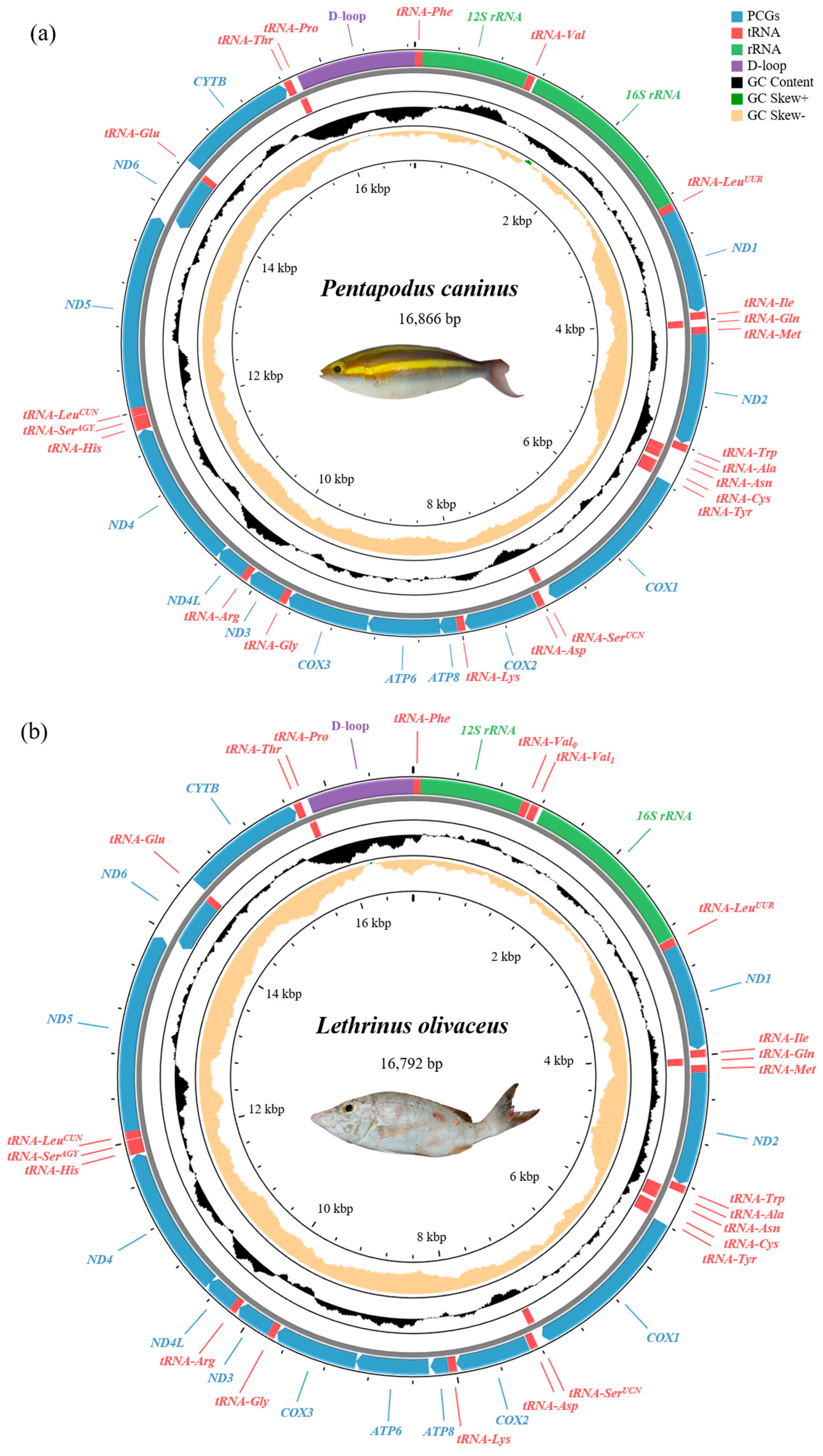
The complete circular mitogenomes of P. caninus and L. olivaceus spanned 16,866 bp and 16,792 bp, respectively. Both genomes displayed the canonical vertebrate mitochondrial architecture, consisting of 37 functional genes—including 13 PCGs, 22 tRNAs, and two rRNAs—alongside a major non-coding control region (D-loop) (Table 1 and Table 2; Figure 1) [34]. Gene order conforms to the canonical teleost arrangement, and no gene rearrangements were detected [35]. ND6 and eight tRNA genes (tRNA-Glu, tRNA-Pro, tRNA-Gln, tRNA-Ala, tRNA-Asn, tRNA-Cys, tRNA-Tyr, tRNA-Ser) are encoded on the light strand (L-strand), whereas the remaining genes are located on the heavy strand (H-strand) (Figure 1) [36]. We detected 14 intergenic spacer regions (totaling 85 bp) and 10 overlaps (29 bp) in P. caninus, and 15 spacers (135 bp) together with 9 overlaps (19 bp) in L. olivaceus.
An overall bias toward A+T content was observed in both species. In P. caninus, the nucleotide distribution was A (28.1%), T (27.5%), G (16.9%), and C (27.5%), resulting in a total A+T content of 55.6%. Analysis of strand asymmetry revealed a positive AT-skew (0.010) and a negative GC-skew (−0.238), reflecting a slight preference for Adenine over Thymine and Cytosine over Guanine. Similarly, L. olivaceus presented an A+T content of 52.6% (A: 26.6%, T: 26.0%, G: 17.2%, C: 29.7%), with comparable skew metrics (AT-skew = 0.013; GC-skew = −0.265).”

3.2. Analysis of Protein-Coding Sequences

The combined length of the 13 PCGs is 11,433 bp in P. caninus and 11,430 bp in L. olivaceus, accounting for approximately 67.8% and 68.1% of the total genome size, respectively (Table 1 and Table 2). In terms of gene size, ATP8 (168 bp) is the smallest element, while ND5 (1839 bp) represents the largest coding region in both genomes. The transcriptional orientation is conserved: ND6 is the sole PCG encoded on the Light (L) strand, with the remaining twelve genes situated on the Heavy (H) strand.
Initiation codons are predominantly ATG across both mitogenomes; notably, COX1 initiates with GTG. Termination codons include both complete (TAA/TAG) and incomplete forms. According to our annotations, ND1-ND3, ND4L, ND5, ND6, COX1, COX3, ATP8, and ATP6 terminate with complete codons, whereas COX2, ND4, and CYTB display incomplete stop codons (Table 1 and Table 2).
Across PCGs, base composition is modestly AT-biased in both species. In P. caninus, A+T ranges from 47.8% (ND4L) to 57.1% (ATP8), with a mean across PCGs of 55.6%; in L. olivaceus, A+T ranges from 44.5% (ND4L) to 55.4% (ATP8), averaging 52.6% (Tables S4 and S5). Strand-asymmetric base skews are apparent at the gene level: most PCGs show negative GC-skew, whereas ND6, encoded on the opposite strand, shows the opposite tendency.

3.3. Codon Usage Patterns and Amino Acid Frequency

The amino acid composition of the 13 PCGs was analyzed for both species. In total, the PCGs of P. caninus and L. olivaceus encode 3800 and 3799 amino acids, respectively (excluding stop codons). The amino acid frequency distributions were highly similar between the two species. Leucine is the most abundant amino acid (16.5% in P. caninus; 17.4% in L. olivaceus), followed by alanine and threonine, whereas cysteine is the least frequent (0.8% and 0.6%, respectively) (Table S7).
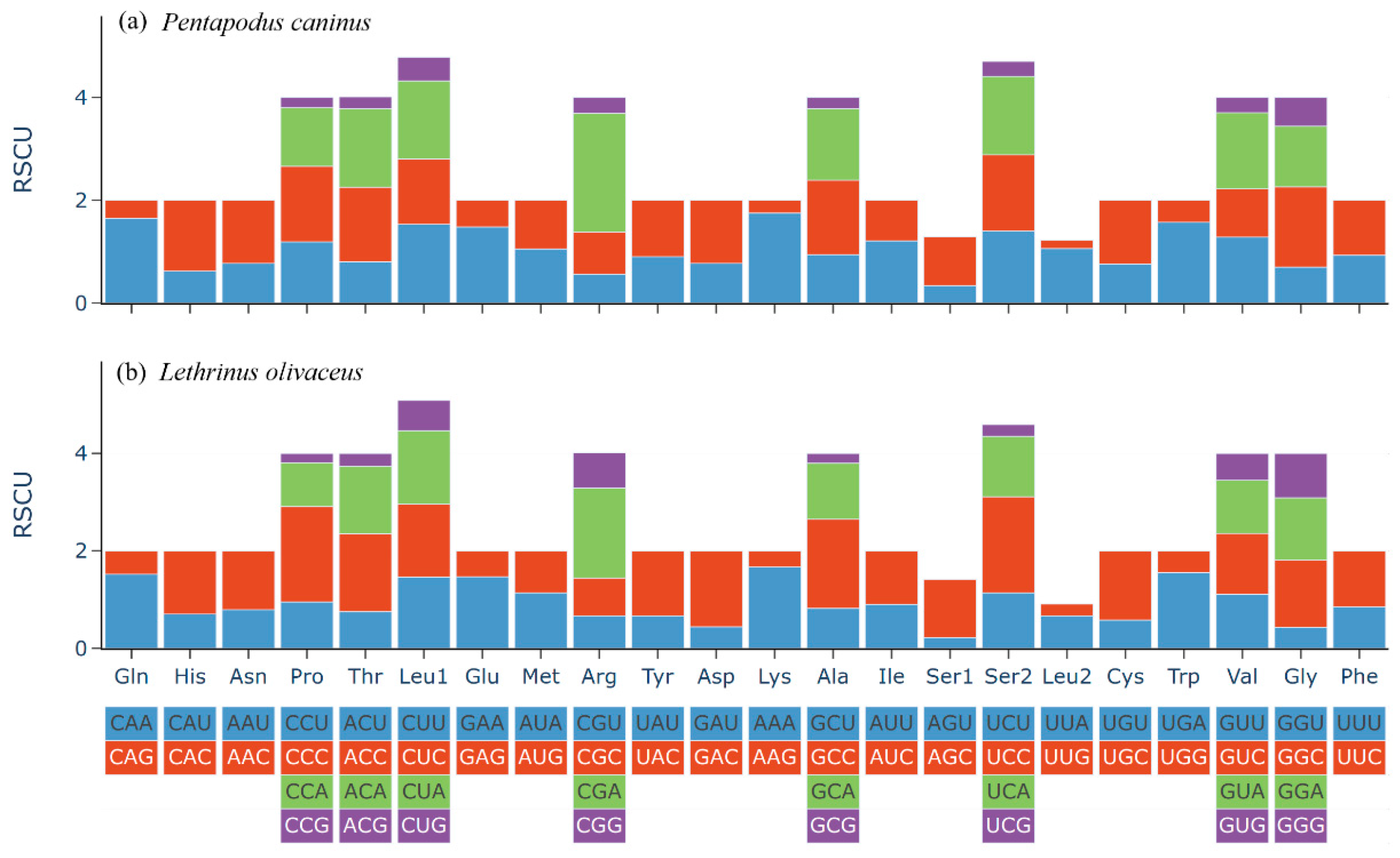
To investigate codon-usage bias, RSCU values were calculated (Figure 2). A clear pattern of nonuniform codon usage was observed. The most notable trend is a strong bias against G at third codon positions across most synonymous families; within fourfold-degenerate families in particular, G-ending codons were the most underrepresented (RSCU < 0.3). For example, in both species, GCG (Ala), CCG (Pro), and ACG (Thr) are rare. By contrast, C- or A-ending codons are often preferred. In L. olivaceus, CCC (Pro, RSCU = 1.96) and UCC (Ser, RSCU = 1.97) are highly favored; in P. caninus, CGA (Arg, RSCU = 2.31) and AAA (Lys, RSCU = 1.75) show strong positive bias.

3.4. Characterization of RNA Genes

3.4.1. rRNA Genes

The mitogenomes of P. caninus and L. olivaceus contain the standard set of two ribosomal RNA genes. The large subunit (16S rRNA) is 1705 bp and 1669 bp long, and the small subunit (12S rRNA) is 997 bp and 955 bp long in P. caninus and L. olivaceus, respectively. The two ribosomal RNA genes are encoded on the H-strand and are interspersed with tRNA-Val. Notably, while P. caninus possesses a single copy of tRNA-Val, L. olivaceus exhibits a tandem duplication of this gene. Specifically, the 12S rRNA is flanked by tRNA-Phe and tRNA-Val, whereas the 16S rRNA is positioned between tRNA-Val and tRNA-Leu (Table 1 and Table 2).

3.4.2. General Features of tRNA Genes

All 22 typical tRNA genes are identified, with total lengths of 1561 bp in P. caninus and 1638 bp in L. olivaceus. Individual tRNAs range from 67 to 76 bp (Table 1). Fourteen tRNAs are encoded on the H-strand and eight on the L-strand. Predicted anticodons match the standard vertebrate mitochondrial genetic code, with no lineage-specific substitutions (Table 1).

3.4.3. Tandem Duplication of tRNA-Val in L. olivaceus

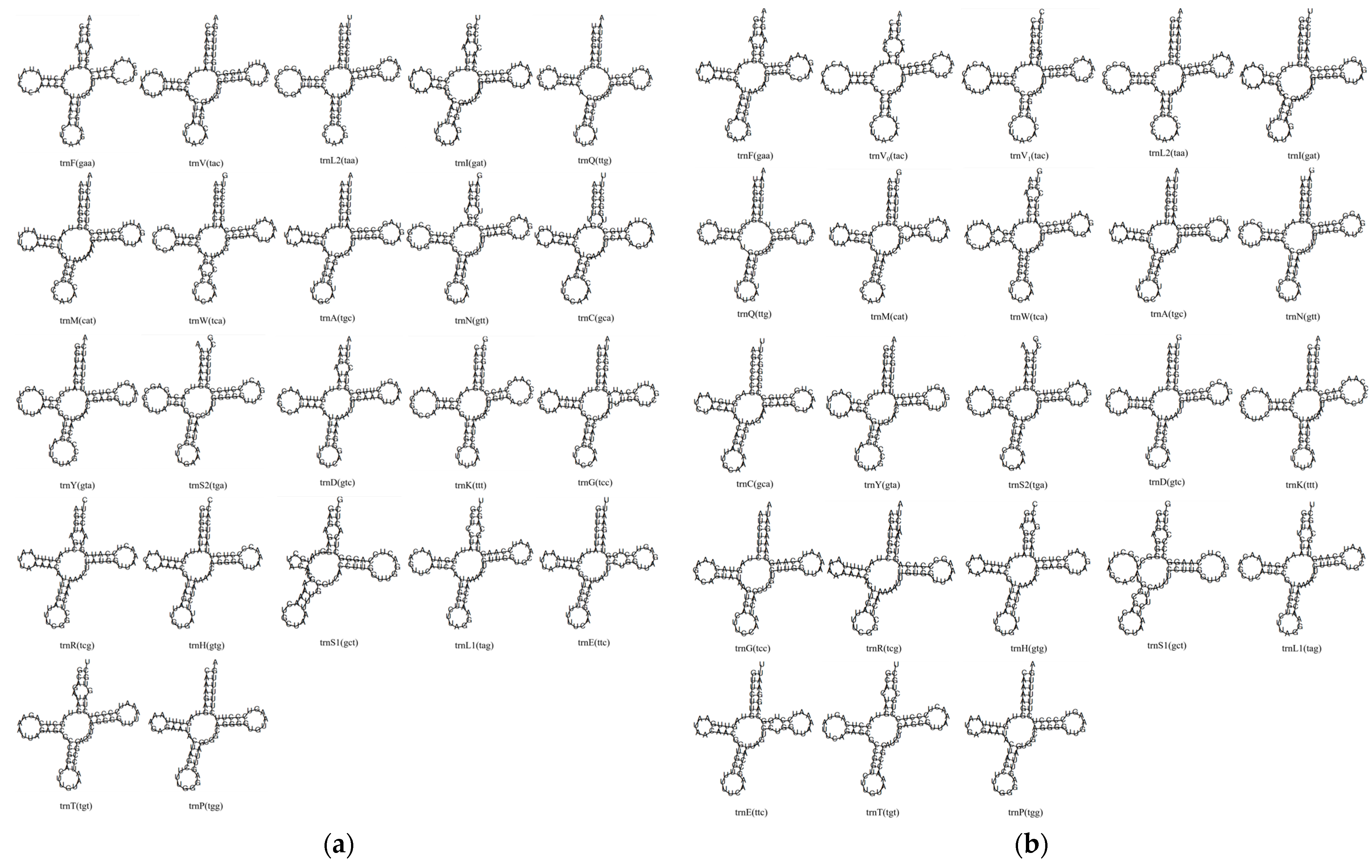
A notable feature in the mitogenome of L. olivaceus is a tandem duplication of the tRNA-Val gene located between the 12S and 16S rRNA genes. The two copies, designated tRNA-Val0 and tRNA-Val1, are separated by a 13 bp non-coding spacer and are encoded on the same strand (Table 2). Both copies retain the canonical valine anticodon (UAC) and fold into nearly identical, stable cloverleaf secondary structures (Figure 3). Only three single-nucleotide differences are observed between them, and their structural integrity suggests that both copies are likely functional. The presence of this duplication is further confirmed by targeted PCR amplification and subsequent Sanger sequencing across the entire locus (Table S1). A tandem duplication of the tRNA-Val gene within the 12S16S rRNA region represents a rare but recurrent structural variation within Lethrinidae. According to comparative mitogenomic data, only three species, L. olivaceus, Lethrinus nebulosus (Fabricius, 1775), and Lethrinus obsoletus (Fabricius, 1775), exhibit an extended 12S-tRNA-Val-16S region (165–202 bp) and confirmed tRNA-Val duplication, whereas the remaining lethrinid species possess a typical short interval (72–76 bp) with a single copy (Table S6).

3.4.4. tRNA Secondary Structures

Predicted secondary structures for all 22 tRNAs in both species are cloverleaf forms except tRNA-SerAGY, which lacks the dihydrouridine (DHU) arm (Figure 3). G-U wobble pairs are present in stem regions (35 in P. caninus and 35 in L. olivaceus), and no additional noncanonical mismatches were detected.

3.5. Characteristics of Control Region

The control region represents the primary non-coding sequence in both P. caninus and L. olivaceus. Consistent with the conserved vertebrate mitogenome architecture, this region is situated between the tRNA-Pro and tRNA-Phe genes. The control region is 1114 bp in P. caninus and 984 bp in L. olivaceus. This region shows a pronounced AT bias (62.5% in P. caninus; 60.0% in L. olivaceus) and a negative GC-skew (−0.062 and −0.178, respectively), reflecting mutational pressures typical of the heavy strand.
At the 5’ end (tRNA-Pro side), a termination-associated sequence (TAS)-like motif containing a TACAT core is present (P. caninus: “…TTATACATGGTG…”); in L. olivaceus, a TACACT variant is observed (“…CAGGTACACTCAT…”). Toward the 3’ end (tRNA-Phe side), both species exhibit a conserved-sequence-block cluster comprising a CSB-1-like element defined by “TAAAC” followed by a C-rich tract immediately adjacent to a CSB-2-like poly-C/G box (for example, “TAAACCCCCCTACCCCCCTA”), with an AAAC/AAACA short motif downstream as a CSB-3-like candidate. Other conserved blocks, such as CSB-D/E/F, are not clearly identifiable [37].

3.6. Phylogenetic Relationships

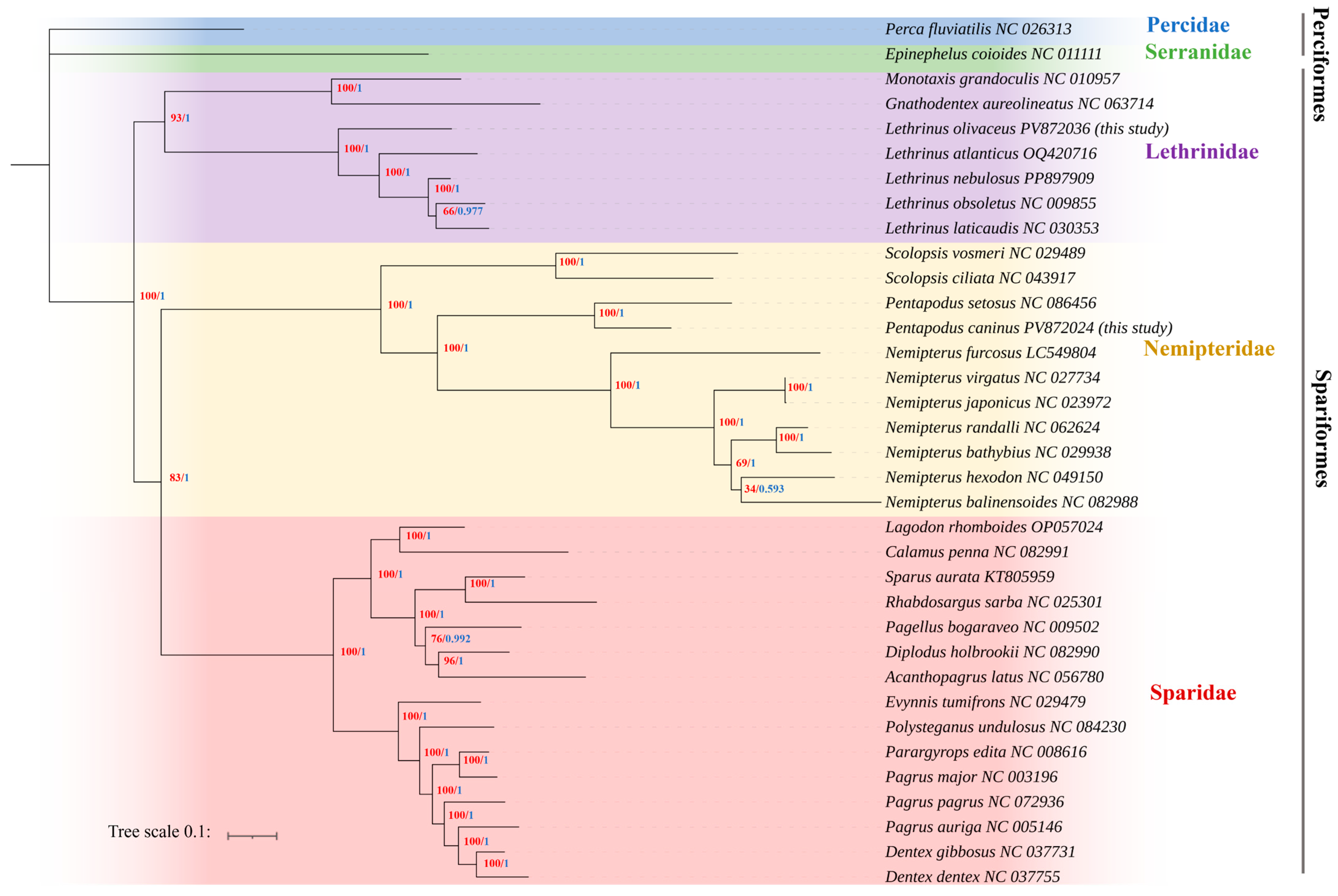
To clarify the phylogenetic positions of the two newly sequenced species, P. caninus and L. olivaceus, and to refine interfamilial relationships within Spariformes, we infer ML and BI trees from the concatenated nucleotide sequences of 13 mitochondrial protein-coding genes across 35 ingroup taxa, using Perca fluviatilis and Epinephelus coioides as outgroups (Figure 4).
L. olivaceus is recovered as the earliest-diverging lineage among the sampled Lethrinus species. Monotaxis grandoculis (Fabricius, 1775) and Gnathodentex aureolineatus (Lacepède, 1802) fall just outside the Lethrinus radiation, and internal Lethrinus groupings show short terminal branches with strong support. The sequencing of L. olivaceus adds to the mitogenomic representation of the genus, corroborating its phylogenetic placement within Lethrinidae. In Nemipteridae, Pentapodus caninus clusters with P. setosus, recovering a monophyletic Pentapodus lineage. This lineage forms a sister group to Scolopsis, while Nemipterus furcosus (Valenciennes, 1830) appears genetically divergent from other sampled Nemipterus species, suggesting potential generic-level distinctiveness that warrants further investigation. Within Sparidae, two strongly supported assemblages are recovered: a (Dentex, Pagrus) cluster and a (Sparus, Rhabdosargus, Diplodus) cluster.
The ML and BI analyses yield an identical overall topology with uniformly high nodal support, recovering unequivocal monophyly of the three sampled families and the backbone arrangement (Lethrinidae, (Nemipteridae, Sparidae)).

4. Discussion

The overall lengths (16,866 bp in P. caninus; 16,792 bp in L. olivaceus) and the standard complement and arrangement of 37 mitochondrial genes conform to the canonical teleost pattern, indicating absence of large-scale structural innovation in these two newly sequenced genomes. The counts and total sizes of intergenic spacers and overlaps fall within the range commonly reported for percomorph mitogenomes and are consistent with a compact genome architecture shaped by the tRNA-punctuation model [35,36]. The positive AT-skew combined with negative GC-skew in both whole mitogenomes reflects strand-asymmetric mutation patterns linked to replication-associated deamination and differential single-strand exposure during transcription/replication in vertebrate mitochondrial DNA [21,36]. These compositional skews and overall proportions are also consistent with patterns reported for Spariformes and related percomorph lineages [3,20,35], supporting conserved mutational or regulatory constraints among these taxa.
The uniformity of protein-coding gene lengths (e.g., shortest ATP8 and longest ND5) and strand distribution (ND6 on the L-strand, remaining PCGs on the H-strand) matches previously described teleost gene organizations. The use of GTG as the initiation codon for COX1 agrees with frequent alternative starts documented for teleost COX1 [13], suggesting conserved translational flexibility rather than a lineage-specific innovation. The mixture of complete and incomplete stop codons (COX2, ND4, CYTB) follows the well-known pattern whereby incomplete terminal codons are completed post-transcriptionally by polyadenylation [38]. Overall start/stop codon usage falls within the range reported for other Spariformes and related percomorph lineages [35], implying no unusual selection on translational initiation or termination signals. The contrasting GC-skew of ND6 relative to H-strand PCGs reflects the expected effect of strand location under replication-associated mutational bias in teleost mitogenomes [39]. This pattern reinforces the interpretation that compositional asymmetry reflects replication-associated mutational/repair processes tied to strand exposure, rather than locus-specific adaptive optimization.
Similarity in amino acid frequency profiles between the two species, with Leu, Ala, and Thr dominant and Cys rare, mirrors common teleost mitochondrial trends and suggests broadly conserved functional constraints on mitochondrially encoded proteins. The pronounced underrepresentation of G-ending codons (RSCU < 0.3 in multiple four-fold-degenerate families) and preferential use of A- or C-ending codons reflect underlying nucleotide skews at third positions. The avoidance of third-position G corresponds to the negative GC-skew of most H-strand genes and is consistent with asymmetric mutational pressure against guanine during replication [13]. Thus, codon usage patterns in P. caninus and L. olivaceus appear characteristic of teleost mitogenomes, shaped predominantly by mutational biases rather than by strong translational selection, and are comparable to those reported for other Spariformes species [3,20].
The lengths and arrangement of 12S and 16S rRNA genes, separated by tRNA-Val, match the typical vertebrate organization. The tandem duplication of tRNA-Val in L. olivaceus (two intact copies separated by a 13 bp spacer) represents a structural variant documented in a subset of Lethrinidae (L. olivaceus, L. nebulosus, L. obsoletus) showing expanded 12StRNA-Val16S intervals, whereas other Lethrinidae species retain a single-copy compact configuration (Table S6). Sequence comparisons in related species (one canonical plus one divergent or variant copy) suggest multiple processes—full tandem duplication, fragmental duplication, and subsequent sequence divergence or degeneration—have contributed to heterogeneity in this locus. Preservation of functional anticodons and predicted stable cloverleaf structures in both L. olivaceus copies supports potential retained functionality rather than incipient pseudogenization. Placement at the canonical rRNA junction and maintenance of structural integrity are consistent with a tandem duplication–random loss mechanism recognized for mitochondrial gene rearrangements [34,40]. Under the tRNA punctuation model, duplicated cleavage signals may be selectively neutral if transcript processing efficiency is not impaired [41]. Comparable tRNA duplications (including pseudogenized derivatives) in other teleost lineages (e.g., Labridae: Chlorurus sordidus (Fabricius, 1775)) [42,43] illustrate that such events, though infrequent, recur across Eupercaria and contribute sporadically to mitogenomic structural diversity [43,44]. The absence of noncanonical mismatches beyond expected G–U wobble pairs and the conserved loss of the DHU arm in tRNA-SerAGY—a characteristic vertebrate feature [45,46]—indicate strong functional constraints on tRNA secondary structure despite occasional duplication events.
Control-region lengths and marked AT bias with negative GC-skew values further reflect mutational pressures typical of the heavy strand, reinforcing shared replication/transcription dynamics in these mitogenomes. Detection of a TAS-like motif containing a TACAT core (variant TACACT in L. olivaceus) at the 5′ end and a downstream cluster of CSB-1-like (“TAAAC”), adjacent C-rich tract (CSB-2-like poly-C/G box), and an AAAC/AAACA short element (CSB-3-like candidate) at the 3′ end recapitulate canonical teleost control-region organization. The inability to clearly delimit additional conserved blocks (CSB-D/E/F) may reflect elevated sequence divergence in these lineages [37]. Overall TAS–CSB arrangement and compositional patterns indicate conserved regulatory architecture across Spariformes, with no evidence for lineage-specific acquisition or loss of major functional motifs.
The inclusion of the new complete mitogenomes for P. caninus and L. olivaceus enhances phylogenetic resolution within the Spariformes, providing robust support for relationships among major families. The recovery of L. olivaceus as the sister lineage to all other sampled Lethrinus species provides critical insight into the basal diversification of the genus. The clustering of P. caninus with P. setosus confirms a distinct Pentapodus clade separate from Scolopsis and the Nemipterus core assemblage. Recovery of two well-supported Sparidae subclusters (Dentex, Pagrus) and (Sparus, Rhabdosargus, Diplodus) agrees with prior mitogenomic topologies. Whereas previous work reported negligible bootstrap support (bootstrap = 36) for the arrangement ((Lethrinidae, Nemipteridae), Sparidae) [35], our analyses strongly resolve the topology as (Lethrinidae, (Nemipteridae, Sparidae)), corroborating a closer sister relationship between Nemipteridae and Sparidae. This strengthened support may reflect expanded taxon sampling and full PCG concatenation under both ML and BI frameworks. Further progress will benefit from denser taxon sampling (particularly unsampled genera and species) and incorporation of independent nuclear datasets and site-heterogeneous models to more fully test backbone relationships within Spariformes.

5. Conclusions

This study presents two new complete mitochondrial genomes for L. olivaceus and P. caninus, expanding the mitogenomic representation of Lethrinidae and Nemipteridae. Both mitogenomes conform to the canonical teleost organization (13 PCGs, 22 tRNAs, 2 rRNAs, and a control region) with conserved gene order and overall AT bias. A rare tandem duplication of the tRNA-Val gene was identified in Lethrinus olivaceus and related species, highlighting structural flexibility and lineage-specific rearrangements within Lethrinidae mitogenomes. The primary contribution of this work is the clarification of major phylogenetic uncertainties. ML and BI analyses of concatenated PCGs recover an identical, well-supported topology that confirms the monophyly of Lethrinidae, Nemipteridae, and Sparidae and resolves the backbone as (Lethrinidae, (Nemipteridae, Sparidae)). This study provides a revised phylogenetic framework for Spariformes, which can inform future comparative genomic and systematic research on this fish order. The genomic data generated provide valuable resources for taxonomic distinction and population genetic studies. However, future work incorporating nuclear genome-wide data is essential to test these mitochondrial hypotheses and fully resolve the evolutionary history of this group.

Supplementary Materials

The following supporting information can be downloaded at https://www.mdpi.com/article/10.3390/ani15243526/s1. Table S1: Primer pairs used for PCR amplification of the mitochondrial genomes of Pentapodus caninus and Lethrinus olivaceus; Table S2: List of mitochondrial genomes from Spariformes and Perciformes species used in this study, with Perca fluviatilis and Epinephelus coioides included as the outgroups; Table S3: Merged partition scheme and best-fit nucleotide substitution models inferred by ModelFinder for mitochondrial protein-coding genes (PCGs) of 35 fishes’ species; Table S4: Nucleotide composition of the mitochondrial PCGs of Pentapodus caninus; Table S5: Nucleotide composition of the mitochondrial PCGs of Lethrinus olivaceus; Table S6: Presence or absence of tRNA-Val gene duplication in the 12S–tRNA-Val–16S region across representative Spariformes mitogenomes; Table S7: Codon frequencies and relative synonymous codon usage (RSCU) of the mitochondrial PCGs of fish species of Percoidei.

Author Contributions

Conceptualization, N.C. and L.C.; methodology, N.C.; software, L.X., M.G. and W.J.; validation, N.C., M.G. and W.J.; formal analysis, Q.Q. and L.X.; investigation, N.C.; resources, J.C. and Y.D.; data curation, Q.Q. and J.C.; writing—original draft preparation, N.C.; writing—review and editing, Y.D. and L.C.; visualization, N.C.; supervision, S.L. and L.C.; project administration, S.L. and L.C. All authors have read and agreed to the published version of the manuscript.

Funding

This work was supported by the National Key R&D Program of China (No. 2022-36) and Fundamental Research Funds for the Central Universities (No. 21624402).

Institutional Review Board Statement

This study was approved by the Jinan University Laboratory Animal Welfare and Ethics Committee, with no ethical code associated (Effective from March 2025). The experiments were conducted in accordance with the National Institutes of Health Guide for the Care and Use of Laboratory Animals.

Informed Consent Statement

Not applicable, as this study did not involve humans.

Data Availability Statement

The original contributions presented in this study are included in the article/Supplementary Materials. Further inquiries can be directed to the corresponding authors.

Conflicts of Interest

The authors declare no conflicts of interest.

Abbreviations

The following abbreviations are used in this manuscript:
PCGsProtein-coding genes
tRNATransfer RNA
rRNARibosomalRNA
RSCURelative synonymous codon usage
MLMaximum likelihood
BIBayesian inference
DHUDihydrouridine
D-loopNon-coding control region
TASTermination-associated sequence

References

  1. Betancur-R, R.; Wiley, E.O.; Arratia, G.; Acero, A.; Bailly, N.; Miya, M.; Lecointre, G.; Orti, G. Phylogenetic classification of bony fishes. BMC Evol. Biol. 2017, 17, 162. [Google Scholar] [CrossRef] [PubMed]
  2. Nelson, J.S.; Grande, T.C.; Wilson, M.V. Fishes of the World; John Wiley & Sons: Hoboken, NJ, USA, 2016. [Google Scholar] [CrossRef]
  3. Sanciangco, M.D.; Carpenter, K.E.; Betancur-R, R. Phylogenetic placement of enigmatic percomorph families (Teleostei: Percomorphaceae). Mol. Phylogenet. Evol. 2016, 94, 565–576. [Google Scholar] [CrossRef] [PubMed]
  4. Carpenter, K.E.; Johnson, G.D. A phylogeny of sparoid fishes (Perciformes, Percoidei) based on morphology. Ichthyol. Res. 2002, 49, 114–127. [Google Scholar] [CrossRef]
  5. Day, J.J. Phylogenetic relationships of the Sparidae (Teleostei: Percoidei) and implications for convergent trophic evolution. Biol. J. Linn. Soc. 2002, 76, 269–301. [Google Scholar] [CrossRef]
  6. Johnson, G.D. The Limits and Relationships of the Lutjanidae and Associated Families; University of California Press: Oakland, CA, USA, 1980. [Google Scholar]
  7. Natsidis, P.; Tsakogiannis, A.; Pavlidis, P.; Tsigenopoulos, C.S.; Manousaki, T. Phylogenomics investigation of sparids (Teleostei: Spariformes) using high-quality proteomes highlights the importance of taxon sampling. Commun. Biol. 2019, 2, 400. [Google Scholar] [CrossRef]
  8. Damadi, E.; Moghaddam, F.Y.; Ghanbarifardi, M. Taxonomic characterization of five species of emperor fishes (Actinopterygii: Eupercaria: Lethrinidae) based on external morphology, morphometry, and geographic distribution in the northwestern Indian Ocean. Acta Ichthyol. Piscat. 2024, 54, 115–124. [Google Scholar] [CrossRef]
  9. Fabian, V.; Houk, P.; Lemer, S. Phylogeny of Micronesian emperor fishes and evolution of trophic types. Mol. Phylogenet. Evol. 2021, 162, 107207. [Google Scholar] [CrossRef]
  10. Carpenter, K.E. FAO Species Catalogue. v. 9: Emperor Fishes and Largeeye Breams of the World (Family Lethrinidae); Food & Agriculture Org.: Rome, Italy, 1989. [Google Scholar]
  11. Russell, B.C. Nemipterid fishes of the world. FAO Fish. Synop. 1990, 12, I. [Google Scholar]
  12. Bowen, B.W.; Rocha, L.A.; Toonen, R.J.; Karl, S.A. The origins of tropical marine biodiversity. Trends Ecol. Evol. 2013, 28, 359–366. [Google Scholar] [CrossRef]
  13. Miya, M.; Takeshima, H.; Endo, H.; Ishiguro, N.B.; Inoue, J.G.; Mukai, T.; Satoh, T.P.; Yamaguchi, M.; Kawaguchi, A.; Mabuchi, K. Major patterns of higher teleostean phylogenies: A new perspective based on 100 complete mitochondrial DNA sequences. Mol. Phylogenet. Evol. 2003, 26, 121–138. [Google Scholar] [CrossRef]
  14. Chen, W.; Borsa, P. Diversity, phylogeny, and historical biogeography of large-eye seabreams (Teleostei: Lethrinidae). Mol. Phylogenet. Evol. 2020, 151, 106902. [Google Scholar] [CrossRef] [PubMed]
  15. Froese, R.; Pauly, D. FishBase. World Wide Web Electronic Publication. Version (04/2025). Available online: www.fishbase.org (accessed on 10 June 2025).
  16. Schoch, C.L.; Ciufo, S.; Domrachev, M.; Hotton, C.L.; Kannan, S.; Khovanskaya, R.; Leipe, D.; Mcveigh, R.; O Neill, K.; Robbertse, B. NCBI Taxonomy: A comprehensive update on curation, resources and tools. Database 2020, 2020, a62. [Google Scholar] [CrossRef]
  17. Lo Galbo, A.M.; Carpenter, K.E.; Reed, D.L. Evolution of trophic types in emperor fishes (Lethrinus, Lethrinidae, Percoidei) based on cytochrome b gene sequence variation. J. Mol. Evol. 2002, 54, 754–762. [Google Scholar] [CrossRef] [PubMed]
  18. Hung, K.W.; Russell, B.C.; Chen, W.J. Molecular systematics of threadfin breams and relatives (Teleostei, Nemipteridae). Zool. Scr. 2017, 46, 536–551. [Google Scholar] [CrossRef]
  19. Ogwang, J.; Bariche, M.; Bos, A.R. Genetic diversity and phylogenetic relationships of threadfin breams (Nemipterus spp.) from the Red Sea and eastern Mediterranean Sea. Genome 2021, 64, 207–216. [Google Scholar] [CrossRef]
  20. Wujdi, A.; Ewusi, E.O.M.; Sektiana, S.P.; Amin, M.H.F.A.; López-Vera, E.; Kim, H.; Kang, H.; Kundu, S. Mitogenomic characterization and phylogenetic placement of the Red pandora Pagellus bellottii from the Eastern Atlantic Ocean within the family Sparidae. Sci. Rep. 2025, 15, 30432. [Google Scholar] [CrossRef]
  21. Cui, L.; Cao, R.; Dong, Y.; Gao, X.; Cen, J.; Lu, S. The first complete mitochondrial genome of the flathead Cociella crocodilus (Scorpaeniformes: Platycephalidae) and the phylogenetic relationships within Scorpaeniformes based on whole mitogenomes. Genes 2019, 10, 533. [Google Scholar] [CrossRef]
  22. Cui, L.; Dong, Y.; Cao, R.; Zhou, X.; Lu, S. Characterization of the complete mitochondrial genome of Arius dispar (Siluriformes: Ariidae) and phylogenetic analysis among sea catfishes. J. Ocean Univ. China 2020, 19, 1198–1206. [Google Scholar] [CrossRef]
  23. Bernt, M.; Donath, A.; Jühling, F.; Externbrink, F.; Florentz, C.; Fritzsch, G.; Pütz, J.; Middendorf, M.; Stadler, P.F. MITOS: Improved de novo metazoan mitochondrial genome annotation. Mol. Phylogenet. Evol. 2013, 69, 313–319. [Google Scholar] [CrossRef]
  24. Iwasaki, W.; Fukunaga, T.; Isagozawa, R.; Yamada, K.; Maeda, Y.; Satoh, T.P.; Sado, T.; Mabuchi, K.; Takeshima, H.; Miya, M. MitoFish and MitoAnnotator: A mitochondrial genome database of fish with an accurate and automatic annotation pipeline. Mol. Biol. Evol. 2013, 30, 2531–2540. [Google Scholar] [CrossRef]
  25. Camacho, C.; Coulouris, G.; Avagyan, V.; Ma, N.; Papadopoulos, J.; Bealer, K.; Madden, T.L. BLAST+: Architecture and applications. BMC Bioinform. 2009, 10, 421. [Google Scholar] [CrossRef] [PubMed]
  26. Reuter, J.S.; Mathews, D.H. RNAstructure: Software for RNA secondary structure prediction and analysis. BMC Bioinform. 2010, 11, 129. [Google Scholar] [CrossRef] [PubMed]
  27. Kumar, S.; Stecher, G.; Li, M.; Knyaz, C.; Tamura, K. MEGA X: Molecular evolutionary genetics analysis across computing platforms. Mol. Biol. Evol. 2018, 35, 1547–1549. [Google Scholar] [CrossRef] [PubMed]
  28. Capella-Gutiérrez, S.; Silla-Martínez, J.M.; Gabaldón, T. trimAl: A tool for automated alignment trimming in large-scale phylogenetic analyses. Bioinformatics 2009, 25, 1972–1973. [Google Scholar] [CrossRef]
  29. Kalyaanamoorthy, S.; Minh, B.Q.; Wong, T.K.; Von Haeseler, A.; Jermiin, L.S. ModelFinder: Fast model selection for accurate phylogenetic estimates. Nat. Methods 2017, 14, 587–589. [Google Scholar] [CrossRef]
  30. Stamatakis, A. RAxML version 8: A tool for phylogenetic analysis and post-analysis of large phylogenies. Bioinformatics 2014, 30, 1312–1313. [Google Scholar] [CrossRef]
  31. Posada, D. jModelTest: Phylogenetic model averaging. Mol. Biol. Evol. 2008, 25, 1253–1256. [Google Scholar] [CrossRef]
  32. Zhang, D.; Gao, F.; Jakovlić, I.; Zou, H.; Zhang, J.; Li, W.X.; Wang, G.T. PhyloSuite: An integrated and scalable desktop platform for streamlined molecular sequence data management and evolutionary phylogenetics studies. Mol. Ecol. Resour. 2020, 20, 348–355. [Google Scholar] [CrossRef]
  33. Letunic, I.; Bork, P. Interactive Tree of Life (iTOL) v6: Recent updates to the phylogenetic tree display and annotation tool. Nucleic Acids Res. 2024, 52, W78–W82. [Google Scholar] [CrossRef]
  34. Boore, J.L. Animal mitochondrial genomes. Nucleic Acids Res. 1999, 27, 1767–1780. [Google Scholar] [CrossRef]
  35. Kundu, S.; Kang, H.; Go, Y.; Bang, G.; Jang, Y.; Htoo, H.; Aini, S.; Kim, H. Mitogenomic architecture of Atlantic emperor Lethrinus atlanticus (Actinopterygii: Spariformes): Insights into the lineage diversification in Atlantic Ocean. Int. J. Mol. Sci. 2024, 25, 10700. [Google Scholar] [CrossRef] [PubMed]
  36. Perna, N.T.; Kocher, T.D. Patterns of nucleotide composition at fourfold degenerate sites of animal mitochondrial genomes. J. Mol. Evol. 1995, 41, 353–358. [Google Scholar] [CrossRef] [PubMed]
  37. Miya, M.; Kawaguchi, A.; Nishida, M. Mitogenomic exploration of higher teleostean phylogenies: A case study for moderate-scale evolutionary genomics with 38 newly determined complete mitochondrial DNA sequences. Mol. Biol. Evol. 2001, 18, 1993–2009. [Google Scholar] [CrossRef] [PubMed]
  38. Taanman, J. The mitochondrial genome: Structure, transcription, translation and replication. Biochim. Biophys. Acta (BBA)-Bioenerg. 1999, 1410, 103–123. [Google Scholar] [CrossRef]
  39. Hassanin, A.; Leger, N.; Deutsch, J. Evidence for multiple reversals of asymmetric mutational constraints during the evolution of the mitochondrial genome of Metazoa, and consequences for phylogenetic inferences. Syst. Biol. 2005, 54, 277–298. [Google Scholar] [CrossRef]
  40. Macey, J.R.; Larson, A.; Ananjeva, N.B.; Fang, Z.; Papenfuss, T.J. Two novel gene orders and the role of light-strand replication in rearrangement of the vertebrate mitochondrial genome. Mol. Biol. Evol. 1997, 14, 91–104. [Google Scholar] [CrossRef]
  41. Ojala, D.; Montoya, J.; Attardi, G. tRNA punctuation model of RNA processing in human mitochondria. Nature 1981, 290, 470–474. [Google Scholar] [CrossRef]
  42. Mabuchi, K.; Miya, M.; Satoh, T.P.; Westneat, M.W.; Nishida, M. Gene rearrangements and evolution of tRNA pseudogenes in the mitochondrial genome of the parrotfish (Teleostei: Perciformes: Scaridae). J. Mol. Evol. 2004, 59, 287–297. [Google Scholar] [CrossRef]
  43. Formenti, G.; Rhie, A.; Balacco, J.; Haase, B.; Mountcastle, J.; Fedrigo, O.; Brown, S.; Capodiferro, M.R.; Al-Ajli, F.O.; Ambrosini, R. Complete vertebrate mitogenomes reveal widespread repeats and gene duplications. Genome Biol. 2021, 22, 120. [Google Scholar] [CrossRef]
  44. Alvarenga, M.; D Elia, A.K.P.; Rocha, G.; Arantes, C.A.; Henning, F.; de Vasconcelos, A.T.R.; Solé-Cava, A.M. Mitochondrial genome structure and composition in 70 fishes: A key resource for fisheries management in the South Atlantic. BMC Genom. 2024, 25, 215. [Google Scholar] [CrossRef]
  45. Panja, A.S. The systematic codon usage bias has an important effect on genetic adaption in native species. Gene 2024, 926, 148627. [Google Scholar] [CrossRef]
  46. Watanabe, Y.; Suematsu, T.; Ohtsuki, T. Losing the stem-loop structure from metazoan mitochondrial tRNAs and co-evolution of interacting factors. Front. Genet. 2014, 5, 109. [Google Scholar] [CrossRef]
Figure 1. Circular genome visualizations for P. caninus (a) and L. olivaceus (b). Genes encoded on the heavy strand are plotted on the outer circle, whereas those on the light strand are positioned on the inner circle.
Animals 15 03526 g001
Figure 2. Analysis of codon usage bias in mitochondrial PCGs. Charts display codon frequencies and relative synonymous codon usage (RSCU) values for P. caninus (a) and L. olivaceus (b).
Animals 15 03526 g002
Figure 3. Putative secondary structures for the complete set of 22 mitochondrial tRNAs in P. caninus (a) and L. olivaceus (b).
Animals 15 03526 g003
Figure 4. Phylogenetic reconstruction of Spariformes relationships. The tree topology was inferred from the concatenated dataset of 13 PCGs using Maximum Likelihood (ML) and Bayesian Inference (BI). Nodal support is indicated by numbers on branches: red values represent ML bootstrap percentages, while blue values denote Bayesian posterior probabilities. Perca fluviatilis and Epinephelus coioides were included as outgroups.
Animals 15 03526 g004
Table 1. Organization and genomic features of the P. caninus mitogenome. “H” and “L” denote genes located on the heavy and light strands, respectively.
FeaturePositionSizeStrandSpacer (+) /Overlap (−)Start/Stop
Codon
AntiCodon
StartEnd
tRNA-Phe17171H0-GAA
12S rRNA721068997H2--
tRNA-Val1071114272H22-TAC
16S rRNA116528691705H1--
tRNA-LeuUUR2871294474H0-TAA
ND129453919975H4ATG/TAA-
tRNA-Ile3924399370H−1-GAT
tRNA-Gln3993406371L−1-TTG
tRNA-Met4063413270H0-CAT
ND2413351791047H−1ATG/TAA-
tRNA-Trp5179525072H0-TCA
tRNA-Ala5251531969L2-TGC
tRNA-Asn5322539473L34-GTT
tRNA-Cys5429549769L0-GCA
tRNA-Tyr5498556871L1-GTA
COX1557071201551H1GTG/TAA-
tRNA-SerUCN7122719271L2-TGA
tRNA-Asp7195726672H7-GTC
COX272747964691H0ATG/T---
tRNA-Lys7965803975H1-TTT
ATP880418208168H−10ATG/TAA-
ATP681998882684H−1ATG/TAA-
COX388829667786H−1ATG/TAA-
tRNA-Gly9667973771H0-TCC
ND3973810,088351H−2ATG/TAG-
tRNA-Arg10,08710,15569H0-TCG
ND4L10,15610,452297H−7ATG/TAA-
ND410,44611,8261381H0ATG/T---
tRNA-His11,82711,89569H0-GTG
tRNA-SerAGY11,89611,96267H3-GCT
tRNA-LeuCUN11,96612,03873H0-TAG
ND512,03913,8771839H−4ATG/TAA-
ND613,87414,395522L1ATG/TAA-
tRNA-Glu14,39714,46569L4-TTC
CYTB14,47015,6101141H0ATG/T---
tRNA-Thr15,61115,68474H−1-TGT
tRNA-Pro15,68415,75269L1-TGG
D-loop15,75316,8661114H0--
Table 2. Organization and genomic features of the L. olivaceus mitogenome. “H” and “L” denote genes located on the heavy and light strands, respectively.
FeaturePositionSizeStrandSpacer (+) /Overlap (−)Start/Stop
Codon
AntiCodon
StartEnd
tRNA-Phe16868H0-GAA
12S rRNA691023955H1--
tRNA-Val01025109874H13-TAC
tRNA-Val11112118675H39 TAC
16S rRNA122628941669H5--
tRNA-LeuUUR2900297374H0-TAA
ND129743945972H4ATG/TAG-
tRNA-Ile3950401970H−1-GAT
tRNA-Gln4019408971L−1-TTG
tRNA-Met4089415870H0-CAT
ND2415952051047H−1ATG/TAA-
tRNA-Trp5205527773H0-TCA
tRNA-Ala5278534669L1-TGC
tRNA-Asn5348542073L37-GTT
tRNA-Cys5458552669L0-GCA
tRNA-Tyr5527559670L1-GTA
COX1559871481551H1GTG/TAG-
tRNA-SerUCN7150722071L3-TGA
tRNA-Asp7224729572H7-GTC
COX273037993691H0ATG/T---
tRNA-Lys7994806976H1-TTT
ATP880718238168H13ATG/TAA-
ATP682528935684H−1ATG/TAA-
COX389359720786H−1ATG/TAA-
tRNA-Gly9720979071H0-TCC
ND3979110,141351H−2ATG/TAG-
tRNA-Arg10,14010,20869H0-TCG
ND4L10,20910,505297H−7ATG/TAA-
ND410,49911,8791381H0ATG/T---
tRNA-His11,88011,94869H0-GTG
tRNA-SerAGY11,94912,01870H5-GCT
tRNA-LeuCUN12,02412,09673H0-TAG
ND512,09713,9351839H−4ATG/TAG-
ND613,93214,453522L0ATG/TAG-
tRNA-Glu14,45414,52269L4-TTC
CYTB14,52715,6671141H0ATG/T---
tRNA-Thr15,66815,74073H−1-TGT
tRNA-Pro15,74015,80869L1-TGG
D-loop15,80916,792984H0--
Disclaimer/Publisher’s Note: The statements, opinions and data contained in all publications are solely those of the individual author(s) and contributor(s) and not of MDPI and/or the editor(s). MDPI and/or the editor(s) disclaim responsibility for any injury to people or property resulting from any ideas, methods, instructions or products referred to in the content.