Genetic Structure and Genetic Diversity of the Endemic Korean Aucha Perch, Coreoperca herzi (Centropomidae), in Korea



Abstract
Simple Summary
Abstract
1. Introduction
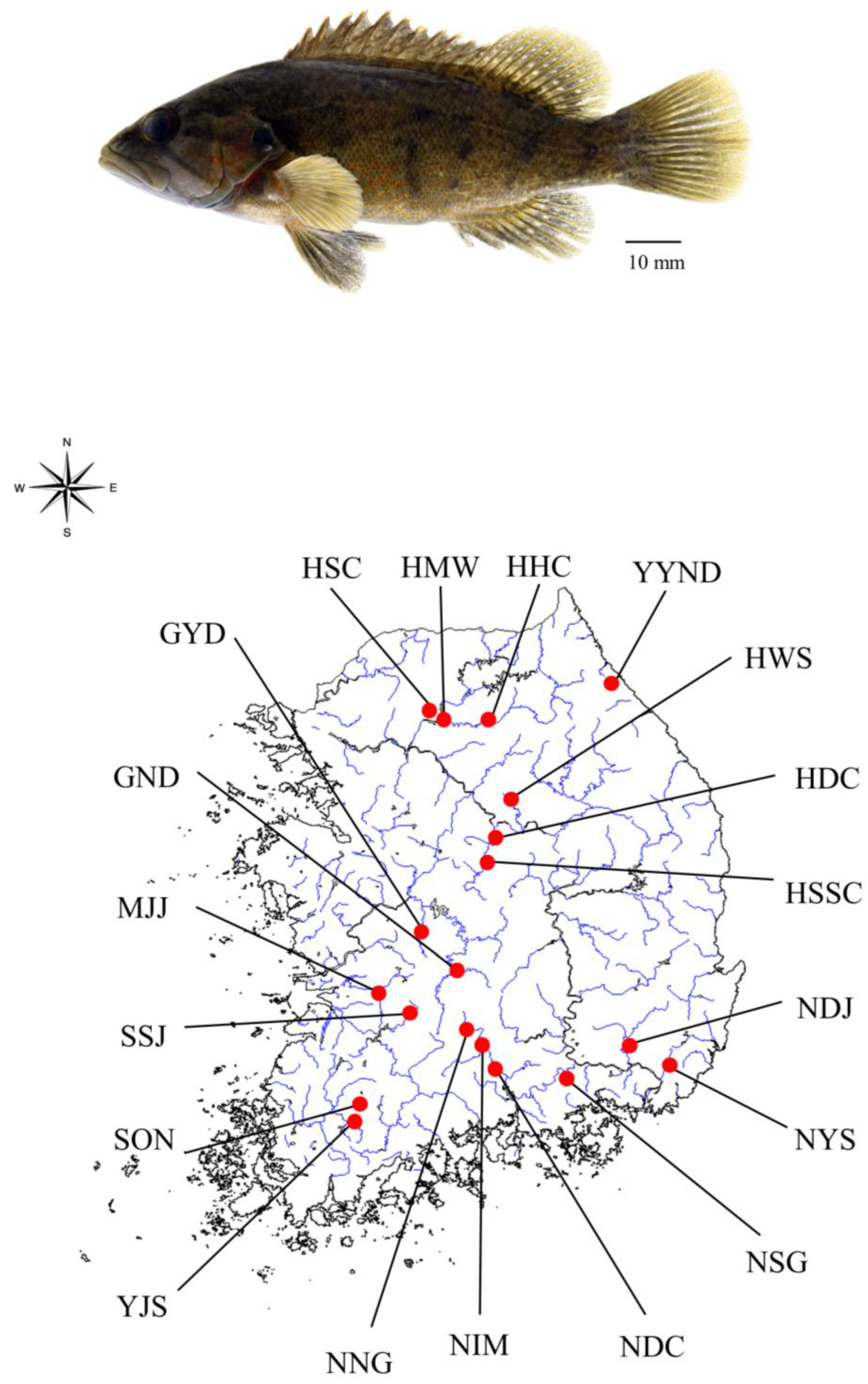
2. Materials and Methods
2.1. Sample Collection and DNA Extraction
2.2. MtDNA Sequencing
2.3. Statistical Analysis of Genetic Diversity in MtDNA
3. Results
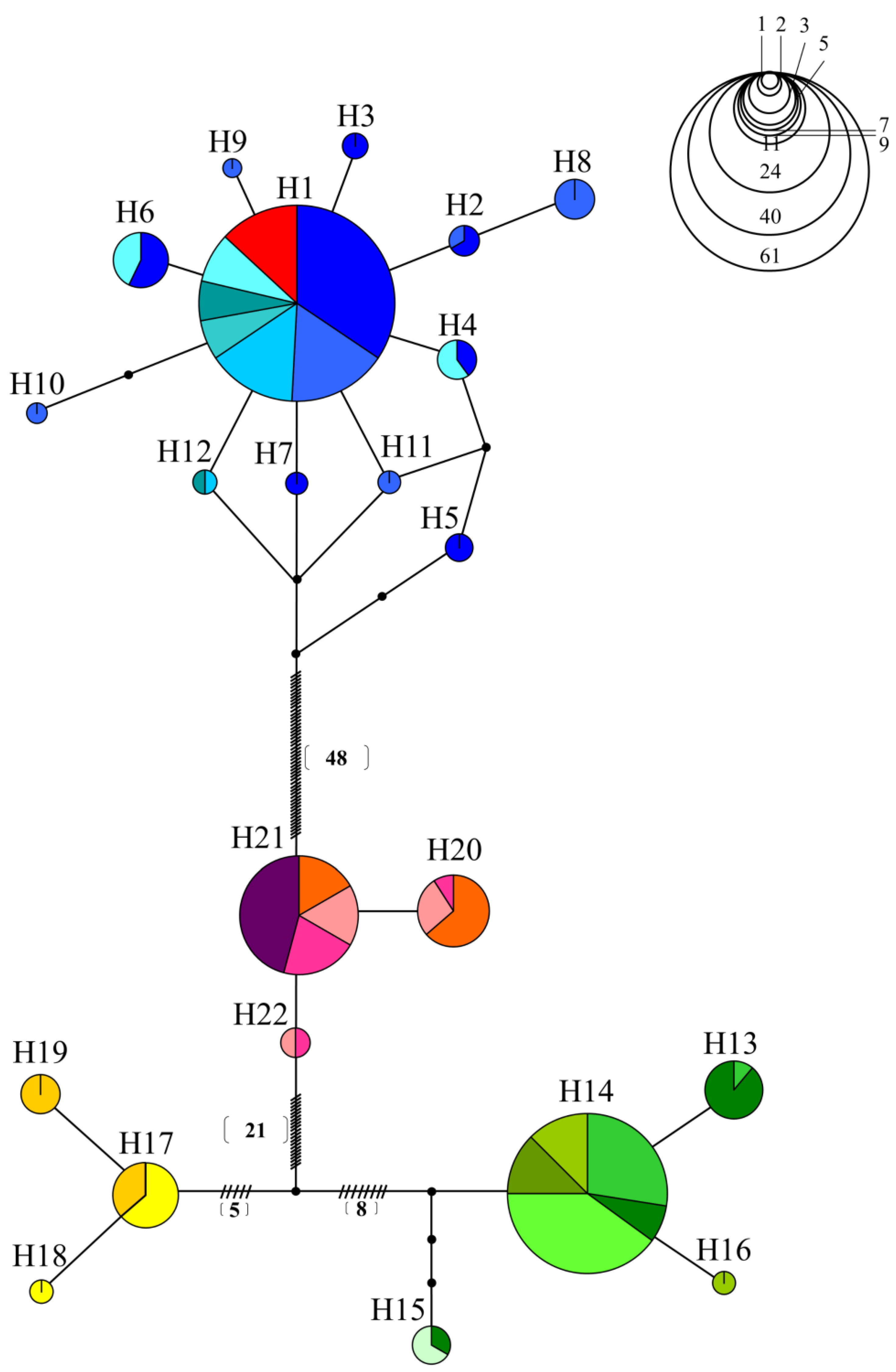
3.1. Genetic Diversity
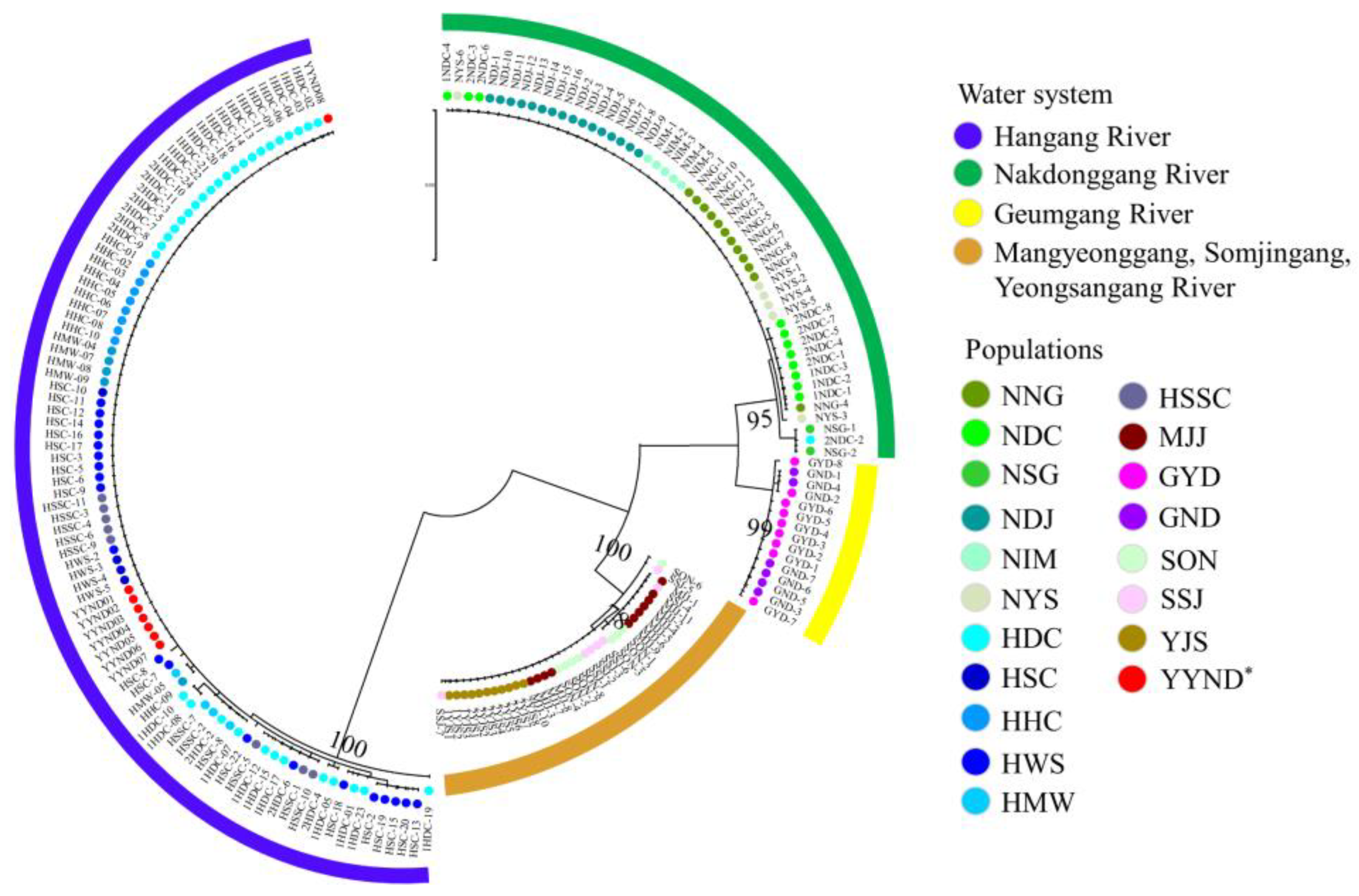
3.2. Variations in the Genetic Differentiation of Populations
3.3. Population Genetic Structure
4. Discussion
4.1. Genetic Diversity within 19 Populations of C. herzi
4.2. Genetic Structure of Wild and Translocated Populations
5. Conservation Implications
6. Conclusions
Supplementary Materials
Author Contributions
Funding
Institutional Review Board Statement
Data Availability Statement
Conflicts of Interest
References
- Kim, I.S.; Park, J.Y. Freshwater Fishes of Korea; Kyohak: Seoul, Republic of Korea, 2002; 465p. [Google Scholar]
- Han, K.H.; Park, J.T.; Jung, G.H.; Lee, W.K.; Lee, J.Y.; Bang, I.C. Spawning behavior and early life history of Korean aucha perch, Coreoperca herzi Herzenstein. J. Aquacult. 1998, 11, 49–58. [Google Scholar]
- Barbat-Leterrier, A.; Guyomard, R.; Krieg, F. Introgression between introduced domesticated strains and Mediterranean native populations of brown trout (Salmo trutta L.). Aquat. Living Resour. 1989, 2, 215–223. [Google Scholar] [CrossRef][Green Version]
- Madeira, M.J.; Gómez-Moliner, B.J.; Barbé, A.M. Genetic introgression on freshwater fish populations caused by restocking programmes. Biol. Invasions 2005, 7, 117–125. [Google Scholar] [CrossRef]
- Kajungiro, R.A.; Palaiokostas, C.; Pinto, F.A.L.; Mmochi, A.J.; Mtolera, M.; Houston, R.D.; De Koning, D.J. Population structure and genetic diversity of Nile tilapia (Oreochromis niloticus) strains cultured in Tanzania. Front. Genet. 2019, 10, 1269. [Google Scholar] [CrossRef] [PubMed]
- Byeon, H.K. Studies on the feeding habits of Korean aucha perch, Coreoperca herzi in the Geum River, Korea. Korean J. Environ. Ecol. 2017, 31, 472–478. [Google Scholar] [CrossRef]
- Gye, M.C. Spermatogenesis of Coreoperca herzi (Perciformes; Percichthyidae). Korean J. Ecol. Environ. 2002, 35, 232–236. [Google Scholar]
- Park, C.E.; Park, G.S.; Kwak, Y.; Hong, S.J.; Khan, A.R.; Jung, B.K.; Park, Y.J.; Kim, M.C.; Kim, K.H.; Park, H.C.; et al. Complete mitochondrial genome of the endemic species Korean aucha perch Coreoperca herzi (Teleostei, Centrarchiformes, Sinipercidae). Mitochondrial DNA Part A DNA Mapp. Seq. Anal. 2016, 27, 3493–3495. [Google Scholar] [CrossRef]
- Park, J.M.; Jeon, H.B.; Suk, H.Y.; Cho, S.J.; Han, K.H. Early life history of Coreoperca herzi in Han River, Korea. Dev. Reprod. 2020, 24, 63–70. [Google Scholar] [CrossRef]
- Parvez, I.; Mahajebin, T.; Clarke, M.L.; Chhanda, M.S.; Sultana, S. Genetic variation of native and introduced climbing perch Anabas testudineus (Bloch, 1792) derived from mitochondrial DNA analyses. Ecol. Genet. Genom. 2020, 17, 100067. [Google Scholar] [CrossRef]
- Zhao, L.; Dong, J.; Sun, C.; Tian, Y.; Hu, J.; Ye, X. Phylogenetic analysis of sooty grunter and other major freshwater fishes in the suborder Percoidei based on mitochondrial DNA. Mitochondrial DNA Part A DNA Mapp. Seq. Anal. 2019, 30, 234–248. [Google Scholar] [CrossRef]
- Byeon, H.K.; Oh, J.K. Fluctuation of fish community and inhabiting status of introduced fish in Gangeungnamdae stream, Korea. Korean J. Environ. Ecol. 2015, 29, 718–728. [Google Scholar] [CrossRef]
- Byeon, H.K. Habitat characteric of Coreoperca herzi and Coreoleuciscus, and effect on introduced to different water system. Korean. Nat. Conserv. 2014, 165, 13–23. (In Korean) [Google Scholar]
- Paolucci, E.M.; MacIsaac, H.J.; Ricciardi, A. Origin matters: Alien consumers inflict greater damage on prey populations than do native consumers. Divers. Distrib. 2013, 19, 988–995. [Google Scholar] [CrossRef]
- Ward, R.D.; Zemlak, T.S.; Innes, B.H.; Last, P.R.; Hebert, P.D. DNA barcoding Australia’s fish species. Philos. Trans R. Soc. Lond. B Biol. Sci. 2005, 360, 1847–1857. [Google Scholar] [CrossRef]
- Tamura, K.; Dudley, J.; Nei, M.; Kumar, S. MEGA4: Molecular Evolutionary Genetics Analysis (MEGA) software version 4.0. Mol. Biol. Evol. 2007, 24, 1596–1599. [Google Scholar] [CrossRef]
- Librado, P.; Rozas, J. DnaSP v5: A software for comprehensive analysis of DNA polymorphism data. Bioinformatics 2009, 25, 1451–1452. [Google Scholar] [CrossRef] [PubMed]
- Bandelt, H.J.; Forster, P.; Röhl, A. Median-joining networks for inferring intraspecific phylogenies. Mol. Biol. Evol. 1999, 16, 37–48. [Google Scholar] [CrossRef]
- Excoffier, L.; Lischer, H.E. Arlequin suite ver 3.5: A new series of programs to perform population genetics analyses under Linux and Windows. Mol. Ecol. Resour. 2010, 10, 564–567. [Google Scholar] [CrossRef] [PubMed]
- Guindon, S.; Gascuel, O. A simple, fast, and accurate algorithm to estimate large phylogenies by maximum likelihood. Syst. Biol. 2003, 52, 696–704. [Google Scholar] [CrossRef]
- Frankham, R. Genetics and extinction. Biol. Conserv. 2005, 126, 131–140. [Google Scholar] [CrossRef]
- Cao, L.; Liang, X.F.; Du, Y.; Zheng, H.; Yang, M.; Huang, W. Genetic population structure in Siniperca scherzeri (Perciformes: Siniperca) in China inferred from mitochondrial DNA sequences and microsatellite loci. Biochem. Syst. Ecol. 2013, 51, 160–170. [Google Scholar] [CrossRef]
- Tian, C.; Yang, M.; Liang, X.F.; Cao, L.; Zheng, H.; Zhao, C.; Zhu, K.; Yuan, Y. Population genetic structure of Siniperca chuatsi in the middle reach of the Yangtze River inferred from mitochondrial DNA and microsatellite loci. Mitochondrial DNA 2015, 26, 61–67. [Google Scholar] [CrossRef] [PubMed]
- Madduppa, H.H.; Timm, J.; Kochzius, M. Reduced genetic diversity in the clown anemonefish Amphiprion ocellaris in exploited reefs of Spermonde Archipelago, Indonesia. Front. Mar. Sci. 2018, 5, 80. [Google Scholar] [CrossRef]
- Byeon, H.K. Ecological characteristics of Korean aucha perch, Coreoperca herzi in Jaho Stream, Korea. Korean J. Environ. Ecol. 2020, 34, 216–223. [Google Scholar] [CrossRef]
- Yang, T.; Huang, X.; Jiang, Y. Reveal the population genetic characteristics of Bombay duck (Harpadon nehereus) in coastal waters of China with genotyping-by-sequencing technique. J. Ocean Univ. China 2022, 21, 1373–1380. [Google Scholar] [CrossRef]
- Jang, S.H.; Ryu, H.S.; Lee, J.H. Stock assessment and management implications of the Korean aucha perch (Coreoperca herzi) in freshwater: (2) Estimation of potential yield assessment and stock of Coreoperca herzi in the mid-upper system of the Seomjin River. Korean J. Ecol. Environ. 2011, 44, 172–177. [Google Scholar]



| ID | MtDNA | h | Hd | Nucleotide Diversity | D | F |
|---|---|---|---|---|---|---|
| NNG | 12 | 2 | 0.16667 | 0.00025 | −1.14053 | −0.47566 |
| NDC | 12 | 3 | 0.53030 | 0.00176 | −1.12253 | 0.97942 |
| NSG | 2 | 1 | 0.00000 | 0.00000 | - | - |
| NDJ | 16 | 1 | 0.00000 | 0.00000 | - | - |
| NIM | 5 | 1 | 0.00000 | 0.00000 | - | - |
| NYS | 6 | 2 | 0.33333 | 0.00051 | −0.93302 | −0.00275 |
| HDC | 34 | 7 | 0.60784 | 0.00144 | −1.28905 | −2.74768 |
| HSC | 19 | 6 | 0.67836 | 0.00196 | −0.81109 | −1.59902 |
| HHC | 10 | 2 | 0.20000 | 0.00031 | −1.11173 | −0.33931 |
| HWS | 4 | 1 | 0.00000 | 0.00000 | - | - |
| HMW | 5 | 2 | 0.40000 | 0.00061 | −0.81650 | 0.09021 |
| HSSC | 11 | 3 | 0.70909 | 0.00133 | 0.85048 | 0.32272 |
| MJJ | 11 | 2 | 0.50909 | 0.00078 | 1.18556 | 1.02256 |
| GYD | 8 | 2 | 0.25000 | 0.00038 | −1.05482 | −0.18197 |
| GND | 7 | 2 | 0.57143 | 0.00087 | 1.34164 | 0.85642 |
| SON | 8 | 3 | 0.67857 | 0.00120 | 0.06935 | −0.22360 |
| SSJ | 7 | 3 | 0.52381 | 0.00087 | −1.23716 | −0.92180 |
| YJS | 11 | 1 | 0.00000 | 0.00000 | - | - |
| YYND | 8 | 1 | 0.00000 | 0.00000 | - | - |
| NNG | NDC | NSG | NDJ | NIM | NYS | HDC | HSC | HHC | HWS | HMW | HSSC | MJJ | GYD | GND | SON | SSJ | YJS | YYND | |
|---|---|---|---|---|---|---|---|---|---|---|---|---|---|---|---|---|---|---|---|
| NNG | - | 0.322 ** | 0.963 | 0.025 | −0.093 | 0.033 | 0.987 *** | 0.985 *** | 0.997 *** | 0.998 *** | 0.996 *** | 0.991 *** | 0.990 *** | 0.988 *** | 0.981 *** | 0.987 *** | 0.990 *** | 0.997 *** | 0.998 |
| NDC | - | - | 0.768 ** | 0.473 ** | 0.295 | 0.302 | 0.983 *** | 0.979 *** | 0.987 *** | 0.984 | 0.983 *** | 0.982 *** | 0.975 *** | 0.953 | 0.945 *** | 0.970 *** | 0.971 *** | 0.982 *** | 0.988 *** |
| NSG | - | - | - | 1.000 *** | 1.000 *** | 0.934 | 0.984 *** | 0.979 *** | 0.997 *** | 1.000 | 0.994 | 0.986 *** | 0.987 *** | 0.988 | 0.974 *** | 0.980 *** | 0.986 *** | 1.000 *** | 1.000 *** |
| NDJ | - | - | - | - | 0.000 | 0.179 | 0.989 *** | 0.988 *** | 0.999 *** | 1.000 *** | 0.999 *** | 0.994 *** | 0.994 *** | 0.995 | 0.990 *** | 0.992 *** | 0.995 *** | 1.000 *** | 1.000 *** |
| NIM | - | - | - | - | - | −0.034 | 0.985 *** | 0.982 *** | 0.998 *** | 1.000 *** | 0.996 *** | 0.989 *** | 0.989 *** | 0.990 | 0.979 *** | 0.985 *** | 0.989 *** | 1.000 *** | 1.000 *** |
| NYS | - | - | - | - | - | - | 0.985 *** | 0.981 *** | 0.996 *** | 0.996 *** | 0.994 *** | 0.988 *** | 0.986 *** | 0.983 | 0.972 *** | 0.982 *** | 0.986 *** | 0.997 *** | 0.998 *** |
| HDC | - | - | - | - | - | - | - | 0.113 * | 0.002 | −0.100 | −0.022 | 0.008 | 0.984 *** | 0.987 | 0.986 *** | 0.983 *** | 0.983 *** | 0.986 *** | −0.023 |
| HSC | - | - | - | - | - | -- | - | - | 0.114 | 0.012 | 0.065 | 0.178 | 0.981 *** | 0.984 *** | 0.983 *** | 0.978 *** | 0.979 *** | 0.984 *** | 0.095 |
| HHC | - | - | - | - | - | - | - | - | - | −0.122 | −0.126 | 0.160 | 0.993 *** | 0.996 *** | 0.994 *** | 0.991 *** | 0.993 *** | 0.998 *** | −0.024 |
| HWS | - | - | - | - | - | - | - | - | - | - | −0.053 | 0.049 | 0.993 *** | 0.997 *** | 0.994 *** | 0.990 *** | 0.993 *** | 1.000 *** | 0.000 |
| HMW | - | - | - | - | - | - | - | - | - | - | - | 0.099 | 0.991 *** | 0.995 *** | 0.992 *** | 0.988 *** | 0.990 *** | 0.998 *** | 0.101 |
| HSSC | - | - | - | - | - | - | - | - | - | - | - | - | 0.987 *** | 0.990 *** | 0.988 *** | 0.984 *** | 0.986 *** | 0.992 *** | 0.154 |
| MJJ | - | - | - | - | - | - | - | - | - | - | - | - | - | 0.986 *** | 0.982 *** | 0.026 | 0.275 | 0.600 ** | 0.994 *** |
| GYD | - | - | - | - | - | - | - | - | - | - | - | - | - | - | 0.268 | 0.982 *** | 0.986 *** | 0.996 | 0.998 *** |
| GND | - | - | - | - | - | - | - | - | - | - | - | - | - | - | - | 0.977 *** | 0.981 *** | 0.993 *** | 0.996 *** |
| SON | - | - | - | - | - | - | - | - | - | - | - | - | - | - | - | - | −0.058 | 0.273 *** | 0.993 *** |
| SSJ | - | - | - | - | - | - | - | - | - | - | - | - | - | - | - | - | - | 0.069 | 0.995 *** |
| YJS | - | - | - | - | - | - | - | - | - | - | - | - | - | - | - | - | - | - | 1.000 *** |
| YYND | - | - | - | - | - | - | - | - | - | - | - | - | - | - | - | - | - | - | - |
| Source of Variation | d.f. | Sum of Squares | Variance Components | Total Variance (%) | F-Statistics |
|---|---|---|---|---|---|
| mtDNA COI Southwest region water system vs. Hangang River water system (NNG, NDC, NSG, NDJ, NIM, NYS, MJJ, GYD, GND, SON, SSJ, YJS vs. HDC, HSC, HHC, HWS, HMW, HSSC, YYND) | |||||
| Among groups | 1 | 2319.321 | 22.92867 | 80.27 | FcT = 0.803 *** |
| Among populations within groups | 17 | 889.882 | 5.34772 | 18.72 | FSC = 0.949 *** |
| Within populations | 177 | 50.884 | 0.28748 | 1.01 | FST = 0.990 *** |
| Total | 195 | 3260.087 | 28.56387 | 100.0 | |
| mtDNA COI (NNG, NDC, NSG, NDJ, NIM, NYS vs. GYD, GND vs. MJJ, SON, SSJ, YJS vs. HDC, HSC, HHC, HWS, HMW, HSSC, YYND) | |||||
| Among groups | 3 | 3189.688 | 24.26246 | 98.41 | FcT = 0.984 *** |
| Among populations within groups | 15 | 19.515 | 0.10333 | 0.42 | FSC = 0.264 *** |
| Within populations | 177 | 50.884 | 0.28748 | 1.17 | FST = 0.988 *** |
| Total | 195 | 3260.087 | 24.65327 | 100.0 | |
Disclaimer/Publisher’s Note: The statements, opinions and data contained in all publications are solely those of the individual author(s) and contributor(s) and not of MDPI and/or the editor(s). MDPI and/or the editor(s) disclaim responsibility for any injury to people or property resulting from any ideas, methods, instructions or products referred to in the content. |
© 2023 by the authors. Licensee MDPI, Basel, Switzerland. This article is an open access article distributed under the terms and conditions of the Creative Commons Attribution (CC BY) license (https://creativecommons.org/licenses/by/4.0/).
Share and Cite
Kim, K.-R.; Kim, S.K.; Sung, M.-S.; Yu, J.-N. Genetic Structure and Genetic Diversity of the Endemic Korean Aucha Perch, Coreoperca herzi (Centropomidae), in Korea. Animals 2023, 13, 2614. https://doi.org/10.3390/ani13162614
Kim K-R, Kim SK, Sung M-S, Yu J-N. Genetic Structure and Genetic Diversity of the Endemic Korean Aucha Perch, Coreoperca herzi (Centropomidae), in Korea. Animals. 2023; 13(16):2614. https://doi.org/10.3390/ani13162614
Chicago/Turabian StyleKim, Kang-Rae, Sang Ki Kim, Mu-Sung Sung, and Jeong-Nam Yu. 2023. "Genetic Structure and Genetic Diversity of the Endemic Korean Aucha Perch, Coreoperca herzi (Centropomidae), in Korea" Animals 13, no. 16: 2614. https://doi.org/10.3390/ani13162614
APA StyleKim, K.-R., Kim, S. K., Sung, M.-S., & Yu, J.-N. (2023). Genetic Structure and Genetic Diversity of the Endemic Korean Aucha Perch, Coreoperca herzi (Centropomidae), in Korea. Animals, 13(16), 2614. https://doi.org/10.3390/ani13162614