Plant Growth-Promoting Rhizobacteria as a Strategy to Enhance Enzymatic and Metabolic Tolerance of Cucumis sativus L. Under Salinity Stress

 ,
,  , and
, and 
Abstract
1. Introduction
2. Materials and Methods
2.1. Vegetal Material and Seed Treatment
2.2. Bacterial Strains and Culture Conditions
2.3. Experimental Treatments
2.4. Protein and Enzyme Extraction
2.5. Spectrophotometric Enzyme Assays
2.6. Statistical Analysis
3. Results
3.1. Plant Enzymatic Response Under Salinity Stress
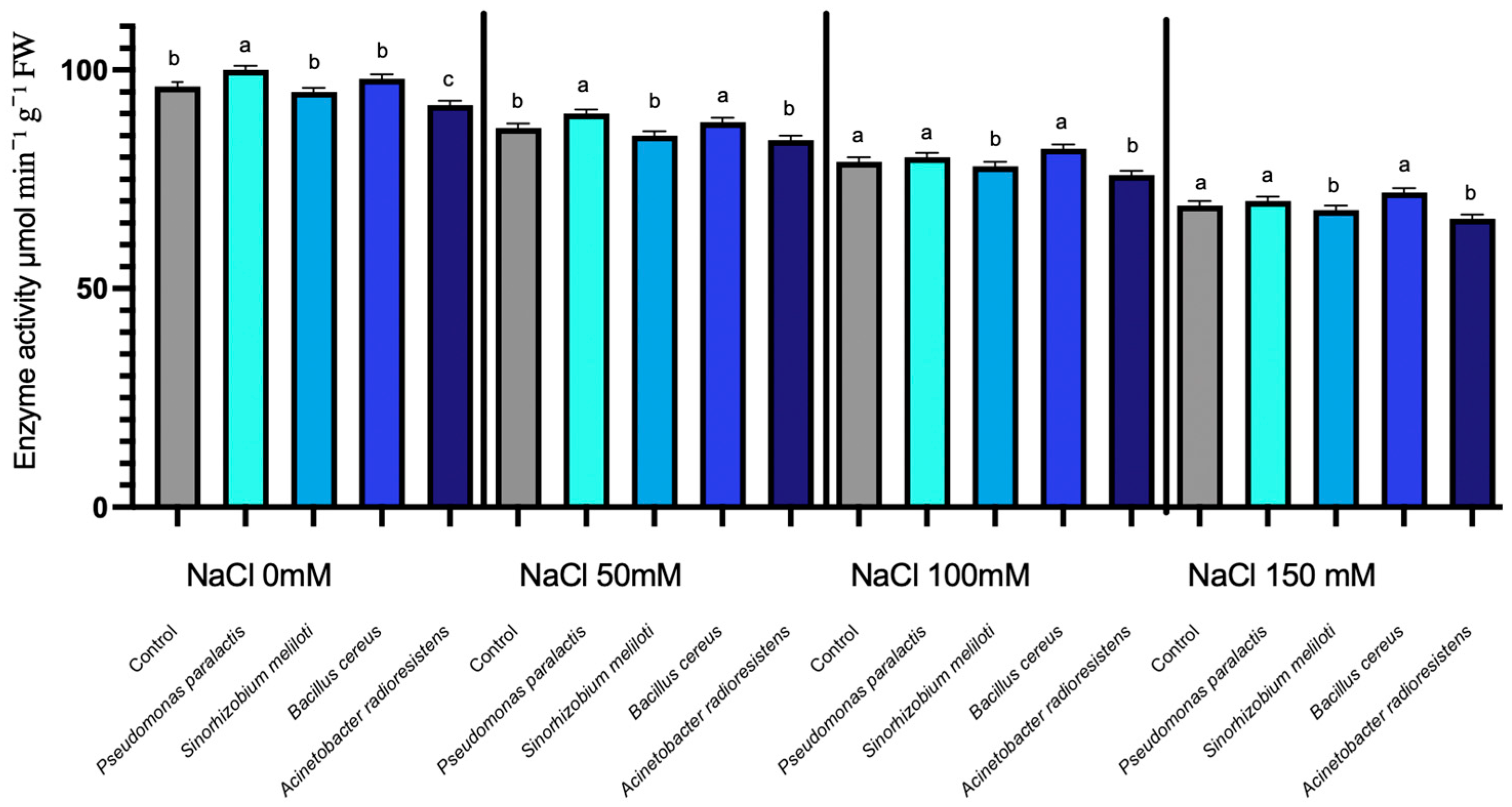
3.1.1. RuBisCO Expression Under Salinity Stress
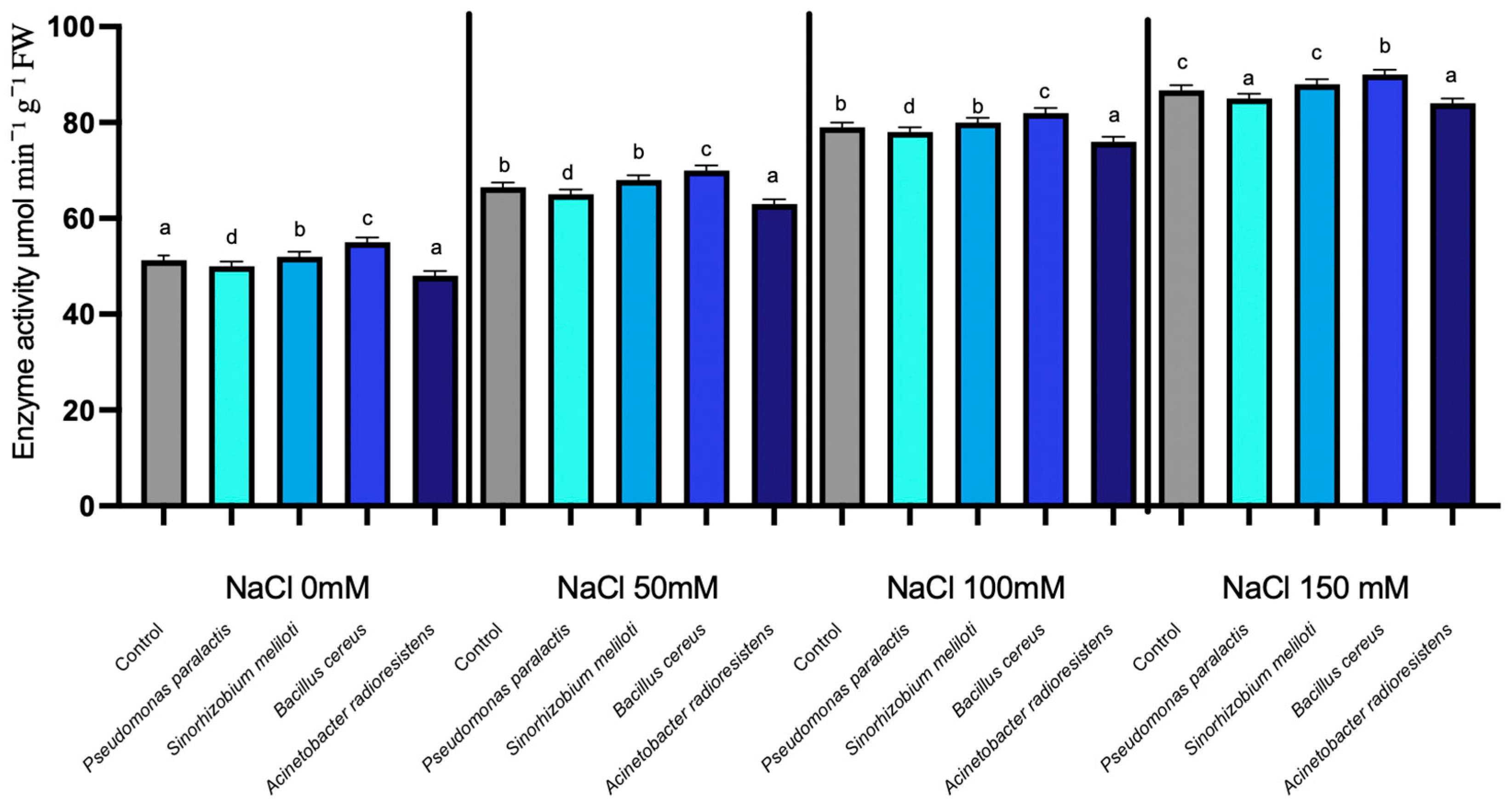
3.1.2. Proline Dehydrogenase (ProDH) Activity
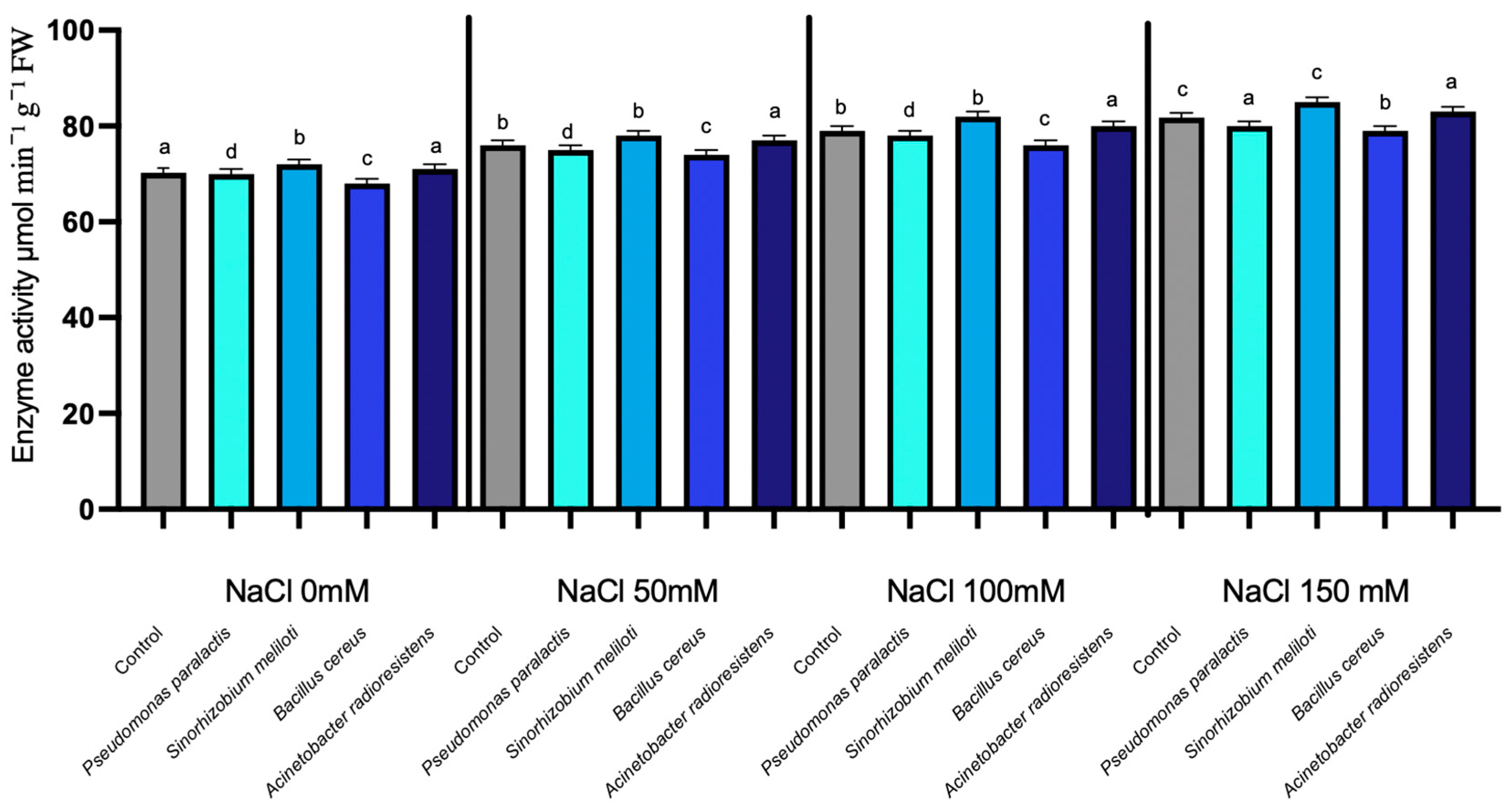
3.1.3. Nucleoside Diphosphate Kinase (NDPK)
3.2. PGPR Enzymatic Activity Under Salinity Stress
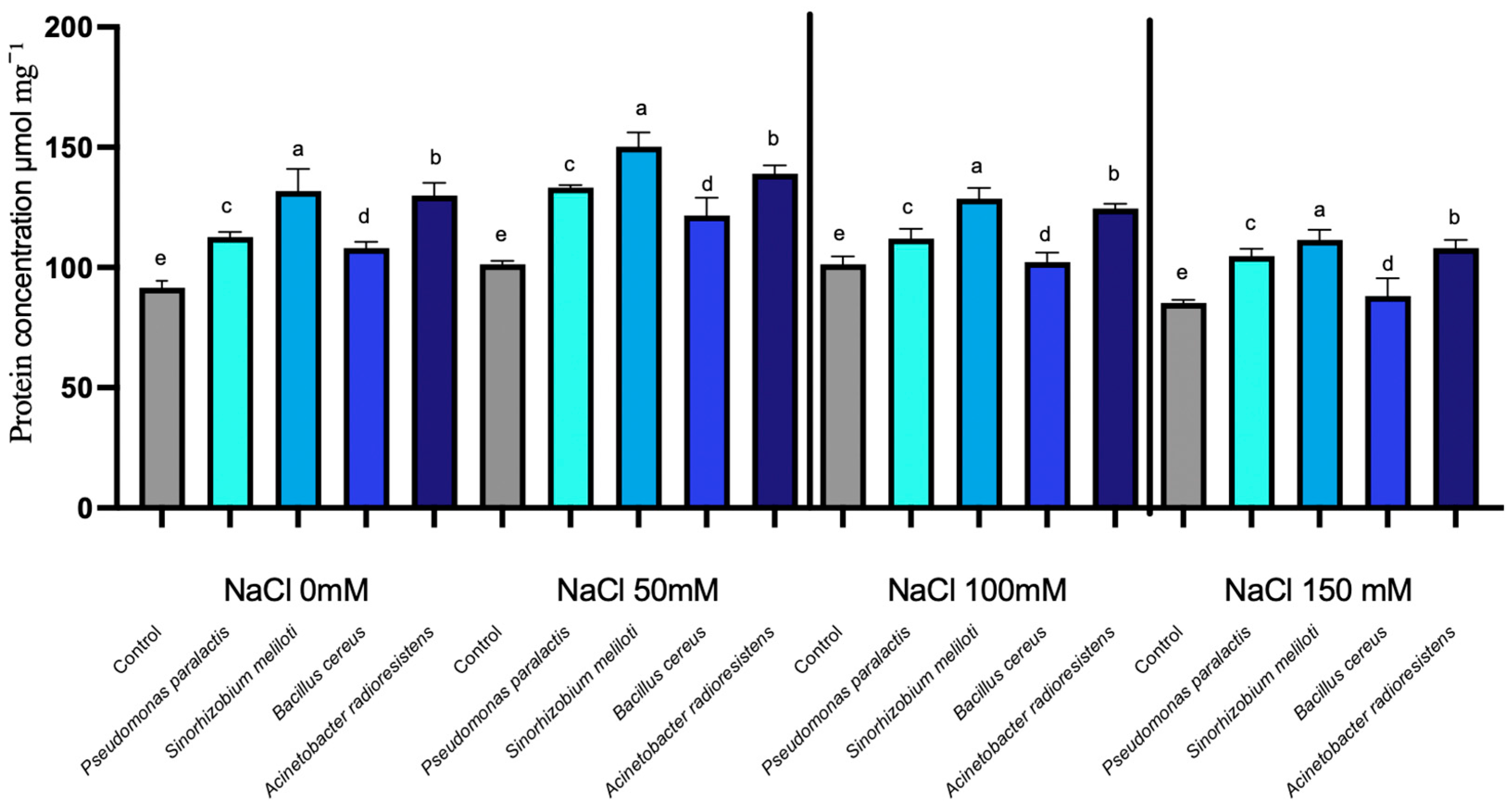
3.2.1. Nitrilase Activity
3.2.2. ACC-Deaminase (1-Aminocyclopropane-1-Carboxylate Deaminase)
3.2.3. Indole-3-Pyruvic Acid (IPA) Pathway Activity
3.2.4. Indole-3-Acetamide (IAM) Pathway Activity
4. Discussion
5. Conclusions
Author Contributions
Funding
Institutional Review Board Statement
Informed Consent Statement
Data Availability Statement
Acknowledgments
Conflicts of Interest
Abbreviations
| NaCl | Sodium chloride |
| CO2 | Carbon dioxide |
| RuBisCO | Ribulose-1,5-bisphosphate carboxylase/oxygenase |
| ROS | Reactive oxygen species |
| ProDH | Proline dehydrogenase |
| NDPK | Nucleoside diphosphate kinase |
| PGPR | Plant Growth-Promoting Rhizobacteria |
| IAA | Indole-3-acetic acid |
| IAM | Indole-3-acetamide |
| IPA | Indole-3-pyruvate |
| ACC | 1-Aminocyclopropane-1-carboxylate |
| EPS | Exopolysaccharides |
| UJED | Universidad Juárez del Estado de Durango |
| LB | Luria–Bertani medium |
| RPM | Revolutions per minute |
| CFU | Colony forming units |
| mL | Milliliter |
| h | Hour |
| pH | Potential of hydrogen |
| mM | Millimolar |
| EDTA | Ethylenediaminetetraacetic acid |
| FW | Fresh weight |
| NADH | Nicotinamide adenine dinucleotide |
| DNPH | 2,4-Dinitrophenylhydrazine |
| ANOVA | Analysis of variance |
| HSD | Honestly Significant Difference (Tukey’s test) |
| ATP | Adenosine triphosphate |
| PCA | Principal Component Analysis |
| USA | United States of America |
| SECIHTI | Secretaría de Ciencia, Humanidades, Tecnología e Innovación |
| PRODEP | Programa para el Desarrollo Profesional Docente |
| COECyT | Consejo Estatal de Ciencia y Tecnología del Estado de Coahuila |
References
- Qi, R.; Wang, H.; Zhao, X.; Liu, B. Bacillus Co-Inoculation Alleviated Salt Stress in Cucumber Seedlings. Agronomy 2021, 11, 966. [Google Scholar] [CrossRef] [Scilit]
- Chele, K.H.; Majidi, H.; Ahmad, P. Soil Salinity, a Serious Environmental Issue and Plant Responses: A Metabolomics Perspective. Metabolites 2021, 11, 724. [Google Scholar] [CrossRef] [Scilit]
- Qadir, M.; Quillérou, E.; Nangia, V.; Murtaza, G.; Singh, M.; Thomas, R.; Drechsel, P.; Noble, A.D. Economics of salt-induced land degradation and restoration. Nat. Resour. Forum 2014, 38, 282–295. [Google Scholar] [CrossRef] [Scilit]
- Atta, K.; Mondal, S.; Gorai, S.; Singh, A.P.; Kumari, A.; Ghosh, T.; Roy, A.; Hembram, S.; Gaikwad, D.J.; Mondal, S.; et al. Impacts of salinity stress on crop plants: Improving salt tolerance through genetic and molecular dissection. Front. Plant Sci. 2023, 14, 1241736. [Google Scholar] [CrossRef] [Scilit]
- Xiao, F.; Zhou, H. Plant salt response: Perception, signaling, and tolerance. Front. Plant Sci. 2023, 13, 1053699. [Google Scholar] [CrossRef] [Scilit]
- Liu, Y.; Xun, W.; Chen, L.; Xu, Z.; Zhang, N.; Feng, H.; Zhang, Q.; Zhang, R. Rhizosphere microbes enhance plant salt tolerance: Toward crop production in saline soil. Comput. Struct. Biotechnol. J. 2022, 20, 6543–6551. [Google Scholar] [CrossRef] [Scilit]
- Li, L.; Du, L.; Cao, Q.; Yang, Z.; Liu, Y.; Yang, H.; Duan, X.; Meng, Z. Salt Tolerance Evaluation of Cucumber Germplasm under Sodium Chloride Stress. Plants 2023, 12, 2927. [Google Scholar] [CrossRef] [Scilit]
- Lindberg, S.; Premkumar, A. Ion Changes and Signaling under Salt Stress in Wheat and Other Important Crops. Plants 2024, 13, 46. [Google Scholar] [CrossRef] [Scilit] [PubMed]
- Wang, X.; Chen, Z.; Sui, N. Sensitivity and responses of chloroplasts to salt stress in plants. Front. Plant Sci. 2024, 15, 1374086. [Google Scholar] [CrossRef] [Scilit]
- Zahra, N.; Al Hinai, M.S.; Hafeez, M.B.; Rehman, A.; Wahid, A.; Siddique, K.H.M.; Farooq, M. Regulation of photosynthesis under salt stress and associated tolerance mechanisms. Plant Physiol. Biochem. 2022, 178, 55–69. [Google Scholar] [CrossRef] [Scilit]
- Ondrasek, G.; Rathod, S.; Manohara, K.K.; Gireesh, C.; Anantha, M.S.; Sakhare, A.S.; Parmar, B.; Yadav, B.K.; Bandumula, N.; Raihan, F.; et al. Salt Stress in Plants and Mitigation Approaches. Plants 2022, 11, 717. [Google Scholar] [CrossRef] [Scilit]
- Balasubramaniam, T.; Shen, G.; Esmaeili, N.; Zhang, H. Plants’ Response Mechanisms to Salinity Stress. Plants 2023, 12, 2253. [Google Scholar] [CrossRef] [Scilit]
- Hao, S.; Wang, Y.; Yan, Y.; Liu, Y.; Wang, J.; Chen, S. A Review on Plant Responses to Salt Stress and Their Mechanisms of Salt Resistance. Horticulturae 2021, 7, 132. [Google Scholar] [CrossRef] [Scilit]
- Ha-Tran, D.M.; Nguyen, T.T.M.; Cao, H.T.; Lee, Y.; Kang, K. Roles of Plant Growth-Promoting Rhizobacteria in Stimulating Salinity Stress Defense in Plants: A Review. Int. J. Mol. Sci. 2021, 22, 3154. [Google Scholar] [CrossRef] [Scilit]
- Tang, J.; Li, Y.; Zhang, L.; Mu, J.; Jiang, Y.; Fu, H.; Zhang, Y.; Cui, H.; Yu, X.; Ye, Z. Biosynthetic Pathways and Functions of Indole-3-Acetic Acid in Microorganisms. Microorganisms 2023, 11, 2077. [Google Scholar] [CrossRef] [Scilit] [PubMed]
- Orozco-Mosqueda, M.C.; Glick, B.R.; Santoyo, G. ACC deaminase in plant growth-promoting bacteria (PGPB): An efficient mechanism to counter salt stress in crops. Microbiol. Res. 2020, 235, 126439. [Google Scholar] [CrossRef] [Scilit]
- Ilangumaran, G.; Smith, D.L. Plant Growth Promoting Rhizobacteria in Amelioration of Salinity Stress: A Systems Biology Perspective. Front. Plant Sci. 2017, 8, 1768. [Google Scholar] [CrossRef] [Scilit]
- Primo, E.; Bogino, P.; Cossovich, S.; Foresto, E.; Nievas, F.; Giordano, W. Exopolysaccharide II Is Relevant for the Survival of Sinorhizobium meliloti under Water Deficiency and Salinity Stress. Molecules 2020, 25, 4876. [Google Scholar] [CrossRef] [Scilit]
- AbuQamar, S.F.; El-Saadony, M.T.; Saad, A.M.; Desoky, E.-S.M.; Elrys, A.S.; El-Mageed, T.A.A.; Semida, W.M.; Abdelkhalik, A.; Mosa, W.F.A.; Al Kafaas, S.S.; et al. Halotolerant plant growth-promoting rhizobacteria improve soil fertility and plant salinity tolerance for sustainable agriculture—A review. Plant Stress 2024, 12, 100482. [Google Scholar] [CrossRef] [Scilit]
- Zhou, Y.; Zhang, Q.; Li, Z.; Huang, L. Effects of Bacillus cereus on Photosynthesis and Antioxidant Metabolism of Cucumber Seedlings under Salt Stress. Horticulturae 2022, 8, 463. [Google Scholar] [CrossRef] [Scilit]
- Shultana, R.; Zuan, A.T.K.; Naher, U.A.; Islam, A.M.; Rashid, M.H. PGPR Mechanisms of Salt Stress Adaptation and Plant Growth Promotion. Agronomy 2022, 12, 2266. [Google Scholar] [CrossRef] [Scilit]
- Muntyan, V.S.; Roumiantseva, M.L. Molecular Phylogenetic Analysis of Salt-Tolerance-Related Genes in Root-Nodule Bacteria Species Sinorhizobium meliloti. Agronomy 2022, 12, 1968. [Google Scholar] [CrossRef] [Scilit]
- McCoy, K.B.; Derecho, I.; Wong, T.; Tran, H.M.; Huynh, T.D.; La Duc, M.T.; Venkateswaran, K.; Mogul, R. Insights into the extremotolerance of Acinetobacter radioresistens 50v1, a gram-negative bacterium isolated from the Mars Odyssey spacecraft. Astrobiology 2012, 12, 854–862. [Google Scholar] [CrossRef] [Scilit]
- Fotoohiyan, Z.; Hashemzadeh, A.; Moosavi, S. Improved Salinity Tolerance in Cucumber Seedlings Inoculated with Halotolerant Bacterial Isolates. BMC Plant Biol. 2024, 24, 821. [Google Scholar] [CrossRef] [Scilit]
- Rashid, M.H.; Hossain, M.S.; Hossain, M.A.; Rahman, M.T. Salt-tolerant bacteria support salinity stress mitigating impact of arbuscular mycorrhizal fungi in maize (Zea mays L.). Microorganisms 2025, 13, 1345. [Google Scholar] [CrossRef] [Scilit] [PubMed]
- Athar, H.U.-R.; Zulfiqar, F.; Moosa, A.; Ashraf, M.; Zafar, Z.U.; Zhang, L.; Ahmed, N.; Kalaji, H.M.; Nafees, M.; Hossain, M.A.; et al. Salt stress proteins in plants: An overview. Front. Plant Sci. 2022, 13, 999058. [Google Scholar] [CrossRef] [Scilit] [PubMed]
- Renzetti, M.; Bertolini, E.; Trovato, M. Proline Metabolism Genes in Transgenic Plants: Meta-Analysis under Drought and Salt Stress. Plants 2024, 13, 1913. [Google Scholar] [CrossRef] [Scilit]
- Fu, H.; Yang, Y. How Plants Tolerate Salt Stress. Curr. Issues Mol. Biol. 2023, 45, 5914–5934. [Google Scholar] [CrossRef] [Scilit]
- Kausar, R.; Komatsu, S. Proteomic Approaches to Uncover Salt Stress Response Mechanisms in Crops. Int. J. Mol. Sci. 2023, 24, 518. [Google Scholar] [CrossRef] [Scilit] [PubMed]
- Toribio, A.J.; Jurado, M.M.; Suárez-Estrella, F.; López, M.J.; López-González, J.A.; Moreno, J. Seed biopriming with cyanobacterial extracts as an eco-friendly strategy to control damping off caused by Pythium ultimum in seedbeds. Microbiol. Res. 2021, 248, 126766. [Google Scholar] [CrossRef] [Scilit]
- Takeuchi, K.; Ogiso, M.; Ota, A.; Sato, Y.; Shimizu, M. Pseudomonas rhodesiae HAI-0804 suppresses Pythium damping-off and root rot in cucumber (Cucumis sativus L.) by multiple mechanisms. Front. Microbiol. 2024, 15, 1485167. [Google Scholar] [CrossRef] [Scilit] [PubMed]
- Pérez-García, L.A.; Sáenz-Mata, J.; Palacio-Rodríguez, R.; Rueda-Puente, E.O.; Torres-Rodríguez, J.A.; Preciado-Rangel, P. Plant Growth Promoting Rhizobacteria Enhances Germination and Bioactive Compounds in Cucumber Seedlings under Saline Stress. Ecosist. Recur. Agropec. 2025, 12, e4276. [Google Scholar] [CrossRef] [Scilit]
- Kaloterakis, N.; van Delden, S.H.; Hartley, S.; De Deyn, G.B. Silicon application and plant growth promoting rhizobacteria consisting of six pure Bacillus species alleviate salinity stress in cucumber (Cucumis sativus L.). Sci. Hortic. 2021, 288, 110383. [Google Scholar] [CrossRef] [Scilit]
- Pérez-García, L.-A.; Sáenz-Mata, J.; Fortis-Hernández, M.; Navarro-Muñoz, C.E.; Palacio-Rodríguez, R.; Preciado-Rangel, P. Plant-Growth-Promoting Rhizobacteria Improve Germination and Bioactive Compounds in Cucumber Seedlings. Agronomy 2023, 13, 315. [Google Scholar] [CrossRef] [Scilit]
- Almirón, C.; Petitti, T.D.; Ponso, M.A.; Romero, A.M.; Areco, V.A.; Bianco, M.I.; Espariz, M.; Yaryura, P.M. Functional and genomic analyses of plant growth promoting traits in Priestia aryabhattai and Paenibacillus sp. isolates from tomato rhizosphere. Sci. Rep. 2025, 15, 3498. [Google Scholar] [CrossRef] [Scilit]
- Herigstad, B.; Hamilton, M.; Heersink, J. How to optimize the drop plate method for enumerating bacteria. J. Microbiol. Methods 2001, 44, 121–129. [Google Scholar] [CrossRef] [Scilit]
- Poorter, H.; Fiorani, F.; Stitt, M.; Schurr, U.; Finck, A.; Gibon, Y.; Usadel, B.; Munns, R.; Atkin, O.K.; Tardieu, F. The art of growing plants for experimental purposes: A practical guide for the plant biologist. Funct. Plant Biol. 2012, 39, 821–838. [Google Scholar] [CrossRef] [Scilit]
- Hurkman, W.J.; Tanaka, C.K. Solubilization of plant membrane proteins for analysis by two-dimensional gel electrophoresis. Plant Physiol. 1986, 81, 802–806. [Google Scholar] [CrossRef] [Scilit]
- Bradford, M.M. A rapid and sensitive method for the quantitation of microgram quantities of protein utilizing the principle of protein–dye binding. Anal. Biochem. 1976, 72, 248–254. [Google Scholar] [CrossRef]
- Karnwal, A. Screening and identification of abiotic stress-responsive efficient antifungal Pseudomonas spp. from rice rhizospheric soil. BioTechnologia 2021, 102, 5–19. [Google Scholar] [CrossRef] [Scilit]
- Sulpice, R.; Tschoep, H.; von Korff, M.; Büssis, D.; Usadel, B.; Höhne, M.; Witucka-Wall, H.; Altmann, T.; Stitt, M.; Gibon, Y. Description and applications of a rapid and sensitive non-radioactive microplate-based assay for maximum and initial activity of D-ribulose-1,5-bisphosphate carboxylase/oxygenase. Plant Cell Environ. 2007, 30, 1163–1175. [Google Scholar] [CrossRef] [Scilit]
- Sanyal, N.; Arentson, B.W.; Luo, M.; Tanner, J.J.; Becker, D.F. First evidence for substrate channeling between proline catabolic enzymes: A validation of domain fusion analysis for predicting protein-protein interactions. J. Biol. Chem. 2015, 290, 2225–2234. [Google Scholar] [CrossRef] [Scilit]
- Penrose, D.M.; Glick, B.R. Methods for isolating and characterizing ACC deaminase-containing plant growth-promoting rhizobacteria. Physiol. Plant. 2003, 118, 10–15. [Google Scholar] [CrossRef] [Scilit]
- Gordon, S.A.; Weber, R.P. Colorimetric estimation of indoleacetic acid. Plant Physiol. 1951, 26, 192–195. [Google Scholar] [CrossRef] [Scilit]
- Nash, T. The colorimetric estimation of formaldehyde by means of the Hantzsch reaction. Biochem. J. 1953, 55, 416–421. [Google Scholar] [CrossRef] [Scilit]
- Bates, L.S.; Waldren, R.P.; Teare, I.D. Rapid determination of free proline for water-stress studies. Plant Soil 1973, 39, 205–207. [Google Scholar] [CrossRef] [Scilit]
- SAS Institute Inc. SAS® 9.4 Global Statements: Reference; SAS Institute Inc.: Cary, NC, USA, 2017. [Google Scholar]
- Tukey, J.W. Comparing Individual Means in the Analysis of Variance. Biometrics 1949, 5, 99–114. [Google Scholar] [CrossRef] [Scilit]
- Hashem, A.; Tabassum, B.; Abd_Allah, E.F. Bacillus subtilis: A plant-growth-promoting rhizobacterium that also impacts biotic stress. Saudi J. Biol. Sci. 2019, 26, 1291–1297. [Google Scholar] [CrossRef] [Scilit]
- Miao, Y.; Gao, X.; Li, B.; Wang, W.; Bai, L. Low red to far-red light ratio promotes salt tolerance by improving leaf photosynthetic capacity in cucumber. Front. Plant Sci. 2023, 13, 1053780. [Google Scholar] [CrossRef] [Scilit]
- Gupta, S.; Kaur, N.; Kant, K.; Jindal, P.; Ali, A.; Naeem, M. Calcium: A master regulator of stress tolerance in plants. S. Afr. J. Bot. 2023, 163, 580–594. [Google Scholar] [CrossRef] [Scilit]
- Anee, T.I.; Sewelam, N.A.; Bautista, N.S.; Hirayama, T.; Suzuki, N. Roles of ROS and NO in Plant Responses to Individual and Combined Salt Stress and Waterlogging. Antioxidants 2025, 14, 1455. [Google Scholar] [CrossRef] [Scilit]
- Etesami, H.; Glick, B.R. Bacterial indole-3-acetic acid: A key regulator for plant growth, plant–microbe interactions, and agricultural adaptive resilience. Microbiol. Res. 2024, 281, 127602. [Google Scholar] [CrossRef] [Scilit]
- Musazade, E.; Mrisho, I.I.; Feng, X. Auxin metabolism and signaling: Integrating independent mechanisms and crosstalk in plant abiotic stress responses. Plant Stress 2025, 18, 101034. [Google Scholar] [CrossRef] [Scilit]
- Gamalero, E.; Lingua, G.; Glick, B.R. Ethylene, ACC, and the Plant Growth-Promoting Enzyme ACC Deaminase. Biology 2023, 12, 1043. [Google Scholar] [CrossRef] [Scilit]
- Gupta, A.; Rai, S.; Bano, A.; Sharma, S.; Kumar, M.; Binsuwaidan, R.; Suhail Khan, M.; Upadhyay, T.K.; Alshammari, N.; Saeed, M.; et al. ACC Deaminase Produced by PGPR Mitigates the Adverse Effect of Osmotic and Salinity Stresses in Pisum sativum through Modulating the Antioxidants Activities. Plants 2022, 11, 3419. [Google Scholar] [CrossRef] [Scilit]
- Vineeth, T.V.; Krishna, G.K.; Pandesha, P.H.; Sathee, L.; Thomas, S.; James, D.; Ravikiran, K.T.; Taria, S.; John, C.; Vinaykumar, N.M.; et al. Photosynthetic machinery under salinity stress: Trepidations and adaptive mechanisms. Photosynthetica 2023, 61, 73–93. [Google Scholar] [CrossRef] [Scilit]
- Ravi, B.; Foyer, C.H.; Pandey, G.K. The integration of reactive oxygen species (ROS) and calcium signalling in abiotic stress responses. Plant Cell Environ. 2023, 46, 1985–2006. [Google Scholar] [CrossRef] [Scilit]
- Irshad, A.; Rehman, R.N.U.; Abrar, M.M.; Saeed, Q.; Sharif, R.; Hu, T. Contribution of Rhizobium–Legume Symbiosis in Salt Stress Tolerance in Medicago truncatula Evaluated through Photosynthesis, Antioxidant Enzymes, and Compatible Solutes Accumulation. Sustainability 2021, 13, 3369. [Google Scholar] [CrossRef] [Scilit]
- Kumawat, K.C.; Sharma, B.; Nagpal, S.; Kumar, S.; Tiwari, S.; Madhavan Nair, R. Plant growth-promoting rhizobacteria: Salt stress alleviators to improve crop productivity for sustainable agriculture development. Front. Plant Sci. 2023, 13, 1101862. [Google Scholar] [CrossRef] [Scilit]
- Alzate Zuluaga, M.Y.; Fattorini, R.; Cesco, S.; Pii, Y. Plant-microbe interactions in the rhizosphere for smarter and more sustainable crop production. Front. Microbiol. 2024, 15, 1440978. [Google Scholar] [CrossRef] [Scilit]


Disclaimer/Publisher’s Note: The statements, opinions and data contained in all publications are solely those of the individual author(s) and contributor(s) and not of MDPI and/or the editor(s). MDPI and/or the editor(s) disclaim responsibility for any injury to people or property resulting from any ideas, methods, instructions or products referred to in the content. |
© 2026 by the authors. Licensee MDPI, Basel, Switzerland. This article is an open access article distributed under the terms and conditions of the Creative Commons Attribution (CC BY) license.
Share and Cite
Pérez-García, L.-A.; Sáenz-Mata, J.; Fortis-Hernandez, M.; Preciado-Rangel, P. Plant Growth-Promoting Rhizobacteria as a Strategy to Enhance Enzymatic and Metabolic Tolerance of Cucumis sativus L. Under Salinity Stress. Microorganisms 2026, 14, 351. https://doi.org/10.3390/microorganisms14020351
Pérez-García L-A, Sáenz-Mata J, Fortis-Hernandez M, Preciado-Rangel P. Plant Growth-Promoting Rhizobacteria as a Strategy to Enhance Enzymatic and Metabolic Tolerance of Cucumis sativus L. Under Salinity Stress. Microorganisms. 2026; 14(2):351. https://doi.org/10.3390/microorganisms14020351
Chicago/Turabian StylePérez-García, Laura-Andrea, Jorge Sáenz-Mata, Manuel Fortis-Hernandez, and Pablo Preciado-Rangel. 2026. "Plant Growth-Promoting Rhizobacteria as a Strategy to Enhance Enzymatic and Metabolic Tolerance of Cucumis sativus L. Under Salinity Stress" Microorganisms 14, no. 2: 351. https://doi.org/10.3390/microorganisms14020351
APA StylePérez-García, L.-A., Sáenz-Mata, J., Fortis-Hernandez, M., & Preciado-Rangel, P. (2026). Plant Growth-Promoting Rhizobacteria as a Strategy to Enhance Enzymatic and Metabolic Tolerance of Cucumis sativus L. Under Salinity Stress. Microorganisms, 14(2), 351. https://doi.org/10.3390/microorganisms14020351