Article

Hepatitis E ORF2 Blocks Trophoblast Autophagy to Induce Miscarriage via LC3B Binding Rather than PI3K/Akt/mTOR Pathway Suppression


1
State Key Laboratory of Veterinary Public Health and Safety, College of Veterinary Medicine, China Agricultural University, Beijing 100193, China
2
Nanjing University of Chinese Medicine, Changzhou 213003, China
3
National Key Laboratory of Intelligent Tracking and Forecasting for Infectious Diseases (NITFID), Chinese Center for Disease Control and Prevention (Chinese Academy of Preventive Medicine), Beijing 102206, China
*
Authors to whom correspondence should be addressed.
These authors contributed equally to this work.
These authors also contributed equally to this work.
Microorganisms 2026, 14(1), 181; https://doi.org/10.3390/microorganisms14010181
Submission received: 6 November 2025 / Revised: 18 December 2025 / Accepted: 9 January 2026 / Published: 14 January 2026
(This article belongs to the Section Virology)

Abstract

Hepatitis E virus (HEV) is a zoonotic pathogen that can infect pregnant women and cause adverse pregnancy outcomes, including miscarriage and preterm delivery. The previous study demonstrated that HEV genotype 3 (HEV-3) inhibits complete autophagic flux in both mouse placental tissue and human trophoblast cells (JEG-3), evidenced by reduced expression of ATG proteins (including LC3, Beclin1, ATG4B, ATG5, and ATG9A) and accumulation of p62. However, the specific regulatory pathway involved remains unclear. Thus, eukaryotic expression vectors for HEV open reading frames (ORFs) were constructed, and ORF2 and ORF3 proteins were transiently overexpressed in JEG-3 cells via liposome transfection. While both ORF2 and ORF3 significantly reduced LC3B protein levels (p < 0.01), only ORF2 induced p62 accumulation (p < 0.01), indicative of autophagic inhibition, which indicates that ORF2 was the key viral protein mediating autophagy suppression in JEG-3. The results of WB and RT-qPCR showed that ORF2 suppressed the PI3K/Akt/mTOR pathway while enhancing nuclear translocation of TFEB (p < 0.01) and AMPK phosphorylation (p < 0.01), suggesting paradoxical activation of upstream autophagy regulators. Through co-transfection of mCherry-LC3 with ORF2, co-localization studies, and AlphaFold 3-based intermolecular interaction predictions, we propose that ORF2 directly binds LC3B to block autophagosome formation. Finally, co-immunoprecipitation confirmed physical interaction between HEV ORF2 and LC3B, elucidating the molecular mechanism of HEV-induced autophagy suppression in trophoblasts. These findings reveal the molecular mechanism by which HEV inhibits autophagy leading to miscarriage in mice, providing new insights into HEV-induced reproductive damage.

1. Introduction

Autophagy serves as a cytoprotective mechanism that is activated in response to intracellular stressors such as protein aggregates, damaged organelles, or pathogenic invaders, thereby preserving cellular homeostasis and functionality [1]. The overall process of autophagy is referred to as the autophagic flux, which includes three stages: autophagy initiation, autophagosome formation and maturation, and autophagosome–lysosome fusion and degradation, coordinated by autophagy-related (ATG) proteins and involving the mobilization of various cellular components [2]. The PI3K/Akt/mTOR signaling pathway serves as the core upstream regulatory pathway of autophagy, negatively modulating the metabolic processes of synthesis and degradation of autophagy-related genes [3]. The mTOR pathway serves as a critical regulator in placental trophoblasts [4], with mTORC1 being the predominant pharmacological target for modulating placental autophagy [5]. As the master transcriptional regulator of autophagy and lysosomal biogenesis [6], TFEB is dynamically controlled in trophoblasts through mTORC1-dependent phosphorylation [7,8]. Additionally, AMPK is an evolutionarily conserved serine/threonine protein kinase that initiates downstream autophagy by phosphorylating mTORC1, ULK1, and autophagy-related proteins in the PIK3C3 complex [9]. Consequently, monitoring mTORC1 signaling flux is essential for investigating autophagy in trophoblast cells.
Hepatitis E virus (HEV) is a non-enveloped, icosahedral virus with a single-stranded positive-sense RNA genome. The viral particles measure approximately 32–34 nm in diameter, containing a 7.2 kb genome that features a 5′ methylguanosine cap and 3′ poly(A) tail [10]. The genome encodes four open reading frames (ORFs)—ORF1, ORF2, ORF3 and ORF4, with ORF4 being expressed exclusively in genotype 1 HEV [11]. ORF1 contains multiple functional domains, including methyltransferase (MeT), papain-like cysteine protease (PCP), hypervariable region (HVR), RNA helicase (Hel) and RNA-dependent RNA polymerase (RdRp) [11], primarily encoding non-structural proteins with well-characterized functions. ORF2 encodes the immunogenic capsid protein capable of inducing neutralizing antibodies. This protein is conserved among the four major pathogenic genotypes (HEV-1 to HEV-4), and the currently licensed HEV vaccine was developed using a modified recombinant antigen derived from HEV-1 ORF2 [12,13]. The ORF2-encoded capsid monomer consists of three distinct domains: S (shell), M (middle) and P (protruding). ORF3, which partially overlaps with ORF2, encodes a small multifunctional protein (~12 kDa) involved in viral egress and quasi-envelope formation. This protein contains two hydrophobic domains (D1 and D2) and two proline-rich domains (P1 and P2), enabling the formation of membrane-associated oligomers through its proline-rich regions [14,15]. HEV infection generally manifests as self-limiting hepatic injury with subsequent complete clinical recovery and viral elimination; however, pregnant women exhibit markedly increased susceptibility to severe complications, including premature delivery, abortion and impaired fetal development [16].
Tophoblast cells represent the most functionally important cell type in the placenta, playing critical roles in pregnancy maintenance and embryonic development [17]. Trophoblasts secrete various bioactive substances including steroid hormones, neuropeptide hormones, growth factors, and cytokines [18]. Moreover, the invasive migratory behavior of trophoblasts is essential for proper placental formation, embryonic development, and successful pregnancy progression [19]. Dysregulation of autophagic flux in trophoblasts significantly contributes to pregnancy disorders [20,21]. In this study, we utilized the JEG-3 human choriocarcinoma cell line, a well-established and widely used in vitro model for investigating human trophoblast biology and pregnancy-associated pathologies, including autophagy regulation [2,22,23]. Tan et al. demonstrated that autophagy inhibition in trophoblasts markedly impairs their invasive capacity, with significantly suppressed autophagy observed in trophoblasts from spontaneous abortion cases [2]. Aiko et al. reported that ATG7 knockout in murine trophoblasts, leading to autophagy deficiency, resulted in placental hypoplasia [24]. Furthermore, Cao et al. proved that ATG16L1-mediated autophagy suppression can induce preterm birth [25].
The previous studies have demonstrated that HEV infection of placental trophoblast cells (JEG-3) leads to impaired autophagic flux, as evidenced by LC3B downregulation and p62 accumulation, resulting in defective autophagosome formation and ultimately abortion in ICR mice [26]. However, the precise molecular mechanisms underlying HEV-mediated autophagy suppression remain to be elucidated. Here, we successfully generated recombinant plasmids encoding HEV ORFs, using a combination of electron microscopy, Western blot, RT-PCR, and co-immunoprecipitation to systematically investigate the modulatory effects of HEV infection on host cell autophagy pathways. The study aims to identify viral proteins and critical functional domains responsible for autophagy inhibition, delineate the involved signaling mechanisms, and evaluate the therapeutic potential of targeting autophagy as a novel strategy for preventing and treating HEV infection during pregnancy in both humans and animals.

2. Materials and Methods

2.1. Plasmids

The eukaryotic expression plasmids used in this study, pcDNA3.1(+)-N-eGFP and pcDNA3.1(+)-N-6His, were synthesized and purchased from GenScript Biotech (Nanjing, China). The inserted ORF2 and ORF3 genes were codon-optimized sequences based on Hepatitis E virus genotype 3 (GenBank: XMQ88656.1 for ORF2; GenBank: AXF47753.1 for ORF3). Schematic diagrams of the two plasmid vectors are shown in Figure S2, while the restriction enzyme sites and inserted protein sequences for each plasmid are detailed in Table S1.

2.2. Materials

The JEG-3 cell line was purchased from ATCC (Manassas, VA, USA). Reagents included: Minimum Essential Medium (MEM) (Gibco, Thermo Fisher Scientific, Waltham, MA, USA), fetal bovine serum (FBS) (Gibco), phosphate-buffered saline (PBS) (Gibco), Lipofectamine 3000 (Invitrogen, Thermo Fisher Scientific), Opti-MEM (Gibco), G418 (Sigma-Aldrich, Cat# A1720, St. Louis, MO, USA), dimethyl sulfoxide (DMSO) (MCE, Cat# HY-Y0320), Trizol reagent (Thermo Fisher Scientific), RIPA lysis buffer (Solarbio, Beijing, China), glycine (Beyotime Biotechnology, Shanghai, China), Tris-base powder (Beyotime Biotechnology), polyvinylidene difluoride (PVDF) membranes (Millipore, Burlington, MA, USA), bovine serum albumin (BSA) (Beyotime Biotechnology), prestained protein ladder (Thermo Fisher Scientific), enhanced chemiluminescence (ECL) substrate (Millipore), antifade mounting medium with DAPI (Solarbio), 4% cell/tissue fixation solution (Solarbio), methanol, formaldehyde, xylene, absolute ethanol, isopropanol (Beijing Tongguang Fine Chemicals, Beijing, China), chloroform (CAU Central Lab, Beijing, China), and nuclease-free water (Solarbio). Antibodies used were: LC3B (ab192890, Abcam, Cambridge, UK), p62 (Q13501, Abbkine Scientific, Wuhan, China), GAPDH (60004-1-1g, Proteintech, Rosemont, IL, USA), HRP-conjugated goat anti-mouse/rabbit IgG (Beyotime Biotechnology), Flag-tag (M20008, Abbkine Scientific), p-ULK1 (#6888, CST), ULK1 (#8054, CST), p-mTOR (#2971, CST), mTOR (#2983, CST), p-Akt (#4060, CST), Akt (#9272, CST), p-PI3K (#13857, CST), PI3K (#4257, CST), p-AMPK (TA3423, Abbkine Scientific), AMPK (T55326, Abbkine Scientific), TFEB (13372-1-AP, Proteintech), and α-Tubulin (M20005, Abbkine Scientific). Molecular biology reagents included reverse transcription premix kit (Accurate Biology, Changsha, China) and SYBR Green master mix (Thermo Fisher Scientific).

2.3. Plasmid Transfection

Transfections were performed according to the manufacturer’s protocol for Lipofectamine 3000 (Invitrogen, Carlsbad, CA, USA). For standard transfection in 24-well plates, each well was transfected with 1 μg plasmid DNA and 1.5 μL Lipofectamine 3000 reagent, followed by 48 h of incubation. For standard transfection in 24-well plates, each well was transfected with 1 μg plasmid DNA and 1.5 μL Lipofectamine 3000 reagent, followed by 48 h of incubation. For co-transfection experiments involving LC3 with ORF2 or ORF3, each well received 0.5 μg mCherry-LC3 plasmid, 0.5 μg ORF2 or ORF3 plasmid, 3 μL L3000 reagent, 2 μL P3000 reagent, and 50 μL Opti-MEM. After transfection, cells were seeded onto coverslips, and images were acquired immediately using a confocal microscope (A1HD25, Nikon, Tokyo, Japan).

2.4. Cell Selection

Since the transfected plasmids carried a kanamycin/neomycin resistance gene, transfected cells were selected using G418 (Geneticin, Sigma-Aldrich, Cat# A1720). To determine the minimum lethal concentration (MLC) of G418 for JEG-3 cells, a gradient of G418 concentrations (0, 50, 100, 200, 400, 500, 600, 800, 900, and 1000 μg/mL) was tested. JEG-3 cells were seeded in 96-well plates at a density of 5000 cells per well and allowed to adhere. The culture medium was then replaced with G418-containing medium, and cells were incubated at 37 °C for 7–10 days. Fresh G418-supplemented medium was replenished every 3 days to maintain selection pressure. Once significant differences in cell viability were observed between groups, CCK-8 reagent (C0038, Beyotime Biotechnology) was added to quantify cell proliferation.

2.5. RT-PCR

Total RNA was extracted from JEG-3 cells using Trizol reagent (Invitrogen, Carlsbad, CA, USA) according to the manufacturer’s instructions. Briefly, cells were lysed in TRIzol, followed by phase separation with chloroform. RNA was precipitated with isopropanol, washed with 75% ethanol, and dissolved in nuclease-free water. RNA concentration and purity were determined using a NanoDrop spectrophotometer (Thermo Fisher Scientific). RNA was reverse-transcribed into cDNA and amplified with the kit mentioned in Materials, and the RT-PCR was performed using an ABI 7500 Real-Time PCR System (Thermo Fisher Scientific, USA). The primers used for autophagy-related genes in RT-PCR are listed in Supplementary Table S2.

2.6. Western Blot

Proteins were extracted from JEG-3 cells using RIPA lysis buffer (Solarbio, China) with 20 min of ice incubation. Protein concentrations were determined and normalized across experimental groups using the BCA assay kit (Thermo Fisher, USA). Prior to electrophoresis, samples were mixed with loading buffer (Cell Signaling Technology, Danvers, MA, USA) and denatured by boiling for 10 min. Electrophoretic separation was carried out on 4–20% Bis-Tris gradient gels followed by electroblotting onto PVDF membranes (Millipore, USA) at 200 mA constant current for 50–100 min, with transfer duration optimized according to target protein molecular weights. Membranes were blocked for 1 h at room temperature with 5% non-fat dry milk (Mengniu, Hohhot, China) prepared in PBST solution. Primary antibody incubations were conducted overnight at 4 °C with 1:1000 dilutions. Following three PBST washes, membranes were probed with species-appropriate HRP-conjugated secondary antibodies (1 h, room temperature). Protein bands were visualized using enhanced chemiluminescence substrate (Millipore, USA) and imaged with a Tanon 5200 detection system (Shanghai, China).

2.7. Immunofluorescence Assay (IFA)

JEG-3 cells were seeded onto coverslips placed in 24-well plates. When cells reached approximately 80% confluence, they were co-transfected with plasmids encoding ORF2 and mCherry-LC3B. After 48 h of incubation, cells were washed three times with ice-cold PBS (5 min per wash) and air-dried at room temperature until semi-dry. Cells were then fixed with pre-chilled 4% cell/tissue fixation solution for 30 min at room temperature. After removal of the fixative, cells were washed three times with PBS and stained with DAPI for 10 min. Following DAPI removal, cells were washed three times with PBS. The coverslips were carefully removed with forceps, air-dried, mounted with one drop of antifade mounting medium, and sealed for microscopic observation. Images were acquired using a Nikon A1HD25 confocal microscope.

2.8. Co-Immunoprecipitation

The Co-IP assay was performed using an immunoprecipitation kit (Abmart, #A10022, Shanghai, China) following the manufacturer’s instructions. The target protein was immunoprecipitated with an anti-Flag antibody (M20008, Abmart), with normal IgG antibody (Beyotime Biotechnology) serving as an isotype control. After overnight antibody incubation, 20 μL of Protein A/G beads were added and incubated at 4 °C with gentle rotation overnight. The samples were then centrifuged at 12,000× g for 1 min, and the pellets were retained. The beads were washed three times with wash buffer. The immunoprecipitated complexes were resuspended in SDS loading buffer and denatured by boiling for 5 min. After centrifugation, the supernatant was collected for subsequent Western blot analysis.

2.9. Statistical Analysis

Statistical analysis was performed using GraphPad Prism 8 (GraphPad Software, San Diego, CA, USA) and SPSS Statistics 25 (IBM, Armonk, NY, USA). Data are presented as mean ± SD. Differences between groups were assessed using Student’s t-test or one-way ANOVA, as appropriate. * p < 0.05 was considered to be statistically significant.

3. Result

3.1. Overexpression of HEV ORF2 and ORF3 in JEG-3 Cells

The eukaryotic expression plasmid vectors used for transfection (Flag-ORF2_pcDNA3.1(+)-N-eGFP and Flag-ORF3_pcDNA3.1(+)-N-eGFP) carry the NeoR gene, conferring significant resistance to neomycin in successfully transfected cells. Therefore, G418 (Geneticin) can be used for cell selection to retain only the successfully transfected JEG-3 cells. The cell viability of JEG-3 cells under different G418 concentrations (0–1000 μg/mL) was determined by CCK-8 assay. The results showed that at a G418 concentration of 500 μg/mL, untransfected JEG-3 cells (those without the resistance gene plasmid) were completely eliminated (cell viability < 30%). This concentration was thus determined as the optimal G418 screening concentration for post-transfection selection (Figure S1).
Following drug selection, transfected JEG-3 cells were seeded onto coverslips for immunofluorescence analysis. As shown in Figure 1A, the overexpressed viral proteins exhibited distinct subcellular localization patterns due to their fused eGFP fluorescence signals. ORF2 primarily localized to the perinuclear region and nucleus. ORF3 was distributed throughout the cytoplasm, with significantly higher expression levels than ORF2. The difference in expression correlates with protein size, as larger proteins typically exhibit lower transfection efficiency compared to smaller ones.
To confirm protein overexpression, Western blot (WB) analysis was performed using the Flag tag fused to both proteins (Figure 1B,C). In ORF2-transfected cells, a band of ~100 kDa (eGFP: ~25 kDa + ORF2: ~75 kDa) was detected. In ORF3-transfected cells, a band of ~40 kDa (eGFP: ~25 kDa + ORF3: ~15 kDa) was observed. These results align with the predicted molecular weights based on the plasmid-encoded sequences, confirming successful overexpression of HEV ORF2 and ORF3 in JEG-3 cells.

3.2. HEV ORF2 Plays a Key Role in Autophagy Inhibition in JEG-3 Cells by Suppressing ULK1 Phosphorylation

The inhibitory effects of HEV proteins on autophagy in JEG-3 cells were investigated using cells overexpressing either HEV ORF2 or ORF3, with cells transfected with the Flag_pcDNA3.1(+)-N-eGFP plasmid serving as negative controls. As shown in Figure 1D, the expression levels of the autophagy marker LC3B were significantly reduced in JEG-3 cells overexpressing either ORF2 or ORF3 (p < 0.01). Additionally, ORF2 overexpression led to significant accumulation of p62 (p < 0.01), indicative of strong autophagy suppression. ORF3 overexpression also reduced LC3 levels but did not cause significant changes in p62. These results demonstrate that both HEV ORF2 and ORF3 inhibit autophagy in JEG-3 cells, with ORF2 exerting a more pronounced suppressive effect than ORF3. This suggests that HEV-induced autophagy inhibition in trophoblasts may be primarily mediated by ORF2.
The previous study demonstrated that HEV infection downregulates autophagic flux in chorionic trophoblast cells (JEG-3), suppressing all three stages of autophagy: initiation, progression and maturation [26]. This suggests that HEV likely interferes with upstream autophagy-related signaling pathways through its viral proteins, leading to global inhibition of autophagic flux. To test this hypothesis, the expression of the autophagy initiation complex protein ULK1 and its phosphorylated form (p-ULK1) was examined in trophoblast cells overexpressing HEV ORF2 or ORF3. As shown in Figure 1E, both ORF2 and ORF3 significantly inhibited ULK1 phosphorylation (p-ULK1, p < 0.01), detected by an antibody targeting phospho-Ser757, a site phosphorylated by mTOR and indicative of autophagy suppression. ORF2 additionally suppressed total ULK1 protein expression (p < 0.05). These findings indicate that HEV ORF2 and ORF3 block autophagy initiation by suppressing ULK1 phosphorylation, thereby disrupting subsequent autophagic processes. Notably, ORF2 exhibited stronger inhibitory effects on ULK1 than ORF3, consistent with its more pronounced suppression of LC3B observed earlier. Collectively, these results demonstrate that ORF2 likely serves as the primary mediator of HEV-induced autophagy suppression in JEG-3 cells.

3.3. HEV ORF2 Suppresses the Upstream PI3K/Akt/mTOR Pathway in JEG-3 Cells

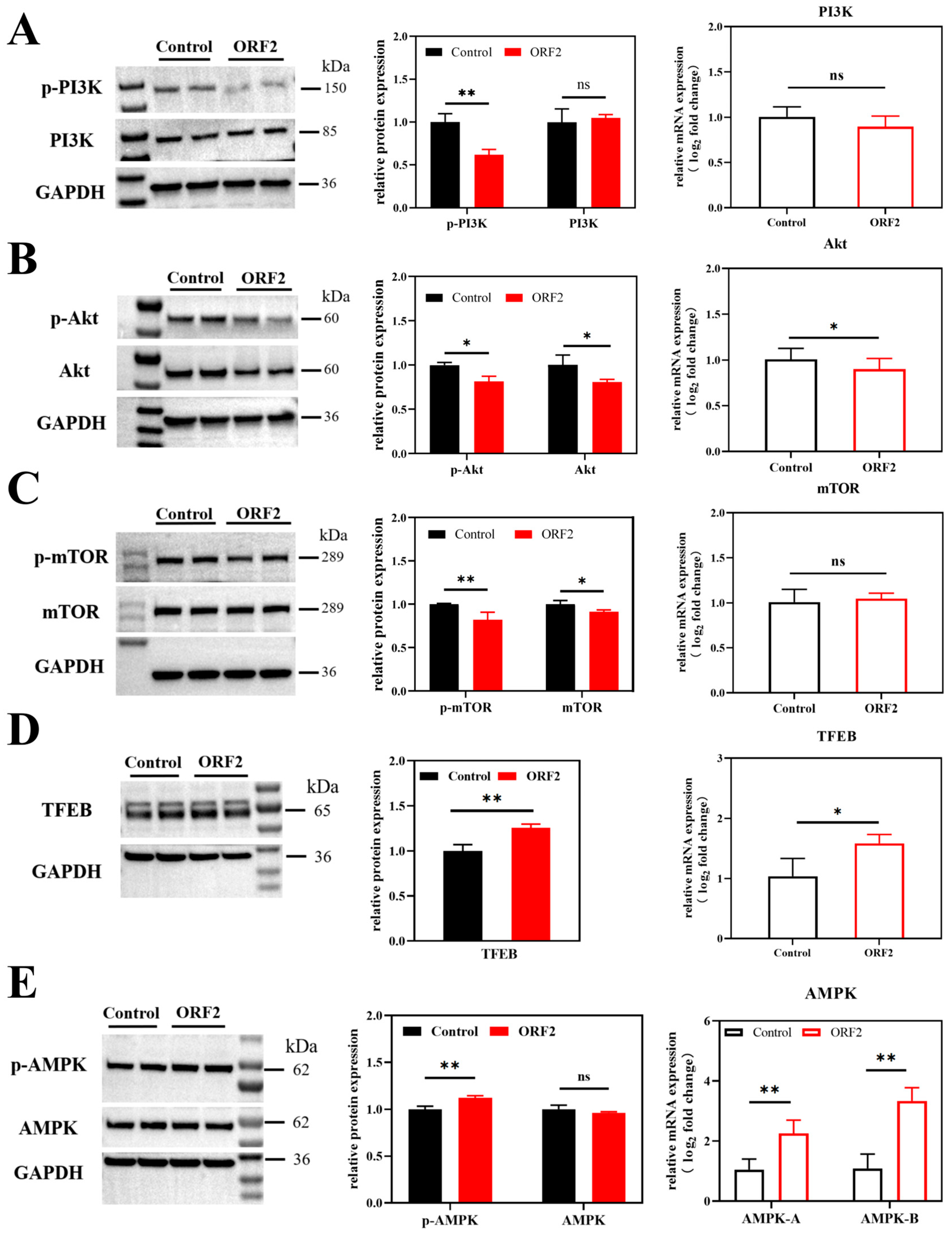
HEV significantly inhibits autophagy initiation and progression in JEG-3 cells. Since the PI3K/Akt/mTOR signaling pathway serves as a central negative regulator of autophagy, the study investigated whether HEV ORF2 targets this upstream regulatory axis. Based on previous findings demonstrating that ORF2 markedly reduces protein levels of the autophagy marker LC3 and the initiation complex ULK1, further examination was conducted on its effects on PI3K/Akt/mTOR signaling. As presented in Figure 2A,B, ORF2 significantly suppressed phosphorylation of PI3K and Akt (p < 0.01). Downstream mTOR and phospho-mTOR levels were consequently reduced (Figure 2C; p < 0.01), reflecting cascade inhibition of the entire pathway. Paradoxically, while PI3K/Akt/mTOR suppression typically activates autophagy initiation, ORF2-mediated inhibition of this pathway coincided with overall autophagy repression, as evidenced by reduced LC3B and accumulated p62. This apparent contradiction—where upstream signals suggest activation but downstream markers indicate suppression—hints at a blockade in the later stages of autophagic flux rather than a simple inhibition of initiation. Indeed, in our previous study using the mCherry-GFP-LC3 tandem reporter system, we directly demonstrated that HEV infection blocks autophagic flux at the degradative stage in JEG-3 cells [26]. The current finding that ORF2 binds directly to LC3B provides a mechanistic explanation for this blockade: by sequestering LC3B, ORF2 physically interferes with autophagosome formation and/or subsequent maturation, thereby overriding the pro-autophagic signals from the inhibited PI3K/Akt/mTOR and activated AMPK/TFEB pathways.
The interaction between the nuclear regulatory transcription factor EB (TFEB) and mTOR represents another core determinant of autophagy activation. Expression changes of TFEB, an mTOR-interacting protein, were therefore examined. As shown in Figure 2D, HEV ORF2 overexpression in JEG-3 cells significantly increased both transcriptional and protein levels of TFEB (p < 0.01). When considered alongside the observed inhibition of mTOR phosphorylation, these findings would typically indicate enhanced autophagic activity. However, this apparent pro-autophagic signature contrasts sharply with the strong suppression of LC3 protein in the autophagic flux, suggesting a paradoxical regulatory mechanism.

3.4. HEV ORF2 Activates AMPK to Stimulate Alternative Autophagy Pathways

AMPK, a central regulator of cellular energy metabolism, also activates autophagy through both direct and indirect mechanisms. Beyond the canonical mTOR-dependent pathway, AMPK regulates multiple alternative autophagy routes and positively modulates downstream autophagic processes. To investigate this compensatory mechanism, AMPK and phospho-AMPK expression were analyzed in JEG-3 cells overexpressing HEV ORF2. As shown in Figure 2E, ORF2 significantly upregulated both AMPK gene expression and p-AMPK protein levels (p < 0.01). This AMPK activation would typically indicate enhanced upstream autophagic signaling, yet paradoxically coincides with downstream autophagy suppression (evidenced by reduced LC3 levels).

3.5. HEV ORF2 Directly Binds LC3 to Suppress Autophagy in JEG-3 Cells

Although HEV ORF2 significantly suppresses the PI3K/Akt/mTOR signaling pathway and promotes AMPK phosphorylation—changes that would normally trigger autophagy activation—an unexpected suppression of autophagic activity was observed. These paradoxical findings suggest that the strong inhibition of LC3 protein and downregulation of ULK1 and its phosphorylated forms in ORF2-overexpressing JEG-3 cells may result from direct binding between the viral ORF2 protein and host LC3.
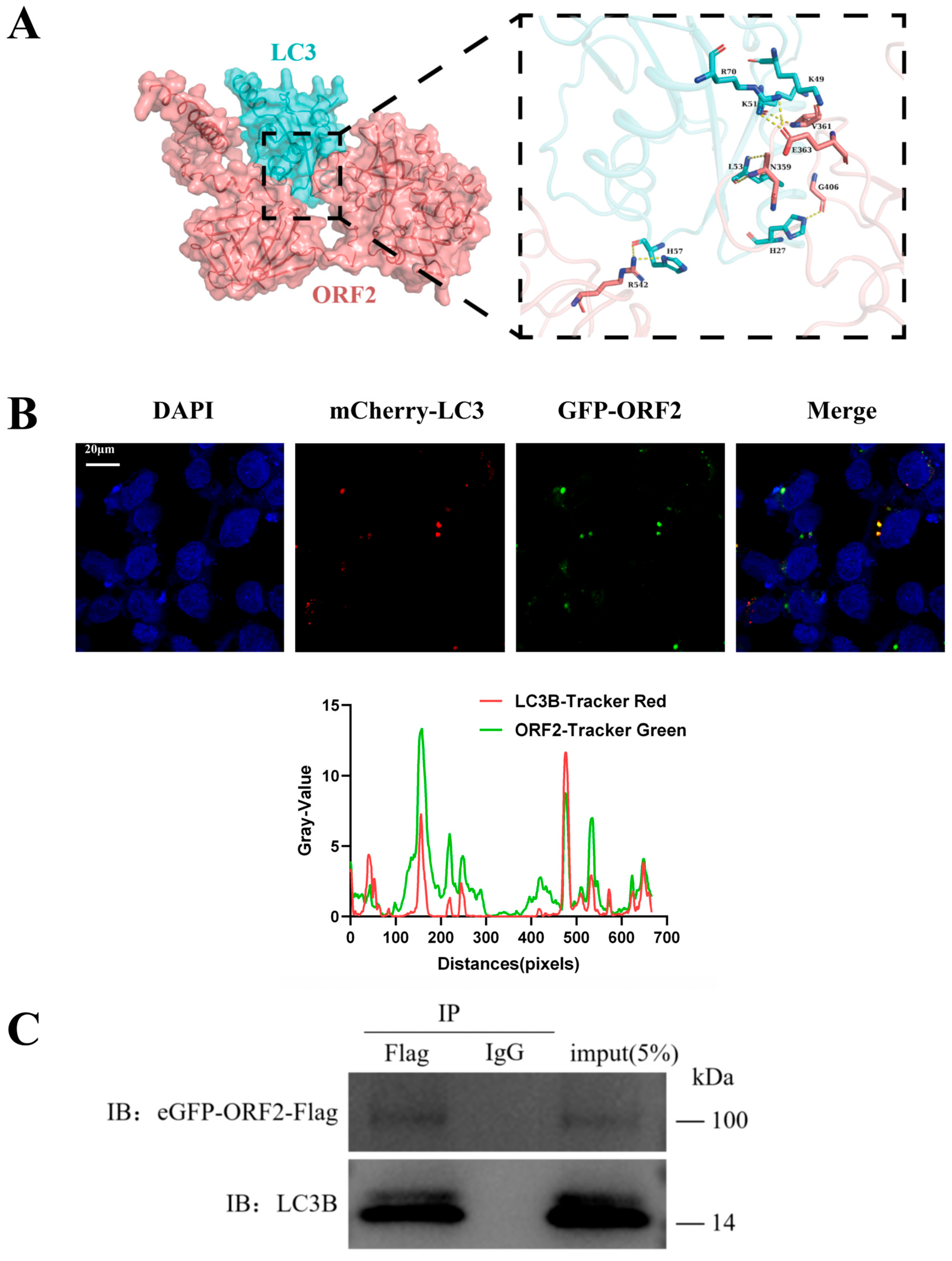
Intermolecular interaction between HEV ORF2 and LC3 proteins was predicted using AlphaFold 3. As shown in Figure 3A, the ORF2 protein could theoretically bind directly to the LC3 protein, forming hydrogen bonds for stable linkage. In the structural prediction, valine at position 361 (V361) and glutamic acid at position 363 (E363) of the ORF2 protein may form hydrogen bonds with lysine at position 51 (K51), lysine at position 49 (K49), and arginine at position 70 (R70) of the LC3 protein. Additionally, asparagine at position 359 (N359), glycine at position 406 (G406), and arginine at position 542 (R542) of the ORF2 protein may form hydrogen bonds with leucine at position 53 (L53), histidine at position 27 (H27), and histidine at position 57 (H57) of the LC3 protein, respectively.
To further verify the direct binding interaction between HEV ORF2 and LC3 proteins, a eukaryotic expression plasmid vector carrying red fluorescent signal (mcherry-LC3) was constructed and co-transfected with green fluorescent protein-tagged ORF2 and ORF3 plasmids (eGFP-ORF2/3) into JEG-3 cells. The distribution of red and green fluorescence was observed using fluorescence microscopy. Figure 3B shows that HEV ORF2 protein can co-localize with LC3 protein, with red and green fluorescence overlapping to form yellow fluorescent signals.
The interaction between HEV ORF2 protein and LC3 was validated using lysates from JEG-3 cells transfected with Flag-tagged ORF2 plasmid. The lysate supernatant was incubated with anti-Flag magnetic beads at 4 °C overnight, using IgG antibody magnetic beads as an isotype control. After thorough washing, the immunoprecipitated complexes were eluted and detected by Western blot using anti-LC3 antibody. The results showed (Figure 3C) that a clear LC3 band could be detected in the ORF2 overexpression group, while no binding signal was observed in the IgG group. In conclusion, these results demonstrate that HEV ORF2 can inhibit trophoblast cell autophagy through direct binding with LC3 protein.

4. Discussion

HEV ORF2 and ORF3 proteins were successfully overexpressed in JEG-3 cells. The results suggest that both HEV ORF2 and ORF3 proteins could significantly downregulate the expression of autophagy marker protein LC3B. Moreover, ORF2 caused a strong accumulation of p62, leading us to conclude that ORF2 is the key protein responsible for autophagy inhibition in JEG-3 cells. The previous research demonstrated that HEV inhibits all stages of autophagic flux (initiation, progression and maturation), suggesting that HEV’s mechanism of host cell autophagy inhibition targets upstream regulatory signaling pathways of autophagy. However, contrary to experimental expectations, HEV ORF2 significantly inhibited the activation of the core upstream autophagy regulatory pathway PI3K/Akt/mTOR while simultaneously upregulating both AMPK and TFEB pathways—theoretically this should, similar to other hepatitis viruses, activate downstream autophagy in cells. Ultimately, through AlphaFold 3, fluorescence co-localization experiments and Co-IP assays, it theoretically and experimentally demonstrated that HEV ORF2 can directly bind to autophagy marker protein LC3, thereby blocking the initiation and development of intracellular autophagy.
Interestingly, although ORF2 significantly inhibited PI3K/Akt/mTOR and activated the AMPK pathway, which should theoretically upregulate ULK1 expression, the experimental results are opposite [27]. The regulation of autophagy by ULK1 is intricate. The ULK1 complex consists of activated ULK1, ATG13, ATG101, and FIP200, which activates the downstream Beclin-1 complex to initiate autophagy [27]. ULK1 can be degraded via the ubiquitin–proteasome pathway, and downregulation of p32 can significantly shorten ULK1’s half-life, reducing its protein levels [28]. Additionally, excess ULK1 may form small but dense autophagosome-like structures with Atg13, Atg14, Atg16 and other proteins, failing to properly activate autophagy and instead being degraded [29]. These findings suggest that the reduction in ULK1 expression may involve ubiquitin–proteasomal degradation.
HEV ORF2 encodes the viral capsid protein, which exhibits strong immunogenicity and is relatively conserved among the four major genotypes infecting humans, making it a primary target for vaccine development [30]. Currently, the commercially available HEV-1 ORF2-based vaccine Hecolin shows relatively weaker protection against HEV-3 and HEV-4, indicating structural differences in ORF2 proteins across genotypes [31]. Furthermore, phylogenetic clustering studies based on ORF2 sequences suggest that HEV-3ra differs significantly from HEV-3 and HEV-4 and should be classified separately [32]. These differences may explain why HEV-3ra, unlike other HEV genotypes, inhibits autophagy in JEG-3 cells instead of activating it as observed in hepatocytes. Recent studies have identified two forms of ORF2 in host cells: non-glycosylated ORF2 (ORF2c), which forms the viral capsid, and secreted ORF2 (ORF2s) [33]. ORF2s is abundant in cells and mediates virus–host interactions, contributing to immune evasion, viral replication support, and other functions. It is likely the primary form that binds host LC3 protein.
LC3B is cleaved by Atg4 protease, and its C-terminus covalently binds to phosphatidylethanolamine (PE), promoting membrane extension and autophagosome maturation, serving as a key indicator of autophagy activity. LC3B interacts with multiple autophagy receptor proteins, such as p62/SQSTM1, NBR1, and OPTN (Optineurin), through the LC3-interacting region (LIR) [34]. Current research shows that some pathogen proteins can directly and competitively bind to LC3B to inhibit autophagy. For instance, the nucleocapsid protein (NP) of Hantaviruses competes with viral glycoprotein (Gn) for LC3B binding, preventing autophagosome formation [35]. Influenza A virus protein PB1-F2 may physically interact with LC3B, inhibiting LC3B-mediated autophagosome formation and thereby impairing innate immunity [36]. Additionally, the nonstructural protein 1 of Respiratory syncytial virus (RSV) can disrupt normal cellular functions by binding to LC3B [37]. In this study, we demonstrate that HEV ORF2 physically interacts with LC3B in JEG-3 cells, as evidenced by co-localization and Co-IP assays. This interaction provides a plausible mechanistic basis for the observed autophagy inhibition and identifies ORF2 as a potential therapeutic target for HEV-induced placental damage. However, while our co-localization and Co-IP data confirm a physical interaction between ORF2 and LC3B, they do not prove direct binding.
Intriguingly, structural modeling using AlphaFold 3 predicts a potential direct interaction interface, but the identified ORF2 residues (e.g., V361, E363, N359) do not conform to the canonical LIR domain characteristic of most known LC3 interactors. This suggests that if the interaction is indeed direct, it may occur through a novel, non-canonical binding mode, distinct from the LIR-dependent mechanisms employed by the aforementioned viral proteins.
Therefore, our data establish a physical association between HEV ORF2 and LC3B but leave open two key mechanistic questions: (1) whether the interaction is direct or mediated by a host factor, and (2) if direct, what structural interface is involved. Future studies employing site-directed mutagenesis of the predicted ORF2 residues combined with in vitro pull-down assays using purified proteins will be essential to resolve these points. Confirmation of a direct, non-LIR-mediated interaction would reveal an atypical strategy for viral hijacking of autophagy and could explain part of HEV’s unique pathogenic signature in trophoblasts.
In conclusion, the findings demonstrate that the binding of HEV ORF2 protein to LC3B serves as a key mechanistic target in host cell autophagy regulation. This discovery provides a theoretical foundation in autophagy research for elucidating the correlation between HEV infection and female reproductive system damage, as well as adverse pregnancy outcomes in pregnant animals/women.

5. Conclusions

In summary, this study demonstrates that HEV ORF2, but not ORF3, plays a central role in suppressing autophagy in human trophoblast cells (JEG-3) by directly binding to LC3B, thereby disrupting autophagosome formation. Although ORF2 inhibits the PI3K/Akt/mTOR pathway and activates AMPK and TFEB, the net outcome is a profound suppression of autophagic flux. This paradoxical effect is mechanistically explained by the physical interaction between ORF2 and LC3B, as supported by computational prediction, co-localization, and co-immunoprecipitation assays. These findings not only elucidate a novel viral strategy to hijack host autophagy but also provide a potential molecular target for intervening in HEV-associated pregnancy complications such as miscarriage.

Supplementary Materials

The following supporting information can be downloaded at: https://www.mdpi.com/article/10.3390/microorganisms14010181/s1, Figure S1: Determination of G418 concentration in screening drug-resistant JEG-3 cells; Figure S2: Schematic representation of two plasmid carriers; Table S1: Restriction Enzyme cutting sites and protein sequences of each plasmid; Table S2: Primer sequence for RT-qPCR amplification; WB-figures.

Author Contributions

Y.C.: Conceptualization, Data Curation, Formal Analysis, Writing—Original Draft. Y.Y.: Conceptualization, Data Curation, Formal Analysis, Methodology. Q.B.: Validation. X.T.: Formal Analysis. C.Z.: Methodology. X.L.: Funding Acquisition, Supervision. T.L.: Supervision, Project Administration, Conceptualization, Writing—Review and Editing. All authors have read and agreed to the published version of the manuscript.

Funding

This work was supported by the National Key R&D Program of China (NO. 2021YFC2301403, NO. 2024YFF0728800) and the National Key Laboratory of Intelligent Tracking and Forecasting for Infectious Diseases under Grant [Project No. 2024NITFID].

Institutional Review Board Statement

Not applicable.

Informed Consent Statement

Not applicable.

Data Availability Statement

The original contributions presented in this study are included in the article/Supplementary Materials. Further inquiries can be directed to the corresponding authors.

Conflicts of Interest

The authors declare no competing financial interest.

References

  1. Feng, Y.; Chen, Y.; Wu, X.; Chen, J.; Zhou, Q.; Liu, B.; Zhang, L.; Yi, C. Interplay of energy metabolism and autophagy. Autophagy 2024, 20, 4–14. [Google Scholar] [CrossRef]
  2. Tan, H.X.; Yang, S.L.; Li, M.Q.; Wang, H.Y. Autophagy suppression of trophoblast cells induces pregnancy loss by activating decidual NK cytotoxicity and inhibiting trophoblast invasion. Cell Commun. Signal. 2020, 18, 73. [Google Scholar] [CrossRef]
  3. Xiang, H.; Zhang, J.; Lin, C.; Zhang, L.; Liu, B.; Ouyang, L. Targeting autophagy-related protein kinases for potential therapeutic purpose. Acta Pharm. Sin. B 2020, 10, 569–581. [Google Scholar] [CrossRef]
  4. Li, M.Y.; Shen, H.H.; Cao, X.Y.; Gao, X.X.; Xu, F.Y.; Ha, S.Y.; Sun, J.S.; Liu, S.P.; Xie, F.; Li, M.Q. Targeting a mTOR/autophagy axis: A double-edged sword of rapamycin in spontaneous miscarriage. Biomed. Pharmacother. 2024, 177, 116976. [Google Scholar] [CrossRef]
  5. Lee, S.; Shin, J.; Kim, J.S.; Shin, J.; Lee, S.K.; Park, H.W. Targeting TBK1 Attenuates LPS-Induced NLRP3 Inflammasome Activation by Regulating of mTORC1 Pathways in Trophoblasts. Front. Immunol. 2021, 12, 743700. [Google Scholar] [CrossRef] [PubMed]
  6. Wang, J.; Zheng, F.; Wang, D.; Yang, Q. Regulation of ULK1 by WTAP/IGF2BP3 axis enhances mitophagy and progression in epithelial ovarian cancer. Cell Death Dis. 2024, 15, 97. [Google Scholar] [CrossRef] [PubMed]
  7. Cui, Z.; Napolitano, G.; de Araujo, M.E.G.; Esposito, A.; Monfregola, J.; Huber, L.A.; Ballabio, A.; Hurley, J.H. Structure of the lysosomal mTORC1-TFEB-Rag-Ragulator megacomplex. Nature 2023, 614, 572–579. [Google Scholar] [CrossRef]
  8. Zheng, W.; Zhang, Y.; Xu, P.; Wang, Z.; Shao, X.; Chen, C.; Cai, H.; Wang, Y.; Sun, M.A.; Deng, W.; et al. TFEB safeguards trophoblast syncytialization in humans and mice. Proc. Natl. Acad. Sci. USA 2024, 121, e2404062121. [Google Scholar] [CrossRef]
  9. Nwadike, C.; Williamson, L.E.; Gallagher, L.E.; Guan, J.L.; Chan, E.Y.W. AMPK Inhibits ULK1-Dependent Autophagosome Formation and Lysosomal Acidification via Distinct Mechanisms. Mol. Cell Biol. 2018, 38, e00023-18. [Google Scholar] [CrossRef]
  10. LeDesma, R.; Nimgaonkar, I.; Ploss, A. Hepatitis E Virus Replication. Viruses 2019, 11, 719. [Google Scholar] [CrossRef] [PubMed]
  11. Muñoz-Chimeno, M.; Cenalmor, A.; Garcia-Lugo, M.A.; Hernandez, M.; Rodriguez-Lazaro, D.; Avellon, A. Proline-Rich Hypervariable Region of Hepatitis E Virus: Arranging the Disorder. Microorganisms 2020, 8, 1417. [Google Scholar] [CrossRef]
  12. Zhou, Z.; Xie, Y.; Wu, C.; Nan, Y. The Hepatitis E Virus Open Reading Frame 2 Protein: Beyond Viral Capsid. Front. Microbiol. 2021, 12, 739124. [Google Scholar] [CrossRef]
  13. Peron, J.M.; Larrue, H.; Izopet, J.; Buti, M. The pressing need for a global HEV vaccine. J. Hepatol. 2023, 79, 876–880. [Google Scholar] [CrossRef]
  14. Gouttenoire, J.; Pollán, A.; Abrami, L.; Oechslin, N.; Mauron, J.; Matter, M.; Oppliger, J.; Szkolnicka, D.; Dao Thi, V.L.; van der Goot, F.G.; et al. Palmitoylation mediates membrane association of hepatitis E virus ORF3 protein and is required for infectious particle secretion. PLoS Pathog. 2018, 14, e1007471. [Google Scholar] [CrossRef]
  15. Ding, Q.; Heller, B.; Capuccino, J.M.V.; Song, B.; Nimgaonkar, I.; Hrebikova, G.; Contreras, J.E.; Ploss, A. Hepatitis E virus ORF3 is a functional ion channel required for release of infectious particles. Proc. Natl. Acad. Sci. USA 2017, 114, 1147–1152. [Google Scholar] [CrossRef]
  16. Van Tong, H.; Hoan, N.X.; Wang, B.; Wedemeyer, H.; Bock, C.T.; Velavan, T.P. Hepatitis E Virus Mutations: Functional and Clinical Relevance. EBioMedicine 2016, 11, 31–42. [Google Scholar] [CrossRef] [PubMed]
  17. Maltepe, E.; Fisher, S.J. Placenta: The forgotten organ. Annu. Rev. Cell Dev. Biol. 2015, 31, 523–552. [Google Scholar] [CrossRef]
  18. Turco, M.Y.; Gardner, L.; Kay, R.G.; Hamilton, R.S.; Prater, M.; Hollinshead, M.S.; McWhinnie, A.; Esposito, L.; Fernando, R.; Skelton, H.; et al. Trophoblast organoids as a model for maternal-fetal interactions during human placentation. Nature 2018, 564, 263–267. [Google Scholar] [CrossRef] [PubMed]
  19. Abbas, Y.; Turco, M.Y.; Burton, G.J.; Moffett, A. Investigation of human trophoblast invasion in vitro. Hum. Reprod. Update 2020, 26, 501–513. [Google Scholar] [CrossRef]
  20. Yang, H.L.; Lai, Z.Z.; Shi, J.W.; Zhou, W.J.; Mei, J.; Ye, J.F.; Zhang, T.; Wang, J.; Zhao, J.Y.; Li, D.J.; et al. A defective lysophosphatidic acid-autophagy axis increases miscarriage risk by restricting decidual macrophage residence. Autophagy 2022, 18, 2459–2480. [Google Scholar] [CrossRef] [PubMed]
  21. Liu, N.; Shen, H.; Wang, Z.; Qin, X.; Li, M.; Zhang, X. Autophagy Inhibition in Trophoblasts Induces Aberrant Shift in CXCR4+ Decidual NK Cell Phenotype Leading to Pregnancy Loss. J. Clin. Med. 2023, 12, 7491. [Google Scholar] [CrossRef]
  22. Mlyczyńska, E.; Kurowska, P.; Drwal, E.; Opydo-Chanek, M.; Tworzydło, W.; Kotula-Balak, M.; Rak, A. Apelin and apelin receptor in human placenta: Expression, signalling pathway and regulation of trophoblast JEG-3 and BeWo cells proliferation and cell cycle. Int. J. Mol. Med. 2020, 45, 691–702. [Google Scholar] [CrossRef]
  23. Tu, W.; Qin, M.; Li, Y.; Wu, W.; Tong, X. Metformin regulates autophagy via LGMN to inhibit choriocarcinoma. Gene 2023, 853, 147090. [Google Scholar] [CrossRef] [PubMed]
  24. Sharma, S. Autophagy-Based Diagnosis of Pregnancy Hypertension and Pre-Eclampsia. Am. J. Pathol. 2018, 188, 2457–2460. [Google Scholar] [CrossRef]
  25. Cao, B.; Macones, C.; Mysorekar, I.U. ATG16L1 governs placental infection risk and preterm birth in mice and women. JCI Insight 2016, 1, e86654. [Google Scholar] [CrossRef]
  26. Yang, Y.; Liu, B.; Tian, J.; Teng, X.; Liu, T. Vital role of autophagy flux inhibition of placental trophoblast cells in pregnancy disorders induced by HEV infection. Emerg. Microbes Infect. 2023, 12, 2276336. [Google Scholar] [CrossRef]
  27. Lee, D.H.; Park, J.S.; Lee, Y.S.; Han, J.; Lee, D.K.; Kwon, S.W.; Han, D.H.; Lee, Y.H.; Bae, S.H. SQSTM1/p62 activates NFE2L2/NRF2 via ULK1-mediated autophagic KEAP1 degradation and protects mouse liver from lipotoxicity. Autophagy 2020, 16, 1949–1973. [Google Scholar] [CrossRef] [PubMed]
  28. Jiao, H.; Su, G.Q.; Dong, W.; Zhang, L.; Xie, W.; Yao, L.M.; Chen, P.; Wang, Z.X.; Liou, Y.C.; You, H. Chaperone-like protein p32 regulates ULK1 stability and autophagy. Cell Death Differ. 2015, 22, 1812–1823. [Google Scholar] [CrossRef] [PubMed]
  29. Banerjee, C.; Mehra, D.; Song, D.; Mancebo, A.; Park, J.M.; Kim, D.H.; Puchner, E.M. ULK1 forms distinct oligomeric states and nanoscopic structures during autophagy initiation. Sci. Adv. 2023, 9, eadh4094. [Google Scholar] [CrossRef]
  30. Aslan, A.T.; Balaban, H.Y. Hepatitis E virus: Epidemiology, diagnosis, clinical manifestations, and treatment. World J. Gastroenterol. 2020, 26, 5543–5560. [Google Scholar] [CrossRef]
  31. Sayed, I.M.; Karam-Allah Ramadan, H.; Hafez, M.H.R.; Elkhawaga, A.A.; El-Mokhtar, M.A. Hepatitis E virus (HEV) open reading frame 2: Role in pathogenesis and diagnosis in HEV infections. Rev. Med. Virol. 2022, 32, e2401. [Google Scholar] [CrossRef]
  32. Khan, N.; Kakakhel, S.; Malik, A.; Nigar, K.; Akhtar, S.; Khan, A.A.; Khan, A. Genetic substructure and host-specific natural selection trend across vaccine-candidate ORF-2 capsid protein of hepatitis-E virus. J. Viral Hepat. 2024, 31, 524–534. [Google Scholar] [CrossRef]
  33. Maas, M.; Neumann-Haefelin, C. Deciphering the role of soluble ORF2 protein in virus-host interaction in HEV infection. Hepatology 2023, 78, 1692–1694. [Google Scholar] [CrossRef]
  34. Yao, Y.; Li, S.; Zhu, Y.; Xu, Y.; Hao, S.; Guo, S.; Feng, W.H. miR-204 suppresses porcine reproductive and respiratory syndrome virus (PRRSV) replication via inhibiting LC3B-mediated autophagy. Virol. Sin. 2023, 38, 690–698. [Google Scholar] [CrossRef] [PubMed]
  35. Wang, K.; Ma, H.; Liu, H.; Ye, W.; Li, Z.; Cheng, L.; Zhang, L.; Lei, Y.; Shen, L.; Zhang, F. The Glycoprotein and Nucleocapsid Protein of Hantaviruses Manipulate Autophagy Flux to Restrain Host Innate Immune Responses. Cell Rep. 2019, 27, 2075–2091.e5. [Google Scholar] [CrossRef] [PubMed]
  36. Wang, R.; Zhu, Y.; Ren, C.; Yang, S.; Tian, S.; Chen, H.; Jin, M.; Zhou, H. Influenza A virus protein PB1-F2 impairs innate immunity by inducing mitophagy. Autophagy 2021, 17, 496–511. [Google Scholar] [CrossRef] [PubMed]
  37. Cheng, J.; Wang, Y.; Yin, L.; Liang, W.; Zhang, J.; Ma, C.; Zhang, Y.; Liu, B.; Wang, J.; Zhao, W.; et al. The nonstructural protein 1 of respiratory syncytial virus hijacks host mitophagy as a novel mitophagy receptor to evade the type I IFN response in HEp-2 cells. mBio 2023, 14, e01480-23. [Google Scholar] [CrossRef]
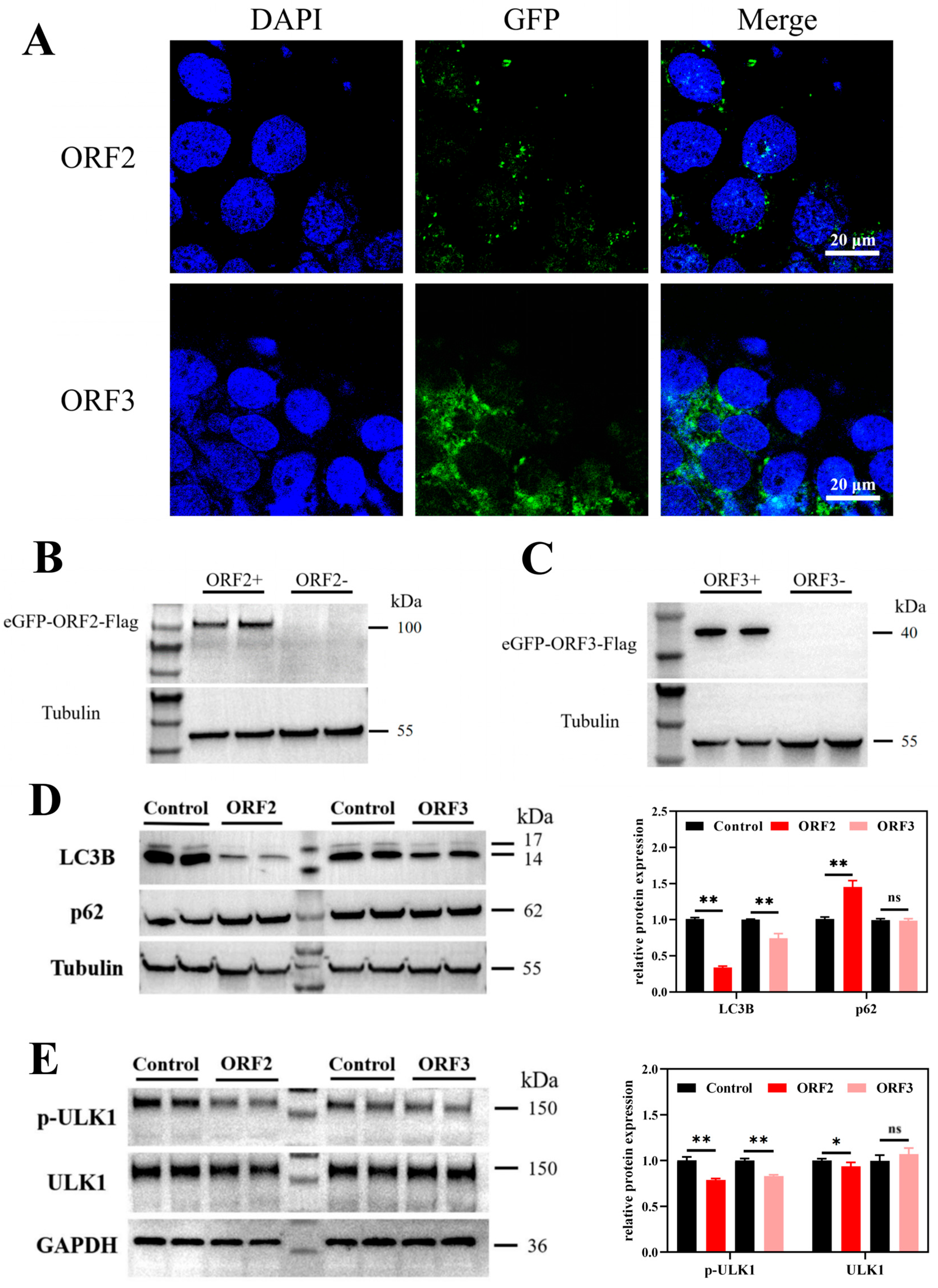
Figure 1. HEV ORF2 and ORF3 were successfully overexpressed in JEG-3 cells. Proteins and genes expression of LC3B and ULK1 in JEG-3 cells overexpressing HEV ORF2 and ORF3 (all Western blot analyses were performed 48 h post-transfection). (A) The JEG-3 cells transfected with ORF2 and ORF3 plasmids were observed under fluorescence microscope. The nucleus was stained with DAPI (blue), overexpressed ORF2 and 3 proteins were labeled with eGFP fluorescent protein signals (green). Scale bars represent 20 μm. (B) WB result of eGFP-ORF2-Flag and (C) eGFP-ORF3-Flag protein expression in JEG-3 cells (Flag antibody, 1:2000 dilution). eGFP protein is about 25 kD and the size of Flag tag protein can be negligible. Therefore, the target protein size is about 100 kD and 40 kD, respectively. (D) The expressions of LC3 and p62 protein were significantly decreased in JEG-3 cells when HEV ORF2 protein was overexpressed, exhibiting typical autophagy inhibition. When HEV ORF3 protein was overexpressed, only LC3 protein expression decreased significantly. Bars indicate mean ± SEM, n = 6. ** p < 0.01. (E) The expression of p-ULK1 (phospho-Ser757, a mTOR-dependent inhibitory site) was significantly decreased in JEG-3 cells when HEV ORF2 and ORF3 proteins were overexpressed. HEV ORF2 protein further significantly inhibited the expression of ULK1 protein. Bars indicate mean ± SEM, n = 6. * p < 0.05, ** p < 0.01. ns: not significant.
Microorganisms 14 00181 g001
Figure 2. Proteins and genes expression of PI3K/Akt/mTOR, TFEB and AMPK in JEG-3 cells overexpressing HEV ORF2 (performed 48 h post-transfection). (A) WB results and quantitative protein analysis of PI3K and p-PI3K. mRNA expression levels of PI3K. (B) WB results and quantitative protein analysis of Akt and p-Akt. mRNA expression levels of Akt. (C) WB results and quantitative protein analysis of mTOR and p-mTOR. mRNA expression levels of mTOR. (D) WB results, quantitative protein analysis and mRNA expression levels of TFEB. (E) WB results and quantitative protein analysis of AMPK and p-AMPK. mRNA expression levels of AMPK. * p < 0.05, ** p < 0.01, ns: not significant.
Microorganisms 14 00181 g002
Figure 3. HEV ORF2 combined LC3 protein to inhibit autophagy of JEG-3 cells. (A) Prediction pattern graph of ORF2 and LC3 interaction structure using Alpha fold 3. LC3 (cyan) and ORF2 protein (pinkish lotus) structures are displayed in surface form. (B) Co-IP analysis of HEV ORF2 and LC3B in JEG-3 cells. Representative confocal microscopy images of JEG-3 cells co-transfected with mCherry-LC3B (red) and eGFP-ORF2 (green) plasmids. Nuclei were stained with DAPI (blue). The merged panel shows the co-localization of ORF2 and LC3B signals (yellow). Scale bar: 20 μm. (C) Immunoprecipitation (IP) was performed using anti-Flag antibody, followed by immunoblotting with anti-LC3B antibody. The ORF2 protein specifically co-precipitated with LC3B, while no interaction was detected in the IgG isotype control. Input lanes represent 5% of total lysates used for IP.
Microorganisms 14 00181 g003
Disclaimer/Publisher’s Note: The statements, opinions and data contained in all publications are solely those of the individual author(s) and contributor(s) and not of MDPI and/or the editor(s). MDPI and/or the editor(s) disclaim responsibility for any injury to people or property resulting from any ideas, methods, instructions or products referred to in the content.